"Still in shape, my methods refined", singt Paul Banks in "Toni", dem Eröffnungsstück und der ersten Single von Interpols siebtem Album "The Other Side of Make-Believe". Mit dem diesem Album betritt die Band Neuland: Parallel zur Erkundung der düsteren Unterströmungen des Zeitgeists sind die neuen Songs von Interpol von Sehnsucht und Anmut durchzogen. Daniel Kesslers Signature- Gitarren-Sound, Samuel Fogarinos messerscharfe Percussion-Präzision und Paul Banks sonore Stimme strahlen eine Verletzlichkeit aus, die viele langjährige Fans der Band überraschen dürfte. "Es gibt immer ein siebtes Mal für einen ersten Eindruck", so Banks darüber. Die Aufnahmen zu "The Other Side of Make-Believe" begannen im Jahr 2020 aus der Ferne heraus. Anfang 2021 trafen sich Interpol erneut, um in einem angemieteten Haus in den Catskills an neuem Material zu feilen, bevor sie es später im selben Jahr in Nordlondon fertigstellten. Dabei arbeiteten sie zum ersten Mal mit der Produzentenlegende Flood (Mark Ellis) zusammen und taten sich anschließend wieder mit dem ehemaligen Co-Produzenten Alan Moulder zusammen. Der Titel von "The Other Side of Make-Believe", das Cover und der lyrische Hang zu Fabeln, Nebelkerzen und der Wandelbarkeit der Wahrheit spiegeln Banks Abscheu vor den Verwerfungen des Informationszeitalters wider. Das Album wird sich im Bewusstsein der Interpol-Fans bald ebenso vertraut anfühlen, wie es für die Band bei den Aufnahmen zu der Platte der Fall war. Das Trio-Noir hat fast sieben Alben und mehrere Besetzungswechsel besser überstanden, als irgendjemand hätte vorhersagen können, und sich dabei nie selbst verloren. Heutzutage sind Interpol eine der am markantesten klingenden Rockbands des 21. Jahrhunderts. Seit nun mehr einem Vierteljahrhundert verfeinern Interpol ihre Methoden, womit sich dann auch der Kreis zum ersten Song des neuen Albums wieder schließt.
Suche:method
In the late 90’s and early aughts, internet video capabilities like Real Video and Quicktime were expanding, proving the early prophecy that ‘anyone would be able to have their own television channel on the internet’ was indeed coming true. After the critical success of Mulholland Drive, director David Lynch doubled down on the medium, funneling virtually all of his time into personally animating, filming, and scoring content for his own internet destination: davidlynch.cm. It was fertile and limitless ground for a creative like Lynch, allowing him to return to the days of his experimental film roots, where it was actually possible for him to have his hands on every element of the process.
It was out of this newfound digital freedom that the early seeds of Inland Empire were born, evolving and fissuring from an internet-bound experiment itself, into something much more expansive. The film collated a variety of ideas and working methods that the recent web paradigm had nurtured in Lynch, one of which was an increased frequency of his own solo music productions. Having finished constructing his own personal recording studio in 1998, he was no longer tethered to the scheduling and high premiums of rented studio time and was free to accelerate his musical experimentation without constraint. As a direct result of this was a unique shift in Lynch’s musical trajectory; a shift that would eventually bear multiple albums and a short film featuring a lounge-crooning monkey. In the first weeks of 2005, Lynch would record a blues instrumental and instead of getting someone else to sing on the song, he would sing, via a formant and pitch-altering piece of equipment known as the Boss VT-1. It was because of the davidlynch animated series “Dumbland” that the director had discovered the device that would enable him to be ‘any character he needed.’ With “Ghost of Love,” Lynch was experimenting with bringing those ‘characters’ into his own musical compositions. Intrue Lynch fashion, it’s difficult to know which inspired which: did “Ghost of Love” birth a scene in Inland Empire, or did the film’s ideas birth the song? Just as “In Heaven” had served to encapsulate Eraserhead, “Ghost of Love” managed to encapsulate Inland Empire allowing its listener to close their eyes and immediately channel the film’s images and mood onto the screen of the mind.
“Ghost of Love” is backed with “Imaginary Girl,” originally released via CD single in 2006 are now finally seeing their vinyl and digital release for the first time in celebration of Inland Empire’s 2022 theatrical re-release. Both are signature cinematic Lynchian classics that feature Lynch on guitar and vocals, accompanied by his long-time collaborator and Sacred Bones staple Dean Hurley on bass.
Das Debüt-Album von GRAVESEND "Methods of Human Disposal" nun in Swamp Green/ Black Bone Brown Splatter Vinyl!
‘Jim, I’m Still Here’ is the second album from James Righton under his own name; produced by David & Stephen Dewaele of Soulwax and released on their label DEEWEE, the album follows The Performer released in 2020. James’ musical past is well documented; as the frontman of the genre inventing Klaxons, he helped create a revolution in British music and spawned a youth subculture. ‘Jim, I’m Still Here’ is a captivating meditation on the artists experience of the pandemic as James looks to conceptualize the myriad of emotions and events into a fascinating third person narrative. One of the album tracks features Benny Andersson from Swedish pop legendary band ABBA, with whom James has been working on putting together their new live band.
"I wrote this record during the first few months of the pandemic. At the time I wasn’t intending to make any music. I’d just released ‘The Performer’ on what turned out to be the first week of lockdown. The outside world shut down and I was busy being Dad. Then. I started making notes on my phone. Just words. In moments stolen from family life I’d head downstairs to my garage studio and put the words to music. When I was happy with a song I’d send it to Dave and Stef. Demos and Pro Tools sessions were passed back and forth between my home studio and the Deewee studio in Ghent. I was nervous about their response to the music I was making. It was personal, raw: unlike anything I’d ever written before. A conversation with the outside world during these times of isolation. For the most part my life was centred on the domestic. Getting to spend so much time with my family was a blessing. Making music was my play time. Isolation opened me to memories and allowed me to dream of the future. As the outside world tried to adapt to the pandemic I was asked more and more to promote ‘The Performer’ in live stream concerts on various platforms. As the pandemic went on, demands on production increased (more camera angles, better lighting, higher quality audio recordings). It became a one man show. I’d head downstairs to my garage, put on my Gucci suit, comb my hair and become someone else. Jim. Jim the deluded rock star, living out his fantasies from the confines of his garage. A lonely stardom. And yet, Jim was part me. He made me feel like I still existed. Jim became the centre of the new album. Dave, Stef and I worked into the sessions over the following months. It was always exciting to see where they would take my initial demos. The working method and the restrictions of making music together but in separate spaces, separate countries shaped the sound and feel of the record.
I won’t make another record like this again”.James/Jim
- A1: Maria Maria
- A2: Cozinha
- A3: Pilar (Do Pila) (Do Pila)
- A4: Trabalhos (Essa Voz) (Essa Voz)
- B1: Lilia
- B2: A Chamada
- B3: Era Rei E Sou Escravo
- B4: Os Escravos De Jo
- B5: Tema Dos Deuses
- C1: Santos Catholicos X Candomble
- C2: Pai Grande
- C3: Seducao
- D1: Francisco
- D2: Maria Solidaria
- D3: De Repente Maria Sumiu
- D4: Eu Sou Uma Preta Velha Aqui Sentada No Sol
- D5: Boca A Boca
- D6: Maria Maria
Repress incoming...
Far Out Recordings proudly presents Milton Nascimento's Maria Maria. Recorded in 1974 and unreleased until almost thirty years later, the album was written as the soundtrack to a ballet which dealt with the legacy of slavery in Brazil. Raw, atmospheric and emotionally charged, Maria Maria reveals one of Brazil's greatest ever songwriters at his creative peak. Featuring an all-star cast of fellow Brazilian legends including Nana Vasconcelos, Joao Donato, Paulinho Jobim, and members of Som Imaginario, Maria Maria holds what Milton considers to be the definitive versions of some of his classic songs, including 'Os Escravos De Jó' and 'Maria Maria'.
Originally released in 2003 as a double CD package, with Milton Nascimento's 1984 follow up ballet soundtrack Ultimo Trem, Maria Maria will be available on vinyl for the very first time from December 2019, with Ultimo Trem set for vinyl release early 2020.
Milton Nascimento possesses one of the most immediately recognizable voices in Brazilian music: high and sweet and as breathtakingly sublime as that of any soul singer. It was this voice that the legendary Brazilian singer Elis Regina fell in love with back in 1964, having heard Milton perform his song 'Canção do Sal (Sultry Song)' at a private party in Sao Paulo. Ellis went on to record the song in 1967 -giving Milton his first hit in Brazil and beginning a career that has spanned over 50 years.
Born in Rio on the 26th October 1942, Milton moved with his adoptive parents at the age of 18 months to Tres Pontas, a rural town in the state of Minas Gerais, 500 miles north of Rio. He began his musical career as a young teenager, singing in a crooner style he learnt from listening to Brazilian singers and US groups such as The Platters on the radio. Hungry for more opportunities to perform, Milton moved to Belo Horizonte, the capital of Minas Gerais, at the age of twenty. By the beginning of the 60s Milton had made a name for himself both as an accomplished singer and guitarist.
Milton became part of a local network of musicians, film makers, dancers, theatre directors and writers that included the journalist and song writer Fernando Brant as well as lyricist Marcio Borges and his younger brother Lo Borges. Together these four wrote and produced what would become Milton's milestone album, 'Clube da Esquina (Club on the Corner)'. The originality of 'Club da Esquina' shaped the local scene, and it reflects the essence of 'the Nascimento Sound'. Milton's religious upbringing as an Afro-Brazilian Catholic saw him exposed to church choral music from an early age. His love of this genre of music is apparent in both his celestial falsetto and vocal choral arrangements. This collection also displays his early fascination with evocative, non-verbal, scat-style singing, spare, harmonic guitar work and local folk music, jazz and rock.
In 1976, Milton and Fernando Brant teamed up with a new contemporary dance company called Grupo Corpo, whose Argentinian choreographer Oscar Araiz, would become a collaborator with the two musicians. Together, they conceived a show based on the composite life story of the daughter of a black slave called Maria. Nascimento wrote music to Brant's lyrics and "Maria Maria" was premiered in the main theatre of the Belo Horizonte Palacio das Artes that year. "Fernando wrote the lyrics for the ballet, but there were originally no lyrics for the theme song, "Maria Maria'". Milton and Fernando worked on the lyrics together, basing them on folk stories about black women of the countryside. Adds Milton "These memories are mostly things that we witnessed – Fernando and I – rather than what we experienced ourselves.
Milton's music is impressionistic, emotional and romantic. Relying on songs without lyrics as well as evocative vocalizing and choruses, Milton experimented heavily with Afro-Brazilian percussion and taped jungle sounds. His composing method for these recordings was highly unconventional: "I wrote the music for 'Maria Maria' in a tiny Rio apartment with friends and their kids running around and having fun! I love to be in noisy places, surrounded by people", he says.
The music on 'Maria Maria' was performed by an impressive group of young musicians who are today household names in Brazilian music, including Naná Vasconcelos (percussion and effects), Toninho Horta (guitars) and Paulo Moura (sax). Several vocalist including Naná Caymmi, Fafá de Belém, Beto Guedes, and Milton himself, had hits in years to come with reworkings of these songs.
Milton says his compositions follow his visions "like a movie", and he believes that reflects his long love affair with cinema. "I only began composing because of enjoying the movies so much," he says. "I wrote my first song "Peace for the Coming Love" after seeing 'Jules et Jim' (the cult 60s French film directed by François Truffaut), with my friend Marcio Borges. We went early in the morning and watched it four or five times in a row, then went to Márcio's home and wrote the song."
The songs also include solo spoken passages set to music, clearly influenced by this style of French art cinema. On the title track, Maria's story is narrated and translated to music through the use of African Percussion, drums and metal signifying the field slave tools of the day. 'Trabalhos (Works)' runs to work rhythms and whipcracks: no words, just pain. 'Lília' documents the beating of the slave woman. After 'A Chamada (The call)' and the triumphant 'Era Rei e Sou Escravo (I was a king now I am a slave' things begin to turn and Milton employs tropical jungle cries to symbolize freedom. 'Santos Catholicos x Candomble (Catholic Saints vs Candomble)' represents the battle between African and European religions through the music of both sides. Milton's heavenly falsetto pours into 'Francisco' and 'Pai Grande (Great Father)' and the outstanding 'Eu Sou Uma Preta Velha Aqui Sentada no Sol (I'm an old black lady, sitting under the sun)' conjures images of an old woman sitting deep in the forest, her memories painted in drums, piano and voices.
"The letter X marks the spot, crosses over, literally with a cross. It’s the former, the ex-. The ex-lover known simply as “an ex”. Ex- is the latin prefix meaning “out”. Exterior, an exit. Extraordinary. Excellent. It’s exciting. Generation X. X-files. X is the unknown. X is Extreme“
Extreme is Molly Nilsson’s tenth studio album. Recorded in 2019 and throughout the 2020 global pandemic at home in Berlin, Extreme is a departure for Nilsson, an explosion of angry love. It’s an album of anthems for the jilted generation, soaked with joy and offering solace, bristling with distorted, Metal guitars and planet-sized choruses that bring light to the dark centre of the galaxy. It’s an album of the times, by the times and for the people. It’s a record about power. About how to fight it, how to take it and how to share it.
Absolute Power explodes with massive guitars, double kick beats and the instantly iconic line “It’s me versus the black hole at the centre of the galaxy.” Nilsson’s performance itself portrays absolute power in its confidence but the song is a call-to-arms, an entreaty to grasp the here and now, to take the power back. It’s Nilsson pacing the ring and we’re instantly in her corner. Earth Girls takes familiar Molly Nilsson themes - female empowerment and subverting the patriarchy - but casually throws in one of the choruses of her career. “Women have no place in this world” she sings, but it’s the world that isn’t good enough. Stadium-sized but still warmly hazy, Earth Girls has its fists in the air, glorifying in harmony, almost ecstatic in its feeling good. Nilsson’s Springsteen-level conviction and righteousness bleeds through the speaker cones, the cognitive dissonance between the song’s cadences and angry lyrics redolent of Bruce in his prime. Female empowerment isn’t always an angry energy on Extreme, however. On Fearless Like A Child, Nilsson’s anthem to the female body and women’s sovereignty of it, she croons over a mid-80s blue-eyed Soul groove. It sets a nocturnal scene as the narrator surveys her past and her surroundings. Before we’re fully submerged in a dreamlike, Steve McQueen-era Prefab Sprout poem to learning from your mistakes the song erupts into one of those lines only Molly Nilsson can get away with: “I love my womb, come inside I feel so alive” she fervently sings. Against the backdrop of ever-encroaching, conservative rulings on women’s reproductive rights in places like Texas, it’s simultaneously angry and full of love.
Every song on Extreme is a gleaming gem in a pouch of jewels. On Kids Today, Nilsson is the voice of wisdom, archly commenting on the eternal struggle between youth and authority. Wisdom infuses Sweet Smell Of Success with a transcendent love that forgives the narrator’s shortcomings and celebrates the moment, it’s a letter to the author from the author that asks “what is success” and concludes that this is it, this song, this moment. It’s a rare moment of simple reflection that is generous in its insight to Nilsson’s inner life. “Success” is a tool of power and we don’t need it… We need power tools and there are moments on Extreme where it feels like Nilsson is showing us how to find them. It's an open conversation through out Extreme. She’s a warm, comforting presence through out the album and specially on these songs of encouragement, songs perhaps sang to a younger Molly Nilsson or, really, to whomever needs to hear them. “They’ll praise your efforts, they’ll call you slurs a rebel, a master, an amateur / Merely with your own existence, you already offer your resistance.” On Avoid Heaven she’s even more direct, pleading with us to avoid concepts of purity and to embrace the glorious, ebullient, emotional mess we’re often in as a method of upending the power structures who need things to be perfect.
They Will Pay brings back the big, distorted power chords in the form of a agit-punk, pop slammer. Of course, when Molly Nilsson does punk pop we get the catchiest chorus this side of The Bangles or The Nerves. It’s rendered in an off the cuff, throwaway manner that is just perfect in its roughness. However, it’s on Pompeii that Nilsson delivers the album’s epic, emotional heartbreaker. Like 1995 on Nilsson’s album Zenith, or Days Of Dust on Twenty Twenty, the lyrics of Pompeii are heavy with a transcendent sadness, an aching poetry that cuts to the truth of the heart like the best Leonard Cohen lines, though here delivered with an uplifting, life-affirming love. It contains the most personal moments of Extreme, a song lit by the dying embers of romance. Yet it’s here where the alchemy at the base of all Nilsson’s best work is found. Turning small nuggets of personal truth into big, generous universal moments that invite everyone to cry, to love and to fight the power. In an album of jewels, it might be the shining star.
Molly Nilsson’s biggest, boldest and most vital album to date, Extreme is about power. Against the love of power and for the power of love.
BBE Music presents the first ever reissue of ‘Classifieds’, an ultra-rare, privately pressed 1985 album by Moonshine aka Monica Rypma & Friends. A naive and charming dose of dreamy DIY synth-pop interspersed with off-kilter, ambient interludes, original copies of ‘Classifieds’ are now almost impossible to dig up, but lately, thanks to the internet, the album has earned a cult following from music obsessives all over the globe. Created by aspiring songwriter and recent music-school dropout Monica Rypma, incredibly the album’s recording and production was entirely financed from sponsorship and advertising, way back in 1985. Inspired by René Van Helsdingen, the Amsterdam based composer, pianist and crowd-funding pioneer, Monica decided to sell advertising space on the album sleeve and name the album 'Classifieds', designing the cover to mimic a newspaper’s small ads layout. Written and recorded in only 5 days with René Van Helsdingen collaborator, synth wizard and multi-instrumentalist Brian Batie producing, the album was engineered by Wil Hesen at Studio Farmsound in Heelsum. With Rypma assisting, Batie composed and arranged almost all of the music on the spot, and lyrics were dreamed up by Batie, Rypma and Brian’s friend Jenny Garner. With an album full of music she could be proud of, Monica called in help from friends and family to print, fold and assemble the albums. “The original cover sleeve had three coloured bands; yellow, green or pink” says Rypma. “These were not different pressings, as most people presumed, but came from the limited budget that was left for printing. As one ink ran out, another colour was used, and this method produced the three versions.” Once copies had been distributed to the record’s advertisers and sponsors, hardly any were left. Until now, that is!
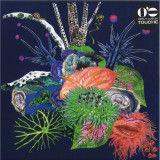
O’o share many of the musical characteristics of their ornithological namesake. The Kaua’i O’O produced the most exquisite birdsong before its extinction in Hawaii in the late 1980s. The beauty and character of its voice was delicate and mysterious, tuneful and surprising. You can experience it with just a cursory websearch, a haunting cri de coeur from the last century. If the poor O’O is consigned to history, then life is just beginning for this French duo, based in Spain, who’ve won plaudits and awards already in their short musical lifespan.
O’o are about to release their sublime debut album Touche. This is not an endling, it’s just the beginning: “I found the name on a website of weird English language words, and I loved the way the letters were arranged like a pair of glasses,” says O’o singer Victoria Suter. “Afterwards, I went onto YouTube and started listening to the last bird of its species, calling for a mate that would never come. I thought: ‘Oh my God, that’s so sad’. Then we talked about the name and we thought it could be a nice thing to honour it and keep it alive in some way.”
Suter met her musical partner Mathieu Daubigné at college in Agen, South West France, when the pair were studying music theory in their teens. Victoria moved to Barcelona in 2010; Mathieu followed six years later. Their debut EP, Spells, appeared in 2018 a beautifully crafted patchwork of vocals and samples that is redolent of the uncanny vocalese of Laurie Anderson. The bird makes an appearance at the beginning of the EP: “Sweet tooth beak. Soft melody peak / Oh O’o, go round and round in circles / Looking for a honeydrop, til you vanish, til you drop”.
That sense of profound longing for something lost is carried over to Touche, as well as the same heightened sensory awareness of the world around them. What has developed in spades is the creative process. O’o have blossomed organically, augmenting their pop sensibilities. Avant-garde techniques have been brought to heel as the pair create off-kilter pop music that warms the heart and nourishes the brain. The catalyst that enabled this bold pop transformation came with the song ‘Touche’ itself, a saucy chanson at the heart of the album. Suter’s wry narrative about a botanical femme fatale is inserted into a lithe and skittish song with reggaeton beats and an inviting, balmy atmosphere.
“The song is about a flower which attracts male insects, producing the very same smell as the female of the species,” explains Victoria. “The poor male is fooled by the sex-appeal of this botanical trap, and gets so excited that he exhausts himself and wastes all his other chances of ulterior mating and having any offspring. The flower entices the insect in in mermaid-like fashion, to come nearer and touch her. It’s the hot track!”
‘Touche’ reaches into hitherto unexplored areas of pop, while the rest of the album is accessible in the way that James Blake, Radiohead or Kate Bush are accessible, and it always challenges, in a way that pop isn’t supposed to. Suter writes playful, poignant, observational songs that tell stories as well as tell us something about ourselves. Songs like ‘Dorica Castra’ are built upon the voice as an instrument, centrifugal and layered from its core.
Complimentary to this method is Daubigné, who brings startling innovation with found sounds, samples and clever vocal manipulations—creating unique, otherworldly sonic flourishes. A guitar whirs like a musical spinning top on ‘Spin’, created in Ableton; an Ondes Martenot appears to make a guest appearance on the title track, though it’s the ingenuity of the Prophet 8 synthesiser. “I’ll often say to Mathieu, ‘what’s that?’” says Suter, He’ll reply, ‘that’s your voice’.”
O’o found their own voice when they won a competition held by the legendary festival organisers Primavera Sound. Victoria entered the band into a competition she saw on Instagram, sending off rough demos on the final day of entry, thinking little more about it other than the fact Mathieu might be annoyed. Soon they would have to build a live set from scratch and figure out how to present their music for the first time. At stake was seventy hours of recording time at Aclam studios, used by Rosalía and Kendrick Lamar, and for the winner a coveted spot at the festival. A pool of 350 acts were whittled down, and then O’o triumphed at a Battle of the Band style face off.
The O’O might be extinct, but O’o the band have learned how to fly. Just watch them go.
Alex the Fairy is an artist based in Berlin producing music with an emphasis on electronic and concrete methods. Alex the Fairy is also part of the 3Ddancer trio, a live act focusing on improvisation and expression using electronics.
Alex The Fairy writes: "I had sent The Tapeworm tracks before, but I was being difficult so was asked to send a new bunch, with a deadline. I sent the new bunch, a fairly odd collection expecting perhaps some of them to be combined with the older stuff but not seeing any coherence in them. I figured The Tapeworm would find at least something. To my surprise the suggestion that came back was exclusively the tracks I had sent the second time, and, re-listening through the tracks in this new order after returning from a Christmas dinner lying on the floor of my nephews bedroom gave them a completely new context. Despite them being quite varied in terms of age (one had been flung together a few days earlier on the train while another was approaching Schulreife) they seemed to meld together in such a way that I hardly recognised them…
Last year my grandmother died. My last grandparent. I had put off seeing her during corona, as I thought it best not to put her at risk and had almost left to visit her days before her death but had delayed my departure because of a medical appointment. My failure to her weighs heavy on my mind - fates grimacing grin: too little, too late. The approaching march of death, one generation closer was a confrontation I wasn't prepared for.
While clearing out her flat in the following weeks I had kept some of my grandfathers cassettes, live recordings of jazz greats, Pink Floyd, Sade and some classical among them, none originals, several presumably from the radio e.g. a church organ rendition of Bach. At the time I wasn't sure why I was hanging on to them, other than the urge to hoard, and that it felt wrong not at least to keep some. Half a year later, half way through mixing this cassette, suffering from my first bout of COVID, I had the insatiable urge to hook up the cassette player I had received from my grandfather after his death around nineteen years earlier and had been dragging along with me since. I stuck a cassette in only to immediately return to the safety of my covers. I began to work my way into what I had saved, hearing the fruits of my grandfathers labour decades before. It felt like quite an intimate interaction with someone I had long lost contact to/was long gone. Quite a wonderful thing, these time traveling cassettes.
I returned to the tracks to mix them shortly before my corona/cassette experience, with a new mixing console at hand. I had been looking for one for several years, but nothing had ever clicked, until I found this old broadcast desk 30 minutes from my place (it also coincided with a payment from a job the sum of which matched the price identically… fates return). Installing became a massive hassle and I doubted my decision continuously, but the further it was implemented the more it made sense. The first track I recorded with the mixer is on this cassette. Shortly before the mixing I was introduced to an Effektgerät by a friend, Rapha. Another good friend Art lent me their one, and I ended up using copious amounts of it throughout mixing, alongside my usual space creators. All the tracks on this release were mixed again on this mixer and are in a sense all a bit of a dub of the originals. I wouldn't have worked this way without the mixer, and the effect gave me a dimension I hadn't had before, so, from a technical perspective, the mixer and this effect define this release, giving it a coherence, at least for me. Emotionally of course the chaos and turbulence of the preceding year and my newfound appreciation for the medium give it a meaning I will struggle to formulate." – Alex The Fairy, Berlin, 9 May 2022
- A1: Kurrytee (Midi_2_Cv)
- A2: Smit
- A3: Day Aft8R (The_Greyz)
- B1: Poly_Ana Summers (Schoolyard Surph Beat)
- B2: Carniblurr.lane 6
- B3: Mixolydian Transition 18
- C1: Kurzweil Dame
- C2: Bouhed Trot
- C3: (Take1)
- D1: Triangulate Dither (Night More Sleepy Version)
- D2: Frikandel (The End Bit)
- D3: Yamaha Hills (Edit)
- D4: Late Ither (Ma8Ema8Mati7S Afsxissor Nap Version)
Repress
Brainwaltzera's debut LP 'Poly-ana' follows quickly on the heels of the producer's Aescoba EP - also released this year via FILM. Across thirteen tracks of both previously released material and fresh excursions into the artist's world, Brainwaltzera explores sounds ranging from luscious, downtempo grooves and expertly reduced braindance cuts with nods to early 90's experimental IDM to harder, more caustic outings - all bound together by a recurring theme of otherworldly ambience. Taking its name from a variety of sources dear to the artist, including polyphonic analogue synthesizers and the Pol-lyanna Principle itself - a theory that suggests individuals recall pleasurable experience more acutely than displeasing ones - the title represents a meeting point in the artistic process between creative method and conceptual choices. Production techniques range from more traditional hardware synthesis to the incorporation of a modified dot matrix printer acting as a modulation source for MIDI parameters. Sample sources include VHS material from the produ-cer's own childhood and ambient Bullet Train samples from an on-the-fly production session traveling from Tokyo to Kyoto. According to the enigmatic producer, memory and its fundamental role in the human experience is one of the central themes of the record. While the artist's own experiences shaped the sound of the record, there is no attempt to impose them on the listener through blatant exposition.
Die Occult Metal Band THE HERETIC ORDER THE HERETIC ORDER präsentieren mit "III" ihr drittes Album, auf dem wütende Gitarren und donnernde Drums eine Reihe schneller, fieser und harter Songs ankündigen, die dennoch bösartiges Gift in das Bewusstsein des Hörers träufeln.
"III" befasst sich mit unzähligen Themen, sowohl modernen als auch alten Themen.
Von aktuellen Übeln wie Weltverschmutzung, Krankheiten, menschlicher Gier und der Korruption der Religion, den Illuminaten und der Verbindung von Geheimgesellschaften mit außerirdischem Leben bis hin zu historischen Geschichten aus den finsteren Kapiteln der Menschheit - wie dem Völkermord an den Katharern, den Hinrichtungen im Tower von London und den Menschenopfern der Maya - nichts entgeht dem Blick des kranken Geistes von Dominus Ragnar...
Als Gastmusiker sind Jeremy Gomez (Red Method) und Ays Kura (Die Kur) auf dem Album vertreten.
Mach dich sich darauf gefasst, dass deine Alpträume zurückkehren werden.
Harrison Whitford, LA-based multi-instrumentalist, producer and songwriter, announces his new album Afraid Of Nothing, released via Screwdriver Records, building on his previous work, his delicate vocals and signature guitar tones being joined by lush layers of instrumentation. It's both emotionally devastating and sonically impressive, an immersive record that warmly embraces the listener. He has spent the last several years lending his warm, expressive guitar skills to Phoebe Bridgers (who lends backing vocals to select tracks on the album) and even when her music started being noticed, Harrison still felt the urge to flex that creative muscle. A departure from his previous method of writing and recording quickly, Afraid of Nothing is an album that has benefitted from the time afforded to Harrison from being able to truly focus. “Recording Afraid of Nothing taught me an important lesson: don't stop until you're happy with it,” Harrison says. Recording was seen as a constantly evolving process, every single kink ironed out until he was sure every track was how he envisaged it.
The latest offering from French shape-shifter Maxime Primault (High Wolf, Black Zone Myth Chant, etc.) is both a distillation and deepening of psychedelic soundsystem strategies honed across a decade plus of production and performance, in crisscrossing trenches of vibrational exploration. The four cuts comprising IN D EV IL were born of bass and syrup, designed as anthems for baser desires: “I just wanted to make bangers really.” Alien squelches and insectoid chatter pulse above thick swells of low end, intercut with sirens, screwed voices, and seasick wobble, alternately pummeling and prismatic. Masterfully disorienting, flickering with FX, drops, and narcotic murmuring, at the threshold of dissociative and dubstep.
Recent years spent performing in clubs influenced Primault’s listening habits, both in taste and production methods, skewing towards a starker contrast of highs and lows. IN D EV IL encapsulates this evolution, hallucinatory but urgent, like DJ tools for an underworld afterhours: tight, tripped, and lightless. The EP’s tracks vary in energy and density but share Primault’s premise of “tunes that sound fat and heavy.” Club music as dimensional gateway, booming and liminal, rippling with tremors, texture, and undertow. Whether deployed in public or private, these designs manifest vividly altered states, testament to their creator’s omnivorous vision of rhythm and sound.
Gilmer’s first release came out in 2015, called ‘Brain Poacher’ on Lobster Theremin. Showcasing a production style taht lands between Ancient Methods, Sandwell district and a more rugged version of the live-orientated Karen Sound. Keeping the Rhythms and grooves undulating under booted foot. The next year after the nuclear arms test that was the ‘Brain Poacher’, Gilmer returns to the lobster family via Lucid, Murky sub-label Mörk with his second record called ‘Lost Tapes’. Taking a much more languid and contemplative approach to his follow up. ‘Lost Tapes’ finds itself washed ashore on waves of warm, translucent, salt-infused techno and house giving his next release the opportunity to make his debut in Turbo Recordings with a foour track EP called ‘Baker Shit Ton’. After releasing on Lobster Theremin and Turbo, Gilmer Galibard launches his own imprint ‘Gilmer Galibard Records’. This project is a pure expression of his personal experiences and stories through music and visual art using each release as a timeline of his life. The concept of the label is also to explore boundaries of introspective musical experiences, taking sound design as a way to connect with his body and soul. These tracks were written in a period of uncertainty and a s big change in Gilmer, seeking powerful change in his life and his music. Inspired by Austin Osman Spare and his book ‘Book of Pleasure’ Gilmer gave birth to Novaturient, to honour that important moment of his life. Novaturient (Rainforest Spiritual DUB) is the first track of GIL01 and delivers almost over 7 minutes worth of deep harmonics and metallic textures, manifesting Gilmer’s own sound design. Even though the core ideology remains correlative. B-Sides Komorebi (Getwaway To The Sun Mix) creates its own identity by venturing into a deep industrial techno with drops of light and hope accompanied by an organic percussion through the track. All tracks produced written and Mixed by Gilmer Galibard
- A1: Seventh Mirror
- A2: Ionization
- A3: Cloud Chamber
- A4: Harmonic Oscillator
- A5: Transfiguration
- A6: Urzeit
- A7: Cybernetic Dreams
- B1: Interference
- B2: Computer Garden
- B3: Pyramid
- B4: Halide Crystals
- B5: Integratron
- B6: Imaginary Forces
- B7: Phantom Lfo
- B8: Opticks
- C1: Mannequin
- C2: Mind In Light
- C3: Palantir
- C4: Vertigo Of Flaws
- C5: Exit Syndrome
- C6: Stasi
- D1: Atomic Voyage
- D2: Ultraviolet
- D3: Violence Cascades
- D4: Traumsprache
- D5: Zeitgeber
- D6: Prism
- D7: Threnody
- D8: Mind Oscillation
Trees Speak are back!
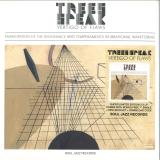
Speak’s new album, “Vertigo of Flaws: Emancipation of the Dissonance and Temperaments in
Irrational Waveforms” comes as a double-vinyl edition, single CD and digital release. The limitededition first pressing only of the vinyl includes a bonus 45 enclosed in an 8-page 7”x7” booklet
insert housed within the gatefold sleeve with cover artwork created by Soviet Union propaganda
artist Lazar Markovich Lissitzky in 1911.
Trees Speak are back!
This new release is a vast leap into an ocean of space and sound, a quantum leap into cybernetics, biology, anti-gravity,
time travel, dream speech and transfiguration. A seriously next step release!
Showing no signs of slowing down their rapid creative pace – incredibly this is their fourth album in the space of just over
one year – ‘Vertigo of Flaws’ is a mighty 29 tracks, one and a half hours of music across one double album that is surely
going to be a defining point in their musical career, a giant leap into the sonic unknown, an epic exploration of intensity
and sound.
Alongside their now trademark German krautrock motoric-beat rhythms, angular New York post-punk attitude, tripped-out
60s spy soundtrack, psyche-rock, and 70s synthesizers and vocoders, here you will also hear a new cosmic spacial
awareness (both personal inner space and galactic outer space) and a truly wilful pushing of sonic boundaries - as police
sirens, static noise, alarms, radio signals, avant-garde voices, and orchestral string quartets, all collide to add beautiful
dissonance to uber-powerful, intense, addictive and propulsive rhythms - in the process creating a truly unique
soundscape that Trees Speak have made wholly their own.
If you ever wanted to hear Can, Hawkwind, Destroy All Monsters, Pere Ubu, electric eels, John Cage, Liquid Liquid,
Tangerine Dream, Suicide, Neu!, Laurie Spiegel, Art Ensemble of Chicago, John Barry, Mother Mallard’s Portable
Masterpiece Company, Sun Ra, Stockhausen, John Carpenter, Electro-Acoustic and Musique Concrete and Mars in one
band - then this is it!
Trees Speak are Daniel Martin Diaz and Damian Diaz from Tucson, Arizona and their music often draws on the cosmic nighttime magic of Arizona’s natural desert landscapes. ‘Trees Speak’ relates to the idea of future technologies storing
information and data in trees and plants - using them as hard drives - and the idea that Trees communicate collectively.
Special guests from the hyper-creative hub of the Tucson music scene on this release are Gabriel Sullivan, Ben Nisbet, Saul
Millan, Stephani Guilmette, and Davis Jones.
The album Vertigo of Flaws was recorded in Brooklyn, New York, and Tucson, Arizona during the plague of 2021.
Extract from Vertigo of Flaws sleevenotes:
‘As we travel through space and time, avoiding the discarded remains of the industrial period, the
deconstruction of social norms through the expression of art, music, and philosophy guide the human
experience towards the unknown.
All that remains are musical echoes scattered throughout the universe, like ancient vibrations that now
populate the cosmos. These waves now show signs of decay. Melody, beauty, tonality have all but fallen
away as dissonance blossoms. As John Cage wrote in 1937,
“Whereas, in the past, the point of disagreement has been between dissonance and consonance, it will be,
in the immediate future, between noise and so-called musical sounds. New methods will be discovered,
bearing a definite relation to Schoenberg’s twelve-tone system and present methods of writing percussion
music and any other methods which are
free from the concept of a fundamental tone”.
Similarly, George Van Tassel claimed the Integratron as capable of
rejuvenation, anti-gravity, and time travel. So, what remains of the
“people”? We have adopted from them our own Zeitgeber: their pulses
now guide our sun, our planets, our earths, and are the new circadian,
diurnal, and ultradian rhythms of the galaxy. Traumsprache, dream
speech, is now the internal language of trees.
Decaying metal and machines liberated the note unto nature’s table,
and we sip the delicious nectar of music once more irrational, elaborate,
violent, vast. The past is the future, musical disintegration its own rebirth.
We are nature, once more the computer of the Universe.’
Recorded back in 1999, 'Half a Dove in New York, Half a Dove in Buenos Aires' is the recorded debut of a NetCast improv between deep listening pioneer Pauline Oliveros and Argentinian free music trio Reynols >> a fascinating early example of the internet’s capacity to foster remote creativity in-the-moment that deploys the slowest electronics, accordion, voice, trombone and computer sounds on a next level ritual drone incantation recorded in another era, but made for our time.
As the story goes, Oliveros first met Reynols in the mid ‘90s at a Deep Listening workshop she held in their home city, Buenos Aires, where they impressed her with an improvised brass serenade. Years later, in 1999, they met again via NetCast - a series of very early online live improvisations - to explore the Internet’s potential for collaborations between artists thousands of miles apart. Finally mixed down in 2021 and mastered by Helge Sten (aka Deathprod) after marinating in the archive for 22 years, the album resonates with the late, great Oliveros’ legendary work in exploring alternate tunings, spatial dynamics and methods of intuitive performance - a remarkable slab of omnidirectional drone bearing traces of Miguel Tomasin's vox and Oliveros’ just-intoned accordion embedded in its cosmic roil.
Broadcasting from fabled record shop The Thing in NYC, with Oliveros (Accordion) joined by Jennifer McCoy (ICR), Kevin McCoy (Computer processing), and Monique Buzzarté (Trombone), and Reynols revolving Miguel Tomasin (Electronics, subliminal voice & Alclorse drums), Rob Conlazo electronics, leather gloves & e-gtr), and Anla Courtis (electronics, rubber foot & e-gtr) and dialling-in from Florida 943 in Buenos Aires, the results are an incredibly absorbing and consistently surprising testament to vanguard, experimental spirits prizing the internet’s nascent, unprecedented ability to connect minds and art across continents, language barriers, and modalities.
The album's first side, titled 'Micro Macro Wind Dance', puts Oliveros' accordion under a microscope, enhancing it with lower case rumble and noise from Reynolds' arsenal. Shifting glacially over 22-minutes, Oliveros plays subtly and slowly at first, letting the accordion breathe in-and-out like a sleeping mythical beast, before she transitions to fluttering bird-like phrases by the end of the side.
'Astral Netcast Pigeon' expands the dissonant drones to widescreen, submerging Oliveros' trills and drones beneath layers of dirt and grit. It's time-altering music that dissasembles yr head before you've completely worked out what's happening >> basically the perfect mid-point between Oliveros' deep listening practices and Reynols' wildly inspirational free-noise-drone freakouts.
Fractal head rearrangement from Keith Fullerton Whitman on his first vinyl release in what feels like years, here blessing Japan’s NAKID label with a new instalment in his forever-evolving Generators project, arcing from bleeping post-Kosmische sounds into completely unexpected drum mutations in footwork and grime modes. It’s properly head melting gear that links the algorithmic mind-fukkery of Laurie Spiegel with the floor-bending rhythmic experimentation of Mark Fell, Rian Treanor or Jana Rush, and the first in a three part series that offers some of the strongest gear we’ve heard from one of the very best in the game.
Modular synth scientist, critic and historian Keith Fullerton Whitman first debuted his »Generators« set in 2009, using a modular setup to create non-repeating melodic patterns that basically came close to generating themselves. Over the course of hundreds of live shows (and a handful of releases on Root Strata, Editions Mego and other labels), Whitman glacially honed his process and allowed the concept to slither down different avenues, mutating as it picked energy from the various venues it was situated in. His rigorous method meant ‘Generators’ was never played out the same way twice, veering from psychedelic Kosmische experimentation to obliterated, off-grid Techno.
In 2019, on the tenth anniversary of the project, Whitman was invited by the GRM in Paris to set up in Studio C, where he avoided the arsenal of pristine, museum-worthy modular synthesizers and instead reprogrammed his classic ‘Generators’ patch. Recorded in a single take using luxe analog- to-digital convertors, the result is a 45-minute durational piece, split into two distinct sides for this release.“Very little manual interaction happened,” Whitman explains. The music is, as its title suggests, generative, and at this point basically sounds as if it reached its most advanced, final form. The first few minutes of the opening side mine the original theme, with clocked LFO shapes triggering oscillator blips in mind-expanding non-looping patterns. Soon, percussion enters the matrix, at first wrong-footing us with a 4/4 fake-out - possibly nodding to the piece’s 2010 Root Strata iteration - before splitting into staccato polyrhythmic abstractions of the most loose- limbed and deadly variety.
General MIDI drums can sound almost hilariously boxed-in, but handled by Whitman they show off a plastic cultural sheen to piercing effect, deployed in a way that re-draws the rhythmic bass music of someone like Jlin while nodding to Mark Fell and Rian Treanor’s quasi-generative dance explorations. These comparisons take on even more weight on the second side, where Whitman opens up his filters to allow the synth bleeps to sing even more loudly, introducing that all- important clap/hat interplay that dialogues with Atlanta and Chicago simultaneously.
"The focus of this project and presentation examines the art of mental persuasion and how the mind can control as well as fall vulnerable to subservient ways. It allows the means to look creatively and more in-depth to a subject that applies to every person and at every stage of life because how we perceive or sense something is part of our evolutionary survival pattern. " -Jeff Mills
Mind Power Mind Control
The focus of this project and presentation examines the art of mental persuasion and how the mind can control as well as fall vulnerable to subservient ways. It allows the means to look creatively and more in-depth to a subject that applies to every person and at every stage of life because how we perceive or sense something is part of our evolutionary survival pattern. Because there is no exact mental compatibility between any of us, speculation and misconceptions are not exemplary so, an emphasis on "the presentation of facts, ideas and methods and what we knew as true by example" are the major points that drives the overall purpose of this album project.
Mainly artistic but scientifically as well, the album will explore various techniques used to control minds, physicality of people and inanimate objects. The objective of this project is to examine, reveal and demonstrate how humans have created metaphysical and mind-bending techniques to control people, they're minds, societies and our outlook on reality and life.
-Jeff Mills