Aus großen Melodien und strapazierfähigen elektronischen Teppichen gestrickt, ist "Love What Survives" gewissermaßen die Essenz ihres bisherigen Schaffens, indem verschiedene Gesangsgäste und Musikerpersönlichkeiten (James Blake, Micachu, King Krule) hinzukommen, um gemeinsam zu experimentieren, Formen neu zu denken, Dinge auszuradieren, mit Pop-Überlieferungen zu spielen, alles zusammen wachsen zu lassen. Die neuen Tracks enstanden größtenteils auf zwei Vintage-Synthesizern (Korg MS-20, Korg Delta), die beide, so die Band, diese "punkige, schloddrige Qualität hätten, die an Robert Wyatt erinnert", die mit ihrem Industrial-Einschlag und dem unverkennbar direkten Sound Mount Kimbie zu ihrem neuesten Sound-Update bewegen sollten. Der pulsierende Motorik-Beat der Single "Blue Train Lines" zum Beispiel schickt King Krule direkt auf die Überholspur, von wo aus er seine zerklüfteten Vokalsalven abgeben kann. Die offene, ausladende Aura der Platte ist ferner der Tatsache geschuldet, dass sie zwischen London und Los Angeles entstanden ist, zwei Standorten, zwischen denen das Duo pendelte, um gemeinsame Sessions zu veranstalten und Ideen zu verfeinern.
Search:mic line
Repressed !
The Argentinian team brings the power of their knowledge back to our imprint with this split EP, a six track musical journey from drones to heavy kicks, with a bunch of intelligent techno in the middle.
The release starts with Jonas Kopp's "Grey Area", a floating intro exploring the deepest frequencies in the sound spectrum. Next comes "Intelligent seeker", with grooved synth toms, sharp hats and a naive oscillating sequence that runs free in the arrangement. Profound and aggressive at the same time.
The following number is "Akut": dry kick, reverberated and panned continuous sequences, spiced with classic 909 workout.
Pfirter provides his intro with "Another Dimension", a dreamy ambient piece to warm up for what comes next: "Euritmia". Based on distorted kicks and sequences, "Euritmia" creates an obsessive rhythm that grows alongside the white noise washes during the whole track.
Closing the release is "Rising", which starts with a cleaner beat approach, and once again works with white noises and modular lines to create tension and expectation. Micro percussions run along the groove, nicely adding spice to the hypnosis.
Dark Entries present the sophomore album from Austin, Texas analogue hardware enthusiast Bill Converse. Immersed in the early days of the 90s midwest rave scene, Bill began DJing at a young age in Lansing, Michigan. Luminaries such as Claude Young, Traxx, and Derrick May were key early influences. Techno, noise, ambient and tape processing are all part of his uncanny sound palette. His debut album 'Meditations/Industry' was released on cassette in 2013 and edited for a vinyl release in January 2016 followed by two 12' singles 'Warehouse Invocation' and '7 of 9' the same year.
'The Shape Of Things To Come' is a 70 minute journey spread across two pieces of vinyl. It's comprised of seven tracks recorded directly to tape with no overdubs, made at Converse's home studio. At the time of recording, Bill was sending this material to Josh Vance (Josua Dorje Ngodup) for feedback. Most of the time Josh would respond in the form of artwork, and then Bill would create another track inspired by this feedback chain. Converse has dedicated this series of tracks to him. The songs on this album reveal a sublime influence from Detroit techno, early Chicago house, and Acid. For this album Converse slightly bumped up the tempos geared for dancefloor energy. Built around vintage synthesizer lines and gritty drum machine percussion, the tracks evoke how things have changed and how they have come to be.'
All songs were mastered for vinyl by George Horn at Fantasy Studios in Berkeley. Each LP is housed in a gatefold jacket with a painted photograph portrait by Dietmar Busse and layout design by Eloise Leigh. The gatefold conceals an otherworldly collage made by Josua Dorje Ngodup. Each copy includes a postcard featuring artwork from Bill's sister with notes.
Repress!
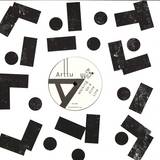
Berlin based Arttu has been dropping his dusty fat beats across numerous techno labels including Philpot, Clone and 4Lux for a few years but it was 2016's track 'Hoodies' on Arttu's own imprint Cyblo that caught the attention of Accidental label boss Matthew Herbert (and which remains firmly in Herbert's record bag). Arttu was invited onto the Accidental Jnr roster and has delivered a chunk of techno with so much swing it made Donkey Kong blush.
Arttu takes the most simple of jazz bass hooks and loops across a rigid kick, it's when those hats kick in that the groove goes fucking wild. The presence of US native Roberto Q Ingram on vocals brings a full Detroit gangster flavour to the party. Initially Arttu and Roberto had an idea to record a simple and sweaty track with Roberto on the mic and Arttu at the control of some dusty old machines. The result, 'Bass Trakk' is exactly that: Roberto dropping lyrics over a raw beat and a massive bassline. The EP is rounded off with a deep bit of techno 'Debris' with all the trappings of the darkest hour of a Berlin winter in which it was recorded.
It s time for Lewis Fautzi to introduce his first album on Pole Group, a collection of ten tracks of cosmic techno, carefully crafted making a soundtrack of the future, deep, intense and scientific.
Psycho path is the intro, made of granular textures, subtle drones and ambiences, stepping into Entering, pulsating sub bass, continuous sinoidal sequences, pads and tension.
Subconscious starts with the beat, opaque bass drum, micro hi hats, atmospheres and monotonous sequences at a low bpm rate while Diffracted speeds the tempo a bit with electric synths, flanges and twists creating an hypnotic number. Rentless pain follows, with resonant bleeps starring until assymetrical sequences appear and the synth lines evolve in a hi pass filter galore.
Seasick is humid and liquid, gummy sounds, clean drum programming, spaced out sounds and a lot of room. Then we come into Furrow, aimed to the intelligent dancefloors out there, synthetic bubbles, rolling sub woofer action , bleeps and noises. Cyclic Human reminds to the best scifi techno with bell like sequences, digital clicks, jazz harmonies and abstract progression.
Number nine is Optic Chiasm a direct number based on an obscure drum workout and filled with hi pitched relentless sequences, intelligently arranged to create a mental feeling as well as inducing to dance. Album closes with The Brain Revolution, like an evolution of Entering, beatless but still preserving the tension and the movement.
A coherent and complete collection of precise, surgical and futuristic music to be enjoyed as a whole adventure..
Brian Kage returns on Michigander with the, 'Best Kept Secret EP.' Kage once again provides three deeply emotional dance tracks filled with his signature warmth that immediately draw connections between personal memories and Michigan's natural splendor. Best Kept Secret starts the record off with tones of hypnotic bells that cascade down from within minor chords that hypnotize the listener until they are met with swelling strings to tie the infectious grooves to intelligent vintage percussion. Lush vocals continue building into an atmosphere of nostalgia and eventually gives way to that moment of intimacy that can only be felt outdoors while exploring with a person they love. Lost on Old Free-soil Road features a detuned analog synth-line that winds up and down over a bed of spooky night-time forest field-recordings which are encompassed by a jackin' 909 beat . Suddenly, juno stabs straight from the 80's pierce through sending the syncopated grooves back the direction they came from taking dancers along for the joyful ride. Cruise Control on US-31 rounds out the record with an infectious blend of pitched wooden toms, warm mid-range bass, deep 303 lines, and a smoky pad straight from a vintage rhodes. All these elements help keep the composition positive & relaxing, while expertly conjuring the feeling of sun on your face. This tune is the perfect tool for any DJ interested in luring day-partiers to a space where they can't resist bobbing their heads and enjoying their summer outside.
- Whole Lotta Shakin' Goin' On
- Milkshake Mademoiselle
- Wild One (Real Wild Child)
- Lovin' Up A Storm
- Breathless
- Great Balls Of Fire
- Hand Me Down My Walking Cane
- Down The Line
- End Of The Road
- Big Blon' Baby
When Jerry Lee Lewis walks on-stage, he provokes uproar just by standing still... And from the moment he hits the keyboard, hands raking and floating around the mic stand, hair flying, he leaves no one in any doubt about who gives the greatest live show on earth.
One of the few serious contenders to Elvis Presley's title of the King of Rock 'n' Roll, Lewis made his finest recordings during his early years with Sun Records. Whilst there he recorded prolifically, encompassing the diverse musical styles, including: country, gospel, blues, hillbilly and R&B, genres which he had grown up listening to.
This new LP highlights the cream of Lewis' peerless recordings made for Sun Records, when he was at his creative peak and includes: 'Great Balls Of Fire', 'Whole Lotta Shakin' Going On', and 'Wild One (Real Wild Child)'.
The Sun Rockabilly Legends Series is produced by Sun Entertainment Corporation president John A. Singleton and Charly Records founder Jean-Luc Young.
'The Killer' changed the face of both Rock 'n' Roll and Country Music.' - Clive Anderson
The seminal 1994 double album by the original PAINKILLER line-up BILL LASWELL, JOHN ZORN and MICK HARRIS on vinyl for the first time! Avant-jazz, grindcore, dub and ambient melt into eerie tracks of haunting atmospheres.
When PAINKILLER started in 1991, their first two albums "Guts Of A Virgin" and "Buried Secrets" (both released on extreme metal label Earache) were heavy attacks blending grindcore and free jazz that brought together the musical backgrounds of the three protagonists: drummer MICK HARRIS had just left grindcore legend NAPALM DEATH, JOHN ZORN explored new extremities with his NAKED CITY project while BILL LASWELL had as a member of roaring free jazz quartet LAST EXIT ( PETER BRÖTZMANN / SONNY SHARROCK / RONALD SHANNON JACKSON) proven that he was not only a visionary producer but also an accomplished bassist. But it is their 1994 double album "Execution Ground" that remains the opus magnum of the brilliant trio: ZORN's unmistakable shrieking saxophone, HARRIS' pounding drums and LASWELL's growling sub-bass lines were given heavy mixing desk treatment, resulting in extended tracks that are no less intense than their early works but display the full range of the musicians' skills. Soaked with reverb and delay, avant-jazz, grindcore, dub and ambient melt into eerie tracks of haunting atmospheres - even more so in the ambient versions of disc 2. Mastered and cut by RASHAD BECKER at D&M Berlin, "Execution Ground" is now available on vinyl for the very first time as 2x 180gr LP incl. a download code and insert in a limited edition of 500 items.
Ark & Pit Spector continue their inspired journey with an extended EP full of groovy jams and absorbing rhythms for Hold Youth. The Frenchmen have formed a potent alliance with a series of expertly-crafted, high-quality releases dropping over the last couple of years. On this new EP they go deeper into their sound explorations with five original works and a remix from their Parisian buddy and Hold Youth member, Le Loup. First up, we go into bumping jazzy territory with 'Chauffage Central', a mesmerising cut with swirling pads, soulful vocal clips and a jaunty b-line. Straight up after that, Hold Youth rudeboy Le Loup gives 'Chauffage Central' a funky little rework, throwing live sounding percussion, Nubian vocal clips, trumpet parps and a pumping bassline into the mix which gives a totally different identity. The final track on side A, is a cheeky teaser called 'Petite Ondée'. Rolling out for just under two minutes the track has a muffled, jazz-esque feel to it with a warm rolling bassline and bright, sparkling piano keys.
On the flip we kick off with 'Air Conditionelle', a lush, retro feeling with those oh-so-familiar heavy-hitting eighties snare licks. The bassline takes you to a New York City street and the whole atmosphere is that of an old school NYC neighbourhood, while a spoken-word sample adds a human touch just before the track comes to an end. 'Sub Tropical' goes a little leftfield with an unusual combination of sounds in tandem with a pulsating low end, occasional sax licks and punchy percussion to give it plenty of energy. 'Averse Et Contre Tous' closes out the EP with a slothish ride into the sunset - Ark and Pit Spector show their experimental side presenting an odd union between blues samples, gruff electronic sounds and piano keys.
Another triumphant effort from Ark and Pit Spector, in fact, some of the finest work to date. Make sure you check it out!
Consider this a warning - tearing out of 2015 on the gale of our compilation with the legendary duo of Jeroen Search and Dimi Angeli´s carrying us on their winds into 2016, Chronicle steps into the eye of the hurricane for its second release this year, by the mighty Mike Storm. A xture in the Dutch techno scene since the late '90s, it was when Michael de Winde moved to hardware live sets that he found his true inspiration, continuing to this day
to use only analogue equipment in his restless search for techno perfection. Consistently released since 2012, initially on Subsist, a label notable for
early work of SHXCXCHCXSH and Stanislav Tolkachev, he then moved on
to respected underground sources such as Ars Mechanica, Orbis Records, and Belief System, where he released his 2014 album 'Pulsars'. Supported by Mills, A&S, Arnaud Le Texier, Tadeo, Antigone, and others, we are proud to give Mike Storm the twelfth entry in the series with 'Where the WolvesCome From'.
It begins 'At Certain Points', channeling the jazzy mid-2000s Mills of his most abstract era with subtle string swells, cosmic bleep patterns and equally subtle Detroit-style percussion lls. 'The Day We See' moves into morning, with its complex, melodic bass gures and shimmering strings taking
the nocturnal intro into morning following a tense lead line that enters.
Again referencing Detroit but falling closer to the dystopian feelings of contemporary Terrence Dixon, 'New Light' is an exercise in tension between taught drum lines, dissonant keyboards, and a metallic sequence pattern. Stripping down for the hunt, the title track stalks more aggressively, razor- sharp hats and growling bass accelerating as the predator closes in on its prey, an eerie forest wind bringing terror in its path until the final struggle.
* Following on from successfully funding her How To Make A Symphony Kickstarter project, Emika returns with a new four-track EP that sees her chart yet more new territory.
* Lead track Flashbacks is a typically haunting affair whose deeply personal lyrics are a heartening example of how art can turn feelings of trauma into something beautiful
* Her velvety voice belies the deep subject matter while the sounds gracefully tread the line between the brooding and the ethereal, with pulsing, filtered synth delays, low register piano bass octaves and a stuttering slo-mo beat produced with The Exaltics, building an engrossing atmosphere
* Restless Wings goes into more experimental territory - both in terms of composition and concept. 'It's about creating a new personality which lives in the internet - something we all know
* Total features the silver-toned soprano star of How To Make A Symphony, Michaela Srumova, and tackles the complicated relationship between a mother and her daughter
* French musician Franck Vigroux provides a stark, shuddering remix of Flashbacks to complete the EP, driven by gnarled blasts of wildly distorted synths and bass grunts, rising to an intense, mesmeric crescendo
* This EP brings together the classical and electronic extremes of the Emika sound, proving that her signature is like no other and continues to evolve.
Michael Ludwigs, 45 RPM Audiophile — 'Atlantic 75: Genesis, Bad Company, Phil Collins Against the Original Pressings.' YouTube video.
On his first solo album, 1981's Face Value, Genesis drummer-singer Phil Collins showed that he wasn't about to be left behind in the mire of classical-rock sludge. That LP boasted shorter songs and demonstrated that Collins had a true pop sensibility. Hello, I Must Be Going! continues that trend, with some familiar patterns emerging, wrote Rolling Stone's John Milward.
"First, there are the dramatic rock dirges that use drums as a lead instrument; 'I Don't Care Anymore,' with Collins' one-man band playing alongside Daryl Stuermer's atmospheric guitars, wins in this category. Then there are the buttery ballads, of which "Don't Let Him Steal Your Heart Away" is the best by virtue of a Beatles-like melody that buoys Collins' anonymously sweet voice. Both of these styles were already Genesis staples; it was Collins' uptempo soul tunes on Face Value and Genesis' Abacab that surprised old fans and found new ones. 'I Cannot Believe It's True,' with Earth, Wind and Fire's Phoenix Horns casting out clean lines, clobbers the other soul contenders on Hello, I Must Be Going!, especially his remake of the Supremes' 'You Can't Hurry Love.' Collins took the golden-oldie route on that song and the result isn't soulful, it's superfluous. Despite its trend-bucking boast of an 8-track recording, the album's rich luster is of the old classical-rock school. In fact, the LP sounds like stripped-down Genesis, ornamental but not too ostentatious. — John Milward, Rolling Stone (3 Stars)."
This Analogue Productions (Atlantic Series) reissue of Hello, I Must Be Going! has the essential elements that make it a standout for your collection. First, we turned to Chris Bellman at Bernie Grundman Mastering to cut lacquers from a 1/4" EQ'd Dolby tape copy of the original master. Pressing on 180-gram vinyl is by Quality Record Pressings, and the album is housed in tip-on old style gatefold double pocket jackets with film lamination by Stoughton Printing.
Hello, I Must Be Going! was a triple-platinum-selling hit in the U.S. for Collins in the 1980s and it stayed on the U.K. album charts for more than a year, peaking at No. 2. For the fans it is a drummer's album, a record that expresses rage and desperation as well as loneliness and longing. Not an album for every day, but one that really speaks to you when you need it, wrote Martin Klinkhardt.
- A1: Interview - Salut Des Salauds
- A2: Philippe Krootchey - Qu'est Ce Qu'il A (D'plus Que Moi Ce Négro-Là)
- A3: Gérard Vincent - Gérard Vincent Pas Gérard Vincent
- A4: Style - Playboy En Détresse
- B1: Pierre-Edouard - A Mon Age Déjà Fatigué
- B2: Casino - Pât Impérial
- B3: Bianca - La Fourmi
- B4: Trigo & Friends - La Dégaine
- B5: Hugues Hamilton - Je M'laisse Aller
- C1: Pascal Davoz - Cinéma
- C2: Anisette - Scratch Au Standard
- C3: Pilou - Ça Va
- C4: Henriette Coulouvrat - Miam Miam Goody
- D1: New Paradise - Easy Life
- D2: Gérard Vincent - Tas Qu'à Fermer Ta Gueule
- D3: Ich - Ma Vie Dans Un Bocal
- D4: Attaché Case - Les Crabes
- D5: Yannick Chevalier - Ecoute Le Son Du Soleilv
This is France in the Mitterrand years: fashions fleet as fast as governments. In the early eighties, the happy-go-lucky gather the nectar of each and every new release.
Believing in a bright future for videotex, and loosened up by the sexy talks broadcasted on the budding pirate radios, the new generation dreams of dance floors and holiday clubs. French Boogie, which preserves the spirit of these years of boodle and bunkum, is the ideal soundtrack to their dreams.
What the web now refers to as French Boogie is some synthetic funk reflecting the spirit of those days when nothing was impossible, or so it seemed. Its syncopated flow heralded the dawning of French rap. Often considered as some kind of post-disco, inspired as much by black music as by new wave, this carefree pop music with bawdy lyrics indulged in simple pleasures: holidays, swank and sun were recurrent themes. Totally in tune with its time, it incidentally glorified luxury, success, and a certain consumerism embodied, for instance, in Bernard Tapie.
In popular clubs such as La Main Bleue in Montreuil, or L'Echappatoire in Clichy-sous-Bois - where Micky Milan could be seen behind the decks - an enthusiastic audience discovered this new sonic wave, influenced as much by French pop as by Sugar Hill Gang or Kurtis Blow. The artists who first launched the movement engaged in it wholeheartedly, but as often the case with new music trends in France, humour and casualness quickly became a decoy to impose a new style. This explosive mixture, in which startling and typically Frenchy French lyrics go along New-York-style tunes, is sometimes reminiscent of the kinky comedies directed by Max Pécas or Claude Zidi. On this prolific scene, partly originating from the Jewish community, everybody was looking for success, trying to hit the jackpot with what was to hand. Famous media personalities, one-hit wonders or John Does in quest of fame, all had a go at French Boogie - more or less successfully. Apart from « Vacances j'oublie tout » by Elégance, « Un fait divers et rien de plus » by Le Club, or « Chacun fait ce qui lui plaît » by Chagrin d'amour (produced by Patrick Bruel), very few songs became hits: the story of funk in France is that of a half-baked robbery.
In this myriad of new musicians, the very young François Feldman and Phil Barney pioneered a fresh and hybrid style. Other well-known artists like Gérard Blanc from Martin Circus (Attaché Case), Richard de Bordeaux (Ich), or Jean-Pierre Massiera (Anisette, Pirate Scratch Band, Mandrake, Scratch Man...) added an eccentric touch to this sound-wave, making it often entertaining, and sometimes showy.
Capture d'écran 2015-10-26 à 12.55.43Singers like Agathe (the author of 'La Fourmi' and of the hit song 'Je ne veux pas rentrer chez moi seule') were far more than just window dressing. They even tried to give an ironic and subversive twist to this rather harmless genre. The very vindictive rebel Gérard Vincent shared in this spirit, but as a whole, French Boogie became associated with nonchalance and sauciness. Thus, Stéphane Collaro, Gérard Jugnot, Alain Gillot Pétré and other TV clowns would clumsily contribute to this French variation on funky sounds. In a few but intense years, French Boogie gave all the tips to party with style.
If some hits made it possible for the happy few to get a real house under truly exotic palm trees, the wave actually ebbed away very quickly, leaving quite a few musicians stranded on the shore. Whether they were sincerely motivated, or simply opportunistic, they had failed. In 1984, French Boogie was already breathless, and got merged with other genres: on the one hand, rap and breakdance adapted its flow to a more urban world, especially with Sydney's show, H.I.P.H.O.P, and Dee Nasty's broadcasts on Radio Nova; on the other, italo, new beat and house began to rule over dance floors, even more strongly asserting the will to develop music for clubs.
Squeezed in between the age of disco and that of modern electronic music, French Boogie was a transitional phase, but it remains an amazingly refreshing testimony to the intermingling of pop and underground cultures. The genre was hastily categorized as anecdotal in spite of its pioneering synthetic groove and matchless bass lines. An attentive ear will discover the poetry of the ephemeral beyond the eccentricities of the genre, as well as a certain unexpected avant-gardism. At the origin of major music trends, always cheerful and catchy, French Boogie is what you need to party.
Something is looming on the horizon, a flickering presence, a sparkle in the twilight, hardly visible at first, then slowly taking shape and finally coming into view: "I will depart/I see, I will, I won't go far," Stefanie Boehm (Couch) sings on "Sirens", one of 10 tracks Ms. John Soda have recorded for "Loom", their first album in eight years – and it's true: It's a return that often feels like yet another departure, like it's time to say farewell once again, one last hug and off it goes into the valley, where life is already waiting.
A lot has changed since Ms. John Soda released the first 7" back in 1998, since Micha Acher (The Notwist, Tied & Tickled Trio, Alien Ensemble) joined Stefanie Boehm and completed the creative nucleus of this band around the turn of the millennium; day-to-day life indeed feels different some 16 years later (and half as many since the release of their sophomore album, "Notes and the Like"), but the basic chemistry, the intricate balance of electronic and analog molecules that orbit this nucleus – and thus, the resulting mood and vibe -, they're still recognizable, still undeniably Ms. John Soda: Whether it's the dense, intensely rushing soundscapes of "Hero Whales", numerous layers pushing and taking off into the same direction, the propelled clatter of "Sirens", a track like "Millions" that blows off more and more steam, a glistening, wheezing sort of madness even (though there is a tender side to it as well), the perpetual, magic lantern-like motions of "Name It" (think Trish Keenan and Broadcast) or the gradually descending melodies of opening track "In My Arms" – they're all lined with a certain tension, underpinned by a certain atmosphere, a unique brand of melancholy that never quite gives in, keeps searching for new outlets and answers.
The album title Ms. John Soda have chosen for their third full-length, "Loom", obviously hints at this feeling of re-emergence, gathering and looming, but according to the singer, it also refers to a weaving loom: It's about "weaving and combining a vast number of influences, ideas, instruments, melodies, rhythms, and layers to create a whole," says Boehm, whose vocals span these new tracks like thick, reliable ropes that glow with marine luminescence. "It's about weaving individuals into a group ('Millions'), weaving and merging former ideals and hopes with reality ('The Light'), combining 'hi' and 'bye', beginning and end ('Hi Fool'), interweaving opposite or contradicting concepts, such as pushing forward vs. being pushed ('In My Arms')." And while the weaving, just like life itself, can easily get out of hands, "because you lose track, and yet life goes on ('Name It')," a lot of these songs – e.g. "Hero Whales", the billowing "Sodawaltz", "Fall Away" – revolve around a shimmering sense of something we can't quite grasp or put a finger on just yet: "Intuitions, hopes, dreams, wishes, affinities, distances, temptations…"
Whereas Cico Beck aka Joasihno (drums, electronics), also part of Aloa Input and the latest addition to Ms. John Soda's live band, and drummer Thomas Geltinger helped out on various tracks they recorded with Oliver Zülch in Weilheim, Boehm and Acher were also joined by Karl-Ivar Refseth (percussions) and Matthias Götz (trombone). Together, they keep feeding the loom with countless spools of yarn, until epic piano closer "Fall Away" seems to offer a temporary respite: "find your way/take the dry suit off/for a night". Time to rest, to take a deep breath. Or is it already the first rays of dawn looming on the horizon?
Introverted Dancefloor is Bevan Smith, a New Zealander who has released music under names like Signer and Aspen, and who has played in the Ruby Suns and Skallander throughout the last decade. His prior output has been spread over many international labels and has touched on sundry genres (like techno, IDM, folk, ambient) while featuring restraint and sophistication as compositional hallmarks.
As Introverted Dancefloor, Smith has kept those features as guiding principles while allowing a more propulsive low end to dominate the construction of this music, winding up with understated but energetic dance tracks. Gestation, too, is a prominent attribute of this music, though not necessarily an obvious one. Smith started these songs with hundreds of layers, which he then pared down to a few core elements before rebuilding again.
For Introverted Dancefloor, Smith limited himself to the use of two synthesizers, one mic, one filter, and one effects processer. This constraint is not obvious upon listening as the album works across the idioms of electro, Detroit techno, pop house, and leftfield disco, playing with the line between fluid melody and drum machine programming. Each track has a playlist as its scaffolding, Smith's goal being to filter a certain set of varied influences through just a couple of instruments. Metro Area's Miura' (Original Mix) turned into Introverted Dancefloor's Happiness is such a mess/Pipedream.' If there can be such a thing as a subtle banger, then Smith may have earned that distinction here. Take it high' seems to be a constant ascent with its climbing bass and layers of chords, relying on no hackneyed drops or releases for its crescendo. Smith's layering practices show their precision on tracks like Even if you try' and Tiger bones,' in which disparate elements contribute to pointed melodies, an unidentifiable percussive part entering the same expressive plane as a sung line.
One of the record's most striking features is Smith's inclusion of certain elements of a song in a neighboring one (vocals from Pipedream' in Happiness is such a mess,' a synth line from Even if you try' in Always turn your head') to lend a phantasmagorical effect to the procession, blurring the distinction between a track and its reprise. The result is a song cycle wrought from painstaking labor, while nonetheless retaining core values of amorphousness and motion.
Volume 2[12,56 €]
MISS KITTIN & THE HACKER are the Electro duo of CAROLINE HERVE and MICHEL AMATO from Grenoble, France. The pair met during the early '90s at a rave and soon after bought turntables and began DJing. In 1996, they began writing music heavily influenced by '80s synth and post-punk bands like Fad Gadget, DAF, Liaisons Dangeuresues, and Yazoo, as well as Italo Disco. Bored by the techno scene at the time, they set out out to lighten the serious tone and bring a campy sexiness to the dour musical landscape. Upon hearing their demos DJ Hell signed them to his Munich-based International DJ Gigolo label and released their first 2 EPs in 1998 and 1999. Their debut album First Album was released in 2001. Lost Tracks Vol. 1 contains 4 previously unreleased demos recorded between 1997 and 1999. The duo fused '80s European New Wave/Italo Disco with '90s Detroit Electro acts like Le Car and Dopplereffekt. By utilizing verse-chorus structures, they playfully shook up the loop based hard techno and electro that was popular at the time. Their studio set up at the time was a Korg MS-20, Roland SH-101, TR-606, TR-808, Siel DK80, and Boss DR-660 drum machine. The songs are direct, spontaneous, seemingly improvised in places. Miss Kittin sings about falling in love with an alien, sexy nightlife in Berlin, and explicit S&M leather play, all in her cheekily derisive French accent All songs have been transferred from the original DAT tapes by the band and mastered for vinyl by George Horn at Fantasy Studios. The vinyl comes housed in a glossy jacket featuring a black and white photo of the duo taken in 1996. Each LP includes a postcard with liner notes from Miss Kittin and The Hacker designed by Eloise Leigh. As Miss Kittin says of these demos, 'We were naive, innocent, adventurous and we didn't expect anything in return."
Fantasma, the latest project of South African innovator and creatve pioneer Spoek Mathambo, is
a fve-man collectve which weaves together electronica, hip-hop, traditonal Zulu maskandi music,
shangaan electro, South African house, psych-rock and punk to form a unique, original and fresh
hybrid.
The godfather of 'Bacardi House', producer DJ Spoko joins with former Machineri guitarist André
Geld- enhuys, drummer Michael Buchanan and maskandi mult-instrumentst Bhekisenzo Cele to
complete the line up.
Fused by Spoek Mathambo's futurist vision, Fantasma pulls inspiraton from all corners of South Africa:
the sounds and spirits of townships and cites as well as the rural countryside. It is diverse not only in
its membership but also in its forward-looking music.
LTD. FULL COLOUR SLEEVE 12' (500 COPIES ONLY) INCLUDING FULL RE- LEASE DOWNLOAD
Fantasma, the latest project of South African innovator and creatve pioneer Spoek Mathambo, is a fve-man collectve which weaves together electronica, hip-hop, traditonal Zulu maskandi music, shangaan electro, South African house, psych-rock and punk to form a unique, original and fresh hybrid.The godfather of 'Bacardi House', producer DJ Spoko joins with former Machineri guitarist André Geld- enhuys, drummer Michael Buchanan and maskandi mult-instrumentst Bhekisenzo Cele to complete
the line up. Fused by Spoek Mathambo's futurist vision, Fantasma pulls inspiraton from all corners of South Africa:
the sounds and spirits of townships and cites as well as the rural countryside. It is diverse not only in its membership but also in its forward-looking music. The band will be in the studio this summer recording their debut LP set for release early 2015. Watch
this space.
Took a bit of a break from demos and releases after extending the family with a cute little boy, but now we're back with some of the best deep techno and house lined up for you! But first, something completely different.
Michele Mininni hails from the south of Italy and counts everything from post- and krautrock over new wave, house and disco amongst his influences. He's been a DJ for years, but only recently released his debut EP on Optimo Trax in Glasgow. He immediately found himself on the playlists of Beats In Space and Rinse FM. We were literally blown away when he sent us his music and didn't hesitate to release it although it's not what you're used to hear from us. It's hard to describe 'Endless Ceremony'. Epic, but not as you know it. Cosmic, definitely.
For the remix we thought of Rocketnumbernine. Two brothers with releases on Soul Jazz, Four Tet's Text label and more recently an album on Smalltown Supersound. Currently touring with James Holden and Neneh Cherry. Their remix could be described as almost dreamy electronica/idm.
We think this is a really special release. The following people already agree: Gavin Russom, Âme, Ripperton, A Made Up Sound, James Holden, Optimo, Deadbeat... First pressing on coloured vinyl!
Earlier this year, Micha Acher and his band The Notwist returned with their latest full-length 'Close To The Glass' and received rave reviews around the globe. Yet, it's not the only album he's going to release this year, since Acher's about to introduce his latest musical entity - the Alien Ensemble. It's an all-acoustic line-up, devoid of electronic enhancements. And even though all members have a background in jazz, this is no classic 'jazz music' either - there's simply no need to show off technical skills... Since you'll hear anything from Minimal Music to Krautrock influences, from delicate brass sections to the sound of New Orleans, it's pretty much impossible to pigeonhole Alien Ensemble's sound or slap a genre term on it.