On Everything Harmony, the fourth full-length studio release from New York's The Lemon Twigs, the prodigiously talented brothers Brian and Michael D'Addario offer 13 original servings of beauty that showcase an emotional depth and musical sophistication far beyond their years as a band, let alone as young men. Everything Harmony successfully blends the brothers' distinct personalities while giving voice to their eclectic influences. Opening the album with the unassuming acoustic folk of plaintive "When Winter Comes Around," which echoes the sophisticated grandeur of classic Simon & Garfunkel recordings, they immediately switch things up to the sunny classic pop motif of "In MyHead." "Corner of My Eye" channels an Art Garfunkel-like vocal melody over a moody, vibraphone-tinged backing track suggesting the chamber pop of Brian Wilson. While they had no grand concept for Everything Harmony, both the D'Addarios felt a "palpable mood of defeat" prevailed while writing and recording it. "New To Me" was inspired by their shared experience with loved ones suffering from Alzheimer's, "What You Were Doing" is dressed in the tortured jangle of vintage Big Star, while "Born To Be Lonely," written after watching John Cassavetes' Opening Night, deals with what Brian calls "the fragility that often comes with age." Everything Harmony is a unified song cycle born of shared blood andcommon purpose. With two musical heads being better than one, there's no shortage of ideas to draw on. Their only impediments are time and the challenge of keeping up with their own prolific musical inspiration. "We share an intuition and tend to be influenced by one another," says Brian, "so the lyrical ideas on this record tend to complement each other. Writing has never been the issue for us. It's completing, editing and compiling that takes the time. We're trapped in a web of songs!"
Cerca:michael head
Clear Vinyl
On Everything Harmony, the fourth full-length studio release from New York's The Lemon Twigs, the prodigiously talented brothers Brian and Michael D'Addario offer 13 original servings of beauty that showcase an emotional depth and musical sophistication far beyond their years as a band, let alone as young men. Everything Harmony successfully blends the brothers' distinct personalities while giving voice to their eclectic influences. Opening the album with the unassuming acoustic folk of plaintive "When Winter Comes Around," which echoes the sophisticated grandeur of classic Simon & Garfunkel recordings, they immediately switch things up to the sunny classic pop motif of "In MyHead." "Corner of My Eye" channels an Art Garfunkel-like vocal melody over a moody, vibraphone-tinged backing track suggesting the chamber pop of Brian Wilson. While they had no grand concept for Everything Harmony, both the D'Addarios felt a "palpable mood of defeat" prevailed while writing and recording it. "New To Me" was inspired by their shared experience with loved ones suffering from Alzheimer's, "What You Were Doing" is dressed in the tortured jangle of vintage Big Star, while "Born To Be Lonely," written after watching John Cassavetes' Opening Night, deals with what Brian calls "the fragility that often comes with age." Everything Harmony is a unified song cycle born of shared blood andcommon purpose. With two musical heads being better than one, there's no shortage of ideas to draw on. Their only impediments are time and the challenge of keeping up with their own prolific musical inspiration. "We share an intuition and tend to be influenced by one another," says Brian, "so the lyrical ideas on this record tend to complement each other. Writing has never been the issue for us. It's completing, editing and compiling that takes the time. We're trapped in a web of songs!"
- A1: Main Theme
- A2: Band Of Brothers (Suite One)
- A3: Band Of Brothers (Suite Two)
- Part One - Curahee’
- B1: The Mission Begins
- Part Two - Day Of Days
- B2: Swamp
- Part Three - Carentan
- B3: Spiers’ Speech
- B4: Fire On Lake Part Four - Replacements
- B5: Parapluie
- B6: Boy Eats Chocolate
- B7: Bull’s Theme
- Part Five - Crossroads
- C1: Winters On Subway Part Six - Bastogne
- C2: Headscarf Part Seven - The Breaking Point
- C3: Buck In Hospital
- C4: Plaisier D’amour Part Eight - The Patrol
- C5: Preparing For Patrol
- Part Nine - Why We Fight
- D1: String Quartett In C-Sharp Minor (Opus 131)
- D2: Discovery Of The Camp
- D3: Nixon’s Walk Part Ten - Points
- D4: Austria
- D5: Band Of Brothers Requiem
After more than 20 years, Band Of Brothers is still considered one of HBO’s most important series. Produced by Steven Spielberg and Tom Hanks, the series has won major awards such as the Golden Globe for Best Miniseries and the Emmy Award for Outstanding Miniseries. The series is a war drama miniseries based on historian Stephen E. Ambrose’s 1992 non-fiction same titled book. It follows the story of Easy Company of the U.S. Army 101st Airborne Division and their mission in World War II Europe, from Operation Overlord to V-J Day
The score, composed by the late Michael Kamen, is credited as one of the essential elements in creating the realistic atmosphere of the series. Kamen was best known for scoring movies such as Die Hard, Lethal Weapon and X-Men and received an Academy Award nomination for both Don Juan DeMarco and Robin Hood: Prince Of Thieves.
Revisit the Band Of Brothers score with this deluxe reissue on smoke- coloured vinyl, available as a limited edition of 1500 individually numbered copies. The 2LP is housed in a gatefold with a cast picture on the inside, and includes a large poster and insert.
Repress!
Using an old door, 17 strings, chopsticks and combining them with phasers, echo units and amplification, the new device was to become his signature sound, mixing Irish folk influences with Asian and North African sounds in a mesmerising and soulful new way that brought him to the attention of the leading improvisers of his day - Alice Coltrane, Ravi Shankar, Don Cherry and more.
A logical follow up to AllChival's recent reissue of Stano's debut LP, Michael O'Shea's self titled LP was originally released on Wire's Dome Imprint in 1982.
The background to the album is as interesting and inspiring as the artist who created it - born in Northern Ireland but raised in the Republic, O'Shea was keen to travel and escape the troubles of his home.
Wandering throughout Europe and the Middle East, O'Shea found himself living and working as a relief aid in Bangladesh in the mid Seventies where he learned to play sitar while recovering from a bout of hepatitis. A later period spent busking in France accompanied on zelochord by Algerian musician Kris Hosylan Harp led to O'Shea's idea of combining both instruments as a homebuilt instrument - Mo Chara (Irish for "My Friend").
He later described the process on the back of the LP himself saying:
"Having sold my sitar in Germany and being desperate for money to travel to Turkey, I conceived of the idea of combining both sitar and zelochord. The first Mo Cara was born, taken from the middle of a door, which was rescued from a skip in Munchen"
A combination of dulcimer, zelochord and sitar, O Shea would play it with a pair of chopsticks, striking the strings softly using Irish folk rhythms mixed with the rich, nostalgic sounds of of the many Asian artists he'd encountered on his travels.
It was a pan cultural sound standing at an unusual crossroads of folk, traditional, rock, progressive, jazz, electronic and post-punk worlds without hesitation.
Perfecting the instrument on the streets, there were further spells spent busking in the underground stations and cafes of London's West End and Covent Garden during the heady days of the 1970s when they were full of eccentric street entertainers, jazz improvisers and musical pioneers.
His work with Rick Wakeman never saw the light of day but O'Shea's contact with the world of post-punk London ensured his name would live on.
Introduced to Wire's Bruce Gilbert and Graham Lewis via cartoonist Tom Johnston, O'Shea eventually acquiesced to an open invite to record at their studio. Turning up unannounced in the summer of 1981 the LP was recorded in a day in the legendary Blackwing Studios and released on Dome the year after.
The first side features the fifteen minute masterpiece "No Journeys End" with the B side featuring more input from Wire in processing the Mo Chara sound.
Lewis himself said years later of the forgotten masterpiece: 'I always said it was the best job we ever did.'
After an aborted LP with The The's Matt Johnson the following year, O'Shea quietly disappeared from the formal recording world and his brief but unique contribution to the music world came to a sad end in 1991 when O'Shea was struck by a post van and died a few days later in hospital in London.
This repress on All City's AllChival imprint has been remastered and reissued with the approval of both Dome and his surviving siblings.
‘’Ace Todmorden label makes a significant discovery on its own doorstep: a superb cache of ‘loner folk’ songs recorded in the early-70s by Hebden Bridge’s answer to Nick Drake’’ UNCUT PLAYLIST
"This is music that can confidently hold its own with pioneers such as Davey Graham, Michael Chapman, Bert Jansch and Jackson C Frank, as influenced by jazz, blues and steel guitar as any of the old songbook classics from ancient Albion.” Benjamin Myers
"Defiantly Northern and out of this world" Folk Radio
Anti-counter culture loner folk from a teenage attic in the heart of rural Northern hippiedom.
Today the valley town of Hebden Bridge in West Yorkshire is world-renowned as something of a bohemian backwater. It wasn’t like this back in the late 1960s and the early 1970s, when a disparate selection of radicals, drop-outs, heads, musicians, artists and writers started to be attracted to the Calder Valley. Local lad and future poet laureate Ted Hughes called the area “the fouled nest of industrialisation”.
Over time, those seeds of radicalism and collectivism ensured Hebden Bridge evolved into a place where people could be themselves and all shades of individual oddness not only tolerated but actively encouraged. But back at the turn of the dreary 1970s it remained a monochrome world defined by its unforgiving surrounding landscapes, where the old gritstone over-dwellings were stained with soot and rain lashed down for weeks.
It was here that Trevor Beales, who was born in 1953, grew up, and from where he drew musical and lyrical inspiration.
Perhaps it was this dual nationality heritage, unusual in the valley’s largely white working class population at the time, that gave the teenager Trevor Beale’s music an outsider’s perspective. The discovery of Bob Dylan, Django Reinhardt, The Byrds and James Taylor at a young age, lead to him picking up a guitar at the age of ten, and he was soon writing his own originals and performing them at local (though often remote) folk clubs and pubs.
Recorded in the attic of the family home at Ivy Bank in Charlestown on the verdant wooded slopes at the edge of Hebden Bridge between 1971 and 1974, these early recordings are collected here for the first time and mark Trevor Beales long-overdue solo debut.
In these songs is a suffer-no-fools sense of realism that is defiantly Northern, yet also expresses a worldliness that belies Beales’ young years, whilst also showcasing an inherent storyteller’s ear for narrative. Here is a postcard from the past at that crucial musical period of transition, when the idealistic exponents of the 1960s emerged into an austere new decade that was to be shaped by strikes, rising unemployment and economic upheaval.
Two aspects of this music make it remarkable: Beales’ natural ability showcases a sophisticated guitar-picking style that was leagues ahead of many of his (older, more recognised) contemporaries. This is music that can confidently hold its own with pioneers such as Davey Graham, Michael Chapman, Dave Evans, Bert Jansch and Jackson C Frank, as influenced by jazz, blues and steel guitar as any of the old songbook classics from ancient Albion.
Secondly, his lyrics are a far cry from either the naïve bedroom scribblings of a teenager who has barely left his upland home, nor do they fall foul of the type of lazy cliches and sub-Tolkien imagery that was still in abundance in the early 1970s. Most remarkably the earliest songs here were laid down less than a year after he left school (an unearthed report written by his headteacher on July 3rd 1970 noted he had “a considerable ability and interest in music”, though his education ended abruptly when he simply walked out of a science lesson one sunny day while at sixth form, never to return).
Trevor’s music is grounded in reality – his reality. ‘Then I’ll Take You Home’, for example, considers the Guru Marajai, who encouraged his acolytes to give over their worldly possessions, yet who drove a Rolls Royce and lived like a playboy. Unsurprisingly, this latest in a long line of spiritual charlatans found several followers in Hebden Bridge, and Beales casts a disdainful eye over the growing popularity for such false prophets.
With its ancient narratives and propensity for myth-making, folk has certainly produced it’s fair share of cult figures who have enjoyed rediscovery or career resurgence and with this debut compilation of home recordings, rescued from cassette tapes, Trevor Beales might just be the latest addition. Certainly he was the real deal.
Crucially, Beales' music is never jaded or cynical, but instead possesses a poet’s ear, a strong sense of self and some sound critical faculties. And much of it recorded at an age when he could neither vote nor order a pint of heavy.
Trevor Beales died suddenly and unexpectedly on March 29th 1987, aged 33. He left behind Christine and their young child Lydia.
7A Records are proud to announce the 50th Anniversary
Edition of Michael Nesmith’s “Pretty Much Your Standard
Ranch Stash” album. The LP version is pressed on 180g
opaque grey vinyl and comes in a gatefold sleeve, includes
extensive liner notes and session details by Andrew
Sandoval and lyrics to all of the songs. Also included is a
bonus track, the 1973 alternate version of “Marie’s Theme”.
The Album:
Nesmith’s time with the Monkees was well and truly in the
rear-view mirror and he needed a new place to live and
work. He caught the ear of Jac Holzman, head of Elektra
Records, and a path forward miraculously appeared.
Realising that most of the record companies at the time
didn’t understand Country Rock, Nesmith convinced
Holzman to start a new label, Countryside. Nesmith would
run the label, put together a ‘house band’ and produce
albums by various up and coming country artists.
Unfortunately, most of the new label’s releases didn’t make much of an impression and Nesmith soon started to
contemplate his own music again. Aided by the power of his Countryside house band, he quickly crafted Pretty Much
Your Standard Ranch Stash, a full and final RCA album. Despite its commercial sheen, Ranch Stash wasn’t a success saleswise and it became the closing remark to a heavy chapter in Nesmith’s life, a final “adios” to Monkee Mike, to the cosmic
cowboy, and to his family, as he moved further on up the trail.
7A Records are proud to announce the 50th Anniversary
Edition of Michael Nesmith’s “Pretty Much Your Standard
Ranch Stash” album. The LP version is pressed on 180g
opaque grey vinyl and comes in a gatefold sleeve, includes
extensive liner notes and session details by Andrew
Sandoval and lyrics to all of the songs. Also included is a
bonus track, the 1973 alternate version of “Marie’s Theme”.
The Album:
Nesmith’s time with the Monkees was well and truly in the
rear-view mirror and he needed a new place to live and
work. He caught the ear of Jac Holzman, head of Elektra
Records, and a path forward miraculously appeared.
Realising that most of the record companies at the time
didn’t understand Country Rock, Nesmith convinced
Holzman to start a new label, Countryside. Nesmith would
run the label, put together a ‘house band’ and produce
albums by various up and coming country artists.
Unfortunately, most of the new label’s releases didn’t make much of an impression and Nesmith soon started to
contemplate his own music again. Aided by the power of his Countryside house band, he quickly crafted Pretty Much
Your Standard Ranch Stash, a full and final RCA album. Despite its commercial sheen, Ranch Stash wasn’t a success saleswise and it became the closing remark to a heavy chapter in Nesmith’s life, a final “adios” to Monkee Mike, to the cosmic
cowboy, and to his family, as he moved further on up the trail.
The undisputed kings of garage rock are back! It’s been 22 years since the last Headcoats album, but now Billy, Bruce, and Johnny return with a brand-new studio album!
Recorded last year at Ranscombe Studios in Rochester. Billy, Bruce, and Johnny kindly answered some pertinent questions…You got back together recently as Thee Headcoats Sect to make the ‘Tribute to Don Craine’ EP. What was it like working with each other again after all this time? BILLY: It was 'fab' and 'gear.' BRUCE: The weirdest thing for me was how weird it wasn't.
It was like time compressed, but to the 'good old days', early on. I was wary that it 'wouldn't be like Thee Headcoats', but it was. JOHNNY: I'm with Bruce and Billy on that one. I think we were all surprised how it all just worked. If I remember correctly, we kicked off role playing like we detested each other. Then we got started and well, you can hear the result.
What were the first songs you ran through when you got in the studio? BILLY: That’s a very good question. No idea. BRUCE: I can't remember. They all sound the same to me. JOHNNY: Bill had stuff on his phone that went “KSSHHCCCKSSHHHH”! So, we did that first. You’ve also paid tribute to Don with a track on the Irregularis album – ‘Oh Leader We Do Dig Thee’.
He was, along with the other members of Downliners Sect, a big inspiration to Thee Headcoats. When did you first become aware of his music and what was he like to work with? BRUCE: We were given (or possibly lent) a reissue of the Sect's first LP around 1977, marketed as 'Punk From The Vaults', which certainly floated our boats and definitely popped our corks, due to the somewhat aggressive yet carefree nature of the tunes and sound in general. Ollie, our old bassist, found an ad in a trade magazine for them with a contact number for a Michael O'Donnell, which I excitedly called almost immediately.
T'was none other than Don his'self and we managed to convince him into venturing down to Rochester to record some tunes with us which became the first Headcoat Sect EP. We were fairly starstruck and presented him with a brand new 'dearstalker' (or 'Headcoat', as they were now known). He was very accommodating and a great laugh and spent the evening with us, regaling us with tales of yore. I recorded a lot of it on cassette, which I may still have somewhere. Gawd bless Don
Es gibt mehr als eine Art, BEBORN BETONs neuntes Album "Darkness Falls Again" zu hören: Es lässt sich einfach nur tanzen und als zeitgenössische Synthie-Pop-Hymnen genießen, die musikalisch fest in den goldenen 80ern verankert sind - und mit einer Prise leckerer 90er-Einflüsse serviert werden. Eingängige Melodien und ausgereiftes Songwriting verbinden sich zu einer klanglichen Spritztour. Doch BEBORN BETON legen ihren Finger auch auf den Puls unserer Zeit. Das Trio spricht sich lyrisch klar gegen Frauenfeindlichkeit, sexuelle Diskriminierung und Umweltzerstörung aus. BEBORN BETON wurden 1989 von Sänger Stefan Netschio, Keyboarder und Schlagzeuger Stefan Tillmann sowie Keyboarder Michael Wagner gegründet. Die drei Deutschen setzten sich erfolgreich zum Ziel, den Synth-Pop relevant zu halten und ihn um wichtige Inhalte zu bereichern. Nach den ersten beiden regulären Alben "Tybalt" (1993) und "Concrete Ground" (1994) trafen BEBORN BETON in ihrer neuen Label-Heimat auf namhafte Acts wie WOLFSHEIM und DE/VISION. Nachdem sich die Elektro-Musiker in Deutschland fest etabliert hatten, expandierten die Drei mit dem 1996 erschienenen Album "Nightfall" ins Ausland, wo sie ebenso wie mit den folgenden Scheiben "Truth" (1997) und "Fake" (1999) bei Kritikern und Fans auf große Gegenliebe stießen. Spätestens mit dem im Jahr 2000 erschienenen Werk "Rückkehr zum Eisplaneten" hatten sich BEBORN BETON in ihrer Szene fest als Headliner positioniert und in allen Hochburgen der elektronischen Musik rund um den Globus gespielt. Doch die anstrengenden Touren und die kreativ äußerst anspruchsvolle Veröffentlichung so vieler exzellenter Alben in kurzer Folge forderten ihren Tribut. Nachdem die Band "Tales from Another World" (2002) vorgelegt hatte, worauf sie unter anderem eine ausgedehnte Konzertreise quer durch die USA absolvierte, legten BEBORN BETON eine längere Pause ein. Erst 13 Jahre später kehrten BEBORN BETON zur großen Freude und Überraschung ihrer immer noch zahlreichen Anhängerschaft mit einem neuen Album auf Dependent Records zurück. "A Worthy Compensation" (2015) wurde von allen einschlägigen Magazinen wie Sonic Seducer und Orkus mit Lob überschüttet. Da BEBORN BETON nicht in einen unerbittlichen Produktionszyklus zurückfallen wollten, nahm sich das Trio genügend Zeit, um ein weiteres Meisterwerk zu komponieren. "Darkness Falls Again" hat all die köstlichen Zutaten, die Synth-Pop so großartig machen: Eingängige Songs, die die Beine zucken lassen. Eine Prise Melancholie. Eine Dosis Ironie. Aber auch eine Messerspitze Wut. Und das Ganze wird mit jeder Menge an Verstand gekrönt. Willkommen zurück BEBORN BETON!
White Vinyl
Es gibt mehr als eine Art, BEBORN BETONs neuntes Album "Darkness Falls Again" zu hören: Es lässt sich einfach nur tanzen und als zeitgenössische Synthie-Pop-Hymnen genießen, die musikalisch fest in den goldenen 80ern verankert sind - und mit einer Prise leckerer 90er-Einflüsse serviert werden. Eingängige Melodien und ausgereiftes Songwriting verbinden sich zu einer klanglichen Spritztour. Doch BEBORN BETON legen ihren Finger auch auf den Puls unserer Zeit. Das Trio spricht sich lyrisch klar gegen Frauenfeindlichkeit, sexuelle Diskriminierung und Umweltzerstörung aus. BEBORN BETON wurden 1989 von Sänger Stefan Netschio, Keyboarder und Schlagzeuger Stefan Tillmann sowie Keyboarder Michael Wagner gegründet. Die drei Deutschen setzten sich erfolgreich zum Ziel, den Synth-Pop relevant zu halten und ihn um wichtige Inhalte zu bereichern. Nach den ersten beiden regulären Alben "Tybalt" (1993) und "Concrete Ground" (1994) trafen BEBORN BETON in ihrer neuen Label-Heimat auf namhafte Acts wie WOLFSHEIM und DE/VISION. Nachdem sich die Elektro-Musiker in Deutschland fest etabliert hatten, expandierten die Drei mit dem 1996 erschienenen Album "Nightfall" ins Ausland, wo sie ebenso wie mit den folgenden Scheiben "Truth" (1997) und "Fake" (1999) bei Kritikern und Fans auf große Gegenliebe stießen. Spätestens mit dem im Jahr 2000 erschienenen Werk "Rückkehr zum Eisplaneten" hatten sich BEBORN BETON in ihrer Szene fest als Headliner positioniert und in allen Hochburgen der elektronischen Musik rund um den Globus gespielt. Doch die anstrengenden Touren und die kreativ äußerst anspruchsvolle Veröffentlichung so vieler exzellenter Alben in kurzer Folge forderten ihren Tribut. Nachdem die Band "Tales from Another World" (2002) vorgelegt hatte, worauf sie unter anderem eine ausgedehnte Konzertreise quer durch die USA absolvierte, legten BEBORN BETON eine längere Pause ein. Erst 13 Jahre später kehrten BEBORN BETON zur großen Freude und Überraschung ihrer immer noch zahlreichen Anhängerschaft mit einem neuen Album auf Dependent Records zurück. "A Worthy Compensation" (2015) wurde von allen einschlägigen Magazinen wie Sonic Seducer und Orkus mit Lob überschüttet. Da BEBORN BETON nicht in einen unerbittlichen Produktionszyklus zurückfallen wollten, nahm sich das Trio genügend Zeit, um ein weiteres Meisterwerk zu komponieren. "Darkness Falls Again" hat all die köstlichen Zutaten, die Synth-Pop so großartig machen: Eingängige Songs, die die Beine zucken lassen. Eine Prise Melancholie. Eine Dosis Ironie. Aber auch eine Messerspitze Wut. Und das Ganze wird mit jeder Menge an Verstand gekrönt. Willkommen zurück BEBORN BETON!
The album serves as the recorded introduction of ex-Last Chance To Reason vocalist Michael Lessard to The Contortionist fold, ‘though he’s taken the stage live with his new band mates for well over a year already. Lessard lends his voice to the signature song craft developed by the original core of the band, guitarist Cameron Maynard and the brotherly duo of Robby and Joey Baca, on guitar and drums, respectively. They’re joined by new additions Jordan Eberhardt(bass) and Eric Guenther (keyboards).
“I can say that Mike is the most talented vocalist we've had in the band,” Robby declares unequivocally. “We’ve progressed, which has been a real, organic process. It will be cool
for people to hear the kind of songwriting and music we are creating with The Contortionist enhanced by a vocalist who is totally up to par.”
A different producer was drafted each time The Contortionist has made an album. Language was created together at North Carolina’s The Basement Recording with producer Jamie King(Between The Buried And Me, The Human Abstract, He Is Legend). As taste maker blog MetalSucks noted in a post with the headline, “Drop What You’re Doing and Listen to the New Contortionist Single Right Now!,” Language embraces the spacey adventurous flourishes of Intrinsic, with concise and streamlined certainty.
The album’s first single, “Language I,” was also the first song the group crafted for the album. The product of much time and deliberation,every moment transitions seamlessly to the next. “Primordial Sound” boasts an emphasis on chord progressions with key signature modulations, and yet it has an accessible rock n’ roll vibe and swing. “Thrive” is a wicked blend of the atmospheric heft of Deftones and The Contortionist’s own well established progressive attack.
Kouslin returns to Livity Sound with a second collection of slippery club tracks after the 2020 Vision E.P. With an emphasis on head-twisting sound design and a detailed line in percussive programming, the London-based producer continues to reach into intriguing new areas without forsaking soundsystem-ready physicality.
The tracks which make up the Patterns E.P. stemmed from a period of personal experimentation, where Kouslin returned to making music for its therapeutic benefits rather than a fixed purpose. The loops and sketches he returned to and expanded upon for this EP bristle with originality at every turn.
There is a continued exploration of dancehall rhythms on ‘King’, while ‘Five Four’ toys with time signatures for a jagged, fast-paced abstraction of techno. ‘Why Don’t You Don’t’ is harder to pin down thanks to its knotty beat and mutant synthesis, and ‘Michael’ flips the script further with an unexpected swerve into pearlescent melodic lead lines – the perfect demonstration of the honest and instinctive approach Kouslin took when making these tracks.
Livity Sound is a label set up by Peverelist in 2011 as a vehicle for a raw and exploratory strain of UK techno, rooted in the heritage of UK dance music and sound system culture. It has since become one of the UK's foremost protagonists for cutting edge underground electronic music.
- A1: Jb Banfi - Gang (For Rock Industry) (For Rock Industry)
- A2: Michael Garrison - To The Other Side Of The Sky
- B1: Iasos - Lueena Coast
- B2: Carl Matthews - As Above, So Below
- B3: Tim Blake - Midnight
- C1: Stratis - By Water
- C2: Steven Halpern - Starborn Suite (Part 1)
- C3: Laurie Spiegel - Improvisation On A 'Concerto Generator
- D1: Mother Mallard's Portable Masterpiece Company - Ceres Motion
- E1: Michael Stearns - In The Beginning
- E2: Beverly Glenn-Copeland - Ever New
- F1: Richard Pinhas - Variations Vii Sur Le Theme Des Bene Gesserit
- F2: Tod Dockstader - Piece #1
- F3: Kevin Braheny - Ancient Stars
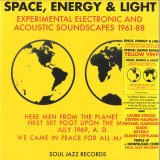
New edition of this Soul Jazz Records out-of-print classic album available now as a new limited-edition one-off pressing triple yellow vinyl album (plus download code), and limited-edition one-off pressing special yellow CD edition.
Soul Jazz Records’ Space, Energy and Light is a collection of music by early electronic and synthesizer pioneers (from the 1960s through the 1970s), mid-1970s proto-new age gurus and 1980s guerrilla D-I-Y cassette-era electronic artists, spanning in total over a near 30-year time frame. All of these artists used electronic advancements in music technology as a means of exploring not only space and the idea of the future, but also of looking inwards to the soul and of creating music in harmony with the natural world.
From computer software and hardware experimentalists and sound pioneers such as Laurie Spiegel and Kevin Braheny, as well as Mother Mallard’s Portable Masterpiece Company – the first synthesizer ensemble created in collaboration with Robert Moog – through to musique concrète experimentation, the album shows how technological advancements and creative artistic expression often went hand in hand.
In the mid-1970s artists Steven Halpern and Iaxos were instrumental in creating proto-new age music, experimenting in both the healing properties of sound and its relationship with the natural world. These artists also pioneered a new self-contained and underground D-I-Y approach to music, creating their own record labels, forming new distribution networks (with albums sold in meditation centres, health food stores and ashrams) far away from the commercialism of the mainstream music industry. In the early 1980s after the revolution of punk, these D-I-Y attitudes and ideas appeared once more in the growth of the distinctly anti-commercial and underground cassette-only careers of artists such as Germany’s Stratis and Carl Matthews in Britain.
Artwork includes some of the earliest photography of the Plieades star cluster dating from the 1880s.
"Listening to Space, Energy & Light in one sitting is a bit like experiencing constellations exploding within constellations inside your brain." Record Collector
"Incredible collection of spacey electronics and meditative soundscapes dating from the early 60s to the late 80s here, lovingly assembled by the Soul Jazz team. This compilation has it all if you like your music deep. Big names such as Iasos and Laurie Spiegel feature, but even if you think yourself a bit of a nerd in this field, there are some lesser known pearls to be found." Bleep
"Quite simply an amazing mix of some quite bizarre and interesting pieces of music, no way to describe it other than to buy it, put on some headphones and drift off to inner space.” Amazon
"New compilation charting almost three decades of experimental
electronic and synthesizer music from the most influential and often
unsung composers of their generation. Beginning and 1961 and
following the story until 1988, Space, Energy and Light connects
proto-new age gurus and DIY tape vigilantes who were equally
inspired by the advancements of new technology and its potential to
unlock utopian futures in both the music and the soul." Vinyl Factory
Opaque Red Vinyl[10,04 €]
For Fans Of... Lady Wray, Lee Fields & the Expressions, Clairo, Thee Sacred Souls, Chicano Batman, Menahan Street Band, Khruangbin. Red vinyl 7” is strictly for Indies only. The female-led discodelic soul band Say She She take you tumbling into the blazing inferno of discovering and dodging infidelity with their latest song 'Trouble'. Co-produced by former Daptone touring stalwarts Michael Buckely (Sharon Jones/ Lee Field) and Vince Chiarito (Charles Bradley, Antibalas) at their analog studio, Hive Mind Recording, in Brooklyn. The track carries a classic sound for an age-old trope of feeling like you've reached the end of a beautiful love affair that's run its course, knowing you're out of time but still susceptible to getting pulled right back into the chaos. The wailing chorus will have you losing your head grappling with weighing up the responsibility of trying to fix a broken relationship and the lure of temptation as you find yourself falling for another. 'Trouble' leaves you engulfed in weaving vocals and gut-wrenching vibrato - caught between lofty desire and rock hard rejection.
Black Vinyl[10,04 €]
For Fans Of... Lady Wray, Lee Fields & the Expressions, Clairo, Thee Sacred Souls, Chicano Batman, Menahan Street Band, Khruangbin. Red vinyl 7” is strictly for Indies only. The female-led discodelic soul band Say She She take you tumbling into the blazing inferno of discovering and dodging infidelity with their latest song 'Trouble'. Co-produced by former Daptone touring stalwarts Michael Buckely (Sharon Jones/ Lee Field) and Vince Chiarito (Charles Bradley, Antibalas) at their analog studio, Hive Mind Recording, in Brooklyn. The track carries a classic sound for an age-old trope of feeling like you've reached the end of a beautiful love affair that's run its course, knowing you're out of time but still susceptible to getting pulled right back into the chaos. The wailing chorus will have you losing your head grappling with weighing up the responsibility of trying to fix a broken relationship and the lure of temptation as you find yourself falling for another. 'Trouble' leaves you engulfed in weaving vocals and gut-wrenching vibrato - caught between lofty desire and rock hard rejection.
PUPPY formed in 2015 when school friends Jock Norton (vocals, guitar) and Billy Howard (drums) met bass player Will Michael while working in a London bar. Later that same year, the band released their eponymous debut EP, that quickly earned comparisons to acts like The Smashing Pumpkins and Dinosaur Jr. A second EP quickly followed in 2016, and “Vol ii” saw the band take their first major steps into the live sphere, with UK festival appearances at Download and 2000 Trees. The Goat, Puppy's debut album, was released in January 2019, while the band were midway through an epic European tour with Monster Magnet. In support of the album, the band recorded a live set at BBC’s iconic Maida Vale studios (their second), and racked up festival appearances everywhere from Glastonbury to Bloodstock Open Air. That year also saw PUPPY travel to the US for the first time, selling out a headline show in Brooklyn’s iconic St Vitus Bar for Revolver Magazine. Without missing a beat, the band saw out the year by releasing a surprise EP, ‘iii’, and is now ready to open a new chapter.
- A1: Logic System - Unit
- A2: Kraftwerk - Computerwelt (2009 Remastered
- B1: Whodini - Magic's Wand
- B2: Rocker's Revenger - Walking On Sunshine (Feat Donnie Calvin
- C1: Klein & Mbo - Dirty Talk (European Connection
- D1: Liaisons Dangereuses - Los Niños Del Parque
- D2: Yello - Bostich
- E1: The The - Giant
- F1: The Residents - Kaw-Liga
- G1: Clan Of Xymox - Stranger
- G2: A Split - Second - Flesh
- H1: Severed Heads - Dead Eyes Opened
- H2: The Weathermen - Poison!
- I1: New Order - Blue Monday
- J1: Anne Clark - Our Darkness
- J2: 16 Bit - Where Are You?
- K1: Phuture - We Are Phuture
- K2: Model 500 - No Ufo's (Vocal
- L1: Frankie Knuckles Feat Jamie Principle - Your Love
- L2: Quest - Mind Games (Street Mix
- M1: Jasper Van't Hof - Pili Pili
- N1: Guem Et Zaka Percussion - Le Serpent
- N2: Hugh Masekela - Don't Go Lose It Baby
- O1: Sly & Robbie - Make 'Em Move
- Q1: The Ecstasy Club - Jesus Loves The Acid
- R1: Foremost Poets - Reason To Be Dismal?
- S1: Lhasa - The Attic
- S2: A Guy Called Gerald - Voodoo Ray
- T1: M/A/R/R/S - Pump Up The Volume - Usa 12" Mix
- T2: Bobby Konders - Nervous Acid
- U1: Meat Beat Manifesto - Helter Skelter
- V1: Raze - Break 4 Love
- W1: Sueño Latino With Manuel Goettsching Performing E2-E4 - Sueño Latino (Paradise Version
- X1: Off - Electrica Salsa
- O2: Brian Eno - David Byrne - Help Me Somebody
- P1: Primal Scream - Loaded (Andy Weatherall Mix
For this uniquely personal retrospective spread over twelve vinyl discs, Sven Väth takes us back to the early days of his DJ career. On What I Used To Play we meet great pioneers of electronic music, gifted percussionists, obscure wave bands, and innovative producers of a bygone 'new electronic' era. Rough beats and irresistible grooves from the identification stage of house, techno, and acid remind us not just how far electronic music has evolved over the past four decades, but how great it was to dance to EBM, techno, and house for the very first time.
If there is one protagonist of the electronic music scene who has remained curious, innovative and at the very cutting edge of music for over four decades, it's Sven Väth. His multi-layered artist albums and Sound of the Season mix compilations have been defining the genre for over two decades, and even today, he is constantly on the lookout for the next top tune to add to the highlights of his next set. At least, that's the case when he's not producing them himself as an artist or remixer. "Actually, it's always been part of my DNA to think ahead," and nothing had been further from his mind than looking back at his past, but when in spring of 2020 the international DJ circuit had to be scaled down to virtually zero, the 'restless traveler' suddenly had time. Time to stop and reflect on "how it actually was back then, at the very beginning of my career..."
"It was a great trip and with every track, beautiful memories came flooding back".
In the London apartment, he had just moved into, Sven has set up a "little music room", where he cocooned himself for several days, "to look way back for the first time and review my musical journey through the eighties, so to speak."
The interim result was six thematically oriented playlists with a grand total of 120 tracks from 'early 80s' to 'Balearic late 80s', together with excursions into afrobeat, European new wave, and EBM sounds and a few epochal techno/house tracks from the USA in between. From these 'Best of Sven Väth's favorites', the project What I Used To Play crystallized. Sven remembers how the Cocoon team reacted to his proposal: "They found the idea of making a compilation out of it MEGA from the beginning and everyone said 'Sven, go for it', but then, of course, the work really started, namely, to clear the rights and to get clean sounding masters of the up to 40-year-old tracks. There was also disappointment, of course. We couldn't clear certain titles because the rights holders in the USA had fallen out with each other or simply disappeared from the scene. In short, it wasn't easy, but now I can safely say we got the most important tracks."
Finally, after two years of research, curation, design, and administrative fine-tuning, the "little retrospective" from 1981 to 1990 is available. The exquisitely packaged, and three-kilo heavy box set is not only physically impressive, WIUTP is also the definitive record of Sven Väth's musical development. On each of the twenty-four sides of vinyl, you can trace track by track, what influenced him during which phase, and how he took off as a DJ from his parents' Queen's Pub straight into the spotlight at Dorian Gray. There and at Vogue (later OMEN), Sven became the style-defining player in the DJ booth that he still is today.
1981 - 1990: Future Sounds of Now
In the early eighties, the crowd in clubs like Vogue and Dorian Gray danced to what nowadays we call 'dance classics' - mainly disco, funk, soul, and chart pop. It was up to a new generation of DJs, including Sven Väth, the youngest protagonist in the Rhine-Main area at the time, to create their own club-ready music mix. Good new tracks and potential floor-fillers were rarities that had to be sought out and found, in order to prove oneself worthy.
Without MP3s, internet streaming, or other digital download possibilities, music didn't just gravitate to the DJ, instead, it had to be tracked down. In well-stocked record stores in Frankfurt and Wiesbaden or even in Amsterdam, London, or New York, Sven and friends sourced the material for countless magical nights. On WIUTP we can follow Sven's very personal journey through this wild, innovative era in which synth-pop, funk, hip-hop, and disco were successively replaced as 'club music' by house, techno, acid, and breakbeat. By the end of the decade, it was clear to see that these once exotic 'fringe' phenomena would soon become 'mass' phenomena.
Early 80s
Dirty Talk by the Italian-American duo Klein & M.B.O. represents the most innovative phase of the Italo-disco genre in the early eighties like no other track. Mario Boncaldo (I) and Tony Carrasco relied entirely on the original synthetic drum and percussion sounds of the Roland TR-808, coupled with the raunchy vocals of Rossana Casale and guitar accents of Davide Piatto. Of course, other tracks from this period were also influential in style, most notably Unit by Logic System, which worked as the perfect soundtrack to the laser lighting system at the legendary Dorian Gray club. With stomping beats and robotic rap interludes, Bostich by Yello also belongs on Sven's eternal playlist - after all, it caught the attention of Afrikaa Bambaataa, who invited the Swiss duo to perform at the Roxy in New York in 1983.
EBM Wave - Mid 80s
From today's point of view, the almost ten-minute-long, downtempo track Giant by Matt Johnson's band project The The, would probably not be considered an obvious club classic. However, a closer (re)listen reveals the rhythmic intricacies of the percussion overdubs by JG Thirlwell (aka Foetus) on Johnson's composition, and it becomes clear why this exceptional piece of music is one of Sven's absolute favorites. Other classics from this phase include Kaw-Liga by the mysterious The Residents, the hypnotic-synthetic Our Darkness by Anne Clark (and David Harrow), and last but not least, the somber, monotonous anthem Where Are You? by 16Bit, one of Sven Väth's projects together with Michael Münzing, Luca Anzilotti from 1986.
US House - Late 80s
You certainly can't talk about Chicago house without mentioning Frankie Knuckles. The resident DJ at the Warehouse not only gave the name to an entire genre, but also produced epochal floor fillers on the Trax label like the timeless Your Love, sung (and moaned) by Jamie Principle. Acid house protagonists Phuture also hail from Chicago, and on We Are Phuture (also released on Trax) we hear the chirping acid sounds of the legendary Roland TB-303 in full effect. Another featured classic is No UFO's by Detroit's Model 500 aka Juan Atkins, who is rightly considered the 'Godfather of Techno' even if the genre-defining track from 1985 still breathes with the spirit of hip-hop and electro from the first breakdance era.
Afrobeat
Le Serpent, by Algerian-born Abdelmadjid Guemguem, is a track that sounds completely different from everything else on WIUTP. Made in 1978, it's a monumental, rousing groove created without bass or synths, just with five congas! Even though Guem sadly passed away in 2021, his immortal, acoustic beats are understood all over the world and will continue to enrich many thousands of DJ sets for years to come. Another classic that not only Sven appreciates beyond measure is Hugh Masekela's Don't Go Lose it, Baby. In addition to being one of the most important jazz pioneers, the trumpeter and freedom fighter from Johannesburg was very experimental, integrating electronic sounds into his music in later years, in a similar vein to Miles Davis and Herbie Hancock. Dutch jazz pianist Jasper van't Hof's afrobeat project Pili Pili has also aged well. The trance-like, almost sixteen-minute-long track of the same name, manages to fill a whole side on the seventh of twelve vinyl discs in the WIUTP box.
UK-US-Euro - Late 80s
Time for a change of scene, in the truest sense of the word, and from a musical perspective, this section is like landing on another planet. First up is Andrew Weatherall's classic remix of Primal Scream's Loaded, featuring the iconic Peter Fonda sample (lifted from the 1966 biker film Wild Angels) that came to personify the mood triggered by the British Second Summer of Love in the late eighties: "We wanna be free to do what we wanna do, and we wanna get loaded...". This period also saw the emergence of M/A/R/R/S whose only single, 1987's Pump Up The Volume, became a club classic with support from DJ legend CJ Mackintosh. In this most eclectic of sections, we also encounter New York house and reggae producer Bobby Konders and his seminal Nervous Acid.
Balearic - Late 80s
Those who know him, know that Sven had already lost his heart to the 'magic island' of Ibiza as a teenager, so with that in mind, the WIUTP project couldn't end without a Balearic chapter. Inspired by Manuel Göttsching's E2-E4, the immortal, eponymously titled Sueño Latino belongs in there without question. Equally popular on the island was, and still is Break 4 Love by Raze, which thinking about it, would also fit perfectly into the house chapter. Last, but not least, there's an overdue reunion with Sven Väth himself, in his role as frontman of the successful Frankfurt trio OFF. Together with Michael Münzing and Luca Anzilotti (later of Snap!) this 'Organization For Fun' created the off-the-wall club hit Electric Salsa in 1986 which incidentally turned into an international chart smash, putting Sven in the enviable position of having to decide between pop stardom and a DJ career. Well, we all know how that decision turned out and the rest, as they say, is history. A not insignificant part of his story is What I Used To Play. Enjoy!
- 1: The Rocks And The Water
- 2: Wild Theme
- 3: Freeway Flyer
- 4: Boomtown (Variation Louis' Favourite)
- 5: The Way It Always Starts
- 6: The Rocks And The Thunder (I)
- 7: The Ceilidh And The Northern Lights
- 8: The Mist Covered Mountains
- 9: The Ceilidh: Louis' Favourite, Billy's Tune
- 10: Whistle Theme
- 11: Smooching
- 12: Stargazer
- 13: The Rocks And The Thunder (Ii)
- 14: Going Home (Theme Of The Local Hero)
Mastered from the original master tapes and pressed at RTI on dead-quiet 180g vinyl, Mobile Fidelity's numbered-edition 180g LP of Local Hero gives the beloved effort audiophile-grade sound on a par with the reference-quality sonics afforded Dire Straits' Mobile Fidelity reissues. In each arrangement, Knopfler's methodical guitar lines emerge with supreme transparency and multi-hued textural detail. The intricate notes, finger-picked passages, and cosmopolitan lines come across as if they're transmitted just feet away from you in real time.
Ditto the diverse accompaniment, including the Celtic-themed effects, supplemental jazz accents, and folk inflections. The keys to the nearly 44-minute effort's success and continuity relate not only to Knoplfer's laidback style and low-key approach, but his ear for uncanny melody and blues traces. Woven acoustically and electrically, his tapestries benefit from the newfound airiness, openness, and balance that live on this reissue. No matter the instrument or treatment, the music arrives with pinpoint imaging and vibrant liveliness. Close your eyes, and the Mobile Fidelity version of Local Hero projects movies in your head.
For instance, take the closing "Going Home," a cherished instrumental whose proud spirit resonates with English football fans and features saxophone playing by the late, great Michael Brecker. Heard before every Newcastle United F.C. home game, it has become an anthem on both sides of the Atlantic. Or, look to "The Ceilidh: Louis' Favorite Billy's Tune" on which Scottish-flavored vibes and dance tempos conjure a festive jig until a transition gives the number a more subdued, romantic feel. Then, the pattern repeats. Seeking to expand beyond the parameters of Dire Straits, Knoplfer taps into a global economy of structures and sounds, and takes anyone with a sense of adventure along for the ride.
Not that his hallmark six-string is absent from the proceedings. It frames the lovely tin-pan whistle motif of the aptly titled "Whistle Theme," acts as a beacon for the elegant, vibraphone-kissed "Smooching," and pushes forward the jovial, top-down momentum of "Freeway Flyer," among other highlights. Knopfler also receives assistance from session pros Mike Mainieri, Steve Jordan, and Terry Williams, as well as vocalist Gerry Rafferty on the set's sole vocal tune, "That's the Way It Always Starts."
Landmarks and milestones are always memorable, but the 50th EP release on FUSE feels that little bit more special as head honcho Enzo Siragusa steps up to the mark and returns for the second time this year. Having launched the label in 2011 with his now iconic ‘The Sagamore’ EP, the renowned selector and producer has grown and shaped the FUSE from a Sunday after-hours to one of the most notable names within house and techno worldwide - anchoring the label at the heart of its identity and bringing its trademark sound to an international audience. Following material from original residents Rich NxT, Rossko, Seb Zito and Archie Hamilton through to regular guests and close friends such as Guti, East End Dubs, Michael James and Fabe, October sees Siragusa showcase both his and FUSE’s evolution over the past decade as he uncovers two bustling productions across his ‘Dreamscape’ EP.
A production oozing with his signature sound, yet introducing fresh subtleties in amongst the track’s snaking groove and hypnotic melodies, ‘Dreamscape’ welcomes a title cut full of energy as the FUSE boss picks up right where he left off to provide yet more heavily requested material on home turf. On the flip, ‘Bean That Talks’ sees Siragusa get playful while maintaining the vigour of his bustling live sets, combining chunky low-ends with skippy percussion and rich pads to showcase precisely why he and FUSE continue to flourish as leaders of a sound that they can truly call their own.
- A1: Rival Consoles - Them Is Us
- A2: The Art Ensemble Of Chicago - Mama Koko (Feat Moor Mot
- A3: Bell Orchestre - The Stars In His Head / Bernard 33- Da
- B4: Masayoshi Fujita - Book Of Life
- B5: Hatis Noit - Aura
- B6: Anne Müller - Nummer 2
- C7: Lubomyr Melnyk - Son Of Parasol
- C8: Daniel Brandt - Flamingo
- C9: Ben Lukas Boysen - Clarion (Kiasmos Remix)
- C10: Crayon - Ithinkso (Feat Bastien Brison)
- D11: Penguin Cafe - Harry Piers 2021
- D12: Peter Broderick - Sonata For The Sirius
- D13: Qasim Naqvi - Aftertouched
- D14: Kevin Richard Martin & Hatis Noit - After The Storm
- E15: Rival Consoles - I Love This, I Love You
- E16: Douglas Dare - Heavenly Bodies (Feat London Contempora
- E17: Roedelius & Story Spirit - Clock
- E18: Högni - Anda _Inn Gud (Feat Hatis Noit)
- E19: Daniel Thorne - From The Other Side Of The World
- F20: Michael Price - Sandham (Feat Shards)
- F21: Shards Inner - Counterpoint
- F22: David Allred - The Garden
- F23: Nils Frahm - O I End
A new compilation titled Erased Tapes _+ù_¦ö, encompassing a two hour cross-section of the label"s 15-year history including hidden gems and previously unreleased material, will be available on November 4 to coincide with specially curated festivals in London and Berlin. The first offering comes from UK producer Kevin Richard Martin aka The Bug and Japanese voice artist Hatis Noit who share their paranormal first collaborative cut After the Storm amongst other unique pairings such as The Art Ensemble of Chicago featuring Moor Mother, Bell Orchestre interpreted by Colin Stetson, Douglas Dare joined by The London Contemporary Orchestra and Ben Lukas Boysen remixed by Kiasmos. Premiered exclusively via The Wire magazine in form of a free download ahead of their debut live performance at Le Guess Who? Festival 2019 in Utrecht, the track is now finally made available on vinyl and streaming platforms alongside other previously unreleased pieces from electronic producer Ryan Lee West aka Rival Consoles and Icelandic composer Högni. "As a solo vocalist and voice artist, I"d always dreamed of floating and being drowned in a beautiful sonic storm. And then I met Kevin Martin" - Hatis Noit The artwork is composed of the Japanese kanji for "15" - calligraphed by label founder Robert Raths and designed by Munich-based artist Bernd Kuchenbeiser.
MADFISH PRESENTS STEVE HILLAGE'S PREVIOUSLY UNRELEASED
LEGENDARY GLASTONBURY 1979 PERFORMANCE. On Friday 21st June
1979, the Steve Hillage Band performed a headline set of soaring
psychedelic guitar riffs of cosmic aspirations
The summer solstice night was a pivotal point in Steve Hillage's musical journey
& this recording, provided from Steve's personal archives, will cement the
performance as historic.Prior to the festival, Steve & the band spent two weeks
rehearsing in a barn at Worthy Farm, site of the Glastonbury Festival. They crafted
a set fitting & psychedelically uplifting enough to truly celebrate the longest day
of Summer at such an auspicious location. Steve was an integral member of the
Glasto team alongside Michael Eavis, Pyramid' Bill Harkin & Turbosound/Funktion
One's Tony Andrews. Their work focalised the 1979 Fayre, helping the rebirth of
the first of the modern Glastonbury Festivals. After spending the 80's in music
production, Steve & his partner Miquette Giraudy returned to recording & live
performance in the 90's with the dance-oriented System 7 & was fundamental in
the introduction of the Dance Stage to Glastonbury in 1995.
Presented on CD in deluxe media book with 24-page booklet and LP w/ Gatefold
sleeve.
Following the highly acclaimed album Dream Violence
(2021) and the recent LP re-issue of his modern underground
classic Gravity/ Repulsion, Michael Beach has announced
a new self-titled 12-inch EP, to be released via Goner and
Poison City Records.
Recorded during the winter of 2021, the new record is
made up of both 8-track tape and full studio recordings,
interspersed with experimental, moody interludes, and
features Beach’s Australian bandmates Bonnie Mercer
(guitar), Peter Warden (drums) and Carla Oliver (bass)
throughout. The EP’s stunning closer “Only A Memory”
is a collaboration with Lloyd Swanton of renowned
Australian minimalist trio The Necks, recorded in NSW’s
Blue Mountains.
“Out In A Burning Alley,” the EP’s lead single, combines
Beach’s soulful abstracted lyrics over two minutes and fifty
eight seconds of blazing garage-rock, where the sounds
of the Melbourne and Oakland / Bay Area underground
collide.
In support of the upcoming EP and recent Dream
Violence album, Beach will be returning to tour the US in
September/ October, headlining dates on the East and West
coast and performing at the iconic Gonerfest in Memphis,
TN. The touring outfit will also feature Beach’s long time
collaborator Utrillo Kushner (Comets On Fire / Personal
and The Pizzas) on drums.
- A1: Primal Scream - Higher Than The Sun (Higher Than The Orb) (Higher Than The Orb)
- A2: Critical Rhythm - It Could Not Happen (Feat Jango Thriller & Vandal - Essential Trance Hall Mix)
- A3: Sheer Taft - Cascades (Hypnotone Mix)
- A4: History - Afrika (Feat Q-Tee - Love & Laughter Remix)
- B1: The Grid - Floatation
- B2: Saint Etienne - Speedwell
- B3: One Dove - Fallen (Album Version)
- C1: Transglobal Underground - Temple Head (Pacific Mix - Airwaves)
- C2: Massonix - Just A Little Bit More (Electro Instrumental Mix)
- C3: Elsi Curry - U Make Me Feel (Running Water Aka Workhouse Mix)
- C4: Family Sensation - I Don't Even Know If I Should Call You Baby (Marshall Jefferson Symphony Mix)
- D1: Bbg - Snappiness
- D2: The Aloof - Never Get Out The Boat (The Flying Mix)
- D3: Moodswings - Spiritual High (The Moodfood Megamix)
Mit ihrem Berlin-Umzug Mitte der 1970er Jahre wollten David Bowie und Iggy Pop nicht nur für einige Jahre den Lebensmittelpunkt ins Zentrum Europas verlegen, sondern auch musikalisches Neuland erkunden. Auf ihren Trips nach Paris oder Warschau ließen sie sich von neuer, europäischer Musik inspirieren die so ganz konträr zu der grassierenden Disco-Welle in den USA war. 16 dieser Tracks sind nun von St. Etienne's Bob Stanley und Jason Wood (u.a. 'English Weather') zu einer Compilation zusammengestellt worden, die einen Einblick in die europäische Elektronik- und Krautrock-Szene gibt, von der sich vor allem Bowie inspirieren ließ. Passend benannt nach einem von Bowie's Liebelings-Bars in Berlin, kommt 'Cafe' Exil' mit Tracks von Amon Düül II, Faust, Michael Rother, Brian Eno, Soft Machine, Cluster oder auch der Jan Hammer Group! Die Doppel-Vinyl kommt mit dem Edgar Froese-Bonustrack 'Epsilon In Malaysian Pale'! Natürlich mit umfangreichen, sehr informativen Liner Notes zu allen Tracks!
The Hesitations&Bobby "Blue" Bland&Michael Omartian
Soul Superman / Ain't No Love In The Heart Of The City
A chiming guitar, vibes on full and that heady
Motown / Ric Tic drumbeat with a falsetto vocal…
what’s not to love?
Originally released on Kapp in 1966 and often
bootlegged, copies go for in excess of £100 for this
excellent, driving floorfiller.
The Hesitations have a few Northern nuggets to
their credit - ‘Soul Superman’ is right up there with
the best.
Backed with the super bluesy vocal of the
legendary Bobby Bland on an aching tale of loss
and regret.
A slow smoochy groove with lyrics of genuine
heartache… and all this with a resilient slow
motion dance beat and some exquisite brass
breaks.
Featuring a gorgeous vocal-only drop out, it’s a
triumphant return from the man who also released
the beautiful ‘Shoes’.
Both sides remastered for sprung dancefloorshaking longevity.
Here’s Lantern Heights’ personal tribute to the one and only Michael Chapman, a hero in his own right, a ‘Fully Qualified Survivor’ (just to mention one of his most successful creations). An unreleased live album on vinyl in the form of an astonishing trio.” A live set recorded at Nottingham’s Playhouse Theatre on July 23rd 1977 by Chapman and a power house rhythm section in Lindisfarne bassist Rod Clements and former John Mayall drummer Keef Hartley. Some of his best-loved songs are showcased in “And There Were Three” – a jocular reference to Chapman’s ever-shrinking band, also known as ‘a beast with three heads’.
Recorded under a loft bed in the guest bedroom of his Nashville home, Michael Ruth aka Rich Ruth’s “I Survived, It’s Over” starts in a humble space. And while many contemporary music projects are produced in such an environment, “I Survived, It’s Over” sets itself apart in its transformative properties as well as its transparency. What we have here is honest sound exploration, session musician-level instrumentation, and a true love for nature run through the fingers of a dude who can channel some acute and undeniable magic. This music goes deep. "I conceived much of this record amidst the quiet and tumult of 2020 in my neighborhood that had recently been ravaged by a tornado," Ruth recalls, "I spent most of my days working on these pieces between bicycle rides - watching the beautiful Tennessee ecosystem flourish in Shelby Park, listening to Keith Jarrett’s The Koln Concert and John Coltrane’s Ascension." Underneath the swell of the strings and the shredding of the guitars, this record has hard working, rustbelt, drum-heavy roots all over it (which makes sense as Ruth hails from outside of Toledo, the album was mixed by John McEntire from Chicago band Tortoise). Many of the flutes, saxophones, pedal steel, and other instruments were recorded remotely because we live in the future, but this only adds to the collage of sampled and sample-able material that Rich Ruth has to offer. The organic relationships between the artist and other musicians on the album is evident even in the compilation style sampling that needs to occur in putting such a project together. "Working on this music is a daily meditation," says Ruth. "I constantly experiment with sound until it reflects the way I am feeling and attempt to sculpt something meaningful from it. Through years of being a touring musician, it is a constant inspiration and privilege to collaborate with the individuals that graced this record with their voices." And those relationships pay off, because “I Survived, It’s Over” is a sonic meal. It’s rich (no pun intended) with massive instrumentation that’s usually reserved for more symphonic delights. But at the same time it’s simple and leaves space to breathe–space you didn’t know you needed. In his own words; "I Survived, It’s Over is a meditation on healing, confronting trauma, surrendering, and finding peace. I wanted to encapsulate the tranquility and disarray found within this process." Ruth’s heart and the peace that his presence produces is all over this album. And despite his midwestern humility and willingness to brush off any praise, he’s put together something really special that carries its own weight. It's the kind of record that only comes around every once in a while and it's worthy of all the head-bobs, acclaim, and celebratory potlucks that Mike and the gang have coming their way. “I Survived, It’s Over” is a record you should buy for your friend, your foe, and yourself. It’ll sit perfectly on your shelf between Alice Coltrane and Hiroshi Yoshimura.
- Disc: 1 1. Yearly Dying
- 2: Under Silence
- 3: Pelekas
- 4: Magnificent Obsession
- 5: The Space Inbetween
- 6: Blind Mountain (1994 Version
- 7: If This Is All
- Disc: 2 1. Left Brain Ambassadors (1999 Demo)
- 2: If You Should Leave (1994 Version)
- 3: Save Your Soul (1999 Demo)
- 4: Nowhere To Go (199 Version)
- 5: Until The Morning (1999 Demo)
- 6: Sour Stains (1994 Version)
- 7: Angel Of Betrayal (1999 Demo)
- 8: Per Aspera Ad Astra (1999 Demo)
- 9: Blessed (Instrumental Version 1 Demo)
- Disc: 3 1. Mushroom Tea Girl (1996 Demo)
- 2: Let The Magic Talk (1999 Demo)
- 3: The Goddess (1999 Demo)
- 4: Inside Charmer (1996 Demo)
- 5: Trouble In My Head (1996 Demo)
- 6: Mr White
- 7: Broken Morning (1996 Demo)
- 8: Monster Astronauts (1996 Demo)
- 9: Sad Queen Boogie
Traffic Lights Vinyl Edition[52,90 €]
The Spiritual Beggars debut album (1994) reissued with 2 full LPs of extra tracks – 18 demo cuts and other rare versions, presented in ravishing triple fold packaging with astounding art by Costin Chioreanu. The Spiritual Beggars mastermind Michael Amott (Arch Enemy, ex-Carcass) is one of today’s most important guitarists in Metal, and this reissue originally coincided with the band’s 20th anniversary. The original limited vinyl being long sold out, Svart Records present a new edition as the band’s 30th anniversary draws near.
- Disc: 1 1. Yearly Dying
- 2: Under Silence
- 3: Pelekas
- 4: Magnificent Obsession
- 5: The Space Inbetween
- 6: Blind Mountain (1994 Version
- 7: If This Is All
- Disc: 2 1. Left Brain Ambassadors (1999 Demo)
- 2: If You Should Leave (1994 Version)
- 3: Save Your Soul (1999 Demo)
- 4: Nowhere To Go (199 Version)
- 5: Until The Morning (1999 Demo)
- 6: Sour Stains (1994 Version)
- 7: Angel Of Betrayal (1999 Demo)
- 8: Per Aspera Ad Astra (1999 Demo)
- 9: Blessed (Instrumental Version 1 Demo)
- Disc: 3 1. Mushroom Tea Girl (1996 Demo)
- 2: Let The Magic Talk (1999 Demo)
- 3: The Goddess (1999 Demo)
- 4: Inside Charmer (1996 Demo)
- 5: Trouble In My Head (1996 Demo)
- 6: Mr White
- 7: Broken Morning (1996 Demo)
- 8: Monster Astronauts (1996 Demo)
- 9: Sad Queen Boogie
Black Vinyl[52,90 €]
Traffic Lights Vinyl Edition
The Spiritual Beggars debut album (1994) reissued with 2 full LPs of extra tracks – 18 demo cuts and other rare versions, presented in ravishing triple fold packaging with astounding art by Costin Chioreanu. The Spiritual Beggars mastermind Michael Amott (Arch Enemy, ex-Carcass) is one of today’s most important guitarists in Metal, and this reissue originally coincided with the band’s 20th anniversary. The original limited vinyl being long sold out, Svart Records present a new edition as the band’s 30th anniversary draws near.
NEW 45 BY DEEP-FUNK PIONEER LUCKY BROWN RECORDED DURING THE MYSTERY ROAD SESSIONS!
"Funk is a living, breathing, creative and generative entity and The New Lucky Seven celebrate its life with a mysterious and authentic sonic snapshot from the iconic Mystery Road sessions: WOODHEAD!"
Woodhead is a steady medium groover built around an acute chanky guitar part that Joel Ricci aka Lucky Brown composed while living in the "Woodhood" district of Bellingham Washington, USA in the fallout shadow of an industrial area on the outskirts of town. The Woodhood was so named because the streets were all named after different kinds of trees; Cottonwood, Alderwood, Birchwood, etc. Though members of the band had been performing Woodhead since as early as 2004, it had never been officially committed to tape. So during the 2013-2014 span of living room "Magik Carpet" sessions at drummer, Oliver Klomp's house in West Seattle, the combo dubbed by Lucky as "The New Lucky Seven" casually hit the head a couple times before calling it a night as Lucky rolled tape.
Opening with the now world-famous guitar player, Jabrille "Jimmy James" Williams dropping deftly into his rhythmic part, Lucky chants in the background the words "don't stop" as the tension builds up into the moment the whole band comes in. With Bob Heinemann on bass, Marc Hager on Rhodes and Oliver Klomp on drums, the thick but honest groove is instantly palpable. Trombone player Mars Lindgren and Sax player Thomas Deakin, along with Lucky on Trumpet lay down the 'head' to the tune right off the bat with everyone in the band giving that hard hit on the 4 count of the last bar of the repeated figure. This 'hit' returns again to form the breakpoint between soloists Jimmy James, Marc Hager, and on side B, Thomas Deakin, and Lucky Brown on the flute. The horn section microphone was situated on the dining room table and Lucky just had to lean over to reach it with his instrument! Michael Iris of Bell Creek Studio transferred and mixed these two tunes from Lucky Brown's cassette machine.
This tune was left off of the Mystery Road compilation album but comprises one of the last tracks created during those sessions therefore the concept, vibe, style, and intention should resonate and be interchangeable with the rest of the 45s from that epic Box Set TR-9043 released by Tramp Records on May 4, 2015.
As you spin and interact with the Mystery Road recordings, you are invited to allow Woodhead to take its rightful place specifically alongside the other "The New Lucky Seven" recordings and generally as a part of the suite of crude and naive living-room "Magik Carpet" funk of the rest of the Mystery Road.
As illuminated before in Lucky's artist statement regarding the Mystery Road sessions, the music contained therein was always intended to put emotion, vibe, feeling, and spirit before technical, spatial, or even performance constraints and to serve as a gift of discovery to lovers and aficionados of the deep funk idiom and the rare 45rpm format. Funk is a living, breathing, creative and generative entity and The New Lucky Seven celebrate its life with a mysterious and authentic sonic snapshot from the iconic Mystery Road sessions: WOODHEAD!
- A1: Queen & David Bowie - Bohemian Rhapsody
- A2: Queen & Elton John - Another One Bites The Dust
- A3: Queen & David Bowie - Killer Queen
- A4: Freddie Mercury & Montserrat Caballe - Fat Bottomed Girls
- B1: George Michael & Queen - Bicycle Race
- B2: Brian May - You're My Best Friend
- B3: Freddie Mercury - Don't Stop Me Now
- B4: Freddie Mercury - Save Me
- C1: Queen & Wyclef Jean - Crazy Little Thing Called Love
- C2: Somebody To Love
- C3: Now I'm Here
- C4: Good Old-Fashioned Lover Boy
- D1: Play The Game
- D2: Flash
- D3: Seven Seas Of Rhye
- D4: We Will Rock You
- D5: We Are The Champions
- E1: A Kind Of Magic
- E2: Under Pressure
- E3: Radio Ga Ga
- E4: I Want It All
- E5: I Want To Break Free
- F1: Innuendo
- F2: It's A Hard Life
- G1: Headlong
- G2: The Miracle
- G3: I'm Going Slightly Mad
- G4: The Invisible Man
- H1: Hammer To Fall
- H2: Friends Will Be Friends
- H3: The Show Must Go On
- H4: One Vision
- I1: The Show Must Go On
- I2: Under Pressure (Rah Mix)
- I3: Barcelona
- I4: Too Much Love Will Kill You
- J1: Somebody To Love
- J2: You Don't Fool Me
- J3: Heaven For Everyone
- J4: Las Palabras De Amor (The Words Of Love) (The Words Of Love)
- K1: Driven By You
- K2: Living On My Own
- K3: Let Me Live
- K4: The Great Pretender
- K5: Princes Of The Universe
- L1: Another One Bites The Dust
- L2: No-One But You (Only The Good Die Young) (Only The Good Die Young)
- L3: These Are The Days Of Our Lives
- L4: Thank God It's Christmas
- F3: Breakthru
- F4: Who Wants To Live Forever
Released for the first time on vinyl, Queen’s compilation ‘The Platinum Collection’, featuring all three of their Greatest Hits albums, shows their unrivalled track record of chart-topping, award-winning, record-breaking rock and pop classics. June 17th will see the limited edition 6LP colour vinyl set released in a slipcase with brand new artwork. Each piece of vinyl will be a different colour and come in its own individually designed sleeve. The set also comes with an exclusive 24-page 12″ photo booklet. LIMITED EDITION
"I live too fast to die young, it ain't nothing when your
head's screwed on,? röhrt der elektrisierende Frontmann
Michael Monroe auf seinem zweiten Album für Silver
Lining Music. Ein großartiges Rock'n'Roll Album, "I Live
Too Fast To Die Young" - ein ehrlicher Schrei aus vollem
Herzen.
Zu einer Zeit, wo Spaß zu haben nicht einfach ist,
kommt "I Live Too Fast To Die Young" als gradliniges,
freches Album mit rauer Rock'n'Roll Musik - deftige Songs
wie "Young Drunks & Old Alcoholics?, "All Fighter? und
dem punkigen "Murder The Summer Of Love?. Die
Songs bringen frische, knackige Elektrizität und Melodien,
die sich schimmernd um messerscharfen Riffs wickeln.
Ausgedehnte, Stones-angehauchte Tracks gibt es
ebenfalls wie das "Can't Stop Falling Apart? und
"Everybody's Nobody?, während der Titeltrack genau
zwischen deine Augen zielt, mit einen forschen Back Beat
und einem frechen Chor , wundervoll und großartig in
Szene gesetzt mit Michael Monroes unbändiger,
aufregender Pose - mit seiner großartigen Attitude.
Das Album wurde in den Inkfish Studios in Helsinki,
Finnland im November/Dezember 2021 aufgenommen und
von der Band zusammen mit Erno Laitinen produziert.
Michael Monroe (Gesang und Harmonika) , Steve Conte
( Gitarre und Gesang), Rich Jones (Gitarre und Gesang),
Karl Rockfist (Schlagzeug) und Sami Yaffa
(Bass/Gesang/Gitarre) und einigen Gastmusikern; unter
anderem dem legendären Guns N' Roses Gitarristen
Slash , den man mit einem Solo und zusätzlicher Gitarre
auf dem Titeltrack hören kann.
- A1: Roulette Dares (The Haunt Of)
- A2: Son Et Lumière (Unfinished Original Recordings Of De-Loused In The Comatorium)
- A3: Inertiatic Esp (Unfinished Original Recordings Of De-Loused In The Comatorium)
- A4: Drunkship Of Lanterns (Unfinished Original Recordings Of De-Loused In The Comatorium)
- A5: Eriatarka (Unfinished Original Recordings Of De-Loused In The Comatorium)
- B1: This Apparatus Must Be Unearthed (Unfinished Original Recordings Of De-Loused In The Comatorium)
- B2: Televators (Unfinished Original Recordings Of De-Loused In The Comatorium)
- B3: Take The Veil Cerpin Taxt (Unfinished Original Recordings Of De-Loused In The Comatorium)
Landscape Tantrums Lost for two decades, the recent rediscovery of Landscape Tantrums the first attempt at recording the music that would become The Mars Volta’s De-Loused In The Comatorium revealed an important and hitherto missing chapter in the group’s evolution. Selfrecorded by Omar (assisted by Jon DeBaun) at Burbank’s Mad Dog Studios within a head spinning four days, Landscape Tantrums captures De-Loused in somewhat embryonic form, though much of what would make The Mars Volta’s debut album such an electrifying, sublime experience was already in place: the fearless invention, the fusion of futurist rock elements and traditions from outside of the rock orthodoxy, the sense of virtuosity working in service of emotional effect. From a distance, The Mars Volta must have seemed as if they were on a high when they walked into the studio to record what they expected to be their debut album (“I didn’t think of it as demos or a dry run,” Omar says). The group had recently played the Coachella festival to rave reviews, a vindication of the quixotic risk Omar and Cedric had taken, quitting At The Drive In to lead such an uncompromising musical proposition.
Their debut EP, Tremulant, had similarly signalled their singular vision, and been rewarded with similarly positive feedback. But the truth was that The Mars Volta entered Mad Dog in tatters, scarcely believing anything other than failure lay within their reach. They’d recently lost their bassist, Eva Gardner, and parted ways with keyboard play Ikey Owens. Tensions were brewing with drummer Jon Theodore, too himself a replacement for founding drummer Blake Fleming Omar questioning Theodore’s commitment to the group. And sound manipulator Jeremy Michael Ward’s drug problem had gotten so far out of hand that he’d been sent to rehab, and wouldn’t return until two days into the Landscape Tantrums. The pressure upon Omar was intense, and it began to manifest in the form of physical and emotional breakdowns. His art was his life, but now he began to wonder if it was actually going to kill him. Under such heavy manners, miracles occurred at Mad Dog. Surely that’s the only way to describe the music contained on Landscape Tantrums, as Omar fashioned early versions of Inertiatic ESP, Drunkship Of Lanterns and Eriatarka that rivalled the Rick Rubin produced versions that ended up on De- Loused for intensity, precision and immediacy, as Cedric delivered a powerfully intimate reading of Televators, and as a bare bones version of the group sketched out the peaks of what would become their debut masterpiece in barely half a week, on a shoestring, and believing they wouldn’t last long enough to see it hit the shelves. Listening to Landscape Tantrums now, with the benefit of hindsight and the knowledge of what these songs will become, one notices Cedric has yet to fully find the voice that will lend The Mars Volta their devastating authority, that Eriatarka will evolve even further under Rick Rubin’s watch, and that the lyrics to De-Loused’s climactic chapter, Take The Veil Cerpin Taxt, have yet to be penned. But one also notices how lithe the group sound here, how hungry, and one appreciates the raw edge that Rubin would later polish to a venomous sharpness. More than mere historical curiosity, Landscape Tantrums is an essential text for the dedicated Mars Volta aficionado, and a breathtaking album in its own right.
[a] a1. Roulette Dares (The Haunt Of) [Unfinished Original Recordings Of De-Loused In The Comatorium]
- 1: The Rain Drops
- 2: Another Time
- 3: Melted Car (Feat. Karina Gill)
- 4: Deep In Squalor (Feat. Griffin Jones)
- 5: Hey There Flower
- 6: Cliché (Feat. Kati Mashikian)
- 7: Say It Now (By Françoise Hardy)
- 8: Uneasy
- 9: Ode To Little Bird (Feat. Alexis Harper)
- 10: September Skies (Feat. Karina Gill)
- 11: The Portal
- 12: The Word
- 13: Unled Lives (Feat. Hannah Lew)
- 14: Saint Matthew
Solo bedroom-pop project of Michael Ramos (Flowertown, April Magazine, Hectorine). Mostly recorded between last Christmas and New Year's during a window of isolation at home, “Hey There Flower” preserves Tony Jay’s prowess at making beautifully eerie lo-fi pop; like a hazy memory where your favorite Sixties girl-group melody is perpetually slowed down. Without a band to practice with, Tony Jay recorded the music alone, but recruited a slew of friends to remotely record backing vocals: Karina Gill (Cindy), Griffin Jones (Galore), Kati Mashikian (Mister Baby), Alexis Harper (Al Harper), & Hannah Lew (Cold Beat). "Hey There Flower", the most recent release from the prolific and mysterious Tony Jay delivers real melodies -- both lacey with vocal harmonies and dusty with layered guitars -- as fans have come to expect. This release also carries forward and elaborates on Tony Jay's tradition of songs that express a kind of naked honesty about things we all know -- love and loneliness and all that -- while communicating at the same time a wry edge of skepticism, so that the songs are like coins spinning on edge before landing heads, tails, or lost under the couch. Tony Jay brings us into a nostalgia where we recognize moods from music of the past -- Marc Boland definitely comes to mind, as well as Velvet Underground of the Nico era, and Tony Jay even covers Francoise Hardy on this collection -- but the songs create a three dimensional space with what feels like a thousand layers so that instead of being thrown back in time, it's like stepping into a little world with its own laws of nature, of which the listener gets just a few hints. - Karina Gill, Cindy/Flowertown. “Hey There Flower” is introduced by thudding snare beats eliciting reverb-stained tattered noisy guitar scrapes, to weave abrasive shimmery emotive vibrations, imbued with shattered nostalgic dreams, lit by brittle yet dazzling forsaken keyboard flows, over submerged and distorted male vocal’s whispery deluge of obsessive longing, lonely melancholy, and dark desire to exude a hazy gritty concoction of awkward sadness and brooding unrest.” White Light // White Heat // “What Tony sketches are concise commentaries on love, loneliness and a few things in between. His mode of expression is sparse, intense, and captivating. The arrangements are invariably lo-fi and slow tempo, blanketed with a fuzzy hiss. And it only took one listen to decide that it is a very special album. It has a '60s feel, albeit washed in an eerie slowcore machine. An ace example is "September Skies", which could be the 1965 'last dance' at the prom for the introverted students.” - When You Motor Away
‘Director’ is the follow up to Chrome Canyon’s
2012 debut ‘Elemental Themes’.
Chrome Canyon is a composer for film and TV,
including the HBO Max / Cartoon Network series
‘Infinity Train’.
‘Director’’s lead track, ‘Broken Theme’, was used
in an iPhone 13 Pro advert.
Vintage synths were used to create ‘Director’,
including the PE-1000, which was Korg’s first
polyphonic instrument, and the Chroma Polaris,
which was the second synth made by
Fender/Rhodes.
Chrome Canyon’s music is greatly influenced by
scores that are as revered as the films they
soundtrack: ‘Tron’, ‘Blade Runner’, ‘Metropolis’,
etc. His new album, ‘Director’, arrives ten years
after his Stones Throw debut ‘Elemental Themes’,
and is his vision of a soundtrack to an unmade
film.
The ten pieces across ‘Director’ are intended spark
vivid, cinematic imagination. The album was
recorded between downtown LA and the
Californian desert and is inspired by the drama of
the natural landscape.
For fans of Ben Frost, Mica Levi, Kyle Dixon &
Michael Stein, Trent Reznor.
Radio - Radio 1, KCRW, 1Live, Byte FM.
Online - Music Radar, Music Tech, Fifteen Questions, The
Vinyl Factory.
Storming into 2022 with a flurry of high-octane remixed from a stellar array of artists, Anfisa Letyago continues to solidify her position as one of techno's most talked about names. An intrepid selector with a positive attitude regarding all things art and dancefloor related, she's been making seismic waves within the industry for a few years. Letyago launched her own imprint - N:S:DA last year, originally a celebration of her own dark-brooding style of techno, the label has entered a metamorphosis of sorts, welcoming in a host of established producers to remix the labels first two remix EP's.
Kompakt head-honcho and German techno extraordinaire Michael Mayer opens up the floodgates of this remix project with an alluring interpretation of "Nisida". Decades of industry experience have finely tuned Mayer's taste making to an impeccable standard, his extensive knowledge of dancefloors and deep cuts serves as an excellent explanation for his undeniable ability in the studio. Ethereal vocal snapshots from the original mix are weaved intricately amongst the machine-orchestra of arpeggiated synths and stalwart drum loops. "My aim for this remix was to crystallize this yearning sentiment in Anfisa's whispers by adding more warmth and drama to the track" adds Michael.
The Italian-born, multi-faceted DJ Tennis steps into the arena with his unique take on the original mix of "Nisida". Elegant pads flourish through the mix, carrying listeners weightlessly into warping basslines and razor-sharp drum work. The droning synths seem to induce hypnosis, circling and swaying around the driving kick and scattered hi-hats. A production powerhouse since the early nineties, DJ Tennis continues to juggle event promotion, running a label and booking agency. A hugely talented all-rounder.
1979 draws the EP to a close with a swirling techno edit of "Orizzonte", tastefully minimal and precisely crafted with compelling sound design from the analog synth wizard. Classically trained with a deep penchant for attending illegal raves in his youth, 1979 has been making waves with a flurry of breakout hits in recent years. The arrangement climbs through cycles of high-pitched tones and rolling mid-range bass, taking listeners on a sonic journey steeped in warmth with classic drum machine hits. "'Orizzonte' caught me in many ways, and I decided to use the beautiful space-arpeggios and the shoegaze pads made by Anfisa to create my own version of the track" he adds. The perfect track for highway driving and rocking dancefloors.
- A1: Darts Of Pleasure
- A2: Take Me Out
- A3: The Dark Of The Matinée
- A4: Michael
- A5: This Fire
- B1: Do You Want To
- B2: Walk Away (Htth Edit)
- B3: The Fallen (Htth Edit)
- B4: Outsiders
- B5: Lucid Dreams
- C1: Ulysses
- C2: No You Girls
- C3: Right Action
- C4: Evil Eye
- C5: Love Illumination
- D1: Stand On The Horizon
- D2: Always Ascending
- D3: Glimpse Of Love
- D4: Curious
- D5: Billy Goodbye
Franz Ferdinand announce ‘Hits To The Head’, a 20-track greatest
hits collection showcasing the world-conquering success of the
band’s career to date.
Released on Domino, ‘Hits To The Head’ also features two brandnew tracks - ‘Billy Goodbye’ and ‘Curious’, produced by Alex
Kapranos, Julian Corrie and Stuart Price (Dua Lipa, Madonna, Pet
Shop Boys).
Armed with an astute sense of what constitutes the ‘classic pop song’
(famously proclaiming that they write music “to make girls dance to”),
the music of Franz Ferdinand continues to resonate globally and over
the course of nearly two decades they’ve become, commercially and
critically, one of the biggest UK bands in the world, selling over 10
million albums, 1.2 billion streams to date, 14 Platinum albums,
winning Brit, Ivor Novello and Mercury Prize awards, Grammy
nominations and selling six million tickets for their incendiary live
show worldwide.
Deluxe CD in hardback book-style sleeve with 48-page case-bound
booklet with liner notes by JD Beauvallet plus lyrics.
CD in standard jewel case with clear tray and 24-page booklet with
liners by JD Beauvallet.
2LP into black poly-lined inner sleeves plus 16-page booklet with
liners by JD Beauvallet and digital download card.
Disco Segreta teams up again with Miro (b. Mario Baldoni) in the re-release of his 1970s-80s productions, after the italo-disco burner Stranamore by Brina (DS M 002) and the tropifrutti balearic italo-house smasher Tobago by Pat & Pats (DS M 006), we are back introducing to italo-disco connoisseurs a truly atomic jam !
“Passion Night” was originally written by Miro in 1985. Story goes that envisioning a release by 1987, Miro teamed up with legendary south-african sound engineer Allan Goldberg, in light of their previous Vedette Records disco-infused collaboration for the “Slang“ studio project and the “Real Life Games” LP. The team featured also track co-writer Gregorio Puccio, ready to unleash the synths (Roland JD800 + D50, Yamaha DX7, Oberheim 12, Prophet 5), along with two young vocalists, Giulia Fasolino and Silver Pozzoli, later to become household names for the italo-disco heads.
As a special feature on the track, Miro brought in the studio contribution of the top italian jazz contralto saxophone virtuoso of the era, Massimo Urbani.
In September 1987 a session at Pomodoro Studio had the track recorded on a 24 tracks tape, where has been sitting unreleased for 35 years, until now !
Within its cross-genre blend of synth-pop, italo-disco and jazz, “Passion Night” is an outstanding musical time capsule, a picture-perfect vivid snapshot of year 1987, with the additional historical value as a document itself: it’s the only strictly non-jazz project in Massimo Urbani’s repertoire, in a revelatory performance shedding a light over an unusual facet of Urbani’s versatile talent, regardless of boundaries, a few years before his untimely passing.
Three years in the making for this first-ever release, so that we could bring you “Passion Night” in its original 1987 version from the actual multitrack master, with our usual respectful treatment, plus three remixes: the balearic infused “Miro Smooth Jazz Remix” and a remix by highly acclaimed musician and producer Giulio d’Agostino aka Julyo, who can claim a plethora of collaborations for artists as diverse as Aphex Twin, Goldie, and Michael Brecker.
Erik Escobar with his third release on Ten Lovers Music is joined by Michael Pipoquinhal on Bass and Miguel Assis on Percussion and Drums for five amazing Brazilian Jazz Fusion tracks. The EP is titled New Brazilian Trio and first up is a track called Arcanjo Miguel which is dedicated to the aforementioned drummer and percussionist Miguel Assis. Following that is Chick which is dedicated to the late great Chick Corea who is still one of Erik's main references. Onto the AA side and Samba for Petrucciani is another track dedicated to one of Erik's main influences, the track is inspired by a Michel Petrucciani track called Bite. Next up is Maraca - Funk, this song is a fusion of a Brazilian rhythm called “Maracatu” with added Funk in the style of Herbie with The Headhunters, another one of Erik's influences since his teenage years. Finally Change of Plan is a song dedicated to the memory of his father, Freddy Escobar who was his mentor.
- A1: Jessy Lanza - Guess What
- A2: Jessy Lanza - Seven 55 (Feat Loraine James)
- A3: Jessy Lanza - Wet X3 (Feat Taraval)
- A4: Oyubi - 140Yaku
- B1: Jim C Nedd - Maleka
- B2: Jessy Lanza - Heaving (Feat Taraval)
- B3: Dee Jay Nehpets - Na Na Na
- B4: Dj Swisha - If The Shoe Fits
- C1: Cn - Anubis
- C2: Lolina - A Path Of Weeds & Flowers
- C3: Mafia Boyz - Teaspoon La Qoh
- C4: The Raining Heart - Raining Heart
- D1: Michael J Blood - Lip Biter
- D2: Markus Mann - I'm Losing
- D3: Mr Ho - Bail-E
- D4: Golden Donna - Foaming
Jessy Lanza has always made music that perfectly suits the mood - whether it's the heads-down trance of the dancefloor or that hazy, post-club bliss. It's no surprise for an artist that takes electronic music's most intoxicating sensibilities and effortlessly reimagines them as experimental pop and R&B. The Canadian singer, producer and DJ from Hamilton, Ontario, has trodden an inspiring path which led to 2013's boldly minimalist debut Pull My Hair Back, released on revered UK label Hyperdub. Gorgeously complex follow-ups Oh No - shortlisted for Canada's prestigious Polaris Prize - and 2020's All the Time crowned her as a singular talent in the left-of-pop sphere. It's with this genre-bending approach that Jessy Lanza presents her entry for the DJ-Kicks series - a sprawling, club-indebted odyssey that draws you in closer and closer with each listen. Recorded this summer, the mix is an incisive snapshot of her emotional landscape during the past 18 months. In 2020, with nothing but a van, a few personal belongings and her musical gear, Lanza and her partner relocated from New York City to the Bay Area to ride out the pandemic. A change of scenery, buoyed by the slower pace of their new home, gave her a fresh perspective during a worldwide screeching halt. Jessy Lanza's DJ-Kicks mix also arrives as a divine stroke of timing. As the world slowly starts to re-open, it's a portal into the ecstatic energy of the dancefloor; an emblem of genuine healing - both personal and communal - that transports listeners to a state of pure euphoria.
Pressed on 140g Black Vinyl Including a signed print from Eddie Piller, limited to 750.
Demon are proud to release “Eddie Piller Presents British Mod Sounds Of the 1960s”, the follow up the “The
Mod Revival”. Featuring 100 original tracks across 6LPs, its a deep dive into the Mod scene in '60s Britain.
Including a selection of classic and rare tracks, tracing the scene from its R&B rootsto a soulful finale
Curated by Acid Jazz Records and Modcast founder Eddie Piller, and featuring new sleeve notes from
respected author and broadcaster Paul 'Smiler' Anderson.
As Eddie Piller points out in the forward to the extensive sleeve notes that accompany this collection, he
chose the word 'Sounds' carefully, reflecting the variety of talent contained here, from uncool session
musicians without an ounce of style in them, acts who saw an opportunity to jump on the Mod bandwagon
and bands who whole heartedly embraced Mod way of life.
And so this new collection mixes the Mod mainstays (Small Faces, The High Numbers The Action, The Fleur
De Lys), with a generous selection of future superstars (David Bowie, Rod Stewart, Elton John, Marc Bolan,
Jeff Beck and Graham Gouldman of 10cc are all represented here), and a few artists so obscure, so rare, that
they never got to release a record in the '60s, but Eddie has tracked down the tapes nonetheless.
"Be in with the In Crowd once more."
Every great youth cult deserves a great soundtrack, and when the '60s Mods adopted classic American R&B,
with a side order of hip Jazz, they undoubtedly found the right music for their exuberant and stylish way of
life. And yet, buying expensive imports, hoping for a local release or praying for a rare visit from overseas
talent was never going to be enough to satisfy British youth with a thirst for the latest sounds. Certainly not
those on the dancefloor and definitely not those with their own musical ambitions.
It was a music scene that began with imitation, before skill and imagination lead curious minds to innovation,
a scene that evolved from average (at best) copies of releases on the Chess, Motown and Stax labels, to
become something more sophisticated,something quite unique, something very British.
All formats are stylishly packaged (of course) and include new sleeve notes by Paul 'Smiler' Anderson, author
of the best-selling and highly regarded books'Mods: The New Religion' and 'Mod Art'.