Introspection Recordings is proud to present his new limited 300 copies series.
A four-track EP that practically oozes class, the debut offering from Italian label Introspection is nothing if not an auspicious one. Featuring four tracks from an evidently shrewdly chosen bunch of artists, Introspection001 takes on numerous different styles and sounds, with the end result one that's thoroughly uncompromising and always engaging throughout. Featuring the work of four Italian producers; E-dward!, Matthew Redden, Lorenzo Magnozzi and BCFHBH, it's a release that dazzles from start to finish.
We get going courtesy of Edoardo Scarpellini aka E-dward!'s 'Got It'. A firm fixture in discerning Italian circles, as a DJ he has played in practically all of his country's foremost nightspots, not least Cocoricò in Riccione, Spazio 900 in Roma as well as Tenax and Fortezza da Basso in Florence. Equally renowned as a producer, his sounds have brought him to a wide range of respected outlets, including Bosconi, Stardub and Apparel Music. A minimal track that's but a sum of a few parts, Scarpellini's contribution here is a dubby, weighty, emotional cut that's high on intensity throughout.
Next up is Matteo Salvadorini aka Matthew Redden. A native of Livorno, Redden's contribution here, the whimsical, curious strands of 'Melancholic Probe In A Sad Space' serves up a very different sound to what's come before. A nimble, microhouse-inspired cut that's both happy and sad while serving up a host of introspective vibes, Redden's contribution here is truly a joy to behold.
The B side kicks off courtesy of label owner Lorenzo Magnozzi and his track, the wonderful 'Acid Morning (Space Time)'. Another track on display here that's been suitably named, it's teeming with peak-time prowess, with its sporadic vocal stabs only adding to the sense of drama. A considerable move into a different sound sphere, it signals the EP's intentions with some prowess. Supported by a host of respected names such as Ricardo Villalobos, Dana Ruh, Raresh, Tobi Neumann and Nastia, his is a sound that defines categorisation but one that always follows a discerning script.
Born in Huntingdon in the UK but raised in Pisa, BCFHBH started his musical journey at the age of 11, meddling with his parent's vinyl collection, a move that would ultimately inspire a life-long love affair with all things electronic music. His deep house flavoured track, 'Kin' is a wonderfully deep number that harks back to the days when deep truly did mean deep. A classy, sophisticated and wonderfully restrained track, it signs off the release in some style.
Search:micro on
"Nicolas Gaunin's surreal sound experiments lift you out of the everyday and transport you to an off-world Tiki lounge set high amongst the tree tops of a tropical rainforest, where you're surrounded by bizarre, colourful creatures and weird psychotropic plants. Noa Noa Noa is modern Dada, a neon soundtrack to your most outlandish fever dreams.
Nicolas Gaunin is the alter ego of Nicola Sanguin, part of the vibrant experimental music scene around Padua, Italy where he plays in outsider rock groups The Lay Llamas and Orange Car Crash. Nicolas Gaunin is his solo electronic project, a bright and playful cosmic mash-up that uses the rhythms of traditional African percussion groups and skews them slightly to create unsettling, off-kilter grooves. These drum machine experiments are laid over a teeming microscopic sound world of bird calls, insect chatter and weird jingles reminiscent of advertising earworms or video game soundtracks.
Noa Noa Noa takes its influences from music from around the world, and inspiration from high and low culture; from composer Gyorgy Ligeti to the cosmic sounds of Italian DJ Danielle Baldelli, from the experimental music of Moondog or Harry Partch to the playful sounds of Francis Bebey or the exotica of Martin Denny, from Iannis Xenakis to 8-bit video game music. Noa Noa Noa ends up sounding something like the imaginary soundtrack to the Nintendo Gameboy version of a lost William S. Burroughs novel.
Incredibly, most of the tracks on Noa Noa Noa were recorded live in one take with the express intention of creating music that is, in contrast to much of today's electronic music, bright, sunny, light-hearted and mischevious. The resulting album is both totally essential and also completely throwaway.
These tracks were originally released in 2018 by Artetetra Records (Italy) as Noa Noa (cassette & digital) and Danse de l'Oiseau (digital only). Hive Mind Records are proud to present Noa Noa Noa on vinyl for the first time."
’La Macarena’ is one of the brightest lights in Barcelona’s glimmering nightlife, and a landmark of the Spanish techno scene. 17 years in daily business brought thousands of electronic artists behind the decks and countless dancers and electronic music lovers on the floor of the legendary micro club. The new music label ’Macarena Musica’ features musical contributions by ’Macerena’ resident artists and special guests - all of them share a big love for ’La Macarena’ and Barcelona. The passionate crafted releases come as limited vinyl-editions and extended digital packages, complete with expressive black-and-white artworks, capturing the atmosphere of the club and the streets of Barna.
For the debut release, ’Macarena’ longterm-resident Patrick Zigon teamed up with his friend Paulo Olarte for ’Belleza Tropical’ - a declaration of love to the club and the heart warming vibe of Barcelona, which is strongly coloured by the latin way of life. It’s not surprising at all that this beautiful inspiration led Patrick Zigon to a tropical excursion into the deep cosmos of latin-infused Techno and House music. As in many previous collaborations, Paulo Olarte refines the productions of the Berlin-based producer with his naughty vocals, resulting in a poetic and love-driven statement for the latin familia. ’Belleza Tropical’ is the first glimpse into Zigon’s third studio album ’Between The Lines’, coming up in summer on his ’Traumraum’ imprint. Beside the Original and Instrumental versions, the single features remixes by the Spanish master of hypnotic techno, señor Eduardo De La Calle, Paulo Olarte and Blanali (digital only). Desde Barcelona con amor!
After a seven year hiatus since the release of their debut LP on ESP Institute, Kyle Martin and Jonny Nash’s Land Of Light return with their sophomore album for Melody As Truth. Written and composed over the course of two years, “The World Lies Breathing” reflects the pair’s shared development towards spacious, abstract composition crafted from a wide range of contrasting sound sources. Utilising a combination of acoustic instruments, contact microphones and Martin’s self-built modular synthesiser “The World Lies Breathing” focuses on the space between sounds, conjuring up an organic yet alien landscape that exists on the edge of an unknowable void.
lack Truffle present In Real Life, the latest in a flurry of releases from Berlin-based guitarist and composer Julia Reidy. Having drawn acclaim for solo performances on 12-string acoustic guitar that bridge microtonality, ‘American primitive’ stylings and classic minimalism, Reidy’s recent releases have utilised an increasingly broad sonic palette, fleshing out guitar-based composition with electronics, field recordings, and – most strikingly – heavily auto-tuned vocals. On In Real Life, Reidy pushes one step further, crafting an epic LP-length suite that moves from abstracted song to lush electronics and explorations in contemporary musique concrète. Beginning with a passage of eerie electronics and creaking percussive interjections, Reidy’s heavily auto-tuned voice quickly takes centre stage. Surrounded by explosions of electric guitar and synthesised arpeggios, the auto-tuned voice delivers a melancholic ode, bringing together poetic images to reflect on the instability of experience and mutability of identity in a contemporary world saturated by digital technology. This concern with the unsettled relationship between the physical and digital is reflected musically by the constantly shifts in emphasis between Reidy’s physically demanding guitar-picking and the various forms of synthesis deployed. Similarly, the dynamic imagery of cutting, shattering, and ‘racing streams’ present in Reidy’s lyrics also serves to characterise the structure of In Real Life, which ceaselessly shifts between distinct episodes. The song-based opening, long sequences of frenetic 12-string guitar shadowed and eventually overtaken by synth tones, passages of delicate chiming harmonics, electro-acoustic cut-ups – each flows seamlessly into the next, often recurring throughout the record’s duration, which lingers over interstitial moments between these episodes.
Mixed and mastered by Joe Talia at Good Mixture, Tokyo. Vinyl cut at 45rpm for maximum fidelity by Rashad Becker at D&M, Berlin. Artwork by Suze Whaites. LP desgn by Lasse Marhaug.
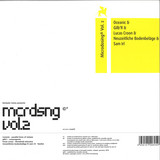
Microdosing is a series of compilation 12”s selected by Julienne Dessagne aka Fantastic Twins, and designed in collaboration with French visual artist Geff Pellet. Microdosing is a collective experiment aimed at helping you fighting back your modern obsession with happiness. You may deserve a nice day but the day does not need a nice you, nothing should be forced, everything is permitted. Microdosing will provide you with sonic healing weapons on regular basis and at irregular dosage. Those doses will favour psychedelic social techniques against self help tyranny, creation over soma, provoking over numbing, our outer-selves over our inner-selves. Microdosing refuses the fatality of the pleasure principle. Life is a struggle, time to embrace it. —— "My battery is low and it’s getting dark” We at Microdosing will make Opportunity’s famous last words fully ours. Some would see these as an epitaph on a black screen, we embrace them as a reclaimed fragility. Are we grains of sand wandering in space, hoping for a goal? No. We are the cosmos, the cosmos is us, unafraid of the end, unafraid of the void. Before the rise of the infinite silence, Microdosing brings you new guiding lights, white sun or black hole being a simple permutation of the kinetic rainbow. Oceanic’s “Parallel Lines Of Stripes” is a meandering mantra, an synthesised Moebius ring, a mission to your heart, that furthest star in the sky. Gilb’R’s “Cosmogonie” simply reminds us of the profound relation between spatial systems and the holy act of birth (cosmo, world and gon, conceive). The universe is a body, your body is your universe. Lucas Croon’s “Threshold Stimulus” is the soundtrack of a never ending voyage, the man is on a trip to the core sanctum. Imagine Space as a reverberation room cladded with bakelite. Losing yourself in delay repeats sometimes is the shortest way. Neuzeitliche Bodenbeläge & Sam Irl’s “Faeden” is another hymn to the umbilical chords joining us to the outer world, a black monolith of kraut acid, a pagan dance as portal to a destination only you can choose. Microdosing will be back soon with more enablers, helping to turn your petty struggles into a search for a meaning of life. The Quest lives on.
Jatinder Singh Durhailay and David Edren released Tea Notes as a cassette back in April of 2018. London-based Jatinder Singh Durhailay is a painter and student of Indian Classical music. He has trained in both the sitar and the Hindi singing technique, Dhrupad. He also plays two traditional Sikh instruments; the bowed, stringed Dilruba and Taus. Poetic Pastel Press issued his solo debut, The Last Ballad Of Mardana, in 2017. David Edren`s expertise lies with machines and modular synthesis. His Kosmische and New Age-Inspired electronics have featured on numerous cassettes, and compilations, produced for imprints from the current Belgian underground, such as Jj Funhouse, Social Harmony, and Ultra Eczema. These recordings appearing, since the turn of the millennium, either under his own name, or the moniker DSR Lines. Jatinder and David’s collaboration, Tea Notes, is a celebration, a meditation, on both the beverage, and the communal time shared imbibing. The coming together to partake in its ritual. Each of the six tracks represents a different infusion. The opening piece is a tribute to semi-oxidised Oolong, from China`s Wuyi Mountains, with hammered dulcimer-like glissando. Gongs shimmering, gently crashing, as if signaling a change in the weather. A calm of thin, stretched synths and Ai angels introduces Tulsi from India. The Holy Basil of Hinduism, used in the worship of Vishnu, Krishna, and Rama. A traditional herb of Ayurveda and Siddha medicine. Automated arpeggiated sequences raising a vibrating wall of hallucinatory sound. Pairing swooning strings with a racing robot heart. Ceylon is a modern twist on the classical raga. Serving to tell the story of a tea smuggled into Sri Lanka in the 19th century. Plants stolen from South West China, where the brew had been enjoyed since the days of the Shang Dynasty (1766 to 1122 BC). The contraband founding fresh industry in its new home when the indigenous coffee crops failed. Muted organ and sleepy, treated sine wave microtones describe Kava, the Polynesian fireweed root, whose extract serves as both sedative and euphoriant.Shincha are the first young leaves of the season. Picked in Southern Japan and steamed to prevent oxidization, retain their flavour and green / gold colour. Their musical counterpart finds Edren establishing an ecclesiastical drone, while Durhailay`s strings chart an ancient romantic ache. Sonic stars shine. Singing out to the infinite, the universe, before dissolving into knots of Radiophonic Workshop noise.Melodies treated with subtle sustain and delay denote Pu-Ehr, from the Yunnan province. The only truly fermented black tea - made distinctive by the action of bacteria, moulds, and yeasts. Its musical themes hovering in the vapour trails, the atmospheres, they themselves create. Spiraling, soaring, reaching for the heavens, while pretty music box glitches - tiny chimes turned in on themselves. Catching, reflecting, like light at play on fresh running water. (words: Robert Harris)
Our Danish secret weapon ANTN is back on Counterweight with his new monstrous release. Four original tracks with his very own and distinctive vision of techno.
Fast, straight, raw and pretty industrial, but without loosing the groove, that's our boy. If this wasn't clear for you yet, now you know why you should keep an eye on this excellent producer.
2019 marks the 20th anniversary of ‘Low Birth Weight,’ the second album by Piano Magic, then a loose collective of musicians centred around founder songwriter, Glen Johnson. Though a year later, the collective would take shape as a bona fide internationally touring group, in 1999, Johnson had one foot in his native Nottingham and the other in his new home of London where, finding himself label manager at Rough Trade Records, also became highly prolific, releasing his own records across a myriad of micro-labels (Che, Wurtlitzer Jukebox, Darla, Rocket Girl, etc).
By his own admission, ‘Low Birth Weight,’ owes much to the East London experimental group, Disco Inferno who, embracing sampling technology, attempted to turn pop music inside out. By 1995, the Inferno had burnt out but Johnson remained inspired by their playful, subversive manifesto and thus, the album here, partly produced by “Nottingham’s own Martin Hannett,” Martin Cooper, is difficult to pigeonhole either at the end of the millennium or even now. Drum kit signals are fed through a tiny amp literally inside a cardboard box; breathing is employed for rhythms; kick drums are replaced with broken glass; there’s a ragbag of tablas, huge slap back delay and phase, theremin, shortwave radio, and more.
Aside from the DI benchmarks, ‘Low Birth Weight’ bears the marks of an infatuation with the dreampop of the time – the guitar saturated in delay and overdrive – inspired by the likes of AR Kane and Kitchens Of Distinction and not the more languid “shoegaze,” which has oft been levelled at LBW.
There’s a revolving door of guests on the album, including Pete Astor (The Loft/The Weather Prophets) on a cover of Disco Inferno’s ‘Waking Up’; Simon Rivers of The Bitter Springs supplies lyrics and voice to ‘Crown Estate’ and ‘Dark Secrets Look For Light’; Jen Adam, then an American art student on a year’s placement in London, writes and sings ‘The Fun Of The Century,’ a personal account of being pushed off a roof at a party by someone she thought a close friend.
‘Low Birth Weight’ is undoubtedly of its time, though undoubtedly more playful and literary than much of the music made during the late 90’s and a fascinating bridge between dream pop and experimental electronic music.
Basic Rhythm follows up his album 'On The Threshold' with an EP that lays out theexplicit connections between hardcore and footwork. A connection made even clearer by the inclusion of a rare remix by Chicago footwork originator RP Boo.
2 Da Core's punchy rolling drums are levelled up against rough samples and a vocal hook pitched up and down in classic hardcore style. Get Up runs a tubby bass under hazy vocal samples and weird sound effects. RP Boo's remix of 2 Da Core disassembles the track into pieces, building a stalking helicopter-like rhythm which plays hide and seek with the samples, while the closing track Nuh Ramp rounds off the EP with tumbling micro-edited rhythms and a melody built from small colourful sounds that draw on the Caribbean roots of this music.
After last year’s excellent ‘Insula’ album, Proc Fiskal returns to Hyperdub with the six track EP ‘Shleekit Doss’; in his own words, “a kind of representation of the time I was running the club night of the same name in Edinburgh. These tunes represent the night’s ethos of genre-defiance and high-energy futuristic sets, ecstatic and transcendent while still being fun and stupid. I was getting my friends to play and I made all the posters on my phone - like this EP’s artwork. I also started hoarding old FM synths which crop up a lot on the EP, and was reading a lot of sci-fi like Isaac Asimov’s ‘Foundation’, and ‘2001’. The night ran until last November when the bouncers and some punters got in a fight, the club got damaged, and unfortunately I got banned too.”
Through this mayhem and misdemeanour, ‘Shleekit Doss’ feels like an oasis of calm; light, bouncy and melodic, the EP sees Proc developing the depth and range of his music in satisfying ways. The beatless, processed male voice choirs of ‘Satan’ open the set, breaking into glitchy drums before the melodies are time-stretched into a pretty drone and gentle rolling piano. Clouds of bittersweet synths waft across cut-up voices and clattering drums on ‘Smith’s Deli’, while ‘Pico’ is a driving mix of tight, tiny micro-edits that feel like micro-house crossbred with jungle breaks. ‘2 Moros’ takes the Sinogrime developed on ‘Insula’ deeper into dense rhythmic abstraction, and on ‘4 minutes’, charming synth melodies and 8-bit bass lines are threaded through skeletal drum machine kicks and snares. ‘Prop-O-Deed’ finishes the EP, Proc Fiskal displaying his inimitable gift for heart-wrenching anthemic melody, built around tuned Asian percussion and scratchy synth violin.
Inner atmos and next time – rain into rivers, rivers to rain.
Sequence is subjective, irrelevant – it’s where we stand. Out of order, we dissolve and reform, coming together to come undone. There is no first, no now, no next – just precision points in the wide deep sky.
Another bang, another – it’s the reading which is important. Repeating in parallel, the natural loop is healing; repair, resonance, return. We live in a fragment; soft light and clouds drift like dreams into memory, showing movement in the mirror.
“Here the performer becomes free like the playful clouds high above the world of pain, suffering, happiness, ecstasy, disappointment, greed and ambition of human life”
In this present, we are touched to have unreleased business from Memphis. In unlocking the stoic DAT tapes we open a direct channel from 1993 to this now; three tracks which are meditative, essential rhythm with direct, organic charge. It’s Dream Night Dance Music and Osram 509, with RHK, En-Trance, and Microgravity.
More poetry in remembering our first release was also Memphis. Big complex loops and inner paths. Who’s been here before? All of us, one of us, none of us.
Few albums have treated human voice and drone as a whole entity like ABoneCroneDrone, the third in a trilogy for Real World Records that this record closed back in 1996. In Sheila Chandra’s own words “it was about the gateways between vocal techniques from different cultures and how it was possible to cross between them within a single word or phrase.”
Indipop Recordings founder Steve Coe, probably best known for helping to popularise the term World Music in the early eighties, produced and worked with extreme accuracy along with Chandra on all drones and set a new industry standard of what was possible in the treatment of voice. With the help of bagpipes, didgeridoos and guitars, ABoneCroneDrone puts drones under the microscope and encourages listeners to retrain their ears to hear the nuances that musicians have always heard in them. Emitting low, chantlike waves, Chandra sings deep spaced atonal words while haunting chord sounds flow and drones slowly interact with listener.
This is the first vinyl pressing. It includes a fold-out insert with a new Sheila Chandra interview, original sleeve notes edited by Chandra herself and unseen pictures taken from the 1996 sessions. Limited to 500 copies, no digital release this time.
“The artistry of ABoneCroneDrone is in the attention to detail. The album is beautifully performed, mixed and compiled with intelligence and strong sense of structure. It makes good use of a listener’s valuable time while issuing a challenge to hear in a fresh way.” John L. Walters, The Wire issue 150.
In-demand deep modal jazz tune from Belgium featuring Babs Roberts!
The lesser-spotted jazz atoms that formed the fusion of Futurist Flanders! It might sound like an ambitious claim but having been a firm fixture at the top of many European jazz collector want lists over the past decade Finders Keepers wouldn’t be alone when proclaiming this extremely rare, lesser-known two-track 7” from 1969 as one of the best jazz 45s of all time! Alongside Polish pianist Krzysztof Komeda’s soundtrack 7” for the film Cul-De-Sac and ranking closely with François Tusques’ commemorative Le Corbusier exhibition 45 (featuring Don Cherry) this format-specific release known only as Brussels Art Quintet might well sit at the top of the podium while striking similarities and arguably combining the best stylistic traits of both aforementioned contenders.
This is all speculative and clearly a matter of individual opinion but it’s not often that one should find a recording from this era, comprising such high production qualities, keen compositional values and robust craftsmanship spread across two equally spellbinding individual tracks, all of which awards this record justified hyperbole albeit subject to a 50 year delay. It is safe to say that this unique release is “rare” on many levels. Like all privately pressed art projects this 45 comprises some serious outsider art trappings. However, on closer inspection it also stands as a pivotal record in the micro-genre of Belgian jazz, pin-pointing an early axis for some vital progressive jazz players who went on to become sturdy pillars of the central European happening.
Essentially as a five-piece, the short-lived Brussels Art Quintet neatly combines members of both the mythical Babs Robert Quartet (early exponents of Belgian spiritual jazz) and key players from the leading progressive jazz/rock/funk unit known as COS (formally Classroom) who would stand as close affiliates of the likes of Marc Moulin, Kiosk and Placebo through the 1970s. Reproduced in close collaboration with COS leader Daniel Schell, who, under the early guise of Daniel “Max” Schellekens, authored both tracks that make up this facsimile 45 single, this one-off single includes the only known output by the Brussels Art Quintet thus marking the essential in-road to instantly start and complete your entire BAQ collection not without reliving the early germination of the froward-thinking jazz fusion that came to shape Belgium’s truly unique movement.
Since completing his two-decade-long hip-hop trilogy as Dabrye in 2018, Ann Arbor-based artist and Bopside label head Tadd Mullinix has engaged his arsenal of aliases with renewed heat. First came the debut of X-Altera, a new project flexing a wildstyle hybrid of drum & bass and deep techno. Now, he returns to James T. Cotton, a moniker which dates back as far as Dabrye and helped define Spectral Sound, the dance imprint of Ghostly International. While historically tagged as Mullinix’s acid house alias, JTC has always expressed with a more pliable sense of genre, freely fusing an eclectic blend of classic electronic sounds; helpings of Chicago acid, Belgian New Beat, and the leftfield techno stylings popularized both in Berlin and Detroit. With Indigo, Flesh and Fire, Mullinix moves closer to the latter city, adopting a bright, optimistic tone informed by minimalism and futurism.
"I have been more withdrawn and introspective on a personal level, in a positive sense, and I think that fact has made my creativity reach toward feelings about peace, positivity, fantasy, wonder, and openness,” says Mullinix.
The EP is packed, but still playfully ambiguous; a club-ready set built to max out mixing boards with spacious and nuanced melodies and motorized percussion. Five tracks, each with roughly five-minute run-times, offering all but a few breaths in a quest for highly operative dancefloor hypnosis. The record wastes little time locking in; on the first track, “Innerloire Rendezvous,” a dense square kick plows through a brisk four-on-the-floor routine phasing over harmonious synth stacks of rubbery fifths and sevenths. The title track splatters a lenticular static spray between thumping kick, billowy melodic swells, and staticky clicks, snaps, and claps.
Mullinix’s distilled musical vocabulary, developed by his many years in the game, gives the set a misty-eyed quality without compromising its contemporary merit. This is music, inspired by history but fiercely forward-thinking, that feels both subterranean and airborne; in the grind on the ground and soaring above in an iridescent super-charged fog.
key selling points: - Debut release on Spectral Sound - Past releases on Firm Tracks, Nite Owl Diner, Sweat Equity, FCR, Clave - Limited to 300 copies worldwide.
Apollo are delighted to welcome the return of Australia duo Albrecht
La’Brooy AKA Sean La'Brooy and Alex Albrecht with their blissful new
album 'Healesville' recorded in a mud-brick hut on a strawberry crop
in the Melbourne countryside.
Apollo are delighted to welcome the return of Australia duo Albrecht
La’Brooy AKA Sean La'Brooy and Alex Albrecht with their blissful new
album 'Healesville' recorded in a mud-brick hut on a strawberry crop in the
Melbourne countryside. 'Healesville' follows on from the bucolic wonder of
their Apollo debut 'Tidal River' which took inspiration from the duo's visit to
the beautiful Wilson's Promontory (a remote national park on the South
East coast of Australia). "Late last year, we trekked out to a beautiful mudbrick studio located next to a large strawberry crop in Healesville," Albrecht
explains. "We spent a few days capturing the feeling of the slow-paced,
relaxed surrounds: The wildlife, the strawberry pickers, the sounds of the
night, and improvising a response to them with music we felt suited."
Setting up their favoured musical equipment, which included two pianos, a
Waldorf, a Nord and a clutch of microphones the long-form improvisations
began. "The physical construct of the hut imparted a warm and acoustically
interesting environment to record in," Alex explains. "It also allowed us to be
as close to the strawberry crop itself - we positioned a mic out the window
to capture the recordings of the sound outside. During one of the sessions,
a harvest was taking place, and you can hear tractors passing and workers
talking and laughing in the recording. The resulting drowsy pieces were
completely improvised (augmented by percussionist Joseph Batrouney,
guitarist Carla Oliver (Badskin) and guitarist Oliver Patterson), freeform
recordings that explores themes of relaxation, sleep and dreams;
somnambulant piano figures are caressed with delicate guitar passages
bathed in the bucolic field recordings of the Healesville environs. Recording
the album proved to be as relaxing and civilised a process as listening to it:
"We cooked nice dinners, enjoyed good wines, and took plenty of walks
through the landscape to break up the sessions," Alex shares. The resulting
record is one of quietly sozzled majesty - a delicate fusion of ambient
electronic textures, live instrumentation and field recordings that beguiles
and soothes the listener in these troubled times. — Recorded live at Earth
Mud Straw in Healesville by Alex Albrecht and Sean La'Brooy. Guitar by
Oliver Paterson and Carla Oliver (Badskin), Percussion/FXs by Joseph
Batrouney. Mastered by Corey Kikos. Thanks to Sabbine, Boomtown wines
and the strawberry pickers in Healesville.
'There's a lot of serendipity involved in wrestling grooves out of these awkward machines', says Richards about the process behind the record. 'A large part of the composition is making the machines and the patches. They define the limitations of the pieces coming together. Then the performances are happy accidents - found using intuition and practice.'
Made up of two studio sessions and one live recording, PINK NOTHING reflects the unusual space Richards inhabits musically. It's partly informed by his background as a PhD student at Goldsmiths, where he re-imagined and built the Mini Oramics machine – a 'drawn sound' instrument first conceived by electronic music pioneer Daphne Oram, and finally realised by Richards in 2016.
But Richards is also an autodidact beat-maker, and much of the structures and sounds on PINK NOTHING derive from dance music, while his influences also include ritual trance, Ghanaian drum choir music, and the cellular rhythms of Steve Reich. 'It's polyrhythmic abstract electronica' – and he emphasises – 'listening music'.credits
Suitman Jungle is a creation of percussionist Marc Pell. The idea behind it is a man in a suit playing jungle music. He uses his voice, plays a standing drum kit and utilises live electronics such as an SPD-SX, a clunky office keyboard and guitar pedals.
Suitman Jungle is the Director of RBS (Regional Bassline Services), a company that provides a wide variety of sub & mid-range bassline services internationally.
'Liquid Lunch' is an album influenced by the sounds of London and daily routines. It was produced in OpenOffice spreadsheet processor and mastered in a cracked version of Microsoft's Powerpoint. Track four, 'Nil Cash Option', is a recording of two gig-goers who gatecrashed Brighton's Great Escape Festival by pretending to be accountants. Track six, 'Lift Going Up', is about how some days one's mood can be better or worse than on other days.
Hyperdub launch new sub-label Flatlines for the release of ‘On Vanishing Land’, an audio-essay by Justin Barton and the late Mark Fisher. ‘On Vanishing Land’ evokes a walk along the Suffolk coastline in 2006, from Felixstowe container port ("a nerve ganglion of capitalism") to the Anglo-Saxon burial ground at Sutton Hoo. A walk under immense skies, through zones of deep time, and within sunlit, liminal terrains, into the eerie. Everywhere there are charged atmospheres, shadowy incursions, enigmatic departures. A derelict radar base, coastal heathland, drifting thistledown, towers of overgrown shipping containers - music haunted by wider levels of reality, narrations about rarely visited zones and potentials, voices of dreams and stories. This music includes newly-composed tracks by John Foxx, Gazelle Twin, Baron Mordant, Raime, Pete Wiseman, Farmers of Vega, Skjolbrot, Eerie Anglia, Ekoplekz and Dolly Dolly. Alongside these are glimpsed views toward M.R.James’s ‘Oh Whistle and I’ll Come to You My Lad’ (1904), Joan Lindsay’s ‘Picnic at Hanging Rock’ (1967), and Brian Eno’s ‘On Land’ (1982). Beyond the surface of the day something becomes visible, a way forward, an escape-path from capitalist reality. ‘On Vanishing Land’ is about following the lines of terrains and dreams. It is about a micropolitics of escape, of disappearance. A micropolitics of waking the faculties. ‘On Vanishing Land’ was initially part of an exhibition commissioned by The Otolith Collective and The Showroom in London, and after ‘londonunderlondon’ (2005) it was the second audio-work collaboration by Justin Barton and Mark Fisher.
The LP cover features photos taken by Mark Fisher, and a short essay by Justin Barton. Pressed on 180g vinyl, in deluxe rigid board sleeve, with free mp3 download code.