Following highly praised releases by Hermeto Pascoal & Grupo, Leonardo Marques, Xenia Franca, Moons, and Gus Levy, 180g and the legendary Disk Union continue to explore the best of today's Brazilian music scene with this wonderful album by Bruna Mendez. A chill, mellow and futuristic musical masterpiece with funky and electronic flavours, Corpo Possível leads the way to the new era of Brazilian R&B.
Bruna Mendez is a female singer/songwriter from the inland city of Goiânia, Brazil. Originally a lyricist, she began her musical career in 2008 to express herself as a musician, joining several bands in Rio as well as in her hometown Goiânia. After releasing her debut EP "Pra Ela" in 2014, Bruna released her debut solo album "O Mesmo Mar Que Nega a Terra Cede à Sua Calma" in 2016, which received critical acclaim in Brazil.
After this first album, Bruna also finds interest in electronic sounds and textures, and starts incorporating these elements into her music. Her second album here, "Corpo Possivel", is the result of such an encounter between electronic beats, addictive melodies and a band and musicians playing a tight and propulsive sound. All of this makes Corpo Possivel an album standing out in today's Brazilian music scene, where many extraordinary talents are produced. 180g and Disk Union are proud to release Corpo Possivel for the first time outside of Brazil. This is an essential LP by an artist promised to a bright future on the Brazilian and international scenes.
This album comes on 180g vinyl format.
Suche:mim
In the Company of Serpents traffic in sonic catharsis. Their music inhabits the strange fringes between sludge metal and sprawling spaghetti western scores, constantly striving for visceral power and raw intensity, contrasted with eerie, spare instrumental passages. Founded in Denver, Colorado in 2011 the band quickly managed to establish a name for themselves. Several releases followed in the years to come and In the Company of Serpents managed to impress the masses on stage as well. Late 2019/early 2020 the band started to work on their album ‘Lux’. It turned out to be one of the most impressive Doom/Sludge Metal albums ever recorded. The band self-released the album in limited edition during 2020 but soon afterwards Petrichor noticed their supreme musical qualities and decided to offer the band a chance to release the album worldwide. A deal was made, hands were shaken and you now all have to face the impending doom before you. The music of In the Company of Serpents is so intense it mimics the gravitational pull of a black hole.
- A1: Sketch For Dawn (1)
- A2: Portrait For Frazier
- A3: Jaqueline
- A4: Messidor
- A5: Sketch For Dawn (2)
- B1: Never Known
- B2: The Act Committed
- B3: Detail For Paul
- B4: The Missing Boy
- B5: The Sweet Cheat Gone
- C1: Danny
- C2: Enigma
- C3: Experiment In Fifth
- C4: Portrait For Paul
- C5: Favourite Painting
- D1: For Mimi
- D2: For Belgian Friends
- D3: Self-Portrait
- D4: Zinnia
- E1: Sketch For Summer (Live)
- F1: Requiem For A Father (Version)(Live)
After recording debut album The Return of the Durutti Column with producer Martin Hannett in 1979, virtuoso guitarist Vini Reilly purchased a TEAC four-track recorder from Bill Nelson and began producing his own material. These evocative demos were perfected by Reilly at Graveyard Studio with co-producer Stuart Pickering, with additional drums and percussion from Bruce Mitchell. Originally released by Factory Records in November 1981, LC is a key album in a body of work described by David Stubbs of Uncut magazine as ‘unique in rock, with Reilly’s scampering, watercolour guitar style building a tentative bridge between post-punk and the chamber sketches of Debussy and Ravel.’
On this expanded Factory Benelux the original ten tracks are supplemented by no less than 9 bonus cuts, including rare Sordide Sentimental single Danny/Enigma, and the three tracks Reilly contributed to A Factory Quartet in 1980 - his last recordings with Hannett, which feature Donald Johnson of A Certain Ratio on drums.
The remastered double disc set is housed in a gatefold sleeve printed on matt reverse board, with liner notes and archive images. The package also includes an exclusive 7-inch single featuring live versions of Sketch for Summer and Requiem for a Father, recorded at Leeds Polytechnic in October 1980. These are the earliest surviving professional live recordings of Durutti Column in concert.
»DNA« is Rosaceae’s second album for Pudel Produkte after last year’s acclaimed »Efia« for the Hamburg label. The eight tracks further explore the artist’s interest in the interplay of sound and language while also adding skittering rhythms and thumping kickdrums to the mix. »DNA« is a complex but enriching album that as a whole not only reflects ideas of resistance, solidarity and internationalism, but also how they are mediated and their meanings are shaped by different types of mediation. Whether Rosaceae seems to mimic the sound of rapid machine gun fire, indulges in gabber-informed beats or soothing, tinkling ambient sounds: by the end of the album the sonic experience could as much provide solace as it may be understood as an elegy, it has become abundantly clear that even the most straightforward usages of certain musical elements or statements on this album are more complex than they may seem at first. Much like »Efia,« »DNA« poses uneasy questi-ons but provides no easy answers—neither in sound nor in language.
Having already unearthed three collections of archival ‘70s recordings by Catherine Christer Hennix, Blank Forms continues their annual illumination of the visionary Swedish composer’s music by turning to more recent work with this first-time vinyl edition of Hennix’s “Blues Alif Lam Mim in the Mode of Rag Infinity/Rag Cosmosis,” a 2014 piece first released as a CD in 2016 (Important Records).
The double album captures the April 22, 2014 premiere of Hennix’s composition by by the Chora(s)san Time-Court Mirage, her expanded just intonation ensemble, featuring a brass section of Amir ElSaffar, Paul Schwingenschlögl, Hilary Jeffery, Elena Kakaliagou, and Robin Hayward; live electronics by Stefan Tiedje and Marcus Pal; and voice by Amirtha Kidambi, Imam Ahmet Muhsin Tüzer, and Hennix herself. Intended to reveal the blues’ origins in the eastern musical traditions of raga and makam, “Blues Alif Lam Mim in the Mode of Rag Infinity/Rag Cosmosis” has its roots in Hennix’s 2013 realization of an “Illuminatory Sound Environment,” a concept developed in 1978 by anti-artist Henry Flynt on the basis of Hennix’s own “The Electric Harpsichord.”
As Hennix explains in Other Matters, Blank Forms’ 2019 collection of her writings:
“Rag Infinity/Rag Cosmosis presents fragments of ‘raga-like’ frequency constellations following distinct cycles and permuting their order, creating a simultaneity of ‘multi-universes.’ When two such ‘universes’ come in proximity of each other and begin unfolding simultaneously along distinct cycles, there is a kaleidoscopic exfoliation of frequencies as one universe is becoming two, but not separated—the effect of cosmosis is entrained, binding two or more frequency universes into proximity where their modal properties interact and blend, creating in the process entirely new microtonal constellations in an omnidirectional simultaneous cosmic order with phenomenologically ‘transfinite’ Poincaré cycles (cyclic returns to initial conditions).”
As with Hennix’s best work, the organic unfolding of this quivering drone belies a precision that opens onto the infinitesimal. Upon its mesmerizing ebb and flow, the vocalists incant a devotional poem written in Arabic by Hennix and featuring quotations from the Quran. Also reproduced on the album’s gatefold jacket, Hennix’s reduction of the sacred text to its most elegant formulation invites the contemplator to bring their inner knowledge to the composition for use as a prompt for meditation. Yet the piece offers depth to even the most secular listener willing to immerse themselves in music brimming with such serene intensity.
Catherine Christer Hennix (b. 1948) started her creative life playing drums with her older brother Peter, growing up in Sweden where she heard jazz luminaries, such as John Coltrane, Eric Dolphy, Dexter Gordon, Archie Shepp, and Cecil Taylor perform from 1960 to 1967. Directly after high school, Hennix went to work at Stockholm’s pioneering Elektronmusikstudion (EMS), where she developed early tape music, incorporating computer generated speech done at the Royal Technological University (KTH), where she was an undergraduate student. After traveling to New York In 1968, she met artists Dick Higgins and Alison Knowles who invited her to stay at the Something Else Press Town House where she had the opportunity to meet, among others, composers John Cage, James Tenney, and Phil Corner. During the following years she developed fruitful collaborative relationships with many composers in the burgeoning American avant-garde, including, most significantly, Henry Flynt and La Monte Young. Young introduced Hennix to Hindustani raga master Pandit Pran Nath and she would later study intensively under him as his first European disciple. While Hennix continued to make music performing alongside Arthur Russell, Marc Johnson, Henry Flynt, and Arthur Rhames, she also served as a professor of Mathematics and Computer Science at SUNY New Paltz and as a visiting Professor of Logic (at Marvin Minsky’s invitation) at MIT’s Artificial Intelligence Laboratory. In recent years Hennix has led the just-intonation ensemble the Chora(s)san Time-Court Mirage, which has featured musicians Amelia Cuni, Amirtha Kidambi, Chiyoku Szlavnics, Hilary Jeffrey, Amir El-Saffar, Benjamin Duboc and Rozemarie Heggen. She currently resides in Istanbul, Turkey pursuing studies in classical Arabic and Turkish makam.
The Ember, The Ash is 鬼 from Unreqvited’s post blackened death metal project that explores the heavier, darker, deeper and weirder sides of the DSBM genre. "Throughout all of Unreqvited’s manifestations, 鬼’s roots in post-hardcore ring out in the form of bright, building riff-walls that welcome the dawn of a new day. More of a DSBM artist through his general emotional intensity that escapes the prison of despair, Unreqvited becomes a candle in the depths of darkness. Surely, there needs to be a place to store overwrought feelings in order to arrive at a place of hope, and that’s where The Ember, The Ash comes in. 鬼 has added the new band to his list of rock and metal ventures, and it is arguably the gloomiest yet. While his songwriting still very much mimics the building of a staircase, it is one that aims steadily downward to the pits instead of upwards to the heavens." - INVISIBLE ORANGES
Orange Vinyl
"Following on our first EP, 'Collisions', we wanted to explore the use of modular synths, and also hardware, in more depth. Exordium was crafted from countless modular jams, passed back and forth between London and Liege, and polished into a piece of work that captures our love for club music, with an experimental edge. We wanted to get out for a moment from the 170 which we are a bit more known for. Hopefully you will enjoy this exploration into our shared sound and influences as much as we enjoyed creating it."
- Fearful & Mtwn
Spindle Ensemble’s highly anticipated sophomore album is scheduled for a release on Thursday 27th May 2021 on vinyl, CD and digital download via Hidden Notes Records. The vinyl version will be accompanied by a special 12 page booklet which also includes liner notes written by celebrated DJ and Broadcaster Nick Luscombe (BBC3’s Late Junction/Musicity/Flomotion Radio).
In conjunction with the announcement a brand new single Caligo - with B side Menilmontant - was released via Bandcamp on Friday 5th February 2021 together with a unique music video that combines super 8 footage and scratched 16mm film visual artist Narna Hue (watch the video below).
A special socially distanced album launch concert is due to take place at St George’s Bristol on Thursday 27th May depending on COVID guidelines and restrictions at that time.
Since their formation in Bristol in 2016 contemporary chamber quartet Spindle Ensemble led by composer and pianist Daniel Inzani (Yola, Alabaster dePlume, Tezeta) which also features tuned percussionist Harriet Riley (Charles Hazelwood’s Paraorchestra, Bristol Symphony Orchestra), cellist Jo Silverston (Mesadorm) and violinist Caelia Lunniss (Edward Penfold) have garnered much praise for their innovative take on contemporary classical music, rooted in spontaneity and improvisation performed with deft musicianship and unique instrumental pairing all resulting in truly captivating sonic soundscapes.
Equally at home performing in concert halls such as the Union Chapel, Southbank Centre, Bristol Beacon, St George’s Bristol and festivals including Shambala and Hidden Notes to churches, art centres, record shops and independent venues across the UK they continue to bring their music to a diverse and ever growing audience.
Listeners may hear influences from composers such as Satie, Pärt, Ravel, Reich, Glass and Moondog in their music but might also find the soundtracks of Morricone and the minimalist aesthetics of the Penguin Cafe Orchestra nestled alongside the more experimental leanings of groups such as Rachel’s, Esmerine, Bell Orchestre and Amiina.
The quartet’s forthcoming album Inkling was recorded at various venues across Bristol, capturing their performances as unique 3D sound images enabling the listener to hear each instruments position mimicking the audible experience as a live audience member. Unlike their debut BEA, some of the compositions on Inkling also features a collection of guest musicians expanding their sound to an orchestral scale, featuring the addition of brass and percussion instruments.
In September 2019 the group released a double A-side single of Chase and Okemah Sundown from the album with accompanying videos by acclaimed Director/Cinematographer Fred Reed and stop-motion animator Marie Lechevallier.
Spindle Ensemble’s highly anticipated sophomore album is scheduled for a release on Thursday 27th May 2021 on vinyl, CD and digital download via Hidden Notes Records. The vinyl version will be accompanied by a special 12 page booklet which also includes liner notes written by celebrated DJ and Broadcaster Nick Luscombe (BBC3’s Late Junction/Musicity/Flomotion Radio).
In conjunction with the announcement a brand new single Caligo - with B side Menilmontant - was released via Bandcamp on Friday 5th February 2021 together with a unique music video that combines super 8 footage and scratched 16mm film visual artist Narna Hue (watch the video below).
A special socially distanced album launch concert is due to take place at St George’s Bristol on Thursday 27th May depending on COVID guidelines and restrictions at that time.
Since their formation in Bristol in 2016 contemporary chamber quartet Spindle Ensemble led by composer and pianist Daniel Inzani (Yola, Alabaster dePlume, Tezeta) which also features tuned percussionist Harriet Riley (Charles Hazelwood’s Paraorchestra, Bristol Symphony Orchestra), cellist Jo Silverston (Mesadorm) and violinist Caelia Lunniss (Edward Penfold) have garnered much praise for their innovative take on contemporary classical music, rooted in spontaneity and improvisation performed with deft musicianship and unique instrumental pairing all resulting in truly captivating sonic soundscapes.
Equally at home performing in concert halls such as the Union Chapel, Southbank Centre, Bristol Beacon, St George’s Bristol and festivals including Shambala and Hidden Notes to churches, art centres, record shops and independent venues across the UK they continue to bring their music to a diverse and ever growing audience.
Listeners may hear influences from composers such as Satie, Pärt, Ravel, Reich, Glass and Moondog in their music but might also find the soundtracks of Morricone and the minimalist aesthetics of the Penguin Cafe Orchestra nestled alongside the more experimental leanings of groups such as Rachel’s, Esmerine, Bell Orchestre and Amiina.
The quartet’s forthcoming album Inkling was recorded at various venues across Bristol, capturing their performances as unique 3D sound images enabling the listener to hear each instruments position mimicking the audible experience as a live audience member. Unlike their debut BEA, some of the compositions on Inkling also features a collection of guest musicians expanding their sound to an orchestral scale, featuring the addition of brass and percussion instruments.
In September 2019 the group released a double A-side single of Chase and Okemah Sundown from the album with accompanying videos by acclaimed Director/Cinematographer Fred Reed and stop-motion animator Marie Lechevallier.
Label Text "Dekmantel once again teams up with RE:VIVE, the cultural initiative setup by the The Netherlands Institute for Sound and Vision, to pair modern electronic talent with Dutch archival footage. The third EP in the Scores series sees Interstellar Funk and Italian producer Guenter Råler create innovative, modular soundscapes to the graceful visual arts unearthed from the EYE Filmmuseum archives.
As Interstellar Funk, Olf van Elden uses his production competency to craft a heavenly arpeggiated, synth composition to the amateur aquarium movies by J.L. Clement which are edited for this project by Sjoerd Martens. Filmed in the 1940’s, the video’s turn-of-the-century black-and-white style aquatic footage is reanimated through van Elden’s tacit polyphonic, modular sonic soundtrack. Layering together multiple sequences, van Elden pieces together the music as a whole, to mimic the way in which the film was created.
On the B-Side, Italian abstract artist and Dutch native Guenter Raler concocts a deeply introspective, and perfectly choreographed, ambient soundtrack to a select series of pieced together clips from the Collectie Natuurbeelden, the Institute’s Collection of Natural Images. The music plays against the depiction of multiple biological communities in transition; what is referred to as an ecotone. The title itself not only recalls that of a musical tone, but represents the ever-evolving aspect of life and nature as similar colours, along with movements of animals and plants pass on from one image to the next.
Within their own right, the new scores not only give the age-old films new context and sonic character, but exist as creative works as their own, full of resonance and individualism that highlight the retrospective artists’ voices to their fullest."
Rich in musical associations yet utterly singular in its voice, joyous with an inner tranquility, the music of Natural Information Society is unlike any other being made today. Their sixth album in eleven years for eremite records, descension (Out of Our Constrictions) is the first to be recorded live, featuring a set from London’s Cafe OTO with veteran English free-improv great Evan Parker, & the first to feature just one extended composition. The 75-minute performance, inspired by the galvanizing presence of Parker, is a sustained bacchanalia of collective ecstasy. You could call it their party album.
This was the second time Parker played with NIS. Joshua Abrams: “Both times we played compositions with Evan in mind. I don’t tell Evan anything. He’s a free agent.”
The music is focused & malleable, energized & even-keeled, drawing on concepts of ensemble playing common to musics from many locations & eras without any one specific aesthetic realization completely defining it.
“The rhythms that Mikel plays are not an exact reference to Chicago house, but that’s in there,” Abrams says. “I like to take a cyclic view of music history, can we take that four-on-the-floor, & consider how it connects to swing-era music? Can we articulate a through line? I dee-jayed for years in Chicago & lessons I learned from playing records for dancing inform how I think about the group’s music. The listener can make connections to aspects of soul music, electronic music, minimalism, traditional folk musics, & other musics of the diaspora as well. It’s about these aspects coming together. I don’t need to mimic something, I need to embody it to get to the spirit, to get to the living thing.”
For jazz fans, the sound of Parker’s soprano & Jason Stein’s bass clarinet might evoke Coltrane & Dolphy, even though they didn’t necessarily set out to do that & they play with complete individuality. Abrams sees a bridge to the historical precedent, too. “Since we first met in the 1990s, one of the things that Evan and I connected on was Coltrane’s music,” he says. “I hoped that we would tap into that sound world intuitively. In this case, I think that level of evocation adds another layer of depth, versus a layer of reference.”
Indeed, this is a performance in which the connections among the ensemble & the creative tension between improvisation and composition build into a complex mesh of associations & interactions. While the band confines itself to the territory mapped out by Abrams’ composition, they are remarkably attentive & responsive, making adjustments to Parker’s improvisations. When Parker’s intricate patterns of notes interweave with the band, the parts reinforce one another & the music rockets upward. Sometimes, Parker’s lines are cradled by the group’s gentle pulse & an unearthly lyrical balance is struck.
Drummer Mikel Patrick Avery is locked-in, playing with hellacious long-form discipline, feel & responsiveness. Jason Stein’s animated, vocalized bass clarinet weaves in & out with Lisa Alvarado’s harmonium to state the piece’s thematic material; the pulsing tremolo on the harmonium brings a Spacemen 3 vibe to the party. Abrams ties together melody & rhythm on guimbri, a presence that leads without seeming to. Like his bandmates, he shifts modes of playing frequently, improvising & then returning to the composed structure.
“As specific as the composition is, the goal is to internalize it & mix it up,” Abrams says. “The idea is to get so comfortable that we can make spontaneous changes, find new routes of activity, stasis & byways every gig. It’s like a web we’re spinning. If someone makes a move, we all aim to be aware of it, make room for it. Experiencing & listening is what it’s about, & Evan supercharges that.”
& “supercharged” is the word for this album. With Parker further opening up their music, descension (Out of Our Constrictions) is the sound of Natural Information Society growing both more disciplined and freer, one of the great bands of its time on a deep run.
Aguirre edition: Mastered by Helge Sten, Audio Virus, Oslo. Lacquers by Dubplates & Mastering. Liner Notes by Theaster Gates. LPs pressed on premium audiophile-quality vinyl at Pallas Records. US 2xLP edition available thru Eremite records.
- A1: Missing Highs
- A2: Caveat Emptor
- A3: Ultra Blue (Feat Newborn Jr)
- A4: An Obstruction In The Clear Plastic
- A5: What Else Do You Want? (Feat Baltra)
- A6: Utica
- A7: Salvaged Copper (Feat Terrence Dixon)
- B1: Basic Needs (Feat Nick Murphy)
- B2: Asmr/Exhaustion
- B3: Cement Object, Vacuum Sealed
- B4: Pain Tolerance
- B5: Muscle/Maintain/Feen (Feat Danny Scales)
- B6: Faith For The Weak
- B7: Life Out Of Balance (Feat Santpoort, Shigeto & Krzysztof Wodiczko)
Since his 2012 debut as Heathered Pearls, Jakub Alexander has constructed art — music, objects, installations, performances — as a way of re-imagining fragments of his past and mapping ideas for his future. The Polish-born, Michigan-raised, New York-based artist and producer sees imagery and narrative framework as fluid components to his craft. Alexander’s first album, Loyal, mimicked the hypnotic motions of ocean waves at night, offering melodic, loop-based ambient music as a tribute to the tasteful influence of his mother and aunt. The second Heathered Pearls album, Body Complex, found inspiration from comfort, imperfection, and visions of interior architecture, transforming Loyal’s soft textures into driving 4/4 figures, glacial tone drifts, and starry synth plateaus. His 2017 EP, Detroit, MI 1997 - 2001, reflected on a formative era through ephem- eral dance music. The third Heathered Pearls full-length,
Cast, returns to moodier loop formats joined by the distinctly new presence of the spo- ken word. The move mirrors the multitudes of its namesake: collaborators comprise a cast, healing in the bind of a cast, complex emotions and the shadows they cast. Alexander started work on Cast when living in Berlin and in Queens.
“I hit a wall listening to these tracks when they were instrumental.” This is where he diverged from previous modes, deciding to integrate speech. With a healthy distaste for aspects of performance art, he invited strictly non-scripted recordings, a series of anti-performances. This new format adds a surprising human element to music that has previously operated as sea-shapes or infrastructure. These flashes of language, Alexander’s close friends speaking about things, narratively and cerebrally, casually and profoundly, turn the distinctive Heathered Pearls sound into some- thing surprisingly gritty, tangible, and in certain sweeps, cinematic. It is as if the world outside of these compositions bleeds into the music, casting their verbal being from just off the surface, like the album’s cover artwork where the light hits the plexi object but misses the wall.
Alexander sees his covers as naturally unfinished workstations; the gauzed and patinaed copper on Cast continues in this philosophy. This is all to say Cast deals with absence as much a presence. Among the guest storytellers is Alexander’s friend and tourmate Nick Murphy (formerly Chet Faker), who unwinds a series of tender observations on “Basic Needs.” The swirling synthesizer immerses a series of empathies; feeling like an egg yolk, a window’s view, his love for the color yellow, and wanting yellow to love him back.
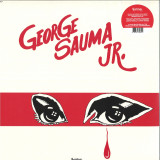
Favorite Recordings proudly presents an exclusive eponymous LP by Brazilian singer and composer George Sauma Jr., originally produced in 1985. Imagine a never-marketed release on which you’d hear not only the beautiful and genuine George’s songs but also the work from two figures of the Brazilian Music Golden Age: Arthur Verocai and Junior Mendes! A much-needed album for all Brazilian connoisseurs.
Back in the days, George Sauma Jr. was a young artist from Rio de Janeiro, learning on his side how to play chords and compose songs since he was 10. Still at the university, he’s influenced by Brazilian artists like Cassiano or Tim Maia, deeply fascinated by the arrangements and the “levada” (the groove) of all these new Brazilian songs. Simple and romantic music that resonated to his soul and creativity.
Around 1985, the story took an unexpected turn. George tells: “Dna Deyse Lucidy, the mother of Junior Mendes was a candidate for deputy and went to my father’s company to advertise. When I saw her, I shouted, “I’m a big fan of your son!” ” Of course, she could not praise more the work of her son. On her advises, George went to his studio on Rua Siqueria Campos at Copacabana. Junior loved the project and sent him to Arthur Verocai to improve the arrangements. Without money, the decision was taken to record everything at Junior Mendes’ studio on an 8-channel mixer. It was a small set-up but the emotions were there! George surely had other plans for some of his songs but without the budget, they ended up doing everything the best they could. And they did very fine with a top-notch team of musicians: Paulo Black on Drums, Arthur Verocai on Guitar, Ricardo Do Canto on Bass and Helvius Vilela on Keyboards.
Leaving the studio with the tapes, George tried to knock doors of international labels, but none did even dare to give him an answer. With less than 1000 copies pressed back in the days and without any distributor or label behind him, he went with proud to record stores, but received nothing than a strong reality check regarding the difficulties for a young Brazilian artist to achieve something on the saturated market of the 80s. Even for free, record stores didn’t want it. In the end, he ended up giving copies to friends and families, knowing deep inside that the songs were good! George tells: “I decided to leave, calm and conscious. I’ve still made three more albums, however on tapes, as it was more affordable. This time, just for my pleasure…”.
Thirty-five years after, it’s with great emotion that this first album by George Sauma Jr. is now made available as Vinyl LP with its original offset printed innersleeve & CD
Hawkwind have always been associated with music festivals, most notably the free festivals, where Dave Brock has said that, at
those events, the band is not shackled to appease an audience by giving them what they expect and have paid to see. With that obligation removed, the band can relax and experiment more than usual and gigs become even more fun. Their sessions, where they played for free, sometimes with the Pink Fairies, at Canvas City, outside the official site of the Isle Of White Festival in 1970, are a matter of legend and Nik Turner gained much attention when he painted his face silver and was much photographed as a result. During his set, Jimi Hendrix referred to him as 'the cat with the silver face'. However, when we think of Hawkwind and festivals, the word Stonehenge leaps to the fore.
The band always loved being there, enjoying the whole event as well as the freedom of how and when they played. This was not a time of business, but a time of fun. The most important one of these was Stonehenge 1984, which proved to be the last festival before the authorities moved in the following year to block the festival from being set up and Hawkwind ended up playing a few miles away instead. It was the sad end to an era. It had taken place twelve times and, had it been allowed one more time, it would have become a public event and the powers that be were determined to prevent that from happening. Happily, the 1984 festival was recorded and filmed and the Hawkwind Solstice Eve and Solstice Morning were both preserved...and we should be grateful for that.
The fact that Hawkwind were playing for free didn't mean it was a basic show. As well as the line-up of Dave Brock, Harvey Bainbridge, Huw Lloyd Langton (who played the evening session, but not the following morning), Nik Turner, Alan Davey and Danny Thompson, there were half a dozen dancers, a mime artist and fire spitting. A free event, it was the ideal time to introduce the new rhythm section to the band in the form of Danny Thompson on drums and Alan Davey on bass, with Harvey moved to keyboards. A move which was to have a long term affect in the way he made music, leading to his solo career, as well as years playing synths for Hawklords, in years to come, after his stint as the Hawkwind keyboards player came to an end.. Danny fitted the bill comfortably and drummed for the band until he left in 1988, to be replaced by Richard Chadwick. Danny went on to play for other bands including Bedouin and Pre Med. He also recorded a cassette album called Skinwalker. Alan made a good team alongside Dave Brock and it can be seen on the video just how pleased he was to be playing alongside Dave Brock, a man whom he had only met for the first time in November 1982, backstage at the Ipswich Gaumont. He went on to be the longest serving Hawkwind bass player, before moving on to pursue solo projects and form a nmber of bands. So in terms of the line-up, Stonehenge 1984 had a notable impact on the formation of the band for a number of years and, indeed, the destinies of Harvey, Danny and Alan. As if that were not enough to make the event special in the annals of Hawkwind, they played an interesting and varied main set in the evening, featuring a blend of old and new Hawkwind songs, along with numbers from Inner City Unit and
Bob Calvert's Lucky Leif And The Starfighters album. In keeping with the relaxed atmosphere, there was a considerably extended
version of Ghost Dance, lasting around ten minutes. The sunrise set was special too, with a long, laid-back, jam at dawn, in fitting with the occasion.
A lovely and relaxing start to the day and the kind of jam they couldn't really play to a paying audience. It's good to have the
memories of this significant festival gathered together in three formats.
Enjoy this special set, which commemorates a special event, not only in the history of Hawkwind, but of the saga of Stonehenge festivals.
180 gram reissue of Rita Lee's (Os Mutantes) debut solo album, originally issued in Brazil in 1970. Orchestral arrangements by Rogerio Duprat and production by Arnaldo Baptista, with a cover of The Beatles' "And I Love Her."
- 1: You Just Haven't Earned It Yet, Baby ('Free World' B-Side)
- 2: Closer To God? ('Free World' B-Side)
- 3: La Forãªt De Mimosas ('Free World' B-Side)
- 4: Please Help Me, I'm Falling ('Days' B-Side)
- 5: Still Life ('Days' B-Side)
- 6: Happy ('Days' B-Side)
- 7: El Paso ('Days' B-Side)
- 8: Clubland ('Innocence' B-Side)
- 9: Don't Run Away From Me Now ('Innocence' B-Side)
- 10: Other People's Hearts ('Don't Come The Cowboy With Me Sonny Jim' B-Side)
- 11: Complainte Pour Ste Catherine ('Don't Come The Cowboy With Me Sonny Jim' B-Side)
- 12: Am I Right? ('Don't Come The Cowboy With Me Sonny Jim' B-Side)
Was hätte die unter tragischen Umständen viel zu früh verstorbene Sängerin noch für Platten machen können! Zusammenstellung von B-Seiten u.a. vom Album 'Kite', das mit Produzent Steve Lillywhite und Johnny Marr entstand, und diverse Hitsingles abwarf. U.a. mit der Smiths-Coverversion 'You Just Haven't Earned It Yet, Baby'. 'Other People's Hearts erschien in kleiner Auflage zum RSD und ist nun aufgrund der Nachfrage nochmals als 140 Gr. LP (Black Vinyl erhältlich).
- 1: Tenha Pena De Mim
- 2: Boato
- 4: Fala Baixinho
- 5: Marambaia
- 6: O Samba Está Com Tudo
- 7: Cadeira Vazia
- 8: Perdão
- 9: Beija-Me
- 10: O Bilhete
- 11: O Samba Brasiliero
- 12: As Polegadas Da Mulata
- 13: Eu Quero É Sorongar
One of the most shocking but ultimately uplifting stories of Brazilian music: Soares grew up in extreme poverty in a favela, at 13 was forced to marry a man who raped her, gave birth to three stillborn children - but still fought her way to the top of the industry, married Garrincha, lost him to booze & loose women, in addition to their son and her mother in car accidents. And is still going strong! This is probably her best album and indeed is absolutely lovely, grooves like nothing else. She sings with passion & fire in her lungs like the fabulously versatile singing magician she is. Her husky voice became her trademark. After finishing A Bossa Negra - her second album - Elza went to Chile to represent Brazil in the 1962 Football World Cup, where she met with Louis Armstrong personally.
This is the first ever archival collection of material from the Italian Minimalist Tiziano Popoli, featuring fourteen previously unreleased recordings for installations, theater, and radio broadcasts spanning from 1983 to 1989. Featuring extensive use of the Yamaha DX7 synthesizer, TR909 drum machine, and early sampling techniques, these recordings trace the organic, hybridized elements of Italian experimental music as it convened in the hands of Tiziano Popoli and his friends, uniting elements of pop music, minimalism, and manipulations of found sound. Popoli's first album, Scorie, recorded with Marco Dalpane, is a highly sought after LP, and was finally repressed in 2018 by Italian label Soave. "Burn the Night / Bruciare la Notte: Original Recordings, 1983-1989" is a joint release between RVNG Intl. and Freedom To Spend, and was compiled from hours of material unearthed by Tiziano Popoli from his archives, and then meticulously remastered from original sources by Rashad Becker. The 2xLP and CD include printed inner sleeves and booklets with extensive liner notes written by Bradford Bailey, archival photographs, and ephemeral enrichment. RIYL: Philip Glass, Franco Battiato, Lino Capra Vaccina, Oren Ambarchi, RAMZi, Roberto Musci, Faust, CAN, Art of Noise, Durutti Column, Roberto Cacciapaglia.
Two versions of this much-loved gem (covered by Led Zeppelin and Roger Daltrey from The Who more recently), ‘As Long As I Have You’ was the
title track of Garnet Mimms’ first solo album from 1964 which made a brief appearance as a seven inch and now goes for £500.
The slightly longer ‘Single Version’ made it to demo-only in France in 1967 and is a super rare cut - an edited live version with brass courtesy of
The Senate that goes for around £400 if you can find a copy. Remastered here from the original sound source.
Hello Sailor Recordings is back with its first (and last) release of 2020, this time with another excellent addition to the beloved 7" series.
The chaotic sounds and lyrics of 'Sera que eu to Pirada' originally released in 1995 by short lived band Silvanna & A Maquina do Tempo, feels current amidst the challenging times we face and it's accompanied by 'Vem Viver Pra Mim' on the flip side.
Both songs were elegantly edited by Sao Paulo mystery producer Hotaru for this Brazilian holy grail of early electro and proto-house
- A1: Yoko, Ai To Kako (Mimikazari) (3 43)
- A2: Noriko, Ai To Omei (Utsukushiki Emono) (3 11)
- A3: Chie, Ai To Shinjitsu (Ame No Hi No Wana) (3 45)
- A4: Miyako, Ai To Tsuiseki (Koi No Wana) (2 53)
- A5: Nobuko, Ai To Tobo (Shi To Sora To) (5 15)
- B1: Miyako, Ai To Gisei (Aoi Kemonotachi) (4 11)
- B2: Misako, Ai To Kibo (Tobosha) (2 53)
- B3: Sakiko, Ai To Uragiri (Hitokui) (3 43)
- B4: Sanae, Ai To Kyofu (Konoha No Fune) (4 45)
Presented by Mitsuko & Svetlana Records, distributed by WRWTFWW Records.
A golden era gem from the master himself.
Archival reissue of long lost treasure from genius pianist and composer Masahiko Satoh whose resume includes hundreds of legendary albums and collaborations with Midori Takada (Lunar Cruise and Ton•Klami) among many others.
Very rare soundtrack of a 9-episode suspense drama that aired on TV in 1969 and 1970. Filled with exquisite jazz, soul-jazz, folk-jazz, and mystery-jazz, plus groovy affairs, classical moods, and 70s flair.
Highly recommended to Japanese jazz collectors, soundtrack collectors, Masahiko Sato collectors, lovers of rare gems and wearers of vintage trench coats.
All compositions and arrangements by Masahiko Sato
Masahiko Sato: piano, keyboard
Yoshiko Goto: vocal
Kiyoshi Sugimoto: guitar
Kunimitsu Inaba: bass
Yasuo Arakawa: bass
Akira Ishikawa: drums
Originally released in November 1970 as an LP on Toho Records (BL-1001)
"Tensal - Graphical" album split.
Up next on Jimmy Rouge’s Orange Tree imprint is Moving Still aka Jamal Sul. Following his Dar Disku release, supported by Hunee and Palms Trax, Jamal steps up with an eclectic four track EP full of Arabic influenced chuggers, a style quickly becoming synonymous with the young Dublin based producer.
We are proud to present another debut on Axces Records, this time from label head Alfredo92. The A side kicks off with Mimis, an explorative bass driven track with crisp snares and bubbling synthesizers. Next up is the title track Helfand, whose experimental sounds and textures take things in a mystic IDM like direction.
On the B side we Adax_pcp, a hypnotic club cut which further explores complex pulsating outernational rhythms. Finally to seal the deal we have Scalex, a twisted dancehall tune with splashes of futuristic sound design.
To call Marcos Valle 'a legend' of Brazilian music is much more than just easy press-release hype. As singer, writer, musician and record producer, Marcos has played an integral role shaping the sound of the country’s music from the 'golden era' of the 60's and 70's, through to the modern day. Alongside his brother, Paulo Sergio Valle, they have penned a huge catalogue of classic songs, not just for themselves but for other greats such as Elza Soares, Astrud Gilberto, Claudia to name a few.
‘Braziliance!’ takes things back to the early heady days of Marcos’ career with the bright and optimistic sound of Rio's Bossa Nova scene. It includes an instrumental version of ’Crickets Sing For Anamaria’ or 'Os Grilos’ in Portuguese, which would also be re-recorded with vocals. Though only in his early twenties at the time, ‘Braziliance!’ depicts very sophisticated production for a musician so young. Recorded in 1966, produced by Louis Oliveira and Ray Gilberts with arrangements by the very talented Emir Deodato, the album was released on Warner Bros. Records.
The artwork presents a very clean-cut, wholesome looking Marcos but darker things were around the corner for Brazil. The ‘Tropicalica’ movement was on its way and about to shake thighs up both musically and politically.
Unlike some of his Bossa Nova contemporaries, Marcos continued to stay relevant, surfing the changes and adapting to the musical developments that culture and society projected and needed, without comprising his art. Under exclusive license to Light In The Attic Records & Distribution, LLC | Mr Bongo Records.
Pedro "Ramayá" Beltrán, born in Patico, a small town in Colombia's Bolívar province, is a maestro of Colombian folkloric music known as the King of the 'caña de millo' flute, although he is also proficient in various percussion instruments as well as the reed instrument known as 'gaita'. He founded La Cumbia Moderna de Soledad in the early 1970's. With this group he set out to "modernize" the folkloric music of his people, adding electric bass and a brass section to
fresh arrangements of cumbias, porros, fandangos, puyas and other costeño genres. "La Clavada" (1979) was La Cumbia Moderna de Soledad's sixth record and first for Codiscos' Costeño imprint.
The LP has many excellent examples of Beltrán's inventive mix of the ancient and the modern, making for a collection of tunes brimming with tradition and yet fearlessly bristling with innovation, not the least of which is 'Crees que soy sexy', with its gaita refrain mimicking the main melody of Rod Stewart's international disco smash 'Da Ya Think I'm Sexy'.
The album's title song was a massive hit in Colombia and has become a standard of the genre. Restored to its original glorious sound, this LP is poised to be rediscovered as an innovative yet rootsy gem. Presented in facsimile artwork and pressed on 180g vinyl.
Part of Vampisoul's reissue series of classic LP's from Colombia's Codiscos and it's sublabels such as Zeida, Costeño and Famoso.
“Experimental trio Giraffe crystalize time on ‘Desert Haze’, their new LP on Marionette. Giraffe is the musical project of Sascha Demand (guitar), Jürgen Hall (keys), and Charly Schöppner (percussion). Sascha Demand is a composer that comes from a contemporary and improvised musical background, collaborating with the likes of Ensemble Integrales and Vinko Globokar. Jürgen Hall works in electroacoustic experimental projects, theatre and film scores, with releases on Staubgold and Edition Stora. Charly Schöppner is known for his popular music releases such as Boytronic on major production companies in the 1980´s and composes for theatre, dance, and film scores. With only a couple of releases to date on the wonderful Meakusma imprint as well as an EP on Marmo, little is known about Giraffe. After letting go of other artistic projects, the trio now focuses solely on Giraffe by continuously searching for and finding their own unique language.
Sascha, Jürgen and Charly have quite diverse musical backgrounds, though morphing into Giraffe they tower into one single composer. Their music is a critical statement, not in a political sense but rather an artistic one. Being mindful about what it means to create and how to position themselves as artists nowadays (without the constant hassle of being en vogue and short-lived trends) shaped their rather rare and stoic artistic stance. It is refreshingly honest to see their expression develop so naturally.
On Desert Haze, they’ve created a vibrant and minimalistic tribal sound that feels inspired by the Saharan traditional music of the Tuareg, Jazz, and German psychedelic krautrock. Giraffe themselves also list the radical music of the Viennese School (Schoenberg along with his pupils Berg and Webern) as well as the Köln School with its early electronic experiments as their main influence and inspiration. More precisely the composition process and the organization of musical material within space and time, where a conceptual and intellectual approach melds with an experimental yet expressive sound searching method.
Side A focuses on the trios studio work; it is built around tone color and pitch analysis of resonating prepared guitar sounds. Through a unique mixture of free improvisation and a serialism "rule set”, they develop instrumental layers and structures to form their tracks. Side B sees Giraffe playing more freely with a reduced setup - representative of what you may hear when listening to them live.
Desert Haze, along with its track-titles, showcases an almost mimetic approach to art. The haptic music grabs the listener not as a passive recipient but as an active resonant body to vibrate through. One can almost feel the Elements, pressure and heat forming a diamond, hypnotic overtones ringing through windy caves, shamanistic rhythms conjuring up mysterious and ancient landscapes - where the constant cycle of sedimentation and erosion reveals structures of fragile beauty - always gentle to the hand’s touch and the mind’s eye.”
Neurot Recordings are proud to reissue the landmark collaboration Neurosis & Jarboe, which was originally released in 2003. This latest version is fully remastered and with entirely new artwork from Aaron Turner.
Very limited silver metallic and black swirl 2LP - Non-Returnable
Steve Von Till explains the idea behind the remastering; "Bob Weston (Chicago Mastering Service, and member of Shellac) worked closely with Noah on making these new versions sound as good as the possibly can. Noah has the most trained critical ear for fidelity out of all of us being an engineer himself. We recorded this ourselves with consumer level Pro Tools back then, in order to be able to experiment at home in getting different sounds and writing spontaneously. The technology has come a long way since then and we thought we could run it through better digital to analog conversion and trusted Bob Weston to be able to bring out the best in it....This new mastered version is a bit more open, with a better stereo image, and better final eq treatment."
He continues about the original artwork..."Aaron felt he could create something that would unify the energy of both Jarboe and Neurosis in an elegant manner. We let him do his thing and I think it definitely adds to mystery of the album and sets it apart from the rest of our catalog."
When two independent and distinct spheres overlap, the resulting ellipse tends to emphasise the most striking and powerful characteristics of each body. Such is the case with this particular collaboration between heavy music pioneers Neurosis and the multi-faceted performer Jarboe (who performed in Swans and who has collaborated with an array of people from Blixa Bargeld, J.G. Thirlwell, Attila Csihar, Bill Laswell, Merzbow, Justin K. Broadrick, Helen Money, Father Murphy, the list goes on...) The musicians pull from one another some of the most harrowing and unusual sounds ever heard from either artist at the time - a sentiment which also rings true to some 15 years later.
Neurosis & Jarboe opens with a high-pitched whirring sound winding up as Jason Roeder's ominous tom-drum beat and Noah Landis' slinking synth line writhe in unison until Jarboe drops in, drawling in her characteristic, corrupted Southern belle voice, "I tell ya, if God wants to take me, He will." From there on in, the album is a series of abrupt shifts and cleverly juxtaposed themes that flows in a rhythm of its own. The sinister and ethereal sounds, vocal coos and electro-pulses of "His Last Words" seem like the perfect soundtrack to a David Lynch film. On "Erase," song parts are dissected and grafted one atop the other, continually building tension as Jarboe wails and yelps with Banshee fervor.
The project began with the artists working in seclusion, recording the elements that would best highlight their own characteristic integrity and personality, rather than either attempting to mimic one another's familiar elements. As recorded ideas were passed back and forth, the collaboration proved to bring out the most unhinged and urgent talents of all those involved.
Throughout the album, that signature "Neurosis note" - the sound of something simultaneously recoiling and erupting, the apocalyptic tone announcing the birth of a new world - reaches its apex and becomes evermore icy and eviscerating. Guitarists Steve Von Till and Scott Kelly trim their tones for cleaner, chorus-drenched effects layered between the thunderous distortion blasts of bassist Dave Edwardson. Likewise, Jarboe's operatic wail and other vocal contortions sound perfectly suited to the eruptive emotional fray of the music.
The collaboration is a deeply textured mosaic that is a culmination of merged aesthetics from two major influences on free-thinking sounds. It unlocked the hidden potential of electronic music as a new force in heavy rock. At a time when groups like Oneida, Wolf Eyes and Black Dice were beginning to experiment with technology in making mind-numbing leaden electro-drone freed from any essence of "dance music," Neurosis & Jarboe redefined all notions of their past - and outlined the course of heavy music to come. It's interesting to look back through the lens of this release, and think about these ideas and concepts in the present.
Neurosis & Jarboe remains the meeting point of all art that takes us beyond ourselves.
Attraverso is the debut album of new ambient trio PCM. The band consists of Francesco Perra (P) who also records solo as Perry Frank, Pop producer and sym- phonic ambient composer Matteo Cantaluppi (C), and sound designer/engineer and PCM creative director Matteo Milea (M). The album was conceived after a brief studio session exposed that each member brought something unique to their collaborative take on ambi- ent's many sub-genres. Attraverso, in concept, is meant to mimic four long-form journeys through human inner consciousness utilizing an amalgam of drone, modern composition, guitar ambient, and Koyaanisqat- si-eque arpeggiated kosmische musik. Each track title is the word "Attraverso" with three of the four being represented in different languages.
Attraverso is out October 18th on limited edition 180-gram ultra clear vinyl and gatefold compactdisc.
Kompakt welcomes veteran contemporary experimental producer Marcus Schmickler with the release of his spectacular noise/techno fused medallion entitled “Particle/Matter-Wave/Energy”. Marcus Schmickler’s fifty plus release discography is one of the most fascinating in his field. From his studies under Cologne based Stockhausen collaborator Johannes Fritsch to his releases through legendary imprints a-Musik, editionsMego and Mille Plateaux, over the years Schmickler has been behind innumerable collaborations and sonic explorations. Be it through his ground-breaking indie/electronic band Pluramon or through his releases that have included collaborations with musicians such as John Tilbury, Thomas Lehn, Julee Cruise or MIMEO he has even had his works being performed by ensemble recherche, musikFabrik or Paragon Ensemble. Beyond continuing to perform on the world stages, he authors theatre and film and currently teaches at Institut für Musik und Medien in Dusseldorf. This brings us to the release of "Particle/Matter-Wave/Energy" - a 37 minute long piece (split into 2 parts on the LP version) that explores the borders of a scientific universality of sonification towards something that becomes a singular experience – sound. The pieces’ foundational aim was to create an acoustic rendering of what it sounds like when two galaxies collide by gravitational forces. To avoid this one sheet getting lost in theory, the audible result of “Particle/Matter-Wave/Energy” is an incredibly, immersive work that is required listening from start to end. Contemporary experimental music and modern techno collide as waves of synths caress the listener through intense waves of frequency variables. The orchestral enormity of the piece is both discomforting yet embracing as the listener feels engulfed with it’s robotic caress.
White Vinyl
EMEX is the emergent project of George Apergis who is the owner of Modular Expansion and is based in Athens & Berlin. EMEX "Mimas EP" includes two original tracks "Mimas" a hard kicker with minimal synth-lines, percussive rhythms followed by trippy arpeggios and "Andromeda" a hypnotic, minimal track with deep Berlin influence chords, which progresses into darker territories while the dark strings come. The release includes also two massive remixes. The first one "Mimas" has been remixed by Radial, who has created a perfect groovy tool with his unique classic style, an instant hit. The second remix is coming from SLV, who is making "Andromeda" darker with his pumping futuristic version.
With the release of their first two albums and live shows supporting Snarky Puppy, Roy Ayers, Marcus Miller, Larry Mizell & the Blackbyrds, Butcher Brown, Yellowjackets and more, Resolution 88 have already established themselves as one of the UK's leading exponents of funk jazz. Their music is synonymous with the silky, buttery sound of the Fender Rhodes. They're also a bona fide band, a refreshing change in a musical world increasingly occupied by online collaborations and viral videos. They're best mates who love to hang out, play together and make their own music - that sincerity is evident in their songs and their chemistry on stage.
'Revolutions' represents a lot of firsts - the first time Resolution 88 have recorded to multi-track tape, the first time that they've included a real string and brass section, the first time they've included special guests on record and the first time they've pressed an album on vinyl. Imagine a combination of an undiscovered Herbie Hancock album from the mid' 70's, rare-groove samples from the golden era of hip hop (ATCQ, Pharcyde etc) and the new London sound of bands like Yussef Kamaal.
Every track on'Revolutions'represents an aspect of music on vinyl. On'Pitching Up'you hear the DJ pitch the record up from 33rpm to 45rpm.'Out Of Sync'simulates a clumsy attempt at beat-matching. The hypnotic, circling sax line that opens the title track'Revolutions'(echoed by the strings at the end) evokes the mesmerizing sensation of watching the record label artwork whirling as it spins on the platter.'Runout Groove'fades in and out; the drum beat mimics the distinctive, perpetual rhythm tapped out by the stylus as it reaches the runout groove. On the second side,'Sample Hunter'unexpectedly deviates from the main section into Rhodes-drenched interludes; the type of moment that producers searched high and low for back when hip hop was great.Marcus Tenney's (Butcher Brown) lyrics on 'Dig Deep'are all about the thrill of digging for records and'Matrix'is inspired by the hidden messages sometimes left in the matrix markings on record pressings. On'Tracking Force', you can hear the beat twist and morph as the stylus skates over the record. Finally,'Warped Memories'closes out the album with a wistful, melancholy melody. Sit back with a glass of Japanese whisky and a Cuban cigar (or whatever your chosen poison is), stick the album on and enjoy it from start to finish - although if you're listening to it on vinyl, you'll need to get up to turn it over to the B-side ;)
- A1: Penny Penny - Shilungu
- A2: Alaska - Accuse (Instrumental)
- B1: Ze Spirits Band - Tucheza (Esa Extended Mix)
- B2: Nonku Phiri - Sîfó (Feat. Dion Monti)
- B3: Os Panteras - Melo Do Anjo (Outra Edit)
- C1: Pascal Latour - Lague Yo (Boulo Edit)
- C2: Masalo - Yera (Feat. Doussou Koulibaly)
- D1: Esa - Pantsula Traxx
- D2: Narchbeats - Cheeks
- D3: Dj Spoko - #Justsnares
Esa's compilation Amandla: Music To The People holds diverse dancefloor tracks from over the world. The first compilation in 2019 for Soundway and a comprehensive picture that connects the dots of Esa’s musical journey.
Growing up in Cape Town, South Africa, during the last days of Apartheid, Esa recalls the immense power that music had in resisting oppression and division. “Amandla, Awethu”, which literally means “the power is ours”, was an ubiquitous chant echoing throughout the politically charged atmosphere of the time – a call to unite, and a call from which this release derives not only its title, but its intention as well.
“Music was a crucial way of bringing people and communities together”, reflects Esa, “and it’s what I hope to achieve with this compilation, too”. For Esa Williams is not only a musical polymath but also passionate about connecting people through music – be it as a skilled DJ, an educator in production, a band leader reigniting the legendary Ata Kak band from Ghana, or a collaborator with the likes of Tanzanian artist Mim Suleiman. A firm favourite on the DJ circuit, he held a monthly residency at Phonox London for over 6 months - bringing guests such as Nu Guinea to Brixton audiences - as well as delivering memorable sets at Dekmantel, Atlas Festival, Boiler Room and more.
The last few years have seen a recent surge in interest in South African music from the 80s and 90s, including bubblegum, which was recently showcased on Soundway’s critically acclaimed 2018 compilation Gumba Fire: Bubblegum Soul & Synth Boogie in 1980s South Africa, put together by DJ Okapi. It was only natural that the label looked to delve deeper into the country’s rich musical legacy and tap another of its esteemed ambassadors for the role of compiler.
The result is a rainbow of complementary electronic styles hailing from not only South Africa but further afield, including zouk from Brazil and the French Antilles, as well as Afro-futurism. Together, they form a comprehensive picture that connects the dots of Esa’s musical journey – from growing up in South Africa, to artists he has encountered in his worldwide travels who have helped develop his identity as a musician.
Untameable Anatolian feline fuzzy folk funk finally uncaged. A spontaneous Turkish-Norwegian-Dutch expedition, where seafaring jazz cats entangled with fugitive roadies and Tee-Set mods, makes the story of Durul Gence’s highly anticipated/ill-fated Asia Minor Mission group the stuff of lost-rock legend and remains one of Turkish music’s great “what ifs?” The black cat is finally out of the bag...
Having forged a celebrity status as one of Turkey’s premier percussionists and bandleaders, Durul Gence assembled the underground fusion group known as Asia Minor Mission (AMM) in early 1972 (with Irfan Sumer, Oguz Durukan and Ugur Dikmen) while trying to escape the constant daze of paparazzi camera flashes that followed him across Turkey. During a far-fetched post-gig brainstorm the group pondered relocating to Norway (based on fact that none of them had ever visited the country) when a local seaman who claimed to have recording studio connections in Oslo overheard them. Enlisting the roadie services of a streetwise Istanbul taxi driver friend on the run from the police AMM took the plunge, accepting the sailor’s offer of passage on his next sailing.
In these new idyllic surroundings, the same region that played host to fellow Turkish percussionist Okay Temiz, Durul found the peace he desired discovering a muse in Norway’s welcoming creative climate. Much like Barıs Manço and Mogollar in France, Cem Karaca and Gökçen Kaynatan in Germany, Gence’s relationship with Norway rekindled a passion for composition in ways he couldn’t have imagined in his homeland, opening doors thought previously unreachable. As a potential prodigal son for Anadolu pop Durul joined a wider pop-cultural diaspora alongside electronic pioneer Ilhan Mimaroglu, Tülay German (aka Tuly Sand) Kardasllar’s “Alex” Wiska (collaborator with Krautrockers Can) and Maffy Falay from the band Sevda.
Despite a blooming fan base and original repertoire the Nordic dream was not to be and after two years without a studio session, AMM called it quits during a tour of Holland after which Durukan and Dikmen went home to join Cem Karaca’s band Dervisan - Dikmen’s keyboards feature on Finders Keepers releases by Turkish singer Selda (FKR011). Retreating to the city of Delft to ponder his next move, Durul met Peter Tetteroo, former vocalist from successful Dutch psych-pop combo Tee-Set, who also found himself in a lonely boat after the demise of his long-running group. As an AMM fan, Tetteroo suggested they record two Gence penned AMM demos for Dutch Philips signed exotic songbird Sasi Naz at Peter’s home studio. A session was hastily arranged and a talented, yet unconfirmed, guitarist was enlisted. Durul maintains it was the work of Ferry Lever from Tee-Set/After Tea, something Ferry has denied, and with Tetteroo having died in 2002 the question remains. Upon entering the humble studio Durul stumbled upon a skeletal drum kit. Lacking hi-hat, toms or even a snare he cobbled together a bongo and a tambourine and set to work. Together, under the watchful eye of Tetteroo, the pair jammed stripped back versions of the AMM live staples Black Cat and Boo Song, with an added freak factor otherwise missing from their jazzier approach. Laid down in just 30 minutes, with Gence’s accomplished guide vocals and fuzzy overdubs, the rudimentary but professional recordings never made it to Philips execs and the tapes returned to Turkey under Durul’s arm as one of only two documented AMM recordings (the other being a live performance in Oslo’s Hennie-Onstad Art Centre in May 1973).
Unintended for commercial release, curiouser and curiouser, Finders Keepers proudly present these previously unheard tracks sourced directly from original tapes, which stand as a testament to the inimitable talent of Gence and the only studio document of the mythical AMM Turk jazz funk troubadours, representing a pop-psych Hollandaise holiday postcard which has taken five decades to be delivered. 45 revolutions later... The cat’s got the cream.


![Tensal - Graphical [C/D Disc]](https://www.deejay.de/images/l/3/6/949036.jpg)