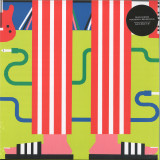
Soul To Burn features highly inventive and memorable avant-rock songs by trio of celebrated musicians, Reciprocate. The germ of the notion that would flower into Soul To Burn came when Reciprocate’s vocalist/guitarist Stef Kett reflected on the idea of funk rock. It ought, he thought to himself, be the best of genres but so often in practice it ends up being the poorest. True enough. Kett decided to approach the problem from a fresh angle, multiple fresh angles, grinding angles, creating an “alt-soul” in which the soul gets to stretch and burn, applied with the power of a rock’n’roll trio but dynamism and agility, rather than cumbersome bulkiness. Reciprocate is a super-group made up of highly celebrated musicians from the UK DIY music scene – their singular, searing-hot power conjured by Stef Kett (Shield Your Eyes) in tandem with drummer Henri Grimes (Shield Your Eyes, Big Lad) and Marion Andrau (The Wharves, Underground Railroad) on bass. The result is the excellent Soul To Burn, which proceeds at a cadence all of its own, halting and blasting, ducking and weaving, zooming away from its distant cousins: Taste era Rory Gallagher or Mr Zoot Horn Rollo of Captain Beefheart’s Magic Band. That’s particularly evident on “Self Regarding Floor Sweepings”, with echoes of “When Big Joan Sets Up” from Beefheart’s Trout Mask Replica, especially with Kett’s added harmonica as the trio hit the winding dirt track, slaloming and swerving. Here is an album of full throttle soul, an avant-rock made up of ear worms so intoxicating they borrow from deep in the mind down deeper into the heart – it’s the cool, weighty groove of Tony Joe White leathering it at full throttle, fuelled by virtuosic back beats that remind of somewhere between the rolling rock of Mitch Mitchell and the fractured noisebeat of Lightning Bolt’s Brian Chippendale: immediate, innovative, virtuosic, exhilarating. Key to the impact of Soul To Burn is Grimes’ drumming, a force unto itself, which sometimes feels like it’s engaged in a creative and playful tussle with Kett’s virtuosic vibrato guitar. Take “Rhodia”, which sounds initially like a radical reworking, an anagram of Free’s “All Right Now”, on which Grimes doesn’t so much hit the groove as hammer it into the ground. Reciprocate tend to be averse to mere repetition, too full as they are of ideas, possibilities. But they know how to hit a riff, as on “Pissed Hymn”. Kett’s vocals are unconventionally impassioned - no vibrato or performative hollering. Rather they climb, up and and again up from the pit of the soul. There’s a sense throughout that this music is hard wrought, squeezed through small apertures, produced against the odds, born to trouble as the sparks fly upwards. There are quieter moments, however, such as the exquisitely beautiful “Ressypressocate”, which affirm the ultimately tender place from where this album proceeds, notes plucked like black flowers, twisted and cherished. Reciprocate demonstrate an astonishing virtuosity, nuance and musical sensitivity manifested through their deep mutual understanding and synergetic interactions. There are moments of sync and camaraderie that remind of the very late Beatles, those rare moments during the Let It Be Era when they loosened up, reassumed their old understanding. But then Kett’s lets fly with a long, looming note and suddenly we’re somewhere else again. With Soul To Burn, Reciprocate set out their stall of intoxicating, super catchy good-time, big heart music – a human album delivering a human message of love and love lost. By the album’s end, you’ll feel pushed and pulled through the mill, wiped out, blissfully exhausted, strangely serene

Suche:mind to mind
Clear Vinyl
On Rock Island, their second LP, Palm produces evidence of a distinct musical language, developed over time, in isolation, and out of necessity. On the island, melodies are struck on what might be shells or spines. Rhythms are scratched out, swept over, scratched again. Individual instruments, and sometimes entire sections, skip and stutter. There is the sense of a music box with wonky tension or a warped transmission in which all the noise is taken for signal.
Like other groups so acclaimed for their compulsive live show, Palm has been burdened by the constant comparison between their recorded material and their touring set. On Rock Island, they render this tired discussion moot, using the album form to present that which could never be completely live, reserving for performance that which could never be completely reproduced.
Despite appearing behind the instruments typical of rock music, Palm trades in sounds of their own making. On these songs, one of the guitars and the drum kit are used as MIDI triggers, producing an index that can be combed through later and replaced with new information. The percussion is sometimes augmented so as to suggest a multiplication of limbs. The strings are manipulated to choke, crack, and hum like other instruments, or other bodies, might.
Working again with engineer Matt Labozza, the band spent the better part of a month in a rented farmhouse in Upstate New York. With the benefits of time and space, Palm recorded the various elements piecemeal, only rarely playing together in groups larger than two or three. While some members tracked, others holed up in the next room, experimenting with quantization, beat replacement, and other methods borrowed from electronic music. Even accounting for the many labors that brought them to be, these materials seem produced by an organic logic. Their complex friction forms a habit of thought, scores a network of grooves on the floor of the mind.
This is music with dimensionality. Sonic objects are deployed, developed, and dissected in various states of mutation. The listener flits about between the field and the lab. The tone is warm in a way only the sun could make, the pace as forceful and as variable as a gale. Whether one locates Rock Island in a sea or in a refinished attic (as in Greg Burak's album cover), whether one escapes to there or is banished, its psychic environs are charted clearly enough. Only at this remove from the mainland can we sense the conditions necessary for such a strange species of sound.
Parisian quintet En Attendant Ana's third album "Principia" is without a doubt their best yet. Bandleader Margaux Bouchaudon's voice anchors many of the songs on "Principia". The songs were composed from a place of confusion about the state of the world and their place in it, looking outward and inward for answers. Guitarist Max Tomasso - newly joined just before the recording of "Juillet" - feels more "moved-in", his guitar-work gliding effortlessly through. New member Vincent Hivert's bass-work is rubbery & flexible, urging on drummer Adrien Pollin's metronomic swing. The band's secret weapon, multi-instrumentalist Camille Frechou's trumpet & saxophone add a new layer of sophistication to the group's debonair indie pop. Bouchaudon says "One of the most important points we tried to focus on was the place given to each instrument. For the first time, we withdrew parts, we were careful not to play everyone at once and I think that the result is a much lighter album in which every musician has a specific place and moment". "Principia" is a great step forward without sacrificing the things that make the band unique, and absolutely feel like the next great phase of an already great band.
Third full-length from Kentuckiana studio chiselers EQUIPMENT POINTED ANKH. Seven tracks of Great Lake inspired genre transgressions sure to make the cover of Modern Hocketing Magazine. Mono minded drumming, superstitious Clavinet, Siege style guitar, cod-turntablism, billowing Serge and Russ' crotales collide at FAO Schwartz in a rush to return the instruments before the 30 days are up. Recorded at Electrical Audio in Chicago, IL and End of an Ear in Louisville, KY Fall of 2021. Engineered & mixed by Taylor Hales at Electrical Audio. Produced by The Barney Rubble Trio. Mastered by Seth Manchester at Machines With Magnets in Providence, R
About Tonder:
Match made! Between poet Alex Deforce and Azertyklavierwerke more specifically. Over a runaway beat, they seem intent on taming the search for love, or anything that smells like it from far or near. "Swiped right, match made" dictates Deforce as rhythmically and unflappably as if he were a Chat GPT controlled computer: more mechanical and cold love has never sounded. What follows would not have been out of place on the soundtrack of Fritz Lang's Metropolis: an industrial drum computer gasping for breath in an attempt to ward off an epileptic fit.
Contemporary yet headstrong, cryptic yet unapologetic: Tonder is an intriguing song full of contradictions that leaves you orphaned but also addicted.
About Soort Van Nerd:
A hearty dash of tristesse rubbing up against the best work of such masters of Weltschmerz like Sufjan Stevens or Spinvis: "Soort Van Nerd" translates as "Kind of nerd" and is a kind of genius underground pop song.
Melancholy and sincere emotion, it is still allowed. Melancholy but above all thoughtful: Azertyklavierwerke handles words and sound extremely sparingly but cuts deeper into his or anyone else's skin as a result. On a nostalgic but austere bed of a drum machine, a naive piano line he pokes Eternal-sunshine-of-the-spotless-mind-wise where it hurts: "I wish you could melt, like an ice cube in the sun."
Changing Mindset is an EP developed around Tuber's title track,
This work is presented as a work of sonic craftsmanship, with a distinctive character that will make you delve towards the limits of electronic music. This sound fuses atmospheric, hypnotic and mental elements, creating a listening experience that goes beyond listening to become a total immersion into the cosmos.
-On the first remix, it denotes a special flavor thanks to the presence of Orbe, a true master in the creation of textures and enveloping sounds. Known for his skill in weaving complex sonic layers, he dives into the core of Tuber's main track, displaying an ability to transform and enrich every musical element.
-The second remix, created by HD Substance, promises to be an experience that will take listeners on a vibrant musical journey, inviting them to surrender to the beat with an infectious energy. The presence of HD Substance, backed by an extensive and outstanding trajectory in the music world, augurs a remix that goes beyond simply being listened to, it is a direct invitation to immerse oneself in the intensity of the sound and let oneself be carried away by the melody.
-The last remix, by Dinamite, adds a touch of elegance and forcefulness, completing the "Changing Mindset" EP. Dinamite, renowned for his ability to fuse musical sophistication with pulsating beats, brings with him an experience-laden perspective.
Unlock the Groove: Trax Couture Unleashes Vinyl Magic with Exclusive Limited Release
Prepare to embark on a sonic journey like never before as Trax Couture, the trailblazing genre-bending record label, unveils its latest vinyl gem—the first in many years! Brace yourselves for a sweated out experience from Welsh producer Tru Method, with a two-tracker that's set to define your dancefloor encounters.
In a world saturated with predictability, Trax Couture continues to break the mold, daring to explore uncharted musical territories. The highly anticipated release boasts a scanty run of only 100 copies, ensuring that each fortunate owner becomes part of an exclusive adventure.
The star of the show is none other than the lead track, "Music." Brace yourself for a mind-bending experience as this trippy, breaks-infused dub-techno warper weaves its spell over your senses. It's not just music; it's a voyage into unexplored dimensions, where beats and breaks collide in a cosmic dance.
But that's not all. Enter the realm of euphoria with the second track, "Studio 77." A classic in the making, this euphoric breaks-driven hitter is designed to lift your spirits and transport you to a realm where every beat is a celebration. It's not just a track; it's a euphoric escape, a sonic sanctuary.
Trax Couture's commitment to pushing boundaries is encapsulated in this unique release, signaling a return to the vinyl scene with a bang. The limited edition ensures that these musical treasures are as rare as they are extraordinary.
With only 100 copies available, each sleee is hand painted and comes with unique insert in true TC style. Secure your slice of this sonic magic is not just a choice; it's a necessity for anyone
NO_COVER[24,33 €]
Phét is a Tibetan syllable that means to cut through. Through concepts & obscurations. Through anything in the mind that stands as an obstacle to our direct engagement of the present. Such tempting distractions! Phét says: RIGHT NOW. As Phét does: RIGHT NOW.
That Jarrett Gilgore named his project after this mantra—Phét Phét Phét—underscores his interest in music as a form of awakening. Music as presence, manifestation, & channeling, more than as ornamentation or description of experience. This is no vessel for preconceived notions, but a record of musicians opening themselves to discovery & encounter through play. Through each other’s company. Phét Phét Phét says: Say farewell to what you’ve known. Say hello to everything you feel now, & to all the things that feel through you.
Gaucho — Steely Dan's Grammy-winning seventh studio album now on UHQR!
Definitive reissue Ultra High Quality Record, the pinnacle of high-quality vinyl!
45 RPM LP release limited to 20,000 numbered copies
Mastered by Bernie Grundman from a 1980 analogue tape copy originally EQ'd by Bob Ludwig
Pressed at Quality Record Pressings using 200-gram Clarity Vinyl®
Purest possible pressing and most visually stunning presentation and packaging!
Tip-on old style gatefold double pocket jackets with film lamination by Stoughton Printing
Gaucho — the iconic seventh studio album by Steely Dan, released in November 1980 — and Grammy-winner for Best Engineered Non-Classical Recording, was also Grammy-nominated for Album of the Year and Best Pop Performance by a Duo or Group with Vocals. The album represents the band's musical evolution towards a more polished and sleek sound, featuring a collection of meticulously crafted songs that blend jazz, rock, and pop music, while exploring themes of decadence, longing, and disillusionment.
Gaucho opens with the title track, a jazzy instrumental piece that sets the tone for the rest of the album. The standout tracks on the album include "Hey Nineteen," a catchy and upbeat tune that features a memorable saxophone riff and lyrics about an older man's attraction to a young woman, and "Babylon Sisters," a funky and groovy track that showcases the band's impeccable sense of rhythm and melody.
The sessions for Gaucho represented the band's typical penchant for studio perfectionism and obsessive recording technique. To record the album, the band used at least 42 different musicians, spent more than a year in the studio, and far exceeded the original monetary advance given by the record label. Still, the album features multiple layers of instrumentation, carefully crafted arrangements, and the use of top-notch session musicians to create a lush and sophisticated sound that is uniquely Steely Dan.
Despite its critical and commercial success, Gaucho was a challenging album to make. During the two-year span in which the album was recorded, the band was plagued by a number of creative, personal and professional problems. MCA, Warner Bros. and Steely Dan had a three-way legal battle over the rights to release the album. After it was released, jazz musician Keith Jarrett was given a co-writing credit on the title track after threatening legal action over plagiarism of Jarrett's song "'Long As You Know You're Living Yours."
Gaucho marked a significant stylistic change for the band, introducing a more minimal, groove- and atmosphere-based format. The harmonically complex chord changes that were a distinctive mark of earlier Steely Dan songs are less prominent on Gaucho, with the record's songs tending to revolve around a single rhythm or mood, although complex chord progressions were still present particularly in "Babylon Sisters" and "Glamour Profession." Gaucho proved to be Steely Dan's final studio album that Donald Fagen and Walter Becker would make together until the year 2000.
Gaucho reached No. 9 on the U.S. album chart and was certified platinum-selling. "Hey Nineteen" reached No. 10 on the U.S. Singles Chart and went to No. 1 in Canada. Pitchfork, in its review, describes the almost "pathologically overdetermined production" as elegant, arid and a little forbidding. "Every last tinkling chime sounds like it took 12 days to mix, because chances are, it did." The New York Times deemed Gaucho the best album of 1980, beating out Talking Heads' Remain in Light and Joy Division's Closer.
Founded by core members Walter Becker (bass) and Donald Fagen (vocals, keyboards), Steely Dan's popularity rose throughout the late 1970s on, and their seven albums throughout that period of time blended elements of jazz, rock, funk, R&B, and pop. Steely Dan created a sophisticated, distinctive sound with accessible melodic hooks, complex harmonies and time signatures, and a devotion to the recording studio. Becker and Fagen, with producer Gary Katz, gradually changed Steely Dan from a performing band to a studio project, hiring session musicians to record their compositions. The duo didn't perform live between 1974 and 1993. But their popularity nevertheless grew throughout the '70s as their albums became critical favorites and their singles became staples of Adult Oriented Radio and pop radio stations.
After a brief battle with esophageal cancer, Walter Becker died on September 3, 2017 at the age of 67. Steely Dan has sold more than 40 million albums worldwide and were inducted into the Rock and Roll Hall of Fame in March 2001. VH1 ranked Steely Dan at No. 82 on their list of the 100 Greatest Musical Artists of All Time. Rolling Stone ranked them No. 15 on its list of the 20 Greatest Duos of All Time.
This stereo UHQR reissue will be limited to 20,000 copies, with gold foil individually numbered jackets, housed in a premium slipcase with a wooden dowel spine.
Gaucho remains a testament to Steely Dan's enduring musical legacy and their ability to create timeless music that transcends genre and style.
Repress!
With a pioneering catalogue that boasts releases from artists such as Kenny Dope, Frankie Bones & Lennie Dee, Joey Negro and Joey Beltram, Nu Groove records was one of the key labels in establishing the NYC house sound. However, it was the Burrell Brothers who were by far the most prolific artists to release on Nu Groove, with Rhano and Rheji exploring the underground and avant-garde nature of their musical minds on the imprint. With the label now lovingly cared for by London imprint Defected Records, who acquired the catalogue in 2017, a new era of Nu Groove has meant new releases for the first time in almost three decades, the latest coming from the Burrell Brothers’ A.B.T. (A Burrell Thang) alias. ‘ABT2’ sees Rheji takes control of the A-Side, and Rhano the flip, as Rheji delivering the sparkling grooves of ‘24/7’ and glorious piano house on ‘Cut A Rug’ on the A-Side. Rhano goes ‘Back To Tha Underground’ with the headsy minimalism of his first cut, before closing out the package with a slice of soulful, evocative club heat on ‘2 Black, 2 Strong’ featuring Hakim Green.
- A1: Kölsch - Grey
- A2: Mr Scruff - Get A Move On!
- A3: Nufrequency Feat Ben Onono - Fallen Hero (Motor City D
- A4: Fritz Kalkbrenner - Facing The Sun
- B1: Fakear Feat Deva Premal - La Lune Rousse
- B2: Scott Grooves Feat Parliament & Funkadelic - Mothership Re-Connetion (Daft Punk Rmx)
- B3: Isolee - Brazil Com (Freaks Reinterpretation)
- B4: Laurent Garnier - Wake Up
- C1: Bob Sinclar - The Ghetto
- C2: Tom & Joy - Queixume (Masters At Work Mix Edit)
- C3: Zaabriskie - Higher
- C4: General Elektriks - Raid The Radio
- C5: Alex Gopher - The Child (Radio Edit)
- D1: José Padilla - Bossa Rosa
- D2: Yuksek & Bertrand Burgalat - Icare
- D3: The Xx - On Hold (Jamie Xx Remix)
- D4: The Hacker - Classic Revisited Part
- E1: Dj Gregory - Tourment D'amour
- E2: St Germain - Alabama Blues (Todd Edwards Vocal Radio Ed
- E3: Sandy B - Make The World Go Round (Deep Dish Radio Edit
- E4: Purple Disco Machine - Walls
- E5: Avicii - Sweet Dreams
- F1: Zero 7 Feat Mozez - This World
- F2: Bicep - Glue
- G3: Superfunk | Feat Ron Carroll - Lucky Star
- G4: Mr Oizo - Flat Beat
- G5: Vitalic - Poison Lips
- H1: Thievery Corporation - It Takes A Thief
- H2: Ame - Rej
- H3: Claptone Feat Jaw - No Eyes
- H4: Marie Davidson - Work It (Soulwax Remix)
- I1: Bonobo - Terrapin
- I2: Dj Cam - Birds Also Sing For Anamaria
- I3: Kid Loco - A Grand Love Theme
- I4: Robin S - Show Me Love
- I5: Swayzak - Make Up Your Mind
- J1: The Mighty Bop - Feeling Good
- J2: Quantic - Time Is The Enemy
- J3: Thylacine - Piany Pianino
- J4: Scan X - Alpha
- J5: The Prodigy - Firestarter
- F3: Moderat - A New Error
- F4: Kerri Chandler - Get Up
- G1: Fkj & Masego - Tadow
- G2: Gotan Project - Diferente
With its tenth record from Fortunato Durutti Marinetti, Quindi continues to celebrate songwriting and storytelling framed by curious musicality. In keeping with the label's trajectory to date, this is an album which draws on a universal human sentimentality and presents it with an uncommon flair. In the case of Toronto-based Daniel Colussi, the man behind Eight Waves In Search Of An Ocean, his melancholic poetry cuts through with a clarity which calls to mind all-time greats from Anette Peacock through to Lou Reed and Leonard Cohen.
Turin-born Colussi has drifted through various bands, guises and styles over the past 20 years, but since settling into Fortunato Durutti Marinetti as a vehicle for his songs, he's found a strong expressive impetus which transcends genre to become entirely hinged on the power of his words and melodies. The first album under this alias was a 2020 cassette album, Desire, later pressed on vinyl due to demand in tandem with the release of 2022's Memory's Fool. On each record, Colussi has found distinct arrangements of players to set the mood, ranging from gently lilting art and folk rock through to orchestrated balladry, but Eight Waves In Search Of An Ocean widens the palette of Fortunato Durutti Marinetti to create an album in which each song feels like a tale unto itself.
Colussi's renewed approach is instantly apparent as album opener 'Lightning On A Sunny Day' unfurls, informed greatly by producer Sandro Perri's input pursuing a hybrid electro-organic sound. The addition of drum machines and synths to the musical palette bring with them the strong connotations of pop while the sax and violin sounds similarly smooth and silky, and one can't help but think of John Martyn's slide into the digital sound of Sapphire or Kraftwerk's bittersweet synthetic tenderness.
Within this sound, there's still space for the energy to fluctuate according to the whims of songs. 'The Flowers' turns inward with a soft-touch composition as delicate as the petals Colussi describes falling to the floor. 'Misfit Streams' and first single 'Clerk Of Oblivion' savour the fluid, luxuriant tone of fretless bass with all the 80s connotations intact. Colussi remains the central focus whatever happens around him, in possession of the kind of unforced charisma which drives a song deep into the listener's heart. It's at once entirely his own style and yet comforting and familiar. The lyrics might sweep you into the singer's inner world, similarly to the experience listening to late 60s Tim Buckley, or you might well inhale the mellow jazziness of the harmonic movement like you would Joni Mitchell on Hejira.
The emotional direction of each track is never linear - 'Smash Your Head Against The Wall' snarls its rhythm section before the strings sow their aching beauty to cool the song's temper, winding up as a track of distinct halves jabbing at each other. "I Need You More' leaves space for spiralling flute solos and strangely stiff, militaristic drum rolls in the midst of a sweet, slightly sad synth ballad, the final wave receding back into the tidal undulations of Colussi's unique exploration of his muse.
The artist himself dubs his musical expression as "poetic jazz rock" with a sideways glance - it's not exactly poetry, far from trad jazz and it doesn't really rock, yet the tag feels uncannily like it fits, just like the curious music it's used to describe.
Repress!
On 22nd October, the Nottingham-raised and highly-praised musician/DJ/producer Matt Cutler, AKA Lone, presents his 8th album – and first in 5 years – ‘Always Inside Your Head’. It marks two major changes, with both a new label and new approach – featuring vocalists for the first time.
This deeply textural and ethereal artwork is situated high above the clouds, amidst the heavens, occupying a stratospheric state where swathes of synthesized vapour and azure rays sound like a literal breath of fresh air.
A varied selection of music influenced the record, but two main influences were Cocteau Twins and My Bloody Valentine. “I wanted to approach a range of different styles, but attack them from their angle in a way, so for example on 'Inlove2' I tried to imagine what a Balearic / acid house tune might sound like if it were produced by Kevin Shields”, comments Lone.
Another key example of Cutler’s strange but successful combination of elements is the halcyon bliss of ‘Echo Paths’, where his trademark fat drums and love for hip hop meet double-time pan pipes, dub effects and dream pop, mixed into a wonderfully lysergic concoction.
This rarefied auditory stratus was previously evident in tracks like ‘Alpha Wheel 4 (Ambient Mix)’ from ‘DJ Kicks’, ‘Under Cherry Blossoms (Minds Eye Reprise)’ from ‘Ambivert Tools, Vol. 2’, ‘Pulsar’ (from ‘Ambivert 4’), and ‘How Can You Tell’ (from ‘Abraxas’), but is now more fully-fledged, broader in scope and even more celestial.
In addition to the above, the LP exists somewhere between trip hop on Mo' Wax, 90s Warp, intelligent drum & bass and ambient house. There are heavier forays too, like ‘Mouth Of God’, where darker clouds emerge, but are pierced like acid lightning with fierce, tearing tech-step bass.
Although still firmly rooted in club culture – here Lone shows a definite leaning towards a song-based sound, with several tracks edging towards the same crossover space as the nineties hits which also inspired him – particularly William Orbit’s production on Madonna's 'Frozen', and Olive's 'You're Not Alone'. This is especially evident on the bright, spacious brilliance of 'Hidden By Horizons', where vocals and synths swirl around one another, with crisp breakbeats and reggae rolls pushing purposefully through the ether.
Despite initially seeming almost entirely sunny of disposition, upon deeper immersion there’s lot more beneath the album’s surface, both in its deep pools of immiscible layered elements, and also thematically. When recording Cutler kept in mind a loose narrative based on birth, death, and our existence in-between.
He then extended this idea to reach what may happen after death, which is reflected in the sequencing: By penultimate track ‘Undaunted’ the life reflected in this longplayer has come to an end, which is then followed by 'Coming In To Being And Passing Away' – an afterlife epilogue, which evokes a transition from this world to the next.
Repress!
Listeners familiar with Kaitlyn Aurelia Smith's previous album Euclid (an album that prompted Dazed to call her "...one of the most pioneering musicians in the world.") will no doubt notice her heavier use of vocals on her new album EARS. On all but one song, her gently ecstatic swells of vocals emerge to soar over a dense jungle of synths and woodwinds. After initially composing on a Buchla analog synth, she wrote arrangements for a woodwind quintet, added vocals, and further refined the pieces with granular synthesis techniques she developed in her sound design work (she contributed sound design to Panda Bear's "Boys Latin" video, and handled sound design and original compositions for Brasilia co-written by and starring Reggie Watts).
Kinetic arpeggios of synths pulse, often buoying her graceful vocal mantras, while woodwinds breathe and flutter, emulating the wildlife Smith observed while growing up on the West Coast (she even studied recordings of slowed down bird calls prior to composing these pieces). Though some of her gestures echo the musical tropes used by early minimalist composers, the world she creates on EARS is uniquely hypnotic and full of life, not unlike Miyzaki's film Nausicaä, which she cites as an inspiration.
EARS is a masterful articulation of Smith's vision, which she achieved in part by spending time preparing her mind prior to composing the album.
Die Gründung von 49North markiert eine neue Ära für Duncan Forbes, neben Charlie May eine Hälfte des legendären 1990er Progressive House-Duos Spooky und Remixer für Schwergewichte wie Depeche Mode, M83, Sasha, William Orbit und Apparat. Auf dem finalen Teil seiner '49North – Phase 1: Distilled & Amplified' Trilogie verwandelt der nicht minder legendäre UK-Produzentenkollege Mr. G zwei Tunes in Killertracks, während Forbes' selbst einen pulsierenden, breit angelegten, 10-minütigen Motor-City-meets-The-White-Isle-Trip mit Reminiszenzen an glorreiche Progressive-House-Zeiten bringt.
‘Free Your Mind’ is an iconic track made and released in 1991 by the Cowan brothers – Mark and Andy. They had previously put out a couple of records beforehand, but the release that got them forever known is the ‘Psychology’ EP, which the original version of ‘Free Your Mind’ appears on. It was also an all-time favourite tune for Amen Brother boss, Brent Aquasky. So much so, that when he started his repress label, Vinyl Fanatiks, he hunted down the brothers in order to re-release it.
Seven Steps to Heaven arrived at a crucial junction in Miles Davis' career. Recorded at two separate locations in spring 1963, it served as Davis' first release in more than a year – a layoff that was then unprecedented for the jazz visionary who had issued at least one LP a year since debuting in the early '50s. Equally notable, Seven Steps to Heaven marks the point at which the core of Davis' Second Great Quintet started to assemble. The twice Grammy-nominated effort is also Davis' final studio record to blend standards with originals. And it happens to be one of the expressive, well-played albums in the jazz canon.
Sourced from the original master tapes, pressed at RTI, and housed in a Stoughton gatefold jacket, Mobile Fidelity's 180g SuperVinyl LP of Seven Steps to Heaven adds yet another step (or more) towards the bliss suggested by the album title. Playing with standout clarity, detail, tone, and balance, this audiophile reissue pulls back the curtain on the instrumentalists. Afforded the tremendous advantages of SuperVinyl – including a nearly inaudible noise floor, dead-quiet surfaces, and superb groove definition – this numbered-edition version presents Davis and Co. amid a wide, deep soundstage whose dimensions and solidity help bring the record's historical importance and musical merit into focus. Warm, organic, and present, the SuperVinyl LP of Seven Steps to Heaven is what great-sounding hi-fi is all about.
And there's nary a passage on this 1963 landmark that isn't great. That Davis manages to make it feel so cohesive and seamless is a testament to the inspired performances and engaging compositions. Davis didn't draw it up the way it unfolded. No matter. He held trump cards that stayed up his sleeve for the next three decades: A drive to be nothing less than superb, a refusal to settle for mediocrity, and standards to which nearly no other composer or player could match. "The toughest critic I got, and the only one I worry about, is myself," Davis wrote in the liner notes. "The music has to get past me."
Davis' demanding approach partly explains why he switched up his band between the first and second sessions – and underscores how fast his mind was racing with new ideas. Seven Steps to Heaven acts as the stable bridge between the transitional period that followed the dissolution of his First Great Quintet and formation of the Second; without it, Davis perhaps doesn't invite then-23-year-old Herbie Hancock and a still-teenage Tony Williams into the fold. The trumpeter not only got his men – he preserved in amber for the only time (well, magnetic tape anyway) the chemistry and vibe he achieved with pianist Victor Feldman, drummer Frank Butler, tenor saxophonist George Coleman, and bassist Ron Carter.
That line-up gels for half of the six songs on Seven Steps to Heaven. Captured in Los Angeles April '63, the quintet stretches out on a luxurious reading of the late '20s New Orleans staple "Basin Street Blues"; lays on the romance for a candlelit stroll through the '40s standard "I Fall in Love Too Easily"; and explores the rounded contours and melodic crevices of the early blues "Baby Won't You Please Come Home." The performances are refined, elegant, emotional; the band lets the feelings linger and gives the listener time to absorb the colours and textures.
A month later, Davis returned to New York City with Coleman and Carter, and partnered them with Hancock and Williams. Tellingly, the quintet tried its collective hand at the title track and "Joshua" – Feldman-penned songs already recorded in Los Angeles – as well as the yearning "So Near, So Far." Those are the tunes that comprise the other piece of Seven Steps to Heaven, with the revised quintet's liquid pulse, articulate dynamics, and timing shifts a harbinger of things to come.
It's also worth mentioning that the interpretations of the bounding "Seven Steps to Heaven" – a showcase for Davis' trumpet – and interlocking "Joshua" netted considerable radio airplay and attracted the attention of other contemporaries who covered the songs. Keeping Carter and Williams as the rhythmic engine, and Hancock as the anchor between solo flights and structural motifs, Davis would soon soon welcome Wayne Shorter into the family and transform jazz. Again. The aptly – and, in hindsight, perhaps prophetically titled Seven Steps to Heaven – is how he got there.
- A1: Can't Seem To Make You Mine
- A2: No Escape
- A3: Lose Your Mind
- A4: Evil Hoodoo
- A5: Girl I Want You
- A6: Pushin' Too Hard
- B1: Try To Understand
- B2: Nobody Spoil
- B3: It's A Hard Life
- B4: You Can't Be Trusted
- B5: Excuse, Excuse
- B6: Fallin' In Love
- C1: Out Of The Question (Version 1, Master)
- C2: Excuse Excuse
- C3: Dreaming Of Your Love
- C4: Pushin' Too Hard (Take 1)
- C5: The Other Place (Take 2)
- C6: It's A Hard Life (Take 3)
- C7: Nobody Spoil My Fun (Alternate Overdub, Take 3A)
- D1: You Can't Be Trusted (Take 3)
- D2: Evil Hoodoo
Legendary US garage band best known for their evergreen classics ‘Pushin’ Too Hard’ and ‘Can’t Seem To Make You Mine’ that detonated in the US charts in late 1966 and early 1967. Whilst ‘Pushin’ Too Hard’ was their only top 40 hit, this song has been discovered by every new generation that hear it from punk rockers of the 70s to those who are glued to their mobile phones today.
Their debut LP “The Seeds” released in 1966 contains both these tracks and is rightly feted as a garage classic. It is an essential album. As our very own Alec Palao stated, “Like the first Ramones long-player, it is one of rock’s great debuts; an album where, in spite of some obvious influences, a signature sign was sharply defined.”
Ace are delighted to serve up the deluxe edition of “The Seeds” that was lovingly curated by Palao and released by GNP Crescendo some years back. Not only do you get “The Seeds” with 12 pulsating tracks but also a bonus LP of alternate versions and a couple of unheard tracks like ‘The Other Place’ and ‘Out Of The Question’. The extended version of ‘Evil Hoodoo’ is a stone cold treat.
Both albums are housed in a gatefold sleeve with an 8-page full colour booklet with Palao’s brilliant liner notes and sensational photos and memorabilia.
There is no ‘Excuse Excuse’ not to pick up or stock this one.
Autumn Crossing, the newest release from Goose, is a three-song EP that showcases the band's incredible creative synergy, technical proficiency, and spellbinding vocals. The project is an auditory peregrination through the ups and downs of life. A
testament to Goose's continued evolution, the work wanders through pensive optimism on "Travelers I" and epic instrumentation on "Travelers II," arriving at an epic conclusion, "Elmeg the Wise."
With Autumn Crossing, Goose continues to push the boundaries of their creative output, with a work that speaks to the mind, body, and spirit. Available digitally everywhere, and on 180g limited edition etched vinyl.
Felipe Gordon is a Colombian producer based in Bogota. He’s one of the most famous faces of latin american underground house music. He built a track record of pure house productions from the mid-2010s up until now, being Laurent Garnier-supported and releasing records with the most notorious house labels around the globe (Royal Oak, Razor-N-Tape, Toy Tonics, Local Talk, Shall Not Fade, etc.) His unique sonic touch, intertwining elements of raw analogue sounds from his synth collection and a strong hip-hop sampling background are allowing him to explore and revisit his influences to craft a solid musical signature.