Tangential Music is pleased to present the new album from veteran Spanish DJ and producer, Dj Toner (aka Antonio Herrera). Alongside his co-writer/arranger Daniel Molina and with guests that include the legendary Blue Note Records innovator Erik Truffaz and Grammy winning flautist and saxophonist Jorge Pardo, he has created a 10 track collection of slow-burning instrumentals that straddle the worlds of hip hop, jazz and electronica.
With a personal, precision tooled approach to his craft, the Andalusian has offered up an album of finely modelled downbeat moods.
At first glance, ‘Out Side’ is made up of recognisably superior hip hop instrumentals but if you listen carefully, and with patience, one can hear a craftsman at work. A wooden box is just a box until you look closer. The hidden joints, the perfect lining up of the grain, the years of artisanal graft and laser-focussed attention to detail that go into making something that has nothing present, that doesn’t deserve to be there. This is how Dj Toner operates.
The two singles that preempt the album’s release reveal different sides of his craft. ‘Camina’ struts with tough intentions. Soundtrack-y in an exploitation police drama manner, the get-out-of-my-way drum break and tension-filled chords suggest the bad cop, Erik Truffaz’s piercing lyrical trumpet lines, the good. The Afro-jazz horns led second release ‘Surprise’ is an altogether more playful, sunbaked affair. Sensual and slow-burning, there’s still an edge but it’s too hot to quarrel.
Dj Toner’s minimalist attitude to creation is shared with his co-composer Molina - an individual’s contribution may be cut to the bone, leaving just its aura or tone. The echo of a piano, a single blast of tuneful wind from a flute, a perfectly positioned drum hit.
Since the Wu-Tang Clan’s RZA began applying his beatmaking prowess to movie soundtracks, the hip hop instrumental has been acknowledged as something to listen to, as much as being used as a DJ tool or backing for an MC. Dj Toner’s instrumentals can, therefore, be seen as soundtracks. Soundtracks to his life and craft, vignettes of his environment in both the urban sprawl and the wider and slower spaces of “el campo”.
The sweet-tempered jazz-blues of ‘La Rimosa’ is a gentle welcome to the album. A simple, laid back groove with the most romantic of piano hooks that one could imagine Common dropping rhymes on. You’re kept on your toes with the odd purposeful moment of discordant interruption but the tender heart of the composition is never far away.
‘O’Beat’ hints at John Coltrane with the sparse but full-sounding upright bass before a head-snap break leads into a curious piano groove, a vintage organ swirls into a psychedelic fractal, whilst the bluesy female vocal snippets add the spice, that zing in the Granadan gazpacho.
The flamenco guitar driven ‘Flama’ is an excellent example of intricate sample placement and musicality. Old school (school yard) scratch interludes, sweet piano hooks, a minimalist but knife sharp flute contribution from Jorge Pardo, and the crunchiest of drums taking us for an intriguing walk round the corner.
We’ve mentioned them before but it’s on ‘Sweetband’ that we can feel that Wu-Tang dread hanging off its shoulders. A brooding orchestral number with powerful horns and a cavernous piano hit. The title of the piece is in stark contrast to the dark shadows of the tune.
Erik Truffaz returns in fine form on the super lethargic jazz-funk-hop of ‘The Day’. His instantly identifiable muted trumpet sound paints dazzling colours over the more earthy tones of the filtered down keys as a rubbery upright bass keeps the forward momentum. Dj Toner’s ‘Blessed Are The Weird People’ album, was rated in Jazz Magazine as one of the 20 jazz albums of 2021, so he isn’t some dilettante when it comes to playing with the complex hues of jazz but he does like to strip it to its bare essentials.
‘Fanega’ sees a gorgeous flute contribution from Jorge Pardo. An eerie boom-bap groove with sprinkles of electronic pulses and washed out chords is the canvas on which the award-winning multi-instrumentalist evokes the heat shimmer of the savannah.
‘Esperanza’ translates as ‘hope’ in English and this lovely slow, swinging jazzy groove really does provoke feelings of positivity and belief. Sublime vibraphone and another stunning trumpet offering from Erik Truffaz, take us on a journey of warm days and possibilities, the shuffling drums and sweet chord patterns are nicely finished off by a tranquil horn chorus towards its unhurried end.
‘Under Beat’ ends on a beefy boom-bap groove with a liquid funk bassline, elegant synth strings and old school scratching. Again, there’s that undisputable soundtrack edge, action and motion, the smell of the city.
There you have it, 10 tracks that go beyond the surface, deep into the dedicated craft of Dj Toner. Decades of experience and collaboration purified and refined into beat-heavy emotions, listen closely or crank it up, it’s down to you!
quête:minimal man
Following the release of Eric Chenaux's last album Say Laura (2022), The Guardian wrote "the Canadian songwriter has one of the all-time great singing voices in popular music, an intensely romantic Chet Baker-ish instrument that seems to float with piercing direction, like a paper aeroplane thrown hard through mist." With Uncut describing his songcraft "as delicate and lovely as a rare orchid" and Record Collector praising the album's "sublime alien balladry" such are the accolades that have accrued throughout Chenaux's unique and consummately uncompromising solo music for well over a decade now. Delights Of My Life opens a new chapter for the singer/guitarist and formally introduces the Eric Chenaux Trio, with Toronto-based musicians Ryan Driver on Wurlitzer organ and Phillipe Melanson on electronic percussion. Driver is a longtime collaborator, appearing on several of Chenaux's solo albums (even embedded into the very title of the 2010 masterpiece Warm Weather With Ryan Driver). Melanson has a long list of involvements that include Bernice, Joseph Shabason, and U.S Girls, and a recent release with his Impossible Burger project on Chenaux's own experimental label Rat-drifting, but this marks the first fulsome involvement between the two as players on a recording. In many ways Delights Of My Life also picks up right where Chenaux's previous album left off, in its subversions of a classic, timeless jazz-inflected balladry, while the interplay of the trio formation indeed unfurls many new delights. Recording together at Chenaux's spartan home studio in rural France, Driver's harmonically warped organ and Melanson's electroacoustic sampling and percussion hold time in newfound ways. Where previously Chenaux relied on a freeze/sustain pedal and minimalist rhythmic triggers to generate both pulse and chordal foundations, Melanson now paints timekeeping with expressive and intricate colourations, through live deployments of fluid sampled percussion (including orchestral timbres like timpani, kettle drums, and woodblock) that blur the boundaries between acoustic and electronic. Driver also ramps up his role in the song arrangements (prefigured in his support playing on Say Laura), teasing out chords and melodic filigree on Wurlitzer that percolate more prominently with Chenaux's signature fried guitar solos and succulent singing. Both trio members add dulcet backing vocals, most notably on the 10-minute tour-de-force of fuzzed and ring-modulated swing "This Ain't Life" that opens the record. All seven songs on the album groove and sway, simmer and sparkle, like nothing in the inestimable Chenaux discography to date. Chenaux's tunes have the uncanny ability to sound like jazz standards; songs you feel you've heard before, though certainly never quite like this. Yet these are of course all originals, compositionally and interpretively, bent through an inimitable avant/out-music lens. Delights Of My Life conveys warm familiarity, shot through with the exuberantly experimental subversion and playful, even mischievous, iconoclasm that continues to mark Chenaux as defiantly, virtuosically, and genially one-of-kind.
Die erste Singleauskopplung aus Jimi Tenors neuem Timmion-Album "Is There Love In Outer Space?" wirkt wie eine Wüstenbrise aus dem kosmischen Liederbuch des nigerianischen Keyboarders Mamman Sani aus den 1980er Jahren. Vielleicht ist es genau dieses Panorama, das Tenor und Cold Diamond & Mink uns vor Augen führen wollen, während wir die beiden Seiten dieser Vinyl-Single durchqueren. Spätestens das psychedelische Wüstenblues-Gitarrensolo versetzt uns auf eine kalte Sahara-Sanddüne, wo wir einen magischen Sonnenaufgang auf Mutter Erde beobachten, den nur wenige Menschen erleben dürfen. Dies ist die Art von Jam, bei der man die Augen schließen und sich von den Farblandschaften des Geistes erfüllen lassen kann. Die minimalen Gesangsparts wirken wie ein Willkommensgruß an die Sonne, die langsam am Horizont emporsteigt und bereit ist, ihre brennenden Arme um alle Dinge zu legen - lebende und tote gleichermaßen. Mit ihrem neuen gemeinsamen Projekt hauchen Jimi Tenor und Cold Diamond & Mink den bewährten Stilen des jeweils anderen eine neue Art von Leben ein und liefern eine natürliche Verschmelzung von kosmischer und rauer Soulmusik.
Listening to The Softies has always felt like peeking into a diary, with no personal detail spared. Lyrically the band documents a lovelorn heart in every manifestation, and hope is the bright silver lining adorning each song. As the third Softies album, Holiday in Rhode Island KLP119 presents a more accessible view to the humble honesty of their emotive universe. When Holiday in Rhode Island was originally released in Sept. 2000, it had been three and a half years since The Softies previous album Winter Pageant [KLP061]. In that time Jen and Rose's introspective musings are reborn, sparkling with renewed vision, both musically and spiritually. The trademark harmonies between Jen Sbragia (All Girl Summer Fun Band) and Rose Melberg (Tiger Trap, Gaze) simply shimmer, brighter than ever before, benefiting from strong yet simple arrangements and excellent production (at a house on Galiano Island near Victoria, British Columbia) by Dave Carswell and John Collins. The beautiful surroundings and supportive production crew inspired The Softies to extend their minimalist blueprint of two delicately jangling guitars and two crystalline voices to include acoustic guitar embellishment on "Just a Day," "You and Only You;" piano and sparse drums on "Me and the Bees;" a xylophone makes subtle appearances here and there. Holiday in Rhode Island is a stunning artistic accomplishment from these two much heralded pop icons.
Lock on for a legit excursion into 140 realness as Sneaker Social Club welcomes Silas into the fold. The breakthrough Oxford beatsmith has been on the bubble-up for a minute, facing off with the likes of Trends and Boylan on Mean Streets, remixing PRAGA and throwing down for repeat appearances on Rinse and elsewhere.
The sound Silas pushes on the ‘Wot’ EP - his debut solo 12” no less - is steeped in the original dank pressure of OG grime and dubstep, where moodiness and minimalism create the perfect storm for all-consuming soundsystem immersion. There’s a wavey swing to ‘Know Yourself’ which contrasts with the strict, claustrophobic drive of ‘Wot’. ‘Ubuntu’ on the flip teases an evocative sound world just past the edge of the mix, but manages to hold down the stripped back approach on a skippy 4/4 rhythm which nudges garage into a kind of tech-house-funky amalgamation. ‘Make It Happen’ offers yet another subtle slant on Silas’ style, crooked and gritty but still executed with
an unrelenting, austere focus.
Consider this an essential pin dropped on forward-leaning bassweight sounds which carry the torch for grime and dubstep’s ice-cold origins, maintaining maximum presence without even a whiff of derivative wobble.
Boulderhead debuts on Rhythm Section International with his most expansive EP to date:
“ I Need Space to Dance”
The Bristol based producer, known for his intricately crafted, up tempo club records has long been a favourite at RS HQ and has, over the years, garnered much respect from a plethora of influential DJs. His most recent hit “ Bread, Butter, Noodles, Spice”, was a festival earworm and one of the most played underground tracks of 2023.
Existing in the sweet spot between tech-house, prog, broken beat and minimal techno - this EP sees Boulderhead widen his sonic palette with a collection of songs that showcase his versatility.
Equally appealing to the Ricardo Villalobos contingent as it will be to those delving into the history of progressive house and the golden days of minimal techno - we think there’s a bit of something for everyone here.
Despite the many different bases the EP touches on - the sound pallette and production are unified and coherent. Henry is at the top of his game, and much like contemporary artists like Adam Pits, Priori and Russell EL Butler - his style screams ALBUM!
Deluxe 180g vinyl. Art Edition LP includes set of six 12”x12” art cards.
The follow-up to Kee Avil's acclaimed 2022 debut Crease: "A stunning debut" (The Quietus); "A whiplash style of uninhibited exploration" (The Wire); "Kee Avil's debut is a force" (Foxy Digitalis); "A work of Frankensteinian wonder" (Electronic Sound); "A tightly coiled, finely wrought vision of avant-pop" (Exclaim); "A debut of fiendish creativity" (Bandcamp Album Of The Day / Albums Of The Year) Kee Avil's music is both adventurous and intimate, intellectually challenging and emotionally resonant. The Montréal guitarist and producer's 2022 debut LP Crease garnered plaudits from outlets like The Wire, The Quietus, Mojo and Foxy Digitalis, picking up a Canadian Juno Award nomination and Bandcamp Album Of The Day and Albums Of The Year along the way. Its intricate construction, unnerving atmospheres, and knife-edge take on avant-pop prompted comparisons to early PJ Harvey, This Heat, and Gazelle Twin. A remix EP with work by claire rousay, Ami Dang, Cecile Believe, and Pelada brought collaborative perspectives to four Crease tracks, offering new pathways within those songs. With Spine, Kee Avil strips back her heavily textured compositions, opening up a much rawer sound. She calls it folk… and while traditionalists might scoff, this is urgent music that reflects the precarity of modern life, as well as the jarring mixture of electronic and real-world interactions that have become the fabric of our day-to-day experiences. There's a hypnotic post-punk somnambulance to it all, using the repetition and fracturing of melodic phrases interwoven with delicate electronics to create curious and persistent hooks. While not a concept album, themes of time's passage, remembrance, and decay crop up across multiple tracks. Each track intentionally only has four elements - guitar, electronics, and two other instruments, with Kee's voice and guitar pushed to the front. Within this minimalist framework, the juxtaposition of beauty and discomfort that is key to the Kee Avil sound stands out in skin-prickling relief. "We're shaped by many versions of ourselves," says Avil. "I was looking back at these versions of myself and what could have been, what didn't end up being and what did end up being, and going back like that through time. Seeing the future, the past." Spine was written in Kee Avil's home studio after a lapse in writing while touring Crease and working on other projects. She is a well-known and respected member of the Montréal experimental scene, and formerly ran Concrete Sound Studio with Zach Scholes, who continues to work with her as a producer on Spine. Compared to the three years that went into making her debut, Spine emerged in a matter of months - a process that may also be a factor in its intensity and sharpness: "This record was much harder, like it was really discovering everything from scratch." In her desire to not simply replicate or extend the sound of Crease, she felt she had to rip up the rule book, write in a different way, and pare back songs against her usual instincts. Sometimes, when we work against our ingrained habits, we get to the core of who we really are. Spine is an exercise in that process. Without over-intellectualizing or being didactic, it hits immediately and emotionally, especially if you are a person who has spent much time in the process of self-examination. Kee's voice hisses, whispers, and chants; her guitar bends and rings; electronics skitter and crackle; violin creaks like a door in the wind. There is something so evocative about the atmospheres she creates that it's easy to overlay one's own feelings onto her work, but to do that wholly would be to overlook one of the most important things about Spine: Kee Avil's clear and thoughtful vision. This isn't just the next step forward in her artistic trajectory; it's a stunner of a record that stands on its own, a bracing and thrilling listen that has much to reveal about the contradictions inherent in being human. - jj skolnik
Born in Beirut, Lebanon, Rami Gabriel has been a motive force in rock n' roll, jazz, Arabic, and experimental music communities across North America for over twenty years. In that time, he has released numerous projects across genres and under many names. On his debut LP for Sooper Records, Rami trips all the breakers. In his own name and voice for the first time, That's what I been sayin' is not so much a debut as a conflagration in Rami Gabriel's worldly underground. Drawing on Punk, Krautrock, Dub, No Wave, and lo- fi, the territory occupied by That's what I been sayin' is astringent, minimal, and buzzing with the sound of machines dancing in the wind. "I'm used to putting out records based on genre," says Rami of his multiple endeavors. "I was listening to one of the `70s Brian Eno records where he took his experimental work and his songs and put it all together, and I was thinking, `Why don't I try to put all the different ways I've been working for the last couple years onto one record?'" That's what I been sayin' ignites this vision with an album that ranges from the motorik-driven krautrock of "Like a monk" to the unexpected trance-like pairing of "Buzuq synth." That's what I been sayin' is a furnace of Rami's insuppressible impulses, where he undertakes to ask and answer: what is left of punk but making do with what is at hand? At times direct and scorching, at others meditative and wandering, That's what I been sayin' compresses Rami's understanding as a composer, musician, and singer into a restless, 11-track love letter to the underground. For Fans of The Fall, Haruomi Hosono, Brian Eno, and Scientist.
- A1: Searching I 00 00:10
- A2: Kilter 00 04:48
- A3: One Place 00 04:39
- A4: Searching Ii 00 00:04
- A5: Bottom Dweller 00 03:03
- A6: Searching Iii 00 00:04
- A7: No More No Less 00 03:28
- A8: Searching Iv 00 00:03
- B1: Vascai 00 03:42
- B2: Searching V 00 00:06
- B3: Maybe Tomorrow 00 04:40
- B4: Searching Vi 00 00:05
- B5: Last Strut 00 05:01
- B6: Lights Down Low 00 05:30
- B7: Searching Vii 00 00:14
- B8: Ending 00 04:16
James Devane returns with another adept investigation into minimal techno’s spaces in between. “Searching” serves as both companion to “Beauty is Useless” and the next logical step in James’ exploration of process as guiding compositional tool. Conceptually simple, technically robust, the end result elicits both an undeniable groove and a trove of detail for listeners willing to go deep. In his own words: “These recordings are the result of chance. Using hours of source material, everything was “chosen”, manipulated, and assembled at random via custom software without concern for key, tempo, measures, or rhythm. A search button and a save button.”
- A1: Samba 00 04:58
- A2: Panorama 00 04:39
- A3: Golfo Mistico 00 04:34
- A4: Open Sky With Tears Of Blue 00 04:56
- A5: Contemporary Lullaby 00 03:05
- A6: Requiem 00 02:55
- B1: Whispers 00 04:19
- B2: Modular Clouds In Rome 00 03:21
- B3: Piano Bells 00 03:30
- B4: Space Call From Mars 00 03:01
- B5: Tuning The Orchestra With Tears Of Blue 00 03:22
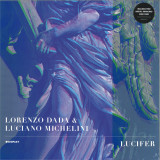
With Lucifer, Kompakt presents an album of rare beauty from two masters of modern music. A family affair, it’s a collaboration between the Italian father-and-son duo of Luciano Michelini and Lorenzo Dada, whose combined histories bring to Lucifer a depth of experience alongside clarity of vision and a finely tuned, neatly developed combined compositional voice. A lovely, beguiling suite of music that combines the electronic and the acoustic, the urban and the pastoral, its gorgeous night-eye vision and tender melancholy sits neatly within the Kompakt universe, while offering the curious listener some rich new perspectives.
There is already plenty to know both artists by. Lorenzo Dada creates across multiple fields – a techno producer and DJ who has already worked with the likes of Jay Haze, Fete, Leo Benassi, and Der, he’s released a small clutch of stylish, smartly designed EPs, and a solo album, Second Life (2018). His complementary background in classical music and composition informs his ensemble project, Tears Of Blue (who appear on Lucifer), where Dada paints with neo-classical tones for a quartet of violin, viola, cello and grand piano, supplemented by electronics for live performance.
Luciano Michelini’s history is yet richer. He may be best known, to many, for his piece “Frolic”, the theme to Larry David’s Curb Your Enthusiasm series; it was also sampled by Snoop Dogg for 2022’s “Crip Ya Enthusiasm”. But there’s much more to Michelini’s story. A successful soundtrack composer, Michelini both studied and taught at the Conservatoro di Santa Cecilia, and worked for RCA from the sixties to the eighties; his soundtracks from this period are gorgeous examples of the form, particularly his work for Il Decamerone Nero (1972), L’Isola Degli Uomini Pesce (1979), and the devastatingly gorgeous Dimensione Donna (1977).
In the eighties, Michelini and his wife Anna Gutling founded the Electronic Music Division studio and academy in Rome, which is where the majority of Lucifer was recorded. Dada reflects on the experience: “We never worked together before, so it was all new for both of us,” with Michelini adding, “I truly love this experience with my son. He’s a talented pianist and composer. I am not very familiar with electronic music nowadays, but we did it fluently.” There’s certainly a familial energy at play through Lucifer, and you can hear how Dada and Michelini, through exploration and experiment, find a shared language, balancing Dada’s tendency toward minimalism, and Michelini’s composerly voice.
Lucifer flows as a suite that interweaves electronic music with acoustic instruments: the lonely sigh of saxophone; Michelini’s lush, verdant piano; the weeping strings of Tears Of Blue (recorded at the studio of Michelini’s friend, the late Maestro, Ennio Morricone). These multiple voices are located within the electronic sighs and swarms from Dada’s kit; there are moments of propulsion, and passages of lambent drift, where the album revels in its tonal sweetness. If it flows so effortlessly, that’s because Lucifer was designed that way, as a suite or a sonata of sorts.
And the title? Dada reflects, “Lucifer was an angel who decided not to be one anymore. The miracle of life is that we can decide what we want to be, even if we are born as angels or vice versa.” This feels somehow apposite: there’s certainly something of the transformative, and the transportive, in Lucifer, a unique family collaboration of rare poetry and sensitivity, where two generations meet in the modern crucible that is the electronic music studio.
030/313 – Berlin/Detroit, the fundamental techno union. Now Carhartt WIP, whose roots can be traced to Detroit, Michigan, join forces with Tresor for a collaboration that celebrates the enduring spirit of two music metropolises. Referencing the early 90s compilations like “Tresor II – A Techno Alliance”, they present a 12” mini compilation with exclusive material from both cities.
The compilation opens with “I.D.L.E.”, a lost Model 500 track, of essential funk that touches the techno soul of The Motorcity, with trippy melodies and cosmic drilling traversing electrified Mojo freeways. It’s followed by another true Detroiter: Ectomorph’s “Searching (Live At Globus)”, a first extract from their live set at Globus in 2021, which BMG and Erika played on borrowed equipment after Erika’s case was lost on a flight. The A-Side stays in Detroit and finishes with “Your Body”, an exclusive track by AMX, also known as The AM, one of Detroit’s freshest funk techno sensations. She carries on the mentorship mindset by having learned from two of the greatest: D.I.E. and Scan 7. “Your Body” is a classic techno feel swinger, where subtle chords meet drum machine funk in the spirit of early Detroit techno.
DJ Stingray 313 opens the B-Side with a bang. Precisely hacked techno, full of dark funk and that special industrial jack, that the man in the mask has made his own. A total “Dynamic Instability”. Magic & furious. The thrill continues with “Metal Goat”, by JakoJako, one of Berlin’s brightest synth sensations. She provides an introspective grower that slowly evolves into a fast-paced techno grinder, laden with micro shifts and magic twists. The final tune comes from Erik Jabari, a newcomer from the 030 zone, emerging from the Hard Wax peers with haunting modular synth techno–a feverish minimalistic trip of motorized kicks. DJ Pete performed as spiritual guidance on this one. It’s floor proven. An overall cachet of “030313” - the small compilation with a huge techno heart.
“All this I do for glory” is a reasoning and exploration of the machinations of ambition and legacy, an examination of the concepts of afterlife, and the first half of a doomed love story in the model of the greek tragedies. As a narra- tive, it exists temporally somewhere between 2015’s “Never were the way she was” (with Sarah Neufeld) and the 1st volume of the NHW Trilogy.
With this, his first solo outing since 2013’s “To See More Light”, Colin Stetson ventures into territory both familiar and strange. Here still, is the dogmatically stripped down approach to performance and capture (all songs recorded live with no overdubs or loops) but there is an immediacy to the album that belies a more invasive and thorough miking of the various instruments being utilized and a seeming influence drawn from the early nineties electronica of artists like Aphex Twin and Autechre, evident in the more pointed role played by the instruments’ many percus- sive elements.
There are ancestries, motivic and timbral, woven through these six songs that plainly anchor them within the shared universe of his Trilogy, though the overall experience is one of extreme intimacy, the sounds and imagery more tangible and immersive than previous offerings. The brief and brutal “In the clinches” recalls (or presages) echoes of songs like “Judges”, though now feeling like one has fallen down the bell of Stetson’s ancient bass sax- ophone itself. “Spindrift”, crystalline and serene, calls to mind the ambient works of Aphex Twin, while “Between Water and Wind” with it’s “Immigrant Song” swagger, relentlessly carves it’s way into the bedrock here, paving the way with an increasing focus on the minute and the minimal, with a deepened sense of patience shared by most of the album’s six tracks.
Engineered and mixed by Stetson himself, this album represents a decidedly independent approach across the entire creative process and finds him at the top of his game, both as a composer and instrumentalist as well as a producer.
London outfit Kassian continue their broadly- evolving yet highly detailed journey through and beyond sound towards something ever more expansive. Their second release for !K7 Records comes in the wake of creating a dedicated hardware-forward studio in a Northeast London container complex, where they have the freedom to interlink their machines. This renewed focus brought them to Supercontinent EP, named for the ancient geological era when Africa and South America were joined as Pangea.
A reformulation of rhythmic ideas inspired by South= African Amapiano and South American Baile Funk governs the two hemispheres of the record. The pair examine and deconstruct dancefloor material, eschewing 4/4 for interlocking shaker patterns, searing acid lines, cracking breakbeats, and vocal samples in Zulu and Brazil Portuguese.
The immediacy of the restless rhythm and bass-led funk of “Yena” (the word Yena translates to ‘he/him /man’)forms a sweet spot where double-time and half-time can coexist. “Yami” (‘mine’ in Zulu) is a slinkier proposition which sheds prominent percussion in favour of a weighty, fluid, acid-informed bassline undulating from below.
An ascending percussive riff marks the arrival of “Pulgueiro”, followed closely by break beats and the nostalgia of distinctly British acid electro; it is an intentionally future-forward retelling of a vintage sound, replete with a mind-melt breakdown of rave pads.
A dubbed-out groove dominates the bottom-heavy “Sistema” – a groovy, steady roller that chugs and propels and chugs with head-nod hypnotism through an intricately minimalistic approach.
Manchester’s multifarious sound organiser Andrew Hargreaves (Tape Loop Orchestra, The Boats, Beppu) channels key touchstones of Glenn Branca’s microtonal minimalism, the paranormal, and DIY amateur broadcasting with some of his most enigmatic, intuitive recordings to date.
‘Drones In The Air’ finds Hargreaves deep in a new phase of vibrational investigation where the sentimentality of prior eras gives way to more abstract conceptual processes. Utilising a bunch of oscillators and the Lyra-8, an “organismic analog synthesiser”, plus pedals, Hargreaves works within just intonation tuning systems - or more precisely “intuitive intonation” - to just-about harness a microtonal flux of clashing, beating frequencies, but the project is more about ceding a certain amount of freedom to the machines and allowing aural alchemy to occur, prompting a spectrum of harmonic colours and rich timbral overtones distinguished from previous tape loop-based works.
Comparative to “Glenn Branca’s micro-tonal workouts if he had worked with oscillators instead of guitars”, the result also variously evoke mysteries of The Conet Project, the oceanic feel of Éliane Radigue compositions, and early ambient works by Terre Thaemlitz in their sound sensitivity and scope. In ‘The Sun is Afraid’ he mesmerises with glistening microtones that develop a coarser traction, interrupted by shortwave radio comms and resolving into phantasmic noise gauze that speaks to his long-standing fascinations with entropic decay and the sounds between sounds. ‘Your Hands Are Shaking’ follows with a stealthier approach to coaxing a hallucinatory drone mass inflated by ether voices and thickening up into a sinister gloam redolent of NWW’s ’Soliloquy for Lilith’.
- A1: Look Inside Yourself
- A2: Make The Woman Love Me
- A3: Only Dreaming
- A4: Black And White
- A5: Valleri
- A6: After Your Heart
- A7: Incredible
- A8: I'll Love You Forever
- B1: Hippy Hippy Shake
- B2: She Believes In Me
- B3: King Lonely The Blue (Later, Alt. Ver.)
- B4: Hangin' By A Thread (Studio Ver.)
- B5: Don't Go
- B6: Fallen Hero
- B7: Can You Whistle?
- B8: Free (The Greatest Story Ever Told)
7A Records are proud to present Davy Jones’ “Incredible!”. A deluxe reissue of Jones' “lost” ‘80s album, remastered and expanded with bonus tracks. The limited edition gatefold Vinyl release is limited to 1,000 copies. Pressed on 180g transparent blue vinyl, it features extensive liner notes from Monkees historian Mark Kleiner and rare and previously unseen pictures by photographer Henry Diltz.
Fuelled by MTV’s re-runs of the original Monkees TV series, “Incredible!” was recorded at the height of mid-‘80s Monkees comeback-euphoria. Given the flurry of activity happening on multiple fronts for the Monkees throughout 1986, especially the grueling demands of their touring schedule, the fact that Davy Jones managed to record a full album amid the chaos is somewhat staggering. “Incredible!” features several songs that could well have reached the Billboard charts, had things played out differently. However, Jones decided to hang on to the album and it ended up being self-released on cassette on his own mail order label. The minimalistic promotion and treatment of the original release belie the considerable studio and artist firepower behind these recordings. This deluxe repackaging allows this chapter in Jones’ fascinating journey to finally more fulsomely shine.
• Remastered With 6 Bonus Tracks
• Rare & Previously Unseen Photos
• Extensive Liner Notes
• Limited to 1,000 copies
Ultimately about self trust, Nicholson uses brooding chamber- pop and synthladen alt-pop to navigate many of the different relationships we have in our lives: friends, family, relationships with ourselves and, more personally, her changing relationship with music.
Self-produced by Nicholson at Blank Studios in Newcastle, the recording process was complemented by mix engineer Oli Deakin (CMAT, Benjamin Francis Leftwich, Elanor Moss) and mastering engineer Katie Tavini (Arlo Parks, Nadine Shah, Sega Bodega).
The resultant album takes the listener on intimate journeys of minimalism and melancholy through to blooming, euphoric ends, with Nicholson's signature rich harmonies and ethereal, reed- like vocals remaining a compelling constant. Exploring themes of escapism, nostalgia and self-reflection, Nicholson leans on musical influences including Daughter, Matt Corby, The National, Warpaint, Lucy Rose and Laura Marling. There are also nods to her prog-rock upbringing and 80s inspired outros that wouldn't sound out of place on the soundtracks to Drive and Stranger Things.
Neon Lies started as a synth wave bedroom solo adventure in late 2015 by Goran Lautar while he was still singing and playing guitar in prominent bands from Zagreb’s D.I.Y. punk and post punk scene.
His fourth full length album “Demons” is the logical progression from the minimalistic lo-fi darkwave sound crafted on the highly praised previous album “Loveless Adventures”, but on this one you can expect even more of this desperate and introspective display, dwelling into the darker dystopian side of up-to-date electronic sounds from European underground clubs and sweaty stroboscopic flash dance floors. Both restless and intimate, “Demons” brings eleven personal hymns full of icy synth lines, rubbery bass punches along with minimal wave drum beats that are all accompanied by desperate and warm cry out of his vocal manoeuvres.
Warehouse Find!
With Manuel Tur's Es Cub LP just out and winning high praise from all corners of the electronic music press we present you DJ's and vinyl aficionados with the second part of the two separate 12's highlighting Manuel's brilliant third album. As RA put in their review - 'This is among the most seductive collection of house tracks so far this year.'
In 2012 Manuel spent a year living in Ibiza, the birthplace of his father and somewhere he has always felt a strong connection with despite never having lived there. This period became something of a sabbatical, a year of orientation both privately and musically and despite managing to visit not one single club in his
entire time there the esoteric and cabalistic nature of the island clearly became a big influence.
Here in Part 2 things get off to a suitably raw and bumpy ride with El Soplo where a depth and certain majestic beauty are created from the simple, stripped back, rolling beats and flowing pads. Flux takes things in a more minimal direction with echoing percussion hits and plucked synth line giving a sense of space, the driving, the single note bass reminding us of the more techno side of say Ame or Baikal. Flipping over we have Basilia which picks up the tempo and pushes a single reverberating vocal hit to the front of the mix before we are introduced to the glassy chiming arpeggiations that have become Manuel's signature sound for this LP. Finally, El Dub goes for a subaquatic vibe with a slow pace and dubby FX allowing us to get absorbed in the foggy haze Manuel creates with his thoughtfully conceived
minimalism and minute attention to detail. Expect to be hearing much more from Manuel in the coming months. He has become
in demand for his mixing skills, working regularly with Andre Hommen for Objektivity, Shit Robot for DFA and Marcus Worgull for Innervisions.
Warehouse Find!
As we hurtle towards our 200th Freerange release the quality output you've come to expect from Freerange shows no sign of faltering with Bas Amro bringing you an absolutely stellar EP entitled You And Me. Dutch wunderkind Bas has built himself a solid reputation through only a handful of releases on labels such as Wolfskuil, Kutchuli and most notably his 2011 EP Ten on Freerange which has gone onto become a stone-cold classic in the deep house mecca of Johannesburg. This long awaited follow up delivers on every level and if early feedback and crowd
response is anything to go by looks set to push Bas further into the spotlight where he deserves to be.
You And Me starts in a deceptively understated manner wrapping you in a shroud of warm, dubby stabs underpinned by a rolling groove that can't fail to draw you onto the dancefloor. Things stay deep with hints of Chandler and echoes of Basic Channel until the breakdown arrives, the filters roll up and the whitenoise
shines through bringing a new energy and dynamic to the track. A classic, timeless vibe which we're proud to be bringing you on Freerange. As with his previous release Ten, Bas works hard to deliver not one but two faultless originals so flip over for Across The Street featuring the vocals of Jennifer and you won't be disappointed. A simple, repeating six-measure synth hook drives the track and brings with it a lovely looseness and lack of obvious
structure. Kennifer's sparse, almost improvised sounding vocal drops heighten the sense of space and freefall effect making such a refreshing change to most of todays formulated and conventional house music. Last up is an amazing remix of You and Me from rising start Matt Karmil who brings his own unique and refreshing sound to the EP. Karmil's recent LP on PNN
won rave reviews from all corners and with just two other releases on Beats In Space and International Records Recordings he seems to have burst from out of nowhere but has certainly become hot property in the last 12 months. His forthcoming remix for John Talabot and Axel Boman under their Talaboman is immense and here he treads a similar path focusing on a raw percussion-heavy sound with very minimal tweaks and effects adding subtle colour and interest. These days it's very hard to breakthrough with an original, new approach to house
but Matt Karmil seems to have done it with ease.