Having already unearthed three collections of archival ‘70s recordings by Catherine Christer Hennix, Blank Forms continues their annual illumination of the visionary Swedish composer’s music by turning to more recent work with this first-time vinyl edition of Hennix’s “Blues Alif Lam Mim in the Mode of Rag Infinity/Rag Cosmosis,” a 2014 piece first released as a CD in 2016 (Important Records).
The double album captures the April 22, 2014 premiere of Hennix’s composition by by the Chora(s)san Time-Court Mirage, her expanded just intonation ensemble, featuring a brass section of Amir ElSaffar, Paul Schwingenschlögl, Hilary Jeffery, Elena Kakaliagou, and Robin Hayward; live electronics by Stefan Tiedje and Marcus Pal; and voice by Amirtha Kidambi, Imam Ahmet Muhsin Tüzer, and Hennix herself. Intended to reveal the blues’ origins in the eastern musical traditions of raga and makam, “Blues Alif Lam Mim in the Mode of Rag Infinity/Rag Cosmosis” has its roots in Hennix’s 2013 realization of an “Illuminatory Sound Environment,” a concept developed in 1978 by anti-artist Henry Flynt on the basis of Hennix’s own “The Electric Harpsichord.”
As Hennix explains in Other Matters, Blank Forms’ 2019 collection of her writings:
“Rag Infinity/Rag Cosmosis presents fragments of ‘raga-like’ frequency constellations following distinct cycles and permuting their order, creating a simultaneity of ‘multi-universes.’ When two such ‘universes’ come in proximity of each other and begin unfolding simultaneously along distinct cycles, there is a kaleidoscopic exfoliation of frequencies as one universe is becoming two, but not separated—the effect of cosmosis is entrained, binding two or more frequency universes into proximity where their modal properties interact and blend, creating in the process entirely new microtonal constellations in an omnidirectional simultaneous cosmic order with phenomenologically ‘transfinite’ Poincaré cycles (cyclic returns to initial conditions).”
As with Hennix’s best work, the organic unfolding of this quivering drone belies a precision that opens onto the infinitesimal. Upon its mesmerizing ebb and flow, the vocalists incant a devotional poem written in Arabic by Hennix and featuring quotations from the Quran. Also reproduced on the album’s gatefold jacket, Hennix’s reduction of the sacred text to its most elegant formulation invites the contemplator to bring their inner knowledge to the composition for use as a prompt for meditation. Yet the piece offers depth to even the most secular listener willing to immerse themselves in music brimming with such serene intensity.
Catherine Christer Hennix (b. 1948) started her creative life playing drums with her older brother Peter, growing up in Sweden where she heard jazz luminaries, such as John Coltrane, Eric Dolphy, Dexter Gordon, Archie Shepp, and Cecil Taylor perform from 1960 to 1967. Directly after high school, Hennix went to work at Stockholm’s pioneering Elektronmusikstudion (EMS), where she developed early tape music, incorporating computer generated speech done at the Royal Technological University (KTH), where she was an undergraduate student. After traveling to New York In 1968, she met artists Dick Higgins and Alison Knowles who invited her to stay at the Something Else Press Town House where she had the opportunity to meet, among others, composers John Cage, James Tenney, and Phil Corner. During the following years she developed fruitful collaborative relationships with many composers in the burgeoning American avant-garde, including, most significantly, Henry Flynt and La Monte Young. Young introduced Hennix to Hindustani raga master Pandit Pran Nath and she would later study intensively under him as his first European disciple. While Hennix continued to make music performing alongside Arthur Russell, Marc Johnson, Henry Flynt, and Arthur Rhames, she also served as a professor of Mathematics and Computer Science at SUNY New Paltz and as a visiting Professor of Logic (at Marvin Minsky’s invitation) at MIT’s Artificial Intelligence Laboratory. In recent years Hennix has led the just-intonation ensemble the Chora(s)san Time-Court Mirage, which has featured musicians Amelia Cuni, Amirtha Kidambi, Chiyoku Szlavnics, Hilary Jeffrey, Amir El-Saffar, Benjamin Duboc and Rozemarie Heggen. She currently resides in Istanbul, Turkey pursuing studies in classical Arabic and Turkish makam.
Buscar:mir
“We’re proud to announce the release of our debut EP ‘Reporting
Live From The Living Room Floor’ via Nice Swan Records. A
prologue chapter within the world we call Hallan, ‘Reporting Live
From The Living Room Floor’ introduces the 21st Century to the
Gumshoe Boy. The boy is always the man for the job. He’s the man
on the inside. He’s the Agency’s number one frontman and he’s
armed with a tape provided by an anonymous source. An undercover
operative in a satirical, Orwellian world, ‘Reporting Live From The
Living Room Floor’ paints a semi-abstract but tangible image of the
new decade, holding a mirror up to not only our modern society but
our individual selves. The time is now right. From the corner of his
bleak bedroom the boy plans his plan, and from the corner of ours we
do the same.” - Hallan
The EP draws influence from everyday observation, mainstream pop
culture and laughable tabloid fiction. ‘Reporting Live From The Living
Room Floor’ paints an semi-abstract but tangible image of the new
decade, holding a mirror up to not only modern society but
individuals.
Frontman Conor speaks on the track: “Our sound changes depending
on our agenda at any time, finding a different stride with every step.
With ‘Hands Up’ we found ourselves dropped into a Western rerun
armed with a fiercely cowboyish twang on our six string shooter. We
wanted to forth a thematic, semi abstract prose, attacking
businessmen and penny pinchers in a flurry of suitably delirious
criticisms.”
While struggling to find a studio which didn’t just place Hallan in the
cogs of a much larger machine, the band found Rob Quickenden of
Ford Lane studios for their last single, ‘Modern England’. Returning to
the rural depths of Yapton, Hallan once again join forces with
Quickenden on their debut EP. In a studio setting where no ideas
were out of the question and experimentation and exploration were
the words of the day, expect ‘Reporting Live From The Living Room
Floor’ to be a no-holds-barred exploration into the minds of Hallan.
Back in the far forgotten world of live events, Hallan supported the
likes of Sports Team and Porridge Radio. Yet 2021 sees the band
carve their own path all together. Backed by Nice Swan Records
(Sports Team, Courting, Sprints) Hallan are finally ready to release
their latest imaginings to the world.
- A1: Paradise (Stay Forever)
- A2: Go!Go!Style
- A3: Lady Blue
- A4: Midori Eyes
- A5: Breeze With U
- A6: The Lemegeton Bop
- A7: Knife & Crystal
- A8: Ego 24-7
- A9: Last Dance Xx
- A10: Sunset Song
- A11: To The Heart
- A12 17: 00
- B1: House Of Bliss
- B2: Headlights On The Shore
- B3 8: Th Street Rose
- B4: Leaving
- B5: End Of The World
- B6: Welcome
- B7: The Plateau
- B8: The Sarcophagus
- B9: Temple Of Tears
- B10: Idle Lands
- B11: Transit Empyrean
- B12: Transit Perdition
In Zusammenarbeit mit dem britischen Entwickler-Studio Kaizen Game Works veröffentlicht das Kölner Soundtrack-Label Black Screen Records im Frühjahr 2021 Barry "Epoch" Toppings funkigen "City-Pop meets Vaporwave"-Soundtrack zu dem von der internationalen Gaming-Presse gefeierten Open World Adventure Game Paradise Killer auf Vinyl. Barrys Toppings Soundtrack erscheint auf limitiertem 180g Crystal Clear Vinyl und kommt in einem von 80er Animes & City Pop-Alben inspirierten Artwork der deutschen Designerin Mizucat. Zudem enthält das Vinyl ein gefaltetes A2 Poster und einen Download Code. Die Sounds des Paradieses. Die Musik eines kosmischen Traums. Tracks einer anderen Realität. Das Tempo eines Verbrechens, dass alle Verbrechen beendet. Der Beat von lange verlorenen außerirdischen Göttern. Die Playlist des "Investigation Freaks". Lass dich von der Musik ins Paradies führen. Fühle die glühend heiße Sonne auf deiner Haut. Rieche unerträglich heißen Beton. Genieße den süßen Geschmack von Verbrechen, begangen, auf einer tropischen Insel in einer alternativen Realität. Erinnerst du dich daran, wie wir am Strand getanzt haben? Neben den paradiesischen Straßen? Du hast mir dieses Mix-Tape auf dem Dach deines Apartments gemacht. Wir haben den Mond angestarrt. Du sagtest, du würdest den Mond töten. Ich glaubte dir nicht. Wie falsch ich doch lag.
Hologram is the first release from New York Post-Punk legends A Place To Bury Strangers on their own newly formed label, Dedstrange. Hologram is the follow up to their highly regarded fifth album, Pinned, and is a sonic return to A Place To Bury Strangers’ rawest, most unhinged sound. With songs addressing the decay of connections, friendships lost, and the trials and tribulations of these troubled times, Hologram serves as an abstract mirror to the moment we live in. Written and recorded during the on-going global pandemic and in the midst of the decline of civilization, Hologram is a sonic vaccine to the horrors of modern life.
Beautifully presented translucent blue heavyweight vinyl LP, cased in 4 panel printed outer and inner sleeves.
Subexotic Records presents our first project with talented producer Onepointwo. Konstantinos Giazlas (aka Onepointwo) hails from Thessaloniki, Greece, and sites influences from the late 50s electronic experimental sounds, motorik,krautrock, lush shoegaze melodies and modern electronica. Talking about hiscreative outlook, Kostas says: "I continually look to emulate a musical journey into space, time, memories and frequencies". This journey is conducted with the use of minimal electronics, abstract and distorted shortwave radio signals, dystopian soundscapes, all carefully wrung out from criss-crossing digital and analogue sources, fused with a passion for heavyeffects and percussive sounds. Fashioned from a collection of tracks hitherto believed to be lost to a cruel computer malfunction, Synchronization was salvaged from a final reboot. No editing, no tweaking, no second chance - these tracks have reached terminal velocity. Luck is on our side, as what remains reveals a series of intricate yet powerful soundscapes, with finely wrought motifs that repeat and build to create Onepointwo's trademark shimmering psychedelic impact. His previous discography includes Keene (Poeta Negra) / SANS (Lotus RecordShop Editions) and various appearances & remixes on domesticlabel compilations. 2020 brought about 2 album releases on highly regarded cult UK labels Miracle Pond and Woodford Halse, garnering a slew of positive reviews, including warm praise in Electronic Sound Magazine.
Etruria Beat founder Luca Agnelli unveils his long-awaited debut album, ‘Source Drops’ – presenting a ten-track journey through techno and beyond.
A name at the centre of Italy’s rich house and techno scene for over a decade, Etruria Beat head-honcho Luca Agnelli continues to showcase his talent as a leading DJ, producer and label boss on the international stage. With releases via a host of globally renowned labels, plus standout remixes including Moby’s iconic ‘Porcelain’, the Tuscany native’s reputation has seen him become of the genre’s leading artists when combining energetic, entrancing productions throughout his powerful DJ sets. Yet, the core of his work has always found a perfect home on his own Etruria Beat imprint, with July now welcoming the arrival of his highly-anticipated debut album ‘Source Drops’ – an in-depth musical story presenting growth, development, self-reflection and raw emotions via a collection of ten tracks ranging from powerful peak-time anthems through to EBM influenced cuts and slower, hypnotic productions.
“This is the journey that traces my musical evolution of the last 20 years, discovering more conceptual, deeper musical territories; taking inspiration from what influenced me in my career as a DJ and from my continuous research without musical barriers. A journey always in equilibrium, at times dark and sharp, solar and fluid, that develops a different creative vision in each track trying to convey my most intimate and strongest emotions". – Luca Agnelli
Opening via the slow-blooming builds and atmospheric and waves of ‘Black Mirror’, before diving into the heady and menacing tones of ‘Mutant Circle’, the ten-track project quickly showcases a wide-reaching range of influences and nuances central to Agnelli’s development as an artist over his career. Productions such as ‘Balance’ and ‘Oxigen’ contrast with one another whilst bringing space to proceedings, guided by breaks-influenced percussion, minimal arrangements and warping leads, whilst the driving ‘Resistance’ harnesses classic techno tendencies to provide an energetic and lively, snaking journey through rich soundscapes.
Title cut ‘Source Drops’ brings that trademark Luca Agnelli energy to the heart of the project, merging scintillating melodies, acid-tinged stabs and icy hats to unveil a high-octane ride into the peak-time, whilst ‘Raw Surface’ keeps the tempo high with sweeping leads, oscillating basslines and resonant lasers. Next, ‘Omega’ spirals into an off- kilter ride through glitchy echoed vocals, crunchy percussion and rumbling low-ends, with the epic ‘Losing Control’ welcoming an infectious lead melody at its core guided by punchy kicks and slick drum licks. To close, the package veers to an eerie yet ethereal close as hazy, celestial vocal chants meet panning sirens and swooping electronics – punctuating an expansive and diverse offering from the Italian favourite and shaping up an impressive debut LP in the process.
White Coloured[17,86 €]
Klasse Indie-Rock von Downunder. Riley Jones, Louis Forster und James Harrison sind seit Ewigkeiten beste Freunde deren gemeinsame Leidenschaft die Musik ist. Folgerichtig manifestierte man den Bund der Freundschaft in einer gemeinsamen Band schon zu High School Zeiten - The Goon Sax waren geboren. "Mirror II" ist bereits das dritte Album der australischen Indieband, gleichzeitig ihr Debüt auf ihrem neuen Label Matador Records und zudem ein Aufbruch in neue Soundwelten. Das 2016 erschienene Debütalbum "Up to Anything" war eine Mischung aus Selbstfindung und musikalischen Feldversuchen zum Nachfolger "We're Not Talking" (2018) hatten man seinen ganz eigenen Sound gefunden hatte. Für "Mirror II" ließen sich die drei Australier drei Jahre Zeit. Louis zog zwischenzeitlich nach Berlin, wo er in einem Kino arbeitete, während Riley und James eine Post-Punk-Band mit dem Namen Soot gründeten. Alle drei experimentierten in dieser Zeit mit teils abstrakter Musik und atonalen Sounds, nun folgt die Rückbesinnung zum Pop. Jedes Bandmitglied bringt dabei seine ganz eigene Art des Songwriting ein. Rileys musikalische Vorbilder wie Les Rallizes Dénudés, Keijo Haino aber auch Kylie Minogue hört man auf "Desire" und "Tag". Louis ist wiederum beeinflusst von avantgardistischem Pop. Er liebt Bands wie HTRK, Young Marble Giants und Stereolab, aber auch Hits von poppigeren Künstlern wie The 1975 oder Justin Bieber. Aus diesen Einflüssen entstanden Songs wie "Psychic" oder "In the Stone". Seine Art Songs zu schreiben brachte ihm immer wieder Vergleiche mit der großen australischen Band The Go-Betweens ein - kein Wunder, schließlich ist Robert Forster sein Vater. Da fällt der Sound nicht so weit vom Stamm. James Harrison ist wiederum ein großer Bewunderer von Syd Barrett, den Walker Brothers, Felt und Jandek, was man den psychedelisch geprägten Tracks "Carpetry" und "Caterpillars" auch anhört.
LP[17,86 €]
WHITE COLOURED VINYL
Klasse Indie-Rock von Downunder. Riley Jones, Louis Forster und James Harrison sind seit Ewigkeiten beste Freunde deren gemeinsame Leidenschaft die Musik ist. Folgerichtig manifestierte man den Bund der Freundschaft in einer gemeinsamen Band schon zu High School Zeiten - The Goon Sax waren geboren. "Mirror II" ist bereits das dritte Album der australischen Indieband, gleichzeitig ihr Debüt auf ihrem neuen Label Matador Records und zudem ein Aufbruch in neue Soundwelten. Das 2016 erschienene Debütalbum "Up to Anything" war eine Mischung aus Selbstfindung und musikalischen Feldversuchen zum Nachfolger "We're Not Talking" (2018) hatten man seinen ganz eigenen Sound gefunden hatte. Für "Mirror II" ließen sich die drei Australier drei Jahre Zeit. Louis zog zwischenzeitlich nach Berlin, wo er in einem Kino arbeitete, während Riley und James eine Post-Punk-Band mit dem Namen Soot gründeten. Alle drei experimentierten in dieser Zeit mit teils abstrakter Musik und atonalen Sounds, nun folgt die Rückbesinnung zum Pop. Jedes Bandmitglied bringt dabei seine ganz eigene Art des Songwriting ein. Rileys musikalische Vorbilder wie Les Rallizes Dénudés, Keijo Haino aber auch Kylie Minogue hört man auf "Desire" und "Tag". Louis ist wiederum beeinflusst von avantgardistischem Pop. Er liebt Bands wie HTRK, Young Marble Giants und Stereolab, aber auch Hits von poppigeren Künstlern wie The 1975 oder Justin Bieber. Aus diesen Einflüssen entstanden Songs wie "Psychic" oder "In the Stone". Seine Art Songs zu schreiben brachte ihm immer wieder Vergleiche mit der großen australischen Band The Go-Betweens ein - kein Wunder, schließlich ist Robert Forster sein Vater. Da fällt der Sound nicht so weit vom Stamm. James Harrison ist wiederum ein großer Bewunderer von Syd Barrett, den Walker Brothers, Felt und Jandek, was man den psychedelisch geprägten Tracks "Carpetry" und "Caterpillars" auch anhört.
Out now for the first time on vinyl! The world first heard Pill on their self-titled cassette release on Dull Tools. And the world took note. Evan Minsker, writing for Pitchfork, says 'they are loose with form, they pack in a lot of ideas, and they successfully deliver an emotionally complex narrative where joy is accompanied by an impossible-to-ignore undercurrent of danger. The band's debut outing is enigmatic—a Dull Tools record through and through—but it's also well crafted, full of stellar performances and unflinching lyrics.'
The band then signed to Mexican Summer, releasing their debut LP. Shortly after, prolific in a way that has become a hall- mark of Dull Tools artists, they release another cassette, 2017's 'Agressive Advertising'. If one thought the self-titled cassette couldn't get more acerbic and confrontational, Agresstive Advertis- ing proved them wrong.
Now both releases are available on one LP. This LP is an important document of New York City's DIY scene and one of the best bands to emerge from it. Pill are an ever present force in NYC's scene. Playing small clubs like Baby's All Right, DIY spaces like Silent Barn and even the Museum of Modern Art. When the art and culture of New York is examined in, much in the way we examine culture from the past, you can bet that Pill will be a shining example of this moment in time.
Second release of the year already from the party music people of Abstrack. This time, it’s Brussels based artist Strapontin whose original production is on the menu, with re interpretation from several gifted companions. The multitude here is no excuse for genericity or easy recipes, rather a fertile playground for toying around with a wide range of vibes and moods.
Matches is a poetic, sensual spoken-word piece. The song feels like a flower about to blossom, though with plenty of hybrid DNA in it. In the end it leaves the way wide open for further emotions to get through. And they do.
Sasnal Park is the emotion of wander : looking for something forever, but for what? The drums make you believe that you found it but they turn out to be a mirage, and so does every tangible element of the track. A beautiful journey in the end even if you don’t know where you’ve been.
Family Diner … no ambiguity this time : a mystical roller as dark as it is trippy. Or maybe more trippy. Either way, not sure you can resist dancing to this one played out loud. Lose yourself to screaming halfway through, but only to fall back well rooted in those dancing feet afterwards.
On the flip, remixers put it where they’re expected to : A Strange Wedding takes the wandering “Sasnal Park” on the Edge of trancy club music, closer to the roots of Abstrack parties.
Feon turns the belter “Family Diner” into a road roller : sirens and massive subs engage into a memorable fist fight.
And home man Vidock choses the very dreamlike “Matches”, adding quite a touch of dancefloor but not removing one inch of dream.
Riding the razor’s edge between rigorous experimentation, innovation, and tradition, London based, Italian composer, cellist, and electronic performer, Sandro Mussida, joins the Die Schachtel family with Rueben, his 3rd solo LP.
Active since the early 2000s, Sandro Mussida worked extensively with Mark Fell, Curl Collective, Lorenzo Senni, Oren Ambarchi, and Alessandra Novaga, among others, as well as a founding member of the interdisciplinary artists' group TQS Collective, before releasing his solo debut, Ventuno Costellazioni Invisibili, on Metrica in 2017, followed by Eeeooosss, released by Soave in 2019. Rueben, like its predecessor, deploys a microtonal vocabulary within a three-instrument sound palette and builds upon Mussida’s long-standing investigations of active listening, augmented by a developing practice that challenges aural perceptions of historical, non-equal-tempered tuning systems.
The 3rd instalment of Die Schachtel’s Decay Music series - launched to highlight inspired contemporary experimental efforts in the ambient, ethereal, and emotively abstract music - Rueben was recorded during 2018 in the church of St.Giusto in Volterra, Italy. Deeply inspired by Italian Renaissance paintings encountered by Mussida during the work’s composition, and conceived at the intersection of acoustic and electronic aural fields, in careful response to the space itself, the sounds of electric guitar, bass clarinet and cello - treated as minuscule sound atoms, rapidly projected to form structures of evolving densities - harmoniously enter into dialogue, forming a multi-layered, contemplative sonic landscape, within the interwoven complexity of their own reflections.
Central to Mussida’s work is the role of the performer, the experience of sound in a given space, and the relation of those sounds to memory and observation. Across the length of Rueben, bound to the work’s inspiration in the visual realm, the interplay between the senses blurs, presenting the act of listening as a mirror for the experience and legacies of seeing. In Mussida’s hands, sound emerges as a trace or memory suspended in a non-linear conception of time, where imprint, movement, and event, as they relate to place and happening, are perceived by the ear, recalling the Russian theologian Pavel Florenskij’s idea of ‘reverse time’, that likens temporal condition activated by experiences with art as similar to that of dreams.
Vast in scope and intricate detail, the 9 discrete compositions that form Rueben unfold in a series of interconnected, shimmering landscapes of tone and texture, each, through the interplay of their elements, configuring a radically dense rendering of minimalist, ambient music that challenge the perceived boundaries of those historical definitions. The identity of individual sound sources fades against their collective whole, sculpting an inward-looking aural image of the church of St.Giusto, that echoes the radiance of the paintings that lay at the heart of the album’s inspiration.
An inspired and radically forward-thinking realization of electro-acoustic music, Mussida pushes toward innumerable possible futures of experimental practice, imbued with ghosts and histories of the past. Rueben is issued Die Schachtel on vinyl in a one-time edition of 250 copies, pressed to 180g marble vinyl and housed in a pro-printed inner sleeve and jacket, featuring an original Sumi-e painting by Japanese artist and avant rock drummer Akihide Monna (Bo Ningen), contained in a silk-screen PVC sleeve.
2021 Repress
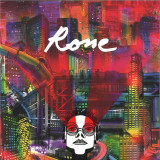
Rone is a stalwart of the French electronic scene and returns with his fourth album, 'Mirapolis', a synesthetic journey with features from Bryce Dessner (The National), Baxter Dury, John Stanier (Battles) and Saul Williams. The artwork was created by the critically acclaimed director Michel Gondry.
Stepping into Rone's music is like sleepwalking through a vividly colourful dream, eventually stumbling across a strange, scintillating Megapolis of saturated light and colours: 'Mirapolis'. Its twelve tracks / districts, each with their own specific planning, pulsate as though animated by their musical mastermind.
The project was an opportunity to get reacquainted with long- time stage and studio partners John Stanier, Gaspar Claus and the Vacarme band and Bryce Dessner (guitarist for The National,) while bringing in new collaborators (and thus, new interpretation of Rone's dreams). We find American slam-poet Saul Williams, who happened to be in Paris for a moment and contributes a searing anti-Trump screed, Baxter Dury, who brings an irresistible East London touch to 'Switches', a kind of fan fic that reimagines the Beatles' Sergeant Pepper lounging pensive in a club chair, Israeli electronic music muse Noga Erez, who inspired 'Waves' which, despite being recorded remotely, betrays a euphoric partnership, and finally, Kazu Makino, Blonde Redhead's bewitching singer and multi- instrumentalist, who contributes to the album's closer, the gauzy 'Down For The Cause'.
Rone remains a producer of grand instrumental pieces, which cannot be easily categorized in the architectural canon of our electronic music galaxy. Hypnotic, cinematic opening track 'I Philip' is an offshoot from the score for the first French virtual reality fiction, built around Philip K Dick - the perfect gate into a city that then opens up myriad temporal perspectives.
Dauw welcomes Taylor Deupree to the label with his new record 'Mur'. With this release Dauw also introduces Jelle Martens, a Belgian graphic designer and painter, for the artwork of this release.
Deupree describes the album title “as if there’s always something about my music that’s like a murmur”, resulting in a murmuring effect when pronouncing the names of each track. Mur is a personal journey through the challenging year that 2020 has been. The fifth and last track on the album, Mar, contributes as a catharsis to this turbulent period in Deupree’s personal life, which is defined by the interaction between the loud sounds and the soft keys of the piano. As if the storm has died down and the waters have found their peace.
Taylor Deupree is an American musician and mastering engineer based just outside of New York. As a former member of the American electronic band Prototype 909, Deupree has had numerous collaborations with artists such as Ryuichi Sakamoto, Stephen Vitiello, Alva Noto and Marcus Fischer. Curating 12k, a New-York based music label, is another aspect of Deupree’s career and brought together over one hundred releases since its beginnings in 1997. Having some similar artists in our catalog (Federico Durand, Will Samson and Steinbüchel for example), it’s safe to say that Deupree’s new release through Dauw will be in good company.
Snapped Ankles return to the forest, but it's not as they left it. Trees planted in neat rows. A well-ordered monoculture with access roads and heavy machinery. The smell of greenwashed money in the air. There's no sign of the ancient woodland they emerged from on debut album, Come Play The Trees. And it's far cry from the gentrified East London they found themselves hawking on Stunning Luxury. All is not well in the face of progress. Welcome to the Forest Of Your Problems. Even among the famously close-knit woodwose community there are factions forming. Meet The Business Imp, The Cornucopian, The Nemophile and The Protester. Each with their own motivations and belief systems. Their own sense of injustice: contradictions, anxieties and guilt. There are woodwose who have risen to the top in the boom and bust world of real estate and hedge funds. Grab what you can before the next crash. Others find euphoria in the absolute conviction that wealth and technology will see us through this. There are those with their recycling in order, who are well-versed in the prospect of imminent ecological and economic collapse, burying themselves in vegan cookery and extensive international holiday itineraries. And there's an increasing number angry at the state of the world, ready to take to the streets and the trees in an attempt to force real change. Forest Of Your Problems runs the gamut of modern woodwose emotions. In this neat human approximation of the forest, it's an increasingly knotted affair. Despite all of this, Snapped Ankles haven't lost their innate ability to make you want to move your feet - their Teutonic forest rhythms are still shot through with post-punk lightning. Whether they're exploring those opportunities which might arise when a Nigerian prince emails out of the blue on 'The Evidence', or referencing the crooked woodwose attempting to go straight on 'Rhythm Is Our Business', this is music to lose your inhibitions to. The moments of pure elation on 'Shifting Basslines Of The Cornucopians' are worth the admission price alone - "It's a great time to be alive!" ...apparently. Snapped Ankles outsider status has always allowed them to hold a mirror up to society. Now the boundaries are not so clear. In the four years since Come Play The Trees was released, their cult has flourished. Previous album Stunning Luxury saw the band invited to play the BBC 6 Music Festival and a KEXP session on the back of a sold-out UK tour which culminated with two nights at Village Underground in London. As those who have witnessed the shamanic ritual of their live shows will attest, they are a truly unique, communal experience. Forest Of Your Problems will see the woodwose bring their ancient forest rhythms and high-wire, multi-media live act to ever bigger stages - including Camden's iconic Roundhouse in October.
Blue Vinyl
Lynch protégé and Twin Peaks sound designer Dean Hurley coaxes an incredible puzzlebox of atmospheres and mood pieces on this killer contribution to our Documenting Sound series, now remastered and pressed on vinyl for what is, perhaps unsurprisingly, the most cinematic and neon-lit instalment in the series. Like a
smudged and overdubbed copy of the BoC Maxima tape, with added iridescence.
Across almost 40 minutes we transition from aerosolised synths to romantic chromatics, thru to Nurse WIth Wound-style severed rhythms and fading glimmers of hope, ‘Concrete Feather’ epitomises Dean Hurley’s prized knack for nuanced instrumental story-telling in the finest and most engrossing style we could imagine. Against the backdrop of the Hollywood film industry that has primed us for as long as we can all remember, the music spans a panorama of lush, mirage-like choral pads and starry flickers thru to gloaming
nightmare sequences and screwed drums, while touching on some of the dankest synth tones this side of his ‘Anthology Resource’ volumes or indeed his soundtrack work for Twin Peaks: The Return. It’s full of dread and a slowly unfolding sense of tragedy.
“Having a regular practice of recording is probably the single most important element to my craft. It’s a way of dropping indiscriminate mile markers while constantly moving forward in time without ability to pause.
Over the years, working for David Lynch taught me a great deal about this and the concept and importance of experimentation. I’ve found myself clinging to those lessons during this time and using them as tools for both productivity and balance. His notion of experimentation is a simple one, yet incredibly profound. It was one of the very first words I heard him say during our initial meeting, and I never stopped hearing the term daily over the subsequent 13 years working together. An ‘experiment’ can provide a legitimate mental back-entrance into the act of creation. It can position an approach toward discovery as opposed to effort, and eliminate the thought that one needs to ‘will’ something into existence. It also aids in calming the judgmental
side of a brain from stepping on/interfering with expression…after all, experiments are not about success or failure, they’re simply about learning. In the Lynch school of thought, multiple experiments then become firewood…and with firewood, one can not only build but actually sustain a fire…even turn it into a multipleacre blaze or more.
Dean Hurley
Wir haben gehört, dass Post-Punk es bis auf die Frühlingsseiten der Sunday Times geschafft hat. Oh, bleibt da dran - Desperate Journalist wüten schon seit gefühlten Äonen mit ihrer melodramatischen Mischung aus traumatisierten Gitarren und kunstvoll gebrochenem Gesang gegen den Konzern-Apparat. Sechs Jahre sind vergangen seit dem Erscheinen des teuflischen "Desperate Journalist"-Debuts in 2015. Das stürmische zweite Album "Grow Up" erschien 2017, während 2019 das stellare "The Search For The Miraculous" weit und breit zu hören war. "Maximum Sorrow!", das komplett in Crouch End inmitten der Covid-Pandemie aufgenommen wurde, strotzt nur so vor Alt-Rock-Muskeln, die in sieben Jahren unermüdlicher Auftritte und Veröffentlichungen aufgebaut wurden, wie ein wilder Panther auf der Pirsch. Angetrieben von Simon Drowners ohrwurmverdächtiger Bassline zeigt sich das Quartett schon beider Lead-Single "Fault" in makellos brutaler Form, mit Banshee-Heulen und selbstzerfleischenden Texten von Sängerin Jo Bevan: "And those teenage hangups are hard to beat / When your closet is piled up with defeat", schnauzt sie an einer besonders stacheligen Stelle, während ihr Gitarrist Rob Hardy und Schlagzeuger Caz Hellbent nur noch feuriges Öl in die akustischen Flammen gießen können. Wie ein Großteil des restlichen Albums ist "Fault" sowohl verspielt als auch voll mit Wut. Das sind Desperate Journalist in hyperdynamischer Form, superglatt, aber nie krankhaft glatt; ambitioniert und expansiv, aber immer noch selbstverliebt und durch und durch DIY. Es gibt traditionelle verzweifelte Reisen in das Herz der Dunkelheit - siehe die doomig-prägnanten Desintegrationen von "Armageddon". Und es gibt brillant beleuchtete Lichtblicke: die ohnmächtige Eleganz von "Utopia", die sardonische, melodieverliebte Frechheit von "Personality Girlfriend", die Ruhe von "Formaldehyde", ein tragisches Finale auf jedem anderen Album - hier als Opener. Ein Lob auch für die raumgreifenden, epischen Chorschübe von "Everything You Wanted" und die spektakulär bittersüßen Sehnsüchte von "What You're Scared Of", die mit verstreuten Zuckerwürfeln bestückt sind.
- 01: The Wrestlers (With Bob Rutman)
- 02: Palmistry (With Marnie Weber And Walter Hus)
- 03: Fire Is A Mirror (With Jabir)
- 04: Sideways In Time
- 05: A Descant For El Fuego Es Un Espejo (Performed By Jabir)
- 06: No-End Street (With Walter Hus)
- 07: Edgeways In Time
- 08: Valley Of Dry Bones
- 09: When Youre Really Gone (With Walter Hus)
- 10: 8-Infinities
- 11: Palmistry (Instrumental)
8-Infinities represents Discos Transgénero’s first contemporary release after several reissues and archival projects. Stepping away from customary North-American guitar traditions, Ameel Brecht (core member of Razen) presents an utterly singular take on early European music with an album which evokes the inner conflicts of growing up and their connection to the concerns of fatherhood.
A classically trained musician, Brecht resorts once again to the use of resophonic guitars and mandolins as a way of finding a middle ground between the virtues of being a schooled musician and the ability to escape pre-established tendencies in pursuit of what he has referred to as ‘metaphysical freeform string music’.
Additionally, the album features a series of fascinating and subtly merged contributions by label associates Marnie Weber and Jabir, along with Bob Rutman’s distinguished steel cello and Walter Hus’ automated glockenspiel. Echoing the likes of Renaissance and Baroque music on plucked instruments, Brecht assembles here a collection of timeless compositions.
Antoine Tato Garcia,Juan Luis Curbon « Patela »,Steeve Laffont,Ramon Del Pichon,Nas Heredia,Fra
Mediterranean Gypsies Roads - The sounds of guitars
- A1: Caroline (Antoine Tato Garcia) 2'51
- A2: El Rencuentro (Juan Luis Curbon « Patela ») 4'04
- A3: El Ratinho (Steeve Laffont) 4'35
- A4: Suspiro (Ramon Del Pichon) 4'21
- A5: Cositas Del Maestro (Nas Heredia) 2'56
- B1: Gipsy Melancolie (Steeve Laffont Et William Brunard) 4'36
- B2: Raphael (Antoine Tato Garcia) 4'38
- B3: Miro Djiben (Fraïda) 5'58
- B4: Bossa Gitana (Djelito Soles) 3'26
I attended a trade fair in Rio de Janeiro, Brazil. In this show, we met producers, label and festival managers. It is a privileged moment when it is possible to learn about new trends, new musical forms, emerging groups. The timing of the meal is undoubtedly the most important. We take the time to introduce ourselves and discover each other. When my turn arrived, I took out my little map to locate the town of Sète on the map of France. There, an American promoter exclaimed "Yeah! You live in this beautiful city. Where there is this incredible music. ” I admit that at the time I didn’t quite understand what he meant but flattered by his remark I told him yes. Later, I realized that he was talking about gypsy music that made the whole world dream.
When my friend shared this anecdote to me, it resonated deeply with me. Indeed, for us, people of the south of France, this was nothing exceptional. Indeed, every day you could meet in the street a gypsy musician performing a rumba, another declaiming a fandango or another who liked to paraphrase the maestro Django. It is part of our daily environment, but it is indeed a peculiarity of this region. The territory of the Mediterranean arc, from Arles to Perpignan, is indeed the cradle of gypsy music in France. In addition, we must underline the major influence of the Gypsy artists of Catalonia in the development of these different artistic forms. Through weddings and family reunions, the repertoires have shifted to be reinterpreted according to the identities specific to each and the territories of residence.
With this new collection, we wanted to show, to hear all the musical richness of Gypsy and Manouche artists populating the territory. From appropriation to recreation, they never stop bringing this music to life, re-enchanting it and offering it a resolutely modern reading, open to the world. In this first opus, devoted to the guitar, we will take the routes of latin music, flamenco or jazz alongside renowned artists and young talents. With "The sound of guitars", it is a first door open to the gypsy music of the Mediterranean Arc, that we will discover gradually through the "Mediteranean Gypsies roads" collection.
- A1: Never (A Perpetual Transhumanist Curse)
- A2: Demons (Conditioned Noosphere)
- A3: Necropolitics (Loose Remembrance)
- A4: Alucard And Alive Again (Melancholic Rage)
- B1: Sacrificing Your Heart (It Could Be Bloody Marvellous)
- B2: Crossed Realities (Drained Vectoralisation)
- B3: Demons Ii (Wardrums And Noises Of An Attention Crisis)
- B4: Silent Together (Somewhere Alone)
- B5: Necrorose For The Illdisciplined Void (Dark Euphoria)
- C1: Nicola Kazimir - 9 Eternities In Doom Ep (7Inch) - Midnight Fury (9 Eternities In Doom)
- D1: Nicola Kazimir - 9 Eternities In Doom Ep (7Inch) - Maniac (Resentment Of The Alienated)
In Post-Heretic Dracula X Chronicles II the Dracula figure functions as a part fictive and part autobiographical metaphor. Dracula mirrors certain systematic (therefore also internal) conditionings and attributes in its whole ambivalent fluctuations. This character represents the complex relationships of a loving/living person in a neo-liberal capitalist system while oscillating between melancholia & rage, facing the preservation or loss of his love and standing in an alienated position towards the ruling order. The eleven featured compositions and their respective song names (both of them are riddled with references) playfully touch on conflicts between love, life and system-critique, without being too upfront about the subject-matter.
Nicola Kazimir (*28.05.1990 in Zürich, Schweiz)
A DJ, producer, musician, artist, space-owner, record label owner and party organizer, Nicola Kazimir works freely across platforms and communities. For Kazimir, these numerous positions are not static, and they can actfluidly and reciprocally as a whole, or as separate entities. His artistic and acoustic productions are mostly based on topics that include the institutionalization of techno, copyright, dividualism and the human perception of repetitive rhythm patterns mixed with aesthetic codes of b-movie horror movies or occultism. He is one of the founders and still part of the labels Les Points/ Gentrified Underground / Infoline and the offspace Mikro Zürich. Other projects include a supporting role in the organization of Zentralwäscherei Zürich and being part of the Clubbüro-team at Rote Fabrik.