LINEAR MOTION
Epic arp sequences dancing around solid synth stabs and minimal percussion. Movingly imaginative and thought provoking techno.
ECHOES
Absolute dreamy progressions turn into a 4x4 techno stomper.
Early Detroit funk-influenced bass lines perfectly meshed within the atmosphere of an alien world.
METALLICS
Drama filled bell tones, eerie synth leads. Killer dance material for peak hours.
A joy for serious techno missionaries and a show & prove moment for Djs.
Red hot funk & straight to the point.
SEQUENCE IN TIME
Futuristic magic landscapes, then that signature rubbery Keith Tucker baseline.
Then...the perfect kick. Living up to its title, this track takes
Suche:miss k
REISSUE
2004 saw the release of Monster Magnet’s sixth studio album Monolithic Baby, the follow-up to 2000’s “God Says No”, which cemented the Red Bank, NJ rockers in the world of space rock and roll. This 14-track journey of masterful hard rock features 11 ripping originals and three cover songs recorded in true classic Magnet style, including covers of The Velvet Underground, David Gilmour and Robert Calvert. Monolithic Baby is being reissued on August 19th via Napalm Records on orange vinyl with white and black splatter, as well as in a limited glow in the dark vinyl variant! Don’t miss the album Ultimate Classic Rock calls “a revitalized, fire-breathing Monster Magnet” and All Music calls “another collection of undeniably Wyndorfian tunes.”
- A1: Midnight Walker (Davy Spillane Cover)
- A2: Death & Resurrection Show (Killing Joke Cover)
- A3: Time (Dennis Wilson Cover)
- A4: Sad Motherfuckin' Parade (Johnny Depp Original)
- A5: Don't Talk (Put Your Head On My Shoulder) (Put Your Head On My Shoulder)
- A6: This Is A Song For Miss Heady Lamarr (Johnny Depp Original)
- B1: Caroline, No (Beach Boys Cover)
- B2: Ooo Baby Baby (The Miracles Cover)
- B3: What's Going On (Marvin Gaye Cover)
- B4: Venus In Furs (The Velvet Underground Cover)
- B5: Let It Be Me (The Everly Brothers Cover)
- B6: Stars (Janis Ian Cover)
- B7: Isolation (John Lennon Cover)
In a collaboration you might never have expected but somehow makes perfect sense, original Brit blues mastermind Jeff Beck teams up with a little known American by the name of Johnny Depp to render some of the latter's songs alongside some finely selected covers. From The Beach Boys to John Lennon, The Velvet Underground to Killing Joke and more besides, this is the sound of two lifelong music lovers letting it all hang out and playing with the impassioned energy and innocence of youth. More than just a throwaway side project for a global superstar, this is a deeply discerning project which frames Depp's music in a whole new light.
Monster Truck tick all the musical boxes that have garnered the Hamilton-based band a reputation as one of Canada’s hardest-hitting rock outfits, live and on record.
On Monster Truck’s fourth full-length album Warriors, the band (bassist and lead singer Jon Harvey, guitarist Jeremy Widerman, keyboardist Brandon Bliss, and former drummer Steve Kiely), take their signature, riff-driven brand of rock to new heights and bombastic lows. With blazing shared riffs, massive gang vocals, and an ‘all for one, and one for all’ spirit, Warriors reads like a mission statement; one that telegraphs the tireless work ethic Monster Truck has displayed since starting out in 2009, as well as where they’re at and where they’re heading, sonically, in the future.
Das erfolgreichste Duo der Musikgeschichte, Daryl Hall &
John Oates, veröffentlicht sein sechzehntes Studioalbum
"Do It For Love", das erstmals 2003 erschien, nach einer
sechsjährigen Veröffentlichungspause neu. Das Album
wird zum ersten Mal als Doppel-LP und in einem
erweiterten CD-Format mit Bonustracks, die auf dem
Originalalbum nicht enthalten waren, veröffentlicht.
"Do It For Love" gilt als eines der besten Hall &
Oates-Alben, auf dem das Duo seinen
unverwechselbaren, anspruchsvollen und mühelos
unterhaltsamen Blue-Eyed-Soul serviert, der sowohl
langjährige Fans als auch Liebhaber der 80er Jahre
anspricht. Das Album enthält die Singles "Do It For Love",
"Man on a Mission" und "Getaway Car".
- A1: “Midnight Walker” (Davy Spillane Cover)
- A2: “Death And Resurrection Show” (Killing Joke Cover)
- A3: “Time” (Dennis Wilson Cover)
- A4: “Sad Motherfuckin’ Parade” (Johnny Depp Original)
- A5: “Don’t Talk (Put Your Head On My Shoulder)” (Beach Boys Cover)
- A6: “This Is A Song For Miss Heady Lamarr” (Johnny Depp Original)
- B1: “Caroline, No” (Beach Boys Cover)
- B2: “Ooo Baby Baby” (The Miracles Cover)
- B3: “What’s Going On” (Marvin Gaye Cover)
- B4: “Venus In Furs” (The Velvet Underground Cover)
- B5: “Let It Be Me” (The Everly Brothers Cover)
- B6: “Stars” (Janis Ian Cover)
- B7: “Isolation” (John Lennon Cover)
Jeff Beck and Johnny Depp tapped into the frustration of living through the pandemic in 2020 with their well-timed cover of John Lennon’s “Isolation.” The Grammy winning guitarist and Hollywood Vampires co-founder are back with their first album together, appropriately titled, JEFF BECK AND JOHNNY DEPP. On the new record, Beck’s first studio effort in six years, the artists coax unexpected performances from one another on 11 covers and two originals that touch on everything from Celtic and Motown to John Lennon, the Beach Boys and The Velvet Underground.
The result is a wild roller coaster ride through different genres where hairpin juxtapositions deliver some of the album’s biggest thrills. A remarkable example comes early on when the industrial stomp of Killing Joke’s “Death And Resurrection Show” gives way to the intense heartache of Dennis Wilson’s “Time.” Each performance stands on its own, but the sharp contrast created by sequencing them together heightens the emotional impact of both songs.
The duo recorded most of the album in Beck’s studio over three years while Depp lived on and off in the guitarist’s English cottage. Robert Adam Stevenson co-produced several tracks on the album and engineered many of the sessions remotely from Depp’s studio in Los Angeles. When the basic tracks were finished, they were fleshed out by musicians who’ve played with Beck through the years, including drummer Vinnie Colaiuta and bassist Rhonda Smith.
The album title will be “18.” The cover illustration (attached) was done by Jeff’s wife, Sandra and pictures them when they were both 18. Here’s Jeff’s comment on the title from the PR: Beck explains the album title: “When Johnny and I started playing together, it really ignited our youthful spirit and creativity. We would joke about how we felt 18 again, so that just became the album title too.”
A series of four limited edition box sets released to celebrate the 40th
Anniversary of the Etcetera label
This one features 10 classic Baroque music recordings from their catalogue:
JS Bach: Toucher Bach Son for Flute & Harpsichord (KTC1695)
JS Bach: Goldberg Variations/Canonic Variations (KTC1400)
JS Bach/Abel/ JC Bach: Souper Galant with the Bach Family (KTC1293)
Vivaldi/Cage: 8 Seasons (KTC1429)
Schutz/Bach: Musicalische Exequien (KTC1578)
JS Bach: Kunst der Fuge (KTC1348)
JS Bach: Gamba Sonatas (KTC1365)
Faber/ Vivaldi: Missa Maria Assumpta (KTC1597)
Fiocco: Lamentations (KTC1544)
George is Lord is a celebration of all things George Harrison - What began
as an exercise inlearning to play the drums, became a band - Anna
Pomerantz quit her job as Interior Designer to the stars and called upon
old friend Lindsay Glover, to teach her to play the drums
Lindsay, who has played in local LA favorites, Whiskey Biscuit and Future Pigeon,
began by teaching Anna the fundamentals and quickly it turned into learning
songs. "One of the first songs we learned was 'Something.' I've actually spent
most of my life hating the Beatles, but hearing them again for the first time
through the drums, made me fall completely in love, especially with George and
Ringo" recalls Anna. "I began teaching Lindsay the guitar and we started playing
together." The duo went on to learn a number of songs like, "Long, Long, Long," "All
Things Must Pass," and "Give me Love" when they realized they were ready to play
with other people. Lindsay asked friend Cody Porter of Pearl Harbor and Puro
Instinct to come play bass. "In our lessons, Lindsay had taught me how to sing
while playing the drums to keep my place in songs. I didn't think I was going to be
a singer in a band, it just happened." The missing ingredient was a lead guitar
player, and the trio invited Sam Blasucci of the popular LA folk duo Mapache if
he'd be willing to jam with us. He brought his magic and completed George Is
Lord. George is Lord recorded their first album of covers with producer Jason
Quever (Beach House, Cass McCombs). Dean Wareham (Luna, Galaxie 500)
appears as a guest. The ten song record includes a variety of George favorites
from the Beatles catalogue and throughout George's solo career.
On their new album Looming, The Spindle, The Pleasure Majenta shape a
terrifying and sublime mix of noise, broken electronics and guitar
feedback that begs to remain untamed
From New Zealand by way of Berlin, these dystopian goth punks take their cues
from the harsh and heavy energy of The Birthday Party, Swans and The Fall
€"casting bummer vibes into the void to create the pain- soaked statement so
many albums want to make but wind up missing the mark.The lead single € Full
of It € fills the screen with flashes of cinematic post-punk savagery up to its ears
in swampy distortion and sleazy funhouse skronk. Velvety € 70s exploitation flick
saxophones hustle with devilish no-wave spaghetti western guitars and a slippery
bassline like a coffin dragged through mud in a grungy post- punk dirge. It's a
waking tour through a dysfunctional late- capitalist bardo where disassociation
becomes an effective coping mechanism for the cyclical, paralyzing grind of
clock- in, clock- out psychosis. € I felt okay when I wasn't myself "when I was
making music or playing onstage, so I decided I would contact myself in this way,
says The Pleasure Majenta's Lawrence Loz Fergus Goodwin. It's a dangerous
game to play.
Tracks: Satellite / Fabric / Sad2say / Smiles Through A Sneer / Anxious Patient /
Osc / Full Of It / It's Ten / Erik Satie / Gardens
This is the final nail in the coffin of Reverend Bizarre and also the final part of Svart Records’ long-standing mission to release the band’s entire discography on vinyl. The vinyl box set contains both versions of the band’s legendary demo Slice of Doom plus the promo tape the band did to get a deal for their first album In The Rectory. Additional bonus is a live DVD of the band’s very first live show at TVO in Turku, Finland on September 18th, 1999. Then there’s replicas of three early gig posters, the rare True Doom manifesto by Earl of Void, a large booklet compiling all visual material and background info from these early years, a very rare promo booklet replica, flyers plus hidden gems.
• Brings together themes from popular soundtracks and TV series
• Ramin Djawadi Game of Thrones, Max Richter The Leftovers, Downton Abbey main theme, Lalo Shiffrin Mission Impossible, Henri Mancini The Pink Panther, and many more
1. Ramin Djawadi
Game of Thrones Medley (Main Theme/The Night King/Light of the Seven)
arr. Matthieu Gonet; orch. Matthieu Gonet & Ronan Maillard
2. Lalo Schifrin
Mission: Impossible
arr. & orch. Matthieu Gonet
3. Justin Hurwitz
La La Land Medley (Mia and Sebastian theme/ Another Day of Sun)
arr. Matthieu Gonet
4. Trad. Scottish, late 19th century
The Skye Boat song (Outlander)
arr. Julie Berthollet, Camille Berthollet
5. Trad. Italian, late 19th century
Bella Ciao (La casa de papel)
arr. & orch. Matthieu Gonet
6. Boots Randolph & James Rich
Yakety Sax, (The Benny Hill Show)
arr. & orch. Matthieu Gonet
7. Max Richter
The Leftovers Suite
arr. Julie Berthollet, Camille Berthollet
8. John Barry
The Persuaders! (Amicalement vôtre)
arr. Matthieu Gonet; orch. Matthieu Gonet & Ronan Maillard
Side B:
1. Ludovico Einaudi
Fly (Intouchables)
arr. Julie Berthollet, Camille Berthollet
2. Julie Berthollet
Flashback
words and music by Julie Berthollet, arr. Camille Berthollet
3. John Lunn
Downton Abbey Main Theme
arr. & orch. Matthieu Gonet
4. Henri Mancini
The Pink Panther
arr. & orch. Matthieu Gonet
5. Lorne Balfe, Rupert Gregson-Williams and Hans Zimmer
The Crown Main Title
arr. Matthieu Gonet; orch. Matthieu Gonet & Ronan Maillard
6. David Arnold & Michael Price
The Game is on (Sherlock)
arr. Matthieu Gonet; orch. Matthieu Gonet & Ronan Maillard
7. Loik Dury & Christophe Mink
Dix pour Cent
arr. Matthieu Gonet; orch. Matthieu Gonet & Ronan Maillard
8. Mathieu Lamboley
Arsène (from the Netflix original series Lupin)
9. Kyle Dixon & Michael Stein
Stranger Things Main Theme
arr. Matthieu Gonet; orch. Matthieu Gonet & Ronan Maillard
10. Danny Elfman
The Simpsons Main Title
arr. Matthieu Gonet
11. Camille et Julie Berthollet
Générique
music by Julie Berthollet, arr. Camille Berthollet
Here’s artist Max Kuhn on hearing the new Ralph White recordings for the first time: “I was driving a familiar round trip across the high desert when I first put it on. It immediately spoke to me. In the lyrics there's a familiar geography for me, a familiar emotional landscape for all of us. And maybe it was driving an almost 40 year old truck on sun baked & cracked asphalt in July, but it's like you can hear his songs coming apart- the cadence, the rhymes stumbling & defying expectations, consistency but they just keep moving. You have no choice but to go with it. Probably a good lesson for how to live in this era we're in, cracking up but keeping it all running somehow, trying to make something pretty with the time.” Recorded in Austin, Texas in March of 2020, just days before the city and the rest of the world shut down, Ralph White spent two days with producer, Jerry David DeCicca (Will Beeley, Ed Askew) and recording engineer, Don Cento, capturing a raw and wild set of performances. Ralph, having recently converted his van into a mobile living and touring quarters equipped with a wood-burning stove, left Austin, the city where he was born 70 years ago, and retreated to an Arizona commune where he began building a new house in the desert hills to escape the virus and insanity of daily living. Ralph takes us on a journey through his myriad of travels: from Dock Boggs to Syd Barrett to William Faulkner to Stella Chiweshe to Blind Uncle Gaspard…scratching banjo, rasping train whistle hollers, rolling kalimba, rousing accordion, taut shimmers of guitar, caustic fiddle and lyrics - that could have been hidden amongst the dusty inner groove of a lost Harry Smith 78 - weaving in and out of streams of consciousness, time and place. In addition to his solo work, White has recorded or performed with a diverse group of folk and avant-garde musicians: Thurston Moore of Sonic Youth, Jandek, Jack Rose, Eugene Chadbourne, Michelle Shocked, Sir Richard Bishop, and Michael Hurley. “This is what Ralph White really sounds like. It’s what time passing really sounds like. It’s what a look really feels like. This record is someone touching you all over!” --Bill Callahan “Striking, electrifying acoustic music from an underappreciated legend of the American Southwest. Here, tight song structures meet open, unadorned instrumentation: guitar, banjo, kalimba, accordion, fiddle, and White's elastic voice, unspooling pitches and syllables. White draws listeners in on his terms. Lyrics wind and twist and pull back: "Motel 6, Motel 6, Altoona, Altoona; missing you, missing you so, great big hole in my--..." Brave, beautiful, a high point in White's long career. And this is just Volume 1!” - Eli Winter. "What Ralph White puts on albums and onstage is so mind-boggling and vast, it forces those of us in the description business down a treacherous path." --Darcie Stevens, Austin Chronicle. “White was a member of well-loved punk bluegrass outfit Bad Livers, but his solo work is possessed of a much more lonesome spark, exaggerating the implied drone at the heart of the music of Dock Boggs and The Stanley Brothers…White plays wooden six-string banjo, violin, button accordion and kalimba and his voice has a high, eerie quality to it…extremely psychedelic.” --David Keenan, The Wire Tracklisting: 1. Gun Barrel Polka 2. Misinformation Shuffle 3. El Golfo 4. Something About Dreaming 5. Rye Straw 6. The Stovepipe Blues 7. No Stranger 8. Morning Sickness 9. Lord Franklin
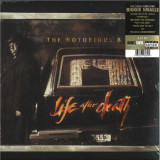
- A1: Life After Death (Intro)
- A2: Somebody's Gotta Die
- A3: Hypnotize
- A4: Kick In The Door
- B1: #!*@ You Tonight (Feat R Kelly)
- B2: Last Day (Feat The Lox)
- B3: I Love The Dough (Feat Jay Z & Angela Winbush)
- B4: Whats Beef?
- C1: Big (Interlude)
- C2: Mo Money Mo Problems (Feat Mase & Puff Daddy)
- C3: Niggas Bleed
- C4: I Got A Story To Tell
- D1: Notorious Thugs
- D2: Miss U
- D3: Another (Feat Lil Kim)
- D4: Going Back To Cali
- E1: Ten Crack Commandments
- E2: Playa Hater
- E3: Nasty Boy
- E4: Sky's The Limit (Feat 112)
- F1: The World Is Filled... (Feat Too Short & Puff Daddy)
- F2: My Downfall (Feat Dmc)
- F3: Long Kiss Goodnight
- F4: You're Nobody (Til Somebody Kills You) (Til Somebody Kills You)
The year is 2050, humanity is collapsing and overrun by an anonymous entity, known as the Robodroid. The mission of the Robodroid is to end civilization as we know it. After their successful collaboration debut "The Darkness Is Coming" on Crobot Records, Robodroid is back once again with a new release. Now the Robodroid has traveled back through time to reprogram the future. The EP includes four dark and aggressive electro originals and two remixes by none other than Maelstrom and Dexorcist. Robodroid is a futuristic electro project ran by Przemek Kuduk (Robodrum) and Ben Evans (The Droid).
Los Cotopla Boyz: Millennial Cumbia For The End Of The World. The newest psychedelic space ranger Cumbia band from Bogotá's infamous DIY scene have been sent to earth to save the party! Los Cotopla Boyz make the walls sweat, they set fire to your feet on the dance floor. It all started in Bogotá, which you might say is the tropicanibal venue par excellence, a place that has brought life to acts like Frente Cumbiero, Los Meridian Brothers, Romperayo, Chúpame el dedo, Dub de Gaita, Los Pirañas, Onda trópica and León Pardo, among other eccentricities that have taken the world and stand out not only for their virtuosity but also the connection that lives between that salvaging of traditional folklore and lysergic futurism that expands hypnotically around the world. From this musical hotbed that emerged in the second decade of the new millennium, there is now a new generation to continue the tropicanibal scene, with groups such as La Sonora Mazurén, La Tromba Bacalao, Los Yoryis, El Conjunto Media Luna and, of course, Los Cotopla Boyz, a five-piece that formed in Bogotá in 2018 but inhabit a post-pandemic dystopian multiverse where their mission is to save the party. So their live performances have that illusion of frantic Power Rangers singing about their adventures, as if these were epic chants, except instead of heroic feats they sing with humor about their everyday lives, like the drama “N’sync” about that chat where they leave you on read, or “Me Malviajé con las Ganlletas” about the hallucinogenic experimentation of ingesting cannabis and flipping out. These experiences also lead to songs like the clumsy love lost of “Dama tu Wasap,” the cathartic “Tren de Cotopla” and the ode to excess that is “Raspafiestas,” that moment in your life when the night seems eternal and you only want to go from one party to the next until the world ends. These songs, together with “Plankton (Abanico Sanyo)” and “El Peruanito” are part of Mamarron, Vol. 1, a compilation of seven millennial cannon shots inspired by Los Mirlos, Los Hechizeros Band, Anan, Wendy Sulca, La Sonora Cordobesa, Bad Bunny, Yandel and Los Corraleros de Majagual, tracks laid down on their debut record that saw the light in 2020 in the middle of the pandemic and will be re-released in 2022 by AYA records (ZZK Records imprint.) As well as being pressed on vinyl the album will include the bonus track “El Peruanito” remixed by Colombian producer Santiago Navas and taken from Mamarrón, Vol. 2, their album of remixes by figures such as Frente Cumbiero, Cerrero, Prendida, Sonido Confirmación, DJ Rata Piano and Felipe Orjuela, local producers and musicians with a global scope and vision who expand the raspafiesta universe to the limits of the world. Los Cotopla Boyz are a sweaty, schizophrenic cumbia experience that has been witnessed by emerging Bogotá clubs like Matik-Matik, Boogaloop, El Chamán, Tejo Turmequé, Videoclub and the festival Hermoso Ruido, providing nights of wild abandon to the beat of an outrageous big cumbia sound, a ritual of release giving those present a maximum catharsis that has no compare, not even the most animalistic moves of any metaller shaking his powerful mane. Los Cotopla make the walls sweat, they set fire to your feet on the dancefloor, drawing amorphous moves from their fans on exquisite nights. Tracks SIDE A: 1. Plankton (Abanico Sanyo) 2. El Peruanito 3. Dame tu Wasap 4. N’sync SIDE B: 1. Tren de Cotopla 2. Me Malviaje con Ganlletas 3. Raspafiestas 4. El Peruanito (Santiago Navas Remix)
Raised somewhere between Ministry Of Sound’s ‘The Annual’ and early music message boards, Kolya’s taste still extends from obscure tape-only releases to turn-of-the-millennium trance anthems.
As a DJ, it’s taken the South Londoner from Bugged Out! to Berlin – at home supporting Demdike Stare with coldwave, spinning runway house alongside MikeQ while a House Of Trax resident, or unleashing noughties fidget at the closing of Camden’s infamous Lock Tavern. All of which is to say, his debut EP for Ecstasy Garage Disco arrives steeped in musical history.
Recorded during lockdown, it draws on perhaps his greatest love, deep (deep, deep) house. A soaring synth work out, opener ‘Stick Together’ is a case in point, standing on the shoulders of giants like Peter Daou, but with a life-affirming exuberance all of its own. ‘Miss Honey Prancin’ In The Twilite’, meanwhile, is a tribute to Moi Rene, as well as a love letter to Project X Records in general, her vocal recast over a groove that alternates between outer space iciness and snare-rolling high drama.
On the flip, ‘Crying Over Spilt Poppers’ blends the flavour of amyl-soaked Gherkin with the emotional nuance of Nu Groove, joyous and reflective in equal measure. And ‘Jamais Vu’ signs off, its bumping kick pattern and intertwining melodic layers connecting glimmering 90s electronica and contemporary, future-facing house.
.
- A1: Yann Dub - Untitled
- A2: Yann Dub - Bruit Blanc
- A3: Explore Toi, Yann Dub - 20 Kilos D'huitres S V.p Madame
- A4: Yann Dub - Brest Sa Place, Son Port Industriel Et Sa Base Atomique - Locked Groove
- B1: Mindfuck - Flamings Terminal
- B2: Explore Toi, Manifest, The Cyberminds, Mobile Squat Base - Urban Groove
- B3: Base Mobile - Face Ambiance (Outro)
- B4: Gh Et - Untitled
Anthology of some the earlyest french Hardcore producers.
Featuring Yann Dub from Brest, who passed away 10 years ago in Barcelona playin guitar in the a bar... Peace to him and his familly.
Playing experimental music since the 90's, creating "Reverse Studio" in Paris in Y2K (we did a lot of cut with him...) and then moving away to Barcelona, cutting again... His brother took over with DK Mastering studio... His cutting machine is now in Belgium at Angström Studio... The story continues...
Explore Toi is Explore Toi Crew. Also early french Hardcore music producer, golden age where musicians were nameless... Everybody knows his label(s) as a CYBER Hardcore pure creation... Visual and musical artist.
Alive and kicking, active !
Big respect for this high ranking production, with locked grooves and remastering.
All tunes are improvisations from the 90's.
Don't miss !!!
- A1: Rock This Mother
- A2: Talk To Me Girl
- A3: You Can Find Me
- A4: Check This Out
- A5: Jesus Going To Clean House
- A6: Hope You Understood
- A7: Is It What You Want
- A8: Love Is Everlasting
- A9: This Is Hip-Hop Art
- A10: Opposite Of Love
- A11: Do You Know What I Mean
- B1: Saving All My Love For You
- B2: Look Out Here I Come
- B3: Girl You Always Talking
- B4: Have A Great Day
- B5: Take My Hand
- B6: I Need Your Love
- B7: Your Town
- B8: Talk Around Town
- B9: Booty Head/Take A Little Walk
- B10: I Love My Mama
- B11: I Never Found Anyone Like You
Cassette[11,72 €]
As the sun sets on a quaint East Nashville house, a young man bares a piece of his soul. Facing the camera, sporting a silky suit jacket/shirt/slacks/fingerless gloves ensemble that announces "singer" before he's even opened his mouth, Lee Tracy Johnson settles onto his stage, the front yard. He sways to the dirge-like drum machine pulse of a synth-soaked slow jam, extends his arms as if gaining his balance, and croons in affecting, fragile earnest, "I need your love… oh baby…"
Dogs in the yard next door begin barking. A mysterious cardboard robot figure, beamed in from galaxies unknown and affixed to a tree, is less vocal. Lee doesn't acknowledge either's presence. He's busy feeling it, arms and hands gesticulating. His voice rises in falsetto over the now-quiet dogs, over the ambient noise from the street that seeps into the handheld camcorder's microphone, over the recording of his own voice played back from a boombox off-camera. After six minutes the single, continuous shot ends. In this intimate creative universe there are no re-takes. There are many more music videos to shoot, and as Lee later puts it, "The first time you do it is actually the best. Because you can never get that again. You expressing yourself from within."
"I Need Your Love" dates from a lost heyday. From some time in the '80s or early '90s, when Lee Tracy (as he was known in performance) and his music partner/producer/manager Isaac Manning committed hours upon hours of their sonic and visual ideas to tape. Embracing drum machines and synthesizers – electronics that made their personal futurism palpable – they recorded exclusively at home, live in a room into a simple cassette deck. Soul, funk, electro and new wave informed their songs, yet Lee and Isaac eschewed the confinement of conventional categories and genres, preferring to let experimentation guide them.
"Anytime somebody put out a new record they had the same instruments or the same sound," explains Isaac. "So I basically wanted to find something that's really gonna stand out away from all of the rest of 'em." Their ethos meant that every idea they came up with was at least worth trying: echoed out half-rapped exhortations over frantic techno-style beats, gospel synth soul, modal electro-funk, oddball pop reinterpretations, emo AOR balladry, nods to Prince and the Fat Boys, or arrangements that might collapse mid-song into a mess of arcade game-ish blips before rallying to reach the finish line. All of it conjoined by consistent tape hiss, and most vitally, Lee's chameleonic voice, which managed to wildly shape shift and still evoke something sincere – whether toggling between falsetto and tenor exalting Jesus's return, or punctuating a melismatic romantic adlib with a succinct, "We all know how it feels to be alone."
"People think we went to a studio," says Isaac derisively. "We never went to no studio. We didn't have the money to go to no studio! We did this stuff at home. I shot videos in my front yard with whatever we could to get things together." Sometimes Isaac would just put on an instrumental record, be it "Planet Rock" or "Don't Cry For Me Argentina" (from Evita), press "record," and let Lee improvise over it, yielding peculiar love songs, would-be patriotic anthems, or Elvis Presley or Marilyn Monroe tributes. Technical limitations and a lack of professional polish never dissuaded them. They believed they were onto something.
"That struggle," Isaac says, "made that sound sound good to me."
In the parlance of modern music criticism Lee and Isaac's dizzying DIY efforts would inevitably be described as "outsider." But "outsider" carries the burden of untold additional layers of meaning if you're Black and from the South, creating on a budget, and trying to get someone, anyone within the country music capital of the world to take your vision seriously. "What category should we put it in?" Isaac asks rhetorically. "I don't know. All I know is feeling. I ain't gonna name it nothing. It's music. If it grabs your soul and touch your heart that's what it basically is supposed to do."
=
Born in 1963, the baby boy of nine siblings, Lee Tracy spent his earliest years living amidst the shotgun houses on Nashville's south side. "We was poor, man!" he says, recalling the outhouse his family used for a bathroom and the blocks of ice they kept in the kitchen to chill perishables. "But I actually don't think I really realized I was in poverty until I got grown and started thinking about it." Lee's mom worked at the Holiday Inn; his dad did whatever he had to do, from selling fruit from a horse drawn cart to bootlegging. "We didn't have much," Lee continues, "but my mother and my father got us the things we needed, the clothes on our back." By the end of the decade with the city's urban renewal programs razing entire neighborhoods to accommodate construction of the Interstate, the family moved to Edgehill Projects. Lee remembers music and art as a constant source of inspiration for he and his brothers and sisters – especially after seeing the Jackson 5 perform on Ed Sullivan. "As a small child I just knew that was what I wanted to do."
His older brother Don began musically mentoring him, introducing Lee to a variety of instruments and sounds. "He would never play one particular type of music, like R&B," says Lee. "I was surrounded by jazz, hard rock and roll, easy listening, gospel, reggae, country music; I mean I was a sponge absorbing all of that." Lee taught himself to play drums by beating on cardboard boxes, gaining a rep around the way for his timekeeping, and his singing voice. Emulating his favorites, Earth Wind & Fire and Cameo, he formed groups with other kids with era-evocative band names like Concept and TNT Connection, and emerged as the leader of disciplined rehearsals. "I made them practice," says Lee. "We practiced and practiced and practiced. Because I wanted that perfection." By high school the most accomplished of these bands would take top prize in a prominent local talent show. It was a big moment for Lee, and he felt ready to take things to the next level. But his band-mates had other ideas.
"I don't know what happened," he says, still miffed at the memory. "It must have blew they mind after we won and people started showing notice, because it's like everybody quit! I was like, where the hell did everybody go?" Lee had always made a point of interrogating prospective musicians about their intentions before joining his groups: were they really serious or just looking for a way to pick up girls? Now he understood even more the importance of finding a collaborator just as committed to the music as he was.
=
Isaac Manning had spent much of his life immersed in music and the arts – singing in the church choir with his family on Nashville's north side, writing, painting, dancing, and working various gigs within the entertainment industry. After serving in the armed forces, in the early '70s he ran The Teenage Place, a music and performance venue that catered to the local youth. But he was forced out of town when word of one of his recreational routines created a stir beyond the safe haven of his bohemian circles.
"I was growing marijuana," Isaac explains. "It wasn't no business, I was smoking it myself… I would put marijuana in scrambled eggs, cornbread and stuff." His weed use originated as a form of self-medication to combat severe tooth pain. But when he began sharing it with some of the other young people he hung out with, some of who just so happened to be the kids of Nashville politicians, the cops came calling. "When I got busted," he remembers, "they were talking about how they were gonna get rid of me because they didn't want me saying nothing about they children because of the politics and stuff. So I got my family, took two raggedy cars, and left Nashville and went to Vegas."
Out in the desert, Isaac happened to meet Chubby Checker of "The Twist" fame while the singer was gigging at The Flamingo. Impressed by Isaac's zeal, Checker invited him to go on the road with him as his tour manager/roadie/valet. The experience gave Isaac a window into a part of the entertainment world he'd never encountered – a glimpse of what a true pop act's audience looked like. "Chubby Checker, none of his shows were played for Black folks," he remembers. "All his gigs were done at high-class white people areas." Returning home after a few years with Chubby, Isaac was properly motivated to make it in Music City. He began writing songs and scouting around Nashville for local talent anywhere he could find it with an expressed goal: "Find someone who can deliver your songs the way you want 'em delivered and make people feel what you want them to feel."
One day while walking through Edgehill Projects Isaac heard someone playing the drums in a way that made him stop and take notice. "The music was so tight, just the drums made me feel like, oh I'm-a find this person," he recalls. "So I circled through the projects until I found who it was.
"That's how I met him – Lee Tracy. When I found him and he started singing and stuff, I said, ohhh, this is somebody different."
=
Theirs was a true complementary partnership: young Lee possessed the raw talent, the older Isaac the belief. "He's really the only one besides my brother and my family that really seen the potential in me," says Lee. "He made me see that I could do it."
Isaac long being a night owl, his house also made for a fertile collaborative environment – a space where there always seemed to be a new piece of his visual art on display: paintings, illustrations, and dolls and figures (including an enigmatic cardboard robot). Lee and Issac would hang out together and talk, listen to music, conjure ideas, and smoke the herb Isaac had resumed growing in his yard. "It got to where I could trust him, he could trust me," Isaac says of their bond. They also worked together for hours on drawings, spreading larges rolls of paper on the walls and sketching faces with abstract patterns and imagery: alien-like beings, tri-horned horse heads, inverted Janus-like characters where one visage blurred into the other.
Soon it became apparent that they didn't need other collaborators; self-sufficiency was the natural way forward. At Isaac's behest Lee, already fed up with dealing with band musicians, began playing around with a poly-sonic Yamaha keyboard at the local music store. "It had everything on it – trumpet, bass, drums, organ," remembers Lee. "And that's when I started recording my own stuff."
The technology afforded Lee the flexibility and independence he craved, setting him on a path other bedroom musicians and producers around the world were simultaneously following through the '80s into the early '90s. Saving up money from day jobs, he eventually supplemented the Yamaha Isaac had gotten him with Roland and Casio drum machines and a Moog. Lee was living in an apartment in Hillside at that point caring for his dad, who'd been partially paralyzed since early in life. In the evenings up in his second floor room, the music put him in a zone where he could tune out everything and lose himself in his ideas.
"Oh I loved it," he recalls. "I would really experiment with the instruments and use a lot of different sound effects. I was looking for something nobody else had. I wanted something totally different. And once I found the sound I was looking for, I would just smoke me a good joint and just let it go, hit the record button." More potent a creative stimulant than even Isaac's weed was the holistic flow and spontaneity of recording. Between sessions at Isaac's place and Lee's apartment, their volume of output quickly ballooned.
"We was always recording," says Lee. "That's why we have so much music. Even when I went to Isaac's and we start creating, I get home, my mind is racing, I gotta start creating, creating, creating. I remember there were times when I took a 90-minute tape from front to back and just filled it up."
"We never practiced," says Isaac. "See, that was just so odd about the whole thing. I could relate to him, and tell him about the songs I had ideas for and everything and stuff. And then he would bring it back or whatever, and we'd get together and put it down." Once the taskmaster hell bent on rehearsing, Lee had flipped a full 180. Perfection was no longer an aspiration, but the enemy of inspiration.
"I seen where practicing and practicing got me," says Lee. "A lot of musicians you get to playing and they gotta stop, they have to analyze the music. But while you analyzing you losing a lot of the greatness of what you creating. Stop analyzing what you play, just play! And it'll all take shape."
=
"I hope you understood the beginning of the record because this was invented from a dream I had today… (You tell me, I'll tell you, we'll figure it out together)" – Lee Tracy and Isaac Manning, "Hope You Understand"
Lee lets loose a maniacal cackle when he acknowledges that the material that he and Isaac recorded was by anyone's estimation pretty out there. It's the same laugh that commences "Hope You Understand" – a chaotic transmission that encapsulates the duality at the heart of their music: a stated desire to reach people and a compulsion to go as leftfield as they saw fit.
"We just did it," says Lee. "We cut the music on and cut loose. I don't sit around and write. I do it by listening, get a feeling, play the music, and the lyrics and stuff just come out of me."
The approach proved adaptable to interpreting other artists' material. While recording a cover of Whitney Houston's pop ballad "Saving All My Love For You," Lee played Whitney's version in his headphones as he laid down his own vocals – partially following the lyrics, partially using them as a departure point. The end result is barely recognizable compared with the original, Lee and Isaac having switched up the time signature and reinvented the melody along the way towards morphing a slick mainstream radio standard into something that sounds solely their own.
"I really used that song to get me started," says Lee. "Then I said, well I need something else, something is missing. Something just came over me. That's when I came up with 'Is It What You Want.'"
The song would become the centerpiece of Lee and Isaac's repertoire. Pushed along by a percolating metronomic Rhythm King style beat somewhere between a military march and a samba, "Is It What You Want" finds Lee pleading the sincerity of his commitment to a potential love interest embellished by vocal tics and hiccups subtlely reminiscent of his childhood hero MJ. Absent chord changes, only synth riffs gliding in and out like apparitions, the song achieves a lingering lo-fi power that leaves you feeling like it's still playing, somewhere, even after the fade out.
"I don't know, it's like a real spiritual song," Lee reflects. "But it's not just spiritual. To me the more I listen to it it's like about everything that you do in your everyday life, period. Is it what you want? Do you want a car or you don't want a car? Do you want Jesus or do you want the Devil? It's basically asking you the question. Can't nobody answer the question but you yourself."
In 1989 Lee won a lawsuit stemming from injuries sustained from a fight he'd gotten into. He took part of the settlement money and with Isaac pressed up "Saving All My Love For You" b/w "Is It What You Want" as a 45 single. Isaac christened the label One Chance Records. "Because that's all we wanted," he says with a laugh, "one chance."
Isaac sent the record out to radio stations and major labels, hoping for it to make enough noise to get picked up nationally. But the response he and Lee were hoping for never materialized. According to Isaac the closest the single got to getting played on the radio is when a disk jock from a local station made a highly unusual announcement on air: "The dude said on the radio, 107.5 – 'We are not gonna play 'Is It What You Want.' We cracked up! Wow, that's deep.
"It was a whole racist thing that was going on," he reflects. "So we just looked over and kept on going. That was it. That was about the way it goes… If you were Black and you were living in Nashville and stuff, that's the way you got treated." Isaac already knew as much from all the times he'd brought he and Lee's tapes (even their cache of country music tunes) over to Music Row to try to drum up interest to no avail.
"Isaac, he really worked his ass off," says Lee. "He probably been to every record place down on Music Row." Nashville's famed recording and music business corridor wasn't but a few blocks from where Lee grew up. Close enough, he remembers, for him to ride his bike along its back alleys and stumble upon the occasional random treasure, like a discarded box of harmonicas. Getting in through the front door, however, still felt a world away.
"I just don't think at the time our music fell into a category for them," he concedes. "It was before its time."
=
Lee stopped making music some time in the latter part of the '90s, around the time his mom passed away and life became increasingly tough to manage. "When my mother died I had a nervous breakdown," he says, "So I shut down for a long time. I was in such a sadness frame of mind. That's why nobody seen me. I had just disappeared off the map." He fell out of touch with Isaac, and in an indication of just how bad things had gotten for him, lost track of all the recordings they'd made together. Music became a distant memory.
Fortunately, Isaac kept the faith. In a self-published collection of his poetry – paeans to some of his favorite entertainment and public figures entitled Friends and Dick Clark – he'd written that he believed "music has a life of its own." But his prescience and presence of mind were truly manifested in the fact that he kept an archive of he and Lee's work. As perfectly imperfect as "Is It What You Want" now sounds in a post-Personal Space world, Lee and Isaac's lone official release was in fact just a taste. The bulk of the Is It What You Want album is culled from the pair's essentially unheard home recordings – complete songs, half-realized experiments, Isaac's blue monologues and pronouncements et al – compiled, mixed and programmed in the loose and impulsive creative spirit of their regular get-togethers from decades ago. The rest of us, it seems, may have finally caught up to them.
On the prospect of at long last reaching a wider audience, Isaac says simply, "I been trying for a long time, it feels good." Ever the survivor, he adds, "The only way I know how to make it to the top is to keep climbing. If one leg break on the ladder, hey, you gotta fix it and keep on going… That's where I be at. I'll kill death to make it out there."
For Lee it all feels akin to a personal resurrection: "It's like I was in a tomb and the tomb was opened and I'm back… Man, it feels so great. I feel like I'm gonna jump out of my skin." Success at this stage of his life, he realizes, probably means something different than what it did back when he was singing and dancing in Isaac's front yard. "What I really mean by 'making it,'" he explains isn't just the music being heard but, "the story being told."
Occasionally Lee will pull up "Is It What You Want" on YouTube on his phone, put on his headphones, and listen. He remembers the first time he heard his recorded voice. How surreal it was, how he thought to himself, "Is that really me?" What would he say to that younger version of himself now?
"I would probably tell myself, hang in there, don't give up. Keep striving for the goal. And everything will work out."
Despite what's printed on the record label, sometimes you do get more than one chance.
A rediscovered untitled Mass by Adriaen Willaert "Missa Ippolito", a
hidden ode to the Cardinal of Ferrara, Willaert's patron.Adriaen Willaert
must have already been a prolific composer before he assumed the
position of kapellmeister at the Basilica of San Marco in Venice
After all, a second Mass of his was included in a large, illuminated choral
manuscript that was produced for the Illustrious Brotherhood of Our Blessed
Lady in 's- Hertogenbosch, the Netherlands (the first Mass in this manuscript,
Missa sex vocum super "Benedicta," can be found on the LP Adriano 2). The title
page of the Mass does not mention the name of the composition, only that of the
composer, Adrianus Willart. It was catalogued as a Missa sine nomine, a Mass
without a name. It is assumed that the work was composed between 1522 and
1527, at a time when Willaert was a member of the music chapel of Cardinal
Ippolito d'Este in Ferrara, Italy. At first glance, what's striking about this
composition is that one of the tenor voices sings a cantus firmus (a "given, fixed,
foundational voice" that provides the basis for each movement of the Mass, to
which the other voices are added) that always consists of the same 13 notes: mi
ut mi sol mi ut fa mi fa mi re mi.
In an article about the Mass, the musicologist Joshua Rifkin claims to have
discovered a sogetto cavato delle parole in this sequence of notes. This is a
compositional technique common for the time in which the notes of a melody, in
this case the cantus firmus, are derived from the vowels of certain words. The
notes used for the tone poetry are those of the Guidonian hexachord, a series of
the 6 notes ut-re-mi-fa-sol-la.
For example, the word Maria (Ma-ri-a) can be "translated" into the notes la mi la.
The cantus firmus of the Mass, according to Rifkin, fits the words "Primus
Ippolitus Cardinalis Estensis" (Ippolito I, Cardinal d'Este) perfectly. The Mass is
thus almost certainly (via a hidden message in the music) an ode to the Cardinal
of Ferrara who was Willaert's patron. This rediscovered untitled Mass by Adriaen
Willaert, which we have now sung as a world premiere, can therefore rightly bear
the name Missa Ippolito.