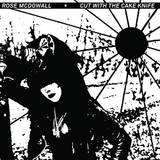
Cut The With The Cake Knife was recorded by Rose McDowall in 1988/89 following the break up of her group Strawberry Switchblade. Produced with the aid of several musicians in several studios, the album features songs written for the fabled second Strawberry Switchblade album. More importantly perhaps it showcases the honest, direct and life-affirming songs of one of the greatest unsung songwriters of the modern pop era at a tumultuous time in her career.
Tibet opens the set and could be one of the best pop songs you've never heard. The innate sadness of the songs' content - the loss of a friendship, impending sorrow - is heightened to heart-melting level by McDowall's pop nous and melodic sensibility. Choruses and hooks are everywhere on Cake Knife, from the outsider take on stadium 80s pop in Wings Of Heaven to the spiraling, ecstatic So Vicious, a glorious anthem that highlights the human fragility in McDowall's vocal performance, an instrument that has never lost the naïve purity it first exemplified in Strawberry Switchblade's early 80s recordings. The centerpiece of the album, the title-track, is the greatest Switchblade pop chart hit that never was. Like the veiled melancholy of her former group's hits, Cut With The Cake Knife hints at a darkness beneath the gloss, a darkness that saw McDowall delve into more esoteric territory with her subsequent recordings and collaborations. Cut With The Cake Knife serves as the bridge between the pop music McDowall had been making with her friends Jill Bryson, Lawrence from Felt and Primal Scream to what became a more extreme, deep sound informed by neo-folk and post industrial music.
Rose McDowall's role in the canon has always been one of an outsider. Beginning in Glasgow's East End in the avant proto-noise group The Poems, achieving fame briefly in the 80s and then disappearing into counter-cultural folklore, the emphasis in the internet-age has been skewed towards her image and cultural significance. Unseen to many, her solo work, her groups Sorrow and Spell and her collaborations with a whole host of underground luminaries have still touched lives. As McDowall elucidates: 'They're real sad songs, about real life. I've had people come up to me to say I'd connected with them and helped them. I remember a gig in America when we made a whole room cry. It was bizarre. A couple at the front of the stage started crying and then these two boys beside and suddenly everyone was crying. And I thought, "that's power."
Night School's issue of Cut With The Cake Knife includes unpublished photographs, extensive sleeve notes from Rose McDowall and 2 bonus tracks culled from the bootleg 7' 'Don't Fear The Reaper.' First vinyl pressing is Clear w/ Black swirl; 500 only / has DL card and booklet, with a poster
CD has extensive booklet and is packaged in anO-Card.
Suche:mod it
Tilaye Gebre is one of Ethiopia’s most soulful saxophone giants, with a musical legacy that’s hard to surpass. A founding member of the Equators, later renamed the Dahlak Band, he was a key figure in Ethiopia’s vibrant hotel music scene and a sought-after musician and arranger for artists like Aster Aweke, Mahmoud Ahmed, Tilahun Gessesse, and Muluken Melesse.
Tilaye — still going strong — was at the epicenter of the Ethiopian music scene during one of the most turbulent periods in the country’s history. Tilaye’s musical trajectory, regardless of the forms it has taken over the decades, is simply ceaseless. The road to a musical career spanning six decades started out winding, and the first steps came almost as a fluke.
With the Dahlak Band, Tilaye had managed to secure a musical residency at the legendary Ghion Hotel, where they honed their skills and developed their musical expression to unparalleled levels. From the late sixties onwards, Dahlak Band lit up Addis Ababa with a mixture of James Brown and Wilson Pickett tunes, rhythm and blues, soul, funk, and the sound of the disco era — mixed with modern Ethiopian styles — serving up majestic concoctions with full-range instrumentation, featuring trumpet, keyboard, saxophone, bass, drums, and guitar. Through their hotel sessions, Tilaye developed further as an arranger, arranging fellow band member Muluken Melesse’s first solo album, Muluken Melesse with the Dahlak Band (Kaifa Records – LPKF 39), recorded during the turbulent years of 1975–1976, following the fall of Haile Selassie. Everything was in flux in this transitional period, but a constant was how Tilaye stood in the spotlight. On that record, there’s a loose vibe to the soundscape that lets Tilaye’s skills shine, while all the other musical contributions coalesce into a slowly cooking atmosphere where the groove at times fluctuates into psychedelic territory, making the music stand out from most contemporaries.
Most of their recorded output came from one-take live cassette recordings at the Ghion, or from music shops at that time — one microphone at the front, hit record: no EQ, no reverb, just some delay. Some of the Dahlak Band’s releases featured Tilaye as frontman, such as Tilaye’s Saxophone with the Dahlak Band from the late 1970s — typical of a rare groove on the Ethiopian scene — with excursions into reggae territory, including the band’s characteristic sound featuring Tilaye Gebre (tenor and alto saxophone), Dawit Yifru (organ), David Kassa (electric guitar), Shimelis Beyene (trumpet), Moges Habte (tenor saxophone), Abera Feyissa (bass guitar), Tesfaye Tessema (drums), and Muluken Melesse (cowbell). The Dahlak Band’s output was so prodigious that they simply couldn’t be pigeonholed.
No saxophonist in Ethiopia influenced the sound of popular music more than Tilaye in the 1970s, yet his recordings have been hard to come by for ages, which has meant that newcomers to the scene have gems to uncover in retrospect. Arguably, Tilaye shifted gears when he relocated to the U.S. to such an extent that his musicianship became even more renowned, accompanying the greatest of his contemporaries internationally. Tilaye is one of Ethiopia’s all-time greats, with a musical legacy — both as musician and arranger — that’s hard to surpass. It’s a wonder to be able to enjoy a recording like this half a century later.
Molekul sub-label.
Filtrack brings a breath of fresh air to Loud Pressings with a signature sound at the forefront of modern techno. He develops his ultra-minimalist techno style through a highly technical approach, blending textured sounds, refined percussion work, and dark yet elegant atmospheres.
The result is a two-track EP that is sharp, effective, and impactful in its purest form.
2026 Repress
Following on from the super-fast stock sell-outs of the 2LP of joyous Alfredo selections, Rebirth follow up with the second of the sample EPs of rare, cherished and formerly unreleased gems.
Kicking off with Dubtribe (Sound System) - Sunshine’s Theme which goes for big money on discogs if you can find a copy, next up Max Berlin – Elle Et Moi Really simple, minimal disco à la Giorgio Moroder or Cerrone, actually Max Berlin (Jean-Pierre Cerrone) IS Cerrone’s brother!
On the Flip we have The Woodleigh Research Facility – Borderland (Andrew Weatherall Mix) Borderland is a beautiful collaboration between Woodleigh Research Facility’s Nina Walsh and viola virtuoso, Sarah Sarhandi. Andrew Weatherall set Sarah’s strings to an energetic electro glam stomp. A cracking kosmische, motorik “Pomp & Circumstance” march, with something of the Depeche Modes / New Orders about it. Finishing off the EP with some 90s UK deep house bliss from Acupressure – We Are the Future (Instrumental Mix) again this goes for big money on the Cogs.
Rebirth deliver another fantastic selection.
Limited Press, act fast.
ULURU is a large sandstone rock formation in Australia. It's sacred to the Anangu, the local Indigenous of the area. For many years it had been deprived of its spiritual significance, due to mass tourism, capitalism, as well as greedy and selfishness of people who just want to make money out of it. However, as a result of the Anangu’s resilience, care and staunchness, huge changes took place in the national park around Uluru as well as in the broader public's consciousness, giving again to the Uluru the sacred identity that had been lost.
You might be reading and thinking now: so what's the point? Actually, there's no real point. I would rather say, there’s hope. The hope of seeing humans all around the world following the example of the Anangu. The hope of seeing humans finally stopping to treat the earth and all what’s part of it, what’s on and what’s in it, as a slave without soul. The hope of changing today, and if not today at latest by tomorrow. This system is failing. It's no longer sustainable, and there's no much time left.
So everybody, don't sleep, be critical.
Finnish dub-techno craftsman TM Shuffle, head of Vuo Records, resurfaces with a deep and distilled EP that goes straight for the late-night heart of the dancefloor. Rooted in Tampere’s raw, analog dub sound, his productions have long balanced weight and warmth, smoked-out chords, rolling low-end and subtle shuffle that keeps the groove in constant motion.
The lead track “Kellari” dives into basement mode: pressure-cooker drums, slow-burning stabs and a humid, lived-in atmosphere that feels equally at home on a huge system or in headphones at 4 a.m. On the second original cut, TM Shuffle links up once again with long-time collaborator Monoder, the alias of Jussi-Pekka Parikka, known for his dubbed-out explorations on labels like Statik Entertainment and Pakkas-Levyt since the early 2000s. Their joint track stretches time, letting echo, tape hiss and distant melodic fragments float around a rock-solid groove, channelling years of shared studio language into one focused, hypnotic flow.
On the flip, Anton Kubikov (SCSI-9) steps in with a lush reinterpretation of Kellari. A true Russian techno veteran with a catalog that spans Kompakt, Force Tracks, Mayak and beyond, Kubikov melts the original into a widescreen, dream-state trip, soft-focus pads, gentle yet insistent percussion and that unmistakable rolling pulse that made his work so enduring. The remix doesn’t just extend the track; it opens a new dimension, turning the basement pressure into a slow-rising, celestial drift.
Pressed on limited coloured vinyl, this EP is built for selectors who like their dub techno deep, human and timeless, a record that will quietly live in bags for years and keep resurfacing whenever the room calls for true late-night elevation.
Thanks All is an EP that fuses nostalgia and futurism through hypnotic textures and dancefloor-ready grooves, highlighting Braga Circuits' knack for blending the ethereal with the grounded. "Break It Down" opens with classic house-inspired piano and organ layered over a modern groove. "Too Much to Ask" drifts into dreamy, hypnotic territory, while "Walk With Me Gentle" builds a shamanic vocal into a mesmerizing peak. Closing track "With the Bats" grounds the journey in rhythm, maintaining Braga Circuits' melodic and surreal sound design.
Third Space returns with ‘Third Wave’ and it’s a big one! The latest Various Artists EP gathers four deep and soulful house cuts from talented producers SY, Mbius, Jay Gadian, and label boss Miguel Seabra. A tribute to vibey, musical house tracks made for both the soul and the dancefloor. Each tune stands strong as an anthem, respecting the rich heritage of house music while dressing it in fresh, modern grooves. True to Third Space tradition, ‘Third Wave’ arrives as a limited vinyl-only release, capped at 150 copies with a strict no repress clause. A must-have for collectors and house music enthusiasts alike.
Mastered by: Miguel Seabra at Aura Project Studio
Distributed by: Carpet Distribution
Andreas Tilliander returns to Kontra-Musik in a grand style with his second TM404 album. Titled 'Acidub', this highly anticipated release is much more of an evolution than a repetition of the first superbly self-restricted album, where Tilliander even decided to use only one of the two Roland TB-303 waveforms. Acidub is a more playful and open listening experience, no doubt inspired by his extensive live touring with the TM404 concept. In fact, you can almost hear Tilliander's flock of acid machines breaking free from the restrained modus operandi. Every sound is like a migratory bird with a heart yearning for high altitude and favourable winds. The opening track Alinge paints a lucid picture of these acid birds leaving a cold industrial landscape behind, the flickering black shadows from their wings against the white smoke rising from a forest of chimneys below. The very last seconds of Alinge even echo of the place the silver birds are longing for, but that will remain a secret between Kontra-Musik and the avid listener. Sufficient to say, we can follow these birds of passage as they're heading south towards a warmer climate, fleeing the cold discipline of the North. Mutron Mantra, for instance, brings us to a rainforest full of serpentine lianas, giant leaves dripping with moist and green pools of water bubbling with organic life. Don't Defend Mascot guides us through a steaming savannah at dusk with hundreds of yellow eyes following our every step while Pade vividly describes the perils of the flight and the pace and courage needed to press on. In all, Acidub is a surprisingly exuberant follow-up to the more introspective TM404 album. But while the musical journey of this second album is quite different, the experience of sheer aural eminence remains the same. Andreas Tilliander has done it again, and Kontra-Musik couldn't be prouder.
Reissue 2026
"Call Me" is an electronic/house track by DJ Dino (Dino Lenny) on Nu-Tella Records, released in 2003.
It's praised for its deep, emotional, and melodic atmosphere, occasionally shifting from darker tones to uplifting major keys,
recalling classic electronic sounds with modern touches, though specific aggregate scores are scarce.
Official 2026 reissue includes, in addition to the original and remixes by Par-T-One and Santos, the previously unreleased version by Walterino.
Mixes completely remastered by Gianni Bini at HOG Studio.
Vohkinne is the alter-ego of Craig McWhinney, close associate and one of Southern Light’s foundation artists. The Way Of All Things is his first album in six years and provides a dystopian sonic journey into contemporary and modern techno that few artists can match.
Internal Collapse is an opening statement of intent; drone-infused and heavily cloaked dark ambient techno. Falling Knife is a chilling half step creation, providing a sense of murky sonics raining down from above. Unearthly Lights shifts gears as it traverses a more linear and magnetic path, while Disintegration diverts again with darker, squelching breaks.
C h r o m e s t h e s i a slows down the tempo but the morose and opaque feel of the album remains ever present, before War Paint is unleashed with a sense of urgency and high-octane intensity. Between Lives continues that intensity by unleashing its dark hypnotic breaks, before closing with the title track, perhaps for the first time on the album revealing a ray of hope amongst the dystopian energy that prevails on the album.
The Way Of All Things is more than a collection of tracks; it’s a look inside one artist’s view of the world, distilled into a singular and expansive archetype body of work.
Repress!
LTD Edition white vinyl version of RÜFÜS DU SOL's debut LP 'ATLAS' that hit Number 1 in Australia. The album was a testament to the band’s passion, work ethic and DIY approach to music, featuring the much loved singles 'Take Me' and 'Desert Night'.
A labour of love, the album was written, produced and recorded by the band between two studios they built themselves - one in a remote farmhouse on the NSW south coast, the second in a hollowed out water tank under one of their parents houses.
This is the debut release from Laguna Seca, a new project from Porto based Mike Jefford. It foreshadows a new body of work, steeped in 70s nostalgia, refracted though sounds that could belong to krautrock, disco, electronica, noisy alt rock and everything in between. Mike has previously recorded as Positive Centre releasing textural, experimental techno on such labels as Stroboscopic Artefacts, SNTS and Leyla. (seek out if you you’re a fan of Vatican Shadow or the ghostlier wing of Black Dog)
After mastering his forthcoming 2026 debut album ‘O Tempo’, Mike Jefford caught a second wind of inspiration. In just seven frantic days he recorded the heap of tracks that formed the basis of 'Live from Müsli Mountain’. It soon became clear that these tracks foreshadowed the album perfectly and the EP was born.
Named after the California raceway, this project fuses 1970s recording techniques, modern electronics and psychedelic retrofuturism, it’s a pyramid of sonic adventure that will be explored deeper on the album next year.
Were FEX the Wildest & Weirdest German New Wave Band in 1984?
Few cult mysteries in modern music have captured the internet's imagination quite like "The Most Mysterious Song on the Internet." Eventually identified as "Subways of Your Mind" by the elusive German band FEX, the track became a viral sensation decades after its creation-and even made its way into a recent Hollywood blockbuster (Black Phone 2).
Now, two more lost FEX recordings have emerged from an old demo cassette: "Dead End" and "Sarah." And they're every bit as electrifying as the legend suggests.
On both songs, guitarist and main songwriter Ture Rückwardt joins forces on lead vocals with his former wife and musical partner Ilona Rückwardt, forming a vocal pairing that channels raw energy and eerie chemistry. What they deliver are two of the most urgent, adrenaline-fueled post-punk artifacts you're likely to hear this year-even if they were recorded more than forty years ago.
Opening with a sharp, melodic guitar solo, "Dead End" bursts forward with uptempo drive-catchy, fierce, and full of momentum. Apparently inspired by Orwell's 1984, its lyrics depict urban desolation-loneliness, homelessness, hopelessness-yet still shimmer with defiance in lines like, "Truth is amazing - hoping is like waiting."
The second track, "Sarah," dives even deeper into darkness. Mixing post-punk intensity with psychedelic textures, Rückwardt tells an imaginary story of a couple lost in drugs and spiraling through a bad trip, only to wake and realize that sobriety offers little comfort-the real world itself can be just as brutal and offers no easy escape.
Neither song makes the slightest concession to commercial trends. Instead, they feel utterly uncompromising-wild, strange, and defiantly timeless. In a world obsessed with polish and playlists, "Dead End" and "Sarah" sound like transmissions from a different planet.
Both tracks were originally recorded as demos in 1984 in the band's rehearsal room, with Hase engineering. The newly restored versions preserve the raw spirit of the original tapes while adding subtle layers to enhance their atmosphere without losing the authentic 1980s sound. FEX hint that the untouched demo versions might surface later, possibly on a second volume of their archival
CER009 finally brings Pumphouse Gang – “Welcome Back Into My Life” back to the 7inch format, a killer slice of Irish modern soul perfection from 1979. Originally pressed in tiny quantities and barely escaping dublin, it’s one of those records that rarely becomes available. A favourite of label boss miche, it’s in his words “an unbeatable soul track, that really fills a dancefloor with smiles”
On the flip, Medlar steps up once again, this time sending his mix straight from the Cayman Islands — a dubbed-out, Part 2-style reprise that stretches the groove, teases the rhythm, and gives the track a second life for late-night dancefloors.
As always, Celestial Echo digs deep into the overlooked corners of soul and disco, unearthing some of the best soul records and giving them a new lease of life. Each release is remastered with care and presented with the respect these recordings deserve.
Grace & Raffaella is the first collaborative release by ML and Vittoria Totale. Over nine tracks, the album strikes a deceptively minimalist tone, taking in a ton of musical as well as literary references. An elegy on a journey back to the present, with all the hushed intensity of an informed fever dream, Grace & Raffaella has a magic-realist feel. Its vocal parts serve as loopy self-fulfilling prophecies. Cut off from the sun, the gorge grows darker. Using an electroacoustic sense of spacing, as well as abstracted current-day club influences, with scraps of background noise fading in and out, this album's use and treatment of a snippet-like narrative is its core aesthetic. A digital gleam drenches the spoken bits into instances of subtle surrealism. Like a kitchen sink drama stripped of all deadweight. We are on the edge of relinquishing all control here. Rip up your diary and let go of the language of the old ones. Grace & Raffaella is a seductive slice of modern hyper-pop that defines its own intentions over and over again.
Isa Gordon and Tony Morris were first brought together through their individual releases on Optimo Music, which established mutual respect within the label’s community. While they had not previously performed live together, they were invited to take part in a fundraiser hosted by Queen’s Park Arena in support of Glasgow NW Foodbank and later for JD Twitch’s end-of-life care. Tony asked Isa to contribute guitar and backing vocals to his set, including a track then called Last Night I Had a Dream. That performance became the seed for their collaboration.
The first phase of fleshing it out, recalls Tony: “Somebody said Isa sang like Shania Twain. That got me thinking about country music and call and response, prompting me to come up with alternative lyrics.” Isa remembers: “I cycled over to Tony’s house with my guitar, and we spoke about what the tune meant. It was about him being wrapped up in dreamland, luxuriating in his subconscious, while my character — impatient and trapped in her own routines — barely had time to remember her own dreams.” Tony continues: “Brilliantly I realised that I could never collaborate with anyone in situ and so I sat in the garden for two hours watching my wife tend to plants. Every now and again I would creep up the stairs and put my ear to the door. I could hear Isa warbling away and so would resume my garden watch. After two hours I went back upstairs to see how she was getting on, only to find that she had written one of the greatest songs I’d ever heard. I still think that.” Tony adds: “My overwhelming sentiment about Wake Up Baby is pride. I can honestly say that I’m more proud of it than anything else I have done. It ticks a whole load of boxes. Isa’s singing in various Scottish modes is unique. The way her electric guitar adorns the dance beat makes it a rock song as well as a dance and a C&W song — truly multi-genre.”
The B-side of the 12” release, Syringe Moustache, is a surreal, darkly playful counterpart to Wake Up Baby. The track was inspired by a dream Tony had: “I was in a shopping mall, in a two-level shoe shop, and my attention was taken by a little girl with a syringe taped beneath her nose like a moustache. She went about her business trying on shoes, confident and wise beyond her years. In the dream, I imagined her as the daughter of cultured, intelligent parents determined to raise her independently. I was struck by my own feelings of inadequacy — I knew I could never have coped with such a contraption myself.” Isa’s take on the meaning of this song somewhat differs: “Tony sent me the tune over Instagram months before I met him, and I was spooked — as far as I knew, he didn’t know anything about me, but the story felt like it was written about me as a little girl, growing up around heroin addiction. The syringe beneath the girl’s nose became a symbol of the inescapable constraints of that environment, literally written on her face, yet something you just have to carry on through. On a buzz from the serendipity, I added a full instrumental backing to this most bizarre of works.”
The result is absurd, unsettling, and strangely empowering, staking out its own surreal, cinematic space. The 12” dance single is a format Tony had long wanted to explore — a tangible artefact to leave for family, a medium that celebrates the physicality of sound and the ritual of listening. It allowed the artists to maximise the format’s potential: a strong, multi-genre A-side, a surreal B-side, and remixes that expanded the record’s sonic world. Glasgow music staples Auntie Flo and 100% Positive Feedback were invited to reinterpret the tracks, bringing their distinctive touch — Auntie Flo transforming the A-side into a luscious, dancefloor-ready meditation, and 100% Positive Feedback twisting Syringe Moustache into absurd, playful shapes with false-start drops and over-the-top vocal editing.
The cover photograph, taken at the University Café by Harrison Reid, captures Isa and Tony embodying the characters they brought to life in the songs — a visual reflection of the record’s narrative and emotional stakes. The Café also holds personal significance: it’s where all of Isa’s meetings with Keith McIvor took place, where she first remembers visiting Glasgow as a child, and a place Tony fondly likes to go to drip egg yolk down his tie and watch the world go by. Together, the 12” format, the remixes, and the artwork create a cohesive, tactile experience, amplifying the duality, theatricality, and emotional breadth of the collaboration.
Mit Money landete Mozzart 1987 einen echten Euro-DiscoHit, der bis heute als Club- und Genreklassiker gefeiert wird.
Treibende Beats, eingängige Synthesizer-Melodien und der typische 80er-Jahre-Disco-Sound machen diesen Track zu einem zeitlosen Highlight der europäischen Dance-Ära.
Jetzt ist „Money“ endlich wieder erhältlich – als limitierte Maxi Single auf farbigem Vinyl. Neben der originalen Version aus dem Jahr 1987 enthält diese Veröffentlichung brandneue Remixe, die dem Klassiker einen frischen, modernen Twist verleihen, ohne seinen ursprünglichen Charme zu verlieren.
Diese Maxi Single ist ein Muss für Sammler, DJs und alle Fans von Euro- und Italo-Disco.
Cyborg Quest encapsulates MODAZ 2024—its learning, its searching, and its becoming. It moves through cycles of connection and disconnection, yet above all, it is driven by music. This EP is deeply personal. It echoes the phrases that resonate with his daily life: “It’s happening again,” lifted from Twin Peaks; “Where you at?”; and even “Why the world isn’t the way I wanted?” Together they form a blend of symbolism, mystique, and raw reality.