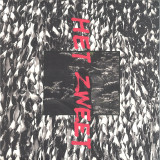
Modal Analysis proudly presents Het Zweet - Archives Volume 1: 1982-1988, a compilation of the Dutch outsider legend painstakingly picked from over 100 hours of unheard tape. An early electronic pioneer who deployed an array of homemade instruments alongside synths and a tape recorder to craft his searching sound, Marien Van Oers occupies a lonely branch on the tree of this music's early efforts, sliding between pounding industrial grooves, ambient fragments, and extended, entrancing compositions bridging this divide. Most closely akin to Muslimgauze, Test Dept. or Fad Gadget, who shared his outsider practice while remaining thoroughly entrenched in contemporary sounds, Het Zweet is striking for his diversity and for its meticulous composition, formed of carefully arranged layers of sonic detritus culled from his collection of homemade devices and electronic distortions. Finally rising to greater exposure since his death in 2013, Modal Analysis passionately continues this mission with our first volume of archives dedicated to the memory of this bold innovator gone before his time.
Suche:mod it
- A1: Allegretto For A Lady/Allegretto Per Signora
- A2: Belinda May
- A3: Dream Inside A Dream/In Un Sogno Il Sogno
- A4: Poetry Of A Woman/Poesia Di Una Donna
- A5: Sestriere
- B1: Fashion (No 2)/La Moda (No 2) (No 2)
- B2: Like When It Rains Outside/Come Quandofuori Piove
- B3: A Bit Of An Acid Irony/Un Po' Di Ironia Acida
- B4: Faith/U-Pa-Ni-Sha
- B5: Listen, Let's Make Love/Scusi, Facciamo L'amore? (The Big One)
- C1: Fashion/ La Moda (No 3) (No 3)
- C2: The Alibi/L'alibi (Shake No 2) (Shake No 2)
- C3: Slalom (Un Caffe Sulla Banchina) (Un Caffe Sulla Banchina)
- C4: The Doll/La Bambola
- C5: To Lydia/A Lidia
- D1: The Alibi/L'alibi (Shake No 3) (Shake No 3)
- D2: Slalom (Una Sera In Albergo) (Una Sera In Albergo)
- D3: Steal To Your Next/Ruba Al Prossimo Tuo (Seq 9) (Seq 9)
- D4: Definitive Turning Point/Svolta Definitiva
- D5: Little Cat Lady/La Donna Cattina (#2) (#2)
180 GRAM AUDIOPHILE VINYL
PVC PROTECTIVE SLEEVE
GATEFOLD SLEEVE WITH VELVET SPOT VARNISH ON THE OUTSIDE AND IMAGES OF ICONIC MOVIE POSTERS ON THE INSIDE
4-PAGE INSERT
A SELECTION OF DEFINING MORRICONE SONGS, FEATURED IN CLASSIC MOVIES AND SERIES “VERUSCHKA”, “SLALOM”, “ALIBI”, “VIOLENT CITY”, “MACHINE GUN MCCAIN”, AND MANY MORE
LINER NOTES BY CLAUDIO FUIANO
PART OF THE MORRICONE THEMES COLLECTION
THE SPINES OF THE FIVE TITLES FORM ONE IMAGE TOGETHER
MORE INFORMATION ABOUT THE SERIES ON MORRICONEONVINYL
BLACK VINYL
Lounge is the third in a series of five double vinyl releases that bring together some of Ennio Morricone’s greatest soundtrack music. Each collection centres on a different movie genre, together they allow the listener to rediscover the unmatched genius of the greatest movie composer of all time. The Maestro. This collection was announced before Ennio Morricone passed away on July 6, 2020. We’ll continue to release the series to honour this great composer.
The term Lounge Music is not one that Ennio Morricone would have heard at the time he was composing these pieces for the movies that they enhanced, but it is one has been retrospectively applied to a certain type of music, and it is a style that Morricone has contributed a great deal towards.
Lounge refers to a type of easy listening music that began to be popular in the 1950s and developed right through the 1960s and into the 1970s. This was sophisticated music for an adult audience. Lounge music combined its American influences with music that was popular outside the USA such as Latin, Hawaiian, Polynesian, French , and many others. This was an era that was inspired by new inventions. Lounge mimicked the space-age sound effects of the time and the advent of stereophonic technology allowed spatial audio techniques to be used to full effect.
This collection is not about a specific genre of music for film, it is a celebration of Lounge style pieces by Morricone that are capable of evoking in the listener thoughts of easy living, sophistication, romantic moods, and the excitement of a 1950s cocktail lounge or a 1960s nightclub.
Starting 70 years ago as an arranger for the piece Mamma Bianca, Ennio Morricone is the emperor of scores and soundtracks. Morricone has always been a huge influence for the likes of Hans Zimmer, Danger Mouse, Muse, Metallica and many more musicians. He was one of the most successful composers of all-time, selling over 70 million records and winning dozens of awards.
Lounge on black vinyl includes a 4-page insert with liner notes written by Claudio Fuiano. The gatefold sleeve contains a velvet spot varnish on the outside and images of iconic movie posters on the inside.
Nestled within the fields and forests surrounding Oslo you'll find Raaja Bones. There, in Raaja's secluded studio surrounded by vintage synthesisers, modular equipment, samplers and drum machines, is where he makes music that owes as much to his personal tastes as it does his identity and upbringing. 'Black Dreams', released 2nd July on Snorkel Records, is where this venn diagram of influences overlap, from the shimmer of e-funk and the effortless grooves of soul to the unashamed, heartfelt honesty of 80s pop.
Since the late aughts, Helsinki-based multi-instrumentalist, linguist, and skateboarder Olli Aarni has released a steady stream of diverse and remarkably consistent recordings via labels such as Mappa, Longform Editions, Cotton Goods, Laaps and Superpang. “Koko maailma” constitutes a major new work in his discography, finding a fertile middle ground between what might be understood as his two primary compositional modes: organic/chaotic/aleatoric music and rule-based, longform works of minimalism. The source material for these compositions was recorded exclusively using the Serge system at EMS Stockholm, but the timbres that Aarni arrives at do not recall archetypal Serge music as most know it. Meticulous editing and processing of the material with an array of digital tools has resulted in music that preserves the erratic and cybernetic character of the Serge system but sounds totally unique unto itself. The first piece, “Ylhäällä,” has the sonic character of fireflies at dusk or ants in the dirt — mercurial, hypnotic, flittering, and scattering tones presented in the spirit of the best environmental music. “Alhaalla” functions almost like a zoomed out impression of what precedes it, with just intonation tuning applied to sine wave generators to create grid-like, harmonically rich, and surprisingly emotive drone music. Micro and macro — two pieces of music, two perspectives of a world.
Started as a reggae band, Chequers were formed by the Matthias Brothers, John & Richard, in Aylesbury, Buckinghamshire in 1973. Inititally releasing in the early part of the 1970s (with their first single Rudi's In Love charting in the UK) their sound then developed to also incorporate Philly soul influences in the mid-70s, then releasing a rare but solid LP 'Check Us Out', in 1976. The group eventually evolved into a seven piece funk outfit in the late 70s, playing shows to larger and larger audiences and touring throughout the UK & Europe.
1980 saw the birth of the Matthias brothers' own small independent outlet for the group, Matthias Records. The press release of the new label's first single declared that their "roots in the reggae and soul music of the last mod era" were being brought up to date, now embracing "the music of today and tomorrow...". That 45 (the cheeky pop-punk meets ska cover version of Midnight Hour, backed with the uptempo instrumental funk of Move Up) didn't necessarily come good on that promise. 3 years would then pass until this 45 showcased the throughly-updated & stellar electro-boogie sound of Hard Times and it's equally strong b-side If You Want My Love.
Following this neither Matthias Records nor Chequers as a group ever released anything further - the record's scarcity (and hideously inflated prices on today's secondhand market) hint at low sales and potential distribution problems upon it's original release, perhaps leading to the label and the group calling it a day. Conjecture aside, there's really no denying this record slaps, and with discogs prices reaching beyond ridiculous levels there is only one option - get it before it's gone!
This Autumn, Nicole Willis rolls out with her third album made together with The Soul Investigators "Happiness In Every Style". It is bound to send shivers through backs all around the world. As the name suggests, the new album will offer variety and tilt towards a more positive note after the murky "Tortured Soul" from two years back.
This means Nicole and the boys have made things a bit more soothing for the listener, offering upbeat modern soul and even embrace more sophisticated melodies alongside their highly evolved raw funk sound. To get a taste of this, one only has to put on "Let's Communicate" or "One In a Million" to have their hands clapping and toes tapping in no time, or respectively, witness the dance floor explode. From minor key ballads such as "Thief In The Night" to the unapologetically poppy "Angel", the new album is bound to bring to the hearts of humans in every shade and style.
Whether you know Nicole Willis from before or not does not hold any weight here. After hearing her with The Soul Investigators on this new album, you will know they are for real, and out to offer you everything you need to fill up your soul supply. With Nicole's insightful lyrics and the band's hard-hitting music you are in good care.
Returning to Balkan Vinyl after 2020’s Beats For Straight Boys, the Italian XXXL queer acid-disco duo Hard Ton are back, this time with guest vocals from legendary model & singer ROY INC. Three tracks of proper acid house for sweaty bodies on the dancefloor, plus two bonus vocal acapellas. Out on limited edition of 303 pink heavyweight wax.
”Look up, into the light” she said, while the camera shutter clicked. ”Like this? Does it look holy?” His neck felt stiff. Her reply: ”Yes, just like that. What do you mean holy? Like religious? ”No, more like trying to look very far, somewhere beyond what we can see.” ”Okay, stand still, I’m going to come close to you now. The light hits your face great.” *click, click, click.
He noticed her fingernails. They were not polished. Natural. Even somewhat rugged, as if something wore out the fingers slightly. What had these hands held besides the camera? What made the edges of her fingernails drift off?
He thought it’s weird to look straight into the camera. The photographer had closed her left eye, the one not looking into the lens. Then it opened, she looked up, perusing the surroundings, then she closed her eye again, then looked up, closed, looking up, very quickly. It all seemed very professional. Maybe she calculated the light, making sure it’s close to perfect. ”What will these photos look like?” – the thought popped into his head briefly. It was liberating to think it wouldn’t matter.
”What’s that song playing?” he asked. ”Wait a sec, Ol’ Dirty Bastard?” she replied. ”Oh yeah, right. But the sample?” ”Hey, could you look up again, like that. No, lower.”
New directions: ”Look out from the window, turn left.” ”My left or yours?” ”Yours, I always try to think from the direction of my model.” How professional! This is a good shoot, so natural. Should I worry about how the photos look like? No, I don’t want to. His thoughts bounced around. What would the story be like? It’s a big newspaper, everyone will read it. Maybe someone drinks coffee and eats a stroopwafel while they do it. Will they place the waffle on top of the mug for a brief while, so that it gets hot and the syrup melts a little? Then it feels wet, and you can bend the cookie.
She broke his train of thought off midway through: ”Now turn right, but look left, and slightly up, but don’t turn your face right.” ”Umm, like this? Sounds like a set of pilates instructions.” she laughed ”You do pilates?” ”Yeah, it’s hard sometimes. Have you tried?” ”No”, she said. ”I’m not good for sports that are done in groups.” ”Yeah, but in pilates you can just be inside your mind, drowning in your private thoughts.”
”What are you thinking in pilates?” she asked, taking more photos. ”Well, mostly just which way is right. And which left.” *click, click.
BASSIST/COMPOSER PETROS KLAMPANIS LOOKS TO PAST AND FUTURE AS HE TRANSFORMS TRADITIONAL GREEK MUSIC WITH TORA COLLECTIVE
Unique instrumentation bridges Greek folkloric and modern jazz worlds, with Klampanis (bass, artistic direction), Areti Ketime (vocals), Thomas Konstantinou (oud, laouto), Giorgos Kotsinis (clarinet), Kristjan Randalu (piano), Ziv Ravitz (drums, electronics, co-production) and more.
Following up his acclaimed recent outings Rooftop Stories and Irrationalities, bassist and composer Petros Klampanis creates one of his most inventive musical settings to date with Tora Collective, his sixth album as a leader. For Klampanis, who grew up in Athens, Greece
surrounded by the confluence of Mediterranean and Balkan folk cultures, making music has always meant navigating cultural crossroads. With Tora Collective (“Tora”=“Now”) he puts traditional Greek music at the centre, even as he presents it from a bold new angle.
In addition to the two new originals “Disoriented” and “South By Southeast,” Klampanis and his compact hybrid jazz/Greek folk ensemble interpret popular Greek songs such as “Xehorismata,” “Sybethera,” “Hariklaki” and “Menexedes ke Zoumboulia.” These songs, Klampanis asserts, are “not just part of Greek cultural heritage or a fragment of the past, but also as part of the future: they live into the present, breathe into the ‘here and now,’ while constantly evolving in a dynamic state and in dialogue with contemporary music.”
“For me it’s a personal thing,” he says. “I want to reflect on what Greek music and culture offer the world. How can music from the Aegean to Epirus and from the Ionian Islands to Crete, meet and speak to the hearts and minds of musicians and audiences from different parts of the world, different traditions and backgrounds?”
To that end, Tora Collective draws on regional characteristics, as Klampanis explains: “Every region has a strong identity. In Epirus the clarinet is more prominent and the music has this slow, groovy, meditative vibe. The islands are lighter sounding, Macedonia is groovier, faster tempos and energetic dances. Music from Asia Minor or Istanbul is more sophisticated. Greeks often refer to Istanbul as ‘Poli,’ from Constantinopoli, so the songs from there are called ‘Politika.’”
There is magic in the clear and consistent voice of Areti Ketime throughout Tora Collective, as can also be said for the supremely voice-like articulation of Giorgos Kotsinis on clarinet. Ziv Ravitz, on drums and electronics, also plays a pivotal role as coproducer: “He added so much in the orchestration,” says Klampanis. “His knowledge of electronics, all these non-acoustic sounds and keyboards, treatments of the acoustic instruments, it’s all because of Ziv. He brought a new perspective on the whole thing.”
The string element in Tora Collective is also strong: in addition to Klampanis’ bass there is Thomas Konstantinou on oud and the traditional Greek laouto, as well as Kristjan Randalu (the pianist in Klampanis’ Irrationalities trio) providing an anchor and bringing Klampanis’ inventive arrangements into harmonic focus. Additional guests appear: Alexandros Arkadopoulos on clarinet for “Disoriented,” Laura Robles on percussion for “South by Southeast” and trumpeters Sebastian Studnitzky and Andreas Polyzogopoulos on “Milo Mou ke Mandarini” and “Hariklaki,” respectively. (“Milo Mou” is slated as a post-release bonus track.)
Using traditional Greek music to discover a common new voice, the project aims to build dialogue, spark creativity, cultivate respect for the past, pave a path forward, discover a new musical storytelling powerful enough to reach and touch audiences in many countries. This is an experiment that bridges worlds: the east and the west, the traditional and the modern, the nostalgic and the forward-looking, using the power of music and improvisation.
Country songwriter from Brooklyn's indie underground, Dougie Poole blurs the lines between genre and generation on his third solo album, The Rainbow Wheel of Death. Rooted in sharp songwritingvand the organic sounds of a live-in-the-studio band, it's a classic-sounding record for the modern world. The Rainbow Wheel of Death's title nods to the colorful pinwheel that appears onscreen whenever a computer's application stalls. For Poole _ who found himself working as a freelance computer programmer once the pandemic brought his touring schedule to a temporary halt in 2020 _ it's also a reference to the holding pattern that's left much of society feeling stuck, unable to move ahead in an uncertain world. That feeling was pervasive when he in his New York City bedroom and wrapping up the songwriting process in the recording studio itself. Once hailed as the "patron saint of millennial malaise" for his sardonic wit and topical, tongue-in-cheek songwriting, Poole broadens his reach here. "High School Gym" builds a bridge between 2020s lo-fi textures and 1980s pop vibes, while "Must Be In Here Somewhere" _ whose narrator sits at a lap top, searching through "every server burning in North Carolina" for a digital souvenir of a long-lost relationship _ mixes modern concerns with classic country instrumentation. If records like 2017's Wideass Highway and 2020's breakthrough release The Freelancer's Blues told stories about uninspired Millennials languishing in dead-end jobs and no-good relationships, then The Rainbow Wheel of Death focuses on more universal issues like mortality, love, and the passing of the time. With The Rainbow Wheel of Death, Dougie Poole breathes new life into country music, retaining the acclaimed elements of his previous work _ drum machines, synthesizers, and his deep-set voice _ while pushing toward something warm, organic, and prismatic.
- A1: Personal Jesus
- A2: Just Can't Get Enough
- A3: Everything Counts
- B1: Enjoy The Silence
- B2: Shake The Disease
- B3: See You
- C1: It's No Good
- C2: Strangelove
- C3: Suffer Well
- D1: Dream On
- D2: People Are People
- D3: Martyr ((Single Version)
- E1: Walking In My Shoes
- E2: I Feel You
- E3: Precious
- F1: Master And Servant
- F2: New Life (Remastered)
- F3: Never Let Me Down Again (Remastered)
Record Kicks presents "Yours Truly", the new album by Bordeaux's "Soulboy", Mr. Alexis Evans.
Like fine Red Wine, "Soulboy" Alexis Evans gets better with Age. The best evidence of this is his brand new album "Yours Truly", set for release on February 3rd, 2023 on LP, CD and digital via Milan-based label Record Kicks. Produced and mixed by Louis-Marin Renaud (Lou Doillon, Theo Lawrence, Desmond Myers), "Yours Truly" is the third studio album by Bordeaux-based singer-songwriter Alexis Evans and sees the light 4 years after his previous LP "I've Come A Long Way", defined "Soul album of The Year" by Rolling Stone France. "Yours Truly" consists of 12 brilliantly soulful cuts that take direct inspiration from 60's & 70's classic soul music adding a sound that is firmly rooted in the new millennium.
Anticipated by the first single "Mr Right On Time", the album was recorded between Bordeaux and Nantes during 2021 and beginning of 2022. The idea behind the new album was to find a unique sound, mixing classic 60's & 70's soul music with more contemporary influences such as hip hop beats, jazz, reggae, and Caribbean sounds. To do that, Alexis paired up with producer Louis-Marin Renaud, known for his work with French-English singer, actress and model Lou Doillon and country-soul rising star Theo Lawrence, who took part in the arrangements and mixed the album.
"All instruments were recorded live, some titles were completely live and others got modified, cut, sampled, depending on the tunes in a kind of beatmaking way. It was a very fun and fulfilling project that will sound awesome on stage for sure," explains Alexis.
Lyrically, the album could be described as soulful everyday rhymes. "Love may be the number one subject in soul music and clearly has its place of honor in a few songs ("Close to me", "What is this feeling"), while other songs tend to deal with it in a more cynical but poetic way, for instance on "Mister right on time", in which beauty remains in simplicity," states Mr. Evans. He continues: "Another topic of the album is abandonment ("It matters to me", "The only apple", "Close to the water"). Whether it is the fear of being left behind or the sadness after a loss, this album still bears some traces of lockdown and I was aiming at giving another perspective on different matters, looking at them in a dreamlike way." The themes of the album are reflected in the cover artwork, made by Adrià F Marquès.
Alexis Evans, songwriter with a timeless style based in Bordeaux, France, found the love of music and learnt to play guitar thanks to his father, an English musician. His inspirations range from Marvin Gaye and Sam Cooke to David Bowie. At the age of 17 he debuted with his first project "Jumping to the Westside", with which he was awarded the "Cognac Blues Passion" prize and flew to the "International Blues Challenge" in Memphis, Tennessee, where he impressed the American audience even though he was still a teenager. Mr. Evanshas built a household name in the scene as the "enfant prodige of soul" starting with his first album, released in 2015, and consolidated his reputation with his second long play "I've Come a Long Way", released in 2019 on Record Kicks. Rolling Stone France described it as "The Soul album of the year", while Blues & Soul Magazine and BBC 6 defined him as "One of the most exciting additions to the international Soul Scene". Following the release of the album, Alexis toured in France and Europe extensively, stopped only in 2020 by the Pandemic. Thanks to the forced break, Alexis started to lay down the new album, and he's now ready to present the fruit of his hard work: "Yours Truly".
After Patrick Campbell-Lyons and Alex Spyropoulos dissolved their partnership, they both went separate ways in the music scene. Campbell-Lyons began work on the Local Anaesthetic songs while going through a series of personal matters which ended up being reflected in the tone of the album. He did release it under the Nirvana name in 1971, but what we have here is a totally different thing. He decided to break with what had been doing up to that moment, and came up with an experimental progressive rock album that was perfectly suited for the Vertigo label through which it was released. Musically, it has been compared to "something Frank Zappa could have done". It was not inspired by Zappa, but it certainly explored similar boundaries as he may have done in his works, often moving away from that pop sensitivity that had characterized Nirvana's previous outings. A unique sounding piece in their catalogue.
And although being so far from what was the Nirvana sound, we have another excellent LP here that has become a most sought after piece among collectors. Pianist/keyboardist Patrick Joseph "Pete" Kelly helped Campbell-Lyons complete the LP, which also featured collaborations by Jon Field, with whom Campbell-Lyons had the pre-Nirvana band Second Thoughts and who would later go to form The Tomcats, July and Jade Warrior - Jade Warrior's Tony Duhig had also played in Second Thoughts. Some brass arrangements are thrown in, but the orchestra is gone in favour of a harder free form, prog-rock sound.
The Wah Wah reissue is housed in the original gatefold sleeve and features one bonus track with the 1971 single version of TheSaddest Day Of My Life. It's the first ever official vinyl reissue since 1971. 500 copies only!
Forty Below Records releases 'Weight of the World', the new album by
award-winning Blues and Roots musician Joe Louis Walker
A Blues Hall of Fame inductee and six- time Blues Music Award winner, NPR
described Walker as "a legendary boundary- pushing icon of modern blues." His
2015 release, 'Everyone Wants a Piece', was nominated for the Contemporary
Blues Grammy. In addition, Walker dueted with B.B. King on his Grammy Awardwinning Blues Summit album and played guitar on James Cotton's Grammywinning album 'Deep in the Blues'. Recorded with Producer Eric Corne (John
Mayall, Walter Trout, Sugaray Rayford), 'Weight of the World' showcases the depth
of Walker's influences and the prowess with which he commands different
genres; be it Soul, "The Weight of the World," "Is it a Matter of Time," "Don't Walk
Out That Door," Gospel, "Hello, it's the Blues," Funk, "Count Your Chickens," New
Orleans 2nd line, "Waking Up the Dead," Indie Blues "Root Down," Rock N Roll,
"Blue Mirror," Contemporary Blues, "Bed of Roses," or Jazz, "You Got Me Whipped."
It's a compelling album that displays a master at the height of his game. They say
Roots musicians age like fine wine, which certainly rings true with Walker. 'Weight
of the World' is a resounding statement and quite possibly the beginning of the
greatest chapter of a storied career
Forty Below Records releases 'Weight of the World', the new album by
award-winning Blues and Roots musician Joe Louis Walker
A Blues Hall of Fame inductee and six- time Blues Music Award winner, NPR
described Walker as "a legendary boundary- pushing icon of modern blues." His
2015 release, 'Everyone Wants a Piece', was nominated for the Contemporary
Blues Grammy. In addition, Walker dueted with B.B. King on his Grammy Awardwinning Blues Summit album and played guitar on James Cotton's Grammywinning album 'Deep in the Blues'. Recorded with Producer Eric Corne (John
Mayall, Walter Trout, Sugaray Rayford), 'Weight of the World' showcases the depth
of Walker's influences and the prowess with which he commands different
genres; be it Soul, "The Weight of the World," "Is it a Matter of Time," "Don't Walk
Out That Door," Gospel, "Hello, it's the Blues," Funk, "Count Your Chickens," New
Orleans 2nd line, "Waking Up the Dead," Indie Blues "Root Down," Rock N Roll,
"Blue Mirror," Contemporary Blues, "Bed of Roses," or Jazz, "You Got Me Whipped."
It's a compelling album that displays a master at the height of his game. They say
Roots musicians age like fine wine, which certainly rings true with Walker. 'Weight
of the World' is a resounding statement and quite possibly the beginning of the
greatest chapter of a storied career
Vibrant acid tracks knead muscular electronic dance
structures on Gerald Brunson’s debut EP. A member of
the Model 500 extended family and running Dance
Sacred Records, Brunson presents a restless world
that beckons forth from the underground of the
Midwest, full of bouncing flair and techno passion.
Hoffman's S.O.S. (Scully, Owsley, Sand) is more than a
mere head nod to the alchemists participating in the
League for Spiritual Discovery and The Brotherhood of
Eternal Love. It induces a pristine acid trip that twists
neurons about agitated filtered eects and eective
rhythmic structures. Finally, it emerges into wondrous
vistas of ever-expanding horizons. Blue Striped Felix
worms deep into the groove with the same brawn, its
components lean and unceasing.
Over on the flip side, 2way struts a mean dance,
stripping out the previous track’s acid melodies into
something far more focused on repetition with an
electro influence shining through. This electro sound
beams forward even more into a mutant funk on Morf.
The synths move squeakily as if the machine got
jammed into enlightenment. Unexpected beat
changes flick over to a four to the floor briefly, before
out of nowhere chords invite the closing moments in
with an eventual melodic response to the dancing
synths.
Brunson's tracks represent a unique sound. Techno is
as real as the person who experiences it, and these
tracks come from an enigmatic messenger who is
firmly out on a limb.
Braindance is the second, highly anticipated, collaborative EP from Irish producer DJ Mudak 2000 and French producer FTL, landing on their new label as the debut release.
Produced in Dublin & Paris, the two prolific junglists have encapsulated the intricacies of modern jungle while still highlighting the emotive elements of yesteryear.
The first track "I Wanna" begins as a fantastically light, classic jungle track with piercing soul vocals that unpacks into a soaring brawl of amens and intense 808s. A great representation of the duality of light and dark elements which make this whole EP a standout.
A2 "Barriers" is a driving, high tempo club ready cut. There is absolutely no messing about with this one, in your face reese business for the peak timers. On the flipside, title track "Braindance" is a complex yet ethereal roller carried along by hovering staccato vocals that are contrasted with a deep cutting sub that will hit you in all of the right spots.
The final track "Chasing A Dream" lives up to its name as its emotive synth lines and Sad Boys-esque cowbells will fill you with the tangible feelings of want and passion.
Canto Ostinato is the new volume of classical minimalism from musician and producer Erik Hall. Written for four pianos in 1979 by Dutch composer Simeon ten Holt, the piece is freshly framed as an intimate, hour-long solo performance consisting of multitracked grand pianos, electric piano, and organ. Modern yet warm, ethereal yet tangible, Hall's Canto Ostinato expertly bridges a revered piece of meditative concert repertoire with a tactile and highly personal studio setting. Chicago-born and Michigan-based, Erik Hall is known as a multi-instrumental pillar for the groups NOMO, Wild Belle, and his own songwriting moniker In Tall Buildings. He has composed music for feature films, and as a producer/engineer he has shaped records for Natalie Bergman and Western Vinyl labelmates Lean Year. In a 2020 creative pivot, he chose to reinvent composer Steve Reich's monumental contemporary classical masterpiece Music for 18 Musicians as a solo undertaking, applying the piece's score to the familiar keyboards, guitars, and synthesizers in his studio. "At the time I think I was working through my identity as a musician and an artist," Hall explains, "and on a level there was some sort of exorcism of a long held pop spirit." The album was celebrated for being "freshly thrilling" and "legible in history but assertive of the moment" (Pitchfork) and "beguiling, meditational, and magical" (Electronic Sound). It won the 2021 Libera Award for Best Classical Record, and it quickly joined the canon of the piece's quintessential recordings. "There is a pseudo-meditational benefit to working on a longform piece that's built on repetition," Hall says. "Every stage- from internalizing the music, to executing the performance, to editing and mixing the record- requires deep and sustained presence of mind. I've always been drawn to a hallucinatory combination of harmony and repetition, and I found the entire process addictive." An apt second chapter, Canto Ostinato is inherently vast, and its score gives great creative license to the performer. Comprising 106 sections, complete freedom is given to repeat each one as many or as few times as desired. Additional leeway is given with regard to dynamics, articulation, and even instrumentation. On the heels of his previous, rather maximal arrangement, Hall chose to limit this album's palette to three foundational keyboards of his studio: a 1962 Hammond M-101 organ, a 1978 Rhodes Mark I electric piano, and his family-heirloom 1910 Steinway grand piano. "This particular piece brought the added challenge of rekindling my dexterity as a pianist, something I haven't maintained in earnest since I was a teenager," he admits. The ensuing five-note rhythmic motif- the piece's primary building block- is steady and workmanlike, forgoing virtuosic flare for depth, texture, and resonance, and eventually giving way to the stunning gratification of a gorgeously lyrical left turn. As with Music for 18 Musicians, Hall employed no loops nor quantization nor any programmed or sequenced instruments of any kind. Every part was performed live in a room and captured with microphones, one at a time, each informed by, and reacting to the last. In this way the record breathes with interplay and an organic humanity, complete with flaws, noise, and the faint sound of turning pages. The recording quality is nonetheless toneful and saturated, characteristic of Hall's production style and straying from the usual transparency of classical albums by using gear with tubes, transformers, and various stages of compression in the signal path. Always there is unmistakable realism and the feeling of being present in the room, sitting among the keys, hammers, and tines. Ten Holt said: "Time, patience and discipline are the prerequisites for making a genetic code productive." His landmark composition provides Hall once again with a wondrous space in which to reverently embody this sentiment and deftly convey the elegant beauty of this music.
In a blizzard of delirious sonics and twis’ up samples extracted from the annals of dancehall and ragga, Seekersinternational return to Sneaker Social Club to double down on the manifesto they laid out with the original RaggaPreservationSociety EP way back in 2016.
As ever, the SKRS magic lies in their ability to convey a deep affection and serious dedication for the source material while simultaneously getting shamelessly weird with it, taking the mutant tendencies of dancehall’s wildest instrumentals and injecting some added cosmic sauce into the mix. On this new record, they’re also embracing the volatile potential of junglist breaks - always intrinsically linked to Jamaican music at the point of inception, especially in the rough and ready daze of ragga jungle.
‘No Parasites (Lickshot)’ is a fierce mission statement, raining down mayhem without ever slipping into familiar modes - the emphasis is on the ragga, the jungle is there as a piquant flavour in the stew, but as ever the SKRS sound remains entirely out on its own. In contrast, ‘CaughtUp (HeartBreaks)’ almost edges closer to hardcore structures, but something keeps slipping in to run the interference, hovering just beyond perception for that all important woozy feeling.
‘2GoldChain (DriveUCrazy)’ is cut up enough to be another interstellar voyage, but here SKRS keep the music back in the mix and let a tapestry of chat lead out front as though capturing a casual street level chaos - bewildering and familiar in equal measure. ‘OriginaloftheOriginal’ completes the set with an earth-shattering script flip once more, coming on like square wave grime and half-speed breakbeat set to emotional stun. If it takes a minute to make sense, that’s because you’re hearing something entirely new.
The first LP by Bloedneus & de Snuitkever, MILLI MILLE. Finally on wax, it’s Lukas De Clerck’s musical vehicle for his explorations with the aulos, that ancient reed instrument that mainly satyrs and archeological enthusiasts found beguiling. Equipped with his handmade pipes and the artful sense of devotion of a true modern-day aulete, De Clerck has dug deep into the technical and cultural peculiarities of this long-silenced instrument, paying it the kind of attention and mindfulness that Marsyas the satyr so lacked when he challenged Apollo and his lyre to that ill-fated musical match. But beyond merely resuscitating an ancient cult, De Clerck as Bloedneus gives the aulos a different kind of renaissance where its penetrating qualities are expanded and expounded to effects worth every nosebleed, paving new grounds in these practices of old.
MILLI MILLE hints at mysteries universal to humans of yore, present and morrow, like a Joseph Campbellesque recounting of transcendental journeys through drones and extra reverb. Elegiac modes encounter pastoral vibes that are punctuated by sly baroque flourishes, all pointing to the timelessness of the aulos’s sound - one can easily imagine its power of enlightenment through many ages. Yet in MILLI MILLE, an insistence on the fickleness of the instrument surfaces through disorienting, perception-shifting blasts and a compulsion to push the aulos to its fullest and most destabilizing potential. This is the flavor that Bloedneus & de Snuitkever imbues into that dormant canon, one that permeates the atmosphere long after the last note puts an abrupt end to these vibrations. The satyr’s song rings on, leaving the air abuzz with a timeless pulse that holds the promise of sounds still to be unearthed.


