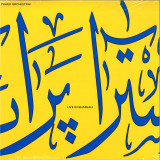
Patrice Scott returns to the controls, offering up a fresh platter of high grade goodness for your listening pleasure. Featuring 3 cuts of his trademark, modern Detroit sounds, this EP sees Patrice continuing to keep the Sistrum standard high and utterly unadulterated. Depth, emotion and groove lead the way through chords, tones and rhythms that call to all who seek sonic salvation. As always, turn it up and enjoy - on the dancefloor, the home hi-fi or anywhere in between
Cerca:mod it
A name, a man, an attitude, Amsterdam Dj and producer San Proper is one that needs very little introduction. His intricately minimal, yet highly musical productions have seen the light of day on Dekmantel, Perlon and Rush Hour Records alongside his own label, Proper's Cult. Now, this renowned crazy cat presents a new set of works, 'Home' EP with MUSAR Recordings.
Teaming up with drummer, producer and long-time collaborator, D. (real name Derek Van Beelen) who has also appeared solo on 'Proper's Cult', the two come together on 'Home' to explore the genre of house; expanding it into new, idiosyncratic forms.
Across 'Home' EP, the flamboyance and quirks of San are deeply embroidered. From the frenetically charged, punk-esque 'Home' to the mid-tempo trip of 'Get On Down', each see the musical talents of D. underpinning the cursive vocals and hardware slurs of Proper. Whilst closing track 'Licks & Tech' provides an off-kilter take, pairing woody, linear percussive parts with sweeping and insidious modulations.
Tokyo's very own 'Watechno' originator and MUSAR associate, Hoshina Anniversary comes through with a rework of 'Home'. Flexing over San's vocals with jazzy keys and native Japanese instrumentation, striking experimentations in-keep with the expansive nature of 'Home' EP.
Karaba is the new signing on Kryptox. The Berlin label founded to show what's happening in the German Jazz crossover scene. One of these bands is Karaba from Munich. The band was already featured on the Kryptox Kraut Jazz Futurism Compilation in 2019. Now they deliver their first mini album for Kryptox. Five young guys from Munich. Skilled and tight on their instruments and deeply rooted in the heritage of all kind of wild forms of jazz, krautrock and psychedelic music. The kids began to jam together when starting to study music in 2012. Being from Munich, a town where legendary Krautrock bands like Amon Düül, Guru Guru and Embryo came from, the Karaba guys are obviously influenced by these german kraut and psychedelic sounds. You can hear that in many shades of this album: the complexity of the unusual rhythmical fundaments and percussive patterns. The Prog-Rock parts, with these partly abstract unisono lines and strange melodic figures or unexpected chord changes. Karaba’s album starts with an slightly arabic feel. The repetitive groove of „Der Inder“ gets the listener immediately into a different south-eastern space. Later the music gets more animated, more structured and more uplifting. A whole universe of little influences. Shades of certain Jazz and prog-rock bands: you might think about the canterbury scene of the 1960ies and 70ies. There are textures reminding of Soft Machine, Frank Zappa, Mats and Morgan, Kraan and maybe some Passport influences. (Another band from Munich that left a huge footmark in the worldwide jazz fusion history). The whole Karaba sound has a certain 1970es feel. But not in a pure retro way. The EP sounds more like a modern psychedelic 2020 Lofi Indie Jazz thing - a sound that fits well in these wild times and finds it’s place in the actual scenario of new jazz bands worldwide.
Big Crown Records is proud to present Ekundayo, Liam Bailey’s debut record on the label. This album is a long time in the making, and after listening, clearly worth the wait. It didn’t take a long time to record, but it did take years for all the stars to line up.
Bailey, born and raised in Nottingham, England, the son of an English mother and Jamaican father got his early influences from his mom’s record collection. Bob Marley and Dillinger, Stevie Wonder and The Supremes, The Beatles and Jimi Hendrix would eventually shape the singer/songwriter we know today.
Fast-forward to 2005, Liam is in London and doing the whatever-gig-you-can-get musician hustle with hopes of landing a record deal. And it was through this time that Liam first teamed up with Leon Michels, musician / producer luminary, and the co-founder of Brooklyn's own Big Crown Records. Liam flew out to New York and those first sessions together produced the now classic tunes “When Will They Learn” and “I’m Gonna Miss You” which still get spins at reggae spots around the globe. That trip helped kick off what was to follow next for Liam: a slew of record releases, label deals, and working with some wildly-notable mainstream producers. Even a just-famous Amy Winehouse heard one of Liam's apartment-made, lo-fi recordings through a friend and liked what she heard. Regardless of the audio quality, Liam's particular sound shone through—all guitar, warm-rough and genuine soul. She signed him to her label shortly after.
But, as the story can go with major labels, they already had an idea of the Liam they wanted to make, promote, and push. With the typical pay-day enticement, Liam did his best to fit into whatever shape they put him to. "'Maybe I can make it work,' that's what you're thinking," Liam remembers, "but, you quickly find out that you can't."
While Liam’s career went through a bunch of record industry twists and turns he and Michels stayed in touch and would regularly connect and collaborate. Finally, in 2019, the time was right to do a full-length album together. And this time, it would be free of any restricting major label presumptions and opinions. "This is the record we always wanted to make," says Michels. Set to release in November 2020, the album is called Ekundayo. And the word's meaning may be all you need to know to get to the essence of this project. It means "sorrow becomes joy" in Yoruba, a language spoken mostly in Western Africa. On the surface, Ekundayo is a weighty Reggae record, full of new and old textured riddims. But listen more in-depth, and you'll find subject matter that's more recognizable from a modern-day R&B record. An example of the former is the first single off the album. Sung to the most beautiful woman at the nightspot, "Champion" is a joyous anthem powered by a silly-thick Juno-bass throb and 808-proof drums. In short, "Champion" is dancehall-ready. But then there's a song like "Don't Blame NY." Moody and sparse with a somber drive, you might have to resist the urge to compare it to a Frank Ocean-ish type vibe. Liam's voice is in a different but fitting element here, showing stripped-back emotion and soulful restraint. Anyone who has lived and tried to thrive in New York won't have a hard time relating to the lyrics but they may join the masses who blame the city, while Liam points the finger at himself and sings praises to The Big Apple.
Credit to Leon's hand, elements of Jamaican production are everywhere, peppered throughout the record. Like the pitch-perfect organ stabs that push through the authentically positive "White Light," or the muted, percussive guitar strums that chug along in the back of "Fight." In the same vein of any fantastic singer/songwriter album, Ekundayo is a reflection of who Liam Bailey is, taking on topics and approaches he never would think of just a few years ago. Some evidence: "Ugly Truth" is about reconnecting with his biological father, a subject he once thought would be too personal to address. The journey from conforming to major labels to this latest record has been a long one for Liam, and a bit of a struggle. But struggle may be the only way we truly grow and evolve. With a new clarity of purpose, sound, and life, Liam has found joy out of those struggles. And it's called Ekundayo.
Four Flies are proud and honoured to release the first vinyl reissue of Bruno Nicolai's outstanding original score for GEMINUS, a 1969 Italian TV mini-series directed by Luciano Emmer and starring Walter Chiari, Alida Chelli, and Ira von Fürstenberg.
Originally released under Italian label Gemelli, Nicolai's soundtrack has been remastered from the original master tapes and comes in a glossy, tip-on style jacket featuring the restored original cover artwork, as well as extended liner notes by film critics Francesco Cesari and Roberto Curti.
Bruno Nicolai composed and directed an eclectic score that brings together different music genres and influences, from 60s beat, psych, and progrock to baroque and experimental music. He did not hesitate to mix classical forms and structures with new instruments andremarkable, eccentric arrangements.
In 'Giano' (Janus), the interplay between a distorted electric guitar and a hypnotic harpsichord creates a strange, somewhat troubling ambience.
The delicate, celestial voice of Edda Dell'Orso leaves its unique emotional imprint on the most lyricalpiece in the soundtrack, 'Tema Barocco' (Baroque Theme).
The main theme 'Il cielo cade' (The Sky Is Falling) features a luxurious arrangement and stunning orchestration enhanced by enchanting vocal harmonies sung by 'I Cantori Moderni di Alessandroni'.
In other pieces, such as 'Larve' (Larvas), 'Il sognatore' (The Dreamer), 'Eclisse di luna' (Moon Eclipse), 'Visioni' (Visions), 'Catacombe' (Catacombs), and 'Notti romane' (Roman Nights), expressive and experimental solo passages played by instruments such as the vibraphone, sitar, harmonica, or percussions, contribute to the sombre, mysterious atmosphere of the score as a whole.
• BGP’s contribution to Ace’s 45th Anniversary are these two perfect examples of modal jazz in their super-rare 7-inch versions, both fine examples of the genius of saxophone great Yusef Lateef.
• First up is his incredible arrangement of Alex North’s ‘Love Theme From Spartacus’. Released on his “Eastern Sounds” album, it has long been a favourite of collectors and DJs. The rare 7-inch edit is incredibly expensive to buy on original release and is reissued here for the first time.
• Equally difficult to track down is the studio version of Lateef’s ‘Brother John’, which he recorded whilst he was a member of the Cannonball Adderley Quintet and which was only released as the B-side of the single ‘Tengo Tango’. Lateef’s own version from his live LP for Impulse is a jazz dance classic; this version is an under-appreciated gem.
The full 11 minutes 49 seconds was too long to be included on the vinyl release of the recent Family of Swede LP 'Family Album.' We believed that it deserved it's own 12" space to ensure that the strength of the song could be heard in full. It's a cosmic soul extravaganza that takes us on a journey through space, with some excellent playing from the group and a lead vocal that glides effortlessly alongside great harmonies. 'Mellow' also features on vinyl for the first time with a funky clav lead and a mad percussive break that rocks. The song itself slow's down into a slower groove that's worthy of it's own platform. We've also chosen 'Life' to close the 12" off with it's swinging modern swagger.
Brand new studio album! Featuring Captain Sensible and Paul Gray from The Damned, with Johnny Moped drummer Marty Love! Who, what and why are The Sensible Gray Cells? Captain: "Paul Gray and myself being garage psych aficionados would prefer to hear more of this kind of music and this is our contribution to the cause. If I said that some of the songs were 'Damned rejects' that shouldn't be seen as an indication of inferior songwriting.. more that they're not wearing the right shirt." A Postcard From Britain came out in 2013. What have you been up to since then? Captain: "I've never been a prolific writer.. being a lazy so and so I think it's best to wait for inspiration to call.. which explains the 7 year gap..( how many albums could the Beatles have crammed in that period!) but in the meantime PG rejoined the Damned and we've gigged about a bit, which is always fun - CAN WE HAVE GIGS BACK AGAIN PLEASE!" A Postcard From Britain was a snapshot of modern life. Does the new album cover similar themes or have you taken a new direction? Captain: "It's sad that high streets around the world have been destroyed by online shopping but nobody's forcing people to do it.. but what can you do. These are very strange times were living though - I just count myself lucky to have been around to witness the 2nd half of the 20th century.. a fab time for music, culture, ideas.. and that without even mentioning Benny Hill and On The Buses. The new album coincides with all this virus malarkey.. which, unpleasant as it is will undoubtedly be used by the powers that be to tighten the screws on us little people on behalf of their billionaire paymasters. Blah blah, etc. There's a bit of that hidden away in the album."
Caught somewhere between environmental sound studies and surrealist sonic architecture, SUGAI KEN helps mark the 30th release of Field Records with an ambitious new album. Commissioned by the Dutch Embassy in Tokyo, Tone River is the product of a year’s intensive work between artist and label, created in part to examine the relationship between Japan and the Netherlands with regard to water management.
While its doors to the Western world were closed during the 17th and 18th centuries, Japan kept abreast of Western science via a Dutch trade post in the bay of Nagasaki. When the country changed from a feudal society to a modern democracy through the turn of the 19th century, Dutch engineers lent their expertise to large-scale water management projects. One of the most prestigious projects of the time was the Tone River, which stretches 322 kilometers across Honshu, Japan’s largest island.
For this project, SUGAI KEN travelled to three points across the Tone River and used regular, binaural and underwater microphones to record environmental sounds, seeking to express the change in landscape of the river in its flow into the Pacific Ocean. On Tone River, these varied recordings are interspersed and juxtaposed with Ken’s distinctive take on synthesis, where raw and precisely sculpted textures and tones interact in stark, neutral space.
On this conceptually rigorous, yet beguiling and free-flowing record, SUGAI KEN glides between the elemental and hyper-synthetic in a flexible exploration of sound and story
Unbegrenzt is the third in an ongoing series of archival records of the unheard music of Swedish composer Catherine Christer Hennix, co-released by Blank Forms Editions and Empty Editions. It follows Selected Early Keyboard Works and Selections from 100 Models of Hegikan Roku (named the #1 archival release of 2019 by The Wire), in addition to a two-volume collection of Hennix’s writing titled Poësy Matters and Other Matters.
Recorded in February of 1974 and featuring Catherine Christer Hennix (recitation, percussion, and electronics) and Hans Isgren (bowed gong), Hennix’s realization of Karlheinz Stockhausen’s “Unbegrenzt” (German for “unlimited”) from Aus den Sieben Tagen is an elaboration both rigorous and radically different from the canonical 1969 recording issued by Shandar. The collection of 15 text pieces written in Paris during May of 1968, Aus den Sieben Tagen, denies its performers notated direction and instead provides poetic cues that hinge upon Stockhausen’s conception of “intuitive music,” a Eurocentric perspective on improvisation antithetical to the vernacular forms Hennix had engaged with as a young drummer performing in Stockholm jazz clubs with musicians like Bill Barron, Cam Brown, Hans Isgren, Lalle Svenson, Allan Vajda, Bo Wärmell, and many others. While both Hennix and Isgren saw the formal prospect of Aus den Sieben Tagen as a productive development of and beyond La Monte Young’s event scores, she here steadfastly counters his rationalization of intuition with the Principle of Sufficient Reason. (Cf. Brouwer’s Lattice.) Eschewing the busy, conservatory-addled lapses into idiomatic citation of Stockhausen’s 1969 recording, Hennix’s alternative realization of the “Unbegrenzt” score’s instructions to “play a sound with the certainty that you have an infinite amount of time and space” is based on her concept of Infinitary Compositions, the trademark of her ensemble The Deontic Miracle which, at one time, considered adding Stockhausen, La Monte Young and Terry Jennings scores to its repertoire. Taking a mature, minimal iteration of Stockhausen’s compositional method of “moment-forming” to heart, her version’s dark, controlled feedback and amplified bowed gong subtly shift through an immanent sequence of formative moments, step by step. Its bubbling computer noise, percussion, and repeated ominous transient sounds of temple blocks over the bowed gong terminate with the integrated recitation of exotic text fragments from Hevajra Tantra which faithfully take Stockhausen’s score into deeper vistas of the unconscious and a more devastating opening to the unlimited time and space of a dreaming mind.
Audio restoration and mastering by Stephan Mathieu, with an essay by Bill Dietz.
Catherine Christer Hennix (b. 1948) started her creative life playing drums with her older brother Peter, growing up in Sweden where she heard jazz luminaries, such as John Coltrane, Eric Dolphy, Dexter Gordon, Archie Shepp, and Cecil Taylor perform from 1960 to 1967. Directly after high school, Hennix went to work at Stockholm’s pioneering Elektronmusikstudion (EMS), where she developed early tape music, incorporating computer generated speech done at the Royal Technological University (KTH), where she was an undergraduate student. After traveling to New York In 1968, she met artists Dick Higgins and Alison Knowles who invited her to stay at the Something Else Press Town House where she had the opportunity to meet, among others, composers John Cage, James Tenney, and Phil Corner. During the following years she developed fruitful collaborative relationships with many composers in the burgeoning American avant-garde, including, most significantly, Henry Flynt and La Monte Young. Young introduced Hennix to Hindustani raga master Pandit Pran Nath and she would later study intensively under him as his first European disciple. While Hennix continued to make music performing alongside Arthur Russell, Marc Johnson, Henry Flynt, and Arthur Rhames, she also served as a professor of Mathematics and Computer Science at SUNY New Paltz and as a visiting Professor of Logic (at Marvin Minsky’s invitation) at MIT’s Artificial Intelligence Laboratory. In recent years Hennix has led the just-intonation ensemble the Chora(s)san Time-Court Mirage, which has featured musicians Amelia Cuni, Amirtha Kidambi, Chiyoku Szlavnics, Hilary Jeffrey, Amir El-Saffar, Benjamin Duboc and Rozemarie Heggen. She currently resides in Istanbul, Turkey pursuing studies in classical Arabic and Turkish makam.
The 3rd volume of the infamous NoLo edits is finally here! Bassi is once again taking care of cutting, pasting and reworking it the old way, ripping and remastering the OG vinyl and giving new life to 3 more outstanding bombs from the 80s.
The super extended A side is a killer edit of a hard-to-find UK electro-funk masterpiece, on the B-side we go back to that US sound with a flipped out version of a classic Up Front electro track, while the 3rd track is pure editing madness for dancefloor lovers, taking out the unnecessary content from a Modern Soul hidden gem.
studio mule is back with another amazement, opening the roster towards sophisticated spiritual sounds on the crossroads of electrified jazz, oriental fourth-world spheres and deeply composed experimental sounds. this time the label welcomes japanese artist ya-sukazu sato aka yas-kaz, a university-trained percussionist, that gained global success as a composer for the internationally known butoh dance troupe sankai juku, that tours around the world since 1975. his infrequent musical amalgamation of ancient eastern genres, airy soundscapes, and ritualistic dance percussions perfectly accompanied the modern dance movements of an avantgarde dance group that is known for slow, mesmerizing dance passages, whose repetitive body movements sometimes focusing only on the feet or fingers. besides his theatre work, yas-kaz composed scores for japanese movies, performed live along stars like us-american jazz saxophonist wayne shorter or legendary japanese new-age musical group himekami and recorded a number of collabo-rative and solo albums.
with “virgo indigo”, studio mule reissues his third solo album, originally published on the japanese label canyon in 1986. the album opens with “djidanda”, a composition whose melodic drive and percussive groove reminds on moondog’s spirit. melancholic strings, loose guitar riffs, spiritual cowbells and wild, yet mild rhythms form a repetitive maelstrom that is made for all sorts of acrobatic body movements. it gets followed by the album’s title track “virgo indigo”, a spiritual jazz leaning arrangement featuring wayne shorter on the soprano saxophone, delivering a crystal-clear performance above tribal rhythms and traces of gamelan. the story-arc of the ten-minute long composition brings also minimalistic percussive moments, oriental ambient zones and some electronic drones, all calm and lively at the same time.
a versatileness, that marks the other four arrangements on the album, too. “kara-kira ~windscape iii~” comes around as an airy spiritual illusionist, that melds joyful flute notes with gentle chime melodies. the b-side’s epic opener “wadji” starts industrial, just to break down into a manic, again moondogish atmosphere full of darkish sounds and nebulous ambient deepness. subsequent yas-kaz enters with “notarinotari” the oriental zones, seducing with a jazz-laden romantic soundtrack mood. the final tune is yet another surprise, as “jasmin” is percussive driven neon cocktail bar pop, that features a hum-ming female voice and mesmerizing synth and guitar melodies. six tracks that introduce six different locations of yas-kaz’s ramified artistic work, which combines sweetish melodies, dynamic percussions, statuesque minimalism and world music traditions in spacious compositions that stay surprising until the very last second.
The album 'Balance' by Frank Bretschneider & Taylor Deupree was originally released in 2002 by Mille Plateaux on CD only. The 9 tracks on 'Balance' are a perfect example for the aesthetics to arise within the Click & Cuts scene and (ambient-)glitch music movement of the late 90s and early 2000s.
The two masters of microscopic sounds and sine wave/white noise-based music constructed these seamlessly mixed pieces around rhythms and melodies, which grants the album plenty of dynamics. The wide variety of carefully chosen ambient sounds throughout the whole work endows 'Balance' warmth and intimacy.
The recordings are now available for the first time on vinyl within the KeplarRev series, presented in a new updated artwork based on the original layout with photographs by Taylor Deupree.
From the original press release in 2002:
"Balance is the first and so far only collaborative release from Frank Bretschneider (Berlin) and Taylor Deupree (Brooklyn). Both of these artists are no strangers to the ears of many; Taylor Deupree is one of New York's most vibrant electronic producers. From his early techno days as a member of Prototype 909 to his current status as one of N. America's key "microscopic" electronic composers and to add runs the prestigious 12K and LINE labels. Frank Bretschneider is a key member and founder of the prestigious Raster Music label, he has critically acclaimed releases under the names Komet and Produkt. It's easy to say that Frank Bretschneider has created some of the most influential spatial electronics of the late 90's.
Utilizing both artists keen ears for carefully crafted sounds, Balance blends the clean sine wave / white noise of Bretschneider with the defined grit of Deupree's granular synthesis. Realized entirely on Nord Modular synthesizers, Bretschneider and Deupree exchanged patch files through email and began constructing foundation loops. Bretschneider then created initial mixes of 9 songs and then sent them to Deupree who remixed and re-processed them. This digital exchange allowed for them to work using their own methods and aesthetic while combining the similarities of each others interests. The result is a looping and churning rhythmic work that is both synthetic, warm, dubby and tonally challenging. Thus Balance creates an engaging balance between the 2 artists aesthetics."
The first vinyl LP by Moscow-based Boris Solomatin also known as DJ Kassir. An outsider from the beginning, this singular producer has shaped his universe around the denial of common sense. Obsessed with absurdity, confusion and weirdness in everyday life, he creates his own narrative where low quality is part of the message. His layering of obscure sound artifacts into psychedelic collages makes the music seem like a sonic counterpart to Russian meme culture. He acts as a modern ragman pursuing the documentation of this delirious post-reality using the language of sound. The album consists of the works created by him and his fellow producers around 2015-2017 and it's truly a blessing that these haven't been lost and are finally available on vinyl.
3 x LP - Live in Sharjah Box Set + Booklet. designed by Lorenzo Mason Studio.
If you’ve ever travelled to Egypt and wandered through its crowded streets, you probably ended up buying a cassette or a CDR of popular synth based music heard in most cabs, cabarets, or alleys around town: the almighty Shaabi.Raed Yassin and Paed Conca based their project PRAED on research between Shaabi and Mouled (traditional trance music from Egypt) and the hypnotic structures of both these genres. Repetitive beats, loud Mizmar and loads of energy, with a strong influence from psychedelic rock, free jazz and electronica.
During the years in which the duo produced 4 albums and performed on an endless number of stages around the globe, PRAED started working on anambitious expansive project: an orchestra that could transpose this study of rural and popular culture into an immense, iconic work. In autumn 2018, supported by the Sharjah Art Foundation, PRAED Orchestra! premiered “Live in Sharjah”, interpreting new material merged with some of the band’s iconic pieces. The composition process started with the choice of musicians: the line-up consisted of some of the most innovative artists coming from a wide spectrum of musical practices. Each musician was chosen for a defined role, and the common denominator was their capacity to interpret written material, and their ability to improvise effortlessly. Each role was clearly set to work in unison with the rest of the group, while simultaneously sustaining a centrality in the choir. Solo parts masterfully drawn over the structure as a fil rouge connecting every piece of the entire concert; massive and powerful orchestral sections leading to a breathtaking trance-like state of mind; all of this material ultimately coalescing into an Egyptian Operette that narrates the sorrow, love, and deeply rooted culture of this urban music called Shaabi.
Paed Conca: Clarinet, Electric Bass, Electronics
Raed Yassin: Synthesizers, Vocals, Electronics
Alan Bishop: Alto Saxophone, Vocals
Nadah El Shazly: Vocals, keyboard, Electronics
Christine Kazarian: Electric Harp
Hans Koch: Bass Clarinet, Soprano Sax
Martin Kuchen: Tenor Saxophone, Baritone Sax
Maurice Louca: Keyboard, Organ
Radwan Ghazi Moumneh: Buzuk, Vocals, Modular Synthesizer
Sam Shalabi: Electric Guitar, Oud
Ute Wassermann: Vocals, Mouth Harp, Whistles
Khaled Yassine: Drums, Percussion, Darbuka
Michael Zerang: Drums, Percussion
Recorded live at Calligraphy Square on November 3rd, 2018 in Sharjah, UAE by: Sudish Suman & Shuaib Ahmad Poonthala
Edited by: Rabih Beaini at Morphine Studio, Berlin, Germany
Mixed by: Radwan Ghazi Moumneh at Hotel2Tango Studio, Montreal, Canada. Mastered by: Harris Newman at Grey Market Studio, Montreal, Canada.
Artwork by Lorenzo Mason Studio.
Project manager : Simsara Music
Big Crown Records is proud to present Ekundayo, Liam Bailey’s debut record on the label. This album is a long time in the making, and after listening, clearly worth the wait. It didn’t take a long time to record, but it did take years for all the stars to line up.
Bailey, born and raised in Nottingham, England, the son of an English mother and Jamaican father got his early influences from his mom’s record collection. Bob Marley and Dillinger, Stevie Wonder and The Supremes, The Beatles and Jimi Hendrix would eventually shape the singer/songwriter we know today.
Fast-forward to 2005, Liam is in London and doing the whatever-gig-you-can-get musician hustle with hopes of landing a record deal. And it was through this time that Liam first teamed up with Leon Michels, musician / producer luminary, and the co-founder of Brooklyn's own Big Crown Records. Liam flew out to New York and those first sessions together produced the now classic tunes “When Will They Learn” and “I’m Gonna Miss You” which still get spins at reggae spots around the globe. That trip helped kick off what was to follow next for Liam: a slew of record releases, label deals, and working with some wildly-notable mainstream producers. Even a just-famous Amy Winehouse heard one of Liam's apartment-made, lo-fi recordings through a friend and liked what she heard. Regardless of the audio quality, Liam's particular sound shone through—all guitar, warm-rough and genuine soul. She signed him to her label shortly after.
But, as the story can go with major labels, they already had an idea of the Liam they wanted to make, promote, and push. With the typical pay-day enticement, Liam did his best to fit into whatever shape they put him to. "'Maybe I can make it work,' that's what you're thinking," Liam remembers, "but, you quickly find out that you can't."
While Liam’s career went through a bunch of record industry twists and turns he and Michels stayed in touch and would regularly connect and collaborate. Finally, in 2019, the time was right to do a full-length album together. And this time, it would be free of any restricting major label presumptions and opinions. "This is the record we always wanted to make," says Michels. Set to release in November 2020, the album is called Ekundayo. And the word's meaning may be all you need to know to get to the essence of this project. It means "sorrow becomes joy" in Yoruba, a language spoken mostly in Western Africa. On the surface, Ekundayo is a weighty Reggae record, full of new and old textured riddims. But listen more in-depth, and you'll find subject matter that's more recognizable from a modern-day R&B record. An example of the former is the first single off the album. Sung to the most beautiful woman at the nightspot, "Champion" is a joyous anthem powered by a silly-thick Juno-bass throb and 808-proof drums. In short, "Champion" is dancehall-ready. But then there's a song like "Don't Blame NY." Moody and sparse with a somber drive, you might have to resist the urge to compare it to a Frank Ocean-ish type vibe. Liam's voice is in a different but fitting element here, showing stripped-back emotion and soulful restraint. Anyone who has lived and tried to thrive in New York won't have a hard time relating to the lyrics but they may join the masses who blame the city, while Liam points the finger at himself and sings praises to The Big Apple.
Credit to Leon's hand, elements of Jamaican production are everywhere, peppered throughout the record. Like the pitch-perfect organ stabs that push through the authentically positive "White Light," or the muted, percussive guitar strums that chug along in the back of "Fight." In the same vein of any fantastic singer/songwriter album, Ekundayo is a reflection of who Liam Bailey is, taking on topics and approaches he never would think of just a few years ago. Some evidence: "Ugly Truth" is about reconnecting with his biological father, a subject he once thought would be too personal to address. The journey from conforming to major labels to this latest record has been a long one for Liam, and a bit of a struggle. But struggle may be the only way we truly grow and evolve. With a new clarity of purpose, sound, and life, Liam has found joy out of those struggles. And it's called Ekundayo.
After a long delay due to his previous powerhouse 'Hypnotised' blowing up the worldwide spot, German maestro Purple Disco Machine finally lets loose the next step in his world dance domination. Every superlative under the sun has been used for this man's talents and he does not disappoint with a return to his updated Italo disco stylings on new single 'Exotica'.
Purple Disco Machine remains at the forefront of world dance music, following a series of remixes for A-list icons Diplo, Dua Lipa, Mark Ronson, Foals, Calvin Harris, Fatboy Slim, Sir Elton John, whilst more recently delivering his stellar cuts of Duke Dumont’s ‘Ocean Drive’, and Lady Gaga and Adriana Grande’s international hit single ‘Rain On Me’.
He now unveils yet another side of his impressive production prowess with new single ‘Exotica’ featuring the Italian electro funk producer Mind Enterprises on vocals, creating an electric club record exploring and playing homage to '80s German and Italian euro disco records that he grew up with.
Based around a replayed sample of 80’s Italo disco classic ‘Void Vision’ by Cyber People, Purple Disco Machine creates a high energy dance-floor heater with a lively modulated vocal. ‘Exotica’ shares its name with the forthcoming studio album, which the artist confirms will feature his playful interpretation of the music of the decade that birthed the Purple Disco Machine sound; Synth Pop, Italo Disco, Electro Funk, Soul, R&B and Boogie.
Certified as one of the most prolific electronic artists of our generation, the Dresden born producer ranks #2 on Beatport’s all-time Top Artists, with his 2013 breakthrough hit ‘My House’ remaining as one of the platform’s best-sellers through to today. With an undeniable midas touch, Purple Disco Machine landed himself in the record books once again in 2018, whilst amassing a stunning 100 million streams across his original ‘Dished (Male Stripper)’, and remixes of Weiss’ ‘Feel My Needs’, and most notably his remix of the seminal ‘Praise You’ by industry icon Fatboy Slim. With a slew of varied releases including hit singles ‘In My Arms’, ‘Body Funk’ and ‘Devil In Me’, the producer’s status was propelled by his debut LP ‘Soulmatic’, earning him critical acclaim across the globe.
Michel Baumann is one of Germany's most respected artists. You probably know him as Soulphiction, his iconic alias Jackmate and head chief of Philpot - a label pushing the sounds of dance music in every possible way since the beginning of 2000.
Now making his debut on the very first release from 18437 Records, after teasing everyone with his recent 12" for Matthew Herbert's Accidental label, Jackmate is back in full swing.
Opening track Modulate Nightdrive is a mind expanding, deep techno affair. Remember when techno had funk and made you sweat? This is it.
Next up is CubanLinx, a percussive machine voodoo exercise. Last but not least, Test Drive shows why Jackmate is still relevant as a producer and worthy of your record collection.
The recipe is simple, a drum machine, a few thick bass notes and whack on some chords - voila - timeless dance music delivered by Michel Baumann.
Label info:
18437 Records is a brand new label by focused on the outer fringes of house and techno.
I can't actually remember why we decided to do this project other than ask ourself, why had it not been done years ago? let's do it! Linkwood and Other Lands are well known from their various outings on Firecracker, Night Theatre, The Nuclear Family, Rush Hour, Dekmantel, AOTN and many other labels, both talented musicians and fierce producers. The plan was simple, drop them into the mostly finished Athens of the North studio and cross the streams….
The results are nothing short of spectacular but putting them into words or genres on paper is somewhat of a challenge. Folding modular textures, post-punk, Electro, House and Techno even ending in some lush Balearic business, they have moulded their years of experience and translated it into something new.
What strikes me when listening to the LP is both their voices have come through in this production. Other Lands guitar work and Vocal and Linkwood deep sense of Rhythm and structure. The recording of this LP was just pre-covid which seems strange as it fits now so well. Like a dream of what it would be like to be out In the city night in all its different factions.
Das Debütalbum des aus Neuseeland stammenden Londoner Singer/Songwriters Imraam Paleker aka Street Rat, der nach einer ersten EP "This Dance" (2016) nun ein intimes, genresprengendes Werk aus Modern Soul und Alternative Rock mit Inspirationen aus Jazz und Elektronik vorlegt. Paleker arbeitet als Songschreiber, Produzent und Studiomusiker eng mit Jordan Rakei zusammen, dessen Karriere ebenfalls auf dem australischen Label Soul Has No Tempo anfing.