After his acclaimed debut EP « Cotonou » on Alma Negra’s record label, James Stewart comes back with his new EP Atlantic River Drive for Mawimbi Records, featuring two collaborations with Ghanaian kologo musician Ayuune Sule as well as two remixes from Simbad aka SMBD.
James Stewart met Ghanaian kologo musician Ayuune Sule, after booking several shows of kologo music star King Ayisoba in Lyon. Stewart was quick to witness the bluesy tone of Ayuune’s voice and his kindness as a musician, despite his impressive stature. Quite logically, Stewart invited Sule to record vocals on two of his ongoing demos at Bruno Patchworks’ recording studio (Voilaaa, Mr. President, Da Break), with the idea of making a rather unheard crossover between traditional kologo music and contemporary styles that would both appeal to Ghanaian crowds and a Western audience. Stewart then had a number of his arrangement ideas re-recorded by a talented cast of musicians, resulting in a brilliant mix of acoustic and electronic textures, sounding both vintage and modern.
Nodding to Eddie Palmieri’s landmark record “Harlem River Drive”, “Atlantic River Drive” is a stomping dancefloor track, drawing from the 6/8 feel of kologo music and the energy of contemporary club music. The track can be read as a tribute to the musical cross-pollinations between the African continent and its many diasporas, which Stewart has dedicated a long part of his life to, but also as a more intimate story about his life and family. All words were written by Stewart and then translated by Sule in his native Fra fra language from Northern Ghana.
“Where Are We Going?” is a two-part journey that reminds us that we should care about each other, about our communities while we don’t know what the future is made of. An important and much welcome message to navigate through these troubled, uncertain times. Referencing congolese N’dombolo tracks, the track has two parts and rich arrangements, with its first part going deep with syncopated clarinet hooks and playful percussion parts, and its second part moving to a four-on-the-floor pattern and an entrancing baritone saxophone solo.
The EP also features Worldwide FM and Brownswood maestro Simbad, who delivers two dancefloor-ready reworks of the track “Where Are We Going?” under his SMBD moniker, turning it into a spiritual, dubby journey, as well as an emotional house music track.
quête:mod it
When it comes to funky boogaloo Hammond B3 7"s George & the Highlanders' only 45RPM single release is certainly one of the best. Both sides are absolutely stunning and since original copies are quite hard to find (especially in clean condition) this reissue is a great one for all mod-soul-jazz DJs out there.
After two years since her debut full-length release, Grand River presents her second album “Blink A Few Times To Clear Your Eyes” on Editions Mego. The 8 track LP shows an evolution towards a more experimental side of the Dutch-Italian composer which is here superbly combined with her ability of creating melodies previously heard on her 2xLP “Pineapple”, released on Spazio Disponibile in 2018.
“Blink A Few Times To Clear Your Eyes” expresses how acoustic instruments can be perfectly merged with electronic and analog synthesizers to become one new organic whole. The composer, whose birth-name is Aimée Portioli, brings the listener along on her personal explorational journey of expressions within a certain genre. The title of the album indicates the desire to explore what is new and see what is around us from different perspectives.
The album opens with the track “Side Lengths”, a complex and dreamy sequence made with one of her favorite synthesizers, the Yamaha DX-7. From there we are brought from extended panoramic sound design and cinematic ambiences, back and forth to synthetic melodies, field recordings, strings and for the first time ever, Aimée’s own modified voice in the closing track “All There Now”.
Recorded primarily at her home base in Berlin, Grand River’s music is pure, magnificent and elegant which documents a solemn atemporal story where her experiences are translated into another language.
One year after the landing of his long-awaited eponymous debut album, French producer Zimmer is back with a massive remix package to make the pleasure last, and he’s certainly put on a great spread for the occasion.
Up on duty for this second round of synth-splattered, stargazing goodies, we find none other than Herr Gerd Janson in the saddle for a pair of ‘short' and ‘extended’ dance versions, expert vibist Lauer, Mexican outfit Zombies In Miami, US-based producer Amtrac, with French clique homeboys Kendal and You Man completing the set.
All synths blazing, Gerd Janson gets the ball rolling with a pair of prismatic reworks of ‘Rey’, tailored to take the dancers on a wildly fun and light-hearted space jaunt. No need for an intro, the ’short edit’ goes straight for the audio G-spot and takes no byway to get its point across - pure mellifluous, horizon-widening dancefloor carefreeness on the menu.
Don’t get too easily distracted by its title, the ‘extended version’ is no basement creeper but rather an enhanced summer-flavoured earworm that lays further emphasis on the drums and bass for optimal peak time functionality.
French duo You Man pick up the torch with an equally sturdy and emotional reshape of ‘Wildflowers (ft. Panama)’, nicely contrasting Panama’s suave vocals with thoroughly funk-oozing bass arpeggios that’ll melt any sweatbox down to the ground.
In comes Lauer’s reinterpretation of ‘Mouvement’ - a dynamic late-afternoon weapon meshing the hectic bounce of cascading synths and incendiary bass, hazed-out poolside vibes and pop-indebted melodic motifs. The result is a fast-paced heater primed for extended use from sunset to sunrise with vibrant variations in shades throughout.
A true solar-powered, mystique-imbued affair, Zombies In Miami’s take on ‘Mayans’ propels us in a fascinating continuum of pulsating rhythms, hyper-modern textures and smouldering ritualistic vibrations.
Adding his spin to ’Techno Disco’, rising talent Kendal shoots his shots with deadeye accuracy, luring you into a junglistic intro to better surprise you with his usual tsunami- like deluge of serpentine keyboard chords and epic buildups.
Topping off this variegated sonic journey, Amtrac takes us on a soul-healing trip with his revisit of ‘Make It Happen’ - laying down a particularly tasty downtempo pop jam for you to chill and dream yourself to sleep with, fully enlarged with his trademark streamlined, balmy signature.
Videosphere, the debut album by Kompakt’s latest signing, the London-based artist Lake Turner (aka Andrew Halford), swoons into focus with “The Sunbird”, a teasing drift of lilting, ambient tones, riding out a submerged piston-pulse rhythm. Across its brief 109 seconds, it manages to traverse evocative terrain – something mythopoetic, something both humble and grandiose, a glimpse of the other behind the sky’s curtain. “I wanted to conjure up something resembling an ancient ceremony or death procession,” Turner nods. “Like a hymn to the surroundings of a faraway hill.” It’s both sky-bound and earthen, a ritual incantation to call in the music of the spheres.
Turner was introduced to the Kompakt family by his sometime collaborator Yannis Philippakis of Foals. He’d previously made music in post-punk and indie groups Great Eskimo Hoax and Trophy Wife, but Videosphere is the first time he’s fully articulated his own vision of electronic music, aside from one limited lathe-cut 12”, 2018’s Prime Mover EP, on Algebra. The lush ambient-disco-techno dreams of Videosphere were constructed and completed in his London studio and at his parents’ arable and sheep farm in Worcestershire, which might help explain the hazy, unhurried pastoralism of the album.
“There was a slight bittersweetness in finishing the record (in Worcestershire) as my parents were in the middle of selling my childhood home,” he sighs, before quipping, “on the plus, I ended up shearing a lot of sheep over the summer.” A student of archaeology and ancient history, Turner is no doubt carefully attuned to the twisting cogs of history and memory, and it’s no surprise that Videosphere has a nostalgic, melancholic cast; much of its beauty rests in the way it tugs, gently, at the heart strings – see the tear-stained cheeks of the lush, dappled “Honeycomb”, or the sweetly sad electro-roundelay of “No Way Back Forever.”
It’s not all drift-dream hypnosis, though – Videosphere is very much grounded in the now. ““No Way Back Forever” is a nod to the linear nature of time,” Turner explains by way of example, “and the tipping point of the world climate crisis that scientists have now declared.” Jayne Powell’s vocals are sent spinning through the song, wound like candyfloss; she takes centre stage on the techno hymnal title track, too. Throughout, there’s a sense of forward movement, despite the life stasis we find ourselves collectively bound by in mid-2020; there’s also a yearning for the communal, for community, that’s captured in the album title, a nod to an object Turner encountered at London’s Geoffrey Museum, “a television set in the shape of a spaceman’s helmet from the 1970s.”
“The vision I loosely had was to make an electronic record that had a communal warmth and almost ceremonial or ritual feel. I wanted to examine the relationship of our archaic minds in the trappings of the modern world,” Turner concludes. “What the Videosphere also symbolizes for me is the oneness of humanity and community, prevailing.”
Eröffnet wird "Videosphere", das Debütalbum von Kompakts jüngstem Signing, dem in London ansässigen Künstler Lake Turner (alias Andrew Halford), mit "The Sunbird" - einem herausfordernden Strom aus Ambient Sounds, die zu schweben scheinen, um sich dann in einen subtilen, maschinellen Rhythmus zu verwandeln. In gerade mal 109 Sekunden gelingt es dem Stück, ein gewaltiges Terrain abzuschreiten - etwas Mythopoetisches, bescheiden und grandios zugleich, gibt uns eine Ahnung davon, was sich hinter dem Himmel verbirgt. "Ich wollte etwas heraufbeschwören, das einer alten Zeremonie oder Totenprozession ähnelt", sagt Turner, "wie eine Hymne an die Umgebung eines weit entfernten Hügels." Himmlisch und irdisch zugleich, eine rituelle Beschwörung von Sphärenmusik.
Der Kompakt Label-Familie wurde Turner von dessen zeitweiligen Mitarbeiter Yannis Philippakis (Foals) vorgestellt. Zuvor hatte er in den Post Punk- und Indie-Bands Great Eskimo Hoax und Trophy Wife gespielt. Bis auf eine limitierte lathe-cut 12", der "Prime Mover EP" auf Algebra von 2018, artikuliert Turner mit "Videosphere" zum ersten Mal seine eigene Vision von elektronischer Musik.
Die üppigen Ambient-Disco-Techno-Träume von "Videosphere" hat Turner in seinem Londoner Studio und auf der Schaffarm seiner Eltern in Worcestershire produziert, was den nebulösen, gemächlichen und beinahe pastoralen Charakter des Albums erklären könnte.
"Es gab einen bittersüßen Moment als ich mit der Platte (in Worcestershire) fertig geworden war, da meine Eltern gerade dabei waren, das Haus meiner Kindheit zu verkaufen", seufzt er, bevor er witzelt, "das Positive war, dass ich im Laufe des Sommers eine Menge Schafe geschoren habe". Als Student der Archäologie und der Geschichte des Altertums ist Turner zweifellos mit den sich unaufhörlich drehenden Rädern der Geschichte und der daran geknüpften Erinnerungen vertraut, und es ist keine Überraschung, dass "Videosphere" einen nostalgischen, melancholischen Einschlag hat; viel von seiner Schönheit liegt in der Art und Weise, wie es einem sanft ans Herz geht - die Tränen benetzten Wangen von "Honeycomb" oder der ambivalente Elektro-Reigen von "No Way Back Forever".
Trotz allem hypnotischen Driften und Träumen - Videosphere ist sehr stark im Jetzt verankert. "`No Way Back Forever`ist eine Anspielung auf die lineare Natur der Zeit", erklärt Turner beispielhaft, "und auf den Wendepunkt der globalen Klimakrise, den Wissenschaftler gerade ausgerufen haben". Jayne Powells Gesang wirbelt dabei wie Zuckerwatte durch den Song und steht auch im Mittelpunkt des technoid hymnischen Titelstücks. Überall ist ein Gefühl der Vorwärtsbewegung zu spüren, trotz der Stagnation, in der wir uns Mitte 2020 kollektiv befinden; trotzdem existiert eine Sehnsucht nach dem Gemeinsamen, nach Gemeinschaft, die im Albumtitel eingefangen ist - eine Referenz an ein Objekt, dem Turner im Londoner Geoffrey-Museum begegnete, "ein Fernsehgerät in Form eines Raumfahrerhelms aus den 1970er Jahren".
„Die lose Vision, die ich hatte, bestand darin, eine elektronische Platte zu machen, die eine soziale Wärme und eine fast zeremonielle oder rituelle Atmosphäre ausstrahlt. Ich wollte die Beziehung unseres archaischen Geistes in den Fallstricken der modernen Welt untersuchen", so Turner abschließend. "Was `Videosphere` für mich auch symbolisiert, ist die Einheit von Menschlichkeit und Gemeinschaft, die am Ende obsiegt".
Traditionally the liner notes of an album take on a kind of third-party address, where a writer is delivering their thoughts about how an album makes them feel without breaching that space where they are representing themselves or the moment in time directly to the reader. The goal is typically a kind of timelessness, but as we live in unprecedented times, unconventional methods take on new life, and hopefully importance. In the spirit of that idea... man, is this the kind of album we all need right now. So many of us feel like we're constantly walking a tightrope, are feeling like we can't unwind, are in genuine need of a few moments of respite. Every so often an album emerges from an artist that most likely did not realize when they were composing how timely the results would be, and Lofi Dimensions is exactly that kind of record. It doesn't really matter why it's coming when it is, what's important is that it's here, offering peace to the perturbed and inspiration for the downcast. The American Dollar have long been one of those artists operating in a kind of middle ground, a band with a long history of creating moving instrumental rock that has somehow avoided ever becoming synonymous with modern American post-rock acts. They retain a sort of autonomy in a valued position just outside the boundaries of classification. Blending electronic textures with moving guitar and keyboard melodies, their music has always traveled somewhere in the spaces between trip-hop, electronic, post-rock and ambient, and this inability to be defined is ultimately what sets them apart from the trappings of genre, allowing them to be whatever they want The American Dollar to be in a given moment, always on their terms.
JON SPENCER, THE BLUES EXPLOSION MAN who put the BELLBOTTOMS on BABY DRIVER! The Top Cat who spread the
Secret Sauce in BOSS HOG! The Rockabilly Right-Hook from Heavyweight Outlaws HEAVY TRASH! The Swank-Fucking Master of PUSSY GALORE!
Jon Spencer is back! Often imitated, never duplicated, the original NYC underground-rock legend returns from the wilderness with twelve red-hot hits, each more powerful than the last!
This is Garage Punk for Now People! A wizard’s brew of rhythm & blues and subversive dance grooves, weaponized with sci-fi skronk and industrial attitude, calibrated for the Revolution, a Molotov cocktail of sound guaranteed to destroy any post-modern hangover!
Pulsing with energy, clanging with excitement, and dripping with radioactive soul and raw emotion, Jon Spencer opens up his heart like never before, exploring man’s modern condition with caustic guitars and outerworld crooning, asking and answering the musical question, “Is it possible to torch the cut-throat world of fake news and pre-fab, plastic-coated teen rebellion with the power of rock’n’roll?”
THE ANSWER IS YES! SPENCER SINGS THE HITS!
This is the truth serum America has been craving, the beginning of a rock’n’roll rebellion that takes no prisoners and puts the squares on ice!
Recorded and mixed with Bill Skibbe at the Key Club in Benton Harbor, MI. Featuring the talents of Sam Coomes (Quasi, Heatmeiser) and M. Sord (M. Sord). On tour in the Europe in Autumn 2018!
At the heart of Christian Stadsgaard's solo project Vanity Productions is a voracious emotive charge that's forever tempered by an austere and self-disciplined approach to composition. His new album for Posh Isolation, the label and project that he authors with Loke Rahbek, is the most thoroughgoing realisation of the tendencies and processes captured in the guise of Vanity Productions to date. Entitled 'But All Spiked,' the album presents a suite of five pieces that veer surely yet subtly through a complimentary range of acousmatic environments. Of his recent works its perhaps 'Only The Stars Come Out At Night' that most resembles a preliminary route in to the arena of his new album. Sometimes overtly, though often with a cryptic veneer, he modulates a central refrain across each piece that comes to engulf the stereo field with different intentions. Citing the influence of American minimalist composers, Stadsgaard has refigured some of the compositional practices towards his particular context and oeuvre. A medley of strings and electronics waver in and out of place on the opening piece, 'White Ribbons On The Ceiling,' introducing the careful preparation and treatment of sound as a means of articulating a profound though compassionate melancholy. The album is drenched in sorrow and seeks its expression with great economy. And it's around this detail that there's perhaps some slight indication of the album's turbulent personal context and the major life changes that underpin it. Stadsgaard's restraint proposes a wealth of wistful invocations. This control, once combined with the subdued presence of his penchant for glaring noise, is what organises 'But All Spiked' into the meditative and dynamic work that it is.
"Latex Love" has been remastered for its first release on vinyl, nearly 30 years later. The Instrumental Version was transferred from the original DAT tape used by the band for their live performances. Kris Baha's inspired dub was re-made from the ground up. And this is the first official remix from Spotlight's Chris Cruse. The vinyl record package includes never-before-seen photography from Michael Matson, an essay from Ron Athey, and a reproduction of the original Drance sticker.
Drance's songs reflected an uneasiness towards disease and modern culture, a lust for the forbidden, and a raw power and rage to stay alive on their own terms.
Two years in the making, Future Ruins, TOM And His Computer’s debut album, will be released on Trentemøller’s In My Room label in October 20th. As a 20 year veteran of the Copenhagen music scene, Thomas Bertelsen has been releasing music under the sobriquet of TOM And His Computer for five years, merging the newest technologies with the old, while squeezing fresh sounds out of equipment that’s not only obsolete, sometimes it’s barely functioning at all. “I switch back and forth between the digital and the analog worlds. I’ll utilize old guitar pedals as well as the newest software,” says Thomas Bertelsen, producer behind TOM And His Computer. “It’s never about the gear, though, but rather finding that one little sound that can trigger an idea for an entire track.” Future Ruins was also co-produced and mixed by Trentemøller. While previous offerings have taken listeners to the outer boundaries of what can be considered “electronic music,” including nods to dark wave, dream pop, krautrock and modern psych rock, Future Ruins presents those influences in a new way and represents a great leap forward for the Copenhagen based producer.
The result is a genre-less collection of songs showcasing TOM’s obsession with propelling sounds of the past into the present, and future, combining noise and edginess with his “commitment to fresh ideas with a clear sense of melodies,” according to Clash Magazine. “My tastes are eclectic and I like to flirt with many different sub genres,” says TOM. “The aim was to combine various styles while trying to maintain a common denominator,” which committing to a full-length offered as an opportunity.
RICO PUESTEL debuts on his TIME IN THE SPECIAL PRACTICE OF RELATIVITY label with a mind-boggling journey of 41 minutes — split in two parts to fit on vinyl! HEPTAKAIDEKA is what it won't be and will be what it never was: Something from in-between worlds, a place beyond far beyond, where time dissolves into relativity...
Every modern electronic music presenter should be able to find joyful, elevated, convulsing or simply useful moments within the extent of this track that is designed to have its inherent connecting factors and starting points in place for every DJ set — letting it be just a few minutes, well-placed groove looping or bigger amounts of its entirety for diving into a long night, bringing it to an end or making it standing out in-between.
Starting off with a hazy half-grasp hint of what's to come, a mysteriously pervasive bionic loop emerges, slowly coalescing with a bone-dry groove on the rise. Taking up a first quadrant of the track, already gnawing into the long-term memory, it manages to gradually establish itself along the pathway while the "rhythmatics" endure some subtle layer-shifting with occult-like strings come sliding in from somewhere unknown like an admonitory subtext.
Being halfway through (and all the way in), everything smoothly crumbles down to its basic framework, still shaking off its own reminiscences while foregone vestiges almost perilously try to reassemble themselves. All of that leading to a clearly unforeseen yet fortunate drift into a 1980's-like synth peak time section after about 27 minutes being in that track, finally cherishing an evolving emotional felicity and the climax of its own being that tends to feel like an overarching salvation.
As everything being eventually finite, the track starts to bring to mind where it came from by assuredly falling back into a story told before with the well-established bionic loop that once used to run free, sounding somehow different and more tamed now. Ending with dignity, the consistently resurfaced admonitory strings lead the way to its conclusion and possibly new beginnings, solely leaving behind the heartbeat-like booming that carried it all, now fading away...
Coming into existence during a series of multiple productions of exuberant proportions with Rico making the studio his citadel-like stronghold, this is an extensive story of desires, instincts, pride, fall, mirth, solicitude, tension, détente and basically life itself while subtly yet versatilely entertaining on a dodgy yet accessible level throughout the wingspread of Techno, House, Minimal, Dub, Electronica and Ambient influences.
The CD version not only brings you the title track in the guise of its non-split completeness but eminently churns out the extra drumming dub treat DEKAEPTA for a pleasurable groove-delight as well as the trippy bonus beauty VOSEM' that transits as a precious component of infinity.
GES: Anthology of American Pop Music
Six great pop standards remembered: five pop songs are dissected by sampler, stretched, compressed, and re-collaged. In this way, their identity is lost. What remains is a vague concreteness: flashes of déjà vu and remote echoes that evoke the original.
GES (Gesellschaft zur Emanzipation des Samples)
-
Active members: Helmut Schmidt, Jan Jelinek
Founded: 2009
Headquarters: Federal Court of Justice, Karlsruhe, Germany
-
GES Glossary
Acoustic Surveillance Series
A 7-inch vinyl record series curated by GES focussing on historical methods of acoustic surveillance. Each record introduces a surveillance system from the past. Starting with Uguisubari in 2017, the series will continue with the release of Orecchio di Dionisio in 2021. GES is open to further suggestions on this subject.
Bundesgerichtshof (German Federal Court of Justice), Karlsruhe
“The use of audio samples as artistic practice may justify the infringement of copyright and intellectual property rights.” (ruling of the German Federal Court of Justice pertaining to Metall auf Metall II, 2016). The court is also the official headquarters of GES.
Circulations
What happens to copyright claims when music from a passing car is captured in a street recording? Is it legal to use this recording freely or is it necessary to obtain licensing rights? Circulations re-enacts this recording situation: audio players are placed in public spaces, where they reproduce the desired sample material. The acoustically choreographed space is then recorded, creating a field recording in which everyday noises circulate together with seemingly incidental music.
Emancipation of Sampling
Fuelled by its criminalization, the act of sampling existing recordings forfeited some of its artistic prestige (see Sampling). GES wishes to rehabilitate and re-emancipate the practice of sampling as a form of art in its own right. Strategy: 1. Name samples and sources explicitly. 2. Choose samples that are as popular and as recognizable as possible (Beatles, Carpenters, etc.). 3. The editing and manipulation of the sample must not compromise its recognizability (negotiable). 4. Use as many samples as possible. 5. Always name more sample sources than were actually used in the composition.
Field Recording
A compositional practice widely used in sound art and ethnomusicology that involves the recording of natural acoustical phenomena. Two additional requirements are usually imposed: The recording process should take place outside a studio environment, i.e. outdoors. And the person recording does not generate any of the acoustic material him/herself. GES expands this definition by introducing the concept of choreographed public space (see Circulations).
Gambling
An acoustic event favoured by GES, already used in numerous sound collages (must take place in public). The most popular option is thimblerig, a cup and ball gambling game commonly played in the street. Compositional instruction by GES: Place an audio playback device in the proximity of a thimblerigger. Play works for orchestra (by Debussy or Mahler). Move slowly towards the gamblers with a microphone.
Helmut Schmidt
Multiple identity and fictional character devised by GES. Figures variously within the semiotic system of GES as member, guest artist or public representative. Following the historical example of Subcommandante Marcos (EZLN).
Kraftwerk
The German band founded by electropop musicians Florian Schneider-Esleben and Ralf Hütter (a.k.a. Die Prozessoren) is the natural enemy of GES. Protected by computer-generated avatars, Kraftwerk operates a quote-hostile cultural hegemony. Their strategy: Install a special brand in the collective consciousness by means of a sophisticated system of quotations and references that may in turn not be quoted by anyone else. Other bands with such delusions of omnipotence: U2, Metallica.
Marcel Duchamp
As the inventor of the readymade, Duchamp may be viewed as a precursor to the art of sampling. However, the artist is appreciated above all for his sonorous qualities, as his vocal silence has often been sampled and processed. It was the inspiration for Jelinek's radio play Zwischen.
Orecchio di Dionisio
This 65-meter-deep limestone cave in the Sicilian town of Syracuse, carved out of a hillside in ancient times, has exceptional acoustics: A person standing at the cave entrance can hear every word whispered deep down inside it. The painter Michelangelo da Caravaggio gave it its name (The Ear of Dionysius) in 1608. The cave indeed resembles an ear and – according to Caravaggio – had a specific function: The tyrant Dionysius I imprisoned his political prisoners in the cave in order to spy on them. Orecchio di Dionisio will be featured in the Acoustic Surveillance Series in the near future.
Sampling
Compositional practice whereby recorded music is fragmented, turned into sound collages and transferred into different contexts of meaning. Since the advent of affordable sampling technology in the 1990s, the music industry has been trying to criminalize and/or promote the practice. Both strategies are driven by the same principle: Profit.
Uguisubari
Sound-making floorboards in Japanese temple and castle complexes, featured in the Acoustic Surveillance Series in 2017. In the Edo period, the “nightingale floor” (literal translation of uguisubari) was a popular acoustic warning system. The principle was straightforward: When someone stepped onto the boards, nails would rub against metal clamps beneath the floor, creating a tell-tale squeaky sound that was said to resemble the chirping of the Japanese nightingale.
Wind
A generator of acoustic events and an amplifier/transmitter of existing sounds. A meteorological form of energy appreciated by the GES on account of its unpredictability. A series about wind as an acoustic phenomenon is planned. Working title: Hotel Corridors.
Zwischen (Between)
Radio play by GES member Jan Jelinek based on recordings of various public interview situations. From the speech of the interviewees (all of them eloquent personalities) the pauses between coherent utterances were extracted and assembled. What we hear is an archaic body language: modes of breathing, word particles and onomatopoeic turmoil. A key question for GES: Which comes first, personal rights or artistic freedom? For Zwischen, Jelinek used only recordings by public figures that were already available to the public.
The global lockdown has seen a number of new hobbies and skills adopted. Yoga mats now decorate homes. Bread makers jockey for space in kitchens. Soiled paint brushes caked in acrylics lie abandoned. At Frigio Records HQ, confinement might have changed the rhythm but it hasn’t changed the aim; to find new and exciting music for 2020. The result? Frigio Allstars 3.
Daniel Holt returns for this new instalment in the Allstars series. Diving deep into the darkness, Holt resurfaces with the nine minute industrial throb of “Vaccuous Transient.” A stomping beat pierces sci-fi score synthlines in a track brimming with menace. Staying in the US, Grey people debuts on Frigio with the grime smeared jack of “Bruxism.” The flip is all first timers to the Madrid label with Scannoir offering “De Panaesher.” Sitting somewhere between synth lament and uplifting wave, this track is a true modern classic from a member of the GOTT camp. Madrid’s very own Negocius man follows with “101 Wars” a winding worming work of glazed electronics to kill any dance floor and the amazing finale, “The Smile Of The Body” coming care of Bari’s talent based in Berlin under the moniker of Sons Of Traders.
Frigio Allstars 3 comes from the murky underbelly of electronics, where the nights are long and the days are short. Ashen tones pricked with lighter shades, all smeared with attitude in this collection of underground tracks made for the underground.
She Lost Kontrol is thrilled to announce the debut full length album by the collaboration between the Berlin based producer Unhuman and the performer – activist Petra Flurr .
The two artists return to the label after their single releases in the two volumes of Surviving in Europe and for Unhuman, after his mighty Aktion Mutante ep in collaboration with Violet Poison back in 2018.
Marking our 14th instalment on the label, ‘’Cause Of Chaos ‘’ comprises eight tracks filled of energy and steeped in to gothic nostalgia and electronic body music. The well-known artists create a mix of post-punk and synthesizer electronics shaped by their uncompromised textures, that glides through genres with ease and combines modern style with retro goodness. An abstract style of contamination seldom seen within the modern music spectrum.
The Deutsch Italo- Griechisch duo offers us an immersive, futuristic and solid sound, inspired by the music which the two artists grew up with, following a natural evolution to their roots in post-punk, electronic and guitar music. Absolutely an album that will find its space on the shelves of passionate collectors of DAF, Liaisons Dangereuses, Virgin Prunes and beyond.
Edition of 350 copies
- A1: Das Goldene Zeitalter - Don't Give Up Your Smile Today
- A2: Nu Art Quartet - Black Bandit
- A3: John Tinsey - Freedom Excelsior (Part 2)
- A4: Obie Jessie Quartet - Black King
- A5: Walt Bolen - Peace Chant
- B1: Genghis Kyle - Bakit Ba
- B2: Luna Brothers Trio - Mozambique
- B3: Hozan Yamamoto - Spotlight On Sapporo
- B4: The Milestones - Funk
From 1963 to 2014: "Peace Chant - raw deep and spiritual jazz" exhibits 51 years of music. A well matched anthology with sounds to dive into, hard rhythms to dance to and vocals to meditate on.
The Tramp Records crew has compiled 9 tracks in nice order and dramaturgy. Some tunes you might have never heard before unless you own one of the rare original vintage vinyl records. Peace Chant is released on two separate LPs with own catalogue numbers and on one CD. Some songs I can't get out of my mind:
The previously unreleased "Don't Give Up Your Smile Today" is opening the compilation. It's from Das Goldene Zeitalter, a band that didn't survive - but whose members had a huge influence on German jazz, soul, afrobeat and funk within the last years merging into groups like The Poets of Rhythm, The Whitefiled Bros., and The Malcouns. Boris Geiger aka. Bo Baral sings a Pharoah Sanders like tune, his voice deeply resonating, the rhythm section heavily grooving.
After the first three woolly recorded tracks Walt Bolen's "Peace Chant" with its dry and funky sounds with flute, two guitars and percussion is quite a pleasure to listen to. Organ and voice are Bolen's who used to play the keys in San Fernando Valley church when he was a child. "Peace Chant" was recorded for his own Ar-Que label in 1972 and is one of the few cuts with him as a leader. He has played sessions and clubs for years and today he is sitting at the church organ again.
This publication's oldest recording dates back to 1963: "Mozambique" by Luna Brothers Trio, a Caribbean and hypnotic instrumental. For my jazz trained ears it is rather unusual that the güiro (the gherkin played with a stick) is being played throughout the entire song. Heavily laid back cowbell, concas and timbales and the slightly detuned piano are wonderful! "Mozambique" sounds like from another star but its origin is Los Angeles, where the brothers Fred and Ricardo Luna had their night club band. You could imagine a bast skirt strip and at the same time the great Raumpatrouille (Space Patrol) landing on German B&W TV screens in 1966.
Hozan Yamamoto recorded crime jazz with the Japanese bamboo flute shakuhachi. He belonged to Tony Scotts "Music for Zen Meditation" in 1964, played with Ravi Shankar, avant-garde jazz bassist Gary Peacock and appeared at Donaueschingen Festival for contemporary music. Tokio university's open minded lecturer recorded the funky and modal "Spotlight on Sapporo" in 1972.
The 7” is arguably one of the 20th century’s greatest art forms (I’m prepared to argue it anyway). What should have been a disposable format, either as the herald for the altogether more serious LP or the truncated version of the extended 12”, ended up a the perfect expression of modern music - tightened up, fat free and to the point.
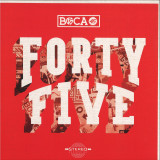
At some point during a DJ career that’s lasted pretty much the entirety of his adult life, Boca 45 (aka Bristolian Scott Hendy) eschewed all other formats to choose the 7” as his weapon of choice. Embracing and celebrating the limitations of the format (both in terms of record length and the type of music showcased on discs of that size), Hendy set out on a truly singular path for soundtracking parties the world over. In 2015 Banksy personally requested him to DJ with his 45s at the opening night at his Dismal Land Show, now, in his forty fifth year on Planet Earth, he’s made an album that reflects a life well spent flipping through the racks the world over.
On this album he has collaborated with lots of the people that he has previously worked with over the past 20 plus years recording music.
Vocal collaborations come courtesy of Louis Baker (Soul On Top / Move A Mountain) Emskee (Energy Boost / The Roxy) Sergio Pizzorno from Kasabian (White, Blue & Red) & Gee Ealey who i worked with on Malachai (Lonely)
Sister of Groovedge Records, Mystery Booms brings together the Lyon electronic scene to show its common love to the Dub.
First appearance is naturally delivered by brother Irie Mona. He is a producer implanted in town since a decade and he perfectly knows how to inject new digi-attitude in an old school roots way of dubbing productions.
Modern weird riddims by the boy Prince Stoner! Expect 2 contemporary songs for the dancefloor, still into a respectfull dub attitude! Tuned in! !!
Counterchange presents 'Eigenlicht' by Portuguese-German multi-instrumentalist, producer and award-winning film composer John Gürtler.
Gently teetering between krautrock-influenced synth mantras and saxophone improvisations, down-tempo electronica, sound design experiments and moments of rich ambience, 'Eigenlicht' is a diverse album of electro-acoustic music. The 11 tracks were recorded between two studios and on location at Berlin's infamous Teufelsberg, the abandoned Cold War era US spy-radio and radar outpost named 'Field Station Berlin', surrounded by forest to the west of the city.
A document of Gürtler's development, many of the pieces here were first laid down in his bunker-like former basement studios at Drontheimer Straße in north Berlin, before he eventually elevated above ground - both physically and musically - building his current Paradox Paradise studio and becoming an established film music composer. In 2019 John won the European Film Academy Award for Best Score, for his soundtrack for Nora Fingscheidt's debut feature 'Systemsprenger' (System Crasher).
In recent years John collaborated on a number of projects with acclaimed German producer and composer Phillip Sollmann aka Efdemin, performing live and releasing the 'Gegen Die Zeit' EP on Sky Walking, a subsidiary of Dial records where he also remixed Efdemin's 'Parallaxis' under the moniker The Borderland State.
In part an ode to the Macbeth Systems M5 modular synthesizer, with its three oscillators, much of the album features the towering instrument, whose uniquely rich tone and rumbling, pure bass end characterises tracks like 'Eigenlicht', 'M5', 'Synthetics' and 'Five Voice'.
"The M5's built in spring reverb and huge sliders and faders - as opposed to all the tiny knobs on Eurorack synths - make it as playable as any acoustic instrument."
John's primary background is in acoustic music, coming from woodwind and keyboard instruments, improvisation and composition. The leap into working with computers and electronic instruments found him exploring ways to make synths and samplers sound as organic as possible.
Listening to Linja’s debut LP makes one think of Polish director Yuri Norstein’s gloomy melancholic (yet playful) movies, or perhaps just of a rainy day, or Chopin.
Velvet Noise is a collection of 7 experimental pieces made by Linja sometime around 2016-2017, using drum ma- chines and a lot of modular synthesisers. The album is woven with Simple melodies that crack through the squeaks and the bleeps, eery pads that fill the voids all sorts of FX. The atmosphere becomes filled with tension when it is playing in the room, as if something is clearly about to happen. Linja’s album is not so easy to describe, and yet due to its coherence and storytelling it has a certain feel and per- sonality of a good book rather than just a record. “It transcends its existence as a record”.
A vital voice in the modern discourse on depression, body positivity, and the LGBTQ community, her trailblazing influence has arguably never been more apparent and some of the key writers of the moment have teamed up to work with her. Alongside Rae Morris and Fryars, who co-penned the first single WHO I AM, co-writers include Jonny Lattimer (Ellie Goulding, James Bay, Rag ‘n’ Bone Man), Future Cut (Little Mix, Shakira, Lily Allen), Tom Neville (Dua Lipa, Kesha, Calvin Harris) and Shura. Among the tracks she releases here are the slinky, tropical-tinged Overload, a warning to a people getting on your nerves, and Escape, a broken beats-driven track about escaping everyday life. The summery Self Love owes a debt to Donna Summer, while Melanie’s love of Billie Eilish influenced the moody, intimate Nowhere to Run. Melanie and Billie’s admiration for one another was plain to see at this year’s BRIT Awards, where Melanie presented Billie with the Best International Female Solo Artist award after a long embrace. Who I Am and second single Blame It On Me have both set up the self-titled album and despite releasing during a global lockdown, she has performed to great acclaim on TV and online across the world on flagship shows such as The One Show in the UK, no less than 4 million plus German TV shows and James Corden’s Late Late show in the US where her performance is now the benchmark. With growing streaming support and A list radio support on both tracks in the UK, Australia, Latin America, SE Asia and Germany so far, it’s a global new chapter for Girl Power.