
Search:modular one

Repress
The Acid Series Celebrates Over 10 Years Of No Way Back, With Music That Directly References That Experience. This Is The Fourth Volume In The Series, To Be Paired Withvol 3 By Jordan Zawideh. There Will Be Four More After This Pair, With Records By Tin Man & Ectomorph, Dona, Romans, And Pervocet (patrick Russell & Jasen Loveland) Yet To Come. They All Arrive In A Unique Sleeve Especially Created For This Series, Inspired By The Decorations Of Nwb. This Is The 3rd Collaboration Between Bmg & Derek Plaslaiko, Each Collaboration Has Been Inspired By No Way Back. For This One, Bmg Was Working On A Modular Based Acid Live Show For The No Way Back 10th Anniversary, And From That Vibe We Created These Songs. The A Side References Sonic's Rendezvous Band's Best Lost Single, They Were A Legendary Detroit Rock Band From The Mid 70s Featuring Founding Members Of The Mc5 And The Stooges. The B Side Was The Opening Salvo Of This 3rd Collaboration, A Day After A Detroit Party We Had Played Together. We Had Just Received The Terrible News About So Many Of Our Friends In Oakland, We Could Think Of Nothing Else. This Is Our Sonic Reaction. The B Side Concludes With An Open Jam Presented As A Bonus Beat, The Perfect Conclusion To These Feelings.

4
Shinoby is back on the iconic label that launched in the end of 2015. Each side includes one original mix and one remix from a few the most interesting and creative artists of the last years. Mass Prod delivers a sneaky techno banger carachterized by a warm modular feeling. Buttechno & Triš built a techno dub aesthetic track in a quietly perfected formula as in the mid-90’s.

5
Pitch language - Modular synth wizard Blawan brings his brand of distorted, syncopated electronic productions. Toast introduces the EP with a playful head bopper with ethereal sounds and menacing overtones. One of the biggest acts in dance music playing international festivals such as Pitchfork 2022, ADE, Nuit Sonores.
Plays from Mary Anne Hobbs on BBC 6 music and coverage from Resident Advisor, Pitchfork, Dekmantel, CRACK, The Face “losing himself in modular synthesis without ever sacrificing soul for science”

4
Specimen Records continue their exploration into the deeper reaches of electro with an EP from Berlin based Richard Easel, featuring remixes from close collaborators Datawave and Federico Leocata. The EP comprises of 3 distinct styles in one release, Easel with intricate sublimation and experimental modular sounds of the Buchala. Datawave’s remix of Exterreri, with his trademark spatial depth charged electro and Federico Leocata with his unique funky-minimal approach, which renders his darkly mysterious sound unlike Metaphysix underpinning a sound suited to Specimen.
Richard Easel is the electro project of Berlin-based DJ and producer and Italian born Riccardo Sbardella. He derives his sense of style out of the various IDM and Hip Hop projects he has created throughout his production journey. Richard Easel is an artistic endeavour that serves as an outlet for his own interpretation of Electro. The word Easel comes from Buchla Music Easel, as a tribute to his passion for modular synthesisers, and especially for West Coast Synthesis.

Autokinetic’s techno roots reach back to 1993 when Mike McClure and John Golden formed Auto K in Minneapolis, forming the vibrant MPLS rave scene alongside Freddy Fresh, Woody McBride, and DVS1. Auto K then changed their name to Auto Kinetic, and now Mike McClure is ripping hypnotic modular techno in hyperspace solo as Autokinetic. These tracks have been secret weapons in DVS1 sets for the past couple years.
“great stuff as always” - Decoder
“Very cool” - Justin Cudmore
“It bangs!” - CMD
“Really good” - 2Lanes
“Great release!” - PlayPlay
“Sounds great!!” - Golden Medusa
“Big blend potential with these trax!” - Escaflowne
The A side consists of “Sidewinder” and the cheekily titled “Didgeradont”. Both of these are bonafide heady techno hits. I mean, the production on these…higher consciousness inducing dancefloor rolling mania. For the old ears and fresh feet alike.
The B side opens up with “File003”, which has a robotic restraint and up-beat bassline to keep you locked in for the never ending tunnel ride of a track. “Wakeword” ends the EP with a proper, slightly acidic challenger to meet all late night crowds with taste. But no chin scratching here. This is techno at its tastiest. Mike is a pro who knows how to kick and punch with full peak euphoric power. He’s been in the game for three decades at this point, and is still pushing his craft and himself to new heights.
300 copies pressed worldwide. Not to be missed out on.
Produced and performed by Mike McClure in MPLS, MN USA
Mastered by Dietrich Schoenemann.
Design by Nick Owen.
Distributed by One Eye Witness.

SPF 50 returns to Professional Music with 'Secret Technology', a diverse 5-track EP of playful, sonically rich material aimed at the dancefloor. The record explores some of the the core staples of the dance: bouncy grooves, rippling, psychedelic synth lines and a few cheeky vocal chops.
Heavily inspired by golden era tech-house, but with an ear for modern sound design, the music comes in with bad-boy energy but hints at something deeper bubbling beneath. Heavy kicks and sharp hats mingle with complex, modular basslines. Dusty breaks and euphoric vocals jiggle over top of lab-concocted acid. This one is for fans of serious fun.

12
Proper analog mental tribe!!
ALL TRACKS BY ASTEKA!!
First release of this mastodonic triple vinyl featuring 12 bangers from the super talented and skilled ASTEKA!
NOT EVEN ONE FILLER!!
Tracks vary from 160 bpm to 170 bpm, HQ production with dark twists and very well designed analog synthesized sounds.
Must have in any bag of this genre lovers, very mixable with solid massive kicks driving you mental for real on the dance floor with surprising synths tricks and skills exercises from the artist.

Fase Luna ist das vom Ozean inspirierte, pulsierende Pop-Album von LA Priest, alias Sam Eastgate, das am 5. Mai über Domino veröffentlicht wird. Nach GENE aus dem Jahr 2020, das nach einer modularen Drum-Maschine benannt ist, die Sam mit 150 selbst gebauten Schaltkreisen entwickelt hat, reduziert sich Fase Luna auf Sam und seine Gitarre: neun sonnendurchflutete Tracks voller Glückseligkeit. Bei den Aufnahmen in Mexiko und in den Regenwäldern Costa Ricas ließ sich Fase Luna von der mythischen Geschichte der jeweiligen Region und den uralten Verbindungen zum Meer inspirieren. Roh und ungefiltert bietet Fase Luna ein One-Way-Ticket in eine andere Welt."

London’s own Trev appeared on our first release, Body Music Vol 1, as well as other key releases on CoOp Presents and Local Talk. We’ve been fans from the start and, after Trev joined the family, his music went from strength to strength. It was already out-of-this-world production, with serious attention to detail, and this EP is nothing short of excellent! He told us 'there’s no hiding that this EP is, in essence, a long love letter to Brazil', but that it’s also written to 'Iran, London, Lisbon, Japan, probably more - too many to remember!'. Trev described his process as 'listening, learning, combining my favourite elements of all this music that has brought me so much joy over the years'. Right on!
This EP is fresh, different and sonically on point. It’s Bruk, it’s Brazilian, it’s Bass, it’s… all-round-really-good dance music! Trev is a real modern musician, an awesome keys player as well as a producer. He understands the importance of musicality and originality, together with weighty beats and bass, working just as well on the dance floor as they do at a house party… or dinner party, for that matter!
'Nightjar', the title track, draws you in with hypnotic plucks like crickets on a hot summer’s night. Eerie pads float in building tension before the beat drops - Pandeiro and Caxixi serving broken-beat with the kick - pumping the sonic palette and pumping the dancefloor. Deep sinister chords pulse in and out, percussive melodies bring love from the middle east, and we reach a beautiful jazz-harmony break - then it’s straight back to the body movement - this time letting loose with the cowbells and the shakers. Think Brazil, think Persia, think Jazz, think dance-floor, it’s all in there!
'Late Flip' pulls us into a more ethereal intro, with the Koto and skate sounds laying our dream scene. Morphing out of flutes, modular synth plucks pay tribute to the sounds of Lisbon as we drop - a rolling broken beat punch, playful Rhodes and distant vocal chops ring out with the Koto dripping in warm echoes. A truly amazing composition and arrangement that leaves you wanting more!
'Beijo' is one of our faves on this EP. We’re straight in with a kiss - MWAH! - a classic Baile rhythm gets a warm Bruk embrace. It’s passionate and dark and tells a story as old as history. Get lost in the movements between drums and percussion, in the flutes and cicadas, until the organ bass calls it - time to get moving. This really is Trev’s signature dance floor style. A banger with a naughty-yet-subtle bassline, and its own game of perspective - feel this rhythm in more ways than one. Vocal chops and Tamborim place São Paulo’s influence front and centre.
'Grey' takes us on a dusty House/Bruk journey with filtering chords that grow patiently until the beat drops - getting your feet moving and neck bopping! Burning slow, Trev is playful with the harmony, keeping the fun with a roller of a bassline that pulls it all together. It’s a six-and-a-half-minute rich musical journey that feels more like half that time!?
Complete your Dance Regular Vinyl collection with this absolute killer EP from the one called Trev.

10
Tom Zé and Faust collide in Domenico Lancellotti's "machine samba"
Domenico Lancellotti's SRAMBA reaches back to the roots of samba whilst completely revamping its blueprint, indoctrinating guitar and percussion-led rhythms with analogue synthesisers, courtesy of album producer Ricardo Dias Gomes.
The majority of SRAMBA was recorded over two months in The Cave - Domenico's home studio in Lisbon, the city both Brazilian ex-pats reside in, where the arrival of a couple of Russian-designed synths purchased by Ricardo influenced the direction of their initial experimentation: "Ricardo had these instruments, modular machines" remembers Domenico, "and I had my guitar, some percussion instruments. On the first day we started making sounds and recording them, and songs started to appear, sambas started to appear."
The son of a renowned samba songwriter, at home Domenico would watch his father play and compose. At parties, the adults would hand his father a tamborim (a small tambourine) and ask him to play along. "I grew up inside samba, it's my roots", he says. "For me, everything is samba, I bring it into whatever style of music I am making".
Domenico and Ricardo instantly saw how the synthesisers were not at odds with the sambas they were playing, instead they had a similar sound to its typical percussion instruments (ganza, repinique, surdo, tarol). What's more, they saw a connection with roots samba, the samba that existed before bossa nova and samba jazz came along. This was rhythmic samba, with grooves that could go on ad infinitum. "It's samba de clave, geometrically structured" says Domenico. "It's ostinato samba", adds Ricardo.
"Diga" is a great example of what their proposal is capable of, as what begins as a glitchy machine whirring into action soon turns into a glorious samba in which the gurgles and scratchy beats coming from the analogue equipment only add to the arrangement. Likewise, on "Tá Brabo" it's an aching melody from one of the synths that gives the guitar rhythm its needed counterpoint, and shows how the duo's greatest accomplishment is not in invention alone, but in creating a great samba album. It's an album that can go from the opening track "Ere" with its reverberant bass thud, mantra-like vocals and staccato rhythms to the string-accompanied "Nada Sera de Outra Maneira", a swooning samba that pays tribute to the Brazilian ensemble Tamba Trio, who along with Tom Zé's Estudando O Samba, Domenico names as the biggest influence on their treatment of samba.
Other important reference points are made clear on "Um Abraço No Faust". One of three instrumentals on the album its title riffs off a JoãoGilberto song, "Um Abraço no Bonfá", but whereas JoãoGilberto was giving a hug (um abraço) to bossa nova guitarist Luiz Bonfá, Domenico and Ricardo are giving theirs to the German avant-gardists Faust. "Quem Samba", with its horn section and dramatic melody give a whiff of Domenico's Italian ancestry, while "Descomunal" is devoid of rhythm whatsoever, guest vocalist Tori singing over a bed of electronic drums, cello and swirling synths, that highlights the duo's unwillingness to stick to a particular formula.
Both Domenico Lancellotti and Ricardo Dias Gomes are revered names within Brazilian music over the past 20 years. As a member of the +2's, with Moreno Veloso and Kassin, Domenico released a trio of albums on Luaka Bop in the early 00s that pioneered a new Rio samba sound with elements of funk and psychedelia. With Veloso and Kassin he would later form Orquestra Imperial, a big band intent on reviving ballroom (gafieira) samba, and that has worked with guest vocalists such as Seu Jorge, Elza Soares and Ed Motta. SRAMBA is his fourth solo album. Multi-instrumentalist Ricardo Dias Gomes first came to notice as a member of Caetano Veloso's band Cê which helped reinvigorate Caetano's career with a sound influenced by British new wave. As well as collaborations with Lucas Santtana, Negro Leo and Thiago Nassif, and work with his own group Do Amor, he has released a series of acclaimed solo albums that reveal a restless music-maker.
SRAMBA is a glorious showcase of the duo's style, uniting Domenico's playful lyrics and rhythmic, samba-rooted songs with with Ricardo's assured accompaniment of unorthodox textures and instrumentations. It may be a new language for samba, machine samba (samba de máquina), but as Domenico says, "samba da máquina is samba".

10
repressed !
A lot can happen in 15 years. Few things manage to thrive for a decade and a half, especially in music. But a scrappy, left of center, Bay Area house music label, Dirtybird, has managed to do just that. Claude VonStroke, Dirtybird’s founder, is marking this 15-year milestone the only way he knows how… working. This year, VonStroke will throw two dozen-plus parties, three festivals (including the famous Dirtybird Campout), host his traveling Dirtybird BBQ series in major cities across the US, publish a coffee table book, release a seasonal clothing line, stage art shows, produce a fly on the wall docu series...and kick it all off by releasing a new album, out February 21st.
What began as a free party, turned basement record label, has morphed into a truly thriving community whose familial, fun and welcoming vibe has won over hearts and minds across the world. And while Dirtybird has grown and evolved, VonStroke’s core focus on music remains unwavering. The new album ‘Freaks & Beaks’ is a celebration of quirky innovation and a relentless pursuit of something new and fresh, while hearkening back to the freewheeling spirit that inspired the launch of his label. This is a project that draws upon the inspirations of family, old friends, new fans and proper dancefloors.
Claude will let his flock wet their beaks while they wait in anticipation of the new album with two new singles demonstrating the breadth of the dance music landscape explored on the record. Youngblood touches on the deeper sides of Claude VonStroke, a throwback to the label’s early days, featuring local LA music house talent Wyatt Marshall, while All My People in the House is a dancefloor heater that is sure to unite new and old Dirtybird fans together.
Today, Claude also delivers fans part one of an intimate video series, shot by his sister Emily (an accomplished filmmaker), documenting the creation of ‘Freaks and Beaks’, celebrating this historic milestone and taking a deeper dive into the day to day life of Claude VonStroke on the road.
‘Freaks and Beaks’ is the fourth artist album and sixth full-length project from Claude VonStroke. He approached the album with a new process, including committing to daily creative time, experimenting with a lot of new hardware and having fun creating a huge amount of sketches. He made music on many levels of gear all the way from complex modular synths to simple drum apps on his iPad. Keeping it all DIY, he sampled his own voice and his two children on several tracks as well. He allowed himself to breathe while creating over 130 ideas, which were whittled down to the finished 11 album tracks.
Freaks & Beaks nods at the inspirations that underpin VonStroke’s world, inside jokes between him and Justin Martin (FlubbleBuddy), unused experimental live sessions (Session A), playful noodling on synths (Alpine Arpline), obscure French producers (Frankie Goes To Bollywood), championing new talent (Youngblood), irreverent self-aware humor (Birthday Messages) and genre inspirations that range from ghetto tech and drum n bass to hip-hop and breaks. This is VonStroke’s love letter to the vibrancy and genre diversity that have made Dirtybird such a singular label.

Modular synthesizers / electronics + a drum kit enhanced with triggers and sensors: on its self-titled debut album, the duo hÄK / Danzeisen creates a sonic energy that oscillates between high-precision rhythm patterns, analogue sounds and frenzy climaxes.
One must imagine hÄK / Danzeisen as a man-machine apparatus. A collection of cables, resonating bodies and restless limbs that together question all routines. Who overthrow conventional role of instruments and explore the possibilities of a new sound language. Bernd Norbert Würtz alias hÄK operates modular synthesizers, self-soldered circuits and control knobs. Philipp Danzeisen plays a drum kit enhanced with triggers and sensors. These two poles are connected to an interdependent whole in which a constant musical dialogue takes place. The dependencies within this system have been meticulously defined by hÄK / Danzeisen: Drum rolls and sound modulations are interconnected in such a way that there is no contradiction between the strict technological structure and the creative outburst that is possible at any time.
What drives hÄK / Danzeisen is the basic idea that the contrast between acoustic drums and synthetically produced sounds must be overcome in order to create a new experience. Würtz, Danzeisen and their combined instrumentation simultaneously rub up against the same edges, finding a single, piercing voice.
Ideal manifestations of this approach are the duo's live performances: raw energy that oscillates as precisely as it surprises between drones, abstraction and noise attacks, driven by an impudent take on jazz. Constantly oscillating between the registers of "composed" and "improvised", each performance by hÄK / Danzeisen ultimately becomes one of a kind. (Arno Raffeiner)

Swedish drone alchemist Mats Erlandsson is sitting in a fictional room on ‘Gyttjans Topografi’, imagining a virtual chamber orchestra using zithers, tapes, double bass, harmonium, organ, and various synthesisers to draft a treatise on alternative tuning and non-normative harmonic structures. Transcendent material.
“The music on this recording is performed by a kind of fictitious chamber ensemble situated in an imaginary room outlined by textures that alternate between gestural foreground and passive landscape. The three pieces contained within this release are tied together by sharing similar harmonic material and instrumentation and could ideally be perceived as parts of one long performance stretching through the two sides of the record. The textural room in which this musical performance operates is unreliable, unstable, constantly shifting in size and activity from sparse and open to dense and claustrophobic. Inside this non-euclidean performance space a chamber ensemble made up of zithers expanded through analog tape transposition, harmonium and organ, double bass, digital FM, feedback-convolution and Serge modular synthesizer perform a music made from justly tuned intervals arranged in a way that blurs the distinction between traditional minor and major tonal harmony in favour of harmonic progression within an essentially modal framework.
‘Oxidationstabell för Hytta A’ unfolds the harmonic material slowly in three sections where individual lines move independently initiated by the attack of the zither while the textural properties of the room shifts and shimmers. ‘Törnar’ forms a dense harmonic counterpoint where lines built from the same intervallic relationships gradually shift the balance from one spectral focal point to the next while the textural-spatial elements move under pressure and permeate the harmonic layers. The double bass heard on this piece was performed by Yair Elazar Glotman.
The whole of Side B is made up of one piece - ‘Sänka’, using a series of chords made from harmonic inversions of a single set of intervals as an anchor, or synchronisation point, for voices gliding towards, or away, from their designated goal as parts of the harmonic structure of the piece. In addition to the harmonic and textural layers previously present, a third percussive voice is present here whose rhythmic material is intimately tied to the intervallic relationships present throughout the record.
The material used to make these pieces included non-harmonic sounds and contaminated field-recordings that have gone through a sort of feedback process between digital and analog, or acoustic, processing where the recordings were edited, processed and re-amplified and recorded again in acoustic spaces to shape their character and imprint acoustic identities on the recordings. The tonal instruments were treated in a process analogous to this - harmonic material built from recordings and digitally generated synthesis recorded, transcribed, rearranged and overdubbed again with additional electronic or acoustic instruments to form a composite electroacoustic instrumental sound.
Mats Erlandsson is a composer and musician, part of the vibrantly reemerging field of drone music in Stockholm, Sweden, associated with practices characterised by the extensive use of sustained sound. Erlandsson presents his work both as a solo artist and in collaborations, most notably together with Yair Elazar Glotman and Maria W Horn.

4
also available
green marbled vinyl[13,87 €]
Paul 'Damage' Bailey, one of the original resident DJs at Birmingham's House Of God club nights along with Surgeon and Sir Real, strikes back on De:tuned with 2 new relentless techno cuts. On offer, a mind-bending modular exploration that takes no prisoners from the Brummie powerhouse accompanied by top drawer remixes. James Ruskin transforms 'Hadal Zone' into a rare darkroom electro orientated piece, while Makaton turns out a deep pulsating 4/4 techno version of 'Decompression'. It's a real burner.
Kevin Foakes (Openmind, DJ Food, Ninja Tune) created all the graphic work. Mastered by Matt Colton at Metropolis and pressed on 180 gr vinyl. A separate digital release will also be available at the usual digital shops. Stay tuned!

4
also available
Black Vinyl[12,82 €]
green marbled vinyl
Paul 'Damage' Bailey, one of the original resident DJs at Birmingham's House Of God club nights along with Surgeon and Sir Real, strikes back on De:tuned with 2 new relentless techno cuts. On offer, a mind-bending modular exploration that takes no prisoners from the Brummie powerhouse accompanied by top drawer remixes. James Ruskin transforms 'Hadal Zone' into a rare darkroom electro orientated piece, while Makaton turns out a deep pulsating 4/4 techno version of 'Decompression'. It's a real burner.
Kevin Foakes (Openmind, DJ Food, Ninja Tune) created all the graphic work. Mastered by Matt Colton at Metropolis and pressed on 180 gr vinyl. A separate digital release will also be available at the usual digital shops. Stay tuned!

Like a phoenix rising from the molten vinyl ashes of European pressing plants that are being overrun by Taylor Swift represses, DABJ are back with their first release in what seems like an eternity.
For this one they welcome Modman to the family, who some of you may have heard before on Jerome Hill's Don't Recordings. Four cold as ice Techno and Electro modular jams aimed squarely at the more discerning dancefloors, on which they have already been causing quite a stir over the past few months.
Strictly limited numbers on this one so don't hang around.

"When you cut into the present, the future leaks out" William S. Burroughs. Third Ear are proud and excited to release a new Brendon Moeller project exclusive to Third Ear... Ultra Random Analog Orchestra. The project kicks off with 13 tracks released on vinyl over 3 individually released 12" and a digital album with 16 tracks. The music ranges from deep, wide-screen Techno to Ambient and beatless, that pushes the limits of the sonic palette. Artwork by The Designers Republic. Brendon says, "the ability to sculpt an audio collage in realtime employing techniques of randomness is one of my favorite pursuits using a Eurorack modular system.
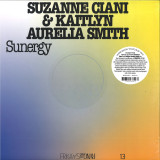
Sunergy brings together synthesists Kaitlyn Aurelia Smith and Suzanne Ciani for the thirteenth installment of FRKWYS, RVNG Intl.'s intergenerational collaboration series. For this edition, a panorama of the Pacific Coast provides the place and head space for a musical appreciation and consideration of a life-giving form vast and volatile with change. Fortuitously (as is the freaky way), Smith and Ciani were discovered to be neighbors in the small coastal community of Bolinas, California. The two had become close friends, bonding over their experience as woman musicians and, more unusually, their shared passion for the Buchla synthesizer. The music of Sunergy embraces this kinship, with Ciani and Smith respectively performing on the Buchla 200 E and the Buchla Music Easel, two modern configurations of the innovative instrument developed in the '60s by Don Buchla.
Sunergy was recorded in the Bolinas home where Ciani has lived for the last twenty-four years. Her living room overlooks the Pacific Ocean from a cliffside perch, creating an idyllic, inspired setting for music making. Setting up their synths side-by-side, Ciani and Smith took turns keeping time and freely improvising for the album sessions. As a complete piece, Sunergy is shaped by slow, pulsing forms and sinuous, melodic sequences that conjure both an oceanic world and the unlimited sound made possible by modular processing.For her part, Ciani has long been a Buchla voyager. Suzanne proselytized the potential of Don's synthesizer instruments in the '60s and '70s, performing her own compositions before introducing synthesized jingles and sound effects to household audiences. Ciani then achieved wide recognition for her debut album Seven Waves, a collection of colorful, classical song-like melodies fluidly working with harmonic textures and sounds of the ocean shore. Since its 1982 release, Seven Waves has become an important chapter of the ambient canon within which contemporary artists like Smith have developed their own synth syntax. Smith was born just a few years after the appearance of Seven Waves, growing up in Orcas Island, Washington. A place of profound natural beauty, the islands would inform Tides, her first instrumental collection from 2014. Smith composed Tides as an accompaniment for Yoga classes, ultimately freeing her from conventional songwriting into the exploratory, synth-based compositions demonstrated in ecstatic variety on 2016's Ears. Despite the serene setting where Sunergy was realized, the album does not romanticize a complete oneness with nature. Smith and Ciani use their collaborative ground to reflect on the unstable forces at play across the Bolinas horizon. Sunergy takes stock of Bolinas in the 21st century, a once-thriving artist's refuge now vulnerable to real estate pressure extending from affluent San Francisco, and more irreparably, the specter of climate change erasing its many waterfront habitats.
A diametric dynamic is present in Sunergy, a somber meditation amidst the intense cultural and solar forces transforming the landscape, and a hopeful assertion of the surviving creative culture of Bolinas. Far from rehashing the gentle grace of the artists' seminal works, Sunergy instead seeks to awaken and bear witness, employing the Buchla waveforms to mirror the infinite rhythms of the ocean and our essential relationship to it.
Kaitlyn Aurelia Smith and Suzanne Ciani's Sunergy will be released on September 16, 2016 on LP, CD, and digital formats. An accompanying documentary by Sean Hellfritsch will be offered in tandem.

The 1st volume of »San Francisco Moog: 1968-72« introduced the world to a trove of recordings from a little-known hinge point in electronic-music history. Vol. 2 brings to light the rest of tapes—and the rest of the story. In 1968, Bay Area native Doug McKechnie got hold of one the very first modular Moog synthesizers ever made and began finding his own way to play it. Soon, he was hauling the finicky instrument around to perform improvised concerts at colleges and psychedelic ballrooms, as well as an ill-fated appearance on the bill at Altamont. Some of the performances were recorded, and the surviving tapes—never before released—capture a free-flowing, transportive sound that fills in the gap between the austere mid-century academic avant-garde and the expansive cosmic suites of Tangerine Dream and the rest of the Berlin School in the ’70s.
Vol. 2 captures a wider range of sounds and moods, encompassing austere sonic experiments, early sequenced pulses, and melodic etudes.
“These pieces represent amazingly fully formed early approaches to the very idea of musical synthesis...arresting even to modern ears.” — Goldmine
“Presages both Tangerine Dream’s soundtracks and, in its most grimy moments, Acid Tracks.” — The Wire
