EN: Possibilities offered by the modular construction of the individual boxes are so varied that they can be combined vertically or horizontally. Supplied connection strips stabilise the shelf construction and create the impression of a homogeneous unit.
In addition, the box is ideal for storing the "Disco-Antistat Generation I & II", and also the dry rack can be perfectly accommodated in the Archifix box.
DE: Durch die Systembauweise können die einzelnen Boxen variabel nebeneinander- und/oder übereinandergestellt werden.
Die mitgelieferten Verbindungsleisten geben dem Regalaufbau besonderen Halt und vermitteln den Eindruck eines geschlossenen Ganzen.
Außerdem ist die Box ideal zur Aufbewahrung der "Disco-Antistat Generation I & II" geeignet, sowie auch der Trockenständer perfekt abschließend in der Box verstaut werden kann.
Gefertigt wird die Archifix-Box aus ABS-Kunststoff, welcher sich unter anderem durch Schlag- und Kratzfestigkeit auszeichnet, Temperaturschwankungen standhält und antistatisch wirkt.
Maße: B = 180 / H = 348 / T = 327 mm
Made in Germany!
Cerca:modular
Colombian-born, New York-raised producer and instrumentalist Felipe Quiroz aka Prince of Queens brings his unique synthesis of trans-caribbean culture with house and techno to RNT on his Merida EP.
Known for releases on Names You Can Trust and his band Combo Chimbita, this lush and varied EP invites you into a world where vintage tropical sounds and modular synthesizers live side-by-side on the dance floor. With 6 songs stretched across two sides, the record explores a wide range of tempos and electronic Latin vibes, and boasts gorgeous cover art that suits the emotion of the music perfectly.
Although he is a seasoned producer, Prince of Queens is still a relatively new name on the club scene…but with this definitive musical statement it’s a name that the heads will remember.
Following floor shaking four trackers on Bliss Point and his own Professional Music imprint, SPF 50 continues his roll on Amsterdam’s Dzungla label with the Terrarium Trek EP.
Terrarium Trek finds SPF 50 exploring the vanishing space between electronic and organic, returning to us with four sonic ecosystems encased in no-frills club melters. Each track thumps with life, conjuring the beauty, mystery and terror of the natural world, stomping and wriggling out of the sound system and immersing the dancefloor.
Composed using modular synthesis, sampling, and a process that eschews the rational for something deeper, with Terrarium Trek SPF 50 has once again gripped the unknown and pulled it into us, turning the club up, inside and out.
- A1: On Dead Waves - Blue Inside - Beg, Steal Or Borrow Remix
- A2: Groove Armada – Time & Space - Lucca's Pitch Down Stella Remix
- A3: Weekend Players – 21St Century – Stella Polaris Remix
- B1: The Sei – Let It All Go – Stella Polaris Remix
- B2: R Missing - Heavens Lower - Tom And His Computer Remix
- B3: Tina Dickow – Moon To Let - Sekuoia's Stella Polaris Remix
- C1: Tom Adams - Seven Birds - Bsb's Stella Polaris Remix
- C2: Mads Björn Feat Rick Astley – I Have Nothing To Say - Cemetary's Stella Polaris Remix
- C3: Grand National – Talk Amongst Yourselves - Leo Ryan's Stella Polaris Remix
- D1: Funkatarium - Jump - Black Hawks Of Panamá And Massey Chill Out Version
- D2: Beg, Steal Or Borrow – Do Androids Dream Of Modular Synths
- D3: Glitch Garden - Sprout
Stella Polaris is all about quality Scandinavian electronica, chill out, down tempo, leftfield indie music. This 18th edition of the Copenhagen chill-out festival brand comes with a double gate folded colored limited edition (300 copies) vinyl with a focus on inspiring female talent
2024 Repress
Finders Keepers invite you to witness the incredible first ever Buchla synthesiser concerts/demonstrations providing a distinctive feminine alternative to The Silver Apples Of The Moon if they had ever been presented in phonographic form. This is history in the remaking.
This spring Finders Keepers Records are proud to release an archival project that not only redefines musical history but boasts genuine claim to the overused buzzwords such as pioneering, maverick, experimental, groundbreaking and esoteric, while questioning social politics and the evolution of music technology as we've come to understand it. To describe this records as a game-changer is an understatement. This record represents a musical revolution, a scientific benchmark and a trophy in the cabinet of counter culture creativity. This record is a triumphant yardstick in the synthesiser space race and the untold story of the first woman on the proverbial moon. While pondering the early accolades of this record it's daunting to learn that this record was in fact not a record at all... It was a manifesto and a gateway to a new world, that somehow never quite opened. If the unfamiliar, modernistic, melodic, pulses, tones and harmonics found on this 1975 live presentation/grant application/educational demonstration had been placed in a phonographic context alongside the promoted work of Morton Subotnick, Walter Carlos or Tomita then the name Suzanne Ciani and her influence would have already radically changed the shape, sound and gender of our record collections. Hopefully there is still chance.
In short, Suzanne was a self-imposed twenty-year-old employee of the Buchla modular synthesiser company, San Francisco's neck and neck contender to New York's Moog. Buchla was run by a community of festival freaks and academic acid eaters whose roots in new age lifestyles and the reinvention of art and music replaced the business acumen enjoyed by its likeminded East Coasters. In the eyes of the consumer the creative refusal to adopt rudimentary facets like a piano keyboard controller rendered the Buchla synthesiser the more obscure stubborn sister of the synth marathon, steering these incredible units away from the mainstream into the homes and studios of free music aficionados, art house composers and die-hard revolutionaries. Championed and semi-showcased by composer Morton Subotnick on his albums The Bull and Silver Apples Of The Moon, Buchla's versatility began to open the minds of a new generation, but the high-end design features and no-compromise modus operandi was often confused with incompatibility and, in the pulsating shadow of Moog's marketing, the revolution would not be televised nor patronised. Suzanne Ciani, as one of the very few female composers on the frontline (and also providing the back line) did not lose faith.
These concerts' are the epitome of rare music technology historic documents, performed by a real musician whose skills and academic education in classical composition already outweighed her male synthesiser contemporaries of twice her age. At the very start of her fragile career these recordings are nothing short of sacrificial ode to her mentor and machine, sonic pickets of the revolution and love letters to an absolutely genuine vision of and 'alternative' musical future. In denouncing her own precocious polymathmatic past in a bid to persuade the world to sing from a new hymn sheet, Suzanne Ciani created a bi-product of never before heard music that would render the pigeon holes ambient' and futuristic' utterly inadequate. Providing nothing short of an entirely different feminine take on the experimental records' of Morton Subotnick and proving to a small, judgmental audience and jury the true versatility of one of the most radical and idiosyncratic musical instruments of the 20th century. These recordings have not been heard since then.
The importance of these genuinely lost pieces of electronic musics puzzle almost eclipses the glaring detail of Suzanne's gender as a distinct minority in an almost exclusively male dominated, faceless, coldly scientific landscape. Those familiar with Suzanne's work, a vast vault of previously unpublished non-records', will already know how the creative politics in her art of being' simultaneously reshaped the worlds of synth design, advertising and film composition before anyone had even dropped a stylus in her groove. Needless to say this record, finally commanding the archival format of choice, courtesy of the Ciani and Finders Keepers longstanding unison, was not the last first' with which this hugely important composer would gift society, and the future of a wide range of exciting evolving creative disciplines.
You have found a holy grail of electronic music and a female musical pioneer who was too proactive to take the trophies. With the light of Buchla and Ciani's initial flame Finders Keepers continues to take a torch through the vaults of this lesser-celebrated music legacy shining a beam on these non-records' that evaded the limelight for almost half a century. You can't write history when you are too busy making it. With fresh ink in the bottomless well, let's start at the beginning. Again. You, are invited!
Filipovich is one of a kind. The Belarus-born, Paris-based artist works in a multitude of media - found footage films, painting, silkscreening and performance to name a few. It's her musical output that has caught the attention of late, though, with Filipovich dropping a run of releases in recent years which began with 2021's Magnificat on Time Released Sound. Filipovich takes as much of a novel approach to her music-making as she does with her other artistic endeavours - Magnificat was centred around treated samples of Sergei Rachmaninov's All-Night Vigil, and she's also combined classical composition with contemporary electronic techniques on her subsequent drops.
For Idealized, Filipovich's debut on Sheffield's Central Processing Unit, she maintains the gothic air which characterised her previous releases and applies it to a record of widescreen contemporary techno joints. These tracks represent something of a gear shift for CPU, a label which has long made its name by delivering top-quality electro and machine-funk jams, but such is the quality of Idealized that these superbly-executed techno productions are sure to win over label fans both old and new.
Idealized is very much schooled in the German tradition of minimal/dub techno. Tracks like 'Physical', 'Wave' and 'Dance Minor' all anchor themselves on single, steady drum pulses and delay-drenched single-chord loops. Filipovich generally lets the central idea of these tracks play out across several minutes while introducing increasingly disorientating elements into the rest of the mix - wiccan atmospherics, clashing chords, spiralling delays and so forth. It's an approach at once respectful of Filipovich's predecessors - Basic Channel, Deepchord, Ellen Allien and so on - but also full of idiosyncrasies and individuality.
Many of the club cuts here hardwire us into the moody, murky environs of the darkest Berlin Basements. 'Ultra Red' rides forward on a crisp drum machine snap, a menacing burble of bassline and an eerie single-note synth whistle in the upper end of the mix; 'Dance Minor' shows off a bit of KiNK in the brain-bending modular loop that waxes and wanes at its centre; the second-half run from 'Wave' to closer 'Small Cave' travels ever-further out into deep space - the kick drums remain insistent, yet the textural elements are delivered with an edge and flair that evidences Filipovich's ability to think outside the box.
Filipovich's unusual methods, and the influence of sound art and electroacoustic composition on her music, are drawn out further when Idealized steps away from the dancefloor. 'Hydra' comes off like a more gothic version of Pole - its central pulse draws from dub techno but never quite settles into a danceable groove, and this beat is combined with the kind of unnerving keyboard work that would make John Carpenter proud. Although closer 'Small Cave' eventually locks into another dark-room techno roller, the opening section of the track delivers a weightless soundscape of bright, tinny chords and a scene-setting field recording.
Idealized, the first drop on Central Processing Unit from Paris-based Belarusian Lina Filpovich, broadens the label's horizons with a selection of finely crafted minimal/dub techno joints.
RIYL: Andy Stott, Deepchord, Ellen Allien, Moritz von Oswald
After a hiatus of a few years to concentrate on various studio projects, Steevio’s Mindtours label is back with a vinyl release over 2 volumes, pressed on bio-vinyl at the carbon neutral pressing plant Deepgrooves.
Dod yn ôl at fy nghoed (which is Welsh for ‘to return to my trees’ meaning to return to balanced state of mind) sees Steevio experimenting with deep, broken-beat bass techno awash with polymetric rhythms and jazz infused chord structures. Steevio’s musical approach has in recent years become more free-form, with loose mathematical frameworks, evading clear generic boundaries, and this release continues and expands on that theme.
All tracks were recorded live and improvised from a blank canvas in real-time on an analogue modular synthesizer.
Vol. 1 was all recorded during Covid lockdown and represents some the best material from jams from that period. All tracks were recorded live and improvised from a blank canvas in real-time on an analogue modular synthesizer.
Vol. 2 to be released 1 month after.
Pleasure Planet’s kaleidoscopic debut album has been a long time coming, but good things come to those who wait. Developed over years of late-night studio improvisations, ‘Pleasure Planet’ is an affectionate and colorful patchwork of the New York City-based trio’s knotted influences that’s suspended between the rave and the chill-out room, weaving glistening pads and chunky basslines into vocal earworms and warm, saturated rhythmic cycles. Bandmates Andrew Potter, Kim Ann Foxman and Brian Hersey enter into a lysergic dialog with their discrete personal musical histories, drawing inspiration from vintage EBM, ambient music and heady early ’90s West Coast rave sounds and launching these classic elements into a transcendent new sonic universe.
Celebrated DJ and producer Foxman was a lead singer of Hercules and Love Affair when she first ran into DC rave veteran Potter, and the two rapidly realized their musical interests overlapped. So when Potter was recording with his studiomate Hersey, a NYC underground club scene mainstay, and they needed to bring in a vocalist, the choice was simple. Working together was a refreshing, freeing experience for the three seasoned artists, and the more they experimented, the closer they became; Foxman ended up moving into the studio, and Pleasure Planet was manifested into existence. “We’re like family,” says Potter. “We’re always on the same page – we couldn’t make this music solo.”
For Foxman, the open-ended jam sessions provided her with a chance to try something new, a few steps from the dancefloor-forward DJ tracks she’s best known for producing. And as the trio pooled their adolescent rave memories, reflecting on them with more mature ears, they began to develop the signature sound that was first heard on the Throne Of Blood-released ‘Animals’ 12″. Pleasure Planet aren’t trying to re-capture the past, but suggest a poetic contemplation that layers their recollections and musical obsessions into a hypnotic sci-fi dream. Harnessing a self-described “Aladdin’s cave” of analog and digital gear that help galvanize the timeline, they bridge the gap between avant-pop and icy bleep techno, curving suggestive words through lattices of tightly-engineered electronics.
On ‘Endless’, Foxman’s voice is echoed into a glistening haze that hovers around ethereal pads and tense, electroid pulses. Slow-moving and evocative, it’s a track that capture the open endedness of post-rave euphoria, touching the afterparty but moving far beyond the material world. She’s more recognizable on ‘Alien’, the album’s most upfront track, singing in a glassy, upper-register coo over urgent bass bumps, taut guitars and florid electronic atmospheres. “Are you an alien, or are you an angel?” she asks, fractalizing the borders between genres. And the band’s sense of cosmic togetherness bubbles to the surface on ‘Saved by the Bells’, a meditative after-hours experiment that diminishes the pulsing beats for a moment to bring out a spectrum of interconnected, serpentine melodies.
Modular bleeps and echoing percussion anchor the swooning ‘Planet Love’, one of Pleasure Planet’s most recent compositions and one of the album’s most outwardly psychedelic cuts, while the urgent and anthemic ‘Go With Madness’ steps back towards the main stage, evaporating Foxman’s memorable calls into a thumping procession of analog drums and squelchy, acidic bass tweaks. But they save the best for last, tugging at the heartstrings with ‘Remember (In Dreams)’, a giddy spiral of blipping synth arpeggios and haunting, reverberated chorals. It’s the perfect way to conclude an album that cryptically gestures towards the vulnerability of friendship, celebrating the shared experiences that result in some of the most meaningful memories of all.
Following two successful dancefloor-orientated releases with remixes by Marco Shuttle and S.O.N.S., London-based label E2-E8 takes an ambient turn while remaining faithful to its ethos of putting new artists on the map. Water Locks is the debut release from Szl0, a sound artist who’s been living and breathing East London’s inspiring atmosphere and contradictions for the last 10 years.
Water Locks is a tale of boats, canals, twists and turns of a quietly ever-changing life. A misty, smoky dive into a soul in constant search for itself. For his debut album, Szl0 peeked into instincts and fantasies and crafted a series of deep live improvisations.
The beauty is in the tension: Szl0’s music is for pause and reflection, yet it’s the moment that matters. A series of intense movements firmly grounded in the here and now which, taken together, becomes bigger than the sum of its parts. A late night listening at sea.
Limited run of 50 tapes. Includes a download code with a bonus remix from E2-E8’s own Miro Sundaymusiq (“First Light” – Pacifist Techno Soul Edit) who reinvents one of Szl0’s movements and gives it an unexpected dancefloor appeal.
A new album is finally on Drivecom. A 2xLp full of new tracks recovered and rearrenged around 2022-23. No doubt the legacy of the past works are represented. Some arpeggios and melody lines will remember us to sonic landscapes from the “La Hora de las Máquinas” or “The Source” albums by Boris Divider but with a new and refreshed production sound, for sure this will be a must item for all the electro community and fans of the label.
The album opens with the intro track “The Way You Feel Me” a mix between electro and synthwave with a moog bass and arpegio reminiscent of some Arpanet’s “Wireless Internet” tracks. Then followed for the “Letters From A Sleeper” theme. As the track’s name reflects, it's a clear tribute to the synth era of David Harrow/Anne Clarke’s “Sleeper in Metropolis” just like a reply from a postnuclear future, with a big role carried out by the initial synthline. Then the first slow bpm track is for “Distante” where synthlines a la Tangerine Dream are crossed and mixed with vintage digital rhythm machine sounds and the pattern seems to be taken from those Dire Straits’ “Money for nothing” intro drum arrange in an infinite and repetitive way.
In the B Side “You Know What I Know” track is again showing an Arpanet-ish intro synthline followed by a sequential prophet's arpeggio which bring us back to the old “La hora de las máquinas” sound. Closing the first 12 inch is “Sin Mirar Atrás”. One of the most important tracks of the album for the author. A big dimensional and introspective track full of vintage synthlines and reverb. Time for “Your Light” track is again here. This song was already presented with its own reference on Drivecom. A future pure Electro classic which was announcing the album months before.
In the same side, we find another slow tempo theme called “Recursos Infinitos” an instrumental track which implements several synthlines that interlink themselves into an infnite Tangerine Dream’s soundtrack that serves as a little break to the power and darkness of “Cenital”. Electro rhythm patterns and dark arpeggio synthlines in the vibe of Vangelis’ Blade Runner are mixed in this cold dystopian agressive dancefloor track. Later we find the theme that gives name to the album: “ Memories From The Dust” a slower track which mixes sounds and melodies between “La Hora de las Máquinas“ and other 80's digital keyboard sounds. The last track is just an outro theme called “Out of Sync”. Its name is a clear statement of its own musical arrangement, synthlines are full out of timing and synchro, it was recorded in realtime from a modular synth to a digital device in one take.
Modularz label head Developer returns just in time for Summer. 2024. Presenting a new vinyl release pushing new limits recording with slightly increased BPMS and focusing more on driving dark rhythms and tribal hypnotic funk-infused drama cuts. After releasing over 100 records in the last 10 years the man continues to push into the next 100 with sure thing works and gaining the pressure knob on every track. this is a must if you want to destroy buildings. TIP!
Modular Wizard Adam Arthur issues forth another sonic spell from his remote fortress! Hot off a searing 12" for Detroit's Interdimensional Transmissions, Adam returns for the third release on his Arkansas imprint, Danger Close. Throbbing with raw analog energy, DANG 03 is soaked in the sound of his chosen instrument, the Buchla 200. Prepare for a journey through the dark night of the soul. Only fools rush in.
A true packing backpack designed to carry what you need.
Made from 120 recycled 0,5l (16oz) plastic bottles, the SOLID BLAZE PACK 120 is an all-purpose travel backpack with modular interior layout crafted for versatility. Whether you are hauling DJ or production gear, photo or video equipment, or other electronics, the SOLID BLAZE PACK 120 enables you to easily and conveniently organize your gear. The spacious and expandable main compartment features removable EVA padding and multiple dividers for ultimate packing experience. The customizable padded interior ensures your gear travels with you safely. Loads of additional compartments, pouches and zippered pockets offer intuitive accessory management and quick access to your belongings. The SOLID BLAZE PACK 120 is crafted from only the highest quality materials, such as its water-repellent RPET 900D shell and YKK® AquaGuard® zippers to protect your laptop, tablet, timecode records and other expensive gear from the elements. Travel comfortably knowing your gear is safe inside the MAGMA SOLID BLAZE PACK 120.
Fabrics made from recycled PET plastic bottles (Global Recycling Standard certified)
Outer material crafted from robust and water-repellent RPET 900D Polyester (with eco-friendly water-based PU-coating)
Lining made from RPET TC Polyester
Lockable dual PVC-coated YKK® AquaGuard® zippers (padlock not included)
Expendable equipment storage compartment with EVA side walls and bottom padding
Includes removable dividers to customize individual sections
Separate padded laptop and tablet compartment fits up to 17” laptops
Numerous internal pouches, compartments and zippered pockets to organize smaller gear
Quick-access front-compartment with internal pockets to organize smaller gear
Dedicated headphone-pocket (also holds cameras)
Side-pocket with pen and key-holder
Side-pocket with USB charger port (power bank not included)
Side-pocket for bottle or tripod storage
Comfortable air channel back padding with hidden document pocket
Carrying-handle with magnetic closure
Contoured and ergonomic riveted shoulder-strap with metal buckles
Adjustable chest-strap
Detachable hip-belt transfers heavy-loads to your hips
Trolley-Sling
Cabin luggage compatible
+ Outer dimensions: (H/B/T): 52 x 35 x 23-26*cm / 20.5” x 13.75“ x 9“-10.25“* (*extended)
+ Inner dimensions: 45 x 32 x 14 -17* / 17.75“ x 12.5“ x 5.5“-6.75“* (*extended)
+ Weight: 2,3 kg / 5lb
+ Color: black/grey (Item-No.: 47892 / EAN:4041212478924)
Black Truffle is thrilled to present the first vinyl reissue of David Rosenboom’s unique Future Travel, originally released on the short-lived Detroit label Street Records in 1981 and here presented in an expanded edition with an additional LP of wild, previously unheard live and studio material from the same period.
Future Travel emerged from the confluence of two important streams in Rosenboom’s work at this time. First, his exploration of ‘propositional music’, defined as ‘complete cognitive models of music’ that start from the radical question, ‘What is music?’ In this case, the music belongs to the universe of Rosenboom’s In the Beginning (1978-1981), in which proportional relationships determine the material available to the composer in all musical parameters (harmonic relationships, melodic shapes, rhythmic subdivisions, dynamics, and so on). Second, the work documents a key moment in Rosenboom’s long collaboration with synthesizer pioneer Don Buchla. Having played a role in developing concepts for some of the modules of the Buchla 300 Series Electric Music Box (an innovative analogue modular system controlled by micro-processors), Rosenboom went on to write the software for Buchla’s hybrid analogue-digital keyboard synthesiser, the Touché, the instrument heard most prominently here.
In a way that no purely analogue synthesizer could, the 300 Series and Touché allowed Rosenboom to work with the In the Beginning algorithms in real time, the synthesizers becoming ‘intelligent instruments’ that actively collaborate with the performer. Developing the open structures of the electronic pieces from In the Beginning, Future Travel explored the possibilities of simply ‘playing the system’, recording live at Francis Ford Coppola’s Zoetrope studio in San Francisco. Working from loose sketches, Rosenboom added acoustic instruments to the electronic sounds and, on some pieces, the processed voice of Jacqueline Humbert. Like Rosenboom’s collaboration with Humbert on the abstracted synth-chanson of Daytime Viewing, this music set out deliberately to challenge the ‘stratified and illusorily coagulated identities in the musical culture of the time,’ refusing distinctions between ‘serious’ and popular music. But where Daytime Viewing achieves this in part through genre references, Future Travel is bracingly sui generis, existing in a unique universe where radical formalisation à la Xenakis spontaneously gives rise to expressive jazz harmonies and old-timey folk melodies.
The crystalline quality of many of the Touché sounds gives Future Travel a sparkling, immediately enticing surface, its layers of shifting ostinato patterns pulsating outside conventional meter, rippling like waves on the surface of water. On opener ‘Station Oaxaca’, ping-ponging synth arpeggios and hand percussion accompany a sentimental violin melody, abruptly overtaken by layered keyboard runs, before the entry of tinkling marimba-like sounds reframe the scene as sci-fi Martin Denny exotica. ‘Time Arroyo’ begins as an austere study in staccato synth sounds in multiple overlapping tempi, reminiscent of Ligeti’s famous ‘clock’ rhythmic effects. Before long, it opens up into a melodic passage with the gentle heroism of classic Roedelius, which proves to be only a brief interlude before the layers of rhythmically distinct synthesiser patterns begin to build and accelerate into an increasingly dense cacophony. The wildest twists and turns are saved for the epic closer ‘Nova Wind’, where the arrangement focuses on Rosenboom’s virtuoso piano playing, perfectly embodying the project’s radical disregard of stylistic orthodoxies as he moves from hyperactive pointillistic flurries to a kind of space-age gospel.
At several points throughout the record, the distinctive voice of Jacqueline Humbert is heard reading passages from the text component of In the Beginning, a dialogue between The Double (an embodiment of humanity’s timeless desire to replicate itself in spiritual and technological copies) and two Spirit Characters. Fittingly, as all are conceived as embodiments of a future form of techno-human collective consciousness, distinctions between the three characters are not immediately evident in Humbert’s delivery, just as the music blurs the boundaries between intelligent computing and human spontaneity. Adorned with a striking retro-futurist cover (and here accompanied by extensive new liner notes and archival images), Future Travel is a time capsule of radical imaginings at the birth of our digital age, reminding us of utopian possibilities of which our own present seems so often to fall short.
A decade after releasing their debut EP through Planet Mu's Timesig imprint, Speed Dealer Moms—a collaborative electronic music project with a fluid line-up commonly made up of Aaron Funk, John Frusciante and Chris McDonald—are set to make their long-awaited return this summer with a new offering entitled SDM-LA8-441-114-211. The 3-track EP, arriving June 11 through Evar Records, offers a glimpse into the treasure trove of Speed Dealer Moms' unreleased material, with each song title alluding to the date in which it was recorded and in how many takes.
Over the years, Speed Dealer Moms have considered various ideas on how to release more of their unorthodox recordings in unconventional ways, with their latest to arrive in the format of a limited edition vinyl pressing. Although a lot has changed since first sharing their intricate creations with the world in 2010, Speed Dealer Moms have routinely gotten together whenever schedules and circumstances allowed, picking up wherever they last left off creatively and adding to their growing archive of recordings. While there are plenty of reminders that time is both irrelevant and an illusion—especially in the fickle music business where trends are fleeting—the chemistry these collaborators exhibit in the studio has no expiration date, offering a purity in approach that reflects the cherished importance of creating in the moment and subsequently celebrating timeless music.
During the writing process, which includes in-depth discussions and days of programming, Speed Dealer Moms record live to stereo with no overdubs or edits, improvising arrangements that often feel composed. In the same spirit of prodigal IDM acts such as Autechre and Luke Vibert, each Speed Dealer Moms session pushes the limits of what an arsenal of modular synthesizers and other machines are capable of, creating tracks that are driven by mathematics, mechanical understanding and musical spontaneity alike. As exemplified by their forthcoming Evar release, each recorded session captures an undeniable magic that is both distinctive and hard to describe, creating a listening experience that transcends genre lines and sonic boundaries.
'The trombonist, in a musical search for the organic origins of life, explores ancestral rhythms and sounds through electro-acoustic landscapes shaped by his modular synth.
Rooted in jazz and Middle-Eastern scales, MŸA revolves around the wordless vocals of the band members and guest singers Lynn Adib and Natacha Atlas.’
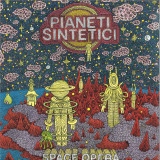
Pianeti Sintetici presents AI-37, entitled ‘Space Opera’. Conceived by Italian artist Davide Perrone, the Pianeti Sintetici (“Synthetic Planets”) project hypothesises the creation of future synthetic worlds as told through sound. Although split across two parts, the album is a singular organism that narrates a journey of boundless cosmic exploration. A sonic tapestry woven of intergalactic atmospheres, Space Opera’s imaginative sound design contributes to a richly spatial and haptic experience.
Taking place in the dimly lit crevices of deepest space, a swirling pool of chemical abstractions and extraterrestrial transmissions spumes out from the darkness. Elements weave through broad washes of drones and scintillating textures, contrasting a sparse backdrop with dense and multilayered passages. Composed with the use of modular synthesisers and intense audio manipulations, ‘Space Opera’ comes to life as an entity that transports the listener on an immersive journey into the mysteries of alien worlds.
Obscure Formats is a sonic strike of moving body electronics. This modern metal machine music is directed, goaded and prodded into reaction by Robert Galbraith, Component Recordings founder and one half (with of the monster modular outfit that is Snowbeasts. Under the Obscure Formats moniker, he forges a tight, earthbound sound from synths, modular racks and drum machines to pound a path through your ears right into your mind. Tracks like pound and pulse with unrelenting beats, percussion and arpeggiating pulses. Within each Obscure Formats track is a harsh soundscape of angles, jagged edges and eerie drones. Obscure Formats - Agitations consists of 4 tracks of alluring body music with special remixes by AXKAN & Years of Denial.
Written + Produced by: Robert Galbraith Except Haunted & Blood Moon - Robert Galbraith & Elizabeth Virosa
Castle Face present Dan Rincon’s (OSEES, Wild Thing, Apache, Personal and the Pizzas) premier solo release Spotlight City.
Artificial landscapes and melodies comprised of Moog Grandmother, Mellotron and a kinky Modular system span from beautiful and lilting to haunting and etherial. The album was a years long learning experience of getting all components and ingredients to link arms and blend comfortably. Wrangling was part of the process. Strings soaring and sines weaving. Sometimes in the atmosphere, sometimes in the Earth’s core, sometimes flanked by neon blur as it hums & weave patterns through a world imagined in vintage sci-fi pulp.
“I was listening to a lot of solo Roedelius and Conrad Schnitzler records while writing this record and I’d say that both have been hugely inspirational on what I want to do as a solo recording artist. The way both of those of those artist pushed the early, chaotic electronic music into something more melodic is really inspiring to me, it’s not that dissimilar than trying to get melodies out of a modular synthesizer.”
An absolute necessary slab for anyone a fan of CF, OSEES, Popol Vuh soundtracks , 8 bit video game accompaniment & 80s Tangerine Dream. Burn one and burn out.
Almost a year on since his Blueprint Records debut, the London-based Brazilian, Vinicius Honorio delivers the follow-up to "Sem Rumo".
With a storied history in DJing and producing, starting in Rio de Janeiro as a D&B selector before settling into London's techno sphere, the Brazilian producer pens dark and dubby textures. Delivering releases on his own label, Liberta Records as well as the likes of Modularz, Mord, Token and of course, Blueprint he has displayed his penchant for trippy and foreboding techno whilst encapsulating the energy and passion that have come to be synonymous with his style. A style that also permeates his DJ sets which he's taken around the globe.
"Ominous Music" features four hard-hitting Techno tracks characteristic of his style.
The next release on Nastia's imprint NECHTO introduces Stanislav Tolkachev's latest offering, 'NECH024.' A pioneer of the Ukrainian techno scene, Tolkachev's journey into techno began in the early 2000s in Dnipro, Ukraine. Renowned for his atonal modular sound, he continues to showcase his mastery of synths in this upcoming release with dozens of timeless tunes under his belt.
Having a longstanding connection with Nastia and the NECHTO label, Tolkachev's collaboration with the label has been in the making for years. Nastia's unwavering support during difficult times has fostered a genuine friendship between them, paving the way for a much anticipated release.
The tracks, recorded approximately five years ago in his studio in Kyiv, are live recordings made using analog modular synthesizers and FM groovebox, adding a touch of hooliganism and romance to the mix.
Having patiently awaited the perfect moment, Tolkachev now unveils the five tracks, characterised by his signature minimalistic, synth-led and atmospheric sound.
- A1: Samba 00 04:58
- A2: Panorama 00 04:39
- A3: Golfo Mistico 00 04:34
- A4: Open Sky With Tears Of Blue 00 04:56
- A5: Contemporary Lullaby 00 03:05
- A6: Requiem 00 02:55
- B1: Whispers 00 04:19
- B2: Modular Clouds In Rome 00 03:21
- B3: Piano Bells 00 03:30
- B4: Space Call From Mars 00 03:01
- B5: Tuning The Orchestra With Tears Of Blue 00 03:22
With Lucifer, Kompakt presents an album of rare beauty from two masters of modern music. A family affair, it’s a collaboration between the Italian father-and-son duo of Luciano Michelini and Lorenzo Dada, whose combined histories bring to Lucifer a depth of experience alongside clarity of vision and a finely tuned, neatly developed combined compositional voice. A lovely, beguiling suite of music that combines the electronic and the acoustic, the urban and the pastoral, its gorgeous night-eye vision and tender melancholy sits neatly within the Kompakt universe, while offering the curious listener some rich new perspectives.
There is already plenty to know both artists by. Lorenzo Dada creates across multiple fields – a techno producer and DJ who has already worked with the likes of Jay Haze, Fete, Leo Benassi, and Der, he’s released a small clutch of stylish, smartly designed EPs, and a solo album, Second Life (2018). His complementary background in classical music and composition informs his ensemble project, Tears Of Blue (who appear on Lucifer), where Dada paints with neo-classical tones for a quartet of violin, viola, cello and grand piano, supplemented by electronics for live performance.
Luciano Michelini’s history is yet richer. He may be best known, to many, for his piece “Frolic”, the theme to Larry David’s Curb Your Enthusiasm series; it was also sampled by Snoop Dogg for 2022’s “Crip Ya Enthusiasm”. But there’s much more to Michelini’s story. A successful soundtrack composer, Michelini both studied and taught at the Conservatoro di Santa Cecilia, and worked for RCA from the sixties to the eighties; his soundtracks from this period are gorgeous examples of the form, particularly his work for Il Decamerone Nero (1972), L’Isola Degli Uomini Pesce (1979), and the devastatingly gorgeous Dimensione Donna (1977).
In the eighties, Michelini and his wife Anna Gutling founded the Electronic Music Division studio and academy in Rome, which is where the majority of Lucifer was recorded. Dada reflects on the experience: “We never worked together before, so it was all new for both of us,” with Michelini adding, “I truly love this experience with my son. He’s a talented pianist and composer. I am not very familiar with electronic music nowadays, but we did it fluently.” There’s certainly a familial energy at play through Lucifer, and you can hear how Dada and Michelini, through exploration and experiment, find a shared language, balancing Dada’s tendency toward minimalism, and Michelini’s composerly voice.
Lucifer flows as a suite that interweaves electronic music with acoustic instruments: the lonely sigh of saxophone; Michelini’s lush, verdant piano; the weeping strings of Tears Of Blue (recorded at the studio of Michelini’s friend, the late Maestro, Ennio Morricone). These multiple voices are located within the electronic sighs and swarms from Dada’s kit; there are moments of propulsion, and passages of lambent drift, where the album revels in its tonal sweetness. If it flows so effortlessly, that’s because Lucifer was designed that way, as a suite or a sonata of sorts.
And the title? Dada reflects, “Lucifer was an angel who decided not to be one anymore. The miracle of life is that we can decide what we want to be, even if we are born as angels or vice versa.” This feels somehow apposite: there’s certainly something of the transformative, and the transportive, in Lucifer, a unique family collaboration of rare poetry and sensitivity, where two generations meet in the modern crucible that is the electronic music studio.
030/313 – Berlin/Detroit, the fundamental techno union. Now Carhartt WIP, whose roots can be traced to Detroit, Michigan, join forces with Tresor for a collaboration that celebrates the enduring spirit of two music metropolises. Referencing the early 90s compilations like “Tresor II – A Techno Alliance”, they present a 12” mini compilation with exclusive material from both cities.
The compilation opens with “I.D.L.E.”, a lost Model 500 track, of essential funk that touches the techno soul of The Motorcity, with trippy melodies and cosmic drilling traversing electrified Mojo freeways. It’s followed by another true Detroiter: Ectomorph’s “Searching (Live At Globus)”, a first extract from their live set at Globus in 2021, which BMG and Erika played on borrowed equipment after Erika’s case was lost on a flight. The A-Side stays in Detroit and finishes with “Your Body”, an exclusive track by AMX, also known as The AM, one of Detroit’s freshest funk techno sensations. She carries on the mentorship mindset by having learned from two of the greatest: D.I.E. and Scan 7. “Your Body” is a classic techno feel swinger, where subtle chords meet drum machine funk in the spirit of early Detroit techno.
DJ Stingray 313 opens the B-Side with a bang. Precisely hacked techno, full of dark funk and that special industrial jack, that the man in the mask has made his own. A total “Dynamic Instability”. Magic & furious. The thrill continues with “Metal Goat”, by JakoJako, one of Berlin’s brightest synth sensations. She provides an introspective grower that slowly evolves into a fast-paced techno grinder, laden with micro shifts and magic twists. The final tune comes from Erik Jabari, a newcomer from the 030 zone, emerging from the Hard Wax peers with haunting modular synth techno–a feverish minimalistic trip of motorized kicks. DJ Pete performed as spiritual guidance on this one. It’s floor proven. An overall cachet of “030313” - the small compilation with a huge techno heart.
With his new instrumental album Ventas Rumba, the French composer (and singer) returns to his signature instrument, the piano, blending it with warm synth tones. This album represents a "return to his roots ", allowing Ezéchiel Pailhès to reinvent himself in a seamless way while still exploring ballads and ritornellos, halfway between light-heartedness and melancholy. Ezéchiel Pailhès has been meaning to write a solo piano album for as long as he can remember. Hardly surprising, of course, for this academically-trained pianist, brought up on classical music and then studied jazz. Yet, since his 2001 debut with the electro-pop duo Nôze, and his subsequent four albums, the artist had constantly postponed this project that was so close to his heart. Then in 2022, just as he was getting ready to start producing an album of new songs, this long-standing aim finally materialized.
The melodies he wrote seemed to stand on their own naturally, spurring him on to compose this series of fourteen tracks, recorded in sessions split between France and Latvia.
A new piano: the Una Corda
Ezéchiel wanted this project dedicated to the piano to begin a new narrative, to explore new instrumental terrain and new tones, something far removed from the familiar piano he has been playing all his life. He opted for the Una Corda piano, designed by David Klavins, a groundbreaking instrument builder renowned for his distinctive pianos with vertical shapes and frames.
The Una Corda, created in 2014, is an upright piano with a single string per note (unlike three strings on traditional pianos). Enticed by the "crystalline and unique" tones of this instrument, which is hard to find in France, Ezéchiel travelled to Kuldiga, Latvia (where David Klavins set up his workshops and studios), to record the first part of the album. Although the title of the album may initially conjure up images of a distant, sensual dance, the reality is quite different. Ventas Rumba indeed refers to the waterfall and rapids (in Latvian: rumba) of the river Ventas, which runs near this small village in the western part of the country. Ezéchiel chose to blur the lines, as the sound and musicality of the title likely evoke both his short stay in the Baltic country, and also a form of distant exotic imagery perfectly in tune with his own mischievous wit. Tracks as short stories
Back in France, Ezéchiel enhanced the first tracks recorded in Kuldiga with subtle synth tone layers, and added other tracks composed and recorded at his Montreuil studio. The album reflects a deliberate and sensitive orchestration of piano, synth keyboards and digital effects, as he puts it: "playing to erase the differences between the tones of the various instruments", as if each instrument's texture echoed the others. According to Ezéchiel, you can listen to Ventas Rumba as you would leaf through "a collection of short stories", through compositions that rarely exceed three minutes and evoke figures of movement, lightness, curves or modulation, such as "La ligne", "La valse des singes" or "Fly Finger". Others more seriously relate to a kind of spirituality, which quietly infuses such different tracks as "Ferveur", "Éclair" and "Louanges". Ezéchiel adds: “I’m by no means religious, but I like what God has managed to get musicians to achieve (laughs)". "Louanges", for instance, despite its electronic edge, "refers to Olivier Messiaen, a very devout composer who I greatly admire". Other tracks are directly inspired by the classical music he listens to on a daily basis. For example, Chopin's “8th Nocturne” formed the backdrop of “Pianovado”. Likewise, the harmonic structure of Beethoven's “Waldstein Sonata No. 21” inspired “Opus 53”. Aside from these multiple references and inspirations, which quickly recede behind a style that is uniquely his, Ezéchiel Pailhès keeps exploring ideas already found on his first solo albums, this time in an instrumental format, undoubtedly purer, fostering an imaginary world that evokes the shapes and themes of ballads, ritornellos, light-heartedness, passing time, reverie or a universal subdued melancholy.
'Scrambled Anthems', das dritte Album von HHNOI, vereint rohe Energie mit technischem Geschick und schafft das, was als "elektronischer Grunge" bezeichnet wird. Es bietet synthetisierte Hymnen für diejenigen, die Drama in der elektronischen Musik suchen, indem es Pop, Lärm, Glitch-Hop und Grunge der 90er Jahre verschmilzt. Inspiriert von Pan Sonic, The KLF und mehr, formt HHNOI eine einzigartige klangliche Identität. Begleitet von Kunstwerken von Salva Baixlaigua ist es auf Vinyl und digital erhältlich und markiert ein entscheidendes Kapitel in HHNOIs musikalischem Werdegang.
Snakes of Russia ist das von Joseph Holiday - Ektronischer Musik mit zeitlosem Appeal. Seine Reise begann mit der EP 'At Home Alone With Lions', was zu Remixen, Filmkollaborationen und Auftritten für Ableton und Spitfire Audio führte. Nun steht sein Debüt-LP 'True Surrender' im Mittelpunkt, eine Zusammenarbeit mit dem Metal-Produzenten Kurt Ballou. Aufgenommen im God City Studio in Salem, MA, erforscht es einen schwereren, texturierten Sound, der Synthesizer mit Gitarrenverstärkern und Drum-Maschinen verbindet. Während der kreative Prozess im God City begann, spielte Josephs Heimstudio in LA eine entscheidende Rolle bei der Verfeinerung und Fertigstellung der Produktionsphasen. Der letzte Schliff kam von Justin Weis bei Trakworx Mastering in San Francisco, um die makellose Erhaltung jeder klanglichen Kontur und emotionalen Essenz zu gewährleisten.
"IHR SPIEL HAT FÜR MICH ETWAS, WAS FLORIAN SCHNEIDER UND RALF HÜTTER GEMACHT HABEN, ALS SIE NOCH EXPERIMENTELLE MUSIK RODUZIERTEN." - WOLFGANG FLÜR (EX-KRAFTWERK)
Die Band Chogori aus Düsseldorf verschmilzt auf ihrem Album "Minor Green" analoge Synthesizer und Kontrabass zu einem fesselnden Klang. Aufgenommen in den legändären Hansa Studios /Berlin, strahlt die Live-Session des Trios eine zenartige Leichtigkeit aus. Mit dem Bruch des 12-Ton-Systems erhebt sich ihre Musik in himmlische Sphären, angeführt vom visionären Ralf Stritt. Gregor Kerkmanns Bass sorgt für Bodenhaftung. Jeder Track präsentiert Chogoris Synergie und symbolisiert das Gleichgewicht zwischen Mollakkorden und Natur. In einem digitalen Zeitalter feiert "Minor Green" den analogen Reiz und lädt die Zuhörer zu einer immersiven Reise ein. Begleiten Sie Chogori auf eine kosmische Erfahrung, eingehüllt in klangliche Wunder.
Following 2020’s 'Point Vacancies', the debut EP from Jamie Paton and Mike Bourne’s collaborative act Metal, the duo return with a trio of dubwise remixes from Mr Paton himself as well as a peak-time stormer from fellow Bristolian artist, Hodge. The latter immediately sets the record ablaze with a driving-tempo kick thump, a duo of grain-textured 16th note hi-hats and chalky clap. He layers an anthemic three-chord pad progression with layered octaves, peppering in arpeggiated bleeps and articulate lead melodies, then tops it off with a few modular elements that retain the character of the original, before climaxing in true rave fashion. Proper. The following three mixes by Metal’s own Jamie Paton make clear his sonic obsession, the type of infinite tweaking that sees some artists/producers to the edge of madness, or at the very least satisfies some dragon-chasing addiction. There’s a successive deconstruction from 'Remix' to 'Dubwise' to 'Dubwise II', most notably in the reduction of rhythm and drum machinery, but also in the general tonality. The melody remains central but is gradually obscured, taking on a less and less recognizable form, and by the end we’re left with a skeleton of the track, quips and cranks, an assembly line of aluminum sheeting punctuated by an array of demented nuts and bolts. As with the previous EP, the sparsity of elements illustrates just how far one can twist an aesthetic, proving that self-imposed limitations can often propel an artist’s process and land them somewhere unfamiliar, somewhere foreign, somewhere enchanted.
The title of the Lau Nau's 10th album, Aphrilis, derives from the Latin word aperire, meaning "to open." A fitting verb for the month of the year it is closely associated with — April. And while the images of plants and blossoms coming back to colorful life after a long, cold winter feels appropriate when listening to the rich and lustrous bloom of music on Aphrilis, another definition of open feels even more apt. For under the abundance lies the memory of times of austerity, the friction of hard choices, the acceptance that nothing is fixed and the future is unknown. This literal and metaphorical exploration of complexity and contradiction makes Aphrilis a multi-dimensional antidote for our troubled times, one that emphasizes the quiet and communal over noise and spectacle. Laura Naukkarinen, the Finnish artist behind this project, has long kept her mind and spirit open to whatever sounds and creative ideas felt appropriate for the moment. For the past six years that has meant primarily working with modular synthesis — learning how to build modules and releasing acclaimed work centered on its sounds like 5x4 (2023) or Puutarhassa (2022). Running parallel to this work, however, has been a continued exploration of acoustic instruments and group performances with her trio Lau Nau ja Seitsemäs Taivas. Aphrilis arrives then like fresh growth in a creative season cycle. A companion to her brilliant 2017 release Poseidon, the album, says Naukkarinen, "felt like a needed moment to embrace songs with lyrics again." And through the creation of this work, she remained open not only to her own creative muse, but also the input of her chosen collaborators. Each player on Aphrilis — Matti Bye on celesta and synths, Pekko Käppi on jouhikko, Hermanni Yli-Tepsa on violin and contrabass, Topias Tiheäsalo on electric guitar, Samuli Kosminen (Múm) on various instruments — was given free reign to arrange their own parts to accompany Naukkarinen's compositions. Kosminen’s lush fingerprint can also be heard in the mixing and production of the album, as with Poseidon six years ago. The moniker of this project may be taken from Naukkarinen’s own name, but Lau Nau feels more like a band than ever before. The delicacy and softness of the music is reflected in Naukkarinen’s lyrics. Each song is rife with imagery and creatures from the natural world. The spiders in the forest. The animals that keep a young woman company in her refuge in the woods. Wet grass. The feeling of the music is almost tactile, as if listening to the album will leave a bit of dew or sap on your fingers. The theme of this material, says Naukkarinen, runs even deeper. “The songs tell about cracks and changes of direction in different histories: personal, societal, planetary,” she says. “About moments when a yes can become a no and vice versa. The album wants to propose that at the moment of a crisis there is a possibility to influence the histories by our choices.” That may feel like a lot for such a fragile sounding collection of songs to bear. But Aphrilis is an album of surprising strength and resilience
- 1: Risk Of Rain (2023 Remaster)
- 1: 2Dew Point (2023 Remaster)
- 1: 3Tropic Of Capricorn (2023 Remaster)
- 1: 4Monsoon (2023 Remaster)
- 1: 5Cyclogenesis (2023 Remaster)
- 1: 625.3°N 9.7°E (2023 Remaster)
- 1: 7Hailstorm (2023 Remaster)
- 1: 8Moisture Deficit (2023 Remaster)
- 1: 9Intermission (2023 Remaster)
- 2: 1Tropic Of Cancer (03 Remaster)
- 2: Aurora Borealis (03 Remaster)
- 2: 3Surface Tension (03 Remaster)
- 2: 4Arctic Oscillation (03 Remaster)
- 2: 5Precipitation (03 Remaster)
- 2: 6Double Fucking Rainbow (03 Remaster)
- 2: 7Coalescence (03 Remaster)
- 2: 8Chanson D'automne.. (03 Remaster)
- 3: 1Intermission Returns
- 3: 2Risk Of Rain Returns
- 3: Surface Tension Returns
- 4: 1Double Fucking Rainbow Returns
- 4: 2Coalescence Returns
Double 180g coloured marbled vinyl (Disc 1: translucent sun yellow with red; Disc 2: purple with violet & white) housed in a gatefold cover. Double EP 7" on randomly coloured eco vinyl with four new tracks written for "Risk Of Rain Returns". Carefully designed, beautifully remastered and loaded with new ways to play - "Risk of Rain" is back and better than ever! Dive into the iconic roguelike full of unique loot combinations, enhanced with new Survivors, overhauled multiplayer, fan favourite content from Risk of Rain 2 and more! Ten years to the day, after "Risk of Rain" was released into the world to become a true classic, the game is revived on November 8, 2023 as "Risk of Rain Returns" to reconnect with its fans and be discovered by those who didn't realise what they were missing. Time to give the iconic game soundtrack an update as well, isn't it? Creator Chris Christodoulou gives an insight on his work as well as the extensive and luxurious new vinyl release that come with some remarkable extras: "Can you believe it's been ten years already? It seems like yesterday that I was sitting in my small bedroom/studio in front of an aching computer writing the music for 'Risk of Rain'. And here we are, ten years later, returning to it to, adding to its musical compendium. What an unexcepted, magnificent journey! With this very special release we're celebrating both, the 10-year anniversary of 'Risk of Rain' and the release of 'Risk of Rain Returns'! This modular album contains the entire Risk of Rain soundtrack remastered and the four new tracks written for 'Risk of Rain Returns' (with contributions from special guest musicians Damjan Mravunac & Maria Papageorgiou).
Dream team trio Better Corners – Valentina Magaletti, Sarah Register and Matthew Simms – have completed a staggering new album Continuous Miracles: Vol. 2 for state51 Conspiracy, and where their debut LP joyfully opened the door to a brand new room, this one strides purposefully inside.
Renowned drummer/percussionist Magaletti (Holy Tongue, Vanishing Twin, Moin), avant rock musician and in demand mastering engineer Register (Kim Gordon, Talk Normal) and multi-instrumentalist and modular obsessed Simms (Wire, MEMORIALS) inject an all-too-rare sense of childlike wonder and joy into their own inimitable collage of experimental rock, wonky dream pop, analog ambient, tape experimentation, avant percussion, modular electronics and noise music.
It is this sense of fun that led to one of the band’s “uncovers”: ‘Modulating De Niro’ began with a solo piano version of Bananarama’s ‘Robert De Niro’s Waiting’ which was then sent on a very long journey through modular synth patches and FX chains until it became the unrecognisable to the original and the majestic beast it is now. The album centres round the colossal 16- minute-long ‘Career Test’, a dynamic trip through glitch-enhanced noise, machine dub and the ambience of amplified rock music, to a transcendent, mind-expanding modern raga.
Like an industrial Gamelan played by a future civilisation who have never heard it, only read about it in ancient books, the song is formed from bowed treated guitars, hypnotic hand drums, water bowl and bells. It also has a suitably macabre genesis, as Register reveals: “I was visiting my aunt's house and slept in her bedroom. In the headboard of her bed are places for curiosities and heirlooms. In these spaces she had box after box of the ashes of pets of hers that I had known over the years…”
Speed Dealer Moms, the combustible live electronics duo comprising John Frusciante (Red Hot Chili Peppers) and Aaron Funk (Venetian Snares) is over a decade into their idiosyncratic run. On "Birth Control Pill," the duo's third release, the parameters of the chaotic and elegant project come into focus.
If there are virtuosos patching modular synthesizers and slicing up breakbeats, then they were in the room when these two tracks were recorded. The epic title cut is perhaps the most "functional" track the duo has ever recorded. This is ruffneck dnb business, but it's also the Speed Dealer Moms, so there is the requisite descent into chaos. The track's precise melodies are unceremoniously dunked into Funk's signature, ripping breakcore, the drums picking up speed until the crash test dummies hit the wall—a thrilling, extratone breakdown.
More madness lurks on the B-side, "Benakis," which seemingly nods to the visionary Greek composer. With its unconventional time signature and intricate melodies, this song cycles through breakcore and hard techno before eventually giving the listener a reprieve with a dreamy, beatless outro.
Speed Dealer Moms drive their own, crooked road built on friendship and a telepathic musical connection—the collaboration and encouragement of Funk ushered Frusciante into the dense world of hardcore machine funk. The results of these sessions don't sound quite like anything else, they are electronic records made in fearless pursuit of the new. Funk and Frusciante follow ideas to an illogical endpoint, and this hurtling approach has now resulted in the best and most concise Speed Dealer Moms record yet.
TIPP!
Moisk aka Pletnev & Fourmi Rouz delve into the depths of psychedelia soundscapes with their latest release “Tetris Life’’ on Terra Magica Rec. The duo skillfully balances modular sounds and shimmers through acid synthesizers with a wide range of psychedelic soundscapes from uptempo half-beat to raw, energetic techno trance, inviting you into a mesmerizing sci-fi universe.
The EP features tracks like “Tetris Life” and “A Glass of Coke with Ice”, that explore underground ambient deserts and immersive jungle improvisations. This is followed by dark and slow breakbeat cuts that transition into faster-paced, floating atmospheric IDM tunes. The 12’’ contains many choppy old-school loops and uptempo trance breakdowns, as in “Orange Button’’ and “Wrong Stability”. Featuring two weird dub/IDM/breaks remixes by Anatolian Weapons and HSDJs X Listensport to round off the wax. Don’t sleep on it!
As a professional sound engineer by day, Colin Dunkerley aka Lapsed Pacifist, spends much of his time traveling and rarely gets to focus on producing his own music. Despite high praise from those who have become familiar with his work over the years, Colin’s previous productions have mainly consisted of shares with friends and DJs in smaller circles through his ‘Negative Neutron’ alias.
Colin envisaged a more pronounced and darker ambient style to emerge one day, but struggled to dedicate the time. ‘Hypatia’ came to life over an extended and fragmented period, with field recordings and loops of audio created on the go, later processed through his modular setup. In the autumn of 2022, Colin spent time collating and listening to these many fragments and field recordings, making notes in a book as he wandered around cold, unfamiliar places with headphones on, trying to shape disparate starting points into something thematically connected.
The title of Lapsed Pacifist’s debut album, ‘Hypatia’ is a reference to one of the many fantastical descriptions of imaginary places by Marco Polo in the book, Invisible Cities. Written as a dialogue between Mongol emperor Kublai Khan and Marco Polo, the book became the inspiration and a clear parallel for how Hypatia came to be and what it means to Colin today.
Attaching music to a place and time can become a very powerful and long-lasting memory. Across its eight tracks, Hypatia depicts fragmented glimpses of color and textures –a scrapbook of senses– traversing the optimistic first steps; the first smell of cold air; cityscapes burnt into your head; and the many emotions from exploring new places that stick with you longer than any photograph ever could.
“The experience of moving between places so frequently can be fascinating but also dislocating and often quite lonely. I have so many small stories about places I’ve been, but I often think they aren’t necessarily real reflections of anywhere, no more real than anything Invisible Cities author Calvino dreamt up”. - Lapsed Pacifist.
Hypatia is available on Transparent Copper smoke 12” + digital, mastered by Rafael Anton Irisarri and featuring artwork by Noah M / Keep Adding.
Khôra is the medium Matthew Ramolo uses to delve deeply into initiatory world-building by way of sound, image, and lyrical prose. Figuring wholly realized art-myths which distill and rouse the numinous while provoking the visceral and cathartic, Khôra intricately collages studio documents of ritualized instrumental performances, introducing overdubs by transient, heteronymic personae which dismantle stable points of reference in the music and open uncommon planes of consciousness.
"Gestures of Perception" is Khôra’s first double album with a supporting artbook and features a fascinating array of sources subjected to patterned assembly, poetic layering, and the elevations of the heart. Deft handling of modular synthesis is palpably central, while feedback, erhu, keys, flute, contact electronics, guitar, field sounds, and various percussion objects (rattle and frame drums, seed pod sticks, random metal objects, meditation bowls, kalimbas, bells) all serve to provide breathing structures and energetic contours that guide and scaffold inner and outer journeys into the far-near. Prominent across the record's span is a home-built, solenoid drum machine, responsible for the alive and askew techno-archaic flows and conceived as the album’s "rhythm seed”. The music on Gestures is teeming with organic and alien textures, soaring drones, inter-dimensional noises, and emotionally resonant melodies; balanced on the fringes of exotica and meditative trance, with capacities that untether the listener from the ballast of limited reality.
Operating hermetically in the penumbra of Toronto's cultural scene for well over a decade, Khôra has been invested in self-publishing handcrafted editions of spiritually driven recordings which led to the LP/CD reissue of inaugural album "Silent Your Body Is Endless" by Constellation. Khôra has toured extensively in North America and Europe both solo and in collaboration with Picastro, Nick Kuepfer (Hrsta,1/4 Tonne), and Brandon Valdivia (Mas Aya, Lido Pimienta), generated over a hundred hours of unreleased, bewildering drone through durational performance with experimental outfit Nidus (Marc Couroux, Jason Doell), composed for live dance and independent film, been commissioned by MaerzMusik, and seeded and co-run the now defunct music and art venue Ratio in Toronto.
FYEAR is a Montréal-based ensemble led by composer Jason Sharp and poet/writer Kaie Kellough that fuses spoken word into genre-bending compositions for electronics, two voices, two drummers, and processed saxophone, pedal steel guitar, and violins. FYEAR incorporates drone, out-jazz, post-classical, ambient metal, avant-rock, and modular synthesis in a sonic and stylistic palette the opposite of collage or pastiche: the FYEAR ensemble integrates a unique and unified sound/aesthetic while traversing adventurous and variegated terrain. Kellough’s poetic materiality conveys acute political-existential themes, alternating between declarative, meditative, and cut-up/semiotic manifestations. This self-titled debut album is a supremely innovative 40-minute multi-movement work; an ardent mission statement that mines the interzone where Saul Williams, Moor Mother/Irreversible Entanglements, Shabazz Palaces, Zulu, Angel Bat Dawid, Damon Locks/Black Monument Ensemble, Shabaka Hutchings, and Matana Roberts are all iconoclastic neighbours. FYEAR melds improvisation and composition, traditional notation and graphic scoring, electronic and acoustic instrumentation, lucid recitation and abstract vocalization, balancing intensive structure with an expansive sense of exploration. Through several years of collaboration, development, workshops, commissions and performances conducted by Sharp and Kellough, their wordsound practice has culminated in this nine-piece group which also features poet/writer/activist Tawhida Tanya Evanson (present director of the Banff Centre Spoken Word program) violinists Josh Zubot and Jesse Zubot (Tanya Tagaq, Darius Jones, Joshua Hyslop), pedal steel player Joe Grass (Tim Hecker, Patrick Watson), drummers Stefan Schneider (Bell Orchestre) and Tommy Crane (The Mingus Big Band, Aaron Parks), with live visual typographics from Kevin Yuen-Kit Lo, who also designs the album art. Propelled by the vocal interactions of Kellough and Evanson, FYEAR interrogates our present and future post-capitalist polycrisis, invoking collective anxieties, emotions, and critiques. FYEAR re-poetizes our constructed, manipulated social/conceptual realities, re-inscribing questions about the future by setting them to a wildly dynamic and evocative temporal soundtrack: Who does it belong to? How will it be shared? How do we project a collective future into the contested challenges of climate change, global migration, wealth gaps, safety/precarity, identity/affinity, segmentation / segregation, all our seemingly irreconcilable histories and forward visions for the world we dream to inhabit
Black Truffle is thrilled to announce a major archival release from legendary American composer and live electronics innovator Richard Teitelbaum, centred around his soundtrack for Suzan Pitt’s cult 1978 animation Asparagus. Best known to some listeners for introducing Europe to the Moog synthesizer as a founding member of Musica Elettronica Viva in Rome, Teitelbaum’s extensive and radically experimental body of work includes collaborative recordings with master improvisers like Anthony Braxton, Andrew Cyrille and George Lewis, intercultural experiments combining electronics with non-Western instruments such as the shakuhachi, works for computer controlled piano, and large-scale multi-media operas. Recorded at York University, Toronto in 1975–1976, ‘Asparagus (European Version)’ sprawls across both sides of the first LP. Discovered by composer Matt Sargent in Teitelbaum’s tape archive, this is a previously unheard major work for Moog modular and Polymoog synthesizers, unique in Teitelbaum’s oeuvre for its lushness and gently melodic quality. The music unfolds slowly, submerging lyrical melodies and burbling arpeggios into uneasy, glacially shifting harmonic swells, the luscious texture thickened with subtle changes of modulation and phase, calling up the shifting layers of Costin Miereanu’s classic Derives or the kosmische Musik tradition more than any academic synthesizer exercise. Teitelbaum incorporated much of this material into his soundtrack for Suzan Pitt’s Asparagus, which receives its first official release here. Asparagus, famously paired with David Lynch’s Eraserhead for a two-year run of midnight screenings at New York’s Waverly Theatre, uses hand-drawn and stop animation to unfurl an oneiric succession of images, beginning with a sequence in which the female protagonist defecates two stalks of asparagus, which multiply and float out of the toilet bowl to form the letters of the title. Teitelbaum’s soundtrack interweaves delicate drifting tones from the ‘European Version’ with contributions from Steve Lacy and Steve Potts on saxophones, George Lewis on trombone and Takehisa Kosugi on violin. Edited closely to the film, even without images the soundtrack proposes a surreal journey through floating synth tones, squealing horns, propulsive arpeggios, distant chatter, and an old-timey waltz. The final side of the set presents a new realisation of Teitelbaum’s text score ‘Threshold Music’, performed at a memorial concert at Roulette, New York in 2022 by Leila Bourreuil (cello), Alvin Curran (sampler and objects), Daniel Fishkin (daxophone), Miguel Frasconi (glass objects) and Matt Sargent (lap steel). The piece asks musicians to match their instrumental volume to that of the sounds of the environment in which they play, sometimes with the addition of recorded environmental sounds, reinforcing frequencies they encounter in listening deeply to their surroundings. Here the players use a field recording taken at Teitelbaum’s home in Bearsville, New York, their long tones and shimmering, glassy textures delicately emerging from the white noise of the location recording. Released with the full approval of both Richard Teitelbaum and Suzan Pitt’s estates, Asparagus is illustrated with striking images from Pitt’s film and accompanied by detailed liner notes by Francis Plagne. These previously unheard pieces shed new light on the work of a key composer in the American experimental tradition, offering up some of Teitelbaum’s most beautiful and engaging music.
Canadian performer and composer Sarah Belle Reid’s 2021 acclaimed album, first time on vinyl, expanded with two new incredible songs, remastered featuring new artwork. From distant ocean song to the clang and howl of a murky forgotten memory, MASS is a dreamlike collage of shrill shrieks, gasps, corroded brass choirs, and melting modular synth soundscapes, all heard through a mist of hiss and noise. Fused with equal parts spastic improvisation, shrouded ritual, and meticulous arrangement, it presents a sonic topography at once tongue-in-cheek, sensitive, and nightmarish. With discordant chorales and angular trumpet improvisations churning in an ever-evolving wash of whispers and howls, MASS is a collection of three hazy, harsh, and frightful sound worlds. With tracks meandering between aggressive rhythms, eerie ambiances, and abrasive cut-up electronic textures, MASS draws inspiration from early tape music, horror film soundtracks, and grindcore. It was assembled between listening to extended doses of Else Marie Pade, Daphne Oram, Eliane Radigue, the Locust, Edgard Varèse, Maryanne Amacher, Dick Raaijmakers, Naked City, Mr. Bungle, and Thomas Ankersmit, bringing a little bit of all of them along with it. MASS was recorded and mixed over the course of three weeks in January–February 2021 while in the midst of a cross-country move. Recorded entirely in short-term housing away from her studio (and most of her instruments), Reid relied exclusively on her voice, trumpet, flugelhorn, household objects, and Make Noise's Strega semi-modular synthesizer for all sound materials. Original sound materials were recorded loosely and independently with little to no overdubbing, instead relying on meticulous editing and processing in the manner of classic tape music.
Miles away from the current UK jazz scene, a mysterious composer from the Nottingham area cooks raw and noisy library music with groovy jazz fusion and beat-heavy funk breaks tackling themes of satanism and witchcraft.
Having previously released music with Jazzman Records, Stones Throw subsidiary Now-Again and French label BMM Records, The Natural Yogurt Band presents the 7th album of his discography that marks an experimental turn.
Spores takes us on an obscure sci-fi journey into extra-terrestrial territories where tropical flutes, pianos, guitars and organs melt under corrosive electronic sounds, modular bird chirps and vintage drum machines sounds. This unsettling and immersive library album will be released on March 1st with a limited pressing of 300 green marbled records.