Swingrowers are known for their mixture of JAZZ, SWING, POP and ELECTRO, they have extensively toured Europe and North America, opening sell-out shows for Parov Stelar, Chinese Man & Caravan Palace. On top of delivering official remixes for Caro Emerald and Swing Republic, Swingrowers also boast musical collaborations with The Lost Fingers, Gypsy Hill, DJ Pony Montana and have had their own songs remixed by Bart&Baker and Jamie Berry.
Following on from their debut album 'Pronounced Swing Grow'ers' in 2012, Swingrowers have released their second album 'REMOTE' in early 2015, followed now by 'OUTSIDEIN', the band's third full-length studio album. This new release shows their expert musicianship and most meticulous production to date, mixing genres from jazz to electronica, from gypsy-swing to full-on rock'n'roll with a melodic pop sensibility.
Cerca:mood music
Fromtheoldtothenew was originally released in 1996 and is the second full length on Peacefrog from Steve
'Stasis' Pickton.
Growing up as a teenager in East London, break-dancing and writing graffiti with B12's Mike Golding, Steve
Pickton's musical education moved along a familiar path, from hip-hop to Electro and onto Techno. Schooling
himself in music theory and purchasing a sampler Pickton set about making his own music.
Releasing on a whose who of seminal UK electronic labels including A.R.T., Likemind, Otherworld and B12 under
various pseudinums Pickton's UK take on lush Detroit melodies fused techno, funk, hip-hop, dub, blues and jazz
into a dense concoction all of his own making.
Fromtheoldtothenew saw Pickton slip off his earlier techno shackles and head for uncharted electrconic waters.
The echo chamber dramatics of Gun and wayward lurch of Ale House Blues were a long way from Detroit, while
few tracks have demonstrated the sheer breadth of electronica more dramatically than Utopia Planetia. All in all it's
more jazz, less tech without losing the soul
Re-issue of forgotten minimal techno abstraction from Hamilton, Ontario. The unsung genius of Secret Werewolf is fully on display on this 1996 gem.
Rubbery and polymetric, akin in mood to Robert Hood/Metroplex productions of the same era, but full of eerie metallic timbres and flexing grooves which combine into a lysergic hypnosis unlike anything else from then or now.
A taste of the forthcoming Geej re-issue project surveying the Steel City Records catalogue, a wellspring of unsung, singular dance music that arose from the abandoned industrial spaces and uncompromising producers of the fertile but secluded techno zone of Hamilton, Ontario Canada circa 1995-1997.
First time pressed in over 20 years, vinyl only.
Tint is the first new solo recording from Joe Talia in over a decade. Australian-born but now based in Tokyo, Talia is known to many listeners as a drummer (frequently collaborating both live and in the studio with artists such as Oren Ambarchi and Jim O'Rourke) and as a recording and mixing engineer responsible for dozens of releases across the fields of contemporary experimental music, wayward pop, and jazz. Alongside James Rushford, he is also responsible for one of the most legendary releases in the Kye records catalogue, the creaking electronic morass of Manhunter (2013).
Lovingly crafted over many months in his tiny Tokyo studio, Tint is an album-length electroacoustic suite that brings together Talia's expertise as percussionist, studio engineer, and performer on analogue electronic instruments (primarily modular synth and Revox tape machine). Ranging from minimalist austerity to kosmische lushness, Tint refreshingly refuses the dark and moody sonic palette of much contemporary electroacoustic music in favour of an airy, at times almost weightless sound-world of gliding tones, skittering percussion, and burbling field recordings. Drawing inspiration from Jean-Claude Eloy's epic concrète love letter to Tokyo, Gaku-No-Michi, Talia makes extensive use of his own recordings of his new home, but removes any sense of audio verite, abstracting them into transparent glosses of outdoor ambience or unidentifiable chimes and creaks. Flowing seamlessly between distinct episodes, Tint is compositionally controlled while retaining a sense of played spontaneity, eventually building to a maelstrom of analogue synth zaps and tape manipulated percussion that reflects Talia's deep engagement with the relentless yet constantly shifting dynamics of free jazz.
The new release features 6 tracks and follows Julien's critically acclaimed debut album, Fallen. Released in 2016, the autobiographical LP was a bold new direction for Julien, and the first release under his birth name. Over the years, the Apron Records boss' bold, experimental electronics, jagged club cuts and outside-the-box collaborations have seen him carve out a lane all of his own making. His debut LP was divided into two musically contrasting sides, and told the tale of a fallen angel though jazz-fusion, chiming soundscapes and dark acid-tinged techno.
Since his album release, Julien has continued his creative streak by playing across the globe, from Tokyo, Seoul and Shanghai to Montreal and Melbourne, and further developing his label, which released a string of underground 12's in 2017 from the likes of Max Graef, Hanna, Molinaro and more.
On 'Bloodline', Steven continues the soundtrack style mood of 'Fallen' - channeling ominous analog techno, drifting synth-house masterpieces, warm soul and hints of new age. Both the title and artwork is a nod to the influence of Julien's family on his rich musical world and distinct nonconformist style, explaining how: 'the influence my family has given me growing up and my ancestors from Africa to native Indians from the Caribbean, has all played a big part in the music I create.'
Recorded in Apron Studios based in East London, each track on 'Bloodline' also features a tr808 or a piece of a 808, as a dedication to the iconic Japanese engineer Ikutaro Kakehashi, who passed away April 2017. The much-loved Roland founder and TR-808 creator revolutionised electronic music in the 1980s and 90s.
Fresh on Francis Harris' Kingdoms imprint comes Adamo Golán's seven track LP, 'Exile And The New'. Golán is the alter ego of British-German artist Laurens A. Schmidt, who has been pursuing a more club-focused techno project, while developing an ever deeper fascination with experimental music, ambient and film scores. Drawing influence from his adopted homes Berlin and currently London, the 26-year-old has been uncompromisingly trying to develop his own musical voice.
'Exile And The New' expresses this ongoing pursuit and, being the first full-length and first ever release by Adamo Golán, marks the start of his most personal project to-date. Stretching over seven tracks, it touches upon a diverse set of sceneries, moods, and emotions whilst a distinctive sound design gives the work a subtle framework and guiding thread.
'Fis' starts the proceedings, introducing drones and field recordings and enveloping the listener in Golán's distinct sound world. 'Just Friends' merges distant snapshots of disembodied vocals with granular sound design and a sense of both space and creeping claustrophobia simultaneously. It's an approach the young producer has mastered - 'Replica' maintains an ambience of the deeply personal and a wider, hazy focus, realised via exquisite melodic fragments against a backdrop of pads and chiming electronics. Title track 'Exile And The New' unfolds around another cinematic world scored via a single stringed instrument, static interference and oceans of space. 'Lie to Me' brings a piano refrain to the fore, wrapped in luscious ambience and more fragments of a conversation heard through the rain. 'Then Rely On Me' slowly develops out of a haunting atmosphere and finds an uneasy but strangely beautiful flow, before 'The Hungry Years' closes out the album as it started - floating in space.
The 26-year-old artist sees the album as a journey that should captivate but never impose itself on the listener. It´s a gracious and neighborly invitation to dive in, get lost and explore its facets and peculiarities
In the Eighties there was an incredibly interesting underground scene emerging in the Belgian Leuven area. Bands like 'The Neon Judgement', 'Sovjet War' and countless others all came from that area and era. One of the most underestimated bands in that scene was 'Company Of State', a duo with a unique sound that played dark moody guitar-electro with a minimal DIY touch. Influenced by a wide array of artists (such as Joy Division, Velvet Underground & Edith Piaf) the duo Rudolf Hecke & Paul Taes formed the band 'Company Of State' and recorded their self-titled debut (a four track 7'EP) on their self-founded label in 1983. Best described as: wild guitars with all kinds of feedback & distortion combined with a heavy bumping rhythm-box in the background... and once the vocals kick in you get that melancholic magic that makes this EP a true classic. With this kind of pedigree, it was only logical that the band landed in the stable of Ludo Camberlin and his label 'Anything But Records', where Belgian dark & danceable underground groups such as 'The Neon Judgement' & 'Aroma Di Amore' resided in those days. Later the band would move to Maurice Engelen's label 'Antler', in company of similar acts such as '2 Belgen', 'Nacht Und Nebel', 'Siglo XX' and many others.
Bergen is the next, and natural step in the expanding career of Dutch producer Tom Trago. The acclaimed producer behind Voyage Direct will release his fourth LP, with the label and crew he's built a close relationship with over the past ten years - Dekmantel. With a new studio and approach to music, Bergen is Trago sounding at his very finest, returning to his roots with a focussed, and dedicated production ethos.
.
'If you change your environment, your music will also change with you,' Trago reflects on the new album. A staple in the Amsterdam club scene, Tom Trago has been a familiar face at the Dekmantel events for over ten years. 'I was even playing Dekmantel parties, before they were even called Dekmantel,' he states. Tom Trago's collaboration with Dekmantel has allowed him the space to grow and finish his most accomplished, and honest album to date. Bergen is an LP that connects his legacy, family, and commitment to dance music in one resplendent package.
Having relocated from Amsterdam, Tom Trago set up his new studio in the coastal town of Bergen, located in the northern Netherlands. Recorded in his family house, with the sea at one side, and the countryside to the other, the resultant record is a craftful piece of art, full of space, and the classic machine-driven, house music aesthetic that has come to represent Trago's sound. Bergen was made with the aim of re-creating a global-music sound, along with the music that has influenced him throughout his life, with a new approach influenced by Trago's immediate natural environment. 'I would take long walks in-between tracks,' explains Tom about the music making process, "and the creative ideas would happen in the forest."
The spacey-passively-paced LP intro 'Bergen' was the first to be picked up by Dekmantel's Casper Tielrooij, who upon hearing the track stated - 'now we are talking album business'. Yet it was the electro- orientated 'Zeeweg' that became the template for the rest of the record. 'The LP was built around this track,' Trago states. The b-boy electro vibe, with its melodramatic synth melody was influenced by the road that leads to his scenic retreat - with slow, steady curves, and a gentle, upward trajectory, Zeeweg and its album namesake, twist and turn in fluid synchronicity. 'The Creation of Lalibela' plays on this world music vibe, with ethereal and fun key patterns, influenced by the work of Mulatu Astatke. 'Always be with you' is one of the LP's standout tracks, epitomising the new album's country settings, and featuring his girlfriend on vocals; it swings at a steady, up-beat pace, rich with harmony, colour and melody. Elsewhere on the album, Trago sticks to his dance floor roots, 'Faith Belongs to Us' is moulded in a Chicago-to- Amsterdam house style, while album closer 'Working Machines' plays with resonance and atmospherics, creating a moody, pulsing yet stylish rhythm.
Having been raised in a musically-driven, and open-spirited household in which the producer grew up learning the piano, it didn't take long for Tom Trago to be indoctrinated into the new school of Amsterdam producers. Studying at a private jazz school while still a teenager, Trago would eventually come to cross paths with the hip-hop loving Dutch duo Rednose Distrikt, who left a permanent imprint on his approach to music. 'They showed me a world of music making using the MPC,' Trago says. 15 years later, the Dutch producer still sticks to this template. Looking to recreate this production approach that influenced him from the very beginning, Trago stripped down his studio to a simple setup with just a few, key 'weapons of choice'. Removing the computer from the setup, the MPC 2000 XL once again became the heart of the music making process. Bergen's analogue tools lend to its organic sound, one honed and crafted by its natural surroundings, and matured approach by one of the Netherland's most accomplished producers.
"The kind of melancholia I'm talking about, by contrast, consists not in giving up on desire, but in refusing to yield. It consists, that is to say, in a refusal to adjust to what current conditions call 'reality' - even if the cost of that refusal is that you feel like an outcast in your own time." (Mark Fisher, Ghosts Of My Life, Zero Books 2014, p. 24) In Ghosts of My Life: Writings on Depression, Hauntology and Lost Futures', the author Mark Fisher outlines - to put it in a big way - a resistant melancholy. This stands in contrast to leftist melancholy resignation', as well as something which Fisher does not talk about: its common masculine counterpart, habitual post-left cynicism - as in seen it all before'. Fisher calls this hauntological melancholy. Haunting, spooks, ghosts and apparitions are an almost constant presence on I Started Wearing Black', the second album by the Cologne-based artist Sonae (pronounced so-nah'). The term hauntology shares a fate with retro-futurism when it comes to inflationary overuse and abuse. It's a conceptual container that looks good and can hold a lot, indeed, too much. Furthermore, hauntology has its peak season behind it, a term on the threshold of its expiration date. Nevertheless, I would like to rehabilitate hauntology and use it properly to characterize I Started Wearing Black', because the term is rarely as compelling to describe music as is the case here. The most recent other example could be Asiatisch' by Fatma Al Qadiri, but with a completely different frame of reference. What are the ghosts of this music It rustles, crackles, ruffles, crunches, rattles, scrapes, sometimes a beat emerges from the constant noise, sometimes an obscure voice mumbles incomprehensibly, sometimes a melancholy piano figure is prevented by this noise from coming too much to the foreground. It definitely is eerie - to bring into play another term used by Fisher in the title of his latest book, The Weird and the Eerie'. In British pop-jargon, eerie first occurred to me more often when referring to particularly leftfield, spooky and... well... ghostly dub, a bass-heavy, echoing noise, from Augustus Pablo to Creation Rebel to Burial. Unlike the Wald & Wagner records by Wolfgang Voigt, Sonae is not a kind of neo-romantic veiling with a tendency for escapist nebula. It is more a noise of latency. The noise signals a latent - not necessarily acute - threat, a latent uneasiness about... yes... about what About a System Immanent Value Defect' That's the name of a track on I Started Wearing Black' where something that sounds like a French Horn (or a foghorn) battles for attention through or against the background noise. An email from Sonae: The piece 'System Immanent Value Defect' should actually be called 'I See Turkey'. I wrote it for my fellow student Elif - she is a pianist and Gezi Park activist from Istanbul. Through her I witnessed the inner conflict and agitation that political circumstances can create: her feelings of guilt when there was an attack, with her safe in Germany as a student, watching the events from afar. It was horrible. When her mother begged her not to come home because she feared for her safety, I felt a cold shiver run down my spine. I started with the piece from this mood, beginning with the piano, then the noise (modulated sinusoidal curves), which reminded me of waves and the then heatedly discussed Mediterranean sea: atmospheric, melancholy motifs. In contrast is the anger, the pressure, represented in corresponding sounds - hopefully audible! - During this time I started to think about world views as they can be found around the globe, in how far they held by societies and their political representation. I realized that I know of no political system that is actually about the people and what would do them good. It's always about positions, power, money. I thought that was a lot more frightening on a global scale than merely viewing Turkey in isolation. That's why the piece is called "System Immanent Value Defect", because our world suffers from precisely that. Everywhere, it's all about the wrong things.' Between the wrong things there are happy moments. In the title track, after 184 seconds of rattling and hissing, a beat is unleashed, like an arrow released from a spanned bow, a beatific relief, if there is such a thing. White Trash Rouge Noir' first meanders along spookily, then after 144 seconds it transforms itself into a distant cousin of Einstu¨rzende Neubauten's Yu¨ Gung', but there is no Big Male Ego to be fed here, and the black in the album title is a completely different type of black from that of the Neubauten. Furthermore, I Started Wearing Black' was finished long before the black dresses were worn at the Golden Globes as a sign of protest against sexual violence. Sonae writes that she herself started wearing black some time ago. Her reasons are so-called personal ones: ... resulting from an individual situation (lovesickness), I started to wear black (gaining weight and feeling ugly).' The political dimension of gaining weight, feeling ugly and therefore dressing in black in I Started Wearing Black' lurks within the noise and never becomes explicit and only rarely manifest - or a manifesto. Sonae writes about the track We Are Here': A piece for minorities... in this case, considering the current pop-feminist discourse, explicitly for women. Female artists have long been saying loud and clear that 'we are here' and 'electronic music is not a boys club!' But this pop-feminist moment should only be seen as one part of the dedication of the piece. It is for minorities, for the oppressed, who didn't belong enough.'
Klaus Walter
The next release on moreaboutmusic comes from one of Chicago house's best kept secrets, often name checked by legends such as Mike Dunn, Marshall Jefferson, Glenn Underground and Tyree Cooper to name a few.A DJ and Producer, Hugo grew up during Chicago's heyday, at one point living with Mike Dunn and Tyree Cooper, where they would spend their days producing and recording tracks on the 808, 303 and 909, along with any other equipment they could get their hands on.
The 'On to another time EP' showcases Hugo's talents, giving you two straight to the jugular acid tracks with 'In, Out & In (Part 1)' and 'In, Out & In (Part 2)' with the flip seeing the mood shifting slightly with the deeper vibe of 'On to another time', the EP finishes up with a cut up disco joint 'The beat goes' creating a solid ep and an excellent introduction to Hugo H.
Haiku's Raw Waxes label is delighted to welcome the famously unconventional Stanislav Tolkachev with a new track EP of experimental techno and IDM sounds. Entitled Champions' Breakfast and with brilliant artwork from German Benedikt Rugar, the releases features six cuts, one of which is a previously digital-only track landing here on vinyl for the very first time.
Haiku has long been a fan of Ukrainian Tolkachev having previously collaborated on a remix for the label, while Tolkachev has also released on Haiku's other label Inkblots. This new EP is one that not only shows off the label's willingness to take risks and put out diverse and interesting electronic music, but also one that proves Tolkachev is a truly unique artist with his own musical voice. He has been that way for more than a decade now, and has put out three long players as well as countless EPs that get heavy support from the tastemakers of the day. This latest offering contains his take on the essentialness of groove, enriched by his use of atonality, dissonance and acid-not-acid textures, all in a minimal style.
The deep 'Shady' kicks things off with spangled synth lines and eerie pads off in the distance. It's a lonely and insular piece with kinked rhythms that keep you locked. The excellent 'The Main Thing Is To Survive' is then less constrained, with kicks that rock back and forth as off kilter synth lines warp and wrap around each other in mind melting and tripped out fashion. Switching up the mood with ease, 'Fuck This Guy' is a dark and musty passage of humid ambient techno with static electricity buzzing about over smeared pads that are filled with menace, then the curious 'Hair In My Mouth' is about blurting, busted frequencies, loose and scattered drums and glassy melodies. It's a mangled and mashed up track that sounds like little else. 'Negative Space' is horror soundtrack techno with urgent, driving drums and nervy sound design that keeps you on edge, and closer 'Self Destruction' is built on broken, bristling beats. A rhythm slowly emerges from the haze and it is one that is physical and restless and sure to make a big impact in the club.
This is a varied and vital EP that oozes essential electronic invention.
2x12"
Tinfoil is the project of DeFeKT and Sunil Sharpe. Initially forged as a studio collaboration in 2014 (and later as a live show), the pair have since racked up an impressive catalogue of 12s on their own self-titled label. Tinfoil's sound is unique in today's scene, reflecting the versatility of both artists, plus a combined know-how of techno and electro. Their music comes primarily from live studio jams, enforced by a desire to get quickly to the point in what they do. This is no surprise given the fast, technical way in which they each perform solo.
For their debut album, Tinfoil provide a varied but cohesive collection of tracks. Following the intro's epic synth blasts, they open with a bang through 'Caravan Life' - a sinister, bassline-driven destroyer that builds and builds over a blend of claps, filter zaps and crying feedback. 'Beads' continues in a heads-down vein, this time with a more musical EBM type bass and knocking rimshots that mark the first appearance of Sunil's role-playing, haunting lead vocals.
'Friendly Safe Fumes' marries playful bass notes to a singing lead line, as fizzling closed hats and busy claps whip things into a frenzy. Next enter the otherworldly mutant electro of 'Meadow Pulse', signaling a well-timed lull in mood to explore a silkier side to Tinfoil's production. 'Every Saturday Night' starts with a taxi conversation about horses and carbolic soap in bygone Dublin days, before launching into a volley of clattering beats and hip-shaking FM sequences.
'Multi-DOMINATION' retains some of the FM wonk and treads a broken-beated path, featuring vocals this time akin to a ritualistic chant or perhaps the murmurings of a possessed baby. 'Both Roads To Triogue' meanwhile, brings us to a short intersection, splicing odd voices with a dense tribal rhythm. 'The Wolves Of Hellfire' is Tinfoil in more minimal dancefloor mode, as drones filter in and out under a resonating bass that detonates at all the right times.
Closing with 'Resting Point', the climax becomes deadly. The beats are stepped and the bass boisterous, while pained screams become quickly uncontrolled, setting up for a crescendo of roughneck rhythms, ricocheting kicks and turbulent modular wails.
Tinfoil have been on a roll since the beginning but maybe 'On A Roll' emphasizes this a little bit more now.
Molten Moods releases another finely curated various artists record with tracks by Skee Mask, Kessel Vale, Jonas Yamer and Konrad Wehrmeister. Kessel Vales opening track Voguing Geisha' is an unconventional breakbeat masterpiece following his sense of harmony and rhythm already shown through previous releases on Tanstaafl Records and Rhythm Nation. As the track unfolds it reveals musical storytelling by integrating a technoid polyrhythmic loop structure into melodic synth figures, slowly deconstructing in the end. Skee Mask collaborated with Molten Moods labelhead and Carl Gari member Jonas Yamer on Fanta Ocean', it being the first release ever outside of his Ilian Tape homebase. The outcome is a moody IDM piece with cinematic qualities, complex but soothing. The B-Side begins with Xenomorph' by Konrad Wehrmeister, who is known by his releases on Public Possession and SVS Records. This trancy yet distorted and detailed electro banger surely takes on the role of the records dancefloor highlight. The closing track Insgeheim' is delivered by Molten Moods head honcho Jonas Yamer. Here groovy kicks, distorted chords and a psychedelic pad are woven into one compelling 10 am techno track. The common thread of Molten Moods 4 is four young Munich artists going on a joint trip into idiosyncratic electronic music. The resulting tracks intertwine as one modern and diverse techno record. Out on 12 vinyl and wav by the end of March 2018. In the tradition of Molten Moods' cost-conscious design strategies by Paul Bernhard, the record comes with a xeroxed low budget sticker set.
Mastered by Manmade.
Originally from the United Kingdom, funky soul-jazz veterans The New Mastersounds have been touring USA, Europe and Japan for over a decade and return here with their twelfth studio album, recorded in New Orleans and Denver and featuring a slew of musical guests.
"Renewable Energy" expands on the NMS template while still providing plenty of the band's trademark sounds. Guitarist Eddie Roberts, drummer Simon Allen, bassist Pete Shand and keyboardist Joe Tatton are joined on this 11-track effort by a number of guests: Sam Bell, one of the founding members of NMS precursor The Mastersounds who also guested on two previous NMS albums, plays percussion on most of the tracks. Mike Olmos and Joe Cohen of the West Coast Horns once again provide added horn action as they did on "Made For Pleasure" from 2015, while Adryon de León from LA band Orgone contributes vocals on "Gonna Be Just Me". Uptempo numbers "Tantalus" and "Yokacoka" see the band flexing their playing chops over a tightly-wound rhythm, while "Green Was Beautiful" and "Groovin On The Groomers" are toe-tapping slabs of soul jazz. The band's cover of James Gang's "Funk 49" takes the album in a fuzzed-out psych-rock direction with Eddie singing the lead, while the moody Hancock-esque inflections of "Stash" and the sweet mellow vibes of "Swimming With My Fishies" add the final brushstrokes of colour to the canvas.
Cover with laser-cutting and printed inner sleeve, ltd. to 500 copies, incl. mp3A Score for Darling is both the sound track for the Danish film "Darling" (2017) as well as a collection of outakes from it. Raúl Pastor Medall (Rauelsson) and Erik K Skodvin (Svarte Greiner & 1/2 of Deaf Center) were paired together to work on the accompanying music after the director, Birgitte Stærmose wanted to try a new direction. Both together and individually they have created a highly affecting collection of pieces to a film that is not afraid of pushing the emotional content to the max, centered around the story of a dancer on the rollercoster ride of her life. This is also the first time either of them have made a full lenght sound track, making it their debut on the big screen.The music and instrumentation heard on the album is brimming with dynamics and diversity, featuring violin by Christoph Berg, cello by Anne Müller as well as a mass of other sounds like church organs, synths, guitar amp violation, electro-acoustics, piano and more, all layered together into 15 beautiful and devastating fragments of mood. The final piece of the album "Breathe" - featuring Otto A Totland on piano and Katinka Fogh Vindelev (We like We) on voice - can be seen as their own lamenting end title to a longer period of work with this album, finally finished.
In a scenario of overwhelming number of instruments, musicians often do not take the time to deepen and explore the creative possibilities of each gear they possess. One Instrument aims at counter-acting this tendency by challenging and limiting each artist in producing a composition by using only one instrument of their choice.
The LP opens with a composition by In Bloom, the new project of Martino Bertola, who drives us directly into a melodic ambience. To follow it is the dense, polyrhythmic experiment by Fabian Kempe's project 'Korridor'. Serena Butler's piece is built around spacey sounds and breezy rhythms.
Yhdessa, the newly born Dutch-Italian duo formed by Grand River (Aimee Portioli) and Enrica Falqui, leans towards ambient atmospherics and ominous sonorities with a refined Northern European touch. Yair Elazar Glotman ventures us across his contrabass player skills giving an acoustic touch to the record.
Swedish producer, Fjader (Ida Matsdotter), handles the flip with a moody techno cut filled with evasive analog acutes.
Claudio PRC delivers an electroacoustic soundscape created with a tiny, graceful drone machine.
The Dutch duo, Wanderwelle, closes the LP with a dreamy and delicate excursion evoking the mysterious sides of nature.
The early 2000s were a time of upheaval for hip-hop. The underground and mainstream divide that had dened so much of the previous decade was showing the rst signs of irrelevance. Timbaland and The Neptunes made radio rappers sound futuristic while independent artists struggled in a quagmire of backpacks and misguided claims to keep it real. Away from this, in a misunderstood middle ground between hip-hop and electronic music, a new generation of artists were busy imagining a new sound for hip-hop.
One such artist was Scott Prefuse 73' Herren, whose perpendicular MPC chops on his 2001 debut for Warp Records set curious minds racing with possibilities. That same year Tadd Mullinix released his debut as Dabrye on Ghostly International, a sonic wildstyle that appealed to both hip-hop heads and IDM nerds. Sometime that same year Herren and Mullinix met after sharing a bill in Detroit. CD-Rs were exchanged and a year later Eastern Development, Herren's newly launched label, released Dabrye's Instrmntl, a short album with a big impact. On its fteenth anniversary Ghostly International is reissuing Instrmtl on vinyl and making it available digitally for the rst time.
Instrmntl is a continuation of the beat experiments Dabrye began with One/Three and a bridge to the diverse textures that would dene Two/Three four years later. About half of its nine tracks (ten if you lived in Japan) were created at the same time as One/Three while the rest were newer or made specically for the album. Once again Mullinix looked outside of hip-hop to techno, house, and drum & bass for stylistic and technical ideas while embracing the blissful minimalism of a good hip-hop instrumental and the rhythmic nuance of Detroit.
Despite the similarities between Dabrye's debut and this follow up, Mullinix didn't simply replicate what had made One/Three so arresting. He pushed and pulled further between the two cornerstones of his approach to reveal more potentials. Instrmntl takes you deeper into electronic depths — the rugged synth stutter of 'Won', the tumbling, wobbling bass in 'No Child Of God', the electro get down of 'Prospects (Marshall Law)' — while also treading more organic grounds by letting samples breathe and moods unfurl at a gentler pace ('Take Me Home', 'Evelyn', and 'You Know The Formula Right'). And then there are the moments where this push and pull nds balance and the result becomes more, as it does on the mournful march of 'D-Town Tabernacle Choir' and the twinkling daydream of 'This Is Where I Came In'.
At just over 30 minutes, Instrmntl offers a snapshot of a time when potentials seemed innite, when lines could be drawn between jazz, ragga jungle, techno, and hip-hop and the resulting shape divined an exciting future.
- Reissue of the out of print 2002 album, available for the rst time on Ghostly.
- Includes previously Japanese-only bonus track, Gimme Lowlands'
- Standard weight blue vinyl is housed in a matte jacket.
- Dabrye's beats are like Jay Dee getting crunked up with Autechre.' — Prefuse 73
DsorDNE (pronounced Disordine) is a project from Torino, Italy that evolved as group out of the electronic experimental post punk project Novostj in 1987. At the core of DsorDNE is Marco Milanesio, musical engineer and co-founder of the HAX record label, joined by a revolving cast of musicians. Their spectrum ranged from experimental to structured electro-poetry and Soundtrack like instrumental electronic music. In 1987 they released their first track on a split-single with The Legendary Pink Dots. Between 1987 and 1994 they released 6 full length albums, 3 split-EPs and appeared on various cassette compilations. à Un Sole (Itâs a Sun) was the groupâs only vinyl full length originally released in 1990 on HAX. Itâs 8 tracks of electro-beat poetry and experimentation recorded between July 1989 and January 1990 by Marco Milanesio (music) and Roberta Ongaro (vocals) with guests Claudio Burdese (guitar), Danilo Beltrame (guitar) and Cristiana Bauducco (vocals). The album is broken up into two distinct halves. Side A contains four chunks of hard hitting, percussive patterns and rushing bass sequences. Dark, moody female vocals force their monologues through the machinery in their native Italian tongue. The traditional song structure is carefully avoided by giving lyrics equal opportunities be they recited, half-sung, whispered or spoken. Side B displays moodier moments, less savage attacks and subtler sensuality, veering towards the more melodic and existential. All songs have been remastered by George Horn at Fantasy Studios in Berkeley. The record is housed in an exact replica of the original jacket featuring a black and white drawing with silver metallic spot color housed in a clear PVC plastic cover with a three color screen-printed design. Each copy includes a 11x11â double-sided lyrics sheet with English translations as well an 8x11â sheet with original press notes from 1990 by Marco Pustianaz.
"Real name Takeshi Fukushima, Takecha has been a key figure within Japan's electronic music scene for decades and belongs to the same pioneering crew as Soichi Terada and Shinichiro Yokota. Now in his mid- fifties, 'Deep Soundscapes' is an album encompassing Fukushima's sound with every track written by the producer between 1990 and 2013. Intricate percussion and crystalline chords set the tone in 'Deep Drive' before a funky bassline joins serene synths in 'Midnight Things'. Appearing in Soichi Terada's mix for Resident Advisor (under its promo title 'Deep Loop C'), 'Gradual Atmosphere' is comprised of a galloping beat and saccharine chimes, 'Factory 141' sees Takecha demonstrate a murkier aesthetic, whilst 'Rhodes Detox' is a definitive example of Takecha's flair for expertly balancing elements within his productions. An homage to Shufflepuck Cafe´, an old Mac Plus video game Takecha would play on a black and white 9- inch monitor back in the day, 'Shufflepuck' blends ghostly melodies with clicks, whirrs and pops. 'Calm Imagination' is a poignant affair from start to finish with its hypnotising atmosphere, contrasting to the more up-tempo 'Warm Rondo' with its soulful keys and purring low-end. Tying it all together, 'Genuine Innocence' is a cut that Takecha made two versions of; one with a solo from a pianist and another with more emphasis on the beat, the latter of which appears on this album."
- A1: The Stand Feat Wildchild
- A2: Air Feat Doom
- A3: Machines (Part 1)
- A4: Encoded Flow Feat Kadence
- B1: That's What's Up Feat Vast Aire
- B2: Tell Dem
- B3: Nite Eats Day Feat Beans
- B4: Jorgy Feat Waajeed
- B5: Special Feat Gulty Simpson & Paradime
- C1: Bloop
- C2: Viewer Discretion Feat Invincible & Finale
- C3: Piano
- C4: Pressure Feat Ta'raach & Waajeed
- C5: Reconsider Feat Kadence
- D1: Get It Together Feat Invincible & Finale
- D2: My Life Feat Ag
- D3: In Water
- D4: Get Live Feat Big Tone
- D5: Machines (Part 2)
- D6: Game Over Feat Jay Dee & Phat Kata
Tadd Mullinix first made a name for himself as Dabrye in the early 2000s with a pair of instrumental albums combining the rhythmic finesse of Detroit hip-hop with the ingenuity of electronic music. But instrumental beats were only a temporary goal, a way for Mullinix to catch the ears of MCs. On Two/Three, his second Dabrye album for Ghostly International, Mullinix brought together a formidable crew of local and national talent to make the statement he'd always intended. Released in 2006, Two/Three o-ered a fevered vision of rap's future that remains just as intoxicating a decade on. Ahead of the long-await-ed conclusion of Dabrye's hip-hop trilogy in 2018, Ghostly is reissuing Two/Three.
Dabrye's move towards rap began in 2004 with the album's first single, 'Game Over' featuring Jay Dee and Phat Kat. An early inspiration of Dabrye's, Jay Dee invited Mullinix to his crib in 2002 for a listening session during which he picked the 'Game Over' beat to rap on. Crucially everyone involved was in accord that despite perceptions of their respective work this would be a hardcore rap song. Together with Kat, Jay delivered a one-two lyrical punch on 'Game Over' that no one saw coming. Detroit made the world go round and everyone's head spun. 'Game Over' set the tone for the album and, over the next few years, became a Detroit anthem — shortly after Jay's passing in 2006 the audience at Movement Festival sung his verse.
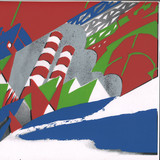
Moody, propulsive, and above all ambitious, Two/Three emerges from a sonic stew of Detroit and UK dance music, Jamaican sound clashes, and hip-hop sampledelia. The guests, a who's who of the mid-'00s underground rap scene, engage in a raucous rhyming session that pays as much attention to the realities of the streets as it does world events. MF Doom, Wildchild, Vast Aire, Beans, and AG represent for the various coasts while local talents — Waajeed, Ta-Raach, Invincible, Finale, Kadence, Guilty Simpson, Big Tone, Phat Kat, and Jay Dee — bring Two/Three alive with an infectious energy. In between bursts of raw rap and hard beats, Dabrye showcases detailed instrumentals that evoke bleak industrial futures, underwater meditations, and smoky late night sessions. With Two/Three Dabrye placed himself at the forefront of hip-hop's new wave, throwing a Molotov cocktail into the rap world as uncompromising as the head-twisting cover art from WK Interact. The independent press praised Mullinix's audacity. Over the following years the impact of Two/Threewas felt in slow increments as Dabrye's music became central to the sonic makeup of a new generation of producers. As this beat scene grew and moved away from rap, it showed Mullinix the influence of his work and the value of his vision for Dabrye as his own brand of Detroit hip-hop.