From playing chaotic house parties in their home city of Oxford to becoming major festival headliners across Europe, Foals' trajectory has been remarkable. They've earned critical acclaim (NME and Q Award wins, plus Mercury Prize, Ivor Novello and BRIT Award nominations) and fan devotion (1.7 million sales of their four Gold-certified albums) in equal measure. And while the majority of contemporaries have fallen by the wayside, Foals continue to hit new peaks.
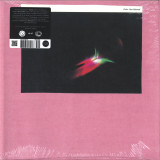
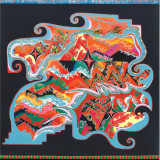
After more than a decade in the game, Foals again embrace that love for the unconventional with the bravest and most ambitious project of their career: not one, but two astonishing new albums: 'Everything Not Saved Will Be Lost'. A pair of releases, separate but related, they share a title, themes and artwork. 'Part 1' will be released on March 8th, with 'Part 2' following later in the year.
'They're two halves of the same locket,' frontman Yannis Philippakis explains. 'They can be listened to and appreciated individually, but fundamentally, they are companion pieces.
Fundamentally tethered but possessing their own personalities, the two bodies capture the most compelling, ambitious and cohesive creations they've ever produced. Eager to break the traditional pop song structure which they felt they were becoming increasingly tapered to, the 20 tracks defy expectation. There are exploratory, progressive-tinged tracks alongside atmospheric segues which make the music an experience rather than a mere collection of songs. Yet the band's renowned ability to wield relentless grooves with striking power and skyscraper hooks also reaches new heights.
The album's lead single 'Exits' is a case in point, featuring Philippakis conjuring the image of a disorienting world via a contagious vocal melody. It's a fresh anthem for Foals' formidable arsenal, but also an ominous forecast.
'There's a definite idea about the world being no longer habitable in the way that it was,' says Yannis. 'A kind of perilousness lack of predictability and a feeling of being overwhelmed by the magnitudes of the problems we face. What's the response And what's the purpose of any response that one individual can have'
'Exits' signposts what to expect thematically from both instalments of 'Everything Not Saved Will Be Lost'. The title is a warning that anything - from the tiniest fleeting moment of inspiration through to the planet's own biological diversity - can be under threat of being irrevocably erased.
It's a theme that permeates throughout the album's material, as Foal mirror the public neuroses that have been provoked by our current cultural climate. Paranoia of state surveillance Fear of environmental collapse Anxiety over Trump's next potentially cataclysmic move It's all there in these apocalyptic songs.
'Lyrically, there are resonances with what's going on in the world at the moment,' summarises Yannis. 'I just feel like, what's the utility of being a musician these days, if you can't engage with at least some of this stuff These songs are white flags, or they're SOSs, or they're cries for help... each in a different way.'
The new albums' journeys began as the 'What Went Down' era ended. Founding bassist Walter Gervers departed on amicable terms after playing the Festival Paredes de Coura in Portugal in August 2017. Foals felt that he couldn't be replaced - a decision that ushered in a period of recalibration, reorganisation and, ultimately, rejuvenation.
After taking a little time out, Foals - completed by Jimmy Smith (guitar), Jack Bevan (drums) and Edwin Congreave (keys) reconvened - with Yannis on production duties, who, together with Edwin, also covered the bass parts. They began by writing in a rehearsal space before exporting those sketches into the recording phase at 123 Studios, Peckham, with the assistance of engineer Brett Shaw. They'd repeat the cycle between the two spaces, effectively creating an ongoing feedback loop as they sought to push every new idea to the finish line.
1 x 12" black vinyl 180gsm
- label 4/c
- discobag on reverse board with matt varnish
- gatefold on reverse board with matt varnish
- shrinkwrap
Suche:moon s flag
- A1: Robert Pico - Le Chien Fidèle
- A2: Annie Girardot - La Femme Faux Cils
- A3: Spauv Georges - Je Suis L'état
- A4: Zoé - Zoé
- A5: Jacques Da Sylva - Fou
- A6: Valentin - Je Suis Un Vagabond
- A7: Jacques Malia - Histoire De Gitan
- A8: Bernard Jamet - Raison Legale
- B1: Jean-Pierre Lebort - Barbara Au Chapeau Rose
- B2: Les Concentrés - Fils De Dégénérés
- B3: Les Missiles - Publicité
- B4: Hegessipe - Le Credi D'hegessipe
- B5: Marechalement Votre - Ethero Disco
- B6: Mamlouk - Decollez Les
- B7: Mozaique - L'amour Nu
- B8: Jean-Marc Garrigues - Je Dis Non
- B9: Penuel - Astronef 328
The journey through French-speaking pop archives continues with this fifth volume, packed with fuzz, gimmicks, and dissent. Far from the charts, the selected tracks display a great creative freedom, often backed by corrosive humor. Welcome to the surprising, kaleidoscopic, and colorful world of the late sixties and early seventies, Wizzz!
Born in Montauban, Robert Pico stumbled into music by chance when he met René Vaneste, then artistic director at Pathé-Marconi. René brought him to Paris to record his first 45 RPM EP in 1964. A year later, Pierre Perret introduced him to Vogue, where he recorded his second album with Claude Nougaro’s orchestra. Sylvie Vartan then introduced him to RCA, where he recorded four singles, including the astonishing "Chien Fidèle," a track backed by a hair-rising fuzz guitar. Alongside his solo career, he also composed for other artists like Alain Delon (the song was recorded but remains unreleased), Magali Noël, Bourvil, and Georges Guétary. In the Paris of the sixties, he mingled with Mireille Darc, Elsa Martinelli, Marie Laforêt, France Gall, Françoise Hardy, Petula Clark, Régine, Dani, Serge Gainsbourg, Joe Dassin, Franck Fernandel, Charles Level, and Roland Vincent. Despite his efforts and winning a Grand Prix Sacem for his final record, Robert Pico didn’t achieve the expected success in show business and decided to leave Paris and return to the Southwest, where he devoted himself to writing. He is the author of 23 books (including Delon et Compagnie, Jean-Marc Savary Editions 2025, a memoir about his youth and his many encounters). Today, he is relieved to never have become a celebrity and devotes himself to his work with passion.
In 1969, the Franco-Italian movie Erotissimo was released, directed by Gérard Pirès (who later directed Taxi in 1998, written and produced by Luc Besson). This pop comedy features Annie Girardot, Jean Yanne, Francis Blanche, Serge Gainsbourg, Nicole Croisille, Jacques Martin, and Patrick Topaloff. The soundtrack was written by Michel Polnareff and William Sheller, with lyrics by Jean-Lou Dabadie. "La Femme Faux-cils," performed by Annie Girardot. It recounts the feelings of a rich CEO's wife who seeks to develop her sex appeal under the influence of advertisement and magazines. Groovy, sparkling and light, this track, with ITS lush arrangements humorously critiques consumer society and feminine beauty standards.
“Je suis l’Etat” (1967) is the flagship track of the first EP by singer-songwriter Spauv Georges, aka Georges Larriaga, better known as Jim Larriaga (1941-2022). Born into a family of bakers, the young man was initially planning to become a hairdresser when he discovered English-speaking music through Elvis Presley and the Beatles. After this revelation, he decided he would become a songwriter and gave himself five years to succeed. He recorded his first two EP’s independently for RCA under the pseudonym Spauv Georges; meaning “that poor George”, a nickname given to him by the mother of her friend Jean-Pierre Prévotat (future drummer of the Players, Triangle, or Johnny Hallyday). Portraying a depressed and eccentric young man, Spauv Georges created corrosive and amusing songs that didn’t reach a wide audience, despite a TV appearance with Jean-Christophe Averty.
Supported by his loyal friend and fellow songwriter Jean-Max Rivière, Georges Larriaga met the future singer Carlos in the early '70s, then Sylvie Vartan’s assistant. He wrote songs for Carlos, including the popular "La vie est belle," "Y’a des indiens partout," and "La cantine", which went onto become a huge hit in 1972. He also composed for Claude François (“Anne-Marie”, 1971), Charlotte Julian (“Fleur de province”, 1972), helped launch child singer Roméo (who sold 4 million records), and later wrote the hit "Pas besoin d’éducation sexuelle" (1975) for the young Julie Bataille. In 1971, Jim recorded an album for Disc'Az: “L’univers étrange et fou de Jim Larriaga”, which featured pop gems like “La maison de mon père”.
The story of the song "Zoé" began when Pierre Dorsay, artistic director at Vogue Records, asked Swiss singer and musician Pierre Alain to write a song for a new female singer. The inspiration came when he realized that Zoé (the artist's name) was also the name of France's first atomic battery, created in 1948, which consisted of uranium oxide immersed in heavy water! The lyrics reflect a bubbling energy that must be handled with caution, while the instrumentation echoes this atomic theme, notably with the use of a theremin.
Zoé’s career lasted only as long as a single 45 RPM, but it seems Christine Fontane was the vocalist behind this pseudonym, who is known for several EPs, a good "popcorn" album in 1964, and a handful of children’s singles in the '70s. Regardless, the photograph on the cover is of a different girl entirely.
Later, Pierre Alain continued his career, writing songs for himself, Marie Laforêt, Danièle Licari, Alice Dona, Arlette Zola (3rd place in Eurovision 1982), and achieving multiple gold and platinum records in Canada. Also an inventor with several patents, president of the Romande Academy, and head of the French Alliance in Geneva, he now composes atonal music, books, and poetry. Moreover, he is also the host of "Les Mardis de Pierre Alain" at "Le P'tit Music'Hohl" in Geneva.
Filled with oriental choruses and fuzz guitar, "Fou" is from Jacques Da Sylva's only EP released by Vogue in 1967. Despite the quality of this recording, all traces of this singer disappear after this first effort.
Valentin is a baroque pop singer born in Belgium. He is the songwriter and composer of most of the tracks on his three singles released in the late 60s in Canada. A legend says that he reincarnated himself as Jacky Valentin during the 1970s for a rock'n'roll revival career in Belgium, but his older brother sadly debunked this story. Valentin's first two singles were arranged by Claude Rogen, a Parisian session pianist who had come to Canada to promote the song “Mister A Gogo”, a cover of David Bowie’s “Laughing Gnome”, adapted by singer Delphine, his wife at the time. Far from his usual network, Claude Rogen arranged music for Polydor, including the arrangements for “Je suis un vagabond” in 1969, a jerk tune with string arrangements and a furious optimism.
Jacques Malia wrote, composed, and recorded his only 45 EP for Festival in 1966. “Histoire de gitan” is an incredible beat track with bohemian scat that tells the story of a gypsy musician who came to Paris to make it in the Music-Hall, to no avail. The hero of the song and its author probably shared a similar fate, as Jacques Malia faded into anonymity after this remarkable attempt.
Bernard Jamet recorded two EPs for Barclay in the late sixties and co-wrote several songs with Christine Pilzer, Pascal Danel, and prolific songwriters Michel Delancray and Mya Simile. The track “Raison Légale” (1968), his masterpiece, immerses the listener in a courtroom right when a murderer is being judged, with jerk rhythm and free arrangements. A unique, paranoid, judicial, and psychedelic oddity.
Jean-Pierre Lebrot-Millers started his career in show business in 1967 as a singer and songwriter for the Philips label. After three singles, he wrote several songs of a new kind with his friend Pierre Halioche, in the midst of the sexual liberation movement and the democratization of drugs. With provocative lyrics, “Les filles du hasard” and “Barbara au Chapeau Rose” were released on a Philips singles in 1968. The character of Barbara was inspired by a queen of Parisian nightlife during the psychedelic years: model Charlotte Martin, who dated Eric Clapton from 1965 to 1968, then Jimmy Page from 1970 to 1983. Jean-Claude Petit’s arrangements, with a table-filled intro, soul brass, and Hendrixian guitar, emphasize the flamboyance of a hedonistic and sexy character, whose dog is named Junkie because “Junkie est un nom exquis”! The track was recorded live in three takes with a full orchestra.
Upon its release, the record was censored by Europe 1 and RTL due to its references to drug use. Jean-Pierre Lebrot was then banned from the airwaves and later dismissed by his record label. He changed his artist name to Jean-Pierre Millers, while his companion Pierre Halioche became D. Dolby for a new dreamy composition, “Chilla”, which Jean-Pierre produced himself with arrangements by Jean Musy. Once again, the song was immediately censored everywhere. After this setback, he decided to stop singing and started taking on odd jobs to support his Swedish wife and their son until the day he met Jean-Pierre Martin, then production manager at Decca, who had worked with Manu Dibango. Martin offered Jean-Pierre Lebrot-Millers, then employed at Rank Xerox, the position of artistic director at Decca. He accepted and became, a year later, promotion director (radio, press, TV). He worked on Julio Iglesias’s first album for Decca, which became a massive hit and allowed him to meet Claude Carrère. The latter asked him to write new songs and find their performers, much like a “talent scout.” It’s through him that Jean-Pierre discovered Julie Pietri and Corinne Hermès. He composed “Ma Pompadour” for Ringo, Sheila’s husband, and took the microphone again for the syncope hit “Rendez-Vous” in 1982.
That same year, Jean-Pierre Lebrot-Millers tried to release a track for which he had heavily gone into debt: “Si la vie est un cadeau”. Having recorded it in London, he presented it to numerous professionals, all of whom refused to get involved. The same thing happened with Antenne 2 and the Sacem when he proposed the song as France’s entry for Eurovision. He then met Haïm Saban, who was producing cartoon soundtracks and had just launched the Goldorak theme song. Saban, having listened to the song, declared it had the potential to become a hit. He sent Jean-Pierre and Corinne Hermès to meet the CEO of the Luxembourg radio and television network. The latter received them, asked to hear a verse and chorus a cappella in his office, and immediately hired them to represent Luxembourg at Eurovision 1983. They reworked the arrangements and recorded a new version with Haïm Saban as co-producer. The song ended up winning Eurovision 1983, a great comeback for our hero. He continued producing and hung out with the band Nacash in Belgium when a couple came to introduce their daughter for an impromptu audition in a hotel room. The girl sang “Les démons de minuit” while dancing to a radio cassette. Impressed, he had her take singing lessons for a year and composed a song for her (for which he had the melody and title, but no lyrics). This required him to go on the hunt for a lyricist, who ended up being Guy Carlier. They recorded the song, which was initially a ballad, at Bernard Estardy’s CBE studio, and gave the singer a new name: Melody. They showed the song around their industry network without success. Later, Estardy called Jean-Pierre to suggest changing the rhythm and making it pop-rock. Orlando, Dalida’s brother, liked the result and decided to co-produce the track. “Y’a pas que les grands qui rêvent » became a classic hit. The song has since been covered by Juliette Armanet (as a ballad, like the original) and Valentina.
Born into an aristocratic Breton family, Hervé Mettais-Cartier worked as a DJ at Queen Kiss, a nightclub in Poitiers, where he formed the band Les Concentrés with Michel (an actor) and Christian (a radio technician). Together, they created a repertoire of whimsical songs (“Ma bique est morte”, “J’suis un salaud”, “Fils de dégénéré”...) that they performed on stage dressed in white (in homage to “concentrated milk”). They performed at Bliboquet and Olympia in 1968 for the 10th edition of the “Relais de la chanson Française” organized by L’Humanité-Dimanche and Nous les Garçons et les Filles, sponsored by Pepsi Cola. Winners in the author-composer category, alongside Danish singer Dorte, their visibility allowed them to record a 45, and appear on television in Jean-Christophe Averty’s show. The A-side of the disc features Bruno le ravageur, a casatchok dedicated to Bruno Caquatrix, the director of Olympia, nicknamed in the song “Coq Atroce” or “croque-actrices”. The B-side is dedicated to “Fils de dégénéré”, a quirky tribute to Hervé's aristocratic roots, mixing absurdity with sophisticated vocal harmonies.
After Les Concentrés, Hervé Mettais-Cartier formed the duo La Paire et sa Bêtise with his friend Olivier Robert. They performed in Parisian cabarets and toured with Pierre Vassiliu. In the late 1970s, Hervé began a solo career. He recorded two albums for the Motors label in 1978 and 1979, which did not achieve their anticipated success due to lack of promotion. In 1980, he met Bernadette, with whom he started a family and created a “Chansons à voir” (songs to see) show that he performed until his death at the end of 2024.
Publicité comes from the final EP by the Missiles (Ducretet Thomson, 1966), a disc that also includes “La (nouvelle) guerre de cent ans”, featured on Volume 4 of our Wizzz! series. Please refer to the booklet for the story of the band.
“He’s 1.82 meters tall, 28 years old, weighs 135 kg, is black and Belgian”: this is the description of singer Hegesippe on the back of his sole single (Decca, 1967). He appears on the album cover wearing a Greek toga, like a hippie gag – we are at the end of the year 1967. In “Le crédo d’Hegesippe”, this former bodyguard of Antoine and the Charlots plays the delightful card of the thick brute converted to Flower-Power and non-violence, with arrangements by Jean-Daniel Mercier, aka Paul Mille.
“Ethéro-disco” was released on a promotional record for clients of the Maréchal company (Liège, Belgium) for the New Year 1979. Over a funky rhythm, celebrity impersonations (Brigitte Bardot, Jacques Dutronc, Fernandel…) deliver an enigmatic text about pharmaceutical products like ether, bismuth, and aspartate. The track was composed by Dan Sarravah (responsible for Joanna's “Hold-up inusité” featured on Wizzz! Volume 3) and Tony Talado, who was also a singer (one 45 in 1967), songwriter (with over a dozen credits between 1964 and 1985 in various styles from surf music to disco), author (Devenez Végétarien, Dricot Editions, 1985), ad designer, and psychologist.
Décollez-les is on the A-side of Mamlouk's only single, a pseudonym for Marsel Hurten, who is known for his work on several EPs in the late sixties, as well as composing music for Hervé Vilard’s “Capri, c’est fini”, Claude Channes' “La Haine”, Annie Philippe’s “On m’a toujours dit”, and Nancy Holloway’s “Panne de Cœur”.
This strange song, with Afrobeat horns and absurd dialogues between a chef and his kitchen staff, is the result of a collaboration between Marsel Hurten and one of his neighbors, a photographer from Pavillon-sous-Bois (93), where the musician settled after returning from the Algerian War. A music video was shot to promote the record.
Marsel Hurten was born in Tourcoing (59) into a musical family. At a young age, he joined the brass band founded by his grandfather, playing the piston before studying trumpet at the conservatory, as well as teaching himself how to play the guitar. As an orchestra musician, he toured in France, Belgium, Germany, and England. He released a series of solo 45’s between 1965 and 1968 for the DMF and Az labels before stopping recording to focus on working for other artists (Gilles Olivier, Noëlle Cordier…).
“L’amour nu” (Vogue, 1971) is the work of the short-lived Belgian band Mozaïque. The track, written by singer Jacques Albin, closely resembles another of his compositions, “Carré Blanc”, which he recorded in 1969 for Disc’AZ.
Represented by the Lumi Son micro-label based in Marignane (Côte d'Azur), Jean-Marc Garrigues released two 45 RPMs in the late sixties, defending the French jerk sound. The song “Je dis Non” is a short, joyful ode to youth, pop music, and rebellion.
Songwriter and performer Jacques Penuel released three singles. The first one, “Astronef 328” (Fontana, 1969), features a dizzying series of chords punctuated by sound effects, a sci-fi story, and arrangements by Jean-Claude Vannier.
We would like to sincerely thank Pierre Alain, Moon Blaha, Marsel Hurten, Bastien Larriaga, Jean-Pierre Lebrot-Millers, Bernadette Mettais-Cartier, Robert Pico, Olivier Robert, Claude Rogen, Micky Segura.
- A1: The Whip Hand
- A2: Aegis
- A3: Dyslexicon
- B1: Empty Vessels Make The Loudest Sound
- B2: The Malkin Jewel
- B3: Lapochka
- C1: In Absentia
- C2: Imago
- C3: Molochwalker
- C4: Trinkets Pale Of Moon
- D1: Vedamalady
- D2: Noctourniquet
- D3: Zed And Two Naughts
Noctourniquet And then everything went black, at least for a while, at least for The Mars Volta. In the months and years following their fifth full-length, Octahedron, Omar kept on at his usual fearsome creative pace. In fact, he ramped up his output considerably, starting up his own Rodriguez Lopez Productions label and releasing a slew of solo albums. It was a practice he’d begun shortly after De-Loused’s release, with his solo debut A Manual Dexterity: Soundtrack Volume One, but as the decade reached its close, Omar grew to rely upon his solo recordings as an outlet for his prolific creativity, these albums often exploring musical pastures far beyond even The Mars Volta’s wide-ranging parameters. Before choosing to release music under his own name, Omar would always play it to Cedric first, to see if the frontman thought it had potential to become Mars Volta music. Shortly after Octahedron’s completion, Cedric flagged one batch of tracks Omar had cut with Deantoni Parks, a brilliant drummer and composer who’d briefly occupied the Mars Volta drumstool in-between Jon Theodore and Thomas Pridgen’s tenures, and whose volcanic creativity and unique, unpredictable approach to rhythm and composition had quickly made him one of Omar’s favourite artistic foils.
As with the music that made up Octahedron, the new tracks Cedric had optioned for The Mars Volta often veered far from the riotous, Grand Guignol visions of their earlier releases. It possessed the punchy, song-based focus of Octahedron, though this was a considerably darker, more menacing strain of pop, with synthesisers figuring heavily in the productions. Cedric took the tracks in 2009 and set about writing songs to the music. But no more new Mars Volta music would be heard until 2012. The years that passed in-between were nonetheless momentous, and busy, witnessing an unexpected reunion of the members of At The Drive-In, and Cedric joining his own side-project, Anywhere. But there wasn’t any sign of life within the Mars Volta until Omar, Cedric and their bandmates took to the road for a series of live shows in the spring of 2011, billed as The Omar Rodriguez-Lopez Group, debuting the songs that would become Noctourniquet. The album followed the next year, and it remains one of The Mars Volta’s finest, its electronic textures staking out unfamiliar but fertile new ground.
An unsettling, subtly turbulent listen, Noctourniquet found Cedric sketching out a story about “some sort of device that stops the darkness from bleeding”, drawing influence variously from the nursery rhyme Solomon Grundy, the Greek myth of Hyacinthus and the song Birth, School, Work, Death by British underground rockers The Godfathers. It was an album of dystopian futurism, signalled by the paranoid cyber-rock of opener The Whip Hand and its unnerving chorus, “That’s when I disconnect from you”. But it was also an album of inspired, unexpected moves and uncanny invention, like how Dyslexicon seemed to eerily evoke Blondie’s Rapture, before rushing headlong into its bruising chorus, tempos shifting restlessly throughout like quaking earth beneath the listener’s feet, or how Aegis put a brave new spin on The Mars Volta’s trademark rewiring of salsa’s overdriven passions, or how Cedric had never sounded as scary as he did on The Malkin Jewel’s mutant burlesque shuffle. Tracks like Molochwalker were sleek and concise in a way The Mars Volta had never really attempted before – which was all part of Omar’s plan.
“It had all been guitar, guitar, guitar, overdubs, everything fighting for space in the same frequency,” he explains. “So for Noctourniquet, it was all about subtracting elements, of sticking to how I made demos.” Deantoni’s presence helped revivify the group, playing against cliché and expectation, and taking each song in unexpected directions. “I’d beatbox a rhythm for him to play, to go with my guitar part, and he’d come back with three or four alternate options. It was so great.” Similarly, Cedric had never sung better than on Noctourniquet, staking out a fearsome spectrum from the chilling Tom Waitsian growl of The Malkin Jewel to the keening, beautiful vocalisation on Vedamalady, rising to match some of Omar’s most deft, most immediately effective and melodic songs yet. Indeed, Noctourniquet is the sound of a band discovering new ways to do familiar things, renewing their commitment to their mission, finding fresh inspiration a decade in, and shaking off any complacency that might have come with ten years of acclaim and success.
Two musicians, two different folk music traditions, two soundscapes hundreds of miles apart and one nightingale song. Nightingale melodies inspired this intoxicating folk album by Slovakian flautist Michaela Antalová and Norwegian double bassist Adrian Myhr. The Oslo-based duo’s album follows their meditative 2021 debut Zvony (Bells), which featured harmonium, field recordings of crickets and a Slovak male choir.
Sing Nightingale is a translation of ‘Zaspievaj Slavicku’, a traditional Slovakian song. The duo experiments with this theme of the songbird; exploring instrumentation from around the world and its rich tonal textures. On ‘Night Singing’, Michaela plays a Slovakian fujara, a tall, upright wooden bass flute originally played by shepherds. The fujara’s smooth, deep tones are laid over a recording of a nightingale by musicologist Tomáš Šenkyřík, with Michaela’s flute mimicking the bird’s nocturnal chirps and warbles to attract a mate. Michaela is carefully imitating the bird, who is in turn improvising his melody. In ‘Worm Moon’, named after the springtime full moon in March, when nightingales return from Africa where they have spent the cold winter, Adrian’s slow and resonant double bass is brightened by the sweet trills of a real nightingale and Michaela’s fujara.
The Norwegian Hardanger fiddle or hardingfele, features on two specially written songs; ‘Lament’ and ‘Rosenhave’ (rose garden) which bring together the nightingale’s symbolic associations with undying love, sacrifice, deep sorrow and loss. Celebrated Hardanger fiddle player Helga Myhr plays alongside Adrian’s double bass and Michaela’s seljefløyte or willow flute. Helga also plays on ‘Flagre’ (Flutter) and ‘Dance Nightingale’. The seljefløyte is very similar to the Slovak overtone flute koncovka. By using this Norwegian instrument, Adrian and Michaela’s new compositions are reminiscent of both countries’ folk traditions. Folk music often comes from unknown sources; the original writer may not be known and the melodies are typically passed down orally. Michaela and Adrian’s project merges the different folk musics from their respective countries, finding common ground in the sonic qualities of instruments and evolving a new hybrid folk style, authentic in its own right.
For the stunning adaptation of the traditional Slovakian fujara song ‘Dolu Ovce Dolinami’ (‘Sheep down the valleys’), Adrian’s friend Javid Afsari Rad plays the Iranian santur, similar to the traditional Slovak string instrument cimbalom. By coincidence, Iran’s national bird is the nightingale, making another unexpected connection to the symbolic bird. These 11 tracks are a beguiling fusion of traditional folk styles, approached by musicians from an avant-garde, improv and jazz background. The album pays tribute to a hugely expressive bird and finds a strange, soothing universality in the folk sounds of different countries.
- Balenos Overture
- Serendia Overture
- Calpheon Overture
- Kamasylvia Overture
- O'dyllita Overture (Piano Concerto)
- Calpheon - Calpheon, The Capital City
- Valencia - Valencia City
- Kamasylvia - Grána
- Atoraxxion - Sycrakea
- Atoraxxion - Yolunakia
- Land Of The Morning Light - Sunset Tainted With Remorse
- Balenos - Velia
- Serendia - Glish
- Calpheon - Keplan
- Balenos - Olvia
- Serendia - Alejandro Farm
- Balenos 42Nd Street
- Mediahn Panorama
- Sunday In Serendia
- Olvian Blue (Live Version)
- 2: Nd Moon - The Shai From Serendia
- 2: Nd Moon - The Busker's Prologue
- Nd Moon - Memories Of Balenos
- 2: Nd Moon - Bustling Tavern Of Calpheon
- Park Juwon - Blood, Roses And Desert
- Koh Sangji - Sycrakea
- Koh Sangji - Velia
- Lim Heonil - Breathtaking Calpheon
- Lim Heonil - A Journey Beyond Keplan
Triple LP pressed on oxblood red, silver and deep ocean pearl vinyl. Pearl Abyss, in collaboration with Black Screen Records, is announcing the release of a special vinyl album set, commemorating the 10th anniversary of its flagship MMORPG, Black Desert. The 3xLP collection celebrates a decade of the game's rich musical legacy, marking a milestone in the globally successful Black Desert IP. Music has been a core pillar of Black Desert's immersive experience since its inception. The anniversary vinyl set pays tribute to that legacy, offering fans an opportunity to revisit their in-game memories through the iconic compositions that have accompanied them on their adventures. The album features a handpicked selection of tracks, composed by Hwiman Ryu and his team, spanning a wide range of genres including jazz, ethnic fusion and alternative rock. Each piece reflects the emotional depth and cultural vibrancy of the Black Desert universe. "I believe vinyl is a journey through time, through music," said Hwiman Ryu, music director at Pearl Abyss. "Since it's common to listen to one side in its entirety, each track builds on the next, complementing each other and deepening the emotional experience. When you listen to the Black Desert soundtrack on vinyl, we hope it will stir something in your adventuring heart and bring about unforgettable memories." In addition to the music, the album's richly designed sleeves are collectible artworks in themselves, making the 10th anniversary set a must-have for audiophiles and longtime fans alike.
On his third album as Etelin, Alex Cobb explores the intricacies of separation and belonging using field recordings and electronics, reconfiguring the dividing line between what is artificial and natural in the process. Maintaining a sense of playful reverence and lurking melancholy in its glitchy pastoralism, Patio User Manual hums with a meticulous and singular energy. From the loops and static pulses of "The Chemistry of Cobalt" to the tension and release of "Electrical Sailing," the listener is pulled into a sound world at once ambivalent and radiant, reaching its denouement in the lovely melody that closes the final track, "Picnic at Gas Station Park". Although the album might bring to mind the nuanced and imaginative ambient music published by labels such as Mille Plateaux, Sonig, and Silent Records in the 1990s, it is, in the end, a world of its own and very much of today. The patio as a stage for alienated life, pyrrhic in its isolation, deceptive in its promise of distinction. Orientation as disorientation, often unseen inside the frame but felt in the bones. What is out there, anyway, other than the thing we fear the most?
"Another day of weird weather and screens. What type of perfume did Philip Johnson wear when he designed Glass House? Is it actually possible to flee to the country when you’ve internalized a lifetime of intellectualized urban living? When you buy a DIY patio kit, you get instructions for how best to embed concrete or brick or flagstone into the natural world. The patio will make you enjoy your environment more. It will become yours. You can stand on it and think “this is Mine.” The structuralists talked about the importance of fixed camera position, but didn’t properly interrogate it because to do so would be impossible. It’s hard to believe that it really wasn’t long ago that computer music seemed exciting, novel, even radical. We’re now thoroughly estranged from eating what’s in season. Walking around the woods in southern Ohio in spring, I thought about the curious imperative of the patio, how my kids get excited about picking oyster mushrooms, the dynamics of switched capacitor filters, and how adequacy is tethered to doubt." - AC, May 2024
Following a handful of singles and EPs, and a series of live performances that have only served to heighten the group's intensity and strengthen its sound, Bada-Bada - the trio of sought after instrumentalists/producers Lilian Mille, Tiss Rodriguez and Leo Fumagalli - finally unveil Portraits, their debut album. As a flagship of a new exciting French scene, melting the jazz idiom with the most innovative instrumental music, Bada-Bada stands out for its rare ability to transcend genres and to use the studio as an instrument in its own right.
“With this band, it’s all about searching for a sound”, says drummer Tiss Rodriguez. “It’s a quest for a sound as much as a quest for meaning," adds Leo Fumagalli (saxophone). A quest that requires unrushed studio experiments, of course, but one that never forgets to draw on the unmatched energy of the live performance and the chemistry at work between an audience that understands a band’s language and intentions and give it time to unfold them, and musicians at the top of their game.
Bada-Bada's sound is informed by its members’ backgrounds – all of whom have put their academic training to good use by confronting it with experience; by the way they relate to the time they’re living as much as the History of music; and by their ability to encapsulate a body of forward-thinking instrumental music (electronica, symphonic music, trance-based music and 21st century jazz).
- A1: The Sonics - Have Love Will Travel
- A2: Count Five - Psychotic Reaction
- A3: The Paragons - Abba
- A4: Kim Fowley - The Trip
- A5: The Preachers - Who Do You Love
- A6: The Strangeloves - Night Time
- A7: The Monks - Oh, How To Do Now
- A8: The Bogeymen - Electrocution
- B1: Harry Nilsson - Jump Into The Fire (Single Version)
- B2: The Eyes - When The Night Falls
- B3: 13Th Floor Elevators - Reverberation (Doubt)
- B4: The Poets - That’s The Way It’s Gotta Be
- B5: The Squires - Going All The Way
- B6: The Electric Prunes - I Had Too Much To Dream (Last Night)
- B7: The Chocolate Watch Band - I’m Not Like Everybody Else
- B8: Mc5 - Gotta Keep Movin’
- C1: The Stairs - Weed Bus
- C2: The Hives - Main Offender
- C3: Pond - Fantastic Explosion Of Time
- C4: Novella - Something Must Change
- C5: Thee Oh Sees - Web
- C6: Allah-Las - Catamaran
- D1: Moon Duo - Eye 2 Eye
- D2: White Hills, Gnod - Run-A-Round
- D3: Goat - Gathering Of Ancient Tribes
- D4: Tame Impala - Half Full Glass Of Wine
Two-Piers, the label that brought you ‘Pop Psychédélique (The Best of French Psychedelic Pop 1964-2019)’ brings you the second instalment in the series ‘Garage Psychédélique (The Best of Garage Psych and Pzyk Rock 1965-2019)’. A thrill-a-minute dive into the crazy awesome world of Garage Psychedelic Rock.
From the Psych sound explosion onto the underground club scene in the US and UK in the mid 1960s, to its discovery by a wider audience via the exceptional Nuggets and Pebbles compilation series in the 1970-1980s. Through its mainstream revival with the Garage sound of the late 1990 - early 2000s, to the current crop of exceptional bands flying the Garage Psych flag today, ‘Garage Psychédélique’ takes you on a journey and gives you a little taste of some of the finest music from the scene and the bands that blazed a trail for others to follow…..Sit back and enjoy the ride!
From the opening bars of The Sonics ‘Have love Will Travel’ through the Psych workout that is Count Five’s ‘Psychotic Reaction’ to the joys of ‘60s Beat Psych groups from the US such as The Paragons, The Preachers, The Strangeloves, The Squires, and the eccentric stylings of The Monks. The album careers along at a blistering pace of Garage Psych brilliance, jammed packed full of underground floor fillers a plenty.
US legendary underground acts such as The Electric Prunes, The Chocolate Watch Band and MC5 all deliver classic tracks for the cause, and singer-songwriter Harry Nilsson even makes a foray into the psych rock sound with ‘Jump into the Fire’.
In recent years such bands as Thee Oh Sees, Moon Duo and Allah-Las from the US have taken the Garage Psych influence and ‘60s sound and made it their own. A whole crop of bands such as White Hills, Gnod and Goat from the scene have evolved the music into a ‘Pzyk Rock’ feel with a darker and heavier vibe, but crucially still with the joyous undertones that the scene brings to its devotees.
The Garage Psych sound has influenced groups from around the globe with bands like Liverpool’s The Stairs ‘Weed Bus’, Scotland’s finest The Poets with ‘That’s the Way It’s Gotta Be’, The Bogeymen, a largely undiscovered ‘90s Psych Hammond band from France with ‘Electrocution’. Hailing from Sweden Goat bring us ‘Gathering of Ancient Tribes’ and The Hives their dancefloor anthem ‘Main Offender’. From Perth, Australia Pond’s Psych leanings on ‘Fantastic Explosion of Time’ are clear to see. Finally, Kevin Parker’s band Tame Impala were very influenced by the whole garage psych sound in their early band incarnation, as perfectly showcased here on the epic wig-out that is ‘Half Full Glass of Wine’ that closes the album.
This isn’t meant to be a ‘crate diggers’ album or a compilation of ‘obscure hard to find tracks’ to out-do your mates. It is quite simply a celebration of the Garage Psychédélique scene and a chance to revel in its brilliance and dance around your kitchen. If it means you go down a rabbit warren of discovery to unearth more gems and brilliant bands from the Garage Psych scene then job done!
- 1: Kaleidoscope World
- 1: 2 Satin Doll
- 1: 3 Frantic Drift
- 1: 4 Rolling Moon
- 1: 5 Bite
- 1: 6 Flame Thrower
- 1: 7 Pink Frost
- 1: 8 Purple Girl
- 1: 9 This Is The Way
- 1: 0 Never Never Go
- 1: Don't Even Know Her Name
- 1: 2 Bee Bah Bee Bah Bee Boe
- 2: 1 Whole Weird World
- 2: Dream By Dream
- 2: 3 Doledrums
- 2: 4 Hidden Bay
- 2: 5 I Love My Leather Jacket
- 2: 6 The Great Escape
- 2: 7 Oncoming Day (Early Version)
- 2: 8 Dan Destiny And The Silver Dawn (Unplugged)
- 2: 9 Martyn's Doctor Told Me
- 2: 10 I'll Only See You Alone Again
- 2: 11 Green-Eyed Owl (Live)
- 2: 1 Smile From A Dead Dead Face (Live)
The Chills reissue their celebrated early singles compilation, this 24-track expanded version of Kaleidoscope World gathers together tracks from the ‘Dunedin Double’ compilation, live recordings, Doledrums’ single and the band’s seminal ‘Pink Frost’. The collection also contains ‘The Lost EP’, with early takes on their groundbreaking ‘Submarine Bells’ album, alongside the aching ‘I Love My Leather Jacket’, perfectly illustrating the rollercoaster ride of Martin Phillipps and The Chills as portrayed in the award film The Triumph And The Tragedy Of Martin Phillipps. “Singer/guitarist Martin Phillipps’ group was at the forefront of the extraordinary little guitar-pop scene in New Zealand in the early ’80s.. Kaleidoscope World is the major document of their early era.” Pitchfork. Part of the 80’s extraordinarily vibrant and innovative independent music scene in New Zealand, The Chills became flag bearers, taking the Dunedin sound, as championed by the Flying Nun label, to the world. Long recognised as one of New Zealand's most influential bands, Kaleidoscope World is a definitive artifact from Martin Phillipps’ groundbreaking project.
The lush psych-pop sound of Copenhagen's Halasan Bazar returns with their ambitious third album, "Burns". After numerous shows, recording sessions, a powerful collaboration LP and tours, "Burns" finds the band even more seasoned and impressive, giving the record a breezy naturalism from these gurus of their psychedelic craft.
Recorded in the French mountains, armed with a magical unending bag of weed, Halasan Bazar laid down these tunes mostly live - all vocals, acoustic guitars, drums and piano. This immediacy emphasizes their blissed out sonics, buoyant melodies and kaleidoscopic composition, each moment purposefully placed creating their rich sonic tapestry. Inspired by the greats of Greenwich Village's '60s folk, the lavish production of Lee Hazlewood, vocal harmonies of yesteryear and hallucinogenic day tripping. Some surf-y guitar vibes and plenty of driving piano jams too.
Tunes like "Freak" wave that Halasan flag proudly atop infectious guitar melodies and layered vocal harmonies creating a sing-a-long anthem for the misfits and the weirdos out there. "Get Sick and Die" incorporates swelling strings for an unexpectedly dreamy passage alongside sophisticated rock 'n' roll. One of many highlights, "Burns My Mind" has a driving, catchy groove and the entire band firing on all cylinders crafting a bombastic party atmosphere.
A beautiful and vivid album from an unapologetic band of freaks and dreamers, Halasan Bazar effortlessly leave their mark with "Burns".
Steve Rosborough, Moon Glyph Records
Say no more. You're safe now. We got medicine for you: a joint EP by Ubahnrider and Quimbie with five dynamic pieces of electronic music. Prancing around you with flags waving, seducing with a foolish wink of our smokey eyes.
What will it do to you? Shoot you to the Moon? Transform everything into strange patterns and colours you haven't tasted yet? Result in a Cosmic Smash? Don't resist - relax. You're going on a billion year trip to love.
The next chapter of the Natural Information Society is here. Since Time Is Gravity, credited to Natural Information Society Community Ensemble with Ari Brown, presents a newly expanded manifestation of acclaimed composer & multi-instrumentalist Joshua Abrams nearly 15 year, 7 albums &-counting flagship ensemble. Joining the core NIS of Abrams (guimbri & bass), Lisa Alvarado (harmonium) Mikel Patrick Avery (drums) & Jason Stein (bass clarinet) are Hamid Drake (percussion), Josh Berman & Ben Lamar Gay (cornets), Nick Mazzarella & Mai Sugimoto (alto saxophones & flute), Kara Bershad (harp) & Chicago living legend of the tenor saxophone Ari Brown. Recorded live to tape at Electrical Audio & The Graham Foundation, cover painting Vibratory Cartography: Nepantla, by Lisa Alvarado. 2xLP on Eremite USA, 2xLP & CD on Aguirre/Eremite Europe. Out 14-04.
Since first developing Natural Information Society in 2010, Joshua Abrams has been gradually expanding the group’s conceptual underpinnings, its musical references & the sheer number of the group’s members. Its music is, in a sense, an expansive form of minimalism, based in repeated & overlaid rhythmic patterns, ostinatos & modality. Its roots, its scale & its meaning become clearer in time. If time is gravity, it also allows us to carry more. Having begun as fundamentally a rhythm section with Abrams’ guimbri at its core, the version here can stretch to a tentet, including six horns.
Abrams has been expanding his minimalism gradually, but he has long understood a key to minimalism’s potential: the breadth of its roots in the late 1950s & early 1960s, ranging from the dissatisfaction of young European-stream composers with the limitations of serialism to the simultaneous dissatisfaction of jazz musicians with the dense harmonic vocabulary of bop & hard bop. The former began exploring rhythmic complexity & narrow tonal palates in place of harmonic abstraction (Steve Reich’s Drumming, Philip Glass’ Music with Changing Parts; perhaps above all Terry Riley’s In C & his late ‘60s all-night organ & loop concerts); the later reduced dense chord changes to scales (signally with Miles Davis' Kind of Blue, but rapidly expanding with John Coltrane’s vast project). In the 1950s the LP record opened the world with documentation of Asian & African musics, key influences on both minimalists & jazz musicians. If John Coltrane’s soprano saxophone suggested the keening shehnai of Bismillah Khan, the instrument was rapidly taken up by two key minimalists, LaMonte Young & Riley, similarly appreciative of its flexible intonation, the same thing that kept it out of big bands.
If the guimbri, the North African hide-covered lute that Abrams plays with NIS, involves a rich tradition of hypnotic healing music associated with the Gnawa people, Abrams’ music also touches on other musics as well — other depths, memories & healings, different drones, rhythms & modes. As the group expands on Since Time Is Gravity, he has made certain jazz traditions in the same stream more explicit as well. If there is a mystical & elastic quality involved in the experience of time, both in direction & duration, you will catch it here. The parts for the choir of winds expand on the roles of Abrams’ guimbri, Mikel Patrick Avery & Hamid Drake’s percussion & Lisa Alvarado’s harmonium: at times, the winds are almost looping in the tentet version, each hitting a repeating note in turn, at once drone & distinct inflection on temporal sequence. The brilliance of the work resides in Abrams’ compositions, the NIS’ intuitive execution & in Ari Brown’s singular embodiment of the great tenor saxophone tradition, including the oracular genius of Eddie “Lockjaw” Davis, & Yusef Lateef. The three pieces by the expanded NIS featuring Brown —the opening “Moontide Chorus” & “Is” & the ultimate “Gravity”— have an immediate impact, & togther might be considered a kind of concerto for tenor saxophone. Here Brown presses almost indistinguishably from composed melody to improvised speech, getting so close to language that he might have a text. Everything here is a sign. Note the tap of the Rhythm Ace that links “Moontide Chorus” to “Is”, the attentive heart always present, even when signed by a machine. There’s a link here to the methodologies & meanings of dub music & the linear & vertical collage of beats, textures & tongues: treated with reverence, a sample of a beat-box can be as soulful, as hypnotic, as a mbira or a tamboura. If those pieces with Brown are heard as a suspended concerto, the three embrace & enfold the other works, like the sepals of a flower. That placement will also touch on the mysteries of our perception of time.
Particularly in “Is”, but elsewhere as well, a phenomenon of transcendence arises in which time appears to be tripartite, at once moving backwards & forwards & standing still. This is an act of technical brilliance certainly, but also an illumination of music’s ability to represent temporal consciousness through polymetrics. This particular listener has only heard it before in a few places, including the horn shouts & bowed basses of Coltrane’s Africa, in moments of Charles Mingus’ The Black Saint & the Sinner Lady, in certain pieces where tapes were literally running backwards, & earlier still in Dizzy Gillespie’s Cubana Be, Cubana Bop, in which the composer George Russell & conguero Chano Pozo found a music that spoke at once in the voices of Stravinsky’s Rite of Spring & the vestigial rites, rhythms & songs of the Yoruba language & Santeria religion of inland Cuba.
In Joshua Abrams’ compositions & the realization of them by the NIS, in the time of one’s close listening & memory thereof, distinctions between the “natural” & the “social”, the “quotidian” & the “transcendent” are erased, suspended or perhaps irrelevant. Consider two of the ensemble pieces, one named for nature, the other social science. In “Murmuration” the repeated wind figures of flute & alto saxophone combine with the interlocking patterns of harp, guimbri & frame drum (tar) to create a perfect moving stillness, not an imitation but a witness to the miracle of the starlings’ astonishing collective art, a surfeit of beauty that might be the ultimate defense tactic.
“Stigmergy” takes its name & concept from the Occupy movement’s Heather Marsh, who proposes a social system based on a cooperative rather than competitive models, one in which ideas are freely contributed & developed as ideas rather than an individual’s property. In its form, Abrams’ “Stigmergy” is the closes thing to traditional jazz, a series of accompanied solos by each of the wind players. However, the composed accompaniment is a radically collectivist notion: a repeated rhythmic figure, call it ostinato or riff, in which the different winds each play only a note or two of the figure, a concept both more collectivist & individualistic in its conception than any typical unison figure. It suggests another of the underlying recognitions that propel the Natural Information Society, the group as social organism, the teleology of hypnotic anarchy, all parts in place, functioning systematically, evolving & expressing itself, its nature & society, as a transformative organism.
George Lewis has described music as “a space for reflection on the human condition”. This suggests that, rather than a “distraction”, at least some music might serve as a distraction from distraction. It’s a focus, a clarity, a awareness, an external invitation to interiority, as if music itself is a model for form & contemplation, an organism contemplating for us or as us. If that is a possibility, & I am sure I have heard such musics, than this music is among them. How many of our rhythms, melodies & harmonies (cultural, historical, biological, psychic) might such music carry, translate & transform in the particulate ecstasy of our own murmuration? (Stuart Broomer, April 2022)
- A1: Radikal Guru Feat Vale - Riddim One
- A2: Radikal Guru Feat Tenor Youthman - Radical
- B1: Radikal Guru Feat Marina P - Do The Right Thing
- B2: Radikal Guru Feat Troy Berkley - Higher Frequency
- B3: Radikal Guru - Melody Dub
- C1: Radikal Guru Feat Junior Dread - Together We Shall Overcome
- C2: Radikal Guru Feat Baptiste - Beyond The Borders
- D1: Radikal Guru - Ready Fi War
- D2: Radikal Guru Feat Lady Skavia - Lost And Found
- D3: Radikal Guru - The Dreamer
Repress
One of Moonshine Recordings' flagship artists, Radikal Guru is going from strength to strength for more than a decade and 2020 is a further proof of it. With the fourth full-length LP release on the horizon, the outstanding
Polish talent ascertains his status as one of he most relevant figures in the international Dub and Dubstep scene once more.
The new project including vocal talents like Junior Dread, Marina P, Troy Berkley or India's up and coming vocalist Lady Skavya encapsulate the musical versatility and collaborative spirit of the sound system veteran alongside spirited instrumentals in various levels of intensity - ranging from meditative bass lines to apocalyptic turbosteppers.
Radikal Guru's digital dub sound signature presents itself in a variety of musical forms in his latest project 'Beyond The Borders' - a testament to his years of experience in lighting up dancefloors around the world. Music with a message nested on monumental heavyweight foundations, his fourth LP deals uplifting and conscious anthems to a set of speakers near you with a high-grade set of vibrations.
Ten meticulous productions designed to make you move as well as to reflect, a journey for body, mind and soul - features a multinational list of guest artists from India, Germany, Italy, Russia, Brazil and France.
Electronic sounds come to life, infused with gratuitous amounts of soul warmed by live instruments and murderous arrays of echo chambers and 808's. Perfectly placed drum fills and vocal fragments to top it all off in style, a masterclass in modern dub production seeking its equal. Bridging both physical and mental borders, Radikal Guru's latest LP release is sure to be heard, felt and enjoyed for time to come
- A1: Sessa - Música
- A2: Gloria Scott - Promised Land
- A3: Anysia Kym Feat Mike - Real Love
- A4: Master Peace - Country Life
- A5: Suzi Moon - Dumb & In Luv
- A6: Hater - I'm Yours Baby
- B1: Sam Burton - Leaving Here Still
- B2: Pale Blue Eyes - Chelsea
- B3: The Prescriptions - Love Is Red
- B4: Saloon Dion - Pressure
- B5: Oldboy - Wow
- B6: Benefits - Flag
Die Rough Trade Shops präsentieren die neueste Ausgabe ihrer jährlichen Counter Culture-Reihe. Ihr jährlicher Almanach der wildesten, schrägsten und wunderbarsten Hits, zu denen wir bis 2023 jammen werden. Wenn es nach diesem Jahrgang von Counter Culturisten geht, dann wird es ein verdammt gutes Jahr werden. Kaufen Sie eine für sich selbst, kaufen Sie eine für Ihre Oma, kaufen Sie eine für Ihren Milchmann, kaufen Sie eine für seinen Hamster, hier ist für jeden etwas dabei.
- A1: John Coltrane & Art Blakey's Big Band - Pristine
- A2: Cécile Mclorin Salvant - One Step Ahead
- A3: Serge Gainsbourg - Black Trombone
- A4: Marcus Miller Feat Corinne Bailey Rae - Free
- A5: Anne Paceo - Smile
- B1: Neue Grafik Ensemble Feat Brother Portrait - Hedgehog
- B2: Mel Tormé - Comin' Home Baby
- B2: Michel Legrand Feat Bill Evans, John Coltrane & Miles
- B4: Yaron Herman Trio - Heart Shaped Box
- B5: Miles Davis - Générique (B O.f "Ascenseur Pour L'echafa
- B6: I | Brahim Maalouf - True Sorry
- C1: Melody Gardot & Seth Kallen - My Sweet Darling
- C2: Norah Jones & Joel Harrison - Tennessee Waltz
- C3: Laurent De Wilde - Misterioso
- C4: Mélanie De Biasio - Afro Blue
- C5: Ella Fitzgerald - How High The Moon
- C6: Quincy Jones - Soul Bossa Nova
- D1: Térez Montcalm - Sweet Dreams
- D2: Biréli Lagrène & Sylvain Luc - So What?
- D3: Sandra Nkaké & Jî Drû - Always The Same
- D4: Youn Sun Nah - Jockey Full Of Bourbon
- D5: Nina Simone - Love Me Or Leave Me
- D6: 2Charlie Parker & Miles Davis - A Night In Tunisia
- 1: Selah Sue - This World
- 2: Jordan Rakei - Say Something
- 3: Anaiis & Azekel - Learn To Love
- 4: Sarah Mccoy - Beautiful Stranger
- 5: Al Jarreau - Lean On Me
- 6: Greyboy & Quantic Feat. Sharon Jones - Got To Be A Love
- 7: Gil Scott-Heron - Lady Day And John Coltrane
- 8: Alice Russell & Tm Juke - Hurry On Now
- 9: Mysie - In My Mind
- 10: Marvin Gaye - (I'm Afraid) The Masquerade Is Over
- 11: T Om Misch - It Runs Through Me (Feat. De La Soul)
- 12: Júníus Meyvant - Beat Silent Need
- 13: Aloe Blacc & King Most - With My Friends
- 14: Terry Callier - Running Around (Fug City Mix)
- 15: Otis Junior & Dr.dundiff - The
- 16: Kimberose - I'm Sorry
- 17: Aaron Neville - Hercules
- 18: Jamie Lidell - Another Day
- 19: Sam Cooke - (What A) Wonderful World
- 20: Normanton Street - Take A Walk With Me
- 21: Moonchild - Cure
- 22: Asa - The Beginning
Piano, handmade electronics, tenor sax, couple strings.
I was after something tangible. Sounds you could roll around in your palm and consider different, complex, and flawed textures. Feel the weight, maybe even smell them.
This desire is probably a reaction to the dissociative nausea from the constant simulacra of these early 2020s. Like deliberately going barefoot to feel yourself grounded in a real place, as I read Andrea Needham did when facing charges for disarming a warplane.
Anyway, my methods to achieve these sound "objects" was to use a healthy amount of acoustic instrumentation with all its familiar sonic unevenness, to free sounds from rhythmic or thematic structure, and to give plenty of blank space around each note so the ear can reach in and pluck it out. A berry from a bush, an eyelash from a friend's cheek.
Really though, a lot of the time now I just want to listen to the birds. There are plenty on here. Mourning dove, titmouse, helicopter.
"Hunter on the Wing" is a reference to De'Andre Hunter, the Atlanta Hawks small forward.
KF, Dec. 2021
Established UK-talent Made By Pete lands on Damian Lazarus’ flagship Crosstown Rebels imprint this February. Collaborating with Savage & SHē on the two-track Walls of Zion, it acts as the debut release of 2022 for each artist and marks Made By Pete’s third release on the label.
The title track sets the tone, taking the form of a spacious, shamanic inspired cut. Rattling percussion reverberates around shimmering hats, as resonant vocals dive in and out. It feels atmospheric and soothing in one, opening neatly into the stripped-back sounds of Too Drunk To Dream. Lucid and dream-like, there’s a spiritual theme throughout, with whirring synths residing beneath tribal-like drum patterns to form an ethereal, club-ready cut.
Born and raised in London UK, Made By Pete is an artist who can count mavens of the electronic music scene like Damian Lazarus, Sasha and Kolsch as big fans of his sound. He has seen his work snapped up by taste-making labels such as Crosstown Rebels, Saved, Rebirth and Radiant to name a few, whilst performances across the world at clubs such as Space (Ibiza), Chinese Laundry (Sydney), Fabric (London) as well as Thailand’s famous Full Moon Party have highlighted him as a truly global artist.
Mexico-based duo Savage & SHē have garnered an international following thanks to a consistent schedule of quality releases. Imprints such as Abracadabra, Earthly Delights, TrueColors and Trndmsk are just a few examples of labels they’ve graced over the years, whilst sharing the stage with standout performers in the form of Adriatique, Be Svendsen, Matthias Meyer and many more besides.
Central to the enveloping aural experience of Dooms Children is its live-off-the-floor recording and organic production style. The effort was co-produced with musical col-laborator Danial Romano, and Montreal guitarist Patrick Bennett. More information on the project will be available in the coming weeks. Since co-founding pioneering post-hardcore outfit Alexisonfire in the early 2000s, the Canadian singer, guitarist, songwriter, and composer Wade MacNeil has lent his talents to numerous influential and impactful projects. He founded gritty punk outfit Black Lungs, fronts U.K. hardcore heroes Gallows, put fingerprints on recordings by the linkes of Anti-Flag, Cancer Bats, and Bedouin Soundclash, and scored a handful of successful feature films and video games. In 2017, Wade composed music for Jay Baruchel’s comedy Goon: Last of the Enforcers, and also scored Baruchel’s 2020 horror film Random Acts of Violence.
“The rumors are true; Providence, Rhode Island is permeated with a mysterious energy”. So says Dave Litifreri, guitarist and vocalist of
Urdog. “Some of us focused this energy, learned to live with the ghosts and tell their story.” It’s a story chronicled on Long Shadows, the new Urdog retrospective on Rocket Recordings - the work of a mercurial band whose music may have been summoned from fog and ghosts, yet possesses considerable staying power beyond their brief time on the planet. “We were influenced by the horror of late-capitalism in general every day” says drummer and vocalist Erin Rosenthal, “This glued and glues us together, also love of bicycles, french fries and faerie folk. Big influences for me were Robert Wyatt, Incredible String Band, Dagmar Krause, but especially This Heat, Riot Grrrl and 90’s hardcore.” From such disparate inspiration came psychically heavy jams and wild improvisational voyages from this triumvirate which chart an instinctive and wild journey, drawing the interplanetary dots between early ‘70s freak-flag-waving transgressions and the folk-tinged frontiers of the early 21st century US underground. Mantric repetition, ceremonial ambience
and fuzz/wah tinged blowouts take equal prominence in this dreamlike realm. Drawing the interplanetary dots between the drone ’n’ klang of Amon Düül II and the cultish hallucinations of Sunburned Hand Of The Man, and replete with both an earthiness of approach and a powerful celestial intensity. “We used our intuitive connection to let three distinct voices be heard” reflects Dave. “There was no foundation; they supported each other. Once that is achieved, a vibe develops. Getting into the space of a song is something you can’t notate. We had the keys, but getting to the door was the trick. Some nights we got all the way through the roof to the stars.”