Two underground artists with many years in the scene behind them in Darwin Chamber and DJ Spun come together for the second in their Episode series on Rong Music.
Once again they dig into the sounds of their formative years while also looking to the future as they blend dub, trance and techno into lithe new forms. 'The Revolution' is a mid-tempo and atmospheric roller with hypnotic vocals, while 'The Playa' is a deft bit of electronic minimalism with a deep space feel and ticking 808 sounds. Things get more loose with the warped synths and dusty tech beats of 'Dysfunction' while 'Acid Tounge' closes with trippy designs, a skeletal rhythm and a sense of late-night melodic and afterparty mischief.
Buscar:more music
- A1: Alone (Live Troxy London Mmxxiv)
- A2: And Nothing Is Forever (Live Troxy London Mmxxiv)
- A3: A Fragile Thing (Live Troxy London Mmxxiv)
- A4: Warsong (Live Troxy London Mmxxiv)
- B1: Drone Nodrone (Live Troxy London Mmxxiv)
- B2: I Can Never Say Goodbye (Live Troxy London Mmxxiv)
- B3: All I Ever Am (Live Troxy London Mmxxiv)
- B4: Endsong (Live Troxy London Mmxxiv)
1st November saw the release of THE CURE's critically acclaimed album, 'SONGS OF A LOST WORLD,' the band’s first new studio record in 16 years and their first #1 album in the UK since 1992.
The night of the album's unveiling, The Cure performed it in full to 3000 fans at Troxy London and to more than a million on a free global stream.
The stunning live performance entitled 'SONGS OF A LIVE WORLD : TROXY LONDON MMXXlV’ will be released on the 14th Feb on vinyl on Fiction/Polydor, with all The Cure's royalties benefitting War Child and this will be opened up to Indie stores.
Initially formed in 1978, The Cure has sold over 30 million albums worldwide, headlined the Glastonbury festival four times and been inducted into the Rock And Roll Hall of Fame in 2019. They are considered to be one of the most influential bands to ever come out of the UK.
'SONGS OF A LOST WORLD' was written and arranged by Robert Smith, produced and mixed by Robert Smith & Paul Corkett and performed by The Cure - Robert Smith: Voice / guitar / 6string bass / keyboard, Simon Gallup: Bass, Jason Cooper: Drums / percussion, Roger O'Donnell: Keyboard, Reeves Gabrels: Guitar.
'SONGS OF A LIVE WORLD : TROXY LONDON MMXXlV’ includes Perry Bamonte: Guitar / 6string bass / keyboard.
We're told that inspiration for this bumper new double album of super fresh techno from the young New Palm label came in 2023 when the artists met up on the LA River armed with "a couple of generators, a Klipsch system, turntables, and a modular rig, for a day into night of music centred around various forms of dub." The results are superb, with Charles Edward opening up with the sparse, laid-back dub of 'Bogus August', Lena Deen keeping it deft with the ambient soundscapes of 'Either Ore' and Berndt's 'Solstice' exploring widescreen minimalism dub, with plenty more to love in between.
- A1: S.i.v.a 01 31
- A2: Galassia M81 04 35
- A3: L'abeille Pourpre 04 31 Video
- A4: Miami 2064 06 09
- A5: L'uomo E La Natura (Part 1) Una Melodia, I Miei Ricordi 04 16
- B1: Dernier Stop Avant Neptune 06 55
- B2: Mer Méditerranée 03 51
- B3: The End Of Capitalism 03 49
- B4: La Terre C'est L'espace 04 29
- B5: L'uomo E La Natura (Part 2) Sogni E Realta 03 25
Emmanuel Mario returns to Karaoke Kalk with his third album under his Astrobal moniker for the Berlin-based imprint. »L’uomo e la natura« (»Man and Nature«) sees the prolific drummer and producer, who has worked with artists such as Laetitia Sadier and label mate Pink Shabab, take a different musical route than before. The French electronic music composer pays homage to the spirit of library music while also making concessions to different strains of pop and even classical music. With only two of the ten songs putting words to the music, »L’uomo e la natura« is a masterful exercise in the evocation of atmospheres: expressing much while saying very little outright—show, don’t tell.
The album was born out of a desire to push the envelope. »I wanted to make music that was both pop and ambitious in its chord progressions as well as surprising in its construction,« explains the Paris-based artist. Taking inspiration from library music artists such as Alessandro Alessandroni or Bruno Nicolai as well as the more cosmic strains of electronic instrumental music, he strove »to create a soundtrack that would immediately bring to mind outer space.« The first of the three singles released ahead of the full album, »L’abeille pourpre,« captures this spirit with funky rhythms and an overjoyed interplay of different melodies, all tied together by wordless yet terminally catchy vocals.
The second single, »Miami 2064,« traverses through many different moods in its six-minute run-time: Starting off as neo-noir synth-wave piece, it then proceeds to pay its dues to the masters of the cosmic music tradition such as Tangerine Dream or, of course, Jean-Michel Jarre before slowly descending back to Earth with guitars and dreamy synthetic vocals, playfully punctuated by a plethora of wistful melodies. It is the perfect encapsulation of the open-ended approach Mario follows throughout the entire album, taking full creative licence in regards to songwriting and arrangements. »I wanted to surprise myself,« he shrugs. He succeeded.
»L’uomo e la natura« rewards multiple listens not only emotionally, but also intellectually. »I also wanted to talk about politics and ecology, because it’s impossible not to,« Mario notes. Some of the track titles express this more openly than others and the two title tracks sung by Mario and Nina Savary use French and Italian lyrics, respectively. However, as a whole the album leaves things open to interpretation. Does »The End of Capitalism« sound elegiac or triumphant? And what do you actually make of this musical vision of the Floridian metropolis, whose mere existence is threatened by climate change already today, four decades from now? Mario doesn’t necessarily answer these questions—he doesn’t tell, he shows.
Moshe Fisher-Rozenberg returns to Altin Village & Mine with his second album as Memory Pearl. »Cosmic-Astral« reimagines a music programme used by psychotherapists in the 1970s in combination with LSD. While the original album was designed to take the listener on a cosmic journey of personal discovery through classical music, Fisher-Rozenberg draws on the sounds of electronic instruments and a collage-like approach: he converted the scores of the original pieces by Richard Strauss, Alexander Scriabin, and others into MIDI files, manipulated those into entirely new shapes and sounds using a variety of techniques, while also combining them with improvisational input from artists such as Sam Prekop, Joseph Shabason, Moritz Fasbender, Alec O’Hanley, Bram Gielen, and Brandon Valdivia.
Besides his work as a multi-instrumentalist, producer and collaborator of bands such as Alvvays as well as a member of the group Absolutely Free, Fisher-Rozenberg is also a registered psychotherapist and certified music therapist. »Cosmic-Astral« is hence marked by his expertise in both fields while also displaying the conceptual rigour and aesthetic playfulness that had already been in full effect on his Memory Pearl debut, 2021’s »Music for 7 Paintings« for Altin Village & Mine. Aiming to create his own version of the »Cosmic-Astral« programme, but making it more »delicate and tender,« as he puts it, Fisher-Rozenberg combines the ethereal with the terrestrial, abstraction and concretion, synthesization and the organic across these nine tracks.
As a whole, the resulting album is quite literally trippy. »Each piece is meant to bring the listener deeper into their journey,« explains the Toronto-based artist. »You can think of it in terms of space travel, with each tune taking you further out of yourself and deeper into a cosmic realm.« Think about »Cosmic Astral« as a map through which you can find your way towards sonic healing.
Hardanger is a collaboration by Mariska Baars (aka Soccer Committee), Niki Jansen, and Rutger Zuydervelt (aka Machinefabriek). The title refers to the instrument played by Jansen, the Hardanger fiddle. It’s a fresh addition to the established musical chemistry from regular collaborators Baars and Zuydervelt.
The music on Hardanger started with improvisations by Niki Jansen, guided by Mariska Baars, who responded with vocal and guitar recordings. Rutger Zuydervelt used this material as the building blocks for the two long-form pieces found on the album. These tracks are like two sides of the same coin, one a collage-like electro-acoustic piece, the other more drawn-out and contemplative.
--
Mariska Baars is probably better known as soccer Committee, creating an experimental blend of ambient rooted in folk music, with minimal arrangements. She has been releasing albums since 2005. In addition to her solo output she is part of improvisation ensemble Piiptsjilling and Fean (Laaps, 2020) and has worked on several duo albums with Rutger Zuydervelt. On other occasions she collaborated with a.o. Annelies Monseré, Wouter van Veldhoven, Peter Broderick and Greg Haines.
Niki Jansen is a violinist who plays both the regular and a hardanger fiddle.She specializes in folk music, especially old Dutch folk music. She plays in various ensembles like Twee violen en een bas (with Jos Koning and Willem Raadsveld), and country quartet Daisy Chain. In addition to music, she also works as a sustainability advisor for governments and institutions and manages a food forest in a cooperative.
Rutger Zuydervelt is perhaps better known as Machinefabriek, the alias under which he releases music since 2004. The stream of releases since is vast, many of them collaborations (with Peter Broderick, Gareth Davis, Chantal Acda, Dirk Serries, and many many more). He regularly works with Mariska Baars, with whom he also plays in Piiptsjilling and Fean (Laaps, 2020). Zuydervelt is an avid composer of scores for film and dance performances, and also works as a graphic designer.
In Todmorden, the oddly-named market border town in West Yorkshire with a habit for embracing the weird and wonderful, a burst of sunshine is a precious thing. Through the thick of Winter, through every season in fact, the town’s folk are used to the wind and rain, fog and mist. As much a part of the town as the trademark deep valley it sits in, here the lay of the land invites the weather in, just as it does the many musicians, artists, and unique characters that have come to call the place home over the centuries.
Bridget Hayden is one such soul who found a home among these hills. The experimental musician, who invites the ghosts in for the classic folk songs that make up her stunning new album, knows only too well about such weather, how rare and treasured the breaks from it are. Her favourite thing to do in the valley, she says, is “to make the most of every tiny minute of sunshine.”
Such aspirations nearly derailed the recording of Cold Blows the Rain, her new eight-song collection released via the Todmorden- based label Basin Rock. Having hired the town’s Oddfellow’s Hall to record these new songs in the late summer of 2022, Hayden says the weather was so good she ended up basking in every second of it, only moving inside to begin recording when the sun was setting, working deep into the night to make up the time.
There’s a good chance, however, that it had to be this way. The songs that make up Cold Blows the Rain are not made for the sunlight. They come, instead, wrapped in mist and coated with drizzle, those elements shaping the album as much as the voice and the instruments held within, as real but ambiguous as the ghosts that linger in the shadows. The sound of the dark valley floor.
Mostly centred around meditative and experimental improvisation, Bridget’s work to-date has seen her spend more than two decades recording and performing on the underground music scene. She’s also toured internationally both as a solo artist and as part of bands such as Schisms and The Telescopes, while working on various side-projects with the likes of Folklore Tapes.
For all of this sonic exploration, so much of her work has been formed around elements of traditional folk aesthetics and, over time, she began to piece together a collection of reinterpreted traditional songs that she absorbed as a child from her mother: through The Dubliners and Muddy Waters, to Bessie Smith and The Leadbelly Songbook. Harvesting her love for Nina Simone, Karen Dalton, Margaret Barry, and more, Bridget takes these traditional songs and transforms them into something uniquely evocative
"It goes back to the womb,” Bridget says of that connection. “I would not call it a memory as it is so deep within my blood and bones. My mum was the source, she sang all the time, as part of life. So it was a very lulling and natural introduction. It seemed common to hear her singing – unbeknownst to her – in time with a raindrop dripping at the window,” Bridget continues. “I’ve always wanted to do a folk record as I love these songs so much. It comes much more naturally to me to sing other people’s words, especially when they’re as beautiful as these old verses.”
Underpinned by waves of analogue reverb, and led by Bridget’s stirring and weather-beaten voice, the songs on Cold Blows the Rain drift and crawl like low heavy clouds on flat-top hills, shaped by the land. The backdrop is equally as arresting, all subtle gloom cast in shadow, a gentle but pronounced swirling of textures, crafted from harmonium and violin courtesy of The Apparitions (Sam Mcloughlin and Dan Bridgewood-Hill).
“The weather speaks the most eloquently about human loss,” Bridget says, articulating such sentiments. “It’s good to feel enveloped by something so much vaster than ourselves. The rain and the tears all become one.”
Jesse Hackett returns with another unclassifiable co-mingling of genres, this time made in collaboration with Durban-based gqom trio Phelimuncasi. The group met up in Nyege Nyege's Kampala studio last year, spending three days engineering a sequence of tracks that turned the acts' respective sounds inside out, stretching urgent vocals over mutating backdrops of time stretched electronic drums, saturated noise and unstable synths.We last heard from Hackett on last year's chilling 'Shadow Swamps', a chilly, surrealist blast of disembodied folk and vintage electronics that added a cinematic twist to industrial music. Phelimuncasi meanwhile followed their acclaimed debut with the enormous 'Ama Gogela', asserting their dominance with tight, dancefloor-fwd, hook-led jams produced by some of the scene's most important beatmakers. In collaboration, both Metal Preyers and Phelimuncasi materialized a few worlds outside their comfort zones, with the Durban trio's words frothing from Hackett's marshy productions like echoes from another universe.Opening track 'Gidigidi ka Makhelwane' erupts in a fizz of beatbox percussion that loops noisily alongside Makan Nana, Khera and Malathon's stirring vocals, delivered in their local isiZulu tongue. Hackett's process is relatively restrained, offering Phelimuncasi the space to work their rousing magic unimpeded and adding punctuation where necessary. But when he takes more of a destructive role, it's just as impressive: on 'Gqom slowgen Chant', he corrupts his rhythm into a ritualistic pulse, letting the trio's words melt into metallic clicks and nauseous atmospheres.Elsewhere on 'Mgiligi wableka', Phelimuncasi's words create a rousing rhythm against a low-n-slow gqom thud from Hackett, and on 'Coffin Roller' he brings to mind '80s video nasty soundtracks, toying with analog synth sequences against Makan Nana, Khera and Malathon's distant chants. 'Like A Corpse' might be the album's most hollowed-out banger, turning the beat into a chopped 'n screwed drag that scrapes clamorously against Phelimuncasi's gurgling raps. Needless to say, there's nothing else like this.Jesse Hackett returns with another unclassifiable co-mingling of genres, this time made in collaboration with Durban-based gqom trio Phelimuncasi. The group met up in Nyege Nyege's Kampala studio last year, spending three days engineering a sequence of tracks that turned the acts' respective sounds inside out, stretching urgent vocals over mutating backdrops of time stretched electronic drums, saturated noise and unstable synths.We last heard from Hackett on last year's chilling 'Shadow Swamps', a chilly, surrealist blast of disembodied folk and vintage electronics that added a cinematic twist to industrial music. Phelimuncasi meanwhile followed their acclaimed debut with the enormous 'Ama Gogela', asserting their dominance with tight, dancefloor-fwd, hook-led jams produced by some of the scene's most important beatmakers. In collaboration, both Metal Preyers and Phelimuncasi materialized a few worlds outside their comfort zones, with the Durban trio's words frothing from Hackett's marshy productions like echoes from another universe.Opening track 'Gidigidi ka Makhelwane' erupts in a fizz of beatbox percussion that loops noisily alongside Makan Nana, Khera and Malathon's stirring vocals, delivered in their local isiZulu tongue. Hackett's process is relatively restrained, offering Phelimuncasi the space to work their rousing magic unimpeded and adding punctuation where necessary. But when he takes more of a destructive role, it's just as impressive: on 'Gqom slowgen Chant', he corrupts his rhythm into a ritualistic pulse, letting the trio's words melt into metallic clicks and nauseous atmospheres.Elsewhere on 'Mgiligi wableka', Phelimuncasi's words create a rousing rhythm against a low-n-slow gqom thud from Hackett, and on 'Coffin Roller' he brings to mind '80s video nasty soundtracks, toying with analog synth sequences against Makan Nana, Khera and Malathon's distant chants. 'Like A Corpse' might be the album's most hollowed-out banger, turning the beat into a chopped 'n screwed drag that scrapes clamorously against Phelimuncasi's gurgling raps. Needless to say, there's nothing else like this.
- A1: Color Me Blu - Fields Of Laughter
- A2: Apple - Love Melody In E Minor
- A3: Tribal Sinfonia - Do You Want Me
- A4: Harve And Charee - New Me
- B1: Kwartet Frits Kaatee - Easy Evil
- B2: Ernie Scott Trio - Souled Out
- B3: Bunker Hill - Dionysis
- B4: San Diego - Sands Of Malibu
- C1: Synod - Sheryl Song Is Gonna Do My Dancing
- C2: Whiz Kids - Long Time Gone
- C3: Ross Miller - I Can Love Her Anyway
- C4: Thunderbolt The Wondercolt - Ragged Edge
- C5: Eyrle Oliver - Lovely Lady
- D1: Lisa Richards - A Day In The Life Of A Fool
- D2: Joe Bozzi Quintet - Masquerade
- D3: George Melvin Quintet - It ´S Good Not To Forget
Watch out! You are holding the 125th (one-hundred-and-twenty fifth!) album on Tramp Records in your hands! We are honored to celebrate this impressive anniversary with the tenth volume in the Praise Poems series. This time, too, we go on a journey to discover previously unheard regions of jazz, folk and AOR from the 1970s and 80s.
Praise Poems Vol.10 presents sixteen (almost) forgotten rare groove gems, all released between the years 1970 and 1984. One of the many highlights is the opening track: "Fields of Laughter" by Color Me Blu - originally released on an acetate only of which two copies exist worldwide. But there is much, much more to discover. This brandnew volume features a wide range of genres, from AOR (Whiz Kids, Ross Miller, and another previously unreleased track by Harve & Charee) to Latin-Rock a'la Santana (Color Me Blue, Tribal Sinfonia, and Apple) to Soul-Jazz (Ernie Lewis Trio, Joe Bozzi Quintet or Dutch saxophonist Frits Kaatee). Right at the end, one track in particular stands out: the wonderful "It's Good Not To Forget" by George Melvin and his quintet - a fabulously dreamy, thoughtful instrumental piece in the style of Ramsey Lewis with catchy tune potential.
Not many compilation series make it to a tenth edition. And if they do, then you often notice that the quality of the songs goes in the opposite direction to the increasing number of series: namely decreasing. Not so with Praise Poems Vol. 10, which the creators prove in an impressive new way. They have found tracks that were originally either a) pressed by the musicians themselves in very small editions or b) released by small, regional labels. It is understandable that neither the musicians nor these small labels had the necessary knowledge or budget to market their albums or singles professionally. The majority of the bands therefore did not manage to reach a large audience - although they certainly had the potential for the big stage.
"Praise Poems 10 - A journey into soulful jazz and funk from the 1970s" makes these almost 50-year-old treasures accessible to a new audience. We hope that you enjoy discovering your personal favorite song(s) and we are already looking forward to many more releases!
When The World Was One is something of a companion piece to Matthew Halsall’s 2012 album Fletcher Moss Park (much of the music was written at the same time) but draws more explicitly on Halsall’s love of spiritual jazz and Eastern music as well as his own studies in meditation and travels in Japan. Beautifully recorded at Hasall’s favourite studio, 80 Hertz in Manchester, and engineered by Brendan Williams and George Atkins it features the recording debut of Halsall’s large ensemble, The Gondwana Orchestra, which utilises the exotic flavours of harp, koto and bansuri flute and Eastern scales to create a global palate for Halsall’s life-affirming sounds.
Hidden Harmony presents the first full-length LP from Estonian composer and keyboardist Volodja Brodsky. The six compositions on 'Whispering Ln.' were entirely recorded during Brodsky's trip to the USA in 2018-2019 and showcased his passion for the transformative power of minimalism as an art form. The follow-up to his keyboard duties on psych funk/rare groove Estonian outfits Estrada Orchestra, Centre El Muusa, Misha Panfilov Septet, on ‘Whispering Ln’ Brodsky reinventing himself as a minimalism evangelist in his own right. From space age pop shimmering sonatas to the monolithic drone/overtone hypnotics, Brodsky created an ascetic yet complex sonic landscape where less is more.
"During this period, I was deeply engaged in the study of this art form. The compositions are meticulously distilled to their most primitive form, crafting an immersive experience that beckons to embark on a journey into the very core of emotions and thoughts. Every pause and each meticulously chosen sound within the album serves a purpose, orchestrating a delicate interplay between simplicity and depth. I hope this music carries you to a place of introspection and serenity, where you may discover the profound beauty within the plainness of life" – Volodja Brodsky
"Langt Fra Jorden" ("Lejos De La Tierra", in Spanish, for the book) is the result of the dialogue between the Spanish photographer and artist Irene Zottola and the Danish musician and artist øjeRum initiated by IIKKI, between June 2024 and November 2024.
øjeRum is Copenhagen based musician and collage artist Paw Grabowski. In his øjeRum guise, he plucks and strums his treated acoustic instruments, sounding at times like church bells, at times like angelic harp, at time like drones, and suspends the listener in the magic of his melodies.
With a deep back-catalogue of releases since 2014 - spanning labels such as eilean rec., Room40, Line, Opal Tapes and many more - he continues exploring his minimal, textural and deeply personal style of ambient music.
Irene Zottola is a Spanish photographer and artist who explores the limits of analog photography to generate a world of dreamlike and poetic character, often accompanying her images with text.
She has been self-taught in Madrid in the laboratory of the Slow Photo collective since 2016. In 2017 she is a finalist in the Rfotofolio Grant.
Her work has been exhibited in Spain, Italy and Morocco. She has published with editorials such as La Bella Varsovia and Lumen (Spain) and magazines such as She shoots film (Australia), Fisheyemagazine (France) and Vostmagazine (Korea).
In 2021 she received one of the Grants to Creation granted by VEGAP with which she began a new project in Paris and was part of the artistic residence ART(e)gileak of the BBK with a participatory photography project. She is one of the 33 authors of the Mission Region project organized by the Community of Madrid and is part of the platform of the National Image Centre in Spain. Winner in 2020 of the V Edition of the Photochannel Contest, she has published with Ediciones Anómalas her first photobook, "Icarus", which has been a finalist in PhotoEspaña and in Les Photobook Awards of Les Rencontres d'Arles 2022.
"Lejos De La Tierra’’ is her second book.
Fine Art Book, Ltd. to 500 copies:
Hardcover book printed on Munken Print Cream 115g/m2 // 80 pages, 17cm x 23cm, 42 photos // Logo and slot embossed // Hot gold stamping // Visible seam and cutting cover pages // Hand-numbered, hand-stamped.
The influence of the UK’s Steel City on electronic music is well documented and undisputed and continues to push the envelope with key figures such as Winston Hazel (Forgemasters, The Step), DJ Parrot/Crooked Man, Richard Benson (RAC, SWAG, Altern 8), Chris Duckenfield (RAC, Popular Peoples Front, SWAG, All Ears Distribution), a thriving underground club scene and the likes of Synaptic Voyager reinforcing the city’s rich musical legacy.
Matt White and Paul Baines have been making off-kilter, emotive, late night electronic jams since meeting in the early 90’s and while life took them on different paths for a while, they have recently blown the thick layer of dust from their synths and drum machines and got busy in the studio to create some amazing new music which draws influence from that classic UK techno sound which played such an important part in the development of dance music culture around the world. With recent releases on Frame Of Mind, Acquit and Telomere Plastic the duo are clearly on a roll, wearing the heritage of their city on their sleeve and delivering what can only be described as heartfelt, authentic machine music made with love and soul.
From the opening beats of lead track Dawn Till Dusk we are drawn in to another place which feels comfortably familiar yet organic, fluid and loose in a way that tugs on the heartstrings. A million miles from cookie-cutter tech house, this is two guys in a bedroom studio, digging deep on hardware machines to create a sound to get completely lost in. Lonely Promontory takes things deeper still with immersive pads, taught electro beats and blissed-out melodic lines which give just hint of optimism and recall those beloved sounds of B12, Redcell and Likemind.
Flipping over we have Stellar Engine which goes a littler heavier on the beats and bass whilst still retaining a floating quality, once again highlighting the hardware jam workflow that Synaptic Voyager utilise in their studio. Once Exposed takes us back to those heady days of the early 90’s when techno, house and ambient electronics combined to create a heady blend of deep atmospherics and driving beats which could work on both dance floors and car stereos alike. Rounding off the EP we have Cognitive Network which goes for a straighter four on the floor techno groove and a killer bassline to lose yourself in. These recordings were delivered to the label in unedited long form (some tracks totalling 15 minutes or more in length!) which Jimpster lovingly edited into the versions which you hear on this release.
We are glad to introduce you to our new full length album, sound designed and arranged by Spanish duo Crime as Service. Their musical output has always been solid and consistent, always offering diverse visions on techno sound.
For this particular work they have explored the deepest side of their sound palette, starting with the beatless intro Unlocked, made of subtle drones and field recordings.
Next track is Altered Circuits, a bass heavy groove on the first bars soon followed by mechanical components colliding with atmospheres and micro drone. A combination of pressure and deepness.
Shadow Crew follows with a continuous sequence over a shuffled beat, the usual textures appear on top of the main synth line spicing the mood, until bleeps and asymmetrical components complete the equation.
Zombie Botnet changes the mood drastically, adrenaline goes up and new sonic components add hypnosis to the overall feel as the track goes by.
Second slice of plastic opens with Lazarus Group, intense and dark with super effected synth lines running through the stereo field wisely.
Darknet Operation, as the title suggests, is opaque and gray but also liquid with water samples appearing randomly along the arrangement. The groove behind is relentless and effective, one more time mixing intensity with mindfulness.
Unknown Exploits shares similar feelings as the previous one, a combination of tension and sonic details.
Closing the release, Deconstructed Blockchain, aimed directly for the dancefloor with a psychedelic approach on the main sound, constantly mutating and evolving as the minutes go.
A solid collection of well-crafted techno tunes, aside from tendencies and hype, made to last.
- A1: Progetto Tribale - The Sweep
- A2: Onirico - Echo Giomini
- A3: Open Spaces - Artist In Wonderland
- B1: Alex Neri – The Wizard (Hot Funky Version)
- B2: M C.j. Feat. Sima - To Yourself Be Free - Instrumental Mix Energy Prod
- B3: Mato Grosso - Titanic Expande
- C1: Dreamatic - I Can Feel It (Part 1)
- C2: Carol Bailey - Understand Me Free Your Mind (Dream Piano Remix)
- C3: The True Underground Sound Of Rome - Secret Doctrine
- D1: Don Carlos - Boy
- D2: Lazy Bird – Jazzy Doll (Odyssey Dub)
Vol 2[28,99 €]
Volume 1 of this expertly curated project of 90s Italian House - put together by Don Carlos.
If Paradise was half as nice… by Fabio De Luca.
Googling “paradise house”, the first results to pop up are an endless list of European b&b’s with whitewashed lime façades, all of them promising “…an unmatched travel experience a few steps from the sea”. Next, a little further down, are the institutional websites of a few select semi-luxury retirement homes (no photos shown, but lots of stock images of smiling nurses with reassuring looks). To find the “paradise house” we’re after, we have to scroll even further down. Much further down.
It feels like yesterday, and at the same time it seems like a million years ago. The Eighties had just ended, and it was still unclear what to expect from the Nineties. Mobile phones that were not the size of a briefcase and did not cost as much as a car? A frightening economic crisis? The guitar-rock revival?! Certainly, the best place to observe that moment of transition was the dancefloor. Truly epochal transformations were happening there. From America, within a short distance one from the other, two revolutionary new musical styles had arrived: the first one sounded a bit like an “on a budget” version of the best Seventies disco-music – Philly sound made with a set of piano-bar keyboards! – the other was even more sparse, futuristic and extraterrestrial. It was a music with a quite distinct “physical” component, which at the same time, to be fully grasped, seemed to call for the knotty theories of certain French post-modern philosophers: Gilles Deleuze, Félix Guattari, Paul Virilio... Both those genres – we would learn shortly after – were born in the black communities of Chicago and Detroit, although listening to those vinyl 12” (often wrapped in generic white covers, and with little indication in the label) you could not easily guess whether behind them there was a black boy from somewhere in the Usa, or a girl from Berlin, or a pale kid from a Cornish coastal town.
Quickly, similar sounds began to show up from all corners of Europe. A thousand variations of the same intuition: leaner, less lean, happier, slightly less intoxicated, more broken, slower, faster, much faster... Boom! From the dancefloors – the London ones at least, whose chronicles we eagerly read every month in the pages of The Face and i-D – came tales of a new generation of clubbers who had completely stopped “dressing up” to go dancing; of hot tempered hooligans bursting into tears and hugging everyone under the strobe lights as the notes of Strings of Life rose up through the fumes of dry ice (certain “smiling” pills were also involved, sure). At this point, however, we must move on to Switzerland.
In Switzerland, in the quiet and diligent town of Lugano, between the 1980s and 1990s there was a club called “Morandi”. Its hot night was on Wednesdays, when the audience also came from Milan, Como, Varese and Zurich. Legend goes that, one night, none less than Prince and Sheila E were spotted hiding among the sofas, on a day-off of the Italian dates of the Nude Tour… The Wednesday resident and superstar was an Italian dj with an exotic name: Don Carlos. The soundtrack he devised was a mixture of Chicago, Detroit, the most progressive R&B and certain forgotten classics of old disco music: practically, what the Paradise Garage in New York might have sounded like had it not closed in 1987. In between, Don Carlos also managed to squeeze in some tracks he had worked on in his studio on Lago Maggiore. One in particular: a track that was rather slow compared to the BPM in fashion at the time, but which was a perfect bridge between house and R&B. The title was Alone: Don Carlos would explain years later that it had to be intended both in the English meaning of “by itself” and like the Italian word meaning “halo”. That wasn’t the only double entendre about the song, anyway. Its own very deep nature was, indeed, double. On the one hand, Alone was built around an angelic keyboard pattern and a romantic piano riff that took you straight to heaven; on the other, it showcased enough electronic squelches (plus a sax part that sounded like it had been dissolved by acid rain) to pigeonhole the tune into the “junk modernity” section, aka the hallmark of all the most innovative sounds of the time: music that sounded like it was hand-crafted from the scraps of glittering overground pop.
No one knows who was the first to call it “paradise house”, nor when it happened. Alternative definitions on the same topic one happened to hear included “ambient house”, “dream house”, “Mediterranean progressive”… but of course none were as good (and alluring) as “paradise house”. What is certain is that such inclination for sounds that were in equal measure angelic and neurotic, romantic and unaffective, quickly became the trademark of the second generation of Italian house. Music that seemed shyly equidistant from all the rhythmic and electronic revolutions that had happened up to that moment (“Music perfectly adept at going nowhere slowly” as noted by English journalist Craig McLean in a legendary field report for Blah Blah Blah magazine). Music that to a inattentive ear might have sounded as anonymous as a snapshot of a random group of passers-by at 10AM in the centre of any major city, but perfectly described the (slow) awakening in the real world after the universal love binge of the so-called Second Summer of Love.
For a brief but unforgettable season, in Italy “paradise house” was the official soundtrack of interminable weekends spent inside the car, darting from one club to another, cutting the peninsula from North to centre, from East to West coast in pursuit of the latest after-hours disco, trading kilometres per hour with beats per minute: practically, a new New Year’s Eve every Friday and Saturday night. This too was no small transformation, as well as a shock for an adult Italy that was encountering for the first time – thanks to its sons and daughters – the wild side of industrial modernity. The clubbers of the so-called “fuoriorario” scene were the balls gone mad in the pinball machine most feared by newspapers, magazines and TV pundits. What they did each and every weekend, apart from going crazy to the sound of the current white labels, was linking distant geographical points and non-places (thank you Marc Augé!) – old dance halls, farmhouses and business centres – transformed for one night into house music heaven. As Marco D’Eramo wrote in his 1995 essay on Chicago, Il maiale e il grattacielo: “Four-wheeled capitalism distorts our age-old image of the city, it allows the suburbs to be connected to each other, whereas before they were connected only by the centre (…) It makes possible a metropolitan area without a metropolis, without a city centre, without downtown. The periphery is no longer a periphery of any centre, but is self-centred”.
“Paradise house” perfectly understood all of this and turned it into a sort of cyber-blues that didn’t even need words, and unexpectedly brought back a drop of melancholic (post?)-humanity within a world that by then – as we would wholly realise in the decades to come – was fully inhuman and heartless. A world where we were all alone, and surrounded by a sinister yellowish halo, like a neon at the end of its life cycle. But, for one night at least, happy.
The legendary outstanding producer from Scotland , based currently in Hilversum Netherlands is delivering since more then 2 decades
Sublime music on plenty of great labels and his own Everysoul , but also labels like Ovum , Pokerflat , Tresor and plenty more!
Excellent artist , each and every release is sublime music!
- A1: Where The Streets Have No Name
- A2: Misirlou (Theme From Pulp Fiction)
- A3: Use Somebody
- A4: Smooth Criminal
- A5: Fragile
- A6: The Resistance
- B1: Hurt
- B2: Welcome To The Jungle
- B3: Human Nature
- B4: Viva La Vida
- B5: Smells Like Teen Spirit
- B6: With Or Without You
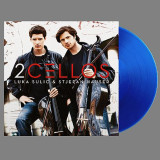
Young Croatian cellists Luka Sulic and Stjepan Hauser, together known as 2CELLOS, have achieved sensational success by taking the cello to a new level. Their playing style has broken down the boundaries between different genres of music, from classical and film music to Pop and Rock. 2CELLOS have no limits when it comes to performing live and are equally as impressive when playing Bach and Vivaldi as they are when rocking out AC/DC. Their debut album is a thrilling collection of chart-topping rock and pop songs performed in their signature style.
2CELLOS rose to fame in 2011 when their version of Michael Jackson’s “Smooth Criminal” took the world by storm. The YouTube video became a massive viral sensation leading to a record deal with Sony Masterworks and an invitation to join Sir Elton John on his worldwide tour. The song charted at No. 10 on the Billboard Hot 100 Digital Songs Chart and landed the 2CELLOS’ debut album in the Top 100.
In addition to many sold out solo tours (US, Japan, Europe) and collaborations with the Red Hot Chili Peppers, Queens of the Stone Age and George Michael, the duo have also appeared on major TV shows such as The Tonight Show with Jay Leno, The Ellen DeGeneres Show, The Bachelor and many others. Together with the Chinese classical superstar pianist Lang Lang, they appeared at the CCTV New Year’s Gala for more than 1 billion viewers.
2CELLOS features the duo’s renditions of popular songs such as “Use Somebody”, “Smooth Criminal”, “Fragile”, “Hurt”, “Smells Like Teen Spirit” and more. It is released as a 10th anniversary edition of 1500 numbered copies on white coloured vinyl. It is housed in a heavyweight jacket with soft touch laminate and includes an insert.
The Montreal rapper's new opus is at once deeply introspective and a wide-eyed embrace of the world. Produced by longtime collaborators Adrian X and Kevin Figs, this sonically adventurous follow-up to her two-part debut Godspeed: Baptism (Prelude), released in 2020, and Godspeed: Elevated (2021) finds her stretching her wings lyrically, vocally and musically.
Naya Ali's journey to We Did The Damn Thing took hard work, sacrifice, faith, and sweat, as represented on the album cover : “Our sweat has trickled down from our braids for generations”. The song The Heist completely embodies the cutthroat energy and hard work that fuels Naya’s music. Yet, We Did The Damn Thing shows there’s more to her artistry. From the dark, ominous More Life, Less Names, a defiant anthem about protecting your peace, to the country-inspired renegade spirit of Turning Tables, and the Afrobeats-infused warmth of Life, where she stepped out of her comfort zone by singing instead of rapping, it is clear that Naya Ali has decided to embrace her versatility as an artist. Beyond the classic, 808-heavy beats, We Did The Damn Thing is a gospel-infused album grounded in live instruments, especially the electric guitar. Naya also took on a larger role in production, leading the choirs and working on vocal production for the songs Life, Jericho and Freedom Creepin.
Young Kingz II marks Krept & Konan’s first album since top-5 charting Revenge Is Sweet, a project which cemented their place in music history as UK rap royalty and saw them become the first British rap act to headline the O2 London. It also follows the duo’s equally ground-breaking 2017 release of 7 DAYS and 7 NIGHTS, which saw them become the first act ever to have two mixtapes simultaneously enter the Top 10 of the Official UK Albums chart, and their 2015 debut album The Long Way Home which debuted at no. 2 on The Official UK Albums Chart, becoming the highest charting British Rap album in UK chart history.
With Young Kingz II, Krept & Konan are set to continue their legacy and undisputed relevance in the British music scene. Returning to their independent roots, they come full circle with the follow up to their 2013 released Young Kingz mixtape which catapulted the duo into the Top 20 of The Official UK Albums Chart, earning them a Guinness World Record for the highest charting UK album by an unsigned act.
Young Kingz was pivotal in establishing Krept & Konan as trailblazers in the UK rap scene, kickstarting their reputation for repeatedly breaking records and consistently breaking ground. With a broad-ranging rollcall of featured artists, it heralded their signature approach to collaborations of enlisting fledgling artists (such as s then little-known MC, Stormzy), alongside more established ones (George The Poet, Chip, Tine Tempah and Giggs). It also saw Krept & Konan gain traction across the Atlantic with US rappers French Montana, Chinx Drugz, Lil Durk stepping up on the remix of the mixtape’s second single release, "Don’t Waste My Time", and garnered them a BET Award (Best International Act) and MOBO Award (Best Hip-Hop Act).
‘Young Kingz II’ is poised to be yet another milestone in Krept & Konan's unstoppable career. As unapologetic pioneers in UK hip-hop, they continue to push boundaries and set new benchmarks in British music.
Rauelsson's third solo album for Sonic Pieces focuses on simplicity and minimalism. It recalibrates his love for ambient with an austere approach that conjures an atmosphere of silence and solitude. On Niu, the artist has traded his craft for shimmering layers of sound clusters and electronic editing in favor of a predominantly raw and acoustic recording.
Recorded primarily in Sofia and Berlin and mixed at Saal 3 of Funkhaus Berlin, Niu presents a 9-song journey that includes orchestral compositions, delicate synth miniatures, and sparse brass and woodwind drones with room for spoken word and a hint of psychedelic noir fable. The result is an album that, despite the eclectic choice of instrumentation, paints a landscape of spiritual clarity; an album that without being typically classical, still feels like a classical album. Three themes vary across the 9 pieces, starting with the purely orchestral "Prelude No. 7" before moving on to airy synth bass arpeggio and pedal steel. With more changing instruments, Raúl next takes us into a fairytale flute composition with guest flutist Heather Woods Broderick and brass vibrations by the trio Zinc & Copper. Finally, Katrine Grarup Elbo recites a poem by Raúl, ending the piece on a somber but beautiful note. The rest of the album continues in this vein, creating a unique sound that surprises the listener at every turn. Niu is a real departure from the artist's previous works in both scope and musicality. Everything was recorded without overdubs and with only minimal editing, trying to preserve the feeling of music coming from a room where musicians play live. Overall, this is music that finds comfort in movement as much as in pause and silence; music in which tenderness and tension exist in the same gesture.
The album also follows a certain mysticism with its poetic interludes, alternate track lists and titles like "Podium Of Riddles", "A Keyhole-Shaped Island" and "Ceramic Swallows, Set Of 3". Perhaps, given enough time, a hidden meaning or a new perception will be revealed. Niu is also set to be expanded into an art book, containing poems and photographs by Raúl, as well as an exhibition. Perhaps the key lies somewhere in there.