Is A Feeling ensures that their new 12" very much is with some classically inclined but not overly nostalgic deep house from Scott Featherstone. 'Plan B' is a bulky, wonky deep house cut for the pumping after party hours, then 'We Played House' taps into the early Chicago sound with Peach Boys style synths and dubbed-out vocals. 'Bad Mother Fucker's a raw, sleazy looper that DJ Sneak would love not least because of the rude-boy vocals and filtered synths, then 'Badass Breaks' spins out on just that. 'Journey' might be the best off the lot with its soulful xylophone melodies and smooth-cruising deep house beats. An eclectic and excellent EP.
quête:mother inc
"In Game of Thrones Season 5, nine noble families fight for control of the mythical land of Westeros. Political and sexual intrigue is pervasive. Robert Baratheon, King of Westeros, asks his old friend Eddard, Lord Stark, to serve as Hand of the King, or highest official. Secretly warned that the previous Hand was assassinated, Eddard accepts in order to investigate further. Meanwhile the Queen's family, the Lannisters, may be hatching a plot to take power. Across the sea, the last members of the previous and deposed ruling family, the Targaryens, are also scheming to regain the throne. The friction between the houses Stark, Lannister, Baratheon and Targaryen and with the remaining great houses Greyjoy, Tully, Arryn,Tyrell and Martell leads to a full-scale war. All while a very ancient evil awakens in the farthest north. Amidst the war and political confusion, a neglected military order of misfits, the Night's Watch, is all that stands between the realms of men and icy horrors beyond. Game of Thrones has always featured excellent music. The opening theme is practically iconic at this point, having been played and covered so many times. Composer Ramin Djawadi’s heavy, atmospheric tunes have always helped set the mood, no matter what tone the show is going for at any given time. Game of Thrones Season 5 (Music From The HBO® Series) is available as a limited edition of 750 numbered copies on translucent red coloured vinyl and includes an insert."
Less than a year after Botanical Illustration takes patience and Skill EP, Giovanni Natalini aka CO-PILOT, comes back on Simona Faraone’s label, New Interplanetary Melodies, with the Green Machine album, which is its natural prosecution: inside it we also find the three tracks previously published by the same label in audio cassette format only (NIM001- MC).
Green Machine is a concept album, which takes up and develops the ecological issues already treated by the artist in his previous work, namely the increasingly tricky dichotomy between nature and machine and the harmful impact of humans on it.
The A side opens with the already published Botanical Illustration takes patience and Skill (A1), an 8 minutes suite in which the powerful Live drum breaks are perfectly combined with synths and vocal samples, transporting us to the tops of exotic mountains, to continue with the ecstatic Himawari (A2) that sounds like a “desert session” made on Mount Fuji, for a result of pure musical mysticism and finally, Mother Love Nature pt.1 (A3), a track that takes us back to more familiar territories, winking at the most experimental British trip hop of recent memory and Mother Love Nature pt.2 (A4) characterized by a background of modular synths and nature sounds effects that precede Giovanni’s powerful drums, underlining once again this perfect fusion of organic and synthesized sounds.
Side B opens with the psychedelic choruses of Dancing Like Fela (B1) supported by synthetic arpeggios and a frenetic drumline sounds like a breakbeat. Continuing along this side, we come to the unsettling use of vocal samples on the beautiful Halo (B2), the ethereal and danceable art-pop of Lost You - In Translation - (B3) to conclude with the evocative Playing the Zurna in Ulan Bator (B4), a track with a pressing rhythm and elegant arrangements that once again underlines Giovanni Natalini’s mastery in mixing sounds and suggestions that are apparently far away but that always find the right place.
Green Machine sounds like a valid attempt to finally find a “solid” balance between humans and nature, but it also demonstrates how the continuous mixing of sounds is the most effective way to escape from the homologation that is increasingly widespread in contemporary society.
- A1: Mother Pepper
- A2: Don't Blame Me
- A3: You've Got Your Troubles
- A4: Personal Possession
- A5: Unity
- A6 00: 7
- A7: Unforgettable
- B1: It Pays
- B2: Young Generartion
- B3: Mother Long Tongue
- B4: Sabotage
- B5: Mother Young Gal
- B6: Keep A Cool Head
- B7: Fu Manchu
- 1: Cypress Crossing
- 2: Pink River Dolphins
- 3: Ride To Cerro Rico
- 4: Dust From The Mines
- 5: The Shadow Song
- 6: Irene, Goodnight
Ava Mendoza has never made an album quite as personal as her second solo full-length, The Circular Train. Through her decades of collaborations with Nels Cline, Carla Bozulich, William Parker, Fred Frith, Matana Roberts, and Mick Barr—plus years leading her power trio Unnatural Ways and playing in Bill Orcutt’s quartet—the guitarist’s name has become synonymous with virtuoso technique, raw passion, and visceral resonance, a player pushing the edges of the guitar’s possibilities. Along the way, from 2007 to 2023, Mendoza was writing these slow-burning, incandescent songs. The Circular Train is comprised solely of her single-tracked guitar playing and, on two songs, her corporeal singing. Her first solo LP of original material since relocating from California to New York City a decade ago, much of The Circular Train was honed amid pandemic years that clarified the virtues of slowing down. This expressive avant-rock is a definitive introduction to one of the most uncompromising and inquisitive visions in creative music. Mendoza’s thrilling melange of free jazz, blues, noise, classical training, and blazing experimental rock’n’roll all coheres with ecstatic feedback, with picking and solos that crest with shimmer. Sometimes she sounds like a one-woman Sonic Youth with guttural and poised vocals that equally evoke Patti Smith and blues greats like Jessie Mae Hemphill. Conceptually, The Circular Train is presented as a psychogeographical train ride through certain of Mendoza’s musical homelands. The songs draw on ancestral and recent familial memories, notably of her parents’ roots in mining towns—in her father’s home country of Bolivia and mother’s hometown of Butte, Montana, each country with its own history of colonialism, racism, forced labor, the eradication of culture and the subsequent excavation of it. These adventurous songs were composed in cars and planes, in the heart of the Mississippi Delta, in Los Angeles and upstate New York—which is to say in motion. “Ride to Cerro Rico,” named for the mountain and silver mine at the center of Potosi, Bolivia, was inspired by Mendoza’s great grandmother’s life there in a Quechua mining family. “Dust From the Mines” drew from that history as well as Mendoza’s familial lineage of miners in Montana, building up to stunning swaths of shredded iridescence. “Pink River Dolphins” was inspired by a visit to the Amazon rainforest, swimming with dolphins alongside her father—the pink bufeos that inhabit both Bolivia and Columbia—and the song is dedicated to the memory of Mendoza’s late friend, the Colombian-American trumpeter jaimie branch. They shared a fascination with those intelligent and agile creatures who often communicate by echolocation. “Make a sound, it comes back around,” Mendoza sings, and later, “Echo, echo/The answer in a sound,” evoking what branch knew well: through music we navigate life. The Circular Train contains one cover, “Irene, Goodnight,” composed by Gussie Lord Davis and popularized by Leadbelly; Mendoza has been performing it for over 20 years. Almost as deeply embedded in her repertoire is the penultimate track, “The Shadow Song.” “Treat your shadow kind and it might treat you good,” Mendoza sings on this song that she’s been reworking for over a decade, an emblem of devotion. “Treat your shadow kind and it might treat you right,” she repeats, becoming a blues mantra. What is a shadow self if not one’s secret world, which, once laid bare, awaits an echo, a return?
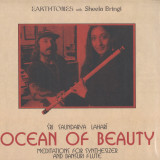
Multi Culti World Records venture deeper into the new new age with the release of 'Ocean of Beauty - Meditations for Synthesizer and Bansuri Flute,' a collaboration between California-based artist/DJ Earthtones and Indian classical musician Sheela Bringi. Earthtones, fresh off his genre-defying debut album on Wonderwheel, here dives into the deep end of the ocean of ambient. With music that traverses cultures,he’s known for bridging influences from Cumbia to hip hop and house music. Here he presents his most consciousness-expanding work yet, no doubt influenced by his involvement in Ojai new age culture,years living in ashrams, practicing Shaktism,+ spending as much time curating sounds suitable foraural healing and meditation as for dance-floors. He’s found a perfect muse in Boulder-based Sheela Bringi, whose virtuosity in Indian classical music sets the tone of the record with her bansuri (Indianbamboo flute) & harp, blending traditional instrumentation with more contemporary influences. Bringi was a direct disciple of bansuri master GSSachdev, and represents a devotional musical lineage. She has released two solo albums, 'Shakti Sutra' and 'Incantations,' and her work has been featured on over 50 world and ambient records, plus publicly on outlets from NPR to NBC News, & more. 'Ocean of Beauty' is the English translation of an ancient Sanskrit text devoted to the divine mother, the Sri Saundarya Lahari, The song titles are taken from verses in that text, and the album is in fact a dedication to the goddess Lalita Devi. It creates a serene, meditative space which seamlessly blends traditions; synth-driven ragas with a spirit of tranquility that nurtures Multi Culti’s philosophical bent towards ‘music without borders.’
Camelot, the legendary seat of King Arthur's court in Early Middle Ages Britain, was probably not a real place. A corruption of the name of a real Romano-Briton city, the word "Camelot" accumulated symbolic, mythic resonances over centuries, until achieving its present usage as a near-synonym of "utopia." In the mid-20th century alone, Camelot inspired an explosion of representations and appropriations, among them the violent, affectless Arthurian court of Robert Bresson's 1974 film Lancelot du Lac and the absurdist iteration of Monty Python's 1975 Holy Grail, both of which feature armored knights erupting into fountains of blood; the mystical Welsh world of novelist John Cowper Powys's profoundly weird 1951 novel Porius, with its Roman cults, wizards and witches, and wanton giants; and the nationalist nostalgia of President John F. Kennedy's White House. Unsurprisingly there are fewer Camelots in more recent memory. Camelot, Canadian songwriter Jennifer Castle's extraordinary, moving 2024 chronicle of the artist in early middle age, charts a realer, more rooted, and more metaphorical place than the fabled Camelot of the Early Middle Ages (or its myriad depictions), but it too is a space more psychic than physical. In Castle's Camelot, the fantastic interpenetrates the mundane, and the Grail, if there is one, distills everyday experience into art and art into faith, subliming terrestrial concerns into sublime celestial prayers to Mother Nature, and to the unfolding process of perfecting imperfection in one's own nature. Co-produced by Jennifer and longtime collaborator Jeff McMurrich, her seventh record is at once her most monumental and unguarded to date, demonstrating a mastery of rendering her verse and melodies alike with crisply poignant economy. For all their pointedly plainspoken lyrical detail and exhilarating full-band musical flourishes, these songs sound inevitable, eternal as morning devotions. "Back in Camelot," she sings on the lilting, vulnerable title track, "I really learned a lot / circles in the crops and / sky-high geometry." The album opens with a candid admission of sleeping "in the unfinished basement," an embarrassing joke that comes true. But the dreamer is redeemed by dreaming, setting sail in her airborne bed above "sirens and desert deities." If she questions her own agency_whether she is "wishing stones were standing" or just "pissing in the wind"_it does not diminish the ineffable existential jolt of such signs and wonders. This abiding tension between belief and doubt, magic and pragmatism, self and other, sacred and profane, and even, arguably, paganism and monotheism, suffuses these ten songs, which limn an interior landscape shot through with sunstriped shadows of "multi-felt dimensions" both mystical and quotidian. The epic scale and transport of "Camelot," with its swooning strings, gives way dramatically to "Some Friends," an acoustic-guitar-and-vocals meditation in miniature on Janus-faced friends and the lunar and solar temperatures of their promises_"bright and beaming verses" versus hot curses_which recalls her minimalist last album, 2020's achingly intimate Monarch Season. (In a symmetrical sequencing gesture, the penultimate track, the incantatory "Earthsong," bookends the central six with a similarly spare solo performance and coiled chord progression, this time an ambiguous appeal to _ a wounded lover? a wounded saint? our wounded planet?) Those whom "Trust" accuses of treacherous oaths spit through "gilded and golden tooth"_cynics, critics, hypocrites, gurus, scientists, doctors, lovers, government, the so-called entertainment industry_sow uncertainty that can infect the artist, as in "Louis": "What's that dance / and can it be done? What's that song / and can it be sung?" Answering affirmatively are "Lucky #8," an irrepressible ode to dancing as a bulwark against the "tidal pools of pain" and the "theory of collapse," and "Full Moon in Leo," which finds the narrator dancing around the house with a broom, wearing nothing but her underwear and "big hair." But the central question remains: who can we trust, and at what cost faith, in art or angels or otherwise? Castle's confidence in her collaborators is the cornerstone of Camelot. Carl Didur (piano and keys), Evan Cartwright (drums and percussion), and steadfast sideman Mike Smith (bass) comprise a rhythm section of exquisite delicacy and depth. This fundamental trio anchors the airiness of regular backing vocalists Victoria Cheong and Isla Craig and frames the guitars of Castle, McMurrich, and Paul Mortimer (and on "Lucky #8," special guest Cass McCombs). Reprising his decennial role on Castle's beloved 2014 Pink City, Owen Pallett arranged the strings for Estonia's FAMES Skopje Studio Orchestra. On the ravishing country-soul ballad "Blowing Kisses"_Pallett's crowning achievement here, which can be heard in its entirety in the penultimate episode of the third season of FX's The Bear_Jennifer contemplates time and presence, love and prayer_and how songwriting and poetry both manifest and limit all four dimensions: "No words to fumble with / I'm not a beggar to language any longer." Such rare moments of speechlessness_"I'm so fucking honoured," she bluntly proclaims_suggest a state "only a god could come up with." (If Camelot affirms Castle as one of the great song-poets of her generation, she is not immune to the despairing linguistic beggary that plagues all writers.) Camelot evinces a thoroughgoing faith not only in the natural world_including human bodies, which can, miraculously, dance and swim and bleed and embrace and birth_but also in our interpretations of and interventions in it: the "charts and diagrams" of "Lucky #8," a daydreamt billboard on Fairfax Ave. in LA in "Full Moon in Leo," the bloody invocations of the organ-stained "Mary Miracle," and all manner of water worship, rivers in particular. (Notably, Jennifer has worked as a farmer and a doula.) The album ends with "Fractal Canyon"'s repeated, exalted insistence that she's "not alone here." But where is here? The word "utopia" itself constitutes a pun, indicating in its ambiguous first syllable both the Greek "eutopia," or "good-place"_the facet most remembered today_and "outopia," or "no-place," a negative, impossible geography of the mind. Utopia, like its metonym Camelot, is imaginary. Or as fellow Canadian songwriter Neil Young once sang, "Everyone knows this is nowhere." "Can you see how I'd be tempted," Castle asks out of nowhere, held in the mystery, "to pretend I'm not alone and let the memory bend?"
. For Fans Of: The Weather Station, Weyes Blood, Adrianne Lenker, Phoebe Bridgers, Joan Shelley, Lana Del Rey, Cass McCombs, Angel Olsen & Neil Young. Camelot, the legendary seat of King Arthur’s court in Early Middle Ages Britain, was probably not a real place. A corruption of the name of a real Romano-Briton city, the word “Camelot” accumulated symbolic, mythic resonances over centuries, until achieving its present usage as a near-synonym of “utopia.” In the mid-20th century alone, Camelot inspired an explosion of representations and appropriations, among them the violent, affectless Arthurian court of Robert Bresson’s 1974 film Lancelot du Lac and the absurdist iteration of Monty Python’s 1975 Holy Grail, both of which feature armoured knights erupting into fountains of blood; the mystical Welsh world of novelist John Cowper Powys’s profoundly weird 1951 novel Porius, with its Roman cults, wizards and witches, and wanton giants; and the nationalist nostalgia of President John F. Kennedy’s White House. Unsurprisingly there are fewer Camelots in more recent memory. Camelot, Canadian songwriter Jennifer Castle’s extraordinary, moving 2024 chronicle of the artist in early middle age, charts a realer, more rooted, and more metaphorical place than the fabled Camelot of the Early Middle Ages (or its myriad depictions), but it too is a space more psychic than physical. In Castle’s Camelot, the fantastic interpenetrates the mundane, and the Grail, if there is one, distills everyday experience into art and art into faith, subliming terrestrial concerns into sublime celestial prayers to Mother Nature, and to the unfolding process of perfecting imperfection in one’s own nature. Co-produced by Jennifer and longtime collaborator Jeff McMurrich, her seventh record is at once her most monumental and unguarded to date, demonstrating a mastery of rendering her verse and melodies alike with crisply poignant economy. For all their pointedly plainspoken lyrical detail and exhilarating full-band musical flourishes, these songs sound inevitable, eternal as morning devotions. “Back in Camelot,” she sings on the lilting, vulnerable title track, “I really learned a lot / circles in the crops and / sky-high geometry.” The album opens with a candid admission of sleeping “in the unfinished basement,” an embarrassing joke that comes true. But the dreamer is redeemed by dreaming, setting sail in her airborne bed above “sirens and desert deities.” If she questions her own agency whether she is “wishing stones were standing” or just “pissing in the wind” it does not diminish the ineffable existential jolt of such signs and wonders. This abiding tension between belief and doubt, magic and pragmatism, self and other, sacred and profane, and even, arguably, paganism and monotheism, suffuses these ten songs, which limn an interior landscape shot through with sunstriped shadows of “multi-felt dimensions” both mystical and quotidian. The epic scale and transport of “Camelot,” with its swooning strings, gives way dramatically to “Some Friends,” an acoustic-guitar-and-vocals meditation in miniature on Janus-faced friends and the lunar and solar temperatures of their promises—“bright and beaming verses” versus hot curses which recalls her minimalist last album, 2020’s achingly intimate Monarch Season. (In a symmetrical sequencing gesture, the penultimate track, the incantatory “Earthsong,” bookends the central six with a similarly spare solo performance and coiled chord progression, this time an ambiguous appeal to … a wounded lover? a wounded saint? our wounded planet?). Those whom “Trust” accuses of treacherous oaths spit through “gilded and golden tooth” cynics, critics, hypocrites, gurus, scientists, doctors, lovers, government, the so-called entertainment industry sow uncertainty that can infect the artist, as in “Louis”: “What’s that dance / and can it be done? What’s that song / and can it be sung?” Answering affirmatively are “Lucky #8,” an irrepressible ode to dancing as a bulwark against the “tidal pools of pain” and the “theory of collapse,” and “Full Moon in Leo,” which finds the narrator dancing around the house with a broom, wearing nothing but her underwear and “big hair.” But the central question remains: who can we trust, and at what cost faith, in art or angels or otherwise? Castle’s confidence in her collaborators is the cornerstone of Camelot. Carl Didur (piano and keys), Evan Cartwright (drums and percussion), and steadfast sideman Mike Smith (bass) comprise a rhythm section of exquisite delicacy and depth. This fundamental trio anchors the airiness of regular backing vocalists Victoria Cheong and Isla Craig and frames the guitars of Castle, McMurrich, and Paul Mortimer (and on “Lucky #8,” special guest Cass McCombs). Reprising his decennial role on Castle’s beloved 2014 Pink City, Owen Pallett arranged the strings for Estonia’s FAMES Skopje Studio Orchestra. On the ravishing country-soul ballad “Blowing Kisses” Pallett’s crowning achievement here, which can be heard in its entirety in the penultimate episode of the third season of FX’s The Bear Jennifer contemplates time and presence, love and prayer and how songwriting and poetry both manifest and limit all four dimensions: “No words to fumble with / I’m not a beggar to language any longer.” Such rare moments of speechlessness “I’m so fucking honoured,” she bluntly proclaims suggest a state “only a god could come up with.” (If Camelot affirms Castle as one of the great song-poets of her generation, she is not immune to the despairing linguistic beggary that plagues all writers.) Camelot evinces a thoroughgoing faith not only in the natural world including human bodies, which can, miraculously, dance and swim and bleed and embrace and birth but also in our interpretations of and interventions in it: the “charts and diagrams” of “Lucky #8,” a daydreamt billboard on Fairfax Ave. in LA in “Full Moon in Leo,” the bloody invocations of the organ-stained “Mary Miracle,” and all manner of water worship, rivers in particular. (Notably, Jennifer has worked as a farmer and a doula.) The album ends with “Fractal Canyon”s repeated, exalted insistence that she’s “not alone here.” But where is here? The word “utopia” itself constitutes a pun, indicating in its ambiguous first syllable both the Greek “eutopia,” or “good-place” the facet most remembered today and “outopia,” or “no-place,” a negative, impossible geography of the mind. Utopia, like its metonym Camelot, is imaginary
In-demand, groove-fuelled producer Opolopo and 24 Carat singer-songwriter Angela Johnson join forces for the eagerly awaited album ‘Best Of Both Worlds’ – a stellar collection of uplifting, struttin’ soulful house, disco & beat-laden music.
Stockholm-based DJ-producer Opolopo can boast two decades’ worth of productions right across the soulful dancefloor spectrum for labels such as Local Talk, Z Records and Defected. His remix discography includes Gregory Porter, Jungle, Leroy Burgess and Mother’s Favorite Child. NYC native Angela Johnson was a member of acid jazz group Cooly’s Hot Box before enjoying solo success via a string of acclaimed R&B albums including They Don’t Know, It’s Personal and Naturally Me & featuring on a host of singles from Reel People Music.
The album follows previous collaborations and provides another stylish pooling of these two soulful talents. The chemistry fizzes and uplifts as ever, Johnson’s rich, fully-flavoured vocals riding confidently upon struttin’ disco, soulful house & dancefloor dynamite.
Moon White Vinyl. All her life, Emma Hardyman has wrestled with contradictions. After all, she was practically rendered a living, breathing contradiction the moment she was born into her half-Peruvian, half-white working-class Mormon family. In young adulthood, Hardyman became increasingly disillusioned with Mormonism's righteous black-and-white thinking, as well as its exclusionary elitism, and decided to leave the church. But she also acknowledged that the institution's all-or-nothing philosophy had become a part of her, resulting in a considerable test of grace and unlearning. As the singer-songwriter behind Little Moon, the Tiny Desk Contest-winning, Utah-based avant-folk project, Hardyman uses music as an outlet to illuminate contradictions of all kinds. Following the release of her 2020 debut LP Unphased, Hardyman set out to write a romantic album about her newlywed husband Nathan (who also sings and plays guitar in Little Moon), but the universe had other plans. After Nathan's mother tragically passed away, Hardyman recalibrated her vision and started work on a love-as-grief, grief-as-love album titled Dear Divine. The record serves as a mirror for the darkest parts of ourselves, allowing us to examine our ego_not to dismantle it, but to better understand how we love, process adversity and move through the world. Centering the classical music, folk, video game soundtracks and Tabernacle Choir hymns she grew up with, as well as ephemeral snapshots of personal significance, Dear Divine is an abundant tapestry of Hardyman's life. As enlivening melodies radiate from a string trio, you can envision the classical music that thrums from her parents' radio 24/7, as Hardyman sings in an otherworldly coo, you can imagine her younger self swooning over the tranquil records of Vashti Bunyan and Joan Baez, and as arpeggiated synths twinkle, you can visualize the enchanting kingdom of Hyrule from The Legend of Zelda: Ocarina of Time that she still adores. Songs like "now" and "messy love" embrace the gloriously jumbled stew of life, with the former chronicling Hardyman's arduous quest for love and trust and the latter patiently navigating the ways romantic partners can mirror each other's shortcomings. As Dear Divine attests, Emma Hardyman may not have it all figured out, but that's kind of the point. Through grief, faith crises and all-encompassing love, she's found the most wisdom in life's maddeningly consistent inconsistencies, as well as the subtle ways one can cultivate a feeling of home. Dear Divine doesn't take a red pen to life, it brings an open heart, an open mind and achingly beautiful, opulently weird folk songs.
- A1: Pride
- A2: Home (Feat Dele Sosimi)
- A3: What Would You Do? (Feat Lumi Hd)
- A4: Glow
- A5: Mother Earth (Feat Abdominal)
- B1: A Sad Story But A Good Story (Feat Aaron Applause)
- B2: Good Vibes (Feat Mr Auden Allen, Lumi Hd &Amp; Richie Culture)
- B3: I Feel It Now (Feat Lumi Hd)
- B4: El Camino (Feat Ellie Coleman)
- B5: Woah!
Sam Redmore made a significant impact on the UK music scene with his debut album Universal Vibrations, a vibrant collection of eclectic, dancefloor-ready tracks that earned extensive radio play on BBC 6 Music. His follow-up album Modulate builds on this foundation, blending electronic and live instrumentation across a diverse range of genres, from house and funk to afrobeat and salsa. Sam, now exploring and expanding his creative process, incorporated live performances into the album's development, and collaborated with notable artists including Dele Sosimi and Abdominal.
A hard rock mash up - Bandleader Paul Ngozi's split album with his drummer and co-vocalist Chrissy Zebby Tembo. The set includes an oversized 8 page booklet detailing Ngozi’s arc, rare photographs, discography and annotations.
"Zambia’s Zamrock movement that exploded in the 1970s...provided young musicians access to European and American music, and created a unique sound. At its root, Zamrock melded fuzz-toned psychedelia, chugging garage rock and roiling funk with a broad mix of African cadences and beats...enlivening a scene that included bands like Musi-O-Tunya, Amanaz and the Ngozi Family” - New York Times
Zamrock was a bona-fide rock scene: on the African continent, only Nigeria can claim one so comprehensive, and Nigeria’s was largely catalyzed and funded by subsidiaries of the European major labels. Zamrock was as independent as the newly-named country, formerly known as Northern Rhodesia. Zamrock is starting in its completeness, especially for a scene that emerged, unfurled and disappeared so quickly. From Musi-O-Tunyaís fusion of Fela’s Afro-beat, Hendrix’s rock, South African jazz and traditional Zambian melodies and rhythms to Salty Dog’s acid folk/rock, Zambia’s rock scene contained all of rock’s subgenres. Zamrock was much more than an imitation of American and European rock music: it quickly became a uniquely Zambian movement, befitting of its name. WITCH, Paul Ngozi and Amanaz sound nothing like other rock music from the African continent - or elsewhere. Zamrock came from a nation's youth carrying forth the momentum of a political and social revolution with a musical revolution that maintained the fiery power of early rock - in the mid-to late-70s. From that era, Zamrockís energy is matched only by the punk and hip hop scenes of England and America.
- Destroy In Order To Grow
- Monkey Man
- The Raju Special
- Baba Shakti
- Mother
- Maushi
- Hit Me!
- Memory
- Tiger
- The Mirror
- Tuk Tuk
- On The Ground
- Dreams
- Hell
- Naam Mera
- Into The Fire
- The Tree
- Cut Open
- Training
- The Kid
- The Candidate
- Snake And A Monkey
- Attacks
- Diwali Madness
- Restaurant
- Get Up
- Rana
- My Son
- Hanuman
- Home
- Saffron Takeover
- The Wallet Song
In collaboration with Back Lot Music and Monkeypaw Productions, Waxwork Records is proud to present MONKEY MAN Original Motion Picture Soundtrack by Jed Kurzel. Monkey Man is a 2024 action-thriller film directed, co-written, and produced by Dev Patel in his directorial debut.
The film follows "Kid", an anonymous young man who ekes out a meager living in an underground fight club where, night after night, wearing a monkey mask, he is beaten bloody by more popular fighters for cash. After years of suppressed rage, Kid discovers a way to infiltrate the enclave of the city's sinister elite. As his childhood trauma boils over, his mysteriously scarred hands unleash an explosive campaign of retribution to settle the score with the men who took everything from him.
Jed Kurzel is an award winning Australian singer-songwriter-guitarist and film composer. His scoring credits include The Babadook, Alien: Covenant, Overlord, Assassin's Creed, and others.
Waxwork Records proudly presents MONKEY MAN Original Motion Picture Soundtrack as a deluxe double LP featuring Blood Red, Black, and Metallic Gold A-Side B-Side colored vinyl, new artwork by Sajan Rai, exclusive director and composer liner notes, heavyweight gatefold packaging, and an 11"x11 insert.
In partnership with Hollywood Records and Regency Enterprises, Waxwork Records is thrilled to present BARBARIAN Original Motion Picture Music by Anna Drubich. Barbarian is a 2022 American Horror film written and directed by Zach Cregger in his solo screen writing and directorial debut. The film stars Georgina Campbell, Bill Skarsgård, and Justin Long. The plot follows a woman finding out that the rental home she has reserved has been accidentally double-booked by a man, not knowing of a dark secret within the dwelling. Anna Drubich is an award-winning film composer from Moscow. Her diverse body of work includes live action features, animated features, television series, documentaries, and plays and concert halls across the world. Anna has score over 35 major film and TV projects including a co-score with Oscar-nominated composer Marco Beltrami on the Guillermo Del Toro adaptation of Scary Stories To Tell In The Dark, Netflix's hit feature Fear Street: 1994, the horror-comedy Werewolves Within, and more. Waxwork Records is proud to present BARBARIAN Original Motion Picture Music as a deluxe vinyl album featuring 180 gram "Mother's Milk & Blood" splatter colored vinyl, heavyweight gatefold jackets with matte satin coating and UV spot-gloss varnish, new artwork by Steven Reeves, and an 11"x11" art print insert!
After four tape editions on Seil Records, Sofie Birch's 2019 debut record "Planetes" is finally available on vinyl featuring new artwork and a beautiful analog remastering.
Sofie creates dream-like, elegant ambient music with an emphasis on exploration and wonder. Her distinctive organic and melodic sound is shaped by improvising with analog synthesizers, acoustic instruments, and field recordings. Repetitiveness is clinically avoided with harmonic progressions that resolve all tension brilliantly. Planetes was described as a beautiful sound universe where the atmospheric sound surfaces and textures gently and elegantly take the listener to new places all the time by Danish experimental music media Passive Aggressive.
For this record's 5th anniversary, apart from the regular vinyl edition, there are two special editions. The first one comes in translucent blue vinyl and includes a limited edition K7 inspired by 70’s yoga tapes. It contains a 20-minute guided meditation on one side and two beautiful unreleased tracks on the other. The second special edition comes in yellow vinyl and includes an inner sleeve with stickers so that you can create your own cover/ constellation for the record.
Sofie's own words about the release:
“It's a dream coming true to see my debut release Planetes coming out on vinyl for its 5th anniversary! Planetes means “a wanderer” in Greek, and I love how this word describes the wandering of celestial bodies, and how we humans wander through life both on a physical and spiritual plane. Wandering is being alive. Wandering is moving, and everything is always moving and changing. Shifting and transforming. The music was created with recordings from a pilgrim trip in Italy with my mom on a little cassette recorder and the music evolved from synth improvisations and the discovery of trusting sound as it is and creating music from immediacy rather than concept.”
Austin, TX legends, The Sword, welcome in the Twelfth vinyl release in the Live at LEVITATION series. On June 27, 2024, the band announced they would reunite for a one-off concert on November 3 at the 2024 edition of LEVITATION in Austin. In celebration of this reunion, we pulled from the archive and this limited live release showcases the bands appearance at the festival with their 2015 and 2021 performances. These recordings are now immortalized on beautiful limited colored vinyl. "With the band originating in the great city of Austin, a city that's proven to be a nucleus for a wide range of distinct and eclectic musical acts, it only felt natural to be included on the Levitation roster in 2015 and again in 2021, adding our own flavor to its diverse landscape. What an honor it has been to be included at such a cool festival. We've had two memorable sets so far, playing alongside some truly amazing bands. When we began entertaining the thought of returning to the stage after a two year hiatus, playing a reunion set at Levitation became the only appropriate solution, to play in front of the fans in Austin Texas, where it all began. We're very excited! Being asked to be part of the "Live at Levitation" LP series is also a great honor. The tracks we selected from each performance, at Carson Creek Ranch and Empire Garage, captured a special energy and enthusiasm that only Levitation could provide. It truly means a lot to share these memories with everyone and be included in this series!" - The Sword LEVITATION and the LIVE AT LEVITATION Vinyl Series The first Austin Psych Fest was held in March 2008, and expanded to a 3 day event the following year. The event quickly developed into an international destination for psychedelic rock fans, with lineups spanning the fringes of indie rock, from up-and-comers to vintage legends, and capped off with headline performances from co-founders The Black Angels, along with Tame Impala, The Flaming Lips, The Brian Jonestown Massacre, Thee Oh Sees (in various forms) and many more. LEVITATION helped spark a movement, inspiring the creation of similar events across the globe and a burgeoning psych scene that would soon ignite. The series captures key moments in psychedelic rock history, and live music in Austin, Texas, pressed on beautiful limited edition colorful vinyl pressings - each an eye popping visual representation of the music contained within. The artists and sets showcased on Live at LEVITATION have been chosen from over a decade of recordings at the world-renowned event, and document key artists in the scene performing for a crowd of their peers and fans who gather at LEVITATION annually from all over the world.
See You At The Maypole, the sixth full-length album in Half Waif"s prolific catalog, is a recognition of personal sadness, and a call to ecstatic togetherness. It"s gathering the colors of our spirit, in all its shades, and making something intricate and remarkable. The ceremonial folk dance performed around a maypole is filled with fauna and flora, with ribbons woven into complex braids incapable of unraveling; these dances are survivals of ancient ritual, honoring the living trees, and the return of Spring and fertility. These patterns -- this dance -- cannot be completed alone, and so, Half Waif welcomes others to join her, a collective of bleeding color. "We are so much stronger for the colorful experiences we go through," she says. "That"s where we find our humanity and find each other." While the seclusion of grief feels infinite, Rose brought the songs to her trusted friend and longtime collaborator of the past decade, Zubin Hensler. The pair worked away from others for Mythopoetics, carefully crafting each note and flourish themselves but something else was needed for See You At The Maypole. To that end, Hensler and Rose welcomed a wealth of players and friends into the world of the record: Jason Burger and Zack Levine on drums and percussion; Josh Marre (Blue Ranger) on guitar; Hannah Epperson and Elena Moon Park on violin; Kristina Teuschler on clarinet; Willem de Koch on trombone; Rebecca El-Saleh on harp; and Spencer Zahn on upright bass. Andrew Sarlo (Big Thief, Bon Iver) lent his deft mixing skills to many of the tracks, including lead single "Figurine." "This wasn"t just my story, I wanted to say. It was every story of loss-the loss of a life, the loss of a dream, the loss of trust and hope and faith. A story of finding a way back again," Rose explains. "My own avenue back to the land of the living was through my relationships with people and with the natural world. It only seemed right that these songs would invite those people in to build the very heart of the sound."
"A group of tried-and-true musicians got together and found the sort of camaraderie and kinship you typically only find once in a lifetime. They didn’t overthink it. They didn’t waste a second. They simply left their blood, sweat, and tears on tape—like they’ve always done. For as much as Better Lovers represents the union of former Every Time I Die members Jordan Buckley guitar,Steve Micciche [bass], and Clayton “Goose” Holyoak [drums] with The Dillinger Escape Plan and Killer Be Killed frontman Greg Puciato [vocals],and musician (Fit For An Autopsy/END) and GRAMMY® Award-winning producer, Will Putney [guitar], it really cements the bond of five friends around a shared vision. That vision is as uncompromising, unapologetic, and undeniable as anything they’ve individually done, yet it’s refined by experience and a commitment to a future together. They’re in it for the long haul... “To me, this band is refreshing,” exclaims Jordan. “Looking back, I’m so happy everything got me to where I am. The pandemic and the last few years made me hungrier and more grateful. This isn’t a hobby. This isn’t temporary. This is the next evolution for each of us. Greg and Will rejuvenated me and made me even more confident.
Now, everybody needs to know we’re a wild animal that just broke out of the zoo—there’s no trying to put it back in the cage.” “Better Lovers definitely feels like its own thing,” states Greg. “I’m in so many lanes right now, so it was important that one lane didn’t step on another. However, nothing I’m doing is this vicious. This is full-on scathing. It’s been really fun. I forgot how much I liked that.” As the story goes, Jordan ended up back in Buffalo, NY, jamming in a basement rehearsal spot with Steve and Goose during the winter of 2022. After working with Will on the last two Every Time I Die records, they shared a handful of early demos with him to produce. As the year progressed, Jordan caught Greg on the road with Jerry Cantrell in Las Vegas, mentioning the new music. Once ideas solidified, he shared them with the vocalist who replied at 3am one night in December. “The text said, ‘Let’s give these motherfuckers what they want’,”chuckles Jordan. “I went to bed smiling and laughing. There is no one like Greg on stage, off stage, or over text. Once I told Will, he was like, ‘Can I play?’ We said, ‘Of course!’ That’s how it was born.” “Once I pick up the scent, I’ll go for the kill,” smiles Greg. “We’ve all hung out, gotten to know each other, and it’s all fire now. Everyone has already been through shit. You know yourself better. Your ego isn’t as big as it used to be. You can share your opinions. It’s a cool dynamic.” Fittingly, they introduce this era with the single “30 Under 13.” A seasick guitar groove bleeds into an incisive riff punctuated by Greg’s vitriolic and venomous screams, “Hold onto me, try to let go of me, let go of what you’ll never be. ”This barrage unpredictably subsides on a haunting clean vocal, only to ramp back up into a pit-splitting thrash crescendo and rapid-fire solo played at warp speed. “We always try to up our game,” notes Jordan. “This is the next step for all of us. There’s just constant forward motion, and we don’t want to compromise that. We want to keep going. We’re doing a lot of shit we haven’t done before in Better Lovers. I’m not going to spoil it for you, but get ready.” “For some reason, this song got me,” recalls Greg. “Once that happens, you have the toe of the dinosaur skeleton in the dirt. You start brushing it away, and soon you have a fucking T-Rex.” The name might give you a hint of what’s coming—or it might not. So, what does the future hold for Better Lovers? Well, it’s entirely in their control. Expect a lot of touring. Expect more music. Expect these five guys to leave a trail of destruction in their wake—really would you want anything less? “We feel like we’re going to explode if we sit around any longer,” Jordan leaves off. “This is my life’s work. I learned all of my lessons, passed all of the tests, and took all of the right turns and the wrong turns. It turns out what I thought were wrong turns got me here, and that’s all that matters. I have no regrets. I know this is what I’m supposed to be doing.” “I just want you to view this on its own merits,” Greg concludes. “I hope it reaches some new people. For me, the enjoyment is making the music and putting it out. The second it’s released, I don’t look back. You drop the bomb and keep flying the plane. You don’t circle back to see how much destruction you cause. You keep moving, which is what we’re going to do.” "
From Cape Town to Cairo, and now to fans, stages and screens around the world, PJ Morton shares his newest album, fully made in the motherland. Cape Town to Cairo is a collection of songs that he created in 30 days throughout 4 countries in Africa — South Africa, Nigeria, Ghana and Egypt. Described as the best trip of his life, this transformative journey began as just the seed of an idea last fall, but instantly grew into his most sonically-sprawling and immediately-inspired record to date. With no music, lyrics or preconceptions, he stepped foot onto the continent with two thoughts: a wild dream to write and record his next LP in less than a month, and a mission to immerse himself in as many different cultures, stories and communities as he could.
Surrounded by featured collaborators like Fireboy DML, Mádé Kuti, Asa, Ndabo Zulu, and Soweto Spiritual Singers, as well as additional producers including P.Priime and The Cavemen., his own live band and local musicians, PJ Morton used music as his common language. Always his greatest way of communicating, he expressed his feelings and experiences of Africa through songs he and others were forming together on the spot, side-by-side in different studios, cities and towns for the very first time. None of the tracks were written before he arrived or after he left, and the arrangements showcase both the countries’ native genres as well as the innate, stylistic instincts that have made Morton a 5x GRAMMY-winner and 20x GRAMMY-nominee, whether it be his soul, R&B and gospel roots, or the pop prowess he has further honed as a member of Maroon 5.
“When you’ve been in music as long as I have, you’re constantly looking for inspiration,” says PJ Morton. “And you’re looking for the things that made you want to do it in the first place. I’ve made albums every type of way you can think, so I wanted to try something I hadn’t done before. As a Black American who had never been to South or West Africa, I knew there was something there waiting for me. So I put a little pressure on myself to make a full record in a month, but I also said, ‘If I’m gonna go to Africa, I want to see Africa.’ We made music, but we also formed connections. We made new friends, and this is just the start.”
ESSENCE adds, "This trip is not just a physical move, it's a spiritual return…The soul of Africa pulses through every note he plays and every word he sings,” and VIBE adds that “the multi-faceted artist is fully embracing a new phase in his life.” Cape Town to Cairo marks PJ Morton’s first album since 2022’s Watch The Sun, which featured collaborations with Stevie Wonder, Nas, JoJo, Wale, Jill Scott, Alex Isley and more. Since then, Morton has become the first Black composer to write an original song for a Disney attraction, having just finished making the music for Tiana's Bayou Adventure, opening on June 28th, 2024 at Disney World and Fall 2024 at Disneyland. He also won his latest GRAMMY earlier this year, worked with Samara Joy on “Why I’m Here” for Regina King’s Netflix film Shirley, and landed a cover of his song “Don’t Let Go” as the soundtrack to Apple’s iPhone 15 commercial.
PJ Morton recently returned from headlining his debut shows in Asia, New Zealand and Australia, and announced an extensive Cape Town to Cairo Tour for North America summer and fall 2024. Following iconic performances at New Orleans Jazz Fest, The Kennedy Center, Roots Picnic and Newport Jazz Fest, Morton will embark on a run of more than 25 dates across the country, including New York City’s Beacon Theatre, Chicago’s Chicago Theatre, Nashville’s Ryman Auditorium, Los Angeles’ The Wiltern, and dozens of others.
On the heels of his headline tour and Maroon 5’s Las Vegas residency, PJ Morton will publish a life-spanning new book titled Saturday Night, Sunday Morning. The memoir sees him recounting and reflecting upon a trailblazing path that continues to defy expectations and straddle the tensions of music and faith, race and culture, expression and identity. As the son of two pastors and gospel artists, Morton grew up grounded by the sound of the Church, but soon found himself drawn to R&B, pop and soul, writing songs that the industry, his family and community struggled to understand. In the face of mounting pressure, rejection and constant miscategorization, he committed himself to a steadfast path of independence: making music on his own terms, launching his own record label, joining one of the biggest bands in the world while staying true to his New Orleans roots. The risks he took paid off, and through his transformation from preacher's kid to the busiest man in showbiz – performing everywhere from his local congregation to the Super Bowl, collaborating with everyone from his father to Stevie Wonder, Erykah Badu, Jon Batiste and Lil Wayne – he hopes to encourage readers and listeners to overcome obstacles as they seek their dreams.
- A1: All In (Original Mix)
- A2: Golden (Original Mix)
- A3: Axen (Original Mix)
- A4: Dicktator (Original Mix)
- A5: Give It To Me (Original Mix)
- A6: Ergh (Original Mix)
- B1: Treat Yourself Badly (Original Mix)
- B2: Try Again (Original Mix)
- B3: Flummi (Original Mix)
- B4: Rabbit Underground (Original Mix)
- B5: Your Mother (Original Mix)
- B6: Seven Rivers (Original Mix)
- C1: Dicktator (Club Mix)
- C2: Golden (Cub Mix)
- C3: Treat Yourself Badly (Club Mix)
- D1: Give It To Me (Club Mix)
- D2: All In (Club Mix)
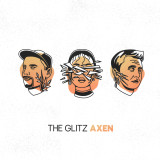
Heavy support by Radio Slave, Sam Divine, Acid Pauli, Green Velvet and Maceo Plex to name a few, while also being played on radio stations world wide. The album marks the beginning of a new chapter for The Glitz as they embark on a journey beyond the world of electronic music. After a wide range of beautiful, inspiring, provoking and uplifting The Glitz-singles, we are now approaching the full album in all its might. The singles have shown us the diverse soundscapes you can find in Andreas and Daniels musical multiverse, with the genres ranging from the classic House and Techno genres, to also introducing their take on Trip Hop, Neo RnB, Hip Hop, Ballad and Electronica. This journey into their musical realm has resonated with fans and colleagues alike the last months, putting the first single on position 1 in the German Club Charts for four weeks straight (it is still in the Beatport top100 after 7 months). Born out of a desire to create a space to explore and expand their unique sound, their new album is a bold extension of The Glitz vision and purpose. It has been a long time coming and is the result of four intense years in the studio together with the unique and talented singer and songwriter Mulay. And now it is time to present the full album to the world. is the mesmerising product of one of their many jam sessions in the studio. It carries the unique The Glitz fingerprints all over it while also letting them shine in a new context. The slow flowing Hip Hop beat paired with Mulays raw vocals and incredibly poetical and personal lyrics is a must hear for old and new The Glitz-fans alike.
Placed between some of the beautiful singles we have heard before, "Ergh" hits us with full force. The track takes us on a breaky, synth loaded trip. As an energetic and driving fresh breath of air, the track combines a frisky attitude with a tension building arrangement, showing that while Andreas and Daniel embrace new genres and styles, they still have good ears for club oriented, heavier hits as well. "Flummi" is put to work in a similar setting, but with a completely different world of sounds. Bright synths slowly build up, paralleled with the pulsating low end and guiding the listener towards an explosive breakdown. The track is followed by the wild and intoxicating "Rabbit Underground" that swoops you off your feet like a rocket launch. A skilfully crafted yet raw drum work with an exquisite snare creates a foundation for tantalising synths and captivating vocals that radiates with power. After this rollercoaster of a track, the wilderness is countered with the soft and playful "Mother". The Glitz bring together various layers of soft synths and smooth percussions, creating a beautiful sphere where the captivating vocals by Mulay shine in a new way. Ending this incredible journey of sound exploration is the stunning ballad "Seven Rivers". No noise, no distractions, just a beautifully stripped down ballad that carries an ocean of emotions. A perfect completion of "Axen". In their own way, each song carries the unique sound characteristics that Andreas and Daniel are so known and loved for, while giving them space to experiment and show themselves in new ways. The mix of emotionally charged, dance floor oriented and vibrant songs are bound to give the listeners an entrancing, unforgettable experience.