Here is a brand new single from the Radikal Guru's 4th studio album 'Beyond The Borders'. 'Do The Right Thing' features italian vocalist Marina P mainly known for her previous works with Mungo's Hi Fi. Her soulful lyrics are touching on social struggles that we are facing today in our communities. On the musical side Radikal Guru comes with meditative basslines, melodic patterns and arrays of echo chambers and 808's. Backed by two roots style vinyl exclusive remixes made by the Guru himself.
Suche:mun sing
Dexta and Crypticz are delighted to announce their long awaited 12" single, 'Together', featuring two remixes from Munich-based Danny Scrilla. Two years in the making, the project will finally see the light of day on 10th November 2017 via Diffrent Music.
A fusion of Drum & Bass, Jungle, House and Garage, 'Together' is built for the dancefloor. The track borrows vocals and breaks from the early '90s, while blending drum machines, bass samples and vintage effect processes crafted by Dexta & Crypticz.
Danny Scrilla debuts on the label with a pair of remixes. The 'Reslice', is a great example of signature Scrilla, manipulating the original parts into an exploration of dubby, half time soundsystem music. His 'Reflop', meanwhile, is a 140bpm re-think, splicing chopped up breaks and bass stabs from the original along with strong percussion lines and weird vocal edits.
Since his outing on Hospital Records in 2015, and his debut 'SE4 EP' on Diffrent Music last year, Dexta - otherwise known as Londoner Chris Royle - has released the third part in an ongoing series for None60 Recordings, honing tracks for dancefloors and stereos alike.
Somerset's Crypticz (aka Jordan Parsons) has had quite an eventful 12 months, with his 'Echo Sound EP' on Doc Scott's 31 Recordings, and more recently the 'Forever EP' Om Unit's Cosmic Bridge imprint, while evolving his club performance from a DJ set to a custom live show consisting solely of his own music and explorations in sound design. This single comes two weeks after his latest release, the 'Access You EP', also on Diffrent Music, which set a new benchmark for Jordan, refining his sound to its highest quality.
Danny Scrilla (born Daniel Pirkl) has gone from strength to strength this year, dropping a cassette tape project on Cosmic Bridge, compiled of 16 synth and hardware-led experiments. Last month Dan also released a collaborative 12" with Sam Binga called 'Weird In Munich' - a superb effort, pushing boundaries from both their usual styles - before putting out an EP for Amit's AMAR imprint in early September.
'Together' will be available as a limited 300 run of 180gsm coloured 12" vinyl, and will be officially released on 10th November 2017. An exclusive small batch will be available at the Clashmouth D&B Label Market on 28th October 2017 at Cafe 1001 on London s Brick Lane.
Thaba is a collaboration between South African singer/
songwriter Khusi Seremane and American producer/musician
Gabriel Cyr. Tragically in July 2020, while the two were
working with Soundway to prepare the release of their first
record, Seremane died a few days past his 41st birthday, after
battling health issues for several years.
The particular Thaba sound reflects a sonic duality drawing
on a double pop heritage of Mbaqanga and Bubblegum artists
like The Soul Brothers, Paul Ndlovu and Pat Shange alongside
traces of Roxy Music, Grace Jones, Sade, and Talk Talk that’s
wrapped up in a modern, electronic, layered, introspective
and at times jazz-tinged production style.
Brought together by a shared love of kwaito, 90’s R&B and
classic downtempo, Seremane and Cyr collaborated for a
decade after meeting online in the halcyon days of Myspace
Music. While the pair initially planned for Seremane to guest
on a Teleseen track, their ideas eventually evolved into an
entire record. Their debut, Eyes Rest Their Feet, was created
remotely over the course of several years, with the core
recorded during a 2016 studio session in Cape Town.
After returning to New York, Cyr honed these recordings with
several Brooklyn-based musicians, calling upon members
of Antibalas, Underground System, Midnight Magic, Loboko
and others. Eyes Rest Their Feet spans genres as well as
geography, touching on elements of soul, reggae, synth-pop
and beyond, with lyrical themes that explore loneliness and
the challenges of human relationships.
Eyes Rest Their Feet not only represents the apex of
Seremane’s work as an artist but also a meditation on the
transformative power of love and the impermanence of all
things.
The 7” is arguably one of the 20th century’s greatest art forms (I’m prepared to argue it anyway). What should have been a disposable format, either as the herald for the altogether more serious LP or the truncated version of the extended 12”, ended up a the perfect expression of modern music - tightened up, fat free and to the point.
At some point during a DJ career that’s lasted pretty much the entirety of his adult life, Boca 45 (aka Bristolian Scott Hendy) eschewed all other formats to choose the 7” as his weapon of choice. Embracing and celebrating the limitations of the format (both in terms of record length and the type of music showcased on discs of that size), Hendy set out on a truly singular path for soundtracking parties the world over. In 2015 Banksy personally requested him to DJ with his 45s at the opening night at his Dismal Land Show, now, in his forty fifth year on Planet Earth, he’s made an album that reflects a life well spent flipping through the racks the world over.
On this album he has collaborated with lots of the people that he has previously worked with over the past 20 plus years recording music.
Vocal collaborations come courtesy of Louis Baker (Soul On Top / Move A Mountain) Emskee (Energy Boost / The Roxy) Sergio Pizzorno from Kasabian (White, Blue & Red) & Gee Ealey who i worked with on Malachai (Lonely)
After six years, The Notwist return with three new tracks on Morr Music. It’s both an exposition of the the band’s musical variety and a prospect on a forthcoming album.
Six years have passed since The Notwist released their last regular studio album, but that doesn’t mean that the members of this outstanding band have been idle in the meantime. There have been side projects, movie scoring, and other activities, like programming four editions of „Alien Disko“, a festival taking place in Munich, Germany. One of that event’s regular guests was the Japanese duo Tenniscoats – and a lovely side effect from that was an evolving friendship between the two bands. It lead to various collaborations: most recently in a new album by international band „Spirit Fest“ (featuring Tenniscoats singer Saya & The Notwist’s Markus & Cico) & a deep digging compilation of Japanese indie music called „Minna Miteru“.
The title track of this new EP is another step in this collaboration – and a first step to an upcoming album by The Notwist – as it features Saya, who lends her voice to the percussive song. It is build around a slightly detuned synthline, which is contrasted by more pragmatic guitar work. „It neither sounds like The Notwist, Tenniscoats, nor Spirit Fest“, tells Markus Acher. „Just like Saya is saying in the lyrics: ‘I want to go outside, I want to meet people’, „Ship“ is another chapter in what The Notwist always tries to do: redefining itself, exploring something new, integrating different styles of music and collaborating with musicians they admire.“
The second song „Loose Ends“ is, in contrast, more classic Notwist material. A gently expanding ballad, this time featuring the distinctive voice of Markus Acher. The song came out of recording sessions for the soundtrack for „One Of These Days“, a movie by Bastian Günther. The EP then closes with „Avalanche“ a carefully optimistic instrumental.
With its variety of styles, „Ship“ also serves as an outlook on an upcoming album, which will be influenced by the band’s experiences from their detailed work of creating sounds and moods for film soundtracks, and it will include more collaborations with international guest musicians.
New album of one of the biggest Reggae/Dub french soundsystem starring MacGyver, Rooty Step & Pupajim (who worked with Alpha Steppa, Biga Ranx, High Tone, Mungo's Hi-Fi ...).
Available as super limited edition including 60x60cm Poster !
Since their inception at start of the 2000s, Stand High Patrol have rocked sound systems to their own riddim, assimilating and re-purposing the codes of the genre in their own unique style. From tiny bars in Brittany to huge festival stages, on independent radio or across national airwaves, the crew have quietly trod their own path, never compromising their core value of independence. Connoisseurs have long recognised Stand High’s credentials both as a dub group and a leading sound system, but they stand out from the crowd because of their ability to deliver the unexpected, whether live or on record. Their ability to draw such a diverse audience is testament to this atypical approach to making music.
In 2020, almost 20 years since their humble beginnings, the collective presents their fifth album, “Our Own Way”. As with their first two albums “Midnight Walkers” and “Matter Of Scale”, now considered as classics in their genre, this new opus asserts itself as the latest representation of the crew’s versatile approach to crafting sound. Their music, a blend of its own known as “Dubadub”, has always borrowed influences from multiple sources, and over the course of their career their roots in dub and reggae have intertwined with hip-hop, jazz, new wave, trip-hop and numerous other genres. The ‘Dubadub Musketeers’ have never ceased experimenting, forever seeking to increase the sonic territory they cover, day after day. Both live and recorded, they’ve made it a point of honour to never offer up the same thing twice. Any resemblance that “Our Own Way” might bear to those first two albums is a consequence of this obvious creative continuity, rather than of going “back to basics”.
In contrast to the last two Stand High Patrol records, the hip-hop inspired “The Shift”, or the Bristol indebted “Summer On Mars”, “Our Own Way” doesn’t have a unifying concept or theme. Rather than being limited to a single aesthetic, the LP pays respect to the entire canon of Jamaican music, all unified under Stand High’s inimitable production values. With the wealth of experience gained during the recording of their last two records, the collective decided to aim for a freer project, letting themselves be guided by their own music and their own instincts. The end result is a musical portrait of what Stand High Patrol is in the present moment.
The tracks that make up the new LP burst out of the studio, each born out of unbridled, impulsive creativity. Previously unheard compositions and specially re-tooled dub plates have been assembled into a tracklist that shifts and moves like a classic Dubadub Musketeer live set. Each step of the process has been refined by years of practice : composition, effects, and the final mix. Throughout “On Our Way”, the brutal dub stepper, though still a favourite for sound system sessions, is noticeable by its absence. Instead, it’s the full weight of the crew’s reggae heritage that’s expressed in the mix. It's not just the depth and weight of each tune that strikes the listener, but also the spaces heard between the notes that grab and hold their attention.. The sense of a trip, whether musical, internal or geographic, is omnipresent throughout the LP, linking each track to those before and after. “Our Own Way” finds Stand High Patrol exploring as usual, yet also narrating their journey as they’ve rarely done before
Queried on his favourite word in the German language, Masayoshi Fujita will pick ‘getragen’ – without a sliver of hesitation. Further questioning will reveal that he loves the term’s semantic signifiers, its inherent sense of “expansive, deep, quiet and sombre.” And yet, ‘getragen’ leaves plenty of room for interpretation: depending on context, it might also indicate wearing apparel or the state of being carried – two more mundane interpretations that I would rather keep from him. Does Masayoshi’s own definition, however, apply to ‘Bird, Lake, Objects’? Only to a limited extent. Compared to previous Faitiche releases, ‘Bird, Lake, Objects’ is certainly the most ‘getragen’ of them all. Nevertheless, this is by far not the first association that comes to mind. From a distance, these tracks seem rather introspective, cautious even – and reflect the recording situation: deliberately pared down, reduced to a single microphone in space and a separate track for all other instruments, each movement and action is chronicled by the treacherous mike. This confronted me with some unexpected and unfamiliar problems. For example, we had to swap out the seating in the studio as my favoured chair had a characteristic creak. Other, external influences were proved our control: fire engine klaxons, street noise and footfall became part of the recordings and their improvisatory nature. Each movement required careful orchestration, fully aware of its irrevocable nature. Space itself was always present and an audible entity, except on ‘Stripped to RM’ (recorded without a microphone or vibraphone track). After extensive deliberations, we decided to forgo the vibes on this piece – a very similar version had already been released in 2008 (on the compilation ‘Enjoy The Silence’, Mule Electronic, 2008). Jan Jelinek, February 2010
Queried on his favourite word in the German language, Masayoshi Fujita will pick 'getragen' - without a sliver of hesitation. Further questioning will reveal that he loves the term's semantic signifiers, its inherent sense of "expansive, deep, quiet and sombre." And yet, 'getragen' leaves plenty of room for interpretation: depending on context, it might also indicate wearing apparel or the state of being carried - two more mundane interpretations that I would rather keep from him. Does Masayoshi's own definition, however, apply to 'Bird, Lake, Objects'? Only to a limited extent. Compared to previous Faitiche releases, 'Bird, Lake, Objects' is certainly the most 'getragen' of them all. Nevertheless, this is by far not the first association that comes to mind. From a distance, these tracks seem rather introspective, cautious even - and reflect the recording situation: deliberately pared down, reduced to a single microphone in space and a separate track for all other instruments, each movement and action is chronicled by the treacherous mike. This confronted me with some unexpected and unfamiliar problems. For example, we had to swap out the seating in the studio as my favoured chair had a characteristic creak. Other, external influences were proved our control: fire engine klaxons, street noise and footfall became part of the recordings and their improvisatory nature. Each movement required careful orchestration, fully aware of its irrevocable nature. Space itself was always present and an audible entity, except on 'Stripped to RM' (recorded without a microphone or vibraphone track). After extensive deliberations, we decided to forgo the vibes on this piece - a very similar version had already been released in 2008 (on the compilation 'Enjoy The Silence', Mule Electronic, 2008). Jan Jelinek, February 2010
Fusing dexterous hand-percussion, hypnotic guitar riffs & soaring melodies, Waaju rise from London’s rich cultural palette with their latest album ‘Grown’, proving UK Jazz doesn’t have to sound the way we expect it to. Led by drummer and percussionist Ben Brown (Alfa Mist, Dizraeli, Ashley Henry), the band comprises percussionist Ernesto Marichales (Jordan Rakei, Sigala), guitarist Tal Janes (Nubiyan Twist, Bahla), Sam Rapley (Fabled, Maria Chiara Argiro) and Joe Downard (China Moses, Judi Jackson), each with their own strong presence on the UK’s extensive music scene. Waaju’s refined and divergent sound connects the dots between the likes of Ali Farka Touré, Alain Peters, Los Muñequitos de Matanzas, Oscar D’Leon and Beth Carvalho. Waaju formed as a means of exploring music’s hidden connections, from trance-inducing Moroccan Gnawa to Caribbean carnival music, and embracing them to reflect different shades of London’s own musical culture. It was the band’s love for Mali’s folk music – and Ali Farka Touré’s stylistic prowess in particular – that first set the project in motion. London’s Jazz Cafe invited Waaju to reinterpret classic tracks from Farka Touré’s catalogue to sold-out audiences in 2018 and 2019. According to Brown: “Ali’s one of the best. He has such a unique sound. His playing is so gnarly. His spirit and attitude are things I always think of when making music.” Waaju (meaning ‘to urge, inspire or influence to take action’ in Malian language Bambara) blends pulsing Latin polyrhythms, psychedelic Malian blues licks and cinematic textures. Following the group’s 2018 self-titled debut record, Grown presents a group more unified and distinctive-sounding than ever with six fresh, bold compositions. The record begins with Moleman, a potent reminder of the intricacy and energy Waaju’s become known for. Gritty, clattering metal defines the landscape for sizzling builds, hinting at rave culture styles like Bashment and Jungle. Listening Glasses follows and it’s clear why this is the album’s lead single – its Afrobeat-like energy and joyful interplay between guitar and tenor sax lies somewhere between Tony Allen’s grooves, Chimurenga guitar and Headhunters’ funk. On late night jam Rollando, Joe Downard’s skulking bass frequencies rule and wonkiness reaches new heights as heavy dub grooves almost tear themselves apart. Time’s Got a Hold was co-written by Waaju and Jordan Rakei for a show together in November 2018. Kicking off side B, this version features special guest vocalist Will Heard over bouncing triplets evocative of 1970’s Sega from La Reunion. A kind of looseness found only at night, the quiet drive of Wassoulou is sparse yet purposeful. Pulling back the tempo and dimming the lights, cavernous percussion fills each corner of the room, springing back as spectral reverbs. The title and final track shows the many dynamic sides of the outfit’s far-reaching sound, with its expansive harmonies and explosive psychedelia, spanning Yoruba Andabo to Hendrix, signing off an exciting and energetic second LP from Waaju at their most scintillating.
As a long-time friend of the Connected label, Le Croque makes his debut with a superb single that comes with a remix from Themba. At the forefront of the ever-growing Greek afro-house scene and part of The Madorasindahouse team, Le Croque has also released on Open Bar Music and King Street, and DJed alongside such legends as Black Coffee, Adam Port and &Me. For this release he teams up with Berlin via Munich vocalist HRRSN who came to electronic music from soul and R&B and has released on such labels as Stil Vor Talent, Suol and Noir Music. This latest partnership leads to a beautiful deep slice of electronic hypnosis on 'Melancholia.' The track has a driving rhythm that is sparse and simple, with lush keyboard refrains and vocals soaring in the drop. It is the sort of majestic and melodic offering that will make for a fantastic high point in any set, while the dub keeps things even deeper for more intimate moments. Remixer Themba has swiftly risen to prominence over the last few years and is at the forefront of the South African house scene. Here he delivers a sharp and striding groove that is joined by stabbing bass, with fading, string-like notes and dubbed vocal refrains taking things to another level as HRRSN comes into the spotlight and delivers a message from the heart. This is a subtle but celebratory house package packed with plenty of emotion.
I remember the first time I read W.E.B. DuBois eclectic masterpiece The Souls of Black Folk. The way in which this Weberian scholar flowed from personal account to prose to sociological analysis to music and even political intervention has had a lasting impact on my own work as a cultural anthropologist. It made me understand that as scholars we must use different means in order to give expression to the totality of the lived experience: There is only so much in an academic text.
The experience of alienation has always been at the heart of my scholarly and artistic practice. I have used academic writing, lecturing, theatre performance and electronic improvisation to understand and represent it as a theoretical concept, postcolonial condition and lived experience. I believe, some issues need to be told like a story, some analyzed in most abstract terms and others need to be sung like a gospel. The medium changes the message.
In this sense, I guess, I’m a singing cultural anthropologist.
For some time now I have been engaged in the use of dystopian themes and sounds to paint a sonic picture of structural racism and whiteness of our present. But recently I have grown weary of this Ballardian idea of Future Now and the resulting phantasmagorian aesthetics myself and others have been invested in. The widespread availability of Digital Audio Workstations, sequencers, loopers and delay pedals has lead us into a futuristic cul de sac best described by Mark Fisher as the very absence of future.
Likewise, I am most skeptical of the “naturalist” countermovement, the return of folk. Especially in Germany, I am convinced there is no such thing as an innocent or progressive folk musical expression as it is always connected to the idea of the homeland (“Heimat”) which in turn produces the colony. It seems to me, the current zeitgeist is stuck between a “museum of a dystopian future” and a “museum of an idealized past”, but I wanted to sing about the present.
So, I involuntarily returned to pop music in its two-folded meaning of something popular and addressing not an essentialist notion of “Volk” or its woke cousin “communities”, but society as a whole.
I entered the studio just with a few lo-fi sounding melodies and rhythms from my circuit bent CASIO synthesizer. I had no clue what the finished product would sound like. But as soon as Markus started drumming, in a way strangely reminding me of CAN’s Ethnographic Forgery Series, my uptight sounds were suddenly embedded within a warmer global sound spectrum. The alien at home and abroad and the strange overlapped: We were seeing one and the same sound differently but were gently held together by Tobias’ producing.
Making music is about building coalitions. It’s about suggesting an articulation of styles, sounds and people, that hasn’t materialized, yet, but may help us in the current crisis: I wanted Amon Düül II to send their drug induced archangel thunderbird to rescue the refugees, that had tried to escape the police by climbing up a tree in Munich in 2016. I wanted Sun Ra to taunt far-right protesters in Chemnitz in 2018. And I wanted to mourn the loss of a former kebab shop cum discotheque that served as proof that there is such a thing as a minoritarian universalism.
SCHLAND IS THE PLACE FOR ME is a pop album featuring songs of alienation, not only as a tragic experience, but as a pop-cultural promise. Maybe Bill Callahan sung it best, “I am Star Wars today, I am no longer English grey”. I want those who suffer from alienation to stand in alliance with those who seek alienation, and vice-versa. A coalition, that tolerates the possibility that we are moved by the same groove for contrary reasons.
Fehler Kuti
Munich, Autumn 2019
Music by Julian Warner, Markus Acher & Tobias Siegert
Saxophone on RINDERMARKT by Franz Brunner
Trombone on RINDERMARKT and IL by Matthias Götz
Recorded and mixed by Tobias Siegert in Munich.
SONTAGSFAVORIT mixed by Dario Albiez in Dusseldorf.
Mastered by Duphonic in Augsburg.
Artwork by Atelier Grande, Munich.
- A1: Ghosts
- A2: Late Night City
- A3: One By One
- A4: Tvc 15
- A5: All Ways
- A6: Summer In The City
- B1: Nightmare
- B2: Strangler
- B3: Overseas
- B4: The Munsters Theme
- B5: Raceway
- B6: Keep The Pace
- C1: Get Off My Case
- C2: The Late Mistake
- C3: Ice Machine
- C4: Comateens
- C5: Pictures On A String
- C6: Garbanzo
- D1: Uptown
- D2: Cinnamon
- D3: Cold Eyes
- D4: Desert Song
- D5: Donna
- D6: Crime Time
- E1: Resist Her
- E2: Confessions
- E3: Love Will Follow You
- E4: Satin Hop
- E5: Deal With It
- F1: Nightmare
- F2: Walking Watching
- F3: Don't Come Back
- F4: Jo-Ni
- F5: Ask Yourself
In the fall of 1978, after working with a series of bands, New York-based musician and composer NickWest became interested in experimenting with minimalism, collaborating with guitarist and songwriter Ramona Jan and Lyn Byrd. They decided to play pure pop but to substitute a primitive electronic beatbox for a human drummer. The result was Comateens, becoming one of the first groups to discard the traditional sounds and line-ups used by everyone else in New York City’s downtown music scene of
the late 1970s. In 1980 Nick’s brother Oliver joined them as guitarist, and after going on to release three major label albums (Comateens, Pictures On A String, and Deal With It), and with some
successful tours and dance-club hits behind them, the band split up following the terribly untimely death of Oliver in June 1987.
However in 1988 Virgin Records issued another LP entitled West & Byrd, recorded by Nick and Lyn as a duo, and in 1991 released a retrospective compilation called ‘One By One: Best Of Comateens’, now a rare and much sought-after record among collectors of new wave music. Acclaimed by Etienne Daho, the band has made a name for itself with the singles “Late Night City“, “Get Off My Case“ and “Don't Come Back“.
Based in Munich, Germany, the producer, part-time DJ and Permanent Vacation label co-head Tom Bioly aka TB delivers new romantics, inspired by influences like The Cure’s „The Holy Hour“, Boards of Canada’s late 90s electronica, Miami Vice tropic percussion and Angelo Badalamenti’s Twin Peaks. Acid drops, string distortions, lushed melody bits, hushed robo vox and washed space guitars are being layered and sprinkled over machine beats and disco drums.
TB’s first release "Invitation To Love" made it on John Talabot's vinyl-only Hiverned 10" imprint and was voted amongst the best 10" releases by UK Fact magazine. GROOVE magazine wrote "..entirely superb..“, about the follow-up EP "City Girl" on Permanent Vacation, of which the title track has been licensed to the independent film „All These Sleepless Nights“ by director Michal Marczak.
In 2017 TB followed with “Heartbreak Hotel“, a double twelve-inch release with eight tracks of melancholic dance noir set in smoke-filled darkness. In 2018 he followed with the „Night Heat“ single, of which a RMXD EP with contributions by Gerd Janson, Sascha Funke, DJ Hotel and Bostro Pesopeo came out earlier this year.
NO MORE don't need much of an introduction - the legendary Kiel-based (No)Wave / PostPunk band project took the worlds dancefloors by storm with the release of their seminal single "Suicide Commando" in 1981 which was later re-introduced to the Techno / Electro youth of the world, when Munich's DJ Hell famously reinterpreted the tune in 1998.
Still actively touring and releasing on a regular NO MORE are now making their debut on the freshly launched Intrauterin Recordings-offshoot EL CABALLO SEMENTAL..
The labels cat.no. 001 is a first time on vinyl release taken off NO MORE's "The Return Of The German Angst" digital mixtape and sees one of the bands hit tunes being reworked in a unique, highly captivating manner, pressed exclusively as a limited to 200 copies whitelabel edition on purple / violet vinyl.
"123456789 (baze.djunkiii + Herr Brandt Dream A Nudream Remix)" exceeds the bands natural musical realm by far and transfers the song into MoombahGoth / DubWave territories previously unheard of, not only for a classic band like NO MORE.. The rework picks up latest developments from the urban and bass music world whilst keeping the haunted vibe of the original songs chorus intact, slighty references NuBeat / PostPunk and Dub, adds lush, dreamy Cosmic guitar textures and even winks to the underground whistle and rave posse with a sweet as candy piano breakdown.
In their conjunctional remix work we see Intrauterin Recordings-founder baze.djunkiii, quality electronic music activist and prolific DJ for more than 20 years, and Herr Brandt, founding member of the classic German Wave / Indie / Alternative outfit The Convent as well as of the praised underground Synth Pop / Minimal Wave band Sonnenbrandt, effortlessly merge the best of two musical worlds to create something new and captivating, like they used to do on the decks with their former BETA-ZERFALL parties which were the main and initial reason the two of them and NO MORE came together in the first place.
a A- 123456789 BAZE.DJUNKIII + HERR BRANDT DREAM A NUDREAM REMIX
Over the years Kid Loco has become a reference in the French electronic music landscape. Firstly, known for being an activist in the French underground music scene, he cofounded Bondage Records in 1982. With Bondage Records, he introduced several bands to the French alternative music scene like Bérurier Noir, Ludwig Von 88 or Washington Dead Cats. Alongside his activity of label manager, he composed and released under the name of Kid Bravo, an experimental music at the crossroads of rock and electronic. Astonished by the beginnings of the instrumental hip-hop of DJ Shadows, Jean-Yves Prieur aka Kid Loco experimented new ways of composing music with the sample technic in his own studio near Orly. This new musical adventure led to the birth of a mini album Blues Project released in 1996 on Yellow Productions.
Exploring further his own psychedelic universe, he released his first album A Grand Love Story in 1997 under the name of Kid Loco. Acclaimed both by the French and international music review, “A Grand Love Story” established itself as an iconic album of the trip-hop and electronic music scene. During the two years following its release, Kid Loco continued to invent his own musical universe nurtured by multiples influences. In 1999, he released Jesus Life For Children Under 12 Inches, an album featuring thirty remixes he composed for French and international artists (Pulp, Talvin Singh etc.) as well as his mixed compilation for the famous DJ KICKS collection released on the German electronic music label, !K7.
After a first European tour, Kid Loco returned to his studio, nicknamed “The Lafayette Velvet Basement” and composed his second album Kill Your Darlings released in 2001. Compared to his previous compositions, Kill Your Darlings features more tracks without sampled vocals. Eager to explore new musical horizons, Kid Loco produced in 2004 the original soundtrack of the American movie The Graffiti Artist directed by James Bolton (Narrative Feature Sound Award – Austin Film Festival 2003). Cruising to new musical galaxies, Kid Loco continued to compose and released the album Party Animals & Disco Biscuits in 2009 followed in 2011 by the album Confessions Of A Belladonna Eater. In addition of his albums, Kid Loco continued to experiment with the production of compilations celebrating the trip-hop music with “Trip-Hop Classics” released in 2010 followed by a second opus released in 2013 on Wagram Music.
2019 marks the return of Kid Loco with his track Here Comes The Munchies selected in the original soundtrack of the show Vernon Subutex (Canal +), the vinyl reedition of his cult album A Grand Love Story and for the first time the digital release of the album Confessions Of A Belladonna Eater with exclusive remixes.
For its 3rd releases, Nubiphone is proud to present you a compilation of the best early 7inch releases of the mythical Cameroonian band Los Camaroes.
10 raw tracks taken from various singles from 1968 to 1975, that present the musical diversity played by those seven young people: Bikutsi, Afro-Funk, Jerk, , Soukous, Rumba & Blues music. The band led by the charismatic lead vocal Messi Martin that managed to modernized Cameroonian music. Deluxe edition that includes an 8-pages booklet, with exclusive pictures, biography in both English and French languages, and a HQ digital download
card.
Hamburg-based Mireia Records is ecstatic toannounce their thirteenth release: Julian Stetter’s “Sensual EP”.
You’ve probably crossed paths with Julian in thelast couple of years. Not only because he’s the tallest guy in Cologne, but the producer and DJ has been actively shaping modern dance music
with his flourishing, melancholic sound. He’s been releasing music with Permanent Vacation, Kompakt, Correspondent and hometown labels Ancient Future Now and PNN.
It’s also not his first time on Mireia Records. Remember the beautiful “Porto” on “We’ll Sea
Pt.1?” Here, Julian presents two original tracks which are reinterpreted by SONNS and Matt
Karmil.
The title track “ Sensual ” manages to erase the mundane, the world’s vanishing around you.
It’s pitched shaker and airy bells evoke introspective tones. The bassline on the other hand
keep you steady - the dancefloor is still visible through the clouds!
“ Rumors ” picks up the pace. Kick drum and syncopated hi-hats set the stage for a serious
bassline, interwoven with fleeting melodies.
Bright and euphoric brushstrokes from Julian’s synth elevate the pace and catapult the track
towards a crescendo. Booming snares signal the peak.
New Release Information
Strobe lights, sweat and ecstasy.
SONNS opens up the B side with the first remix by whispering “ Rumors ” in your ear. A
brooding bass line takes you on a trip to the dark corners of the city. Hypnotically chugging
toms highlight the sights. Let’s get lost tonight!
With his releases on Kompakt and strong DJ Sets SONNS’ been a long time favored entrant
into Mireia Record’s catalogue.
Matt Karmil’s version of 'Sensual', although on B2 of the vinyl, doesn’t hide its assets.
Kicking off with frantic high hats and a distorted glitch, he pushes the track forwards
intriguingly. Arpeggiated melodies layered supremely over the percussion drive the track
forwards, the simplicity of the track and sharp cuts and drops create an interesting dynamic
to the single creating a perfect juxtapose to the other tracks on the release.
Matt’s also been on Mireia’s radar for a long time. His atmospheric adventures for Studio
Barnhus, Smalltown Supersound or Beats in Space always convey a spirit of living, breathing
leeway.
Catalan Gypsy singer from Perpignan France has been making waves in the Gypsy Rumba scene with his new album "El Mundo".. prompting the release of this 12" Vinyl EP of his tune "La Rumba Me Va" with Remixes from Ashley Beedle, Art of Tones, Raph Dumas and Jeff The Fish covering several different styles from classic House, New Disco, Soul and Latin Jazz. There's something a little different here for the DJs... Gypsy goes global!
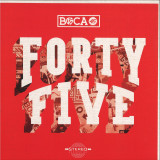
Forty Five is the soundtrack of a life. A revolution in sound played out in stacks of 7' singles; a long player that pulls together the numerous disparate musical strands that have made Boca 45 (aka Bristolian
record selector Scott Hendy) the DJ he is today, in his forty fifth year on Planet Earth. Having previously made records for Grand Central, Jalapeño, Island and Domino, Boca 45 returns with a twelve-track album that's semi-autobiographical and full-time firing on all cylinders.
The first single from Forty Five = "Move A Mountain' featuring the soulful vocals of New Zealander Louis Baker, heavy on the drums, dripping with soul & heavy on the funk "Bryan Munich Theme" - sounds like an incendiary lost '70s library record; the perfect psych funk-flecked walk on music for a team of doughty outsiders destined to lift the cup.
Mount Liberation Unlimited are Tom and Niklas, two Swedes from space who have spent the last 5 years
carving out a particularly vivid niche in contemporary electronic music. Their previous work has seen them
connect with an impressive list of global dance powerhouses: New York's Beats In Space, Melbourne's
Superconscious and Munich's Permanent Vacation have all released 12'' heat from the duo, while their
hometown buddies at Studio Barnhus provided an outlet for what has been perhaps their biggest and boldest
release yet, 2017's double smash single Double Dance Lover. Their live shows are fervent, fast-paced and very
multi-instrumental affairs, performed non-stop at an increasingly prestigious list of clubs and festivals, serving
as prime examples of the MLU boys' core obsession: the interaction of human rhythm and electronic pulse.
They have their own great little radio show on Gilles Peterson's Worldwide FM! Australia loves them! They
got their artist friend Tom-Hadar Elde to sculpt their heads for their debut album cover!
That self-titled debut, to be released May 31 on Studio Barnhus, has been in progress since the very formation
of the MLU project in 2014. It contains some of their earliest work and of course their very latest – all perfected
at the Neve desk of legendary Gothenburg studio Svenska Grammofonstudion, in cahoots with mix engineer
Christoffer Berg (Depeche Mode, Robyn, Fever Ray).
The result is a sonically fascinating, endlessly generous and straight up FUN record that takes the listener on a
joyride through bittersweet stoner disco, frenzied scando-kraut jams and some of the sweetest dance pop to
come out of Sweden this side of Super Trouper.
The record is preceded by a limited 10'' release of album track Climb Me Up, complete with an exclusive club
mix of the song.