Search:my neighbour is

Styles
All
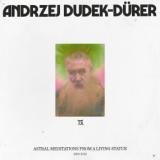
ANDRZEJ DUDEK-DÜRER - ASTRAL MEDITATIONS FROM A LIVING STATUE (1990 - 2013)

Forty years of cassette releases, pressed for the first time on vinyl

First of two instalments exploring the previously unreleased sonic archives of one of Poland’s most enigmatic
living artists - with its first volume focused on his deep listening practice and spiritual reverie (recorded 1990–2013)

The last time Andrzej Dudek-Dürer took a banknote bearing the face of the Polish anarchist Jarosław Dąbrowski from his pocket to trade it for a pair of shoes was in 1969. He bought them for 120zł - the equivalent of 100€ today - and never replaced them since then. Only rebuilt them, year after year, drawing a needle and thread through the leather each time it split, closing one wound before the next one opened. It became a ritual of precision, stitching a record of another year into their soles.

That same year, in Wrocław, he arrived at a conclusion that would recalibrate everything that followed. Convinced he was the reincarnation of Albrecht Dürer, he adopted the surname Dudek-Dürer, stopped cutting his hair and began wearing the same garments every day. It was the first ritual of many, though he wouldn't have called it that yet. Look closely enough, over the decades, and it is always the same gesture, returning in different material: hair growing in a single unbroken strand, a needle drawing thread through leather, sitar strings pulled taut across a neck he built with his own hands and magnetic tape spooling forward inside the cassette boxes stacked against his walls.

None of this began in a vacuum. Dudek-Dürer emerged from the Wrocław neo-avant-garde, in a Polish art world where an exhibition could be cancelled overnight by the stroke of a censor's pen. In 1973, his exhibition Auto-crucifixion was shut down by the state, and for a time he found himself blocked from exhibiting his own art at all - the one force in his life that ever came close to cutting the thread.

He seemed to experience it differently. In 1974, after long, patient research into sitar craftsmanship, he built his first prototype with his brother, a knowledgeable luthier. In 1978, in a smoked-out jazz club, he took his first steps into sound recording with the unreleased album Jazz From Underground with his first band. By 1979, recognition started to travel further than he could.

Turning toward Far-Eastern philosophy, meditation and the idea of reincarnation was another language of freedom for him. It was a way of claiming an inner territory the state could not reach, a border it could not close. Mail Art served a parallel function, reaching further out: in a country that restricted travel and expression, sending and receiving art through the postal system became an act of quiet rebellion.

The body, in his understanding, is only an envelope readied for constant transformation. From this came Metaphysical Telepathy: during the years he could not leave Poland, he treated that confinement as a rehearsal room, sending his mind out ahead on the same thread his body would later follow. Living Sculpture grew from the same root with performances of stillness beside static art objects, until the boundary between the object and the man beside it simply dissolved. Camera Meditation extended the same instinct into photography: a shutter click flattening three dimensions into two so that a single instant could be held forever. Inspired by the pioneers of self-portrait photography like Robert Cornelius, he used it to document time itself, and kept explaining to me: "You know. This is not about vanity. This is about observing time passing.”

The isolation did not end suddenly. It ended the way his own philosophy had already predicted it would, from the inside first. Mail Art quietly solved the problem politics couldn't. Correspondence built during years of confinement slowly worked its way through doors the state itself had kept locked. Contacts made through folded paper and stamps became invitations. Ultimately, invitations became passports.

In 1983 he made his first trip outside Poland, to Germany, in search of the audio technology he couldn’t get his hands on before. In 1985, he was invited by the Indian embassy in Poland to give a sitar concert on an instrument he had spent a decade patiently stringing together - half sitar, half tanpura, built from patience and determination. After the collapse of the People's Republic of Poland, the travels kept unspooling: South Korea, then Mexico, then Australia, Canada, New Zealand, Singapore, Japan and the United States - each stop leaving behind its own small knot of tape, tied off and carried home.

In the decades since, recognition arrived at the same unhurried pace: he conducted workshops at UC Berkeley, served as vice-president for artistic affairs of the Union of Polish Art Photographers and the Union of Polish Visual Artists between 2010 and 2014 and received the Bronze Medal for Merit to Culture - Gloria Artis. His visual work gradually entered collections including the National Museums of Warsaw, the Stedelijk Museum, Tate Modern, MoMA and the Venice Biennale. His musical practice, by contrast, never found that kind of room - left to circulate quietly, sharing his cassette tapes directly, waiting for someone willing to follow it further.

It took months before I could find a way to reach Andrzej Dudek-Dürer - his presence online is very close to nonexistent. Surprisingly, LinkedIn turned out to be the only door still open, a faintly absurd irony given everything else about him. I packed the strict minimum for a three-day trip and an empty notebook and made my way to Wrocław. His headquarters sits in the neighbourhood of Grabyszyn: a two-storey pre-war house that has belonged to his family for generations. The man who opened the door was long-haired, long-bearded, in his trademark leather shoes and patched jeans. We sat in his living room, in front of a computer where decades of recordings sat organised in cryptically named files, surrounded by books and objects that had arrived one layer at a time, leaving room for only two chairs in the middle. His shoes sat by the door, rebuilt so many times they had become their own quiet sculpture. Cassette tapes filled boxes against the walls, almost unlabelled, each one a spool of thread holding decades of sound that had never once been asked for, until now.

I listened for hours: meditating in front of strangers on the porch of a Seoul temple until the tourists stopped taking photos and simply waited with him; a stand-off with border guards at the US–Mexico crossing over an instrument they couldn't identify and didn't trust; a session with the Stockhausen family that he still, decades later, describes like it happened last week. All of it interrupted, occasionally, by the smell of soup boiling and fresh bread warming on the ceramic stove. After two days, it felt like being handed the end of a very long thread and asked, gently, to keep following it. I left with a USB drive holding his full discography, signed with his unmistakable signature.

Astral Meditations From A Living Statue is a length of that thread, drawn out from the boxes stacked against his walls - recordings gathered from different rooms, different countries, different decades. This first record breathes slowly: incense-thick, meditative, built for stillness. A cutting-edge séance in outer space where machines learn how to dream.

It begins with the neo-classical improvisations of Andrzej, space-delayed, recorded at Klub Muzyki i Literatury in Wrocław in 2002. 'When..So' opens the curtains with a deep-rooted meditation accompanied by slow-decaying piano figures illuminated by a candle-lit spirit gathering.

Los Angeles, 1990: a dormant villa, a grand piano, the voice of Bonnie Barnett. 'Exception' is captured in a single room, in a single afternoon - voice and keys circling each other, neither one leading, until the silence between the notes starts to feel like the instrument.

'The Meta...' and 'Tired Of...', recorded at Studio Morandi in Ponte Nossa, Italy, in 1992, settle into a sitar drone built entirely from patience - overtones stacking and beating against each other, strung by a man who never once set foot in India. 'Mastery Of...' follows, recorded the same year at Studio Suski in Łomianki, pushing that same hum further still, until pitch dissolves into a spectral reverie. 'Transcendental Sound', from 2000, closes the first record in a slow bath of celestial frequency - better heard beside the shores of the Odra river.

More than fifty years after deciding that a life could become an artwork, Andrzej Dudek-Dürer continues to inhabit that decision. His shoes keep wearing thin against the earth's crust. His hair keeps growing, one strand at a time. His cassette tapes keep spooling in the dark of their boxes.

Now the thread finds its last shape: a single unbroken groove, spiralling inward from the outer edge to the label at the centre. Never cut - the way nothing else in his life ever was. Drop the needle and it will find that groove and follow it, the same way a needle once followed leather, once followed a border it couldn't cross, once followed string into an instrument that didn't exist until he built it. This record is the other end of a thread that has been travelling for fifty years. For the length of both sides, it rests here, in your hands. This is a timeless proof that the Lord of the New Age was never lost."

Produced by Andrzej Dudek-Dürer

Mastered by Ruud Lekx

Liner Notes written by Mathias Chaboteaux

Pictures by Andrzej Dudek-Dürer

Artwork by Wojciech Gawronski

Executive Producer: Mathias Chaboteaux

℗© 2026 Huveshta Rituals Records. All rights reserved. HR006

pre-order now06.11.2026

expected to be published on 06.11.2026

27,69 €
Five Special - The More I Get To Know You (Unissued Long Version) +2 Tracks (7")
  • A1: The More I Get to Know You (Unissued Long Version)
  • B1: You Got to be The One That I Love (Previously Unissued)
  • B2: Oh, (Oh Look What We’ve Done) (7")

Five Special were a five-man harmony vocal group all from Detroit, formed during 1975. Founding members Mike Pattillo of ‘The Explosions’ and Steve Harris of the group ‘Trouble’ both unhappy with their then situations decided to unite to form their own group. They were soon to be joined by Zeke Stanley of “Deep Velvet”. As a threesome, the sound they created was fantastic but they all agreed a five-man group with five potential lead singers was the way forward.

It was around this time that Mike Pattillo’s lifelong neighbour Ron Banks (of The Dramatics’) introduced the guys to Charles “Chuck” Underwood. Chuck had been involved in the music business from the early 60’s as a show promotor, one of many acts he promoted was The Dramatics. Chuck had known the group from their earliest days and later became their road manager. After a failed attempt to buy the Dramatics contracts from Groovesville Music, Chuck pressed ahead with his plans to form T.E.A.I Record Corporation (T.E.A.I being an abbreviation for “Tellin’ Everybody About It”) with Ron Banks joining the label in an executive role only. This young and aspiring record company sprung into production during 1974 with initial releases on a local artist’s Renee Williams “Special To Me/Are You My Brother”, followed by ‘The Gaslight’ “Just Because Of You/It’s Just Like Magic” in 1975.

Now under the auspice of Chuck, Mike, Steve and Zeke were introduced to Greg Finley formerly of the ‘Innovations’. Now four, the quest for a fifth member continued. After months of disappointing auditions, Ron Banks decide it was time for his younger brother Bryan to embark on a professional career after initially resisting due to him being a 16-year-old school boy. After many daily rehearsals in each other’s respective basements until Bryan’s graduation the full and dynamic sound of these five young men was finally honed. Still nameless, it was Steve Harris that came up with the group’s name ‘Five Special’ stating that these five young men were “very special and unique entertainers, with each member being a complete show in himself” with Bryan on lead they sometimes sounded like “The Dramatics” with Mike they sometimes sounded like “The Temptations” high comparisons indeed.

Five Special’s first recording for T.E.A.I was the 1976 joyously uplifting dancer “The More I Get To Know You” a Jimmy Roach and Marcella Henderson composition featuring Bryan on lead, released as a part I and part II deemed to be a more disc-jockey friendly practice at the time. The record was popular with radio stations throughout the Detroit metropolis and Chuck went on to precure a deal with Polygram which resulted in a release on their nationally distributed Mercury label. A second Five Special release followed in 1977, the Jimmy Roach penned mellifluous “(Let’s Stop Making) Small Talk” backed with the Ron Banks/Paul Clark penned psychedelic soul styled “Oh, Oh (Look What We’ve Done)” with Greg Finley and Zeke Stanley exchanging tenor and baritone parts throughout.

Through our ongoing working relationship with T.E.A.I we have gained access to some previously unissued material on Five Special. From the tapes we have taken “The More I Get To Know You” in its 5:50 minutes entirety backed with the previously unissued mid-tempo delight “You Got To Be The One That I Love” with interchanging leads from Bryan and Steve. The second b-side track is the psychedelic soul “Oh, Oh (Look What We’ve Done)” with interchanging leads between Greg and Zeke. Three songs, three different styles all of the highest quality, with more to come from Five Special, so watch this space!

In Stock

On Stock and ready to ship

Last In: 78 days ago
18,07 €
Agustin Pereyra Lucena - Ese Dia Va A Llegar  LP

"I think I have never met anybody, with the exception of Brazilian guitarists Baden Powell and Toquinho, as connected to his instrument as Agustín Pereyra Lucena" – Vinicius de Moraes

Far Out continues its exploration into the singular catalogue of Argentine guitarist and songwriter Agustin Pereyra Lucena with a special Record Store Day edition of his most celebrated album Ese Dia Va A Llegar.

Agustín Pereyra Lucena was one of South America’s outstanding guitarists. Hailing from Buenos Aires but obsessed with the music of neighbouring Brazil, Agustin abandoned his architecture studies to pursue music full-time, earning friendship and collaborations with Brazilian music's greatest figures including Vinicius de Moraes, Baden Powell, Toquinho, Dorival Caymmi, Maria Bethania and Chico Buarque.

Originally released in 1975, the album has been better known in some parts of the world as Brasiliana – a title repurposed by Agustín's European record label in the 70s to exoticize the sounds of South America for the continental market. It finds Agustin and band—which includes key collaborators Guillermo Reuter on contrabass, and Carlos Carli on drums and percussion— at their most blissfully laid back. The album features idiosyncratic renditions of classics by Antonio Carlos Jobim, Vinicius de Moraes, João Donato and Agustin’s personal hero and friend Baden Powell, alongside Agustín's own works which ooze with captivating mystical wonder.

The analog warmth of the recording is such that it feels like you’re there in mid-seventies Buenos Aires, on a balmy late night session at Estudios Audión, with a group of phenomenally impressive musicians. The heat generated is offset only by the cool temperament of everyone involved. On the handful of vocal tracks on the album, Agustin’s gentle voice is responded to by the liquid smooth vocals of Laura Hatton, Luis Maria Cosenza and Patricia Scheuer.

Agustin’s unique position in the annals of his continent’s musical history has been lovingly maintained by Agustin’s nephew Jose Luis Pereyra Lucena, who has entrusted Far Out Recordings to preserve and re-release Agustin’s works. The music has been professionally remastered at London’s Metropolis Studios, using multiple copies of well kept original vinyl.

Reissued worldwide for the first time under its original title and cover as Agustin originally intended, Ese Dia Va A Llegar will be presented in a limited edition obi-stripped gatefold replica sleeve.

In Stock

On Stock and ready to ship

Last In: 4 months ago
26,85 €
Jeb Loy Nichols - The Music Maker (LP 2x12")

“The high priest of country cool” - Rolling Stone

“I like him very much. He’s very special. He’s singing with a voice I never heard before” - Townes Van Zandt

“A conscious, soulful brother” - Horace Andy

“He’s a brother to me - one of the best singer/songwriters I’ve ever met” - Adrian Sherwood

“Unearthed mine of gems from inner Wales - a songbook of ideas - that's Jeb!” - Gilles Peterson

Jeb Loy Nichols is a bonafide Country (Got) Soul legend. The Music Maker presents 21 incredibly deep, grooving and soulful songs from the cream of Jeb's catalogue; from its earliest days to his latest unreleased gems via countless rare and unbelievably good lost-classics. This 2LP set is presented in a gatefold sleeve complete with freshly commissioned artwork courtesy of Jeb himself.

In collecting these uncut, under-heard gems, we hope to do justice to Jeb's jaw-dropping artistic brilliance. A man who, in working with Adrian Sherwood, Dennis Bovell, Dan Penn, Larry Jon Wilson and countless other legendary characters, has crafted some of the most deeply affecting folk, country, soul, funk, blues, dub, reggae, gospel, rap and electronic music, ever heard.

The first music Jeb really felt a connection with was southern soul: "I used to listen to the radio at night and fell in love with Bobby Womack and Al Green, The Staple Singers and Joe Simon – that whole Nashville/Memphis/Muscle Shoals thing.” But Jeb was so much more than a soul boy, Indeed, he "went to bluegrass festivals with my dad and come home and listened to jazz records with my mother.” And, when he was fifteen, he heard his first punk record: "God Save The Queen" by The Sex Pistols. “That and The Ramones completely changed me.” In 1979 he got a scholarship to go to art school in New York: “A great time. Punk was over but hip-hop was starting and I got into that in an obsessive way.”

His first recording, in 1980, was an unreleased rap song called "I’m A Country Boy". If that isn't an insight enough into Jeb's kaleidoscopic path through music, in 1981 he visited friends in London and found himself living in a squat with Adrian Sherwood, Ari Up (from the Slits), and Neneh Cherry. “Adrian put me to work immediately, moving boxes of records all across London. It was Adrian that was and is my biggest influence – in his complete disregard for genre purity.” So, presumably you're getting the picture? A veritable musical magpie with a voracious appetite and unimpeachable taste.

"Mine has always been a meandering career. I've done what I've done, and made the music I've made, due to chance meetings. I'm not particularly ambitious; it's more important to me that I work with friends and like-minded people. I've been a big fan of Be With for years. Everything they release is essential. When they asked about rereleasing "Countrymusicdisco45" I was both pleased and flattered. We began talking about how we'd do it; two years and twenty-one tracks later, here we are. I've always thought of the music I make as Country Music. Music conceived in the country, written in the country, recorded in the country. I left London and moved back to the country so I could live among the trees, the grasses, the animals, those things that don't go to war and get greedy. This compilation is the story of that life. Hand made, lo-fi, ramshackle, stripped down, real deal music. Heartworn and funky. Music made in the kitchen, not in the studio. As the great Skip Mcdonald said, Perfect ain't perfect. It's great to see all these tracks gathered together. It feels like a family reunion. Some older members of the tribe, some newer arrivals."

Opener "countrymusicdisco45" is a song Jeb wrote about how his crew lives, tucked up blissfully in the hills: "House parties full of country folk dancing to disco, reggae, soul, country, hip-hop. All night. I recorded it at home under the influence of Stevie Wonder." It's one of the funkiest records you'll ever hear. "Sometimes Shooting Stars" was recorded in Nashville and mixed by the legendary Dennis Bovell. It's deep, dubby, majestic. A thing of fragile, melodic beauty. The party ramps back up again with the undeniable groove of "Short Cut Home" before the profoundly moving "Disappointment" arrives. One of many songs he's recorded with good buddy Benedic Lamdin (aka Nostalgia 77): "We were going for a Leon Thomas meets Richard Brautigan meets Alice Coltrane kind of thing". We think they nailed it. "Days Are Mighty", like a lot of the tracks on this collection, "started life as a demo, an attempt to get something down while it was fresh. No frills, nothing fancy, just feel." And what feels!

The irrepressibly funky "Don't Dance With Me Tonight" is a deeply moving, slow-mo organ-drenched head-nod-funky country-ballad. Next up, the breezy "You Got It Wrong" was recorded in Wales with some of Jeb's good friends and neighbours, The Westwood All Stars, featuring Clovis Phillips and Will Barnes. Skanking fiddle-flecked gem "Ring The Bells" was the first thing Jeb recorded when he moved to Wales. A combination of all his loves; country, reggae, soul. It's followed by "Let's Make It Up", a truly sumptuous string-drenched emotional groover. "When Did You Stop Loving Me" is another Nashville track, written and recorded during a time Jeb was spending a lot of time with the Muscle Shoals crew, Donnie Fritts, Spooner Oldham, George Soule and Dan Penn: "It shows, I'm sure, their influence." Oh, you bet it does!

The swaggering country-funk of "Just Beginning" should grace many groove-focused DJs' sets whilst "Wintering Of The Year", again made with Clovis, is pastoral, campfire soul. The glacial, gorgeous "Let It Rain" is from an unreleased record Jeb made with the great British jazz bass player Andy Hamill and "We Tell Each Other Who We Are" is freaky country-soul made by a man with a love for strutting, wonky hip-hop stylings. Rounding out the side, "Trip To You" is pure, uncut amphetamine-propelled drum-machine soul.

The spare, beautiful "Dirt" is from an EP Jeb made with Julian Moore in his house in South London: "All first takes, straight to tape." Swoon! "Heaven Right Here" was a very minor league hit in America: "It was produced by the brilliant and much missed Wayne Nunes. It was started in the countryside of Missouri, finished in the countryside of Wales, and recorded in the countryside of Sussex." Double swoon! "If Later Ever Comes" is electronica meets J.J. Cale business whilst "Remember The Season" is truly wonderful and breezy guitar soul. "A Little Love" was made with Wayne Nunes as well, after a night of listening to Studio One and Northern Soul. Bouncy dub closer "Weary Traveller" was written by Bill Monroe, the hero of Jeb's youth: "Monroe's music was heavily influenced by black southern churches; I've tried to keep some of that feral feel." This was the final recording by Jeb's 1990s Country-Dub band, Fellow Travellers.

The name of this compilation comes from a time when Jeb lived in Peckham, south London and he used to DJ and sometimes perform at a local bar: "The owner of the bar, a Jamaican named Count Percy, once asked me what I called my music. I told him I wasn't sure, I guess just pop music. He thought about it for a minute and then said, 'no, more like mom and pop music'. Rather than call me a country singer or a folk singer he always referred to me as The Music Maker."

With the long overdue deluxe overview of his beloved music, we hope to finally shine a light on the unheralded genius of Jeb Loy Nichols. RIYL Larry Jon Wilson, Townes Van Zandt, Bobby Charles, country got soul artists, dub, deep soul, disco, dancing, heartbreak. This deluxe collection, spellbinding from beginning to end, should hopefully go some way to ensuring Jeb reaches an ever bigger, ever more appreciative crowd of followers. Mastering for this special double vinyl edition was overseen by Be With regular Simon Francis and it was cut by the esteemed Cicely Balston at Abbey Road Studios to be pressed in the Netherlands by Record Industry. The artwork has been lovingly put together by The Music Maker, himself, Jeb Loy Nichols. "Be With is the perfect home for this mongrel music. I am forever in their debt." The pleasure is all ours, Jeb.

In Stock

On Stock and ready to ship

Last In: 8 months ago
28,99 €
Various - Volition Cuts Vol.1

Efficient Space honours trailblazing Australian imprint Volition Records with Volition Cuts Vol. 1. Evolving from Andrew Penhallow’s time at GAP Records, which smuggled Cabaret Voltaire, The Fall and the Factory catalogue into the region, Volition shifted focus to homegrown talent over imported sounds. Echoing its precursor’s blend of indie friction and electronic curiosity, the label wired itself into the pulse of club and rave culture, linking city scenes and amplifying them for the mainstream. With retina-scorching design, uncompromising packaging and top-tier remixes, Volition consistently bent the major label machine to its will.

No Volition retrospective would be complete without Sisters Underground’s intergenerational anthem ‘In the Neighbourhood’. Otara teenagers Brenda Makamoeafi and Hassanah Iroegbu brought their Pasifika perspective to Proud (An Urban-Pacific Streetsoul Compilation), a commercial success that platformed NZ rap and R&B with a clarity that outshone its overseas counterparts. The quiet architect of Volition’s sound, producer prodigy Robert Racic flipped the classic as a hip-house dub before his untimely passing in 1996.

Its A-side companion comes from Brisbane synth-pop unit Boxcar, who signed to Volition after frontman Dave Smith handed a cassette to Tom Ellard of Severed Heads during a school newspaper interview. That unlikely handoff led to their 1990 debut Vertigo. Here, their ritual-laced, body-jacking industrial is retooled by Miami freestyle maverick Tony Garcia.

Further cherry-picking from the VOLT vaults, Sexing The Cherry unleash a bleep-addled meltdown from Brisbane’s Edwin Morrow and Cherryn Lomas. ‘This Is A Dream’ was recorded exclusively for High (A Dance Compilation), the first all-Australian V/A to top the ARIA charts, propelling the local movement into national consciousness.

Closing the sampler, Sydney’s Single Gun Theory joined Volition as they moved from post-punk abstraction and electronic collage toward downtempo, sample-based mysticism. Their 1994 ambient-pop reverie ‘Fall’ is reimagined by Stuart Crichton and Apollo 440’s Norman Fisher-Jones as full-throttle Goa trance, a final surge that channels the label’s relentless push into new terrain.

Volition Cuts Vol. 1 is dedicated to the loving memory of Volition’s visionary founder Andrew Penhallow, and key contributors Robert Racic and Edwin Morrow.1

In Stock

On Stock and ready to ship

Last In: 7 days ago
14,71 €
Teen Daze - Elegant Rhythms

DJ support: Tim Sweeney, Make A Dance, Parris, Pleasure Voyage, Camillo Miranda

Back yard - Back yard is the first single from the new Teen Daze album, Elegant rhythms, and features singer-songwriter Andy Shauf on drums, and LA jazz staple, Sam Wilkes, on bass. This is a stark change in sound for Teen Daze, who’s last album Interior was an exploration of neon-lit House music. Back yard is a mellow groover, conjuring up images of Laurel Canyon in the 70s, yet still with its flourishes of contemporary sounds.

We’re out of phase again - We’re out of phase again is another vulnerable glimpse into the inner world of Teen Daze, and marks the release of his most personal album to date, Elegant rhythms. In contrast to the synthesized, digital world of his prior album, Interior, here we’ve been brought into a lush, organic arrangement, brought to you in large part to the stunning bass playing by Sam Wilkes. While the verses pulse forward, the chorus slows things down, and evokes the sophisti-pop sounds of The Blue Nile. This track is a stunning showcase of the world of Elegant rhythms.

Nothing’s gonna change my love - Teen Daze returns with his second single of the year, Nothing’s gonna change my love. The stark change in sound, as heard on previous single Back yard, is on display here again: a smouldering, 2 and a half minutes of slow jazz-pop, indebted to the great Sade, or perhaps the feeling of leaving downtown LA at 2 AM. Lyrically, we hear a story of a love, challenged by the unpredictable nature of our lives. This may be Teen Daze’s smoothest song to date.

Neighbourhood - Neighbourhood is the third single from the recently announced LP from Teen Daze, Elegant Rhythms. Along with Andy Shauf on the drums, and Sam Wilkes on the bass, Teen Daze gives us a languid tour of his quiet neighbourhood. The sun has set on the pleasant, tree-lined streets, and a stranger, more surreal environment presents itself. The song plods forward at an extremely comfortable pace, held down by the paradoxically loose-yet-tight rhythm section. Lyrically, we walk around the Neighbourhood at night, and while the chorus reveals a type of sobriety, the vibe of the song makes it easy to feel a little…effected.

Fade away - Fade away sets the tone for Elegant Rhythm’s side B: a deeply personal, though somewhat veiled, confession of loss. How does it feel to grieve something that was never really here? A smouldering, slowly progressing first half erupts in synthetic noise, and then fades into the ether with it’s repeating refrain, “I can feel you / feel you fade away / when there’s nothing / nothing left to say”.

Fall ahead - A sweet piano tune which serves as a quiet break in the record, intended to help the listener reflect and take a moment of pause before we reach the final two songs on the album.

HST underwater - The penultimate track on the record tells a story where the narrator finds themself in an alien, yet oddly familiar place. Arpeggios soaked in crystal blue water flow through the stereo field, while the narrator, vocoded and drenched in autotune, searches for meaning and purpose in a confusing world. This is one of Teen Daze’s most cinematic, emotional songs yet.

In the rain - It’s never really made explicitly clear on this record, but a lot of these songs find Teen Daze wrestling with life as a new father, and this song, the final on the album, expresses the fears of generational trauma. A touching, tender ode to his children, we hear Teen Daze at his most personal and vulnerable. The falling rain surrounds some absolutely breathtaking bass playing from Sam Wilkes, and Teen Daze’s signature ambient keyboard sounds.

Radio Support: Ruf Dug (Soup To Nuts on NTS)

In Stock

On Stock and ready to ship

Last In: 2 years ago
20,97 €
Various - If I Had a Pair of Wings: Jamaican Doo Wop, Vol. I - III (3x12")
 
42

Death Is Not The End together all three LP volumes of the critically acclaimed If I Had a Pair of Wings LP compilation series for a bundled edition.

"...all of the music on this compilation is the result of the forward-thinking artists and producers that realised the worth of local Jamaican artistry during a time when the island's leading political figures had not yet managed to throw off the colonial yolk. These are sounds with a certain innocence and the optimistic promise of better to come, with the influence of American pop ballads and doo-wop looming large, yet already pointing to the innovations of the future. Listen keenly and take in the sounds of the Jamaican music industry at its very beginnings, its singers and players drawing from the popular styles of the island's larger neighbour and already changing those styles into something their own." - David Katz

Lauren Laverne's comp of the week on BBC Radio 6 Music w/c 11th Jan.

In Stock

On Stock and ready to ship

Last In: 3 months ago
41,98 €
Diepkloof United Voice - Harmonizing Soweto: Golden City Gospel & Kasi Soul from the new South Africa

In apartheid-era South Africa, gospel music provided solace and served as a tool for covert communication to circumvent the censorship of the settler regime. By the 2010s, South African gospel, deeply ingrained in the soul of Soweto, assumed a new role—as a heartfelt cry against persistent failures and shortcomings, a cry mourning a South Africa that never materialized.

A new South Africa needed a new gospel sound.

In 2016, nine young men from different parts of Diepkloof, a celebrated neighbourhood brimming with talent within Soweto's sprawling township, came together to form the sound of a new South Africa under the name Diepkloof United Voice.

Diepkloof United Voice's music has gone viral multiple times on TikTok, YouTube, and Facebook, garnering between 60,000 to 2 million views. The comments section displays flag emojis from Brazil to India, showcasing the global reach of their music.

This album was recorded on site in Soweto, in an abandoned classroom of Lebowa Elementary School in Diepkloof Zone 3, where the choir rehearsed for years. Amid rolling blackouts, Diepkloof United Voice poured their heart, soul, and vocal chords into their debut record, combining classic South Africa gospel, Soweto's own kasi soul, American blues, and Zulu flavor, to present the contemporary gospel sound of a changing South Africa.

The promise of a new South Africa might finally be realized, as Diepkloof United Voice guarantees the country's future is guided by the truth, uttered with each gasp of breath from their inimitable voices.

In Stock

On Stock and ready to ship

Last In: 2 years ago
15,08 €
Ludwig Von 88 - Le Printemps du Pogo LP

After the inevitable success of L'Hiver des crêtes (aka season 1 of their major new project celebrating 40 years of approximate punk), Ludwig Von 88 are back for new adventures in a second season entitled Le Printemps du Pogo. This second vinyl album (of the four planned this year) is this time illustrated by LauL (iconic graphic designer of the 80s - Bérurier Noir, Ludwig Von 88, Mylène Farmer, Patrick Topaloff).

Fourteen tracks packed with love, joy, shitty jobs, noisy neighbours, flowery pogos, fried chicken, unsanitary dungeons and a negative carbon footprint.

There are some good traditional Keupon numbers, but also ska, reggae, yodelling (Yodel to Hell), a universal anthem of destructive punk (Youplapunk), swing, the follow-up to Fistfuck Playa Club (New Club) and Kaliman (Kaliman saves the world), and the long-awaited conclusion, 38 years later, to their interstellar hit J'ai tué mon père (J'ai sauvé mon père). Or the hit Let it burn, which we'll probably be able to sing along to during the long hot days to come.

Thirteen of these songs have already been released on the internet (at a rate of one a week, because the Ludwigs like periodicity, and that's why they keep coming back and coming back) but the fourteenth track, Casques Rouges, is completely new to the galaxy.

So here's something to liven up the weeks of holiday that are just around the corner. On the beach, in the mountains or in the forest, approximate punk remains salvific and Ludwig Von 88 are its most faithful servants.

Youplapunk to you all!

In Stock

On Stock and ready to ship

Last In: 3 years ago
22,06 €
Antonio Neves - A Pegada Agora É Essa (The Sway Now)

repressed !

From samba and bossa nova through to baile funk, with carioca expressions of jazz, rock and hip hop in between, the sound of Rio de Janeiro, while continually evolving, has always held an unnameable quality which reflects the magic and mystique of the city itself. Multi-instrumentalist and arranger Antonio Neves is the city’s newest trailblazer: the enfant-terrible of Rio’s music scene, leading a vital and diverse constellation of both emerging and well-known artists advancing the city’s musical legacy.

“It all started one sleepless night, after watching a Quincy Jones documentary”. Inspired by the legendary music magnate, Neves began writing a list of artists residing in Rio de Janeiro “people that I admire, that I consider geniuses of their instruments, who share with me affinities, anxieties and projects.” The list included some of Brazil’s most revered living musicians who Neves has worked with in recent years: Hamilton de Holanda, Leo Gandelman and Dorival Caymmi. Neves also called on some of Brazil's most exciting emerging talents including Alice Cayymii and Ana Frango Eletrico.

A Pegada Agora É Essa (The Sway Now) is Neves’ second album: a vibrant portrait of the current Brazilian music scene. From the regional to universal, popular to erudite, samba to rap, Latin rhythms to jazz, MPB and pop to good old rock'n'roll, Neves walks with fluency and mastery amongst all the musical genres that Brazil has to offer.

“My offer to the musicians was complete freedom to express themselves through the songs I proposed – classics like “Summertime”, “Luz Negra” and “Noite de Temporal”, and compositions of my own – creating a space of authorship for the band and the guests. A space for inventions, purges, delusions, laughter. The idea was to bring the freedom of jazz crossed by Brazilian rhythms, such as the traditionals Partido Alto (A Pegada Agora É Essa) and Jongo (Jongo no Feudo and Luz Negra); rhythms of African-Brazilian religions like Candomblé (Noite de Temporal) and Umbanda (Forte Apache); and a tribute to newest Rio de Janeiro’s contribution to Brazilian music, the Funk Carioca (Simba)”.

Coming from a musical family, Antonio’s father, Eduardo Neves, was a renowned conductor and a professor at Juilliard School of Music and the California Jazz Conservatory. In the bohemian neighbourhood of Lapa, aged 14, Antonio began his career as a drummer, before experimenting with brass. He would soon become a skilled trombonist and arranger achieving the recognition of his teachers and peers. It wasn’t long before he would be playing with some of the biggest names in Brazilian music, such as Hamilton de Holanda, Leo Gandelman, Moreno Veloso, Kassin and Elza Soares.

His debut album as a trombonist was PA7 (2017, Rock It), released at the same time he was travelling the world playing with artists like Moreno Veloso, Kassin and Leo Gandelman, and recording the albums Jobim, Orquestra e Convidados (2017, Biscoito Fino), with Mário Adnet and Paulo Jobim; and Elza Soares Canta e Chora Lupi (2017, Coqueiro Verde Records). More recently, Neves was the arranger for the acclaimed Little Electric Chicken Heart album, by Ana Frango Elétrico, which has been nominated for a Latin Grammy and voted 2019’s ‘Brazilian Music Revelation’ by The Art Critics Association of São Paulo.

In Stock

On Stock and ready to ship

Last In: 3 years ago
14,71 €
Mouchoir Étanche - Une fille pétrifiée

Mouchoir Étanche

Une fille pétrifiée

12inchCELL-03LP NOCOVER
Cellule 75
30.12.2020

"I am sitting in a garden, I haven't left the property in weeks, someone is dropping off food once a week. I haven't seen a human being in ages, I feel like a reverse Schroedinger cat - do I exist when nobody sees me? I must be somewhere in France but I don't remember. I have lost my consciousness again. When I wake up I hear a broken record looping somewhere in the mansion. A washed-out opera. Behind the trees I see the dilapidated hermaphrodite sculpture in a field of verdant nettles and fern. I hear gunshots far afield, aeroplanes in the sky, sirens on the main road.
When unconscious I dreamt of sitting on the Concorde observing the scarab blue ocean and iridescent clouds from above, an erstwhile receding memory. Sometimes I hear the organ of the nearby Renaissance Cathedral merging with the Russian Church bells.
I am hallucinating again. Someone's humming in the kitchen? Singing? A Radio? I overhear two young women talking about art galleries in the neighbour's garden. Bees attack, again…..again and again. The hairspray finally intoxicates them. An amphoric japanese voice is whispering in my head saying I will die soon. Someone (something?) bangs on the vases. The fountain's water turns dark red.
Fleur calls and says mum died. The funeral will be televised on tuesday. We opt for the synthetic choir for the service. The call is suddenly interrupted. Mold is slowly taking over the house.
I go back inside."

Une Fille Pétrifiée is the debut album of new Black To Comm related entity Mouchoir Ètanche (after one recent 12" on Richter's own Dekorder label). Combining real and fake acoustic instrumentation, sampling, field recordings and excessive yet inaudible post production this is another sublime and ethereal statement. Influences are ranging from (French) Classical & Opera to the anecdotical compositions of Luc Ferrari, Chinese Opera, Chanson, Sacred Music / Church Music, JG Ballard and Surrealism.

Marc Richter records as Black To Comm for Thrill Jockey, Type and Dekorder and as Jemh Circs for his own Cellule 75 imprint. He also produces soundtracks and acousmatic multichannel installations for institutions such as INA GRM Paris, ZKM Karlsruhe and Kunstverein Hamburg.

In Stock

On Stock and ready to ship

Last In: 15 months ago
19,37 €
Troye Sivan - She’s the Best

Als Sänger, Songwriter, Schauspieler und Model hat sich Troye Sivan längst als eine der prägendsten Popstimmen seiner Generation etabliert.
Seine Musik verbindet emotionale Offenheit mit modernem Synth-Pop, euphorischen Dance- und ClubSounds und persönlichen Geschichten über Liebe, Begehren, Identität und Selbstfindung.
Mit seinem vierten Album „She’s the Best“ führt Troye diesen Weg weiter: Intim und selbstbewusst zugleich bringt das Album all das zusammen, was Troye Sivans Musik ausmacht – große Popmomente,
emotionale Verletzlichkeit, pulsierende Club-Energie und eine unverwechselbare queere Perspektive. Das
Album beschäftigt sich mit Begehren, Identität, Freude, Einsamkeit und queerem Zugehörigkeitsgefühl und
ist als immersives Projekt konzipiert, das ebenso visuell wie musikalisch erlebt werden soll.
Seit seinem Debütalbum Blue Neighbourhood (2015) und dem Nachfolger Bloom (2018) hat Troye seinen
Sound und seine visuelle Welt kontinuierlich weiterentwickelt. Songs wie „Youth“, „My My My!“, „Dance
To This“ feat. Ariana Grande, „Angel Baby“ und „Rush“ machten ihn zu einem international gefeierten
Pop-Artist. Einen bisherigen Karrierehöhepunkt markierte sein drittes Studioalbum Something to Give Each
Other (2023). Die Leadsingle „Rush“ entwickelte sich zum globalen Dance-Pop-Hit, erreichte international
hohe Chartplatzierungen und brachte Troye u.a. zwei Grammy-Nominierungen ein.
Die enge Verbindung zu seiner Community und eine selbstverständliche queere Perspektive prägen Troye
Sivans Musik und visuelle Welt seit jeher. Mit She’s the Best entwickelt er diese weiter und eröffnet
ein neues Kapitel, in dem Pop, Performance, Fashion und Clubkultur zu einer unverwechselbaren Einheit
verschmelzen.

pre-order now09.10.2026

expected to be published on 09.10.2026

27,94 €
Railcard - Two Steps At A Time LP
  • 1: Two Steps At A Time
  • 2: 196 Forever
  • 3: Hillman Minx
  • 4: Flannelette
  • 5: Foxy
  • 6: I’m A Disaster
  • 7: Paper Thin
  • 8: Unstable Neighbour
  • 9: Runaround
  • 10: When You Say You Love Me
  • 11: Snow Blind
  • 12: Sunday Sun

You have to wonder why Railcard took so long to be born: their debut album feels like it should have been in your collection for years.


But it wasn’t until 2025 that Rachel Love (Dolly Mixture), Ian Button and Peter Momtchiloff (both Heavenly) met at a gig, realised that they were exactly the same age, and decided that this was an excellent reason to form a new band. The shared history, the same pop references, the parallel lives… Railcard had to happen, and there was no time to lose. Two Steps At A Time - the album title and theme song - express exactly how quickly Railcard have worked since then - jumping over pavement cracks and whistling past graveyards to get these songs written, recorded and released while they are still sweet and fresh.


The band released three digital EPs in early 2026, which were then gathered onto a CD and released by Skep Wax and Slumberland. They sold out very quickly. The critical response to a mail-order-only CD was far greater than anyone expected.


Railcard made their live debut in December 2025 and had by then recruited their fourth member: Allison Thomson (Trash Can Sinatras, The Love Band), whose flawless trumpet and swirly keyboard-playing complete the Railcard sound, allowing the band to fulfil the significant ambition and range of the songs, which are mostly co-written and often co-sung by Love and Button. “Flannelette” and “Sunday Sun”, delicate and swoony, could almost be Slapp Happy at their most Bacharach. “Foxy”, mysterious and charming, has more than a hint of Kate Bush December magic. The raucous duet “I’m A Disaster” is The Kinks meets deadpan Shangri-Las. The title track could have been an alternative theme tune for Whatever Happened To The Likely Lads. “Runaround” is like a school choir doing The Raincoats. “Unstable Neighbour” is mesmerising and insistent: it might make you think of Stereolab; we might imagine an indiepop Hawkwind. Peter Momtchiloff also contributes two wonderful songs on the album: the fragile and hallucinatory “Paper Thin” and the Love-meets-Undertones rush of “Hillman Minx”.


As with the first EPs, Railcard enlisted the sonic services of Medway psych expert Allan Crockford (of The Prisoners, James Taylor Quartet and many more) who has delivered mixes that pump with vintage valve energy and reverby depth.


Railcard have a string of UK dates through the summer and Autumn.

pre-order now18.09.2026

expected to be published on 18.09.2026

23,95 €
Josephine Foster - Godmother LP
  • 1: Hum Menina
  • 2: Sparks Fly
  • 3: Guardian Angel
  • 4: Old Teardrop
  • 5: Flask of Wine
  • 6: Gold Entwine
  • 7: Dali Rama
  • 8: Nun of the Above
  • 9: The Sum of Us All

A beautifully observed baroque masterpiece, part dream pop, part futuristic psych-folk with ambient synths and Josephine Foster’s plaintive guitar. Godmother is a slowly unfolding song cycle that marries a myriad of previous musical escapades with electronic experiments. Exploring new horizons on this record, it sees Foster at her most expressive and hypnotic. Now back home in the mountains of Colorado, Josephine’s 20-year journey to this new nirvana becomes enthralled further with a symphony of synths that sound like they are played in some neighbouring netherworld, through cotton gauze. It’s music that’s devotional, spiritual, a fitting soundtrack for any journey within or without, a means to experience places and vibrations beyond the boundary of time and space. Discussing the record, Josephine explains “You may notice me travelling a bit further sonically from our precious earth, aspiring to rise into broader astral perspective, to contemplate the light and origins of it all, as I do believe there is a grand source that is the sum of it all, us all. Performing all the parts on this recording, you may sense me focussing gestures of my singing into the instrumentation, which is a very great relief indeed, as the voice has such grand dreams to be set free.” “With her haunted, theatrical delivery, Foster cuts an arresting figure.” Pitchfork // “Out of time yet timeless” The Wire

pre-order now04.09.2026

expected to be published on 04.09.2026

14,92 €
Zzzahara - Spiral Your Way Out MC (TAPE)
  • It Didn't Mean Nothing
  • In Your Head
  • Bruised
  • If I Had To Go I Would Leave the Door Closed Half Way
  • Wish You Would Notice (Know This)
  • Ghosts
  • Pressure Makes a Diamond
  • Head in a Wheel
  • Bluebird
  • NY NY
also available

LP[18,07 €]


"I decided to just let myself go," Zzzahara says of their new record, 'Spiral Your Way Out' "I think I finally came to this acceptance that I don't have to be perfect. I want to be a good role model to my fans and stuff like that, but I also don't want to hide who I am." Zzzahara's music wades into the deep waters of love, lust, and self-discovery in a part of the world where artifice and authenticity co-exist. Emerging from the heart of LA's alternative music scene, their sound is raw in feeling and rebellious by nature.

Their 2022 debut album, Liminal Spaces, chronicles a coming- of- age in Highland Park, following painful childhood memories through to late- night, live- fast coping mechanisms, and the changes the neighbourhood has endured over the same period of time. Their 2023 follow- up, Tender, marked a period of slowing down, looking inward, and embracing a softer side of being. 'Spiral Your Way Out' sees Zzzahara evolve again. Emotionally, its foundations are built on scorched earth.

The album finds Zzzahara in the aftermath of a relationship spent trying to fit someone else's mould, being jerked around by indecision, and then hitting "emotional rock bottom." Made in a three-month burst that let all their pent-up frustrations loose, 'Spiral Your Way Out' is in part a work of self-reclamation, swapping there 2nd album Tender's meditative state for something fiery and more assertive. The new album marks another sonic evolution as much as an emotional one. Zzzahara's songs have always come wrapped in a warm glow that reflects how they were written -namely at home in their bedroom.

That glow remains on 'Spiral Your Way Out', but it also packs an ambitious streak and a gutsy punch. Taking a more collaborative approach than usual, Zzzahara worked with a range of producers including Jorge Elbrecht (Japanese Breakfast, No Joy, Sky Ferreira), Sarah Tudzin (boygenius / Cloud Nothings / The Armed), former Ducktails guitarist Alex Craig (Jelani Aryeh / re6ce) and Halsey tour drummer Franco Reid, who helped harness their intimate style of writing and blow it up into something more panoptic. After a year of upheaval, Zzzahara finally feels "calm." The musical equivalent to going several rounds on a punching bag, 'Spiral Your Way Out' finds solace between extremes. It licks its wounds in a place where pain and love, healing and abandon, sit side-by-side. If it has a message, it's one of standing tall in your own shoes - scuffs and all.

pre-order now05.06.2026

expected to be published on 05.06.2026

10,29 €
Zzzahara - Spiral Your Way Out LP

"I decided to just let myself go," Zzzahara says of their new record, 'Spiral Your Way Out' "I think I finally came to this acceptance that I don't have to be perfect. I want to be a good role model to my fans and stuff like that, but I also don't want to hide who I am." Zzzahara's music wades into the deep waters of love, lust, and self-discovery in a part of the world where artifice and authenticity co-exist. Emerging from the heart of LA's alternative music scene, their sound is raw in feeling and rebellious by nature.

Their 2022 debut album, Liminal Spaces, chronicles a coming- of- age in Highland Park, following painful childhood memories through to late- night, live- fast coping mechanisms, and the changes the neighbourhood has endured over the same period of time. Their 2023 follow- up, Tender, marked a period of slowing down, looking inward, and embracing a softer side of being. 'Spiral Your Way Out' sees Zzzahara evolve again. Emotionally, its foundations are built on scorched earth.

The album finds Zzzahara in the aftermath of a relationship spent trying to fit someone else's mould, being jerked around by indecision, and then hitting "emotional rock bottom." Made in a three-month burst that let all their pent-up frustrations loose, 'Spiral Your Way Out' is in part a work of self-reclamation, swapping there 2nd album Tender's meditative state for something fiery and more assertive. The new album marks another sonic evolution as much as an emotional one. Zzzahara's songs have always come wrapped in a warm glow that reflects how they were written -namely at home in their bedroom.

That glow remains on 'Spiral Your Way Out', but it also packs an ambitious streak and a gutsy punch. Taking a more collaborative approach than usual, Zzzahara worked with a range of producers including Jorge Elbrecht (Japanese Breakfast, No Joy, Sky Ferreira), Sarah Tudzin (boygenius / Cloud Nothings / The Armed), former Ducktails guitarist Alex Craig (Jelani Aryeh / re6ce) and Halsey tour drummer Franco Reid, who helped harness their intimate style of writing and blow it up into something more panoptic. After a year of upheaval, Zzzahara finally feels "calm." The musical equivalent to going several rounds on a punching bag, 'Spiral Your Way Out' finds solace between extremes. It licks its wounds in a place where pain and love, healing and abandon, sit side-by-side. If it has a message, it's one of standing tall in your own shoes - scuffs and all.

pre-order now05.06.2026

expected to be published on 05.06.2026

18,07 €
Joeystarr - Egomaniac (2x12")

Joeystarr

Egomaniac (2x12")

12inchMOVLP4038C
Music On Vinyl
15.05.2026
  • A1: Underground Up
  • A2: Jour De Sortie
  • A3: Hip Hop (feat. Degom)
  • A4: Dans Mon Secteur
  • A5: Appel À La Resistance (feat. Olivier Besancenot) (Interlude)
  • B1: On Te Voit
  • B2: On N On (feat. Nathy Boss)
  • B3: Complexe
  • B4: Faut S' Lever
  • C1: I Got Kimfu On My Track (Interlude)
  • C2: Mon Rôle (feat. Oxmo Puccino)
  • C3: Mamy…. (feat. Nicoletta)
  • C4: Champagne
  • D1: Affamé
  • D2: Je Paie Pas (feat. Fdy Phénomen)
  • D3: Egomaniac (Interlude)
  • D4: Jour De Sortie (Kimfu Remix)

JoeyStarr is the co-founder of the famous French rap duo Suprême NTM. Originally starting out as breakdancers and graffiti writers, the duo is known for representing the perspective of minorities residing in the underprivileged neighbourhoods of Paris and beyond through dark, gritty, politically-conscious lyrics. Despite achieving record sales with their four albums, they split in 1998.

After a few detours away from the music business, in 2006 JoeyStarr dropped his first solo album. Egomaniac, released in 2011, is his second album and includes some high-profile collaborations; on "Mamy..." he works together with Nicoletta on a rework of her 1971 hit single "Mamy Blue" and the interlude "Appel À La Resistance" features a speech by leading left-wing politician Olivier Besancenot. After its initial release, the vinyl edition went out of print so we're happy we can finally make it available again.

Egomaniac is available as 15th anniversary edition of 1000 individually numbered copies on orange vinyl and includes an 8-page booklet.

pre-order now15.05.2026

expected to be published on 15.05.2026

46,18 €
Guilty Razors - Complete Recordings 1977 - 1978

UILTY RAZORS, BONA FIDE PUNKS.


Writings on the topic that go off in all directions, mind-numbing lectures given by academics, and testimonies, most of them heavily doctored, from those who “lived through that era”: so many people today fantasize about the early days of punk in our country… This blessed moment when no one had yet thought of flaunting a ridiculous green mohawk, taking Sid Vicious as a hero, or – even worse – making the so-called alternative scene both festive and boorish. There was no such thing in 1976 or 1977, when it wasn’t easy to get hold of the first 45s by the Pistols or the Clash. Few people were aware of what was happening on the fringes of the fringes at the time. Malcolm McLaren was virtually unknown, and having short hair made you seem strange. Who knew then that rock music, which had taken a very bad turn since the early 1970s, would once again become an essential element of liberation? That, thanks to short and fast songs, it would once again rediscover that primitive, social side that was so hated by older generations? Who knew that, besides a few loners who read the music press (it was even better if they read it in English) and frequented the right record stores? Many of these formed bands, because it was impossible to do otherwise. We quickly went from listening to the Velvet Underground to trying to play the Stooges’ intros. It’s a somewhat collective story, even though there weren’t many people to start it.
The Guilty Razors were among those who took part in this initial upheaval in Paris. They were far from being the worst. They had something special and even released a single that was well above the national average. They also had enough songs to fill an album, the one you’re holding. In everyone’s opinion, they were definitely not among the punk impostors that followed in their wake. They were, at least, genuine and credible.

Guilty Razors, Parisian punk band (1975-1978). To understand something about their somewhat linear but very energetic sound, we might need to talk about the context in which it was born and, more broadly, recall the boredom (a theme that would become capital in punk songs) coupled with the desire to blow everything off, which were the basis for the formation of bands playing a rejuvenated rock music ; about the passion for a few records by the Kinks or the early Who, by the Stooges, by the Velvet mostly, which set you apart from the crowd.
And of course, we should remember this new wave, which was promoted by a few articles in the specialized press and some cutting-edge record stores, coming from New York or London, whose small but powerful influence could be felt in Paris and in a handful of isolated places in the provinces, lulled to sleep by so many appalling things, from Tangerine Dream to President Giscard d’Estaing...
In 1975-76, French music was, as almost always, in a sorry state ; it was still dominated by Johnny Hallyday and Sylvie Vartan. Local rock music was also rather bleak, apart from Bijou and Little Bob who tried to revive this small scene with poorly sound-engineered gigs played to almost no one.
In the working class suburbs at the time, it was mainly hard rock music played to 11 that helped people forget about their gruelling shifts at the factory. Here and there, on the outskirts of major cities, you still could find a few rockers with sideburns wearing black armbands since the death of Gene Vincent, but it wasn’t a proper mass movement, just a source of real danger to anyone they came across who wasn't like them. In August 1976, a festival unlike any other took place in Mont-de-Marsan – the First European Punk Festival as the poster said – with almost as many people on stage as in the audience. Yet, on that day, a quasi historical event happened, when, under the blazing afternoon sun, a band of unknowns called The Damned made an unprecedented noise in the arena, reminiscent of the chaotic Stooges in their early adolescence. They were the first genuine punk band to perform in our country: from then on, anything was possible, almost anything seemed permissible.

It makes sense that the four+1 members of Guilty Razors, who initially amplified acoustic guitars with crappy tape recorder microphones, would adopt punk music (pronounced paink in French) naturally and instinctively, since it combines liberating noise with speed of execution and – crucially – a very healthy sense of rebellion (the protesters of May 1968 proclaimed, and it was even a slogan, that they weren’t against old people, but against what had made them grow old. In the mid-1970s, it seemed normal and obvious that old people should now ALSO be targeted!!!).
At the time, the desire to fight back, and break down authority and apathy, was either red or black, often taking the form of leafleting, tumultuous general assemblies in the schoolyard, and massive or shabby demonstrations, most of the time overflowing with an exciting vitality that sometimes turned into fights with the riot police. Indeed, soon after the end of the Vietnam War and following Pinochet’s coup in Chile, all over France, Trotskyist and anarcho-libertarian fervour was firmly entrenched among parts of the educated youth population, who were equally rebellious and troublemakers whenever they had the chance. It should also be noted that when the single "Anarchy in the UK" was first heard, even though not many of us had access to it, both the title and its explosive sound immediately resonated with some of those troublemakers crying out for ANARCHY!!! Meanwhile, the left-wing majority still equated punks with reckless young neo-Nazis. Of course, the widely circulated photos in the mainstream press of Siouxsie Sioux with her swastikas didn’t necessarily help to win over the theorists of the Great Revolution. It took Joe Strummer to introduce The Clash as an anti-racist, anti-fascist and anti-ignorance band for the rejection of old-school revolutionaries to fade a little.

The Lycée Jean-Baptiste Say at Porte d’Auteuil, despite being located in the very posh and very exclusive 16th arrondissement of Paris, didn’t escape these "committed" upheavals, which doubled as the perfect outlet for the less timid members of this generation.
“Back then, politics were fun,” says Tristam Nada, who studied there and went on to become Guilty Razors’ frontman. “Jean-Baptiste was the leftist high-school in the neighbourhood. When the far right guys from the GUD came down there, the Communist League guys from elsewhere helped us fight them off.”
Anything that could challenge authority was fair game and of course, strikes for just about any reason would lead to increasingly frequent truancy (with a definitive farewell to education that would soon follow). Tristam Nada spent his 10th and 11th unfinished grades with José Perez, who had come from Spain, where his father, a janitor, had been sentenced to death by Franco. “José steered my tastes towards solid acts such as The Who. Like most teenagers, I had previously absorbed just about everything that came my way, from Yes to Led Zeppelin to Genesis. I was exploring… And then one day, he told me that he and his brother Carlos wanted to start a rock band.” The Perez brothers already played guitar. “Of course, they were Spanish!”, jokes their singer. “Then, somewhat reluctantly, José took up the bass and we were soon joined by Jano – who called himself Jano Homicid – who took up the rhythm guitar.” Several drummers would later join this core of not easily intimidated young guys who didn’t let adversity get the better of them.

The first rehearsals of the newly named Guilty Razors took place in the bedroom of a Perez aunt. There, the three rookies tried to cover a few standards, songs that often were an integral part of their lives. During a first, short gig, in front of a bewildered audience of tough old-school rockers, they launched into a clunky version of the Velvet Underground's “Heroin”. Challenge or recklessness? A bit of both, probably… And then, step by step, their limited repertoire expanded as they decided to write their own songs, sung in a not always very accurate or academic English, but who cared about proper grammar or the right vocabulary, since what truly mattered was to make the words sound as good as possible while playing very, very fast music? And spitting out those words in a language that left no doubt as to what it conveyed mattered as well.
Trying their hand a the kind of rock music disliked by most of the neighbourhood, making noise, being fiercely provocative: they still belonged to a tiny clique who, at this very moment, had chosen to impose this difference. And there were very few places in France or elsewhere, where one could witness the first stirrings of something that wasn’t a trend yet, let alone a movement.

In the provinces, in late 1976 or early 1977, there couldn’t be more than thirty record stores that were a bit more discerning than average, where you could hear this new kind of short-haired rock music called “punk”. The old clientele, who previously had no problem coming in to buy the latest McCartney or Aerosmith LP, now felt a little less comfortable there…
In Paris, these enlightened places were quite rare and often located nex to what would become the Forum des Halles, a big shopping mall. Between three aging sex workers, a couple of second-hand clothes shops, sellers of hippie paraphernalia and small fashion designers, the good word was loudly spread in two pioneering places – propagators of what was still only a new underground movement. Historically, the first one was the Open Market, a kind of poorly, but tastefully stocked cave. Speakers blasted out the sound of sixties garage bands from the Nuggets compilation (a crucial reference for José Perez) or the badly dressed English kids of Eddie and the Hot Rods. This black-painted den was opened a few years earlier by Marc Zermati, a character who wasn’t always in a sunny disposition, but always quite radical in his (good) choices and his opinions. He founded the independent label Skydog and was one of the promoters of the Mont-de-Marsan punk festivals. Not far from there was Harry Cover, another store more in tune with the new New York scene, which was amply covered in the house fanzine, Rock News (even though it was in it that the photos of the Sex Pistols were first published in France).
It was a favorite hang-out of the Perez brothers and Tristam Nada, as the latter explained. “It’s at Harry Cover’s that we first heard the Pistols and Clash’s 45s, and after that, we decided to start writing our first songs. If they could do it, so could we!”
The sonic shocks that were “Anarchy in the UK”, “White Riot” or the Buzzcocks’s EP, “Spiral Scratch” – which Guilty Razors' sound is reminiscent of – were soon to be amplified by an unparalleled visual shock. In April 1977, right after the release of their first LP, The Clash performed at the Palais des Glaces in Paris, during a punk night organised by Marc Zermati. For many who were there, it was the gig of a lifetime…
Of course, Guilty Razors and Tristam were in the audience: “That concert was fabulous… We Parisian punks were almost all dressed in black and white, with white shirts, skinny leather ties, bikers jackets or light jackets, etc. The Clash, on the other hand, wore colourful clothes. Well, the next day, at the Gibus, you’d spot everyone who had been at this concert, but they weren’t wearing anything black, they were all wearing colours.”

It makes sense to mention the Gibus club, as Guilty Razors often played there (sometimes in front of a hostile audience). It was also the only place in Paris that regularly scheduled new Parisian or Anglo-Saxon acts, such as Generation X, Siouxsie and the Banshees, the Slits, and Johnny Thunders who would become a kind of messed-up mascot for the venue. A little later, in 1978, the Rose Bonbon – formerly the Nashville – also attracted nightly owls in search of electric thrills… In 1977, the iconic but not necessarily excellent Asphalt Jungle often played at the Gibus, sometimes sharing the bill with Metal Urbain, the only band whose aura would later transcend the French borders (“I saw them as the French Sex Pistols,” said Geoff Travis, head of their British label Rough Trade). Already established in this small scene, Metal Urbain helped the young and restless Guilty Razors who had just arrived. Guitarist for Metal Urbain Hermann Schwartz remembers it: “They were younger than us, we were a bit like their mentors even if it’s too strong a word… At least they were credible. We thought they were good, and they had good songs which reminded of the Buzzcocks that I liked a lot. But at some point, they started hanging out with the Hells Angels. That’s when we stopped following them.”

The break-up was mutual, since, Guilty Razors, for their part, were shocked when they saw a fringe element of the audience at Metal Urbain concerts who repeatedly shouted “Sieg Heil” and gave Nazi salutes. These provocations, even still minor (the bulk of the skinhead crowd would later make their presence felt during concerts), weren’t really to the liking of the Perez brothers, whose anti-fascist convictions were firmly rooted. Some things are non-negotiable.
A few months earlier (in July 1978), Guilty Razors had nevertheless opened very successfully for Metal Urbain at the Bus Palladium, a more traditonally old-school rock night-club. But, as was sometimes the case back then, the night turned into a mass brawl when suburban rockers came to “beat up punks”.

Back then, Parisian nights weren’t always sweet and serene.

So, after opening as best as they could for The Jam (their sound having been ruined by the PA system), our local heroes were – once again – met outside by a horde of greasers out to get them. “Thankfully,” says Tristam, “we were with our roadies, motorless bikers who acted as a protective barrier. We were chased in the neighbouring streets and the whole thing ended in front of a bar, with the owner coming out with a rifle…”
Although Tristam and the Perez brothers narrowly escaped various, potentially bloody, incidents, they weren’t completely innocent of wrongdoing either. They still find amusing their mugging of two strangers in the street for example (“We were broke and we simply wanted to buy tickets for the Heartbreakers concert that night,” says Tristam). It so happened that their victims were two key figures in the rock business at the time: radio presenter Alain Manneval and music publisher Philippe Constantin. They filed a complaint and sought monetary compensation, but somehow the band’s manager, the skilful but very controversial Alexis, managed to get the complaint withdrawn and Guilty Razors ended up signing with Constantin with a substantial advance.

They also signed with Polydor and the label released in 1978 their only three-track 45, featuring “I Don't Wanna be A Rich”, “Hurts and Noises” and “Provocate” (songs that exuded perpetual rebellion and an unquenchable desire for “class” confrontation). It was a very good record, but due to a lack of promotion (radio stations didn’t play French artists singing in English), it didn’t sell very well. Only 800 copies were allegedly sold and the rest of the stock was pulped… Initially, the three tracks were to be included on a LP that never came to be, since they were dropped by Polydor (“Let’s say we sometimes caused a ruckus in their offices!” laughs Tristam.) In order to perfect the long-awaited LP, the band recorded demos of other tracks. There was a cover of Pink Floyd's “Lucifer Sam” from the Syd Barrett era – proof of an enduring love for the sixties’ greats –, “Wake Up” a hangover tale and “Bad Heart” about the Baader-Meinhof gang, whose actions had a profound impact on the era and on a generation seeking extreme dissent... On the album you’re now discovering, you can also hear five previously unreleased tracks recorded a bit later during an extended and freezing stay in Madrid, in a makeshift studio with the invaluable help of a drummer also acting as sound engineer. He was both an enthusiastic old hippie and a proper whizz at sound engineering. Here too, certain influences from the fifties and sixties (Link Wray, the Troggs) are more than obvious in the band’s music.

Shortly after a final stormy and rather barbaric (on the audience’s side) “Punk night” at the Olympia in June 1978, Tristam left the band ; his bandmates continued without him for a short while.

But like most pioneering punk bands of the era, Guilty Razors eventually split up for good after three years (besides once in Spain, they’d only played in Paris). The reason for ceasing business activities were more or less the same for everyone: there were no venues outside one’s small circuit to play this kind of rock music, which was still frightening, unknown, or of little interest to most people. The chances of recording an LP were virtually null, since major labels were only signing unoriginal but reassuring sub-Téléphone clones, and the smaller ones were only interested in progressive rock or French chanson for youth clubs. And what about self-production? No one in our small safety-pinned world had thought about it yet. There wasn’t enough money to embark on that sort of venture anyway.

So yes, the early days of punk in France were truly No Future!

out of Stock

Order now and we will order the item for you at our supplier.

Last In: 6 months ago
21,43 €
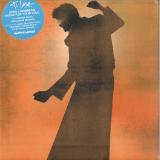
DAVID WALTERS - TI LOVE LP 2x12"

In his own time, in his own tone and in his own company.

‘Win and lose without losing oneself’’ This line from French rapper Oxmo Puccino greatly accompanied David Walters while composing his fourth studio album. Over the eleven tracks on ‘Ti Love’, David took his time to find the right tone and in turn, tell his truth.

‘Ti Love’, is a French-Creole abbreviation for “petite love”, meaning ‘little love’, evoking that sweet fondness found in those small gestures and little acts of kindness.

Think of things like young kids' brotherly love or a stranger lending you a helping hand, while expecting nothing in return. It’s these motions that allow this album to feel full of real life, carried by beating drums that also pull at our heart strings.

Basing himself in a small village in Martinique, where David had not long since scattered the ashes of his late mother, the multi-instrumentalist decided to remain there and let the writing of Ti Love pour out from deep inside him. Taking influence from around the island, the energy from his makeshift studio set up in Fort de France, allowing a resilient yet grieving man to recount, let go and come to terms with his recent loss.

So embracing these new circumstances, on the rugged coastal Caribbean island of Martinique, David took up an artist’s residency in the island’s capital Fort de France, located near the town’s port is the ‘Manoir des Artistes’, a bustling recording studio space. A place where the walls shake as the latest sounds being created are blasted by locals and visitors alike. Most studio doors are wide open; as music here is a huge part of everyday life, feedback from encouraging neighbouring musicians is on hand and welcomed. A contrast to the isolation often assumed with working in more traditional music studios.

It was here in this stimulating environment that David recorded Ti Love’s initial demos.

With his first collaborator onboard, Neeweed, a 25-year-old producer and gospel expert who David met at the Martinique Jazz Festival.

Of the album’s initial versions of the record David recollects: ‘It took me three years to write it, then I rewrote it, reworked it. In the end I'm really glad I stepped back and listened to myself.’ I found a great ally in GUTS, who ended up being the artistic director of the record”

David surrounded himself with the right people who helped him express himself in the best possible way. He called on other friends and musical comrades; album opener and title track, ‘Ti Love’ features the incomparable Fatoumata Diawara (World Circuit Records / Africa Express) and further along additional production came in from; Izem, Art Of Tones, and GUTS himself, who all added just the right amount of ‘little love’ to this

project. Further helping hands came from Californian producer and DJ Captain Planet, who David was introduced to a few years ago. Closer to home, here in Europe, the German producer Bluestaeb appears on two tracks: the very catchy disco funk ‘Mr Maraboo’ and ‘Kite Koule’, the latter being the first single lifted from the album, where David invited Nigerian guitarist Keziah Jones.

Elsewhere on the album, fellow Heavenly Sweetness recording artist Blundetto contributed two tracks; the reggae ‘Voodoo Love’, which is David's tribute to Studio One, and the very sweet and resilient ‘Bon Voyage’, which closes the album... "It's gold, it doesn't need anything changing.” remarked David - ‘Bon Voyage’ is a goodbye to his mother, whose voice called him from the bottom of the sea one night while he was surfing during the full Moon.

Released almost 20 years after his debut album ‘AWA’ released on French imprint Ya Basta, home to Gotan Project and many others, David boasts a long list of radio supporters including; Gilles Peterson, Cerys Matthews and Don Letts at the BBC, while further field Cosmo Radio in Germany, and KCRW in Los Angeles.

On this new record, David has shown sincerity and vulnerability, while still honouring the infectious groove that he is known for the world over. Despite the upsets, a little love can indeed go a long way.

CREDITS:
Produced by Bluestaeb / Blundetto / Captain Planet / Izem / Art of Tones
A&R : Guts
Mixed by Mr Gib @ Onetwopassit
Except "Bon Voyage” and "Voodoo Love" mixed by Jerome “Blackjoy” Carron
Mastered by Benjamin Joubert @ Biduloscope
Art by Elliott Walters

out of Stock

Order now and we will order the item for you at our supplier.

Last In: 7 months ago
23,11 €
The Neighbourhood - Wiped Out! 10th Anniversary LP 2x12"
  • A1: A Moment Of Silence
  • A2: Prey
  • A3: Cry Baby
  • A4: Wiped Out!
  • A5: The Beach
  • B1: Daddy Issues
  • B2: Baby Came Home 2 / Valentines
  • B3: Greetings From Califournia
  • B4: Ferrari
  • B5: Single
  • B6: R.I.P. 2 My Youth
  • C1: Leather Weather
  • C2: Maniac
  • C3: Cinnamon
  • C4: Pressure
  • D1: Daddy Issues (Remix) feat. Syd
  • D2: The Beach (Demo)
  • D3: Greetings From Califournia (Demo)
  • D4: R.I.P. 2 My Youth (Demo)
  • D5: Daddy Issues (Memo)
  • D6: Cry Baby (Memo)
  • D7: Wiped Out?! (Memo)

Celebrating a decade since its release, Wiped Out! returns in a special 10th Anniversary Edition. This expanded reissue features eleven bonus tracks alongside fan favorites like ''R.I.P. 2 My Youth,'' ''Daddy Issues,'' and ''The Beach.'' Pressed on 180g double vinyl and packaged with brand-new artwork.

pre-order now30.01.2026

expected to be published on 30.01.2026

27,69 €
PILLBERT - Memoria (LP)

PILLBERT

Memoria (LP)

12inchSQM035
Squama
30.01.2026

On her debut LP 'Memoria', songwriter/producer Lilian Mikorey aka PILLBERT contemplates themes of identity and belonging, hardships and heartbreak in her signature blend of bendy folk guitars, field recordings and intimate vocals.
Moving to London from Munich, not yet 20 years old, Mikorey realized she was leaving her home behind for good. The subsequent state of being lost and alone in a place too temporary to start building the foundation for a new one led her to question the concept of home itself.
Is it friends? Family? A house?
"I started collecting objects, bones, sticks, stones and kept them close", she says, as to create a cosmos traveling with her.
"I was tracing the actual feeling of being home to the point where I built a dreamhouse in my head, as an idea, just to evoke that feeling." Soon enough she would learn that yielding to the yearning of actually going to that house, must be an inevitably sad experience.
A photo she took on a family visit to East-Munich became a reference and starting point for Memoria. It was a small house in her neighbourhood, the windows lit as dusk sets in. To Mikorey, it looked haunting, radiating warmth but somehow looking abandoned at the some time.
"I wanted to make music that sounds like this photo"
She started recording the sounds of the objects she had gathered and of her surroundings, building an archive and sonic material to work with.
From her mid-teens she had learned to produce with Ableton and now she picked up the guitar, too, learning it autodidactically by playing around, creating sounds.
At some point in the process, she realized it's okay to be lost for a while and by enduring the feeling, there's room for something new to grow, far off from any general idea of what home should mean.

The album, over the course of 10 tracks, traces these three phases of building a home in your head, realizing it's not a remedy, nor forever and coming to terms with it. You've grown in the process and the album is a guiding light for everyone who strives to do so, too.

pre-order now30.01.2026

expected to be published on 30.01.2026

22,65 €
China Crisis - Autumn In The Neighbourhood LP
  • 1: Smile (What Kind Of Love Is This)
  • 2: Down Here On Earth
  • 3: Autumn In The Neighbourhood
  • 4: Because My Heart
  • 5: Bernard
  • 6: Tell Tale Signs
  • 7: Everyone You Know
  • 8: Joy And The Spark
  • 9: Being In Love
  • 10: Fool
  • 11: My Sweet Delight
  • 12: Wonderful New World
pre-order now05.12.2025

expected to be published on 05.12.2025

33,06 €
Donna Regina - Lilac LP

Donna Regina

Lilac LP

12inchKALK139LP
Karaoke Kalk
21.11.2025

»Lilac« is the first Donna Regina album since 2019’s »Transient.« The world has changed considerably since then, which has also left its mark on the Berlin indie pop duo. The songs released as part of the 2021 single »Welt in einer Stadt« (»World in a City«) for Karaoke Kalk had already dealt with the pandemic-induced standstill and its effects on urban space, and also the rest of the album shows that Günther and Regina Janssen have been influenced by recent social and political developments. »In ›Lilac,‹ I imagine good ol’ Earth as a big ol’ bear shaking us off because it can’t stand us anymore,« says Regina Janssen. It has become a serious album, Günther affirms, but he is also adamant that it is not a sad one. Musically, Donna Regina have remained true to the spirit of their early work, recently re-released by Karaoke Kalk: their arrangements are as minimalist as they are emotionally rich.

»The music is always there,« says Regina Janssen about the creation of the tracks on »Lilac.« As always, the two record their music »track by track and without computers,« as Günther notes. Samples play a smaller role this time than on earlier albums, with analogue instruments such as a monophonic synthesiser and, above all, guitars coming to the fore again. This frames lyrics that are being delivered by Regina in German, English, or in both languages. They delve even further into the intricacies of urban life. »Cities are underrated! What a civilisational achievement it is to have so many people living under one sky,« says Regina. »They constantly put you in touch with the unfamiliar. Sometimes they’ll be overwhelming, and they are always alive.« This ambivalence shapes the tone of the album that ponders on the state of the world today.

Starting with the ominous sounds of »Whole World In My Town,« through the dreamscapes of »Autumn In Paris,« to the elegiac conclusion of »No More Roses,« Regina and Günther Janssen move through different timbres and styles with a few select means. Their preference for minimalist electronics becomes evident at times, while elsewhere the pieces open up to balladic arrangements in which the guitar plays a leading role. This turns »Lilac« into a city by itself, the songs forming its soundscape: every neighbourhood looks different, every street has its own character.

out of Stock

Order now and we will order the item for you at our supplier.

Last In: 10 months ago
22,27 €
DYLAN HENNER - STAR DREAM FM

Enigmatic UK producer Dylan Henner announces new album of deeply considered and choral-laced experimental ambient music Star Dream FM, said to be taped from a mysterious radio broadcast that plays his favourite memories from adolescence.

Though (clearly) fictional, the backdrop to new album Star Dream FM represents a tactile canvas on which the record’s true meaning is painted. It is, through Henner’s now-characteristic employment of ambient-textured synthesis, marimba, digital choir, and processed voice, a study of late adolescence and the experience of being seventeen.

Little is known about Dylan Henner, who landed on the ambient scene in 2020 with cassette releases for Phantom Limb, Belgian label Dauw, and cult tastemakers AD93. He barely promotes himself publicly, instead choosing to communicate through disarmingly poetic song titles. His debut album “The Invention of the Human” (AD93, 2020 - a recipient of BBC 6Music’s Album of the Year honours) responds to a set of philosophical questions - what exactly makes us human? What good is civilisation when there’s so much misery attached to it? How will technology affect humanity in the long run? In 2022, he released follow-up You Always Will Be on AD93, which traced the course of a single life from birth, to childhood, to adolescence, adulthood, parenthood, middle-age, old-age, and demise. He has also covered Raymond Scott, Terry Riley, Aphex Twin, Ryuichi Sakamoto, and Su Tissue among numerous further projects.

out of Stock

Order now and we will order the item for you at our supplier.

Last In: 10 months ago
25,00 €
PHYLIPE NUNES ARAUJO - Phylipe Nunes Araujo  LP

Phylipe Nunes Araújo's songs are as rich and varied as the diverse landscapes they were written in. The hills of Pernambuco, the lagoons of Alagoas, and the beaches of Bahia are all woven into his stripped-back, folk-inspired Brazilian songwriting. As part of a wider movement of musicians originating from Brazil's Northeast, Phylipe sees the process of music-making as the search for beauty itself.

Collaborating with fellow Northeastern artists Bruno Berle, Batata Boy and Nyron Higor among others, Phylipe's debut album represents the latest flowering of this exceptionally talented community's creative search.

The Northeast holds an almost sacred importance in Brazil's collective cultural imagination. The region bore witness to the brutal histories of Portuguese colonization and the African slave trade, while simultaneously amalgamating the diverse cultures, religions and traditions of those who have called it home. Countless Brazilian music greats - Gilberto Gil, Caetano Veloso, Hermeto Pascoal, Djavan and Luiz Gonzaga - have emerged from this vast cultural melting pot.

Born in Caruaru, Pernambuco state, and raised in the city of Santa Cruz do Capibaribe (famed for its textiles industry), Phylipe describes his music simply as "Brazilian music from the Agreste of Pernambuco". His masterful compositions thread together regional rhythm, folk poetry and sophisticated harmony.

Phylipe's musical foundations were laid in youth, listening to the local elders rehearsing their forrós, attending São João street parties in front of his house and watching the Junina Quadrilhas dance through his neighborhood. At street fairs he would read the Literatura de Cordel (handcrafted pamphlets of Brazilian folk literature), and watch the rhyme battles between cantadores, violeiros, and repentistas, who improvise verses on daily life, social commentary and philosophy. This tradition of Northeastern folk poetry proved particularly formative for Phylipe as a lyricist. "I always try to write things as simply as possible. I believe that beauty must be easily understood. If I can facilitate the path to the message, there's no reason not to. It's something I learned from the traditional poetry here: it's more beautiful if everyone understands."

At the age of 11, Phylipe first got access to the internet. As he explains: "Still in adolescence I was also able to discover things like The Beatles and Nick Drake - I started to get to know music from the rest of the world and later to correlate that with my local musical experiences." Rich with extended chords and artful dissonances, it's clear from his compositions that jazz and bossa nova also took hold, but he's quick to eschew stereotypes. "Inevitably, people associate a Brazilian musician playing a nylon-string guitar with bossa nova..." "But the foundation is another story," he asserts, "It's the Northeast."

On the guitar Phylipe experiments with the binary rhythms inherent in traditional Northeastern music. Coco, frevo, maracatu and baião are recontextualised, placed alongside Brazilian popular music (MPB), gentle lullabies and stunning ballads. "In these 10 songs, I am experimenting with making pop music on a nylon-string guitar with my foundation in the Northeastern songbook."

The contemporary musical community which Phylipe belongs to developed initially in Pernambuco's neighbouring state Alagoas. Phylipe lived in its capital Maceió for three years, where he built friendships and musical bonds with Bruno Berle and Batata Boy who together produced his album. Bruno also sings in unison with Phylipe on the duet "Valise", a song Phylipe wrote aged just 15.

In recent years, Phylipe, Bruno and Batata have migrated south to São Paulo, where the majority of the album was recorded. Other collaborators on the album include Alici, who provides vocals for the ebb and flow of "Temperim", Nyron Higor who plays drums on lead single "Asa" and the sweet indie moment "Ziz"", bassist Meno Del Picchia who plays on the mystical baião "Bixin" and the propulsive "Subindo a Ladeira", and Raphael Coelho who joins Bruno and Batata on percussion for "Santa Cruz", Phylipe's hypnotically powerful portrait of his hometown.

out of Stock

Order now and we will order the item for you at our supplier.

Last In: 11 months ago
23,11 €
Lack of Afro - Love Dealer LP

Here to dazzle you by the power of the disco ball, Lack of Afro is your friendly neighbourhood ‘Love Dealer’. Two years on from the funk & soul rebirth of ‘Square One’, powered by the ubiquitous ‘Loving Arms’ featuring Greg Blackman, Lack of Afro aka Adam Gibbons is now close to two decades deep in the game with soundtrack credits galore and online streams doing calculator-busting numbers. With extensive touring taking ‘Love Dealer’ up and down the country this Autumn, Gibbons’ ninth studio album is all for "the thrill of seeing people on a dancefloor, all collectively locked into a track that you've produced - there’s nothing like it!”.


‘Love Dealer’ is the authentic modern disco experience, packing a stacked sole’s worth of club beats full of stardusted sing-alongs, style-outs and French touch-style cool. Despite being “written during one of the longest winters in living memory”, ‘Love Dealer’, featuring some co-production from fellow South Coast dancefloor scholar Flevans (and influenced by producer du jour Barry Can’t Swim), exudes warmth and will make you sweat when its highs take effect.


Entering the scene with the radiance of ‘Make It Shine’ featuring Greg Blackman, washing over the airwaves of BBC 6 Music and Radio 2 and taking up a 10-week residency on the Jazz FM playlist, Gibbons and his crack line-up of discotheque players are your go-to team when you can’t wait for the weekend to begin, as subtle as they are straight down to business. ‘Love Dealer’ offers you nothing but the best in sparkling string symphonies, the hippest guitar licks, samples of those invited beyond the velvet rope and struts soaked in night fever.


Double A-side ‘Walls Start Rockin’ and ‘Heart & Soul’ guide the album’s glamour-and-groove, while ‘Love Saves The Day’ and ‘Plain to See’ dramatically take to the podium in a shimmer of pure peak 70s theatre. ‘Keeping Me Strong’ is the synergy of disco chic and the sound of a global advertising tie-in with Dyson, ahead of Gibbons taking a slightly Moroder/Cerrone-ish detour on ‘Idolising People Like Madlib’. “'Love Dealer' is aimed unequivocally at the dancefloor" says Adam. "As an artist, I wanted to push myself in a slightly new direction - more into the land of disco and a four to the floor sound. 'Love Dealer' is quintessentially an upbeat record, full of joy, optimism and hope for the future”. Seek your inner ‘Love Dealer’, kink your ‘fro and let your funk flag fly.


n B7. 14 Your Love (feat. Jonah Hitchens) BONUS TRACK


n B7. 14 Your Love (feat. Jonah Hitchens) BONUS TRACK


[n] B7. 14 Your Love (feat. Jonah Hitchens) [BONUS TRACK]


[BONUS TRACK]

out of Stock

Order now and we will order the item for you at our supplier.

Last In: 11 months ago
26,68 €
Lack of Afro - Love Dealer LP

Here to dazzle you by the power of the disco ball, Lack of Afro is your friendly neighbourhood ‘Love Dealer’. Two years on from the funk & soul rebirth of ‘Square One’, powered by the ubiquitous ‘Loving Arms’ featuring Greg Blackman, Lack of Afro aka Adam Gibbons is now close to two decades deep in the game with soundtrack credits galore and online streams doing calculator-busting numbers. With extensive touring taking ‘Love Dealer’ up and down the country this Autumn, Gibbons’ ninth studio album is all for "the thrill of seeing people on a dancefloor, all collectively locked into a track that you've produced - there’s nothing like it!”.


‘Love Dealer’ is the authentic modern disco experience, packing a stacked sole’s worth of club beats full of stardusted sing-alongs, style-outs and French touch-style cool. Despite being “written during one of the longest winters in living memory”, ‘Love Dealer’, featuring some co-production from fellow South Coast dancefloor scholar Flevans (and influenced by producer du jour Barry Can’t Swim), exudes warmth and will make you sweat when its highs take effect.


Entering the scene with the radiance of ‘Make It Shine’ featuring Greg Blackman, washing over the airwaves of BBC 6 Music and Radio 2 and taking up a 10-week residency on the Jazz FM playlist, Gibbons and his crack line-up of discotheque players are your go-to team when you can’t wait for the weekend to begin, as subtle as they are straight down to business. ‘Love Dealer’ offers you nothing but the best in sparkling string symphonies, the hippest guitar licks, samples of those invited beyond the velvet rope and struts soaked in night fever.


Double A-side ‘Walls Start Rockin’ and ‘Heart & Soul’ guide the album’s glamour-and-groove, while ‘Love Saves The Day’ and ‘Plain to See’ dramatically take to the podium in a shimmer of pure peak 70s theatre. ‘Keeping Me Strong’ is the synergy of disco chic and the sound of a global advertising tie-in with Dyson, ahead of Gibbons taking a slightly Moroder/Cerrone-ish detour on ‘Idolising People Like Madlib’. “'Love Dealer' is aimed unequivocally at the dancefloor" says Adam. "As an artist, I wanted to push myself in a slightly new direction - more into the land of disco and a four to the floor sound. 'Love Dealer' is quintessentially an upbeat record, full of joy, optimism and hope for the future”. Seek your inner ‘Love Dealer’, kink your ‘fro and let your funk flag fly.


n B7. 14 Your Love (feat. Jonah Hitchens) BONUS TRACK


n B7. 14 Your Love (feat. Jonah Hitchens) BONUS TRACK


n B7. 14 Your Love (feat. Jonah Hitchens) [BONUS TRACK]


[n] B7. 14 Your Love (feat. Jonah Hitchens) [BONUS TRACK]


[n] B7. 14 Your Love (feat. Jonah Hitchens) [BONUS TRACK]


[n] B7. 14 Your Love (feat. Jonah Hitchens) [BONUS TRACK]

pre-order now10.10.2025

expected to be published on 10.10.2025

28,53 €
Kalahari Surfers - Own Affairs LP
  • A1: Free State Fence
  • A2: The Surfer
  • A3: Prayer For Civilisation
  • A4: Hillbrow 1
  • A5: Hillbrow 2
  • B1: Hippo In Town
  • B2: Independence Day
  • B3: Don't Dance
  • B4: Crossed Cheques
  • B5: September 1984

This is an album made during a crucial period in South Africa’s history during which there was a palpable feeling of a slow turning towards the collapse of the apartheid state side by side with an increasingly well-organised culture of resistance through the formation of the United Democratic Front (UDF) and various affiliated bodies. However, as a result, there was increased pushback from the state security establishment, a turning to dirty tricks and the formation of hit squads whose members murdered and tortured many of our friends and created chaos throughout South Africa as well as neighbouring countries.

This album is situated in this political environment however it took advantage of the new do-it-yourself music technologies available at that time. Technologies that made it possible to make and release records without interference from traditional record company executives. Two musician friends of mine pooled their resources after their respective bands had broken up. Ivan Kadey (National Wake) and Lloyd Ross (Radio Rats) built an 8-track recording studio control room and fitted it out in a second hand caravan and called it Shifty. They parked it in a garage attached to the only house left in a demolished and derelict mining village near Soweto on the outskirts of Johannesburg.
All the work on this album was completed there, mainly after hours and mostly alone where I enjoyed an exhilarating freedom to develop a whole new set of musical skills and ideas, incorporating my love of a wide range of music I’d grown up with. Influences of 1970s progressive/kraut/and psychedelic rock combined with mbaqanga bass styles, early reggae/dub and Indian tabla rhythms. Stockhausen, early Zappa and Holgar Czukay were radio text and shredding influences, and Chris Cutler’s band Henry Cow & Art Bears helped me see a way to political expression. Mostly though was the exciting post-punk and no-wave music coming through to us from Europe and America: bands like This Heat, the Mekons, Raincoats, Sonic Youth and Pere Ubu were immensely important to me as was my reading from the period: J.M.Coetzee’s first 3 novels are strong influences on Free State Fence; the stark landscape, superstition, ritual, and sexual repression are in many of his settings. JG Ballard was a constant presence throughout that period, especially whilst living in such a surreal environment, surrounded by mine dumps, but mostly I think the whole French post-modern philosophical movement—Derrida, Foucault and of course, Baudrillard’s Simulacra and Simulation—set out a new sense of possibilities, possible ways to express oneself, ways to think, and ways to try and analyse the political intersection of public and private life. Most important at that time was the influence of sound recordings I had made and experiences garnered from working as a sound recordist on documentary films. These financed my work and later the studio and were consistent employment throughout the 1980s. Film work also enabled me to experience much of South Africa that was hidden from most. The track Independence Day is a good example; drawn from some time spent in the rural homeland of Venda. This then was the first full length Kalahari Surfers album, completed in summer of 1984 it was taken to EMI pressing plant but rejected by the cutting engineer as being ""political, pornographic and anti religious"". Chris Cutler at Recommended Records took up the challenge and released the album through his label. He wrote the original liner note

pre-order now27.06.2025

expected to be published on 27.06.2025

29,37 €
Stella Z - Music to Watch Seeds Grow By 005: Stella Z (Fig)

Following the contemplative explorations of previous works in the series and hot on the heels of the beautiful Cosmos from E Ruscha, Stella Z's "Figs" emerges as a delicate meditation on growth, patience, and the hidden life of fruit.

Recorded in London yet deeply inspired by distant memories from China, the album is a musical documentary that explores the fig—a plant with a profound personal significance to Stella. "The fig tree was the big, generous presence in our old home, feeding my family and neighbours every summer," Stella shares. "When we moved to an apartment, we thought we had lost the fig tree. But my mum took a cutting and planted it at our new place. To our surprise, a small fig tree started growing again, as if it had never left."

Early support from Vladimir Ivkovic, DJ Harvey, Jaye Ward, Laurent Garnier.

pre-order now13.06.2025

expected to be published on 13.06.2025

12,40 €
Minyo Crusaders - Tour Of Japan LP

Minyo Crusaders

Tour Of Japan LP

12inch180GLP06
180g
13.06.2025

"For Japanese people, min'yo is both the closest, and most distant, folk music" explains band-leader Katsumi Tanaka. "We may not feel it in our daily, urban lives, yet the melodies, the style of singing and the rhythm of the taiko drums are engrained in our DNA".

Initially indifferent to min'yo, a tragic event in recent Japanese history set Tanaka on his current path: "Following the Tohoku earthquake of 2011, I reflected on my life, work and identity. A fan of world music, I began searching for Japanese roots music I could identify with. Discovering mid-late 20th century acts like Hibari Misora, Chiemi Eri and the Tokyo Cuban Boys, I was captivated by their eccentric arrangements and how they mixed min'yo with latin and jazz music."

Lead singer Freddie Tsukamoto fell for min'yo after hearing a song from his hometown on a TV competition whilst in a restaurant. It was a revelation – until then he had been an aspiring jazz singer yet was uncomfortable singing in English. The restaurateur told him a min'yo teacher was his neighbour and the two connected. Tanaka and Freddie formed Minyo Crusaders in 2011 in Fussa, a city where the US military Yokota Air Base is located, in western Tokyo.

Recruiting other local musicians versed in afro and latin rhythms, they began hosting jam sessions at the Banana House, a building that was previously part of the military base and that used to house US soldiers. The band started recording their music, and their debut album "Echoes Of Japan" was released in 2017. It received huge acclaim in Japan and abroad, and was also released by British label Mais Um in 2019. Several European tours followed, as well as some US and South America gigs.

In this second opus, the Minyo Crusaders take us on a trip to Japanese folk songs fused with latin rhythms. Their unique arrangements breathe new life to classics like Kiso Bushi, Sado Okesa or Soran Bushi, among many other min'yo songs from all over Japan that were originally performed by Japanese fishermen, coal miners and sumo wrestlers hundreds of years ago. The magical groove created here proves once again that the Minyo Crusaders are one of the most dynamic representatives of the current Japanese world music scene. Yoi Yoi, Enjoy!

pre-order now13.06.2025

expected to be published on 13.06.2025

29,37 €
Tartine de Clous - Compter Les Dents

Tartine De Clous

Compter Les Dents

12inchOKRAÏNA#18
Okraïna
30.03.2025

'It begins with a shoebox of mysterious provenance, full of recordings from the Vendée department on France’s western seaboard: songs of love and war, life and death, played out on land and sea. Songs passed down and sung by ordinary men and women, gracefully delivered with the poetic economy which unites the folk song of all peoples.

Next it takes a group of contemporary musicians to make selections from this treasure trove and sing these old songs anew; to sing them for their beauty, of course, and to reclaim the people’s tradition from those who would seek to exploit it for nefarious political ends. Who better for this task than Tartine de Clous, a singing trio from Vendée’s neighbouring department of Charente-Maritime, who burst into national and international consciousness with their debut album "Sans Folklore" in 2015? The result of their shoebox rummagings, the new album "Compter les dents", recorded in 2019 and finally seeing the light of day, is bound to delight old fans and win them many new ones.

Time makes many’s the alteration, and "Compter les dents" finds 'les garçons' - Geoffroy Dudouit, Thomas Georget and Guillaume Maupin - in a different state of being from their debut release. The trio, friends since youth, have certainly matured between albums, as one would expect; consequently the newer performances are more considered and poised, unfolding with a patient confidence. A relaxed domesticity prevails, something to do with the fact that the album was entirely recorded chez les amis, in contrast to the first album, which was mostly recorded at live performances in bars and night-spots across France.

Lending gravitas to the grain of their voices we mark a deepened richness, doubtless born of the various vicissitudes of daily existence which these gentlemen - and we too as citizens of this turmoiled globe - have weathered in the intervening years. Not too dissimilar, in fact,
from some of the vicissitudes detailed in those old Vendée songs. Plus 'ça change', right?

There’s a greater complexity and subtlety to their unique three-part harmonising, too. Their voices mesh in even stronger - almost telepathic - 'fraternité' than ever before: now commanding and mighty as a full-rigged counter-vessel, now gentle and lulling as a mother’s
cradle-croon, or as the whisper in a lover’s ear.

Three legendary figures of French traditional music, now sadly departed, preside as tutelary spirits over Compter les dents. They are: the late Claude Flagel, musician and ethnomusicologist; and the late Jean-Loup Baly of the well-known 1970s band Mélusine. Most of the album was recorded by Claude in the Brussels home he shared with his late wife Lou Flagel. The album is dedicated to the memory of Jean-Loup, Claude and Lou.

For the first time there are several guest instrumentalists working their magic to expand the Tartine de Clous sound. Jean-Loup plays a characterful accordéon on the song ‘La Veuve'. The other guests are: Maurice Artus (voice), Robert Thébaut (violin), Quentin Manfroy (piccolo, contrabassoon), Marceau Portron (cigar box guitar). Their contributions add even more conviviality to that which the trio of singers already share, a sensation which will doubtless be shared by those who happen to find a place in their lives for "Compter les dents".'

Liner notes by Alasdair Roberts.

pre-order now30.03.2025

expected to be published on 30.03.2025

22,27 €
BEÃTFÓØT - Too Cute (LP)

In a world of division, BEÃTFÓØT’s delayed second album is as an invitation to unite at a utopian celebration of life. Originally scheduled for release in October 2023 but postponed due to the ongoing Israel/Palestine war, the intrinsically-political ‘TOO CUTE’ has taken on more prominence than the Tel Aviv duo of Udi Naor and Adi Bronicki could have imagined.
“It's more urgent than ever for us to share this now, even though the album has been ready for a while,” says producer Naor. “BEÃTFÓØT are against any war, and believe that people should talk and not use violence - never,” he adds vehemently. “We feel the pain of Palestinians and Israeli loss of life, and are devastated by it. We hope the war will be finished soon and that peace and prosperity will come soon for both sides.”
While both Naor and vocalist Bronicki have been active in protests, charity work and community efforts over the past year - explicitly against the current government in Israel - such values of peace, acceptance, coexistence, inclusiveness and anti-hate from all sides are further instilled in the songs that form ‘TOO CUTE’.
“We're really trying to highlight that there are people here working tirelessly for a brighter future for our ill kids and our neighbour’s kids,” adds Naor, who is also co-founder of techno duo Red Axes. Having had to flee the country with his family, it’s through music that Naor and Bronicki have found hope.
In light of such conflict, the multi-layered yet sonically-bonkers record also enables escapism, which is needed more now than ever. Following their self-titled 2021 debut (released on DJ Tennis’ label Life and Death), ‘TOO CUTE’ is a refreshingly-ridiculous dark-rave rollercoaster which careers between hard-dance, big-beat, post-punk, techno, hyperpop, country and everything in between.
Things blast off at breakneck speed with the chaotic title track’s hyperpop snares, instantly-catchy lyrics (which feel ominously striking considering the war) and a stadium-ready chorus that erupts into rolling breakbeats, punishing EDM and even a nod to The Bloodhound Gang’s ‘The Magic Touch’. Somehow, we’re just three minutes into the record.
The tongue-in-cheek ‘HEART OF LEAD (TAKE IT OFF)’ still bangs despite its silliness, like if Kero Kero Bonito got in the studio with will.i.am. Later, ‘LEO’S SONG (THE SOCIAL MEDIA GUY)’s wittily satirical one-liners - “I just wanna get high with AI” - come thick and fast amid a barrage of glitches and guitars. ‘SUKC MY DIKC !!!’, meanwhile, pairs flute with pulsing hardstyle beats.
While their first record’s experimental explosion captured the pure carnage and energy of the BEÃTFÓØT universe in a conceptual fashion (though remaining polished in its own way), album two is primed to connect with a bigger audience thanks to its pop melodies, structures and songwriting.

Much of ‘TOO CUTE’ was written while the duo toured Europe for the first time, with rough sketches of tracks created in the moment during their incendiary live shows, and then recorded in planes and cars.
If their first record was a case of testing the vibes, album two is more assured and confident within their sonic world. “In the first album, we stepped into the club, metaphorically, and started making eye contact with everyone to figure out the energy,” Bronicki says. “But, this time round, I already had an idea of the story that I wanted to tell to these random people.”
And what is that story? “Radical silliness, or radical fun – that’s the essence of BEÃTFÓØT,” Naor confirms. “What we really want to do is goof around and have fun, and that brings out something very profound and honest,” he explains. A sense of nostalgic freedom is also at the album’s core, thanks to the removal of adult predetermined social constructs that decide how people should behave or look. “There’s a very honest and positive energy in holding onto your childlike wonder and trying to explore that with others,” Bronicki suggests, adding that “the adult world can be so wrong and angering”.
She feels this relates to both the album’s lyrics and the artistic state of mind that the duo always work to: “the goal is to feed a really thought-out and profound idea, but through a playful spoon,” she says. With this in mind, the recurring theme of ‘TOO CUTE’ stems from the duo’s “radical and lived experience of existing in a place that holds a lot of guilt and fear – because death is so imminent and prevalent in a very confronting way”. This is clearly represented on ‘FOOTYLICIOU$’, on which Bronicki screams “someone’s gonna die tonight!” before emphatically shouting “NOT ME!”
The album title is BEÃTFÓØT’s response to that: “We want to be a celebration of life, and that applies to all lives, of all backgrounds, including animals… that’s our guiding light,” Bronicki says.
“We create in the context of living in a country where the current government’s anti-democratic measures are limiting who is included in the celebration of life. Because different people are always being pushed out and excluded: whether it’s queers, Palestinians or people from different religions.”
BEÃTFÓØT - who have found a home among the LGBTQIA+ community - are fighting back against oppression. “We want everybody to come to the party and celebrate life together,” says Naor, setting out his and Bronicki’s mission… “and our goal is to widen that party as wide as it can go.”


c MANIAC ft. Princess Rani

e WHERE HAVE I BEEN ALL MY LIFE ft. Bugle Boy


c MANIAC ft. Princess Rani

[e] WHERE HAVE I BEEN ALL MY LIFE [ft. Bugle Boy]


[c] MANIAC [ft. Princess Rani]

[e] WHERE HAVE I BEEN ALL MY LIFE [ft. Bugle Boy]

out of Stock

Order now and we will order the item for you at our supplier.

Last In: 22 months ago
21,81 €
Anadol / Marie Klock - La Grande Accumulation

Anadol and Marie Klock have teamed up for a joint album, La Grande Accumulation. They met two years ago at a festival in England crowded with violent seagulls and outsider musicians. Klock being prone to barking on stage and Anadol not laughing at jokes she doesn’t find funny, they straight away had the intuition that they would meet again. And so they did, a few months later, at Anadol’s studio in Istanbul.

Today, the two Pingipung artists present the fruit of this musical friendship. La Grande Accumulation was born out of the peculiar atmosphere of the studio neighbourhood in Büyükada, an island where thousands of cats run free and humans randomly destroy things during apocalyptic times when parts of Turkey had just been turned into dust by terrible earthquakes. The French lyrics are inspired by hours of conversations, the music is consequently drenched in absurdity, overflowing with a strong urge to live and enjoy. According to the LP sticker, this album has been certified “Best handshake of 2024”, and stickers never lie.

La Grande Accumulation brings together Marie Klock's mysterious metaphors and Anadol's intriguing radiophonic psych-pop. Stretching forms beyond common sense to see how long they can resist is probably their favourite game. The result are six highly imaginative tracks that challenge the sub-3-minutes standards of Spotify pop.

Gözen Atila aka Anadol is well known to the Pingipung audience, with three solo LPs on the label. Her music follows a kind of collage logic, she interweaves countless styles, combining field and studio recordings with obscure quotation marks here and there. "I hope no one will come and explain this music to me, because it's the most beautiful music there is", says Kristoffer Cornils about her solo album Felicita.

Marie Klock is a French writer and musician who produces songs oscillating between synthpop and neo-folk, full of anarchic humour and existential dread. Her recent solo LP on Pingipung was a captivating tribute to the recently deceased poet Damien Schultz entitled Damien est vivant.

Marie Klock delivers her lyrics in song or spoken word, stream-of-consciousness musings on strange human adventures, and her rich keyboard melodies culminate in a nonchalant dialogue with the bass trombone (La Reine des Bordels). In the opulent opening piece (La Grande Accumulation), a woman is cursed to take home everything she kicks in the street; a bit later, we stumble upon a ghoul hiding in the gutter (Sirop amer), Mona Lisa loses her teeth (Sonate au Jambon) and a warthog struggles to climb the stairs of a silver tower (Sabots triviaux).

La Grande Accumulation was mixed and mastered by Jonas Romann at Chaos Compressor Club in Hamburg and cut to vinyl by Kassian Troyer at D&M in Berlin. It's an audiophile LP that invites to focus on every detail in this heap of musical ideas.

out of Stock

Order now and we will order the item for you at our supplier.

Last In: 20 months ago
24,16 €
Fohn - Seanteach

Fohn

Seanteach

12inchODA04M
ODDA Recordings
18.10.2024

Fohn brings connection, displacement and new identities into the moment, on pastoral debut album Seanteach - informed by island life, marine folklore and musical tradition.

Connection to the land, the severing of earthly ties, explorations of environment, mythos and generational memory: under the moniker of Fohn, English violinist and producer Tom Connolly (Quade, AD93) takes to the fiddle on which he learned his craft as a child. Forging new bonds with his family’s island home off the coastal west of Ireland, their story is retold in Seanteach (Irish for ‘old house’), released on Odda Recordings.

“Seanteach explores the nature of my relationship with Ireland, and Connemara in particular, where my dad’s family is from,” explains Connolly, speaking on a long-form work that blends new compositions on traditional Irish fiddle with ambient electronics and evocative field recordings.

“It explores how the island of Maighinis became an almost mythological space for me, growing up in England - we would spend every summer there, but it felt equally present for me when we were back in the UK, a sort of mental solace that I found through music especially.”

Each track on the album is a reflection of aspects of that relationship to island life - where physical features intersect with mythology. Such as, ‘Boreen’, named after a colloquial term for rural byroads sometimes shared with otherworldly neighbours. ‘Aisling at Sea’ draws on the primal, unstoppable momentum of the water, while the folklore of ‘Immram’ reflects on generationally-kept tales of marine bravery and supernatural accomplishment.

“The compositions often sit at the fraying edges of memories I’ve inherited from my own experiences, that of family lore, or from stories that I have come across. I wanted the compositions to tread the space between documentation and fantasy that feels so reflective of my relationship with this place.”

Tying these worlds together is the presence and memory of Connolly’s ‘Mamó’ (Irish for grandmother), Bríd. Despite passing during Connolly’s childhood, this “larger-than-life character” shaped his imagination with anecdotes and stories, representing both a familiar figure, and the poignancies of potential and regret.

“Even at a young age I sensed a sadness emanating from her. Through a series of unfortunate and fortunate circumstances, she found herself leaving Ireland and settling in Boston like so many others. Under the impression she was an illegal immigrant in the US she didn’t return to Ireland for decades.”

‘Between the Shoreline and the Gorse’ channels her early childhood, born to a large Catholic family in the island’s ‘Seanteach’, and cast adrift from her old life - a severance of ties that Connolly attempts to make ethereal amends for, with the album named for her family home.

“It’s something that feels so visibly prominent in Connemara with its landscapes charcoaled with deserted ruins. It’s a feeling I also experience, despite never having lived in Ireland, which prompted me to want to explore the idea of longing for something/somewhere ‘un-experienced’, and to a certain extent, fictionalised.”

pre-order now18.10.2024

expected to be published on 18.10.2024

21,22 €
RAT BOY - SUBURBIA CALLING LP

Rat Boy

SUBURBIA CALLING LP

12inch205521
Hellcat
04.10.2024

RAT BOY have recorded in Los Angeles with T im Armstrong of Rancid, played festivals as far afield as Japan and China, and toured North America with The Interrupters. Yet for all those globe-trotting adventures, there"s no place you know quite as well as home. That"s the central topic that R AT BOY explore on their upcoming third album "SUBURBIA CALLING", which will be released on October 4th via Hellcat. "SUBURBIA CALLING" sees RAT BOY exploring stories from their roots in Essex. It"s the land of wheeler -dealers and dodgy geezers, and home to nosey neighbours, rowdy clubs and Joey Essex. For readers outside of the UK, it"s the land of Blur, Depeche Mode and The Prodigy: a place not so far outside of east London, but in other ways it"s a world away. And it"s not only an immense font of inspiration for RAT BOY, but the place where ever ything happens for them.. Just outside of Chelmsford sits a converted barn where the band can jump in and be creative whenever the mood takes them - a HQ that is a recording studio, a rehearsal space, an art studio, a storage space and a hangout spot all-in-one. Frontman Jordan Cardy says, "I wanted to sing about Essex. Essex is where we live and when you"ve grown up somewhere you notice things about it. There"s so much to draw on. Essex is really close to London but it"s different in a lot of ways. We"ve got a lot of freedom here, we built a place where we can record and rehearse and hang out, somewhere you wouldn"t be able to have in London." RAT BOY - completed by Liam Haygarth (bass), Harr y Todd (guitar) and Noah Booth (dr ums) - approached the making of the al - bum in unorthodox fashion. They recorded a home demo and a live performance of each song, which were then sent to producer Stephen Street (The Smiths, Blur) to edit together like a tapestry puzzle.

pre-order now04.10.2024

expected to be published on 04.10.2024

21,22 €
RAT BOY - SUBURBIA CALLING LP

Rat Boy

SUBURBIA CALLING LP

Pict-Vinyl205523
Hellcat
04.10.2024

RAT BOY have recorded in Los Angeles with T im Armstrong of Rancid, played festivals as far afield as Japan and China, and toured North America with The Interrupters. Yet for all those globe-trotting adventures, there"s no place you know quite as well as home. That"s the central topic that R AT BOY explore on their upcoming third album "SUBURBIA CALLING", which will be released on October 4th via Hellcat. "SUBURBIA CALLING" sees RAT BOY exploring stories from their roots in Essex. It"s the land of wheeler -dealers and dodgy geezers, and home to nosey neighbours, rowdy clubs and Joey Essex. For readers outside of the UK, it"s the land of Blur, Depeche Mode and The Prodigy: a place not so far outside of east London, but in other ways it"s a world away. And it"s not only an immense font of inspiration for RAT BOY, but the place where ever ything happens for them.. Just outside of Chelmsford sits a converted barn where the band can jump in and be creative whenever the mood takes them - a HQ that is a recording studio, a rehearsal space, an art studio, a storage space and a hangout spot all-in-one. Frontman Jordan Cardy says, "I wanted to sing about Essex. Essex is where we live and when you"ve grown up somewhere you notice things about it. There"s so much to draw on. Essex is really close to London but it"s different in a lot of ways. We"ve got a lot of freedom here, we built a place where we can record and rehearse and hang out, somewhere you wouldn"t be able to have in London." RAT BOY - completed by Liam Haygarth (bass), Harr y Todd (guitar) and Noah Booth (dr ums) - approached the making of the al - bum in unorthodox fashion. They recorded a home demo and a live performance of each song, which were then sent to producer Stephen Street (The Smiths, Blur) to edit together like a tapestry puzzle.

pre-order now04.10.2024

expected to be published on 04.10.2024

25,17 €
Boston Manor - Sundiver

Boston Manor

Sundiver

12inch4065629724085
Nuclear Blast
06.09.2024

Coming out on September 6th on Sharptone Records, Sundiver is Boston Manor’s fifth album and one that represents a glimmering dawn for the Blackpool five-piece. Grown from a seedbed of optimism and sobriety, the LP celebrates new beginnings, second chances and rebirth. With two members recently stepping into fatherhood, hope is baked into every note. “Datura came out of these really dark few years over the hangover of the pandemic,” Henry reflects. “I'd been struggling a lot with drinking and not taking care of myself and bad mental health and stuff. We wanted Sundiver to be the next morning of the following day.” He explains that it feels good this time round to write through the lens of positivity. “The themes began to emerge, of rebirth, spring, dawn, sunshine and then other elements just started to fit into that.” It was during the making of Sundiver that Henry found out he was going to be a dad. This album is a significant one for the band. Originally coming out of the emo and pop punk scene, they’ve explored sonics and genres throughout their career, taken risks and achieved more than they could ever had dreamed of. They’ve grown up as Boston Manor – their lives and the world changing around them. They’re now taking stock, at a crossroads of the band they were and the band they could be.
While writing the album, they revisited the bands that shaped them in the late 90s and early 00s. “I was listening to the music I loved when I was a teenager and I just thought, why don't we make music like our favourite bands?”, guitarist Mike Cuniff remembers with a smile. “So we brought our interests to the table that way. Y2K kind of vibe. There are elements of Deftones, there are elements of Portishead in there, some Garbage, The Cardigans.” He laughs and adds NSYNC to the list of inspirations. From this cocktail of classics comes a dynamic and ambitious record, rich with depth, groove and more hooks than Peter Pan’s nightmares. Lyrics that foxtrot from parallel universes to personal growth, vivid dreamscapes to raw grief. Individually they’re single strokes full of meaning and magic. Together they’re a landscape.
Container (out Feb 15th) is the first single and it’s them at their best – impassioned and infectious. “This song is about the stagnancy of life creeping up on you & how that can bring about change.,” Henry explains, citing Ocean Song by US band Daughters as an inspiration.

The concept of the butterfly effect is present on Sundiver – how small actions can lead to big changes. This is no clearer than on their second single, Sliding Doors (out April 5th). It has the golden sound of late 90s Lollapalooza rock – think Smashing Pumpkins - rebooted with crisp 2024 production and a potent heaviness. In the lyrics Henry wonders, what if?, pondering on what could be. The idea that there are infinite versions of you whose lives splinter off in different directions at every decision you make. That there’s another you out there somewhere right now reading this sentence, and another me writing it. “So much is down to chance and circumstance,” Henry says. “You might catch that train and your life totally changes. Or you might miss it and things stay the way they are.”
Heat Me Up (out May 30th) is defiant and victorious, the audio equivalent of quitting your shit job and driving into the hot summer sun with a head full of dreams. “The lyrics are about love and gratitude,” Henry shares. “Another theme on the record is just appreciating what you have. It’s about not taking for granted the things that you've been afforded.”
There was some natural magic in the creation of Sundiver. They worked with their usual producer, Larry Hibbitt, and engineer, Alex O’Donovan, but instead of recording in London again they ended up in the green pastures of Welwyn Garden City. “Because Larry lives out in the countryside now, it was a way different environment and way different experience recording this time,” Mike remembers. “That contributed a lot to the brighter sound of the record.” The daily barbecues they had during their recording sessions imbued the process with harmony – five old friends spending quality time together and making quality music.
However, the album is by no means one-note. Birthing this new world they’ve created wasn’t without it’s pain, and that can be heard in the heavier moments on Sundiver. What Is Taken Will Never Be Lost is the most-stripped back on the album, a slow rock number seasoned with the downtempo Portishead influence. The heartfelt lyrics are Henry’s way of processing the loss of his grandfather, who died in a hospice last year(?). “It was just fucking horrible. It was always cold when I went there and they were always trying to get rid of me. The song title, What Was Taken Can Ever Be Lost, is the idea of his memory fading at the time because of dementia.” Henry goes onto explain that shoeboxes of photographs, diaries and a legacy is what he’s left behind. “He lived a really rich life and it has really impacted me and my father. His legacy is etched into the fabric of history in a very small way.” This song continues the connection between his grandfather and the band, as his painted face is emblazoned on the cover of the very first Boston Manor EP, Driftwood. As well as emotionally heavy themes, there’s heaviness in the music of Sundiver too. The closing song, Oil In My Blood, descends into an intense shoegaze outro with Debbie Gough from Heriot screaming hellfire. It’s in moments like this that the band show us aggression and fury can be as much a part of positive change as quiet introspection. The last lyrics of the song, “It resets and starts again,” leaves us in contemplation as the final chord rings out.
Touring the US, Europe and Japan over the years makes for an impressive CV, but if you know anything about Boston Manor you’ll know that they’re all about their hometown. Their choice to work with Blackpool-based photographer Nick Barkworth is testament to that. They’ve been working with him since the pandemic. “He captures Blackpool in a light that really reflects the weirdness and quirkiness of the town,” Henry says.” He's got a really good way of presenting that.” For the Sundiver cover, Nick photographed a 30ft tall abstract glass sculpture made by the local artist John Ditchfield. A striking and bewitching monolith that’s familiar to them but unusual to most people. “It has such kind of a gravity and power to it,” Henry describes the sculpture which stands in a field just outside of the seaside town. “It reminds me of either an explosion or a star or a supernova. To me it represents new life, power and radiance.” Boston Manor have got a knack for that - connecting the otherworldly and the everyday, the stars and the streets.
They’re a band known for using their music to make bigger statements about society. This time round they’re harnessing the uplifting power of music, and the communion it creates, as an antidote to the daily doom and isolation. “It seems like absolute chaos out there at the moment,” Henry says. “You’ve got Gaza and Israel, you've got Russia, you've got the fact that 40% of the world is going to have an election this year and increasingly most governments are leaning very far to the Right. The internet is dividing everybody, people are getting poorer and more desperate. It's really, really scary.” They considered trying to tackle the weight of it all in their music. “We could’ve written Welcome to the Neighbourhood on steroids, where it's just absolute darkness and misery”. He’s referring to their 2018 concept album that deals with class, inequality and the bleaker side of Blackpool. “But I think it's really important to write something that people can be immersed in and find some sort of solace in. Somewhere they can escape to from the modern day pressures and everything that’s going on. We’re all in this together.”

pre-order now06.09.2024

expected to be published on 06.09.2024

32,14 €
Moroka - Junction Tape (TAPE)

Eight no-nonsense tracks, straight to the point. Moroka delivers the goods in this raw, unpolished gem of a release. Constructed in a week at home in Loughborough Junction after a conversation with FG boss Alex - these cuts are all about the energy, no time wasted on refinement. The drums rumble and shuffle, crashing into each other with an unpredictable rhythm that keeps you on your toes. The narrative here is simple: Mo, his neighbourhood, and his gear.

Early support and plays from Shy One, Scratcha DVA, D Bridge & Mr Beatnick.

Photography by Charlie Birch, design by Alex Horne, tape covers riso printed at Terry Bleu, Amsterdam.

pre-order now02.08.2024

expected to be published on 02.08.2024

8,82 €
Herbert Hunter / THE JADES - I Was Born to Love You /  I Know That Feelin'

Repress!

HERBERT HUNTER will be forever worshiped by the UK Northern Soul scene for his anthemic 45 'I Was Born to Love You', recorded in the home of country music, Nashville, in 1967. Sometimes things are just meant to be and they collide in perfect harmony. 'I Was Born To Love You' is a case in point. The perfect lyric - 'I Was Born To Love You, You Were Born To Tear My Heart Apart' - the perfect beat, and perfect timing as it crashed onto these shores in the summer of '76 when Northern Soul was at its zenith and Wigan Casino owned the All-Nighter scene! But, Hunter is no one-trick pony, as his list of collectable 45s bears testament, not least 'Happy Go Lucky', also on Spar. Hunter was part of Ted Jarrett's roster of artists and, under Jarrett's stewardship recorded a string of cover versions under the pseudonym Leroy Jones for the neighbouring budget label 'Hit'. He learnt much of his trade from established artists and label mates such as Gene Allison who he toured with as minder and nursemaid, due to Allison's drink problem. Often, when they arrived a venue, Allison was too drunk to perform and Hunter would step in for him.
For our B-side we've chosen a lesser known, but no less wonderful and gritty Northern Soul dancer 'I Know The Feelin'' by THE JADES. Currently very much in demand with a mint copy selling earlier this year for over $900. We know little about The Jades who recorded this incredible slab of up-tempo soul for Ted Jarrett's Poncello label in 1964 featuring, of course, Herbert Hunter's booming lead vocal.
Many thanks to Fred James for making this superb double-sider possible.

out of Stock

Order now and we will order the item for you at our supplier.

15,55 €
Doctor Who - David Tennant & Catherine Tate - Pest Control & The Forever Trap LP 6x12"

“There goes my TARDIS!” Demon Records celebrates David Tennant and Catherine Tate’s partnership as the Doctor and Donna with two audio-exclusive stories, read by the actors themselves. In Pest Control, read by David Tennant, the Doctor and Donna face monstrous insects and a ruthless robot exterminator when the TARDIS is lost in battle on a distant planet. The Doctor sets off in pursuit of his craft, while Donna finds herself accepting a commission in the Pioneer Corps. Something is transforming soldiers into monstrous beetles - and she could be the next victim. In The Forever Trap, read by Catherine Tate, the duo find themselves imprisoned in a complex of luxury apartments in space, and neighbours to a terrifying assortment of aliens. Deadly mobs wage battle in the corridors and on the stairwells, and the travellers must cross their paths as they search for the ultimate authority. Who, or what, lies at the heart of the Edifice? This stunning box set, with an illustrated lift-off lid, features 6 x 140g vinyl LPs - three in Transparent Red and three in Transparent Yellow - each housed in a unique inner sleeve. A four page booklet features sleeve notes by authors Peter Anghelides and Dan Abnett, who reflect on the process of writing for the Tenth Doctor and Donna, and how they regard the stories 17 years later. Now for the first time on vinyl, accompanied by original sound design and Murray Gold’s Series 4 arrangement of the familiar theme music, these two high-octane adventures are a reminder of the excitement, humour and magical wonder of Doctor Who

pre-order now31.05.2024

expected to be published on 31.05.2024

96,93 €
Items per Page:

Language