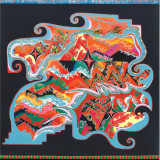
LA/Joshua Tree based Sugar Candy Mountain deliver carefully built psychedelic odes in the style of Jacco Gardner and Tame Impala. Their breakout album 666 feels like something unearthed from a box of records found in your dad's garage, glowing wistfully with vintage inspired tones, rambling organs, fuzzed out guitars, shimmering keys and sprawling drums. Ash Reiter's woolly voice croons with the icy warmth of Francoise Hardy, while Will Halsey's tender Lennon-esque vocals uncoil with easy languor. Recorded with Jason Quever of Papercuts, the bands sophomore album sits comfortably between 60's Laurel Canyon bliss and more modern production of Dave Fridmann (Flaming Lips/Tame Impala). 666 is the band's first record after deciding to retire Ash Reiter's eponymous solo project to focus solely on Sugar Candy Mountain. With this shift Ash became more heavily invested in writing for the project. On 666 the band moves away from the grandiose production of their previous album, Mystic Hits, on which some songs featured over two hundred instrument tracks. The majority of basic tracking was done on Jason Quever's 16 track Ampex tape machine through a Neve console, and completed at the bands home studio. Under Quever's guiding hand, production on 666 is significantly simplified, favoring featuring strong melodies over the wildly playful orchestrations of Mystic Hits. Quever is also significantly featured on the record as a player, with his influence distinctly coloring the album.
Buscar:mystic base
For more than 30 years, singer-songwriter and guitar hero Mary Timony has cut a distinctive path through the world of independent music, most recently as vocalist and guitarist of acclaimed garage-pop power trio Ex Hex (Merge) but also as a member of seminal postpunk band Autoclave (Dischord), celebrated leader of the deeply influential Helium (Matador), multifaceted solo artist (Matador, Lookout!, Kill Rock Stars), and a co-founder of supergroup Wild Flag (Merge). Described by Sleater-Kinney's Carrie Brownstein as "Mary Shelley with a guitar" and dubbed "a trailblazer and an innovator" by Lindsey Jordan a.k.a. Snail Mail, Timony has distinguished herself as one of her generation's most influential. Although she has remained a cult hero and critical favorite since the early '90s, Timony's many triumphs have long been counterbalanced by crippling doubt and self-nullification. Her fifth solo album, Untame the Tiger, approaches these emotions head on. Her first solo release in 15 years is a startling document of an artist fully coming into her own power during the fourth decade of her career. It is the product of lessons learned during life-altering struggle. The mystical, acoustic-driven Untame the Tiger emerged after the dissolution of a long-term relationship and was bookended by the deaths of Timony's father and mother. The album was recorded during a two-year period during which she was the primary caregiver for her ailing parents. The tectonic psychic shift Mary experienced due to this loss informs many of her lyrics. Standout track "No Thirds" "is a song about losing everything and having to keep on going," says Timony. "I wanted the verses to sound like a wide-open barren space, like driving across a desert, because that is what the song is about - losing people and the feeling that your future is a giant, wide-open blank space." The stripped-back acoustic instrumentation of "The Guest" conjures Sweetheart-era Byrds. Timony describes it as a song sung directly to loneliness: "I was imagining loneliness as a house guest who keeps knocking on your door. I thought it would be funny to say loneliness is the only one who always comes back." Untame the Tiger does not eschew Timony's guitar hero reputation; in fact, "Summer" relishes in it, a straight-up banger that you'd be half tempted to call "no frills" until its initial garage rock stomp breaks into the unexpected bliss of a twin guitar solo conclusion. "I wanted the recording to have the energy of the Kinks, early Dio and Elf, or Rory Gallagher," she explains. "I was also listening to a lot of Gerry Rafferty's first solo album and was inspired to have two simultaneous guitar solos." Untame the Tiger picks up the thread woven through Timony's freak-folk-anticipating solo albums of the early '00s. Basic tracks were recorded at Studio 606 in Los Angeles, with Timony backed by Dave Mattacks, drummer of legendary British folk-rock band Fairport Convention. "Mattacks is a hero of mine and one of my favorite musicians of all time. He is a true legend. I never in a million years thought he'd agree to play on my record," says Timony. "Before the session, I had a panic attack and had to go sit alone in the parking lot_ Once we started playing together, it felt so great that the fear subsided and turned into excitement. His playing felt instantly familiar, which makes sense because it's the foundation of many of my favorite records." Untame the Tiger was produced by Mary Timony, Joe Wong, and Dennis Kane. The album was recorded over the course of two years at Studio 606, Magpie Cage, 38North, and in Mary's basement Additional engineering by J. Robbins (Jawbox, Burning Airlines). Musicians include Chad Molter (Faraquet, Medications), David Christian (Karen O, Hospitality), and Brian Betancourt (Cass McCombs, Devendra Banhart, Hospitality). The album was mixed by Dave Fridmann (MGMT, The Flaming Lips, Mercury Rev), Dennis Kane, and John Agnello (Dinosaur Jr., Kurt Vile, Waxahatchee).
Six years ago, Oum Shatt released a critically acclaimed debut album that led to Song of the Year awards from Berlin Radio Eins ("Gold To Straw") and TAZ Popblog ("Power To The Women Of The Morning Shift"), as well as BBC and Arte features and appearances at SXSW, Transmusicales in France and Electric Picnic in Ireland. Now, the Berlin-based band, whose members are otherwise known from bands such as Kissogram, Fenster, Die Türen, Golden Showers and Peaches, consisting of singer and songwriter Jonas Poppe, founding member Chris Imler on drums, guitarist Richard Murphy, and Rémi Letournelle on bass and synthesizer – return with a second effort that even surpasses their debut. Building on the minimal-rock style of their debut album (Vogue Magazine), OUM SHATT weaves a mystic, at times psychedelic soundscape with meandering guitars, a wild percussive aesthetic, and Jonas Poppe’s evocative, mantra-like baritone. "Opt Out" also stands as a thematic concept album, delving into the individual's various forms of resistance against societal expectations. While drawing from obscure influences, the album remains unmistakably unique.
Opt Out by Oum Shatt, released 26 January 2024, includes the following tracks: "Love the Way She Stands", "Madame LeSoleil LeVant", "Over the World and Out", "Investors" and more.
This version of Opt Out comes as a 1xLP.
The vinyl is pressed as a blue disc.
It’s a family affair. One formed almost thirty years ago, back in the mid-nineties, when the pair joined seminal French jazz combo Olympic Grammofon. For twenty-four years they have worked together as Bumcello, each complementing the other, echoing polar opposites. The Boom in Bumcello is none other than Cyril Atef, incisive drummer, relentlessly pushing beats towards new horizons. The Cello is Vincent Ségal, cellist without blinkers and extraordinary musical alchemist. Since 1999, these two die-hard music fans, coming together for mercurial results, have released one record after the other whilst conquering the hearts of their live audiences, old regulars as well as new recruits. We have all been seduced by the way their music leapfrogs categories - these two experts are much more interested in kindred spirits than pigeonholing, and this very spirit is celebrated on more than one track of this ninth record, whose concept is original to say the least.
Everything began with an idea by Cyril Atef - a soundtrack based upon drawings penned by Marin, Vincent’s son, architect and visual artist. The musicians involved then coached their reaction to these images on a score, and the pair were charged with collating and adjusting the results. These thirteen ink drawings, in a heroic fantasy vein, constituted a matrix which was then to serve as a guide, like a roadmap through a singular and multi-faceted labyrinth. The key to this sonic fresco is in Bumcello’s image – an eclectic aesthetic twinned with a great sense of contrast. Herein lies the trademark of this entity animated by the gift of musical ubiquity, gorged on scales and rhythms, capable of a slap as much as a gentle caress. From classical music to electronics, from improvised music to sophisti-pop, everything is allowed with no preconceived ideas. They can even reclaim the traditions of others, all the better to propel them towards new horizons - this is how the very history of music has always panned out.
If you listen between the lines and look at the details, more than one piece bears witness to the moments and individuals that have impacted the criss-crossing lives of Vincent and Cyril. The track Crash is the perfect excuse to create a Jamaican-style jam with New York inflections, and we can see, in capital letters, the name Hilaire Penda, playing alongside Bumcello at the Apollo Theater in the associated drawing. This bass player from Cameroon, who died on 5th November 2018, was more than just a friend for the two Frenchmen. He was one of the family. Similarly, they give a nod to another Cameroonian, and another departed friend - singer of rock band les Têtes brûlées, Zanzibar, through the vocals of fellow countryman Zanzi. The ghost of Rémi Kolpa Kopul, emblematic voice of Radio Nova, haunts the margins of Spark Av, in a vocal sample with a smattering of effects. As for I Remember Tim, it directly honours the memory of Timothy Jerome Parker, aka The Gift Of Gab, another friend who left us in 2021. Tim is depicted in a drawing with the docks of Oakland in the background, and it’s his alter ego within Blackalicious, Chief Xcel, who remotely added his signature to the track, notably by adding the words of Lateef The Truthspeaker to brass and woodwind sounds.
These are the only additions to Bumcello’s original nucleus, all the better to create a genuine musical concoction where Vincent Taurelle is in charge of production and mixing sessions recorded live and direct. He is also invited for a twinkle on the keys (piano, synths, Wurlitzer, organ), on a handful of tracks. Already at the commands of previous opus Monster Talk, always taking care over the slightest detail, the one that makes all the difference, this pianist is now also part of the family. “Everything he brings is perfect, whether added though slight touches or through very important choices”, say the two members of a combo which today, appears to us under the guise of a trio, adding an extra dimension to a far-reaching mix, in the image of the veiled or more explicit tributes making up the cornerstones of this release.
Booker, a drawing where we see the musicians enter a club, honours James Booker, great pianist from New Orleans who has always fascinated Vincent, in a genre that is off-beat and gender defying. Her Story was created by Cyril in support of the Iranian women’s movement. Aysyen Kampe evokes, even in the original drawing, a tradition that remains impactful for Bumcello – Haitian mysticism, and Ouï Khouïette Ouï conjures up the beats of the Allaoui, a war dance from Western Algeria, one they have taken part in in the past with the help of Cheikha Rabia. They deliver a metal version, original and surprising, especially as Marin Ségal’s drawing features the Nicholas Brothers, those iconic dancers of the 30s jazz scene!
Resolutely hard to pin down, Bumcello’s beats can initially take on the structure of disjointed house, though Sangre begins like a film soundtrack, “in a Mexican style” adds Vincent, who was at the origin of this track. A delicate alap on the cello can open up onto afrobeat rhythms, a well-pitched voice can enchant, like on the amazing The City Has Eyes which has everything of a hummable pop hit. Emblematic of this manner of encompassing all music without being exclusive, Le Grand Sommeil, a direct reference to the Howard Hawks movie inspired by Raymond Chandler, a precursor of David Lynch, begins nice and smooth but ends on a wild tempo, on a drum’n’bass tip, as in the good old days of Cithéa, when this Party story began in the other century.
Adam Pit’s Grounded EP sees the space•lab favourite exploring deeper, techno-inspired terrains. Opening track, ‘Schtoopbloop’ traces mystical synth lines and expansive vocals, underpinned by a satisfyingly substantial, driving baseline. Track two, ‘Tiptoe’, enters Pits’ iconic breaksy palette - equal parts dreamy and slick, this is the wipeout soundtrack for the next century. On the flipside, Konduku dips his toe into remix duties, offering up a shimmering, spiralling rework of the original. Finally, closing up the release, title track ‘Grounded’ growls into view, rising from sub-heavy foundations into dubby, treacle-speed sounds.
- 1: She's Faced The Hardest Time
- 2: Just To Be Close To You
- 3: Original Roll Call
- 4: External Fire
- 5: Goodbye
- 6: Suspicious Minds
- 7: Sweet Inspiration
- 8: If I Follow My Heart (Medley)
- 9: Togetherness
- 10: Swinging My Love (Medley)
Dynamic dancehall singer Anthony Johnson began his career in the mid-1970s, cutting a few sides for Channel One before he joined the group Mystic I who cut some great work for Lee Perry and Linval Thompson before disbanding, leading to the hit material Johnson cut for Jah Thomas as a solo singer. Togetherness dates from 1993, when Johnson was long based in London, but his singing kills remained on par as in his heyday, the album a mix of ballads, pop adaptations and songs of dancehall appeal, the soave production values and one-off vocal style making it popular in Brazil and other territories. A lost gem, ripe for rediscovery!
The fragility and balancing act of creativity is an immeasurable factor in the life of any artist, serving as a commanding force in the choices they make over their careers. If the connection and meaning in creativity becomes devoid, there's a transformation process that either channels an ascension or departure. An internal and external battle that can chase and haunt individuals in every part of their life if one falls into the latter position. In the case of Los Angeles based electronic producer Huxley Anne, ascension was achieved during one of these tests of creative endurance and preservation, entering a phase of her life where the process of feeling art on meaningful levels had subsided for a lengthy period and the eventual reprisal of these natural gifts returned. This led to the creation of her debut album and an expansion in creativity that marks an important beginning for her path as an artist. This work is known as Ilium, representing a moment in Huxley Anne's life that's been one of her most testing yet rewarding mountains to climb. Ilium is Huxley Anne's debut album with Los Angeles indie imprint and Alpha Pup Records affiliate, Dome of Doom. Sonically, Ilium is an orchestrated field of unique beauty, drawing together eight tracks of exotic electronic music that calls upon the darkest and most light-driven of emotions. Exploratory textures take on vortexes of shape through cinematic sound designs, fluidly traversing between amorphous undertones, intricate composition mapping and pulsing rhythms. From the submersion of euphoria to the illumination of power, Ilium draws upon as many influences in the realm of mystical antiquity as it does the landscape of experimental music leading us into the future. A sonic portrait of her ascension through creative turmoil, the struggle of sustained determination and a rebirth into timeless artistry. Huxley Anne has created a boldness in sound that was made with the most vulnerable and giving of sides and simply put, Ilium is the continuation of meaningful life
Los Angeles-based visual artist and musician Lionel Williams was born and raised in a family of musicians - he is the grandson of soundtrack composer John Williams. Since 2010, he has been releasing music as Vinyl Williams. After three albums released on No Pain In Pop (Lemniscate, 2012) and Chaz Bundick's Company (Into, 2015 and Brunei, 2016), Vinyl Williams joined French label Requiem Pour Un Twister for his fourth album Opal released in 2018. Throughout his art, both musical and visual, Lionel Williams explores the syncretistic territory between reality and dreams, between earth and space. "Music is a chance to transmute qualitative opposites into the center, to dissolve all illusions of duality", he says. Since chaos and disorder are an illusion, Vinyl Williams is trying to reach a new state of celestial harmony on Opal. The result is an album fueled with mysticism and space age utopia, ten kaleidoscopic lush pop songs that takes you into a transcendental journey on an opal marbled vinyl limited to 500 copies.
Those familiar with the sound and style of the DIY scene in Chicago's Logan Square may be surprised to find out that it was the birthplace of psych pop quintet Lucille Furs. They are a little surprised themselves.
At the time it wasn't exactly the place to hear harmonies and harpsichords so much as songs about sniffing glue. This isn't to say they didn't like the raucous power of Magik Milk, on the contrary. But, as the people who would come to make up the band began to talk, it became clear that they wanted to make something different entirely. They wanted to make something with the heartbeat of sweaty city basement shows but with the unrestrained imagination of places and times where they had never been.
Bassist Patrick Tsotsos will tell you about the music of post-war Greece where his grandparents grew up. Guitarist Nick Dehmlow will tell you about the garage bands of LA. Drummer Brendan Peleo-Lazar can fill you in on a late 60s London studio session as though he was running the tape machine. Mellotron/organ player Constantine Hastalis can show you a record by some long-forgotten folk singer who writes so earnestly you won't forgive the world for forgetting it. Singer Trevor Newton Pritchett is unapologetic about what they borrow. "You might hear the Zombies for their kind of haunting and contemplative quality, the Kinks kind-of casual criticism, the West Coast Pop Art Experimental Band for their distant romantic quality, Temples, Love, Diane Coffee, Charles Bradley or our Chicago people Post Animal, Jude Shuma and Whitney." Now that half of the band is located in Los Angeles you'll be likely to hear those influences, too.
And that's what becomes crystal clear when listening to the upcoming album Another Land. It's an immersive listen, the kind of record you can get lost in on a cross-country drive from the midwest to the west coast. A record with warm blood running through its veins. Music where thought can be abandoned.
The whole record is dressed up in surreal and esoteric terms, in exchange for being topical. Think Dylan lyrics from the late 60s. "Paint Euphrosyne Blue" is kind of a meta-level example of that. The song is a reference to the goddess of mirth, about the human need to adapt to the point of becoming unoriginal. It's about chasing Van Gogh's depression because it makes you feel like a better painter.
The album was written through September 2017 and was recorded following the release of the self-titled Lucille Furs album later that year. It was recorded direct to tape before being completed at Treehouse Records in Chicago.
For fans of: The Kinks, The Zombies, Love, West Coast Pop Art Experimental Band, The Byrds, The Beatles, Foxygen, Triptides, Temples, Mystic Braves, Levitation Room
Those familiar with the sound and style of the DIY scene in Chicago's Logan Square may be surprised to find out that it was the birthplace of psych pop quintet Lucille Furs. They are a little surprised themselves.
At the time it wasn't exactly the place to hear harmonies and harpsichords so much as songs about sniffing glue. This isn't to say they didn't like the raucous power of Magik Milk, on the contrary. But, as the people who would come to make up the band began to talk, it became clear that they wanted to make something different entirely. They wanted to make something with the heartbeat of sweaty city basement shows but with the unrestrained imagination of places and times where they had never been.
Bassist Patrick Tsotsos will tell you about the music of post-war Greece where his grandparents grew up. Guitarist Nick Dehmlow will tell you about the garage bands of LA. Drummer Brendan Peleo-Lazar can fill you in on a late 60s London studio session as though he was running the tape machine. Mellotron/organ player Constantine Hastalis can show you a record by some long-forgotten folk singer who writes so earnestly you won't forgive the world for forgetting it. Singer Trevor Newton Pritchett is unapologetic about what they borrow. "You might hear the Zombies for their kind of haunting and contemplative quality, the Kinks kind-of casual criticism, the West Coast Pop Art Experimental Band for their distant romantic quality, Temples, Love, Diane Coffee, Charles Bradley or our Chicago people Post Animal, Jude Shuma and Whitney." Now that half of the band is located in Los Angeles you'll be likely to hear those influences, too.
And that's what becomes crystal clear when listening to the upcoming album Another Land. It's an immersive listen, the kind of record you can get lost in on a cross-country drive from the midwest to the west coast. A record with warm blood running through its veins. Music where thought can be abandoned.
The whole record is dressed up in surreal and esoteric terms, in exchange for being topical. Think Dylan lyrics from the late 60s. "Paint Euphrosyne Blue" is kind of a meta-level example of that. The song is a reference to the goddess of mirth, about the human need to adapt to the point of becoming unoriginal. It's about chasing Van Gogh's depression because it makes you feel like a better painter.
The album was written through September 2017 and was recorded following the release of the self-titled Lucille Furs album later that year. It was recorded direct to tape before being completed at Treehouse Records in Chicago.
For fans of: The Kinks, The Zombies, Love, West Coast Pop Art Experimental Band, The Byrds, The Beatles, Foxygen, Triptides, Temples, Mystic Braves, Levitation Room
PHORMA makes its return from a prolonged hiatus with the second release by Stockholm's very own Adam Craft. The enigmatic EP, "Renata Tracks II," delicately unfolds like a well-kept secret. Kicking things off, "Pace (Variation)" mystically opens the EP. Meanwhile, "Pace," the second track, proves itself equally versatile, capable of setting the tone for the evening's outset or carrying you through late-night after-hours. Flipping over to the B-side, "Into Dust" takes center stage, a relentless and pulsating dub techno masterpiece that will undoubtedly get dance-floors moving. As we bid farewell to this extraordinary EP, "I Only Said" will be your soundtrack to the exit. Renata Tracks II is accompanied by the captivating sleeve design crafted by the talented New York-based artist, Sebastian Lemm.
Mystical and moving, Wish Queen (aka Cleveland-based singer/ songwriter Grace Sullivan) takes the intangible feelings of desire and yearning (wishing), and transforms them into gorgeous melodies, ranging from danceable pop to deliciously introspective ballads you'd love to sit alone and cry to Blending her rich classic vocals and long hidden poetry with layered reverb and synth-based production styles, Wish Queen transports her listeners to a myriad of times and places all at once. Drawing inspiration from various Queens that came before her, including Billie Holiday, Joni Mitchell, Fiona Apple, Lana Del Rey, Weyes Blood, and Ethel Cain, Wish Queen has created a unique sweet spot that is all her own, and invites you to immerse yourself in her dream world. A hypnotic blend of dream pop, art pop, and indie folk, Wish Queen's debut album, "SATURNALIA," explores earthly cycles, heartbreak, and coming of age via Saturn Return. Recorded mostly in a garage in the summer of 2022, "SATURNALIA" is a true diamond in the rough, complete with breathtaking layers of synths, powerfully intuitive vocal harmonies, and a meticulously crafted hidden narrative. If you're looking for a sound that's been compared to Stevie Nicks meets Beach House, this music is for you. Make a wish!!
Roots run deep on "Candid', the first LP by Munich-based producer Polygonia and drummer Simon Popp. The record is a perfect blend of their distinct voices, with Popp's drumset and his signature percussion sounds buzzing around Polygonia's bold and blooming productions.
Comprised of live material recorded at Munich's ZIRKA in late 2022 and over several studio sessions in-between touring duties, 'Candid' is a meadow of herbal Electronic, mystic at times, but joyful nonetheless.
INFODUMP Recordings, a Tokyo-based independent music label, releases a new EP produced by the label owner Takuro Hasumi. A Japanese outsider artist Pinkski created the illustration of the new EP’s cover art.
“A 3 track ep from Takuro Hasumi that dives deep into the mystical weirdness of house music. Out-there melodies and synths come together on a bed of machine funk grooves that demand you shuffle your body and mind too. My fav here is Ticktack, a house track from a wonky, chunky parallel universe.”
John Osborn (DRED RECORDS)
Jord (Swedish for “Earth”) performs Swedish Atmospheric Black Metal with ear-catching melodies. For fans of Enslaved, Vintersorg and Borknagar! Jord is an atmospheric Black Metal band with Blackgaze and post rock influences founded in 2020 as a one-man project by Jurg. Based in Sweden the inspiration came from northern nature, folk lore, mysticism, a man’s relation to this part of the earth and bands like Alcest, Enslaved, Anathema and Russian Circles. Two albums were released by Northern Silence Productions, “Sol” in 2021 and “Måne” 2022. Jord transformed into a trio in late 2022 and the new demo songs got attention from Hammerheart Records. A few months later a full studio recording of the third album ”Tundra”, in this new band setting, was done. “Tundra” tells the stories about ancient gods, dark and terrifying beings from Swedish folk lore mixed with modern day power struggles. There is a sand grain of truth to every story however old it may be. Jord uses these old mythologies to give a hint about today’s problems with authorities, mind control and delusions. But most importantly on how the elite will break and fall when they have pushed us too far.
- A1: Intro (Ghetto Kumbé Remix) 05 00
- A2: Sola (Les Enfants Sauvages Remix) 07 37
- B1: Vamo A Dale Duro (Uproot Andy Remix) 05 24
- B2: Djabe (Monte Remix) 05 42
- B3: Pila Pila (Trooko Remix) 02 44
- C1: Cara A Cara (Dj Firmeza Remix) 03 54
- C2: Tambó (Nickodemus Remix) 04 21
- C3: Está Pillao (Studio Bros Remix) 05 39
- D1: Pide Mas (Montoya Remix) 04 02
- D2: Lengua Ri Suto (Cero39 Remix) 03 50
- D3: Bomba Feat Walshy Fire & Sky Monroe
Purple[23,49 €]
For this album Ghetto Kumbé has enlisted an all-star roster of artists from four different continents, they’ve put together a fresh version of their debut album that’s been specifically geared to the world’s diverse slate of dancefloors, whether at home or in the club, this double 12” 45 RPM is the perfect format to experience this music. There's no denying the power of the drum. It's primal, it cuts across borders and most importantly, it makes you want to move. Ghetto Kumbé don't just understand that they celebrate it, and it's why the tambor was at the heart of the Bogotá-based trio's 2020 self-titled debut album. Rooted in mysticism and the Afro-Caribbean rhythms they'd grown up with all their lives, the critically acclaimed LP thrillingly updated the traditional Latin template, folding in elements of modern hip-hop, house and bass music while also delivering a transportive Afro-futurist vision. On Clubbing Remixes, that vision has been further amplified, as Ghetto Kumbé who were already one of Colombia's most prominent alternative acts have now gone fully global; enlisting an all-star roster of artists from four different continents, they've put together a fresh version of their debut album that's been specifically geared to the world's diverse slate of dancefloors. As the title implies, the new LP is meant for the club, which is why Ghetto Kumbé have turned to Latin music heavyweights like Trooka a multiple Grammy winner whose resume includes work with Lin-Manuel Miranda and Residente and Monte (a.k.a. Bomba Estéreo founder Simón Mejía), along with top-shelf DJs like Nickodemus and Uproot Andy, two NYC artists who've spent decades championing Afro-Latin rhythms. True to the LP's global spirit, the record also includes reworks from batida maestro DJ Firmeza, fellow Afro-Portuguese outfit Studio Bros and Parisian house groovers Les Enfants Sauvages, plus genre-blurring remixes from sonically adventurous Colombians Montoya (himself another ZZK artist) and Cero39. Even the artwork on Clubbing Remixes is a remix, as Ghetto Kumbé have tapped Uganda's Denzel Muhumuza to transform the cover of their debut album into a new, explicitly Afro-futuristic illustration. Depicting a strong Black face and glowing neon fauna beneath a sparkling moonlit sky, the fantastical image speaks to both the ritual magic and Afro-indebted heritage of Ghetto Kumbé's music, and thanks to Clubbing Remixes, the group's passionate, drum-fueled sounds will soon be blasting out of soundsystems around the globe.a
- A1: Tony Tuff - Answer
- A2: Prince Green - Serpent
- A3: Preddi - Blessed
- A4: Ghadian - One Unity
- A5: Steve Harper - Jah Jah Never Fail I
- A6: Ben Dice - Words Of The Wise
- A7: Johnny Clarke - Love & Understanding
- B1: Steve Harper - Rise Up
- B2: Steve Harper - Creation
- B3: Pacey - Little Way Different
- B4: Daddy Ants - Murderation
- B5: Kerosene Oil - Do Anything
- B6: Willie Williams - Plastic World
- B7: Tippa Irie - Chant Down Babylon
‘Time Will Tell’ : A journey in reggae music from Bristol to Kingston JA.
Embark on the wild journey of a reggae-loving Bristolian youngster who travelled to the heart of Jamaica on intrepid mission to record a timeless reggae album in the 90s. ‘Time Will Tell’, a collaborative masterpiece uniting the extraordinary talents of Henry & Louis (Andy Scholes & Jac kLundie), Blue & Red (aka Rob Smith from Smith & Mighty) and renowned Jamaican and UK-basedv ocalists.A musical opus that infuses reggae's rich history into modern rhythms straight outta Bristol.
It all began in the summer of 1997, when Andy Scholes decided to trace the origins of reggae music straight back to its origins; armed with a 16-track reel-to-reel and an abundance of passion,he flew to Jamaica with a desire to record his reggae heroes over riddims built by Rob & Jack in Bristol.
Through a series of unexpected events Andy crossed paths with UB40 in the streets of Kingston.He built a friendship with the band and their lead singer, the legendary Ali Campbell took a ninterest in the project, generously giving Andy free access to his studio in Port Maria allowing him to bring life to ‘Time Will Tell’.
Scholes got in the studio with various Jamaican artists and recorded with Tony Tuff, Prince Green, and Johnny Clarke, each contributing their distinct voices and adding to the album's spiritual and conscious themes. The mystical vibe continued with the participation of other artists like Ghadian, Shalom, Pacey, Ben Dice, and Kerosene Oil, each bringing their own authentic style to the project.
The making of ‘Time Will Tell’ required time, dedication, and the synergy of a like-minded collective. The album embodies the warmth and transformative power of music serving as a driving force for positive change.
22 years after its initial release, the album is freshly remastered and reissued onto 12” vinyl by Dubquake Records!
ORKA is a duo comprising Francine Perry from London and Jens L. Thomsen from the Faroe Islands. They crossed paths in the vibrant club scene of London, an immersive world that had a profound impact on their creative journey. ORKA's music draws inspiration from the Hardcore Continuum and UK sound system culture, blending it with elements of minimal techno, progressive electro, and ambient music, resulting in a diverse range of stylistic influences. Now ORKA emerges with their long-awaited new album. Once again, they greet us with their distinct blend of earthy tones and a bold, adventurous spirit, taking us to a realm bursting with neon-lit hues, pulsating club beats, and an abundance of sensory stimulation. Aptly named "All At Once," the album title provides a clue to the auditory and sensory experience that awaits the listener in this immersive record. ORKA has continuously evolved as a project over many years and iterations, embracing fluidity and a relentless quest for fresh sonic amalgamations. Their journey has been marked by a gradual refinement, stripping away layers to reach the core essentials. This transformative process has unfolded over the years, reaching from their site-specific, cowshed sampling and band-based expedition in "Livandi oyða" (2007) to the bold, innovative exploration of minimalist techno in "Vað" (2016). However, their latest release, "All At Once," signifies yet another remarkable leap forward in their artistic evolution. The seeds of this artistic progression were already planted in previous releases like the <13 EP (2017) and the hard-hitting techno single "Juno" (2018). However, it is with the arrival of the album "All At Once" that ORKA's vision fully blossoms, unveiling a vivid and expansive sonic landscape. This latest offering presents a glorious and vibrant tapestry, showcasing a maximalist approach to techno that pulsates with energy coupled with their signature meticulous attention to sound design, reflecting a deep awareness and intentionality in their creative process. If this album was to be thought of as a place, it would be a shimmering, futuristic, buzzing kind of city with vibrating night-time drizzle from above and endless glowing lights in the distance. Several of the tracks are built around cut-up vocal samples that are divided from their semiotic meanings and reconfigured as loops, and thus mined for their timbral and percussive qualities. Recurring collaborators South London duo LV (Hyperdub, Keysound, Brownswood) are featured on a handful of these tracks, mixing in their complex cocktail of grime and bliss. The result is a sort of queer erotic dance-floor mysticism, and the closest to a full-blown dance record that ORKA have ever made. There must be a club in that shimmering futurist city of the night.. and it is a collective, inclusive and alluring place. There is no need to fear any dancefloor exhaustion by listening to this album though, as there are also moments of floating cyber beauty and pure enveloping warmth to be found among its tracks. As always, following the artistic journey of ORKA is a joyous experience, filled with unexpected twists and turns that keep us captivated.
For BiD006 we're very pleased to announce that renowned Artist Matt Sewell has agreed to release his fledgling audio project, Sewell & The Gong on the label.
4 guitar led mystical meanderings and deep meditations of cosmic transcendental psychedelic folk.
Matt's acoustic guitar has been a fixture of his studio for many years, although nobody would ever of known as he kept it pretty much to himself.
Over the years he developed a self taught, repetitive, finger picked style in hushed tones to not bother anybody. Just a quiet little part of his studio practise, calming looping melodies.
Like his art, his music is very much inspired by nature, earth magic and cosmic wanderings. His 'A Crushing Glow' compilations are pretty much a defining list of inspirations.
Never heard by anybody outside of the family home that all changed after Matt started working with Newcastle based multi-instrumentalist, fellow pathfinder and astral traveler Chris Tate.
Combining forces Chris helped build a beautiful world for Matt's melodies to wander in, deep and lush and always, always positive.
No shortage of colorful characters emerged from Cameroon’s bikutsi scene in the 1980’s and early 90’s. Gibraltar Drakus is one of the most enduring and enigmatic of the artists who helped transform bikutsi into a beautifully endless fabric of triplet rhythms that eventually reached ears around the world.
Following the advent of Cameroon Radio Television in 1987, bikutsi began to supplant makossa and soukous for domination of the local airwaves and the attention of cosmopolitan, thrill-seeking residents of Cameroon’s capital Yaoundé and beyond. Biktusi perfectly fused Beti traditional music and increasingly electronic, highly rhythmic guitarbased bikutsi. Mimicking the sound of village-based xylophone music by rigging a mute to electric guitar strings, bikutsi artists provided a relentlessly energetic dance format for those with a taste for music steeped in their hometown sensibility (countering the popular makossa that many felt sounded less indigenous).
By the early 1990’s, Les Tetes Brûlées were indisputably the most famous and influential artists in bikutsi, due in part to the innovations of their incendiary guitarist Théodore Zanzibar Epeme. Following their first European tour in 1987, the band blew up internationally but Zanzibar tragically, and mysteriously, passed away, which nearly brought an end to the band completely. In hindsight, the consensus among most Cameroonians is Zanzibar’s contributions to biktusi were transformational and immeasurable.
“Zanzibar is the one who taught me how to compose a song, and I learned a lot from Zanzibar musically. We spent whole nights working on methods and other approaches to compose beautiful songs. I owe half of everything I have today to Zanzibar!”
Swept up in all this was Gibraltar Drakus, who was the youngest member of Les Têtes Brûlées and was also the protégé of his biggest supporter, Zanzibar. So it was fitting that he dedicate his 1989 debut to their groundbreaking late guitarist who had meant so much to him. Drakus literally exploded from his first album Hommage A Zanzibar (1989), which sold over 100,000 copies despite rampant piracy. For the recording, Drakus made sure he engaged prolific producer Mystic Jim to record and mix the album. The innovation musically rests both within the guitar interplay and the discipline in the orchestration, which result in a mind-bending clockwork of cross-rhythmic harmony.
Available for the first time on vinyl - a 20th anniversary release of The Mystic Chords Of Memory's seminal, unique DIY psych-folk debut. By Beachwood Sparks singer/songwriter Chris Gunst & Aislers Set's Jen Cohen. Mastered at Abbey Road. The seeds of this exquisite album are scattered among the tracks of Make The Cowboy Robots Cry - the LP Beachwood Sparks hung their hats on before a ten year break. A further step forward from west coast country psych towards something with folkier roots but new, mysterious and above all free. Chris and Jen's conjuring of magical, unforced, domestic spirituality. Recorded in a little wood cabin amongst the redwoods overlooking a running creek with a range of collected musical toys. Just give it 5 minutes once you’ve dropped the needle & you’ll be right there. Here’s Amanda Petrussich’s brilliant write up in Pitchfork - “With its soft melodies, sweet vocals, and scratchy DIY production, Mystic Chords of Memory is also an overwhelmingly intimate record, focused and domestic - much closer to Elliott Smith than former-benchmarks the Byrds and Buffalo Springfield…. The duo's wordy moniker was lifted from Abraham Lincoln's first inaugural address, a lecture delivered in the spring of 1861 and boldly eternalised at the base of Mount Rushmore... Appropriately, the band's sound is just as archaic as a truly striking political speech: Gunst and Cohen blend tinkling bells, melodica, harp, keyboards, bits of samples, tinny drums, and strummy guitars, presenting a vaguely contemporary update on the British folk phenomenon of the late 1960s with more blips. Mystic Chords of Memory is a surprisingly coherent re-introduction to Gunst, and his professional coupling with Jen Cohen has proven both a freeing and inspired move.” Two decades later it’s obvious how seminal a record they conjured up. They forged a path that came to define the wave of US indie that followed for a while. In our opinion, the original has a natural, guileless, effortless beauty that trumps them all. Without a whiff of Starbucks. "Mystic chords of memory speech I interpreted the meaning as the underlying psyche fabric we are all creating on this land together. Jen and I thought it would be a great name to inspire our music together. This was really close to post 9/11 times and we were thinking about all of this and also wanting to improve our own contribution to the psychological fabric of the world.” Chis Gunst.
Colloboh (a portmanteau of Collins Oboh) is a Nigerian-born, Los Angeles-based experimental producer and composer who has spent the past several years cultivating genre-spanning modular wizardry. A self-taught synthesist, Colloboh’s DIY recording diaries (still archived on Instagram) quickly amassed a dedicated online following, eventually catching the eye of Leaving Records founder, MatthewDavid, who wasted no time tapping the then-twenty-six-year-old to perform at the monthly Leaving showcase, Listen to Music Outside In The Daylight Under a Tree. In 2021, Colloboh permanently relocated to Los Angeles from Baltimore, dedicating himself to music full-time, and quickly becoming a fixture of the city’s vibrant experimental scene. Whereas Colloboh’s debut EP Entity Relation (released that same year) dove headlong into club beats, Saana Sahel, out May 5th 2023 on Leaving Records, showcases the breadth of the fledgeling composer’s ambitions. The EP’s title, Saana Sahel, refers to a land of Colloboh’s pure imagining—an untouched utopia spanning lush coastlines and sweeping deserts. Beginning with the stately “Acid Sunrise” (like a Phillip Glass rave comedown), the EP functions as an atlas of sorts, mapping the region’s varied environments and moods. And varied indeed—across these six tracks there lie ecstatic jazz freakouts, samba shuffles, guest vocals from (seemingly) the very Seraphim, and interpolations of Debussy and Gabriel Faure. The breadth of sounds conjured here is a testament not only to Colloboh’s eclectic roster of influences, but also the period of deep and challenging personal growth that immediately preceded the EP’s composition. The construction of Saana Sahel (both the imagined locale and the release) served as a spiritual lode star, a place to which Colloboh could retreat for energetic restoration. Ever-generous, Colloboh has charted these expeditions for us in song, and now we may all draw sustenance and inspiration from the wellsprings of this rich land.
Brian Jonestown Massacre, Velvet Underground, TOY. “Upon the highways of Freedom, where Evil is like a Ferrari… “ Unbeknownst to its members, Index For Working Musik was born on an evening in late 2019 amidst the discovery of a collection of faded b&w photocopies that had been marinating on the floor of a urine-alley in the Gothic Quarter of Barcelona. An assortment of sacred and profane imagery were crumpled amongst an essay on early Christian hermits, entitled Men Possessed by God, the meaning of which was enticingly vague. Received together, they planted the seeds for a new endeavour. Though Max Oscarnold and Nathalia Bruno were already engaged in a creative ping-pong of sorts, the results to this point had only totaled a 30 min long ½ inch tape containing one track and four interludes. They needed a page and they needed ink, and they needed a place and it needed energy. Suddenly by chance or divine intervention, their experimental venture had been given form and direction. Back home in London’s cursed smog, they moved themselves and their 8-track studio into a basement in E8, where the project’s gravitational pull gained strength, quickly developing into an unexpected collective with the incorporation of drummer Bobby Voltaire, double bass player E. Smith and guitarist J. Loftus. As the world shifted around them and the Plague Years followed, it became increasingly clear that they were not going to leave that small basement room. The scarcity of light or outer world presence was less a limitation, instead the main tool at hand, allowing the recording to stretch for boundaryless days in architectural isolation, and forcing them to make straight forward free guitar music, adopting a ‘first thought, best thought’ approach. 35 minutes of repeat phrased guitars, slow-clipped drums and dulcet vocals where the recurring landscape is the desert. Reel-to reel-loops of Afghan music compete with the found sound overlays of voices recorded at the queue of the pharmacy and drum machines borrowed from Spanish heroes, channelling both far-off climes and snippets from a closer reality. It’s a strange psychic brew, built of imagined mysticism and domestic realities, of fever dreams and days that stretched into weeks of months. What was sparked by that discovery in the Gothic Quarter was actually a realisation that what they were looking for was with them all the while, buried as it was in piles of voice memos and recorded guitar feedback. Men Possessed By God they may be not: it was self-possession that was to guide their way in the end. “Life, despite all its destructive changes, remains indestructibly powerful and joyful
Long out-of-print release available digitally for the first time. Extensive notes by a local writer in English and French. Previously unpublished family photos. Urbanized traditional music at a dance-floor-friendly tempo. The very definition of an "Awesome Tape From Africa". Roger Bekono made a deep mark in the contemporary history of Cameroonian music through the four-on-the-floor, ribald intensity of bikutsi. The Ewondo-language dance-pop style that forms an undulating tapestry of interlocking triplet rhythmic interplay came to international prominence in the European "world music" scene as the 90s began. But the relentless sound of bikutsi developed in Yaoundé at the hands of Bekono and many others, as it developed from a village-based singing style performed mostly by women into a cosmopolitan music force that rivaled the popularity of established musics like Congolese rhumba, merengue and makossa. With his unique—some say suave—voice, Bekono contributed much over a period of more than 10 years as part of the evolution of this traditional rhythm-turned-urban dance movement. Bekono worked with legendary producer Mystic Jim, who had built a prolific home studio along with a crack team of musicians. They joined as part of the production of his self-titled album, which became known locally as "Jolie Poupée," the name of the album's lead single and most popular song. For "Jolie Poupée" Mystic Jim programmed the kick or bass drum, adding effects to have a heavier bass. Overall the album represented a new level of finesse and professionalism for his second release. In the middle of 1989, Jolie Poupée was released by the label Inter Diffusion System and aggressively hit the radio, discos and national television. The music video for the title track was on loop on TV. It felt like everyone was talking about it, even artists in adjacent music scenes like makossa. The album came out on vinyl and cassette and remains Bekono's best-selling recording to this day. With Jolie Poupée Bekono finally made an impact outside Cameroon as the record captured listeners in some Central African countries like Equatorial Guinea, Gabon, Republic of Congo and Sao Tome & Principe. In these countries, we find the Fang or Mfan people (also known as Ekang), Bantu-speaking ethnic groups that are also found in Cameroon. This umbrella language group includes the language in which bikutsi is mainly sung. Most of Bekono's songs are in French, Ewondo (of which Beti is a dialect) and Pidgin. The four songs on Jolie Poupée are all considered bikutsi classics. On September 15, 2016, Bekono died of a long illness at the age of 62. In the wake of his passing the media published a wave of tributes, thanking him for what he did for Cameroonian music. He was an admired musician, songwriter and guitarist, and some of his old colleagues and some of the new generation of performers showered Bekono with vibrant tributes via social media, many of which noting something to the effect of: "The artist dies but his works remain."
A tale of two Indians recorded in Cologne, Stockholm & Berlin.
Anurag Choudhary & Pawas Gupta are Non Solo.
Friends from more than two decades, these gentlemen decided to bring together their knowledge of music at Anurag's apartment in Stockholm back in 2008. Anurag’s life journey took him to Stockholm,
Sweden and Pawas’ culminated in Berlin, Germany; both cities a cultural and a musical powerhouse in their own right. Anurag, a professionally trained Flautist (bamboo Flute or “Bansuri”) in the traditional Hindustani Classical Music and Pawas, someone who has been exploring the realms of electronic music since 1997 as a DJ and releasing records under different monikers since 2007 decided to bring in their forces on a gloomy Stockholm afternoon.
You may ask, why Non Solo? Well, for obvious reasons!
In traditional Indian classical music you are trained as a soloist, mastering a single instrument and each instrumentalist has a deep understanding of the common syntax and rules of engagement that produce some brilliant duets. Both Anurag and Pawas have been pursuing their solo music careers and mastering their craft. However, ‘Non solo’ brought these two (soloists) together to collaborate on something that has not been done before in this way so two soloists coming together and forming NON SOLO.
It all started over a “Fika” which translates to “ a concept, a state of mind, an attitude and an important part of Swedish culture. Many Swedes consider that it is almost essential to make time for fika every day.
It means making time for friends and colleagues to share a cup of coffee (or tea) and a little something to eat” in Anurag’s favourite Cafe, not to forget his exquisite palette for Coffee. After a short brainstorming on how to create something new and fresh without it being too cliched and with the help of impeccably roasted coffee beans that were freshly brewed, the men decided to jam it out to see where this goes.
The first attempt resulted in the second track on the record “Svar” which means “note or tone” which was a one take track. Motivated and excited, they both decided to continue working on this project.
A few months later Anurag visited Pawas' previous Studio in Cologne to record, where Sarang, Tandav and Bhoop were born. Even though the creation had happened, they felt it wasn't the right time to put
it out there just yet. However, time flew by and after almost 14 years of waiting, the men came back to what they had created and decided it was now the time to release it.
The title track “Sarang” is inspired by raga Brindavani Sarang, where Anurag infuses the romantic and mystical flavour of this raga with his flute and Pawas brings his deep repertoire of electronic grooves and
atmospheric sounds to create an intelligent track that touches the listeners.
Svara is inspired by raga Hansadhwani (translated ‘svan song’ or ‘sound of swan’) is an endearing melange of Indian classical and house music.
Tandav is a high energy track based on a variation of Sarang raga. With Pawas’ in-depth knowledge of both Indian classical percussion and electronic music….. This track combines multiple rhythmic layers
manifesting in one exhilarating track that is filled with polyrhythmic cadence and interludes.
Bhoop is melancholy and nostalgia infused into one melodious offering inspired by raga Boopali laid over a bed of organic drums and bass.
The Feel:
Svara is falling in love, the feeling you get when you are walking after that first wonderful date, smile on your face and so much anticipation and joy in the heart for all that excitement that is about to come.
Sarang is being in love, when you start to experience all those emotions you didn’t know even existed inside your heart. It is a complete journey.
Bhoop has a tinge of melancholy, longing and missing each other , while Taandav is coming back together after a long time away from each other. Re-discovering each other and re-experiencing all those
emotions at an even deeper level and celebrating the togetherness, be it in friendship or relationship.
Non solo is first in its kind to bring the melodious/musical depth inspired by the raga traditions to the exhilarating rhythmic world of deep house and electronica.
Available now in your favourite digital store and on limited edition Vinyl with an exquisite typographic artwork by Shantanu Suman in collaboration with Masala Movement's Manoj Kurian!
The next chapter of the Natural Information Society is here. Since Time Is Gravity, credited to Natural Information Society Community Ensemble with Ari Brown, presents a newly expanded manifestation of acclaimed composer & multi-instrumentalist Joshua Abrams nearly 15 year, 7 albums &-counting flagship ensemble. Joining the core NIS of Abrams (guimbri & bass), Lisa Alvarado (harmonium) Mikel Patrick Avery (drums) & Jason Stein (bass clarinet) are Hamid Drake (percussion), Josh Berman & Ben Lamar Gay (cornets), Nick Mazzarella & Mai Sugimoto (alto saxophones & flute), Kara Bershad (harp) & Chicago living legend of the tenor saxophone Ari Brown. Recorded live to tape at Electrical Audio & The Graham Foundation, cover painting Vibratory Cartography: Nepantla, by Lisa Alvarado. 2xLP on Eremite USA, 2xLP & CD on Aguirre/Eremite Europe. Out 14-04.
Since first developing Natural Information Society in 2010, Joshua Abrams has been gradually expanding the group’s conceptual underpinnings, its musical references & the sheer number of the group’s members. Its music is, in a sense, an expansive form of minimalism, based in repeated & overlaid rhythmic patterns, ostinatos & modality. Its roots, its scale & its meaning become clearer in time. If time is gravity, it also allows us to carry more. Having begun as fundamentally a rhythm section with Abrams’ guimbri at its core, the version here can stretch to a tentet, including six horns.
Abrams has been expanding his minimalism gradually, but he has long understood a key to minimalism’s potential: the breadth of its roots in the late 1950s & early 1960s, ranging from the dissatisfaction of young European-stream composers with the limitations of serialism to the simultaneous dissatisfaction of jazz musicians with the dense harmonic vocabulary of bop & hard bop. The former began exploring rhythmic complexity & narrow tonal palates in place of harmonic abstraction (Steve Reich’s Drumming, Philip Glass’ Music with Changing Parts; perhaps above all Terry Riley’s In C & his late ‘60s all-night organ & loop concerts); the later reduced dense chord changes to scales (signally with Miles Davis' Kind of Blue, but rapidly expanding with John Coltrane’s vast project). In the 1950s the LP record opened the world with documentation of Asian & African musics, key influences on both minimalists & jazz musicians. If John Coltrane’s soprano saxophone suggested the keening shehnai of Bismillah Khan, the instrument was rapidly taken up by two key minimalists, LaMonte Young & Riley, similarly appreciative of its flexible intonation, the same thing that kept it out of big bands.
If the guimbri, the North African hide-covered lute that Abrams plays with NIS, involves a rich tradition of hypnotic healing music associated with the Gnawa people, Abrams’ music also touches on other musics as well — other depths, memories & healings, different drones, rhythms & modes. As the group expands on Since Time Is Gravity, he has made certain jazz traditions in the same stream more explicit as well. If there is a mystical & elastic quality involved in the experience of time, both in direction & duration, you will catch it here. The parts for the choir of winds expand on the roles of Abrams’ guimbri, Mikel Patrick Avery & Hamid Drake’s percussion & Lisa Alvarado’s harmonium: at times, the winds are almost looping in the tentet version, each hitting a repeating note in turn, at once drone & distinct inflection on temporal sequence. The brilliance of the work resides in Abrams’ compositions, the NIS’ intuitive execution & in Ari Brown’s singular embodiment of the great tenor saxophone tradition, including the oracular genius of Eddie “Lockjaw” Davis, & Yusef Lateef. The three pieces by the expanded NIS featuring Brown —the opening “Moontide Chorus” & “Is” & the ultimate “Gravity”— have an immediate impact, & togther might be considered a kind of concerto for tenor saxophone. Here Brown presses almost indistinguishably from composed melody to improvised speech, getting so close to language that he might have a text. Everything here is a sign. Note the tap of the Rhythm Ace that links “Moontide Chorus” to “Is”, the attentive heart always present, even when signed by a machine. There’s a link here to the methodologies & meanings of dub music & the linear & vertical collage of beats, textures & tongues: treated with reverence, a sample of a beat-box can be as soulful, as hypnotic, as a mbira or a tamboura. If those pieces with Brown are heard as a suspended concerto, the three embrace & enfold the other works, like the sepals of a flower. That placement will also touch on the mysteries of our perception of time.
Particularly in “Is”, but elsewhere as well, a phenomenon of transcendence arises in which time appears to be tripartite, at once moving backwards & forwards & standing still. This is an act of technical brilliance certainly, but also an illumination of music’s ability to represent temporal consciousness through polymetrics. This particular listener has only heard it before in a few places, including the horn shouts & bowed basses of Coltrane’s Africa, in moments of Charles Mingus’ The Black Saint & the Sinner Lady, in certain pieces where tapes were literally running backwards, & earlier still in Dizzy Gillespie’s Cubana Be, Cubana Bop, in which the composer George Russell & conguero Chano Pozo found a music that spoke at once in the voices of Stravinsky’s Rite of Spring & the vestigial rites, rhythms & songs of the Yoruba language & Santeria religion of inland Cuba.
In Joshua Abrams’ compositions & the realization of them by the NIS, in the time of one’s close listening & memory thereof, distinctions between the “natural” & the “social”, the “quotidian” & the “transcendent” are erased, suspended or perhaps irrelevant. Consider two of the ensemble pieces, one named for nature, the other social science. In “Murmuration” the repeated wind figures of flute & alto saxophone combine with the interlocking patterns of harp, guimbri & frame drum (tar) to create a perfect moving stillness, not an imitation but a witness to the miracle of the starlings’ astonishing collective art, a surfeit of beauty that might be the ultimate defense tactic.
“Stigmergy” takes its name & concept from the Occupy movement’s Heather Marsh, who proposes a social system based on a cooperative rather than competitive models, one in which ideas are freely contributed & developed as ideas rather than an individual’s property. In its form, Abrams’ “Stigmergy” is the closes thing to traditional jazz, a series of accompanied solos by each of the wind players. However, the composed accompaniment is a radically collectivist notion: a repeated rhythmic figure, call it ostinato or riff, in which the different winds each play only a note or two of the figure, a concept both more collectivist & individualistic in its conception than any typical unison figure. It suggests another of the underlying recognitions that propel the Natural Information Society, the group as social organism, the teleology of hypnotic anarchy, all parts in place, functioning systematically, evolving & expressing itself, its nature & society, as a transformative organism.
George Lewis has described music as “a space for reflection on the human condition”. This suggests that, rather than a “distraction”, at least some music might serve as a distraction from distraction. It’s a focus, a clarity, a awareness, an external invitation to interiority, as if music itself is a model for form & contemplation, an organism contemplating for us or as us. If that is a possibility, & I am sure I have heard such musics, than this music is among them. How many of our rhythms, melodies & harmonies (cultural, historical, biological, psychic) might such music carry, translate & transform in the particulate ecstasy of our own murmuration? (Stuart Broomer, April 2022)
Andrius Arutiunian’s debut album »Seven Common Ways of Disappearing« was first conceived as an installation for the Armenia Pavilion at the Venice Biennale in 2022. The Armenian/Lithuanian artist and composer uses hybrid forms of music, focusing on sonic vernaculars, hypnotic musical forms, and aural cosmologies. Arutiunian is known to work with installations, sound objects, and time-based collaborations with ensembles and performers. The piece on this record was written for two musicians, a retuned piano and analogue electronics, and it borrows an enneagram as its score—the world-ordering model introduced by the controversial Armenian-Greek mystic and composer G.I. Gurdjieff. The result is an album that is both aesthetically and spiritually intoxicating music of the spheres, at once reminiscent of the masterpieces of minimal music and improvised, if not stochastic music. G.I. Gurdjieff was one of the first thinkers and (quite possibly charlatans) to introduce a syncretic idea of Eastern philosophy into the West. His unique way of teaching was based on an esoteric blend of Middle Eastern, Buddhist, and Dervish philosophies, and oscillated between a genuine search for enlightenment and a complex form of trickery. Borrowing from Gurdjieff’s writing on the world ordering and musical tuning, Arutiunian used the enneagram to organise the musical and structural matter of the piece that was originally conceived as a live performance.»Seven Common Ways of Disappearing« is written for a grand piano—the epitome of Western composition and musical production—and follows a simple set of rules: the two musicians have to navigate the topography of the score, rendering the piece in a different configuration each time. In a sense, this gripping recording is thus only one of the potentially infinite versions of how it could be played, but also seems to take on different shapes and forms with each new listen. It documents a truly mystical composition that follows its own logic
With BloodPact 11xxx27 & Mystics present their first installment on ZHARK. Dense, oppressive and gloomy atmospheres meet hard hitting heavy percussions, violent rhythmical and fragmented vocals underline a constant sentiment of ferocity and nostalgia. The Napoli based duo deliver 6 powerful energetic and deeply emotional electronic explorations.
‘Where is Agartha? What is the specific region in which it lies? Along what road, through what civilizations, must one walk in order to reach it?.’ Saint-Yves d’Alveydre in 1886
Agartha, the debut full-length album by Japanese producer Wata Igarashi, is a mysterious, divine thing. Named for the mythical secret kingdom, understood as a complex maze of underground tunnels, perhaps designed by Martians who colonised the Earth tens of thousands of years ago, it’s a similarly mystical, perhaps even cosmic trip – but this time, exploring an inner, deeply personal cosmos. Beautifully detailed and bustling with rich incident, it takes Igarashi’s music to new places, which still retaining his unique sonic imprimatur; in this respect, it’s perfectly at home with Kompakt, a label that’s always encouraged artists to make the visionary music they need to create, to take risks and make sideways steps into uncharted territory.
An eloquent producer and DJ, Igarashi has been releasing techno for eleven years now, appearing on such imprints as The Bunker NY, Delsin, Midgar, and Time To Express; he has also self-released his productions via his WIP net label. Throughout, Igarashi has consistently explored his unique approach to techno and electronic music, one that’s eloquent and poised, even when it shifts into more psychedelic terrain; he’s a master at balancing the sensual and the functional, and he has an unerring ear for the right texture, the right tone, at the right time. He brings all of this into Agartha, his most thorough-going expression of self to date.
For Agartha, Igarashi had a strong concept he wanted to explore. Visualising specific scenes from an imaginary film based on the titular secret kingdom, he created soundtracks for those scenes, spending time during the pandemic in his studio, working away carefully at the ten tracks here. Given his background in creating music for television and advertisements, Igarashi is well-placed to explore the marriage of the sonic and the visual in such intimate ways, but freed from commercial concerns, he let his imagination run riot. He also drew on a rich palette of musical influences – techno is in there, of course, but you can also hear the smoky, improvised jazz of the likes of Miles Davis (to whom the album’s title is an indirect nod), and the minimalism and systems music of Steve Reich.
The latter is particularly pronounced on the gorgeous, beatless drift of “Floating Against Time”, where an arpeggiated sequence lingers, lovingly, around your ears for nine blissful minutes, coasting across swooning drones and waves of ambient noise. “Ceremony Of The Dead”, originally composed as part of a Sony 360 Reality Audio spatial sound concert, is a deep pass into systems composition, with various patterns overlaid and interlocking, before a wordless vocal rises from the depths, a gorgeous counterpoint to the swarming textures that gather across the track. On the other hand, tracks like “Burning” and “Subterranean Life” nudge toward Fourth World territory, painting deluxe dreamscapes of uncertain provenance; the title cut is an abstract drift-world, Igarashi painting an alien tableau dotted by shape-shifting creatures.
Agartha’s conceptual framework means that everything on the album sits perfectly together; listening to it in one sitting is a dizzying, lush experience. Its imaginings of inner landscapes recall, in some respects, the nautical, aqueous mythologies of the Drexciyan universe, though from different perspectives. But the result is Igarashi’s own creation, a deluxe, enchanting trip through the visionary Agartha of this unique producer’s cinematic mind’s-eye.
Wo liegt Agartha? In welcher spezifischen Region liegt es? Auf welchem Weg, durch welche Zivilisationen muss man gehen, um dorthin zu gelangen?'
Saint-Yves d'Alveydre im Jahr 1886
Agartha, das Debütalbum des japanischen Produzenten Wata Igarashi, ist ein geheimnisvolles, göttliches Ding. Benannt nach dem mythischen, geheimen Königreich, das als ein komplexes Labyrinth unterirdischer Tunnel verstanden wird, die vielleicht von Marsmenschen angelegt wurden, die vor Zehntausenden von Jahren die Erde kolonisierten, ist es eine ähnlich mystische, vielleicht sogar kosmische Reise - aber dieses Mal erforscht es einen inneren, zutiefst persönlichen Kosmos. Wunderschön detailliert und voller reichhaltiger Begebenheiten, führt es Igarashis Musik an neue Orte, die dennoch seine einzigartige klangliche Handschrift bewahren. In dieser Hinsicht hat es bei Kompakt ein perfektes Zuhause gefunden - einem Label, das Künstler immer ermutigt hat, jene visionäre Musik zu machen, Risiken einzugehen und seitwärts Schritte in unbekanntes Terrain zu tun.
Der eloquente Produzent und DJ Igarashi veröffentlicht seit elf Jahren Techno auf Labels wie The Bunker NY, Delsin, Figure und Time To Express; außerdem hat er einige Produktionen über sein Label WIP net selbst veröffentlicht. Dabei hat Igarashi stets seinen einzigartigen Ansatz für Techno und elektronische Musik verfolgt, der kontrolliert und ausgeglichen ist, selbst wenn er sich in psychedelisches Terrain begibt; er ist ein Meister der Balance zwischen dem Sinnlichen und dem Funktionalen und hat ein untrügliches Gespür für die richtige Textur, den richtigen Ton zur richtigen Zeit. All das bringt er in Agartha ein, dem bisher umfangreichsten Ausdruck seiner selbst.
Für Agartha hatte Igarashi ein starkes Konzept, das er erforschen wollte. Er stellte sich bestimmte Szenen eines imaginären Films vor, der auf dem titelgebenden geheimen Königreich basiert, und schuf Soundtracks für diese Szenen. Während der Pandemie verbrachte er Zeit in seinem Studio und arbeitete sorgfältig an den zehn Tracks. Mit seinem Hintergrund als Komponist von Fernseh- und Werbemusik ist Igarashi prädestiniert dafür, die Verbindung von Klang und Bild auf solch intime Weise zu erforschen, aber frei von kommerziellem Dünkel ließ er seiner Fantasie freien Lauf. Er schöpfte auch aus einer reichen Palette musikalischer Einflüsse - Techno ist natürlich dabei, aber man hört auch den rauchigen, improvisierten Jazz von Miles Davis (an den der Titel des Albums eine indirekte Anspielung ist) und den Minimalismus und die Systemmusik von Steve Reich.
Letzteres ist besonders ausgeprägt in dem wunderschönen, beatlosen "Floating Against Time", wo eine arpeggierte Sequenz neun Minuten lang liebevoll um die Ohren fliegt und über schwelende Drones und Wellen von Umgebungsgeräuschen gleitet. "Ceremony Of The Dead", ursprünglich als Teil eines Sony 360 Reality Audio-Raumklangkonzerts komponiert, ist ein tiefes Eintauchen in eine Systemkomposition, bei der sich verschiedene Muster überlagern und ineinander greifen, bevor sich ein wortloser Gesang aus der Tiefe erhebt, ein wunderschöner Kontrapunkt zu den wimmelnden Texturen, die sich über den Track legen. Andererseits bewegen sich Tracks wie "Burning" und "Subterranean Life" in Richtung der Vierten Welt und malen luxuriöse Traumlandschaften ungewisser Herkunft; der Titeltrack ist eine abstrakte Scheinwelt, in der Igarashi ein außerirdisches Tableau malt, das von formwandelnden Kreaturen übersät ist.
Der konzeptionelle Rahmen von Agartha ermöglicht, dass alles auf dem Album perfekt zusammenpasst; es in einem Zug durchzuhören ist eine schwindelerregende, opulente Erfahrung. Wata's Vorstellungen von inneren Landschaften erinnern in gewisser Hinsicht an die nautischen, wässrigen Mythologien des drexciyanischen Universums, wenn auch aus einer anderen Perspektiven betrachtet. Aber das Ergebnis ist Igarashis ureigene Schöpfung, ein luxuriöser, bezaubernder Trip durch das visionäre Agartha dieses einzigartigen Produzenten mit seinem cineastischen Blick.
This is Parand Haghi’s debut project for Specimen, and here we indulge the concept of events based around Area 51. This has always created controversy and conspiracy as a covert space for experimenting on extraterrestrial aliens. We can only imagine the horrors of human endeavour to probe the inner bodies as a means of developing advanced interstellar technology. Albeit, driven by fear and paranoia as a means of conquering outer space the alien species remain a puzzle, but they are here among us have no doubt.
An alien organism reaches planet earth it is sent in the form of a superior female whose dark, passionate embrace allures us to the magical and mystical bewilderment of sonic worlds. Parand is the future of Specimen with PATIENT-X. This is a taste of things to come, after probing into the future with a dark remix of Arsonist Recorder’s "Vaxxer", she is proving to be a formidable force in the realms of electro.
PARAND is Berlin-based producer
At an early age, she developed her passion and taste for music. While her musical roots are grounded in classical piano training, her broad influences and obsession with electronic beats led her to experimenting with DJing and producing what could be considered a unique style of electro with experimental sound shapes, infused with dark bass-lines and beats.
Bedouin aka Tamer Malki and Rami Abousabe are to release their long awaited and adventurous debut album Temple of Dreams on their own label Human By Default this Spring.
Over the course of the pandemic, Malki and Abousabe spent a great amount of time finalizing songs created in the past 7 years, composing, song writing, singing, and working on numerous projects including collaborations and new originals. Temple of Dreams was shaped from these sessions and captures the enigmatic sound of the versatile, forward-thinking group.
Malki explains that the album looks to “experiment and push the boundaries.” It differs from their previous work, as the album is intended to be a deep listening experience for the fans, rather than a slew of club cuts. The multi-talented artists sought to create a timeless sound in Temple of Dreams. Malki outlines that the album lies between “what we play on stages around the world and what we’re capable of writing and producing as musicians and producers. We wanted to exceed expectations and present something that you might think or feel you’ve heard before, yet it's something completely new and not what might be expected from us.”
It starts with the enchanting sounds and candle lit grooves of Rise And Fall then journeys far and wide through the Eastern string sounds of Coldman featuring Nathan Daisy, darkly alluring vocals and mystic rhythms of Voices In My Head and the hypnotic melodic leads of Crazy feat. Iveta Mukuchyan. Elsewhere the richness of Bedouin's sound makes for spellbinding listening on tracks like Hokema Feat. Delaram and Flore Chico feat. Chico Castillo with its alluring Spanish vocals. Love And Hate is a more dynamic and punchier house cut while Fill The Space is an intriguing mix of melodic magic, authentic instrumentation and smooth rolling grooves.
The musicians, singer-songwriters, and producers in Bedouin have spent the better part of a decade fine-tuning their sound, which draws as much from their Middle Eastern heritage as it does their world travels as DJs playing iconic venues across the globe. They have pioneered a distinctive and timeless sound on some of the world’s most notable labels such as Crosstown Rebels, Get Physical, All Day I Dream, and recently their own imprint—Human By Default.
Select major label releases include remixes for Black Coffee and Virgil Abloh on Ultra and Sony/Universal and as well as calling Burning Man home they have their own iconic Ibiza party, Saga, at Pacha each week of summer, and play major events such as Coachella, Tomorrowland, and Art Basel and venues like Ushuaïa, Wynn Las Vegas as well as a ground-breaking Cercle set filmed in Petra, Jordan.
This much anticipated debut album shows yet another side and the artistic development for this influential pair.
Sophomore album from Tenerife based trio, LAGOSS (Gonçalo F. Cardoso, Mladen Kurajica and Daniel García).
Moving away from their megamix vignette based first volume, the trio now experiments with a more song based approach whilst still keeping their trademark jam infused tropicalia and electronic freak outs with an offering to their 1970’s sci-fi masters – enter the lift to the stars.
First proposed by Russian rocket scientist Konstantin Tsiolkovsky and taken to mystical literary heights by Arthur C. Clark in his 1979 book Fountains of Paradise, the concept of a space lift takes a spiritual turn here, with LAGOSS chronicling its construction, right here and there on a near future version of their Island of Tenerife, in the Canary Archipelago.
The album moves freely through ideas and moods akin to the world imagined by Arthur C. Clarke. It conveys a new story by sonically imagining future civilizations in a faux ethnographical exercise whilst exploring current ideas of technology, religion and alternative history by creating its own particular insular sound world.
The album counts with the participation of dear friends such as a synth solo by Spencer Clark (Monopoly Child Star Searchers et all.) and a punchy, full blown remix by Muqata’a. Altogether creating a unique collection of eerie musical moments made of sub tropical moods and cyber exotica jams from a band that keeps growing and evolving into their very own personal sound.
Enter Tenerife in the late 21st Century, meet the Aquachachos and Guayechi, and ascend!
- 1: Intro (Ghetto Kumbé Remix)
- 2: Sola (Les Enfants Sauvages Remix)
- 3: Vamo A Dale Duro (Uproot Andy Remix)
- 4: Djabe (Monte Remix)
- 5: Pila Pila (Trooko Remix)
- 6: Cara A Cara (Dj Firmeza Remix
- 7: Tambo (Nickodemus Remix)
- 8: Esta' Pillao (Studio Bros Remix)
- 9: Pide Mas (Montoya Remix)
- 10: Lengua Ri Suto (Cero39 Remix
- 11: Bomba Feat. Walshy Fire (Sky Monroe Remix)
There's no denying the power of the drum. It's primal, it cuts across borders and most importantly, it makes you want to move. Ghetto Kumbé don't just understand that_they celebrate it, and it's why the tambor was at the heart of the Bogotá-based trio's 2020 self-titled debut album. Rooted in mysticism and the Afro-Caribbean rhythms they'd grown up with all their lives, the critically acclaimed LP thrillingly updated the traditional Latin template, folding in elements of modern hip-hop, house and bass music while also delivering a transportive Afro-futurist vision. On Clubbing Remixes, that vision has been further amplified, as Ghetto Kumbé_who were already one of Colombia's most prominent alternative acts_have now gone fully global; enlisting an all-star roster of artists from four different continents, they've put together a fresh version of their debut album that's been specifically geared to the world's diverse slate of dancefloors. As the title implies, the new LP is meant for the club, which is why Ghetto Kumbé have turned to Latin music heavyweights like Trooko_a multiple Grammy winner whose resume includes work with Lin-Manuel Miranda and Residente_and Monte (a.k.a. Bomba Estéreo founder Simón Mejía), along with top-shelf DJs like Nickodemus and Uproot Andy, two NYC artists who've spent decades championing Afro-Latin rhythms. True to the LP's global spirit, the record also includes reworks from batida maestro DJ Firmeza, fellow Afro-Portuguese outfit Studio Bros and Parisian house groovers Les Enfants Sauvages, plus genre-blurring remixes from sonically adventurous Colombians Montoya (himself another ZZK artist) and Cero39. Even the artwork on Clubbing Remixes is a remix, as Ghetto Kumbé have tapped Uganda's Denzel Muhumuza to transform the cover of their debut album into a new, explicitly Afro-futuristic illustration. Depicting a strong Black face and glowing neon fauna beneath a sparkling moonlit sky, the fantastical image speaks to both the ritual magic and Afro-indebted heritage of Ghetto Kumbé's music, and thanks to Clubbing Remixes, the group's passionate, drum-fueled sounds will soon be blasting out of sound systems around the globe.
Critically-acclaimed, criminally-overachieving Glasgow-based singer and guitarist Alasdair Roberts is known as a superlative original songwriter as well as an interpreter of traditional songs from Scotland and beyond. For the past twenty years, his recordings have alternated between these two complimentary poles, with "pop" records such as The Amber Gatherers and A Wonder Working Stone nestling in his expansive back catalogue alongside "folk" albums such as No Earthly Man and What News (with Amble Skuse and David McGuinness). Additionally, all of these records possess a further dimension, derived from their collation of songs together into one album-length statement. This is part of Alasdair"s great achievement in his career - for him, this thing of music and song hasn"t come the eons it"s travelled to simply entertain. These impulses fully present and well honed, Alasdair returns to his roots with Grief in the Kitchen and Mirth in the Hall, his fifth full-length collection of traditional song. Recorded live in the studio, it is an entirely solo collection of twelve traditional ballads and songs sparsely arranged for acoustic guitar, piano and voice. The majority of the songs originate in Alasdair"s homeland of Scotland, with a couple from Ireland and one from Prince Edward Island on Canada"s eastern seaboard too. The record takes its title from a line in the final verse of one of its songs, "The Baron o" Brackley" - a ballad of feuding clans and matrimonial betrayal from the north-east of Scotland. Grief in the Kitchen and Mirth in the Hall: it"s a title which goes some way towards encapsulating many of the record"s themes. Collectively the songs treat of various conflicts and tensions - those of gender; of class, status and position; and of geography and tribal belonging - and the roles and responsibilities expected at the various intersections of these constructs. That we should never forget! As with many of Alasdair"s recordings, Grief in the Kitchen and Mirth in the Hall contains ballads aplenty: tragic ("Bob Norris"), supernatural ("The Holland Handkerchief") and dramatic ("Eppie Morrie"). There are love songs ("The Lichtbob"s Lassie") and anti-love songs ("Kilbogie"). There are rare, seldom-heard pieces ("Young Airly") and much more well-known ones ("Mary Mild," a version of "The Queen"s Four Maries"). Woven through all of this - a thread of levity, perhaps - is a triptych of zoological allegories - a panegyric to a mystical steed ("The Wonderful Grey Horse"), a lament for a lost cow ("Drimindown") and a paean to a regal waterbird ("The Bonny Moorhen"), which serves to highlight the intersection of the mythic, the eternal and the mundane at which we all find ourselves in every day of our life on Earth. Grief In the Kitchen and Mirth in the Hall was masterfully recorded by Sam Smith at Green Door Studios, Glasgow over an economical two days, and mixed in one day. Its brevity on all levels is an aspect of its expression. Alasdair"s renowned acoustic fingerstyle guitar is understated yet questing, ever in service to the needs of the song, underpinning his soulful tenor voice. Three songs eschew his habitual acoustic guitar in favour of simple piano arrangements. The spare setting and Alasdair"s deeply committed performance gently reminds of the meanings and melodies of these old songs, chosen instinctively and with care, for all to hear and sing in 2023, and the world beyond that is ever coming.
'Unconscious Collective' is the first album by PS5 - the new ensemble led by Pietro Santangelo (Nu Guinea, Slivovitz, Fitness Forever) - and it will be out for Hyperjazz Records on 21th May 2021.
It's a musical experiment where layered memories and hidden feelings resonate as if they arise directly from the most recondite part of the unconscious and produce a suspension of the stream of consciousness. With the aim to create a state of trance and override the human reason, this is an imaginary round trip across the Mediterranean Sea and the Atlantic Ocean, ideally connecting Naples with North Africa and Latin America.
The arrangements wrote by Santangelo are based on great freedom of improvisation: while the melodic textures of the two saxophones didn't give any clear references, the other musicians followed the rhythmic pulse and its unpredictable ways. The music moves naturally along an imaginary line highlighting the ancestral connection between Jamaica and Ethiopia or between Nigeria and Cuba. In the background, Naples is a synthesis of all the sonic ingredients, mixed and cooked in its own mystical and spicy belly.
Besides Santangelo himself on the tenor and soprano saxophones, the collective is made up of: Paolo Bianconcini, a brilliant Neapolitan percussionist with a very deep Afro-Cuban background; Giuseppe Giroffi, young and talented alto and baritone saxophonist; the bassist Vincenzo Lamagna and the drummer Salvatore Rainone, both loyal members of the former Santangelo's trio.
Recorded live at the Auditorium Novecento in Naples, the legendary studio of Phonotype Records, 'Unconscious Collective' is mixed in analog format by Fabrizio Piccolo, and mastered by Davide Barbarulo at his 20Hz20KHz Studio.
Pietro Santangelo
Pietro was born, lives and plays in Naples. As a saxophonist and composer, he has released five albums with Slivovitz and one with his PS3 trio (Clinamen, Emme records 2017). Graduated in Digital Sound Processing at the Faculty of Physics of Federico II University, he is involved and engaged in the Italian scene of radical improvisation (Franco Ferguson, Elio Martusciello and Officina Arti Soniche, Collettivo NISE).
Multi-instrumentalist since forever, he has collaborated with Nu Guinea, Enzo Avitabile, Fitness Forever, Marzouk Mejri, Dennis Bovell and many others.
He's also author of soundtracks and electronic musician. He appreciates analog photography, loves walking outdoors. He hates biographical notes.
Nat Birchall continues apace with his “one-semble” recording projects, this album being the fourth one to feature only Nat himself playing all the instruments.
The Infinite presents seven original compositions loosely based around various mystical aspects of the universe.
The recording demonstrates Nat’s belief in the music having its own life outside of any human input, and also that it has its own laws and innate sense of balance and form, as does the universe itself. As the ancient saying goes - as above, so below.
The track Kalaparusha Arha Difda is named for the late, great tenor saxophonist who Nat considers to be one of the deepest and most Spiritual musicians that have had an influence on him.
“Mt. Hadamard National Park” is the Hallow Ground debut by composer, programmer, and instrument designer Matthias Puech. Informed by mathematical and artistic approaches that aim to both contemplate on and control complexity, the eponymous five-part composition explores natural and mystical forces through what he calls “audio-naturalist noise”. The composition is complemented by two further pieces that follow similar concepts: “Suspension” emulates the chemical phenomenon of the same name, while “Imperceptible Life” hinges on the musical possibilities of stridulation. Over the course of the entire album, Puech’s singular take on electro-acoustic and electronic music creates unique sonic spaces as much as it pays its dues to the unpredictability of the world that we inhabit. Jacques Hadamard was a pioneer among physicists and mathematicians who, in the early 20th century, were puzzled by processes that are deterministic but hard to predict. The sounds, arranged in sweeping and tense dynamics, serve as multiple agents within a complex system. The synthetic flora and fauna created through the use of the composer-performer’s instruments feels uncannily familiar or even disturbingly hostile at times... This process is mirrored in aquatic yet tangible sounds as well as dynamics that slowly converge towards density before the composition ends on a quiet note. The 14-minute-long “Imperceptible Life” is based on a 2019 live performance first conceived as a full-scale test drive of some new electronic equipment Puech was designing at that time. It explores the musical potential of stridulation, the act of creating sounds by rubbing together certain body parts—in the insect world, a common means of communication. Again, Puech’s approach is neither purely naturalistic nor only mimetic. Rather, “Imperceptible Life” offers yet another artistic reflection on the theme of chaos and order, and how human perception and emotion relate to it.As a whole, “Mt. Hadamard National Park” thus not merely mirrors natural phenomena but transforms them in ways that are emotionally evocative: the complexity and apparent arbitrariness of Puech’s compositions reveal an underlying beauty that is equal parts haunting and comforting.
Parisian DJ, producer and emerging fashion icon Kiddy Smile embodies the lifeblood of house music past and present. His music flashes with nostalgia for those mid-80s New York basements where house music first came alive. 'Teardrops In The Box' pulses with the intoxicating energy of a Ball in Kiddy's native Paris, with its deep-rooted traditions but its intensely forward-focussing culture.
Following up on his fearsome debut 'Let A B!tch Know' on Defected, Kiddy Smile has deployed the well-established remixing capabilities of Mystic Bill, a house champion from the underground schools of Detroit and Chicago. His 'Jersey Dub' eases back on the tempo for a syncopated strut to The Garden State, while the 'Vocal Mix' is a bulkier prospect, emphasising Kiddy's growling vocal with some serious attitude bass. Finally, his vinyl-exclusive 'Acid Mix' is specifically designed for getting twisted on dark, underground floors. Cowbell and raw synths give 'Teardrops In The Box' unadulterated dancefloor credentials but this is more than a club record; the layers to this track run deep.