Once again melding relatable words of life, love and late nights to the hip-shaking grooves that have ignited numerous festival stages, irrepressible indie-soul-funk six-piece Red Rum Club return with their head-bopping new single, Nightcalling. Their first new material of 2021, the pin-sharp, three-minutes of pure cocktail-swilling, dancefloor-carving magic heralds the release of their third album, How To Steal The World, announced for a Fri 12 November 2021 release via Modern Sky.
Unaccustomed to the new ‘wait and see’ conditions of modern living, Red Rum Club bottled their impatience, wrapped up their worries and gathered their thoughts together in cathartic writing and recording sessions for album number three. Reacting with force
to dark winter lockdowns and the extended live break, Nightcalling is a story of new love set to the beat of a smooth soundtrack that’s as close to the sound of red-hot Miami as it is the band’s wind-blown, native Mersey.
Cerca:native funk
Honing your skills is under-appreciated in times of instant gratification and the continuous stream of music. Rotterdam-based producer Kofi The Unknown subverts this idea and took time for spiritual introspection, studying rhythms and sound production. Where being a late bloomer normally is seen as a sobriquet, the producer, composer and beatmaker wears it as a badge of honour and solidifies it as an honorary title by pinning it to his debut EP on Wicked Wax: The Late Bloomer. Wearing his heart on his sleeve, Kofi The Unknown shares his journey that led to The Late Bloomer, an emotional journey through sophisticated dance music, straight from the heart, aimed at the soul and feet.
Highly influential to Kofi’s sound and this EP is London’s Broken Beat scene. Syncopated drums, soulful chords and heavy bass lines work in tandem to emphasise the danceability the genre is known for. This is further solidified by the track Kofi released leading up to this release: One for Motet, an ode to the Broken Beat MC and Jazz Refreshed host Jason Hicks. The Late Bloomer further develops Kofi’s ode, but provides his Rotterdam flavour and brings his Hip Hop and Funk lineage into the mix.
Embrace Mistakes sets the stage for what’s to come in various ways. It is a textbook case of how dance music can tell a story and be introspective. Kofi’s honesty shines bright on the entire EP and strikes from the first kick drum on. It also shouldn’t be hard to recognise and feel the emotion the producer shares on the title track The Late Bloomer. The emotionally-laced chords and crushing drums are reminiscent of late nights at a warehouse or emotional sequences from a dystopian movie.
Staying true to his ethos ’exploring the university that music holds’, Kofi finds this beyond music production as The Late Bloomer provides an audible experience through creative mixing. Stuttering analog synths, enveloping leads, multiple percussion rhythms and off-beat snare rolls hit from all directions of the stereo spectrum, further underlining the sophistication of his merit. While the EP follows the Broken Beat accents on dance, it is an equally mindful listening experience.
Kofi The Unknown is a Rotterdam native producer with a knack for rhythms. His keen ear is informed by mentor and Dutch enigma Trian Kayhatu. While Kofi has taken the time to perfect his skills under the guidance of Trian, the two are simultaneously working on the exciting follow-up project to this debut EP. Without looking too far ahead, enjoy The Late Bloomer. It’s not only a crown jewel Kofi proudly wears, it is also establishing him as a future household name in the sophisticated dance scene. "
Who cares, who cares?!
Does anyone remember the great Barry Künzel?! Of the band Butter?! The funk-pop duo Q?! Or Fuschimuschi?! All this funk-, jazz- or hip-hop-influenced, wondrous psychedelic soul music from German lands?
A quarter of a century later, "Who Cares Who Cares" is the name of Wolfgang Pérez's solo debut album. In recent years, he was mainly busy as the keyboardist of the native German speaking pop band GOLF. Now he is preparing to leave the German pop worlds as a solo artist - supported by an opulent session band. As the son of a Spaniard, Wolfgang grew up multilingual anyway - an alien by nature, so to speak. His music, on the other hand - caught between indie pop, funk, jazz and tropicalismo - doesn't sound at all like coming from someone who doesn't know where he belongs. Quite the opposite: It sounds like the big wide interconnected world of pop out there and inside of us.
The result is some groovy music between Frank Ocean, The Whitest Boy Alive, Phoenix, Melvin Van Peebles, Marcos Valle and the record collection of a lovable jazz records collecting uncle. And Wolfgang is hailing from Essen in the Ruhr region, of all places. Yes, why not, or, to stay with the album title: Who cares, who cares?!
On the cover packshot we see the album title scrawled in countless variations. The short story: Wolfgang started the following call in his messenger portals one night:
- Write "Who cares who cares" at last 10 times now.
- Do it in your own style.
- You are free to vary a bit like using small letters or writing without spaces between the words.
- You don't have to go crazy, if you feel like it, keep it simple.
Bouquet Records features Olive T. for their sixth EP release on vinyl to infuse their 2021 roster with the desired verve and energy that dormant club kids are thirsting for.
Releasing in early summer, the energetic dance tracks herald a return to the dance floor, uplifted by soul-stirring synthesiser orchestral strings.
The native New Yorker and scene fixture was influenced by 90's house, inspired by Raze, Deee-lite, Green Velvet, and smooth disco flows.
The ascension sensation of 'Goin' Up' builds on familiar house grooves with digital synths and a thoughtful utilisation of today's technology.
Known to play a range spanning hip hop to club, jazz to funk, disco to garage, and more, Olive T has DJ'd countless venues and over international airwaves.
An early exposure to house and techno, combined with a wide span of diverse musical taste, shaped her unique style. In 2020 she started her own 2 hour radio show on The Lot Radio.
Olive T worked with Tiro! due to her admiration of his use of traditional sounds of the 90's era, sensing he also listened prolifically to 90's house and techno. Tiro!'s remix of 'This Is A Bop' adds organic flare to the original.
A long-time fan of Matt Karmil, she invited him to remix 'Opaque' - He flips the track upside down to reveal a different, but still vibrant interpretation, with his technical approach to remixing.
Olive T has released singles and remixes on Nervous records, 2MR, and on her own. The four track record 'Goin' Up' marks Olive T's first label-released EP, and first release on San Diego-based Bouquet Records.
- A1: Africa Is My Root - Osayomore Joseph And The Creative Seven
- A2: Ta Gha Hunsimwen - Akaba Man The Nigie Rokets
- A3: Popular Side - Akaba Man And The African Pride
- B1: Iranm Iran - Victor Uwaifo And His Titibitis
- B2: Sakpaide No 2 - Victor Uwaifo And His Titibitis
- B3: Ta Ghi Rare - Akaba Man The Nigie Rokets
- C1: My Name Is Money - Osayomore Joseph
- C2: Ogbov Omwan - Akaba Man The Nigie Rokets
- C3: Aibalegbe - Victor Uwaifo And His Titibitis
- D1: Who Know Man - Osayomore Joseph And The Ulele Power Sound
- D2: Obviemama - Victor Uwaifo And His Titibitis
- D3: Ororo No De Fade - Osayomore Joseph And The Ulele Power Sound
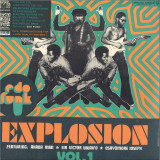
Analog Africa Presents Edo Funk Explosion Vol. 1, available on
2xLP/Gatefold LP with 20-page booklet / CD with 36-page booklet. It was
in Benin City, in the heart of Nigeria, that a new hybrid of intoxicating
highlife music known as Edo Funk was born.
It first emerged in the late 1970s when a group of musicians began to experiment with different ways of integrating elements from their native Edo culture
and fusing them with new sound effects coming from West Africa s night-clubs.
Unlike the rather polished 1980 s Nigerian disco productions coming out of the
international metropolis of Lagos Edo Funk was raw and reduced to its bare
minimum.
Someone was needed to channel this energy into a distinctive sound and Sir
Victor Uwaifo appeared like a mad professor with his Joromi studio. Uwaifo
took the skeletal structure of Edo music and relentless began fusing them with
synthesizers, electric guitars and 80 s effect racks which resulted in some of the
most outstanding Edo recordings ever made. An explosive spiced up brew with
an odd psychedelic note known as Edo Funk.
That’s the sound you’ll be discovering in the first volume of the Edo Funk Explosion series which focusses on the genre’s greatest originators; Osayomore
Joseph, Akaba Man, and Sir Victor Uwaifo: Osayomore Joseph was one of the
first musicians to bring the sound of the flute into the horn-dominated world
of highlife, and his skills as a performer made him a fixture on the Lagos scene.
When he returned to settle in Benin City in the mid 1970s - at the invitation of
the royal family - he devoted himself to the modernisation and electrification
of Edo music, using funk and Afro-beat as the building blocks for songs that
weren’t afraid to call out government corruption or confront the dark legacy of
Nigeria’s colonial past.
Akaba Man was the philosopher king of Edo funk. Less overtly political than Osayomore Joseph and less psychedelic than Victor Uwaifo, he found the perfect
medium for his message in the trance-like grooves of Edo funk. With pulsating
rhythms awash in cosmic synth-fields and lyrics that express a deep personal
vision, he found great success at the dawn of the 1980s as one of Benin City’s
most persuasive ambassadors of funky highlife.
Victor Uwaifo was already a star in Nigeria when he built the legendary Joromi
studios in his hometown of Benin City in 1978. Using his unique guitar style as
the mediating force between West-African highlife and the traditional rhythms
and melodies of Edo music, he had scored several hits in the early seventies,
but once he had his own sixteen-track facility he was able to pursue his obsession with the synesthetic possibilities of pure sound, adding squelchy synths,
swirling organs and studio effects to hypnotic basslines and raw grooves. Between his own records and his production for other musicians, he quickly established himself as the godfather of Edo funk.
What unites these diverse musicians is their ability to strip funk down to its
primal essence and use it as the foundation for their own excursions inward to
the heart of Edo culture and outward to the furthest limits of sonic alchemy.
The twelve tracks on Edo Funk Explosion Volume 1 pulse with raw inspiration,
mixing highlife horns, driving rhythms, day-glo keyboards and tripped-out guitars into a funk experience unlike any other.
While the powerhouses of the loose Native Tongue collective were undoubtedly De La Soul, A Tribe Called Quest and the Jungle Brothers, the wider family threw up some intriguing groups and unforgettable records.
Black Sheep – the duo of Dres and Mr Lawnge – were a natural fit for the Native Tongue vibe, displaying the same kind of wit and humour as their counterparts, with an off-kilter approach that helped them stand out.
While they only released one truly amazing album – their debut ‘A Wolf in Sheep’s Clothing’ was a standout in 1991, one of hip-hop’s best years for LP’s – it spawned five unique singles, with this the first one that really garnered any attention.
While it wasn’t a smash hit outside of hip-hop circles, it showcased their approach perfectly – sinuous rhymes, clever wordplay and a hint of flirtation. If the drums sound familiar, it’s because it’s the same Joe Farrell break – the intro to 1974’s ‘Upon This Rock’ – that Kanye West later used for ‘Gone’. Add in some horns from Herb Alpert and The Tijuana Brass and you’ve got a funky little earworm.
They return to the same Joe Farrell well for the flip, ‘Butt… In the Meantime’, because if the break isn’t broke, don’t fix it. Previously unavailable on 7”, this brace of 1991 sureshots is the perfect introduction to the idiosyncrasies of the Native Tongue era.
Label Text "Dekmantel once again teams up with RE:VIVE, the cultural initiative setup by the The Netherlands Institute for Sound and Vision, to pair modern electronic talent with Dutch archival footage. The third EP in the Scores series sees Interstellar Funk and Italian producer Guenter Råler create innovative, modular soundscapes to the graceful visual arts unearthed from the EYE Filmmuseum archives.
As Interstellar Funk, Olf van Elden uses his production competency to craft a heavenly arpeggiated, synth composition to the amateur aquarium movies by J.L. Clement which are edited for this project by Sjoerd Martens. Filmed in the 1940’s, the video’s turn-of-the-century black-and-white style aquatic footage is reanimated through van Elden’s tacit polyphonic, modular sonic soundtrack. Layering together multiple sequences, van Elden pieces together the music as a whole, to mimic the way in which the film was created.
On the B-Side, Italian abstract artist and Dutch native Guenter Raler concocts a deeply introspective, and perfectly choreographed, ambient soundtrack to a select series of pieced together clips from the Collectie Natuurbeelden, the Institute’s Collection of Natural Images. The music plays against the depiction of multiple biological communities in transition; what is referred to as an ecotone. The title itself not only recalls that of a musical tone, but represents the ever-evolving aspect of life and nature as similar colours, along with movements of animals and plants pass on from one image to the next.
Within their own right, the new scores not only give the age-old films new context and sonic character, but exist as creative works as their own, full of resonance and individualism that highlight the retrospective artists’ voices to their fullest."
In 1970 Barney Wilen assembled a team of filmmakers, technicians and musicians to travel to Africa for the purpose of recordi ng the music of the native pygmy tribes. Upon returning to Paris two years later, he created Moshi, a dark, eccentric effort fusing avantjazz sensibilities with African rhythms, ambient sound effects and melodies rootedin American blues traditions. Cut withFrench and African players including guitarist Pierre Chaze, pianist Michel Graillier and percussionist Didier Leon , this is music with few precedents or followers, spanning from extraterrestrial dissonance to earthbound, streetlegal funk. Wilen pays little heed to conventional structure, assembling tracks like "Afrika Freak Out" and "Zombizar" from spare parts of inde terminate origins. (Jason Ankeny, AMG)
Revelatory reissue of Barney Wilen’s ambitious jazz-fusion journey, Moshi (1972), presenting the legendary French jazzman and Miles Davis-sideman’s wildly ambitious effort fusing recordings of Pygmy tribes with African rhythms and stellar avantjazz leanings, sounding little like anything before or since its release. (boomkat)
Super rare and long out of print, the ground-breaking 1972 album from saxophonist Barney Wilen receives a reissue treatment of the highest order. Complete with a 20-page booklet and a never before seen DVD chronicling Wilen’s trip to Africa, this one is sure to be a delight for fans old and new. The deepest spiritual jazz grooves meet field recordings from the Upper Volta and b eyond, whilst psych rock influences collide with hypnotic and shamanistic percussion work. Truly one of the most out -there jazz records we’ve stocked for a long time! (bleep)
Originally issued by the seminal imprint Saravah in 1972, and among the most uncategorizable and sought after artefacts of the French avant-garde, Barney Wilen’s Moshi is nothing short of a masterpiece - long holding a coveted spot in the hearts of adventurous listeners and record collectors alike. A wild unkept cultural collage. A series of sonic experiments. A spiritual, psychedelic pilgrimage into the unknown - darting from one continent to the next, each of its tangents building toward a more optimist world view through ordered sound. Its scope remains as difficult to understand today as it was when it was released. Now brought back into the light by Souffle Continu, this is a moment to be celebrated far and wide. (Soundohm)
Deluxe reissue with additional artwork & remastered audio. 20-page booklet including rare pictures, sheet music & original liner notes. Bonus DVD with exclusive artwork of Caroline de Bendern’s movie « à l’intention de Mlle Issoufou à Bilma » documenting this incredible african journey.
Sounds Over Seas is back with their third release. This time
introducing Leipzig native Jay Magnum, who makes his 12”
debut on wax. Schlappendisko EP comes with 3 original
pieces drenched in funky chord stabs, thumping basslines
and relentless grooves. Label head Julian Bainbridge adds
his own touches with a percussive and melodic remix.
De¦nite Dance Floor Material!
In 1970 Barney Wilen assembled a team of filmmakers, technicians and musicians to travel to Africa for the purpose of recordi ng the music of the native pygmy tribes. Upon returning to Paris two years later, he created Moshi, a dark, eccentric effort fusing avantjazz sensibilities with African rhythms, ambient sound effects and melodies rootedin American blues traditions. Cut withFrench and African players including guitarist Pierre Chaze, pianist Michel Graillier and percussionist Didier Leon , this is music with few precedents or followers, spanning from extraterrestrial dissonance to earthbound, streetlegal funk. Wilen pays little heed to conventional structure, assembling tracks like "Afrika Freak Out" and "Zombizar" from spare parts of inde terminate origins. (Jason Ankeny, AMG)
Revelatory reissue of Barney Wilen’s ambitious jazz-fusion journey, Moshi (1972), presenting the legendary French jazzman and Miles Davis-sideman’s wildly ambitious effort fusing recordings of Pygmy tribes with African rhythms and stellar avantjazz leanings, sounding little like anything before or since its release. (boomkat)
Super rare and long out of print, the ground-breaking 1972 album from saxophonist Barney Wilen receives a reissue treatment of the highest order. Complete with a 20-page booklet and a never before seen DVD chronicling Wilen’s trip to Africa, this one is sure to be a delight for fans old and new. The deepest spiritual jazz grooves meet field recordings from the Upper Volta and b eyond, whilst psych rock influences collide with hypnotic and shamanistic percussion work. Truly one of the most out -there jazz records we’ve stocked for a long time! (bleep)
Originally issued by the seminal imprint Saravah in 1972, and among the most uncategorizable and sought after artefacts of the French avant-garde, Barney Wilen’s Moshi is nothing short of a masterpiece - long holding a coveted spot in the hearts of adventurous listeners and record collectors alike. A wild unkept cultural collage. A series of sonic experiments. A spiritual, psychedelic pilgrimage into the unknown - darting from one continent to the next, each of its tangents building toward a more optimist world view through ordered sound. Its scope remains as difficult to understand today as it was when it was released. Now brought back into the light by Souffle Continu, this is a moment to be celebrated far and wide. (Soundohm)
Deluxe reissue with additional artwork & remastered audio. 20-page booklet including rare pictures, sheet music & original liner notes. Bonus DVD with exclusive artwork of Caroline de Bendern’s movie « à l’intention de Mlle Issoufou à Bilma » documenting this incredible african journey.
Recline Music founder Nicco (N.D) returns on the label this April, delivering his grooving single 'Lost Universe', accompanied by a remix from Javonntte. Florence native Nicco (N.D) is a long-standing player within the house music scene. Producing since the late 90s, he has previously performed as a singer and guitarist before joining forces alongside Ivano Coppola to launch their Recline Music imprint. He has worked with DJ T., Oxia, Clarian and many others, whilst releasing over one-hundred tracks and gaining support from Marco Carola, Joris Voorn and Steve Bug.
The remixer of this package is Detroit-based Javonntte. Since the early nineties, he has been producing music and has collaborated with legendary producers including Blake Baxter, Amp Fiddler and Andres in his formative years, whilst his solo releases have landed on Quintessentials, Traxx Underground and Kai Alce's NDATL.
'Lost Universe' is a glistening deep house track that effortlessly combines luscious chords with rising pads and blissful keys to transport listeners on a hypnotic journey. Javonntte's interpretation reveals a feel-good affair, as fathomless bassline sequences fuse with kinetic drum programming and dubby chords - wrapping up this enchanting offering in style.
BEN SIMS: Sweet remix from Javonntte!
DJ BONE: Funky! I love it
STACEY PULLEN: Solid Tracks
SHUR-I-KAN: Javonntte remix is nice and summery!
FRED P: Nice one..
KAI ALCE: Javonntte remix hard, deep & HOT!
PHIL DAIRMOUNT: Javontte remix for me
SPATIAL AWARENESS: Love the OG
TELFORT: Real nice ! :)
BILL BREWSTER: Original's nice.
CRAIG SMITH: Real nice Javonette remix
DIZ: Really Nice!!
FRED EVERYTHING: Very nice Javonntte Remix!
Perth’s DJ/producer Charlie Bucket drops his second EP "One Life". It is a melting pot of sounds and Influences featuring guest appearances from all over the globe such as SLIMKID3 (The Pharcyde), Detroit natives Guilty Simpson and Boog Brown, UK Hip Hop artist TY, Raashan Ahmad (Crown City Rockers), Ghanian MC Blitz The Ambassador and Australia’s own NFA Jones.
Fusing together the sounds of Afrobeat, Samba, Jazz, Soul and Funk music "One Life" presents a more organic approach to Hip Hop.
Steppin up, steppin in. Detroit native Jason Hogans supplies the goods for ALELAH014 with a five-track journey though the depths of the downtown. With releases on the likes of Planet E and Moods & Grooves, Hogans hits with a serious dose of deep, emotive, crunched up cuts, heavy on the over-driven basslines and melodic synths that echo through the night.
Nocturnal house business, from the heart of Detroit.
"Do you feel what I feel too?" Brijean Murphy floats the question at the start of Feelings, the full-length Ghostly International debut from Brijean, her collaborative project with Doug Stuart. Guided by a lush mix of charismatic keyboard chords, grooving bass lines, and radiant bongo-driven rhythms, the "Day Dreaming" lyric doubles as an invitation and a statement of intention. Brijean want you to move, physically, mentally, dimensionally; this is dance music for the mind, body, and soul. With Feelings, they've manifested a gentle collective space for respite, for self-reflection, for self-care, for uninhibited imagination and new possibilities. The album cultivates a specific vibe, a softness Murphy has come to call "romancing the psyche." Growing up in a family immersed in jazz, Latin and soul music, Murphy would become an accomplished DJ, session and live player in Oakland's diverse music scene and one of indie's most in-demand percussionists (Poolside, Toro Y Moi, U.S. Girls). In 2018, she began recording songs with multi-instrumentalist and producer Doug Stuart, who shares a background in jazz and pop in bands such as Bells Atlas, Meernaa, and Luke Temple. Following their first sessions, which resulted in the mini-album Walkie Talkie (released in 2019 on Native Cat Recordings), the duo continued freeform hangs in Oakland, inviting friends Chaz Bear, Tony Peppers, and Hamir Atwal. "We improvised on different feels for hours," says Murphy. "Nothing quite developed at first but we had seeds. We re-opened the sessions a couple months later, after returning from tours, and spent a month developing the songs in a little 400 square foot cottage." Aforementioned album opener "Day Dreaming" is a dynamic celebration of newness: the excitement in finding deeper understandings of yourself as you get to know someone, something, or somewhere new. "Wifi Beach" drops a pin in pure psych-pop exotica. With Atwal on drums, Stuart on bass, Peppers on keys, and Bear engineering, the group improvised the track's intro sequence based on the vision of a lavish 1970s pool party. Establishing the scene is a mid-frequency drum kit disco shuffle augmented by tight congas and timbale effect, as Murphy sings in spurts: "I want to be / Deep in love / I want to be / Say you love me too / I want to be / Honey." The stanzas cut between "reflective moments of wants and being overwhelmed by feelings of the present," she explains. "A lot of the `love songs' I write are to my psyche, self-reflections on how to encourage tender perspectives and make more time for the sweet stuff." Though there is a loose, dance-oriented motif throughout, the material gives way to somnolent turns. On "Ocean," Brijean's anodyne lyrics, reminiscent of Astrud Gilberto's airy croon, float atop a brushed drum pattern, sparkling rhodes lines, and pittering and softly funky woodblock bops. The opening line sets up the rest, "In this gentle space we lay" _ among the album's propensity for movement, tracks like "Ocean" stand out by leaning back for momentary sways of blissful introspection. Murphy calls the charming "Hey Boy" a "psychedelic guide _ the exploration of finding what feels good _ through sorrow, anxiety, apathy." This mentality applies to Feelings on the whole: in these nebulous and verdant worlds of hazy melodies, feathery hooks, and percussive details, the songs simply want us to feel alive. They radiate in wonderful abandon and with a sense of devotion to the self. RIYL: Stereolab, Astrud Gilberto, Air, Little Dragon, Broadcast, Khruangbin, Poolside.
LTD. BLUE & PINK SWIRL VINYL
"Do you feel what I feel too?" Brijean Murphy floats the question at the start of Feelings, the full-length Ghostly International debut from Brijean, her collaborative project with Doug Stuart. Guided by a lush mix of charismatic keyboard chords, grooving bass lines, and radiant bongo-driven rhythms, the "Day Dreaming" lyric doubles as an invitation and a statement of intention. Brijean want you to move, physically, mentally, dimensionally; this is dance music for the mind, body, and soul. With Feelings, they've manifested a gentle collective space for respite, for self-reflection, for self-care, for uninhibited imagination and new possibilities. The album cultivates a specific vibe, a softness Murphy has come to call "romancing the psyche." Growing up in a family immersed in jazz, Latin and soul music, Murphy would become an accomplished DJ, session and live player in Oakland's diverse music scene and one of indie's most in-demand percussionists (Poolside, Toro Y Moi, U.S. Girls). In 2018, she began recording songs with multi-instrumentalist and producer Doug Stuart, who shares a background in jazz and pop in bands such as Bells Atlas, Meernaa, and Luke Temple. Following their first sessions, which resulted in the mini-album Walkie Talkie (released in 2019 on Native Cat Recordings), the duo continued freeform hangs in Oakland, inviting friends Chaz Bear, Tony Peppers, and Hamir Atwal. "We improvised on different feels for hours," says Murphy. "Nothing quite developed at first but we had seeds. We re-opened the sessions a couple months later, after returning from tours, and spent a month developing the songs in a little 400 square foot cottage." Aforementioned album opener "Day Dreaming" is a dynamic celebration of newness: the excitement in finding deeper understandings of yourself as you get to know someone, something, or somewhere new. "Wifi Beach" drops a pin in pure psych-pop exotica. With Atwal on drums, Stuart on bass, Peppers on keys, and Bear engineering, the group improvised the track's intro sequence based on the vision of a lavish 1970s pool party. Establishing the scene is a mid-frequency drum kit disco shuffle augmented by tight congas and timbale effect, as Murphy sings in spurts: "I want to be / Deep in love / I want to be / Say you love me too / I want to be / Honey." The stanzas cut between "reflective moments of wants and being overwhelmed by feelings of the present," she explains. "A lot of the `love songs' I write are to my psyche, self-reflections on how to encourage tender perspectives and make more time for the sweet stuff." Though there is a loose, dance-oriented motif throughout, the material gives way to somnolent turns. On "Ocean," Brijean's anodyne lyrics, reminiscent of Astrud Gilberto's airy croon, float atop a brushed drum pattern, sparkling rhodes lines, and pittering and softly funky woodblock bops. The opening line sets up the rest, "In this gentle space we lay" _ among the album's propensity for movement, tracks like "Ocean" stand out by leaning back for momentary sways of blissful introspection. Murphy calls the charming "Hey Boy" a "psychedelic guide _ the exploration of finding what feels good _ through sorrow, anxiety, apathy." This mentality applies to Feelings on the whole: in these nebulous and verdant worlds of hazy melodies, feathery hooks, and percussive details, the songs simply want us to feel alive. They radiate in wonderful abandon and with a sense of devotion to the self. RIYL: Stereolab, Astrud Gilberto, Air, Little Dragon, Broadcast, Khruangbin, Poolside.
Analogue Productions (Atlantic 75 Series)
Celebrating the 75th Anniversary of Atlantic Records!
6x platinum-selling album includes "New Sensation," "Never Tear Us Apart," "Devil Inside," and the No. 1 hit "Need You Tonight"
180-gram 45 RPM double LP release
Mastered by Ryan K. Smith from an EQ'd tape copy
Pressed at Quality Record Pressings
Tip-on old style gatefold double pocket jacket by Stoughton Printing
Kick, the sixth and best-selling 1987 studio album by Australian band INXS, has the unmistakable sound personified by its four U.S. Top 10 singles, "New Sensation," "Never Tear Us Apart," "Devil Inside" and "Need You Tonight," — which reached the top of the U.S. Billboard singles charts.
Between 1980 and 1984, INXS released four studio albums and had toured their native country Australia extensively. With Kick, producer Chris Thomas fused the funk and soul of their previous album The Swing with the mainstream rock of Listen Like Thieves. In an interview with MusicRadar, Andrew Farriss stated, "The melding of funk and rock was always in our heads. We were very excited about the idea of overlaying two types of songs and genres together."
Kick showcased a diverse range of musical styles, blending rock, pop, funk, and dance elements. This versatility appealed to a wide audience, making the album accessible to fans of different genres. It's four catchy singles became radio staples and were accompanied by stylish music videos, helping propel INXS to international stardom.
Incorporating elements such as electronic percussion and synthesizers gave Kick a modern sound, helping it stand out, together with Michael Hutchence's charismatic and sultry vocals that created a strong emotional connection.
All the hallmarks of a top-notch Analogue Productions reissue are here for you to savour: Mastered directly from an EQ'd tape copy by Ryan K. Smith at Sterling Sound and cut at 45 RPM. Pressed on 180-gram vinyl at Quality Record Pressings, and housed in a tip-on old style gatefold double pocket jacket by Stoughton Printing.
- A1: Pa Pa Pa (Lp1 Stop The Hate)
- A2: As We Struggle Everyday
- A3: Stop The Hate
- A4: Land Grab
- A5: Na Bigmanism Spoil Government
- B1: You Can't Fight Corruption With Corruption
- B2: Show Of Shame
- B3: Privatisation
- B4: Set Your Minds & Souls Free
- C1: Free Your Mind (Lp2 For(E)
- C2: Your Enemy
- C3: Blood
- C4: Different Streets
- D1: Higher You'll Find
- D2: Hymn
- D3: Young Lady
- D4: We Are Strong
Legendary activist and Afrobeat originator Fela Kuti used his
music to lament social injustices and political corruption in his
native Nigeria. Fela’s legacy spans decades and genres,
touching on jazz, pop, funk, hip-hop, rock and beyond. While
this impact can be felt in Nigeria and the entire world, it also
greatly affected Fela’s son Femi and his son Made, both of
whom carry his legacy as torchbearers for change. Partisan
Records release two albums from Femi and Made, packaged
together and appropriately titled ‘Legacy +’.
Both albums that make up ‘Legacy +’ are steeped in the
tradition of Afrobeat invented by Fela but each also offers their
own unique vision.
Femi’s ‘Stop The Hate’ honours Fela in a traditionally fun,
sharply political and affirming way. Meanwhile Made’s
‘For(e)ward’ is a modern and progressive freedom manifesto,
pushing boundaries of the subgenre even further. Made also
performs every instrument on his album.
Both albums also feature portraits of Femi and Made, done by
Brooklyn-based artist Delphine Desane, whose work was
recently featured on the cover of Vogue Italia.
The recording debut of Elia y Elizabeth (or Elisabeth, as it appears originally credited in the first edition of this single) took place in Spain in 1971 with Juan Carlos Calderón, one of the most prestigious producers and arrangers in the country.
These first versions of "Fue Una Lágrima" and "Cae la Lluvia" appear full of rich and intrincated orchestral arrangements, a very different approach to both songs from the tropical feel that producer Jimmy Salcedo added when they were later re-recorded for Codiscos in his native Colombia. The duo would record there a handful of songs between 1972 and 1973 (compiled in our past release "La Onda de Elia y Elizabeth" VAMPI 160), mixing soft-pop with a touch of tropical-pastoral funk, singer-songwriter sweetened by the subtle perfume of Caribbean music and psychedelia, which remain among us as part of the most wonderful pop legacy of all time.
These early versions of two of the most celebrated songs by Elia y Elizabeth are reissued here for the first time, with remastered sound and housed in a picture sleeve with the original artwork.
-LTD. COL. EDITION-
We are always sitting on a handful of unreleased songs that didn't make their way to albums. Listening back to these gems we decided to launch a new series entitled Big Crown Vaults and the first volume features the music of Lee Fields & the Expressions. These tunes were cut during the Special Night & It Rains Love sessions. Listening to these tracks you can imagine how difficult some of these decisions were in the first place to leave them off the albums. An absolute standout is "Regenerate," a song that finds Lee in the country soul realm, a style that Mr Fields, a North Carolina native, flourishes in. A drum break starts the song and then drops into a chorus where El Michels, Paul & Big Bill Schalda belt out the earworm chorus. Lee sings an encouraging tune about finding your way out of a low point in a relationship while The Expressions lay down an airtight groove. "Thinking About You" takes it back to the dance floors with what will surely be a hit at Soul parties around the globe. An uptempo drum break opens the song and Lee launches into a tale about the unbreakable bond with his significant other and how they keep each strong through moments of hardship and pain. People who have seen Lee perform live in the last decade might have been lucky enough to hear his rendition of Little Carl Carlton's "Two Timer". For those of you who haven't heard it, Big Crown Vaults has got you covered. A faithful version of the song showcases Lee's gorgeous voice and the Expres- sion's unwavering groove. Another treat on here is the fuzzed out funk banger "Do You Know" where Fields uses his platform to address some of our societal woes in a "Make The World" style. A deeper from the vaults number is "Out To Get You", an instrumental that Lee never laid down vocals to. Even as just a rhythm track it stands as a testament to The Expressions musical prowess, the band that created 5 studio albums with Lee Fields which will go down in history as stone classics.
It gives us great pleasure to introduce the baddest new voice in the land, Napoleon Demps. A Flint Michigan native, he grew up listening to Soul luminaries OV Wright, Willie Hutch and Sam Cooke, whose influence led Demps down a path to becoming an accomplished Soul singer himself - scoring his first hit at the age of 24 in the still thriving Southern Chitlin Circuit of the early aughts. Demps, having been a long time Daptone fan, connected with the Dap-Kings at a soundcheck at a Detroit nightclub for an impromptu rendition of “A Change is Gonna Come.” Bosco Mann was floored by his voice and swore they would meet again. Last year, with that sweet soulful voice still ringing in his ears, Mann would reconnect with Demps and bring him out to Penrose Recorders in Riverside, California to finally cut his first Daptone side. "Norma Jean" is a funky soul groover that lands somewhere between the nuanced big city sounds Chicago and Detroit were pumping out in the late '60s: think the grit of Twinight's houseband Pieces of Peace, kissed by the sophisticated Motor City production of Dave Hamilton or The Brothers of Soul and you're getting warm. Napoleon's smooth, commanding voice injects a je ne sais quoi that's wholly fresh, bypassing the affected trappings that plague many of today's singers. In short... Napoleon Demps is a Soul singer's Soul singer. Take a listen and hear for yourself!