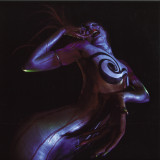
Toronto-based producer and DJ Ciel is renowned for a style of dancefloor material that’s as heady as it is visceral. The Xi’an-born artist’s ascendant profile has seen her cutting- edge and club-ready EPs released on UK labels Peach Discs and Coastal Haze, as well as Stateside imprints Spectral Sound and Mister Saturday Night.
As a member of the renowned collective Discwoman and the creator of femme-forward party Work in Progress Ciel’s thoughtful narratives are clear, running in parallel to the perception-altering sounds that are consistently woven deeply into her wide-ranging sets, beloved mixes and inventive collaborations. Now the Parallel Minds label co- founder is crystallising her imaginative and omnivorous sound with her !K7 Records debut, ORLANDO.
Written during her emergence from an uncharacteristic bout of writers’ block, the three original tracks of Orlando chart a return to the musical self, spurred along by a cinephile’s embrace of film, a love of classic literature, and a curiosity for the oddest corners of popular culture. “SCENES FROM A MARRIAGE” might share a name with the episodic series, but is rather a nuanced critique of the modern rite of union, moving through structured chapters, and mirroring the un-static nature of longtime love.Inspired by Virginia Woolf’s radical novel, and its superphysical protagonist, “ORLANDO” considers the cult literary figure who lived from the renaissance to the modern age, and embodies both sides of the sex binary.
The thrown sounds and aural illusions of “EL CALIFA” create the effect of a beckoning, beguiling psychedelic experience. To complete the EP, Ali Berger, Ciel’s recent collaborator on the Jacktone Records’ release Damn Skippy! repurposes the mind-bending flourishes of “El Califa” into a noodly and spacious deep house production, replete with pillowy, gauzy pads.
Suche:nature lo
Composed, produced and arranged by Evangelia VS, the artist behind Abyss X, Freedom Doll is the culmination of a year of emotional unloading through songwriting, offering an introspective journey into the ocean of her mind. Produced and recorded between an artist residency near the Mayan jungle in Mexico and her Berlin home, the album chronicles transformations the performer tackled mentally during the writing process, tracing the rollercoaster of falling in love during the pandemic, as well as the pleasures and tribulations of womanhood.
Freedom Doll encapsulates the romantic escapade between her voice and the guitar. The amalgamation of seduction, sexual tension, vulnerability and assertiveness pulses throughout the entirety of the album, spiralling out of the cracks spawned from her vocal chords. From the twirling dance between her lush harmonies and the progressions of the acoustic guitar in tracks such as Ascend and From Hot to Cold, to the explosive confrontation between the metallic and operatic qualities of her voice, the searing sound of the electric guitar in industrial rock / psychedelic anthems such as Torture Grove and Banyana and the cathartic momentum found in the gospel inclined chants in A CHEW - Freedom Doll untethers the dramatics and theatricality that defines Abyss X’s vocal performance and music production, while maintaining the sensual vibrations of her creative essence.
Freedom Doll is the encapsulation of the Minoan woman, the elusive harlequin tiptoeing her way through the “circus of terror” that is living and loving her way through womanhood. With this visual reference, Abyss X pays tribute to her ancestors and their groundbreaking ancient artistry. The back cover of the vinyl features a reiteration of depictions of bulls leaping found in Minoan frescoes; an inherently male cultural act that in the ancient Minoan times presumably gave expression to a tension that underlies man's somewhat tenuous mastery of nature. Freedom Doll’s artwork challenges this preconceived notion through an eco-feminist approach, bringing the Minoan woman slash Gaia in the seat of the bull leaper, taming the unhinged and predominantly male earth - threatening human force.
Repress.
Back in 2015, Japanese DIY house pioneer Soichi Terada stepped back into the limelight courtesy of Rush Hour's 'Sounds From The Far East', a Hunee curated retrospective of material first released on his own Far East Recording label in the 1990s and early 2000s. Buoyed by the positive response and renewed interest in his work, Terada went back into studio to record his first new album of house music for over 25 years, Asakusa Light.
Developed over 18 months, Terada tried to recreate the mental and physical processes that led to the creation of his acclaimed earlier work. Those familiar with Terada’s celebrated, dancefloor-focused sound of the 1990s – a vibrant, atmospheric, and emotive take on deep house powered by the twin attractions of groove and melody – will find much to enjoy on Asakusa Light.
“I tried to recall my feelings 30 years ago, but when I tried it, I found it super difficult,” he explains. “I didn’t even know what I thought about myself five years ago, and the mental metabolic cycle seems to be faster than I thought. I tried different methods, including digging up my old MIDI data and composing by remembering old experiences. With the help of Rush Hour, I found some of the light from my heart that I had 30 years ago. I nicknamed the light I found in my heart, ‘Asakusa Light’.”
Produced using the very same synthesizers and drum machines that powered his 1990s work, the album is a joyous, colourful and life-affirming collection of timeless house music that not only recalls Terada’s own impeccable back catalogue, but also that of similarly celebrated contemporaries such as the Burrell Brothers or Ben Cenac (Dream 2 Science, Sha-Lor).
Terada, who has spent much of the last two decades writing video game music, has always had a gift for combining warm, undulating synthesizer basslines and perfectly programmed machine drums with stirring chords, smile-inducing melodies and mellow musical flourishes. It’s this immersive, sun-kissed and tuneful trademark style that takes centre stage on Asakusa Light, an album for the ages.
The set begins with the alien-sounding chords, soft-touch percussion and dawn-friendly warmth of ‘Silent Chord’ and ends on a high via the bouncing string stabs, starlight chords and thickset grooves of ‘Blinker’; in between, you’ll find a deluge of effortlessly feelgood music that’s the aural equivalent of a dopamine rush at sunrise.
There are subtle variations aplenty throughout the album – see the 8-bit lead lines and pulsing electronic textures of ‘Takusambient’, the vintage Tony Humphries flex of ‘Diving Into Minds’ and the effortlessly funky ‘Marimbau’ – but it’s the uniquely atmospheric, vivid and tactile nature of Terada’s loved-up sound that resonates. After well over 30 years in house music, the light in his heart is shining brighter than ever.
Life has changed in the eight years since the release of II. In ours, yours and Gala Drop themselves. Most times without noticing it, partly due to those two years of a semi-existence that still resonates and with the ongoing predatory gentrification process changing the landscape and life of Lisbon, home to the band since ever. Close to a decade and a half of existence, with various mutations along the way enacting new perspectives and moments of stillness and reflection to a sound that's been mutating itself to its own internal rhythm and agency under the guiding light of the core duo of Afonso Simões and Nélson Gomes. Now a trio, with Rui Dâmaso transitioning from II after the departure of Jerry the Cat and Guilherme Canhão, Gala Drop sound even more focused as a working band, with their new album title Amizade – friendship in Portuguese – making perfect sense in a celebration of their, by now, patented soundworld of cosmic inspiration: krautrock's endless and hypnotic potential, dub's sense of transient space, the throb of house, balearic dreams, polyrhythms and a communal sense of belonging.
Again, this sprawling sphere of influence opens itself to new shapes and inspirations, but there's a deeper sense of accuracy and direction, with the band channeling those legacies into something we can only grasp as the Gala Drop sound. An organic outcome of working steadily as a trio, made possible by a residency promoted by gnration in Braga, Amizade dwells on the psychedelic nature of the group through seven tracks made up of dreamy synth washes, loads of percussion, echoes, chilled guitars under a radiant aura. Gala Drop have never sounded as openly dubby as on 'Dub da Meia Noite' and 'Areal Dub' or capable of converging different tropes of the hardcore continuum – rave stabs and cut up vocals – on a slow burner as memorable as 'Monte do Ouro'. Or given free reign to electricity as on the narcotic guitars of 'Guitarra Voadora' – excepting the one off with Ben Chasny on 2012's Broda. 'Amizade' points towards all of that with comforting escapism and wrapping things up 'Raio' turns dubstep's original bass weight meditations into a cosmic funk workout. One last hug before we leave. An album that feels like a collective moment of celebration, just when we most need it.
Afonso Simões - Drums, percussion and synthesizers
Nelson Gomes - Electric guitar and electronics
Rui Dâmaso - Electric bass & guitar and synthesizer
Recorded by Budda Guedes at Estúdio Mobydick, Braga
Mixed by Gala Drop and Hugo Valverde at Estúdio Cão Andaluz, Lisboa
Mastered by Anne Taegert at Dubplates & Mastering, Berlim
Cover photo by Sara Graça
Design by Nicolai Sarbib
After our debut vinyl release “Cosmic Vibrations” with Rush City x Handerk we are ready to present our second vinyl release. This time one of our label founders Jonathan Lopez A.K.A Jonahlo wants to take you in a psychedelic journey on his new EP “ACID DAYS”; a four track EP where each track gets you through a different state of mind.
Jonahlo is an amazing musician, jazz bass player and producer from Bogotá, Colombia. He has released music on labels such as Nomada Records, Night Young and Otayana Records.
This trip starts with “Acid Days”; a superb Deep House anthem with layers of evolving sounds, exquisite melodies and uplifting chord progressions that make us take off and start feeling 100% positive. You can hear samples from cinema describing how it feels when you start connecting and being one with nature.
The following track is “Particles”; on this track Jonahlo goes deeper, evoking hypnotic and far-sighted moods of melancholy. At this point we start pondering about the universe’s infinite dimension and imagining particles vibrating as we fall into our deepest thoughts.
On the flip- side we bump into “Lost Mind”, a percussive deep techno with spacey and bleepy sounds reminding us that 90’s uk old-school style. Now is the time to get lost in the moment after going through the trip’s hard peak where you really start letting go.
The release closes with “It’s Alright”; a good vibe deep sampled house track that tell us to take it easy, to just relax and appreciate life.
The Album cover was disigned by incredible Colombian artist Jose Mejía which represents a flower going through the process of questioning oneself and coming out transformed on the other side. It is a process of exploration, discovery, and rebirth.
From Ōtautahi, Aotearoa (Christchurch, New Zealand) comes a collaboration between James Barrett, best known for his work in techno on Perc Trax, Mord, South London Analogue Material, and KAOS/OAKS as Keepsakes, and Henry Nicol, a founder of industrial-freak outfit Loghorn Breed who’s work as a member of Dog Power saw his music signed to legendary Aotearoa indie label Flying Nun. As CUT 989 the two bring their respective musical worlds in to collision,
producing a debut EP representing a mutated hybrid of industrial, post-punk, techno, and experimental music tied together with cynical lyricism musing on anxiety, human nature and the crumbling state of politics and society in the modern era.
The A1 starts with bass driven drum hits and rolling metallic percussion combine with booming vocals and looping dark synth melodies in ‘The Dominant Trough’. The A2 follows with ‘Castle Of Doubt’, where sombre atmospheres and hand-drum rhythms come together with melancholy Lyra-8 refrains and verbed-out vocals to complete the first side of the record.
‘TPOTT’ launches the flip and picks up the energy with gated reverb toms, weighty kick drums, heavy bass sweeps and vocals ranging from enraged screaming to faint whispers in a driving slab of electronic bitterness. The B2 closes this debut offering with ‘Skin’ – a mournful bass-heavy piece featuring tribalistic drumming, experimental percussions, gloomy synth work and lyrics pondering political betrayal.
Always exciting when Klasse Wrecks comes with a new label project!! This one they do together with Kid Who and is a series of records showcasing previously unreleased house, techno, acid and more from the 90s Amiga Demoscene.
Created using early sample sequencers such as ProTracker, these tracks radiate the authentic energy of techno's golden era - and they've been hiding in plain sight in Demoscene web repositories for many years. It was during the long days of the 2020 lockdowns that Kid Who began to explore these archives, sifting through thousands of tracks to eventually amass a collection of several hundred of his favourites.
Curated by Klasse Wrecks and Kid Who in close collaboration with the talented artists behind them, the .NFO project aims to bring some of these finds to the broader dance music community via a series of VA 12"s and mixes. Tip!! Vinyl comes with A4 insert and stickered sleeve.
As it celebrates its 50th anniversary, Bill Withers' Still Bill remains true to its title – and stands as the greatest male-fronted soul album not made by a singer named Marvin, Al, Sam, James, or Ray. Though the saying "keeping it real" did not exist in popular parlance when Withers released his sophomore effort on Sussex Records, no words better capture the music's approach, mindset, and value. Every facet of Still Bill radiates honesty, truth, and emotion.
These characteristics – along with Withers' strong singing, hybrid arrangements, and deceptively simple songwriting – have allowed the album to endure to the point where it sounds as fresh today as in 1972.
After rising into the Top 5 of the Billboard Album charts and attaining gold status within a year of release, Still Bill has long been evaluated not by sales – but according to its merit, spirit, and agelessness. Included by The Guardian on its "1,000 Albums to Hear Before You Die" list (2007) as well as in Tom Moon's 1,000 Recordings to Hear Before You Die book (2008), its contemporary standing as one of history's most venerated soul efforts eclipses the positive reception it enjoyed in the early ‘70s.
Still Bill walks the same hallowed ground as What's Going On, Call Me, Night Beat, and Genius + Soul = Jazz. Like those landmarks, Still Bill plays with a mix of consistency, effortlessness, and complexity that rewards repeat listening and transcends categorization.
In combining four of the era's predominant styles – Philly soul, sweaty funk, Southern-reared blues, acoustic-based folk – and melding them with standout production borrowed from both minimalist affairs and sophisticated singer-songwriter albums, Still Bill occupies a distinct universe.
Its rhythmic fare is equally laidback and invigorating; relaxing and rollicking; eloquent and muscular; soft and tough. Withers' calm, self-assured voice hovers above it all, doubling as a warm blanket that adds comfort and grace to lyrics steeped in maturity, perspective, and compassion.
Withers' balanced outlook on human desires, needs, and situations stem from his own existence as a former blue-collar employee who believed his time as a musician would soon end. That grounding forever separates Withers from other contemporary soul greats – and stamps Still Bill with a conversational nature and egoless approachability.
"I mean look, I'm really a factory worker," said Withers in 1972. "That's a real job." There's that word again: real. The songs on Still Bill are tethered to modesty and actuality, wedded to a belief in simplicity, and connected to universal truths that link us all – independent of our economic or social standing. No track better exemplifies those principles than "Lean on Me," a feel-good paean to brotherhood and community that hit No. 1 on the pop and R&B charts en route to becoming a mainstream staple.
Withers approaches the plainspoken insight on "Lonely Town, Lonely Street" and heartbreaking vulnerability of "I Don't Want You on My Mind" with similar sincerity and straightforwardness. His proclivity for authenticity extends to the record's other big hit: the sexual, funk-laden "Use Me," which reached No. 2 and reflects the singer's everyman persona. It's an identity couched in keeping it real, the very inclination that ultimately led Withers to retire in the mid-'80s rather than bend to industry pressures or risk credibility.
That commitment to truthfulness and realism helps make Still Bill feel as unaffected as the air we breathe. Looking back on "Lean on Me" years later, Withers said it seemed like "something that was there before I got here" – the kind of song that could be 100 or 10 years old, or one we encounter anew 10 years into the future. The same can be said for every note on Still Bill.
Two mavericks, out on the weekend, trying to make it pay...
"Maverick was the word that came to mind when I listened to this music. A slightly wayward independence of spirit and outlook. The word originally referred to an unbranded male calf that had become separated from the herd (because Texan rancher Sam Maverick was so negligent in his branding - ‘if it ain’t branded, it’s a Maverick’). But Sam’s grandson Maury Maverick gave it a different twist in his short but stormy Congressional career as the only liberal member of the Southern Democratic caucus. Maury was so out of step with his own folks that he not only voted in 1937 to make lynching a federal crime, he even addressed the House to condemn the practice as barbaric. His attempt to ban racist mob murder sadly failed, but it’s that refusal to march in step which distinguishes the two ‘mavericks’ who made this record.
Who would attempt to combine cunning ethnological forgery, Scottish folk songs, claw-hammer guitar, untutored horn-tootling, elastically relaxed drumming and garage electronic fuckery? Only Greg and Stefan, high on sea, sunshine and mis-judged micro-dosing – that’s who. ‘Don’t drown’ was offered as practical advice during the self-described ‘Yellow Submarine’ phase of making this record. And while they managed to avoid literally doing so (phew), they sound here like they got pretty ‘deep in’ to an Octopus’s sound world all their own. This surprisingly clear analogue recording has just enough Bikini Bottom grit to ensure traction. The tunes are inviting, and the sonic disruptions are too good-natured and goofy to upset even the most delicate digestion.
The sessions have had a couple of years to marinate, courtesy of some pandemic, and are here offered in that most Archducal of vinyl formats, the double ten inch. What are you waiting for, a side of Crabby Patties? Get your water-wings and dive in (unless you’re tripping)!" - Bruce Russell (The Dead C)
Pumice is the long-running, endlessly inventive project of New Zealand native Stefan Neville (1974), whose shambolic music is equally reminiscent of Kiwi pop groups such as The Clean and Tall Dwarfs as well as the country's experimental noise-rock bands like the Dead C. Largely recorded solo by himself on junky equipment, his songs typically feature blown-out guitars, wheezing chord organs, and vocals disguised by tape hiss and static.
Greg Malcolm (1965) is a guitarist from New Zealand who has played everywhere on the globe and with all most everyone, including Rosy Parlane, Toshimaru Nakamura, Tetuzi Akiyama and Bruce Russell, as well as solo releases on his own label, Corpus Hermeticum, Kraak and Celebrate Psi Phenomenon.
Berlin based OKMACH3 presents a divers and club-oriented sound. The focus is on releases blending genre conventions and challenging listeners while keeping in mind that the night belongs to lovers and dancers alike. Our ¦rst release is also the solo debut of fnctrl and encapsulates the spirit of OKMACH3 perfectly. His sound merges Electro influences with a bass-driven four to the floor production and grooves ranging into Trance. It’s an atmospherically dense and dark Sci-Fi trip attended by an AI contemplating the nature of human interaction.
Back in 2011 when I was tentatively looking for a second release for my fledging record label Clay Pipe Music, I stumbled upon a mysterious MySpace page by a group called ‘Tyneham House’, the page was decorated with artwork by Rena Gardiner (who was unknown to me at that time) and the music was an otherworldly mix of field recordings, Mellotron and acoustic guitar. It turned out that Tyneham was promised to Glen Johnson’s Second Language label, so I offered to do the artwork, and in January 2012 the two labels co-released it on tape and CD in a cardboard box with a handmade booklet of my illustrations.
In 2016 Clay Pipe reissued it on 10” vinyl, in an edition of just 300, which has since become sort after. The new 2023 pressing is on blue and transparent marbled vinyl, with a reverse board cover and inner sleeve, and the booklet of illustrations has been given a complete redesign. Frances Castle 2023
The pastoral, wistful yet ineffably disquieting music of Tyneham House is made by artists who wish to remain anonymous here, save for their eponymous title. The musicians are happy, however, to let it be known that these recordings have been around for some years (many of them complied from old cassettes) and that they take inspiration from the 1960s/’70s/’80s work of the Children’s Film Foundation – a body who really ought to have made a film about this mysterious West Country curio. At least now we have its endlessly poignant soundtrack.
The small village of Tyneham, on the beautiful Isle of Purbeck, in Dorset, was once a thriving little community – that is until the British Government requisitioned it for training manoeuvres and other ‘strategic purposes’ in the run up to WWII. This was supposed to be a temporary measure, but the area remained in military possession long after hostilities had ceased, causing distress among former inhabitants, many of whom were farmed out to prefabs in nearby Wareham and Swanage.
Tyneham was characterised by its red telephone box, a tiny parade of shops – Post Office Row – and a grand country pile which stood about half a mile away from the village: Tyneham House. The army removed the building’s oak panelling and ornate decorative details and promptly set about using it for target practice. So great was the shame expressed locally about the damage inflicted upon one of Dorset’s grandest houses that the powers that be decided to grow a copse around the remains of the structure to give the impression that it was no longer there. Despite this, a substantial part of the structure remains intact, including its Saxon hall.
Land access around Tyneham was opened up in the 1970s, but admission to the house remains strictly verboten. Those who’ve been found around the premises, especially anyone wielding a camera, have felt the full weight of military trespass law. Tyneham today is regarded as a nature reserve by some – as a national embarrassment by others. It’s still a political hot potato, in Dorset at least.
2023 Repress
'Soleil Tartare' is Dim Garden's debut album on Rotterdam's young label Yarrow Ballet. This five-track EP embodies both the depths of Hades' underworld and Helios' realm. The album is a worship of the metaphysical side of nature. The opening track, 'Cunning Morose' evokes incandescence and sun worship. Its propulsive 808 beat and lofty vocals conjure flamboyant pagan ceremonies. The instrumental track 'Golfinho do Rio' is a heroic ode to the infinite sea, combining driving rhythms with new-age-inspired synthesized sea creatures' cries, layered with mighty string melodies. It is followed by the grungy 'In Sorrow', where ghoulish and fiery rebel energy is summoned through ice cold drums, and haunting gothic vocals. The album sees the re-emergence of the blazing sun in the softer and melodic title-track 'Soleil Tartare'. 'Vostes et Cercueils' crowns the album with its epic and dramatically ascending polysynth sonic poem. With her seminal and genre-defying album, Dim Garden brings new and disruptive energy into the hinterlands of electronic music. Her work spawns a distinctive mix of raw electronics, minimal wave, noisy industrial and gothic ballads. Having previously released mostly on digital and cassette tape labels (Nightwind Records, Italo Moderni, Ophism, Hunger!, ClanDestine, tanzprocesz, ERR REC, Ernest D. Tapes etc), Dim Garden's debut vinyl, which collates a variety of influences, is sure to compel listeners with its poetry and awe-inspiring synthesis.
We are proud to present the Mr Bongo pressing of Guilherme Coutinho E O Grupo Stalo's self-titled mythical album. Blending lo-fi, Brazilian tropicalia, jazz, funk and MPB with a unique aroma, this record is pure perfection.
It was originally released in 1978 on Erla - Estudio Rauland, an obscure record label from Belém in Brazil, that only released 7” singles, with this album being one of two exceptions. During the 1970s, Belém had a thriving nightclub scene, but it is thousands of miles away from the music industry hubs of Rio de Janeiro and São Paulo, making this record insanely difficult to find, even in Brazil. Added to the scarcity factor is the magical nature of the recording, which has naturally resulted in a hefty price tag to match. Original copies have become a prized, collector’s item.
The elusive Brazilian band leader and keyboard player, Guilherme Coutinho is a true cult artist. He passed away in 1983, at the age of just 41, and during his career he only seems to have appeared on a handful of marvellous records, which makes them all the more special. This album feels individualistic and distinctive from other albums of the day. Listening back to vocalist Elinho’s (aka Hélio Rubens de Oliveira) delivery, it sounds not too dissimilar to some of Belle & Sebastian’s songs. ‘Guilherme Coutinho E O Grupo Stalo’ is rich in charm, quirky and playful. It feels cinematic, soothing and benefits from being heard in its entirety. A proper album experience.
Repress!
KNTXT signs hotly-tipped techno artist Indira Paganotto for a new EP that showcases her unique sound across four compelling tracks.
Indira's father was a DJ in the iconic Goa scene in India in the 90s, so she grew up surrounded by colourful, emotive techno and psytrance. She has brought that to her own DJ sets and productions ever since she moved to Madrid to pursue her career. Now Indira is coming out with her best EP to date.
“I got to know Indira Paganotto when we opened up for demo submissions earlier this year,'' says KNTXT label boss Charlotte de Witte. “She immediately caught my attention with her unique take on psy/techno music. It feels very good to have her on board and I'm curious to see what the future holds for her.”
Indira adds, "I understand music as a state of trance where each track develops a journey and a story. Himalaya EP is the reflection of everything I learned since my childhood until today, the heritage and passion for Psytrance, the experiences in India, the connection with nature, as well as the feeling of freedom and strength like the gallop of a horse, the synths of Goa music, the love and the truth, which is what fills my life. Thank you Charlotte for understanding my language in such a true way. Ours is a real connection in such a sincere mental embrace, and I am proud to be part of your KNTXT family and to be able to show everyone who I am."
The EP ́s opening track, 'Takeshi', is a slick techno roller that is rippled with psychedelic melodies and bright acid lines. They bleep and squeak up top to create a hypnotic effect as the drums march on. 'Sultans Of Mountains' contains intense psychedelic synths waning about the mix. The drums are stripped back and urgent, and crashing hits and smart filters bring real tension as this one unfolds in an arresting fashion. On the other hand, 'Himalaya' has a deep and sleek techno atmosphere where astral pads and heavenly vocal coos make for a cinematic sound that will cast a real spell on the crowd. Last, but certainly not least we have the edgy and heavily textured 'Cobra' with its unrelenting drums, slapping hits and futuristic, psytrance-tinged melodies all designed to mess with your mind.
This is an EP packed with fresh techno, straight from the breakout star Indira Paganotto.
“In the Flesh” is the brainchild of Egyptian-born, New York-based conceptual artist Nader Sadek. Known for his impressively twisted sculptures, masks, and installations used for example by bands such as MAYHEM and SUNN O))), Sadek is now venturing into the realm of recorded music- including songwriting credits on this album! The band NADER SADEK emerges out of a collaboration between Sadek and some of extreme music’s most talented artists with its core made up out of songwriter/vocalist Steve Tucker (ex-MORBID ANGEL), CRYPTOPSY drummer Flo Mounier and Norwegian composer/guitarist Rune Eriksen (AVA INFERI, ex-MAYHEM). A host of guest-appearances lends additional weight to the musical impact of “In the Flesh” by leading artists such as Attila Csihar (MAYHEM), Travis Ryan (CATTLE DECAPITATION), Tony Norman (MONSTROSITY), Descructhor (MORBID ANGEL), and Nick McMaster (KRALLICE). “In the Flesh” is firmly based on a technically masterfully executed unique style of Death Metal with a pitch black twist that creates a multi-cultural symphonic abyss where melody and corrosion meet. As a work conceptual art “In the Flesh” is best explained like this: NADER SADEK invite you on a journey to the depths of the earth, where substances of a repulsive nature dwell. Beneath the earth’s crust, over millions of years creatures have disintegrated and decayed until taking on ghastly new life as petroleum. Like a return of the undead, petroleum and its derivates have wrought cross-cultural conflict, environmental pollution, and economic distress. With a visual and aural assault, Sadek’s new work “In The Flesh” re-interprets petroleum’s sinister insinuation into our everyday lives. Nine songs and a series of original drawings video works explore several aspects of the commodified resource we find ourselves fatally dependent on. “In the Flesh” exploits the sonic links between death metal and gasoline-dependent heavy machinery such as automobile and airplane engines. These links shaped the process of musical composition itself: The album opener, “Petrophilia”, kicks in with a sound evoking an engine starting up. Another song, “Of This Flesh (novus deus)”, follows the sonic structure of a car shifting gears. While continuing to link musical composition to mechanical transformations, other songs depart from engine-based references. The outro to the album, “Nigredo in Necromance” which is already accompanied by a video, dwells on an individual’s recognition that he must die in order to reunite with his deceased lover. The song riffs on the life-in-death of an oil-drenched society, as the lovers’ reunite in their decomposition and rebirth as petroleum. This theme also drives the track “Mechanic Idolatry”, which channels the uncanny thrust of Sadek’s recent artistic output, as live human beings provide the fuel for machines transforming themselves into flesh.
Reflections of the Sun is a collection of new music that see JOHN ROCCA experiment with a more laid back side to his musical personality. John is best know in Jazz Funk circles for his 1980s self funded, self produced and self released Brit Funk classic 'Southern Freeez', and as the band Freeez's founder.
"The melancholic suburban soul of ‘Southern Freeez’ never gets tired for me....an album that has remained at the top of my Brit Funk pile!" - GILLES PETERSON
Much of the album is also somewhat reflective. A personal and emotional reflection on John's life - the tracks a nod to John's varied musical pasts. Sounds, a pondering upon his collection of global influences and his life experiences over the years; Genre, the pulse of today, societal, musical or otherwise - but not easy to place as is John's character; Lyrics, the present dilemmas we face as humanity, whilst reflecting on our own private and deepest human feelings, of life and, of love in all its wonderous forms.
Musically, the 'Reflections of the Sun' album casts a glimpse back to Rocca's Brit Funk roots growing up amongst 1970s classic Jazz Funk and Soul, while also blending inspiration from his 1980-90s electronic influences topped off with everything else he has seen and heard on his life travels since then.
Giving a nod to John's own past while bringing Reflections of the Sun up to date was completed by adding elements of London's re-surgent and vibrant jazz scene. Not so different from John’s own early days jamming with Freeez, he is accompanied on all the album's tracks by his two young nephews and highly respected jazz musicians, Benjamin Rocca on keyboards and Joel Rocca on Saxophone. The two youngsters are known on the current London Jazz scene as the "Rocca Brothers".
The album's title track, "Reflections of the Sun" refers to how humanity, gorging on the sunshine that brings life to everything, also has a tendency to reflect the hellishness of the sun itself. Comparing our self-destructive nature with our planet's volumes of un-ending beauty.
Initial support for various tracks has come via radio plays on UK stations such as JazzFM, Jazz Funk & Soul Radio (JFSR), Soul Groove Radio and Solar (amongst others).
At long last, hi-tek whizz-kid Metrist returns to Timedance with the third addition to the ‘Pollen’ series and brings his epic trilogy started in 2019 to a breath-catching end.
Elevating an already unique approach of sonic craftsmanship to whole new levels, the London based producer delivers some of his wildest and most dramatic compositions to date while pushing further his signature blend of 22nd century dancefloor pyrotechnics.
From the angelic vocal cascades of opener « Leven Lever Liver Love » to the heart-wrenching heights of « Bullet Time », a playful and intricate display of cross-pollinated emotions shines through this collection of boundary pushing tracks, giving them a life of their own while bringing a stormy cycle of auditory experiments into human nature to completion
As thunderstorms form, pollen grains often ascend into clouds, soaking up humidity to a point they inevitably burst out, liberating innumerable particles that tumultuous winds send back to ground-levels.
With a false sense of distance and safety, we sit back and watch the lightning strike in complete awe, unaware of pollen slowly descending from the skies, making its way through our lungs and deep into our bodies ; the storm may be over, but Pollen has now fully become a part of us.
re:discovery records is proud to release for the first time, a vinyl edition of 'Two Zeroes' by Grain for it's 25th anniversary.
Grain was a west coast project that emerged out of the psychedelic music and art scenes in Los Angeles in the early 1990s. After a few of their tracks were featured on the key chill out compilations United State of Ambience 1&2 and Excursions in Ambience
and many local live performances, they released two ep's on local labels. Shortly after in 1998, 'Two Zeroes' the full length project appeared. A west coast chill out classic that unfortunately did not get much disribution outside the west coast let alone to the world.
To classify this album is very hard. Think early Jammin Unit with a touch of the Orb and dash of west coast breakbeat and chill out styles and you still can't fully pin it down. A unique album that sonically, was leaps and bounds ahead of most albums in this style thanks to sound designer, audio instalation architect, scientist and artist Jimmy Johnson along with illustrator and fellow sonic artist Peter Ehrlich. Featured on double vinyl with updated artwork by the original designer, Kevin Hanley and presented on beautiful gatefold with a shimmering silver vinyl to match. This could be one of the discoveries of the year for those that have never heard this album. Dare to Dream with us.
On May 12th 2023, Helsinki-based duo Ya Tosiba will release their second album, ASAP Inşallah. The album will be led by two singles, ‘Mənəm’ and ‘Pul’, due for release on March 2nd and April 13th respectively.
A collaboration between Finnish electro producer Tatu Metsätähti (also known as Mesak and Mr Velcro Fastener, and of the Scandinavian skweee scene) and Azerbaijani musician and vocalist Zuzu Zakaria, Ya Tosiba absorbs electronics, live instrumentation and folkloric poetry of Caucasus into a spirited, groovy sound.
The follow up to their 2017 debut album Love Party, Ya Tosiba’s ASAP Inşallah plays with tension of living in a world of contradictions.
Across the 10 tracks musical and lyrical collaboration takes the listener on a global trek. Sonically, features come from Norway’s Center of the Universe, France’s Poborsk, Ukraine’s Zavoloka, Sweden’s Pavan and Daniel Savio, Azerbaijan’s Rahman Memmedli, plus Patric Catani and Debmaster from Berlin. As Zuzu sings in Azerbaijani, the storytelling of ASAP Inşallah comes alive. All of the album’s lyrics are taken directly from poetry and texts: with tales of romance and war, sex and gender, nature and machine, politics and society. Though the stories are varied, and some are historical, they all tap into that tension; it’s the weight of history versus the promise of tomorrow. After collecting myriad stories during her field studies, some of which are over 100 years old, Zuzu was stunned by their contemporary relevance.
When Ya Tosiba wrote ASAP Inşallah, it started with these texts-as-lyrics; melodies and music were built out from their internal rhythms and vocalpossibilities. With a range of electronic hardware and software, Zuzu and Tatu went back-and-forth, creating taut loops and clips out of Zuzu’s vocals, drums and keyboards, with samples of their collaborators instruments and Tatu’s productions.
In chopping up recordings of the live players into their electronic beats, Ya Tosiba creates an effect of tradition and modernity “being samples from the same record, taking it apart and looping it to sound like one machine.” The patchwork nature of their process, alongside the ambitious and danceable sonics, invites the listener into Ya Tosiba’s unique perspective.
- A1: Everything I Own
- A2: Silver Words
- A3: I Wish It Could Be Peaceful Again
- A4: Artibella
- A5: Lady With The Starlight
- A6: Walk Away From Love
- A7: Why Baby Why
- B1: Is It Because I'm Black?
- B2: Freedom Street
- B3: Live Good
- B4: Let Go
- B5: Can't Fight Me Down
- B6: Your Feeling & Mine
- B7: You're No Good
- C1: Crying Over You
- C2: It's Gonna Take A Miracle
- C3: Who Gets Your Love
- C4: Say You
- C5: (That's The Way) Nature Planned It (That's The Way)
- C6: Now I Know
- C7: I'm Not For Sale
- D1: Freedom Day Aka Freedom Time
- D2: Love & Unity
- D3: Somewhere
- D6: Got To Get Away
- D7: Love Don't Love Nobody
- D4: Rasta Never Fails (Feat Lloyd Charmers)
- D5: Satta Massagana
Ken Boothe, der wohl begabteste jamaikanische Musiker seiner Generation, gilt heute als lebende Legende, dieüber einen Zeitraum von rund 60 Jahren unzählige Ska-, Rock-Steady- und Reggae-Klassiker aufgenommen hat.
Nach seinem Aufnahmedebüt im Jahr 1962 erlebte Ken Boothe eine äußerst erfolgreiche Karriere in Jamaika, bevor er 1974 mit seiner Interpretation von "Everything I Own" und dem Top-10-Nachfolger "Crying Over You" internationalen Ruhm erlangte.
Diese beiden äußerst beliebten Titel sind auf dieser Sammlung enthalten, die Teil der neuen "Essential Artist"-Serie von Trojan Record ist und die beliebtesten Aufnahmen einiger der größten
Musiktalente Jamaikas präsentiert.
Erhältlich als 28-Track-Doppel-Vinyl-LP und als umfassende 2CD-Compilation, zeigen beide Veröffentlichungen das außergewöhnliche Gesangstalent eines der besten und gefühlvollsten Interpreten, die der modernen Popmusikszene seit den Sechzigern ihren Stempel aufgedrückt haben.
- A1: Nandele & A-Tweed - Deserto 05 20
- A2: Nadia Struiwigh – Lovessong 04 38
- B1: E-Saggila - Pr1Nt 04 18
- B2: Nvst - Heatstress (Tunnel Edition) 05 36
- C1: Ryan James Ford - Totes (Bath Mix) 04 42
- C2: Viikatory – Cinema 03 56
- D1: Jean Redondo – Hypersonic 03 52
- D2: Significant Other - Cellar One 04 30
- D3: Willis Anne - Späti System 03 28
- E1: Dj Sotofett Meets Kavadi - Kandhan Karunai 05 10
- E2: Ireen Amnes – No Longer Human 05 12
- F1: Solid Blake – Hexaghost 05 33
- F2: Nit. - Cirrus Virga 06 00
yet is a slippery word in English. Amorphous, these three letters in dierent contexts can define contrast or emphasis, set a place in time, show an expectation that something will occur or, paradoxically, that it is likely to stop.
It is this mercurial nature that makes yet the perfect title for Tresor’s latest compilation: the label follows on from the more explorative sections of 2021’s landmark Tresor 30 boxed set with a compilation, featuring 13 artists making music that resists easy definition.
Every track hints at and borrows from the familiar yet none follow the expected path: halfway through Deserto, Nandele & A-Tweed dramatically reveal a very dierent sonic landscape that was initially suggested; DJ Sotofett collaborates with Sri Lankan artist Kavadi with results that are unlike anything in the Norwegian producer’s catalogue as yet.
Further invention can be found as Jean Redondo’s Hypersonic moves across spaces inhabited by digital hardcore and hyperpop before swerving o-road and into a futuristic hip-hop section; on No Longer Human, Ireen Amnes takes a dierent path at the crossroads melding hyperpop, trance, and sci-fi soundtrack atmospherics, Significant Other heads towards UK Bass and Dubstep, and France’s Willis Anne skims by the outskirts of footwork with a piece that is almost completely uncategorisable.
Yet more sonic experimentation comes from E-Saggila, Nadia Struiwigh, NVST, Solid Blake, and Viikatory who oer unique takes on the well-established electro blueprint, while Ryan James Ford, and Nit. both find ways to blend elements normally found in ambient pieces with those heard on a dancefloor.
The feel of the compilation is yet again reflected in the enigmatic artwork by Malik Arbab, where shapes and colours suggest animals and plants but in a world that appears to be transient and constantly evolving.
Lord knows we have put out some rare R&B records here at Real Gone Music, but this one may take the cake! Mary Mundy’s 1980 album for the obscure Image label goes for hundreds of bucks if you can find it at all (which, as of this writing, you can’t). Loaded with bassheavy, disco-soul grooves over which Mundy’s voice floats like
a butterfly and stings like a bee, Mother Nature lives up to the collector hype. That Mundy’s discography consists of this album and a few scattered singles just adds to the mystique of this intriguing one-off, which sees its first reissue in any format here. Remastered for vinyl by Mike Milchner at Sonic Vision. We’re only making 1000 copies and you better not tarry…pink vinyl pressing!
fter 1 EP, 2 albums acclaimed by the national press and a marathon tour around the world, the French band Grand Blanc decided to take some time.
Time to recharge their batteries, time to rethink the band, time to strengthen their ties even more by isolating themselves for almost a year in a house in the Picardy countryside. It is this new place and the daily contemplation of nature that gave the band this new mutation.
A new album carried by a renewed instrumentation like harp, folk guitar, pedal-steel, electronic goldsmiths in the service of a dystopian tale, of a quest for colour in a world that has become pale. Here is the return of Grand Blanc, on new territories that they have patiently tamed, signed on their own label called PARAGES.
Flautist Johanna Orellana teams up with Carmen Villain for a collection of horizontal, pastoral field recordings and close mic-ed flute sounds that zero in on the instrument’s unstable resonance and levitational magic. There’s no cringe virtuoso business or fourth world firewalking here - just sonic purity, sublime minimalism and the precise capture of time, place and poetry.
You might have come across Johanna Orellana before if you’ve listened to Carmen Villain’s music (or seen her perform live), and Villain appears here in a producer’s role, using her engineering expertise to impart a level of restraint and sonic fidelity that’s quite startling. There are only really two central elements to the album: environmental recordings and flute. There’s no psychedelic delay, no cavernous reverb; no audible treatments at all - Orellana and Villain instead force us to consider the flute and its musical lineage.
‘El Jardín I’ introduces the instrument as a physical conduit; Orellana allows her breath to distort the sound - the padded pat pat of the keys forms a kind of rhythm, closely recorded so it’s amplified and jarring, linking to primal wind instruments like conch shells, bamboo flutes and wooden whistles. Recalling the way in which Debit interfaced with the ancient world using AI- assisted tech on last year’s ‘The Long Count’, Orellana uses a comparatively modern contemporary transverse flute, an instrument with roots that stretch back through the baroque era, into Medieval Europe, back to the Byzantine era and into Asia. The component that connects the instruments and eras is breath, and its amplification and modification through differently shaped pipes and vessels.
Orellana lets the environment sing: insects, rushing water and zephyr-like winds form a stage that presents her mortal energy, suggesting a harmony between our use of breath and its environmental ubiquitousness. Her technique is steeped in folk history and decouples itself from expectation by rooting itself in nature. It allows her to bridge the gap between equal temperament and less ordered (less commercially-focused) microtonality without overstating the concept. Other sounds waft in from the sidelines; what might be an Indian bansuri, stray notes, a gust of air.
There’s a link to the foundational new age recordings that Joanna Brouk made with Maggi Payne back in 1980, but Orelanna also absorbs the outdoor folk magic of Fonal or Stroom, and the improvisational grist of Bendik Giske or legendary US horn duo Nmperign.
- A1: Dreams (Feat Xênia França&Zé Leônidas)
- A2: Kismeti (Feat Matthias Schriefl)
- A3: Asase (Feat Eric Owusu)
- A4: Sábado (Feat Zé Leônidas)
- A5: Carrossel (Feat Zé Leônidas)
- B1: Caio & Eric (Feat Eduardo Camargo)
- B2: Ndiyakhangela (Feat Bongani Givethanks &Amp; Mpho Nkuzo)
- B3: Agôra (Feat Matthias Schriefl)
- B4: Oblique Sunshine (Feat Rebekka Ziegler)
Global pointing Brazilian jazz trio releases their new album Agôra, that sparkles with electric funk and Herbie-esque eclecticism. It features a myriad of guest vocalists and musicians including Brazilians Xênia França and Zé Leônidas, Jembaa Groove's Ghanaian singer Eric Owusu and South African artists Bongani Givethanks & Mpho Nkuzo
Re-wiring the concept of 'fusion' for 2023, Agôra is Brazilian trio Caixa Cubo's resurgent new record with the title referring to 'now', based upon the intuitive and fluid nature of the trio's method, and this inspired recording. With shoots to black music culture, from Brazil to Brooklyn, Ghana and South Africa, Agôra is the group's ninth album yet is their first where they've invited guests, mainly singers, onto each track and follows their last, Angela from 2020, released on Heavenly Records, which won a BBC 6 Music Album of the Year (Huey Morgan's selection) granting them much deserved international recognition.
The core musical elements of Caixa Cubo are Henrique Gomide (keys), João Fideles (drums) and Noa Stroeter (bass), all from São Paulo, Brazil and where they met as teenagers and would continue their friendship and musical bond at the Royal Conservatory in The Hague, Netherlands. Now all in their mid thirties, João and Noa live back in the city where it all started but Henrique has settled in Cologne, Germany where the recording of Agôra took place, over the course of 3 days, at the home cum studio of Chris 'Dusty' Doepke, their friend and owner of the label they signed to, Jazz & Milk.
In line with all their creations where flow and energy provide the magic, allowing what the moment provides, the album shines not only for its virtuosity but for its minimalism, the depth of space, and for the first time, the ability to figure in and outside of the jazz fold, as the trio decided, for the first time, to bring in singers and add a new aesthetic to their sound.
"Agôra is a wake-up call to reality, a reminder that the infinite possibilities of technological progress should not disconnect us from the earth, from eye-to-eye relationships, and from moments lived in person" the band are keen to point out. "And that we must not be consumed by greed, for all we truly possess.... is the NOW."
Turning hope and metaphor into music, the debut single Sábado, an electrified future- jazz-fizz reflects perfectly the spontaneity that permeated the entire recording of the album. "When we got to the studio, we had no idea what we were going to record. We started playing a groove, kind of inspired by Gilberto Gil's 80s albums, and our drummer João started singing this funny song 'Sábado Barrigudão' (Big Belly Saturday) alongside the bass groove and that was that". Inspired by their city of birth, São Paulo, it features long time collaborator and vocalist Zé Leônidas, with cuicas, tamborim, agogo and shakers providing the most obvious Brazilian affect from the album.
Dreams is the band's first foray into R'n'B melding the group's simple and sporadic instrumentation of drums, keys and bass into a Jill Scott inspired song that could have been born in Brooklyn yet sung by Brazilian singer and Grammy nominated Xênia França and Zé Leônidas in both English and Portuguese. Xênia recently performed online for hip-to-it website Colors and it's her latest collaboration with Caixa Cubo, having first met in 2009 for a series of live performances.
South African artists Bongani Givethanks & Mpho Nkuzo come to the record with a wholly different approach on Ndiyakhangela, providing spoken word and vocal refrains on top of an Afro-Brazilian percussion jam with a delivery and verse in Xhosa, Zula and Ndebele. Asase is the album opener and features vocals of Eric Owusu who is part of highlife pioneer Pat Thomas's live band and most recently, co-leader of Jembaa Groove, an Afro-soul band from Berlin. It's a synth wig out with djembe grooves and offers a brand new take on Afro-soul-jazz.
Other contributions come from Cologne based jazz singer Rebekka Ziegler (Oblique Sunshine), São Paulo based guitarist Eduardo Camargo (Caio & Eric) and trumpet player Matthias Schriefl on Kismeti, a gorgeous and rolling number that ebbs and flows, exemplifying the group's effortless ability to craft a sound energised by a belief in one-self and the idea of having faith without the need to look at each other for verification.
As drummer and percussionist João Fideles perfectly surmised upon arriving for the recording session, "What drums do you have? Whatever you have, I'll use it". Agôra is testament to nearly 20 years of camaraderie, friendship and most importantly, trust.
Talla 2XLC is celebrating his forthcoming birthday with the annual
spectacular Technoclub event along with faithful friends such as DJ
Dag, Woody van Eyden, Andreas_Kraemer, Sven Wittekind, Ulli
Brenner ,LXD and Bluefire amongst others. While during his career
has faced many obstacles and unfortunate situations, he manage to
stay ahead of his game by gaining the respect and admiration of his
fans and DJ colleagues. His career is a bright example of an artist
that fight against all odds and work ultra-hard to be always at the top
of download shops charts with his single releases and at the top of
the physical sales charts with his long lasting Mixed CD compilation
Technoclub that in 2023 celebrates its 25th year anniversary. Well
known for his ability to provide brilliant remakes of huge trance
classics on his label Technoclub Retro while on That’s Trance service
original solo tracks or collaborations with brilliant singers such as
Christina Novelli and fellow DJs like Ronski Speed or Ralphie B. Last
year he established his psy-trance label Dreamscape with remixes
by his psy-trance alter ego Zyrus 7. Talla 2XLC is not just a pioneer
in techno and trance music scene but also a frequently booked DJ
performing on the most iconic festivals and club events such as Nature One, Mayday, Airbeat One and many more as he knows excellently to entertain his crowds with memorable DJ sets . Talla 2XLC embraces social media with active accounts in the most of them with hundreds of followers.
During the pandemic lockdowns he conquered twitch with
his very successful live DJ sets receiving donations and support from
his global fan base. What is more Talla 2XLC is taking part in wide
variety of documentaries narrating his contribution in the development and growth of electronic music culture. He is co-founder of MOMEM - Museum Of Modern Electronic Music in Frankfurt that any electronic music follower should visit to learn about the history of our culture.
For his 2023 Birthday he has a huge surprise to all his vinyl lovers.
He is going to release his BDay Bash EP that will include two massive
tracks already released digitally under his techno moniker RRAW on
Technoclub Pure. The two massive mainstage techno friendly anthems Wonderful Dayz and The Promised Land. Both tracks have been fans favorites and have been road-tested extensively by Talla 2XLC and many other well-known artists worldwide. Banging mainstage techno basslines, slamming kicks, haunting dark moody atmospheres, acid touches and strong euphoric breakdowns followed by massive hands in the air dark climaxes, turn both tracks into must have for any vinyl lover who wishes to embrace Talla 2XLC techno moniker RRAW. Wish Talla 2XLC happy birthday by purchasing his Bday Bash EP with hi latest techno alias RRAW out on ZYX Music.
2023 Repress
It's always a huge pleasure to have him back. Lewis Fautzi's astronomic ascension is well known and we are delighted that he decided to 'play home' one more time.
Although the years are passing by, Lewis is faithful to his principles. His personal style is almost a trademark and impossible not to recognize. Techno scene has evolved and he has evolved with it but always in a straight line, adapting himself perfectly to the new tendencies and keeping his touch and his vision.
This new ep is full of trippy pads and powerful bass lines. Mesmerizeng techno as its finest and with a small cherry on top of the cake: a remix by Rødhåd. His first time with us and there is no greater feeling, specially knowing the huge artist he is. Established nowadays as a techno force, the german producer combines the hypnotic with different theatrical approaches and came a long way demonstranting the uncontainable nature of his brand of shadowy dance creations, as someone once described his work. We couldn't be happier with the result.
In summary, the first ep by Lewis Fautzi on his own imprint with a remix by Rødhåd.
Lewis, welcome back home!! And thank you for bringing such an illustrious guest.
An artist with a rich history within modern house music and longstanding ties to Hot Creations, Ali Love makes his solo debut on the label with collaborator and Brazilian rapper Prince Andre. Ali takes on production duties here, and the result is a pretty unique slice of Brazilian hip house. ‘Da Da On’ brings a driving bassline, samba inspired percussion, whistles, and Prince Andre’s effervescent rhymes. This is an explosion of energy built for Carnaval. The dub highlights the track’s rolling drums and Carnaval atmosphere. Remixes are to follow on Hot Creations.
One of the premier songwriters of contemporary UK dance music, Ali Love has released material via Crosstown Rebels, Keinemusik, and Defected in recent times, and collaborated with The Chemical Brothers, Justice, Camelphat and Róisín Murphy, amongst many others. It was, of course, on Hot Creations, where Ali collaborated with Jamie Jones, Lee Foss and Luca C as Hot Natured, and whose ‘Benediction’ has now become a contemporary dance music classic. This is Ali Love’s long-awaited return to the imprint.
- A1: Mlo - Birds & Flutes
- A2: Pulusha - Isolation (Part Two)
- A3: Space Time Continuum - Fluresence
- B1: David Moufang - Sergio Leone's Wet Dream
- B2: La Synthesis - Frozen Tundra (Dub)
- C1: Richard H Kirk - Oneski
- C2: A Positive Life - The Calling (Loved'ub Mix)
- D1: Sideral - Mare Nostrum
- D2: Primitive Painter - Levitation
- D3: Sun Electric - Love 2 Love
- E1: Lfo - Helen
- E2: Dubtribe Sound System - Sunshine's Theme (Sunshine Remix)
- E3: Human Mesh Dance - 8 (Infinit) (Infinit)
- F1: Link - Arcadian (Global Communication Remix)
- F2: The Arc - Orphic Mysteries
- F3: Bedouin Ascent - Joyriding Iii
Music From Memory is delighted to be turning 50 with a special release: MFM050 - V/A - Virtual Dreams: Ambient Explorations In The House & Techno Age, 1993-1997 (3xLP/2xCD). The first in a series of compilations, alongside more in depth artist-focused releases, Virtual Dreams will delve into music produced during the 1990’s that redefined the boundaries of ‘Ambient’. This was music that explored the possibilities of Ambient music within a new setting, created often by House & Techno music producers for a world beyond dance floors but made very much with the pre and post-clubbing listener in mind.
When House and Techno exploded out of America in the mid 1980s a whole generation was redefined not only musically but also culturally and chemically speaking. Peaking, quite literally, with a second ‘Summer of Love’ in 1988, millions of young people across the world would experience the life-changing ups of a brave new world but with it of course came the downs; enter the concept of a ‘Chill-out’ room. Whilst early Chill-out rooms lacked a specific sound and were often soundtracked by music such as reggae and soul, slowly young Techno and House producers themselves would become increasingly interested in developing a futuristic ‘Ambient’ soundtrack to a world beyond the thud of the main room.
‘Ambient’ in this new age now though had sharper teeth than in Brian Eno's key text for ‘Music for Airports’, instead here the sounds were the mode of transport rather than the backdrop. While the melodies were pretty, the soundscape steered away from the pastoral, dreaming of outer-space and technology as opening up exciting new dimensions. Much like in the first Summer Of Love; the musicians were again exploring psychedelic, mind-altering and transcendental possibilities of music. And also much as in the first Summer Of Love, a psychedelic visual language would accompany the music. Though now the tracks could be accompanied by music videos, utilising early CGI techniques, they would look almost entirely to the future: envisioning technology, nature and humanity intertwined in a new Utopian future. Virtual Dreams of a better world.
From Ambient and early Chill-out classics, to lesser known one-off projects, as well as Ambient deviations by some of House and Techno’s leading producers, Volume One of Virtual Dreams features tracks by Bedouin Ascent, LA Synthesis, LFO, Marc Hollander, Mark Pritchard & Kirsty Hawkshaw, Richard H. Kirk and more.
To celebrate our 50th release the first 1000 copies include a holographic 'Virtual Dreams' sticker plus a special insert poster with artwork by Victoria Pacheco and design by Steele Bonus.
KingUnderground presents a stunning collection of 8 releases pressed onto 7” vinyl from the Cavendish Music catalogue. Paying homage to the genre of Library Music, furthering its exposure to a new generation of listeners.
Library Music experienced its heyday in the 60s and 70s, as thousands of instrumental tracks were produced by musicians and composers for the purpose of placements in Radio, Television, and Film. This rich piece of European music history would go on to inform genres to come and speak heavily to the Jazz, Funk, and Hip Hop communities of the future.
This was often a musician's first opportunity to become a composer, or what most would commonly know now as producer of music. These composers would work with a stable of musicians to record 100’s of tracks that would go into a publishing Library. The pieces of music were recorded quickly and deliberately. The composers, musicians, and engineers understood their role in the process, it was an act of discipline amongst all involved. Often the composer was given a brief on what the end goal was for the client. The specifics would include tempo to lock into, song ending time, ect.
Never before have these tracks from the Cavendish Music Library been pressed on 7” vinyl at 45RPM. In all there will be 8 individual 45s, licensed from Boosey & Hawkes & Cavendish Music Library. The collection includes compositions by Tony Kinsey, John Scott, Sam Fonteyn, Ray Davies, and more.
There’s a boldness to Library music. It's in the forward nature of where the drums sit in the mix and the percussive playing of the keys that gives you something to grab hold of, it feels grounded yet exciting. It’s music beamed in from a different galaxy!
- A1: Super Violao Mashup
- A2: Who Can Say Which Way
- A3: Night Time In The Backyard
- A4: Cira Regina E Nana
- A5: Recado Para Pio Lobato
- A6: Amor Em Jacuma
- B1: Hold Me In
- B2: I Can't Live Far From My Music
- B3: Ca Pra Nos
- B4: O Violao De Mario Bros
- B5: Ripple Of The Water (Para Nana) (Para Nana)
- B6: Natureza No 1 Em Mi Maior
Flexi Cuts is pleased to introduce Lazy Snail's new EP, Lucky Life. A truly valuable work, the result of time and research, where Alessandro (aka Lazy Snail) wanted to explore different sides of electronic music of an inner and mature nature at the same time.
Lucky Life is like going up to the attic and finding something precious to take care of; it sums up a long musical journey, from the past to the present, in five tracks full of meaning.
The first track, Remèrcier, is a tribute to 'dance' music, an intense talk over a hypnotic moog bass.
This is followed by Vagrants, dedicated to his hometown (Cudgnola), where we find an 808 rhythmic patterns as involving and beating as a walk in the rain.
The B-side opens with One Place, which features a vocal stunning collaboration with Flicker Fox, who brings the track into a techno universe with percussion and intimate echoes.
Climbin' High was inspired by Alessandro's passion and admiration for the mountains. He composed it imagining an extreme climb, and immediately afterwards an equally dangerous but necessary descent. Just like in reality.
The record ends with No Evil, an ambient-flavoured gem that opens on the climax in a riot of expert snares and synths.
(Produced, Arranged and Conducted by Claus Ogerman)
Not long after the dawn of her career, as a teenager in Rio de Janeiro, Joyce was declared “one of the greatest singers” by Antonio Carlos Jobim. Yet despite reputable accolades and the fact that she has since recorded over thirty acclaimed albums, Joyce never quite achieved the international recognition of the likes of Jobim, João Gilberto and Sergio Mendes, all of whom became global stars after releasing with major labels in the US.
There was a moment when it seemed she might be on the cusp of an international breakthrough. While living in New York, Joyce was approached by the great German producer Claus Ogerman. Ogerman had already played a pivotal role in the development and popularisation of Brazilian music in the 1960s, recording with some of the all-time greats like Jobim and João Gilberto, as well as North American idols like Frank Sinatra, Billie Holiday and Bill Evans.
"I met him in New York City, in 1977”, recalls Joyce. “I was living and playing there, and João Palma, Brazilian drummer who used to play with Jobim, introduced me to Claus. We had an audition, he liked what we were doing and decided to produce an album with us.”
Featuring fellow Brazilian musicians Mauricio Maestro (who wrote/co-wrote four of the songs), Nana Vasconcelos and Tutty Moreno, and some of the most in-demand stateside players including Michael Brecker, Joe Farrell and Buster Williams, the recordings for Natureza took place at Columbia Studios and Ogerman produced the album, provided the arrangements and conducted the orchestra.
But mysteriously, Natureza was never released, and what should have been Joyce’s big moment never happened. As Joyce remembers, “I returned home, but Claus and I remained in contact, by letters and phone calls. He was very enthusiastic about the album and tried to hook me up with Michael Franks. He wanted me to go back to NYC in order to re-record the vocals in English with new lyrics, which I actually wasn’t too happy about. But then I got pregnant with my third child and could not leave Brazil. And little by little our contact became rare, until I lost track of him completely. And that was it. I never heard from him again."
While Claus was known to be something of an elusive character, the album’s disappearance might also have been a result of timing. The Brazilian craze was coming to an end, making way for disco and new wave at the end of the seventies, and Ogerman struggled to find a major label interested in a new Brazilian sensation. Additionally, as Joyce mentions, it wasn’t quite finished. Ogerman wanted to add finishing touches to the mix and to record alternative English lyrics for the US and international markets - a critical artistic difference between Joyce and Ogerman.
As the military dictatorship’s grip on Brazil began to subside in the 1980s, Joyce had a handful of hits in her home county, including a tribute to her daughters ‘Clareana’, and the iconic ‘Feminina’ - an intergenerational conversation between mother and daughter about what it means to be a woman. But already a feminist pioneer, these successes were hard fought. Joyce had caused controversy as a nineteen-year-old when she became the first in Brazil to sing from the first-person feminine perspective, and the institutional sexism she faced was worsened by the dictatorship who would often censor her music. Even once the Junta was out of the way, Joyce found herself up against the male-dominated major record companies in Brazil, who sought to dictate her career and sexualise her image, before dropping her for refusing to play along.
A few years after the success of her albums Feminina and Agua E Luz in Brazil, Joyce’s music began to find its way to the UK, Europe and Japan, and “Feminina” and “Aldeia de Ogum” became classics on the underground jazz-dance scenes of the mid to late-eighties and early-nineties.
The full-length version of “Feminina” from the Natureza sessions was first heard on a Brazilian Jazz compilation in 1999 and “Descompassadamente” was licensed for a CD compiling the work of Claus Ogerman in 2002. Following these, word began to get out about an unreleased Joyce album with Claus Ogerman and the legend of Natureza grew.
Forty-five years since it was recorded, Natureza finally sees the light of day, as Joyce intended: with her own Portuguese lyrics and vocals. Featuring the fabled 11-minute version of ‘Feminina’, as well as the never before heard ‘Coração Sonhador’ composed and performed by Mauricio Maestro, Natureza’s release is a landmark in Brazilian music history and represents a triumphant, if overdue victory for Joyce as an outspoken female artist who has consistently refused to bow to patriarchal pressure.
***Disclaimer! While “Feminina” and “Descompassadamente'' were mixed by legendary engineer Al Schmitt and mastered from the original master tapes, the remaining five tracks are unmixed. Due to significant deterioration of the master-tapes, the best audio source for these tracks was an unmixed tape copy Joyce had kept of the recordings. The best care has been taken in the restoration and mastering of this release, but the sound quality may differ from other releases on Far Out Recordings. We advise listening to sound clips before buying where possible.
Born and raised in the heart of the French Alps, and now residing in Paris, DJ Physical’s sound is one of a harsh romance. Perhaps it was the beauty and serenity of the snow-covered mountain tops and the ferocious nature of French techno moulding together that spawned his ‘Raw Poetry’ aesthetic; an emotive blend of dark and light that feels like it could belong in concert halls and theatres as well as underground clubs. Now the Parisian local serves up five deadly cuts of brooding electro and techno for 1Ø PILLS MATE.
‘Not So Human’ delivers the influence of trance on the contemporary techno soundscape, but doesn’t over-do it. Trance-licked, not dominated, the uncompromising cut of wave-driven techno is the perfect accompaniment for when you want to take things up a notch. ‘Sex Club’ maintains DJ Physicals’ fascination with Raw Poetry - brimming with breaks-driven breakdowns, spine-tingling atmospherics and low-pressure basslines that highlight the variety of influence the emerging producer brings to the table.
Acid synth-lines and lively trance-inspo create an altogether lighter mood as we flip the record on ‘Mortal Dance’, before ‘Easy Dancer’ changes its tune altogether with a pounding cut of progressive, freaky electronica.
Closing the release is ‘Go Further’ - misty electro, Southern-trap samples and those distinctive, high-culture ambient interludes creating a sense of emotive mystery. A well-rounded release with plenty of left-turns, this is DJ Physical’s ‘Raw Poetry’ at its finest.
- A1: In The Night Garden (Opening Theme)
- A2: Oh No! It's The Ninky Nonk!
- A3: Hello Igglepiggle!
- A4: Igglepiggle Goes For A Walk
- A5: Hello Upsy Daisy!
- A6: Upsy Daisy Kisses Everything In The Garden
- A7: Tittifers (Verse 1)
- A8: It's The Tombliboos' House!
- A9: Tombliboo Bricks
- A10: Tittifers (Verse 2)
- A11: Hello Makka Pakka!
- A12: Catch Makka Pakka's Og-Pog!
- A13: Tittifers (Verse 3)
- B1: Hello Pontipines!
- B2: The Pontipines Go For A Walk
- B3: The Pinky Ponk
- B4: Where Is The Pinky Ponk Going?
- B5: The Haahoos
- B6: Everybody Loves Jumping!
- B7: Tittifers (Verse 4)
- B8: Time For Tombliboos To Clean Their Teeth
- B9: The Night Garden Dance
- B10: The Tittifers Bedtime Song
- B11: Time To Go To Sleep
- B12: In The Night Garden (Closing Theme)
IN THE NIGHT GARDEN is one of the most captivating and heart-warming TV series of the last 20 years.
The make-believe world of IN THE NIGHT GARDEN’s loveable and caring characters, conjures a magical picturebook fantasy-land that exists between waking and sleeping in a child’s imagination.
The calming and soothing nature of the music and nursery rhymes, carry the viewer through this happy world.
This 12” Vinyl LP Picture Disc brings the characters to life!
(warehouse find)
With an extensive legacy and a list of alter egos longer than your arm, Martin Damm aka Biochip C achieves a delicate balancing act on this 11 year old record, a handful of extras copies of which were recently unearthed in what can only be described as a highly fortunate 'warehouse find'. He pulls off a delicate balancing act here, letting the abrasive, industrial punk rock side of his music off the leash to frolic unhindered, while never losing sight of the needs of dancefloor and its needs across the six tracks. Highlights? Well, the title track's speedy electrofunk is highly addictive, 'Eraser' has a driving, chunky techno edge that fans of Force Inc will love, while the double dub speed grooves of 'Knobgine' and 'Liquid Silence' are forces of nature in themselves.
PicCover[27,31 €]
Mr Bongo are delighted to present an officially licensed re-issue of this underground Japanese rock rarity 'Uganda (Dawn of Rock)' by Akira Ishikawa & Count Buffaloes. This album has become highly sought-after amongst psych, prog and acid rock collectors and due to the rare nature of original copies they come at a hefty price tag.
The respected Japanese jazz drummer Akira Ishikawa was not messing around when he recorded the 'Uganda (Dawn of Rock)' album with his band the Count Buffaloes. For this offering, originally released in 1972 on Toshiba Records, Akira Ishikawa takes us on a deep tripped-out journey. 'Uganda (Dawn of Rock)' is a fusion of progressive and psych rock with African percussion workouts, dergy-wah wah blues-funk, and jazzy sensibilities; with different genres morphing and uniting as they progress.
A long way from his funk and afrobeat album 'Back To Rhythm’, re-issued on Mr Bongo in 2019, this record has a darker, deeper, abstract and experimental stoned tone with the listener being pulled into its vortex for the ride. This record doesn’t pull any punches.
For this album, Akira is joined by Hideaki Chihara on bass, guitarist Kimio Mizutani, sounding at times like an early 70s Peter Green, percussionist Larry Sunaga and composer Takeru Muraoka.
The album has become highly sought-after amongst psych, prog and acid rock collectors and due to the rare nature of original copies they come at a hefty price tag.
We are delighted to present an officially licensed re-issue of this underground Japanese rock rarity.
Available in 2 formats: Original LP in Box version & Tip-on Sleeve with OBI version.
• Highly sought-after underground Japanese rock rarity, originally released in 1972.
• Feat. Hideaki Chihara, Kimio Mizutani, Larry Sunaga and Takeru Muraoka.
• Available as the original LP in Box version & Tip-on Sleeve with OBI version.
- A1: Unreality
- A2: Don't Look Down (Feat Natalie Shay)
- A3: Faded Memory (Feat Sarah Appel)
- A4: Taking Over Me (Feat Natalie Shay)
- B1: Only A Dream
- B2: Come Alive (Feat Sarah Appel)
- B3: Be The Horizon (Feat Dom Youdan)
- B4: Last Light
- C1: Virtual Companion (Feat Dom Youdan)
- C2: Closer Apart (Feat Natalie Shay)
- C3: Disconnected (Feat Sealine)
- D1: Pattern Recognition
- D2: Look To The Light
- D3: Our Cosmic Insignificance
This is about remembering our humanity, which perhaps we lost a little bit over the last couple of years - maybe we can get a bit of it back in the dark, under some strobe lights." There's a considered and conscientious edge to every record that comes from the studio of Graeme Shepherd, a.k.a. Grum. Strip away the club exterior and you will find a nuanced, sometimes provocative, message that asks us to challenge our outlook on the world. 'Unreality', Grum's fourth studio album, is his most reflective work to date, putting human connection in the digital age under the microscope. "Based near Glasgow, Scotland where I had to spend a lot of time by myself. I watched, alone, as world events unfolded and I think that has funnelled itself into the music somewhat." The visceral nature of Graeme's work has been present since his debut LP 'Heartbeats'. A feel good, get up and dance record championed by Annie Mac and Pete Tong in the early 2010s, Grum was a product of the blog era, riding the heights of Hype Machine with his synth heavy sound.
Gudu Records continues a busy start to 2022 with Italian due Hiver’s debut for the label - a high-definition EP that draws on classic electro and techno, following the group’s acclaimed past releases for Curle Recordings, Bokhari and Deeplabs.
A record that both marks and celebrates Hiver’s 10 years of operation, ‘Wave Sliding’ wears its influences on its sleeve: lead track ‘The Initiative’ is a “tribute to Detroit’s Hi-Tech Funk of the early 2000s”, lead by the sort of ostinato bassline and legato strings that have become Hiver’s trademark. ‘Vapour’ and ‘Entangle’ continue the EP’s retro-futurist outlook, drawing on sci-fi imagery and themes of travel, while ‘Stateless’ looks to the “easy-trance” sounds of 90s dancefloors for inspiration. Together, the tracks mark a perfect summary of Hiver’s vision of the dancefloor - bound together by vibrant colours and a starry-eyed, utopian nature.