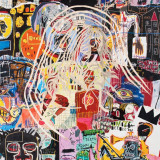
**Hardcore, FWD dance music from two leading sound artists. Edition of 500, Mastered and cut by Matt Colton** Mark Fell and Gábor Lázár ratchet the game with their razor-sharp debut collaboration, 'The Neurobiology of Moral Decision Making'. As promised in the wake of Gábor's acclaimed vinyl debut, 'EP16', the duo have colluded on a full set of ten tracks, ranging from short synapse bursts thru to an uncannily emotive 12 minute masterpiece on the closing side. As the 10th release on The Death of Rave, it demonstrates the distance travelled since the early '90s paradigm shift of original rave culture, effecting a radical recalibration of meter and tone conventions in electronic/dance music, and by turns, acutely probing our perception of time and space. Essentially it's incredibly "funky", if "funk" is taken to mean syncopation or a play on tension-and-resolution. By utilising the grid-morphing potential of Max/MSP software, they unlock mutant ballistic patterns cleanly weaving between and recoding the tendons and ligament of techno, garage, footwork and hardcore with muscle memory-reprogramming impact. Kicks, claps and visceral chromatic stabs land at irregular, blind-spot junctures, acutely rewiring our sense of rhythmic anticipation and offering a thrilling new freedom of expression and dancefloor discipline in the process. It's a masterful step forward from Yorkshireman, Mark Fell's Sensate Focus output and SND classics, and, likewise, a logical leap from Budapest-based Max whizz, Gábor Lázár. If you're into Mumdance, Errorsmith, Lorenzo Senni, Autechre, Actress or SND; we'd say it's as essential as they come.
quête:neuro d
Announcing Dion Lunadon's (of A Place To Bury Strangers / The D4) debut solo album, on Agitated Records. The album was recorded over a three-month period in Brooklyn, NY and features Robi Gonzalez (APTBS) on drums and Blaze Bateh from Bambara on select tracks including 'Fire'. "With 'Fire' I wanted wild and heavy guitars with heavy sentiment in the first vocal line to match. Something that grabs you and demands attention. Not background music," Lunadon explains of the track. The album also features mixing by Chris Woodhouse (Mayyors, Ty Segall, The Intelligence, Thee Oh Sees) on select tracks including 'Com/Broke'. From cutting his teeth back home in New Zealand as a member of The D4 to his current role as bassist of Brooklyn-based A Place to Bury Strangers, Dion Lunadon has played in some form of a rock & roll band his entire life. During a short break in touring with APTBS, Lunadon had a rush of inspiration in the form of a Dion Lunadon creative spasm — a neurotic impulse to make a batch of songs and do it right then and right there. What resulted is quite a jump away from his work in APTBS and draws more influence from bands like Toy Love and The Gun Club, as well as New Zealand unknowns such as Gestalt and Supercar. 500 only pressed / black vinyl theres 200 for UK/EU only
lynyn sounds like if Aphex Twin or Autechre could compose for symphony and shred jazz. Though lynyn is a new Artist, his debut LP lexicon is essential listening for anyone interested in the compositional heights of electronic, synth, and modular music. So, who is lynyn? lynyn is the moniker of Chicago artist Conor Mackey, a working symphonic composer who has scored for institutions including the Illinois Philharmonic Orchestra and Brain.fm (the neuroscience driven musical platform where he is currently lead composer on staff). He is also a guitarist / composer in the Chicago jazz fusion quintet Monobody. After years of quietly mastering the creation of electronic music in his home, Mackey first introduced his electronic alias lynyn as producer of NNAMDI's Are You Happy EP in the Fall of 2021 (Pitchfork described his production on that project as "a novel intersection of IDM" and contemporary pop). lynyn now offers up his debut electronic oevure lexicon via Chicago label Sooper Records. lexicon displays a mastery of both musical composition and sound design, as well as a deep appreciation of the vocabulary and history of the electronic genre_ with particular emphasis on the 90s IDM movement. Throughout lexicon we are propelled through the sounds of musique concrete, footwork, hip-hop, ambience, glitch-core, IDM, drum and bass, dub, break beats, and so much more. These influences work in tandem to produce a linear experience that can be spellbinding, euphoric, and sometimes destabilizing, but without ever feeling listless or wandering. The dense arrangements of lexicon are intentionally constructed with a painstaking attention to the most minute detail, and also with a masterful awareness of the macroscopic sound design profile of the entire work. Synth sequences and modular tones merge with sounds that seem wholly organic to create a series of purposeful movements from start to finish. Mackey is particularly adept at taking disparate, often difficult to control elements and introducing them harmoniously. He is a fastidious architect and designer of sound tinkering away in his modular laboratory. lexicon is an innovative entrant into the history of IDM and electronica with all the makings of an essential contribution. What Mackey accomplishes with lexicon is a progression; he's taking the sum articulation of a genre and attempting to carry it forward by imbuing it with his own unique language as a symphonic composer. His melting together of genres and techniques is a gateway into a more wide-ranging expression of the artform, particularly with respect to the sophistication of melodic composition. The result is arguably a landmark. While rightfully positioning the lynyn moniker as an electronic alias, lexicon leaves no doubt that Mackey is a composer above all else.
Black Vinyl[21,64 €]
lynyn sounds like if Aphex Twin or Autechre could compose for symphony and shred jazz. Though lynyn is a new Artist, his debut LP lexicon is essential listening for anyone interested in the compositional heights of electronic, synth, and modular music. So, who is lynyn? lynyn is the moniker of Chicago artist Conor Mackey, a working symphonic composer who has scored for institutions including the Illinois Philharmonic Orchestra and Brain.fm (the neuroscience driven musical platform where he is currently lead composer on staff). He is also a guitarist / composer in the Chicago jazz fusion quintet Monobody. After years of quietly mastering the creation of electronic music in his home, Mackey first introduced his electronic alias lynyn as producer of NNAMDI's Are You Happy EP in the Fall of 2021 (Pitchfork described his production on that project as "a novel intersection of IDM" and contemporary pop). lynyn now offers up his debut electronic oevure lexicon via Chicago label Sooper Records. lexicon displays a mastery of both musical composition and sound design, as well as a deep appreciation of the vocabulary and history of the electronic genre_ with particular emphasis on the 90s IDM movement. Throughout lexicon we are propelled through the sounds of musique concrete, footwork, hip-hop, ambience, glitch-core, IDM, drum and bass, dub, break beats, and so much more. These influences work in tandem to produce a linear experience that can be spellbinding, euphoric, and sometimes destabilizing, but without ever feeling listless or wandering. The dense arrangements of lexicon are intentionally constructed with a painstaking attention to the most minute detail, and also with a masterful awareness of the macroscopic sound design profile of the entire work. Synth sequences and modular tones merge with sounds that seem wholly organic to create a series of purposeful movements from start to finish. Mackey is particularly adept at taking disparate, often difficult to control elements and introducing them harmoniously. He is a fastidious architect and designer of sound tinkering away in his modular laboratory. lexicon is an innovative entrant into the history of IDM and electronica with all the makings of an essential contribution. What Mackey accomplishes with lexicon is a progression; he's taking the sum articulation of a genre and attempting to carry it forward by imbuing it with his own unique language as a symphonic composer. His melting together of genres and techniques is a gateway into a more wide-ranging expression of the artform, particularly with respect to the sophistication of melodic composition. The result is arguably a landmark. While rightfully positioning the lynyn moniker as an electronic alias, lexicon leaves no doubt that Mackey is a composer above all else.
- 1: Connais Tu L'animal Qui Inventa Le Calcul Integral?
- 2: Evariste Aux Fans
- 3: Les Pommes De Lune
- 4: La Chasse Au Boson Intermédiaire
- 5: Dans La Lune
- 6: La Faute À Nanterre
- 7: Ma Mie
- 8: Wo I Nee
- 9: Si J'ai Les Cheveux Longs C'est Pour Pas M'enrhumer, Atchoum!
- 10: La Révolution
- 11: Je Ne Pense Qu'a Ça
- 12: Je Chante Pour Vous Faire Marcher
- 13: Je Ne Suis Pas Simple
- 14: Si Les Étoiles Pouvaient Parler
Évariste is one of the rare specimens of artist-cum-scientists. Among his kind stand others like Pierre Schaeffer, a Polytechnique graduate (an engineer but also the father of musique concrète) and the eccentric Boby Lapointe (graduate of the École centrale and inventor of the Bibi-binaire system, patented in 1968). Évariste's songwriting, joyful and full of energy (albeit extremely critical), shrouds an original tragedy: born in 1943 among résistants, Joël Sternheimer (aka Évariste) grew up without a father, lost to Auschwitz. Although he makes little reference to Jewish culture in his music, his origins leave their mark: in 1974, he sings a Hebrew song on television. In 1966, the young Joël sports Princeton's colourful paraphernalia - that's because he's freshly returning from the US, where he was sent to pursue his research on "particle mass and the interpretation of observed regularities, such as the effects of a wave" (will understand who may). When he gets there the country's in the midst of the Vietnam War. With McNamara keen to find an alternative to the nuclear weapon and calling upon the country's biggest brains to undertake the task, there's a "fund shift" within the university - a diplomatic way to give notice to whoever may not be disposed to follow the government's scheme. Joël, who's under the supervision of a rebellious physician, is dismissed. He regardless keeps following the prestigious seminaries of the Institute for Advanced Study, chaired by Oppenheimer, inventor of the atomic bomb. Likely inspired by the hippie movement and music, Joël buys a guitar and starts playing in Washington Square - after all, Bob Dylan himself started there. He blithely skips Oppenheimer and receives a warm (though surprised) welcome from a crowd thoroughly unfamiliar with French. When the ageing physicist questions him about his decreasing attendance, Joël explains how drawn he is to music, and how he thinks it could help him in self-financing his research. Évariste recalls seeing the sickened man, his face torn by remorse, lighten up to his words and say: "What's keeping you - go for it! If I was still young that's exactly what I'd do." The student takes these words as a testimony from his professor - and it's enough to convince him . And so he takes the leap during the Christmas vacations he spends in Paris. A journalist friend he often sees around the Sorbonne introduces him to the artistic director of Disques AZ. The latter passes the tapes on to the label's boss, Lucien Morisse, also program manager on Europe N°1. Morisse is blown away - and signs him onto the label right away. Michel Colombier, arranger for Serge Gainsbourg and co-author of "Psyché Rock", with Pierre Henry, contributes some of his original ideas to the 7 inch "E=mc2": Évariste's preoccupation with the percussion sound on the track "Le calcul intégral" is that it goes "poom poom" and not "tock tock" - Colombier is aware of the issue and records Évariste's guitar like a percussion in an isolated booth. The organist Eddy Louis, who is to participate, in 1969, to the success of Claude Nougaro's "Paris mai", also appears on the record. It's 1966 and the Antoine phenomenon (signed on Vogue) storms through France. The two singers share similarities: Antoine is an engineer of the École centrale, gifted with a great originality in his song-writing. A godsend for the two labels who turn this resemblance into a commercial strategy, setting them out as rivals. To this day though, Évariste still denies what was little more than slushy tabloïd gossip. Success comes around swiftly and in 1967 Évariste launches into a second 7 inch, "Wo I nee", again arranged by Michel Colombier. Quantum mechanics fans finally get their anthem with "La Chasse Au Boson Intermédiaire" (or the "Intermediary Boson Pursuit"). To sum up what's a boson, say he's a close pal of the meson, photon and other gluons. A few months later, it's May 68 and everything's turned upside down. Évariste writes a series of songs inspired by the events, which he immediately submits to Lucien Morisse. When the man behind "Salut les copains", once married to Dalida, hears the song "La révolution" - a father and son dialogue - he can't take any more: AZ simply cannot release this. But there and then Lucien Morisse makes a gesture which will remain engraved in French music's history: sorry to be unable to officially stand by the singer, he encourages him to self-produce the record, but with his tacit support. He calls the pressing factory and asks they apply the same rate for Évariste as they would for AZ. The singer and his musicians use the same studio as for the previous record, all of them playing for free awaiting a return on investment. Évariste keeps singing at the Sorbonne with "Jussieu's gang" and "the young Renaud" he nicknames "le p'tit gavroche" (or "street urchin"). Renaud volunteers to type the lyrics of the song "La révolution" so that the chorus can be sung and recorded. A boy in the group is related to Wolinski and introduces them. The two get along so well that Wolinski ends up drawing the cover for the record "La révolution", for free. The self-released 7 inch "La révolution / La faute à Nanterre" is sold under the table and door-to-door for half the price of a standard record, on and around the boulevard Saint-Michel; and it runs out fast. In the end, there will be 6 releases of the record, and 25000 copies sold. When the theatre director Claude Confortès decides to adapt Wolinski's drawing series titled "Je ne veux pas mourir idiot" ("I don't want to die a fool"), he asks Évariste to write the original soundtrack. His friend, now cartoonist for Hara-Kiri Hebdo, often promotes him in accordance with a principle dear to him by virtue of which he gives a special place to his friends. Dominique Grange (writer of the song "Nous sommes les nouveaux partisans") soon joins the team. After 150 performances, Évariste leaves his place to Dominique Maurin (brother of Patrick Dewaere). Évariste composes the songs for Claude Confortès' next play, "Je ne pense qu'à ça" ("That's all I think about"), co-wrote with Wolinski in 1969. The comedians of the play record the songs on a 7 inch, with a cover signed, again, by Wolinski. In 1971, French television produces the documentary "Évariste et les 7 dimensions", but doesn't air it. Indeed, the scientific sub-comity of the programming comity (sic) censors the show. The given justification is that "Évariste dangerously mixed science with science-fiction, numerology and other non-scientific disciplines". The underlying motive might have been a will to censor the singer-mathematician's political discourse. In the documentary and among other things, Évariste discusses hierarchy, alienation and revolution. Half a century later the documentary remains invisible, though some excerpts resurfaced in 1992 in the cult show "L'oeil du cyclone", on Canal +. Though flourishing, Évariste's career is nearing its end. 1970 is the beginning of a decade in the course of which he is to make a decisive discovery in the musical and scientific domains. Following this breakthrough, he moves away from self-produced music and gaucho magazines to focus on science. He keeps Oppenheimer's encouraging words in mind, now freely pursuing his research thanks to the sales of his records. Joël realises that when decoding protein sequences, one finds musical sequences recognisable to humans. He names them "proteodies". If, when listening to a proteody, one responds by being so sensitive as to finding it beautiful, then it reveals a deficiency of the related protein - and this peculiar music may be the cure. We could trace back the music history in light of proteins lacking in a given artist, or within a public's majority. You always thought these hysterical groupies who'd throw their underwear with passion and faint in the pit had miraculously appeared because they had never heard anything as wonderful as the Beatles? Make no mistake! For Évariste, it all boils down to an intro's protein content. Indeed, the beginning of their first hit "Love Me Do" corresponds to dopamine, the neurotransmitter linked to compulsive buying. An intro like this could only unleash the fervour of groupies, victims of fashion and biology. Évariste's success is such that the income from his sales gives him the autonomy to which he had aspired when confiding to Oppenheimer. It made it possible for him to pursue his research without any institutional constraints. He now devotes himself to his proteodies, sat in the offices of the European University for Research, just around the corner from the Sorbonne he knew so well. Évariste is no more. Joël regained control of this strange and comical beast.
IMITED 2022 REPRESS ON RED VINYL WITH GOLD SPLATTER.
Steve Von Till, best known as Californian heavyweights Neurosis' singer and guitarist.
TERRORIZER - 8/10 Boxed review and interview excerpt (May issue) "Imagine if a coarser Neil Young had been born in England instead of Canada and if he had done a little bit of time in Hawkwind as well, and the imaginary result isn't too far from some of the best songs on offer here..."
Von Till enlisted Randall Dunn, production supremo and Master Musicians of Bukkake founder, to helm the desk, as well as bringing in Eyvind Kang on viola and percussionist Pat Schowe.
'A Life Unto Itself' also showcases J. Kardong on pedal steel, texturising Von Till's baritone gravel and sun-bleached skeleton of a guitar arrangement with some dust-blown harmonics , reminiscent of similarly raspy, whiskey-throttled voices of Mark Lanegan and Michael Gira.
Black Vinyl Repress
For the third release on De:tuned we proudly present The Kosmik Kommando AKA Mike Dred. Mike hardly needs an introduction; considered as one of the masters of the Roland TB-303 Mike has been releasing records under various aliases since the early 90s. He has recorded for high profile labels such as R&S and Rephlex as well as his own Machine Codes label. Together, with Aphex Twin, Mike was behind the Universal Indicator releases which are among the most collectible and sought after records in techno history.
De:tuned has worked closely with Mike to develop an 8 track project that gives props to the American Psychologist Timothy Leary and his proposed theory of 'The Eight-Circuit Model of Consciousness'. This model describes 8 circuits of information that operate within the human nervous system. Each circuit refers to a different sphere of activity, enhanced by experimentation with a particular substance. Each circuit also represents a higher stage of evolution than the one before it and the higher the circuit, the fewer the people have activated it as the higher four circuits exist for those who migrate to outer space and live extraterrestrially.
The 8 Models are applied to the track titles that present a varied collection integrating acid house, techno, electro and rave culture.
3 of the tracks on offer here were written exclusively for Mike's live performance at the De:tuned 'Meeting of Minds' event in June 2012, which was Mike's first full live show in 3 years.
This 8 track project will be available on limited 180 gr white double vinyl with label and sleeve artwork by Mike himself. Stay Tuned!
2022 Silver Vinyl Repress
For the third release on De:tuned we proudly present The Kosmik Kommando AKA Mike Dred. Mike hardly needs an introduction; considered as one of the masters of the Roland TB-303 Mike has been releasing records under various aliases since the early 90s. He has recorded for high profile labels such as R&S and Rephlex as well as his own Machine Codes label. Together, with Aphex Twin, Mike was behind the Universal Indicator releases which are among the most collectible and sought after records in techno history.
De:tuned has worked closely with Mike to develop an 8 track project that gives props to the American Psychologist Timothy Leary and his proposed theory of 'The Eight-Circuit Model of Consciousness'. This model describes 8 circuits of information that operate within the human nervous system. Each circuit refers to a different sphere of activity, enhanced by experimentation with a particular substance. Each circuit also represents a higher stage of evolution than the one before it and the higher the circuit, the fewer the people have activated it as the higher four circuits exist for those who migrate to outer space and live extraterrestrially.
The 8 Models are applied to the track titles that present a varied collection integrating acid house, techno, electro and rave culture.
3 of the tracks on offer here were written exclusively for Mike's live performance at the De:tuned 'Meeting of Minds' event in June 2012, which was Mike's first full live show in 3 years.
This 8 track project will be available on limited 180 gr white double vinyl with label and sleeve artwork by Mike himself. Stay Tuned!
- 1: Can I Sing With You? Ft. Sidi I.b
- 2: No Hay Pescado Ft. Sidi I.b., El Latigazo & Mame Samba
- 3: Neuron Landfill (Vertedero De Nueronas)
- 4: Smelk
- 5: The Light Mandem Forward Ft. Kiki Hitomi W/ Javier Afonso
- 6: Guidance & Healing Ft. Mame Samba
- 7: Monsanto Ft. Troy Harkin*
- 8: Mike Input At Loud Speakers Corner*
- 9: Bus Meter Ft. Zeeteah & Sidi I.b
- 10: Assuage No.9 Ft. Zeeteah
Helmed by Dave Watts aka D.WattsRiot (Fun-da-mental), the debut KingL Man album, ‘Headonix’ is beat-laden shout out in response to the perpetual state of war we seem to find ourselves at. Outrage and disgust, love and hate, history and presence.
Contributions come from four continents.
Fresh on the scene is Senegalese vocalist Sidi I.B., who arrived on Canarian shores with two hundred other compatriots, cold, wet and hungry after seven days at sea with nothing but his future in his hands.
Temporarily housed at the infamous migrant holding centre in Las Raíces, Tenerife, the studio environment provided an avenue of relief from the inadequate conditions at the overcrowded camp.
Also from Senegal, living in Santa Cruz de Tenerife, is rapper Ibrahima El Latigazo who delivers his lyrics in French, Wolof, Spanish, English & Sérère. Rounding up the Senegalese contingent is Mame Samba, a group that hold the spirits close when performing. Their contribution is from recording sessions they had with François R. Cambuzat & Gianna Greco (Putan Club / Ifriqiyya Electrique).
Kiki Hitomi (Waq Waq Kingdom/King Midas Sound) returns to the fold, exhaling positivity with Canarian multi-instrumentalist Javier Afonso (Grenouille). The Canarian faction also includes violinist Mónica Viñoly, Dani Garcia (Lagoss/Tupperwear) and Vakawuare. Further guests include percussionist Miroca Paris (Cesária Évora/Madonna); Hamid Mantu (TransGlobal Underground);
Ramjac (Dub Colossus), drums and percussion respectively.
If you check the credits of The Rolling Stones' Goats Head Soup LP from 1973 you'll find a certain "Pascal" listed on the percussion section. That is none other than Los Angeles based artist Nicolas Pascal Raicevik (1933-1994), aka 107-34-8933, aka Head, aka Nik Pascal, aka Nik Raicevic. Besides his hitting the bongoes on the Stones album, Nik was a great artist on his own, both as a painter and as a musician. As a musician, he was a pioneer in the use of synthesizers, preceeding the Berlin school by some years when his Head LP was released on on Buddah in 1970. Buddah probably saw in Head the opportunity to cash in some money from the remains of the psychedelic scene - the three tracks on the LP are named after drugs used in the late sixties. The sounds, however, are accomplished works that show Raicevic as one of the most interesting pioneers in the use of synths. The album probably didn't do too well, since Buddah didn't renew the contract with Raicevic, who instead took his own way releasing his works on his very own Narco Records and Tapes label. Between 1968 and 1975 Narco would issue 4 LPs credited either to Nik Raicevic (Beyond The End... Eternity) or Nik Pascal (The Sixth Ear, Magnetic Web and Zero Gravity) plus one credited to 107-34-8933 (Numbers, which is in fact the same LP as Buddah's Head, albeit with different cover art). Copies of these LPs came with an ironic sticker over the shrinkwrap that read "Do not listen to this LP if you are stoned".
Numbers was the first reference in the Narco catalogue (NR101), each of the three tracks it contains is named after a drug: Cannabis Sativa, Methedrine and Lysergic Acid Diethylamide. The album was credited to 107-34-8933, there is no date of release on the disc, some sources take it as back as 1968 - in any case, this is the same record that was issued on Buddah in 1970 credited to Head and eponymously-titled. The Wah Wah reissue features the original cover artwork from the Narco edition.
Besides his musical explorations, Nik was also an interesting painter. His paintings are auctioned from time to time, and are consciousness expanding works influenced by abstract cubism and surrealism, some kind of Salvador Dalí on drugs exploring the outter and inner space. All the artwork on the sleeves of his LPs is done by himself. Spacey landscapes and psychedelic colours that fit perfectly to the music they contain.
"Nik Raicevic's music is at the intersection of radical psycho-electronic weirdness and kraut kosmische music (in particular the scifi-hypno-minimal modules of Conrad Schnitzler in Grun, Rot and Blau). It presents mega epic & tripped out electronic improvisations.
"This is an absolute must for collectors and fans of visceral, neurotic soundscapes."
"As far as late-60s / early-70s American Bedroom' Electronic Music goes, these LPS have to be among the first transmissions from this sector, made all the more attractive when coupled with Raicevic's alien topographIes - the covers are high-color portrayals of Venusian lanes, knotted growths, & future-past architecture in a style you might equate with Vintage' sci-fi pulp-novel covers - & copious Downer' sentiment. This music is imbued with a sort of lonely, anti-social sensibility that's about as far as you can get from the Academic' Early Electronic vector. I will say that if the Steve Birchall, Cellutron & the Invisible, and/or Pythagoron™ seed your garden, this will likely do the same."
Never reissued before on vinyl format, the Wah Wah reissue features original sleeve artwork made of paintings and drawings by Nik himself and reproduction of the famous ironic "Do not listen if you are stoned".
Limited edition, 500 copies only.
If you check the credits of The Rolling Stones' Goats Head Soup LP from 1973 you'll find a certain "Pascal" listed on the percussion section. That is none other than Los Angeles based artist Nicolas Pascal Raicevik (1933-1994), aka 107-34-8933, aka Head, aka Nik Pascal, aka Nik Raicevic. Besides his hitting the bongoes on the Stones album, Nik was a great artist on his own, both as a painter and as a musician. As a musician, he was a pioneer in the use of synthesizers, preceeding the Berlin school by some years when his Head LP was released on on Buddah in 1970. Buddah probably saw in Head the opportunity to cash in some money from the remains of the psychedelic scene - the three tracks on the LP are named after drugs used in the late sixties. The sounds, however, are accomplished works that show Raicevic as one of the most interesting pioneers in the use of synths. The album probably didn't do too well, since Buddah didn't renew the contract with Raicevic, who instead took his own way releasing his works on his very own Narco Records and Tapes label. Between 1968 and 1975 Narco would issue 4 LPs credited either to Nik Raicevic (Beyond The End... Eternity) or Nik Pascal (The Sixth Ear, Magnetic Web and Zero Gravity) plus one credited to 107-34-8933 (Numbers, which is in fact the same LP as Buddah's Head, albeit with different cover art). Copies of these LPs came with an ironic sticker over the shrinkwrap that read "Do not listen to this LP if you are stoned".
"Raicevic is clearly still in the early learning-curve stages," which it a key LP to understand Nik's evolution and setting the path for more evolved works to follow.
Besides his musical explorations, Nik was also an interesting painter. His paintings are auctioned from time to time, and are consciousness expanding works influenced by abstract cubism and surrealism, some kind of Salvador Dalí on drugs exploring the outter and inner space. All the artwork on the sleeves of his LPs is done by himself. Spacey landscapes and psychedelic colours that fit perfectly to the music they contain.
"Nik Raicevic's music is at the intersection of radical psycho-electronic weirdness and kraut kosmische music (in particular the scifi-hypno-minimal modules of Conrad Schnitzler in Grun, Rot and Blau). It presents mega epic & tripped out electronic improvisations.
"This is an absolute must for collectors and fans of visceral, neurotic soundscapes."
"As far as late-60s / early-70s American Bedroom' Electronic Music goes, these LPS have to be among the first transmissions from this sector, made all the more attractive when coupled with Raicevic's alien topographIes - the covers are high-color portrayals of Venusian lanes, knotted growths, & future-past architecture in a style you might equate with Vintage' sci-fi pulp-novel covers - & copious Downer' sentiment. This music is imbued with a sort of lonely, anti-social sensibility that's about as far as you can get from the Academic' Early Electronic vector. I will say that if the Steve Birchall, Cellutron & the Invisible, and/or Pythagoron™ seed your garden, this will likely do the same."
Never reissued before on vinyl format, the Wah Wah reissue features original sleeve artwork made of paintings and drawings by Nik himself and reproduction of the famous ironic "Do not listen if you are stoned" sticker. Limited edition, 500 copies only.
Who controls the mind controls the body. After three years of experimentation in isolation, Dopplereffekt have emerged with Neurotelepathy, an oracular narrative of cerebral entanglement and advancement. The sleek mathematical models of 2017’s Cellular Automata have evolved into these synaptic interpretations, transferences and modifications, rejecting binary expectations to meditate on the possibilities and pitfalls of what’s to come. With their second LP and fifth release in total on Leisure System, the duo of Rudolf Klorzeiger and To-Nhan have themselves achieved a near-telepathic capacity for collaborative thought and mechanical construction. They continue to use live appearances to present experimental trials of theoretical models, and that effort is heard in the sizzle and swing of the percussive highlights here, programmed with a serious depth and wriggle that reflect both an extension of and return to form. Considerations of the machine-human interface, neurological realities and physical probabilities dominate. But these tracks are economical and precise, glittering with emotional depth and cinematic effects. The album's core, a three-act movement of symphonic uncertainty and revelation, marks one of the pair's most evocative compositions in a career full of them. Territory is monitored, traced and scanned, resulting in unexpected modulations. Underlying systems are questioned, competing mindsets animated and mutated: brain-to-brain, brain-to-machine and beyond. Neurotelepathy processes these transformative mental, psychological and transgenerational states both traumatic and triumphant.
It started, as it so often does, with two old friends hanging out.
John Shima and C P Smith were joking around one evening in their home city of Sheffield. At some point, Smith challenged Shima that, if the latter could produce a record using nothing more than a small modular synth setup, then Smith would release it on his Central Processing Unit label. As heads will know, while Shima has drops on imprints like FireScope and Subwax Excursions to his name, he had never previously released anything via CPU. Shima accepted, and thus we now have his CPU debut, the four-track EP CPU Modular 1.
The specific setup that Shima worked with for these tracks was Smith's Doepfer A-100P6 Suitcase, a small but mighty combination of modules and programmers. It's no surprise that Shima was able to familiarise himself with the equipment in double-quick time - after all, Shima was an early adopter of the Eurorack modular format back in the day. What emerged from the CPU Modular 1 sessions was a quartet of devastatingly effective DJ tools, mid-set rollers which will get the dance moving something crazy.
Opener '003' kicks the EP off as it means to go on. There's something at once stiff-necked and buoyant about the rhythms here, all thwacking Roland tones and snares which crack like someone whipping a length of sheet metal. While the beat barrels unyieldingly onwards, the programming in the tuned modulars is more exploratory and even trippy, full of delay-laced bleeps and flighty rhythmic motifs. It comes together for a cracking mix in the vein of artists like Jerome Hill and London Modular Alliance. Second A-side cut '010' is no different, the street-beat groove and grumbling low-ends underpinning all manner of modular wizardry.
CPU Modular 1 is really timeless stuff, a set of percussion-heavy, future-focussed beats which recalls Smith's own CPU drop 'DJ Tools Vol.1 - 808 Tracks'. '011' kicks of CPU Modular 1's second-half with a dose of Drexciyan dystopia, playing an atonal loop off of an insistent bass wiggle and neurotic hi-hats. Even when Shima tightens or slackens the modulars here, '011' remains unyielding, a dose of pure 'Wip3out' energy that you could happily groove to all day long. The EP closes out with '005', a gnarled, gurgling production which still retains the dancefloor punch of the rest of the record.
For his Central Processing Unit debut, John Shima was tasked to produce four tracks using a single small modular setup. Unsurprisingly given the pedigree of this seasoned machine-funk pro, Shima aced the assignment.
- 1: Untitled
- 2: Untitled
- 3: Untitled
- 4: Untitled
- 5: Untitled
- 6: Untitled
- 7: Untitled
- 8: Untitled
Justin K Broadrick (Godflesh, Jesu, JK Flesh) breathes new life into his FINAL project for an album on Helm’s ALTER label. Formed in 1984 out of an obsession with the industrial, noise & power electronics acts of the early eighties, FINAL made its public debut at the legendary Mermaid pub in Birmingham when Broadrick was just 14 years old. A string of cassette releases via his Post MortemRekordings label established the name within the underground noise scene of the time until increased activity with his various groups (Napalm Death, Head of David and later Godflesh) meant that FINAL naturally fell by the wayside before the end of the decade. Broadrick reactivated the project in 1993 during the British ambient “isolationism” period and FINAL's sound became focussed more on texture, producing beatless ambient work with a number of albums for labels like Sentrax, Utech, No Quarter and Neurot. ‘It Comes To Us All’ is the first FINAL album to appear on vinyl since 2015’s ‘Black Dollars’ on Downwards and continues to explore the textural nature of Broadrick’s ambient work - this time through a filter of blown-out harmonic noise that reconnects the project with its harsher roots. Rather than channelling the angst of early power-electronics, the noise here rumbles along blissfully through 8 untitled tracks, sombre in tone and at times beautiful. Melodies sampled from pop music are put through a process of decay, stripped of their form and worn down with a rusty, melancholic afterglow. Reducing all its parts to slow-motion shadows of their former selves, ‘It Comes To Us All’ is an exploration of the decay of all living things that we face collectively, day after day.
“Modern Primitive” is the new album by SEPTICFLESH who present a stunning combination of symphonic and cinematic music with aggressive yet catchy Death Metal. Picking up on the group’s sonic evolution in the past decades, “Modern Primitive” proves to be more emotional, epic and heavy than ever.
SEPTICFLESH was formed as “Septic Flesh” in Greece in the early '90s by Spyridon Antoniou (a.k.a. Seth Siro Anton): vocals/bass, Christos Antoniou: guitar and Sotirios Vagenas (a.k.a. Sotiris Anunnaki V.): guitar/ clean vocals. A debut Ep was released in 1991, entitled "Temple of The Lost Race". Their first full-length album "Mystic Places of Dawn" was released in 1994, followed by "EΣΟΠΤΡΟΝ" that was released in 1995. With the release of "Ophidian Wheel" in 1997, a female soprano vocalist (Natalie Rassoulis) was introduced, as the band moved towards a more symphonic style. "A Fallen Temple" (1998) continued in the same musical direction. In 1999, "Revolution DNA" was released, followed by “Sumerian Daemons” in 2003, both albums produced by Fredrik Nordström (At The Gates, Opeth, In Flames). Although the band's popularity was growing, the band members decided to disband, in order to focus on other personal projects and goals. But that was not the end of the story... After a reunion, the band returned with the album "Communion" in 2008, again with Fredrik Nordström at the helm of production. From that point onwards, the symphonic element (composed by Christos Antoniou, that has a Master Degree in Concert Music) was fully implemented in the structure of the songs, with the collaboration of Filmharmonic Orchestra of Prague. “The Great Mass” (2011) followed with Peter Tägtgren (Hypocrisy, Pain) producing, "Titan" (2014) with Logan Mader (ex-Machine Head) as producer and "Codex Omega" (2017) which started the group’s collaboration with Jens Bogren that continues to the very day. In 2020, the recording of the epic and fully orchestrated Live in Mexico entitled "Infernus Sinfonica MMXIX", was released on CD/LP/DVD/Blu-Ray.
Now, SEPTICFLESH has joined forces with Nuclear Blast Records and initiates the next phase in the band’s history, with a new album to be released in May 2022. Once again Jens Bogren is responsible for the bombastic mix and sound whereas Seth Siro Anton - who is also in charge for the visual aesthetics of the band and worked for artists like Nile, Paradise Lost or Moonspell - has crafted a really intense cover and over-the-top artwork for this release. The new songs impress with many layers, gloomy and empowering atmosphere while being heavy and memorable. Besides the continuous collaboration with the Filmharmonic Orchestra of Prague, the band used a full adult choir, a full children choir and a variety of ethnic instruments.
isuals Painted by NEUROBUG
C'est une magnifique surprise. Ca faisait longtemps que je n'avais pas été surpris... que je n'ai pas entendu un morceau aussi riche et aussi précis... Un truc chargé où tout est défini, où tout est clair, et tout existe. Chaque son, chaque fréquence... une 3D sonore... du mastering à la composition infernale tout est incroyable... Il faut une sacrée concentration pour écouter. Je réapprends à écouter... Et c'est aussi insupportable et aussi fascinant et aussi fort et j'aime et je réécoute avec surprise encore. Je suis accro ! Surtout la face "Je Le Sais Je Le Sang"... Terry Riley est mort. ça y est il a eu sa peau. Le hardcore est mort, ça y est il a eu sa peau. La musique est vivante, enfin encore, en kore.
Rappelez-vous que les gens avaient plus ou moins mal reçu les Hangars Liquides 01 et 02, ou le 21 et le 28... Toujours une longueur d'avance...
Ce Vinyle est plus proche de l'art-core que du hardcore et pourtant... Quel bonheur ce sera de l'entendre sur du gros son !! mwhahahahah !!!
STRICKTLY LIMITED
Seventh studio album from acclaimed/multi platinum Canadian rock outfit, released via Music For Nations/ Sony Music. 2015's 'Human' marked the group’s second straight #1 slot on the Billboard Top Hard Rock Albums Chart as well as their fourth consecutive debut in Top 20. It spawned two #1 singles 'Painkiller' and 'I Am Machine', signaling their 13th overall and 5th consecutive number ones on the U.S. Active Rock Radio chart. THe band continue to average over 4 million monthly listeners on Spotify (remaining one of the most listened to rock bands in the world). A 12 track album pressed on standard black vinyl and CD formats. Forthcomiong UK live dates. Promo/marketing activity across all media outlets.
This acoustic body experiment will intoxicate your ears and veins. “Ectomorphin” by Chris Baumann is a straight confession for athletic acid underground – as the artist himself describes his style: “The border between timeless old school quality and new school upfront innovation in today’s techno music – just call it raw, hypnotic techno.” And this new release on Snork Enterprises presents a full load of proof for this bold hypothesis.
Ironically referring to some curious scientific concepts such as “Ectomorphin”, “Brainwave limiter”, “Neurotraxin”, and “Bioport” one may ask himself how the artist may well hypnotize our body and brain. Listening to the four forward moving techno tracks, you will soon know the answer. Just turn up the volume and get your body cells moving.