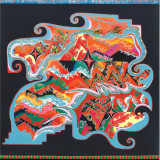
The next chapter of the Natural Information Society is here. Since Time Is Gravity, credited to Natural Information Society Community Ensemble with Ari Brown, presents a newly expanded manifestation of acclaimed composer & multi-instrumentalist Joshua Abrams nearly 15 year, 7 albums &-counting flagship ensemble. Joining the core NIS of Abrams (guimbri & bass), Lisa Alvarado (harmonium) Mikel Patrick Avery (drums) & Jason Stein (bass clarinet) are Hamid Drake (percussion), Josh Berman & Ben Lamar Gay (cornets), Nick Mazzarella & Mai Sugimoto (alto saxophones & flute), Kara Bershad (harp) & Chicago living legend of the tenor saxophone Ari Brown. Recorded live to tape at Electrical Audio & The Graham Foundation, cover painting Vibratory Cartography: Nepantla, by Lisa Alvarado. 2xLP on Eremite USA, 2xLP & CD on Aguirre/Eremite Europe. Out 14-04.
Since first developing Natural Information Society in 2010, Joshua Abrams has been gradually expanding the group’s conceptual underpinnings, its musical references & the sheer number of the group’s members. Its music is, in a sense, an expansive form of minimalism, based in repeated & overlaid rhythmic patterns, ostinatos & modality. Its roots, its scale & its meaning become clearer in time. If time is gravity, it also allows us to carry more. Having begun as fundamentally a rhythm section with Abrams’ guimbri at its core, the version here can stretch to a tentet, including six horns.
Abrams has been expanding his minimalism gradually, but he has long understood a key to minimalism’s potential: the breadth of its roots in the late 1950s & early 1960s, ranging from the dissatisfaction of young European-stream composers with the limitations of serialism to the simultaneous dissatisfaction of jazz musicians with the dense harmonic vocabulary of bop & hard bop. The former began exploring rhythmic complexity & narrow tonal palates in place of harmonic abstraction (Steve Reich’s Drumming, Philip Glass’ Music with Changing Parts; perhaps above all Terry Riley’s In C & his late ‘60s all-night organ & loop concerts); the later reduced dense chord changes to scales (signally with Miles Davis' Kind of Blue, but rapidly expanding with John Coltrane’s vast project). In the 1950s the LP record opened the world with documentation of Asian & African musics, key influences on both minimalists & jazz musicians. If John Coltrane’s soprano saxophone suggested the keening shehnai of Bismillah Khan, the instrument was rapidly taken up by two key minimalists, LaMonte Young & Riley, similarly appreciative of its flexible intonation, the same thing that kept it out of big bands.
If the guimbri, the North African hide-covered lute that Abrams plays with NIS, involves a rich tradition of hypnotic healing music associated with the Gnawa people, Abrams’ music also touches on other musics as well — other depths, memories & healings, different drones, rhythms & modes. As the group expands on Since Time Is Gravity, he has made certain jazz traditions in the same stream more explicit as well. If there is a mystical & elastic quality involved in the experience of time, both in direction & duration, you will catch it here. The parts for the choir of winds expand on the roles of Abrams’ guimbri, Mikel Patrick Avery & Hamid Drake’s percussion & Lisa Alvarado’s harmonium: at times, the winds are almost looping in the tentet version, each hitting a repeating note in turn, at once drone & distinct inflection on temporal sequence. The brilliance of the work resides in Abrams’ compositions, the NIS’ intuitive execution & in Ari Brown’s singular embodiment of the great tenor saxophone tradition, including the oracular genius of Eddie “Lockjaw” Davis, & Yusef Lateef. The three pieces by the expanded NIS featuring Brown —the opening “Moontide Chorus” & “Is” & the ultimate “Gravity”— have an immediate impact, & togther might be considered a kind of concerto for tenor saxophone. Here Brown presses almost indistinguishably from composed melody to improvised speech, getting so close to language that he might have a text. Everything here is a sign. Note the tap of the Rhythm Ace that links “Moontide Chorus” to “Is”, the attentive heart always present, even when signed by a machine. There’s a link here to the methodologies & meanings of dub music & the linear & vertical collage of beats, textures & tongues: treated with reverence, a sample of a beat-box can be as soulful, as hypnotic, as a mbira or a tamboura. If those pieces with Brown are heard as a suspended concerto, the three embrace & enfold the other works, like the sepals of a flower. That placement will also touch on the mysteries of our perception of time.
Particularly in “Is”, but elsewhere as well, a phenomenon of transcendence arises in which time appears to be tripartite, at once moving backwards & forwards & standing still. This is an act of technical brilliance certainly, but also an illumination of music’s ability to represent temporal consciousness through polymetrics. This particular listener has only heard it before in a few places, including the horn shouts & bowed basses of Coltrane’s Africa, in moments of Charles Mingus’ The Black Saint & the Sinner Lady, in certain pieces where tapes were literally running backwards, & earlier still in Dizzy Gillespie’s Cubana Be, Cubana Bop, in which the composer George Russell & conguero Chano Pozo found a music that spoke at once in the voices of Stravinsky’s Rite of Spring & the vestigial rites, rhythms & songs of the Yoruba language & Santeria religion of inland Cuba.
In Joshua Abrams’ compositions & the realization of them by the NIS, in the time of one’s close listening & memory thereof, distinctions between the “natural” & the “social”, the “quotidian” & the “transcendent” are erased, suspended or perhaps irrelevant. Consider two of the ensemble pieces, one named for nature, the other social science. In “Murmuration” the repeated wind figures of flute & alto saxophone combine with the interlocking patterns of harp, guimbri & frame drum (tar) to create a perfect moving stillness, not an imitation but a witness to the miracle of the starlings’ astonishing collective art, a surfeit of beauty that might be the ultimate defense tactic.
“Stigmergy” takes its name & concept from the Occupy movement’s Heather Marsh, who proposes a social system based on a cooperative rather than competitive models, one in which ideas are freely contributed & developed as ideas rather than an individual’s property. In its form, Abrams’ “Stigmergy” is the closes thing to traditional jazz, a series of accompanied solos by each of the wind players. However, the composed accompaniment is a radically collectivist notion: a repeated rhythmic figure, call it ostinato or riff, in which the different winds each play only a note or two of the figure, a concept both more collectivist & individualistic in its conception than any typical unison figure. It suggests another of the underlying recognitions that propel the Natural Information Society, the group as social organism, the teleology of hypnotic anarchy, all parts in place, functioning systematically, evolving & expressing itself, its nature & society, as a transformative organism.
George Lewis has described music as “a space for reflection on the human condition”. This suggests that, rather than a “distraction”, at least some music might serve as a distraction from distraction. It’s a focus, a clarity, a awareness, an external invitation to interiority, as if music itself is a model for form & contemplation, an organism contemplating for us or as us. If that is a possibility, & I am sure I have heard such musics, than this music is among them. How many of our rhythms, melodies & harmonies (cultural, historical, biological, psychic) might such music carry, translate & transform in the particulate ecstasy of our own murmuration? (Stuart Broomer, April 2022)
Buscar:new sense
Teenage Waitress returns with the new album 'Your Cuckoo'. This album is the follow up to the critically acclaimed debut Love & Chemicals. “Melodies and storytelling. . basically" is how Daniel J. Ash of Southampton’s Teenage Waitress describes his eagerly anticipated second album Your Cuckoo. “It’s a bunch of characters singing songs about love, youth, drugs, boredom and of course, dancing”. ‘Your Cuckoo’ is a leap forward in every way for Teenage Waitress. Ash’s trademark ‘story songs’ are set to a backdrop of irresistible melodies, colourful arrangements and impeccable production. While noticeably a more focused effort than Ash’s previous effort Love & Chemicals, this album still offers a little something for everyone. For the recording of ‘Your Cuckoo’ Ash recruited some of his musical friends to join him in the studio, adding a rich new layer of musicianship to his latest songs. “We basically wanted to go a step ahead from where we got to last time. . and I think we’ve done that” smiles Ash “I’ve been a perfectionist in every sense and annoyed a lot of people to get to this point. I hope it was worth it!
Stimela were a popular and successful South African Afro-fusion outfit led by guitarist, vocalist, songwriter, producer and arranger Ray Phiri. The band was formed under the name ‘The Cannibals’ during the 1970s when Phiri got together with drummer Isaac Mtshali, keyboard player Thabo Lloyd Lelosa and bass player Jabu Sibumbe. They initially started out as instrumentalists, but later evolved to Afro-fusion when they joined forces with vocalist Jacob “Mparanyana” Radebe in 1975. The story of ‘The Cannibals’ ends when Radebe died in 1978 but the ‘Stimela’ story was only just beginning.
In 1979, after a life-changing experience in Mozambique (where they were stranded for three months) the band members had to sell all their belongings to take a train home. This trip was a watershed moment as it was here where they conceived the new name for the band: The Zulu word for “locomotive-train” STIMELA.
Stimela would soon become little short of an institution in their home country of South Africa. With soulful tunes and gripping lyrics, the band has recorded platinum-winning albums such as Fire, Passion and Ecstasy, Shadows, Fear and Pain & Look Listen and Decide. In addition to recording their own material, the group supplied instrumental accompaniment on albums by a lengthy list of legendary artists. Stimela would go on to gain global fame after being featured on Paul Simon’s iconic 1986 ‘Graceland’ album and the mega tour that followed.
Ray Phiri would enter into many successful collaborations with major acts and artists such as Harari, Joan Baez, Willie Nelson and Manu Dibango. In 2017 he was diagnosed with lung cancer and died at the age of 70. Phiri has received many awards in recognition for his contribution in the music industry, one of these is the Order of Ikhamanga awarded to him by the South African president. This was to honor his sterling contribution to the South African music industry and the successful use of arts as an instrument of social transformation.
Stimela is the tale of a South African band who have battled their way through dark days to take their rightful place in the forefront of the South African apartheid-era music invasion. One of their most memorable tracks “Whispers in the Deep” was even restricted from being broadcasted by the old South African Broadcasting Corporation.
On the album we are presenting you today (Fire, Passion and Ecstasy from 1984) the unique sounds of Ray Phiri’s Stimela are fully showcased. Expect infectious hypnotic build-up grooves, cinematic lowdown jazz-funk, Afro-soul, delightful reggae, gospel influences and funky synth-boogie sounds…all with a touch of early eighties new wave and hints of Island disco mixed with sensual bubblegum pop. It comes as no surprise that the album has now become a sought-after item due to its addictive and original-sounding nature, a must-have for any self-respecting record digger!
These recordings completely encapsulate Stimela’s fusion style. They managed to craft a modern South African sound that continues to influence SA musicians to this day. Never in a rush, yet always with a sense of purpose and direction – like the steam train after which they took their name.
Tidal Waves Music now proudly presents the first reissue of this fantastic Afro-fusion classic since 1990 (originally released in 1984 on Gallo Records) & this is also the first time the album is getting a release outside of the African continent. This rare record (original copies tend to go for large amounts on the secondary market) is now finally back available as a limited 180g vinyl edition (limited to 500 copies) complete with the original artwork. Also included is a double-sided insert containing rare pictures of the band.
Andrius Arutiunian’s debut album »Seven Common Ways of Disappearing« was first conceived as an installation for the Armenia Pavilion at the Venice Biennale in 2022. The Armenian/Lithuanian artist and composer uses hybrid forms of music, focusing on sonic vernaculars, hypnotic musical forms, and aural cosmologies. Arutiunian is known to work with installations, sound objects, and time-based collaborations with ensembles and performers. The piece on this record was written for two musicians, a retuned piano and analogue electronics, and it borrows an enneagram as its score—the world-ordering model introduced by the controversial Armenian-Greek mystic and composer G.I. Gurdjieff. The result is an album that is both aesthetically and spiritually intoxicating music of the spheres, at once reminiscent of the masterpieces of minimal music and improvised, if not stochastic music. G.I. Gurdjieff was one of the first thinkers and (quite possibly charlatans) to introduce a syncretic idea of Eastern philosophy into the West. His unique way of teaching was based on an esoteric blend of Middle Eastern, Buddhist, and Dervish philosophies, and oscillated between a genuine search for enlightenment and a complex form of trickery. Borrowing from Gurdjieff’s writing on the world ordering and musical tuning, Arutiunian used the enneagram to organise the musical and structural matter of the piece that was originally conceived as a live performance.»Seven Common Ways of Disappearing« is written for a grand piano—the epitome of Western composition and musical production—and follows a simple set of rules: the two musicians have to navigate the topography of the score, rendering the piece in a different configuration each time. In a sense, this gripping recording is thus only one of the potentially infinite versions of how it could be played, but also seems to take on different shapes and forms with each new listen. It documents a truly mystical composition that follows its own logic
We are delighted to welcome from the Finnish electronic music underground the artists MESAK to the n s y d e family. Mesak's dedication to experimentation and sonic exploration always excited us. With an extraordinary sense of futuristic sound designs, these tracks are a perfect example of finding the sweet spots between established and new techniques. The First track "Katosi" shows impressively how a contemporary dertroitish sound design is still able to transport ancient human feelings like hope and melancholia at the same time.
The acidic grounded "Narina" creates a dungeon space constantly hitting the whiplash snare drum, while "Post Sweat" is pouring golden Larry Heard-like warm Deep House neutrons upon you.
For the Remix, he has invited one of the most interesting artists in the field of electronic experimentation coming out of France, Poborsk, also known under his Bill Vortex moniker.
Mesak's music invites listeners to explore a range of emotions and moods, from the contemplative to the ecstatic, with a sense of sincerity and authenticity that is extraordinarily rare.
House Nation is still under one Groove.
“Are we having fun yet? Living in the grey zone”? The Toads ask the question and already know the answer. There’s many a wry smile, often packed with gallows humour, shared on the Melbourne groups’ debut album “In the Wilderness” (out June 9th on Anti Fade and Upset The Rhythm). Navigating the dross of modern life, whilst keeping one foot in a dream is the key to their nervy post-punk scuffle. Featuring members of The Shifters, The Living Eyes and Parsnip you’d be forgiven for guessing what The Toads sound like, but their mordant step and minor-key enchantment makes for an intriguing parry.
The Toads hatched after a short period of domestic readjustment mid-2021. Billy Gardner (guitar) found himself in need of a roof after his home was consumed by fire, and was kindly hosted by friend Stella Rennex (bass). Elsie Retter (drums) was a regular visitor to the house and after seeing Miles Jansen (vocals) tear it up with his other band at the local bowls club, they invited him along to sprinkle his deadpan musings across their fledgling sound. Pretty quickly they hit on their direction; a savvy, snappy lo-fi pop as openhearted as it is brooding.
After playing some formative shows, including a debut at Jerkfest in 2022, The Toads set about recording five songs mid-year for a tentative EP. Realising the songs were too long to fit on a 7”, they booked in another recording session the following September to extend the EP to 12”. Two tracks’ chords structures were fleshed out with new melodies and arrangements, and by this point The Toads were surprised to find they had an album’s worth of material. ‘In The Wilderness’ is a beguiling record, full of twists and turns. It’s arch, resilient, thoughtful and straight-at-your-head catchy to boot.
It’s fitting that the title track “In The Wilderness” draws this record to a close, being the peak of their invention so far. Drums pound and tumbling bass-lines sprint among the crisply stabbing guitar phrases and soaring horns outro. It’s a survivalist epic of hard-worn wisdom, ambling and restless. “I open up the door trying to get all of us through” sings Miles, becoming progressively more dizzy and despondent. There is a sense of toughing it out that never falters though and this is the essence of what The Toads do best. They push onwards into the darkness and keep their appetite, pulling us all into the light.
Manuel Sahagun lives in Buenos Aires, Argentina and has a long history in the music industry. He is known for his unique sound signature which have landed him releases on great labels such as Freerange, True Romance, Minor Notes, Lazy Days and more. And this summer he tryst with Fortunea Records, bringing along his new 3-tracker ‚A Daily Noise‘.
The record starts off with ‚Dreams‘. Don’t expect with this title a fluffy, peaceful melancholic tale. This track pushes through the door with warm subs, galloping hi-hats, xylophones and an irresistible crunchy bassline that’ll get stuck in your head for hours and hours. An absolute belter!
The EPs title-track goes on in similar manner. This time built around an eerie pad that lurks from behind and comes more and more forward in the course of time. A sign for danger? Not at all. But an optimistic relief will come along when the climax hits the dancefloor.
Finally we have ‚Hostages‘ on B2. A deep house track which has a beautiful sense of gloom and curiosity to it. Manuel gives more drama to the track by adding abstract digital glitch noises and haunting synths. A substantial treat for the ears.
‚A Daily Noise‘ comes out on the 9th of June 2023. The vinyl is limited to 300 copies. There will be no repress!
Dynamic British pop trio Flawes are set to release their second album ‘One Step Back, Two Steps Forward’ On June 9, 2022. With its taut production, skittering percussion and effortlessly woven textures, ‘One Step Back, Two Steps Forward’ offers a sense of euphoria to its listeners. Featuring 10 brand new tracks, it’s a driving-with-the-top-down record, one that has propulsive rhythms, yearning guitars and choruses that soar.
Eric Emm and Jesse Cohen of Tanlines are indie-rock lifers turned reasonable, happy middle-aged fathers of two, figuring out their place in a chaotic culture and industry that can no longer command their full attention. They are emblematic of a particular time and place that doesn't really exist anymore, yet here they are existing, and thriving, in 2023. The Big Mess came together when Emm and his family moved from Brooklyn to rural Connecticut, while Cohen launched a marketing career and a successful podcast and stayed in the city. Emm continued writing songs_hundreds of them _ through all the weirdness of the past few years, but he wasn't exactly sure who he was writing them for. "I spent years figuring out in my mind, `What is my musical life going to look like?'" he says. "I just kept writing." Cohen gave Emm his blessing to continue Tanlines, even if his own contributions would be limited due to his own non-musical obligations. "I'm like, `Whatever you can do to keep this thing going, do it,'" Cohen says. And with that, Tanlines was reborn. By January 2022 Emm felt he had a body of work that made sense as a Tanlines album. Cohen spent ten days with Emm at his Connecticut studio, along with unofficial third Tanline Patrick Ford (!!!). This was tied together with a sleek final mix from Peter Katis (The National, Interpol) at his famed Tarquin Studios, resulting in a clear vision of what Emm's musical life was going to look like: The Big Mess. The first sounds on The Big Mess are the title track's coiled guitars and thumping drums, building into the kind of outsize, choral rock anthem artists like Tanlines were almost a reaction to. It is warm and nostalgic, and Cohen likens a lot of the prevailing mood to "a sepia filter on a digital photo." He continues, "we were pretty intentional about making this the first song on the album, underlining the way that this is a new phase of the band." Cohen says. The moody, scintillating "Burns Effect" serves as one of the biggest pushes forward for the Tanlines sound, and for Emm as a lyricist. He says that the song is "deep and dark and dangerous, but in a fun way. It's one of the more personal tracks on the album where this ungrounded part of my personality surfaces, but with an over-the-top machismo, almost an ironic character." Other tracks like "New Reality" and closer "The Age of Innocence" are also demonstrably guitar-forward in ways that wouldn't seem obvious for Tanlines (despite Emm's pedigree in austere avant-garde math-rock outfits Storm & Stress and Don Caballero), but Emm is less sure The Big Mess is a total departure. "I'm trying to make these absolutely simple things," he says. "I think of these songs as Rothko paintings: They're big and they're bold and they're seemingly straightforward, but they have a lot of depth and they engage with you and make you feel something."
Young South Coast UK producer Lyra’s ‘Give It Up 2 Me’ has been a very 2023 entity so far, racking up 170k + streams as an unofficial Soundcloud upload, starting to make an impact on Tik Tok (especially via the L Major remix) whilst being, in 4/4 terms, on the nippier side of things.
Rocking along at an unapologetic 160bpm, ‘Give It…’ goes big on energy, and low on musical frills, as the song (a faithful cover of Ojerime’s original) and driving bass/drums combo do all the work for what is a minimal, avant - donk workout.
On the remix front, Limoux slows things down with a 135bpm 4/4 mix that feels like it has roots in LDN 2015 style foot shuffling, but with added sense of contemporary punch and reach.
Stepping up on an old school / new school junglist front, L Major’s mix takes no prisoners, with his rolling, cut up breaks and big Reese b-line set to cause damage to unsuspecting systems everywhere.
Closing proceedings, the Jag Limbo mix doesn’t seem to know if it wants to be Overmono or Giorgio Moroder, is in reality neither, and arguably none the worse for it.
- A1: Hanif Reads Toni (Feat. Hanif)
- A2: Sun, I Rise (Feat. Angélica Garcia)
- A3: Mezzanine Tippin' (Feat. Teller Bank$, Alfred.)
- A4: Run, Run, Run
- A5: Live! From The Kitchen Table (Feat. Ghais Guevara)
- B1: Tyler, Forever
- B2: Dedicated To Tar Feather (Feat. Anjimile)
- B3: The Story So Far (Interlude)
- B4: The Story So Far (Feat. Seline Haze)
- B5: Beloved! Paradise! Jazz!? (Feat. Ms. Jaylin Brown)
Recycled Col. LP
McKinley Dixon calls the late Toni Morrison the greatest rapper of all time; and the way he tackles topics like survival, violence, and religion within the expansive landscape of the Black experience, evokes her novels. It is from the title of Morrison‘s Beloved trilogy where he finds the title of his new album with City Slang Records: Beloved! Paradise! Jazz!? Musically his household was defined by “artists whose first name was Mary,” including Mary J. Blige and gospel duo Mary Mary. Discovering Outkast was formative for Dixon, deepening his love for hip-hop while he also grew curious about the more theatrical rock of groups of the day, bands like My Chemical Romance and Panic! At The Disco that his Maryland friends introduced him to. “Those groups also helped me with my sense of longing, since their music reflected a sense of longing,” he says. Eventually he channelled these competing influences into a debut EP he released in 2013. With time, his music became his primary means of self-expression, whether discussing Blackness or his own relationship with healing. Across his next releases, his style evolved and his confidence grew, especially when it came to live instrumentation. His 2021 debut album For My Mama and Anyone Who Look Like Her was a game changer, as Dixon set his sights on heartache and grief. “I was making these really dense and chaotic songs, stuffing whatever thought I had into five and a half minutes,” Dixon says of that project. Beloved! Paradise! Jazz?! is an attempt at channeling different impulses. Sometimes rough and other times delicate, this record is a journey into is a journey into the psyche of McKinley Dixon, with all of the of the attendant peaks and valleys.
Legendary New York band M'lumbo distil experiences from their pre-pandemic shamanic travels into their stunning new album The Summer Of Endless Levitation. The eight-track vinyl LP is an avant-garde take on folk music informed by painter and sculptor Jean Hans Arp's 'Biomorphic' works and it serves as a sonic renewal of self.
The cult M'lumbo collective has been a legendary and groundbreaking act since first forming in the mid-80s. They cross genre boundaries as they draw on jazz, world, electronic, rock and experimental music that escapes the commercial world and take you into another realm entirely. There is no limit to their sound; each member brings their own cultural background to the mix, making the band all the more unique.
As the coronavirus pandemic struck, three members of the band Rob Ray Flatow, Paul-Alexandre Meurens and Brian O'Neill under-took a regimen of shamanic traveling in New York City. The experiences led them to spontaneously compose and perform a suite of pieces, informed and inspired by Jean Hans Arp's works but also by the feelings of isolation and indefinite exile yet to come in their urban environment.
Compared to the works they have done as part of the larger M'lumbo band, this album is a more modest and naive affair that is "a vehicle for the renewal of feeling using only a few instruments - acoustic and electric guitar, keyboard, flute, small percussion, kalimba and clarinet - and locating a sense of both the deep sadness and uplifting powers of reverie."
'There Are No Words' kicks off with heavenly chords and organic percussion that recalls the jungle jazz of Don Cherry, then 'Shoreline' is a five-minute dub with percolating rhythms and new age melodies before the soul-soothing acoustic guitar of 'The Afternoon Levitation' blisses you out on a sunny day. The perfectly entitled 'Swoon' is another gloriously uplifting piece of musical spirituality that fuses the electronic and synthetic with the ancient and ritualistic. There is more jungle jazz, big-band horn work and cosmic synth modulations of 'Open The Heavens' while 'Quanta' is a shuffling, jumbled mix of radiant chords, wigged-out electronic lines and celestial charm. 'Planetfall' goes from free-form jazz to double-time techno and back to cathartic ambient. The final trio of tracks conjures up everything from the transcendental jazz of Alice Coltrane to the cinematic downtempo of Calm.
Black Light Smoke is the electronic music moniker of Jordan Lieb - producer, songwriter, and award winning film and TV composer. A Chicago native, Jordan transplanted to New York City in 2001, where his career as a multi-disciplined musician has taken flight in many forms.
Currently residing in upstate New York, Black Light Smoke returns to Scissor and Thread for his first full length debut-album: Ghosts.
The 12 tracks (plus three digital bonus tracks) span everything from 90s house, smooth and deep soulful beats, dusty grooves and thoughtful treaties on the state of creativity, capitalism and identity.
It’s a collection that sits together as a listening experience perfectly, building peaks and sliding into serene troughs, all with a strong sense of radical thought and creative experimentation. Tracks bend and warp in unexpected directions, while gritty, distortion and overdrive counterpoint classic rave stabs and vocal samples. Taken as a whole, the album could be the soundtrack to a night drive through the city, as much as certain tracks will no doubt find themselves woven into the sets of the more leftfield and genre pushing DJs. Either way, it’s an essential release from one of the most exciting and vital producers out there and the first artist signed to Scissor and Thread back in 2011.
The album title, Ghosts, tells two stories. One is personal - an artist embracing the shadows of his past in order to move forward and complete a body of work. The second story is a search for the original meaning of house music - not just the usual sample, appropriation or casual nod to the originators of house - but a meditation on the living story of Black America in which house music is an inseparable chapter. Both stories are a reflection on grief and the transformation of trauma into celebration.
100% of Jordan Lieb’s personal proceeds from this record will go to Little Bit Foundation, empowering students living in poverty to achieve their academic goals.
Bruce Foxton and Russell Hastings are proud to finally release the LP format of their new album ‘The Butterfly Effect’. The Jam's bassist Bruce Foxton, who carried on their legacy by forming From The Jam in 2007 with new vocalist Russell Hastings. Created to tour the iconic back catalogue and ensure its continued relevance, the line-up has undergone a few changes over time, but the songs remain the same. With Foxton & Hastings writing and recording original music, this material has gained widespread acclaim of its own. Following on from previous albums ‘Back in the Room’ and ‘Smash The Clock’, the duo return with The Butterfly Effect, displaying a growing maturity to their song writing and a renewed sense of confidence. Toured the UK from Sept 15th '22 to March 31st this year and throughout the rest of 2023.
Kundan Lal is a highly understated artist. Little is known about his background, though some refer to him as Kunsaf Halil, his personal life remains largely a mystery.
Gathering a cult following amongst people like Den Sorte Skole or DJ Marcelle with his previous releases, he is now set to sail new shores. There is a sense of wanderlust as he opens his box of field recordings, collected on his many travels. From the buzzing streets of Alexandria, early sunday markets in Tafraoute or a crackling bonfire down by the banks of the river Ganges. Each track takes you places.
Kundan's second album is a captivating blend of dubby beats, collages, and exotic instrumentation. Drawing from classic tools like the Roland 808, SC7 and the famous Space Echo, Kundan has created a unique and minimalistic sound that is sure to captivate listeners. At once nostalgic and experimental, "Power of Ra" is a must-listen for both electronic music purists and fans of adventurous soundscapes.
Compelled to work from home on his computer during lockdown, Kundan dusted his pawnshop e-piano, downloaded some orchestral soundkits and started to digitize almost forgotten field recordings. The "Power of Ra“ came to him.
“Illgrimage” is a good example of his approach. Combining atmospheric soundscapes with swirling strings, trombones and pianos. Echoes of birds and children playing in the streets. A small town filled with life and a theremin leading the way while you hear the faint yet powerful words of Greta Thunberg saying: "Imagine...“
“Raqaqa,” a powerful orchestral journey with a hip-hop edge. Tinkling chimes add a groovy vibe, while lush layers of wind instruments weave a masterful soundscape. It’s the slow-burning intensity of this track that pulls you in.
"Nasi Chip" is a signature song that exemplifies Kundan Lal’s musical prowess. An engaging beat coupled with chopped up vocals, 8-bit synth melodies and an arpeggiated piano provide an energetic atmosphere that is both cunning and unique.
”Cen" lures you into the egyptian realm. A Harmonium slithers serpent like around a pounding beat.Horns gently swaying to the rhythm of the desert.
It is hard to put your finger on his style or genre. You can feel Kundan Lal‘s DIY spirit in his production, carving his own ethnic genre. For enthusiasts of Roberto Musci or Muslimgauze, this avant-garde album is one for your collection. Keep your senses open and let the Power of Ra pass you to another world.
Like a winding system of trails and paths cutting through a digital forest-scape, M. Sage's Paradise Crick is shaped by time. Full of wonder and charm, designed patiently and from a rich, curious mulch of synthesized and acoustic sound, the versatile American artist and magic realist's new suite of music is an imaginary destination and a pastoral fantasy that envisions the natural and fabricated worlds as one. Matthew Sage is a musician, intermedia artist, recording engineer and producer, publisher, teacher, partner, and parent. Assembling a sprawling and idiosyncratic catalog of experimental studio music between Colorado and Chicago since the early 2010s, recent highlights include The Wind of Things (Geographic North, 2021), an ensemble-recorded expression of bow-splashed nostalgia, and the four seasonal albums of Fuubutsushi, the improvisatory ambient jazz quartet he formed with friends from afar in 2020. Sage renders projects with nuanced velocity and a completist sensibility _ when it's finished, it's done _ which is what makes Paradise Crick, his debut for RVNG Intl., a compelling outlier. Sage first staked his tent in Crick's conceptual campground five years ago from his home studio in Chicago (he's since returned to Colorado, home to the mountains and prairies often personified in his work). He had just read Richard Brautigan's Trout Fishing in America, a kaleidoscopic reflection of pastoral America's shifting identity by way of magical fishing sojourns. Inspired by that feeling, of getting lost but finding oneself in through the outdoors, he amassed over seventy demos documenting a fictional soundtrack for camping. Pull up to this park, and the sign might read, "Welcome to Paradise Crick. Fire Danger Is Low." The sequence, pruned down to thirteen tracks, courses the dewy mornings, afternoon hikes, and firelit nights of a weekend expedition. While Sage is not a filmmaker, he views the method of making this album as a similar form of world-building via structure, narrative, formal elements, and editorial refinement. Contrasted with his collaborative craft, here he is a sole auteur reclined in total autonomy, able to improvise scenes and implement special effects at will. A parallel precedent for such unchecked imagination in the M. Sage canon is A Singular Continent, his 2014 album that tilted its compass to a faraway land. Where Continent built its world layering samples as composition, Paradise Crick deploys a balance of accessible song structures with experimental instrumentation and sound design. Speckled with harmonica, autoharp, chimes, penny whistle, voice, hand percussion, and other mysteries, Crick's texture is treated as a sensorial adventure; the swamps gurgle, the lakes glisten, and the valleys breathe in robust HD. The rhythms are loose and buoyant, bursting with a few `kick and snare' moments shaped by Sage's lifelong love for drumming and headphone prone electronic music. Crick bumps more than most anything he's done before; crackling static pulses and lush vibrations reveal an intrinsic groove, a hidden beat map. In the landscapes of Paradise Crick, science and magic co-exist, 5k boulders and midi frogs share the frame with real-life memories of Midwest camping trips and the desire to feel extra human in a digitized space. Sage strived for "nature in the holodeck" but couldn't help leaving fingerprints in the simulation, and it's these traces of spirit and character that give Paradise Crick its strange allure. The album's bubbling sense of play, melody, and timbre takes cues from left-field electronic lineage; synth pioneers like Tomita and Raymond Scott up through the more expressive pop tendencies of Woo, Stereolab and the Cocteau Twins, and into contemporary composers like Sam Prekop. The album's vocabulary is uncomplicated; the gestures are sweet and inviting, intended to lull the listener. As much as Sage continues to be an experimentalist by nature in his work, with Paradise Crick, he spins a narrative. Not necessarily a concept album, but rather an invitation to take off for a weekend. That's the modus operandi down here in the Crick, we stretch out. M. Sage's Paradise Crick will be released May 26, 2023 in LP, CD, and digital editions. A portion of the proceeds from this release will benefit Earthjustice, the premier nonprofit public interest environmental law organization.
Eric Emm and Jesse Cohen of Tanlines are indie-rock lifers turned reasonable, happy middle-aged fathers of two, figuring out their place in a chaotic culture and industry that can no longer command their full attention. They are emblematic of a particular time and place that doesn't really exist anymore, yet here they are existing, and thriving, in 2023. The Big Mess came together when Emm and his family moved from Brooklyn to rural Connecticut, while Cohen launched a marketing career and a successful podcast and stayed in the city. Emm continued writing songs_hundreds of them _ through all the weirdness of the past few years, but he wasn't exactly sure who he was writing them for. "I spent years figuring out in my mind, `What is my musical life going to look like?'" he says. "I just kept writing." Cohen gave Emm his blessing to continue Tanlines, even if his own contributions would be limited due to his own non-musical obligations. "I'm like, `Whatever you can do to keep this thing going, do it,'" Cohen says. And with that, Tanlines was reborn. By January 2022 Emm felt he had a body of work that made sense as a Tanlines album. Cohen spent ten days with Emm at his Connecticut studio, along with unofficial third Tanline Patrick Ford (!!!). This was tied together with a sleek final mix from Peter Katis (The National, Interpol) at his famed Tarquin Studios, resulting in a clear vision of what Emm's musical life was going to look like: The Big Mess. The first sounds on The Big Mess are the title track's coiled guitars and thumping drums, building into the kind of outsize, choral rock anthem artists like Tanlines were almost a reaction to. It is warm and nostalgic, and Cohen likens a lot of the prevailing mood to "a sepia filter on a digital photo." He continues, "we were pretty intentional about making this the first song on the album, underlining the way that this is a new phase of the band." Cohen says. The moody, scintillating "Burns Effect" serves as one of the biggest pushes forward for the Tanlines sound, and for Emm as a lyricist. He says that the song is "deep and dark and dangerous, but in a fun way. It's one of the more personal tracks on the album where this ungrounded part of my personality surfaces, but with an over-the-top machismo, almost an ironic character." Other tracks like "New Reality" and closer "The Age of Innocence" are also demonstrably guitar-forward in ways that wouldn't seem obvious for Tanlines (despite Emm's pedigree in austere avant-garde math-rock outfits Storm & Stress and Don Caballero), but Emm is less sure The Big Mess is a total departure. "I'm trying to make these absolutely simple things," he says. "I think of these songs as Rothko paintings: They're big and they're bold and they're seemingly straightforward, but they have a lot of depth and they engage with you and make you feel something."
New signing to Xtra Mile Recordings - Hannah Rose Platt releases her new album 'Deathbed Confessions' on 19th May 2023. 'Deathbed Confessions' is a concept album inspired by classic horror, Rod Serling’s ‘The Twilight Zone’, BBC’s ‘Inside No 9’ and Samuel Pepys’s ‘Balladeer’ and is produced by Ed Harcourt. Available digitally, CD and beautiful gold vinyl, gatefold sleeve with special A3 Print of cover art. 'Deathbed Confessions' is an eclectic collection - sure to intrigue, disturb, and pull on the heartstrings of any listener. A collection of haunting vignettes linked through polarised themes of death, love, the afterlife, murder, regret, the uncanny, and bizarre… “Deathbed Confessions” boasts a wide dynamic curve, featuring the luscious swells of the Budapest Film Orchestra on ‘Inventing the Stars’, Harcourt’s signature piano playing and vocals (featured on the sea-shanty duet ‘The Mermaid and The Sailor’) and classical Ondes-Martenist Charlie Draper on ‘Home for Wayward Dolls’. Hannah Rose Platt is an acclaimed singer-songwriter, multi-instrumentalist and storyteller, who merges the sinister authorial prowess of Nick Cave and Tom Waits, with the gilded Americana of Bobbie Gentry. Track 1 - 'Dead Man On The G Train' - released 24th February 2023 - Single ‘Dead Man on the G Train’ was the first song I wrote for the record and the opening title. I wanted to write little four-minute ‘pulp noir’ mystery thriller, which sets the tone for the rest of the record. Ed and I had such fun recording this track, expect to hear bombastic drums and beastly guitar train sounds. We hope to transport you to 1930s New York, someone’s boarding the G train to Brooklyn and they won’t be getting off… (listen out for the twist!)’ Track 2 - 'Feeding Time For Monsters' - released 29th March 2023 - Single “If a house represents the psyche – what would haunt the rooms of our very own haunted houses? I explore a mix of my own ptsd experiences and personal ghosts in this song. Ed and I wanted to create a sense of chaos and dissociation with woozy vocals and thrashing guitars (and the video animation by William Davies is just astonishing! Check it out!
Take a look at the cover of Rodney Crowell's brilliant new album, The
Chicago Sessions, and you might recognize a familiar callback to the
legendary songwriter's 1978 debut "In a lot of ways, this album feels like that very first record to me," Crowell reflects.
"When my daughter Chelsea suggested we lay the artwork out similarly, the connection made perfect sense. There's something very simple, very innocent about it. It's just me and the band in a room together, loose and live and having fun." Produced by Wilco's Jeff Tweedy, The Chicago Sessions is indeed a throwback to Crowell's early days of making records, but it's no nostalgia trip. The
songs here are vital and timely, touching on everything from love and mortality to race and religion, and the performances are nothing short of intoxicating, fueled by raw guitars, honky-tonk piano, and tight, punchy drums. Tweedy wields a light touch as a producer, his influence subtle yet unmistakable, and engineer Tom Schick's mixes are dynamic and alive, alternately lush and spacious in all the right
places with a spotlight fixed firmly on Crowell's warm, weathered vocals throughout. Put it all together and you've got a masterful, cross- generational collaboration that manages to feel both fresh and familiar all at once, an incisive, engaging collection that balances careful craftsmanship with joyful liberation at every turn
New album from Jason Isbell and the 400 Unit, tackling issues such as gun violence, the opioid crisis, and women's rights all through Isbell's signature songwriting lens. Weathervanes is a collection of grown-up songs: Songs about adult love, about change, about the danger of nostalgia and the interrogation of myths, about cruelty and regret and redemption. Life and death songs played for and by grown ass people. Some will make you cry alone in your car and others will make you sing along with thousands of strangers in a big summer pavilion, united in the great miracle of being alive. A Jason Isbell record always lands like a decoder ring in the ears and hearts of his audience, a soundtrack to his world and magically to theirs, too. Weathervanes carries the same revelatory power. This is a storyteller at the peak of his craft, observing his fellow wanderers, looking inside and trying to understand, reducing a universe to four minutes. He shrinks life small enough to name the fear and then strip it away, helping his listeners make sense of how two plus two stops equalling four once you reach a certain age - and carry a certain amount of scars. Jason Isbell has established himself as one of the most respected and celebrated songwriters of his generation. The North Alabama native possesses an incredible penchant for identifying and articulating some of the deepest, yet simplest, human emotions, and turning them into beautiful poetry through song. Isbell sings of the everyday human condition with thoughtful, heartfelt, and sometimes brutal honesty. The record features the rolling thunder of Isbell’s fearsome 400 Unit, who’ve earned a place in the rock ‘n’ roll cosmos alongside the greatest backing ensembles, as powerful and essential to the storytelling as The E Street Band or the Wailers.