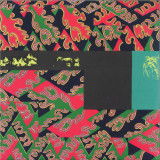
Marcus Schmickler's music is designed for multi-channel sound projections and references German electronic music tradition, spectral music, experimentalism as well as 1990s club music. His artistic practice explores avant-garde trajectories in electronic music composition, formal systems, sonification and psychoacoustics. EMEGO 296 features two new major works from this audacious sound explorer.
Sky Dice / Mapping the Studio premiered at Donaueschinger Tage fur Neue Musik 10.20.2018 having being commissioned by SWR and realized at the Experimentalstudio (EXP) in Freiburg. This is a work for ARP 2500, Publison DHM89B, Publison Infernal Machine and Computer. Taking cues from Bruce Nauman's Mapping the Studio I (Fat Chance John Cage) (2001) the piece draws a fragmented acoustic map of the SWR facility itself; the studio serves as a source-model for the sonic display of historical signal flow graphs. Various acoustic and psychoacoustic effects come into play including the Larsen effect, as well as Style Transfer and Topological Sonification. The result is a daring and dizzying display of disorientating audio. Sound moves in most unusual ways, rising and falling simultaneously, appearing and disappearing like apparitions, nothing here behaves in expected ways. To paraphrase Albert Einstein's now famous quote regarding quantum mechanics, this is spooky audio at a distance.
Fortuna Ribbon is a selection of sonic material that emerged from a research based on how DPOAEs (Distortion Product Otoacoustic Emission) can be designed in the context of musical frameworks, augmenting the compositional pallets in regard to spatial hearing. In this manifestation, the materials are presented without context. The resulting emissions from the ear that are excited in varying ways from the 6 examples on display here. Playback in undisturbed acoustic environments is recommended at >82 dB/A.
Schmickler's ongoing investigation of sound matter conjures impossible audio that delight's in the extremity of form and resulting effects on the listener. Schmickler's audio invocations explore the capabilities of contemporary technology resulting in dizzying new worlds of sound.
Thanks to the Experimentalstudio crew, Detlef Heusinger, Björn Gottstein, Julian Rohrhuber and Peter Rehberg.
Suche:new world audio
Following on from Vince Watson’s sell-out 2020 release, that saw tracks lifted from his 9th studio album ‘Via’ taken to a whole new level with remixes by the mighty Joe Clausell, Steve Bug & Langenberg, Osunlade and Manoo, he unleashes two fresh, new, feel-good cuts on Everysoul Audio!
Defining them as House or Techno would be a mistake, as Vince effortlessly bridges the gap between both worlds in a way that he does so very well. ‘Make A Wish’ was born out of the same studio session as his ‘Teardrops’ track for Sacred Rhythm, taking the initial sketch into a different direction with powerful drums, big basslines and silky synth stabs, adding to the orchestral strings that build. ‘Forever’ was originally a studio jam that made it into his live shows pre-covid, but this gave him the chance to finish it the way he always wanted. It’s an upbeat, jazzy cut with funky 909 drums and acid bassline.
The venerable composer and keyboardist Stale Storlokken follows up his previous Hubro release (and solo debut recording), The Haze of
Sleeplessness, with a second solo album performed entirely on pipe organ and recorded at Steinkjer Church by Stian Westerhus.
He describes the album as “a cavernous cathedral of sound”. While the Norwegian Grammy-nominated ‘The Haze of Sleeplessness’ used a whole keyboardmuseum’s worth of antique synths and contemporary digital software to create
its vast array of sounds, everything on ‘Ghost Caravan’ is the product of one organ’s pedals, pipes and sonic plumbing.
“There’s not so much of a relationship to ‘Haze’, says Stale Storlokken of the new album. “That album was more based on improvised ideas that were tweaked and arranged , while this one is all improvised with almost no editing at all. Everything you hear is from the church organ, with no additional instruments.
The basic concept of the record, and the arrangement of the titles and pieces, is done in such a way that they alternate between a fluent, “on the move”, abstract mood and a more recognisable, concrete and grounded mood. At the same time it should be so open that listeners will hopefully have their own unique experience. The organ at Steinkjer is not a big organ but it has some really nice sounds, with a number of quirks and mechanical eccentricities that suit my music.”
The organ is partly a reconstruction based on a Wagner organ in Nidarosdomen built originally in 1741, the organ is housed in the strikingly modernistic Steinkjer kirke, designed by Olav S. Platou in 1965, and featuring glass panels by the artist Annar Millidahl. What Ghost Caravan does share with its predecessor is a seemingly limitless acoustic space for the listener’s imagination to roam in, with Storlokken creating a cavernous cathedral of sound.
The audio dynamics span an enormous range, capable of stretching from the quietest breathy whisper to a basso profundo squawk or scream, sometimes within seconds of each other. Similarly, the incredible variety of sounds that Storlokken coaxes from the organ can defy rational analysis, with the resolutely analogue instrument appearing to echo the industrial, found-sounds of clanking machinery or buzzing electronics that one might expect to encounter through digital sampling or the tape-based experiments of musique concrete.
Over ten separate improvised pieces which connect into an informal suite through the repetition of key elements and sequential titles (with four ‘Spheres’ and four ‘Cloudlands’, plus ‘Ghost Caravan’ and ‘Drifting on Wasteland Ocean’), Storlokken has made a strikingly unified, self-referential aesthetic world that can stand as a true work of art.
In 1970 Barney Wilen assembled a team of filmmakers, technicians and musicians to travel to Africa for the purpose of recordi ng the music of the native pygmy tribes. Upon returning to Paris two years later, he created Moshi, a dark, eccentric effort fusing avantjazz sensibilities with African rhythms, ambient sound effects and melodies rootedin American blues traditions. Cut withFrench and African players including guitarist Pierre Chaze, pianist Michel Graillier and percussionist Didier Leon , this is music with few precedents or followers, spanning from extraterrestrial dissonance to earthbound, streetlegal funk. Wilen pays little heed to conventional structure, assembling tracks like "Afrika Freak Out" and "Zombizar" from spare parts of inde terminate origins. (Jason Ankeny, AMG)
Revelatory reissue of Barney Wilen’s ambitious jazz-fusion journey, Moshi (1972), presenting the legendary French jazzman and Miles Davis-sideman’s wildly ambitious effort fusing recordings of Pygmy tribes with African rhythms and stellar avantjazz leanings, sounding little like anything before or since its release. (boomkat)
Super rare and long out of print, the ground-breaking 1972 album from saxophonist Barney Wilen receives a reissue treatment of the highest order. Complete with a 20-page booklet and a never before seen DVD chronicling Wilen’s trip to Africa, this one is sure to be a delight for fans old and new. The deepest spiritual jazz grooves meet field recordings from the Upper Volta and b eyond, whilst psych rock influences collide with hypnotic and shamanistic percussion work. Truly one of the most out -there jazz records we’ve stocked for a long time! (bleep)
Originally issued by the seminal imprint Saravah in 1972, and among the most uncategorizable and sought after artefacts of the French avant-garde, Barney Wilen’s Moshi is nothing short of a masterpiece - long holding a coveted spot in the hearts of adventurous listeners and record collectors alike. A wild unkept cultural collage. A series of sonic experiments. A spiritual, psychedelic pilgrimage into the unknown - darting from one continent to the next, each of its tangents building toward a more optimist world view through ordered sound. Its scope remains as difficult to understand today as it was when it was released. Now brought back into the light by Souffle Continu, this is a moment to be celebrated far and wide. (Soundohm)
Deluxe reissue with additional artwork & remastered audio. 20-page booklet including rare pictures, sheet music & original liner notes. Bonus DVD with exclusive artwork of Caroline de Bendern’s movie « à l’intention de Mlle Issoufou à Bilma » documenting this incredible african journey.
In 1970 Barney Wilen assembled a team of filmmakers, technicians and musicians to travel to Africa for the purpose of recordi ng the music of the native pygmy tribes. Upon returning to Paris two years later, he created Moshi, a dark, eccentric effort fusing avantjazz sensibilities with African rhythms, ambient sound effects and melodies rootedin American blues traditions. Cut withFrench and African players including guitarist Pierre Chaze, pianist Michel Graillier and percussionist Didier Leon , this is music with few precedents or followers, spanning from extraterrestrial dissonance to earthbound, streetlegal funk. Wilen pays little heed to conventional structure, assembling tracks like "Afrika Freak Out" and "Zombizar" from spare parts of inde terminate origins. (Jason Ankeny, AMG)
Revelatory reissue of Barney Wilen’s ambitious jazz-fusion journey, Moshi (1972), presenting the legendary French jazzman and Miles Davis-sideman’s wildly ambitious effort fusing recordings of Pygmy tribes with African rhythms and stellar avantjazz leanings, sounding little like anything before or since its release. (boomkat)
Super rare and long out of print, the ground-breaking 1972 album from saxophonist Barney Wilen receives a reissue treatment of the highest order. Complete with a 20-page booklet and a never before seen DVD chronicling Wilen’s trip to Africa, this one is sure to be a delight for fans old and new. The deepest spiritual jazz grooves meet field recordings from the Upper Volta and b eyond, whilst psych rock influences collide with hypnotic and shamanistic percussion work. Truly one of the most out -there jazz records we’ve stocked for a long time! (bleep)
Originally issued by the seminal imprint Saravah in 1972, and among the most uncategorizable and sought after artefacts of the French avant-garde, Barney Wilen’s Moshi is nothing short of a masterpiece - long holding a coveted spot in the hearts of adventurous listeners and record collectors alike. A wild unkept cultural collage. A series of sonic experiments. A spiritual, psychedelic pilgrimage into the unknown - darting from one continent to the next, each of its tangents building toward a more optimist world view through ordered sound. Its scope remains as difficult to understand today as it was when it was released. Now brought back into the light by Souffle Continu, this is a moment to be celebrated far and wide. (Soundohm)
Deluxe reissue with additional artwork & remastered audio. 20-page booklet including rare pictures, sheet music & original liner notes. Bonus DVD with exclusive artwork of Caroline de Bendern’s movie « à l’intention de Mlle Issoufou à Bilma » documenting this incredible african journey.
Buzzing new Glasgow five-piece VLURE release their hotly anticipated
debut 7” ‘Shattered Faith’ via London-based label Permanent Creeps
Records.
Bursting onto the scene at the dawn of 2020, VLURE introduced
themselves to the world with a live audio/visual performance of their
phenomenal track ‘Desire’, captured in beautiful cinematography from
the loading bay of their Glasgow studio space. Blurring the lines between
live electronics, jarring guitars and the performance sensibilities of their
post-punk contemporaries, the video offered a keyhole view into their
captivating live shows.
Combining synth laden hooks, heavy club influenced rhythms and
emotionally confronting lyrics, VLURE have already seen support from
the likes of So Young and Wax Music praising their life affirming, intense
and enigmatic live performances.
Recorded between the halls of a deconsecrated church in the heart of
the Scottish Borders, the self-produced ‘Shattered Faith’ is an indulgent,
genre bending coming of age anthem influenced by the rhythms,
repetitions and euphoric hooks of Glasgow’s thriving afterparty and club
scene with an angular post-punk foundation. Speaking on the track the
band explain: “We wanted to create something that felt at home on the
dancefloors that we all found ourselves on growing up, yet still equally at
home in the sweat-filled venues that the band was conceived in. At its
crux, ‘Shattered Faith’ is about self-empowerment. It’s the
disillusionment with where you are and what you’ve been given. It’s lying
on your kitchen floor at 3am realising who you truly are and finding
power in that - it’s a new lease of life. We believe that, if they want to find
it, there is something for everyone in this song.”
“There is nothing comparable - this is a new era of musically skeletal
human showmanship” - So Young Magazine
“Urgent, destructive and completely absorbing. Brutalist in form -
unyielding, massive-sounding, distinctive - their atmospheric, yearning
mood is overflowing with inclination and exposed tenderness -
vulnerable and exasperated. They pound the door down with every inch
of blood, sweat and tears in their vessels” - Wax Music
“This is post-punk, but not as you might familiarly expect” - Little Indie
Blogs
“One of Scotland’s most exciting new bands” - Tenement TV
Throughout his vast career, the New York based Australian composer JG Thirlwell has adopted many masks as a means of infiltrating and subsequently subverting a wide range of pop cultural forms. His work under the Foetus moniker has taken on everything from big band to opera to noise-rock. Steroid Maximus embraced exotica and the world of soundtracks, while his Manorexia project continued his quest to the outer limits of contemporary composition and musique concrete. Thirlwell has also carved out a significant output in the field of the soundtrack via the large body of work created for the animated television shows Archer and The Venture Bros. In addition he has been commissioned to create compositions by such notables as Kronos Quartet, Bang On A Can, Alarm Will Sound, String Orchestra of Brooklyn and many others.
Now we have ‘Omniverse’, the second release under the moniker Xordox. Xordox is a synthesizer-based project, and on this evocative album we see the project branch into many new avenues. The science fiction element brushes up against crime noir, even veering into areas that could well fit in the video game soundtrack genre. With an audacious attitude and an arsenal of machines Thirlwell serves up a selection of thrilling retro-future mind capsules. This is music made from a life saturated in culture, both underground and mainstream, high and low. Tense sequencing and noir tinged keyboard lines invoke a powerful visual image of films and memory, of screens and speakers, of sound and space, all entering the cosmos and the subsequent galactic race. Thirlwell’s decades long exploration of sampling and sequencing, composing and ingesting a daunting amount of audio and visual artworks speaks volumes for the bold assimilations exposed here. ‘Between Dimensions’ lays out a tense theme which starts off like a score to a a crime thriller before morphing into a simulacra of Kraftwerk scoring a video game. The living ghosts of Giorgio Moroder and John Carpenter haunt ‘Oil Slick’ as it permeates wormholes, updating lifeforms with its stealth sequencing and tense momentum.
‘Omniverse' is a synthesised soundtrack journey, one which embraces past forms whilst reshaping them for the new unknown. ‘Omniverse' is a thrilling liquid ride through fear and hope, and like all the best of Thirlwell’s output, is simply one hell of an enjoyable journey to take.
Ziad Rahbani’s cult album, “Bennesbeh Labokra...Chou?” originally
released in Lebanon only and mixing arabic music with Jazz, Bossa Nova and other western influences, is hailed as an absolute classic.
The album is the soundtrack to his eponymous play and has been highly soughtafter by DJs and collectors around the world. Curated by Lebanese-born music
expert Mario Choueiry from Institut du Monde Arabe in Paris, the album is
reissued on vinyl for the first time since 1978, featuring original gatefold sleeve,
remastered audio and a 2 page insert with a new introduction by Choueiry.
“Bennesbeh Labokra... Chou?” is a skilful blend of Arabic music and Bossa-nova
- “First Introduction” - the recurring theme of the album, groove - the funky
beat of “Second Introduction” and the jazz vibe of “Variation’s 3 and 4.” It’s also
interesting to hear an early version of “Al Bosta” which would grace Fairuz’s
1979 album “Wahdon” in a faster, funkier version.
With a knack for cinematic orchestrations reminiscent of Lalo Schifrin, Ziad
Rahbani also brings more complex arrangements to the album on such tracks
as “Variation 5” making the album such a rich listening. Undoubtedly one of
the most important albums recorded in the Middle East
Wah Wah 45s make a welcome return to the world of re-issues. Having started out over two decades ago releasing dance floor funk from Benny Poole, Cheyenne Fowler and The Googie Rene Combo, and later re-releasing obscure Kompa-funk from Haitian pianist Henri Pierre Noel, they now turn their attention to an overlooked early 90s acoustic soul gem.
About thirty years ago, music teacher and budding producer Alex Boyesen found himself working as part of the Haringey Music Workshop - a community programme and outreach project funded by the local council in Haringey, North London (coincidentally the area in which the Wah Wah head office is now based!).
"Anyone could come and get lessons for free - ranging from piano, sax, guitar, drums, bass, singing and workshops including choral, jazz band and more." Alex Boyesen
It was during that time that Alex came across a young Sam Edwards.
"One day I went into one of the rehearsal rooms and there, by herself, was this girl playing a piano and singing. It was the most incredible voice I had ever heard."
Before long, the pair were playing all over London as a duo with Alex on guitar and Sam on vocals.
"Sam had never had professional training, she was simply an utter natural."
The Haringey Music workshop was connected with other projects in the borough, in particular a community project called the Selby Centre. Here they ran training programs for young people and one of these was a music business course. The idea was that they found an artist, recorded them and then promoted them. One way or the other they ended up picking Alex and Sam to be on their roster.
"My good friend Nixon Rosembert was brought in to oversee the recordings and they hired the Islington Music Workshop to do the recording. We got musicians from the Haringey Music Workshop to play on the sessions and spent a day recording two songs -American CarsandLife. The training workshop had created a label called Progression Music and out the record went."
Three decades later and out of the blue Alex started to get interest again in the record he'd almost forgotten about all those years ago. It had become something of a sought after gem on Discogs, and there seemed to be an interest in that 'acoustic soul' sound once again.
"I got three people asking if they could re-release it and finally here we are with Wah Wah 45s doing the business after all these years."
It was Hospital Records and Wah Wah 45s founder, Chris Goss, who first brought the idea of releasing this record to the table.
"This is a really special record for me, picked up 30 years ago, from a young James Lavelle at Honest Jon's in Ladbroke Grove. Sam Edwards would go on to perform and write songs with North London's Izit, the acid jazz collective fronted by Tony Colman - with whom I have built a music company, these past 25 years. Alex Boyeson worked with Tony at the Haringey Arts Project, who produced a one-off vinyl release of Alex's two compositions back in 1991. Thanks to Alex and Tony, we have been able to clean-up the original audio, uncover photos and lyric sheets to present, with real love and affection, these two lost gems from a bygone era." Chris Goss, Feb 2021.
The project was then expanded by Dom Servini, who got heavy disco legend Ashley Beedle and co-label owner and erstwhile producer Adam Scrimshire in to take on remix duties.
"When approached by Dom Servini to reworkAmerican CarsI had no idea about the history of the original song. After a good listen myself and studio partner Darren Morris set to work and all I can say that it was a lovely experience keeping the vibe of the original but giving it a spaced out feel in true Afrikanz On Marz fashion." Ashley Beedle, Feb 2021.
"Remixing without multi-tracks always brings a bunch of challenges, getting the balance between the bass and drums in the original and what you want to do with your own version. The song really dictates certain things to you.
But it was such a pleasure to explore that with this beautiful song and vocal performance. So many ways to approach it. I just wanted to draw out more of the melancholy in the original and make it an absorbing experience." Adam Scrimshire, Feb 2021.
Perhaps the last word should be given to Alex himself, who's very much enjoying the new lease of life that his music with Sam is getting.
"As I write this we are trying to locate her, she's somewhere singing something, that's all she ever did. Thanks for being part of my life Sam and I am so glad that this small bit of that time is being remembered." Alex Boyesen, Feb 2021.
Hailing from Georgia’s capital Tbilisi, Gacha Bakradze is one of the national scene’s leading electronic music exponents. He returns to Lapsus Records with his new album 'Obscure Languages', his second release for the Barcelona label.
Following the superb LP 'Word Color' Lapsus Records, 2018, which appeared in several ‘album of the year’ lists for publications such as Pitchfork and XLR8R, the prolific producer now presents 'Obscure Languages'. This new piece of work could well be described as a sound continuation from his previous album and maintains a powerful narrative at its core.
‘Obscure Languages' delves into the world of cinematic soundscapes, replete with microscopic details and fragments that showcase a luscious IDM style audio palette, laced with ambient, avant-techno, bass and sound design.
Rich in musical associations yet utterly singular in its voice, joyous with an inner tranquility, the music of Natural Information Society is unlike any other being made today. Their sixth album in eleven years for eremite records, descension (Out of Our Constrictions) is the first to be recorded live, featuring a set from London’s Cafe OTO with veteran English free-improv great Evan Parker, & the first to feature just one extended composition. The 75-minute performance, inspired by the galvanizing presence of Parker, is a sustained bacchanalia of collective ecstasy. You could call it their party album.
This was the second time Parker played with NIS. Joshua Abrams: “Both times we played compositions with Evan in mind. I don’t tell Evan anything. He’s a free agent.”
The music is focused & malleable, energized & even-keeled, drawing on concepts of ensemble playing common to musics from many locations & eras without any one specific aesthetic realization completely defining it.
“The rhythms that Mikel plays are not an exact reference to Chicago house, but that’s in there,” Abrams says. “I like to take a cyclic view of music history, can we take that four-on-the-floor, & consider how it connects to swing-era music? Can we articulate a through line? I dee-jayed for years in Chicago & lessons I learned from playing records for dancing inform how I think about the group’s music. The listener can make connections to aspects of soul music, electronic music, minimalism, traditional folk musics, & other musics of the diaspora as well. It’s about these aspects coming together. I don’t need to mimic something, I need to embody it to get to the spirit, to get to the living thing.”
For jazz fans, the sound of Parker’s soprano & Jason Stein’s bass clarinet might evoke Coltrane & Dolphy, even though they didn’t necessarily set out to do that & they play with complete individuality. Abrams sees a bridge to the historical precedent, too. “Since we first met in the 1990s, one of the things that Evan and I connected on was Coltrane’s music,” he says. “I hoped that we would tap into that sound world intuitively. In this case, I think that level of evocation adds another layer of depth, versus a layer of reference.”
Indeed, this is a performance in which the connections among the ensemble & the creative tension between improvisation and composition build into a complex mesh of associations & interactions. While the band confines itself to the territory mapped out by Abrams’ composition, they are remarkably attentive & responsive, making adjustments to Parker’s improvisations. When Parker’s intricate patterns of notes interweave with the band, the parts reinforce one another & the music rockets upward. Sometimes, Parker’s lines are cradled by the group’s gentle pulse & an unearthly lyrical balance is struck.
Drummer Mikel Patrick Avery is locked-in, playing with hellacious long-form discipline, feel & responsiveness. Jason Stein’s animated, vocalized bass clarinet weaves in & out with Lisa Alvarado’s harmonium to state the piece’s thematic material; the pulsing tremolo on the harmonium brings a Spacemen 3 vibe to the party. Abrams ties together melody & rhythm on guimbri, a presence that leads without seeming to. Like his bandmates, he shifts modes of playing frequently, improvising & then returning to the composed structure.
“As specific as the composition is, the goal is to internalize it & mix it up,” Abrams says. “The idea is to get so comfortable that we can make spontaneous changes, find new routes of activity, stasis & byways every gig. It’s like a web we’re spinning. If someone makes a move, we all aim to be aware of it, make room for it. Experiencing & listening is what it’s about, & Evan supercharges that.”
& “supercharged” is the word for this album. With Parker further opening up their music, descension (Out of Our Constrictions) is the sound of Natural Information Society growing both more disciplined and freer, one of the great bands of its time on a deep run.
Aguirre edition: Mastered by Helge Sten, Audio Virus, Oslo. Lacquers by Dubplates & Mastering. Liner Notes by Theaster Gates. LPs pressed on premium audiophile-quality vinyl at Pallas Records. US 2xLP edition available thru Eremite records.
- 1: Jfet
- 2: Dor
- 3: Xem W/ Gazelle Twin
- 4: Oct W/ Simon Fisher Turner
- 5: Uvu
- 6: Iln W/ Nik Void
- 7: Abii W/ Astrud Steehouder
- 8: Veq
Coloured[19,54 €]
MICROCORPS is the new project by artist and musician Alex Tucker (Grumbling Fur, Alexander Tucker, Imbogodom) exploring electronics, cello and voice. The debut release XMIT, an eight-track album featuring collaborations with Gazelle Twin, Nik Void, Simon Fisher Turner and Astrud Steehouder, is out on 16 April 2021. Tucker's ever-evolving soundworld continues to unfold with this collection of harsh realms centred around processed electronic systems, strings and vocal manipulations. On the new album, MICROCORPS employs altered voices, sound synthesis and atomised beat constructions. In a move away from previous projects XMIT investigates erasing the self, removing obvious traits of the hand and voice, and allowing a focus on the humanoid rather than the human. Instead of recognisable lyrics and coherent imagery, MICROCORPS evolved synthesised voices to generate alternate characters. He expands, "I was investigating how language brings our world into being and how manipulating the actual grain of the voice could open up momentary shifts in perception." Each track is born from a balance between composition and improvisation within set parameters. At each stage audio is heavily processed and then reconfigured. Setting up systems that are non-repeatable, where decisions can be premeditated and intuitive but never the same with each performance, using hardware and instruments outside of the computer to make live stereo takes that have limited room for editing and mixing. "I'd been looking into combining dream music with machine rhythms, but there are so many great examples out there of both music forms, so I started to cut up the drones and really filter the drum patterns to create a hybrid space." The album artwork features manipulated ink drawings by Tucker that originally featured in his recent comic ENTITY REUNION 2. XMIT refers to a time in which information both physical and nonphysical transfers at an alarming rate beyond human comprehension into an age which is at once banal and terrifyingly alien.
Fingerpoppin’ Records The Dave Brubeck Quartet With Paul Desmond / Live In Indiana 1958 Limited Edition Audiophile Pressing
180gr. Premium Vinyl
Following the year-long world tour set up by the State Department, The Dave Brubeck Quartet returned to the United States in 1958 full of new ideas. The group had played in England, Germany, Scotland, Denmark, Belgium, Holland, Turkey, Pakistan, India, Afghanistan, Iran and Iraq, and the music they heard in those places would inspire Brubeck to compose the pieces that would be featured on the album Jazz Impressions of Eurasia.
A few days before taping that studio album, the group performed most of its tunes in Indiana, during the French Lick Jazz Festival, a set heard here in its entirety. A wonderful performance by the same group at the 1960 Newport Jazz Festival and a rare live reading of the classic “Take Five” have been added as a bonus.
PAUL DESMOND, alto sax; DAVE BRUBECK, piano; EUGENE WRIGHT, bass; JOE MORELLO, drums. Recorded live at the French Lick Jazz Festival, Indiana, August 17, 1958.
Composed by Auvinen
Mastered by Denis Blackham at Skye Mastering, June 2020
Cut by Andreas Kauffelt at Schnitstelle, Berlin, June 2020
Johannes Auvinen has been a one man acid king for over a decade producing a wealth of acid and acid house under the moniker Tin Man. For this new release on Editions Mego he navigates an entirely different zone. Drawing on the history of electronic musik Akkosaari is a transcendental journey far from the sensual frenzy of sweaty acid drenched dancefloors we are accustomed to with his work. Akkosaari lies in the middle of the kosmic komische of Ash Ra Temple's Jenseits, the weightless transcendentalism of Eliane Radigue's Trilogie De Morts and the more glacial output of the Sähkö catalogue. The pace is gentle as the listener is drawn further into a world unlike the one we inhabit, these machines are more second life than one's emulating real life. The fantastic potential for audio induced visions are at play in this adventure in music as mind travel. On Kyläläiset Tanssii a measured pulse acts as a means of navigation before Susi spirals out clouds of sound. By the time we get to Kelluminen we are deeply within an unfamiliar state prior to landing in the heavenly plateau of Akkosaari. Throughout Akkosaari we are bathed in enrapturing and enveloping mists of psychedelic haze which take the listener on a vivid mental journey. This is intoxicating head music unfolding like an astral ascension and like any trip warrants repeat visitation.
Luca Yupanqui was not yet born when she recorded her debut album. The music on the aptly titled Sounds of the Unborn is the expression of life in its cosmic state _ pre-mind, pre-speculation, pre-influence, and pre-human. It is the first album created by a person while they were still inside the womb, the expression of a soul that hasn't yet seen the light of day nor taken a single breath of air. It is a message that comes from a different realm, a sublayer of our existence. Sounds of the Unborn was made with biosonic MIDI technology, which translated Luca's in utero movements into sound. With the help of her parents, Psychic Ills bassist Elizabeth Hart and Lee Scratch Perry collaborator Iván Diaz Mathé, Luca's prenatal essence was captured in audio. They designed a ritual, a kind of joint meditation for the three of them, with the MIDI devices hooked to Elizabeth's stomach, transcribing its vibrations into Iván's synthesizers. They let the free-form meditations flow without much interference, just falling deeper into trance and feeling the unity. After five hour-long sessions, the shape of an album began to emerge. Elizabeth and Iván then edited and mixed the results of the sessions, respecting the sounds as they were produced, trying to intervene as little as possible, allowing Luca's message to exist in its raw form. This cosmic soul summoning created new sounds, striking into uncharted territory for Elizabeth and Iván as musicians. A new language was being created, a new form of communication. It was a music without intellect or intentionality behind it, with no preconception or attempt to create any specific sound or melody. Every note on Sounds of the Unborn occurred naturally. It is human nature to wonder what life is like inside another human being's consciousness. How does it feel? What does it sound like? All these questions became stronger and more important to Elizabeth and Iván while they were waiting for Luca to come into the world. At a certain point the questions turned into, What would she say if she could speak? How would she react to the outer world? And ultimately, What kind of music would she play if she was able to? This album is an attempt to answer those questions. RIYL: Brian Eno, Mort Garson, Kaitlyn Aurelia-Smith
- 1: The Ballad Of Crowfoot
- 1: 2 Peruvian Dream (Part )
- 1: 3 Charlie
- 1: 4 Broker
- 1: 5I Pity The Country
- 1: 6C Razy Horse
- 1: 7L Ouis Riel
- 1: 8 S Hool Days
- 1: 9 Te Carver
- 1: 0O Canada!
- 1: Down By The Stream (Starlight Maiden)
- 1: 2 Rattling Along The Freight Train (To The Spirit Land)
- 1: 3 Pontiac
- 1: 4 The Pacific
- 1: 5 Nova Scotia
- 1: 6 The Dreamer
- 1: 7 Sonnet 33 And 55 / Friendship Dance
- 1: 8 Wounded Lake
- 1: 9 Métis Red River Song
- 1: 20 Son Of The Sun
- 1: 2 The Lovenant Chain
- 1: 22 Bear And Fish
- The definitive overview of one of Canada's unsung musical heroes - Rare/previously unreleased recordings, photos, and interviews - Lyrics, discography, and filmography - Audio re-mastered by John Baldwin Mastering - Artwork by Christi Belcourt and Alanna Edwards - Liner notes by Kevin Howes (Voluntary In Nature) - Contributions from the Dunn family, Bob Robb, and Alanis Obomsawin (OC) // How did you first experience the poetry, music, and film of Willie Dunn? In a Montreal coffeehouse during the mid-1960s? On a CBC Indian Magazine broadcast with host Johnny Yesno? At a Toronto record store or Native Friendship Centre at the turn of the 1970s? Waiting outside of the Mohawk Nation Longhouse? Maybe in your parent's record collection on the Rez? A White Roots of Peace gathering? Pow wow? The Mariposa Folk Festival? Or was it that Save James Bay Benefit back in '73? On a good friend's stereo? Sitting around a crackling campfire? How about an old NFB film reel or VHS tape in high school? Or while attending Manitou College? A German concert hall in the 1980s? Maybe a direct action protest on the colonial streets of Canada? Busking in Ottawa during the 1990s? College radio? At Willie's celebration of life service in 2013 alongside Alanis Obomsawin and Willy Mitchell? LITA's Grammy-nominated Native North America (Vol. 1) compilation or the very anthology you hold in your hands? There should be no judgment for coming to things when you do. All that's important is remaining open to life-changing messages such as these_ Willie Dunn shared truth through song and celluloid. His original composition, "I Pity the Country," is an unparalleled statement on the greed and hate created by humankind, recorded in 1971 and still unfortunately needed today. "It's like the reason you're supposed to make music," said Kurt Vile about the song to MOJO Magazine in 2015. With "Charlie," Willie was the first to deliver the devastating story of Chanie Wenjack and the Canadian residential school system to the music community, nearly 50 years before the much-celebrated Secret Path, yet ignored outside of Indian Country and the folk festival circuit. Dunn's film technique, featured in 1968's The Ballad of Crowfoot (NFB), predates the "Ken Burns effect" to great effect. Are you catching the drift? Willie Dunn was not only a trailblazing leader in his time, but well ahead of the curve, simply without the PR push and big money backing of major label players. "He was our Leonard Cohen," said singer-songwriter Eric Landry about his musical hero. The only difference is that Willie refused to play the Hollywood showbiz game. In talent, he is Cohen, Dylan, and Cash rolled into one and along with Buffy Sainte-Marie, Floyd Red Crow Westerman, and A. Paul Ortega, brought a new set of perspectives and realities to the folk music tradition. Willie spoke directly to his people and Mother Earth through his creations, not only from experience but by examining his roots and connecting with the world in which he lived. We are humbled to help honor Willie Dunn. May he never be forgotten_ PEACE
On 28th August, Nirvana's self-titled 7 x platinum-selling posthumous collection Nirvana makes its debut on Deluxe 45rpm double LP on heavyweight 180-gram vinyl with a digital download card for 24-bit 96kHz HD audio, as well as a standard 33rpm single LP 180-gram heavyweight vinyl edition which will feature a download card for 320kbps MP4 audio. Nirvana will also be released as a Blu-Ray Pure Audio in high resolution 24-bit 96kHz in three stereo audio formats: PCM, DTS-HD Master Audio and Dolby TrueHD stereo.
Originally released in 2002, Nirvana features the rare and previously unreleased studio version of You Know You're Right', the last song the band ever recorded, available exclusively on this compilation. Also among the 14 classics on Nirvana: 1991's breakthrough Smells Like Teen Spirit', and fellow Nevermind singles Come As You Are', and In Bloom', In Utero singles Heart-Shaped Box' and Pennyroyal Tea', as well as deep cuts including About A Girl' from first album Bleach, Been A Son' from the Blew EP, the non-LP single Sliver', and live acoustic versions of All Apologies' and David Bowie's The Man Who Sold The World' from the GRAMMY® winning MTV Unplugged In New York.
The music on Dance Nos. 1-5 was originally conceived as a three-way collaboration between composer Philip Glass, choreographer Lucinda Childs and artist Sol LeWitt. Dance received its world premiere in Amsterdam on October 19, 1979 and its New York premiere at the Brooklyn Academy of Music on November 29, 1979.
Post-dating Einstein on the Beach - Glass’s 1975-76 collaboration with director Robert Wilson - Dance was another Glass collaboration, this time with choreographer Lucinda Childs, known for her austere, athematically exact dances, and artist Sol LeWitt, who provided a ghostly, gigantic black- and-white film for several of the piece’s five sections.
RELEASE: 5-3-2021
• 180 GRAM AUDIOPHILE VINYL
• DELUXE HEAVYWEIGHT SLEEVE WITH GLOSS LAMINATE
• PVC JACKET
• THE COMPLETE ALBUM, AVAILABLE ON VINYL FOR THE FIRST TIME IN ITS ENTIRETY ON A 3LP-SET
WITH FIVE SIDES OF MUSIC
• INCLUDES PHILIP GLASS CATALOGUE WITH INFO ON THE PHILIP GLASS SERIES ON MOV
SIDE A
Dance has an abstract purity that easily earned it the label “minimalist,” a term that Glass himself disavows but that seems appropriate, at least in this case. After Dance, Glass’s music took several turns, not so much in style as in the various new contexts in which it was presented: major opera commissions and film scores led him to write for forces other than those of the Philip Glass Ensemble. At the same time, an attempt to reach a wide audience resulted in some shorter, perhaps more accessible, narrative pieces. Dance marked the blossoming of the composer’s experimental work. Here, though, the music - particularly Dance Nos. “1”, “3” and “5”, all written for the Ensemble— has an unforgettable exuberance that somehow speaks all at once of joyful innocence, intense erotic desire, tenderness, regret and, finally, acceptance. On the other hand, Dance Nos. “2” and “4” see Glass composing several large-scale works for solo organ; for instance, Dance No. 2 originated as a 1978 work entitled Fourth Series Part Two. This piece, later incorporated into Dance, and Dance No. “4” as well, have a more subdued, more darkly romantic quality than the work’s other sections and are quite unlike anything Glass had previously written. Still, they too, with their mysterious tilts of time and key signatures, continue the exploration of polyrhythms and harmonic complexities within the context of Glass’s repetitive, “minimalist” style.
The complete Dance Nos. 1-5 album is now available on vinyl for the first time in its entirety on a 3LP-set with five sides of music. The 3 LP’s are housed in a heavyweight sleeve.