With his seventh studio album, Shapes of the Fall, Piers Faccini, pursues his passion for the kind of cross-cultural dialogues that have long been heard on Mediterranean shores throughout the centuries, bridging southern Europe with the Near East and Africa. Although the songs are written and sung in English, the musical influences in Shapes of the Fall draw heavily on Faccini's own Mediterranean ancestry, creating a musical voyage whose geography varies from song to song, crossing multiple frontiers with his voice over the course of the journey, from the snow tipped anglo-american Folk registers of songs like Paradise Fell or Together Forever Everywhere to the eerie desert blown notes of Middle Eastern or north African modes in tracks like Firefly or Dunya. Ruin or repair and hope or despair are the album's parallel narratives and if shapes of the fall are the myriad endangered forms that make up the mosaic of our environmental collapse, the descent, Faccini sings, is of our doing or undoing. ''Bring me my home back'' the chorus of the album's emblamatic opening song They Will Gather No Seed is not then, the singer's personal cry for a home but the animal lament of innumerable species on the brink of extinction. Faccini who has previously collaborated with cellist Vincent Segal for their 2014 duo album Songs of Time Lost has collaborated over the years with musicians far and wide in search of musical dialogue such as Ballake Sissoko, Ibrahim Maalouf or Jasser Haj Youssef. Two exceptional voices feature on the album; Californian singer-songwriter Ben Harper, a collaborator from his 2005 album, Tearing Sky and Moroccan singer and master of the trance traditions known as Gnawa, Abdelkebir Merchane. The album was co-produced by Piers Faccini and Fred Soulard.
Suche:nor easter
Limited editon LP format with extra heavy textured jackets and metallic silver ink. LP includes 12" square insert with lyrics and images of the artist, and download. The raw inspiration for Vague Tidings came from a 2006 DIY tour of the 49th state. It was a trip that went off the beaten path-sometimes a bit too far for comfort. Now, over a decade later, listeners find Joe O'Connell aka Elephant Micah stationed at a creaky spinet piano, singing about the Alaskan sky. Throughout, his lyrics take a new angle on a pet theme: human encounters with the natural world. Vague Tidings places these encounters in the American West and, at times, in its sci-fi corollary, outer space. Its imagery draws from the allure of Alaska, the idea of Western prosperity, and the human relationship to wilderness more broadly. Often, O'Connell sings about the goal of capturing and commodifying nature. In poetic sketches of resource extraction industries and dark sky tourism, frontier lust runs amok. Pipelines catch fire and stars disappear, all to the tune of a stark, uncanny Americana. Vague Tidings is a sustained, hallucinatory rendering of this theme. In style, its eight songs follow a switchback path between foggy incantations and mountain anthems. Made with a small cohort of acoustic instrumentalists, the record is rough hewn, but easy on the ears. To put Vague Tidings down on tape, O'Connell assembled some of his favorite musicians in Raleigh-Durham, North Carolina area, where he's lived since 2015: Libby Rodenbough (Mipso) bows and plucks a detuned fiddle, Matt Douglas (Mountain Goats) breathes life into various woodwinds, and Matt O'Connell (Lean Year) sets the pace on a two-piece drum set. Their loose, imaginative playing pushes Vague Tidings beyond the singer-songwriter genre into something richer in texture. Ultimately, this is foreboding but spacious music, with plenty of room for reconsidering life on earth. R.I.Y.L. Jason Molina, Bonnie Prince Billy, Bill Callahan, Damien Jurado.
Captivating, ethereal and majestic, Mammal Hands (saxophonist Jordan Smart, pianist Nick Smart and drummer and percussionist Jesse Barrett) has carved out a refreshingly original sound from a disparate array of influences: drawing on spiritual jazz, north Indian, folk and classical music to create something inimitably their own. Hailing from Norwich, one of Britain's most isolated and most easterly cities, they have forged their own path away from the musical mainstream and their unique sound grew out of long improvised rehearsals. All three members contibute equally to the writing process: one that favours the creation of a powerful group dynamic over individual solos. Their records are entrancing and beautiful affairs, while their hypnotic live shows have seen them hailed as one of the most exciting bands in Europe as they push their unique line-up to the outer limits of its possibilities.
Shadow Work is their third album and the first they have self-produced. Recorded at 80 Hertz Studios, Gondwana Records home from home in Manchester, it is the result of 18 months of intensive touring and mammoth writing sessions. The energy from their exhilarating live performances has fed into the writing process and yet there is a quiet reflective side to this album, giving it an expanded emotional range that draws the listener deep into Mammal Hand's sound world. One that builds on the sound of their previous recordings, Animalia and the beautiful Floa, but is wider than ever, with the use of prepared piano strings, more prominent effects and field recordings all adding to the band's most ambitious and accomplished album to date. The striking artwork is by Daniel Halsall and reflects the organic, natural influences underpinning the band's music alongside a darker, modern minimalism.
An unlikely meeting of two like-minded spirits, »First Man in the Moon« sees the former Swans guitarist and Hallow Ground regular Norman Westberg and the prolific double bass player Jacek Mazurkiewicz collaborate for five evocative tracks. The pair finds common ground beyond the boundaries of atmospheric drone, abstract jazz and experimental music and blurs the lines between the acoustic and the electronic.The two first met when the composer Mazurkiewicz supported Swans with his solo project 3FoNIA on their 2014 European tour. »I really enjoyed his approach,« says Westberg about the Polish musician’s blending of the acoustic qualities of his instrument with electronically generated sounds. A decision to collaborate was made and when the US-American musician returned to Eastern Europe to support Michael Gira on his solo tour in late 2019, Mazurkiewicz reached out to him with the idea of booking some studio time before Gira’s two concerts in Warsaw. »Recording was very fun and easy,« remembers Westberg. »It was just two people enjoying hearing and reacting to what the other is doing.« »First Man in the Moon« is not however a plain document of these improvised sessions, but also shaped by Mazurkiewicz’s approach as a composer. Once the recordings were finished, he selected and edited the recorded material, refining the peculiar dialogue between the guitarist’s meditative drones and bright chords and his own rhythmic yet subtle approach to playing the double bass, sometimes plucking the strings and occasionally using his bow to underscore
Westberg’s fleeting melodies, but also using the instrument in unconventional ways to generate sound. A feeling of weightlessness prevails throughout the aptly-titled »First Man in the Moon.« Even at their most abstract however, these five improvisations-turned-compositions remain tangible, lively, and joyfully explorative. It is a record that you wouldn’t expect from either of these musicians, but
the logical result of two idiosyncratic minds sharing not only space and time, but also their respective visions with each other. Credits:
Recorded at Studio Diamentowy Pies/ Damian Pielka, engineering/Piotr Mazurek, engineering assistance/Jacek Mazurkiewicz, mix/
Lawrence English, mastering/John Fell, photographs.
Following on from the likes of Goat, Josefin Öhrn, Hills, Flowers Must Die, Centrum and GÅS - VED continue to be among the wonderful plethora of Swedish bands to release their exploratory music on Rocket Recordings. With 3 albums, 3 EPs (including one on Rocket), a compilation on labels like Höga Nord and Adrian Recordings already behind them this Malmö 5 piece are famed for creating trance inducing, repetitive, psych. Their ever evolving sound has always taken in many global influences, from Middle Eastern to African to the monotonous explorations of composers like Steve Reich and Terry Riley. Rhythmically driven like the jittered ecstasy of a Post Punk band covering a Oriental Surf a track, “Ett visst fängelse” (translated as ‘A Certain Prison’) establishes a pulsating
clink clack shimmer that is as hyper actively addictive as CAN in full animated instrumental groove. “The Embrace Of The Oarfish” the lead track, advances the propulsive pummeling to a more aggressive sound centred around a repetitive single bass note that masquerades like an menacingly deep percussive outlaw. The looming ribbon like nature of the track slithers like the giant sea serpent the title alludes too - some say the Oarfish can forecast earthquakes themselves, maybe its the resonance of the bomb shelter in
Malmö that is the bands rehearsal space that imposes itself tremor like through their oscillating work. The firewood that is VED’s work has reminiscent echoes of the primal work of UK act Snapped Ankles, but VED’s journey is a wholly unique controlled burn where rapid oxidation devours any listener into a blaze of restorative enchantment.
Old Dark House: Suspenseful cinematic ambience and subliminal rhythmic sorcery by Andrew Crawshaw and Corey J. Brewer. Andrew Crawshaw (aka Meridian Arc) and Corey J. Brewer have come together to make music as Old Dark House. This is great news, as these Seattle musicians have proved themselves to be masters of suspenseful cinematic ambience and subliminal rhythmic sorcery. Crawshaw has hosted the Depths night at Substation, at which he and other musicians create new soundtracks for cult-classic films. Brewer famously crafted an alternate score for Stanley Kubrick's The Shining, which he performed at Northwest Film Forum in 2017. As Old Dark House, the duo have recorded their debut album, Welcome Home, with another excellent film-music head, Erik Blood, mixing. Welcome Home's 11 tracks combine Crawshaw's penchant for expansive yet intimate synthscapes and Brewer's mastery of morose songcraft. The latter's voice pitches somewhere between Nick Cave and Edwyn Collins, adding a lugubrious luster to Old Dark House's midnight-blue atmospheres and tension-building rhythms. "Through the Trees" is perhaps the record's most chilling and dramatic moment. The song at once drifts and stomps ominously, as Brewer sings like an opiated Chris Isaak, haloed by a synth motif of vaguely Eastern-sounding grandeur. _ Dave Segal
You could think of the collection of tracks here as a library record of sorts, and each track inhabits its own universe. Tropical fits various moods and situations, and it could soundtrack any number of activities at home or on a dancefloor - whether real, imaginary, or hallucinated. Strangely enough, it sounds like it could have been constructed from obscure Italian library breaks, when instead every instrument has been played and panned, several times over, across magnetic tape.
The genesis of many of these tracks began when CV Vision moved to Berlin in 2014. His flat had a small chamber where he could fit a drum set, so he treated the walls with foam, and in true DIY style, dived headfirst into recording these tracks. It was the natural next step on an audio adventure that first began when CV Vision picked up the guitar in his teens, and a couple years later started recording with friends in his home town of Bayreuth. Fast forward ten years and here is his debut - a culmination of practising chops and learning instruments, mastering recording techniques and fine-tuning the CV Vision sound.
It’s a sound that condenses elements of acid rock, psych soul, library funk and new wave oddities into a movie soundtrack for your mind. It’s a journey from ‘60s west coast LSD-drenched excursions to ‘80s synth and post-punk mutations. Tropical is a plunge into another time, another music you can simply swim around in and explore.
Side A opens up with Tropical Tune In, which rides in on a clave and a warm wind, blowing a distinctly herbal aroma and recalling exotica dons like Les Baxter and Martin Denny. Following on with the aural equivalent of a sea breeze through your mind, Spaziergang am Meer blows away the cobwebs and conjures some nice library moments like Stringtronics or F eelings . Next, Ba_c_k(Lava) bounces out of a cold wave post-punk melting pot and crashes through the speakers like a blazed Zebedee, with some sweet eastern synths for added flavour, before the rolling bass licks of Der Böse Schamane take us into another dimension, landing somewhere between a psych rock freak out and a Black Ark dub session. Mr Maze channels the arpeggiators of synth outsiders like Mort Garson and Bruce Haack, creating a glorious interlock of robotic electronics and freakbeat vocals. The side comes to a close with the guitars of Der Strand (außer Rand und Band) letting loose like syrupy springs, and setting a languid mood like the bedroom scene in Bedazzled (1967 version). Side B kicks off with Parallel Universum, which comes through like a woozy krautrock workout, all ducking synths with big chord shifts to create an epic deranged beehive of a soundtrack. Im Land der Ameisen evokes the spirit if not the sound of White Rabbit, when logic and proportion have fallen sloppy dead, before waking up and wandering through the side alleys of Marrakech with the West Coast Pop Art Ensemble and the Electric Prunes, as Ritual (No. 4) blares out the speakers of passing tuk tuks. Ein Wasserfall plumbs the deep synth depths, like Raymond Scott in scuba gear, modular rack strapped to his back delivering oxygen as he swims between connector cables and seaweed forests through a watery underworld. Banana King sounds like a lost soundtrack to Donkey Kong or Mario Cart, if the cart radio was tuned into a synth
documentary hosted by James Pants, while Das Kloster am Berg takes the baton from Brenda Ray and her Naffi cohorts, all dubbed-out niceness and post punk swagger. The LP closes out with Tropical Drop Out, a dreamscape rather than a wake up call, coaxing you deeper into the trek across the desert of your mind.
And that’s Tropical in its essence: capsules from another time, snapshots of another sound, messages from another mind - all in the service of inducing the visions in your head.
written by Max Cole
• BGP’s contribution to Ace’s 45th Anniversary are these two perfect examples of modal jazz in their super-rare 7-inch versions, both fine examples of the genius of saxophone great Yusef Lateef.
• First up is his incredible arrangement of Alex North’s ‘Love Theme From Spartacus’. Released on his “Eastern Sounds” album, it has long been a favourite of collectors and DJs. The rare 7-inch edit is incredibly expensive to buy on original release and is reissued here for the first time.
• Equally difficult to track down is the studio version of Lateef’s ‘Brother John’, which he recorded whilst he was a member of the Cannonball Adderley Quintet and which was only released as the B-side of the single ‘Tengo Tango’. Lateef’s own version from his live LP for Impulse is a jazz dance classic; this version is an under-appreciated gem.
in a trio of records by Andrew Wasylyk which unearth and reshape the landscape of Eastern Scotland as shimmering and inventive instrumental music.
Where Themes for Buildings and Spaces (2017) toured the architecture and industry of Dundee, evoking a place caught between decay and regrowth, the Scottish Album of the Year Award shortlisted The Paralian (2019) explored the littoral exchanges between sea and shore on the North Sea coastline.! !
Fugitive Light And Themes Of Consolation carries a trace of this arc on a return upriver, drifting back inland along the River Tay's inner estuary: a record of the low light on winter fields, empty suburban streets at dawn, the deep clear waters of the quarry excavated to build the city.
Ten songs circling landscapes for meaning, channelling half-heard melodies and misremembered memories; caught somewhere between settling down and setting out towards the shining levels of the estuary and beyond.! ! The record is threaded with the influences of people, place and musical lineages – David Axelrod, John Barry, Virginia Astley, Mark Hollis, Alice Coltrane – yet as with all of Andrew's solo work it has a deft, clear voice all of its own. Recorded between Summer 2019 and January 2020, Fugitive Light…
displays his talent as a multi-instrumentalist and composer: all hushed drum grooves, rolling waves of plucked acoustic guitar, cascading upright piano, Bob James-inspired Fender Rhodes, rippling clàrsach harp, and ECM-worthy electric guitar motifs. As on The Paralian, string arrangements are by fellow Tayside musician Pete Harvey, known for his work with King Creosote, Modern Studies and The National Theatre of Scotland.! !
Brussels-based trio schroothoop (Dutch for ‘junk yard’) is formed by Rik Staelens (wind & string instruments), Timo Vantyghem (bass & clarinet) and Margo Maex (percussion). Their tribal oriented debut mini-album features homemade instruments built from lost and found objects like wood, scrap metal or anything that would end up in a landfill. The band’s music is infused with sounds from around the world orchestrated by PVC flute melodies, jerry can beats and washtub bass lines. The trio effortlessly incorporates jazz with North African chaabi, cumbia, reggaeton, Eastern oriental melodies and Afro-Cuban rhythms, resulting in a danceable and hypnotic trip in 7 compositions through the Brussels melting pot. The musical members are part of groups such as La Clinik du Dr Poembak, Raksinaksi, Sea (Peoples), Borokov and Sea Shark Minor.
Known for his grainy, analogue dance floor hits, Hungarian artist Norwell has returned with a powerful and transcendent 4-track EP, releasing through Fanzine Records. "In Between" EP is a drum-heavy, intricate series of grooves and soundscapes that draw the listener in from the beginning. While remaining faithful to the tendencies of techno, this record brings something of its own to the table in the form of acidic basslines and retro Kosmiche synth parts, resulting in a stunning array of textures.
"Eastern Echoes" is the opening track on this EP, and it deserves that spot. Combining an intense, Aphex-esque drum beat with hazy, dreamlike Middle Eastern inspired vox and pads, this track is a pumped-up monster of an introduction to the EP. This is immediately followed up with "Evaporate Yourself", a dark and brooding beat with a serpentine bassline that creeps its way through the track and combines with the lush, ethereal ebb and flow of the detuned synths and horror-themed vocals. This track is as cosmic as it is industrial, and sits on the fence between the two in a very unique way. "Model 244" on the other hand utilises a much more 70's modular sound reminiscent of early Kraftwerk hits adapted to the modern age. The track builds layers upon layers of left-field percussion that dance around the central arpeggiated bass in a very pleasing way, and Norwell doesn't leave out his signature glitchy, mechanical soundscapes, which give the track its glorious tension and release. The EP is rounded off with "Repetition Void", potentially the most experimental of the four tracks. Flanged hi-hats dance around the listeners ears and hazy analogue keys induce a hypnotic trance, exacerbated by the almost Papal choir vocals that fit seamlessly into the background.
As Norwell's first release through the Fanzine Label, this EP is dark, it is foreboding, and with the unexpected turns the rhythm takes, it doesn't care about your feelings. If you're ready to be punched in the face by this sci-fi horror listening experience, watch for the release of this EP, Fanzine latest addition to their roster of tasty electronic jams.
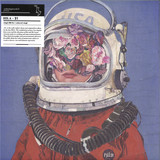
"21" is the well-crafted, sharp and original first album by the duo HILA, composed by American cellist Artyom Manukyan (who already worked with Kamasi Washington, Daedalus, Flying Lotus, Run DMC, Gretchen Parlato, Raphael Saadiq, Clive Lowe Mark...) and french producer Dawatile.
The combination of jazz, Los Angeles beat-scene and the vibrations of 80s and 90s Soviet Armenia make it a striking and unprecedented fusion. These kind of nostalgic and unconventional references forcefully shake the codes of mainstream culture to create a sincere, raw and intimate expression.
"HILA" was born from a spontaneous and intense creative impulse between Artyom Manukyan, a Los Angeles-based Armenian celloist and his partner in crime, David Kiledjian aka Dawatile, a French multi-instrumentist of Armenian descent. This project is proving to be a true master stroke given that it only took 21 days for the duo to make it a reality.
"HILA" was made in less a moon cycle but captivates and electrifies audiences upon its first outings. "H.I.L.A" colors the warmth of the Californian "High" with Armenian vibes. The artists chose this name for their creation since both have a close and valuable connection to these locales. This journey began in 2007, on the day Dawatile went to Yerevan, the capital of this small country in the Caucasus mountain to realize a first fusion project centered around local folkloric music genres.
There he was introduced to local musicians including the Armenian Navy Band, one of the country's foremost groups in which Artyom played the bass and cello. In this context, he also met many musicians such as Tigran Hamasyan and Norayr Kartashyan. This will be the beginning of connections between Lyon, Yerevan and Los Angeles. The following year, the two artists will be be seen performing next to Taylor Mc Ferrin at the Jazz à Vienne festival. More recently, they partnered up again when the cellist, who had freshly relocated in California, invited Dawatile to produce his album. As soon as the studio’s threshold was crossed, they decided to postpone this record and create a joint project: Hay (as the Armenians call themselves) / High In Los Angeles. HILA was born at the end of these 21 days of intense creation. The association of Artyom Manukyan and Dawatile is the combination of two visions, two versions of Armenia, two personalities, the reunion of the Eastern and Western blocs.
One grew up nurtured by the sounds of hip-hop and jazz in Europe and the other by art music and Russian-influenced 1980s Armenian folkloric music before moving to L. A., Ca. The cornerstone of it all, the glue that unites everything : Armenia and music. They generate a new identity synthesizing two perceptions, their complicity transcending these cultural discrepencies. To achieve this, they will scour through images of Artyom’s childhood, within the popular culture of Soviet Armenia. Together, they revisit this decidedly retro vibe, based on the work of Caucasian groups inspired by African American music. This background is rehashed and fused with ancestral Armenian sounds. The DNA of the album "21" is molded by these dear influences.
We can also hear the ancestral sounds of Armenia, a country at the edges of both Europe and Asia. The presence on two tracks of Armenian music Master Norayr Kartashyan, infuses the languor of past melodies and traditions. These purposeful anachronistic sounds offer a fantastic depth to this powerful opus. Listening to the album, one can appreciate the successful fusion of styles and influences. Those combinations, however, manage to preserve individual identities only to enhance the art through an adamant musical dialogue.
Being driven by the urge to transpose Armenian musical traditions into a unique universe, the daring artists, offer an innovative combination by blending, for the first time, these ancestral sounds with the world of Los Angeles beat-scene and jazz. An invention largely fueled by the magic strings of Artyom and maestro Miguel Atwood-Ferguson, a pillar of the genre in Los Angeles combined. These associations resonate with a triumphant equilibrium. HILA is musical uncharted territory in which Artyom's cello strings intertwine to ignite the harmonies of keyboards, the machines, the vocals and electronic layers Dawatile pieced together. HILA plays the soundtrack of an adventure set between Armenia around the end of the Soviet era and a mysterious near future.
Artyom Manukyan grew up in Armenia in the 90s. At the time, he studied Russian classical music while learning jazz with assistance by his father, a music journalist. Being an unconditional music lover, he went on to sharpen his skills at the prestigious Berkelee College of Music. Subsequently, he’s been lucky enough to travel the world touring with numerous acts and mainly with the Armenian Navy Band. The group has fostered alacritous success honored by a BBC Award as a crowning achievement. He moved on 10 years ago and made his way to L.A. with his cello on his back. In the City of Angels, he quickly became a popular figure of the jazz and hip-hop scenes thanks to his first album "Citizen". He’s accompanied prestigious musicians such as Kamasi Washington, Melody Gardot, Daedalus, Flying Lotus, Run DMC, Gretchen Parlato, Raphael Saadiq, Clive Lowe Mark, or Vulfpeck. He released his solo album on the cello, "Alone" in October 2019.
Dawatile is a bold producer and multi-instrumentist as well as a passionate and resolute musician molded by jazz. As a versatile artist, he handles and juggles the saxophone, the keys, the bass and composition. Simultaneously, Dawatile produces cross-over projects and soundtracks for the movie industry. He, as well, has had the opportunity to be a part of many tours, including with his electro hip-hop band, Fowatile and more recently with the "Future Kreyol" trio, Dowdelin. Being the ever workaholic, he has under his belt a string of prestigious collaborations with the likes of Talib Kweli, Foreign Beggars, Roy Ayers, Tigran Hamasyan, Mathieu Boogaerts, Voodoo Game and Piers Faccini. His taste for developing new musical recipes and his know-how in production make him a much sought-after album producer. In concert, the HILA duo offers a sober, precise and rhythmic performance. "21" is an aerial and lively album taking the audience on an at times joyous and sometimes melancholic dreamlike journey. The magic of "HILA" operates at the speed of light and positions it already as an avoidable group.
Sarah Benabdallah and Alexis Lebon are a very 21st century musical coupling, absorbing their metropolitan surroundings while tapping into a rich cultural heritage, not unlike fellow countrymen PNL or the Dutch band Altin Gün. A Paris-based duo set for greatness they might be, but it’s fair to say Mauvais Oeil are operating under a misnomer: while their name means “evil eye” in French, you’ll only experience enlightenment when you lay eyes (and ears) upon them. Mauvais Oeil are set to release their debut EP Nuits de velours, a magical melting pot of musical shibboleths and contemporary grooves. On opener “Mes nuits de velours”, we’re transported in the land of 1001 Arabian Nights, with the music every bit as smooth and alluring as the subject matter. “Afrita” is a trance-inflected musical acclamation evoking all
the madness and gayety of a midsummer souk. Sung entirely in Arabic with delightful blasts of strings, it’s a North African-influenced banger with a delicate wistfulness. “Asha” meanwhile is in a reference to Asha Vahishta, the middle-eastern concept of truth
according to the ancient religion of Zoroastrianism. Sung again in Arabic, it features catchy Phrygian guitar manoeuvres played over ambient analogue keyboard strokes. The E.P. is completed by “Constantine”, a song of longing, dedicated to the home of Sarah’s forebears. Having met in the arty northern faubourgs of Paris, Sarah and Alexis soon developed a musical telepathy and a shared sonic agenda, mining their own histories for the profound
cultural roots that underscore Mauvais Oeil, while absorbing the ubiquitous sounds of the suburbs, where Turkish, Armenian and Ethiopian music ring out. The band’s moving and melancholic chansons are delivered with a delightful French pop sensibility, making Mauvais Oeil one of the most exciting and musically diverse prospects in 2019.
After introducing the world to the elusive named Gitkin last year with the release of his debut album "5 Star Motel", Wonderwheel Recordings is back with another special 7" of two deeply funky, lo-fi globally influenced cuts from the travellin' man himself. "Saint Claude Dash" with it's 70's disco influenced drum machine undertone brings in Middle Eastern & North African vibes on the melody, while shifting into an even funkier B section reminiscent of the Meters. On the flip side, "Chicha Nola" finds Gitkin vibing on the mysteriousness of late night New Orleans (where his studio is now located) playing the South American instrument Charango & juxtaposing the NOLA bump with a just enough twang. Just a taste of the brand new album to come this year…or when the spirits will it.
Rudolf Abramov is a duo based in Berlin and Israel, which seem to have been a door opener to unexpected musical encounters, because it's an almost impossible task to sum up their sound in a comprehensible way. In their own words their music is 'a response to a seemingly endless conflict about disgust, acceptance and love.' Now Hoga Nord Rekord is releasing their Mini-LP 'Krass kontrast'.
Rudolf Abramov is Roland 303, programmed drums, oriental samples, eastern mysticism and instrumentation dressed as German machine funk, Disco, Turkish psychedelia, Krautrock, EBM and so on, and so on.. their music is cosmic, beautiful and boundless.
The arpeggio on the track 'Projekt 4' is running on infinite repeat in a parallell reality where 1982 never ended, where Rudolf Abramov move freely through different dimensions and where they are in total control of their unpredictable creation!
- A1: Ich Will Dir Helfen
- A2: A La Manière (With Roya Arab)
- A3: Ondine
- B1: Aspiration (With Mona Soyoc)
- B2: One Of These Days (With Hafdis Huld)
- B3: Théorème
- B4: Mortel Battement / Nocturne (With Alain Bashung)
- C1: Organique
- C2: The Watcher (With Mona Soyoc)
- C3: Qu’est-Ce Qui M’a Pris (With Philippe Poirier)
- D1: Xr 116 / Messe Rouge
- D2: Untitled
- D3: Ondine (Alt Take)
- D4: Piasong
The sensitive mountain » (la montagne sensible) is the nickname Alain Bashung came up with for Arnaud Rebotini. At the height of his fame, after the success of Fantaisie Militaire in 1998, Bashung readily agreed to create an album with Rebotini. The two men didn’t know each other; their record label had introduced them. Bashung brought in “Mortel Battement” and “Nocturne,” two poems by Jean Tardieu, which he recited in a voice simultaneously warm and flat, and Arnaud produced an impressionist soundscape that ended with an apocalypse of metal. Bashung was so proud of their collaboration that he offered to give several interviews to promote the record. Today, listening back to this moving Léo Ferré influenced "talking singing" exercise, it’s hard not to hear the template for L'Imprudence, the album that Bashung went on to record with Rebotini two years later. In a similar way, the album Organique sparked a productive partnership between Rebotini and filmmaker Robin Campillo, which resulted in their being awarded a César for Best Original Music in 2018. The director, who trusted Rebotini to create the soundtracks for his films Eastern Boys and 120 Beats per Minute, never kept his love for the 2000 record a secret.
Yet it’s an understatement to say that when it was released, Organique was not in the spirit of times. That year was all about the French touch. The funky samples of Modjo’s “Lady” and Superfunk’s “Lucky Star” ruled the sweaty dancefloors. Although Rebotini was familiar with the electronic scene, he had something else in mind when he set about creating Organique. Under his own name or under the pseudonyms Aleph, Avalanche, Black Strobe, Maison Laffitte, and of course Zend Avesta, he had already released several quite bizarre and experimental techno, house, or jungle maxi singles on pioneering labels like P.O.F., Source, and Artefact, run by his friend Jérôme Mestre’s, whom he had met back when both were working as record salesmen at Rough Trade’s ephemeral Parisian store. It was at Artefact, still financed at the time by Barclay and Universal, that he naturally proposed this record project, which was a bit "different." It was his first real album.
Arnaud Rebotini has never hidden his love-hate relationship with the electronic scene. He’s a fan of rave music, Rex, and later Pulp, but he listens mostly to metal and contemporary music, mainly American minimalists such as Terry Riley, Philip Glass, Steve Reich. He wanted to mix this genre with a more French aesthetic inspired by Debussy, whose unconventionality fascinates him. From the first suspended guitar note of Organique, you can pick up another influence, possibly poppier. In the style of Mark Hollis, the erratic leader of Talk Talk, whose only solo album’s silences and dissonances left their mark two years earlier, we hear the fingers touching the keys of the clarinet on “Ondine.” The instruments have presence, character. Nothing is smooth. Everything is organic.
Although it’s sometimes labeled as electronica because of Rebotini’s career, there’s nothing digital about Organique. No "pro tools" editing or samples, only programmed drums and some synth layering. And his guest vocalists. Playing the role of electro producer, he invited Bashung, of course, to join him on the album, but also Roya Arab, who Rebotini first spotted while she was playing in Archive, and her sister Leila, Gus Gus alum Hafdis Huld, Kat Onoma’s Philippe Poirier on the “Samuel Hall” inspired track “Qu’est ce qui m’a pris,” and former KaS Product member Mona Soyoc.
The frustration of a tour where he had "little to do on stage," the desire to sing himself, and the creation of the Black Strobe project, a haunting mix of blues and rock, stopped Zend Avesta from putting out another album. Eighteen years later, the Organique we rediscover today has lost nothing of its strangeness, nor beauty. When it came out, Bashung said, "What is interesting for a musician is to feel that you have a piece of wasteland in front of you, something to clear.” That remains true today.
* Second Album From La Stampa, The Six-piece Band From Berlin, Hamburg & Geneva.
* Includes A Bespoke, Full Colour, Fold-out Poster
* Artwork By The Acclaimed Artist, Shirana Shahbazi.
* Design By Manuel Krebs From Norm.
* Edition Of 500
Closely Working With Legendary Producer Tobias Levin From Hamburg, The Band Have Developed And Recorded The Ten Songs Over The Course Of Two Years. Picture Northern Creatures Sweating Out Their Melancholy In The Southern Sun. As The Wind Carries The Beats From The Beach Disco Across The Bay, Chopin, Vodka Shot In Hand, Imagines Writing Music Based On The Build Of Crystals. To The Side Of The Composer, The Rhythm Section Gets Restless. The Thrum Of Eastern European Electronics Pulsates In Their Brains. 'don't Work Yourselves To Death', One Of Them Shouts, 'it's Not Our Fate. Let's Go Dancing, Everything Must Change', Adds Another, And 'sun Screen's On The House!' This Is A Glimpse Of The World Bonjour
The Orbit was founded in 2016 by saxophonist Soren Lyhne Skov and pianist Peder Vind. The two had been playing together for over a decade in various groups inspired by afro-beat and ethio jazz. The idea with Orbit is to maintain the feel of certain musical traditions but to explore them through a modal jazz perspective.
The ominous Orbit Bound is centered around the figure played by the bass clarinet. The time is 9/8 and with the sound of the bass clarinet you might get a Balkan feel. But the scale is more Middle Eastern making it difficult to place precisely - like an orbit constantly moving.
NV is a tribute to the North Western borough of Copenhagen, which is a multi-ethnic and partly still ungentrified part of Copenhagen. The area has its struggles and social problems but at the same time it is also a place of warmth, surprises and lot of untapped talent.
This song has a loose minor scale theme with some sparse piano chords and a solid bassline leading the way. The drums are constrained giving the track a feeling of unreleased energy similar of the potential energy in NV.
- A1: Ikarie Xb-1
- A2: Surveillance On Standby-Alpha Centauri
- A3: A Small Stone In Space
- A4: Sunflower For A New Star
- A5: The Backwoods Of The Universe
- A6: Silver Ball (Vera In Cameo)
- A7: E.v.a. Will Teach You
- B1: The Tigers Breath
- B2: The Dark Star
- B3: Do Not Eat The Fruit
- B4: The Awakening
- B5: Voyage To The End (Of The Universe)
- B6: The White Planet
Liška, the Czechoslovakian word for fox. Beguiling in its beauty, cunning in it's charm. Said to be one of the most intelligent animals on the planet its global family consists of thirty-seven varieties; all of them recognised, respected and feared for their persuasive, creative, resourceful and elusive nature. The Liška we will talk about today is no exception to these hereditary rules and within the grooves of this record Finders Keepers present an 'elusive' musical artefact that best exemplifies every facet of this composer's animal namesake.
Had he not been born in the small Bohemian town of Smecno in the early 1920s the story of The Fantastic Mr. Liška might have well taken a different course. Alternatively, fettered by the hampers of communism, this lifelong resident of Czechoslovakia would never quite find his seat at the same table as the likes of John Barry, Ennio Morricone, Michael Nyman and Stanley Myers, nor drop enough phonographic breadcrumbs to track his legacy. But having waited patiently behind the borders of the wider landscapes of international cinema, Liška's musical brood, spanning multiple stylistic decades and generations, has now started to walk proudly amongst his would-be, latter-day compeers. In an era where music lovers have almost become immune to adjectives like 'lost', 'rare' and 'unreleased' in a climate where previously lesser-known off-kilter master composers such as Vannier, Kirchin and Axelrod have become widely revered, it is perhaps the perfect time for discerning listeners to advance above the feeding trough and seek out this truly pioneering and revolutionary Eastern European composer. Rivalled only by the likes of Krzysztof Komeda and Andrzej Korzynski in Poland, alongside Alexandr Gradsky in Russia, and often splitting workloads with fellow Czech composers like Luboš Fišer, Zdenek Liska's filmography of over almost 300 fully formed movie scores virtually eclipses the achievements of these socialist era luminaries. Respected unanimously in both Czech and Slovakian by studio bosses, producers, directors and actors alike Liška is widely known for his ability to take the existing energy in a reel of film and literally change the polarity to suit his own interpretation while maintaining the full support from his 'client' who would in-turn end up working under this composer's creative direction. Not only was Liška a genius of emotive orchestral and coral composition, his grasp on small group arrangements and intimate, minimal scores set him above the competition. By utilising primitive sample techniques by 'looping' a films existing ambient noise, or rearranging found sounds and dialog into subtle melodic arrangements, Liška would independently develop his own techniques which had simultaneously become known in Paris as musique concre`te. It is a direct extension of these experiments that saw Liška also draw parallels with Walter Branchi (Ennio Morricone's main electronic sidekick) in Italy as well as Daphne Oram in the UK, making Liška a relatively untravelled pioneer of early electronic composition and sound design due to his unlikely global environment. Imprisoned, preserved or reserved; time has been kind to Liška's music.
In the sweltering North-Eastern Brazilian state of Pernambuco lies the coastal city of Recife, where Amaro Freitas is pioneering the new sound of Brazilian jazz. For the prodigious young pianist, the spirit of his hometown runs deep. From the Afro-Brazilian maracatu born on the sugar plantations of slavery, to the high intensity carnival rhythms of frevo and baião, Amaro's heavily percussive approach to jazz is as indebted to these Pernambuco traditions as it is to Coltrane, Parker and Monk.
As with many of the greats before him, Amaro began playing piano in church aged 12, under the instruction of his father, leader of the church band. As his natural talents became obvious, the young prodigy quickly outgrew his father's instruction. He won a place at the prestigious Conservatório Pernambucano de Música but had to drop out as his family could not spare the money for the bus fare. Undeterred, Amaro gigged in bands at weddings and worked in a call centre to fund his tuition. The transformative moment came at age 15 when Amaro stumbled across a DVD of Chick Corea concert, 'he completely blew my mind, I'd never seen anything like it but I knew that's what I wanted to do with a piano'.
Despite not actually owning a piano, Amaro devoted himself to studying day and night - he would practice on imaginary keys in his bedroom, until eventually striking a deal with a local restaurant to practice before opening hours. By the age of 22 Amaro was one of the most sought-after musicians in Recife and resident pianist at the legendary jazz bar Mingus. It was during this time he met and begun collaborating with bassist Jean Elton and the pair went in search of a drummer. 'We kept hearing about this crazy kid who was playing in 7/8 or 6/4, we knew we had to meet him'. Hugo Medeiros joined, and the Amaro Freitas Trio was born.
'I want to show the simplicity of music, to break the stigma that the piano is for a particular social class. Yes, it's a difficult instrument, which many people do not have access to, but with it you can express everything.'
Following his critically acclaimed debut album Sangue Negro (black blood), the title of his sophomore release Rasif is a colloquial spelling of Amaro's home town. A love letter to his native northeast, Amaro explores its traditional rhythms through the jazz idiom, employing complex mathematical patterns reminiscent of some of the most challenging works by fellow Brazilian masters Hermeto Pascoal, Egberto Gismonti and Moacir Santos.
Preferring to see the piano as a though it were a drum with 88 unique tones, Amaro's intelligence and emotion intertwine on every track, from album opener 'Dona Eni': a scorching reconstruction of the baião rhythmic structure, played in seven measures instead of two, to the serene homage to the coastal reef and its ecosystems on the title track 'Rasif'. 'Aurora' is a suite of three parts, representing the sun's journey from the light and soft of the rise, to the aggressive dissonance at its midday zenith and descending chromatic cadences as the sun sets.
Due for an Autumn release on Far Out Recordings, Rasif sees Amaro Freitas take a deserved step onto the world stage. Having already made a name for himself in Brazil, Amaro and his phenomenal band will embark on their first European tour later this year.
Amaro Freitas - Piano
Hugo Medeiros - Drums & Percussion
Jean Elton - Double Bass
Henrique Albino - Baritone Sax, Flutes & Clarinet
All compositions by Amaro Freitas
Produced by Amaro Freitas
Recorded by Bruno Giorgi @ Carranca Studio, Recife, Brazil
Mixed and mastered by Bruno Giorgi @ Quarto Studio, Rio de Janeiro, Brazil
Executive producer and management: Laercio Costa