The venerable composer and keyboardist Stale Storlokken follows up his previous Hubro release (and solo debut recording), The Haze of
Sleeplessness, with a second solo album performed entirely on pipe organ and recorded at Steinkjer Church by Stian Westerhus.
He describes the album as “a cavernous cathedral of sound”. While the Norwegian Grammy-nominated ‘The Haze of Sleeplessness’ used a whole keyboardmuseum’s worth of antique synths and contemporary digital software to create
its vast array of sounds, everything on ‘Ghost Caravan’ is the product of one organ’s pedals, pipes and sonic plumbing.
“There’s not so much of a relationship to ‘Haze’, says Stale Storlokken of the new album. “That album was more based on improvised ideas that were tweaked and arranged , while this one is all improvised with almost no editing at all. Everything you hear is from the church organ, with no additional instruments.
The basic concept of the record, and the arrangement of the titles and pieces, is done in such a way that they alternate between a fluent, “on the move”, abstract mood and a more recognisable, concrete and grounded mood. At the same time it should be so open that listeners will hopefully have their own unique experience. The organ at Steinkjer is not a big organ but it has some really nice sounds, with a number of quirks and mechanical eccentricities that suit my music.”
The organ is partly a reconstruction based on a Wagner organ in Nidarosdomen built originally in 1741, the organ is housed in the strikingly modernistic Steinkjer kirke, designed by Olav S. Platou in 1965, and featuring glass panels by the artist Annar Millidahl. What Ghost Caravan does share with its predecessor is a seemingly limitless acoustic space for the listener’s imagination to roam in, with Storlokken creating a cavernous cathedral of sound.
The audio dynamics span an enormous range, capable of stretching from the quietest breathy whisper to a basso profundo squawk or scream, sometimes within seconds of each other. Similarly, the incredible variety of sounds that Storlokken coaxes from the organ can defy rational analysis, with the resolutely analogue instrument appearing to echo the industrial, found-sounds of clanking machinery or buzzing electronics that one might expect to encounter through digital sampling or the tape-based experiments of musique concrete.
Over ten separate improvised pieces which connect into an informal suite through the repetition of key elements and sequential titles (with four ‘Spheres’ and four ‘Cloudlands’, plus ‘Ghost Caravan’ and ‘Drifting on Wasteland Ocean’), Storlokken has made a strikingly unified, self-referential aesthetic world that can stand as a true work of art.
All recordings made during Andy Fairweather Low and the Low Riders’ featuring the Hi Riders Soul Revue “Live In Lockdown” live performance at the Hideaway Club, London on 9th September 2020 and streamed live to a virtual audience.
Featuring the hit singles High In The Sky, Bend Me Shape Me, Wide Eyed And Legless and If Paradise Is Half As Nice, plus extensive sleeve notes.
The idea for the album came in summer 2020. At first I only played around on my piano for myself. More and more ideas came up and I started to take recordings. After producing electronic music for more than 20 years and publishing it under different names, the corona pandemic slowed life down. No more gigs, clubs closed, festivals
canceled. For me the chance to try new things and find a new way to make music.
Without the club context, I was free in my mind. Making music right out of myself was a liberating feeling. I could do what had been dormant in me for a long time. There were attempts now and then, but in the end I couldn't get rid of the feeling of always
doing techno. Nice too, but not everything for me.
Many inspirations of my music come from artists such as Nils Frahm, Ólafur Arnalds, Yann Tiersen, Martin Kohlstedt, Poppy Ackroyd and many others, as well as nature, forest and city noises. And often from the instruments themselves.
I switched my setup in the studio from the electronic to a minimalist instrument setup, just piano, double bass and a Moog synthesizer. I also like the background noise that comes from an instrument, like the hammers and dampers on the piano, the fingerboard and bow noises of the double bass. So I tried a lot of recording
techniques and microphones until I found the sound I was looking for.
After a few recordings, a number of pieces came together that went well together. I decided to finish it as an album. Some of them are one-takes with the associated imperfections, others are recorded and arranged layer by layer in the studio. I also used field recordings. A warm summer rain was the starting point for "Rain".
The album will be released in May 2021 as a limited vinyl edition and digitally on my newly founded label "Feldeffekt".
out of Stock
Last delivered 2 years ago available to reorder, subject to availability
Music in Exile announce their forthcoming remix EP, featuring reworkings of Music Yared by Melbourne cult hero, Mikey Young (Total Control, Eddy Current Suppression Ring, The Green Child). SINDAYO - MIKEY YOUNG REMIXES features remixes of an original track from Music Yared’s self titled debut EP, released last year through Music in Exile. In addition to today’s announcement, we’re delighted to also share the first single, Sindayo (Mikey Young’s Masinko Remix - Radio Edit), out March 26 via Music in Exile.
Mikey Young’s legacy is well known throughout the Australian music scene, most notably as part of garage punk band Eddy Current Suppression Ring, and synth-driven outfit, Total Control. However, the talents of Young extend well beyond the performance setting to the world of engineering and mastering with his name appearing in the liner notes of an incredible number of releases, becoming something of a trademark of quality. In this release, Young showcases his skill and nuance, creating a remix where tradition and sonic exploration co-exist.
Anbessa Gebrehiwot and Haftu Reda are masterful players of krar and masinko, traditional string instruments from Eritrea and Ethiopia. Now based in Melbourne, Australia, the pair collaborate with multi-instrumentalist Dale Gorfinkel to create an innovative ensemble sound that celebrates their East African culture. The band's seemingly endless repertoire ranges from modern takes on folk songs to new, original compositions with Anbessa’s strong vocal presence a perfect match to Haftu’s sweet lyrical modesty.
Music Yared’s compositions are inspired by traditional Etheopian and Eritrean folk songs and they sing about love, distance, separation and culture. Their songs also feature virtuosic mastery of traditional instruments - the krar, (a 5 string lyre style instrument), and the masinko (a single string violin-like instrument that is played using a bow.) Although inspired by tradition, Music Yared’s compositions embrace the notion that music is always developing and changing with the times. Taking influence from traditional folk songs, Music Yared finds newness and originality through their personal approach to their lyrics, their treatment of rhythm, and the creation of new beats. This change and openness to new sounds is also apparent in their instrumentation, as they pair their traditional instruments with drums, as well as samples of bass lines and percussion.
Given their openness to new musical approaches and experimentation, it only seems fitting for the songs of Music Yared to be remixed, allowing further exploration of their inherent musical attitudes towards change and development. The first single from the EP, Sindayo (Mikey Young’s Masinko Remix - Radio Edit) traverses new sonic territory, pairing the traditional character of Music Yared with contrasting ideas from different sonic landscapes. Beginning with a musical acknowledgement to the original song, Young’s remix then changes direction into a new sonic world; synth pads and melodies swell and intertwine, samples interject, whilst grooving electronic beats underpin a new approach to texture and song structure.
Recorded by Dale Gorfinkel in Thornbury. Mixed and mastered by John Lee at Phaedra Studios.
Remixed & additional production by Mikey Young in Rye.
out of Stock
Last delivered 5 years ago available to reorder, subject to availability
Following the success of the limited edition of 700 copies for the Record Store Day, we're offering you the chance to pre-order a new unnumbered edition of this unique project. Hot release alert! An unpublished version of Amsterdam, discovered in the archives of French radio. Recorded in front of an audience at «La Maison de la radio» for the show «Jam Sessions» in July 1965, this version offers a new arrangement: without accordion, only accompanied by Gérard Jouannest (piano) and Pierre Sim (double bass), Jacques Brel interprets Amsterdam with deep emotion.
Notice to collectors!
Also on the program that night: Ne me quitte pas, Au suivant and Le Plat Pays.
Swiss heavy metal coven BURNING WITCHES and Nuclear Blast Records proudly present “The Witch Of The North”, the group’s much anticipated, fourth studio album set for worldwide release on May 28th, 2021. Following 2020’s “Dance Of The Devil”, which charted in Germany at #22, and the quickly sold-out “Circle Of Five EP”, vocalist Laura, guitarists Romana and Larissa, bassist Jeanine and drummer Lala notably up the ante on “The Witch Of The North”, their most dynamic, intricate and powerful album thus far. Perfectly mixed and mastered by V.O. Pulver and produced by German thrash titan Schmier (Destruction), BURNING WITCHES stick to their irrefutable 80’s influences (Judas Priest, Iron Maiden, Dio, Accept, Warlock, WASP etc.) and inject an irresistible energy and refreshing vibe, topping it off with classic art by Claudio Bergamin (who illustrated Priest’s triumphant “Firepower”). From the epic title-track to the album’s most catchy anthem ‘We Stand As One’ over to the ballad ‘Lady Of The Woods’ and speedy riff attacks like ‘Thrall’, ‘Flight Of The Valkyries’, and ‘Nine Worlds’, “The Witch Of The North” marks a new highlight in the band’s career, with vocalist Laura brilliantly shifting from aggressive to seductive with ease. No matter if you have followed the band since its humble beginnings in 2015 or just recently fell for their charms, BURNING WITCHES are doubtlessly one of the most sensational bands in heavy metal right now.
Known for the soulful jazz-grooves of their self-titled 2020 debut album, Matti Klein’s Soul Trio actually began as an idea rather than a group.
However, in early 2018 three master musicians met in Berlin’s Lovelite Studio with producer/engineer Jochen Str h (Tony Allen, Ebo Taylor, Pat Thomas, Jimi Tenor) and recorded a set of well-planned and even better executed live sessions, each finding their desired space live and direct, locking into the immediacy of the groove. ‘Soul Trio Live On Tape’ contains these very first sessions of the Matti Klein Soul Trio and comprises new arrangements of songs that had primarily been composed for Klein’s band Mo’ Blow; favourites already back then, timeless classics now thanks to these exciting ‘deep-fried contemporary soul jazz’ versions.
Their leader, known for his work as musical director for the Brazilian superstar Ed Motta as well as Mo ‘Blow, can be heard on Wurlitzer and Rhodes Bass; Lars Zander (The Ruffcats, El Cartel, Lucasonic, STEREOFYSH) not only proves he is the most soulful tenor saxophonist in Berlin, but also why he has earned kudos for a bass clarinet sound that is enhanced with analog tape delays, Wah-Wah and Harmonizer-sweetenings; and drummer Andr Seidel also shows his chops, incorporating elements of rock, hip-hop, odd meter fusion and the sound of New Orleans into his own unique groove jazz style.
As for the music, ‘Rocket Swing’ is a tenor sax feature in which a hip-hop vibe meets a jazzy fifth fall, while ‘Ray’ (dedicated to Mr. Charles) is a Meters-inspired shuffle in 7/8 time. ‘No Particular Way’ showcases the funky side of the band, with singer Pat Appleton in top form over a wonderfully creaky Rhodes bass. ‘Sunsqueezed’ is created in a wide compositional arc, evoking a ray of sunshine peeking through the clouds during a long and grey 10-month Berlin winter, giving hope for the next two months.
‘Eleven Feels Like Heaven’ is a joyful, uproarious gospel blues with a brilliant odd meter drum solo. ‘Grandpa’s Fairytale’ is a hitherto unreleased piece that is dedicated to the bandleader’s grandfather, a former school headmaster who loved to read him stories and is a Wurlitzer-warmth meets bass clarinet groove in an atypical dynamic arc. Summarising their efforts, Klein states somewhat cryptically that “the band rolls in a warm, soft couch whenever there is a risk of having to sit between the chairs.”
Initially available as a limited fan item only at live shows, this document is now being released officially with the addition of ‘Grandpa’s Fairytale’. It is a journey through time, absolutely contemporary and yet wonderfully back to the future.
Cinema Paradiso Recordings is proud to announce the release of the soundtrack to the motion picture 'The Parallax View', on vinyl for the first time ever, this coming April 30th 2021. Based on the book by Loren Singer, ‘The Parallax View’ is directed and produced by Alan J Pakula as the second instalment of his Political Paranoia trilogy - alongside Klute (1971) and All the President's Men (1976). With cinematography by Gordon Willis (The Godfather trilogy, Annie Hall) and starring Warren Beatty, this political thriller from 1974 is perhaps even more relevant today than it was back then.
The legendary score by composer Michael Small is regarded as a benchmark in the sound of paranoia thrillers that dominated cinema in the 1970s, with revered film critic Pauline Kael hailing the film as an essential for all fans of the genre. Now, 47 years later, the soundtrack will finally be available to own on vinyl.
The CPR edition of ‘The Parallax View’ soundtrack includes for the first time the infamous brainwashing scene, an influence on countless films and TV shows over the years. Notably, most recently with the Watchmen series and shows Mr Robot and Homecoming even using the music from the film. Whilst researching to gain approval for this usage we discovered from Jon Boorstin, (Assistant to Pakula on The Parallax View), that the unaccredited disembodied voice from the ‘Parallax Test’ scene belonged to director Pakula himself.
The single LP, deluxe gatefold limited edition in coloured vinyl comes with liner notes that include two essays by Scott Bettencourt and Alexander Kaplan (of Film Score Monthly), which provide a fascinating insight into the making of the film and an analysis of the score.
“The Parallax View embodies a particularly paranoid moment for America, when assassination wounds were still fresh and the President’s bungling burglars were running him out of the White House. Michael Small’s music beautifully captures our hope, our dread, and our nostalgia for truer values. In the Parallax Test sequence, he brilliantly seduces the assassin in all of us. Watching this today, wrapped in Michael's music, what was once wild fantasy feels at least as credible as the pronouncements of our Kool-Aid drinking Congressmen. “
- Jon Boorstin
This week sees the 50th anniversary of the original U.K. release of The Man Who Sold The World David Bowie’s landmark entry into the 1970s. The album not only began the collaboration with guitarist Mick Ronson that would continue withsuch Bowie classics as Hunky Dory, Ziggy Stardust and Aladdin Sane, it kicked off a 10-year run of indispensable albums stretching through 1980’s Scary Monsters.
The album follows the recent January 2021 release of single 'O.N.E.' and the band's sixteenth studio album K.G (the second volume in the band's previous explorations into microtonal tunings), as well as Live In S.F. '16 (ATO Records), a live album recorded during the band's 2016 U.S. tour stop at San Francisco venue The Independent. As the band enter their second decade – and their frontman still only thirty years old - the creative future of the band, as showcased on L.W., promises to be bolder, madder and more imaginative than ever.
Moving into 2021 Pure Space is excited to deliver another year of Australian electronic music. Lately we’ve found therapy through regular body movement to help us see that better days are ahead. We hope you feel this too with this new release…
For our first release of the year, Melbourne’s Third Space captures his most club-focussed exploration to date. It offers a broad path which melts genres, instead showing us an alternate domain.
Having started his own label ‘Nice Setting’ in 2020 and self-releasing an album and an EP, Third Space has established his sound of complex undulating rhythms. For his release on Pure Space, ‘Pattern of Spring’ continues this exploration of dramatic structures with continually shifting timbres - morphing them as they progress through energies, rumbles, and struck surfaces.
The two A-side tracks are powerful displays of organic instrumentation with fluttering pads and subtle resonations. An upbeat tempo and abright atmosphere underpins the opening side, anchored by dnb leaning programming and off-kilter polymetric rhythms.
‘170 Shitshow’ showcases complex percussion underwritten by a formidable resonating karplus-strong section throughout the track. Whilst ‘Pulsing Delay Mod’ builds upon this notion of polymetric rhythms continually at play with one another, it offers a crisp and menacing drum pattern pulsating amongst metallic timbres.
Flipping to the B-sides; ‘Cyclical Pan Workout’ reflects an unruly and evolving atmosphere, anchored by a wonderfully cerebral drum pattern and delicate pad toward the close.
The final track ‘Nonlinear (For Pillows)’ offers re-contextualised melodies and percussion, providing a sense of closure and sonic bookending by linking tones and timbres referenced throughout the EP into a pillow like state.
out of Stock
Last delivered 5 years ago available to reorder, subject to availability
Louisahhh releases her debut LP The Practice of Freedom, via HE.SHE.THEY. The Practice of Freedom heralds the evolution of Louisahhh as she delivers her most exposing work yet, conceived as an exploration of the unorthodox archetype of “feminist submissive,” based on the mantra “sin is not being true to yourself.” Like her uncompromising musical heroes Karen O, Siouxsie Sioux and Shirley Manson before her, Louisahhh’s bold, raw, anti-establishment message on The Practice of Freedom will mark her as punk’s essential new heroine at the forefront of the new dawn of musical feminism.
The Practice of Freedom was born from experiences of loss and love, told through a journey of brutally beautiful electronics, electro and techno colliding with industrial, rock and alternative sounds. On the polysexual polymath label HE.SHE.THEY.’s inaugural album release, Louisahhh captures a record of our times, covering themes ranging from eroticism and empowerment to addiction and apocalypse, and influences ranging from Nine Inch Nails to Patti Smith to Judith Butler. The album, produced by American musician, music video director and photographer Vice Cooler, hears ideas and lyrics by Louisahhh re-contextualised into revolutionary experimental sounds, formed through the pair’s shared love of American alternative rock. Louisahhh’s music fights for and provides a voice for others, rooted equally in the intensity of the dancefloor and the mosh pit.
out of Stock
Last delivered 5 years ago available to reorder, subject to availability
Raymond Charles Robinson was not just a legend, “the genius”, a “force of nature” and “a presence”. He was also pure energy, the source of a radiant glow that dazzled everyone who ever came near him. His passion for music, women, and rhythm, coupled with his love of life and laughter, were ingredients that made his work a monument of 20th century culture. He left essential traces – in jazz, blues, soul and R&B – because music is something inseparable and Ray lived its rhythms from the inside.
Born in poverty, raised in America’s racist South, blind at seven and an orphan at 15, Ray had all it took to be a success… Those attributes, plus a few titles in his case that he’d recorded for Swing Time, made such an impression on Ahmet Ertegun that he signed Ray to Atlantic in 1952. The next ten years forged the legend of Ray Charles. And now, six decades later, the tracks on this album are still hits hummed by all generations.
out of Stock
Last delivered 5 years ago available to reorder, subject to availability
Bachelor, the new project from Melina Duterte (Jay Som) and Ellen Kempner (Palehound), is not a band, it’s a friend-ship. After being mutual fans for years, they finally met when sharing the bill at a show in Sacramento in 2017. Keeping in touch over text and Instagram posts, Duterte and Kempner started recording together for fun in 2018, resulting with what would become "Sand Angel", the seductive slow-burner that convinced the pair to write an album together.
Reconvening in January 2020, the duo packed the entirety of Duterte’s recording equipment into two cars and headed to a rental house in Topanga, CA. In this space Kempner and Duterte hybridized their individual song-writing talents, producing a collection that slips between moods with ease and showcases their lyrical prowess. Arriving with almost no songs written and no solid plan, they
finished the 10 songs that make up Doomin’ Sun after two short weeks. That much work in so little time may sound exhausting, but it wasn’t, it was blissful and freeing.
There was a lot of pain that went into the record, especially around themes of queerness and climate change inspired by the red skies and wildfires subsuming Australia at the time. However, when the duo did shed tears during the creative process, they weren’t tears of sadness, they were tears of laughter. When Kempner and Duterte look back on those weeks, what they remember first is shortness of breath and the inability to track vocal takes without falling to the floor howling. They couldn’t remember a time they’d ever been so delirious with creativity, so overwhelmed with joy.
Excelsior! It’s the hail of yore that one should go ever onward and upward. And so, fittingly Onwards and Downwards is the occultist Swedish band Alastor’s clever call to arms... and also a reflection of our collective dark state of mind these days.
“If our last album Slave to the Grave were about death, this record is more about madness,” says guitarist Hampus Sandell. “You can look at the whole record as one person’s gradual slip into insanity. An ongoing nightmare without end. It also sums up the state of the world around us as this year has clearly shown.”
Alastor is heavy doom rock for the wicked and depraved. Drenched in heavy, distorted darkness and steeped in occult horror that will make your skin crawl and ears cry sweet tears of blood, the band is revitalized in 2021 with meticulously crafted songs and new drummer Jim Nordström bringing a hard-hitting and precise energy.
“It’s a more focused record but at the same time it’s more personal and naked. More raw emotion and pain,” Hampus says. The band recorded the album with the help of Joona Hassinen of Studio Underjord, who has helped with mixing since their ”Blood on Satan’s Claw” EP in 2017. Christoffer Karlsson of The Dahmers also assisted with overdubs and encouraged the band to demo the material early on, aiding in the album’s more deliberate and tighter feel.
From the first note of opener “The Killer In My Skull” the guitars are far thicker and out front than ever, and Nordström pummels the snare and kick like a young Dave Grohl. Bassist/vocalist Robin Arnryd’s chorus-drenched voice soars above it all like a one-man choir, at times harmonizing beautifully with shimmering Hammond organ notes. Nary a moment is wasted on the droning navel-gazing of lesser bands. Particularly, the driving anthem “Death Cult” which sounds like it would fit comfortably on QOTSA’s Songs For The Deaf, though there’s considerably more heft here. The title track pays its due to the Devil’s tritone in a marvelously woven framework of intertwining melodies befitting the album’s theme of descent into madness.
The quartet released its epic 3-song debut album Black Magic in early 2017 via Twin Earth Records, followed by the 2-track “Blood On Satan’s Claw” EP on Halloween the same year. Joining forces with RidingEasy Records in 2018, Alastor summoned the 7-track hateful gospel Slave To The Grave, which was packed with dynamic twists and turns, and funereal girth. It was met with considerable praise, setting the stage for the band’s greatest step onward (and upward... or downward, depending on your preferences.)
Since 1990, Esa Holopainen has been the lead guitarist of the progressively-minded heavy metal innovators AMORPHIS. Thanks to the metallic and melodic beauty of such classic albums as "Tales from the Thousand Lakes", "Elegy" and "Skyforger", Holopainen's magnificent abilities to create enchanting atmospheres and innovative riffs have become widely known within the worldwide heavy metal circuit.
But how would Esa describe SILVER LAKE's material in the bigger picture? "First of all, the record's very diverse. Silver Lake can't really be compared to Amorphis, but then again, there is my fingerprint on both AMORPHIS’ and SILVER LAKE’s material... So I wouldn't be surprised if some fans hear some distant similarities here and there", ponders Holopainen. "I want to underline the fact that when we were working on Silver Lake's material, there were no limits. Not at all. As a result, a few of the songs are really poppy and some other tracks are pretty damn heavy."
Born in San Francisco, Rickey Kelly moved to Los Angeles in 1982.
I first heard Rickey on the local Jazz station and that haunting sound on vibes was just too much to resist. He was working at Hughes Aircraft and didn't have time for gigging in the evening. He had to take care of his family which numbered about six children. I began booking his band soon after meeting him. An artist this blessed should not be working a day job I thought. Rickey soon quit his job at Hughes aircraft and began performing full time. Rickey stayed in his apartment for long periods of time just practising. He often mentioned to me that he needed to stay in isolation to keep his music pure. During Rickey's stay in L.A. he had worked with all the great jazz and R @ B bands. Musicians like altoist Bobby Watson, the legendary drummer Billy Higgins, The Jazz Crusaders, pianist Ahmad Jamal, and one of the most popular artists of his generation Marvin Gaye, often called on Rickey to perform with their bands. As great as these artists were, the addition of Rickey Kelly on vibes seemed to make their music better.Because of his isolation Rickey's music has developed a uniqueness and purity of sound that transcends styles. One reviewer described it as a "childlike quality, a profound innocence”. Relax and listen closely. This is music with a purpose
The trio of fiddle player Erlend Apneseth with guitarist Stephan Meidell and drummer Oyvind Hegg-Lunde follows up their Nordic Prize-nominated album of 2019, ‘Salika, Molika’, with a remarkable suite of tunes inspired by the rhythms and physicality of the human body in motion.
Originally commissioned by FRIKAR Dance Company to accompany the performance of a new work, ‘Skaut’, dealing with the covering of the body in different cultures, the music of ‘Lokk’ takes the trio further than ever before into completely fresh areas of electro-acoustic improvisation.
The sounds of their original instruments are integrated with electronic beats and treated textures to form a kind of enhanced digital-folk style whose influences stretch from traditional south Asian ragas to contemporary dance culture from around the globe.
The result is intense, and intensely rhythmic, music where the normally separate realms of the cerebral and the corporeal can appear to fuse into one irresistible groove.
As the trio rocks on - in a dream of perfect interplay between instruments and players, soloists and ensemble - deep, trembling sub-bass intersects with ethereal ambient soundscapes. Elsewhere, the twittering of birdsong - from both real bird-calls and the uncanny imitation of them by Apneseth’s Hardanger fiddle - meets archival recordings of Norwegian herdswomen.
“Our musical idea for this project was to unite different extremes, connections that felt “forbidden” in one form or another”, says Stephan Meidell. “For example, by using the sampled recording of traditional herd-calling, blended together with aesthetics from more contemporary music styles. This exploration has led us further into a rhythmic and danceable landscape than in previous releases. We also wanted to use this opportunity to deliberately make more dance-related music. As regards the original commission, were pretty free to do what we wanted, but there was one specific dance in mind, ‘Valdresspringar’, for which Erlend wrote the melody. It’s a traditional, asymmetrical dance and has a very particular form. The melody is on the track called ‘Springar’, which we then messed around with.”
This “messing around with” element is key to the sound of ‘Lokk’, whose playful experimentation over the nine separate tracks creates a beguiling, constantly surprising sense of adventure and intrigue that both draws the listener in, and then keeps them on their toes as to where the next stage of the journey will take them. It also becomes inescapably obvious that this is a group of three equals.
The contributions of Stephan Meidell and Oyvind Hegg-Lunde, as musicians, co-composers and producers, appear every bit as important as that of Erlend Apneseth, who performs superbly throughout. “Even though the trio carries Erlend’s name, it’s a band in every sense of the word”, says Stephan Meidell. “We make the music together, where everyone brings their ideas and we build on each other’s input and output. This is not our “coming out” as a band, but the group is sometimes interpreted as having a hierarchical structure, as a soloist and accompaniment.”
As is evident from the trio’s live performances, where each member seamlessly integrates the acoustic and the electronic elements in their respective sounds through constant monitoring and tweaking, Apneseth, Meidell and Hegg-Lunde are also pioneers,
creating real-time effects that in the past were only available through post-production or the intervention of a sympathetic engineer and a truck-load of kit. ‘Lokk’ translates this fleet-footed improvisational approach, and the players’ lightning-speed reaction times, back into the environment of the recording studio, where the music composed for the original FRIKAR dance piece was further embellished and adapted. Played live, it will continue to change again, as improvised music always does.
Als Matthew E. White an dem Nachfolger seines zweiten Studioalbums arbeitete, wollte er seine Herangehensweise an das Songwriting neu erfinden, zumindest für eine Session. White versammelte eine vertrauenswürdige Truppe von sieben Musikern in Richmond, Virginia. Er dirigierte das Septett durch eine Reihe von lockeren, größtenteils gestischen Kompositionen. Die Klänge waren gewaltig, eine Reihe von Keyboards und Gitarren untermalten den Schwung einer ineinandergreifenden vierköpfigen Rhythmusgruppe. Aber die Ergebnisse passten nicht ganz zu der in Arbeit befindlichen Platte, so dass White die Jams auf Eis legte, bis die richtige Muse kam. Das war, wie sich herausstellte, Lonnie Holley, dessen wunderschön verwelkte Stimme bald eine Art kosmische Weisheit über Whites wartende Arbeit ergoss. Das Ergebnis - Broken Mirror: A Selfie Reflection - ist explosiver und eindringlicher als alles, was die beiden Künstler je gemacht haben. Aggressiv, aber ekstatisch, spielerisch, aber pointiert, ist Broken Mirror eine pointierte, aber einfühlsame Sozialkritik, unterlegt mit einem mächtigen Groove. Holley nahm seine Vocals über Whites Aufnahmen in nur vier Stunden auf. Als Visionär und intuitiver Texter hörte sich Holley 20 Sekunden an und proklamierte die Bilder, die die Klänge hervorriefen. Wenn ihm etwas gefiel, zog er ein Notizbuch zu Rate, das voller lyrischer Einfälle war, und sang dann komplette erste Takes zu Musik, die er noch nie gehört hatte. Abzüglich bescheidener Bearbeitungen und leichter Overdubs wurde Broken Mirror: A Selfie Reflection an Ort und Stelle fertiggestellt, ein Blitz, der einen Platz zum Einschlagen suchte. Holley und White mögen als unwahrscheinliche Kollaborateure erscheinen, da sie durch Jahrzehnte und Disziplinen getrennt sind, aber die beiden teilen tiefe Alabama-Wurzeln. Und was noch wichtiger ist: Holley und White betrachten Musik als ein unheimliches Gefäß für sonst undurchdringliche Vorstellungen von Trauer, Leid und Solidarität. Broken Mirror: A Selfie Reflection ist ein zeitgemäßer Appell an die Kraft der Zusammenarbeit, an verwandte Geister, die sich auch in überfüllten Räumen zusammenfinden.
out of Stock
Last delivered 5 years ago available to reorder, subject to availability
Five years after the release of ‘Pressure Loss’ the modern master of electronic minimalism Nicola Ratti returns to Where To Now? in collaboration with Japanese MC ‘MA’, for a suite of submerged, outsider Trip-Hop.
‘Shinkai’ meets at the crossroads of the gloomy sonic snapshot world of Tricky, the South London DIY avant pop bloom of Curl/Mica Levi, the outer fringes of Hip-Hop heralded by the Anticon crew, and the deep textured minimalism of Machinfabriek.
‘Shinkai’ heralds the first time Nicola Ratti has worked with a vocalist, and MA’s unique brand of ritualistic vocal methods and experimental approaches to intonation and inflexion only enhances Ratti’s otherworldly soundscapes. The depth of meaning behind MA’s lyrics further expands this sprawling sound world, revealing a twisted beauty, a deep insight into the melancholic world MA reflects upon within his abstract wordplay – on ‘Suiso’ MA laments above Ratti’s mourning electronics….
“A ship with the wind in the sails erased a path to the skies.
Gone forever,
In sandy finality,
A scene never to be repeated,
Never to be understood.
Never to hatch,
Dreams of never continuing beyond the crossroads
A painting dissipates as the allure runs dry
Without consulting the dusk, dawn never arrives.
Agonising over the silence brought on by a stumble,
Attacked from all angles until I find my ground once more.
What comes next does not matter - just as long as it comes.
A not-so-distant-future, born from certain uncertainty.
Let me face it with wavering reservations,
Bury me in it
My sins left unanswered
Cover the snow on which it falls.
An unthawing aquarium.
An unanswering aquarium.
Hiding, evolving, recollecting, transferring,
A precarious contradiction befalls.
Timeframes cut, edited and replaced with resentment
The ritual aesthetics of a secret ceremony.
The thoughts of once again,
Fills me with dread and rage.
Painted in blood.
Alas, it was fun...”
On the surface this is an unlikely (yet inspired) collaboration – MA has been a part of the Tokyo Hip-Hop underground for many years, over which time he has stylistically leapt into noisier, more experimental territories. We have Rabih Beaini to thank for shining a light on MA’s talents, with the 2019 LP ‘AMA’ being released on Morphine records, and Beaini opening new doors for experimentation and collaboration.
‘Shinkai’ was composed and recorded between January and April 2020. The pair had met a couple of times in Japan first and then in Europe, undertaking a live collaborative experiment combining sounds and words that had not been designed to be performed together, ‘Shinkai’ reflects the fluidity of this encounter and is in essence a consequence of it.
Ratti assigns the following poetic grounding to the intentions and thematic form of the album – “Shinkai means deep sea, a place most of us will never see except on the surface. The sea depths do not belong to us, they are not places for us, we do not know them and they disturb us, they are a material that we can look at without seeing. I have always thought that height, verticality in general, was not a familiar dimension except in relation to our physicality. The horizon reassures us, the depth disturbs us. The Italian language is written and read horizontally, from left to right, the Japanese language can be written vertically and read from right to left. Does the horizon still reassure us?”
out of Stock
Last delivered 5 years ago available to reorder, subject to availability
Debut solo album by the Red River Dialect songwriter. Recorded at the Hotel2Tango, Montreal, by Howard Bilerman. Featuring Thor Harris (Swans, Thor & Friends, Shearwater) on drums and Thierry Amar (GYBE!, ASMZ) on bass, with guest appearances from Tom Relleen (RIP) (Tomaga, Melos Kalpa), Catrin Vincent (Another Sky) and Coral Rose (The Silver Field, Red River Dialect).
David has written five critically acclaimed collections of songs under the Red River Dialect name. The last two albums (released by Paradise of Bachelors) achieved a glowing Pitchfork review and a Folk Album of the Month award from the Guardian. Selected press below.
“Folk Album of the Month. Alert, anti-colonialist folk. Songwriter David Morris brings alternate seduction and disquiet on this worldly album steeped in the British landscape... a wide-eyed, curious creature, willingly alert to the world.” – 4/5 The Guardian
“Animated with a new intensity, the Cornwall band’s fifth album may be its most ingenious and immersive mix of folk and rock yet. It’s also Morris’ most compelling set of songs. He invests small sensations with outsize power, finding joy in sensory pleasures as well as in the mystical inquests that music allows. Even as the record is steeped in the long history of British folk music, that balance of the tactile and the spiritual anchors these songs in the present moment.” – Pitchfork
“The most underrated folk-rock band in Britain. The idea of them as a Cornish-born, Buddhist-inclined Waterboys is more potent than ever. Their fifth album of elementally-battered, rueful and rousing folk-rock ... is as stirringly anthemic as they've managed thus far.” – MOJO
“A beguilingly atmospheric record… imagine Steve Gunn transplanted to Kernow.” – Clash
“Gorgeous and moving, anchored by the heft of the physical but reaching for more. The epic spareness, the way it manages to be both still and an enveloping swirl, reminds me most of Talk Talk. There’s a prayerful intensity to the quiet bits, a listening, wondering awe, that makes the rock payoffs more powerful. The album works as a restless, searching, gorgeous whole. Morris and his band have never been better.” – Dusted
“It’s not often that a band comes along and over the course of nine songs both plays to the tradition and stands it on its ear. RRD has taken the challenge of playing with reckless abandon to heart, generating an album that stands on the shoulder of giants showing no fear.” Folk Radio
Monastic Love Songs continues the tradition that David has established over the course of five albums with Red River Dialect: using a song cycle to articulate a relationship with inner and outer landscapes, inspired by the Taoist approach of observing the movement of the heavens in order to understand the cosmos within, and vice versa. The joyful closing track Inner Smile was initially written as a poem of thanks to his Tai Chi teacher Hollis and takes its name from a Taoist practice.
The songs were written during the final weeks of a nine-month retreat at Gampo Abbey, a Buddhist monastery in Nova Scotia where David took ordination as Buddhist monk. The album title is sincere, with a little tongue-in-cheek. The songs mostly explore human relationships within the community, with outliers: Gone Beyond shimmers with cosmic devotion, in Rhododendron a reverie grows from the shadow of a flower. Steadfast concerns the love to be found beyond the urge to like and be liked, when you can’t avoid that difficult person. Leonard Cohen, on his six years living in a monastery:
“You know, there’s a Zen saying: ‘Like pebbles in a bag, the monks polish one another.’
David considers this album to be a follow up to 2015’s Tender Gold and Gentle Blue. The cover of that lp featured an image of him on top of Skellig Michael, in the years before the island was made famous as the home of the Jedi. He considers the visit to that abandoned Celtic monastic site to be one of the influences that stirred up his motivation. Skeleton Key speaks of what was given up to go, and what he was giving up to leave, referencing the Tibetan concept of the ‘bardo of becoming’.
The album came about through a series of fortunate encounters. David’s friend Tom Relleen visited him at the Abbey in May 2019, mentioning a postponed plan to visit the Hotel2Tango. A spark was sown: this studio had long figured in David’s imagination. Many of the releases on Constellation Records, which he had become a die-hard fan of in his teens, were recorded there. Tom contributed some Buchla synthesizer to the opener New Safe, which concerns healing in emptiness and light.
In May David was given permission by the senior monastics to acquire a guitar, which was swiftly baptised as “Malibu Barbie”. Having let the identity of being a songwriter loosen up, not playing an instrument in six months, he was unsure what would happen. In the single hour he was permitted to practice each day, songs began to cascade. The first, Purple Gold, concerns a reacquaintance with first love. David wrote to the Hotel2Tango asking if they had any days available in mid-July?
Engineer and studio co-owner Howard Bilerman replied that they did, and a date was set. Did Howard know any local drummers or bass players who might do a session? He did, too many to choose from, what kind of style? David decided to ask for his ideal: did Thierry from Godspeed ever do sessions? Howard sent him the demos. Thierry was up for it. On the day he went deep into the cover of traditional song Rosemary Lane, his double bass singing on this and on Circus Wagon.
David asked if there were any local drummers he would recommend? Thierry said “many, what style?” David tried his luck again, “two of my favourite drummers are Thor Harris and Jim White.” Thierry said let’s invite them. Thor, having met David a decade earlier, flew from Austin to Montreal for that July day in the studio. Nine months of watching thoughts come and go in meditation helped David recognise this as an opportunity to practice enjoying the day without expectations.
He is, however, grateful that this album came out the way it did, channelling some of what it was like to live those nine months in a monastery overlooking the Gulf of St Lawrence, frozen and flowing.
Mixed by Jimmy Robertson at SNAFU, London, mastered by DenisBlackham.
Domino are immensely proud to announce the signing of my bloody
valentine, with new physical editions of the band’s seminal catalogue
being made available. ‘Isn’t Anything’ and ‘loveless’ have been
mastered fully analogue for deluxe LPs and also mastered from new
hi-res uncompressed digital sources for standard LPs, with each
being made available widely for the first time ever. Fully analogue
cuts of ‘m b v’ will also be available on deluxe and standard LPs
globally for the first time.
my bloody valentine, the quartet of Bilinda Butcher, Kevin Shields,
Deb Googe and Colm Ó Cíosóig, are widely revered as one of the
most ground-breaking and influential groups of the past forty years.
During an era in which guitar bands denoted, at best, a retroclassicism, not only did my bloody valentine sound unlike any of their
contemporaries, the band achieved the rare feat of sounding like the
future.
With their debut album, ‘Isn’t Anything’ (originally released in 1988),
my bloody valentine revolutionised alternative music and heralded a
new approach to guitar music for generations to come. The album
birthed a sound which became a template for thousands of new
subgenres, heralding a new approach to guitar music and studio
production. Not only was it a new type of music, it paved the way for a
new type of journalism; inciting comparisons to elemental
phenomenon, tapping into how the music affected the psyche.
Shields and Butcher frequently sang in a similar vocal range that
allowed their voices to blend together. This had the effect of making
their gender indistinguishable, to the point where their voices could
be used as another melodic layer to complement the vertigo-inducing
sounds made by Shields’ guitars. It is a record characterised by the
ominous sense of space that inhabits many of its songs, which
veered between the harried and propulsive, to the subdued and eerie.
No one album could ever capture the claustrophobia-to-catharsis of an Eyehategod show, but this compilation of live tracks and demos comes as close as it gets. Giving you an idea of Eyehategod’s uncompromising, single minded purity of expression and exertion of raw nerve, “10 Year Of Abuse” is a monumental document all the way from the demo era to their later, legendary relentless live tour set. Many other bands have tried unsuccessfully to emulate Eyehategod and have never quite captured their dynamic. Formed in 1988 in New Orleans they have become one of the most well known bands to emerge from the NOLA metal scene. Eyehategod note bands like Melvins, The Obsessed, Discharge, Black Flag, Black Sabbath and Saint Vitus as major influences, but are often mentioned in the same breath as any of these legendary bands. Drawing comparisons to Grindcore, Crust Punk and Sludge Metal, their heavy bluesy, detuned rock and roll has been a lynchpin for the misanthropic and disenfranchised. Eyehategod has released five studio albums to date with a sixth in the works and have toured all over the world in a career spanning over thirty years. Though the band has never released a live album, we are left with “10 Years” as the only official witnessing document to decades of decimating live sonic abuse. Released on May 29, 2001, “10 Years” spans seven live tracks from their European tour in 2000, a live radio show from August 1994 and four songs from an early 1990 demo. The result is a feedback-laced window into that wonderful, brutal Eyehategod “sound”, that addictive, lower-than-low note that nestles somewhere in the pit of your burning, alcohol-soaked, nauseated stomach. The booklet alone is a delight for anyone who worships at the altar of Eyehategod’s oppressively heavy, crushing riffs.
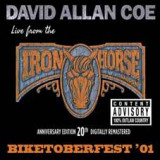
If there’s ever been a way to describe David Allan Coe, it’s got to be his ability to defy categorization. With over six decades of following his musical muse wherever it’s led, this craggy voiced outlaw has crossed the panorama of American roots music. As well as being a singer, guitarist, songwriter, David is also a magician and a ventriloquist, deep sea treasure hunter, and movie star. His movies included Stagecoach, The Last Days Of Frank and Jesse James, Lady Grey, Buckstone County Prison, Take This Job and Shove It, to mention a few. David signed with Sun Records in 1968 and recorded his first album Penitentiary Blues, all songs that David had written in prison. In 1973, Columbia Records bought David’s contract from Sun Records and he recorded his first Columbia album, titled “The Mysterious Rhinestone Cowboy”, several years before Glen Campbell had a hit with the song, “Rhinestone Cowboy.” Much has been written about David’s past and his lifestyle, but not much about his achievements over the years. From performing on Farm Aid to touring with Neil Young, Kid Rock and Willie Nelson. David’s song, “Take This Job and Shove It” has received multi-million airplays certificate from BMI. His “Greatest Hits” album is multi-platinum and his “First Ten Years” album is gold. David has had sixty three songs on the Billboard Singles Charts, including, “Mona Lisa Lost Her Smile”, “The Ride”, “Please Come To Boston”, “Willie, Waylon and Me”, “Jack Daniels If You Please” and “You Never Even Called Me By My Name” to name a few. David has written songs for Johnny Paycheck, Tanya Tucker, George Jones, Willie Nelson, Leon Russell, Charlie Louvin, Del Reeves, Tamy Wynette, Melba Montgomery, Stoney Edwards, The Oak Ridge Boys and Kid Rock. Both “Would You Lay With Me” and “Take This Job and Shove It” are multi- million seller songs penned by David. Johnny Cash has also recorded David’s songs including “Would You Lay With Me” on his chart topping album entitled, Cash. David has been through a lot in his life but has managed to put his past behind him and move forward with his life. This album was recorded in 2001 live from the Iron Horse Saloon in Daytona, Beach Florida and includes the only recorded version of, I’m An Ohio Boy.
Australian artist Indigo Sparke has signed to Sacred Bones and announced a new release date for her debut album, echo, now due May 21st. To celebrate, she has shared a video for the album's latest single "Everything Everything."
Of the song, Sparke says "I wrote this song not long after coming back from a magical castle in Italy where a group of us had been making music and soaking in the golden honey days. I met a beautiful human Shahzad Ismaily who had discovered I also write poetry. One night around midnight he called across the castle and asked me to come over and speak some of my poetry over an instrumental track he had recorded. The only thing he asked me to do was to sing a line or so if I felt it. That song was dog bark echo. He invited me back to NYC and I was living in his empty spare room in Brooklyn briefly. I borrowed this little parlour guitar of his and completely fell in love. I just sat in that room for hours and days playing around and just laying next to the guitar looking at the ceiling thinking about life and death and the poetry of it all. How life and death will hold us up to light. How grief ripens inside us
all and we all decay and everything changes and flies away. I remember feeling this liberating sense of freedom and melancholic nostalgia. It was so hot and the wind almost blew through from a different dimension or plane. I guess the song came through from that place too. It just came out. I can almost still feel that time on my skin, or in my breath."
Indigo Sparke brings her deeply personal lived experiences to her music, highlighting the spaces between the polarity of softness and grit. Pulling from her experiences of addiction, of healing, of queerness, of heartbreak, of joy, of connection, of the softness and of the grit alchemizing it all into tenderness through her music, she conjures up a myriad of feelings that is undeniably potent.
echo was co-produced by Sparke, Big Thief's Adrianne Lenker and Andrew Sarlo.
In 1970 Barney Wilen assembled a team of filmmakers, technicians and musicians to travel to Africa for the purpose of recordi ng the music of the native pygmy tribes. Upon returning to Paris two years later, he created Moshi, a dark, eccentric effort fusing avantjazz sensibilities with African rhythms, ambient sound effects and melodies rootedin American blues traditions. Cut withFrench and African players including guitarist Pierre Chaze, pianist Michel Graillier and percussionist Didier Leon , this is music with few precedents or followers, spanning from extraterrestrial dissonance to earthbound, streetlegal funk. Wilen pays little heed to conventional structure, assembling tracks like "Afrika Freak Out" and "Zombizar" from spare parts of inde terminate origins. (Jason Ankeny, AMG)
Revelatory reissue of Barney Wilen’s ambitious jazz-fusion journey, Moshi (1972), presenting the legendary French jazzman and Miles Davis-sideman’s wildly ambitious effort fusing recordings of Pygmy tribes with African rhythms and stellar avantjazz leanings, sounding little like anything before or since its release. (boomkat)
Super rare and long out of print, the ground-breaking 1972 album from saxophonist Barney Wilen receives a reissue treatment of the highest order. Complete with a 20-page booklet and a never before seen DVD chronicling Wilen’s trip to Africa, this one is sure to be a delight for fans old and new. The deepest spiritual jazz grooves meet field recordings from the Upper Volta and b eyond, whilst psych rock influences collide with hypnotic and shamanistic percussion work. Truly one of the most out -there jazz records we’ve stocked for a long time! (bleep)
Originally issued by the seminal imprint Saravah in 1972, and among the most uncategorizable and sought after artefacts of the French avant-garde, Barney Wilen’s Moshi is nothing short of a masterpiece - long holding a coveted spot in the hearts of adventurous listeners and record collectors alike. A wild unkept cultural collage. A series of sonic experiments. A spiritual, psychedelic pilgrimage into the unknown - darting from one continent to the next, each of its tangents building toward a more optimist world view through ordered sound. Its scope remains as difficult to understand today as it was when it was released. Now brought back into the light by Souffle Continu, this is a moment to be celebrated far and wide. (Soundohm)
Deluxe reissue with additional artwork & remastered audio. 20-page booklet including rare pictures, sheet music & original liner notes. Bonus DVD with exclusive artwork of Caroline de Bendern’s movie « à l’intention de Mlle Issoufou à Bilma » documenting this incredible african journey.
A new title in the series of full-album reissues that Vampisoul (co-produced in collaboration with Little Butterfly Records) is releasing as a valuable addition to the largely acclaimed compilation “América Invertida”, focusing on the obscure leftfield pop and experimental folk scene from ‘80s Uruguay, making some of these elusive and essential albums available again.
Hugo Jasa aimed to merge the glamour of the 80s (drum machines and Yamaha DX7 and Roland D50 synthesizers command the timbre of the album) with Uruguayan Afro-candombe sound in his songs. A deep bench of national talent, as Eduardo Mateo, Hugo Fattoruso, Jorge Galemire or Mariana Ingold, took part in these sessions. The album was originally released in 1990 with a single pressing of 300 copies, and then recently rediscovered by new generation of DJs, musicians and hardcore record collectors around the world thanks to the internet, reaching a cult status and becoming a top want.
Hugo Jasa’s “Estados de ánimo” is reissued here for the first time, in its original artwork with an extra OBI and including an insert with liner notes by Uruguayan music writer Andrés Torrón.
out of Stock
Last delivered 2 years ago available to reorder, subject to availability
Raised in Corsica, Stephanie made a name for herself as a dj in Paris but more recently focused on producing her own sound. The roots of her musical style are deeply entrenched in Pop, House and Ambient music, all genres that to her reflect our human desire to express our feelings. Her heartfelt debut, AUTEL, released on new label Lake Of Confidence, is an invitation to be fully present in the moment and listen to ourselves with awareness. The track "Disarm" is an uplifting tonic for the soul and could not have come at a more fitting time, encouraging the letting go of fear. Stephanie's grounded voice and the tender tones of the music take us on a liberating journey and reminds us of what is important in life - to move beyond ourselves and embrace joy. The captivating "Unchain" and the Superpitcher remix of the track, are both powerful guides for deep contemplation. Each beat is a metaphor of the breath of life, space and the impressive vastness of this extraordinary mystery we live in.
out of Stock
Last delivered 5 years ago available to reorder, subject to availability
Mica Levi is a musician and composer living in
South East London who uses programming
software, written notation and improvisation to
produce music. They are currently a member of
the groups CURL, Good Sad Happy Bad and
Tirzah and have composed scores for a number of
films including Under The Skin, Jackie, Monos,
Zola and Mangrove (part of the Small Axe series).
‘Blue Alibi’ is the second album Mica has released
under their own name. Vinyl edition released
concurrently alongside first album ‘Ruff Dog’.
‘Blue Alibi’ is available on black vinyl in uncoated
printed inner sleeve in printed reverse board 3mm
spine outer sleeve, with retail sticker and digital
download card.
‘Ruff Dog’ is the first album Mica has released
under their own name. Vinyl edition released
concurrently alongside second album ‘Blue Alibi’.
‘Ruff Dog’ is available on black vinyl in white paper
inner bag in printed reverse board 3mm spine
outer sleeve, with retail sticker and digital
download card
Domino are immensely proud to announce the signing of my bloody
valentine, with new physical editions of the band’s seminal catalogue
being made available. ‘Isn’t Anything’ and ‘loveless’ have been
mastered fully analogue for deluxe LPs and also mastered from new
hi-res uncompressed digital sources for standard LPs, with each
being made available widely for the first time ever. Fully analogue
cuts of ‘m b v’ will also be available on deluxe and standard LPs
globally for the first time.
my bloody valentine, the quartet of Bilinda Butcher, Kevin Shields,
Deb Googe and Colm Ó Cíosóig, are widely revered as one of the
most ground-breaking and influential groups of the past forty years.
During an era in which guitar bands denoted, at best, a retroclassicism, not only did my bloody valentine sound unlike any of their
contemporaries, the band achieved the rare feat of sounding like the
future.
Re-emerging in 2013, after two full decades in relative hiding, my
bloody valentine’s third album, ‘m b v’, is by turns their most
experimental record but also their most melodic and immediate; proof
real of their unerring desire for re-invention. Continuing to push
boundaries of both music and genre, ‘m b v’ is an album of
astonishing music, some of which could lay claim to being of a type
never been made before. Otherworldly, intimate and a visceral listen,
‘m b v’ is a startling and beautiful metamorphosis of what was known
of the my bloody valentine sound, pushing the boundaries of genre
unlike any other band. The album’s closer, ‘wonder 2’, is an example
of this, seeing Shields meld hypnotic guitar with drum & bass to
astonishing result.
Joviale is a multidisciplinary artist from North London making otherworldly, immersive music that plays with “minimal textures, killer interjections and vocals that are equal parts restraint and rage.” (The Times) Looping these high vocals with heady, emotional chords, they weave a screen around the listener, pulling them into chaptered, strangely sweet variations of the artist, divided out across albums, and designed to generate a performative atmosphere, both on stage and through the recording.
For their forthcoming EP Hurricane Belle NEVER SEVEN, spring 2021, Joviale combines warm sensual exposure with a flash of teeth, as the fictional Hurricane Belle whirls onto the scene, an embodiment of the “sense of electric and spiralised chaos” erupting from the artist’s centre. Hurricane Belle is a Champion that was inspired by Peter Shenai’s “Hurricane Bell” experiment, in which he cast brass bells modelled on the five stages of Hurricane Katrina. Industrial, insatiable and metallic, Hurricane Belle is embedded in the album not only through sound, but also through sight; the first single of the project, Blow, will be accompanied by a self-directed video, reflecting Joviale’s increased interest in the visual arts, and in building multisensory experiences. As written in the accompanying prose for the album, “Let yourselves into my breath, my rhythm and my core. Take pleasure in the whiplash of this collection.”
2019 saw the release of the artist’s debut EP Crisis, in which Joviale wielded narrative and storytelling to build a dreamy, silk-wrapped universe across songs such as Dreamboat, and Taste of the Heavens. As with Hurricane Belle, Crisis was created in collaboration with the producer Bullion, and it has been widely supported by press, including interviews in The Face and Coeval, and features in Dazed, Line of Best Fit, Guardian, The Times, Fader, Crack and Clash, among others. The EP also merited radio support from Huw Stephens on BBC Radio 1, Jamz Supernova on BBC 1xtra, Selector FM, Matt Wilkinson on Beats 1, Tom Ravenscroft, Tom Robinson on BBC 6 Music, Dan Alani on Reprezent, and Worldwide FM, among others.
Joviale belongs to a generation of artists with a strong sense of collaborative, interdisciplinary practice. The artist leans into this skill-sharing, research-led community, valuing project-based work that allows for the development of concepts related to visual and sound culture. This is reflected in them having recently directed a video for Laura Groves, as well as running a bi-monthly radio show on NTS over a period of twelve months. They carry a deep interest in the connection between the arts, ecological sciences, and semi-fictive encounters, as well as the wider London scene. In 2019, The Face described Joviale’s sound and aesthetic as “building the London artist a loyal fan base”, an effect that encompasses their involvement in the city’s music circuit; Joviale built a reputation for their live shows before releasing any official music. They have played support shows for artists that include Celeste, Zsela, Kate Tempest, Nilufer Yanya, Babeheaven, Kindness, and Westerman, and, in 2019, Joviale sold out their first headline show at Folklore, Hackney.
MONSTER MAGNET’s A Better Dystopia dominates with a psychotic selection of proto-metal and psych-rock obscurities! "Take a trip inside the mind of psychedelic rock legend Dave Wyndorf with MONSTER MAGNET’s A Better Dystopia – a delightfully psychotic selection of proto-metal and late-era psych songs that fit the band like a glove! With wonderfully obscure song choices and excellent sequencing, the mighty Magnet pay homage to some of their favorite songs of all time, crafting another exciting and unique listening experience alike what they’ve become famous for. While the album marks a new frontier for MONSTER MAGNET as their first covers record, this is not your typical set of standards released to pass time. Wyndorf is at the top of his game on A Better Dystopia – howling, crooning, speaking… whatever it takes to get the emotional message of these very special tunes across, delivering each lyric in his own inimitable style. Musicians Phil Caivano, Bob Pantela, Garrett Sweeney and Alec Morton own the sound on A Better Dystopia – vintage and old school, dense and heavy, with searing fuzz leads and pounding bass and drums all played in a deft style that's almost been lost in modern music..
Blackaby - aka London songwriter and multi-instrumentalist William Blackaby - offers-up his first two EPs - 'What's On The TV?' and 'Everything's Delicious' - on limited edition, random coloured recycled 12" vinyl, out 21st May 2021. Blackaby’s 2020 debut EP ‘What’s On The TV?’, released via Hand In Hive, served as a look back at the songwriter’s childhood, recounting hazy playground memories and his messy, formative teenage years. His second collection, ‘Everything’s Delicious’, is described by Blackaby as “another brief flirt with memory lane - not walking down it as much as peering from a safe distance”. In a poem written to accompany the new EP, William writes: “All grown up and what now? Let Time-Out decide. Is that a thin patch? Another day done and dinner’s on. What have I done? Left a mark or a stain?”
It took German metalcore vets, CALIBAN recording a cover of Rammstein’s “Sonne” to realize that their native tongue was a seamless fit with their time tempered collision of punishing riffs and Andreas Dörner’s urgent vocals. With fans hungry for the Essen-borne quintet to record an album exclusively in German, the band simply said: “Why not?” and “Zeitgeister” was born. 11 genre-defining LPs deep into their career, the band’s vision for the album came naturally – a career retrospective and deep-dive into CALIBAN favorites that haven’t had a live airing in some time. “It wasn’t an easy decision, but once we allowed us to make them as different from the originals as we felt it was needed it came fairly naturally”, explains guitarist and main songwriter Marc Görtz. Of course, some updating was necessary when it came to translating the songs to German. “It turned out to be surprisingly tricky,” says Dörner. “While I feel more at home with my native German it made it a lot more complicated, as I had more options to phrase something.” Formed in 1997, CALIBAN’s legacy has been a tireless one, touring the globe and sharing stages with the likes of Slayer, Kreator, Killswitch Engage and many more, “Zeitgeister” was a welcome homecoming. With the help of long-running producer Benjamin Richter (Moonspell, Emil Bulls and more) CALIBAN hand-picked seven tracks to bring new life to: “Trauma“ (feat. Matthi from Nasty, “Arena Of Concealment”), “Herz” (“I Will Never Let You Down”), “Ausbruch nach Innen“ (“Tyranny Of Small Misery”), “Feuer, zieh mit mir“ (“Between The Worlds”), “Nichts ist für immer“ (“All I Gave”), “Intoleranz“ (“Intolerance”). “Mein Inferno” (“My Little Secret”). “Zeitgeister” also boasts a new track, “nICHts”. “It’s a song about feeling disoriented and hopeless, about depression and feeling powerless. Feelings that many of us can probably relate to during these days”, says Dörner.
Extended Revelation for the Psychic Weaklings of the Western Civilization is the second album by Swedish rock band The Soundtrack Of Our Lives. Heavily influenced bands from the sixties and seventies such as The Rolling Stones and Iggy and the Stooges, the band became popular in both Europa and the United States. Their fame was partially propelled by their songs being featured on popular video game franchises such as FIFA, NHL and Gran Turismo.
The title of this album comes from the Rolling Stones Records’ release of Brian Jones Presents the Pipes of Pan at Joujouka, where the inside liner notes state that “Western Civilization has made us such Psychic Weaklings”. About 50% of the songs on the album were leftover material from the bands debut album, yet this record sounds far more dark and contains influences from psychedelic music. The album was well received and spawned one single: “Black Star”.
Wipers were a punk rock group formed in Portland, Oregon in 1977 formed by guitarist/songwriter Greg Sage. The group’s tight song structure and use of heavy distortion were hailed as very influential by many critics and musicians alike.
Land of the Lost is the band’s fourth studio album. It was very well received, with Maximum Rocknroll praising the title track for being “heavier and riffier” than the band had ever sounded before. Spin Alternative Record Guide called the album “the most definitive Wipers record for sound and songwriting”.
Land of the Lost remains a highly sought-after album, but now there’s a chance to get a hold of it again. It’s a limited edition of 1000 numbered copies on yellow coloured vinyl.