Turman first came onto the industrial scene in the late 70’s as the ominous ‘other half’ of legendary noise outfit NON. Shortly after recording the classic 1977 single Mode of Infection, Turman went on to pursue his own unique vision as a solo artist. Fusing every possible influence at his disposal while laying his ideas down on self-released cassettes like Flux (1981), Spirals of Everlasting Change (1987), Way Down (1987) and the massive Chapter Eleven cassette box set (1988). After a hiatus Turman resurfaced in 2005 to team up with seminal noise musician Aaron Dilloway. Since then, he has been gradually adding new titled to his already impressive discography.
For this archival release Turman selected 7 tracks that were recorded between 1980 and 1984. A welcome supplement to his library of avantgarde music that was released in the 80s. This album fits in nicely between the early industrial noise, the long-form minimalism of Flux and the rhythmic industrial of Way Down. Focusing on slowly shifting hypnotic loop-based layers of sound, it covers a specific side of Turman. It feels like there’s a direct link to his earliest works but it’s also a precursor to some pieces that were recorded much later. A missing link that finally gives us the opportunity of a complete overview of his early audio work.
All 7 tracks on this album have a connection to the written word in the form of a poem. Scans of the original typewriter poems are included together with collages and drawings from this specific time frame to create an essential and singular piece of art.
quête:not was
Andrea has his roots in the independent musical scene in the first decade of the 2000s. In addition to his compositional and live experience as the first Nadàr Solo drummer, he is one half of the Turin duo Anthony Laszlo with Anthony Sasso, ex guitarist and singer of Milena Lovesick. Andrea Laszlo De Simone made his debut in 2012 when he released his first homemade album, Ecce Homo. Recorded at home by makeshift means and accompanied by the following videos: Solo un uomo, 11:43, I nostri piccoli occhi, Perdutamente.
At the beginning of 2014, he met some experienced musicians from Turin’s underground scene that later, after a few months in a rehearsal room, became his band: Damir Nefat (guitar/backing vocals), Dani C (bass guitar/backing vocals), Filippo Cornaglia (drums/backing vocals), Zevi Bordovach (keyboards/backing vocals) and Anthony Sasso (keyboards/backing vocals/percussions).
Anticipated by the individual tracks Uomo Donna, Vieni a salvarmi and La guerra dei baci on June 9, 2017 - for 42Records - Uomo Donna came out. It’s Andrea Laszlo De Simone’s first real album, a well received work by both audience and critics. It also was pointed as one of the best albums of 2017 by several national music magazines.
Uomo Donna is a complex, articulate and vital album that lives in its own time - where past, present and future coexist. It’s a time in which a sonic world takes shape blending classic and modern, Italian songs with psychedelia, Battisti and Radiohead, Modugno and Verdena, the Beatles and Tame Impala, the magical flight of Claudio Rocchi and the earthly flight of IOSONOUNCANE.
The album was self-produced and then post-produced by Andrea in collaboration with Giuseppe Lo Bue, a sound engineer from Bologna. The recordings were made between October 2014 and the end of 2016 with experimental techniques straddling digital and analogic.
After playing in some important Italian festivals as Siren Festival and TOdays -- that earned him a special mention in the live scores by Rolling Stones -- on October 28, 2017 the first Uomo Donna album tour started in the clubs of the major Italian cities.
On November 30th 2017, Andrea Laszlo De Simone presented his video, Sogno l'amore, during the Torino Film Festival as a short film, shot in Sicily and directed by Francesca Noto and Andrea Laszlo De Simone.
On March 15th 2018 the music video of Gli uomini hanno fame was released, the most political song of the album, an overlook through ferocious human emotions, an eleven and fifty minutes trip within human nature portrayed even in its most ferocious instincts. The music video was directed by Andrea Laszlo De Simone and the mysterious duo Sans. The official cycle of Uomo Donna ends on 31 December 2018 with the music video of Sparite Tutti created by the creative collective Irene&Irene.
2019 was a year of new goals for Andrea, in fact, the album Uomo Donna leaves national borders and got a special mention on social media by the famous American band The Lumineers which included Andrea Laszlo De Simone and Uomo Donna among the most interesting discoveries of the international musical underground and inserts Solo un Uomo in the Spotify playlist “Inspirations”. A few days later, Solo un Uomo was broadcasted by KEXP Radio. On November 4th Andrea and his band were chosen to open for The Lumineers’ only Italian show at Alcatraz, in Milan.
On November 8th Andrea released a brand new work, digitally and on vinyl for 42Records, Immensità, a ‘suite’ of four singles: Immensità, Conchiglie, Mistero and La Nostra Fine. Turned into a medium-length film using Immensità as the soundtrack.
Immensità was presented with four special sold out concerts in Rome, Turin, Padua and Milan. For these shows Andrea Laszlo De Simone was accompanied on stage by a mixed orchestra composed of synths, electronics, choirs, strings and woodwinds. Classic and modern instruments that are intertwined in a nine elements formation: an immersive concert, a contemporary version of chamber music.
In March 2020 Immensità was released also in France, UK, Canada, Belgium and the United States with Ekleroshock/ Hamburger Records (Roster: Benjamin Clementine, Polo & Pan, Limousine and many others). The response of the transalpine press and media, sector and not, was unexpected: major French newspapers and magazines - from Le Monde to Liberation, Vanity Fair and Les Inrockuptibles - dedicated entire pages and rave reviews to Immensità and Andrea Laszlo De Simone. The track Immensità entered, after a few days, at the fourteenth rank of Spotify’s Top viral 50 playlist and broadcasted on France Inter and Radio Nova.
“Immensità” is a complex cross media work of music and images. A project divided into four chapters (the songs) for nine tracks (each chapter has a prologue or a conclusion). A true suite, using the classic term that best describes an instrumental composition in several stages, that can be enjoyed in its entirety only by listening to vinyl or digitally in the innovative single track format, without pauses: a single symphony of 25 minutes and 6 seconds.
In September 2020, Dal giorno in cui sei nato tu was released on all italian platforms, a song dedicated to Andrea’s children, a real love letter in the form of a small speech, where he tries to give them the three keys to approaching life: fantasy, music and irony. Martino, 8 years old, replies to his father’s love letter by making the video accompanying the song, created in Super 8. It's the story of the world through the eyes of the child. It is also an homage to the new little girl in family, Lucia.
The Telescopes Radio Sessions collects together the essence of three live session recordings in 3 different countries over a three year period between 2016-2019. This is the third in a series of radio session releases from Tapete Records that have so far included The Monochrome Set and Comet Gain. More session releases are being lined up for the rest of the year and beyond - enjoy the sonics and stay tuned. Over the years I have read a lot on people’s impressions of The Telescopes. Some folk think it’s a collective, others imagine it used to be a band and feel nostalgia towards what they consider to be the original line-up (even though many had come before, during and since) and some people refer to it as currently a solo career. In a way this is all true and none of it is. When faced with these kind of questions, along with questions about the style of music that The Telescopes make I often say The Telescopes house has many rooms, which explains things perfectly for me but for people on the outside looking in it only serves to increase their confusion. For me, confusion isn’t such a bad thing. Everything is born into confusion, the sense we try and make of that chaos is interesting and excites me. The universe often disorientates, it sends me a jumble of thoughts and impressions coupled with a feeling of something I need to express… if I could only decipher the encryption. This is how The Telescopes music comes to be and it is also how The Telescopes came to me. I regard The Telescopes as an entity of it’s own that introduced itself in my darkest hour and I was chosen as its vessel. From the second it arrived I was obsessed to the point where there was nothing else. A bit like having an imaginary friend. As the obsession grew it began to infect others, everybody loved my imaginary friend and wanted a piece of it. As its success grew however, so did the corruption, until one day the entity fell silent. The silence lasted for years, I tried everything to reconnect but it was having none of it. I had been a bad caretaker, I had let the house become infested and I had lost my way. This epiphany served to remind me of simpler times when anything felt possible with this entity by my side. It had trusted me with something so simplistically profound and I had let it down. The realisation of this was a eureka moment. I am not The Telescopes, I never was and never will be, I am the caretaker, the lighthouse keeper and if a job is worth doing it is worth doing well. With this dawning, I felt a crack open up in the cosmic egg and a familiar confusion in my head. The entity had returned. It was time to start untangling its tangled threads once more, to make sense of what it was saying, this time without corruption. It’s all about listening. I listen to what my cosmic friend sends me and channel this expression into what you hear through your speakers. It may take one person to achieve this, it may take more. There is no set line up or instrumentation that can hold The Telescopes. Whatever it takes to hit the zone, whatever is available, absolute focus is imperative. Sometimes it takes sabotage to keep that line of vision intact, there is no room for preconceptions or complacency in making the music. The Telescopes music is the now
incarnate and a state of total being is necessary to achieve. From the outside looking in... again, it’s all about listening. What comes through your speakers is the only thing that matters. The music either reaches you or it doesn’t. Everything else may seem interesting or confusing but ultimately it is corruption. So if you’ve bought the record, read the sleeve notes and bought a ticket to see a live show, don’t be surprised if the line-up is or isn’t the same as the recording. The only thing that is for sure is that The Telescopes as an entity is speaking to you in its own voice in every scenario.
Of course the difference between albums and live shows is that you can play the record over and over again to the point where you know every line and every note that was played. Whereas with live events you are left with an impression that can only be replayed in your mind. It can be frustrating at times. When you are touring with a great line-up and feel like something exciting is happening, you want everyone to hear it, not just the people at the shows but the people that couldn’t make it on the night as well. There is no guarantee that there will be the same line-up at a live show as there is on the album. This is why live sessions are important, they document a side of things that is often fleeting. Here we have three sessions, all different people transmitting The Telescopes sound on each. Some are regulars, some dip in and out and some were just passing through. In each case The Telescopes chose them as their vessel and as the lighthouse keeper I did everything I could to help them on that journey while trying to be a good caretaker to the house of many rooms. The Telescopes have been invited in for many sessions over the years, the first two were for John Peel on BBC Radio 1. We also recorded a session for Marc Riley and Mark Radcliffe before their
celebrity when they had a show on BBC Radio Manchester. We could have compiled this album from those sessions, it was certainly considered but Tapete and myself believe this selection gives an exciting glimpse into that fleeting side of The Telescopes in a constant state of flux that is left mostly to myth and imagination. For those who listen to the records but have never had the chance to take in the live experience, welcome to the other side. For those that follow us live, here’s a little reminder and a keepsake. Infinite suns. Stephen Lawrie February 2024.
witching seaside ambience for a sound shaped by inner-city living, Atelier’s second full-length studio album, Lights Towards The Exit, channels the mood of a sleepless cityscape.
Lights Towards The Exit is Atelier’s second full-length studio album. After the release of Varsam Court at the end of 2019 on Lossless, run by mentors and friends Mathias Schober and Thomas Herb, the duo experimented with different ideas in the studio, and at the start of 2020 a common thread began to appear between a few of the tracks which laid the foundation for the sound of their second album.
Both Alexander and Jas moved to Berlin in the period before the release of Varsam Court from their hometown of Cape Town, South Africa, where their first album was written and recorded. Moving provided some challenges, particularly with what was the most essential equipment to bring from their previous studio set-up, but those limitations proved to be useful in incorporating new instruments and techniques to the recording process.
Lights Towards The Exit was written and recorded in different spaces in Berlin – from bedrooms in apartment blocks to three different studios across the city. The different locations all had a specific ambience – such as 4th- and 5th-floor bedrooms with busy street views; a studio with no windows in a typical old Berlin backyard complex forever under threat of being sold and gentrified; and a bigger studio with windows on the opposite side of the corridor overlooking the backyard of a mechanic workshop. The final details and edits were completed in Atelier’s current studio, in a contrasting area surrounded by office blocks, plazas, 9-5ers and, most importantly, their friends and colleagues.
Swapping the mountains, sea and seclusion for tall buildings, backyards and a new community, Lights Towards The Exit channels the sensation of being surrounded by people, but still feeling like you're on your own. The album was written through three years of cold winters, sweaty summers and a period where the world stood still during the pandemic. Frustrated with the cease of momentum, but still optimistic, Atelier disappeared from public view, abandoning social media to focus on recording, songwriting and experimentation.
It was a difficult time: the duo longed to perform and continue producing music, and the imposed limitations sometimes felt like an impossible obstacle. Ultimately, though, this would provide inexpected inspiration and influence the sound and direction of the new album.
The sound of Lights Towards The Exit is not a departure from their first album, but a progression: influenced by the new surroundings in the duo’s adoptive city, Atelier’s second album is an ode to first-time experiences, new languages, challenges, club culture and the shift from youth to maturity, as well as a balm to those stuck somewhere in between.
The overall sound is a lift not in tempo, but in energy, matching the openness needed to make a new start in a new place.
- A1: This Mortal Coil - Waves Become Wings
- A2: Kid Congo & The Pink Monkey Birds - La Lliarona
- A3: The Black Angels - Science Killer
- A4: Low - (That's How You Sing) Amazing Grace
- B1: Chimes & Bells - The Mole (Trentemøller Remix)
- B2: Velvet Underground & Nico - Venus In Furs
- B3: Vampire Hands - Safe Word
- B4: The Shangri-La's - Walking In The Sand
- C1: M.ward - Poor Boy, Minor Key
- C2: Darkness Falls - Noise On The Line
- C3: Papercuts - Unavailable
- C4: We Fell To Earth - Lights Out
- C5: Thee Oh See's - Ghost In The Trees
- D1: Trentemøller - Blue Hotel
- D2: Nick Cave & Warren Ellis - The Proposition #1
- D3: Eden Ahbez - Full Moon
- D4: Ekko - Rehearsal
- D5: Paul Morley - Lost For Words - Part. 1
Warehouse Find!
FIRST TIME ON VINYL
HALF SPEED MASTERED 180 GRAM VIRGIN VINYL PRESSINGS
INCLUDES COVER ART PRINT
INCLUDES EXCLUSIVE CHRIS ISAAC COVER VERSION
INCLUDES DOWNLOAD CODES FOR THE ORIGINAL MIX AND UNMIXED VERSION IN WAV AND MP3 FORMATS
Trentemøller is the Dane who did. He's been making electronic music of one kind of bent or another for over 15 years, first making his name as part of Trigbag, a live house act that toured extensively. But it's his solo material that has impacted on the dance community - and beyond. 'La Champagne' was a game-changer and his remixes of artists like Sharon Phillips secured his place as an artist with some serious chops. But that's not all he is. You can hear that yearning in his productions and it's evident here, a sort of Protestant northern European melancholy. He is aided on his journey towards the Baltic by some heavy hitters, of course: Velvet Underground, Mazzy Star, This Mortal Coil. But that's not the story, it's not where the plot comes from, it's not where we're going. It's just a little indicator to reassure you we know the way. No. For it's in the dark beauty of Low's tremulous 'Amazing Grace' or even the way that the Shangri-Las' '(Remember) Walkin' In The Sand', surrounded by the similarly inclined, takes on a funereal gait. As we navigate the flatlands of your mind, we're helped along by a generous sprinkling of Anders' fellow Danes, like Darkness Falls (the atmosphere of this mix aptly encapsulated right there), Ekko, Chimes & Bells and the Late Night Tales tradition, Trentemøller's cover of Chris Isaacs' 'Blue Hotel', sung by Marie Fisker and Steen Jørgensen.
Originally released in 2010 this mix has gone on to become a classic, it was never released on vinyl at the time, so due to public demand we have carefully mastered each track and carefully cut at half speed for optimum sonic reproduction.
1973 was an amazing year for the pop/rock duo Hall & Oates as they ushered their superstardom further with the incredible second album masterpiece Abandoned Luncheonette.
Produced by the great Arif Mardin, this nine-song album fused with classic Philly soul, rock and acoustic pop anthems delivered in a big way for the history making duo. Including the huge hit single "She's Gone," as well as the celebrated title track, Abandoned Lunchonette was a watershed album which has rewarded them with non-stop success for the past four decades.
Abandoned Luncheonette is the most commercially successful of the duo's Atlantic Records period; the album reached No. 33 on the Billboard Top LPs & Tapes chart. Twenty-nine years after its release, the album was certified platinum (over one million copies sold) by the Recording Industry Association of America (RIAA).
This top-notch Analogue Productions reissue is pressed at Quality Record Pressings, and housed in tip-on old style gatefold double pocket jackets with film lamination by Stoughton Printing.
Castle Face present Dan Rincon’s (OSEES, Wild Thing, Apache, Personal and the Pizzas) premier solo release Spotlight City.
Artificial landscapes and melodies comprised of Moog Grandmother, Mellotron and a kinky Modular system span from beautiful and lilting to haunting and etherial. The album was a years long learning experience of getting all components and ingredients to link arms and blend comfortably. Wrangling was part of the process. Strings soaring and sines weaving. Sometimes in the atmosphere, sometimes in the Earth’s core, sometimes flanked by neon blur as it hums & weave patterns through a world imagined in vintage sci-fi pulp.
“I was listening to a lot of solo Roedelius and Conrad Schnitzler records while writing this record and I’d say that both have been hugely inspirational on what I want to do as a solo recording artist. The way both of those of those artist pushed the early, chaotic electronic music into something more melodic is really inspiring to me, it’s not that dissimilar than trying to get melodies out of a modular synthesizer.”
An absolute necessary slab for anyone a fan of CF, OSEES, Popol Vuh soundtracks , 8 bit video game accompaniment & 80s Tangerine Dream. Burn one and burn out.
The band have released a steady stream of singles over the last few months, receiving international airplay and strong support across the UK Radio network. Their second single, “Cry” was playlisted on BBC Radio 2 for three weeks in early 2024 and was also heavily rotated on BBC 6 Music and KEXP in Seattle. The follow-up ‘Make It Happen’ was premiered on 6 Music by Craig Charles, who touted Wonder 45 as “One To Watch” in 2024.
Now with the release of the stunning single, ‘Nothing’s Gonna Change’, we are delighted to announce Wonder 45’s debut album, “Wonderland” is set for release on Friday 31st May and is available on LP and CD. We’re currently taking wholesale orders and I wondered if you would be interested in stocking some copies?
The delivery should come at the beginning of May so please let me know if you’d like me to put some copies aside for you and if you’d like to put them up for preorder straight away.
"ANNO DOMINI picks up Black Sabbath’s story in 1989, two decades and multiple lineup changes into the band’s groundbreaking career as metal originators. At the time, membership had solidified around riffmaster and founding member Tony Iommi, legendary drummer Cozy Powell (Jeff Beck, Rainbow, Whitesnake), singer Tony Martin, and longtime Black Sabbath collaborator and keyboardist Geoff Nicholls (Quartz, Bandy Legs).
The group originally released Headless Cross in 1989 on I.R.S. Records, the first of five albums Sabbath recorded for the label. Praised by fans and critics alike, the band’s 14th studio release produced three singles: “Devil And Daughter,” “Call Of The Wild,” and the title track. Bassist Neil Murray (Whitesnake, Gary Moore) joined for the “Headless Cross Tour” and stayed to record Sabbath’s next album, 1990’s Tyr. Named for the Norse god of war, the album explores similar mythological themes in songs like “The Battle Of Tyr” and “Valhalla.” On “The Sabbath Stones,” the band channels Old Testament fire and brimstone into a classic bruiser.
In 1992, following a successful world tour, this incarnation of Black Sabbath was put on hold when the band reunited temporarily with Ronnie James Dio. Two years later, Martin and Nicholls were back in the studio with Iommi to record 1994’s Cross Purposes. The band was completed with the addition of founding Sabbath bassist Geezer Butler and drummer Bobby Rondinelli of Rainbow.
The Tyr-era Black Sabbath lineup reunited in 1995 when Powell and Murray returned to record Forbidden. It was the band’s 18th studio album, and its last for nearly 20 years.
Contents:
Vinyl box set includes:
• Newly Remastered Versions Of :
- Headless Cross
- Tyr
- Cross Purposes
• Brand New Remix By Tony Iommi Of Forbidden
• 1989 Headless Cross Tour Replica Concert Book
• 40 Page Book with Photos, Artwork and Liner Notes
• 1989 Headless Cross Replica Colour Poster"
Available on “Green Tea” colored vinyl, limited to 300. Remixed by Chris Teti & remastered by Kris Crummet for 10th Anniversary. Recommend If You Like: Prince Daddy & the Hyena, Into It. Over It., Blink-182. Maybe it always had to be this way. Posture & the Grizzly formed in Connecticut, in '08, and churned out a couple of demo tapes before dropping their debut LP in early 2014. Busch Hymns was scrappy and raw, all weed smoke and pent-up fury. Songs like "Egg Nog Drunk Off Hilary Duff's Piss" (yeah) and "You Know I Know What You Did Last Summer" exemplify the band's charm perfectly crystalline, wobbly leads ready to burst under bouncy hooks equal parts snarl and singalong. Just a glance at the tracklist lets you know what Posture & the Grizzly's all about: eight goofily titled songs in and out in eighteen minutes. Just in time for the LP's tenth anniversary, it's been given a remix by The World Is…'s Chris Teti, who originally produced and engineered the album back in 2013, along with remastering from Kris Crummett (Knuckle Puck, Dance Gavin Dance). Sometimes when an album like this is remastered, it loses some of its charm; the gloss crowds out the grit, the whole thing is recolored a bit too bright. But not so on Busch Hymns—these songs are crisper, but that doesn't mean they're cleaner. J. Nasty's throaty howls are as ragged as ever, but this time around they stand out against Piss Malone and Cabbage Pile's rhythm section, no longer straining for spotlight but basking in it. Their sound would get streamlined a bit over the course of their next two albums, I Am Satan and Posture & the Grizzly, replacing some of Busch Hymns's bite with a clearer-eyed sparkle and a newfound melodicism. Busch Hymns stands now as a document of the cult punks' early days, a transitional period from their throat-shredding demo days to their all-too-brief time as a pop-punk juggernaut. It's clearer than ever with the Busch Hymns remaster that Posture & the Grizzly was meant to sound like this, was meant for more than basement shows and beer-soaked floors. In this light, Busch Hymns is more than a transitional period; it's a glimpse into the greatness to come. So if you're sick of listening to modern punk too, then quit it. Listen to Busch Hymns instead
Upchuck are experiencing a moment. The Atlanta punk collective just came off multiple tour runs with their good friend Faye Webster. Their Ty Segall-produced second album Bite The Hand That Feeds, with all its buzzsaw guitars and high-speed rippers and headbanging sludge, arrived in October. Later this year, they’ll make appearances at multiple festivals including Coachella. In the midst of relentlessly barreling ahead, the band and their label Famous Class are taking a beat to revisit how they got here. After working with Segall on Bite the Hand That Feeds, the band floated the notion that they wished they could hear what their collaborator could do with the songs on their 2022 debut album Sense Yourself. Holed up in his studio over Christmas with COVID and nothing else to do, Ty Segall began toying with Sense Yourself, sifting through folders of unlabeled stems to find the best guitar parts, emboldening the drum sound, and bringing greater clarity to KT’s vocals, all while bolstering the urgency of the band’s overall attack. With Segall’s new mix, Upchuck’s intense and righteous debut now impossibly overflows with even more fuzz and fury. In Segall, they found a kindred spirit whose studio approach made sense for just how hard they wanted this music to hit. “When we first went to record with Ty for Bite the Hand That Feeds, Mikey and I walked into the guitar room and Ty said, ‘Don’t touch the EQs.’ We looked at the amp and everything was on 10 except the master volume,” Hoff said. Previously, the band had been encouraged to capture the unvarnished sound of the studio. They’d toured with Segall’s band Fuzz, so everybody had the same goal while recording together: Capture the electricity of their intense live set. The band’s shows have a reputation for coming unglued, and there’s no greater document of that than Sense Yourself’s iconic album artwork. With no text, it’s a candid photo of a moment from a show shot on film without editing: blood streaked across KT’s face as they shout into the mic. In the middle of their EP release show, KT was in the pit as a fan started crowd surfing inside a shopping cart. A loose piece of metal near a wheel caught the singer right near the eyebrow and blood was everywhere, an instant piece of iconography snapped by probably every camera phone in the room. When Hoff revisits the message of this first album and Upchuck’s first songs, he thinks back to the year before the band even started when he and KT were hanging out. “We were sitting around talking for eight hours like ‘fuck, that's fucked up, that's fucked up.’” Upchuck became a vehicle for these five people to process how fucked up everything it is—to digest these formative hours-long conversations and put them to bludgeoning, intense rock music. The music is also fun as hell, and that’s part of the point. “There's a lot we need to do as people and a lot of things we need to fix in society but also like come on man like have your fun, wild out, have your drink,” KT says. “But be on your shit at the same time. Check your folk.”
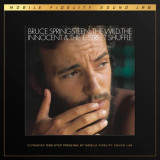
Released only eight months after his exhilarating debut, Bruce Springsteen's The Wild, the Innocent & the E Street Shuffle contains rousing dispatches from the boardwalk, the street, the beach, and the bedroom. It explodes with energy, dares to dream, teases with humour, crackles with tragedy, clings to hope, and overflows with discovery, youthfulness, and personality. It features an unforgettable cast of characters — corner boys, teenage hustlers, doomed lovers, jazz men, junk men, factory girls, fortune tellers, alley cats, pimps, escorts, and more — illuminated by vivid colour, breathtaking detail, and poetic action.
Musically, the heartfelt 1973 record is inhabited by sympathetic vignettes and cinematic arrangements steeped in rock 'n' roll, soul, jazz, and R&B. It finds the New Jersey native looking beyond the parameters of his preceding record and seeking to move on from environments he knows well (and chronicles here) by rushing headlong toward unknown territories, adventures, and people. Underpinned by the singer-guitarist's ambitious poetic enterprise and will to succeed, The Wild, the Innocent & the E Street Shuffle is the album on which Springsteen becomes the Boss.
Mastered on Mobile Fidelity's renowned mastering system, pressed at RTI on MoFi SuperVinyl, and strictly limited to 7,500 numbered copies, Mobile Fidelity's UltraDisc One-Step 180g 33RPM LP set is the definitive-sounding version of Springsteen's sophomore record. Benefitting from SuperVinyl’s nearly non-existent noise floor, superb groove definition, and dead-quiet surfaces, The Wild, the Innocent & the E Street Shuffle plays with a clarity, energy, presence, and openness that complement the expressiveness, dynamics, and scope of the seven restless songs that comprise a work Rolling Stone ranked the 345th Greatest Album of All Time.
Beyond the audiophile sonics that practically place you behind the console at 914 Sound Studios — listen to the separation between the instruments, natural decay of the notes, interplay within the widescreen soundstaging, and nothing-to-lose youthfulness of Springsteen’s voice — this reissue takes seriously this record’s influential merit by presenting it in packaging that underlines its status. Tucked in a beautiful slipcase, the LP is housed in a special foil-stamped jacket with faithful-to-the-original graphics. This reissue is made for listeners who prize sound quality and who want to engage themselves in everything involved with the invigorating set that busted Springsteen loose from the club circuit and landed him on the radio
Determined to liberate anyone within earshot and unafraid to come on strong, The Wild, the Innocent & the E Street Shuffle serves as the debut of the E Street Band — not only heard but seen for the first time by most of the public courtesy of the back-cover photograph. This is where saxophonist Clarence Clemons, organist-accordionist Danny Federici, and pianist David Sancious step out of the shadows — and drummer Vini Lopez and bassist Garry Tallent again stoke a fiery rhythmic engine that helps drive the untamed, reimagined big-band swing of “Kitty’s Back,” breathless R&B thrust of “Rosalita (Come Out Tonight),” and carefree dance steps of the funky “The E Street Shuffle.”
Of course, the main attraction remains a then-24-year-old visionary on the precipice of becoming a sensation and turning a then-bloated rock scene on its head. Recorded over three months while Springsteen and company were busy touring his debut LP, The Wild, the Innocent & the E Street Shuffle reflects the high-octane approach the vocalist embraced onstage and drifts away from the label-dictated acoustic-based frameworks of his debut. The set also witnesses Springsteen deepening his observational skills, with narratives such as the romantically tinged “4th of July, Asbury Park (Sandy)” and redemptive epic “Incident on 57th Street” mirroring changes taking place in the singer’s own life, small towns, and America at large.
A thrilling collision of memories, reflections, and composites — Sandy, Rosalita, and the latter’s parents are all based on actual people Springsteen knew, as is the community depicted in the opening track — the aptly titled The Wild, the Innocent & the E Street Shuffle resonates decades on due to its truths, authenticity, and spirit. Those characteristics — as well as the fact that many of its lengthy songs come on as the equivalent of sweaty, feverish soul revue that won’t stop until you’ve been exhausted — also explain how this now-iconic album triumphed over the reservations of industry “experts” that both demanded Springsteen re-record it and instructed deejays not to play it.
Yet there’d be no stopping a record that saw the past, present, and future, a band whose will would not be denied, and a phenomenon who was born to run. A never-ending invitation to act real cool and stay up all night, The Wild, the Innocent & the E Street Shuffle always feels alright.
The Slovak band Shallov releases their new track "Refrain" on the experimental label Weltschmerzen just one year after the release of "Coexist". Two tracks that both span more than 10 minutes in length, work together as one coherent audiovisual art piece and are out as an EP on 10" vinyl. Music videos do not only visually supplement both tracks but they are equally autonomous art pieces.
The visual feature of the music pieces is highlighted by the vinyl's cover painted by Slovak artist Michal Fízik. The previous back cover carries a photograph which served as an inspiration for the painting while the current back has been created via AI reinterpretation.
The musical component of Refrain is based on a repetition building into a hypnotic trance, gradually disintegrating so it eventually ends in a monumental climax. It contrasts the band's previous work as well as the track Coexist which uses rather neverending rhythmic variations, and a changeable vibe and atmosphere.
The concept of the visuals in Coexist is a result of a collective fusion between the theatre director Adam Dragun, Viktor Ori and dozens of other participating non-actors. The video depicts individualistic egoist actions shaping a contradicting and incomprehensible totality of the world which ultimately seems to be alienated to everybody.
Refrain is an introspective journey leading to the dissolution of the individualistic experience of human existence. The video's concept, direction and production was conducted by the visual artist and performer Jak Užovič who also tends to inter-media art and object installations.
As Shallov and Jak Užovič explain the track's conceptual background: "The idea of owning one's own body and mind is an unnatural way of looking at ourselves imposed by the dominant paradigm. It's a blind ideology - the view of a body as a machine or a commodity is incomplete and represents a materialistic utopia which is being systematically internalized. We're not a community that acts right or wrong, our intentions are determined by an ideology which pretends not to exist - our relations are relations of masters and slaves, of domination and exploitation. We are a society bound by these features and even though we refuse to admit it, the world presented to us is only a legend we're striving to keep alive at all costs, while believing that there is no alternative. Our quality doesn't stem magically from the inside, on the contrary, it's determined by the conditions within which we interpret it through collectively shared fictions. We don't get to know our consciousness through ourselves, but we recognize it through others as they create and form us."
The fourth Subetasch-Release is again combining 4 tracks of our residents, a juxtaposition of different influences on one record, always keeping a driving groove - and again, approaching the dancefloor with exciting, playful sounds. Four tracks with crooked sounds, catchy melodies, distorted voices, pumping beats and last but not least, elements of surprise.
Are you stuck in a rainforest and not sure if the frog you just touched is hallucinogenic? Then "raindrops" by TakaTuka is just the song for you right now! Kicking off on side A, 'the pumping bass and the delusional synth sounds' will help you with moving your body to find a way out of here or to just lay down and get one with the forest. Next up Jdis is striking up a faster pace with "Ghosts", where sharp synth stabs meet subtle acid sounds and whirling voices telling you to stay longer. On Side B, vaZdaZ dives in with delicious, freshly caught fish marinated in hazy vocals and a captivating tribal groove. Followed by Tinbred, which is the sound of beer cans being popped in the sunset on Danube Island if Vienna was flipped upside down and inverted in color. Be careful not to spill any of your Tinbred bread while jogging along to the groove of this tune.
Wormwood is undoubtedly one of the leading bands on the Swedish metal scene right now. The band now returns straight into the hot air to follow up the highly praised predecessors "Nattarvet" and "Arkivet". Albums that made the band soar on the national charts and led to numerous nominations for prestigious awards.
The release of "The Star", concludes the magnificent trilogy about death (NATTRAVET, ARKIVET, THE STAR). "NATTARVET" was about the grim famine that plagued the people in the 19th-century Nordic region. "THE ARCHIVE" focused on the inevitable downfall of mankind and "THE STAR" tells the story of the end of the universe.
There is no doubt that Wormwood musically has taken another big step forward, both in terms of songwriting and performance. Nothing is left to chance, and everything is refined down to the smallest detail, and this without sacrificing the bands unmistakable raw sound.
The album was mixed and mastered the renowned metal producer Sverker Widgren from Wing Studios in Stockholm, Sweden
Wormwood is undoubtedly one of the leading bands on the Swedish metal scene right now. The band now returns straight into the hot air to follow up the highly praised predecessors "Nattarvet" and "Arkivet". Albums that made the band soar on the national charts and led to numerous nominations for prestigious awards.
The release of "The Star", concludes the magnificent trilogy about death (NATTRAVET, ARKIVET, THE STAR). "NATTARVET" was about the grim famine that plagued the people in the 19th-century Nordic region. "THE ARCHIVE" focused on the inevitable downfall of mankind and "THE STAR" tells the story of the end of the universe.
There is no doubt that Wormwood musically has taken another big step forward, both in terms of songwriting and performance. Nothing is left to chance, and everything is refined down to the smallest detail, and this without sacrificing the bands unmistakable raw sound.
The album was mixed and mastered the renowned metal producer Sverker Widgren from Wing Studios in Stockholm, Sweden
Wormwood is undoubtedly one of the leading bands on the Swedish metal scene right now. The band now returns straight into the hot air to follow up the highly praised predecessors "Nattarvet" and "Arkivet". Albums that made the band soar on the national charts and led to numerous nominations for prestigious awards.
The release of "The Star", concludes the magnificent trilogy about death (NATTRAVET, ARKIVET, THE STAR). "NATTARVET" was about the grim famine that plagued the people in the 19th-century Nordic region. "THE ARCHIVE" focused on the inevitable downfall of mankind and "THE STAR" tells the story of the end of the universe.
There is no doubt that Wormwood musically has taken another big step forward, both in terms of songwriting and performance. Nothing is left to chance, and everything is refined down to the smallest detail, and this without sacrificing the bands unmistakable raw sound.
The album was mixed and mastered the renowned metal producer Sverker Widgren from Wing Studios in Stockholm, Sweden
Wormwood is undoubtedly one of the leading bands on the Swedish metal scene right now. The band now returns straight into the hot air to follow up the highly praised predecessors "Nattarvet" and "Arkivet". Albums that made the band soar on the national charts and led to numerous nominations for prestigious awards.
The release of "The Star", concludes the magnificent trilogy about death (NATTRAVET, ARKIVET, THE STAR). "NATTARVET" was about the grim famine that plagued the people in the 19th-century Nordic region. "THE ARCHIVE" focused on the inevitable downfall of mankind and "THE STAR" tells the story of the end of the universe.
There is no doubt that Wormwood musically has taken another big step forward, both in terms of songwriting and performance. Nothing is left to chance, and everything is refined down to the smallest detail, and this without sacrificing the bands unmistakable raw sound.
The album was mixed and mastered the renowned metal producer Sverker Widgren from Wing Studios in Stockholm, Sweden
THE 1968 ALBUM ON WHICH JOHNNY CASH BECAME A LEGEND: AT FOLSOM PRISON AMONG THE MOST IMPORTANT AND POTENT STATEMENTS OF THE 20TH CENTURY
Johnny Cash already knew his way around Folsom Prison when he and his band stepped inside the institution’s forbidding walls on the morning of January 13, 1968 to record At Folsom Prison. He’d played there two years prior. But this time was different.
Cash took the stage that day for two shows amid a darkening sociopolitical atmosphere and a raging war in Vietnam, as well as the knowledge his career and health hung on by a thread. The Arkansas native shared many of the long odds and abject failures of the inmates for which he performed. The songs he chose, and the conviction with which he delivered them, say as much. The point at which Cash transformed from a country star into a legendary artist, and a bold statement about the American prison state and its commitment to rehabilitation, the triple-platinum At Folsom Prison remains one the most important, potent, and fabled records of the 20th century.
You can hear it echo off the walls of the room; pulse through the itchiness of the Tennessee Three’s acoustic-based boom-chick rhythms; crackle in the announcements conveyed over the intercom; ring in the comedy of the off-cuff remarks and pair of novelty tunes; sense it in palpable energy that wells up within Cash and his audience. And you can experience it like never before via Cash’s knockout singing. The bedrock foundation of all his music, the singer’s baritone resonates with profound degrees of depth, pliability, and passion that underscore how much this appearance meant to him — and the extent he was living the narratives.
Indeed, every song on At Folsom Prison serves a purpose and speaks to the conditions — mental, emotional, physical, geographical, legal, social — the inmates confronted on a daily basis. Beginning with the explicit messages of the opening “Folsom Prison Blues,” Cash makes it clear he understands and shares many of their plights. Not for nothing did the myth of Cash having done hard time persist for decades once this record hit the streets. That’s how real it is, and how dedicated Cash remains to conveying every note with the same truth he invests in the impromptu comments he makes between and amid songs.
Listen to the sorrow, regret, pity, and loneliness of Merle Travis’ “Dark as the Dungeon,” Cash pulling syllables til they threaten to break and inhabiting the mood of bleak phrases such as “pleasures are few” and “the sun never shines.” Witness the isolation, dejection, and sadness punctuating the walking-blues “I Still Miss Someone,” matched in gravity by a solemn reading of “The Long Black Veil” — a traditional dirge that involves murder, cheating, and deception. Cash cuts even deeper on a heartbreaking solo rendition of “Send a Picture of Mother” and plainspoken version of Harlan Howard’s “The Wall,” detailing a suicide disguised as jailbreak through cliched-jaw deliveries that softly curse the impossible situation.
In chronicling temptations, mistakes, mortality, punishment, and life “inside” — for better or worse, the stories of the disenfranchised, forgotten, written-off, and unrepentant — At Folsom Prison also has a blast playing the outlaw role. Cash captures wild-eyed craziness and out-of-control mayhem on a revved-up take of “Cocaine Blues,” taking extra satisfaction in its dastardly tales by way of voice that shifts into character for the sheriff and judge. The gallows humor and racing drama of “25 Minutes to Go”; quicksilver accents and resigned acceptance of “I Got Stripes”; train-whistle blare and twangy locomotion of “Folsom Prison Blues” — all fight the law only to see the law win.
Cash remains deeply committed at every moment, and inseparably connected with the tortured souls removed from the goings-on of the outside world. No wonder all but two songs here stem from the day’s first performance that saw Cash, Luther Perkins, Marshall Grant, and company give everything. As does the Man in Black’s soon-to-be-wife, June Carter. The couple’s fiery duet on “Jackson” scorches; their combination of surrender and fortitude “Give My Love to Rose” puts us in the dying protagonist’s shoes.
And with the closing “Greystone Chapel,” famously penned by convict Glen Sherley, who watched it all happen under the watchful eye of guards, Cash separates the corporeal from the spiritual, relaying lessons about salvation and survival. Heady themes to which he’d return for the remainder of his illustrious career.
Two years in the making, 25-year-old Angelica Garcia's album Cha Cha Palace is the result of an artist's need to SAY SOMETHING. The second song on the record, "Jícama" might only be a minute and 25 seconds in its entirety, but the message spans generations and is one that resonates deeply for Garcia with her Mexican and Salvadoran roots. Singing/shouting, "I see you, but you don't see me Jímaca, Jímaca, Guava Tree_I've been trying to tell ya, but you just don't see, like you I was born in this country," Garcia tells the reality for millions of Americans unapologetically and with passion.That feeling of being between places is something Garcia knows well having been raised between multigenerational, multicultural, homes with step-parents and half-siblings. Additionally, she made the journey from the West Coast to the East Coast and back again multiple times before finally settling down in Richmond, Virginia.She fondly recalls Mexican ranchera music always playing throughout her childhood. Ranchera was ingrained within the maternal side of her family with her Mother, Grandmother, Uncle & Aunt constantly singing the traditional music throughout the home of her Grandparents.Like Mitski, Lorde, Billie Eilish, and Rosalía, Garcia isn't afraid to tear pages out of her diary and express emotions that might be difficult and oftentimes daunting to share given today's social and political environment. Like her peers, she joins a new chapter of musicians who are connecting with their audiences on a level that lives outside the reaches of technology, trends, and social media, the daily experience of feeling torn between saying something and doing something, for being a voice and speaking with your voice, of being Latina while being American. And it's humanity and honesty that audiences are looking for and will find in spades throughout each note of Cha Cha Palace.