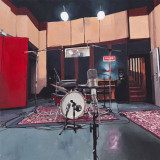
Leather-jacket krautrock? Indeed. Welcome to the world of Carrboro NC's Object Hours. These generous saviors consist of three Triangle scene lifers who all worship the riff but imagine what happens if the riff fell into the middle of your favorite CAN LP. Yes, it lives up to the hype.
"Solved By Walking" was recorded in the winter of 2025 at Betty's in the Chapel Hill woods, these are mighty rock slabs ready for all seasons. Rock believers have felt the ripples and knew the day was coming. Object Hours is a band that fits right in on stage alongside acts as varied as Kim Gordon and Tropical Fuck Storm, bringing the house down in these and similar moments. These are songs that groove, peel paint, sandblast, inspire unconscious movement, make your head bob - frequently all at the same time. These are the jams inspired by the time that you heard "Fun House" coming out of that dude's car with the windows down in the middle of the summer, the ones inspired by the kids who own 3 copies of "Daydream Nation," the ones who listen to the last 1:30 of Wire's "Too Late" over and over. This is the band that has a timer on stage so they don't keep each song playing for days on end, the band whose Bandcamp bio succinctly summarizes their approach thusly: "We try to keep songs under 25 minutes for your sake." Every word here should be inspiration for you to *want* and *need* to hear this record and every word here is true. Just you wait.
Real heads know and the rest of the heads are getting ready to find out. Get ready for Object Hours' "Solved By Walking".
Suche:object hours
Ambroos De Schepper and Pepijn Gyssels became roommates when PiP moved to Brussels in 2021. Both paid close attention to each other’s musical approach and interests. One year later, Ambroos moved out. When he swung by to pick up some boxes, they decided to record something for the fun of it. Between May '23 and November '24 they continued experimenting with textures and improvisations. This collaboration has become the deepening of a friendship and a way to maintain it at the same time.
PiP: “We would have coffee or the occasional beer and everything we recorded came very organically. Ambroos would just bring his saxophone, a clarinet, some FX pedals or a weird flute. Whatever he felt like on that particular day. A few hours later he would usually be on his way again, leaving me with the recordings. I could treat them as I pleased.”
Ambroos: “I liked the idea of working with someone focussing on the physical side of music. Not so much on chords and tonality, but on texture and atmosphere. This gave me a framework with less concrete references, using words like “dark” or “busy”. I could improvise freely and we would try and catch a particular moment."
“l’Esprit de l’Escalier” is meant to be a musical meditation, opening up a continuous and detailed sound palette, aimed for the right mental state to listen with. Ambroos came up with the melody in COVID times and later in PiP’s studio, they recorded it on clarinet.
“Sans Loup” is the first jam the duo did together, after Ambroos and Lou moved out of the apartment they shared. Lou Wéry eventually found her way back to the album, as she can be heard playing the wing piano in this track.
PiP: “We recorded in the apartment we used to rent together. Since the title track and the entire album are named after Lou being absent in this dynamic, it seemed only natural to invite her in a later stage.”
“Spring Whistle” was an attempt to embed Ambroos’ musicality in dreamy textures and “Bring Back Bones” was built around an endlessly evolving krakeb recording that PiP took home from on a trip to Morocco. Both tracks are not aimed to end or evolve drastically, they just make the clock tick slower.
To conclude this release, “Velours de Tendre” is built out of a deconstructed groove and a field recording of the “Ronde van Vlaanderen”, a small reference to the countryside where PiP grew up. The reverberating chords you hear are the echoes Tijn Driessen squeezed out of an old harmonium, in a staircase of De Grote Post in Ostend.
PiP: “During a residency in De Grote Post we recorded in a staircase with a spaced pair of omni microphones. And you can take ‘spaced’ quite serious; one was positioned 5 stories higher and the other 3 stories lower.”
Sans Loup is the first vinyl to release on PiP’s label. They look alike, but none will be identical. The cover is screen printed in various combinations + a risograph insert. A highly personalized object.
credits
Released on Zitstill Records
Recorded in Brussels, Horebeke, Morocco and elsewhere, between September 2021 - November 2024
Music, mixing and production by Pepijn Gyssels
Saxophone, flute and clarinet by Ambroos De Schepper
Grand piano on “Sans Loup” by Lou Wéry
Harmonium on “Velours de Tendre” by Tijn Driessen
Mastering and lacquer cut by Anne Taegert at Dubplates & Mastering
Pressing by Objects Manufacturing
Layout and graphic design by Liselotte Van Daele & Otis Verhoeve
Photography by Willem Mevis
Special thanks to: Stijn Cools, Victor De Greef, De Grote Post
E23 Records is an independent label from Amersfoort that releases music moving between electro, wave, EBM, and acid—sounds that feel familiar, but not quite at ease. Each release is built with care, made to be both an object to collect and a small joke at the universe’s expense. Patterns appear where they want to, chance plays its role, and sometimes the numbers line up in ways that feel more than coincidental. Tune in, and see what reveals itself.
E23 Records launches its catalog with three dark electro transmissions from Amersfoort residents Son of 8-Bits, Mavanov, and Law Of Fives. Opening with Son of 8-Bits’ “Deliverance”, the record sets an ominous tone: heavy bass pressure and sharp machine rhythms push forward with a cold, driving pulse built for late hours. Mavanov’s “Dark Romanticism” drifts into sparse, hypnotic territory, where cold mechanics meet faint traces of emotion. Law of Fives’ “Primer” closes the trip with an urgent workout that turns rhythm into a labyrinth—metallic strikes, pulsing bass, and restless sequences coiling together, building toward moments where chaos threatens to take over but never quite does.
Together, the three cuts form a statement of intent: E001 is moody, uncompromising electro with just enough strangeness to keep the floor on edge. A first chapter that hints at many more signals to come.
A mutant beat manifesto from Miami luminaries Jonathan Trujillo (Jonny from Space) and Pablo Arrangoiz (El Gusano, DJ Fitness, Baüzer Vep), Crespi Drum Syndicate’s Colada Talk follows the duo’s debut on Sonido Isla with a freshly freaked collection of percussive oddities. Rooted in foundational clave rhythms and avant-garde experimentation, Crespi Drum Syndicate emerges from the amphibious underbelly of Miami’s Latin-infused club scene with their singular electro-acoustic vision.
Extensive live recording sessions, free improvisation, and a ritualistic studio practice
— countless hours spent twisting and rearranging sounds from found objects and Buchla modular systems — coalesce into new rhythmic forms. Atonal saxophone, bass clarinet, and slide whistle further expand upon Trujillo and Arrangoiz’s ever-evolving sonic palette, while NYC’s AceMo lends a hand on the heavily syncopated “Siu,” and closer “Boubow” might be the duo’s most hook-driven production to date with its mangled pop vocal and lewd drum-line bounce.
Landing somewhere between Steve Reich’s polyrhythmic “Six Marimbas,” Moebius & Plank’s industrial Krautrock sessions, and Ricardo Villalobos’ hypnotic techno minimalism, Colada Talk delivers on a world of subtropical rhythmic futurism and experimental body music that’s as heady as it is culo-shaking.
For his last solo record ‘Through a Room’, Bill Nace shifted his usual saturated guitar sound and added tapes, hurdy gurdy, doughnut pipe, bird calls and the mysterious Japanese taishōgoto. Setting up for the final night of his three day residency at OTO with only the taishōgoto soundchecked, Nace hoped that Parker would arrive with his small soprano as its opposite. “I’ve been interested in state change, you know, playing until there’s a shift in time.” Known for his development of multiphonics to produce a constantly shifting pattern, Evan Parker has evolved an instantly recognizable sound - his work the soprano most distinct. Happily, it was the soprano Evan brought with him and as soon as the two start to play they entwine - taking off in a double helix of keys and reed primed for endless reconfiguration. Space warps under the velocity of playing, the pitch rising unrelentingly. It felt like unending lift off in the room, sheer energy until the last note makes remember your feet have been on the floor the whole time. Total time bending shredding.
–
"They had never played together before. They had never even met each other before this springtime 2024 concert at London’s Café Oto.
Evan Parker, circular breathing maestro of the saxophone, a legend in the universe that is Free Improvisation since the late 1960s and Bill Nace, one of the most intriguing experimental “noise” guitarists of the 1990s/2000s underground scene.
For those of us who have been enamored by the live and documented work of both these gents, this Café Oto duo was a must-hear event. It could have gone anywhere musically and that would have been totally fine. Particularly with Evan having a history of being thrown into a variety of challenging collaborations throughout his career, employing the learned elegance of trust in his own sensitivity to listening, responding, leading, following, sparring, intertwining, dialoguing, creating in the instant and, essentially, dignifying the non-hierarchical grace of chance.
The aesthetics of socialist consideration in Evan Parker’s playing, in his community of expanded and personal technique, for a younger player such as Bill Nace, strikes an exemplary model. This notion of respect would be entirely the reason Nace, when offered a residency at the most critical “new music” room in England, would request to play in duo with Parker.
Bill Nace came to prominence mostly during the apex of experimental music activity in and around Western Massachusetts in the early days of the aughts, with a focus on visual art and free improvisation guitar action. He could be found in the daytime hours, his head hanging down over a notepad, penning fine-tuned illustrations and abstract line drawings, while in the evenings he’d be attending any number of basement noise gigs, many of which he’d be participating in. His guitar style came across as being informed as much as by the physicality of his writing utensils in friction to the page as it was to his hearing and redefining of radical recordings ranging anywhere from the Black Unity Group to Black Flag.
Utilizing various metal files and other small cylindrical objects Bill would allow his guitar and amplifier to be in tandem with the improvisatory movements of his body as the instrument balanced, intentionally and, at times, precariously, upon his lap. The performances came across thrilling and daring and they would be mostly in the context of venues nothing more than a low-ceilinged damp and dank New England basement, a clutch of people hanging onto rusty pipes or sitting up on dilapidated washer/dryer machines, the shards of Bill’s “file guitar” sounds ringing out like the most alive music on Earth.
By the time Bill reached Café Oto in early 2024 he had relocated to Philadelphia all the while releasing a succession of collaborative LPs on his Open Mouth label to present his developing progression of solo and collaborative work. He also would find himself considerably engaged with playing the electric taishōgoto, a keyboard-activated string instrument from Japan which can exist as a one, two, four, five, or six string oblong sound object. Bill’s approach to the taishōgoto would not be too unlike his approach to the traditional electric guitar, though no outboard implements such as files, sticks, and rocks are utilized. The similarity would lie wholly with Bill’s full immersion of high velocity action-playing where, with the taishōgoto, an electric drone beauty occurs. The flurry of sonics and resultant harmonics emanating from the amplifier (which Bill opts to dial into with borderline loud-as fuck volume settings) furthers the meta-mantra properties of the instrument in an astounding display of drone dynamism.
This sound world of Bill’s two-stringed taishōgoto on this Café Oto night worked beautifully with Evan Parker’s improvisatory saxophone conceptions. The duology achieved instant lift off at ground zero only to find it’s eventual finale as if it were organically ordained. Time seemingly morphed from its ancient human construct of control, rendered inconsequential to the torrential transcendence of the room wildly activated by the magic resonance of the multi-directional pan-spatial sonance of the music as if it were some beatific blessing. It was one of those nights where art as a liberating force of spirit gifted the listeners with an offering of exaltation and joy. It was entirely mystical and mind blowing. A night of Total Music."
Thurston Moore, London, 2025
'Total Spook' mixtape is Artetetra's homage to the forgotten cassette and CD culture of mass-distributed commercial Halloween sound effects, horror tales, and spooky music productions across the eighties and nineties.
Mainly produced in the U.S. these objects featured some of the famous names of the entertainment and commercial industry such as Prince's Dr. Fink (yes, that synth master), Elvira, the Mistress of the Dark and Hallmark as well as unknown and anonymous creatives and artists. In these tracks engineers, musicians and producers arguably had carte blanche in experimenting with extreme samples and vocal manipulation, time-based effects, extended techniques, spooky sound fonts and stock sound effects developing their unique ideas around the sound ambience of the Halloween and horror imagery's campy cliches.
After digging around 30 hours of material gathered from dedicated YouTube channels and playlists such as the ones created by 'Beetlemuse' and 'Caleb Jones', I have compiled a 100' mixtape showcasing some of the most endearing, weird and experimental sound designs long forgotten in the vaporware-like consumer culture of the '80s and ‘90s.
- 1: Purely Physical
- 2: Keep On Moving
- 3: Insane (Tambourine Mix)
- 4: The Road
- 5: Id Do It For You
- 6: Everything Goes
- 7: Ex
- 8: Insane (Bass Mix)
- 9: Gimme A Blast
Repressed LP on Neon Orange Vinyl, includes download card. It feels like someone left the light on in the studio and it all just ran itself, there had been a funky human input earlier in the day but, by a Darwinian machine-led kind of osmosis, the tracks recorded spent the wee small hours self-reducing and simplifying themselves. Marinated in music. “I believe more in the scissors than I do in the pencil,” said Truman Capote. ”Simplicity is the ultimate sophistication,” opined Leonardo da Vinci much earlier in proceedings. Yes, it’s the space around the object, what you leave out that makes what you leave in so important. ESG know this. Sure they can play the game but it’s the swagger of the groove and the minimal topping – like an anti-cup cake – that makes this unique New York sisterhood so appealing on ‘Keep On Moving’. Sampled on TV ads, lauded by critics and swooned over on the dancefloor, ESG’s post-punk took out the grunge and polished the basics. Cut them open and “less is more” is written all the way through. ‘Keep On Moving’ was released over ten years ago to much praise (Q said it was “even better” than 2002’s much loved ‘Step Off’). ESG had been sparring partners for PiL and early hip hop and four years after the ‘Off’, they were onto something new – rhythm as core, reflective storylines about relationship management, sensuality and insanity gather around the bass fix but they’re much blurrier than the incessant beats. Inadvertently they unmask techno and glitch and leave out any kind of superfluous fluff. It’s hard and temple throbbing. Turn it up. And keep moving. “If there's one tune which sums up ESG's enduring lust for life, it's the beautifully-judged Black Flag/early techno crossover of the closing 'Gimme A Blast'.” The Guardian 5/5 // “This album's every percussive aspect has been honed to impart the maximum amount of pleasure.” The Observer // “Despite their influence on younger bands (you can hear LCD Soundsystem's knobbly grooves on ‘Insane’), ESG still sound like nothing else.” The Guardian
Portland-based ambient architect and far afield sound technician Graintable, aka James Cooke returns with his debut outing on Music To Watch Seeds Grow By and his fourth in the R$N stable; 'Blue Flax'. Following his acclaimed and sold out cassette releases 'Herons', 'Universal Ash' and ‘The Rain In The Trees’ on Ransom Note Records, this new collection sees Cooke delving deeper into the intersection of natural processes and liminal organic electronics.
'Blue Flax', the resilient flowering plant celebrated for its delicate blue blooms and medicinal applications, is native to the Pacific Northwest - the region Cooke calls home. This plant has long grown on the ancestral lands of the Wasco, Klickitat, Warm Springs, Cayuse, and Umatilla tribes. Its connection to this landscape underscores the album’s themes, weaving together ten intricate ambient pieces that reflect the plant's dual nature of part healer, part object of wonder. Recorded during the transitional hours of dawn and dusk in his Portland studio, Cooke’s soundscapes capture both the meditative aspects of watching plants grow and the gradual transformation of organic matter into usable forms. The centrepiece of the album Cerulian FIelds, reminds of the early morning light, those inspiring hours before the rest of the world wakes and the first shoots break through the soil into the new dawn. It’s a beautiful crystallisation of what is Cooke’s most comprehensive collection of meditative compositions to date.
For fans of: Steve Roach, Alessandro Cortini, Suzanne Ciani, Davis Galvin
Early support including: Courtesy, Laurent Garnier, Massimiliano Pagliara, DJ Harvey, Domenic Capello
The 2015 edition of Winnipeg’s send + receive festival, focussed on rhythm, turned out to be a generative meeting of minds. There, Mark Fell encountered the music of Will Guthrie, a meeting that was eventually to result in the frenetic acoustic drumkit and digital synthesis pairing heard on Infoldings and Diffractions (2020). At the same festival, Limpe Fuchs first heard and appreciated the music of Mark Fell, planting the seed of a collaboration that came to fruition when Fell (along with his son Rian Treanor) visited Fuchs at her home in Peterskirchen, Germany in September 2022. Black Truffle is pleased to announce the release of the results of this extensive session in the audacious form of a triple LP, housing over two hours of music across its six sides. The collaboration might appear unlikely: what common ground could exist between Fuchs, classically trained pianist, legend of improvised music, instrument builder and sound sculptor active since the 1960s, whose group Anima Sound connected the dots between free jazz, krautrock and ritual, and Fell, proponent of radical computer music, known for his bracingly austere productions that twist remnants of club music into algorithmic stutters? For all their seeming disparity in technology, approach and background, the music on Dessogia/Queetch/Fauch makes it immediately evident the pair share a great deal in their essentially percussive approach and ability to, in Fuch’s phrase, ‘establish silence’. Recording at her home studio, Fuchs had the use of her entire array of instruments, found, invented, and traditional, and treats the listener to some that don’t often make their way to concerts, including extensive passages performed (with Gundis Stalleicher) on pieces of wooden parquetry. Alongside metallic, wooden and skin percussion of all kinds, sounded and struck in every conceivable way, we also hear bamboo flute, viola, and Fuchs’ distinctive free-form vocalisations. Fell also stretched himself, with his contributions ranging from characteristically fizzing pitched percussive pops to swarms of sliding tones and abstract digital noise. Showing both remarkable restraint and improvisational freedom, much of the music consists of duets between a single percussion instrument and a distinctive mode of digital sound, often lingering in one timbral-rhythmic space for minutes at a time. Improvisational forward momentum coexists with a free-floating, wandering quality. On opener ‘Dessogia I’, the shimmering almost-gilssandi tones of Fuchs’ enormous set of microtonally tuned metal tubes ripples across Fell’s rubbery pulse, which moves up the frequency spectrum as Fuchs becomes more animated and switches to horn. At some points, as on the metallic chiming tones that open ‘Fauch I’, only the unexpected dynamic behaviour of Fell’s sounds distinguish them from Fuchs’ acoustic instruments. At others, like on ‘Queetch III’, the waves of sliding tones and noise textures are bracingly synthetic, joined by piercing squeaks and scrapes from Fuchs’ metal objects. Epic in scope, immersing the listener in an entirely distinctive world of sounds, and thrillingly bold in its melding of the most ancient musical procedures with cutting edge technologies, Dessogia/Queetch/Fauch is an unexpected major statement from two of the great mavericks of contemporary music.
Khôra is the medium Matthew Ramolo uses to delve deeply into initiatory world-building by way of sound, image, and lyrical prose. Figuring wholly realized art-myths which distill and rouse the numinous while provoking the visceral and cathartic, Khôra intricately collages studio documents of ritualized instrumental performances, introducing overdubs by transient, heteronymic personae which dismantle stable points of reference in the music and open uncommon planes of consciousness.
"Gestures of Perception" is Khôra’s first double album with a supporting artbook and features a fascinating array of sources subjected to patterned assembly, poetic layering, and the elevations of the heart. Deft handling of modular synthesis is palpably central, while feedback, erhu, keys, flute, contact electronics, guitar, field sounds, and various percussion objects (rattle and frame drums, seed pod sticks, random metal objects, meditation bowls, kalimbas, bells) all serve to provide breathing structures and energetic contours that guide and scaffold inner and outer journeys into the far-near. Prominent across the record's span is a home-built, solenoid drum machine, responsible for the alive and askew techno-archaic flows and conceived as the album’s "rhythm seed”. The music on Gestures is teeming with organic and alien textures, soaring drones, inter-dimensional noises, and emotionally resonant melodies; balanced on the fringes of exotica and meditative trance, with capacities that untether the listener from the ballast of limited reality.
Operating hermetically in the penumbra of Toronto's cultural scene for well over a decade, Khôra has been invested in self-publishing handcrafted editions of spiritually driven recordings which led to the LP/CD reissue of inaugural album "Silent Your Body Is Endless" by Constellation. Khôra has toured extensively in North America and Europe both solo and in collaboration with Picastro, Nick Kuepfer (Hrsta,1/4 Tonne), and Brandon Valdivia (Mas Aya, Lido Pimienta), generated over a hundred hours of unreleased, bewildering drone through durational performance with experimental outfit Nidus (Marc Couroux, Jason Doell), composed for live dance and independent film, been commissioned by MaerzMusik, and seeded and co-run the now defunct music and art venue Ratio in Toronto.
Les yeux grands fermés is a spontaneous new EP that is an ode to freedom, both in the creative process and in everyday life. This opus depicts the rather raw feelings of a young artist who had a tough time of it when he was starting out, and who is now finally experiencing the success he had been hoping for. More liberated, the protagonist is now enjoying a new life: a more freestyle lifestyle full of surprises and lightness, with days governed by studio sessions, parties and carnal relations... all the while keeping his feet firmly on the ground and his goals firmly in mind! In terms of songwriting and production, Les yeux grands fermés is an improved blend of ABSOLEM's last two projects, Leur dire and Balle d'Argent, featuring both their introspective songwriting, here even more touching, and their arrogant, second-rate side. ABSOLEM continues the journey begun on Balle d'Argent, a project in which the rapper discovered himself to be more than ever in harmony with his music (spontaneity, introspection, fluidity of text) and less concerned by all the external factors (industry, the race for numbers, social networks, pressure, etc.), social networks, pressure, etc.).
Produced in a very short space of time, Les yeux grands fermés is a highly intuitive and spontaneous project with some tracks created from scratch in just a few hours.
Entirely produced, recorded and mixed by Dee Eye in their cellar-home studio, the project retains the 'live' touch. studio, the project retains the 'home-made' touch that characterises the duo and which they are constantly perfecting. The featuring with JeanJass, who is very close to the duo, was just as natural, having worked with with Dee Eye and advises them on the creation of their projects. projects. The result is a track with a very intimate theme (esotericism and introspection), which takes the form of an astral journey.
Project after project, the chemistry between ABSOLEM and Dee Eye grew stronger and stronger and the main objective remains the same: to break new ground in every area production, writing, interpretation, mixing and mastering). Continuing to continue to work on a number of projects on their own, Dee Eye continues to progress experience and a keen eye in the artistic direction of ABSOLEM's projects. projects. With quality, consistency and efficiency always in mind and efficiency, ABSOLEM and Dee Eye are increasingly asserting their desire to create their own musical colour, a sort of hybrid between Slowthai and Asap Rocky with and Asap Rocky, with innovative production and flows, featuring rap lyrics.
Five groups, one mythical studio - documenting the emergence of a generation!
The initial postulate was simple: five groups, one emblematic studio and 24 hours for each to imagine and record two unreleased tracks with one objective - the will to document a French jazz scene in the midst of renewal.
In these last few years, several innovative currents have shaken up the world of jazz and attracted new fans. They have bubbled up from Los Angeles, impregnated with hip-hop culture (Kamasi Washington, Terrace Martin, Thundercat), or from London, tinged with African rhythms (Nubya Garcia, Kokoroko, Ezra Collective). Meanwhile, in France, a new scene is emerging, carrying with it more of a dancefloor-oriented sound influenced by electronic music - an obvious kinship with the French Touch explosion of the late 90s.
Historically, every movement has been assimilated to a certain neighbourhood, to specific clubs where late at night, young guns stayed up to imagine the jazz of tomorrow - the Cotton Club for the jazz of the 20s, Minton’s Playhouse in Harlem for Be-Bop, the Black Hawk in San Francisco for West Coast jazz, Birdland in New York for Hard-Bop or a lot more recently, the Total Refreshment Centre which has been the playing field for the new London scene.
In Paris too, this new sound is associated with actual venues, places which have allowed these groups to form, create a repertoire and forge an aesthetic - Le Baiser Salé for Monsieur Mâlâ, La Gare/Le Gore for Photon, La Pêche in Montreuil for Ishkero, La Petite Halle for Underground Canopy and also le Duc des Lombards and le 38 Riv’ for Alex Monfort; it’s in a live context that this music will always continue to evolve.
Keeping this “live” spirit, with all its spontaneity, was actually the guiding line for the elaboration of this Studio Pigalle compilation. Each take was recorded in the most organic way possible, bringing all the musicians together in the same room to limit post-production alterations before the final cut was assembled, in just one day, by studio in-house sound engineer, Felix Rémy.
A feeling of urgency permeates a record guided by an artistic production taking care to crystalise the essence of this artistically free-range generation whose childhoods were rocked just as much by Bill Evans and Roy Hargrove as by J Dilla and Jeff Mills. One of the two tracks recorded is geared towards the dancefloor, and the other, more cosmic/ambient gives freer rein to individual interpretation.
There were therefore many possible ways of interpreting these guidelines for the five formations which number among the most distinctive on the current French musical landscape, and the occasion, for some, to rummage through their archives! With Transe (Mbappé) and Da Verdere (Vella), Monsieur
Mâlâ present us with two unreleased tracks issued from the very first rehearsals of the quintet reworked especially for this compilation. “Seen the aesthetic range of this group, it all worked out very naturally in the studio”, recounts keyboardist Nicholas Vella “Recording like they did in the sixties with all the channels live and working with small imperfections was a very interesting task, even when it came to the mix, we had to make do with the takes we had... “
“Our group is very recent, and with this session, in just two tracks, we had the opportunity to present the entirety of our musical universe,” says Photons pianist Gauthier Toux. “All too often, we assimilate this fusion between jazz and dance music to computers and post-production modifications. For “Dessine”, we kept the first take, and we must have recorded just three or four for the other track with more of a techno bent. In one day, we understood that we could play our entire repertoire live, from A to Z”.
“When the Komos label offered me this project, it immediately spoke to me”, remembers Alex Monfort “Straight away, I thought of “Since I Met You”, a track with a nine/four time signature which really is reminiscent of a new- soul groove, but with this extra cosmic vibe! I wrote the words to the chorus and Nina Tonji placed her voice on the track, adding her own verses. For “Tonight”, the up-tempo track, I wanted to head off in more of a hybrid direction inspired by Kaytranada or the Black Radio series by Robert Glasper. A cross-over between jazz and hip-hop which really does represent my world, and I also tried to place vocals centre stage (Emcee Agora)”.
“We truly resonated with the way Antoine Rajon imagined this compilation and the recording session”, confide Warren Dongué and Jérémy Tallon from Underground Canopy. “When arriving in this studio we felt as if we had gone backtothe70s! Inkeepingwiththespiritofthisera,heknewhowtoletus keep our spontaneity, without recording in too many takes, and that’s how we like to work”.
“We managed to adhere to the themes of the compilation without changing our instrumentation, we wanted to remain faithful to the sound of Ishkero on these new compositions and take them somewhere else” – says drummer TaoEhrlich -“Withoutaddinganyelectronics.Thesessionwassupervisedin a truly subtle and benevolent manner. From a human perspective, it was also a wonderful experience”.
Whether turned towards hip-hop, ethnic or electronic music, the artists featured on this Studio Pigalle compilation represent the eclecticism of a new generation in the process of writing the first chapters of its history. Open to experimentation, these artists continue to hold high an immutable love for improvisation and creation in the moment... another definition of the word Jazz!
Marc Richter aka Black To Comm released his debut record 20 years ago. In 2023 he is still busy releasing music under various disguises and is currently signed to the Thrill Jockey label. To celebrate this anniversary his own Cellule 75 label is re-releasing some classic out-of-print vinyl albums that originally came out on the defunct Type and De Stijl labels. The LP will feature a full-colour printed inner sleeve exclusive to this edition.
In 2009 the Type Recordings label run by John Twells had just released seminal records by Grouper, Jóhann Jóhannsson and Yellow Swans when they signed Richter and put out his breakthrough Alphabet 1968 album. The LP sold out within two weeks, receiving a glowing full-page review in The Wire Magazine by the late Mark Fisher (later reprinted in his book Ghosts Of My Life), was selected for Boomkat's Top 10 releases of the year (alongside debut albums by Leyland Kirby, Demdike Stare and Oneohtrix Point Never) and was greeted with universal praise in the underground blog network as well as established magazines such as The New Yorker and Pitchfork.
The music itself played with the notion of nostalgia without being nostalgic itself. It's the sound of half-remembered dreams, a surreal distorted vision of the past, an aural polaroid of long forgotten musics, a ghostly voice from a non-existent era.
From the original Type one-sheet:
"The mission statement for Alphabet 1968 was to write an album of "songs" for want of a better word. Short tracks which represented genre points, the milestones which stuck in Richter's mind when he thought back to his favorite records. What we arrive at is a breathtaking 10-track album which, over the course of 45 minutes, explores world music, techno, noise, avant-garde, ambient music and even exotica. Each track is linked with a loose thread of radio static or environmental sound, dragging you through the album, as if tuning in to a stray broadcast or a particularly adventurous mix. Richter has pieced the album together from hours of recordings made at his studio with home made gamelan, small instruments and loops gathered from a collection of ancient vinyl and 78 records. The scope of the album is admirable, but ignoring this, it is simply a shockingly arresting collection of experimental oddities, with references ranging from Moondog to Basic Channel by way of Bernard Herrmann. It's not hard to fall in love with Alphabet 1968, far harder would be to place exactly where the record should fit into your collection."
Mark Fisher in The Wire:
"But what if we were to take Richter's provocation seriously - what would a song without a singer be like? What would it be like, that is to say, if objects themselves could sing? It’s a question that connects fairy tales with cybernetics, and listening to Alphabet 1968, I’m reminded of a filmic space in which magic and mechanism meet: JF Sebastian’s apartment in Blade Runner. The tracks on the LP are crafted with the same minute attention to detail that the genetic designer and toymaker brought to his miniature automata, with their bizarre mixture of the clockwork and the computerised, the antique and the ultramodern, the playful and the sinister. Richter’s musical pieces have been built from similarly heterogeneous materials - record crackle, shortwave radio, glockenspiels, all manner of samples, mostly of acoustic instruments. ….. JF Sebastian's apartment was itself an update of older spaces in which science and sorcery co-existed: the workshops of ETA Hoffmann's inventor-magicians, or of Pinocchio's creator, Geppetto. I think, too, of Auguste Villiers de l'Isle-Adam's astonishing 1886 tale The Future Eve in which Edison, using the expertise he has recently acquired from inventing the phonograph, sets himself the task of constructing an artificial woman. But if there are songs here, they are sung by the gramophone and other recording and playback machines. Richter so successfully effaces himself as author that it is as if he has snuck into a room and recorded the objects as they played (to) themselves. Rather than simply automating his music, as in the case of Pierre Bastien and his mechanical machines, Richter makes us feel that he has merely recorded the unlife of objects. ….. Indeed, the impression of things winding down is persistent on Alphabet 1968. Entropy has not been excluded from Richter's enchanted soundworld. It feels as if the magic is always about to wear off, that the enchanted objects will slip back into the inanimate again at any moment."
Murmer is the long-standing project for Estonian field recordist and composer Patrick McGinley, and in Tether, The Helen Scarsdale Agency welcomes Murmer back to our roster, over a decade since he graced us with his last production for the Agency. His field recordings often center upon the amplification and activation of resonance from a particular space, landscape, or object. Such sounds emerge from a condition as begin fleeting, inconsequential, or ephemeral and explode into that which alien, sublime, and profound. Here lies the tremendous prowess of the contact microphone, as wielded by an accomplished musician! The source material cited by McGinley includes cables, fences, wires, and vents.
There is a heft to many of these sounds as heard throughout all of "Taevast" with deep throbbing pulsations from arctic wind generating subharmonic patterns upon thick high-tension wires. Elsewhere the subtle dissonance from a rasping cooling fan blooms into a brooding ambience that is sublimely rich in its metallic timbres and complex reverberations. McGingley has long been an exemplary artist in the field of phonography even as he is less prolific than others. On Tether, he has produced a majestic if occasionally foreboding work on par with the mythic wire recordings of Alan Lamb, Jacob Kirkegaard's haunted resonance from Chernobyl, and much of the Touch catalogue for that matter!
Patrick McGingley on Tether:
In 2006, I made a collection of recordings at a mobile phone mast in Mooste, southeast Estonia. It is a guyed tower, 80 meters tall, affixed to 3 support points with heavy cables. I attached my self-made contact microphones to these cables with poster tack, and spent many hours over several weeks recording the various wind and weather variances (it was summer), and the birds that passed or settled on the tower or cables. This was one of my first visits to estonia, where i now live, and one of the things that marked me about that experience was the access: the tower had no fences or protections around it (I have not been back there recently to answer my own question of whether or not this is still the case); it stands in the middle of a field of tall grass along a dirt road in the countryside, just out of view of the few nearby houses, and during all the hours I spent there I was never disturbed or shooed away.
For more than 16 years, I have been thinking about this location and these recordings, and have made several attempts to work with them. I have used the sounds in installations a handful of times, and uploaded one short edit to the Aporee soundmaps, but have never managed to use them in any composed work. They always seemed too big for any structure I could provide them, whether I left them on their own, or partnered them with other sounds. Finally, in 2019, after putting them down and picking them up again repeatedly over so many years, they seemed to allow me in, although it took me another few years before they were happy with what I could offer. They stand now not quite alone - the majority of the layered sounds in the piece come from various edits of those cable recordings, but I added two other contrasting sounds, related to one another: one is snowflakes landing delicately on a plastic cakebox with microphones inside it, and the other is a frosted field of grass thawing on a lightly warming autumn morning (both these recordings can also be heard on their own on the Aporee maps).
Coming back to those cables brought to mind so many other wind-driven sounds that I had spent time with and recorded, but never returned to, that I began digging through my archives looking for them. I ended up with a pool of sounds from resonant wires, cables, fences, poles, fans, and vents, which became the basis for the 2nd work on this release. One of these sounds is among the first sounds I ever recorded, possibly within a month or so of buying my first microphone and minidisc recorder: the rhythmic fan of a beer cooler in a pub where I worked in North London in 1999. Other sounds in the piece include another phone tower, recorded on the northern coast of France in 2008, a telephone pole recorded in the Beaujolais region in 2010, the drone of ventilator fans at a factory in Tezno, Slovenia in 2012, an electric sheep fence in the Scottish borders in 2013, a hanging wire in a storage space in Rovaniemi, Finland in 2016, and, with no relation to cables or wind at all, calcium deposits being cleaned from the inside of an electric kettle here in Estonia in 2019.
I offer these two new pieces as my first solo publication since 2018, the first release on a physical medium since 2016. No one has ever accused me of working too fast, or being too prolific. I have a need, it seems, to leave a physical space of time around my work, before I can consider it 'finished'. Perhaps it is a simple need to forget how I did something, or that I did something; perhaps I have a need to be able to hear a work as a first-time listener would, before I can consider it ready for such an encounter. In some part of my mind I have to forget it before I can let it go. Well, I've just about forgotten that London beer cooler now, and that walk in the Beaujolais (with my father, who has since passed away), and that sheep fence next to our campsite in the borders, and that kettle that is now leaky. So I guess it's time.
Available from Blank Forms for the first time since its original 1980 release on ALM-Uranoia, New Sense of Hearing documents a collaboration between Takehisa Kosugi and Akio Suzuki, two luminaries of Japanese experimental music in the lineage of Fluxus. Blank Forms's high-quality reissue of the sought-after, long out of print LP, is produced by musician-artist Aki Onda and mastered from the original tapes recorded on April 2, 1979, at Tokyo's Aeolian Hall. Described by Suzuki as the "culmination" of their sound,New Sense of Hearing features the two musicians improvising together in that empty Tokyo theater, Kosugi on vocals, violin, and radio transmitter and Suzuki on the Analapos, his namesake glass harmonica, spring cong, and kikkokikiriki, all apparatuses of his own invention. Suzuki and Kosugi first met at the city's Minami Gallery in 1976 on the occasion of "Sound Objects and Sound Tools," an exhibition of Suzuki's homemade instruments. Two years later, at the Festival d'Automne in Paris, Suzuki invited Kosugi to join him for a suite of performances as part of the exhibition "MA: Espace - Temps au Japon," organized by architect Arata Isozaki and composer-writer Toru Takemitsu. Suzuki and Kosugi performed together at the Musée des Arts Décoratifs, Paris, nearly fifty times, honing their approach to mutual improvisation, before traveling with the exhibition to Stockholm and New York_critic Tom Johnson wrote in the Village Voice that he had "seldom seen two performers so completely tuned in on the same types of sounds, the same performance attitude, the same philosophy, the same sense of what music ought to be."For New Sense of Hearing, the duo reunited in Japan and produced an extraordinary dispatch from their collaboration of arioso violin, echoing vocals and bangs, and metallic twangs. As Johnson observed in 1979, Kosugi and Suzuki are "in a very subtle artistic world where there can be no direct relationships. . . . Only coincidence." Takehisa Kosugi (1938-2018) was a composer, artist, and violinist from Tokyo. In 1960, Kosugi founded Group Ongaku, the country's first improvisational performance collective dedicated to Happenings, with Mieko Shiomi and Yasunao Tone. Four years later, Fluxus leader George Maciunas published Events, an eighteen-piece set of his text compositions. Between 1971 and '74, his band the Taj Mahal Travelers produced four live albums. In 1977, the Merce Cunningham Dance Company invited Kosugi to be their resident musician; from 1995 to 2011 he served as the company's musical director. The Whitney Museum of American Art presented "Takehisa Kosugi: Music Expanded," a two-day retrospective of Kosugi's work, in 2015. Akio Suzuki (b. 1941) was born in Pyongyang, North Korea, to Japanese parents. For the artist-musician's first Fluxus-style work Kaidan ni Mono wo Nageru (Throwing Things at the Stairs), 1963, Suzuki tossed a bucket of miscellaneous objects down a flight of stairs in Nagoya Station and listened to the sounds it produced. During the next decade, he would create original instruments including the Suzuki-type glass harmonica and the echo instrument Analapos. In 1976, Tokyo's Minami gallery hosted his first exhibition, "Akio Suzuki's World: Sound Objects and Sound Tools." For his 1988 performance piece Space in the Sun, Suzuki spent twenty-four hours listening to his surroundings on the meridian line which runs through Amino, Kyoto. Suzuki has performed and exhibited at many venues and music festivals, including Documenta 8 (Germany, 1987), the British Museum (2003), Musée Zadkine (France, 2004), Kunstmuseum Bonn (Germany, 2018), and the Museum of Contemporary Art Tokyo (2019).
Status/Non-Status have spent untold hours gazing out the passenger
side windows of a succession of band vans, watching the country go by
That feeling of observing from a moving object, being somehow both in a place
and outside of it, looking in, is what the band captures on Surely Travel. The
album is a travelogue; a series of snapshots, rooted in history and landscape but
relentlessly looking forward, through the windshield, straining to see what might
be waiting just around the next bend in the road.
Surely Travel trades the band's long-established sludgy, heavy sound (as heard on
2019's Polaris Prize nominated album Warrior Down, released under the band's
previous name Whoop- Szo) for a bold musical clarity and powerfully narrative
lyrics, intense truth seeking, and a heart on the sleeve expression.
Status/Non-Status follow up the 1,2,3,4,500 Years EP and Ombiigizi, band-leader
Adam Sturgeon's collaboration with Zoon, with the anthemic and powerful Surely
Travel.
Black vinyl pressing of the now sold out RSD 2020 reissue.
Cascade was originally released oct 1993 the first single from the now highly regarded LIFEFORMS album. Cascade went on to chart in the UK top 40 at No.27 and has continued to be regarded as an early piece of classic Electronica. Twenty-seven years later FSOL rebuild and create ten new compositions inspired by the original. The familiar electronic swamp of FSOL and engineer Yage can be heard as the tracks journey through fragmented melodies of the original composition.
Cuernavaca / Stateville / Frankincense And Myrrh / Apsara / Ancestral / Spin / Zincali
Approaching his eighty-fifth birthday, sharp and lean, Phil Cohran lives a couple of blocks from the lake on the north side of Chicago. His modest apartment is filled with a palpable richness. His cornet and trumpets, zithers, French horn, harp and frankiphones (an electric kalimba of his own invention); his beloved telescope; African art; a mural of the Chinese monastery where Muslim monks bestowed on him the name Kelan ('holy scripture'); hand-printed posters from the culture wars of 1960s Chicago; all reflect a life dedicated not just to music, but also to science and astronomy, to history and activism. In its range of subject matter the track-list of Kelan Philip Cohran & The Hypnotic Brass Ensemble embodies this invigorating and all-embracing curiosity: a Mexican hill-town filled with perfume and flowers... an Illinois state prison where Cohran taught inmates in the 1960s... heavenly dancers in the temples of Cambodia... a tribute to a sixteenth-century Venetian musicologist. Welcome to the musical world of Kelan Philip Cohran.
Cohran was born in Mississippi and grew up in St Louis. In the immediate post-war years St Louis was a jazz heartland, home of stalwarts like Clark Terry and Oliver Nelson (both of whom he played with), not to mention a genius called Miles Davis. In 1950 Cohran moved to another heartland, Kansas City, where he played trumpet in one of the hardest swinging swing-groups, led by Jay McShann (who famously had given Charlie Parker his first job). With McShann he spent 'the best year of my life', touring as far as Mexico and playing proto-rock'n'roll in Texas with the likes of Big Mama Thornton on vocals. Back in St Louis Cohran led his own group, the Rajas Of Swing, whose show involved wearing red jackets, grey slacks, blue suede shoes and turbans.
Then in the mid-50s he moved to Chicago. He had a small group with a friend, the legendary tenor saxophonist John Gilmore, whose regular gig was to play at Sarah Vaughan's weekly 'birthday' parties, an excuse for the Sassy One to splash the cash and have some fun. ('What, Sarah Vaughan would sing with you and John Gilmore' 'No way, Sarah didn't sing, she was too busy partying.') And in 1959, through Gilmore, he was invited to join Sun Ra's Arkestra, at a crucial period in the evolution of that extraordinary group. Effortlessly wrapping traditions as divergent as boogie-woogie and electronica in an Afro-centric, intergalactic mythology of his own making, Sun Ra casts a huge shadow across conventional narratives of jazz history. 'With Sunny', Cohran simply says, 'I found my own voice'.
You can hear the emergence of this voice on the LP Angels And Demons At Play, recorded in 1960 - Sun Ra's masterpiece from the period. On the track Music From The World Tomorrow, against the urgent whipped and chopped percussion of the Arkestra, it is Cohran's zither, initially bowed and then plucked and strummed, which is the track's magic ingredient. More profoundly it was Sun Ra's example - his defiant self-confidence and sense of purpose - that set Cohran on his own (to quote another Ra composition) 'pathway to unknown worlds'. Indeed this spirit of self-belief led Cohran to turn down the invitation to accompany the Arkestra when Sun Ra moved east in 1961.
Staying in Chicago, Cohran founded the Affro-Arts Theater and performed with the Artistic Heritage Ensemble, recording the group for his own Zulu Records imprint. (Co-members went on to become Earth Wind & Fire; Cohran taught the group's leader Maurice White the mysteries of the frankiphone). The AACM, a musicians' collective of immense influence and importance, had its first meeting in Cohran's front room. With Oscar Brown Jr and Gene Page he wrote and performed in a show celebrating the nineteenth-century Afro-American poet Paul Lawrence Dunbar. He taught music tirelessly in schools and prisons. His studies into music theory and history led him to the discovery of a key book in his life, Gioseffo Zarlino's treatise on harmony, published in Venice in1558. Astronomy is another passion and another area of expertise. One of the gems of the Cohran discography is African Skies, with its lovely harp playing, commissioned by the Chicago Planetarium in 1993.
In Chicago he also raised a large family. Many of his children have gone on to become professional musicians; eight of them are the Hypnotic Brass Ensemble. For each of them, their first teacher was their father, who famously insisted on giving them music lessons not just for several hours after school, but for several hours before school as well. Their father's music was all around them as children; they all vividly remember lying in bed at night not being able to sleep because their father was rehearsing with the Jazz Workshop downstairs.
For the Hypnotic Brass Ensemble, the voyage to where they are now - whether tearing up festivals from Glastonbury to Melbourne, or touring with Gorillaz, or recording their first album on Honest Jon's - has involved a necessary stepping away from their father's shadow. Phil Cohran is the first to recognise this, happily allowing their sound - heavy on the funk, with the urgency of hip hop never far away - to blossom.
But likewise this album is for all of them a natural step. Recorded in Chicago in June 2011, the idea was beautifully simple - 'my music and their band' as Phil puts it, 'we don't have to rattle on more than that'. Only to point out perhaps that here - in the majestic surge of Zincali, for instance, or in the sheer verve and bounce of Cuernevaca - is music not just filled with the warmth of home. This is music that plumbs the depths and rings with joy.
'Cuernevaca is a town in the mountains south of Mexico City. I was there in 1950 when I was on the road with Jay McShann's band. It's a place close to paradise, a city filled with the fragrance of flowers. I always wanted to go back... In 1974 I taught workshops at the prison in Stateville, the Big House where Al Capone spent time. There's a huge wall around the prison, and once I took Hypnotic there - ha - to see what the future holds for them... Makeda, the Queen of Sheba, sent a caravan of gifts to King Solomon - a caravan that took more than a day to pass one point - and the main gifts were Frankincense And Myrrh... I wrote Apsara in 1967, when Jackie Kennedy was in the news with her visit to the temple of Angkor Wat in Cambodia. Apsara were celestial beings, dancers who brought forth the civilization of ancient Cambodia, by dancing in the holy nectar called Amrita... Ancestral is a meditation drone written for my Friday-night residence at the Ethiopian Diamond Restaurant in Chicago's Rogers Park... Spin is the latest of these compositions. Everything in the cosmos spins, from the smallest objects we can see in a microscope to the largest galaxies. Spin is the motion of all things whether it looks like it or not... Zincali is a name Spanish gypsies call themselves. 'Zin', East Africa; 'cali', the people. One of the offshoots in my research into Moorish Spain has led me to Gioseffo Zarlino, the sixteenth-century master of music at St Mark's in Venice. It's said that Bach lost his sight reading Zarlino's treatise on counterpoint. His greatest composition is his setting of the Song of Songs - 'Nigra Sum', 'I am black'. This is my tribute to Zarlino and to the zincali.'
Orions Belte: «Villa Amorini» Jansen Records 2021 Do you remember the time the doorman ran after some drunken kids around the lake outside the club? As he dives into the lake, he scrapes his stomach on a sharp object in the water, but catches up and returns with one youth under each arm. At the same time the singer from the band playing inside, jumps from the loft hoping that the chandelier he grabs will hold him. It doesn’t. Endless afterparties and constantly trying to avoid visits from the police or the liquor control. Still nothing? This was the 90’s club scene in Bergen, and Villa Amorini was the place where everything happened. Starting as an 80’s fine dining spot, it evolved into an extravagant club with tons of artists and DJ’s in screaming shirts and oversized sunglasses. This sets the scene for Orions Belte’s second album. Still a mix of all the sounds they like, reminiscing eras they haven’t experienced, trying to navigate in their own musical atmosphere. Chaotic and calm at the same time. Villa Amorini is recorded at Norsk Riksstudio by engineer Njål Paulsberg, making sure the sounds were on point while leaving the band alone to play together for hours upon hours, chiseling out the base for the album. Where the debut was summery and a bit brighter, this album tends to lean a bit more towards the big city, night life and leftover food from the fridge. Mixed as always by the magnificent Matias Tellez.
Though synthesizers are the backbone of Shen’s music, while performing live, she plays self-made synths, invented instruments, and even acoustic objects like a bull whip.
Her live show vacillates between moments of restraint and swells of frenetic and confrontational movement. Her sound is dynamic with a sensitivity to texture and structure throughout. This sensitivity is maintained in her debut LP
Hair Birth, the result of several weekends locked in a studio creating cacophonous, wondrous synth noise with Harvard’s Buchla 100 and Serge modular systems.
She tracked hours of stems before cloistering herself in a painstaking editing process. Songs like ‘Under The Stall Door’ sound like a cybernetic rollercoaster with rumbles and shrieks that hurtle the listener through virtual space. Others, like ‘Bolete,’ are tense, dense mood pieces that move from the queasy to the tranquil to the surreal.