Repress
Nina Kraviz launches her (pronounced 'trip') label with a double-EP compilation entitled 'The Deviant Octopus', featuring a pair of brand new productions from Kraviz alongside material from Terrence Dixon, emerging talent Parrish Smith & Bjarki, and veteran producers Exos & Steve Stoll.
The idea for has been gestating for some time with Nina Kraviz, an avid crate-digger and frequenter of numerous second-hand record stores, who has long wanted to begin a label of her own which would build on some of the principles of her beloved 90s techno labels in terms of attitude and aesthetics, whilst looking for forward-thinking modern productions that reflect her core tastes for idiosyncratic electronic music.
The art and title of 'The Deviant Octopus' comes from a single-sentence scenario dreamt up by Kraviz: 'Without a moment's notice an Octopus appeared and devoured everyone in sight'. Supplied with this scenario, artist Tombo rendered his own unique visualization for the artwork that adorns the release sleeve. It's Kraviz's own nod to the labels that inspire her and grab her attention while digging through second hand records, the best of which were imbued with the unique personality of the people behind them. This extends to the sound Kraviz intends for : dusky, divergent and trippy music to stimulate brains, dreams and fantasies.
In this respect 'The Deviant Octopus' is a perfect introduction: Kraviz herself is represented on the tracklist by two new tracks that take up the mantle of last year's Mr Jones EP by returning to the vocal-flecked hypnotic techno that marked out that release. Complimenting those are two new cuts from a true master of hallucinatory off-kilter techno, Terrence Dixon in his Population One guise.
Joining them will be a pair of names from the techno pantheon who have been huge influences on Kraviz: with a career that's taken in releases on Synewave, Trax, Novamute and Richie Hawtin's early-90s Probe Records, Steve Stoll has been mining his own variant on techno and acid minimalism for over twenty years, heading up the Proper NYC label and releasing under various pseudonyms, such as Cobalt, of which Kraviz has been a long-term fan. His counterintuitively titled 'Pop Song' sits alongside a 13-minute 90s techno excursion from Reykjavik's Exos - the only previously-released cut (originally appearing on Thule Records sub-label Plast Trax in 1998) - together illustrating that will also live up to its name in the geographical sense: showcasing great music from historically vibrant electronic music scenes outside of the usual Detroit-Berlin axis.
With Kraviz looking to build a small repertory of talent around , this first release also makes room for two newer names: Bjarki is an Icelandic talent to keep a firm eye on, who drew Kraviz's attention in a chance meeting after a gig at Copenhagen's Culturebox club, after which he passed her a collection of mind-bendingly odd demos; while Parrish Smith is a talented Netherlands-based producer whose short yet impactful sketch '1.0 / 8.0 Afrika Genocide' brings the second 12' to a bewitching close.
Suche:odd music 4
Greek electronic music platform, "π" turns seven this year and brings new features on its label catalogue. "Variable Remixes" is the first remixes EP of the Pi Electronics Various Artists series "PEVA". Five tracks from the debut compilation "Variable" - released in 2018 - are getting remixed by some of the label's favorite acts.
Unhuman's “Imminent Fear" gets an alternative Version by the legendary, Spanish band of Esplendor Geometrico. Damcase's "INKL Rules" is remixed by American producer Container. The untitled track of the Variable compilation, by the artist project "I am Legion, for We are many", gets reinterpreted by the Canadia duo of Rich Oddie (Orphx) and Huren as "O/H".
On the flip side, the track "GBNR17" of the label's "3.14" gets its fix by Spanish, industrial techno maestro, Geistform and DΛS' "Spinner" receives a special remix treatment by Athens' infamous ANFS.
Noise break-beats of different tastes on the A side, with stomping industrial beats for the club and sub-club environment on the B side.
This summer, multidisciplinary producer, designer and 3D artist Raynor de Groot serves up Future Static, his debut full-length on Atomnation as Coloray. More than simply a collection of music, the record will be presented in an all-new virtual space where each track is a portal to a different world.
Dutchman de Groot has proven himself as an accomplished conceptual artist who draws together many different creative fields. He has released everything from lush synth-pop to deep techno, and has real songwriting ability. 2019's 'Can't Stop' in collaboration with Eagles & Butterflies proved that as it crossed over multiple scenes and became one of the year's standout tracks thanks to support from heavy hitters as diverse as Hunee and Four Tet. Âme & Dixon have also regularly supported Coloray's music and asked him to release 'Gazing Eyes' on their Innervisions label.
Two years after his Real Life Cinema EP on Atomnation, Future Static finds de Groot open a new chapter that explores a more conceptual sound. The album "translates the concept of man and computer creating a new reality where logic and emotion seems to be at odds with one another." Its 12 tracks have club-ready grooves, but also exquisite synth designs that are edgy and uptempo. They will be translated to a live show and interactive music experience in VR, on your phone and desktop. In the show, online visitors will be able to get lost inside the mind of an AI and watch and interact with a Coloray performance.
Presented with an artfully designed gatefold sleeve, Future Static is a groundbreaking project from Coloray that pushes creative boundaries while offering an immersive listening experience.
- 1: Life On Mars" By Miguel Atwood-Ferguson
- 2: Sound & Vision" By Healdo Negro
- 3: Lady Grinning Soul" By Kit Sebastian
- 4: Soul Love" By Jeff Parker And The New Breed Feat. Ruby Parker
- 5: Panic In Detroit" By Sessa
- 6: The Man Who Sold The World" By The Hics
- 7: Right" By Khruangbin
- 8: Silly Boy Blue" By Nia Andrews
- 9: Chant Of The Ever Circling Skeletal Family" By Foxtrott
- 10: Move On" By L'rain
- 11: Tonight" By Eddie Chacon & John Carroll Kirby
- 12: Modern Love" By Jonah Mutono
- 13: Where Are We Now" By Bullion
- 14: Fantastic Voyage" By Meshell Ndegeocello
- 15: Heroes" By Matthew Tavares
- 16: Space Oddity" By We Are King
BBE Music is thrilled to announce the release of Modern Love, a diverse compendium of specially commissioned cover versions of rarities and classics in tribute to David Bowie. Featuring an array of artists such as Jeff Parker, We Are KING, Meshell Ndegeocello, Helado Negro, Khruangbin, Matthew Tavares, Nia and more, Modern Love seeks to champion Bowie’s lesser-known connection to soul, R&B, jazz, funk, and gospel. The prominent jazz influences throughout Bowie’s final album, Blackstar, were a key inspiration for curating this collection of reimagined Bowie songs with these artists. The resulting album is an eclectic tribute featuring a group of artists who not only fit together creatively, but who, like Bowie, straddle different worlds musically, with soul and jazz at their core. Modern Love offers a fresh look at Bowie's trailblazing career, aiming to highlight the often overlooked relationship between his back catalogue and musical genres traditionally pioneered by artists of color. The project was curated by music executive and DJ Drew McFadden, alongside BBE Music founder Peter Adarkwah. "I felt that the connection between Bowie and R&B, jazz, funk, gospel and all things soulful, had never really been explored before — at least not so much in covers, which tend to lean more towards rock and pop,” says McFadden. “Certainly, there's been plenty of Bowie covers over the years, but none that have really tapped into what seems to have been a big part of his core musical style and direction
Susanna is now releasing a live album of covers with a unique history. Recorded in Oslo and Asker (Norway) in 2019 and 2020
right before the pandemic hit, Live by Susanna and David Wallumrød is a collaboration by the Norwegian and her cousin David, also a prolific musician, whose seeds were unknowingly sown over 20 years ago.“We played a lot together in our childhood and youth, being cousins, growing up in the same small town Kongsberg,” says Susanna. After being highly active musicians for many years, they decided to do a concert together in 2017, at a tiny cocktail-bar concert series in Oslo. It was so much fun they decided to do some more shows. They did, and out of this came Live. The songs on Live are the same covers Susanna and David played together 20 years ago, with a few new additions. They are instantly recognisable classics by Leonard Cohen, Joni Mitchell, Emmylou Harris and Tom
Waits, played in the way Susanna and David know best - voice and keys. Pure, simple, and stunning. David Wallumrød is one of Norway’s most used piano/keyboard-players, he has participated on over 150 albums and been a regular member in the bands of artists like Knut Reiersrud, Odd Nordstoga, Jonas Alaska, Band of Gold and Torun Eriksen. He has his own band called Spirit in the Dark. Susanna is the woman behind Susanna and the Magical Orchestra, a creator of bold, original and enrapturing music, capable of
building worlds to lose yourself in and collaborator with artists such as Jenny Hval and Bonnie ‘Prince’ Billy. Alongside this Susanna has also long been an interpreter of other people’s works, from AC/DC to Dolly Parton, Joy Division to Henry Purcell. Susanna has an ability to transform these works into music that sits comfortably next to her own work while never losing what made the original - and the original composer of the song - so special.
Tape
"Precision ambient might be a suitable genre description for metra.vestlud's work. Every element has a clearly delineated meaning and purpose, and the precise interaction between these elements makes the musical pieces seem more like songs rather than Eno-style ambiences. From flowing water, to nervous birds and rich emotional textures, ∞ sends us onto a deep and thoughtful sonic journey about the flow of life and the many springs therin."
Artem Dultsev was born in 1993, in Revda, Russia. In 2010 he started to write music and later released under different aliases: Artem Dultsev, Moon Rabbit, Virusmoto. In 2017 he founded with a friend Daniil the label Faktura, where they began to release records from the Urals region. The history of metra.vestlud began In 2019 with the release of the album - Hydrogen Lifeforms (Faktura).
metra.vestlud began as a protest against the standard principles of sound recording and musical theory. All the rules and boundaries were shifted towards the unconscious - that something unique would emerge. But on the album ∞ - the other side of this sub-personality showed itself, the sensual side. The music of metra.vestlud is inspired by the eco-futurism and new age of the 80's-90's.
“The album is dedicated to my wife. In April 2021 we had a son.”
"Two days before the birth of our first child, I was sitting at home alone while my partner was already in the hospital. I wasn't able to visit due to Covid restrictions. Anxiously waiting for any updates, while Germany being in complete lockdown, searching for distraction, I did something I rarely do: look into the public-facing email account of my previous label. Normally, I only find spam in there, but this time there was an email that looked different, it was a demo I was supposed to consider for release. I could tell this person had listened to previous music I had been involved with and deliberately chose to send this to me. I could also tell right away that something special was being sent to me. I downloaded the music, listened to it, and to my surprise, was moved to tears. This was on a Friday night in Leipzig, around 32 hours before our child was born.
Sometimes this world can be incredibly strange but in the most beautiful way. For some reason, someone from Yekaterinburg in Russia, close to where the European and Asian continental plates meet, decided to send me an unspeakably beautiful album for release on my new label (which I technically hadn't even founded yet). The album is centered around love and birth, and it sounds like emotion-fueled beginnings, like a meta-version of spring you can visit any season you like. And I received it less than two days before the birth of our child and a couple of months before the birth of their child - what are the odds? And not just that, I had visited Yekaterinburg many years ago with my parents due to a somewhat mysterious obsession my father had with the place and it had left quite an impression on me. There are some moments in life where you think: "please just pinch me". I am just not sure anymore how much of all of this can be attributed to chance. Probably a lot, but if so, it also means incredibly unlikely and beautiful things do happen even if they probably shouldn't.
In any case, I am grateful metra.vestlud reached out to me at this very special moment in time and I am grateful we have created something that will forever document a very special time in our lives. And we are incredibly happy that we are able to share this document with the world." - kofla tapes
∞ is dedicated to metra.vestlud's wife, In April 2021 they had a son.
»Dog Mountain« is the second release by the Zurich-based producer and composer Laurin Huber on Hallow Ground. After last year’s »Juncture« saw the Edipo Re co-founder work mostly with synthesizers and programmed rhythms, the four tracks are much more restrained, drawing on tape loops and feedback, recordings of acoustic guitar and synthesizers such as the Korg MS-10 as well as field recordings that relate to the overarching topic that informed the making of the record. While »Juncture« had previously aimed at deconstructing the binaries and dualities that shape our lives and thinking, »Dog Mountain« is dedicated to geographical divisions that result from political processes and social constructions. »›Here‹ means one nation, ›there‹ another,« writes Huber in a literary piece that accompanies the record. »Being in sound, such a separation seems odd.«
While treating the metaphor of the border as a »membrane, registering and translating the vibrations of its surroundings« and thus as something that is constantly (re-)defined, maintained and defended however, the artist also takes into consideration that »one cannot escape one’s standpoint,« as he puts it. The music on »Dog Mountain« may transcend and overcome certain borders, but it does not deny the realities that they impose on each and every one of us – whether in our political lives or in the realm of sound. This is mirrored in Huber’s engaging in the structural and sonic interplay of repetition and difference. Working with slowly evolving and modulating elements that are exposed to slight shifts, »Dog Mountain« puts a focus on the interaction between small elements that together form a bigger whole which is marked by constant evolution and change.
Opener »Raja« (»border« in Northern Sami and Finnish) starts off with a two-note melody played on an out-of-tune guitar. Different field recordings and synthesizer sounds drop in and out of the mix until the dynamic shifts and Huber starts playing more notes on his instrument, thus increasing the tension. It’s a meditation on minimalism, but also a piece that mediates between notions of what constitutes the difference between noise and music or referentiality and abstraction in sound. After »Nickel« (named after a Russian monotown near the border to Norway) dedicates itself to explore the friction between hissing white noise and melancholic tape loops, »A Town Is Not a Town« (a phrase taken from the documentary »Kiruna – Rymdvägen«) structurally mirrors the experiment of »Raja« with very different sonic means.
Closing the record, »Storskog-Borisoglebsk« (the title refers to the northernmost land border between Schengen-Europe and Russia) is the longest and most challenging piece, working with both long-form drones and musique concrète elements. It proposes a synthesis of the opposites that are explored patiently and with much attention to detail throughout this record.
Welcome to a new exciting chapter in the Four Flies 45s series, which brings to DJs, producers and music lovers all over the world a collection of super-groovy themes from the finest Italian soundtracks, issued on 7-inch vinyl for the very first time. This release presents the two funkiest tunes from the soundtrack to Gianni Proia's Mondo di Notte Oggi, a 1976 Mondo movie whose score was composed, arranged and produced by Gianni Oddi and Gianni Dell'Orso. While Oddi had several successful albums under his belt, either as writer or arranger, Gianni Dell'Orso, one of the most versatile producers of his time and the brother of multi-talented maestro Giacomo Dell'Orso (the husband of Morricone's favourite singer, Edda), had worked in a wide variety of genres, from prog rock to library music.
Side A contains the afro-funk classic "Soul Meeting", a vibrant, infectious and psychedelic piece driven by percussion and flute. Side B features the equally irresistible "Teenager", an afro-influenced funk track with a soulful brass section and wah wah guitar, used in the soundtrack as a sort of background music but, in fact, released a couple of years before as part of Oddi's album "Oddi 4".
A must-have for any DJ and collector, this exclusive 7-inch comes in a limited edition of 350 copies. Don't wait and grab yours before it's too late!
- A1: Soulful Distance
- A2: Discouraged
- A3: To Each His Own
- A4: Nothin' Really, Just Chillin
- B1: My Left Nut Itch
- B2: Just Ridin' By (Feat Big Pokey & Lil Keke)
- B3: You Got No Time To Play
- C1: He Don't Have To Know
- C2: Plansa
- C3: A Good Woman
- C4: High & Trippin' (Feat 14K)
- D1: Break-Fast
- D2: Live & Let Live (Feat Slim Thug & Scarface)
- D3: We Smokin' (Feat Odd Squad)
Devin The Dude is back with another classic. At 14 tracks, Soulful Distance plays on the current global scenario and oozes the familiar smooth sounds and cruising music that Devin is best known for. Keeping things local, the album features several notable Houston natives, including Scarface, Slim Thug, Big Pokey, & Lil Keke.
From their genesis as members of the Venus club in-house band in the early 70s, Hailu Mergia and the Walias Band were at the forefront of the musical revolution during an era where modern instruments and foreign styles superseded the traditional fare to become the staple sound of Ethiopia. No one would argue that the Walias were the trailblazing powerhouse of modern Ethiopian music. They were the first band to form independently without affiliation to a theatre house, a club or a hotel; unprecedented and risky as they had to raise all funding for expenses by themselves including buying equipment. They were the first to release full instrumental albums, considered to be commercially unviable at the time. They opened their own recording studio, with band members Melake Gebre and Mahmoud Aman doubling as technical buffs during sessions. They were also the first independent band to tour abroad. In short, they were the pioneers every band tried to emulate; some more successfully than others.
Odds are, any Ethiopian over the age of 35 who had access to TV or radio by the early 90s, will instantly recognize the sound of Walias. What is not a given is, how many would actually identify the band itself. Barely a day went by without hearing the Walias either in the background on radio or as an accompaniment to various programs on TV.
This Tezeta album, the band’s second recording, released in 1975, is one of those that have been impossible to find for nearly three decades. Sourced by Awesome Tapes From Africa and expertly remastered by Jessica Thompson, its unique and funky renditions of standards and popular songs of the day are so quintessentially Walias, flavorful and evocative. Hailu's melodic organ, unashamedly front and center in every track, makes even the complex pieces accessible.
Profoundly engaging; it's an immersive trip down memory lane for those of us getting reacquainted with it, while also an enthralling and gratifying experience for fresh ears.
Virtually unknown recording outside Ethiopia.
Documents Mergia & Walias legendary early period.
Follow-up to reissue of hugely popular seminal Ethiopian instrumentals LP Tche Belew (ATFA012)
Cassette-only, released in 1975 on the band’s in-house label to fund their record store.
Beautifully-rendered instrumentals of classic Ethiopian standards.
The prolific MC, producer and musician Oddisee’s album ‘The Iceberg’ is a plea for humanity to dig deeper in search of understanding and common ground. ‘The Iceberg’ is a distillation of stereotypical tropes in hip-hop and beyond, 12 tracks about money, sex, politics, race and religion that appear superficial until his multi-dimensional lyrics unfurl to expose the complexities of individuality and identity; how we see ourselves and how others see us. Deeply soulful, and shot through with jazz, Go-go, gospel, thick R&B and hard beats, the album is a timely, poetic statement. Oddisee has released two studio albums, several EP’s, mixtapes, and instrumental albums, and has over 30 million plays on Spotify. He’s been profiled by NPR, the Washington Post, praised by Pitchfork and Stereogum, performed on NPR’s Tiny Desk, Red Bull Sound Select, and at festivals including Glastonbury and Sasquatch. ‘The Iceberg’ follows two releases in 2016, the ‘Alwasta EP’ and the instrumentals album ‘The Odd Tape.’ His 2015 full-length ‘The Good Fight’ was a top five album on the iTunes Hip Hop/Rap chart and he was #5 on Billboard’s Next Big Sound Chart.
- A1: The Syd Dale Orchestra - The Hell Raisers
- A2: Perez Prado - Mamma A Go-Go
- A3: Rocky Roberts & The Airedales -The Bird Is The Word
- A4: Whit Boyd - Hot Blooded Woman
- A5: Lee Dowell - Don't Make Me Mad
- A6: The Penny Arcade - The Wild Scene
- A7: The E-Types - Put The Clock Back On The Wall
- A8: Bit 'A Sweet - Is It On - Is It Off
- A9: The Jaybirds - The Right Kind
- B1: Joe Bisko / Attila Galamb - Beware Of The 4-D Witch
- B2: Alan Hawkshaw - The Action Scene
- B3: Raul And The Revelations - A Sweet Sickness
- B4: Mandarin Gate With Chris Martell - It's A Revolution Mother
- B5: Jim Hughes - Soorangi
- B6: The Group - Bummer
- B7: Various - Musical Mutiny Trailer
- B8: The Love Generation - Different Now
- C1: John Barry & His Orchestra - Swinging City (Mood Three)
- C2: Robert Farnon - Johnny's Dive
- C3: Bob Freedman And His Orchestra - Strip Blues
- C4: Johnny Hawksworth - Jane Bond Theme
- C5: John Barry & His Orchestra - Mood One
- C6: Various - A Taste Of Flesh Opening Credit Theme
- C7: The Tony Harrison Trio - Hot Blooded Woman Incidental Music
- C10: Various - Hot Thrills Warm Chills Opening Credit Theme
- D1: Betty Dickson - Shanty Tramp
- D2: The Huntington Astronauts - Yipes Stripes
- D3: Billy Lee Riley - Speed Lovers
- D4: Lee Dowell - (Be A) Black Belt
- D5: The Ladybirds - At The Blue Bunny
- D6: Tony & Et Cetra - I Want A Woman
- D7: John Gabriel - Love Cool
- D8: Neil Patrick - Love Goddess
- D9: Meg Myles - The Female Of The Species
- C8: Various - My Brother's Wife Opening Credit Theme
- C9: Armando Sciascia - Easy Macumba
New pressing, with a front punch of color! It’s the yellow belt edition!
(yellow vinyl)Take an auditory trip through a wacky world of oddball and obscure ‘classick’ exploitation cinema soundtracks from the 1960s and early 1970s, presented by one of the most beloved genre film video companies of all time’ Something Weird! Two LPs chock-full of oddities and earworms with great sets of liners and track by track factoids!
Red VINYL
This was Belgium. 1989. First wave EBM duo, but also so much more.
Optimo Music Archiv is a new offshoot label for revisiting music JD Twitch has been a big fan of for a very long time. This first release takes 5 Force Dimension favourites and reconfigures them as an extended EP / mini album.
The songs are untouched but have been remastered for 21st Century ears.
“Tension” comes in two versions, one from each version of their debut album. Oddly they put out an original version (Blue), they decided they didn’t like it and re-recorded it. Both versions of Tension rule.
200 FA is an end of the night anthem. A perfect piece of E Music that crossed over into the early 90s Rave era and still much sough after to this day.
Aqua 2000 and All Systems Out are too Belgian bombs that still slay dancefloors today.
Released in full picture sleeve on marbled vinyl.
FEEL THE TENSION!
Born Bad continue their mind-expanding and totally essential series of library music ‘Space Oddities’ compilations with this set focusing on French musician and composer Sauveur Mallia.
In the ever-expanding universe of 70s and 80s French library music, Mallia holds a special place; his career, multifaceted work and the uniqueness of his talent have made him an exemplary figure in the unsung world of library musicians.
In those years a few of them, often for economical reasons, would set off on a
space conquest, taking along just a few synthesisers.
Their ambition well surpassed the modesty of their means; it was in turn the
condition to their experimentations with sound which were to create a new
sonic space: that of a nation tumbling into modernity. From French soil to the
farthest reaches of the cosmos, there were just a few steps to take. It’s with the
label Tele Music, boarding the spaceship Arpadys, along with the Voyage crew,
that Sauveur Mallia took the big leap.
- A1: Africa Is My Root - Osayomore Joseph And The Creative Seven
- A2: Ta Gha Hunsimwen - Akaba Man The Nigie Rokets
- A3: Popular Side - Akaba Man And The African Pride
- B1: Iranm Iran - Victor Uwaifo And His Titibitis
- B2: Sakpaide No 2 - Victor Uwaifo And His Titibitis
- B3: Ta Ghi Rare - Akaba Man The Nigie Rokets
- C1: My Name Is Money - Osayomore Joseph
- C2: Ogbov Omwan - Akaba Man The Nigie Rokets
- C3: Aibalegbe - Victor Uwaifo And His Titibitis
- D1: Who Know Man - Osayomore Joseph And The Ulele Power Sound
- D2: Obviemama - Victor Uwaifo And His Titibitis
- D3: Ororo No De Fade - Osayomore Joseph And The Ulele Power Sound
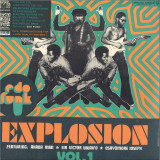
Analog Africa Presents Edo Funk Explosion Vol. 1, available on
2xLP/Gatefold LP with 20-page booklet / CD with 36-page booklet. It was
in Benin City, in the heart of Nigeria, that a new hybrid of intoxicating
highlife music known as Edo Funk was born.
It first emerged in the late 1970s when a group of musicians began to experiment with different ways of integrating elements from their native Edo culture
and fusing them with new sound effects coming from West Africa s night-clubs.
Unlike the rather polished 1980 s Nigerian disco productions coming out of the
international metropolis of Lagos Edo Funk was raw and reduced to its bare
minimum.
Someone was needed to channel this energy into a distinctive sound and Sir
Victor Uwaifo appeared like a mad professor with his Joromi studio. Uwaifo
took the skeletal structure of Edo music and relentless began fusing them with
synthesizers, electric guitars and 80 s effect racks which resulted in some of the
most outstanding Edo recordings ever made. An explosive spiced up brew with
an odd psychedelic note known as Edo Funk.
That’s the sound you’ll be discovering in the first volume of the Edo Funk Explosion series which focusses on the genre’s greatest originators; Osayomore
Joseph, Akaba Man, and Sir Victor Uwaifo: Osayomore Joseph was one of the
first musicians to bring the sound of the flute into the horn-dominated world
of highlife, and his skills as a performer made him a fixture on the Lagos scene.
When he returned to settle in Benin City in the mid 1970s - at the invitation of
the royal family - he devoted himself to the modernisation and electrification
of Edo music, using funk and Afro-beat as the building blocks for songs that
weren’t afraid to call out government corruption or confront the dark legacy of
Nigeria’s colonial past.
Akaba Man was the philosopher king of Edo funk. Less overtly political than Osayomore Joseph and less psychedelic than Victor Uwaifo, he found the perfect
medium for his message in the trance-like grooves of Edo funk. With pulsating
rhythms awash in cosmic synth-fields and lyrics that express a deep personal
vision, he found great success at the dawn of the 1980s as one of Benin City’s
most persuasive ambassadors of funky highlife.
Victor Uwaifo was already a star in Nigeria when he built the legendary Joromi
studios in his hometown of Benin City in 1978. Using his unique guitar style as
the mediating force between West-African highlife and the traditional rhythms
and melodies of Edo music, he had scored several hits in the early seventies,
but once he had his own sixteen-track facility he was able to pursue his obsession with the synesthetic possibilities of pure sound, adding squelchy synths,
swirling organs and studio effects to hypnotic basslines and raw grooves. Between his own records and his production for other musicians, he quickly established himself as the godfather of Edo funk.
What unites these diverse musicians is their ability to strip funk down to its
primal essence and use it as the foundation for their own excursions inward to
the heart of Edo culture and outward to the furthest limits of sonic alchemy.
The twelve tracks on Edo Funk Explosion Volume 1 pulse with raw inspiration,
mixing highlife horns, driving rhythms, day-glo keyboards and tripped-out guitars into a funk experience unlike any other.
I first discovered khroniky – Ukranian folk songs – in the Highlands of Scotland. I was watching a screening of Bajka, a mesmerising documentary made by the filmmaker Lucia Nimcová and sound artist Sholto Dobie. I knew nothing about these ballads beforehand, but I was fascinated by these odd, beautiful songs, especially the easy way in which they mixed misery and levity, where gentle melodies blend with tales of dark violence. The folk songs describe hardship, murder, torture, death in gulags, heavy drinking, outsmarting men, love affairs. But they’re often very funny too – many of the songs make fun of marriage, and there’s an amazing subcategory of khroniky songs called potka (vagina) songs.
The khroniky have never been properly documented because they were considered too crude, or contained lyrics that were problematic, politically. When Ukrainian folk songs have been archived in the past, it’s normally a sanitised, more polite version of the ones that Lucia remembers from her childhood. Lucia grew up on the other side of the Ukrainian border in Slovakia. She is part of the Rusyn (Ruthenian) minority ethnic group found in the borderlands of Slovakia, Hungary, Romania, Ukraine and Poland. Rusyn is a centuries-old Slavic language, looked down upon as a poor, uneducated dialect by the neighbouring Ukraine and Slovakia. It was forbidden to talk about Rusyn culture at Nimcova’s primary school, but the khroniky stayed in her memories.
“I remember weddings when I was young,” says Lucia, who now lives in Addis Abeba, Ethiopia. “At the end of the night, when everyone was drunk and the young couple would go around their guests, people would sing in Rusyn. There was singing and dancing, and songs about being in prison or falling in love. I picked up the lyrics and sometimes my mum would make my sister and I sing them for people we met on the train. I was about five or six but the lyrics still come back when I sing to my kids.”
Determined that these rich, nuanced, unique songs shouldn’t be forgotten, she decided to record them. Over two years, Lucia, joined by experimental musician Sholto Dobie, visited Rusyn villages high in the Carpathian mountains to rediscover the songs and make the documentary. It was at the beginning of war breaking out in Ukraine in 2014.
“The Rusyn community is a very closed one,” explains Lucia. “Sometimes we’d have to wait several days to hear someone sing; we had to earn their trust before they shared something very personal to them. We’d stay up ‘til 5am at a wedding, then go straight to a morning baptism, or collect haystacks with the villagers, hoping they’d sing while they were working.”
DILO is named after an important independent Ukrainian daily newspaper that was shut down when the Red Army entered Lviv in 1939. The four long tracks on DILO blur field recordings with song; an unpolished, privileged glimpse into a private world. We hear dogs barking and insects buzzing in the summer heat, then a blast of hurdy gurdy or violin will drift in, or a plaintive song soars softly over the rural background noise, with casually harrowing lyrics about a cuckoo, “lifeless in a world of misery”, as translated in the album’s booklet.
For both Lucia and Sholto, it was important not to tamper too much with what they heard. “When you think about ethnography,” Lucia explains, “you have to have a lot of time, love and respect to document it with sensitivity.”
“The songs all have their own atmosphere and intimacy from the spaces they were recorded in and it was important to maintain these particularities and move with them,” adds Sholto, who now lives in Vilnius, Lithuania. “They guide and sometimes interrupt a journey between interiors – domestic spaces; in kitchens, by the fire – and exteriors; marketplaces, cow sheds. We used contact microphones to record metal bridges and fences, and we spent one afternoon recording a wool processing machine, the details of the rattling and tuning wheels are the ground layer for the third track.”
Lucia took rough notes and diary entries during the recording process, which are now shared in the booklet alongside a selection of lyrics, loosely translated, but revealing the depth and astonishing beauty that sometimes lies in the language of these folk songs.
The feel of the album is intimate, flipping between laughter, where a woman sings about selling her pussy to buy a cow in one track, then shifts to a raw, painful truth; an adult son asks his mother why his dad won’t be back for dinner, as he’s gone to war.
Since Lucia and Sholto began working together in 2014, they have shared the audio recordings on radio and film and shown photos in gallery spaces, making sure these special, smutty, poignant songs don’t get lost. This new record and booklet joins that same continuum, another glorious fruit from the same rare tree.
On her second album Ursgal Mongolian singer Enji creates a unique blend of Jazz and Folk with the thousand-year-old traditions of Mongolian music. Currently based in Munich, her lyrics tell personal stories about unbearable distances, the oddness of being on earth and the simple truths in life.
She's accompanied by Paul Brändle on guitar and Munguntovch Tsolmonbayar on double bass.
Born in Ulaanbaatar, Enji grew up in a yurt to a working-class family. Having always been drawn to music, dance and literature, she initially wanted to become a music teacher with little ambitions to compose or be on stage. A program by the local Goethe Institute sparked her passion for Jazz and eventually led her to become a performing artist. Inspired by the music of Carmen McRae, Ella Fitzgerald and Nancy Wilson, Enji started writing songs of her own, cherishing this newfound means of expression. Ursgal is the first record featuring her original compositions.
From their genesis as members of the Venus club in-house band in the early 70s, Hailu Mergia and the Walias Band were at the forefront of the musical revolution during an era where modern instruments and foreign styles superseded the traditional fare to become the staple sound of Ethiopia. No one would argue that the Walias were the trailblazing powerhouse of modern Ethiopian music. They were the first band to form independently without affiliation to a theatre house, a club or a hotel; unprecedented and risky as they had to raise all funding for expenses by themselves including buying equipment. They were the first to release full instrumental albums, considered to be commercially unviable at the time. They opened their own recording studio, with band members Melake Gebre and Mahmoud Aman doubling as technical buffs during sessions. They were also the first independent band to tour abroad. In short, they were the pioneers every band tried to emulate; some more successfully than others.
Odds are, any Ethiopian over the age of 35 who had access to TV or radio by the early 90s, will instantly recognize the sound of Walias. What is not a given is, how many would actually identify the band itself. Barely a day went by without hearing the Walias either in the background on radio or as an accompaniment to various programs on TV.
This Tezeta album, the band’s second recording, released in 1975, is one of those that have been impossible to find for nearly three decades. Sourced by Awesome Tapes From Africa and expertly remastered by Jessica Thompson, its unique and funky renditions of standards and popular songs of the day are so quintessentially Walias, flavorful and evocative. Hailu's melodic organ, unashamedly front and center in every track, makes even the complex pieces accessible.
Profoundly engaging; it's an immersive trip down memory lane for those of us getting reacquainted with it, while also an enthralling and gratifying experience for fresh ears.
Virtually unknown recording outside Ethiopia.
Documents Mergia & Walias legendary early period.
Follow-up to reissue of hugely popular seminal Ethiopian instrumentals LP Tche Belew (ATFA012)
Cassette-only, released in 1975 on the band’s in-house label to fund their record store.
Beautifully-rendered instrumentals of classic Ethiopian standards.
Kojaque follows his critically acclaimed cult concept record, ‘Deli Daydreams’, with an
expansive, urgent debut album. In this landmark debut, Kojaque mines both his
emotional interior as an artist, and the external forces of a love triangle barrelling
towards chaos. ‘Town’s Dead’ is a mind-bending, explosive and expansive trip,
documenting a tumultuous love triangle that unfolds across New Year’s Eve in a
place where gentrification poses as much a threat as the violence of street dealers.
Sonically, the record smashes any previous expectations, stretching an aural palate
that leaps from rage to solace, from clattering musical combustions to tender
ruminations. The tremendous scope and scale of ‘Town’s Dead’ demonstrates an
artist utterly untethered to assumptions about what a particular voice or genre should
be, and instead explores radical musical territory. Dark corners of parks, bedrooms,
clubs, streets and psyches are excavated and pouring over the rubble is an artist
who refuses to conform, unafraid of the vulnerabilities that are exposed when the
voice rings true, because there’s just no point in being anything else.
Kojaque is part of a new wave of Irish artists flooding the world with blistering and
sophisticated literature, film and music - ideas and work that emerged from a social
revolution stonewalled by late-stage capitalism. Welcome to that state of mind, where
the path less travelled is the only one worth taking.
On the announcement of his debut album Kojaque has said: “‘Town’s Dead’ comes
from the potential that I see in Dublin and in the people I’m surrounded by day in and
day out. There’s nothing but talent and ambition among young people, I’m constantly
reminded of that through the art and music that I see being made but I think so often
the city grinds you down, it takes your hope and your ambition. I know that it can
change because so many of my friends express the exact same wants, desires and
frustrations with living in Ireland. If so many of us are on the same page then I know
that things can change, there just needs to be some sort of catalyst to kick start that
change and for me that’s always been art and music. Time and time again, amazing
art continues to be made in spite of the struggles and setbacks that are presented
when living here. The title track and the album is a fight against what can sometimes
feel inevitable, it’s a rejection of what people tell you is your destiny as a young
person in the city, Town’s NOT dead it’s just Dormant.”
CD housed in digisleeve containing 12-page lyric and photo booklet.
Black double vinyl housed in 5mm wide spine single sleeve with 12-page lyric and
photo booklet.
“Hints of Odd Future and its offspring... Kojaque is not your average rapper” - i-D
“Dublin’s hip-hop community are making waves right now... an intimate introduction
to the world this bold artist inhabits” - Clash
“Social realist rhymes set to silky hip-hop” - NME
“Likeable and funny” - Trench
“The Dublin MC forcing us to face real life; both the gory and the glory” - Wonderland
“Ireland’s freshest hip-hop hope, Kojaque, serves ‘soft hip hop’ with a side order of
poetry and performance art” - Notion
As a New Era beckons globally, Manchester’s primo Manctalo merchants – Red Laser Records – quietly unveil their latest clutch of specialist space-age kinetics. A fifth-kind encounter enabling users to bridge the continuum of dance & interaction between our Earth-dwelling selves and the inter-dimensional overlords.
Containing three brand new movements in machine music from our treasured production stable of Kid Machine, Bob SwanS and Il Bosco; it also houses an honorary appearance from revered Danish spearhead Flemming Dalum, who serves up a particle-splitting redux of a lesser-known proto-techno nugget from Belgium. Dalum’s been traversing the star-clusters on his own intrepid missions for a while, so we’re mega buzzed to have him back on the RL mothership.
Stretford based synthesizer technician, Bob SwanS has been drafted in specifically by RL head Il Bosco for his advanced skills on the patch bays. “Aphelion Run Theme”, the point of which an object’s orbit is furthest from the Sun, vividly detailing in sound the journey our collective consciousness must undergo in order to reach the Highest Elders. We highly recommend utilising this track alongside Dr. Greer’s outstanding work with extra terrestrials.
KID Machine’s celebratory, vocoder-led Manctalo message: “It’s The K.I.D” is a sonic motif to our interplanetary relatives; this cybernetic b-boy’s way of spray painting the Red Laser logo over Proxima Centauri B’s subway network in neon-blue, pyroxene paint.
Bosco lets loose with one of his most impassioned creations to date too. “We Almost Lost Oddbins” previously titled: “Save Our Scene”, a universe-wide cry for help recorded when worldwide limitations on dancing and human co-exchange were at their most aggressive; its nonetheless positive outlook inviting us all to look both inward and outward for solutions in the New Normal.
Encased within a striking monolith art print, depicting the mystic energies of ancient galaxies it heralds the now widely-accepted belief that we are in no way alone in this universe and that channels of communication between more advanced civilisations than ours have already begun…