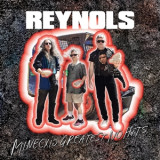
The earth rotates, seasons change_there is but one long day_ Time is a beguiling, indistinct entity_sometimes standing still, sometimes bending back upon itself with premonitions or memories of the future. Growing out of a pen pal style correspondence that took place over the course of a year, separated by the Atlantic Ocean, Gloria de Oliveira and Dean Hurley passed thoughts and music back and forth that would eventually form their collaborative album, Oceans of Time. The result is an aural tapestry of that exchange: woven from conceptual threads of the celestial within, mortality and the realm beyond stars. The duo's partnership is an effortless merge, yet it's the steady presence of de Oliveira's vocals that endows the record with its sense of potency. Throughout the album, there is an innate understanding of how a lyric across a chordal color can sharpen an emotional truth. Much like a sunbeam that pierces a spiderweb to reveal its intricacy, her lyric and melody are purposely aimed in order to illuminate the truths deep within oneself_a process that ties us all to the universal. The Danish philosopher Soren Kierkegaard, a professed influence, wrote about the truth as something that was inherently subjective, less about the concrete reality of what is believed and more about how it is experienced by the believer. Frequent David Lynch collaborator Dean Hurley sets the tonal and sonic landscape of each track on the album, lending a layered ether that envelops, frames and holds de Oliveira's vocals. With its impressionistic synths, shimmering guitars, and ethereal sonics, Oceans of Time at moments recalls the foundational dreampop of 4AD acts like Cocteau Twins and Lush. The album feels especially attuned to the connections between the physical and transcendental realms, and the best dreampop has a way of making the veil between two worlds feel just a little bit thinner. Oceans of Time is a key that has the power to release its listener from the handcuffs of reality, however briefly_
quête:oli
Dirty Electronics (John Richards) and Oliver Torr met in a bar in Prague. One thing led to another. After collaborating at Prague Quadrennial to create a sound-installation in a repurposed ice-hockey arena, gigs followed. They vowed to make an album together, which
finally happened in the geographical space between Prague, London, Brno and Athens. The album brings together disparate spaces and connected artists as a distorted memory trace.
Improvised group scenarios and abrupt electronic episodes are placed side-by-side in a brutal marriag
- A1: Grand Union - Morning Brings The Light
- A2: Tasha Lee Mcclunney - Undone
- A3: Len Udow - Beauty Raise The Tree
- A4: Len Udow - Wild Canada
- B1: Mike Glick - The Ballad Of Ho Chi Minh
- B2: Chris Rawlings - Song Of Creation
- B3: Gary Lapow - Bamboo In The Wind
- B4: Summer Rain - Turn On Your Lovelight
- C1: Jennie Rylatt - Rainfall
- C2: Lucy Kitchen - Olivia
- C3: Henry Parker - Prospect Of Wealth
- C4: Findlay Brown - Teardrops Lost In The Rain (Stallions Remix)
- C5: Harris & Crane Band - Change Is Me, Change Is You
- D1: Frank Pyne & Loon Saloon - Waco
- D2: The Bb Jackson Band - Theme Iv A Detective
- D3: Cascada - Weepin
- D4: Peter Campbell - Let Me Ride
Paul Hillery, Plattensammler, Archivar und DJ, präsentiert mit 'Folk Funk & Trippy Troubadours Volume Two' 17 brillant psychedelische und funky Juwelen, die er auf seiner unermüdlichen Suche nach musikalischen, Generationen und Genres umfassenden Schätzen entdeckt. Liebevoll handverlesene, verlorene Nuggets auf privat gepressten Obskuritäten, vergessenen Studiotapes oder tief in digitalen Ordnern versteckt, warten darauf, wieder gehört zu werden.
- A1: String Quartet No. 5 I
- A2: String Quartet No. 5 Ii
- A3: String Quartet No. 5 Iii
- A4: String Quartet No. 5 Iv
- A5: String Quartet No. 5 V
- B1: String Quartet No. 4 (Buczak) I
- B2: String Quartet No. 4 (Buczak) Ii
- B3: String Quartet No. 4 (Buczak) Iii
- C1: String Quartet No. 2 (Company) I
- C2: String Quartet No. 2 (Company) Ii
- C3: String Quartet No. 2 (Company) Iii
- C4: String Quartet No. 2 (Company) Iv
- D1: String Quartet No. 3 (Mishima) 1957 – Award Montage
- D2: String Quartet No. 3 (Mishima) November 25 – Ichigaya
- D3: String Quartet No. 3 (Mishima) 1934 – Grandmother And Kimitake
- D4: String Quartet No. 3 (Mishima) 1962 – Body Building
- D5: String Quartet No. 3 (Mishima) Blood Oath
- D6: String Quartet No. 3 (Mishima) Mishima/Closing
When Kronos plays a piece, they become fellow composers, true collaborators. Without them, we wouldn’t have the kind of string quartet playing that we find around us today. There are two kinds of string quartet playing: the ‘Before Kronos’ and the ‘After Kronos’.” – Philip Glass
‘Kronos Quartet has broken the boundaries of what string quartets can do.’ – New York Times
Nonesuch releases Kronos Quartet’s acclaimed album Kronos Quartet Performs Philip Glass on vinyl for the first time to coincide with Kronos Quartet: Five Decades, a year-long celebration marking the quartet’s 50th anniversary. Originally released in 1995, the album features David Harrington (violin), John Sherba, (violin), Hank Dutt (viola) and Joan Jeanrenaud (cello) performing Quartet No. 2 (Company) (1983), No. 3 (Mishima) (1985), No. 4 (Buczak) (1990), and No. 5 (1991), the first piece Glass wrote especially for Kronos. Recorded at Skywalker Sound in California, the album was produced by Judith Sherman, Kurt Munkacsi and Philip Glass. The cover art features Francesco Clemente’s painting The Four Corners (1985). At the time of the album’s release, the New York Times said, ‘It contains some of Glass's best music since Koyaanisqatsi. His ear for sumptuous string sonorities is undeniable,’ while the Washington Post called it ‘An ideal combination of composer and performers.’ It was a top 10 hit on Billboard’s Top Classical Albums, and spent 12 weeks on Billboard’s Classical chart.
In his original liner note, critic Mark Swed wrote, ‘Glass’ string quartets may contain his most intimate music. They are works through which a very public composer, perhaps the most important opera reformer of our age and a longstanding collaborator in large-scale music theater, holds up a mirror to himself and his way of composing. “In an odd way,” Glass explains, “string quartets have always functioned like that for composers. I don’t really know why, but it’s almost impossible to get away from it. It’s the way composers of the past have thought and that’s no less true for me. It’s almost as if we say we’re going to write a string quartet, we take a deep breath, and we wade in to try to write the most serious, significant piece that we can.” Glass says that as he sat down to write String Quartet No. 5, he had discovered that perhaps not taking a serious tone might be the most serious way to deal with it. “I was thinking that I had really gone beyond the need to write a serious string quartet and that I could write a quartet that is about musicality, which in a certain way is the most serious subject.”’
Glass’ first numbered quartet was written in 1966; however, he did not return to the string quartet medium until 1983, when he provided incidental music for a dramatization of Samuel Beckett’s prose poem, Company. During those 17 years, Glass had formed an ensemble and developed his style in a series of increasingly elaborate pieces for it. String Quartet No. 3 is also adapted to dramatic music, this time from his score to the 1985 Paul Schrader film, Mishima. It was with the music of Mishima that Kronos became associated with Glass, recording the string quartet sections of the soundtrack and subsequently working extensively with the composer on all five of his numbered quartets. Kronos also gave the first concert performances of Company and Mishima. String Quartet No. 4 was composed in remembrance of the artist Brian Buczak, who died of AIDS in 1988.
As Kronos’ anniversary season continues with further concerts around the world, Nonesuch will reissue Black Angels on vinyl on February 16. First released in 1990, the award-winning album includes George Crumb’s title piece, which inspired David Harrington to found the quartet. Called ‘an unusually elevated and searing Vietnam War protest’ by the New York Times, it sets a dark, powerful tone for this collection, which addresses the political/physical/spiritual consequences of war. Also featured are works by Charles Ives, István Márta, Thomas Tallis, and Dmitri Shostakovich. ‘Stylishly packaged, intelligently programmed, superbly recorded and brilliantly performed,’ proclaimed Gramophone. ‘In short, very much the sort of disc we’ve come to expect from the talented and imaginative Kronos Quartet.’ The Evening Standard included it among its ‘100 Definitive Classical Albums of the 20th Century’.
Born in Baltimore, Maryland, in 1937, Philip Glass is a graduate of the University of Chicago and the Juilliard School. By 1974, he had created a large collection of music for The Philip Glass Ensemble. The period culminated in the landmark opera, Einstein on the Beach. Since Einstein, Glass’s repertoire has grown to include music for opera, dance, theatre, orchestra, and film. His scores have received Academy Award nominations (including Kundun and The Hours, as well as Notes on a Scandal) and a Golden Globe (The Truman Show). Recent works include his memoir, Words Without Music, his first Piano Sonata, opera Circus Days and Nights, and Symphony No. 14. Glass received the Praemium Imperiale in 2012, the US National Medal of the Arts from President Barack Obama in 2016, and 41st Kennedy Center Honors in 2018.
Nonesuch’s relationship with Glass began in 1985, with the release of the score for Paul Schrader’s Mishima featuring Kronos Quartet. Over the years other Glass works on Nonesuch have included Einstein on the Beach (1993), Kronos Quartet Performs Philip Glass (1995), Music in Twelve Parts (1996), Glass Box (2008), as well as the soundtracks for Powaqqatsi (1988), Kundun (1997), Koyaanisqatsi (1998), and The Hours (2002), amongst others.
For 50 years, San Francisco’s Kronos Quartet – David Harrington (violin), John Sherba (violin), Hank Dutt (viola), and Paul Wiancko (cello) – has challenged and reimagined what a string quartet can be. Founded at a time when the form was largely centred on long-established, Western European traditions, Kronos has been at the forefront of revolutionizing the string quartet into a living art form that responds to the people and issues of our time. In the process, Kronos has become one of the most celebrated and influential groups of our era, performing thousands of concerts worldwide, releasing more than 70 recordings of extraordinary breadth and creativity, and collaborating with many of the world’s most accomplished composers and performers. Through its nonprofit organization, Kronos Performing Arts Association, Kronos has commissioned more than 1,000 works and arrangements for string quartet – including the Kronos Fifty for the Future library of free, educational repertoire. Kronos has received more than 40 awards, including three Grammy Awards and the Polar Music, Avery Fisher, and Edison Klassiek Oeuvre Prizes.
Kronos is prolific and wide-ranging on recordings. The ensemble’s expansive discography on Nonesuch includes three Grammy-winning albums: Terry Riley’s Sun Rings (2019), Landfall with Laurie Anderson (2018), and Alban Berg’s Lyric Suite featuring soprano Dawn Upshaw (2003); the 40th-anniversary boxed set Kronos Explorer Series; Nuevo (2002), a Grammy- and Latin Grammy–nominated celebration of Mexican culture; Pieces of Africa (1992), a showcase of African-born composers that simultaneously topped Billboard’s Classical and World Music charts; and Folk Songs (2017), Nonesuch’s 50th album with Kronos, which featured Sam Amidon, Olivia Chaney, Rhiannon Giddens, and Natalie Merchant singing traditional folk songs.
A thrilling immersion into FM synthesis and a puzzle of MIDI data, the Los Angeles based multi-instrumentalist Gregg Kowalsky returns to Mexican Summer with Eso Es, his sophomore outing for the label and first new music since 2017’s L'Orange L'Orange. Representing a significant creative leap for the veteran composer, Eso Es unfolds as a hypnotic journey into Kowalsky’s inner world, laced with a depth of emotiveness and vulnerability that’s rarely encountered in the electronic music realm. Raised in South Florida and trained at Mills College under Fred Frith and Pauline Oliveros, Kowalsky first came to prominence during the mid-2000s as a member of the thriving experimental music scene in the Bay Area, issuing a series of stunning albums on imprints like Kranky and Root Strata and contributing to a reinvigoration of American made Minimalist and electroacoustic music. In an addition to composing solo works, pieces for large ensembles, film soundtracks, dance performances, and site-specific installations over the past twenty years, during the 2010s Kowalsky concentrated his energies as one half of the critically acclaimed duo Date Palms, performing extensively and releasing three hypnotic albums, including 2011’s Honey Devash on Mexican Summer.
LP - 180 Gram Grey Marble Vinyl / Handnumbered Edition limited to 300 Units Prodigious multi-instrumentalist Nate Wood joins the indefatigably creative partnership forged in New York City by Gilad Hekselman and Will Vinson. Urban Myth is a powerful, diverse but unified set of recordings that combines elements of jazz with pop accessibility and the directness and honesty of folk and delivers a new surprise at every turn. The Jazz Mann gave Trio Grande four stars and wrote about them "The sound of three huge individual talents coming together to create something that is even greater than the sum of its parts."
Mit „Es war einmal…“ beginnen märchenhafte Geschichten, die von fantastischen Welten und von mutigen Helden erzählen. Es sind Geschichten, die uns seit Jahrtausenden begleiten und deren Ursprünge in der Fantasie des Menschen liegen. Passend zu diesem Leitmotiv hat Oliver Satyr für das FAUN-Album „Märchen & Mythen“ einen wunderschönen einführenden Prolog ersonnen, der von keinem Geringeren als Otto Mellies gesprochen wurde, also dem Schauspieler, der seine Stimme schon dem Zauberer Saruman im Film „Herr der Ringe“ verlieh.
FAUN hat sich mit „Märchen & Mythen“ von der Welt der heimischen Märchen inspirieren lassen, sie weben uns ein musikalisches Kunstwerk in dem - wie meist in Märchen - die Traumwelt und Realität immer wieder spielend miteinander verbunden sind. Wer sich mit dem Pagan-Folk - der von FAUN erfunden wurde - auseinandersetzt, erkennt sofort das Leitmotiv der mythischen Naturverbundenheit, das sich zu jeder Zeit in der Musik und den Texten der Gruppe wiederfindet.
Dass dies gerade in Zeiten der exzessiven und ökonomisch motivierten Ausbeutung und Zerstörung der Natur und der resultierenden Klimakrise eine durchaus politische Dimension besitzt, sei hier nur am Rande erwähnt. Nun endlich kommt das Album auf coloured Vinyl raus. Auf einer hochwertigen 180g LP und einem 4 seitigen Booklet in Vinyl-Größe - limitiert auf 1.000 Units
Celebrating the 30 anniversary of this legendary cult band from Argentina, with more than 150 releases in labels from Japan, Europe, Oceania, Latin America and USA and shows played and their music presented all over the world. A nondescript, experimental, truly original band with a story to match their legacy. LP includes fold out insert. At last! A comprehensive compilation documenting the exciting career of the legendary experimental Argentinian cult band. A career overview through eight of their most mesmerizing compositions. The fact that their drummer and singer Miguel Tomasin has down syndrome not only makes them one of the longest-running and most notable inclusive rock bands of all time, but also allows us to appreciate the importance of Miguel's creative contribution, both for his singular way of singing and for his inimitable verbal inventions. For his work with the band, Miguel stands as one of the most relevant personalities with down's syndrome in the world and his name appears mentioned in diverse books of neuroscience and neurodiversity. Their long list of collaborators includes luminaries such as Lee Ranaldo (Sonic Youth), Pauline Oliveiros, Damo Suzuki (Can), The Nihilist Spasm Band, Michael Snow, N U Unruh (Einstürzende Neubauten), Alan Licht, Pajarito Zaguri, Acid Mothers Temple, John Oswald and many more.
I want to introduce this work ‘Halos of Perception’ to you in the way Lisa introduced me to it, through the sharing of experiences.
Lisa and I met for a walk near South Yarra station to talk about this work, when inclement weather made it too wet to visit the tunnels. Moving almost seamlessly from a world of leisurewear, infinite milk alternatives and blaring neons to stretches of green by the water that brimmed with sounds and life, we saw a few people climbing the Burnley bouldering wall, butterflies suspended in the hot wind and lots of plants I wish I knew the names of. Overhead the cars rumbled like a ceaseless animal as we talked about hidden ecosystems, imagined spaces and networks of care.
Stemming from a serendipitous encounter with an original Cave Clan member that led to many underground adventures, this work explores the worlds that exist outside of our perceptions. By the river, I leafed through a selection of tunnel photos Lisa had printed off at Officeworks, revealing alien textures, tunnels that stretch on into abysses of their own, underground flowing streams. Light is sparse and delicate, something reflected by the flickering and wavering in Lisa’s piano compositions.
As we walked, we noticed the ways in which infrastructure is often designed to keep people out—cut doors into fencing and clipped wires show an active and ongoing defiance of this. We spoke about how her Cave Clan friend used to go down to this painted room and read in solitude, using candles for light. The way sound exists underground, encased in these hollow cement tunnels, a painted room with its own deep hum. How people used to hold underground shows, how there were rules for safety (no exploring after rain, never alone) that was shared with each other. This warmth and absorption of other’s experiences is present in Lisa’s work—it’s immersive, like wading in water.
We paused on the walk to eat berries and talk about how The Caretaker creates transitory worlds with recorded sound, how this technology captures memory, and the exploratory pursuits of Pauline Oliveros’ Deep Listening Band. These citations of memory and deep listening inform Lisa’s use of analogue and classical instruments, playback artefacts and acoustic feedback in her own world-building. When speaking about ‘Halos of Perception’, she describes it as a fascination with timbre and acoustic artefacts.
Ideas of networks and enmeshment are felt deeply in Lisa’s compositions, motifs overlaid over each other evoking the image of many hands interlinking playfully, tenderly, softly. The way her compositions delve into refraction and echo makes me think about the tunnels and the way they splinter off into many possibilities. Manipulated textures reminiscent of the chalky, earthy, moss air that perfumes the tunnels’ subterranean air. Tactile details that gesture towards close attention, verging on obsession.
This work is also about imagining ecosystems of potential. Lisa shared with me that during this project, she has been reimagining subterranean networks in dreams, thinking about oral traditions, and the way water moves—from the sky to the earth, through the ground, connecting all these spheres. Realised in collaboration with hyperreal video artist Tristan Jalleh, Lisa’s dream landscape melds waterfalls, leaks, flower graffiti, and hidden messages lit up by imagined light sources with existing subterranean networks. There’s a real sense of wonder in this world she has built, how the city can reveal itself to you with some patience and care, how the city and its secrets can find its way into your dreams.
— Panda Wong
Spirit of Sundaze Ensemble (SOSE) is the latest evolution from London based DJ / producer, label and party series Secretsundaze. Sitting at the intersection of live music and electronic music innovation, leading contemporary musicians reimagine, record and perform a selection of tracks which have been foundational across Secretsundaze’s 20+ year history, embracing a myriad of influences from Balearic to synth pop to Brit funk.
EP 1 opens with their first single, a re-imagination of Photek’s seminal ‘Mine to Give’. Featuring Wayne Snow on vocals and garnering wide support from the likes of BBC 6 Music heads Gilles Peterson and Nabihah Iqbal, through to NTS and Worldwide FM tastemakers including Zakia, Moxie and Colleen ‘Cosmo’ Murphy, the tempo is slowed and explored in a more synthy 80s production style.
Next is their take on Joyce Sims’ (RIP) ‘Come into My Life’, moving the original Mantronix production into a more contemporary UK / Street Soul / Balearic territory.
The B-side sees them take on beloved Phil Asher (RIP) production, Nathan Haines’ stunning ‘Earth is the Place’, a classic Secretsundaze record if ever there was one. Featuring the vocals of Cherise, the SOSE version is a dance floor ready update which will appeal to all lovers of proper deep, soulful-leaning house music, one for the heads.
Closing the record is a flip of Wbeeza’s ‘Coast Spotting’. Featuring synths from the excellent Hinako Omori, this one goes in with an extended late night transcendental electronic / jazz rework with the original’s looped lead line modulating throughout the piece.
Leading musicians feature on the record including Myele Manzanza (Theo Parrish, Sound Signature), Lewis Moody (Zeitgeist Freedom Energy Exchange), Nikos Ziarkas (Theon Cross, Chelsea Carmichael), Oli Savill (Basement Jaxx), and Johnny Brierley (Fofoulah).
Following their debut sold out show at Southbank’s Centre Queen Elizabeth Hall, the Ensemble next take to the London stage at the iconic EartH Theatre, Dalston on September 21st for an EP launch party as well as a headline open-air concert at Las Dalias, Ibiza as part of Beat Hotel on September 30th.
All in all, an impressive debut showcasing the breadth and scope of this exciting new live project from Secretsundaze founder James Priestley, one to watch.
Confident and deliberate. Lightning in a bottle. The Rapture’s Echoes was and is a clear-eyed kick in the teeth, a band at the peak of their powers and producers with an ambitious vision making. a. point. The whole “indie crowd finally learns to dance” narrative is overwrought and irrelevant in 2023 - perhaps context is no longer king - but what remains clear is that this album, made by a San Diego punk band who had moved to New York via Seattle, and produced by the DFA in their own studio, where time and gear and ideas both good and bad were aplenty, maintains an energy and search for catharsis that could bulldoze even the most uptight. For whatever reason, it’s remained out of print on vinyl since its initial run.
A defining album of the 90s, Last Splash by The Breeders turns 30 this year. To celebrate, the band have returned to the original tapes to give it its first-ever remaster, and by doing so have also unearthed two lost tracks that will delight fans. Recorded by the "classic" Breeders line-up of Kim Deal, Kelley Deal, Josephine Wiggs and Jim Macpherson and featuring singles "Cannonball" and "Divine Hammer", Last Splash was "an alt-rock classic" (Pitchfork"s Top 100 Records of 1990s) on release; a fast seller too, quickly attaining Platinum status in the US. Despite having had the boxset treatment on its 20th birthday, the album was still left to be remastered so 10 years on, the original y" tapes were taken out of the archives and have been lovingly worked on by Kim Deal, Benjamin Mumphrey and Miles Showell (Abbey Road). Never sounding so good, the album for its 30th anniversary, it"s getting the ultimate vinyl pressing. Entitled Last Splash (the 30th Anniversary Original Analog Edition), this new version has been cut at half speed at Abbey Road by Miles Showell, now spanning two LPs and running at 45rpm. A Japanese cd edition will also be available. This edition contains an exclusive, one-sided etched 12" which features two previously unreleased tracks - "Go Man Go" and "Divine Mascis" ("Go Man Go" is a track that Kim co-wrote with Black Francis while "Divine Mascis" is a different version of "Divine Hammer" with Dinosaur Jr."s J Mascis on lead vocals). Both tracks originate from the original sessions and were left forgotten until the sessions were exhumed to create this new master. The attention to detail continues to the album"s art, which equally celebrates Vaughan Oliver"s iconic sleeve. With Vaughan sadly no longer with us, his long-time design partner Chris Bigg has gloriously reimagined the album"s sleeve for this new version.
Dreyblatt"s minimalist conception - a rhythmic drone played on a double-bass strung with piano wire, playing in concert with other stringed instruments performing in 20 unequal microtones per octave and changing key but keeping the same fundamental pitch - dates back to the 1970s, while he studied under La Monte Young and Pauline Oliveros. Resolve acts in intermittent dialogue with the first Orchestra of Excited Strings release, 1982"s Nodal Excitation.
Since then, Dreyblatt has formed new orchestras across various countries and decades, with each phase of his music requiring several overlapping periods of gestation and arrangement.
The current Orchestra is formed by Konrad Sprenger, Joachim Schütz and Oren Ambarchi. On Resolve, each of the members" playing brings new angles to the compositions. Konrad Sprenger"s involves solenoids, sine waves and a computer-controlled multi-channel electric guitar (as well as a relentless style behind the drum kit and oversight of the album production), while Joachim Schütz"s individual conception of electronics and electric guitar and Oren Ambarchi"s undeniable innovations with signal path work together with Dreyblatt"s bass (still strung with piano wire) as magnetic component parts of Resolve.
These contributions lead to Resolve"s dialogue with the early Orchestra of Excited Strings canon - for instance, the track previewed here, "Flight Path" takes off at a pace not often found in the minimalist genre - a rolling lope! Yet the sense of play is palpable: the ensemble scale their microtonal keys with punkish brio, a stance sharing much with the original Orchestra"s downtown pulse, even as as the new Orchestra burn their own path through Dreyblatt"s music.
Approaching his 70th birthday, with over 40 years of work as a solo artist, collaborator, composer, educator and bandleader, Arnold Dreyblatt views Resolve as an important expression within the long story of The Orchestra of Excited Strings. The album title"s tendency to mean different things is an indicator of the dynamic qualities of his music in all its different phases - an evolution that continues to produce new dimensions in acoustic sound with every new release.
- A1: Sarco - Haich Ber Na & Oliver Torr 02 59
- A2: Pettels - Andriy Kostyukov & Timmi 03 52
- A3: The Darkness Of The Captive - Jay Glass Dubs & Rlung 07 07
- A4: Caviar - Oliver Torr & Andriy Kostyukov 03 23
- A5: Nice & Simple - Jay Glass Dubs & Timmi 04 10
- B1: Sandy Dub - Jay Glass Dubs & Andriy Kostyukov 10 38
- B2: Köre - Jay Glass Dubs & Oliver Torr 03 27
- B3: Sequence 1009 - Haich Ber Na & Rlung 03 46
- B4: Dew On The Desert - Rlung & Timmi 05 10
Extra Muros - Czech Republic is the result of the fourth edition of FLEE's creative residency program which took place in December 2022 on the dance floor of Prague's most infamous nightclub Ankali.
For two weeks on wooden floor, and under a yellow-tinted skylight, the room usually filled with movement and vibrations became home to six musicians and producers from the Czech Republic and all over the world who came together to experiment on new sounds, inspired by a large variety of artistic environments and soundscapes.
Documenting from various perspectives the music production process, capturing those exchanges, this compilation celebrates a unique form of artistic expression and collaboration.
LP
Extra Muros - Czech Republic is the result of the fourth edition of FLEE's creative residency program which took place in December 2022 on the dance floor of Prague's most infamous nightclub Ankali.
For two weeks on wooden floor, and under a yellow-tinted skylight, the room usually filled with movement and vibrations became home to six musicians and producers from the Czech Republic and all over the world who came together to experiment on new sounds, inspired by a large variety of artistic environments and soundscapes.
Documenting from various perspectives the music production process, capturing those exchanges, this compilation celebrates a unique form of artistic expression and collaboration.
- A1: The House Of House (Original Mix) 7’38
- A2: The House Of House (Oliver Lieb Mix 1) 7’57
- B1: The House Of House (Jam El Mar Remix) 09’24
- B2: The House Of House (Mike Push Remix) 07’12
- C1: The House Of House (Moon Project Remix) 07’22
- C2: The House Of House (Dj Taucher Remix) 8’25
- D1: Let There Be House (Original Mix) 08’09
- D2: Conflictation (Original Mix) 10’37
The iconic electronic music masterpiece, "The House Of House" by Cherrymoon Trax, is set to make an electrifying return to the scene. Originally introduced in 1994, this timeless classic, helmed by the talented trio Axel Stephenson, Yves Deruyter, and Franky Kloeck, has been revitalized in a new remastered wax format. The eagerly awaited release is a special double 12", featuring mixes that have never graced vinyl before, alongside the cherished original and other mixes that have left an indelible mark over the years. As an added treat, collectors will find the inclusion of the original tracks "Let There Be House" and "Conflictation." Presented in a captivating 2 color vinyl format (black & white) that harmonizes seamlessly with the sleeve, this reissue is undoubtedly a must-have for electronic music aficionados and vinyl collectors alike. Brace yourselves for the resurgence of a true masterpiece that continues to shape the landscape of electronic music. It’s also the introduction to a new upcoming single with the return of Axel Stephenson.
Jake Muir's latest set of soft-focus, sensual electro-concrète, dissolves X-rated gay sleaze flick soundtracks into a shimmering suite of subdued orchestral flourishes and surreal cosmic psychedelia.
Back in 2020, Muir put together a 90-minute mix for Honey Soundsystem, blending tracks from Kelman Duran, DJ Olive, Daniel Lanois and Terre Thaemlitz with obliquely camp dialog samples from vintage gay porn. The idea was to represent queer sexuality in a looser, more experimental manner, grazing the super-sensory pleasure of the bathhouse experience and the illicit joy of cruising without getting too self-serious while doing it. The mix was so popular that Muir followed it up with a weightless sequel two years later, and began developing the concept into a proper album, using more samples of music and dialogue, eventually performing the piece at the esteemed GRM as part of their FOCUS #4 concerts alongside work by Eliane Radigue, Folke Rabe and Chris Watson.
Bathhouse Blues is split into two side-long pieces that wash and ripple with nervous tension and discreet salaciousness. Opening with a familiar theatre sting, there are echoes here of kosmische and experimental electronics on 'Cruisin’ 87', fashioned into puddles of syrupy, back-room ambience. Occasionally we hear lascivious words thru the fog, men mumbling to each other before sex. "That's beautiful," a voice mutters over a dusky cricket chirp on 'Pipe Dream'. "It is," another replies.
Muir's sonic treatment is suitably explicit, like a 1950s Hollywood jump-cut to a train going into a tunnel; he takes the whole-body, mutual release of queer sex and interprets it with heady gestures, peppering jazzy rhythmic frostings into basins of skewered drone and gurgling synths. His sound is coloured by the pleasure of physical touch, a mussy flux of high frequency scrapes and caresses juxtaposed with woozy, dubbed-out fondles and thrusts. Who said the GRM was buttoned up?
Leave Me Alone is the debut album of Nick Oliveri's Uncontrollable, a solo project created by Nick Oliveri (Kyuss, Queens of the Stone Age, Dwarves, Mondo Generator) released in 2014 on Schnitzel Records. It was recorded in 2013 at Thunder Underground Studios in Palm Springs, California by Harper Hug & Trevor Whatever. Nick Oliveri performs all of the instruments (vocals, guitar, bass & drums) on the album as well as all of the production & writing of the songs. He also recruited guest performers in such as Blag Dahlia of The Dwarves & Motörhead's Phil Campbell. The album is dedicated to deceased Eyehategod drummer Joey LaCaze. Heavy Psych Sounds is releasing a brand new REPRESS with new coloured vinyl.
Magenta coloured vinyl, limited to 300 copies. Leave Me Alone is the debut album of Nick Oliveri's Uncontrollable, a solo project created by Nick Oliveri (Kyuss, Queens of the Stone Age, Dwarves, Mondo Generator) released in 2014 on Schnitzel Records. It was recorded in 2013 at Thunder Underground Studios in Palm Springs, California by Harper Hug & Trevor Whatever. Nick Oliveri performs all of the instruments (vocals, guitar, bass & drums) on the album as well as all of the production & writing of the songs. He also recruited guest performers in such as Blag Dahlia of The Dwarves & Motörhead's Phil Campbell. The album is dedicated to deceased Eyehategod drummer Joey LaCaze. Heavy Psych Sounds is releasing a brand new REPRESS with new coloured vinyl.
Black Vinyl[20,13 €]
Olive green vinyl, limited to 500 copies. "Our upcoming album, titled "Helichrysum," delves deep into the human experience, exploring the wounds we carry and the transformative power that lies within us. It serves as a culmination of the countless creative and personal choices we have made, leading us to a place of greater harmony within ourselves, with each other, and with our collective intentions. Musically speaking, the new album is a testament to our commitment to delivering a sonic experience that is unapologetically raw, adventurous, heavy, groovy and psychedelic. The choice to name the album after the Helichrysum plant, holds a significance as the plant symbolizes endurance, healing, immortality, and the power to overcome adversity, which mirror many of the themes throughout the record."
9 songs of fire, fury and angst. Some of the Songs are reflecting my personal thoughts and some songs are about family and close friends dying and / or committing suicide and some are about My Experience with the corona / sars lock downs. This is a record of real emotion and not for the weak. Nick Oliveri