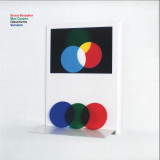
Andrew Kötting is one of the UK’s most highly regarded film makers, having worked on films such as ‘Gallivant’ (1996), ‘Swansdown’ (2012), ‘Edith Walks’ (2017) and many more. His new film, ‘The Whalebone Box’, was released in 2019. The soundtrack is composed by Andrew Kötting, Riz Maslen (Grand Theft Auto, Neotropic, Small Fish With Spine) and Oliver Cherer (Gilroy Mere, Dollboy).
For the soundtrack to ‘The Whalebone Box’, Kötting used various pieces of music by Dollboy,
The Assistant and musician Riz Maslen among others. Kötting chopped, processed and repurposed the songs for the film’s soundtrack, described as “a gentle, savage, unnerving warm bath of noise, music and references that is an integral part of the film and as much Andrew as it is the original tracks.”
The tracks were then remixed again by Cherer and Maslen for this 2LP release on Invada Records.
Pressed on ‘One Disc Green, One Disc Blue’ coloured vinyl and housed in a deluxe spinedsleeve with printed insert included.
Buscar:olive r
Legendary pedal steel player Susan Alcorn presents her music as curated and arranged by cellist and composer Janel Leppin. This recording is from a live performance from her residency at Issue Project Room in July 2012. Leppin’s arrangements and curation emotes the brilliance, transparency and resonance of the pedal steel guitar. Through this ensemble, the mastery of Susan Alcorn's compositions shine.
Susan Alcorn has taken the pedal steel guitar far beyond its traditional role in country music. Having first paid her dues in Texas country & western bands, she began to expand the vocabulary of her instrument through her study of 20th century classical music, visionary jazz, and world musics. Struck by the music of Messiaen she began transcribing classical music from recordings and scores on her instrument. Soon, she began to combine the techniques of country-western pedal steel with her own extended techniques to form a personal style influenced by free jazz, avant-garde classical music, Indian ragas, Indigenous traditions, and various folk musics of the world. By the early 1990s her music began to show an influence of the holistic and feminist “deep listening” philosophies of Pauline Oliveros. As her records gained a cult following she moved to Baltimore, MD. She performs internationally and is a key figure in the free improv scene in the US.
Janel Leppin is a core member of the Washington, D.C. experimental, jazz, punk and improvisational scenes and is a celebrated visual artist as a weaver. DownBeat Magazine describes her as “An absolute virtuoso”, NPR Music says “instrumental intimacy swept up in arrangements that cluster around her voice, as delicate and as imposing as a sheet of falling ice.”. Janel leads and writes for her free jazz sextet, Ensemble Volcanic Ash “a rarity..ahhh-vant garde at it’s finest." -Capital Bop. Leppin and Alcorn also recorded the composition “Thick Tarragon” by Eyvind Kang from the album Visible Breath on Ideologic Organ. Leppin appears as a string arranger on many recordings on labels from Dischord Records to Sacred Bones.
- A1: Clifford Brown & Max Roach Quintet - George's Dilemma
- A2: Zoot Sims & His Orchestra Feat. Vi Velasco - Zing Went The Strings Of My Heart
- A3: Horace Silver - I've Had A Little Talk
- A4: Johnny Hodges With Leon Thomas & Oliver Nelson - Welcome To New York
- A5: Charles Mingus - Ii B.s
- A6: Bob Mc Fadden & Dor - The Beat Generation
- B1: Donald Byrd - (Fallin' Like) Dominoes
- B2: Gene Harris & The Three Sounds - The Book Of Slim
- B3: Kent Schneider - The Church Is Within Us, Oh Lord
- B4: Art Blakey & The Jazz Messengers - It's Only A Paper Moon
- B5: The Dee Felice Trio - Nightingale
- B6: Lou Donaldson - The Humpback
‘Galdre Visions’ is Leaving Records supergroup Galdre Visions’s debut release. Inspired by Celtic mysticism, outer space and New Age both classical and modern, ‘Galdre Visions’ is a document of the exploratory, healing power of music.
Galdre Visions are comprised of Olive Ardizoni (Green-House), South Asian-American sitarist Ami Dang, Diva Dompé of Yialmelic Frequencies and harpist Nailah Hunter. These four artists were drawn together during the pandemic to remotely create collaborative music reflecting global uncertainty.
‘Galdre Visions’ is a reflective, ambient journey with airy vocal harmonies and layers of field recordings, harps and slow-burning ambient chords.
The record is housed in a tip-on jacket with microtene inner sleeves and played at 45 RPM.
For fans of Laraaji, Mort Garson, Kaitlyn Aurelia Smith, Huerco S., Emily A. Sprague, Ana Roxanne, Christina Vantzou.
- A1: Deep Moaning Blues (Feat. Maxayn Lewis)
- A2: El Train
- A3: Lazy Mama
- A4: Chicago Sun
- A5: Those Dogs Of Mine (Feat. Viola Davis)
- A6: Hear Me Talking To You (Instrumental)
- B1: The Story Of Memphis Green
- B2: Jump Song
- B3: Leftovers
- B4: Shoe Shopping
- B5: Deep Henderson
- C1: Reverend Gates
- C2: Ma Rainey’s Black Bottom (Feat. Maxayn Lewis)
- C3: Levee’s Song
- C4: Sweet Lil’ Baby Of Mine (Feat. Clint Johnson)
- C5: In The Shadow Of Joe Oliver
- C6: Hear Me Talking To You (Feat. Maxayn Lewis)
- D1: Levee And Dussie
- D2: Levee Confronts God
- D3: Sandman
- D4: Baby, Let Me Have It All (Feat. Clint Johnson)
- D5: Toledo’s Song
- D6: Chicago At Sunset
- D7: Skip, Skat, Doodle-Do (Feat. Cedric Watson)
Ma Rainey’s Black Bottom is the official soundtrack to the 2020 Netflix original film of the same name about “Mother of the Blues” Ma Rainey. The album features score music by critically-acclaimed saxophonist, instrumentalist, composer, bandleader and educator Branford Marsalis, as well as newly-recorded covers of both popular Ma Rainey tracks and blues and jazz standards from the era. The multi-GRAMMY Award® winner brings over four decades of experience across stylistic boundaries to the project, imbuing the film with an authentic 1920s Chicago soundscape. The film was directed by George C. Wolfe and stars Viola Davis and Chadwick Boseman. It is lauded by critics and moviegoers alike, and it is expected that Ma Rainey’s Black Bottom will be a favorite at many 2021 award ceremonies. Ma Rainey’s Black Bottom is available to watch on Netflix now.
- 1: Bad Man Feat. Million Teeth (Rob Smith Aka Rsd Version)
- 2: Cuss Cuss (Subatomic Sound System Version)
- 3: Wicked Babylon Must Go Down (Dub Spencer & Trance Hill
- 4: Skylarking (Oliver Frost - Eva Be's Dub Version)
- 5: Do You Love My Music (Black Star Liner "Special" Versio
- 6: Money Money (Dreadzone Version)
- 7: Skylarking (Noiseshaper Version)
- 8: Money Money (Dubblestandart Version)
Horace Andy's voice is an instrument that once heard is never forgotten, regardless of whether you first hear it on one of the numerous Jamaican reggae singles that he recorded during the 70s or - like most people - on one of the Massive Attack albums he collaborated on as a vocalist. His falsetto and his characteristic slow-motion vibrato breathed life into tracks like "Spying Glass", "Cuss Cuss", "In The Light", "Skylarking" or "(You are My) Angel", ensuring that they still continue to resonate deeply with listeners. His vocal style influenced countless root singers and the combination of his timbre with Massive Attack's spartan hip hop beats still inspires legions of fans and copyists all over the world. Echo Beach has now picked up on this tradition - and the much older tradition of versioning - by asking friends of the label to rework Horace Andy's classic tracks in their own sound outfit. But this time the label hasn't trawled old Studio One tapes for historic vocal snippets - that would sooo nineties; no, Horace Andy personally put in an appearance to sing new versions of his classic tracks on top of timeless and contemporary riddims. Age may have deepened his voice, but it is by no means weaker, as can be heard on this album, on which Echo Beach welcomes old friends and new faces: there's Rob Smith, who as part of More Rockers and Smith & Mighty was just as crucial for Bristol's musical reputation as Massive Attack or DJ Krust & Roni Size. Today, he ensures continuity by working under the label and producer name.
Altın Gün return with a masterful album that widens their critically acclaimed exploration of Anatolian rock and Turkish psychedelic stylings to include dreamy 80’s synth-pop and dancefloor excursions. Yol (Road) brings together all vectors of the AltınGün experience and delivers their most compelling and individual album to date.
Amsterdam’s Altın Gün have built a strong reputation for melding past and present to make brilliantly catchy, psychedelic pop music, as seen with their Grammy-nominated second album, Gece. They are also a renowned live band with strings of sold-out shows on three continents, who have consistently brought a muscular groove to their recordings. Yol, their third album in as many years, excitedly continues these trends; while also digging in deep to unveil a new palette of sonic surprises.
Though it draws from the rich and incredibly diverse traditions of Anatolian and Turkish folk music, Yol is not just a record that reframes traditional sounds for a contemporary audience. The album often presents a textured, avant-pop sound as evidenced by the debut single "Ordunun Dereleri.” Mysterious and atmospheric, the track is a thrilling evolution for the band. It patiently coaxes the listener into a resonant soundworld of down-tempo electro beats, majestic synths and Erdinç Ecevit's yearning vocal of unrequited love.
The album also signals a very different approach in making and recording for the band. Singer Merve Dasdemir takes up the story: “We were basically stuck at home for three months making home demos, with everybody adding their parts. The transnational feeling maybe comes from that process of swapping demos over the internet, some of the music we did in the studio, but lockdown meant we had to follow a different approach.”
Yol displays a noticeable dreaminess, maybe born from this enforced time to reflect. And select elements of late 1970s or early 1980s “Euro” synth pop also shines through. This new musical landscape was nurtured by certain instrument choices; namely the Omnichord, heard on ‘Arda Boylari’, ‘Kara Toprak’ and ‘Sevda Olmasaydi’, and the drum-machine, an instrument that is key to the gorgeous closing number, ‘Esmerim Güzelim’. Dasdemir once more: “bass player Jasper Verhulst loved the song. He said, ‘it doesn’t sound like Altın Gün, this sounds like a Turkish kindergarten music teacher from the 1980s using an 808!”
As ever, the tracks are the result of a true group effort, with ideas on Omnichord, 808 and other elements - such as field recordings and new age-esque ideas - continually kicked about between the six band members. At a safe distance of course. The record also owes something special to its production team, the band working this time with Asa Moto (the Ghent-based producer-crew, Oliver Geerts and Gilles Noë) who mixed the record. Before this Altın Gün always recorded on tape with their own sound engineer.
It would be wrong to say that what made Altın Gün such a loved and successful band has been left to one side. The pressure-cookers ‘Sevda Olmasaydı’ and ‘Maçka Yolları’ are classic cuts from the band. And their signature employment of a dizzying array of ideas and approaches can be heard with the marked Brazilian feel of ‘Kara Toprak’ and ‘Yekte’. Cosmic reggae filters through the grooves of ‘Yüce Dağ Başında’, and there is a steaming version of ‘Hey Nari’ which gives the traditional composition by Ali Ekber Çiçek a kick onto the dancefloor.
But with Yol, Altın Gün have maybe patented their own magical process of reimagining and sonic path-finding, one probably not heard since the late 1960s and early 1970s British folkrock boom. Less of a reworking than a seduction, their recordings transport the listener to a world where the original songs never previously inhabited. Merve Dasdemir again: “After we worked on them, they got a whole new life of their own. Maybe we went a little bit too far (laughs).”
Laurel Halo, Donato Dozzy and Teheran sound artist Tegh give us their "Glassforms Versions"alongside a new edit by Max Cooper. The works of Philip Glass are reflected and refracted in a myriad of ways by some of the most renowned electronic artists alive, making for a blissful, multi-dimensional listening experience.
Textextext - (add your write up)
With "Glassforms", Max Cooper and Bruce Brubaker set out on an intimate, nuanced exploration of the works of Philip Glass. The resulting recordings, developed in a fluctuating exchange between the American pianist and the Irish scientist-artist, are an astounding testament to the innovation that artistic collaboration can achieve and what depths are yet to discover in Philip Glass' compositions. The two artists did not just rework, but fundamentally rewired the original songs using algorithmic software to process and augment the musical data it received from Brubaker's piano live on stage.
When approaching his remix, Donato Dozzy also tapped into that inspiration to create something new rather than just reworking it, which is one of the core motives that emanates from "Glassforms". The Italian producer and label owner is known for his drive to explore: he develops installations for public spaces and museums, uses obscure musical instruments and collaborates with classical singers or visual artists. "I chose "Two Pages" for it's hypnotic feel in the notes repetition", he says, "but I did not want to merely sample the piano, but instead ask someone I trust and admire to carve it from scratch and even go further." So he followed the lead of Brubaker and Cooper and teamed up with the renowned Italian percussionist and jazz musician Daniele Di Gregorio to completely rewire "Two Pages" into a gorgeous piece of endlessly modulating ambient electronica.
Laurel Halo, the second remixer on "Glassforms Versions", does not need a long introduction either: the American musician is at the forefront of electronic music in 2020, a bright star today after releasing her debut "Quarantine" on Hyperdub in 2012. Her remix of "Opening" brings to mind the string section of an orchestra tuning their violins before the performance - forever. They glide in and out of tune, sometimes individually, then together, then are accompanied by keys that are most likely a ghostly representation of Brubaker's piano, sampled and pitched down, but sound almost jazzy in the context of Halo's remix. It's a blissful listening experience, calling to mind her recent collaboration with cellist Oliver Coates on "Raw Silk Uncut Wood" and showing a deep understanding of Philip Glass' work.
Sound artist Tegh is the third on the remix bill - the electronic musician from Teheran delivers his take on "ƒTwo Pages", once again showcasing how versatile, how inherently complex the works of Philip Glass are. They can be interpreted in a myriad of ways - Tegh's version is a bounding, brooding piece filled with raw energy that feels like it is performed live, just for you, every single time you listen. His version is, at first, much more focused on the underlying moods, electronic undercurrents of the original than Dozzy's version, and yet, when the piano finally does break through, it becomes clear that we are listening to Philip Glass, reflected manifold: through the piano of Bruce Brubaker, the synths of Max Cooper, and then again through the mind of the artist Tegh.
Concluding the new "Glassforms Versions" is a previously unheard edit of "Two Pages". It's difficult to edit a piece of minimalistic beauty without losing it's essence, but Max Cooper - after many efforts and close conversations with Bruce Brubaker - managed to bring these shorter edit into a satisfying, conclusive form.
Ugly is Beautiful’ is the first full-length release from Gen Z’s meme-making extraordinaire Oliver Tree, who announced his early retirement in March - only to return in May with the announcement of his debut after a hacker held Oliver hostage in exchange for 1 million Instagram likes (which Oliver logged in under 24 hours).
To commemorate the digital release, Oliver partnered with Guinness World Records on his secret, longtime passion project of building the world’s largest scooter. He rode the completed 20 foot tall scooter for half a mile.
On ‘Ugly is Beautiful,’ Oliver Tree takes his millions of followers on an unpredictable roller coaster ride through a cracked world full of comic disaster. ‘Ugly is Beautiful’ then is the product of all of Oliver’s otherworldly experiences distilled into fourteen songs - the promise of his EPs, ‘Alien Boy’ and ‘Do You Feel Me?’ fulfilled. “The truth is, it’s my life’s work,” Oliver says.
‘Instant Opaque Evening’ is an epic offering from The Underflow, the new trio of Mats Gustafsson, David Grubbs and Rob Mazurek. It makes vast strides on the heels of their self-titled 2019 debut (Corbett vs. Dempsey/Underflow Records) with nearly 90 minutes of intensely focused live performances from January 2020 shows in France, Belgium, Italy and Poland. That tour was a revelation for all three members, experienced as they are, with this still-new group’s freedom to walk onstage each night determined to surprise one another, moving from long instrumental improvisations into and out of songs and covering a terrific amount of ground at each of these concerts.
‘Instant Opaque Evening’ conveys this broad sweep, from the full-tilt electronics of ‘Self-Portrait As Interference Pattern’ and the climax of the seventeen-minute ‘Instant Opaque Evening’ to the inspired, alternate universe chamber music of ‘Planks’ and ‘A Thin Eternity’ and the group’s spontaneous arrangements of three previously recorded songs by Grubbs, ‘Gethsemani Night’, ‘An Optimist Declines’ and ‘Cooler Side Of The Pillow’.
The short version of the long tale of intersecting paths bringing together these three musicians begins in Chicago in the 1990s, with all three active participants in numerous convergences among jazz, free improvisation, experimental rock and more. Both Gustafsson and Mazurek appear as guests on Gastr del Sol albums (‘Upgrade & Afterlife’ and ‘Camoufleur’ respectively; that’s Rob’s cornet taking ‘The Seasons Reverse’ to new heights) and shortly thereafter Grubbs and Gustafsson recorded two duo albums, including the deep minimalism of ‘Apertura’, a talismanic favourite of both musicians.
David Grubbs has played in Gastr del Sol, the Red Krayola and Squirrel Bait and performed with Tony Conrad, Susan Howe, Pauline Oliveros, Will Oldham and many others. He’s the author of the books The Voice in the Headphones, Now that the audience is assembled and Records Ruin the Landscape.
Saxophone player, improviser and composer Mats Gustafsson is known as a solo artist and for international tours and projects with, among many others, Sonic Youth, Merzbow, Jim O’Rourke, Barry Guy, Otomo Yoshihide, Yoshimi, Peter Brötzmann, Neneh Cherry, Christian Marclay, Albert Oehlen, Ken Vandermark and the working groups FIRE!, THE END, LUFT, ANGUISH and Gush, as well as collaborations with contemporary dance, theatre, art, poetry and projects with noise.
Rob Mazurek is a multidisciplinary artist with a focus on electro-acoustic composition, improvisation, performance, painting, sculpture, video, film and installation, who spent much of his creative life in Chicago and then Brazil. He currently lives and works in Marfa, Texas. He leads/co-leads many ensembles of various sizes and shapes including his flagship large ensemble Exploding Star Orchestra, Chicago Underground and São Paulo Underground. He has
collaborated with Bill Dixon, Pharoah Sanders, Roscoe Mitchell, Jeff Parker, Nicole Mitchell, Chad Taylor, Jim O’Rourke, Naná Vasconcelos and many others.
Rachel Baiman’s ‘Thanksgiving’ EP is a collection of music to inspire an introspective holiday spirit. The songs center around themes of Indigenous Rights, home and homelessness, and love in hard times.
Baiman called upon her superb live touring band (Cy Winstanley, Shelby Means) in addition to special collaborators including flatpicking guitar master Molly Tuttle, who features prominently on a spirited John Hartford cover, “Madison Tennessee” to bring these
thoughtful songs to life. ‘Thanksgiving’ allows Baiman space to stretch out stylistically and marks an intriguing followup to her celebrated full-length debut ‘Shame’.
Baiman moves with ease from bluegrass, to folk, to old-time and country sensibilities over the course of these four tracks. Her adept lyricism is again on full display, as she sheds new light on the complex, bittersweet feelings of both hardship and hope that often intertwine around the holiday season.
Thinking about a fox face may give many warm, fuzzy feelings,
but don’t forget that foxes have teeth.While Milwaukee quartet
Fox Face may not bite one’s face, their new album End Of Man
might just melt it off.
Featuring players drawn from various corners of the Brewtown
music scene, Fox Face came together organically ahead of the
recording sessions for their November 2017 debut album, Spoil
+ Destroy. Main songwriter Lindsay DeGroot (The Olives)
started working on her songs with multi-instrumentalist Lydia
Washechek (Static Eyes). Eventually fellow Olives member
Mary Hickey joined up on bass, and the final piece of the band
was found with the addition of drummer Christopher Capelle
(Midwest Beat, Long Line Riders). Spoil + Destroy was one of
the best garage punk albums of 2017-2018, taking on science
deniers, misogynists and other jerks with songs anchored by
fiery guitar playing and rock-solid ensemble playing.
End Of Man bumps up the furious guitar sound of Spoil +
Destroy a few more notches. It’s not hard rock, per se, but the
album’s sound edges in that direction. And one can tell that Fox
Face has been playing together for several years now, because
these recordings are tight AF. There’s no filler or extraneous
padding; the arrangements and playing make for a cohesive
whole, and lyrically the songs are direct and to the point while
still remaining universal enough to be met on personal terms by
the listener.
End Of Man may not be a party record … at least, once letting
the lyrics filter past the lizard brain enjoyment of the blazing
riffs. But art is not supposed to be all fun and games. Standing
up and speaking truth may not be the easiest path for a band or
its listeners, but there is much to be said for catharthis. Anyone
feeling despair and helplessness about the current political and
societal breakdown should find some common ground to rage
along with these new songs from Fox Face.
Southern Lord announce Crush The Machine, the debut EP from West Coast hardcore punk collective D.E.A (Dead End America), formed by the late, great Steve "Thee Slayer Hippy" Hanford of Poison Idea, with current and former members of Queens Of The Stone Age, Eyehategod, The Accüsed A.D, World Of Lies, Ape Machine, and more.
Captured before Hanford’s passing earlier this year, D.E.A's debut shall be released on 7" and digital EP on 30th October (Non-Returnable) Recording details, liner notes from Mark Lanegan and more info below.
Crush The Machine sees the primary writers, drummer/vocalist Steve Hanford and guitarist Tony Avila (World of Lies, Why Won't You Die, Aborted Cop, Here's Your Warning) joined by lead guitarist Ian Watts (Ape Machine, Minmae) and bassist/vocalist Nick "Rex Everything" Oliveri (Mondo Generator, The Dwarves, ex-Kyuss, ex-Queens Of The Stone Age), with additional lyrics and vocals from Mike IX Williams (Eyehategod, Corrections House, Outlaw Order) and Blaine Cook (The Accüsed A.D, The Fartz, Toe Tag).
"A perfectly appropriate title for this 7 inch EP of jack-hammering, oldschool style hardcore tunes released by Southern Lord, written and played by a rogues gallery of real deal music lifers as a condemnation of the criminal Trump administration and republican party, in the same spirit of those by-gone days when Ronald Reagan or George Bush was the crooked, self-serving president of the crumbling United States empire. Never before has there been a more obvious target, as Donald Trump and his mafia family cabinet rape the country while Rome burns. D.E.A. is Tony Avila, Ian Watts, Nick Oliveri, Mike IX, Blaine Cook and the legendary and beloved, late producer and drummer of Poison Idea, Steve "Thee Slayer Hippy" Hanford. Dying shortly before the completion of this record, it stands as a final testament to his genius, one last hot-wired blast of his epic musical brilliance."
Mark Lanegan
Los Angeles
August, 2020
In the Spring of 1978, Aaron McCarthy Jr, a.k.a. ‘Jelly’ was invited to Miami by local producer, Thomas Fundora to assist Herman Kelly with his forthcoming album, ‘Percussion Explosion!’. Herman, who was studying at the University of Miami at the time, had met Jelly whilst studying Music Theory together at Henry Ford Community College in Detroit. Both Detroit natives, Jelly had founded the group the Soulful Sonics, later to be known as Pure Pleasure whilst Herman transferred to Miami.
The group Life consisted of Jelly on Vocals, Percussion & arrangement, Oliver Wells on Keys, John DeMonica on Bass, Michal Cordoza on, Guitar, Travis Biggs on Horn Arrangements and Keys.
‘Percussion Explosion!’, which included the infamous ‘Dance To The Drummer Beat’, was recorded at ‘Miami Sound Studios’, as a forthcoming release on Fundora’s Electric Cat label, distributed by RCA. On reviewing which tracks made the album, there was a track recorded during those sessions that Herman decided to leave out, a song Oliver Wells had been working on and completed once Jelly arrived called ‘Everybody Needs Lovin, Now’s The Time’. Originally known as ‘Now’s The Time’,
Jamie xx releases a remastered version of his debut album ‘In Colour’ on Young Turks.
Jamie’s definitive ‘In Colour’ is a bold, celebratory and emotional artistic statement that received critical acclaim across the board as well achieving huge commercial success.
The eleven track LP was widely regarded as one of the best albums of 2015 and was voted in the top 25 of Pitchfork’s Best Records Of The Decade. ‘In Colour’ went on to receive Grammy, Brit and Mercury Award nominations, reaching Gold status in the UK Official Charts, and its lead single ‘I Know There’s Gonna Be (Good Times)’ featuring Young Thug and Popcaan is certified Gold in the USA.
As well as continued success with The xx (whose third album ‘I See You’ was released in 2017), Jamie released a new single ‘Idontknow’ in April this year, which has sold out on 12”.
- A1: This Is No Ordinary Puppet Show
- A2: Melissa’s First Hora
- A3: The Woman Behind The Curtain
- B1: Into The Thunderhead
- B2: Easy Now Girl, Come On Now Girl
- B3: The Last Time We Went To The Shore
- D1: Sleep Now, The Dust Won’t Settle (Digital Bonus)
- D2: A Handkerchief For Those Sweet Deep Pools (Digital Bonus)
Much like a bird of prey, Oliver Moir (FKA Flora Tucker, AKA
Sandman) has hovered over CV’s operations for quite some
time, diligently picking at releases, parties here and abroad,
and mixes; waiting to strike. Now, and after what seems like
an aeon, Connection Veri¦ed is proud to present: I Rocked Till
the Midnight Hour at Melissa’s Bat Mizvah. The 8-track
ambient LP is a glowing excursion through Moir’s perception
of the world, as the album hums across vast plateaus, gently
weaving in and out of endlessly complex pads, and into the
pliant ears of listeners. Emotions gush as a mood of warm
introspection sets in, with Moir taking us onboard as he sails
across the glimmering sonic waves. The LP comes off the
back of a long but bountiful path through electronic music,
and CV is proud to exhibit it in full, with our ¦rst dedicated
ambient release.
‘Borderline’ is the debut single from hotly-tipped Jamaican-Canadian artist and musician, SeeMeNot. Released on 18 September, 2020 and accompanied by a remix from Roman Flügel, ‘Borderline’ is available via SeeMeNot’s own imprint, Brainstream. Her debut will be followed by the release of ‘Invisible Me’ produced by Peace Division’s Justin Drake, and ‘Chez Renee’, remixed by Joe Goddard, all in the coming months. A 21 st century house anthem, ‘Borderline’ is a stunning debut that shows the power of both SeeMeNot’s voice and her lyrics, and has been championed so far by Skream, Anja Schneider, Solomun, Adriatique, TSHA, Erol Alkan, Adana Twins, Monika Kruse, Andhim, Tim Sweeney, Chloé, Marco Carola, Digitalism, and many more.
‘Borderline’ was sampled on SeeMeNot’s July 2020 debut mixtape ‘Long Overdue: The Sound Of A Revolution’ along with an excerpt of the powerful speech by Tamika Mallory in the wake of the death of George Floyd.
Reclaiming house music as a form of protest, ‘Long Overdue: The Sound Of A Revolution’ was SeeMeNot’s first creative work. Released via her Soundcloud page, ‘Long Overdue’ featured SeeMeNot singing a cappella over a mix from DJ Oliver Baptiste. The 30 minutes of music is the sound of a Black female artist detailing the journey of Black people from Fight to Flight, channeling the pain she’s experiencing – and experienced – into something beautiful that pays respect to her ancestors but serves as a contemporary reinterpretation of traditional healing through singing and music. Influences from country music to gospel are joined through a shared history of hymnals as both protest and healing music. SeeMeNot recently released a PSA on her YouTube featuring an acapella from the mixtape – “a childhood cover” of the late Ray Charles – paying homage to Black Lives Matter.
Our much in-demand series of classic Brazilian 45’s are back! Featuring a vibrant new design, we’ve curated yet more wants-list regulars and unearthed fresh finds from Brazil that are destined to become collector’sitems in their own right.
Number 81 is our Brazil.45 series sees further digging into the magical world of Jorge Ben’s lesser-explored 1980’s productions. ‘Ma Ma Ma Ma Ma (A Lingua Dos Anjos)’ is taken from his ‘Al Al , Como Vai?’ album from 1980, which is arranged, produced, and features keys by the don, Lincoln Olivetti. The song contains trippy lyrics singing about flying saucers and angels.
‘Dona Culpa’ finds Jorge featuring on a cool mid-tempo groove track taken from Cauby Peixoto’s ‘Cauby! Cauby!’ album (also from 1980). Singer Cauby Peixoto had a long and stellar career, recording and releasing music from the mid-1950’s all the way up until his passing in 2016.
- A1: Sofia Suicidou-Se (Da Serie Samba Policial) (Da Serie Samba Policial)
- A2: Pecou A Rosa - Samba
- A3: Um Assalto No Morumbi (Da Serie Samba Policial) (Da Serie Samba Policial)
- A4: Incendio (Da Serie Samba Reportagem) (Da Serie Samba Reportagem)
- A5: Frida - Poema/Frida - Samba
- A6: Brasilia Seculo 1 - Samba
- B1: Um Crime (Da Serie Samba Policial) (Da Serie Samba Policial)
- B2: A Lenda Da Chuva - Poema
- B3: O Sorriso Da Praia - Samba
- B4: Mar De Sal - Samba
- B5: A Morte Do Violao - Samba
- B6: E A Chuva Nasceu - Samba
- B7: Samba Gregoriano (Da Serie Samba Erudita) (Da Serie Samba Erudita)
A virtuoso pianist and composer of seminal works in early electronic and experimental classical music, Jocy de Oliveira’s musical output has had a great influence within Brazil and abroad. Her sole contribution to Brazilian popular music, her 1959-recorded album, ‘A Música Século XX de Jocy’ in many ways stands apart from the rest of her artistic oeuvre.
The original vinyl release marketed the record as adding to Brazil’s samba heritage with a ‘simple and original dialectic’, naming its style ‘vanguard samba’, which differs from both traditional samba and Bossa Nova, in its infancy at the time.
Listening to Jocy’s ‘20th century music’ in the context of the contemporaneous and vastly more influential Bossa Nova style is especially striking. Where Bossa Nova’s innovators incorporated influences from jazz and French piano music to a samba foundation, Jocy de Oliveira took a greater leap, wedding her century’s classical music to samba. Where Bossa Nova dawned a new epoch of poetic lyricism in Brazilian popular songs with great poets such as Vinicius de Moraes and themes of longing, love and nature, Jocy de Oliveira’s lyrics are concerned with scenes of urban tragedy and decay, presenting an alternative vision to Brazil’s stereotypical tropical paradise image almost 10 years before the emergence of the Tropicália movement.
The sounds and lyrics of Jocy’s landmark release still shock today. Put in the context of a conservative Brazil on the eve of Brasília’s inauguration, it is even more startling that this record ever got made. An unconventional mix of classical and popular musical influences combined with socially critical, ironic and at times journalistic lyrics make for a unique listening experience.
A unique representation of Brazilian popular music, Jocy de Oliveira’s masterpiece ‘A Música Século XX de Jocy’ is reissued for the first time. Meticulously remastered, the record is pressed on high-quality 45-RPM vinyl, with a modernised back cover and printed inner sleeve including previously unseen pictures taken for the record’s release in 1959.