The talented Chinese artist B.AI lands on Cosa Vostra with her "Blue Or Red" EP! After following her work for some time, we’re excited to finally welcome her to the label. This EP brings together four tracks that mix electro and techno with subtle acid touches and a beautiful emphasis on melody. The release also features two collaborations with Diego Santana & David Agrella. Blue Or Red... Which path will you take ?
Cerca:on land
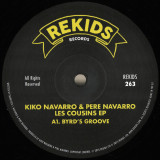
Kiko Navarro & Pere Navarro land on Radio Slave’s Rekids with their first-ever EP, ‘Les Cousins’. Their debut release counts three tracks, merging infectious House grooves with Pere’s Jazz-inflected trumpet solos for a stylish EP rooted in classic sounds, yet with a distinct modern edge to it. Both hailing from the Balearic Islands, Kiko, a seasoned DJ and producer from Mallorca with music on King Street Sounds, Pacha Recordings, Shall Not Fade and more, and Pere, a multi-instrumentalist, composer and producer from Ibiza. Despite sharing a last name, the pair are not related, meeting for the first time at a private party where Pere spontaneously joined Kiko’s DJ set on trumpet, after which their partnership continued when Kiko invited Pere to record a trumpet solo for a Louie Vega remix, leading up to the creation of their debut ‘Les Cousins’ EP, landing on Rekids this May.
Hard Times continues its legacy of championing house music’s finest with another landmark release that brings things full circle. This time, the label welcomes none other than Leeds legend Paul Woolford - one of the most prolific and versatile electronic artists of today - to reimagine one of house music’s most cherished anthems, Karen Pollard’s ‘Reach Out To Me.’
Originally released in 1996, ‘Reach Out To Me’ quickly became a club classic and an archetypal vocal house anthem. Now, Woolford - known for his ability to straddle both underground credibility and mainstream success with ease - boldly takes on the challenge of remixing the iconic track, delivering not one but two impressive reworks that showcase both sides of his production persona.
“‘Reach Out To Me’ has always been one of my favourite US garage records, so when the opportunity to rework it came up one hazy summer evening last year, I knew it had to be done,” says Woolford. “Both mixes have been road-tested and have caused havoc in all sorts of situations, from warehouse raves to basement afters to peak-time sessions and beyond.”
The first remix sees Woolford take the track deep and epic, building to a soaring, anthemic breakdown that pays homage to the song’s timeless energy. Meanwhile, his breakbeat-driven Special Request version adds a UKG twist, built for peak-time destruction in the hands of all selectors.
A true labour of love, these remixes breathe new life into the beloved classic while staying true to its soulful roots. Hard Times fans, house heads, and bass-driven ravers alike can now experience Woolford’s masterful reimagining of ‘Reach Out To Me.’
No Static / Automatic kick off their 2025 schedule with a new release from a lynch pin of Northern Spain’s electronic music community as Fanzine’s Roi joins the roster with a relentless EP of raw, rave-drenched Electro built for sweat-soaked warehouse floors. Giving us a real feel for how Roi channels the untamed spirit of A Coruña’s rugged landscape, Arise EP is powered by kicking and deep sub-bass and pure raw, untamed energy.
A co-founder of Spain’s much respected Fanzine collective, these tracks were originally written for his live set at the 2023 festival edition. Known for pulling from a wide range of influences, Roi works through a dynamic range of hard-punching rhythms on Arise, ending with a crescendo of dense melodies in closing track Spite.
180 G. BLACK VINYL WITH LINER NOTES IN CREOLE, FRENCH, ENGLISH
Originally released in 1979, "Spiritual Sound" lives up to its name, a soaring, triumphant album, six tracks of spirit magic from Guadeloupe.
Telluric, intense, terribly alive, the gwoka drums of Guadeloupe carry the identity of a painful and fervent island. Marked forever by the crime of slavery, Guadeloupe's créolité cherishes the ka drums and their natural environment: the low-pitched boula drum with male goatskin, the high-pitched soloist makè drum with female goatskin, the chacha, ti bwa, triangle, calabash and other percussion instruments that surround them, and the voices - the fiery, proud, timbred, urgent voices of the gwoka.
This album is also a legend for its voices: in his then dazzling youth, singer Lukuber Séjor was one of the first gwoka artists to largely feminize the chorus of répondè, who converse with his text delivered in a straight and powerful voice.
And everything here sets new standards. In 1979, Mizik Filamonik - Spiritual Sound proclaimed a spiritual patriotism of ferocious intensity. The album by Lukuber Séjor - whose spelling alone is a battle - sets out to give Guadeloupe the intangible weapons of self-respect and self-knowledge, through a singular practice of traditional music.
The genesis of gwoka music is less straightforward than one might imagine... The drums performed the servile task of accompanying the work of slaves in the fields and during the “corvées” imposed by the administration, before being freely practiced by the common people after the abolition of 1848. At the heart of the conviviality of the Guadeloupeans furthest from the cities - geographically and socially - the gwoka drums come out for carnival, funeral wakes and neighborhood celebrations, but also during strikes, fits of anger and armed vigils of the riots and revolts that have punctuated the island's history. For generations, governors of the colony and then the prefects of the overseas department of Guadeloupe have been viewing the gwoka as a potential for turbulence and a threat to public order.
But as the Beatlesmania, “chanson engagée” and rock revolutions unfolded in Europe, young people turned to the drums of mizik a vié nèg (“bad negro music”, in Creole), which Guadeloupeans had learned to despise by following the “assimilation” process advocated by the school system and most of the political class. At the end of the sixties, in a Guadeloupe mourning the deadly repression of the May 1967 social movement, they played traditional music, refusing to wrap it up in tourist prettiness and madras folk costumes. Instinctively, they played a rough and contemporary gwoka, led by the incendiary Guy Konkèt. This was the era of decisive 45 rpm records such as Robert Loyson's Kann a la richès, which brought to light the fieriest words of union rallies.
At his home in Sainte-Anne, Lukuber Séjor played with flautist Olivier Vamur and his brother Claude Vamur, who cobbled together a drum kit from tin crockery and became, a few years later, the most influential drummer in Kassav'.
These were the years of the Bumidom program, when young Guadeloupeans were encouraged to emigrate to mainland France. At the age of twenty, Lukuber Séjor embarked on the liner Irpinia, disembarking at Le Havre and taking the train to the Gare Saint-Lazare - the route taken by thousands of young West Indians who went on to study or looked for work, all the while trying to maintain a link with their homeland. In this case, it's at the Antony university residence, where Lukuber played the drum and participated in a thousand gwoka updates and aggiornamentos, while exile reinforced the need for a spiritual link with the native land.
In 1978, Guy Konkèt played at the Salle Wagram, a historic event for West Indian music. After serving as répondè - i.e. backing vocalist - on one of his home-recorded albums, Lukuber joined his live band. Little by little, he became one of the key artists on a circuit parallel to French show business. At a student party in Caen, he met a young woman from Martinique who, at the time, was more motivated by her ambitions as a visual artist than by her vocation as a musician. Her name was Jocelyne Béroard and, a few years before she plunged into the Kassav' adventure and became the greatest West Indian singer of her generation, she designed the cover of Lukuber Séjor's LP.
This ambition was obvious and imposed its will. A more or less regular band was formed, with Roger Raspail, Rudy Mompière and Éric Danquin on ka drums, Claude Vamur on ti bwa, Olivier Vamur and Françoise Lancréot on flutes and Annick Noël on keyboards. Lukuber Séjor is set on wanting to extend the gwoka palette to other instruments, as the jazz-rock revolution opens a thousand new doors. Annick Noël will play a wide range of timbres and textures on electric piano and synthesizer. Another novelty: the répondè are two men and two women, Roger Raspail, Olivier Vamur, Françoise Lancréot and Maryann Mathéus ...
Mizik Filamonik - Spiritual Sound is a self-production in which the singer and leader sank all his savings, allowing him no more than a single day in the studio. The first side is more of a musical manifesto, with the first two tracks, Éritage and Penn é plézi, being instrumentals. The third, Son, forcefully celebrates the need for Guadeloupeans to connect with the gwoka. In fact, Jocelyne Béroard's cover shows a tambouyé in the shadow of a cloudy sky, against which a radiant sun is rising and whose light will soon flood the entire landscape. The silhouette and face of this man strongly evoke the immense Vélo, master of the ka, rejected at the time on the fringes of society.
The second side of the LP is surprising. Formally, three tracks are explicitly linked like the three parts of a triptych. Primyé voyaj evokes the appalling tribulation of Africans deported as slaves to Guadeloupe; dézyèm voyaj speaks of the Bumidom program and the economic, political and social forces driving young Guadeloupeans towards the mirage of prosperity in France; twazyèm voyaj closes the cycle with the emigrants' return from Europe after years away from their island...
This gwoka, obsessed with the need to save Guadeloupe spiritually, appeals far beyond the politicized audience. Mizik Filamonik - Spiritual Sound instantly became a classic, although Lukuber Séjor never really made a career for himself as a musician.
After all, the album was released in 1980, with no promotional resources in France or Guadeloupe - and therefore no concerts. The thirty-two-year-old author, composer and performer made his own third trip back to Guadeloupe. He set up a small woodworking business, which he lost in Hurricane Hugo in 1989. His other activity, teaching in a medical-educational institute, became the core of his professional life. He continued to be an active campaigner - a campaigner for the Creole language, a campaigner for the reawakening of identity, a campaigner for special education, a campaigner for a thousand causes that he ignited with his generous and perceptive enthusiasm, such as the defense of breadfruit fries...
The echoes of his 1979 album have not died down. Of course, the use of Penn é plézi as the theme tune for Radio Guadeloupe's funeral notices from 1980 to 1992 kept him in the collective memory, but he continues to sing and compose sporadically, as with his all-female
vocal group Vwapoulouéka... Still convinced that music is a means of liberating the spirit, he continues the journey of a young man eager to deploy the power of Creole music and language.
Bertrand Dicale
Forms is the debut release from Naturalisten. Behind this name is Rado, one of the founders of the Unknown Species collective. They’ve put together some great underground parties in London through the years, giving space to new talents and sounds, and blissfully ignoring trends and fads.
Rado’s colourful and imaginative take on deep techno shines through all the six tracks here. Fans of the sounds we often hear on the likes of Delsin, Nous’Klaer Audio, Spazio Disponibile, Bitta, Animalia, are likely to find plenty to love here. Starting with the subtlety of “Release The Tension”; passing through the swampy “Against The Tide”, the bleepy minimal drum’n’bass of “Woodpecker”, the acid deepness of “Aves Acid”; and landing on the early-morning atmospheres of “Canopy Dreams”, which we find very much reminiscent of some exquisite James Holden moments from a time long gone.
The final touch to an already beautiful body of work is added by Forest Drive West with his remix of the opening track “Release The Tension”. His reinterpretation slowly creeps in and wraps you up in a wave of low frequencies, before blossoming into an epic outro.
Early support for this release came from Sunju Hargun, Sybil, Aaron J, Benedikt Frey, among others.
2025 Repress
The Colombian producer whose name is on everyone's lips, figure of the underground in his native land, Felipe Gordon makes a sensational debut on our beloved label SKYLAX RECORDS ! His fabulous Django Mango EP mixes his house music obssessions with his love for Latin & jazz music. Adept of analog equipment and eminent musician, he gives us a real work of art to store alongside Nuyorican souls legends (master at work in mind). Kicking off the release, the title song django mango takes us through the swirls of the alleys of bogota, a bit as if moodymann had paid for a first class round trip in bogota , a laid-back title that can be enjoyed at any time of the day. a clever mix of funky bassline & a light piano that almost reminds us of the masters of the buena vista social club (without the vocals!) in house mode. A masterpiece in itself. on A2, we can hear this mixture again the perfect fusion between the golden-age house aesthetics and the cultural sounds of South America all complemented by a superb vocal during the break "our names are nick names wich won't reflect where we came from" a statement in itself ! The b-side from the outset gives us perhaps one of the best songs of the ep, the brilliant dakar, a subtle mix of rhodes, swaying bass and African children's chants. And to end, D, Fuck Off All Your Trouble, is an ode to the resilience of the motor city in the purest style of the 313. A brillant debut !Skylax 4 Ever
AJ Christou returns to Crosstown Rebels with his captivating two-tracker, ‘Desire’. Landing on 25th April 2025, the release sees the V-House Sounds boss return following his contribution to the label’s ‘Spirits’ VA series, showcasing his slick and warm sound across two crisp productions. Manchester-based favourite AJ Christou continues his impressive start to 2025 as he steps up for his first full release on Damian Lazarus’ revered Crosstown Rebels imprint with his latest two-track EP, ‘Desire’. An exciting name within the contemporary house landscape, Christou has earned his ever-rising reputation with releases via influential imprints such as Hot Creations, Paradise Music, Cuttin’ Headz and Fools Gold Records - collaborating with renowned names like A-Trak and Robert Owens - as well as his own V-House Sound imprint. Now, with ‘Desire’, the DJ/producer and label boss delivers a refined yet electrifying showcase of his sound, blending rolling grooves and subtle intricacies.Title track ‘Desire’ opens the release with its deep, pulsating basslines, crisp percussion, and a sultry vocal line that lures listeners into its infectious energy. On the flip, ‘Patience’ offers a more subtle yet equally engaging journey, featuring textured soundscapes, dynamic drum arrangements, and a groove-laden core primed for late-night moments. Providing another standout addition to his catalogue, ‘Desire’ marks Christou’s return to Crosstown Rebels in style, further solidifying his position within the global scene.
Immortal Onion haben sich als eine der aufregendsten Acts der neuen polnischen Jazzwelle etabliert. Ihr einzigartiger Stil geniesst internationale Anerkennung, was sich in Gigs in 25 Ländern Europas und Asiens widerspiegelt. Die neue LP "Technaturalism" geht über Jazz hinaus und bietet eine fesselnde Mischung aus elektronischer Hardstyle-Energie und zarten, lyrischen Momenten, in der die Band moderne Technologie mit organischer Sensibilität verbindet. Das in Eigenregie geschriebene, aufgenommene, produzierte und gemischte Album gab ihnen die Freiheit, einen wahrhaft originellen Sound zu kreieren. Das Vinyl wurde von Stefan Betke bei Scape Mastering gemastert.
Sunny Crypt’s ninth release - and first ever excursion into the realms of previously unreleased music - is “Ufficio Misteri”, the debut album of Milan-based musical collective UFOBAR, an eight piece digital folk orchestra born from the creative synergy of a group of friends with diverse artistic backgrounds. Inspired by evocative ambient electronica, stoner rock songwriting and industrial soundscapes, the project draws on a wide array of influences, crafting a dynamic and multifaceted sonic landscape. The band’s mission is to achieve and share an emotional state they call “total solar”: a synaesthetic experience capable of forging a profound connection between artist and listener.
A1 - Tidal Realm
Opening with the kind of finely-honed, sumptuous ambience we know and love Aural Imbalance for, Tidal Realm slowly reveals its welcoming arc with filtered breakbeats and a captivating off-beat string melody before analogue amen breaks are expertly chopped and sliced at will for our listening pleasure. Further melodic charm is added as the soothing ambient backdrops rise like a calming mist, blanketing the scene in style.
A2 - Tears Of An Angel
Subdued breaks sleepily laze during the intro to Tears Of An Angel, gently roused to movement by a sombre backdrop of delicate pads and high pitched ambient textures. Once in full swing, the old-school breakbeats nestle perfectly over a deep, earthy 808 bassline while the atmosphere develops continually through a melodic, ethereal landscape crafted with a trademark understated panache.
B1 - Surface Area
Readying for the unexpected, a suitably eerie ambient intro to Surface Area sees Aural Imbalance flex his versatility once more as a stunningly crafted break pattern suddenly takes center stage and immediately whisks the listener on a journey to lands afar. Micro melodies and inimitable pads add depth but make no mistake - these breaks are sublime, and will inspire both the listener and the dancefloor in equal measure.
B2 - Warm Embrace
Closing out the EP we have Warm Embrace, which opens with the sounds of playful fireflies in the twilight, emitting their soft glow through the washes of inexplicably radiant FX. Old school breaks soon enter the mix, constructed with aplomb over a bed of deep, classic 808 bass perfect for the occasion. The breakdown introduces a deliciously delicate melody, adding further depth to the track perfectly before the breaks and nightlife resume their frolics.
Words by Chris Hayes (Spatial / Red Mist)
Special collaborative project ARUM lands on the ESHU imprint. Something that every ESHU release has in common is that each project originates from friendship or a cooperation between like minded souls. This release is no different from that. "Guus" refers to the owner of a little cabin studio where a group of friends came together to create some beats. ARUM consists of Kaap (De Lichting), Jasper Wolff (Indigo aera), Luna Ludmila and ESHU head honcho Ivano Tetelepta himself. After an extended weekend of studio sessions this was the last jam created on a hazy Sunday afternoon when the crew headed into deep dub territories. The result is a five minute long smooth dub techno ride honoring Guus and the perfect Sunday ethos. If you talk dub techno, you talk about Deadbeat. Nothing would suit this release more than a remix by this true icon in dub techno and a close friend to the ESHU family. Happy Sundayzzz.
Subterranean stalwart and Underground Quality boss Jus Ed reworks a trio of archive tracks on his 'Mash Up' EP, embracing production with newfound freedom as he continues his ceaseless creative journey. The Bridgeport native has been turning out raw, uncompromising house jams for decades, routinely delivering dancefloor fire. Here, the freak flex of '209 Remix' powers over a relentless synth hook, with vocal cuts, rhythmic bleeps and emotive pads completing the stripped-back sonic landscape. The brooding dub traction of 'Back To Basics' sees hypnotic chords drift over sleazy drums as vocal delays roll into the distance before Ed gets some gripes off his chest via 'Fack Ass Muthafukas' i sending a disapproving message to someone or other, with pointed spoken words jibing over a sinister bass hook.
Kicking off the New Year with a release that truly stands out, Slamm! EP is a high-energy, retro-inspired journey through house and techno. This record is particularly special, featuring a remix by none other than Diego Krause—an artist whose work with the Beste Modus crew was instrumental in shaping my journey into music production. Having admired his craft for years, it’s a privilege to collaborate on this project, especially with both of us sharing roots in Berlin.
The title track, Slamm!, delivers a driving groove packed with punchy percussion and hypnotic synth work, setting the tone for the EP. Diego Krause’s remix refines the original, layering it with intricate textures and deep, rolling basslines that showcase his signature sound. Soul of Fantasy (House Mix) brings a touch of classic house warmth, blending soulful chords with a steady rhythm, while Euro Phase leans into a progressive flow, building tension through evolving layers. Closing out the EP, Landing Time (Digital Bonus) captures the deeper, late-night essence of house, rounding off a versatile and dynamic release.
Rooted in the uptempo energy of early ‘90s house and techno, Slamm! EP fuses past influences with a fresh, modern approach—making it a must-have for house music lovers.
Joe Smooth’s 1987 house anthem 'Promised Land' is arguably one of the most recognizable records of its time. While touring in Europe with Farley 'Jackmaster' Funk, Joe Smooth noticed the growing popularity of house music across the continent. Inspired by his love for Motown records, he wrote a track that expresses themes of positivity and inclusion, resonating with ravers worldwide. This record is an essential addition for ravers and music lovers alike—it's a significant piece of history now available once again on LP, and also includes the previously unreleased and forgotten gem from '87, 'Inside My Mind', which has now been dug from the vaults and remastered for this new pressing. This version is only available for RSD, on 'dove white' vinyl, in celebration of the title track and house anthem, Promised land.
Repress!
Every once in a while a record comes along which is a little bit special, a record which stands the test of time, bringing the same reaction to the dancefloor now as it did all those years ago, and 'Don't You Want My Love' is one of those records. Almost four decades after its original release in 1979, the record has become a favourite with the Glitterbox crowds, creating a seminal moment at Ministry of Sound when David Morales dropped it at the party in March 2017. Now Debbie Jacob's timeless classic lands on Glitterbox Recordings for a special vinyl package including a re-edit courtesy of disco veteran Dimitri From Paris. The spirit of disco lives on.
Velasco’s Moving In Silence label kicks off with four heavy hitters. An exciting time as the Berlin based New Yorker embarks on this solo label project, uncovering underground sounds from all corners of the globe. Landed kicks off the project with gritty peak-time action from the producer on the rise, crammed with an abundance of rave textures throughout the “Enigma” EP. Expect 4 live recorded rolling techno tunes to keep you stuck in a loop.
300 Limited copies
At the start of the 1980’s X-Plode’s dad had a second-hand colour TV business in Bolton, Lancashire where he would buy, sell, repair and trade TVs. He would come back home with all kinds of things he had traded for a TV but the most memorable, to a 10 year old kid at that time, were the keyboards. He use to watch his dad play songs from the 1960’s on these keyboards and when his dad had gone out, Lee X-Plode would sneak on them and start messing about, experimenting with the drum programs and fiddling with the buttons, trying out ideas. He had to move fast though because these keyboards didn’t stay in the house for long as his dad would trade them again for something else; one time that was an old analogue echo chamber, which Lee also messed about with when his dad was out. That echo chamber was a revelation to Lee and opened up the possibilities of what was possible with sound. So by the time Lee was 16, he decided he wanted his own keyboard and started saving. When his 17th birthday came around he had saved up £200 and visited his local Argos where he bought himself a Yamaha PSS 680, an FM synthesizer with memory banks and a basic drum machine incorporated. ‘It was shit quality like, but I didn’t mind. I just wanted it for the programmable drum machine, the synth and the memory banks that came with it” Lee recalls. The year was 1987 and by this time in Lee’s life he was into reggae and hip hop, the latter he first embraced in 1983 by the way of breakdancing and listening to electro, so all he wanted to do when he got his gear was make reggae and electro sounding beats. Recalling his youth and the fun he had with the echo chamber, the next edition to his home set up was to acquire one of those, which he did via a mate of his. But by the time he got his minimal set up sorted in 1988, his musical tastes had changed. House music had landed here in UK and this was Lee’s new passion, so from that point on wards he started experimenting, trying to nail a decent house groove. ‘I wanted 808 sounds, but I didn’t know what one was!’ Lee explains.
Around late 1990 or early 1991, Lee started to improve upon his set up, purchasing an Atari STE, a Cheetah MS6 , a 6 voice polyphonic/multi-timbre analogue rack mounted synth that linked up to his Yamaha – “It wasn’t a great bit of kit, I kept getting electric shocks from it. Eventually it just blew up!” Lee had acquired a cracked copy of Cubase on floppy disk from his local computer game shop but struggled with it. “It was so complicated to understand and took me ages to get used to it. I was stoned a lot back then and I just couldn’t concentrate on anything for long” Lee laughs, continuing “I also picked up a 4 channel sampler/sequencer which plugged into the side of the Atari and that’s when I first started sampling, I think this would have been late 1991. I had the Simon Harris ‘Breaks, Beats and Scratches’ vinyl that he put out on Music for Life which were a godsend back then. I was also sampling a lot from cassette tapes, especially reggae. I would also record the Stu Allan show on Key 103FM, one of the main stations broadcasting out of Manchester. He would do a 3 hour show with hip hop and house, and then hardcore house came along. Eventually he dropped the hip hop altogether and it was just house and hardcore. I recorded the shows onto cassette most weeks and started to learn more about how house and hardcore was put together by listening to those shows.”
- A1: Mohs - Baïne
- A2: Allez Kiki Fermentation - Service 3000H
- A3: Louis Fontaine - Come Dire .. (Feat. Melissa Lesnie)
- A4: Opek - Bajes
- A5: Bombataz - My Face On Your Tv
- B1: Divorce From New York - Flutes Echoes (Feat Arturo Garcia Martin)
- B2: Kau - Sting Like A Bee
- B3: Ncy Milky Band - High Speed Clouds (Instrumental)
- B4: Namas - Ops
- B5: The Natural Yogurt Band - Balloons
After a highly acclaimed first volume featuring pioneers of the new Euro-Jazz movement such as ECHT!, Lander & Adriaan, Triorität, Ishkero, La Récré amongst others, we are proud to present the second volume of Groove Dingueries, our compilation series aiming to shine a light on the new hybrid and constantly evolving sound of jazz and groove. This time, we’ve expanded research further into western Europe with new bands and solo acts such as Divorce From New York, Louis Fontaine, Bombataz, Namas, Opek and many others. This selection of outsider grooves infused with rock, soul, electronica, hip-hop, dub, library and world music will please any groove head looking for something fresh and new.