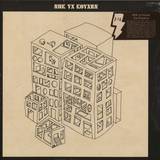
Granny13 opens with Nicola Ratti's 'Odd Doubt'. With the use of a modular system and tape loops, a broken rhythm is obtained by parallelism between single sound signals as LFO one or processed tapes.On the second side, Giovanni Lami's 'Johnny Leech' is made with a small bunch of equipment, just a chaotic hand-made synth (cacophonator) and a memoryman, working mainly on static electricity and leakage current in the synth used without any kind of power supply.
Reviews
The Wire
''Two Italian mucisians share a split single of glitchy fun and everyone goes some happy. Lami s piece uses a defective unplugged synthesizer to make huzzing chitters that have a kind of rhythm in spots. Ratti s contribution is a bit more structured it sounds like a record of accordion miniatures broken into pieces, then glued back together with little pieces of felt stuck onto it. Which would definitely be a pretty hep thing to hear.''
Textura
''Some releases qualify as art objects as much as musical collections, a case in point this recent seven-inch vinyl outing featuring material by Nicola Ratti on one side and Giovanni Lami on the other. That shouldn't be interpreted to mean that the musical content isn't worthy of one's time, as it assuredly is, but more to emphasize how striking the sleeve artwork by Opora is and how effectively it complements the musical content.Mastered by Giuseppe Ielasi and issued in an edition of 150 copies, the release opens with Odd Doubt, a concise experimental setting by the Milan-born Ratti, who's issued material on labels such as Anticipate, Preservation, Die Schachtel, and Entr'acte and who's presently working with Ielasi in the project Bellows, with Attila Faravelli as Faravelliratti, and with Enrico Malatesta and Faravelli in ~Tilde. Though Ratti started out as a guitar player, his current focus is more on beat-analog experimentation and sound installation. In Odd Doubt, Ratti's modular system and tape loops generate broken rhythms that varyingly call to mind dub-techno, even if dub-techno of an extremely wonky variety. Off-beat chords, crackle, and snare strikes add to the dubwise flavour of the material, though ultimately it registers as more of an experimental exploration than straight-up dub exercise.The flip side features Johnny Leech by Lami, a one-time photographer now known as both a field recordist and a musician focusing on soundscaping and sound-ecology. In his contribution to the seven-inch, Lami's chaotic hand-made synth (cacophonator) and memoryman give birth to blustery smears of static electricity that ultimately mutate into an Oval-like array of ripples and scratches. Johnny Leech is so removed from anything conventionally musical, it makes Odd Doubt sound like a Top 40 pop song. Like Ratti's piece, Lami's is short, so short, in fact, it gives the impression of being an excerpt from a larger sound art work. Here's a release where the abstract nature of the musical content matches its visual presentation.December 2014''
Vital Weekly 951
''Granny Records is from Greece, but the two musicians here are from Italy, of which I don't I heard from Giovanni Lami before. His piece is called 'Johnny Leech' and he uses a hand-made synth known as the cacophonator and a memory man (a delay machine), 'working mainly on static electricity and leakage current in the synth used without any kind of power supply'. It makes up for a nice piece of chaotic lo-fi sound, which is put forward through methods of improvisation. Quite a nice piece and it fits the format very well. The crackling of vinyl surely adds an extra layer. Nicola Ratti uses a modular synth and tape loops, of what seems to be percussive material, but the rhythm is broken down and the whole thing has a nice gentle feel to it, even when it bumps, clicks and glides, but the synth makes it more subtle. Here too one could say this perfect for a 7": one doesn't have the idea that this is cut from a longer part as is not unusual with this kind music. Especially Ratti seems to have worked out his music as a composition, which is very nice. (FdW)''Vital Weekly 951''Granny Records is from Greece, but the two musicians here are from Italy, of which I don't I heard from Giovanni Lami before. His piece is called 'Johnny Leech' and he uses a hand-made synth known as the cacophonator and a memory man (a delay machine), 'working mainly on static electricity and leakage current in the synth used without any kind of power supply'. It makes up for a nice piece of chaotic lo-fi sound, which is put forward through methods of improvisation. Quite a nice piece and it fits the format very well. The crackling of vinyl surely adds an extra layer. Nicola Ratti uses a modular synth and tape loops, of what seems to be percussive material, but the rhythm is broken down and the whole thing has a nice gentle feel to it, even when it bumps, clicks and glides, but the synth makes it more subtle. Here too one could say this perfect for a 7": one doesn't have the idea that this is cut from a longer part as is not unusual with this kind music. Especially Ratti seems to have worked out his music as a composition, which is very nice. (FdW)''Vital Weekly 951''Granny Records is from Greece, but the two musicians here are from Italy, of which I don't I heard from Giovanni Lami before. His piece is called 'Johnny Leech' and he uses a hand-made synth known as the cacophonator and a memory man (a delay machine), 'working mainly on static electricity and leakage current in the synth used without any kind of power supply'. It makes up for a nice piece of chaotic lo-fi sound, which is put forward through methods of improvisation. Quite a nice piece and it fits the format very well. The crackling of vinyl surely adds an extra layer. Nicola Ratti uses a modular synth and tape loops, of what seems to be percussive material, but the rhythm is broken down and the whole thing has a nice gentle feel to it, even when it bumps, clicks and glides, but the synth makes it more subtle. Here too one could say this perfect for a 7": one doesn't have the idea that this is cut from a longer part as is not unusual with this kind music. Especially Ratti seems to have worked out his music as a composition, which is very nice. (FdW)''
Buscar:one act play
Mastered and cut by Rashad Becker at Dubplates & Mastering in Berlin.
Hana's first and self-titled LP was recorded in Autumn 2010 at Facta non Verba and consists out of 5 tracks which are techno oriented with disposal of experimental and abstract elements.
Reviews
OMG Vinyl
Hana s S/T LP is easily the best promo records we ve gotten in months. This Greek duo has somehow, almost entirely below the radar, released one of the most exciting electronic records of 2011. Their wobbly brand of techno sometimes chugs ahead at full-speed, other times easing back into a wider waver, almost resembling some weird, warped IDM. I will be shocked if this record doesn t get wider appreciation very soon. Whether that happens or not, we fully recommend it, track one down.
Cyclic Defrost by Oliver Laing
Granny Records duo Hana come correct with their first album, offering a refreshing take on techno and IDM variants in the vein of Jan Jelinek, Raime, Actress and hints of the mighty Chain Reaction label. Mastered at Berlin s Dubplates and Mastering by none other than Rashad Becker, a name that often appears in the run-out groove of artists who inhabit a curiously funky techno-not-techno netherworld Hana s debut self-titled release grows in stature and listening enjoyment with every spin. With a sense of fun and adventure inhabiting the grooves, Hana (who are also part of label-mates, Good Luck Mr Gorsky), explore experimental timbres and ghostly vocalisations with a lightness of touch that belies their recording credentials.
Starting off with an abstract, Clicks and Cuts style intro, Liv slowly finds the sweet spot between mutant Detroit electro funk, a hint of the indie/dance territory of Matthew Dear and the abstract, yet rhythmic 12 releases on the Beatservice label, by Norwegian duo Information from the mid 90s. Obermaier implies the groove to begin with, until a wrong-footed man-with-two-left-feet rhythm leads into minimal acidic flourishes. Album opener SM heads in a Ricardo Villalobos vs. Nonplace Urban Field direction, as the lopsided rhythm and sepulchral vocals add a haunted edge to proceedings. CR80 uses beautifully syncopated live drums and urgent female vocals, and adds a driving, belligerent synth riff falling somewhere in between DMZ and Gary Numan. Echoic, boingy sounds threaten to derail the beat, but somehow it manages to maintain, reminding me of Shed and A Made Up Sound; more in overall feel than in the specific sounds. For those that enjoy abstract electronics that work just as well on headphones as on the dance floor, Greece s Hana are a duo to watch.
Textura
Hana's self-titled debut album arrives saddled with a (literally) cheeky front cover one would more associate with a 70s band like Wild Cherry than a Greece-based techno outfit formed in Thessaloniki last summer. Recorded in fall 2010 at Facta non Verba, the five-cut release finds Good Luck Mr Gorsky members Thanasis Papadopoulos and Thanos Bantis hunkered down in their chemical lab concocting formulae to go along with their material's stripped-down techno beats. Using analogue synths, samplers, and sequencers, the duo brings a decidely experimental edge to their productions, sprinkling as they do liberal doses of burble and flutter over bass-heavy techno rhythms.
The opening track, Sm, sets the scene with a heavy low-end pulse thudding alongside a steady kick drum and joined by acidy synths and percussive effects that suggest a lighter being repeatedly flicked open. On a slightly more aggressive tip, the B-side's Cr80 adds truncated vocal yelps to its bleepy, elephantine throb. A dubby dimension emerges in the track, too, when echoing waves drift repeatedly across the huge bass that slithers across the track's underbelly. The album's most elaborate track comes last. Liv opens beatlessly with flickering shudders and what could pass for the amplified workings of an ant community but then progressively fills in the dots with an insistent beat pattern, voice fragments, and even the demented meander of accordion playing. Though Hana hardly rewrites the techno guidebook on the release, it's nevertheless a pleasurable listen, in part due to the multi-dimensional experience provided by the vinyl format and the always superb mastering work done by Rashad Becker at Berlin's Dubplates & Mastering.
Blurt are perhaps the act who have played live at Optimo more than any other. Active for close to 40 years they are one of the UK's all time great acts, phenomenal live and on record and supremely underrated.
Blurt mainman Ted Milton is a living legend. Now in his 70s but more vibrant on stage than most artists 50 years his junior, he is a man of many talents; artist, poet, musician, performer....
In 1984 he released a solo 12'; 'Love Is Like A Violence', a no doubt accidental dancefloor gem completely out of kilter with any other music of the era that now makes total sense in 2017. Dubbed-out stabs, programmed rhythm, trademark sax squeals and a more subdued than normal vocal that is strangely reminiscent of Vincent Price. Thee definition of a cult classic and much in demand, side A of this 12' presents the A and B side (the equally outre 'It's Only Recently That Stalins Have Begun To Roost') of this mighty 12' on one side of vinyl.
'The Ruminant Plinth' is but one of multiple classic tracks in the Blurt catalogue and is a long, long time personal favourite that takes pride of place of the other side. Tribal hypno rhythms, chicken wire guitar, sax and Milton's voice on fire, this was a genuine party starter on the Optimo dance floor on Sunday nights Glasgow. So louche it should probably be banned.
12' vinyl release in full picture sleeve designed by Glasgow artist Andrew Beltran.
It's impossible to talk about this album without acknowledging the spectre of death that hangs over it - not only is it the third entry in Strata-East Records' Dolphy Series, a collection of archival recordings from some of the label's close associates honoring the recently deceased multi-instrumentalist, but it is actually dedicated to two members of the band, Wynton Kelly and Kenny Dorham, who died in between the recording sessions and its release. The point is driven home even further by the fact that the album begins with a tribute from Payne to the fallen Martin Luther King, Jr., a piece that acts as a de facto solo for Dorham - his playing all rosy elegance and regal warmth - before shifting into the lighter (though equally coolly-paced) "I Know Love," a showcase for Payne's sax. While not the most somber jazz track ever recorded, this opening suite is a low-key and mournful way to open the affair, but thankfully the album really picks off and shows these musicians more in their element the rest of the way.
"Girl, You Got a Home" is a funky piece, beginning very soulfully with some tight interplay among the rhythm section of Kelly, bassist Wilbur Ware and drummer Albert Heath. Ware is in especially fine form on this track, tying together the disparate passages of the piece by grounding the more ponderous moments in a deep funk, while Kelly's playing is especially ear catching in the way he stabs at his piano like it's an organ. After the first two tracks take up nearly twenty minutes, the four-minute "Slide Hampton" feels almost impossibly brief, a feeling that's enhanced by its quick, jittery, and infectious rhythm, driven by some really dexterous work from Kelly. The final track, "Flying Fish," may be the album's highlight, a Caribbean-inspired composition that casts the rhythm section as flighty ground for both Payne and Dorham to vamp on. The track is oddly danceable for something released on Strata-East, maybe the most fun moment ever for the label, and relentlessly uptempo. Though this release may be in part defined by the deaths that preceded it, it's clear that the recording process was actually a lot of fun for everybody, as their enthusiasm and energy jumps right out of the speakers. This is one of the first Strata East records I really got into and is still one of my favorites, a must-hear for any fans of the flightier moments of Dorham or Kelly's career, and a fitting tribute for both master musicians.
Muscle and Mind is the return of Oscar Mulero to long plays, after Grey fades to Green and Black Propaganda. 'Muscle' and 'mind' may seem antagonistic terms in real life, but in terms of music they make sense together, especially when talking about techno.
The coalition of introspection and abstraction is not incompatible with the rough and the percussive, and this
album is a good example of this. The underlying message behind the title refers to the reflection of mental states in the body, the genesis of emotions where body and mind are managed by the sense of hearing.
Throughout these twelve tracks, one can dive into the musical world of this producer whose discourse mutates in every album, always intricate, always meticulous. Darkness acts as a thread and repetition as hypnotic therapy. But now, he sets his usual hard sound aside and looks for a much more cared for and precise sound , where there is room even for a harmony and musicality that go hand in hand with danceability.
The combination of atmospheres and rhythms is constant throughout the album. Each of the cuts has been prepared with few sonic elements. He takes elements away one by one, and keeps exclusively the necessary.
A record that has been developed during endless hours in airports and travelling, absorbing influences from all over the planet. Made in solitude but surrounded by people who don't know what you are really doing on that computer. To close the circle, the album was mixed in professional studio using solid state technology, which gives this work a unique warmth that cannot be achieved in a domestic environment.
Muscle and Mind will be released on vinyl and CD. The digital version will include extra tracks which will also be published in an EP. This will precede the album with edited tracks from the album and remixes by Stanislav Tolkachev and SHXCXCHCXSH.
Muscle and Mind is the return of Oscar Mulero to long plays, after Grey fades to Green and Black Propaganda. 'Muscle' and 'mind' may seem antagonistic terms in real life, but in terms of music they make sense together, especially when talking about techno.
The coalition of introspection and abstraction is not incompatible with the rough and the percussive, and this
album is a good example of this. The underlying message behind the title refers to the reflection of mental states in the body, the genesis of emotions where body and mind are managed by the sense of hearing.
Throughout these twelve tracks, one can dive into the musical world of this producer whose discourse mutates in every album, always intricate, always meticulous. Darkness acts as a thread and repetition as hypnotic therapy. But now, he sets his usual hard sound aside and looks for a much more cared for and precise sound , where there is room even for a harmony and musicality that go hand in hand with danceability.
The combination of atmospheres and rhythms is constant throughout the album. Each of the cuts has been prepared with few sonic elements. He takes elements away one by one, and keeps exclusively the necessary.
A record that has been developed during endless hours in airports and travelling, absorbing influences from all over the planet. Made in solitude but surrounded by people who don't know what you are really doing on that computer. To close the circle, the album was mixed in professional studio using solid state technology, which gives this work a unique warmth that cannot be achieved in a domestic environment.
Muscle and Mind will be released on vinyl and CD. The digital version will include extra tracks which will also be published in an EP. This will precede the album with edited tracks from the album and remixes by Stanislav Tolkachev and SHXCXCHCXSH.
Most of the musicians who gathered to record this fantastic spiritual jazz record for the Strata-East label on May 24th, 1974 had crossed each other's paths in various musical pairings over the preceding few years. Husband and wife team Dee Dee Bridgewater (vocals) and Cecil Bridgewater (trumpet) had been working together on albums like Frank Foster's "Loud Minority", and Roy Ayers' "Coffy" and "Virgo Red". Ten weeks before the "Freedom Of Speech" session, the couple had been joined in Tokyo by Cecil's brother Ronald Bridgewater (tenor saxaphone) to record Dee Dee's debut album, the beautiful "Afro Blue". Also in the studio on May 24th, 1974 was Donald Smith, (piano, vocals), fresh from recording on his older brother Lonnie Liston Smith's "Cosmic Funk" - on which Ronald Bridgewater had also played percussion. Cecil McBee (bass) was also there - just two weeks before, he'd completed his own Strata East date "Mutima", and in February he'd played on Mtume's "Rebirth Cycle" - with both albums also featuring Dee Dee Bridgewater on vocals. He'd also played on Lonnie Liston Smith's "Astral Travelling".
So 1974 was a huge year for all five of these people. Donald Smith and Cecil McBee were six months away from recording on Lonnie Liston Smith's massive "Expansions", with McBee fitting in a few Pharoah Sanders albums in between.
AND THEN, THE MYSTERY ... So with all this fervent activity, the question has to be asked ...Who was Billy Earl Parker Jr (drums), the leader of this session
Billy Parker remains unlisted as a musician on all major jazz sites. His only other recording appears to be as a percussionist on Charles Tolliver's "Impact" in 1975. Then there's nothing.
Finally, by backtracking one of those Zoom info pages, I found a summary of a "SUNY Rockland Community College" 2002 press release that no longer exists :
"Billy Parker's Fourth World Legacy Concert ...The concert, Billy Parker's Fourth World Legacy, is the eighth annual tribute honouring the late percussionist and RCC educator, Billy Parker. A long-time Rockland County resident, Parker began his affiliation with RCC in 1987, building its jazz program and maintaining his life-long tradition of teaching and inspiring others. A lifelong student himself, Parker was near completion of his doctorate in music education at New York University when he died in 1996.
But then people began to read this blog post, and in the comments, Aaron Fuller said :
"Billy Parker was my uncle. He was an incredibly talented, smart, and kind man. I'm very happy to see that folks are still enjoying his masterpiece. Just to give you a bit more information about him... He was born and raised in Buffalo, NY and then attended college at Michigan State University. He met my aunt in Lansing. They lived in NY and toured in Europe for quite a while. Sometime later they relocated to Nyack, NY and he ended up on the faculty of the community college while he pursued advanced degrees from NYU. He was an Ellington scholar. Although his name isn't well-known even among the most avid jazz fans, I think that if you were to talk to some of the great NY musicians that were around in the late 60s and 70s you would find that most knew him. He also had a huge impact as a music educator and I have no doubt that his former students are all over the place, continuing to put his love of the art into practice."
Drumcode returns with its 6th installment of the internationally celebrated A-Sides series. Renowned for fostering a shared space between industry tastemakers and rising talent alike, the careful curation that goes into each volume is a fine example of why Beyer's brand continues to go from strength to strength.
Techno titan Adam Beyer has grown Drumcode into a force to be reckoned with; the label has become synonymous with forward-thinking, functional techno and even after 20 years, Drumcode continues to find new boundaries to push, and ways to solidify its legacy as the world's number one techno label.
2017 is no exception, with Beyer's imprint hosting it's first stage at Tomorrowland, not to mention the expansion of the critically acclaimed Junction 2 where the Drumcode stage is the centrepiece and Adam plays the key role of festival director. The Drumcode phenomenon continues to grow each week, chiefly fuelled by Drumcode Radio, Adam's radio show that's broadcast in 57 countries via 86 stations and to a global audience of 16 million techno fans per week.
The A-Sides series acts as a perfect vignette of Drumcode's cutting-edge sound; functional yet inspired techno, all tracks tried and tested by Beyer himself. Vol. 6 continues this tradition with a collection of 16 multi-faceted cuts from a mixture of both emerging artists and experienced label friends.
The heart-throbbing bass in Amelie Lens' electrifying piece 'In Silence' sets the tone for the dark and dance-floor-ready energy that Vol.6 carries the whole way through. Other standouts include Mars Bill's rough'n'ready 'Mohave'. Pulsating and precise, 'Mohave' has highlighted many of Beyer's sets recently as has Wehbba's monster track 'Fake', which fans have been anticipating the release of all year.
Label-favourites Dense & Pika also feature on 'A-Sides' Vol. 6 with their hard-hitting 'Just a Beat' and a huge track from Beyer himself who has joined forces with Enrico Sangiuliano to bring us their undeniably infectious 'Preset Heaven'.
With many more notable selections from the likes of Julian Jewell, Timmo, Tiger Stripes and Pig&Dan, A-Sides Vol. 6 is another impressive addition to the label's prolific release roster and a testament to why Drumcode remains at the forefront of the electronic world.
There is no end to composer Peter Broderick's creative output, and so we present to you his new album titled All Together Again — available worldwide on November 17th 2017 via Erased Tapes.They say music takes you on a journey, and this collection of commissioned work by Peter quite literally does that. From a ferry boat ride in Istanbul, to walking down the aisle at a wedding, these songs were created for particular situations, yet Peter found a way to work without any sort of limitations and on his own erms. The result is an assortment of works from the past ten years, coming together as one: Peter's new album. Words from Peter, October 2017: Ever since I started releasing records in 2007 (10 years ago now!), people have contacted me periodically to ask if I'd be interested in making music to accompany their projects. Most of these projects have been things like films, dance pieces and theatre plays . . . but every so often I get the odd request for something a little different. Peter, would you write a song for my wedding My one year anniversary A ferry boat ride
In early 2015 I was asked to perform 12 minutes of music during a runway show as part of New York Fashion Week. I agreed and began composing a 12-minute piece which I could perform on my own with a few different instruments and some looping pedals. I made a recording of the piece and sent it over to my contacts at the fashion show . . . but a few days before I was to fly out to New York, they wrote back and told me they actually just wanted me to play a few older songs that they were already familiar with. Feeling slightly disappointed, I shelved the other piece, giving it the title If I Were A Runway Model.It is with great pleasure that I now present this piece in a collection of commissioned works spanning the last decade . . . it's All Together Again. This group of oddball works does indeed include a couple pieces written for weddings (Our Future In Wedlock and The Walk), and a song someone asked me to write as a gift for his wife on their first year wedding anniversary (Emily). And indeed, there's a 17-minute piece written to accompany a ferry boat ride in Istanbul (A Ride On The Bosphorus). A few of the pieces were written for films (Robbie's Song, Atlantic and Seeing Things), and one for a kind of interactive installation (Unsung Heroes).In my early days of recording, I took pride in playing all the different instruments myself and doing the recording myself as well. And then at some point I started branching out, working with other musicians and recording engineers. But this record is very dear to me in that it's a return to that original approach . . . playing all the different instruments myself, working with my limits on each one, and my own limits in recording and mixing. I've always held a broad curiosity for all different instruments and all different styles of music, and if nothing else I hope this record will portray that curiosity, and my pure love for this thing we call music. Can you dig it The cover art was made by Peter himself in his hometown of Portland, Oregon, by cutting and sticking different coloured paper fragments to depict the individuality of each track.
The Doors had one of the most extraordinary debut years in music history in 1967, releasing a string of hit singles and two platinum albums, beginning in January with the band's self-titled debut, followed by Strange Days in September. The latter peaked at #3 on the Billboard album chart and featured classics like Love Me Two Times,' When The Music's Over,' and the title track Strange Days.'
STRANGE DAYS (50TH ANNIVERSARY DELUXE EDITION) was produced by the album's original engineer Bruce Botnick. It includes the original stereo mix of the album on CD for the first time in a decade, with sound that's been remastered for the first time in 30 years. The second disc features the album's original mono mix, which has been remastered for this set and is making its CD debut. Accompanying the set are liner notes by music journalist David Fricke, as well as a selection of rare and previously unseen photographs.
Having a larger budget for Strange Days allowed the band to spend more time experimenting in the studio. They used an eight-track recorder for the first time, which resulted in some memorable overdubs like Krieger's double-tracked guitar on When The Music's Over.' Surprisingly, the trippy keyboard sound heard on the album's title track is actually one of the earliest appearances of a Moog synthesizer in a rock song.
Strange Days mixed new songs written on the road with some written before the band's 1967 debut. In fact, the band performed Strange Days' during its 1966 residency at the London Fog in L.A., while My Eyes Have Seen You' dates back to 1965. Another early track is Moonlight Drive,' which was one of the very first songs that the band practiced together, and where the band heard Krieger's haunting bottleneck guitar playing for the first time. It's also the song Morrison sang to Manzarek at Venice Beach in 1965 when the two former UCLA film students reconnected and decided to start the Doors.
Betino's Records proudly presents its third release: an EP by the very sharp collective The Big Hustle. The band founded in 2014 by bass player and composer Sébastien Levanneur, brings
together 70's old school funk with the hippest actual sound with influences spanning from Steely Dan to Snarky Puppy, from Mandrill to Lettuce and from Herbie Hancock (Manchild era) to Soulive.
With mighty horn players, a rock and funky rhythm section, and percussions added to it, The Big Hustle's music has a very large variety of sound landscapes. Still, the music never loses the groove and always stays close to the funk.
The A side opens with "Afrorever", a tribute to African culture and music. The guest of honor on this song is legendary Malian musician Cheick Tidiane Seck, longtime partner of Salif Keita, and collaborator of Joe Zawinul, Carlos Santana and Damon Albarn to name a few. After Cheick's introduction, the songs jumps into a typical afrobeat vibe featuring a tight and powerful horn section, suddenly breaks into an electro funk groove and ends in a furious percussive party.
Second track on the A side is "Faure is the Magic Number". It is dedicated to Thomas Faure (co-composer of the track) and François Faure (both featured on this song on tenor sax and keyboards respectively). This piece displays the band's ability to blend jazz-funk groove with a heavy hip-hop beat. Kind of DJ Premier meets Steely Dan.
The B side starts with "Afrorever (Sun's Up Mix)". Through this mix, one can acknowledge instantly Olivier Portal's touch. From the very first chords, he conveys us into his realm blending warm and melancholy keyboards with an old school deep-house rhythm pattern.
The fourth track is called 1, 2, 1, 2'. It is a purely improvised moment in the studio while the band was sound checking before recording with special guest rapper Raashan Ahmad. Nicolas Gueguen had the good idea to press the R button and what you hear is basically what happened afterwards.
Enjoy!
SPECIAL LIMITED EDITION X 300 WITH BONUS 7 :
Limited special edition with the 7" containing the track "Lune noire", in 2 parts - one per side.
It's already been 5 years since the last Zombie Zombie album 'Rituels d'un Nouveau Monde', after which the group explored other territories by signing 2 film scores, namely 'Loubia Hamra' by Narimane Mari and 'Irréprochable' by Sébastien Marnier, as well as creating the music accompanying a contemporary circus show called 'Slow Futur' created by Martin Palisse and Elsa Guérin. Wouldn't these beautiful parentheses make you want to return to the sources After 10 years at Versatile Records, 2017 also marks the decade anniversary of the release of their first album 'A Land for Renegades' in 2007, at the time considered to be one of the 10 best albums of the year according to Rough Trade.
'Livity' - Zombie Zombie's latest opus seems to plunge us deep into science fiction, with a cover designed by the mythic cartoonist Philippe Druillet, who is also the founder of the cult Métal Hurlant comic series. The title of the album is somewhat misleading, as one could mistakenly think of a certain dub record made at
the famous Island Records Compass Point studio in the Bahamas. For the uninitiated 'Livity' or 'Life force' is actually a Rastafarian spiritual concept based on the idea that an energy exists within, and flows through, all people and all living things. The record was recorded last winter in Paris, in a very short time frame. 7 tracks played live in 7 days, by Etienne Jaumet (synthesizers / rhythm box / metallophone / sax), Cosmic Neman (drums / vocals / sound effects), and Dr. Schonberg (percussion / electronics / trumpet), recorded at the Red Bull Studios by Thibaut Javoy and Jerome Caron, 2 very competent engineers. To keep it in the family, the album was then mixed by another member of the Versatile stable, the mysterious and legendary DJ/producer I:Cube, done in the label's Victor Studio.
On this album the principles that are dear to the group rest being respected, still as far away as always from the standards of 'radio play', A living kind of music, composed of long instrumental moments recorded with analog synthesizers and drum machines, accompanied by drums and percussion. But I:Cube's touch may bring the unique energy that one may find at Zombie Zombie's concerts; on certain cuts like title track 'Livity' that the group recorded in Laos, a wild combination of 808 kick drums and bewitching jungle sounds that sound quite unlike anything else out there, and especially on 'Hippocampe', which gives the impression of hearing an old school hip hop rhythm with the power of a metal band who have replaced their guitars with an army of synthesizers: we recommend you listen to this particular track in a convertible while speeding down the highway.
As with all of Zombie Zombie's music the cinematic component is still strong, on titles like 'Ils existent..' 'Acera' which was originally composed for ciné-concerts accompanying the films of Jean Painlevé et Maurice Pialat. The energy of the beginning is still very present, as is - of course - the kraut inspiration. But it's also an album that takes new directions and sonic risks, like on 'Looose', which brings to mind the Art Ensemble of Chicago, or the groove of James Chance in New York in the early 1980's, featuring the free sax solos of Etienne Jaumet and Dr. Schonberg on the trumpet. The group also offers some slower and calmer titles, like 'Heavy Meditation' as well as exploring more experimental tracks in the line of French 70's groups such as Lard Free or Richard Pinhas, for example on the bonus track 'Black Moon'.
Please - Take your time, and enjoy listening!
It's already been 5 years since the last Zombie Zombie album 'Rituels d'un Nouveau Monde', after which the group explored other territories by signing 2 film scores, namely 'Loubia Hamra' by Narimane Mari and 'Irréprochable' by Sébastien Marnier, as well as creating the music accompanying a contemporary circus show called 'Slow Futur' created by Martin Palisse and Elsa Guérin. Wouldn't these beautiful parentheses make you want to return to the sources After 10 years at Versatile Records, 2017 also marks the decade anniversary of the release of their first album 'A Land for Renegades' in 2007, at the time considered to be one of the 10 best albums of the year according to Rough Trade.
'Livity' - Zombie Zombie's latest opus seems to plunge us deep into science fiction, with a cover designed by the mythic cartoonist Philippe Druillet, who is also the founder of the cult Métal Hurlant comic series. The title of the album is somewhat misleading, as one could mistakenly think of a certain dub record made at
the famous Island Records Compass Point studio in the Bahamas. For the uninitiated 'Livity' or 'Life force' is actually a Rastafarian spiritual concept based on the idea that an energy exists within, and flows through, all people and all living things. The record was recorded last winter in Paris, in a very short time frame. 7 tracks played live in 7 days, by Etienne Jaumet (synthesizers / rhythm box / metallophone / sax), Cosmic Neman (drums / vocals / sound effects), and Dr. Schonberg (percussion / electronics / trumpet), recorded at the Red Bull Studios by Thibaut Javoy and Jerome Caron, 2 very competent engineers. To keep it in the family, the album was then mixed by another member of the Versatile stable, the mysterious and legendary DJ/producer I:Cube, done in the label's Victor Studio.
On this album the principles that are dear to the group rest being respected, still as far away as always from the standards of 'radio play', A living kind of music, composed of long instrumental moments recorded with analog synthesizers and drum machines, accompanied by drums and percussion. But I:Cube's touch may bring the unique energy that one may find at Zombie Zombie's concerts; on certain cuts like title track 'Livity' that the group recorded in Laos, a wild combination of 808 kick drums and bewitching jungle sounds that sound quite unlike anything else out there, and especially on 'Hippocampe', which gives the impression of hearing an old school hip hop rhythm with the power of a metal band who have replaced their guitars with an army of synthesizers: we recommend you listen to this particular track in a convertible while speeding down the highway.
As with all of Zombie Zombie's music the cinematic component is still strong, on titles like 'Ils existent..' 'Acera' which was originally composed for ciné-concerts accompanying the films of Jean Painlevé et Maurice Pialat. The energy of the beginning is still very present, as is - of course - the kraut inspiration. But it's also an album that takes new directions and sonic risks, like on 'Looose', which brings to mind the Art Ensemble of Chicago, or the groove of James Chance in New York in the early 1980's, featuring the free sax solos of Etienne Jaumet and Dr. Schonberg on the trumpet. The group also offers some slower and calmer titles, like 'Heavy Meditation' as well as exploring more experimental tracks in the line of French 70's groups such as Lard Free or Richard Pinhas, for example on the bonus track 'Black Moon'.
Please - Take your time, and enjoy listening!
With The Object Isn't There UK guitar player and producer Jack Allett has made a deeply personal masterpiece based around cyclical guitar parts and electronic percussion. Playing like a half remembered fever dream with an aesthetic that is ragged, hypnotic and spacey, its two side-long pieces touch on minimalism, kraut-infused dub and euphoric dance floor optimism. As comfortable being played after Manuel Göttschings E2-E4 as right before a Terekke lo-fi house anthem, it is laced with the melancholy of an early morning post-rave comedown. Yet for all the references and name-checking, it's a record that is hard to compare to anything else, past or present.
BIOGRAPHY
Jack Allett works as a producer in London and has been active for many years as an experimental guitar player, releasing a solo record on Blackest Rainbow and collaborating with UK avant-guitar player Cam Deas. The Object Isn't There was written, recorded, and mixed in Camberwell and Camden, London, UK. 2012-2016.
INFO
This record is about - insofar as instrumental music need be about anything - hallucinations. The title The Object Isn't There serves as a concise definition, derived from the quote 'An hallucination is a strictly sensational form of consciousness, as good and true a sensation as if there were a real object there. The object happens to be not there, that is all.' (William James, The Principles Of Psychology, 1890)
Having experienced constant tinnitus - a form of auditory hallucination - for the last 13 years, Jack has long questioned the distinction of something experienced as being either there or not-there. Even if, strictly speaking, an hallucination is something that's not there, if the reality of how it affects day-to-day existence is undeniable then to any extent that matters, it is there. But The Object Isn't There is no tale of woe, nor simply a response to this one condition, and tinnitus need not be considered only as distressing or distracting. Allett sees it merely as one example of many things in life that cross this uncertain terrain:
There are obvious parallels here with the notion of active listening. There is room for emotion too, particularly the kind of overwhelming, -all-consuming emotion that, once it fades, is hard to believe was actually how you felt. Essentially the music here is concerned with being overwhelmed by a sensation, never really being sure to what extent you are conjuring it up yourself, to what extent it exists independently of you, but ultimately deciding that it doesn't much matter; the sensation itself was undeniable.
— Jack Allett
A swirling haze with a plenitude of sounds bobbing to it's surface it's a heartfelt
2022 Repress
HQ Gatefold, 3x12 140g Vinyl, black innersleeve, download code
EXTRAWELT are back! Although in fairness, they were never gone. On the contrary, since their first release on James Holden's Border Community Label dropped in 2005, Arne Schaffhausen and Wayan Raabe have been responsible for a plethora of classics including "Schöne Neue Extrawelt" and "In Aufruhr", their two seminal albums on Cocoon Recordings. The duo are one of the most booked live acts worldwide, commanding a huge fan base. Their performances are the stuff of legend, making them the absolute highlight at every club and festival they play. So it's with great pride and respect, that we can announce the release of Extrawelt's third album for Cocoon Recordings. "Fear Of An Extra Planet" completes the Cocoon trilogy and the excitement growing among their fans represents a new high in the history of EXTRAWELT!
Musically, of course, there's enormous pressure on EXTRAWELT to deliver, but this is dismissed with a playful disregard and they are clearly focused on the job in hand. The album title "Fear Of An Extra Planet" sounds cinematic, like some art-house science fiction film, without giving too much away.
However, from the first seconds of the opening track "Superposition", the album title makes 100% sense and sets the scene for the rest of the trip. We are immersed in wide open spaces and invited to explore dark and dusky worlds that transport us back to their Border Community years. Timeless and elegant, "Superposition" perfectly captures the epic, dream like quality that made James Holden's label so influential.
New Release Information Second up, "Gott ist Schrott" takes a much more minimalist approach with its retro 80s drum programming, monster bass lurking in the breaks and playful Rhodes/synth riffs that span the divide between early German techno and deep Detroit electro with a distinctive film soundtrack aesthetic. "Oddification" continues this theme, adding extra spice reminiscent of the techno-synth vibe of Detroit with a punchy, almost Prodigy-style breakbeat complete with shredded vocal samples that gives us a taste of what's in store. "Gentle Venom" then takes the breakbeat motif to the next stage. The main focus here is the classy sprinter of a bassline, peppered with a flurry of intricate and subtle effects and modulations, that immediately trigger an intense, movie-like 'in pursuit' feeling.
With - Das Grosse Flimmern" we cautiously approach the album's high point. It's still in keeping with the soundtrack aesthetics, but faster and with more urgency. Almost hypnotically, Extrawelt invade us with an energy and impetus that always radiates from their music. Next in line is "Silly Idol" and here Arne Schaffhausen and Wayan Raabe opt again for a more minimal tack, focusing even more intensely on the dance floor to reveal a pulsing, twisted heart to the album.
"Punch The Dragon" is the hidden gem of the collection, utilising and melting together the most bombastic and playful elements. This one is totally off the hook, a sensory overload in an acoustic widescreen format! Then we have the title track "Fear Of An Extra Planet" which perfectly sums up the album concept. It opens up like a film score, with minimal passages following dark sequences that morph into dreamy melodies, all grounded by cool, constantly alternating analogue drum patterns. If you're not listening closely, you might get the impression that three or four different titles are mixed together; such is the effortless flow of the album.
As we near our destination, "The Friendly Coroner" really does honour its name. The morbid charm of the title is captured by a fluid bassline and melodic arrangements that border on the absurd, until the funky drum beat finally drops. In our mind's eye we see a cheerful medical doctor removing his bloody gloves, hanging his smock in the closet and vibing out in his neon drenched workspace. And there we sit, glued to our cinema seat, submerged in the different textures EXTRAWELT have conjured up on "Fear Of An Extra Planet". Over the course of the last title, the strings usher in the final acknowledgments as the credits roll. The dramatic end of "2084" leaves us transfixed in front of a black screen in a large, dark room safe in the knowledge that we've just witnessed a science fiction epic.
Osaka, not being Japan's capital city, has a history of producing some unique underground movements and artists. Without the attention or the funds Tokyo artists may have access to, Osakan artists over the years have had to make their own way with raw innovation.Iku Sakan, an electronic musician and DJ from Osaka, has spent most of the last decade living in Berlin. Prior to that, he was active in the underground club scene of Kyoto & Osaka. A previous unit was Sakan & Senju (with Muneomi Senju of The Boredoms). Together, they produced a 15 copy handmade edition of their music on CDr. Iku personally handed a copy to Karlheinz Stockhausen, when he was visiting Tokyo for his last festival appearance in Japan.Sakan began playing steel drum at the Görlizer park in Berlin, Tori Kudo of Maher Shalal Hash Baz then invited him to accompany the band. Immersing himself in the international DIY / noise / improv scene back in Berlin, he became active as an improviser, DJ and promoter, and has since worked with Sun Araw, Anders Lauge Meldgaard, Pekka Airaksinen, Günter Schickert, and Damo Suzuki.Playing and improvising, touring and DJing, has led to his sound, a kind of metaphysical music, with circular rhythms and an emotive, melodic feel. He combines analogue and digital devices (Omnichord, Roland MC303, and a DIY electronic doll synth. made by his friend Stephane Shibatsuji-Perrin in Tokyo), and pre-recorded materials, mixing and merging all four signals into one mixer (no MIDI sync.), through an effect pedal. When recording, he usually lets these devices run until something clicks. Then he records and starts to improvise, like he's playing an imaginary instrument, entering a timeless region where track length loses its meaning.2017 has seen some of Sakan's Berlin recordings released, initially on two tapes: 'Human Wave Music', for Natural Sciences, and 'Cepheidian' for Planet Almanac. The two track long player 'Prism in Us All' on Japan Blues' imprint is his first LP. His on/off-world sound, part kalimba, part gamelan, part E2-E4 - and at the same time, none of them. A hypnotic, musical mantra, centring the spirit, and resonating with the harmonics of the spheres.Prism In Us All' is the second release on Japan Blues' eponymous imprint, after featuring the album on his NTS show in January.300 copies only, in silk-screened sleeve.
'Exit Entrance' is the DFA debut for Kohei Matsunaga aka NHK yx Koyxen.
Kohei has been making / releasing music since 1997 and has recorded for such iconic labels as Mille Plateaux, Important, Pan & Diagonal.
His latest recordings explore intricate drum programming, lush melodies & sparkling arrangements. Touchstones include the legendary 'Clicks & Cuts' compilations from the 1990's as well as Aphex Twin & Autechre. RA called his music bombastic techno funk....unpredictable but rarely disappointing'.
'Exit Entrance' is a collection of new songs that snap and flicker unlike anything Kohei has done in the past. There is a clarity and beauty to these tracks that bursts out of the speakers in a three dimensional way, matching the 3D glasses that the artist wears during all his live performances. The elegant arrangements and crisp drum breaks match the concise song titles - Kohei foregoes the typical impenetrable track names made up of numbers and shorthand, and opts for a more direct emotional sincerity through the sonic themes of the record. Not all the music here falls into the same exact formula.
As the album heads towards a close, after several tracks of harmonious beauty, we get 'Outset (for Mika Vainio)', a sombre hushed techno tune, dedicated to his late friend and musical collaborator, who unexpectedly passed away earlier this year as the record was being completed. What follows after this track is perhaps the real catharsis, as 'Dented' ominously kicks off with acidic stabs and rolls into a tumultuous dirge of gritty techno.
In this regard, 'Exit Entrance' can play out like a life cycle, a mini opera of birth and beauty, of sorrow and mourning.
It is one of the most direct and honest records Kohei has ever made, and DFA is beyond proud to present this work from such an esteemed creative force in the electronic avant-garde world of music.
For fans of Aphex Twin, Actress, Zomby, Kraftwerk, Four Tet.
With the label's 10th anniversary celebrations now done and dusted, Claremont 56 returns to action with something rather special: a magical debut single from a previously unknown talent.
There's not much we can tell you about Ferdi Schuster, other than that he is a talented young producer from Augsburg in Germany. As Claremont 56 is one of his favourite labels, he speculatively submitted some tracks for consideration. Label founder Paul Murphy was astonished by what he heard and believes the two tracks showcased on this 12' are amongst the best things the label has released for some time.
A-side 'Little River' is breathtakingly good. Opening with the sound o a babbling brook, it sees Schuster wrap plucked, sun-kissed acoustic guitar licks and jaunty vintage synthesizer motifs around a languid, samba-infuenced groove. As the track progresses, further magical musical elements come to the fore, including blissful electric piano solos and more mazy synthesizer solos, seemingly played on battere old equipment from the turn of the '80s. Schuster's love of the acoustic guitar is explored further on similarly impressive B-side 'Befreit'. Here, gently strummed chords and fuid Spanish guitar motifs catch the ear, as hushed cymbals and gentle hand percussion lap at your feet like the sea at sunrise. The German producer adds atmosphere through a combination of leisurely Hammond organ solos and a touch of Jew's Harp. When all of these immaculate elements combine, the results are little less than spellbinding.
Schuster may be taking his frst steps into releasing music, but his
compositional, playing and production skills are already fnely tuned. We can surely expect to hear more inspired music from him in the years to come.
Step Time Orchestra was the collaborative work of producers Jori Hulkkonen and Toumas Salmela, who began producing music together in the nineties whilst studying in Oulu, Finland. Whilst all their friends would be getting up early to go to university, they would only just be going to bed, having spent the night listening to house records from New York, drinking Whiskey and programming their MPC 2000!
Step Time produced a slew of tracks during this time, some of which were licensed and pressed on 12" singles during the late nineties/early noughties on labels operating in North America and Europe, but not everything they made saw the light of day. Heavily influenced by labels like Ibadan and Spiritual Life Music at the height of the New York House Scene, 'Jazz Error NYC' and '2am in Africa' were never signed, not fitting the profile of their other releases at the time, they were left in the drawer and sadly forgotten!
Skip forward to Winter 2016, and FBNM's Lorenzo, whilst over on a DJ excursion, visits Jori in Finland. Keen to keep working together, he presses him for something uniquely special. Magically, the Ajos E.P jumps out of the drawer into Hulkkonen's hand, and as it turns out, it has aged with a rather remarkable grace. Written using a combination of MPC sequencing and an Atari ST powering vanilla Cubase for some midi programming duties, it features the sounds of the Italian made Siel Opera 6, an Alesis S4 Rompler and other vintage Roland, Yamaha and Kawai Synths. They went full out on this one, even finally learning to play keys for that jazzy piano action. It was recorded live through a soundcraft analog board with outboard Fx, creating a sound that transcended it's time to feel remarkably fresh today!
The Ajos EP is named after an area in their native city of Kemi, Northern Finland, which is where they wrote and produced it in 1999.
Following some ear-catching manoeuvres across releases like last year's self-released 'Only' and 'Lagata', which gained her early fans like Bjork and Dev Hynes (who she supported in the USA), 'Tommy' marks Klein's deepest plunge yet into the deep, dark ocean' of her musical imagination on her Hyperdub debut. On 'Tommy' her vocals play with Fifties-esque melodies before switching to familiar tones akin to Brandy and Rodney Jerkins, her live voice and live piano playing filtered through hyper-glitchy and looped production with a loose, internal logic, cutting from angular atonality to pockets of skewered harmony. 'Tommy' also steps things up in conceptual terms. Its eight tracks are broken down into acts that are rooted in themes of vulnerability, sisterhood and death, threading the chaotic sonics with modern operatic undertones and a Shakespearean sense of tragedy. There's a lot of bluster about originality in contemporary UK music and what rises from the noise here is a creative voice who, by her very nature, plays with the construct of what pop is. This is Klein's world ... it's on us to get with it.