With $10 Cowboy, Charley Crockett didn’t set out to make a themed record. He had released a concept album in 2022, the critically acclaimed Man From Waco, propelling Crockett to new heights and establishing him as one of the leaders of a sparkling revival of traditional country and folk music. For the follow up album, Crockett wrote freely, over a two-month period, as he wound his way across the United States on the back of a tour bus. The resulting songs—raw, personal, vivid portraits of a country in transition—ended up being connected after all. “This material is written at truck stops, it’s written at casinos, it’s written in the alleys behind the venues, it’s written in my truck parked up on South Congress in Austin,” explains Crockett. “A ramblin’ man like me, a genuine transient, is in a pretty damn good position to have something to say about America.” As the album unfolds, you begin to understand that a $10 Cowboy is anyone who has hustled to get by, who didn’t fit in, who has slept on other people’s couches, or the street, who has fallen down, gotten up, and ventured from home chasing a paying gig, or a new start. “Being out on the road gives you a first-hand experience of how different kinds of Americans see themselves as going through some kind of great struggle,” Crockett says. “The roughneck working the oil and natural gas fields in West Texas. The single mother raising kids by herself. The young man working a street corner because he thinks it's his only option. I would be dishonest if I said I couldn’t see the thread. Each of ‘em feel invisible. I am struck by the battles they are fighting internally, and the ways they have been entrapped by what America says they are.” The album was recorded at Arlyn Studios in Austin, produced by Crockett and his long-time collaborator Billy Horton. It was recorded live to tape, with anywhere from 6-12 musicians and backup singers on each track, giving the songs the feel of a live performance. It’s a sound Crockett has been after for years. “Reason I cut it on tape is because when you got the right people in the room, and the great players rise to the occasion when that red light is on and the tape is rolling, you get the magic of a great performance.” It's exactly what he achieved with $10 Cowboy. Regular bandmates Fox, Nathan Fleming, and Mayo Valdez are joined by some of the genre’s most talented players—Rich Brotherton, Kevin Smith, Dave LeRoy Biller, T. Jarrod Bonta and others, including a string quartet. Lauren Cervantes and Angela Miller sing on the album. While the musicianship and accompaniment are exquisite, they are also subtle, placed joyously, yet judiciously across the album. No, Crockett didn’t set out to write a themed record. Or, through his studied eye, to find America. But with $10 Cowboy, he might have done both.
Buscar:one hand
"All our dreamers lose to the light" - from "Angels Go Home" When the pandemic began, and the world shut down, so did the process of creating for Iron & Wine's Sam Beam. In its place was a domesticity that the singer hadn't felt in a long time, and although it was filled with many rewards, making music was not one of them. Reflecting on that time, Beam notes: "I feel blessed and grateful that I and most of my friends and family made it through the pandemic relatively unscathed compared to so many others, but it completely paralyzed the songwriter in me. The last thing I wanted to write about was COVID, and yet every moment I sat with my pen, it lingered around the edges and wouldn't leave. This lasted for over two years." The journey back began with a recording session in Memphis to record a handful of Lori McKenna tracks for the EP Lori with friend and producer Matt Ross-Spang. The cathartic experience reconnected Beam with his love for making music, and soon enough the paralysis had passed, and he was finishing lyrics and booking studio time for what would become Light Verse. Light Verse was recorded with engineer and mixer Dave Way at his studio Waystation high up in Laurel Canyon (with an additional session at Silent Zoo Studio with a 24-piece orchestra), with a host of talented musicians joining Beam: Tyler Chester, Sebastian Steinberg, David Garza, Griffin Goldsmith, Beth Goodfellow, Kyle Crane, and Paul Cartwright. And, Fiona Apple joined Beam on vocals for the duet "All In Good Time." Beam lyrically once again takes focus on a series of both fictional and personal insights, filled with desperate characters and wide-eyed optimists, offering promise and a dose of heartache, tears and laughter, life and love. Taking stock in the album's title, he jokes, "Light verse is a form of poetry about playful themes that often uses nonsense and wordplay, and it's my first official Iron & Wine comedy album!_. Just kidding_." While true this may be Iron & Wine's most playful record, Beam says the title mostly reflects the way the songs were born with joy after the heaviness and anxiety of the pandemic. Where recent records like Beast Epic or Weed Garden gave air to the disquiet of middle-aged frailty and brokenness, these songs trade that for the focus acceptance can bring. Moment by moment, they delight in being pointed or silly (or both) and attempt beauty over prettiness. Light Verse arrives April 26th, and it's Iron & Wine's seventh full-length overall and fifth for Sub Pop Records. Fashioned as an album that should be taken as a whole, it sounds lovingly handmade and self-assured as a secret handshake. Track by track, its equal parts elegy, kaleidoscope, truth, and dare.
Apparel Wax's 7inches vinyl series continues with a release focused on new, exciting sounds. APLMINI003, which drops in late January 2024 is composed, as usual, of two tracks, one per side. Side A kicks off with a nu-disco track, in which the solos of a wild sax and a loopy guitar riff takes the listener by the hand until the very last second. Side B, however, shows the more experimental part of APLWAX's soul, with a beat that seems nostalgic of the 90s/00s UK sounds, a broken beat and a decidedly more pressing rhythm, which recalls D&B influences, British-style Electronica. The possibility of combining tracks with different styles on the same record represents a sonic challenge, but APLWAX has always been accustomed to combining different musical currents, keeping the fresh and happy soul of its brand clear. Everything is represented by the new, elegant graphic design of APLWAXMINI, in which even the smallest details and small changes fill the record's release with anticipation. APLWAXMINI003 is coming.
"Corrosion of Conformity's In The Arms Of God was released in 2005 and was the last album to feature Pepper Keenan on vocals and guitar until his return in 201The set shows a return to the form of albums like Deliverance and Wiseblood, where it features a new form of progression and maturity not seen in older Corrosion of Conformity releases and resembles a true underground metal album as opposed to the much more catchy and commercial albums of their classic era in the 90's. The opener of the album, ""Stone Breakers"", closely resembles a Tony Iommi-led Sabbath jam, while such other ragers as ""Paranoid Opioid"" and ""Never Turns to More"" feature a classic COC sound. In The Arms Of God is widely seen as one of their best albums to date and is available as a limited edition of 1000 individually numbered copies on silver coloured vinyl. "
In The Arms Of God by Corrosion Of Conformity, released 26 April 2024, includes the following tracks: "It Is That Way ", "Rise River Rise " and more.
This version of In The Arms Of God comes as a 2xLP in a(n) Gatefold Sleeve packaging.
The vinyl is pressed as a silver disc. Another vinyl is pressed as a silver disc.
Mother Twilight is the second Faun Fables album. It has since been noted by Scottish author R.J. Stewart as a work containing true artifacts of the oral underworld tradition. Dawn and Nils made a hand-assembled first pressing and peddled it to nearly every bar and rural hall across North America from 2001-2003. Drag City reissued the CD in 2004. Things are glowing outside, enough to bring any sun worshiper in for the night. But you must remain outside and begin walking. It"ll prepare you for the night, which otherwise comes as a chilling surprise. If you pay attention this time, maybe you"ll understand why you"re becoming invisible. When your memory began, it wasn"t startling, wasn"t a mistake. It came out of an old, dark and familiar thing, like a storyteller, like Twilight... so save us from fear, mother, and tell your story. Dawn McCarthy"s creative background was forged in oral tradition amidst a large musical family in Spokane, Washington; studying piano, music theater, rock bands, guitar, folklore and ethnomusicology. Dawn cut her teeth as a singer and performer with various bands and cabarets in Madison, Wisconsin and New York City, most notably as yodeler with the Bindlestiff Family Cirkus, who inspired her to want a gypsy life with a kindred spirit someday. Her focus took a pivotal turn in that direction in 1997 with a solo quest through the UK and Ireland and their bardic traditions; singing songs in clubs and homes, all the while undergoing a pastoral, psychological experience with the land. Upon her return to the States, a fateful meeting with Oakland, CA born-and-raised Nils Frykdahl (Sleepytime Gorilla Museum) moved McCarthy back to the West to begin a new creative collaboration in the thriving hills and art community of the San Francisco Bay Area. Since 1999, Faun Fables have released six albums and performed their animist, otherworldly folk music across North America and Europe, with shows in Australia, New Zealand and Israel, as well. Dawn"s writing and voice (described by The New Yorker as "one of the more compelling instruments in contemporary music") opens hearts and minds with a whisper to a rallying battle cry, further animated by Frykdahl"s adventurous musicality and vocals. Dawn has written musical theater performed by the Idyllwild Arts Academy, among others, and has lent her vocals to Bonnie "Prince" Billy on The Letting Go and What the Brothers Sang. In 2022, Faun Fables debuted their family band, joined onstage by their daughters with vocals, percussion, keyboard and dance.
Nina recorded "tarde" in her bedroom 3 years ago and wanted the song to keep the same intimate feeling as when she recorded it.
The result is a dark love song about love so strong, it could almost break you.
David Lohlein and Alex Wilcox delivered perky remixes that are now being released on limited pink vinyl with hand stamped labels.
don't sleep on this one!
Back in 2004 a 4 track 12'' EP appeared from Omar's own label to wide acclaim with one track in particular, a driving heady slice of peak time broken beat soul receiving global appeal and mass attention. Championed by the likes of Gilles Peterson, Patrick Forge & IG Culture 'It's So' went on to become a highlight in the live sets and remains as fresh today as it did over 20 years ago. An instrumental version was never released so this completes the package on the flip as a Mukatsuku exclusive. 'It's So ' featured on the Mukatsuku Records feature on Gilles Peterson's Worldwide show in January of this year. 500 hand-numbered copies. Strictly no repress. As played by DJ Koco, Dom Servini, Rob Luis, Kevin Beadle, Shuya Okino, Smoove & more...
Dark Matter ist Pearl Jams zwölftes Studioalbum und die erste Veröffentlichung der Band seit dem von der Kritik hochgelobten Gigaton (2020). Das Album ist der Höhepunkt eines frischen und rasanten Ansatzes der Band und des Produzenten Andrew Watt (Rolling Stones, Iggy Pop, Post Malone, Miley Cyrus, etc) Während die Band bei Gigaton in vielen Aufnahmesitzungen Songkonzepte erarbeitete und die Fertigstellung des Albums etwa drei Jahre dauerte, kamen die Bandmitglieder für Dark Matter ohne vorgefertigte Songideen und ohne eigene Instrumente in die Shangri-La-Studios. Die Kreativität fand in Echtzeit statt und war eine wirkliche Gemeinschaftsleistung. Die LP wurde in drei Wochen fertiggestellt. In einem Interview mit Classic Rock sagte Mike McCready kürzlich, “Andrew Watt really kicked our asses, got us focused and playing, song after song. It took a long time to make Gigaton, but this new one didn’t take long. Andrew was like: ‘You guys take forever to make records. Let’s do this, right now.’”Von der Bühne ihres Konzerts in Austin im Sommer 2023 sagte Eddie Vedder “We’ve made a record for next year. What I can tell you is if you like the musicians in this group, you’re gonna hear them playing at their highest level.” Dark Matter erscheint auf CD, Vinyl und als Deluxe CD (inkl. Dolby Atmos Version)
Book[57,94 €]
Here In, Absence" ("Here, In Absence" for the book) is the result of the dialogue between the Finnish photographer Mikael Siirilä and the music artists The Humble Bee & Offthesky initiated by IIKKI, between March 2023 and January 2024.
After a first release in 2019 on IIKKI ("All Other Voices Gone, Only Yours Remains"), a second one in 2020 on LAAPS ("We Were The Hum Of Dreams"), Craig Tattersall (The Humble Bee) and Jason Corder (Offthesky) come back with a third stunning out-of-time beauty, paired with the Mikael Siirilä photography works.
Craig Tattersall is a former member of The Remote Viewer and Famous Boyfriend bandmate Andrew Johnson. Tattersall's music can be found these days more often under his alias The Humble Bee; as a founder member of The Boats; and in his collaborative works with the likes of Bill Seaman in The Seaman And The Tattered Sail. He has run the wonderful label Cotton Goods from 2008 to 2015 and since 2009 he has recorded 16 solo albums on his moniker The Humble Bee and almost the same under his name on some collaborations.
Jason Corder is experimental-ambient multimedia artist based in Denver, CO. He has been producing music, video art, audio software, and the occasional interactive sound sculpture, for over 20 years. He teaches private courses on generative music and occasionally lectures on various sound design topics at Denver University. He currently is the Audio Director at the Denver based videogame studio Dire Wolf. Over the years, he has worked with labels such as Home Normal, 12k's term, Facture, LAAPS and more. Over the years he has performed at Mutek, Decibel, Communikey and other festivals, sharing the bill with likeminded artists Pole, Matmos, William Basinski, and more.
Mikael Siirilä: "I am a darkroom artist (b. 1978) based in Helsinki, Finland. My small individual photographs examine the themes of absence, presence and outsiderhood. My characters appear immersed in their inner worlds and moments of being: simultaneously absent and intensely present. The pictures also reveal the outsider’s gaze, lost in observation and reflection. My pictures are true observations captured with minimal interaction with the subjects. Their origin is in the act of looking, and they feel causally connected to the world. The craft of printmaking is inseparable from my artistic expression. I work solely with black & white film and the darkroom. The slow, contemplative process lends the pictures a calmness. I make physical pictures I want to stare at, feel and become lost in. Again and again."
Fine Art Book, Ltd. to 500 copies:
Hardcover book printed on Munken Lynx 150g/m2 // 80 pages, 18cm x 24cm, 51 photos // Logo and slot embossed // Selective UV varnish // Visible seam and cutting cover pages // Hand-numbered, hand-stamped.
2024 RSD Release
Originally released on the cult V4 Visions label in 1991 & 1994, Ashaye’s 'Dreaming' and 'What’s This World Coming To' showcased the sound of Steet Soul, a genre that emerged in the 1990s, blending elements of soul, R&B, and hip-hop, that could be heard playing across London’s pirate radio stations. As the popularity of UK soul has grown in the last 5 years, DJ’s and tastemakers have put 'Dreaming' and 'What’s This World Coming To' into heavy rotation which has only increased demand & price for the original vinyl considerably. At present this demand is so high that it’s not even possible to purchase 'Dreaming' on the second hand market, while copies for 'What’s This World Coming To' are changing hands for £50+. On this fully licenced, RSD release, two of Ashaye’s biggest tracks are together on one 12 inch for the first time! Don’t sleep on this double header of premium UK street soul on South Street International's debut foray into vinyl!
12" - Fully Authorised Reissue on Original Release Label!
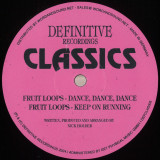
Canadian deep house don Nick Holder's Fruit Loops EP is next to get the remaster and reissue treatment from Definitive Recordings. This label, now overseen by Get Physical Music, first released the EP back in 1995 when Toronto-based Holder had already become one of house music's most tasteful operators. He went on to release over 125 EPs and singles under countless aliases, in various groups, and on his labels DNH Records and Treehouse Records, as well as !K7 Records and NRK. His style spans house, disco loops and minimal Chicago grooves and is always high on immersive atmosphere. Opener 'Dance Dance Dance' brings together all those aspects of the Holder sound with its funky guitar riffs looping beneath raw drums and disco basslines. Classic Chic samples burst out of the mix to bring an air of celebration and party, and it makes for an irresistibly feel-good sound. 'Keep on Running' is a steamy and sweaty house jam with loopy drums and bass and more smartly chosen samples, this time from Roy Ayers, that bring the funk and never let up. It has long been a go-to anthem for house DJs, and the realness and rawness of the emotions in Holder's work also shine through with the filtered synths and jazzy keys of 'The Message of Love', which is complete with bumpy and irresistible drums. Last of all is the unfettered party spirit and diva vocals of the brilliantly lo-fi funk-house pumper that is 'Clap Ya Hands'. This EP hasn't aged one bit and remains a definitive piece of early Deep House history.
Advitam Aeternamour, Cléa Vincent's third album, will be released on 29 March 2024 by Midnight Special.
If the 90s gave us “French touch,” then the 2010s ushered in “French pop,” and it was in the midst of this revival that Cléa began her artistic journey. As early as the music video for
“Achète-le-moi” from her debut LP Retiens mon désir (2016), we witness the singer striking selfie-like poses with her French pop comrades (La Femme, Bertrand Burgalat), appearing pell-mell on screen in the form of their vinyl records. Since then, whether singing with Philippe Katerine or co-producing (and composing) Jeanne Balibar's D'ici là tout l'été (2023), Cléa Vincent has effortlessly carved out a niche for herself in the French pop scene. The advantage of being a “jack-of-all-trades” — Cléa is a writer, composer, and producer — is that her music casts a wide net. Both highly acclaimed in the indie circuit and “as seen on TV” (on Quotidien, among others), she has also enjoyed a stint as the host for web-TV show Sooo Pop, for which she regularly interviewed a plethora of French artists. Beyond France, the singer tours extensively. After a run of concerts in Europe, Asia, North and South America, it was her visit to Latin and Central America that inspired Tropi-cléa (2017-2020-2022). The three EPs bathed in a tropicalist glow do more than just dip their toes in the water; they mark a deep desire to escape in a post-lockdown world.
In between these projects emerged Cléa’s LP Nuits sans sommeil (2019). The album quickly became an instant classic and lives up to its name, since Clea never seems to stop — writing, composing, singing, or dancing. Mixed by Stephane ALF Briat, who has lent his magic touch to records by Phoenix, Bonnie Banane, Air, and Flavien Berger, Cléa Vincent's third LP Advitam Aeternamour proves once again that her music is in perpetual renewal. The artist takes risks both in her pursuit for innovative sounds and in the themes she tackles: coming out, incest, grief...and of course, she will always be a true romantic at heart; there’s no need to be ashamed of loving love. Cléa’s songs are full of “explicit lyrics,” but not in the typical sense: rather than ringing harsh and raw, her words are tinged with sweetness and melancholy, at the risk of shocking less sentimental listeners.
Written hand-in-hand with Raphaël Léger, her creative soulmate for the last ten years who also recorded and produced the album, Advitam Aeternamour features lyrics charged with Epinal and equinox imagery. On the poignantly sober title track, sudden flashes of light are padded by tinkling synthesizers swathed in the voices of an angelic choir, as also heard on “Nuit de Yalda.” Cléa offers a modern take on 90s house music (“C'est Ok”) and 2-step garage (“Free Demain”). Particularly influenced by The Beloved, she is not above dipping pop songs into the electronic melting pot to get them through the club door (“État Second,” where we “turn up the BPM”). And whether on “Shut down ma tête,” or “Douce Chavirée,” Cléa pushes the champagne cork down even further so that the party never stops. The bass gets louder, the rhythm intensifies — the melodies of these eternal hits are an invitation onto the dance floor, lit up by her smile.
As depicted in the soothing embrace that appears on the album artwork, the bright psychedelic hues are the perfect complement to her therapeutically inclined synthetic pop. Even if they tackle themes such as breakups, Cléa's songs, which are vitamin-packed and deep on the surface, are intended to heal and repair. “Se laisser partir,” with its light vocoder echoes, emulating the vocal shadow of a loved one, is an optimistic breakup song. Advitam Æternamour gives us life, from birth to grief — and in the middle, wild, beating passion. If her songs resonate with us, it's because Cléa speaks to us in her songs, as heard on the girl power anthem “Free demain,” where she addresses the listener as a friend (“put the pedal to the metal and you’ll take off for the stars”). When she shares the microphone with Jacques on “État Second,” enveloped by the sounds of unidentified musical objects, the complementary nature of the two artists is evident. The album is as much a tribute to the healing virtues of music as it is a self-portrait of Cléa inhabited by her art. Ad vitam æternam and with love.
Label mainstays Fouk just dropped the perfect dancefloor Bomb with ‘Mirage’ paired with a high-octane Elisa Bee remix
We all know Dutch duo Fouk from their soulful, bouncy take on house music. They’re also responsible for some of Heist’s biggest tracks like Kill Frenzy or their Lil Louis inspired 2021 release ‘Blue Steel’. On their new EP, the talented duo shows us a fresh side of their sound: the main-room hands-in-the-air-going-wild side. To top things off, Italian producer Elisa Bee made time in her busy schedule of DJ’ing and releasing for artists like Ben Sims on his Hardgroove imprint and Unknown to the Unknown to deliver a killer remix of the title track.
Fouk’s return to Heist after 3 years is a welcome one and with ‘Mirage’, they might just have given us their biggest house track in their decade spanning career. The track is built around a stuttering synth loop and a seductive female vocal chanting ‘What made you wanna…” The real star here is the bassline, which propels the track into a seriously infectious groove. Add some lush strings and moody changeovers and you’ve got yourself a full-blown dancefloor weapon. Mirage has been a staple in Dam Swindle’s sets for the past months and has been one of their set highlights ever since.
“Coffee” is one for the classic Fouk fans. It’s got lovely Rhodes, a joyous combination of whoo’s, snare-rolls and synth hits grooving on top of an infectious orchestral background loop. “Tapioca” is a hybrid latin-electronic groove that builds on punchy synths, live percussion and drunk keys to balance the energy of the track.
Elisa Bee’s remix of ‘Mirage’ is an intense percussive workout that builds on a breakbeat loop and a rave-bassline. The tempo is turned up a notch or 2 and that stutter synth and vocal of the original make this remix a wild warehouse affair.
Closing track of the EP is ‘Abalone’; A lovely bleep-house affair that still has a bit of that warehouse vibe. It’s got the perfect amount of distortion the drums while keeping things dreamy with some face-melting pads throughout the track.
As always, enjoy the music and play it loud!
Lars & Maarten
Drummer Kendrick Scott and bassist Alexander Claffy join rising-star Danish pianist RasmusSorensen for the release of a special trio project - BalancingAct- recorded in true jazz spirit in the heart of New York City. Timeless repertoire and intricate originals combine in a piano trio session which captures thetradition of years gone by: three players meeting in a studio to produce music which somehow sounds as if they spent a lifetime together. Sorensenrelocated to New York City in 2018 to pursue his studies at the Manhattan School ofMusic on a full-tuition scholarship and within five years had proved himself as a compellingcreative force, playing alongside some of the scene"s most reputable musicians and performing his original compositions in some of the world"s mostrevered jazz clubs. In line with New York"s fast paced spirit, the session with Claffy and Scott was set up, planned and recorded within a matter of days, with the musicians meeting on the day and spending just three hours together in the studio. It"s something of a rite of passage for pianists to showcase their treatment of classic jazz repertoire;Sorensen choses a selection of Great American Songbook classics and a lesser-knownColtrane number for this, his sophomore album. Alongside a handful of originals, the recording with two veteransof New York"s prestigious scene is a masterclass in energetic, spontaneous, playful and exciting piano trio playing. Effortless groove, rich contemporaryharmony, virtuosic improvisations, dextrous rhythmiccomplexity and intricate arrangements make for an adventurous and thrilling listen; the first meeting of three fearless and experienced masters of their craft. Jazz is no stranger to the concept of passing the baton from one generation to the next, not through loud exclamations and accolades, but by who the greats choose to work with. With Balancing Act, Sorensenhas not only produced a beautiful trio album, but staked his claim - with the help of Scott and Claffy - as one of the ones-to-watch from the new generation of pianists.
Delphine Dora is a prolific composer, improviser and musician who has released on a plethora of labels including Recital, Morc, Sloow Tapes, Feeding Tube, Okraïna and more, and ‘Le Grand Passage’ is her Modern Love debut, a stunning set of songs for piano and voice, recorded in one take without overdubs or edits.
In an act of pure expression, Delphine Dora recorded the 8 songs of ‘The Great Passage’ in a single take, succumbing to a whirlwind of inspiration that transported her beyond the material world. Baroque paradigms bleed into fragile, introspective mantras, expressed through a made up language of existential yearning and channeled through piano and voice. It’s music that caresses the sublime, made without any premeditation.
Delphine was nearing the end of a three-day prepared piano residency when an technician stepped in to tune her grand piano for her final performance. He removed the objects from the strings and fixed the pitch, leaving Dora with a freshly tuned instrument. Mesmerised by its new sound, she proceeded to switch on her recorder and pour out her soul, channeling, in her own words, "something greater than myself".
The result is some of the most unusual but elevated material the prolific composer, improviser and multi-instrumentalist has ever recorded, rooted in a deep understanding of European musical history but willing to push at its boundaries, questioning the earthly logic of life and death, asceticism and impiety. Glistening imperfections lash 'The Great Passage' to the physical world, but Dora - seemingly possessed as she quivers in a fictional dialect - lets her fantasies intensify her spirit, lifting the music towards the heavens. It's not sacred music, per se, but it is unashamedly mystical.
On the luxurious, languid opening, Dora dissolves eerily familiar romantic piano motifs into an attentive ceremony, singing with charged emotion. Her words aren't really decipherable, but their resonance vibrates beyond language; it's striking to hear how confident she is in vulnerability. She lets the piano wrap into her voice, connecting us directly to a unique mode of emotional expression by urging us - the listener - to project our own meaning onto her abstracted words.
Dora refers to the act of improvisation itself as a way to indicate "the fragility of being”, and as her words blur in and out of focus, dipping from a hoarse croak to a choking wail, she places herself at the very edge of musical formality, questioning strictures put in place to suffocate self-expression. Her music has often been labeled "outsider", but here she sounds intimate and interconnected, more self-consciously candid than anything traditional might have allowed. She conjures affecting, plainspoken poetry, like a bedside diary written in a hypnagogic, delirious state: a stream-of-unconsciousness, channelling the beyond.
The album title connects to a book dedicated to French philosopher and activist Simone Weil, who famously pored over global religions to ascertain spiritual truths. To Weil, meditation was a passage to access mystical experience, or a bridge between humanity and divinity. In Dora's hands, this idea is a corridor between herself and the listener, a liminal place where she's able to address feelings without making anything explicit. The title, of course, also refers to life, its impermanence, finitude, and fragility, presenting the complex, multi-dimensionality of being through one of the most undiluted, unbridled set of songs imaginable.
Zwischen bezaubernder Zärtlichkeit und Brutalität, zwischen den Feuern der Unterwelt und den kältesten Dämpfen des Nordens, das ist das Wesen, das WINTERHORDE genannt wird. Gegründet im Jahr 2002 in Nordisrael, hat sich die Progressive Extreme Metal Gruppe weiterentwickelt und versucht, mit jedem Akkord, den sie spielen und aufnehmen, etwas Größeres zu werden. Nur der Himmel ist die Grenze. Ob durch die uralten Künste des geschwärzten Metal bis hin zu den Juwelen der Progression, WINTERHORDE sind auf dem Weg, das nächste Ding der artikulierten Extremität zu sein.
WINTERHORDE hatten das große Vergnügen und das Privileg, mit einigen der größten Bands des Metal wie JUDAS PRIEST, BEHEMOTH, ACCEPT, W. A. S. P, DIMMU BORGIR, KEEP OF KALESSIN, AMORPHIS, SATYRICON und vielen mehr auf den Bühnen verschiedener europäischer Festivals wie "Metal Days", "Rockstadt Extreme Fest", "OST Mountain Fest", "Metalhead Meeting", "Maximum Rock" und "Metal yard" aufzutreten.
WINTERHORDE bahnten ihren Weg in den progressiven Manierismus des Extreme Metal und veröffentlichten ihr Debüt "Nebula" (2006, Burning Star Records), dem eine komplette Europatour mit den finnischen Black Metalern CATAMENIA folgte. Das zweite Album "Underwatermoon" (2010, Twilight Vertrieb) wurde von V. Santura (DARK FORTRESS, OBSCURA, PARADOX, TRYPTIKON) aufgenommen und produziert. Anfang 2016 vollendete WINTERHORDE eines ihrer abenteuerlichen und höchst geheimnisvollen Epos, "Maestro" (Vicisolum Productions) wurde erneut von V. Santura produziert und von Jens Bogren gemastert. Kritiker und Fans begrüßten das dritte Studioalbum "Maestro", das im Mai 2016 veröffentlicht wurde.
Sechs Jahre später, und WINTERHORDE sind wieder bereit für die nächste Herausforderung. Voller Energie und einer neuen, überwältigenden Besetzung haben WINTERHORDE die Arbeit an ihrem neuen, vierten Studioalbum "Neptunian" geschafft.
Im Juni 2022 wurde die Single "The Greatest Plague of Earth" veröffentlicht.
Metal Temple zine:
"This is an expression of extreme passion, through a whirlwind, and a strong character. Winterhorde is back different, but preserving their miraculous nature"
Winterhorde's bassist and founder, Alexander Latman, comments on "The Spirit Of Freedom"
"This song deals with the unbreakable spirit of simple people, who are ready to die for keeping their land free. We wanted to show this spirit, not only in the warrior himself but also in his family members who are filled with pride of their fallen loved one. The simple people are those who sacrifice their lives for unnecessary wars waged by rich people's games. They die, but never give up their freedom and identity. The conflict of life versus freedom at any cost".
Sales Info:
- PR-Kampagne über die deutsche Agentur ALL NOIR für Print / Presse / Radio in der EU + O'Donnell Medien für PR in den USA
- frühere Musikvideos haben jeweils 5-stellige Ansichten auf YT erreicht
- neues Album gemischt und gemastert von Jaime Gomez Arellano (Ghost, Paradise Lost, Insomnium, Moonspell)
- Feat. Künstler auf Album: Kobi Farhi von Orphaned Land und Davidavi Dolev von Subterranean Masquerade
- Saylo
- Can't Take The Hood To Heaven
- Attack Of The Dreadlocks (Feat. Rae Khalil)
- Lynn's Lullaby (Interlude)
- Brownskin Cinnamon
- Grey Seas (Feat. Reaper Mook)
- Cowboy Leather (Feat.pink Siifu)
- Overseas Sam
- Bullets From A Butterfly
- Pearly Gates Playlist
- Things Grandma Told Me
- Bygones
- Lagonda (Feat. Goya Gumbani)
- The Card Players (Feat. Jayellz)
- When I Met Rose
Forest Green Vinyl[27,31 €]
Seafood Sam is a futuristic artifact. If that description might sound confusing at first, it matches the eclectic dualities found in true originals. With his effortless cool and timeless style, the North Long Beach native defies convention and exact comparison. He's a virtuosic rapper, a stop-you-in-your tracks singer, and a symphonic producer. Welcome to the lavish life of a laid-back transcontinental man of mystery, rolling in old school Cadillacs, eating caviar with a blade in his pocket, and making plays in vintage Pelle Pelle gear. A blaxploitation icon for the Instagram age, blessed with the bars of a `90s legend and 23rd century swagger. Seafood Sam is a true hero of modernity. On his full-length album debut for up-and-coming label drink sum wtr (Kari Faux, Deem Spencer, Aja Monet) debut, Standing on Giant Shoulders, Sam splits the difference between Snoop Dogg and D' Angelo, Curren$y and David Ruffin. The songs reveal a forward-thinking sensibility rooted in ancestral soul. He creates spiritual hymns for the streets that tap into universal ideals and irrepressible groove. In an era plagued by short-term thinking, his ambitions reveal a crate-digging depth of music history and a meticulous ear for detail. The giant shoulders in the album's title refer to James Brown, Bobby Brown, and Miles Davis - the holy trinity who inspired Sam's process. From the Godfather of Soul, Sam took a perfectionist's rigor and focus. The example of Bobby Brown lent an unshakeable confidence and self-belief. While the constant artistic left turns of the trumpeter that birthed Ccool offered an aspirational archetype. The story starts in the glory days of Long Beach hip-hop. As a young child, the G-Funk era soundtracked rides in Sam's father's car. Some of his earliest memories are trying to memorize Snoop's verse on "Nuthin' But a "G" Thang." Beyond gangsta rap, the LBC has historically doubled as a capital of lowrider soul and carwash oldies. At any intersection, you could hear Dogg Food or Brenton Wood, Warren G or Barbara Lynn. This too was absorbed via osmosis. It also just so happened that the art of performance was always in Sam's blood. So at family functions, he and his sister supplied entertainment by singing karaoke renditions of The Isley Brothers. While his Harlem Shake remains a thing of local lore. Long Beach is a culturally diverse mecca of skate parks and gang life, street fashion and tricky dance moves. This is the place that raised Sam on a diet of Wu-Tang and Nelly Furtado, Lil Bow Wow and Allen Iverson. He was the middle ground between his two older brothers: one who gangbanged, the other who graduated with a master's degree from UC-Santa Barbara. But it wasn't until the end of high school that Sam started to take rap seriously. Alongside long-time collaborators like Huey Briss and Reaper Mook, Sam's name began to make waves on the northside of the city, but he was partially distracted by a modeling career that paid the bills and took him all to way to walk in Paris' fashion week. The first turning point arrived with 2018's "Ramsey," a self-produced, slick-talk anthem with over 10,000,000 streams across all platforms. With each subsequent release, Sam showcased his peerless consistency, building buzz both online and in the city streets. Spin hailed his "smooth and unhurried cadences and understated lyricism_ that sounds like nothing else in Long Beach." Clash raved about Sam's "evolution as an artist, cruising through nostalgic production with slick, witty rhymes." The culmination arrives with Standing on Giant Shoulders. It's the evidence of a master, a young sensei in the model of Quincy Jones. All rhymes, singing, production, and arrangements were handled by Sam - with an assist from his close Long Beach kinsman Tom Kendall from the group Soular System. It's hard-edged and lyrical enough for disciples of Larry June and Roc Marciano, but orchestral and melodic enough for fans of Anderson .Paak and H.E.R.
Reissue of early Japanese house outing by Junichi Soma, Shuji Wada and Katsuya Sayo. Comes with insert with liner notes.
All musical movements require a spark to set them alight; in the case of Japanese house music, that spark was provided by the forward-thinking resident DJs of The Bank in Roppongi, Tokyo. In 1989, to celebrate the ground-breaking club’s first birthday, the venue released a 12” EP featuring first-time productions from three of its DJs, Junichi Soma, Shuji Wada and Strong Katsuya AKS Katsuya Sayo.
Widely considered to be one of the first ever EP of house music produced in Japan, 1st Unit was never officially released. Instead, 500 of the 1000 copies pressed were given away at The Bank’s first birthday party, with the rest initially being sold not in local record stores, but rather the venue’s own in-house shop. Three decades on, the 12” is finally set to get its first worldwide release via Rush Hour’s Store JPN Series.
The record has its roots in The Bank’s willingness to give its ever-changing roster of DJs a free hand to play what they liked – at the time a rarity in Tokyo nightclubs, whose musical offerings usually revolved around strictly defined playlists. At The Bank in 1989, it was not only common to hear European body music and the kind of post-disco New York productions associated with Larry Levan’s sets at the Paradise Garage, but also acid house – something not offered at the time by other clubs in the city.
This cutting-edge blend of sounds, combined with the venue’s unique decor (it was modeled on the inside of a London bank, complete with a cashier’s window to take entrance fees), made The Bank a go-to spot for young party-goers, celebrities and forward-thinking Japanese musicians (Ryuichi Sakamoto was reportedly a weekly visitor).
When it came to celebrating the club’s birthday by cutting a unique record, it made sense for The Bank’s owners to turn to three of their most exciting resident DJs, who were assisted by Heigo Tani and Jun Ebi. The collective name, 1st Unit, was chosen to reflect the fact that all three resident DJs were debutants with no previous studio experience.
As this reissue proves, the music remains timeless, magical, and authentic to the sound of American house productions of the period – albeit with occasional twists,. Katsuya Sano’s EP opener, ‘I Need Love’, sounds like a twist on Larry Heard productions of the period – all jacking TR-909 drums, undulating analogue bass, dreamy JUNO synthesizer chords and evocative vocal samples.
The influence of Chicago acid house is also evident on Junichi Souma’s ‘Ubnormal Life’, whose unusual title contains what he says was an intentional misspelling. Driven forwards by restless drum machine handclaps, sweet chords and rising and falling melodic motifs, the track is an energetic and uplifting treat.
Perhaps the most influential of the three tracks at the time – within Japan at least – was Shuji Wada’s similarly misspelled ‘Endless Load’. Deeper and more melodic with a more expansive arrangement, the track’s combination of marimba-style lead lines, tribal drum patterns, dreamy chords and jazz-funk influenced bass offered a loose blueprint for the more successful and better-known Japanese deep house tracks that followed.
Bruno Berle, the young songwriter and poet originally hailing from Maceió, the capital of Brazil’s Alagoas state, crafts songs that are simple, direct, and full of tender nuance. With his first album No Reino Dos Afetos (which translates to "In the Realm of Affections” and was released in 2022), Berle firmly established himself as a unique and important voice in the burgeoning scene of new Brazilian artists making a global impact, including peers like Ana Frango Elétrico, Tim Bernardes, Bala Desejo, Sessa and more. Now back with his second album, No Reino Dos Afetos 2, he stretches that further.
Bruno Berle’s music lives between two worlds – a traditional Brazilian folk talent steeped in history, and a contemporary, dreamy electronic pop; the result is songwriting that’s genre-bending, intentional, iconoclastic and consuming, spacious and sinewy and singular, a striking reflection of its composer while leaving space for the listener to settle in. The album follows Bruno’s relocation to São Paulo, and the songs are a reflection of his past and present. A rebuke of former categorizations of his work in Brazilian music scenes, and an idea of where his music can move, unfettered.
Berle’s music is purposeful in being a true portrait of himself, and a reflection of the music, art, and fashion scenes he personally moves through. Berle aims to provide an entrypoint for Black queer joy in his music, in his storytelling, in his presence and vision as a creative. For him, it feels subversive to be playing MPB laced with dubstep and lo-fi, a sort of intentional sacrilege, capturing a dialogue of modernity in traditional music.
Berle wrote most of the arrangements and co-produced his new album, Reino Dos Afetos 2 with longtime friend and musical partner Batata Boy, who is also from Maceió; the album was recorded in Rio de Janeiro, Maceió, and São Paulo, his new home, and picks up the conversation begun in 2022 on Berle’s debut album No Reino dos Afetos. Both records are the result of a nonlinear but coherent seven-year music creation process culminating in these albums, holding hands across space and time.
“Tirolirole,” the first single from the record, was released at the end of 2023; sun-soaked rhythms and soft voice coat the song, the lilting refrain of “Tirolirole” throughout – hushed, gentle, but somehow almost tactile, a golden-hour moment unlocked in the mind. “Tirolirole” is a triumphant future classic about the temporality of a blossoming love, with Bruno’s stunning vocal soaring over melodies which ebb and flow like the waters on the Atlantic shore. Of the track, Berle explains: “Despite ‘Tirolirole’ being an expression that evokes my childhood, just like the light words about nature, the harmony, and the poetry are epic, carrying a great hope for love.”
In fact, the guiding theme of No Reino dos Afetos 2 is a relationship, unfolding in the arc of a weekend. It traverses the innocence of an early young love, how that can be formative, can stretch on to take new shapes, or shape you. The album happens at the genesis of meeting someone and falling for them, before the relationship is thrown into overdrive – set in a big city, against a backdrop of major life changes, rising energy, the sound of São Paulo.
Something transcendental emerges in “Dizer Adeus,” with an arrangement that echoes a gospel atmosphere (evangelical and Catholic environments were pivotal to Berle’s upbringing). On “É Só Você Chegar,” piano and flute gracefully intertwine, a dance, while “Quando Penso” skews sparser, the voice-and-guitar minimalism somehow cultivating an entirely different shape – somehow both cozy and melancholy, with the background sound of a rainy day. Coupled with the lo-fi aspects that shape much of the album’s personality in the vocals and the production, No Reino Dos Afetos 2 is meticulously elaborated by Berle’s sonic alchemy, like on the mid-album instrumental “Sonho,” which feels like floating. “It’s the apex. It’s when lovers are sleeping together,” Berle explains of the feeling he wanted to encapsulate in the song.
On “Love Comes Back” Berle interprets Arthur Russell, the late Iowa musician who only reached greater visibility after he died in 1992. “His way of making music is similar to mine,” Berle explains. “He sings in a more fragile way, has more of an experimental way of recording, letting ‘chance’ appear in the final work.”
Even so, Berle doesn’t want his music to be buried in sentimentality – and the purposefulness of his craft serves as a sort of north star. The production, the arrangements, his restraint and intentionality in crafting his songs feel just as vital as their emotional cores. His songwriting is amorphous, fluid, an encompassing genre-bending movement in-and-of-itself, quietly daring. The songs are often in conversation with other works – drinking in fountains as diverse as the filmmaking of Ingmar Bergman, the poetry of Walt Whitman, the rhythm of Djavan, and the painting of Maxwell Alexandre. Musically he weaves together a rich tapestry of Brazilian folk, UK 2-step garage/dub, trip hop and sun soaked west coast songwriters; something akin to the worlds of Milton Nascimento, Arthur Russell, James Blake, Feist, and Sade colliding into one. But even then No Reino Dos Afetos 2 floats separately, a romanticism driven by a simplicity and intimacy, an open-ended possibility, Berle’s singularity as an artist at the helm of the ship.
FUJI||||||||||TA returns to Hallow Ground with his second full-length for the label after we had released his international breakthrough album »iki« in early 2020. Active since 2006, the Japanese composer and sound artist has become prolific since the release of »iki,« releasing a slew of records while also touring the world. His new album »MMM« is Yosuke Fujita’s most complex so far. Changing the set-up of his pipe organ by switching to an electric air pump allowed him to activate new sonic and compositional potentials of the instrument, while he also expanded upon his experiments with his own voice. »MMM« is a masterpiece of conceptual and formal rigour—a testament to how multi-layered and versatile the music of FUJI||||||||||TA can be.
Previous releases had already showcased Fujita's interest in working with the rhythmic potentials of the organ he built himself in 2009. Replacing its hand-operated air pump with an electric one allowed him to work with it more freely and simultaneously record its sounds. This marked the starting point for the opener »M-1,« for which he recorded the pipes by waving a gun microphone close to it, thus creating shifting rhythmic patterns. The piece engages in a perpetual play of repetition and difference, balancing sonic intensity with compositional dramaturgy. For »M-2,« the artist uses his voice and works with a singing technique he has developed over more than a decade: constantly exhaling and inhaling, he puts a strain on his internal organs in order to create what he calls a »third voice.« The resulting piece is built on a throbbing rhythmic foundation topped by wordless melodies.
»M-3« closes the album as a synthesis of these two pieces, but is far more than the mere sum of its parts. The subtle tonal shifts of the organ take on a more subdued role this time, and Fujita’s scat growling and singing reappears in processed form. »M-3« combines the rhythms and melodies of the previous pieces to let something entirely new emerge out of them, much like the album is based on perpetual changes and recombinatory strategies. In fact, Fujita explains, the acronymic title can be read in many ways: this album is minimalistic, but freely mixes and mingles different materials in magical and even metaphorical ways while also paying its dues to his wife and daughter—M. and M. Just like its title can mean a lot of different things, »MMM« itself is ever-evolving, traversing different moods and opening itself up to a plethora of interpretations at each of its many turns.