Digging back into the Vinyl Fanatiks catalogue, we travel back to 2019. One of the most popular groups that we release on Vinyl Fanatiks – Mad Dog – which is comprised of Dave Wallace from Aquasky and Shaun O’Hara from Aurora. The repress of this EP was funded by a Kickstarter campaign and each copy was hand stamped and numbered. Due to its popularity, this never went into distribution back then.
Originally released in 1993 on Underdog Recordings out of Bournemouth, this was a big Bukem track from that time, played twice in his Dreamscape New Years Eve set as midnight struck! Created in the Avon Studios in Charminster, Bournemouth, where two thirds of Aquasky lived and Underdog Recordings was based. There was even a pirate radio being broadcast from the attic too! The House Of Rave as we all use to call it.
This studio was also responsible for the Fugitive releases, the early Moving Shadow Aquasky releases as well as the home of Stormtrooper Recordings – a UK Happy Hardcore label featuring The Rebel Alliance (which was also Dave and Shaun!) Who would know Bournemouth was responsible for so much of the UK’s dance history!
Only 140 have been pressed on 180g pink marbled vinyl.
Buscar:one hand
It all started with a crashed computer and it certainly didn’t end there. »Cinnte le Dia« is the third collaborative album by Hanno Leichtmann and Valerio Tricoli, their first entry into Ni Vu Ni Connu’s duo series that focuses on Berlin’s Echtzeitmusik scene and beyond. Having already released two joint records on the now-defunct Entr'acte label, the two musicians wanted to document a 2018 concert in Berlin, but technology failed them. Undeterred, the sound artist and percussionist and the electroacoustic composer went to the former’s Static Music Studio to record six of the eight tracks on this record straight to tape, with two additional ones being recorded during a performance at Eupen’s Meakusma festival in 2019.
After 2016’s »The Future of Discipline« saw the duo enter the studio for a one-take session with added synth-bass overdubs and 2018’s »La Casa delle Chimere« documented a live gig in Kyiv, »Cinnte le Dia« presents a synthesis of the two approaches. Mixing the album together and adding overdubs—Leichtmann with his synth-bass again, Tricoli with his trusted Revox B77—the duo combined the special energy of their performance in front of a live audience with the intimate atmosphere of a studio session between two exceptional improvisers and composers. The pieces are accordingly marked by their sonic density, but also a rhythmic intricacy that makes the album as a whole negotiate its place in music history between bass-heavy, dubbed-out club music and electroacoustic as well as musique concrète techniques.
Leichtmann worked with a mix of acoustic percussion routed through a modified looper and a granular live sampler as well as electronic drums consisting of three modular sampleplayers, a Syncussion drum synth and a bass drum module. Depending on the current set-up, the two fed this input through Tricoli’s B77 either individually or collectively to further manipulate single elements or the entire sound. What might look complicated on a tech rider sounds intuitive on record: these are two versatile musicians engaging in a play of difference and repetition, acting and reacting to each other in real-time, but also creating additional layers by inserting new elements after the fact. In a very literal way, »Cinnte le Dia« is the duo’s most refined album, yet at the same time a testament to the uncanny energy they unleash during their improvisations. It’s solemn and moody, spontaneous and driving at once. Of course a computer couldn’t handle that.
From the cold corners of the Canadian soil, Illect's Newselph returns with some fiery furnace baked heat in the form of a remix album. On If It Ain't Broke, Remix It, Newselph carries on tradition in the spirit of Hip Hop legends like Pete Rock, Erick Sermon and Buckwild in the sacred art of remixing and refixing. Like the boom baptists before him, Newselph's ear hears transmissions reserved for angels and dolphins. He takes tracks that in their original incarnations are perfectly fine, banging even, and gets all up in the inner workings of said slaps to create something entirely different. For his latest release, he mines his backyard and reworks ten tracks from his Illect labelmates. The lead single, Those Were The Days, features the UK's Kinetik and BREIS. Newselph turns breezy into bluesy, and the track morphs into a makeshift teleportation device to a simpler time when fat laces, arcade games and handwritten letters reigned supreme. The Flowers remix features Jurny Big and Brand Nubian's most recognisable voice, Sadat X. The two emcees come together to the world and the roles they play within it. Newselph's push-and-pull guitar groove would fit perfectly as the backdrop for a campfire convo filled with nostalgic stories and witty anecdotes. Things get deeper than Atlantis on Matters Of Man, where Newselph again links up with his man, Sareem Poems, and one-third of the Ugly Heroes crew, Chris Orrick. Serving up a healthy slice of adult contemporary musings, the two rhyme writers break down this thing called life with the kind of knowledge, wisdom and understanding that would make King Solomon chill. Like watery clay in the hands of Sam Wheat and Molly Jensen, Newselph scrapes and shapes a rubbery bassline, dreamy droplets of keys and pensive melodies into a reassuring ode of optimism. Other guest appearances on the album include Sivion, Sojourn, MidCentury Modern, Ozay Moore, Dre Murray, DJ Because and many more. Like the classic TV show The Wire, all the pieces matter, and the sum of parts come together seamlessly to form something more meaningful.
[h] 9. Matters of Man (Remix) [
Brixton-based David Agrella returns after the success of his Baby Ford-remixed 'Modulo 02', with two tracks and a nifty remix of each to boot. 'I Felt It Coming' is a heady peak time track, with Underground Resistance-style drum machine handclaps and an addictive synth hook and all the suspense and drama of a Stephen King horror tale. Domenico Rosa's remix turns that frown upside down, converting it into a perky, cheeky and altogether lighter workout that nevertheless will keep feet on the dancefloor. 'Reflexion Nocturna' (Priori remix) kicks off the B-side with fizzling dub techno stealth, subtly embellished with a smidgeon of 'Funky Drummer' breakbeat, while Agrella's original closes proceedings with head down, echo-set Leftfield-style prog house skank. Not for nothing is this chap known as one of the techno scene's fastest rising new names.
- A1: Pushing Feat Derane Obika
- A2: Right Of Me Feat Derane Obika (On My Dace Side Version)
- A3: Back In The Underwater Feat Reiwa Pia
- A4: Walkin’ A Dream Feat Derane Obika
- A5: Hold The Line Feat Derane Obika
- A6: Cat With Camera
- B1: Fall Into The Flame Feat Derane Obika
- B2: I Am Believe Feat Derane Obika
- B3: Don’t You Worry Feat Derane Obika
- B4: Are U Ready? Feat Derane Obika
- B5: Watergate Feat Manuela Amalfitano
- B6: I Am Believe Feat Derane Obika (Dreamy Vibe)
The debut album by musician and producer GO.SOUL.MAP. is a little gem in which pop and soul intersect and the clichés between
mainstream and underground leap. A sexy and pensive nocturnal journey, immersed in thirteen songs between soft bass and space disco trips, with the voice of Londonbased Derane Obika of Living Sounds.
The selection of songs in this album were made with the hope to bring the listener to deep thought, the lyrics and melodies seamlessly
married to tracks that drive the listener's emotions.
Produced, written and performed by Derane and Salvo, they came together by chance and were inspired to make the album making
sure to balance the sound between the Lyrics, Melody and Music to insure that not only the songs are heard but the experience
remembered and both spirit and soul are touched.
The album is truly "Music From The Heart"
Behind the alias GO.SOUL.MAP. hides one of the most authentic and purest talents of the current Catania music scene. Of which,
moreover, under other guises and names, he has been an indispensable pillar for over a decade. An artist of immediate sensitivity, not only artistic. His training is fairly canonical: as a child, he studied piano. From there, as if following the movements of concentric circles, the passion for synths, drum machines, the world of samples and the recording studio. Above all, an uncommon ability to breathe in music. Accepted and found without prejudice, but always with the need to reveal a distinctive track, a signature. Touring between bars, streets, concerts and clubbing. An experience very consistent with the subject matter of this disc. Which is, in fact, the debut of a nonrookie. An ambitious record, because it possesses a sound that is as sexy as it is thoughtful and a writing style, exemplary, that lies on that borderline that, in the stereotype, defines underground and mainstream. Fields that instead it crosses naturally and between which it moves without any particular problems. After all, the music comes not from the malice of the intellect but from the nuances, tender or vehement, of naivety.
Peaceful Sound For Broken Minds is a pop record, pop soul, of modern urban pop. Yes, labels, even in the sense of tags, are definitely that. Of course, it is the way in which ideas are rendered that makes the difference. The record is about the need to find one's peace, but it is the fall that it shows and not the landing. With honesty and, above all, style. That is, mastery of means and an important file work with which to decline that therapeutic soul pain in which his songs are immersed.
We wait for hours more, the initial Fall Into The Flame and I Am Believe seem to tell us from there we move on. Hold The Line is where trip hop forgets itself, immersing itself, to the point of blurring, with the retro atmospheres of someone like Curtis Harding. Pushing has a space disco cadence that, more pronounced, we also find in the lunar expedition sound of Watergate. The exotic visions of Back In Underwater, between the stardust of Air and the innocence of Plone, become more jazzy in Cat With Camera. Just as in the urban streaks of Don't You Worry, which in upbeat mode would sound like a great reggae song, or Are U Ready, or in the disco funk of Right Of Me, the soulful accent of Derane Obika of Living Sounds emerges, a Londoner of Nigerian origin who grew up listening to gospel, Prince and Stevie Wonder, whose voice guides us through the songs of Peacefull Sound For Broken Minds. Which is a new point for that work of redefining the standards of pop today that Space Echo is doing. Throwing the clock overboard, because the time it wants to capture is nothing more than the movement of its hands.
Here In, Absence" ("Here, In Absence" for the book) is the result of the dialogue between the Finnish photographer Mikael Siirilä and the music artists The Humble Bee & Offthesky initiated by IIKKI, between March 2023 and January 2024.
After a first release in 2019 on IIKKI ("All Other Voices Gone, Only Yours Remains"), a second one in 2020 on LAAPS ("We Were The Hum Of Dreams"), Craig Tattersall (The Humble Bee) and Jason Corder (Offthesky) come back with a third stunning out-of-time beauty, paired with the Mikael Siirilä photography works.
Craig Tattersall is a former member of The Remote Viewer and Famous Boyfriend bandmate Andrew Johnson. Tattersall's music can be found these days more often under his alias The Humble Bee; as a founder member of The Boats; and in his collaborative works with the likes of Bill Seaman in The Seaman And The Tattered Sail. He has run the wonderful label Cotton Goods from 2008 to 2015 and since 2009 he has recorded 16 solo albums on his moniker The Humble Bee and almost the same under his name on some collaborations.
Jason Corder is experimental-ambient multimedia artist based in Denver, CO. He has been producing music, video art, audio software, and the occasional interactive sound sculpture, for over 20 years. He teaches private courses on generative music and occasionally lectures on various sound design topics at Denver University. He currently is the Audio Director at the Denver based videogame studio Dire Wolf. Over the years, he has worked with labels such as Home Normal, 12k's term, Facture, LAAPS and more. Over the years he has performed at Mutek, Decibel, Communikey and other festivals, sharing the bill with likeminded artists Pole, Matmos, William Basinski, and more.
Mikael Siirilä: "I am a darkroom artist (b. 1978) based in Helsinki, Finland. My small individual photographs examine the themes of absence, presence and outsiderhood. My characters appear immersed in their inner worlds and moments of being: simultaneously absent and intensely present. The pictures also reveal the outsider’s gaze, lost in observation and reflection. My pictures are true observations captured with minimal interaction with the subjects. Their origin is in the act of looking, and they feel causally connected to the world. The craft of printmaking is inseparable from my artistic expression. I work solely with black & white film and the darkroom. The slow, contemplative process lends the pictures a calmness. I make physical pictures I want to stare at, feel and become lost in. Again and again."
Fine Art Book, Ltd. to 500 copies:
Hardcover book printed on Munken Lynx 150g/m2 // 80 pages, 18cm x 24cm, 51 photos // Logo and slot embossed // Selective UV varnish // Visible seam and cutting cover pages // Hand-numbered, hand-stamped.
Fire! have always been about finding the essence by getting to the core of the music. Their 8th album sees the trio - for the first time on record - stripped down to the bare-bones essentials; with no flutes, no electronics, no guests and no extras, recorded live in the studio to analogue tape - the Steve Albini way - with the master himself at the controls in Electrical Audio in Chicago. Thus, this album stands as a true testament to the group's expressive power and glowing intimacy. Musically, Testament can be seen as an extension of their previous full length album Defeat, released two years ago, to the month. A solitary bass figure from Johan Berthling, quickly joined by a stout drum groove, gets it all going in a familiar fashion before Gustafsson adds desolate cries and whispers from his baritone sax. This approach is even more honed on the second track, with the most simplistic groove you're likely to hear in jazz and Gustafsson shifting between extended, lonely, tortured lines, only once abrupted by a series of short bursts. The third track starts with loose and relatively lively drums that continue throughout, but the mournful saxophone maintains a subdued atmosphere. Track four is a real beauty with the trio slipping into a trance-like dream state before shifting gear halfway into its nine minutes. The final track is the most dynamic of the lot, shifting between bursts of energy and lyrical beauty. Fire's debut album, You Liked Me Five Minutes Ago, was released in 2009 to wide international acclaim. "The basic strategy of pairing the expressive energy of free jazz with a sturdy sense of groove has yielded something potent and self-contained" (New York Times). Between this and Testament there's been six albums, including collaborations with Jim O'Rourke (Unreleased?) and Oren Ambarchi (In The Mouth A Hand), as well as the Requies EP with Stephen O'Malley and David Sandström in 2022. Testament was recorded and mixed during a three-day stint at Steve Albini's Electrical Audio studio in Chicago in December 2022. Mats Gustafsson - baritone sax Johan Berthling - bass Andreas Werliin - drums.
- A1: Wear Your Love Like Heaven
- A2: Mad John's Escape
- A3: Skip-A-Long Sam
- A4: Sun
- A5: There Was A Time
- B1: Oh Gosh
- B2: Little Boy In Corduroy
- B3: Under The Greenwood Tree" (Words By William Shakespeare, Music By Leitch)
- B4: The Land Of Doesn't Have To Be
- B5: Someone Singing
- C1: The Enchanted Gypsy
- C2: Voyage Into The Golden Screen
- C3: Isle Of Islay
- C4: The Mandolin Man And His Secret
- C5: Lay Of The Last Tinker
- D1: The Tinker And The Crab
- D2: Widow With A Shawl (A Portrait)
- D3: The Lullaby Of Spring
- D4: The Magpie
- D5: Starfish-On-The-Toast
- D6: Epistle To Derrol
Donovan’s Original
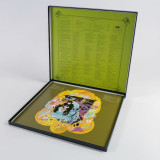
A Gift From a Flower to a Garden made for a few firsts: the first double LP of Donovan’s
career, one of the first box sets in pop and, most importantly for Donovan himself; the first
pop album for the children of tomorrow.
He resolved to make A Gift From a Flower to a Garden an album of two halves. The first,
Wear Your Love Like Heaven, was intended for his own generation as they started to think
about the kind of world they wanted to leave behind. The second, For Little Ones, was for
the children they had or would have in the years to come. The result was a kaleidoscopic
folk-jazz suite on the power of love, imbued with all the romance and mystery of an Arthur
Rackham illustration for an ancient English fairy tale. The songs, remarkably adventurous
given Donovan was a globally famous singer at his commercial height, combined the
influences he had amassed so far.
There is something about A Gift From a Flower to a Garden that could never be repeated,
though. It is such an innocent evocation of the childlike imagination, so redolent of its time,
yet set apart from it too. All these years later, the peaceful qualities of this pioneering,
enchanting, deeply unusual album feel more valuable than ever.
The state51 Box Set
With authenticity core to the project, The state51 Conspiracy engaged one of the UK’s
leading experts in box set design, Daniel Mason at Something Else, to painstakingly recreate
the box, records and accompanying ephemera. The first challenge was to find the deep blue
leatherette paper the original box set was covered in; a problem since it was no longer in
production. “I knew people who had stacks of it, gathering dust on top shelves, so I bought it
up wherever I could find it,” says Mason. Then came the reproduction of 12 loose leaf lyric
sheets on fine art watercolour paper, each of them featuring a watermark and a fairytale-like
illustration by Donovan’s artist friends Sheena McCall and Mick Taylor. Where, though, to
find the same paper stock? “I found out that it was made at a paper mill in North Wales
called Abbey Mills. Unfortunately the mill dissolved in the early 70s and very little of the
paper remained. However enough paper remained to allow us to produce the numbered
certificate also signed by Donovan that sits within the box.”
Then to the iconic cover image. Donovan and Jimi Hendrix’s personal photographer Karl
Ferris, used infra-red film to achieve the psychedelic effect on the cover, but the original
negatives couldn’t be found. Mason then used digital technology to ramp up the colour levels
on a reproduction from an original copy of the album while allowing it to remain a little bit
faded, as it would be after half a century. The same labour of love and care has gone into
producing all elements of the box; from the rebuilding of the famous front cover font to the
hand-numbered and signed certificate; letterpress printed on the original paper stock of the
1968 UK release lyric sheets.
To cap it all off the original mono master tapes were waiting safely in the EMI Donovan
Archive and transferred from tape to digital by Abbey Road Studios where new lacquers
were cut, ensuring Donovan's favoured mono version of the album would be presented both
physically (and digitally for the very first time) in striking audiophile quality. The final touch to
A pioneer of the home recording movement, Linda Smith released several collections of delicate, bewitching solo music on cassette in the 1980s and 90s. The 2021 release of Till Another Time: 1988-1996, Captured Tracks' compilation of Smith's work, has helped bestow rightful critical acclaim to the ahead-of-her-time artist. Now, Captured Tracks dives deeper into Smith's catalog with the release of two full-length companion albums, Nothing Else Matters and I So Liked Spring, available for the first time on vinyl & streaming formats. Recorded at Smith's home in Baltimore in 1995, Nothing Else Matters chronicles the tension between the mundanity of daily life and the creative impulse: Traffic noises on the charmingly boisterous "Little To Be Won" showcase this levity, as does the addition of playful hand claps and a laugh track to her striking cover of Young Marble Giants' "Salad Days." I So Liked Spring, recorded the following year, saw Smith experimenting with the unique challenge of putting another artist's words to music. She'd come across a biography of the English poet Charlotte Mew and found her wistful poetry rife for musical interpretation. The songs on I So Liked Spring are delightfully unpredictable, full of upbeat melodies and spellbinding vocal harmonies. This is perhaps best showcased on the title track, one of Smith's most popular songs to date, a lovelorn anthem that recalls the airy melodies of early dream pop. Both of these albums showcase the mesmerizing charm of Smith's songwriting, often compared to the likes of the Velvet Underground and Laurie Anderson. Home recording technology has come a long way since Smith first began recording demos on her tape machine, but her influence reverberates through the work of today's bedroom artists. The release of these two essential albums seeks to further illuminate this connection, welcoming a new generation of listeners to the work of this trailblazing artist.
Senegalese singer Faada Freddy releases a new album entitled "Golden Cages" after a seven-year hiatus. With an organic approach, he uses mainly his voice, hand-clapping and body percussion. The album features original tracks that reflect his critical yet benevolent thinking, tackling themes such as the standardization of thought, lack of reflection and dehumanization in today's society. Faada Freddy defends the idea of freedom, combining conscience and emotion, reflection and wonder. The album also celebrates the singer's African roots and expresses his attachment to his country and continent. "Golden Cages" is an ode to freedom and harmony, a vibrant love song for overcoming divisions.
The "Economix" EP is a cherished item among collectors, embodying a golden era of rave. Released in 1992, it's oftencompared to other iconic EPs of the time, like 2-X-Treme's 'X-tremity EP' The tracks "Loop" and "Panic" particularly stand out for many.
"Loop" garners attention for its sampling of The S.O.S. Band and Alexander O'Neal's "The Finest", while "Panic" is notable for its two distinct samples: one from Hijack's "TheBadman Is Robbin'" and another from MC Duke and DJ Leader1's "I'm Riffin".
This hand stamped run of white label red vinyl represses catersto the enduring demand among the oldskool rave aficionados. Each track on the EP showcases a blend of hardcore, jungle,and house vibes, contributing to its revered status within the oldskool rave community.
For a long time, the music of Congo-born Bony Bikaye had to be sought in the purgatory of "world music", where diamonds in the rough cohabited with bland nightmares of white dudes who froze rumba like fish sticks. Worse, they did put it on the menu, when so many longed to move on. Take Bikaye, who grew up listening to modern european music, digs Krautrock, struggles with tradition, obviously looking for trouble in the genre. In Brussels, he recorded a few albums with CY1 (Loizillon/Micheli), and brilliant defectors from Aksak Maboul, produced by Hector Zazou. Now it's up to french trio TONN3RR3 to take up the torch and build this project that proudly brags: "It's a bomb". Thought up at home by Guillaume Gilles (compo/keyboards), the album was finished at One Two Pass It studio, with Olivier Viadero and Gae"lle Salomon on percussion, Yoann Dubaud (machines & bass) and Guillaume Loizillon (synth of CY1 fame, and matchmaker of this affair). It's a deeply musical record, crafted by no-attitude reference players with nothing left to prove, and you can hear it. Floats well above the fray. "Keba na butu", beware. Indeed : beyond the simple pleasures of soukouss, or the rumba guitar riff that spins like a merry-go-round that skipped technical inspection, lie lush orchestrations. Freestyle, synthetic : something old, something new, something what-the- fuck-is-that-now. There's straight, there's syncopated, there's 808 and knee-jerk inducing bass patterns_with a vision. BIKAY3 plays his voice more than ever. His crazy vibrato has improved like hard liquor over the years. In "Zela" and "Balobi" in particular, he puts it to good use with flamboyant, Screamin' Jay Hawkins-style antics. He can also resort to pure storytelling : "La fore^t et les dieux", is a French-spoken excursion into the wild, moving along in grasslands of synths and percussion with TONN3RR3. A tale of gods and spirits, plain and simple. Nicole Mitchell brings the occasional flute in "Akei" for this trip in the bush of ghosts where lingala and kikongo rub with English and French. They saved "It's a bomb" for the end, a bastardized rumba, with rimshots that slap like a cool hand on willing skin. We're living in a golden age of reissues coming out in droves and satisfying our desire to catch up on our neighbors' musical heritage, but let's not miss the boat : it's now or never to listen to the music of the living. - Halory Goerger
Record label boss, producer / DJ, and revered collector Marc Davis returns to his Chi-Talo series with the much-anticipated second volume. A concept of a split EP, taking one ultra-rare Chicago gem and the other a scarce Italian disco record and re-interpreting them for the modern dancefloor aesthetic.
With the first volume, released on Marc’s own Black Pegasus label, now trading hands for considerable amounts of money, round two sees him impart another double dose of digging sorcery for this Mr Bongo 12”.
Marc began his illustrious career in the Windy City in the ‘80s and was one of the first out of Chicago to be recognised for his eclectic approach to DJing. Presenting a global sound palette that took in choice cuts from Brazil, Africa, jazz fusion, house, soul and disco, whilst mixing it together Chicago style. Decades of knowledge and experience that is now distilled down into the Chi-Talo series.
The Italo selection came via a tip from Marc's Swedish friend, Julian Wareing. Hearing the track led Marc down the rabbit hole to secure a copy of this Italo-Disco, album cut oddity by the New Sound Quartet from 1979. The original of 'Bass Construction', measures in at four and a half minutes and is already a feverish funk groover. But Marc saw an opportunity to extend and re-edit the track, keeping in the vein of the original but giving it space to breathe. Tweaking out every last ounce of goodness, Marc locks you into a hypnotic groove for maximum dancefloor deliverance.
The Chicago side is as rare, as the rarest of hens-teeth, only ever existing as a one-off acetate by the band The Saucer Planes. One of the members of the group was the sadly passed-away older brother of Marc’s DJ mentor, Jahmal Anderson. From the very first listen, Marc knew he’d been hooked up with an undiscovered boogie gem. A long-lost track that the world needed to hear. But the project has remained dormant until now, not least due to the fact that the original recording of this low-fi vocal boogie groove is housed on an ever-deteriorating solo acetate. Rescued, restored and given a brand-new lease of life, Marc has turned the track into a low-slung, psychedelic instrumental boogie bounce. Raw, rough and mesmerising, it’s a refreshed relic that is a testament to Chicago’s club sound and swagger.
Whichever side you draw for, this is guaranteed to move bodies as much as it wins over hearts.
Analogue Productions (Atlantic 75 Series) Celebrating the 75th Anniversary of Atlantic Records! Iconic musician and singer Ray Charles' classic 1957 album! Includes the hits "Hallelujah I Love Her So," "Ain't That Love" and "I Got a Woman" 180-gram 45 RPM double LP Mastered directly from the original master tape by Bernie Grundman Pressed at Quality Record Pressings Tip-on old style gatefold double pocket jackets with film lamination by Stoughton Printing Hybrid Mono SACD Mastered directly from the original master tape by Bernie Grundman Ray Charles' self-titled 1957 album was one of the first handful of LPs issued by Atlantic (and was later retitled Hallelujah I Love Her So). As AllMusic reviewer Bruce Elder notes, the album is weighted about three to one in favor of Charles' own compositions, with the hits "Hallelujah I Love Her So" and the pounding, soaring "Ain't That Love," which opens the LP, its raison d'etre. Charles does just as well with his interpretations of others' work, most notably the ominous, gospel-focused rendition of "Sinner's Prayer" (which offers a virtuoso piano performance, and comes courtesy of the pen of Charles' former mentor Lowell Fulson) and Henry Glover's wrenching ballad "Drown in My Own Tears," which is topped out on each verse by a gorgeous chorus. "Funny (But I Still Love You)" offers a guitar break played in such an understated fashion that it almost doesn't seem so much a part of R&B as it was usually being offered in 1957 as it does a part of Charles' early career output. The second side of the LP is even better, opening with the title track, a number that is almost too ubiquitous in its various cover versions — the original has a mix of urgency and playfulness that's absolutely bracing, and the album carries this mood forward with "Mess Around," an Ahmet Ertegun-authored piano- and sax-driven romp with Charles at his most ebullient as a singer. "This Little Girl of Mine" offers him in a surprisingly light, almost acrobatic vocal mode, while "Greenbacks" is a knowing, clever cautionary narrative that is almost a throwback to 1940s-style R&B. "Don't You Know" is as salacious a piece of R&B as one was likely to hear in 1957, and "I Got a Woman" closes the record out on a pounding, driving note. All the hallmarks of a top-notch Analogue Productions reissue are here for you to savor: Mastered directly from the original master tape by Bernie Grundman and cut at 45 RPM. Pressed on 180-gram at Quality Record Pressings and RTI, and housed in tip-on old style gatefold double pocket jackets with film lamination by Stoughton Printing.
Audiophile reviews rave about saxophone master John Coltrane's immortal Impulse! records, A Love Supreme (1964) and Ballads (1963). Ballads is an album that will never go out of style and never be unwelcome on any jazz lover's turntable.
You're about to experience Ballads at its peak of vinyl perfection — in UHQR format on Clarity Vinyl, with the added bonus of a double 45 RPM cut by Ryan K. Smith at Sterling Sound. Ryan's cut has his characteristic clarity and transparency all set against Quality Record Pressing's usual noiseless backgrounds on 200-gram flawless records. Each UHQR will be packaged in a deluxe box and will include a booklet detailing the entire process of making a UHQR along with a hand-signed certificate of inspection. This will be a truly deluxe, collectible product.
For this 45 RPM 2LP edition you'll also receive a !2" x 12" 12-page booklet featuring liner notes by Ashley Kahn and recording session images by Jim Marshall.
The intense passionate Coltrane interpretation of standards such as "All Or Nothing At All," "What's New," "It's Easy To Remember" and the Sinatra classic "Nancy (With The Laughing Face)" are the essence of Ballads. When asked why attempt such an undertaking, Coltrane replied "Variety."
While it may have been a short detour by Trane before he exploded off into the nether regions of jazz music a few years later, it is still a fantastic document of one of the premier jazz groups of the 1960s.
Recorded December 21, 1961 and September 18 & November 13, 1962 at Rudy Van Gelder Studios.
"It's impossible to sleepwalk through tracks like "You Don't Know What Love Is" and "I Wish I Knew" and impart them with even a fraction of the emotional heft that the Quartet achieves. This is the type of jazz album in which the music just washes over the listener with it's restrained grace and beauty, and while it may not have the adventurousness that some listeners think Trane should have had each and every time he recorded, I'd say it shows off a side of him that only makes us appreciate his more bold and daring albums even more." — The Jazz Record
Heels & Souls Recordings roll into reissue number eight with a double dose of early '90s UK street soul magic, splitting the sides between two sought-after cuts from Elaine Vassell and 3rd Zone.
Step back to 1993, house music has hit, UK Soul is in full flow and its rawer, DIY street soul sibling is making its mark across the UK’s underground. Fuelled by accessible, affordable production gear and ignited through enthusiasm and an influx of ideas and sounds, two acts drew inspiration from a melting pot of genres they were exposed to, providing their take on soul as they saw it.
Up first, Elaine Vassell - ‘Never Give Up’. A rough breakbeat-driven, mid-tempo groover from a North West London production triple threat, made up of Longsy D, Pinky and Murray. Utilising Pinky’s home studio with its DX7, Juno 106, LinnDrum and 808, they masterminded a track that sits at the intersection between soulful house, hip hop and R&B. Its crunching drum loop, chest-rattling low-end and serene synth lines, lay the foundation for Elaine’s powerful yet emotive voice to take centre stage. ‘Never Give Up’ should have been a future classic, but never quite found its feet.
On the flip side another 1993 gem, as Sansel Ali and twin brothers Mark and Stephen Anglin joined forces to form 3rd Zone. Conceived in Mark’s makeshift bedroom studio, the trio laid down their first foray into recorded music, ‘You Stole My Heart’. Originally promoed as a limited whitelabel in 1991, it officially landed on the group's one and only EP ‘No Real Reason' in '93.
Armed with a handful of synth modules, a drum machine and a Korg M1, Mark, Stephen and Sansel hit with a tough but tender, underground triumph. Part dance, part romance, layering synth strings, chunky breaks and M1 stabs underneath Sansel’s heartstrung vocals and Stephen’s hip house rap interlude, it provides another perfect example of house seen through the street soul prism.
Two timeless tracks that fly the flag for the fact that big studios and big budgets aren't necessary to create songs that really resonate. Each side also contains an alternate version, with the A housing a beatless reprise of ‘Never Give Up’ and the B a tougher, bassier remix of ‘You Stole My Heart’.
Licensed from Pinky Music and 3rd Zone respectively and remastered from the original DATs by Justin Drake.
Reggae and Jamaican music have long embraced a symbiotic relationship with the movies. Rooting back to the island's golden era, countless arrangements have either been direct covers, or inspired by, the musicality and mood found in both cinema and television. These reinterpretations would become part of the backbone of the instrumental sound that accompanied the Jamaican record industry's acceleration from the mid-60s and beyond. Talented young musicians, rising from Alpha Boys School and the early studios of Coxsone, Duke Reid and others, found a showcase for their unique playing style on hundreds of different recordings, while appealing to the country's own love affair with Westerns, James Bond canon, and other rebellious themes and motifs that were projected from Hollywood during this time.
In this same tradition, in a new interval, arrives the debut release of Anant Pradhan and Larry McDonald, the latter a master percussionist with direct participation in some of Jamaica's earliest recordings. McDonald, although often uncredited, was a legitimate influence in helping to bridge the Afro-Caribbean sound from calypso into ska and later reggae with his iconic style on hand drums and percussion. A kindred spirit of McDonald, despite 50 years separating them, Anant Pradhan is a bonafide member of the next generation. Although this is his first "solo" record, the talented saxophonist has already played on dozens of incredible sessions for the likes of Victor Axelrod, The Inversions, Andy Bassford, Channel Tubes, Ralph Weeks and Combo Lulo. As an official member of the current touring group of the legendary Skatalites, Pradhan has honed his musicianship under some of the greats of reggae music. His particular soulful, instrumental arrangements are an homage to that influential era of Jamaican music. Pradhan and his band's performance retain the skill and innovation of the old vanguard, and like the generations before, capture a magic that may only be possible when cinema goes reggae.
A cult favorite from A Nightmare Before Christmas, Danny Elfman's "Sally's Song" was immortalized in Tim Burton's 1993 classic stop-motion film. It's immediately recognizable in all its haunting charm, and now, Pradhan and McDonald have managed to transform it into an irrefutable reggae classic, reinvented with its melancholic lead sax and bombastic percussion. The prolific Henry Mancini is already entrenched in the Jamaican canon, yet nobody has knowingly attempted to recreate one of his most magical numbers, "Meglio Stasera" aka "It Had Better Be Tonight," that of the riveting one-take scene in 1963's The Pink Panther. The galloping percussion of the original is transposed through a cloud of smoke, slow and low in a roots style at the hands of McDonald. Pradhan's sax leads the way over the locked-in rhythm section, both deep and cheeky all at once. These first two productions of Anant Pradhan and Larry McDonald are a deserving entry into the canon of reggae covers, and are equally adept to be heard on the screen and or at the dance alike.
A pioneer in his field, Etienne de Crécy remains more than ever one of the pillars of house music made in France. In his three-decade career, the French producer has recorded some of the world's most important electronic music albums, including Tempovision, released in 2000, arguably his mostaccomplishedto date.