Hailing from the city of Hamilton, outside Ontario, melodic Canadian punk band Teenage Head was formed at Westdale High School in 1975; later, co-founder Frank Kerr became lead singer Frankie Venom, and guitarist Gord Lewis brought in bassist Steve Mahon and
drummer Nick Stipanitz. Major label Epic issued debut singles “Picture My Face” and “Top Down” in 1978, paving the way for acclaimed debut LP, Frantic City; aside from punkish
covers of Eddie Cochrane’s “Somethin’ Else” and Vince Taylor’s “Brand New Cadillac,” power-pop punk originals like “Let’s Shake” and “Infected” helped the disc go gold.
Поиск:one mind
Все
The Master Scratch Band was first break-dance / hip-hop / electro funk band in Yugoslavia in 1984. The band members were Zoran Vracevic, Zoran Jevtic and Milutin Stoisiljevic, previously known as Data and Sizike. Jugoton, the biggest label in Yugoslavia, published Data 7'' and MSB's 'Degout' 12'' with limited edition cassette containing two bonus tracks. Impossible to find on the collectors market, Fox & His Friends team in collaboration with Jugoton / Croatia Records is releasing a full, complete version of the rare "The Breakwar" tape, with tracks "Tonight" and "Pocket" never pressed on vinyl. All tracks are sourced from original studio tapes. With the kind help of Zoran Vracevic on credit list and liner notes, this is now the ultimate Master Scratch Band album, released originally in a year 1984 when break-dance was in the peak of its popularity in Yugoslavia. While Data was synthpop, Sizike mellow synth-disco recorded in private studio, this release is pure breaks and hip-hop electro, done old-school way in one of the best studios in Yugoslavia, Enco Lesic's 'Druga maca' in Belgrade. MSB used impressive electronic gear and were helped by huge list of famous musicians and guests: Duca Markovic from hit-show 'Hit meseca' (Yugoslavian Top Of The Pops); Japanac on bass, Max Vincent of Max & Intro on synths, Dudu Vudu from Du-Du-A, Goranka Matic as photographer and many more. MSB sampling technique and choices are unique: from obscure industrial records to freestyle; from found-sounds to cut-up breaks and even real prank-calls. This is document of time that still sounds fresh and needs to find it's new, young audience of hip-hop history researchers, break-dancers, b-boys, b-girls and DJ's. When you know that it's produced in 1984 Yugoslavia, far away, but actually, so close to its USA & EU brothers and sisters, it's even more mind-boggling. Thanks to Fox & His Friends and Jugoton CR collaboration, this gem is waiting for your freezes, footwork and electric boogie moves. ----- Equipment used: Commodore 64 Computer, Roland MC-4B Microcomposer, Prophet Pro-One, RSF Cobol II Expander, Korg Mono-Poly Synthesizer, PPG Wave 2.3 Synthesizer, PPG Waveterm Computer, Boss DE-200 Digital Delay, Drumtraks Digital Drum Machine, Roland TR-808 Rhythm Composer, Electro Harmonix Vocoder, Linn Drum MKII, Juno 60, SH-101, SVC-350, VP-330 Vocoders, Polysix & MS10, Simmons drum module.
Limited edition cloudy clear vinyl. Combining processed recordings of wind and water with analog synthesizers and chamber orchestra, Elori Kramer's The Blue of Distance is an audio dissertation on the role technology plays in our relationships to geography and nature, unspooling into an examination of memory and longing across seven sections that layer filmic minimalism over churning electronic soundbeds. Half of the suite was written in the Adirondack mountains during summer amid lakes, rivers, and moss-laden forest floors, while the other half was conceived on a frozen Lake Superior island in deep winter, creating a subtextual dialogue between the two extreme settings. Kramer, who was born in 1990 and grew up alongside the internet, uses her music to explore nature in the actual and the virtual world, through direct experience and facsimile alike, focussing and blurring the line between the two. "Looking back at my videos of that summer-- which is where the processed audio came from-- I tried to remember what it had felt like to be there," she recalls, "thinking about questions of reality versus imagination; physical versus digital; and the ways in which memory shifts through our minds and technology." The title The Blue of Distance was derived from Rebecca Solnit's book A Field Guide to Getting Lost, referring to the phenomenon of faraway mountains appearing blue due to light particles getting lost over distance. "If we were to go up to the mountains that appear blue from far away, we would see that they weren't actually that color." she says. "This beauty is made possible because of their distance," much in the same way that the splendor of a lush season is only fully realized in the throes of a bleak one, and the joy of an event can only be felt when it has long since been consigned to remembrance. R.I.Y.L Kaitlyn Aurelia Smith, Philip Glass, Steve Reich, Josiah Steinbrick, Emily Sprague
Stain (1993) is the third album by Living Colour, released after previous albums Vivid MOVLP596 and Time’s Up MOVLP553. The album features a much heavier and aggressive Living Colour, containing elements of thrash metal and industrial music. Produced by Ron “Bad Brains” St. Germain, Living Colour’s Stain showcases the band’s darker side even more, as samples were now added to the sonic mix. Living Colour’s pessimistic viewpoint can be found in tracks such as “Go Away,” “Ignorance Is Bliss,” and “Never Satisfied,” while “Postman” pulls no punches in its depiction of a deranged killer. The explosive “Ausländer” is one of the album’s best tracks, as is the melodic rocker “Leave It Alone” and the superb ballad “Nothingness”. Stain is available as a limited edition on translucent red vinyl. Only 1000, individually numbered copies are available. The package includes an insert with pictures and credits.
Blues singer and harmonica player Brian Knight (1939-2001) is counted as one of the initial members of The Rolling Stones. Co-founder of Brian Jones first band together with Ian Stewart and Dick Taylor (later Pretty Things) among others. Musical disagreement with Jones, who fancied Bo Diddley and Chuck Berry while Knight was a Muddy Waters follower, led to his departure from the group - later to be replaced by Jagger and Richards. He formed his own "Blues By Six" band, frequently with Charlie Watts on drums, and spent the following years touring and playing London clubs. In the seventies he continued with Bradford-Knight Blues Band. Always a high profile act on the English blues circuit Knight has performed with many known artists through the decades, as Rick Wakeman, Peter Green, Paul Jones, Zoot Money, Ronnie Lane, Charie Watts, Chris Farlowe...and many more. After two successful decades of touring and performing he finally got to record his debut in 1981on the independent label PVK Records. The album is a mix of standard blues and rock numbers as traditional "white blues", sometimes reminding of early British R&B from Cyril Davies or Alexis Korner. It features Dick Heckstall-Smith (Colosseum) on sax, Peter Green on guitar and Stones own Charlie Watts on drums
- A1: Samba Negra - Eberebijara
- A2: King Somalie - Monkey 'S Dance
- A3: El Grupo Folclórico - Tamba
- A4: Los Viajeros Siderales - El Campanero
- A5: Rio Latino - Ayu
- B1: Aníbal Velásquez - La Mazamorra Del Diablo
- B2: La Francachela - Mosquita Muerta
- B3: El Grupo Folclórico - Juipiti
- B4: King Somalie - Le Mongui
- C1: El Grupo Folclórico - El Tornillito
- C2: Samba Negra - Long Life Africa
- C3: La Banda Africana - Te Clavo La... Mano
- C4: Myrian Makenwa - El Platano
- D1: El Grupo Folclórico - Tucutru
- D2: Grupo Bola Roja - Caracol
- D3: El Grupo D'abelard - Otro Perro Con Ese Hueso
- D4: Conjunto Barbacoa - Wabali
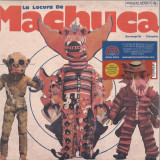
La Locura de Machuca is the story of one man’s bizarre odyssey into Colombia’s coastal music underground, and the wild, hypnotic sounds he helped bring up to the surface.
One night in 1975, a successful tax lawyer named Rafael Machuca had his mind blown in Barranquilla’s ‘Plaza de los Musicos’. Overnight he went from a high ranking position in the Columbian revenue authority to visionary production guru of the newly formed record label that bore his name, Discos Machuca, and for the next six years he devoted his life to releasing some of the strangest, most experimental Afro Psychedelia Cumbias ever produced. La Locura de Machuca is the story of one man’s bizarre odyssey into Colombia’s coastal music underground, and the wild, hypnotic sounds he helped bring up to the surface.
The Colombian music industry was thriving in the mid-seventies, but while homegrown bolero and vallenato tunes were doing well on the charts, it was imported African records that were setting crowds on fire at the picos – the sound-systems that fuelled neighbourhood parties – and wherever those records were played there were always a handful of groups who were inspired to plug traditional Cumbia directly into the electric currents coming from across the Atlantic.
It was these obscure bands, who fused Colombian and African rhythms with the swirling organs and psychedelic guitars of underground rock, that fired Machuca’s imagination. While the label made its money releasing popular hits by legends such as Alejandro Durán and Aníbal Velásquez, that money was poured back into a unique run of experimental releases by fringe artists such as La Banda Africana, King Somalie, Conjunto Barbacoa, and Abelardo Carbono, one of the godfathers of Champeta Criolla.
When Machuca couldn’t find groups to realise his particular vision, he simply created them himself. Drawing on a fearsome roster of musicians associated with the label, he assembled bands that lasted only as long as it took to record an album ,and unleashed the results – complete with arrestingly unusual album covers – under a series of different names such as Samba Negra or El Grupo Folclórico. This unorthodox approach led his longtime recording engineer, Eduardo Dávila, to describes Machuca’s productions as the “B-Movies of Colombian music.”
The story of Doctor Machuca and his eccentric exploits tells of one of Colombia’s most atypical and peculiar record companies; a defining pillar of Afro-Caribbean psychedelia. His productions have come to represent the roots of Champeta and set the pedigree standards for Afro and Costeño avant-garde. The seventeen tracks on La Locura de Machuca, harvested from the darkest, strangest corners of the Discos Machuca catalogue, sound like little else recorded before or since.
Far heavier than their previous record. That’s evident from the get go, as they bash their way through the opening track “Give Me Your Hand,” a rhythm-heavy number fueled by fiery guitar solos, strident vocals, and a hard rocking sound. Yet the band still takes some interesting excursions along the way. “Good Lord,” for instance, encompasses Latin rhythms, a Southern rock segment, space rock passages, and even pop. The Beatles get a nod on “Any Way,” and funk goes psychedelic on “Get One Together”. Still it’s a hard rocking extravaganza. In later years, Charge’s reputation among prog rock fans soared, more so than their self-titled album.
Charge! is available as a limited edition of 1000 individually numbered copies on silver coloured vinyl.
On to my short review. I have to admit that I'm biased in favour of Charles Tolliver. He plays with a combination of strength and sweetness that goes beyond mere language. The fact that he is self -taught is more miraculous. This particular recording has the best sound quality I've ever heard. The clarity is stunning and all the music is magnificent. The recording is so good, one can hear the sound of a musician's fingertips accidentally brushing across the bass strings, for example. Alvin Queen is always brilliant on the drums. This group has a synergy that just goes so deep, it feels like they're reading each others' minds. But I can't recommend this enough. It's some of the best recorded jazz I've ever experienced.
Here in solo instrumental mode, the entire record consists of just one instrument, the pipe organ, and represents absolute liberation of the imagination.All Thoughts Fly radiates a melancholic beauty, and is distinguished by fluid transitions of contrasting elements; calmness and drama, harmony and dissonance, much like the place that inspires the music. About the album Anna explains"there's a sadness and wilderness that inspired me to write this album, also a timelessness. I believe that this park has survived not only due to its beauty but also because of the iconography, it has been liberated from predictable ideas and ideals. The people who built this park truly set their minds and imagination free. All thoughts fly is a homage to this creation, and an effort to articulate the atmosphere and the feelings that this place evokes inside of me. It's a very personal interpretation of a place that I lack the words to describe. I'd like to believe Orsini built this monumental park out of grief for his dead wife, and in my Sacro Bosco I used this story as a core for my own inspiration: love as a foundation for creation."
*repress*
Justin Cudmore returns to the Phonica White shelves with four new tracks, and his long-awaited first full EP since 2017's "Forget It" for The Bunker New York. With the dancefloor seeming far outside our reach right now, 'Train Dance' transports us back to a simpler time lost in the mix.
Across the disc, Cudmore reflects on the sounds and scenes closest to his heart and record bag, flexing his knack for crafting catchy hooks and the kind of ear-worm melodies that helped cement his status as one of house & techno's fast-rising stars. A1 "Train Dance" is his ode to the urban symphony of train cars whirling past his apartment in Brooklyn, with eight minutes of swingy, jacking house built for a sunny afternoon set across the pond at Panorama Bar.
"Club Fetish" shifts to a more introspective, heads-down vibe crafted instead with a dark and sweaty basement in mind. A touch of psych à la classic John Tejada, Cudmore's subtle, squelchy synths rub shoulders with cerebral drums and floating basslines.
The B-side nods to Cudmore's acclaimed acid sound for two deep slow rollers. "Expectation Game" and its no-nonsense 303s chug through a couple of understated breakdowns, while "Realize" was written with a Detroit outdoor patio in mind, with a sleazy acid bassline and cut up vocal groans sounding like Cudmore riffing on a late-night Moodymann jam.
Recorded during a productive time of new beginnings and positive headspace, ‘Train Dance’ comes out during a strange and unclear present for Cudmore and many of his contemporaries in the scene. However given it all, Justin remains excited to share new music and sounds, and hopes to return to the dance floor with everyone again as soon as safely possible.
Artwork as always is supplied by the talented Pedro Carvalho de Almeida
Alfredo "El Inca" Linares is one of the best and most beloved musicians in the history of salsa. Fans love his piano playing because of his authentic Cuban feel and 'swing' combined with progressive arrangements and uncompromising phrasing. "Lo Que Tengo" is full of rock solid dance floor killers and no filler, recorded in 1980 with some of the cream of the crop of contemporary Venezuelan salsa musicians (members of Mango, Madera, El Trabuco Venezolano, Los Dementes, Los Melódicos, Dimensión Latina, Guaco, and La Salsa Mayor) and launched there on the indie label A.L.G. Records as ¡Con Todo!, and then a year later on the much larger Velvet Records with a different cover. This a classic Alfredo Linares album, but with the updated studio sound of 1980s Caracas. With five perfectly paced salsas, one funky cha cha chá, a steamy bolero and a dance-friendly Latin jazz number to top it off, there is something for everybody on this record. Thankfully today's generation can now enjoy this rarity at a fraction of the cost of an original copy. Presented in its original artwork and pressed on 180g vinyl. Good to know: Alfredo "El Inca" Linares is one of the best and most beloved musicians in the history of salsa. Fans love his piano playing because of his authentic Cuban feel and 'swing' combined with progressive arrangements and uncompromising phrasing that puts one in mind of Eddie Palmieri. As a composer, arranger and band-leader Linares is highly respected as well. Ever since the 1960s in Lima Peru when his career began, his records have always been on point, being super tight, sharp, and hard as hell, what salseros call salsa brava con afinque. It's no surprise that Lo Que Tengo is exactly that: full of rock solid dance floor killers and no filler, played with verve and flair. Unlike some of his other records that were patched together from various sessions made in different studios (sometimes even in several countries!), this album has the advantage of being produced, recorded and mixed by Alfredo Linares all in one studio and block of time, and backed by hand-picked seasoned professionals who Linares had already played with, both in the studio and on stage, lending it a consistency and sonic integrity that is excitingly manifest in every groove. The album was recorded in 1980 in Caracas with some of the cream of the crop of contemporary Venezuelan salsa musicians (members of Mango, Madera, El Trabuco Venezolano, Los Dementes, Los Melódicos, Dimensión Latina, Guaco, and La Salsa Mayor) and launched there on the indie label A.L.G. Records as ¡Con Todo!, and then a year later on the much larger Velvet Records with a different cover. The LP was also released in Colombia (INS, 1982) and the US (Gallo, 1984), both editions utilizing the Velvet Records cover. During this time Linares had been in Venezuela for some five years and was under contract with a nightclub in Caracas. Through being on the salsa scene there he became friends with the band Mango and even guested on an album with them in 1976. After the contract was up Linares was a free agent again and he was able to draw on his friendship with Mango and assemble a band to back him, first for the Colombian/Venezuelan production Salsa de Verdad (Fonodisco, 1976) and then again with ¡Con Todo! / Lo Que Tengo. One of the distinctive aspects of Alfredo Linares tunes is the 'break' (la cierre)-there are always plenty of dramatic hand-clapping breakdowns followed by an infectious tumbao (sustained vamp) section that sends shivers up the spine and makes the dancers go crazy. In addition, Linares always lets his musicians stretch out, especially in the percussion section. Again, Lo Que Tengo is no exception: there are so many examples of typical arrangements here that one could call this a classic Alfredo Linares album, but with the updated studio sound of 1980s Caracas, which was awash in petro-dollars at the time and so had the latest equipment and a strong consumer base for the salsa market. The album's title tune (originally credited on the Venezuelan edition as 'Lo que tengo que crear'-'What I Have To Create') is by Mango's timbalero José "Cheo" Navarro and sums up Linares' central career philosophy: the musician lives every day to create music, to spread joy and create a party, without complications, wherever he goes. With five perfectly paced salsas, one funky cha cha chá, a steamy bolero and a dance-friendly Latin jazz number to top it off (note the bluesy piano solo from Linares and the sublime vibes of Mango's Freddy Roldán), there is something for everybody on this record. Thankfully today's generation can now enjoy this rarity at a fraction of the cost of an original copy.
Dutch mainstay Jeroen Search is a true genius of building linear grooves, either subtly breathing or powerfully bouncing. His Figure release following the 2018 LP Monism reflects this aptly once more. Minimalistic, hypnotic loops simply introduce the varied 5-track EP, followed up some by some heavyweight acid-house punchlines.
The flip makes its name, changing course again in order to head deeper for a more heads-down exploration of the bleep-space nebula. Sitting firmly nestled in the center of the record, Magnet Tapes is that endless loop suspended in time and space, slowly working its way into one’s consciousness with every repetition. Search cleverly captures this moment to introduce some sounds beyond the structure of track and loop, challenging our conception of music yet playfully igniting the mind’s imaginations.
Aiming for the finish line, the EP comes to a halt only after another taster of Jeroen Search’s deadpan efficient loop science, effortlessly stacking layers of rhythms for an ultimate straight-up techno workout.
2023 Restock
Within the elusive confines of this film awaits an unreleased album that defies categorisation by a musician who in a different time and space would be revered amongst some of the most important exponents of progressive rock, dark ambient, Krautrock and pioneering synthesiser composition - not to mention sound design and art-house film scores. As a protégé of François Bayle and Luc Ferrari who had studied classical music before immersing himself in found-sound manipulation and oscillators, Alain Pierre quickly became an enthusiastic go-to man for sound sculpture and technical studio proficiency in Belgium’s small film industry.
To the many generations of dedicated fans of the visual work of Philippe Druillet it might seem virtually impossible to adequately “score” the alien, futurist landscapes of the man who many called the “space architect” (on account of his space age reductions of Gothic cathedrals, Art Nouveau, and Indian temples), but once you have heard the sonic reactions of Alain Pierre on this the first-ever dedicated Druillet documentary, Ô Sidarta, complete with his own equivalent sound palette, it will be difficult to “hear” Druillet’s world via any other composer. Despite Druillet’s truly incredible record sleeve designs for projects like cosmic disco ensemble Black Sun, concept albums such as Attention by Jean-Pierre Mirouze (composer of Le Mariage Collectif), Parisian metal bands like Sortilège, gatefold portraits of Jimi Hendrix, later period albums by William Sheller and most relevantly on albums by Igor Wakhévitch (Docteur Faust, 1971) as well as separate releases by both Richard Pinhas and Georges Grünblatt (both from the cosmic prog outfit Heldon), it is fair to say that this criminally unreleased album by Alain Pierre would conjure up the closest synergy between sound and vision that either artist would come close to.
The almost twelve of continuous music that Alain Pierre supplied for Ô Sidarta in 1974 fortunately appears in its entirety, unedited, as it does here for the first time ever away from its original broadcasts. Broadcast on Belgian and French TV that autumn, the film received a warm reception from Druillet fans, prospective film producers and space rock fans lucky enough to catch the short feature.
Throughout his career Alain’s commitment to conceptual music excelled within both cinematic realms as well as with the live arena. Never shying away from the constraints of transporting heavy synthesiser technolog and unpredictable analogue equipment to public spaces, Alain took his self-initiated “live” work very seriously. It was within his lesser-documented performances that you would find the closest sound to the music on Ô Sidarta, proving that the Druillet collaboration was naturalistic and conceptually close to Alain’s personal stylistic agenda. A rare recording of a one-off concert at the Université libre de Bruxelles in October 1976 reveals a very similar set of movements and soundscapes found on Ô Sidarta. This rare artefact has been included on the second side of this record under its original title Notions de physique intérieure (Notions Of Interior Physics) and stands as a perfect companion piece to Ô Sidarta - complete with a very similar “kit list” including the welcome addition of an Arp Sequencer, a Korg Vocoder and a Theremin (a back line whose total would far surpass any stationary studio of the era never mind a live show!).
By looking back at his original composition for one of his very first solo soundtrack commissions, Ô Sidarta, you can hear that back in 1974 Alain had already successfully managed to combine more unlikely musical influences, experimental techniques, and previously unheard soundscapes and studio tricks in to one twelve-minute score than most musicians fail to cram in to a whole discography. But still there is so much music yet to be discovered and Ô Sidarta is just the tip of the iceberg in the middle of a cosmic sea. Much like a character from one of Philippe Druillet’s books, Alain Pierre is a rogue pilot, steering his own ship in to the unknown, uncharted, unnoticed and quite unbelievable.
Flaming Tunes' sole release is perhaps the finest elegy to the '80s home recording ethos that you've never heard. Originally released in 1985 on cassette (with individually hand-colored covers), this self-titled album grew out of the collaboration between childhood friends Gareth Williams and Mary Currie.
Williams is best known as a member of English art-rock band This Heat. After leaving the group in the early '80s, he travelled to India where he studied classical Kathakali dance – an experience that would profoundly shape the music of Flaming Tunes.
In an old Victorian house in South London, the duo recorded during the day while Currie's young son attended school and Williams conducted tape treatments at night. They were joined by various guests including This Heat guitarist Charles Bullen as well as long-term collaborators Martin Harrison and Rick Wilson.
Using whatever instruments they had on hand (clarinet, piano, bells, etc.), Flaming Tunes create lo-fi melodies around simple arrangements, oblique rhythms and densely layered natural sounds. The results are a mesmeric collage of instrumental daydreams and sideways pop songs, floating into one another in a hazy confluence of late '60s Canterbury psych-folk and early Residents experimentation.
All of these beguiling elements converge in a personal manner, quietly insistent in listeners' ears like the blood pulsing in one's veins on a warm summer day.
Today Rozzma announces the ‘Khatar Sayeb’ EP, the artist’s first release for XL Recordings. He kicks off the EP release with ‘Hout’, a track that displays Rozzma’s knack for combining tribal sounds and contemporary urban/street music with a sharp, idiosyncratic flair.
Rozzma is an Egyptian sound artist inspired by the era where sound preceded music – he finds inspiration in the similarities between the wilderness of prehistoric times and modern-day chaos. Having already performed his particular strain of music across the world and at festivals like Sonar and Unsound, Rozzma releases ‘Hout’ into the digital world with an animated video created by the artist’s close friend Mahmoud Shiha.
“Hout is a celebration of beating the odds,” says Rozzma. “It’s about a specific state of mind where one finds comfort in the most extreme and unfortunate circumstances to beat the odds that one could instead fear.”
The EP’s title ‘Khatar Sayeb’ means 'loose danger’. “The release challenges the idea that danger and fear are uncontrollable circumstances,” explains Rozzma. “We cannot fully diminish fear or danger. We can only condition ourselves to believe that safety exists during the absence of fear. It is however more dangerous to deny the uncertainty of danger itself. Danger is a very broad state with infinite circumstances. But it is also infinitely uncertain and mainly linked to luck. We do not control our luck; good or bad. And it is solely luck that dictates danger and safety. It is for that reason that one’s best chances may be to condition themselves to find comfort in danger. Loose danger to be specific.”
Rozzma’s world is one of status quos being challenged, whether that be the real world, the historical world or specifically in the world of music. Rozzma won’t let you settle with what you believe. Everything deserves to be challenged.
Germany’s Jacob Groening is one of those hard to pin down artists working within the space of organic dance music. As a live performer and hybrid DJ, Jacob somehow manages to infuse everything from gypsy to jazz, blues to soul, with distinctly electronic elements. Never one to settle for anything less than unique, his gentle touch and international influences create music that is both sweet and powerful. This sound has already been felt across the likes of Bar 25, teyoyoke, Delicieuse Musique, and his own Kamai Music imprint, and now Jacob
provides the 4th instalment on Amsterdam’s The Gardens of Babylon eponymous label. Jacob’s Leslie Ep is a three-track excursion, Inspired by travels yet constructed in quarantine. It is a testament to the connective power of music through uncertain times, where some dancefloors may be empty, but hearts and minds remain full. Until we meet again, let Jacob’s playful and pulsating Ep satisfy those Communal urges with a journey through sound and culture. Starting this journey, its title track gently swells throughout with subtle chants and hypnotic percussion. Kabir then kicks things up a notch, Bouncing between its own pulsating rhythm and powerful chord progressions. Finally, Iguazu draws direct inspiration from Jacob’s travels through India during times before the world changed. With field audio and local musicians interjected throughout its explorative atmosphere, Iguazu is the perfect representation of Jacob’s distinct style: gentle, shifting, and cultural. If you know The Gardens of Babylon, you know Jacob Groening. His sets from The Dunes of Babylon and ADE’s The Seekers of Light have placed him firmly within family status. Now, with Leslie Ep Jacob Groening joins Geju with his own solo release on the label.
The 3rd release from tINI’s Part Of The Gang Records is here.
This new three-tracker comes courtesy of Barcelona-based Uruguayan producer Jorge Gamarra.
Jorge’s takes influences from Detroit and Chicago, as well as the UK and of course, Montevideo’s electro scene.
Across three cuts we get a selection of future facing productions, composed with a vintage sonic aesthetic imbued with Gamarra’s heady mix of influences.
The track ‘ADE’ is opening the EP with a delightful adventure into the cosmos.
Groaning bass is combined with a menagerie of twinkling sounds, chirps and effects straight from another galaxy.
Next up is ‘MK Ultra’, named after the infamous CIA mind control experiments (“Involves several drugs and electrodes plugged into the brain”).
This one utilises layers of retro instrumentation to take hold of your subconscious and get that body moving uncontrollably...
Finally, ‘DTR’ is 10 minutes of Gamarra demonstrating his production prowess, bringing together groovy bass, sci-fi effects and a catchy earworm, whistling melody…
Leroy Smart the self-proclaimed ‘Don’, carries much respect in the Jamaican musical community. His attacking vocal style gives his lyrics and tunes that extra meaningfulness.
Born in Jamaica and orphaned as a young child, Leroy was sent to Maxfield Park children's home and educated at the famed Alpha Boys School. The school was run by nuns who encouraged musical talent and would provide the world with the cream of Jamaica’s artistic talent. Such legends as Don Drummond, Tommy McCook, Johnny’ Dizzy’ Moore, to name but a few, all learnt their musical trade in this strict environment.
Leroy worked with many Jamaican producers, but seemed to find his feet working with Bunny ’Striker’ Lee. With whom he cut many of his greatest tunes. It is from this period that we have compiled this album. Featuring lost to now dubs to many of his classic tunes, like ' Wreck up my Life’, featured here as ’Dub Wrecker’. ’God Helps the Man’ Help yourself to Dub, Pride and Ambition If I should Dub. Fittest of the Fittest Dub for the Fittest and the title track of this selection his self-affirming Mr Smart Mr Smart in Dub.
These work alongside less known cuts that he also puts his musical stamp on .’No Love’ No Love In Dub. which sees him working over the ‘Zion Gate’ rhythm, made famous by Mr Horace Andy. The ‘My Conversation’ rhythm originally cut by Slim Smith but made into Leroy’s own ‘Jah Jah Forgive them’ For They Know What They Dub. All portrayed in his enviable style.
Such was Mr Leroy Smart’s stature in his homeland Jamaica, that when the ‘One Love’ peace concert line-up was put together for the 22nd of April 1978. The best of Jamaica’s Reggae stars was picked to play alongside Bob Marley & the Wailers. Such greats as Dennis Brown, The Mighty Diamonds, Peter Tosh and Inner Circle were chosen alongside the Don himself, Mr Smart. Whose stage shows were always colourful and to say the least eventful..
Mr Smart has continued to release music during the 80’s & 90’s, most notably with ‘She Just a Draw Card’ & ‘I’m the Don’. But as a set we feel this stands up with the best of them. Hope you enjoy the ride...
Respect Jah Floyd.
'How is it that one of Art Blakey’s greatest albums with the Jazz Messengers is so little known? The 1961 edition of the Messengers included Lee Morgan on trumpet, Wayne Shorter on tenor saxophone, Bobby Timmons on piano, and Jymie Merritt on bass. In February and May of 1961, this group (with pianist Walter Davis Jr sitting in on two tracks) entered Rudy Van Gelder’s studio in New Jersey and proceeded to lay down Roots & Herbs, a brilliant set of six Shorter compositions including the driving hard bop of the title track, the playful “Ping Pong,” and the clever “United.” The album was eventually released in 1970 and deserves a place among Blakey’s finest recordings.
Two great Brunswick sides on one disc, from two of the greatest soul vocalists.
The A side features Tyrone Davis’ version of Clarence Carter’s ‘Slip Away’ from his essential. ‘Can I Change My Mind’ album, which has never previously been available as a single. A mid-tempo toe tapper with a mid-section brass build that’s underpinned by a funky groove.
The flipside cranks up the action with Gene Chandler’s riotous take on James Brown’s anthem ‘There Was A Time’. Worth the entry for the horn stabs alone, it’s an expressive slice of sharp-edged driving funk.