Bomj Diego had one simple dream – to spend a lazy summer weekend at his friend’s dacha, kicking back in a plastic lawn chair, sipping on Ovip Lokos, and letting the world spin as slowly as the rusty ceiling fan in the old guest house.
One Friday, he finally got his chance. He loaded up a plastic bag with a few cans of Ovip Lokos, an ancient Bluetooth speaker, and a single flip-flop (he’d lost the other one in a heated game of dominoes the week before). But as soon as he got off the train at the dacha station, Diego realized he had no idea where the actual dacha was. No address, no signal, just the distant sound of a chainsaw and the smell of freshly cut grass.
Undeterred, he followed the smoke of a barbecue like a hungry wolf. After an hour of wandering, he stumbled into a random backyard where a group of old timers were playing cards around a makeshift table. “Ah, Diego! You made it!” one of them shouted, raising a can of Ovip Lokos. Diego had no idea who the guy was, but he immediately sat down, cracked open his own can, and joined the game.
Hours later, as the sun dipped behind the trees and the mosquitoes started their evening shift, Diego realized – this wasn’t his friend’s dacha. In fact, it wasn’t even the right village. But the old men insisted he stay for shashlik, and as the Ovip Lokos flowed, Diego figured, “Eh, close enough.”
He never did make it to the right dacha, but sometimes, it’s the wrong turn that makes the best story.
Suche:one of them
Neba Solo, whose real name is Souleymane Traoré, is a true living legend of Malian music. His voice and balafon playing are unique, instantly recognizable, and deeply cherished throughout Mali.
He gained international recognition with his iconic track CAN 2002, composed for the famous African Cup of Nations. This success opened doors to global stages, leading to tours in the United States, Asia, and Europe. Prestigious labels such as Cobalt and Secousse supported this exceptional period in the artistic journey of this musical genius.
For many years, Neba Solo has closely collaborated with Yaya Diarra, the sound engineer of the legendary Bogolan studio in Bamako. Diarra played a key role in preserving and recording the works of the balafon master from Sikasso. He was also the one who invited Dom Peter to work on a bold and resolutely modern project: an album with more electronic sounds, enriched with drum machines, offering a new artistic direction to Neba Solo’s compositions.
Dom Peter and Yaya Diarra immersed themselves in the studio to conceive and produce this album, titled TUMA DUMA. The result is a perfect alchemy, where electronic rhythms blend seamlessly with traditional percussion, redefining the richness of Malian musical heritage.
These nine tracks explore classic themes of the Mandingue repertoire while showcasing Neba Solo’s unique way of narrating both everyday life and universal stories
Following the first two releases on Sea~rène, GiGi FM returns with “Virgo Space Acid”, a deeply personal and sonically assertive exploration of transformation and healing.
Rooted in the energies of 2025, the Year of the Snake, this four-track EP channels the mystery and intuition of the serpent, weaving together Virgo’s archetypal forces of the healer and the alchemist.
Across driven beats, hypnotic acid sequences, and vocal-infused textures, “Virgo Space Acid” reflects a journey of renewal, self-ownership, and inner power.
From Berghain to The Bunker New York, GiGi FM has long been known for her ability to channel movement into sound. With “Virgo Space Acid”, she refines her craft even further, working with fewer elements yet pushing them to their fullest expressive potential. She explores the full range of her voice, shaping it into textures, atmospheric layers, and even percussion, while separately reworking classic 909 drum machine sounds into something entirely her own. This EP is a statement of both discipline and liberation, where minimalism meets deep transformation.
Opener “Calibration” sets the tone with its mantra-like intention: an invitation to realign and tune into one’s own energy. Built around a driving bassline, nostalgic yet forward-moving synths, and GiGi’s own spoken word, “A breath holds time, calibrates space”, the track creates a moment of clarity before the journey begins.
“Mercury” follows, embodying the trickster, the messenger, the shapeshifter. Playful and urgent, its bouncing synth sequences move like conversations in motion, with rising tones driving the track forward, pushing toward a restless ascension that mirrors Mercury’s role as a bridge between realms, both celestial and internal.
The title track, “Virgo Space Acid”, is the wormhole: the brain battle, the transformation. With a heavyweight 303 bassline, spiraling bleeps reminiscent of birds, and powerful classic 909, it is pure tension and release, an acid-drenched trip through motion and evolution.
Closing the record, “Floresta” is a sensual and grounding moment of reflection. Named after the stage at Waking Life Festival where GiGi felt a pivotal shift in her healing journey, the track mirrors the scene with dub chord sequences, emotional rising pads, and percussive vocal elements. Like the purple and pink drapes floating above the dance floor at sunset, Floresta is both a farewell and a prelude, a misty horizon where one chapter closes and another awaits.
With “Virgo Space Acid”, GiGi FM continues to expand her sonic language, deepening her connection between body, rhythm, and transformation. More assertive, more urgent, yet deeply intuitive, this is a record of movement, clarity, and self-empowerment.
"We are Sea~rène, swimming in-between supernatural tides, forever following the emotional waves of the universe." GiGi FM
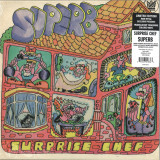
Australia's world-renowned cinematic soul outfit Surprise Chef return with new album Superb. A record that represents a change in their creative approach and turns up the heat in their music. Trading in their meticulous writing and recording techniques for a looser and less planned approach with the intentions of bringing more levity to the process, and it comes through in spades. The high caliber musicianship is still front and center, but they push their sound into a more energetic and fun place on this album. Album opener "Sleep Dreams" is the closest thing to a Surprise Chef tune one would come to expect but then lead single "Bully Ball" comes on and you get the picture that they came to kick in the door on this one. The song's gritty drums thunder through the speakers and get covered with percussion, keys, bass, and guitar chanks that stay in the pocket and bring the funk with them. The band pushes the boundaries of arrangement with tunes like "Body Slam" that starts off like a sweet soul track then pulls a 180, turning dark and haunting, centering on a sound they created by tucking a timpani into a bathroom two doors down from the mixing board. That same sense of experimentation comes up again on "Fare Evader" where they pepper another neck breaking rhythm track with synth notes that sound like robot sound effects from a 70s sci-film. The fellas turn up the tempo for the dance with tunes like "Consulate Case" and "Tag Dag"; the former pulling influence from afro-funk and the latter from jazz-funk. They take us deep into the beautiful world of Surprise Chef ballads on "Websites" and double down on their abilities to make beautiful and ethereal tracks with "Dreamer's Disease". With their new album Superb, their new approach, and plans to tour the world, we are about to see Surprise Chef take the step from the underground's most beloved to a household name and we are definitely here for it.
Totoyov is back with a new identity and is pleased to present its fourth vinyl release, featuring four tracks by the talented Brazilian artist, and one of our label heads, Dru.
Giuliano Lomonte and the rising Romanian star Constratti complete the record with their powerful and refined touches on A2 and B2. A perfect combination of meticulously crafted drums, instruments, and groove that will keep you engaged.
“Unlikely Possibilities EP” is a manifestation of powerful moments in life that happen for a reason, when you least expect them.
The record’s artwork is created by the talented Juliette Siraj, a French artist with synesthesia—a rare condition that allows her to see colors and shapes while listening to music. Each of her paintings is a visual translation of the sounds she perceives. For this release, Juliette painted while immersing herself in the EP’s tracks, transforming the sonic experience into a unique and sensory artwork.
200 copies. No repress!
2025 Repress
Jim Coles once again turns the tide towards a new horizon and travels further into the echo chamber. Leading on from the much-lauded ‘Secret Location’ mini-album with Seekersinternational, one-offs such as ‘Open Palms dub’ (Dub Stuy) and other teasings, ‘Acid Dub Studies’ is the fully-fledged result of the merging of the calligraphic expression of the 303 Acid bassline with the stern sway of Dub Reggae and the hazier edges of Dub Techno and Ambient music.
For those who have been paying close attention, this project will come as a welcome return to the vulnerability and playfulness of early Om Unit records such as his sub-radar single from 2010 ‘Lightgrids/Lavender’ (All City Records) or the unearthed chugging ambience of ‘Friend of Day’ (Idle Hands) and indeed in some sense draws from similar wellsprings as moments on 2013’s Bass classic ‘Threads’.
Whilst being perhaps an ‘interim project’ this is still a vital and important expression of exploration and playfulness. A study in the true sense and borne out of a subtle but pervasive frustration with the rigidity found in musical words he has up to now been cohabiting, Acid Dub Studies comes from the pressing need to break with perceived expectation and to explore an honest and natural space away from the genre labels and tags that had been often lazily applied to his sizeable catalogue of music.
With no desire to reinvent the wheel, rather to paint pictures in an honest framework, the LP was crafted using a medley of classic analogue mixing techniques inspired as much by the adventurous dubbing of Adrian Sherwood as by the inward-delving haze of Scott Monteith’s Deadbeat project. Created during a period of lonely introspective walks through his home town of Bristol, the cover art is a photograph of some of the iron kerbstones that are found almost exclusively in the characterful and hardy city which were installed in the late 1800’s to protect pavements from cart wheels. Something about the permanence of those iron slabs and cobblestones inspired a sense of comfort and determination.
Acid Dub Studies is due for release as yet another self-released label-free project leading on from recent EP titles ‘Violet’ and ‘Submerged’ both of which hinted at some of the shapes found in this full length album.
Once again Jim has shown a rare convincing adaptability that few electronic artists can embody. Another step on the journey of personal and creative curiosity that fans are sure to appreciate.
Australia's world-renowned cinematic soul outfit Surprise Chef return with new album Superb. A record that represents a change in their creative approach and turns up the heat in their music. Trading in their meticulous writing and recording techniques for a looser and less planned approach with the intentions of bringing more levity to the process, and it comes through in spades. The high caliber musicianship is still front and center, but they push their sound into a more energetic and fun place on this album. Album opener "Sleep Dreams" is the closest thing to a Surprise Chef tune one would come to expect but then lead single "Bully Ball" comes on and you get the picture that they came to kick in the door on this one. The song's gritty drums thunder through the speakers and get covered with percussion, keys, bass, and guitar chanks that stay in the pocket and bring the funk with them. The band pushes the boundaries of arrangement with tunes like "Body Slam" that starts off like a sweet soul track then pulls a 180, turning dark and haunting, centering on a sound they created by tucking a timpani into a bathroom two doors down from the mixing board. That same sense of experimentation comes up again on "Fare Evader" where they pepper another neck breaking rhythm track with synth notes that sound like robot sound effects from a 70s sci-film. The fellas turn up the tempo for the dance with tunes like "Consulate Case" and "Tag Dag"; the former pulling influence from afro-funk and the latter from jazz-funk. They take us deep into the beautiful world of Surprise Chef ballads on "Websites" and double down on their abilities to make beautiful and ethereal tracks with "Dreamer's Disease". With their new album Superb, their new approach, and plans to tour the world, we are about to see Surprise Chef take the step from the underground's most beloved to a household name and we are definitely here for it.
Several Years Ago, the Disco Records Dj Crew Members Got Their Hands on a Couple of Original 70s Obscurities, While These Standout Records Shone Brightly in Their Own Right, the Team Finally Decided to Put Them Out as Those Obscure Old Records Fetch Eye-Wateringly High Prices on the Second-Hand Market. Due to Popular Request & Lovingly Mastered to the Highest Possible Standards, They Are Now Available to Play and Share in Very Special Moments at Parties Around the World. This Will Surely Be One of the Most Keenly Anticipated Disco Release of the Year. for Our First Release, We Are Extremely Proud to Bring You at Last, Three Very Hard to Find Disco Anthems on Sides a & B in Their Glorious Full Extended Versions...
The legendary New Jersey House collective Smack were responsible for a long list of hits throughout the 90's, with members of the team producing under a number of different aliases and alongside Blaze, Kerri Chandler, Tony Humphries were at the forefront of the New Jersey sound.
One such alias was Princess Di, produced by Smack Productions own Healey LeCator and featuring an unknown vocalist. Together they released a string of X-rated house tracks from 1994 until 1996 that have gone on to be cult classics, standing the test of time.
With the permission from Jeffrey Collins from Music Station, WOLF have hand-picked their favourite Princess Di tracks and combined them onto one bumper 12". Fully remastered and cut LOUD. Sometimes you have to look back in order to move forward!
- A1: Winter Wonderland (Feat Kansas Smitty's) (2 40)
- A2: I Believe In Father Christmas (3 51)
- A3: Man With The Bag (Feat Kansas Smitty's) (2 54)
- A4: Christmas Don't Let Me Down (3 21)
- A5: Sleigh Ride (Feat Kansas Smitty's) (2 24)
- A6: Amazing Grace (Feat The Vernon Spring) (2 53)
- B1: This Winter (Feat Lady Blackbird & Kansas Smitty's) (2 54)
- B2: Silent Night (3 50)
- B3: Jingle Bells (Feat Kansas Smitty's) (2 55)
- B4: Frosty The Snowman (Feat Kansas Smitty's) (2 09)
- B5: Have Yourself A Merry Little Christmas (5 34)
- B6: God Rest Ye Merry Gentlemen (Feat Kansas Smitty's) (2 15)
- B7: Let No Walls Divide (3 21)
- C1: It's Christmas (3 12)
- C2: Beautiful, Together (3 26)
- C3: Hang Your Lights (4 57)
- C4: The Jolly Fat Man (3 05)
- C5: The Pianoman At Christmas (4 27)
- D1: Turn On The Lights (4 16)
- D2: So Many Santas (3 28)
- D3: Christmas Never Gets Old (2 43)
- D4: How Do You Fly (5 55)
- D5: Christmas Caught Me Crying (3 17)
Multi platinum-selling musician and multi-instrumentalist Jamie Cullum today announces The Pianoman At Christmas - The Complete Edition. Due for release on 19th November via Island Records. The deluxe album completes last year’s critically acclaimed hit album The Pianoman At Christmas Part 1, with its Second Part - featuring 11 covers of classic Christmas songs, as well as two original songs, including lead single ‘Christmas Don’t Let Me Down’, out now.
Drawing from the past and inspired by the present, The Pianoman At Christmas - The Complete Edition sees Jamie team up with London jazz innovators Kansas Smitty’s, as well as composer and producer The Vernon Spring and acclaimed LA-based jazz singer Lady Blackbird to complete a piece of work that is imbued with seasonal sophistication. Alongside his two original tracks, Jamie breathes new life into classics such as ‘Winter Wonderland’, ‘Silent Night’ and ‘Frosty The Snowman’, ranging from ‘Amazing Grace’ to ‘Man With The Bag’ and ‘Sleigh Ride’. The Complete Edition will be released on double CD and double black vinyl formats, alongside a limited run of 180G Heavyweight coloured vinyl in red and gold.
Speaking on the release, Jamie said -
“I had a huge amount of fun creating part two of TPAC. Recorded live, all in the room together - it’s the party after the big show, with friends, drinks and some of the finest musicians on planet earth.”
Released almost a year to the day before The Complete Edition is due out, The Pianoman At Christmas featured 11 original songs played by 57 of Britain’s best musicians, recorded in Abbey Road’s famous Studio 2 and produced by Greg Wells whose The Greatest Showman soundtrack spent 28 weeks at number 1. The album sold over 37,000 copies, spending 6 weeks in the album chart and peaking at number 11. In December Jamie broke the Guinness World Record for the largest music lesson ever, when he held a virtual piano lesson for 2,282 people, teaching them the carol ‘In The Bleak Midwinter’ with special guests Robbie Williams, Sigrid and Dodie.
With 10 million album sales and over 890 million streams to date, Jamie is a celebrated musician the world over with loyal fans in every corner of the globe. With a career spanning over 20 years, his legendary live shows have seen him perform and work alongside artists as diverse as Herbie Hancock, Pharrell Williams, Kendrick Lamar and IDLES - Jamie writing on the latter’s album Ultra Mono. The success of Jamie’s major label breakthrough, Twentysomething in 2003 and its follow up Catching Tales saw him nominated for a BRIT, Grammy and numerous other awards around the world. In 2020 he won an Ivor Novello Award for his track ‘Age of Anxiety’, taken from his acclaimed 9th studio album Taller. In addition to his enduringly successful recording career, Jamie has also established himself as a multi-award winning music broadcaster; his BBC Radio 2 show celebrated its 11th year on air this year.
With her debut album Black Acid Soul earning critical praise, Lady Blackbird is a revelatory new talent with music that transcends the jazz scene through which the LA-based artist is rooted. Reflecting influences as varied as Billie Holiday, Gladys Knight, Tina Turner and Chaka Khan, with critics drawing comparisons to Adele, Amy and Celeste, Lady Blackbird’s distinct and beguiling voice is not one to be missed.
UK band Kansas Smitty’s have developed a musical voice wholly unique from what’s happening around them. They are led by band leader and producer Giacomo Smith who's cinematic compositions feature on their releases, most recently 2021's acclaimed Things Happened Here for Berlin based label !K7. In 2015 they launched their own east London venue and bar, of the same name, which became one of the conception points for the current UK jazz boom.
Londoner Sam Beste aka The Vernon Spring is a polymath in music who has production, writing and performance credits as eclectic as Amy Winehouse, Matthew Herbert, Kano, Joy Crookes, Beth Orton, Blood Orange, Gabriels and MF DOOM. Since 2019 he has been making waves with solo project The Vernon Spring, which foregrounds his rare capacity to hold sophistication and simplicity in the same hands through highly intimate muted-piano compositions and improvisations.
Welcome to the Jungle. ANIMA Records follows up its debut release with JUNGLE 002. As part of our mission to connect the world with a global techno sound - We are releasing one of the first 'Concept' Techno Records. Paired with equally psychedelic artwork, this album is a 'jungle-themed' release, inspired by organic sounds, lush world rhythms, and a focus on producers based in warmer climates. We feature music from Brazil, Uruguay, Malta, Australia and much more - as we take the focus away from club environments, to the places where the sun can shine, a clave pattern pushes the beat forward, and the heat is welcome. 'JUNGLE' is our next step in offering the future of dance music something fresh and different ~
The first release to document the solo cello work of musician and composer Lucy Railton, the 40-minute composition Blue Veil recorded at Église du Saint-Esprit in Paris invites listeners into the realm of precision-tuned states of resonance: states made manifest through Railton's careful traversal of her cello's most subtle acoustic characteristics as they harmonically interlock with mind's embodied modalities of attention and imagination. Blue Veil arises out of, is sustained in and finally dissolves back into Railton's momentary presence with her intimate connection to the cello, a way of hearing that allows for a deeper engagement with harmonic resonance, one that opens a space for immediate encounters of mind and sound. Railton's exploratory practice of harmonic perception emerges from a focus on the physical qualities of intervallic and chordal sounds, their textural qualities, degrees of friction, and inner pulsations. Composing in the moment guided by resonances within the cello's body, her own, and their shared vibrational space, Railton moves through Blue Veil by giving sounds what they ask for: sounds of pure texture manifesting as a move through temporal transparency, sounds of rough texture marking regions of dimensionally dense space. Railton's creative and highly refined use of just intonation harmony deforms sound's inner movements in ways that suggest a mode of listening that actively supplies imagery of sounds implied or completely absent rather than merely savouring those fully present. This active mode of "listening-with", playfully and semi-metaphorically referred to by Railton as "sing-along music", allows listening to reflexively participate in the music's movement as it gradually passes through richly saturated domains of harmonic imagination. And just as the precision-tuned tones of Blue Veil lose their individuality when fusing multifaceted uniformity, listening's structures of reference and recognition dissolve into nameless waves of intensity, continuously unfolding themselves upon and merging with the listener. Blue Veil is the result of a deep exploration of the inner worlds of tuning, an undertaking in turn informed by and emerging out of Railton's realisations of the music of Catherine Lamb and Ellen Arkbro, her collaborative work with Kali Malone and Stephen O'Malley as well as her interpretive practice in performing the work of Maryanne Amacher, Morton Feldman and others.
- A1: So I Don’t Forget (Intro)
- A2: Nothing’s Gonna Fill You Up
- A3: No Joke
- A4: Catch Me
- B1: Pocketful Of Paranoia
- B2: Lay Low
- B3: Before It’s All Over
- B4: The Love That I Feel
- C1: Motel
- C2: Sell My Memories (Interlude)
- C3: Get Me Some Grief
- C4: I’m Alive
- C5: Caught (Catch Me Reprise)
- D1: Won’t Let This World Break My Heart
- D2: No One
- D3: Mallet Groove
DJ Support: Jamie Cullum (BBC Radio 2), Huey Morgan (BBC Radio 6), Gilles Peterson (BBC Radio 6), Deb Grant (New Music Fix, BBC Radio 6)
On debut album ‘While I'm Distracted’, London-based New Zealander Arjuna Oakes draws inspiration from contemporary soul and jazz, touches of global folk, electronica, modern classical, and post-rock, with dynamic arrangements and production. ‘While I'm Distracted’ is an album about fighting for your innocence and right to be a vulnerable and honest human. Arjuna’s songwriting explores themes of identity, depression, existentialism, social media, loss of innocence, and finding hope for the future through artistic expression.
'I'm obsessed with albums,' says Arjuna. 'I've made seven EPs, but needed time to tackle a full length record. I was using the EPs to learn the craft of how to make a great album, much like a director will make short films before they make a feature. I wanted to take the listener on a journey and spark their imagination. Hopefully the album expresses complex emotions, rather than having an intellectual concept. I'd rather ask questions than answer them'.
Across the album, Arjuna performs vocals, piano, keyboards, synths, production, and wrote the string arrangements. He’s joined by Harrison Scholes on bass, Jo Jenkins and Andre Smith on guitar, Sam Notman on drums, Louisa Williamson on saxophone, Nathan Haines on flute, Kate King on french horn, Leah Thomas on clarinet, Hilary Hayes and Emma Colligan on violin, Chris Van Der Zee on viola, Charley Davenport on cello, Zane Hawkins on percussion, James Macewan on trumpet, and additional production by Callum Mower.
Zara is the first album of Parus ethno-ambient project from Belarus that combines pagan songs that are sang by ethnographer and folk singer Hanna Silivonchyk on various dialects of Belarusian language and mixture of synthesizers and field recordings that where reordered in national parks of the country by electroacoustic music composer - Anton Anishchanka. The songs where collected during ethnographic expeditions in remote territories by Belarusian ethnographers in different periods of time
"What I choose to sing from the vast amount of authentic material are songs that
somehow feel like mine for all sorts of reasons, but that I love to be inside." - Hanna Silivonchyk
"Soniejka" is a summer song from the Dnepr river region, which sings about the readiness to meet life in any of its manifestations, about acceptance and love. "Zara" is also from the Dnepr river region, depicting the main Indo-European mythological story of the heavenly love between the Moon and the Dawn and their melting.
"Ruzovyja cviaty" is a lyrical song from Dzvina river region, romantic and touching, which sings about the very beginning of love between two people. And the song "Oj luhom idu" is a spring song from the territory of modern Poland, from Podlasie region, which tells about the life of a married woman, about the fate that may befall her and how it can be experienced. All of them are about one's own feeling of the present time, one's life, about personal life
experience, but at the same time - about universal human contents and meanings that exist outside of time.
180 G. BLACK VINYL WITH LINER NOTES IN CREOLE, FRENCH, ENGLISH
Originally released in 1979, "Spiritual Sound" lives up to its name, a soaring, triumphant album, six tracks of spirit magic from Guadeloupe.
Telluric, intense, terribly alive, the gwoka drums of Guadeloupe carry the identity of a painful and fervent island. Marked forever by the crime of slavery, Guadeloupe's créolité cherishes the ka drums and their natural environment: the low-pitched boula drum with male goatskin, the high-pitched soloist makè drum with female goatskin, the chacha, ti bwa, triangle, calabash and other percussion instruments that surround them, and the voices - the fiery, proud, timbred, urgent voices of the gwoka.
This album is also a legend for its voices: in his then dazzling youth, singer Lukuber Séjor was one of the first gwoka artists to largely feminize the chorus of répondè, who converse with his text delivered in a straight and powerful voice.
And everything here sets new standards. In 1979, Mizik Filamonik - Spiritual Sound proclaimed a spiritual patriotism of ferocious intensity. The album by Lukuber Séjor - whose spelling alone is a battle - sets out to give Guadeloupe the intangible weapons of self-respect and self-knowledge, through a singular practice of traditional music.
The genesis of gwoka music is less straightforward than one might imagine... The drums performed the servile task of accompanying the work of slaves in the fields and during the “corvées” imposed by the administration, before being freely practiced by the common people after the abolition of 1848. At the heart of the conviviality of the Guadeloupeans furthest from the cities - geographically and socially - the gwoka drums come out for carnival, funeral wakes and neighborhood celebrations, but also during strikes, fits of anger and armed vigils of the riots and revolts that have punctuated the island's history. For generations, governors of the colony and then the prefects of the overseas department of Guadeloupe have been viewing the gwoka as a potential for turbulence and a threat to public order.
But as the Beatlesmania, “chanson engagée” and rock revolutions unfolded in Europe, young people turned to the drums of mizik a vié nèg (“bad negro music”, in Creole), which Guadeloupeans had learned to despise by following the “assimilation” process advocated by the school system and most of the political class. At the end of the sixties, in a Guadeloupe mourning the deadly repression of the May 1967 social movement, they played traditional music, refusing to wrap it up in tourist prettiness and madras folk costumes. Instinctively, they played a rough and contemporary gwoka, led by the incendiary Guy Konkèt. This was the era of decisive 45 rpm records such as Robert Loyson's Kann a la richès, which brought to light the fieriest words of union rallies.
At his home in Sainte-Anne, Lukuber Séjor played with flautist Olivier Vamur and his brother Claude Vamur, who cobbled together a drum kit from tin crockery and became, a few years later, the most influential drummer in Kassav'.
These were the years of the Bumidom program, when young Guadeloupeans were encouraged to emigrate to mainland France. At the age of twenty, Lukuber Séjor embarked on the liner Irpinia, disembarking at Le Havre and taking the train to the Gare Saint-Lazare - the route taken by thousands of young West Indians who went on to study or looked for work, all the while trying to maintain a link with their homeland. In this case, it's at the Antony university residence, where Lukuber played the drum and participated in a thousand gwoka updates and aggiornamentos, while exile reinforced the need for a spiritual link with the native land.
In 1978, Guy Konkèt played at the Salle Wagram, a historic event for West Indian music. After serving as répondè - i.e. backing vocalist - on one of his home-recorded albums, Lukuber joined his live band. Little by little, he became one of the key artists on a circuit parallel to French show business. At a student party in Caen, he met a young woman from Martinique who, at the time, was more motivated by her ambitions as a visual artist than by her vocation as a musician. Her name was Jocelyne Béroard and, a few years before she plunged into the Kassav' adventure and became the greatest West Indian singer of her generation, she designed the cover of Lukuber Séjor's LP.
This ambition was obvious and imposed its will. A more or less regular band was formed, with Roger Raspail, Rudy Mompière and Éric Danquin on ka drums, Claude Vamur on ti bwa, Olivier Vamur and Françoise Lancréot on flutes and Annick Noël on keyboards. Lukuber Séjor is set on wanting to extend the gwoka palette to other instruments, as the jazz-rock revolution opens a thousand new doors. Annick Noël will play a wide range of timbres and textures on electric piano and synthesizer. Another novelty: the répondè are two men and two women, Roger Raspail, Olivier Vamur, Françoise Lancréot and Maryann Mathéus ...
Mizik Filamonik - Spiritual Sound is a self-production in which the singer and leader sank all his savings, allowing him no more than a single day in the studio. The first side is more of a musical manifesto, with the first two tracks, Éritage and Penn é plézi, being instrumentals. The third, Son, forcefully celebrates the need for Guadeloupeans to connect with the gwoka. In fact, Jocelyne Béroard's cover shows a tambouyé in the shadow of a cloudy sky, against which a radiant sun is rising and whose light will soon flood the entire landscape. The silhouette and face of this man strongly evoke the immense Vélo, master of the ka, rejected at the time on the fringes of society.
The second side of the LP is surprising. Formally, three tracks are explicitly linked like the three parts of a triptych. Primyé voyaj evokes the appalling tribulation of Africans deported as slaves to Guadeloupe; dézyèm voyaj speaks of the Bumidom program and the economic, political and social forces driving young Guadeloupeans towards the mirage of prosperity in France; twazyèm voyaj closes the cycle with the emigrants' return from Europe after years away from their island...
This gwoka, obsessed with the need to save Guadeloupe spiritually, appeals far beyond the politicized audience. Mizik Filamonik - Spiritual Sound instantly became a classic, although Lukuber Séjor never really made a career for himself as a musician.
After all, the album was released in 1980, with no promotional resources in France or Guadeloupe - and therefore no concerts. The thirty-two-year-old author, composer and performer made his own third trip back to Guadeloupe. He set up a small woodworking business, which he lost in Hurricane Hugo in 1989. His other activity, teaching in a medical-educational institute, became the core of his professional life. He continued to be an active campaigner - a campaigner for the Creole language, a campaigner for the reawakening of identity, a campaigner for special education, a campaigner for a thousand causes that he ignited with his generous and perceptive enthusiasm, such as the defense of breadfruit fries...
The echoes of his 1979 album have not died down. Of course, the use of Penn é plézi as the theme tune for Radio Guadeloupe's funeral notices from 1980 to 1992 kept him in the collective memory, but he continues to sing and compose sporadically, as with his all-female
vocal group Vwapoulouéka... Still convinced that music is a means of liberating the spirit, he continues the journey of a young man eager to deploy the power of Creole music and language.
Bertrand Dicale
- A1: Ponta Preta - Get On My Ride
- A2: Premier Metro - Autopilote
- A3: Little Animal - For You
- A4: Roland Decembre - 40 Jours, 40 Nuits (Thinking About You)
- A5: Giraud & Surmely - City Of Love
- A6: Charlotte Fever - Nu.e
- B1: Sleepy Soul - Smile
- B2: Anoraak & Kimchii - Own The Night
- B3: Palavas - Don't Deny
- B4: Maxime Cartier - Camminando
- B5: Tonton Al - Agora Vamos Todos Dançar
- B6: Street Player - Waves
Between the shows of their international tour "Transatlantic Tour" and the studio sessions for their third album, the duo Bon Entendeur continues their sonic journey in search of new musical concepts, like the Decade Mixtape released last January: a one-hour dive into the music and historical facts that marked the 70s.
Their label BE Records is also an illustration of this. Each year, the duo unearths up-and-coming nuggets and brings them together in an annual compilation of 12 unreleased tracks. The first two releases were a great success: more than 2,000 vinyls sold and nearly 6 million listens on the platforms.
The third compilation will bring together all of Bon Entendeur's favourites, with a focus on many new French pop releases.
Repress!
Emotional Rescue and Utopia Originals join forces to release the pop, new wave, funk of Obscure Desire, a one-off project and EP from effervescent 80s Auckland, New Zealand that saw three friends come together to make a perfect piece of club pop history.
Revolving around the musical talent of Andrew Waldergrave, a trained pianist, music degree drop-out, who moved to the island’s cultural centre of Auckland and emersed himself in the arts and nightlife scene the city had to offer.
Working at Obscure Desire, a Fashion Boutique meets Salon, he became friends with Grant Mitchell and Giselle Trezevant, together forming not a band, but as they saw it, a project to make a record for their scene and beyond.
Coming from outside of the established band route of endless rehearsals, local gigs, growing a fan base and home recordings, they fell did not have the support network of indigenous New Zealand labels. As so often the case in unearthing these lost reissue gems, the artists took matters into their own hands, seeking to write, record and release themselves.
After meeting Trevor Reekie, head of the local Pagan Records label, he took on production duties. Collating the necessary musicians, the project grew from the one song to become a full EP, recording between a home 16 track studio and a full 24 track desk at Harlequin Studios.
Centred around the title song, it is a perfect pop moment. Waldergrave’s piano leads into an infectious groove of slap bass, gated drums, Reekie’s acoustic guitar and cut vocals, before Trezevant’s vocals propel the song to an 80s swing out vibrations. Coming in Extended, Harlequin and Instrumental (digital only) mixes, this was an overload of White Funk.
Here reduced to the best two versions, more room is given to let the other recordings breathe, first the gloriously anthemic instrumental Bullet. Intricate programming and production, lead into the pop sensibility of I Wonder, some kind of wonderful antipodean reimagining of Chris & Cosey finest pop moments, an optimistic paene that permeates the whole EP. Closing 4A, espouses the Jazz Funk, with Trezevant’s simple French lyrics telling of dreams of a lover’s image.
Released in 1986 with no local support from radio and TV, it became something of a “hit” record in New Zealand’s more discerning clubs, however the members soon moved to London and the project remained a one-off moment. Over time the EP has gained cult status to become globally desired that sees copies of the original 12” selling for $000s. Now at last available for a global reach, while remaining a personal, uplifting moment of time.
Liner Notes by Martyn Pepperell
A collection of ten hypnotic guitar renditions that dive deeply into the traditional compositional musicality that underpins Harakami’s hallucinatory beatscapes before reconsidering them under a fresh, innovative and engaging new light. River: The Timbre of Guitar #2 Rei Harakami signals a new level of awareness and understanding of both Rei Harakami’s significance and Ayane Shino’s undeniable talent.
VITAL SALES POINTS:
In 1996 Tokyo-based label Sublime Records received a cassette demo from Rei Harakami, a 26-year-old Japanese experimental filmmaker, and musician. Within one year Harakami’s debut LP ‘Unrest’ was released. As the 21st century dawned, Harakami was becoming a critically acclaimed figure, and there was a feeling in Japan that Harakami would be an inevitable successor to such luminaries as Haruomi Hosono and Ryuichi Sakamoto. Sadly Harakami passed away at age 40 in 2011, leaving behind a musical legacy that seemed to deserve more recognition. A fitting tribute now comes from the incredibly gifted classical guitarist Ayane Shino. Continuing her album series ‘The Timbre of Guitar’ (the inaugural release of which was ‘Sakura’ - a cover album of Susumu Yokota's seminal album, released through the Swiss label, Mental Groove Records in 2021), she now presents ‘River ???? : The Timbre of Guitar #2 Rei Harakami’. Ayane has reworked some of Harakami’s standout tracks into an album of tranquil yet complex compositions helping to build a new level of awareness and understanding of Rei Harakami’s significance. A collection of ten hypnotic guitar renditions that dive deeply into the traditional compositional musicality that underpins Harakami’s hallucinatory beatscapes before reconsidering them under a fresh, innovative and engaging new light.
In the years that followed Harakami’s untimely passing, Sublime Records continued to sign and support new artists emerging from Japan’s rich and fertile electronic music scene. This eventually led to a meeting with gifted classical guitarist Ayane Shino in 2020. Although a new name within electronica, Shino’s classical resume is impeccable. She has performed with a range of prestigious orchestras in concert halls and at music festivals across Japan, Europe, and South America while playing classical guitar for numerous animations, movies and television commercials and holding various educational roles. These days, she also hosts the Tokyo Harmonics radio show, which is syndicated through Hyogo prefecture’s Ashiya Radio and TJS Radio in Los Angeles.
During her time completing a masters at Tokyo’s University of the Arts, Shino became fascinated by Brian Eno, Aphex Twin, Oneohtrix Point Never, Steve Reich, and, closer to home, Harakami and Susumu Yokota. ”I found myself in an environment where I was surrounded by fellow students who produced computer music, live electronics, and installations,” she explains. Following her meeting with Sublime, Hideoki Amano, the producer and owner of Musicmine, the parent company of the label, asked Shino if she would be open to transcribing and recording an album of covers of the late, great composer, producer and DJ Susumu Yokota’s music in incorporate into then-upcoming events commemorating the 5th anniversary of his death and reissues of his past works. “Yokota made music with the Roland TB-303 bass synthesizer and samplers, not in a way like a conventional instrumentalist, so I was aware it might be more of a challenge for her,” Amano explains. Fittingly, Shino was up for his suggestion, leading to ‘Sakura: The Timbre Of Guitars #1 Susumu Yokota’. Song by song, Sakura highlighted Shino’s free-flowing playing and prowess at translating electronic music into classical guitar shapes.
After considering Harakami’s background as an instrumentalist, Amano felt revisiting his catalogue should be the next step for Shino. Well-versed in how often classical versions of electronic music tend to fall flat, he asked her to examine Harakami’s songs closely, select the musical phrases suitable for guitar and create arrangements that would sound interesting to music listeners with a deep engagement with ambient, techno and electronica. In Harakami’s discography, Shino discovered “a sense of simplicity, warmth, moisture and a floating sensation.” “I was gripped by his songs, which had an array of sounds that gave me a sense of mystery but also coexisted with a sense of familiarity,” she explained. Moving beyond his official releases, Shino began digging through YouTube to find live recordings, radio appearances and obscure outtakes. Within her mind’s eye, imagining playing his songs on guitar was effortless. On her approach to the album, Ayane explains: “For this album, I succeeded in spinning some exquisite, silk thread like delicate tones, interwoven with human warmth, gentleness and simplicity. And I was also able to rework Rei Harakami's distinctive sound with a floating feel to it and transform it into a very classical guitar sound. I hope many people will be able to receive this group of sounds that I created in this album that I played with all my heart.” A record of limitless innate beauty, ‘River ???? : The Timbre of Guitar #2 Rei Harakami’ is a delicate and thoughtful body of work. A true masterclass in deconstruction and subsequent rebuilding, and an eternal lesson in how the art that we leave behind can outlive us all.
WRWTFWW Records is honored to announce the first ever vinyl release of Joe Hisaishi’s original soundtrack for the critically acclaimed and all around classic 1993 Japanese yakuza/crime/thriller movie Sonatine. The legendary album comes in a limited edition housed in a luxurious heavyweight sleeve with selective varnish printing and a special paper obi belt.
The celebrated Sonatine was directed, written and edited by Takeshi Kitano, who also takes center stage as the main protagonist of the thrilling yakuza film. Director, screenwriter, comedian, actor, tv personality and icon, 'Beat' Takeshi is also known for Boiling Point, Hana-Bi, Battle Royale, Johnny Mnemonic, Ghost in the Shell and many many more.
Considered one of the greatest ever, Joe Hisaishi is a composer, musical director, conductor and pianist behind over 100 film scores including Kitano’s A Scene at the Sea, Kikujiro, and Brother, as well as his famed work for director and animator Hayao Miyazaki’s Studio Ghibli masterpieces Castle in the Sky, My Neighbor Totoro, Princess Mononoke and the list goes on. Little known fact: his first ever produced-album is a collaboration with percussionist Midori Takada (Through the Looking Glass): MKWAJU Ensemble’s MKAWJU also released on WRWTFWW Records.
The Sonatine movie score showcases the composer’s more contemplative, minimalistic, and intimate side in a superb and deeply evocative neo-classical and ambient musical journey. The depth and emotional resonance of the compositions make for an exceptional and timeless soundtrack. It is known to be one of Hisaishi’s own favorites.
Sonatine (Original Soundtrack) by Joe Hisaishi follows the release of the soundtrack of Takeshi Kitano’s Violent Cop (1989), as well as music from another groundbreaking Japanese movie, Shin’ya Tsukamoto’s Tokyo Fist (1995). Collect them all on WRWTFWW Records!