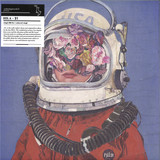
"21" is the well-crafted, sharp and original first album by the duo HILA, composed by American cellist Artyom Manukyan (who already worked with Kamasi Washington, Daedalus, Flying Lotus, Run DMC, Gretchen Parlato, Raphael Saadiq, Clive Lowe Mark...) and french producer Dawatile.
The combination of jazz, Los Angeles beat-scene and the vibrations of 80s and 90s Soviet Armenia make it a striking and unprecedented fusion. These kind of nostalgic and unconventional references forcefully shake the codes of mainstream culture to create a sincere, raw and intimate expression.
"HILA" was born from a spontaneous and intense creative impulse between Artyom Manukyan, a Los Angeles-based Armenian celloist and his partner in crime, David Kiledjian aka Dawatile, a French multi-instrumentist of Armenian descent. This project is proving to be a true master stroke given that it only took 21 days for the duo to make it a reality.
"HILA" was made in less a moon cycle but captivates and electrifies audiences upon its first outings. "H.I.L.A" colors the warmth of the Californian "High" with Armenian vibes. The artists chose this name for their creation since both have a close and valuable connection to these locales. This journey began in 2007, on the day Dawatile went to Yerevan, the capital of this small country in the Caucasus mountain to realize a first fusion project centered around local folkloric music genres.
There he was introduced to local musicians including the Armenian Navy Band, one of the country's foremost groups in which Artyom played the bass and cello. In this context, he also met many musicians such as Tigran Hamasyan and Norayr Kartashyan. This will be the beginning of connections between Lyon, Yerevan and Los Angeles. The following year, the two artists will be be seen performing next to Taylor Mc Ferrin at the Jazz à Vienne festival. More recently, they partnered up again when the cellist, who had freshly relocated in California, invited Dawatile to produce his album. As soon as the studio’s threshold was crossed, they decided to postpone this record and create a joint project: Hay (as the Armenians call themselves) / High In Los Angeles. HILA was born at the end of these 21 days of intense creation. The association of Artyom Manukyan and Dawatile is the combination of two visions, two versions of Armenia, two personalities, the reunion of the Eastern and Western blocs.
One grew up nurtured by the sounds of hip-hop and jazz in Europe and the other by art music and Russian-influenced 1980s Armenian folkloric music before moving to L. A., Ca. The cornerstone of it all, the glue that unites everything : Armenia and music. They generate a new identity synthesizing two perceptions, their complicity transcending these cultural discrepencies. To achieve this, they will scour through images of Artyom’s childhood, within the popular culture of Soviet Armenia. Together, they revisit this decidedly retro vibe, based on the work of Caucasian groups inspired by African American music. This background is rehashed and fused with ancestral Armenian sounds. The DNA of the album "21" is molded by these dear influences.
We can also hear the ancestral sounds of Armenia, a country at the edges of both Europe and Asia. The presence on two tracks of Armenian music Master Norayr Kartashyan, infuses the languor of past melodies and traditions. These purposeful anachronistic sounds offer a fantastic depth to this powerful opus. Listening to the album, one can appreciate the successful fusion of styles and influences. Those combinations, however, manage to preserve individual identities only to enhance the art through an adamant musical dialogue.
Being driven by the urge to transpose Armenian musical traditions into a unique universe, the daring artists, offer an innovative combination by blending, for the first time, these ancestral sounds with the world of Los Angeles beat-scene and jazz. An invention largely fueled by the magic strings of Artyom and maestro Miguel Atwood-Ferguson, a pillar of the genre in Los Angeles combined. These associations resonate with a triumphant equilibrium. HILA is musical uncharted territory in which Artyom's cello strings intertwine to ignite the harmonies of keyboards, the machines, the vocals and electronic layers Dawatile pieced together. HILA plays the soundtrack of an adventure set between Armenia around the end of the Soviet era and a mysterious near future.
Artyom Manukyan grew up in Armenia in the 90s. At the time, he studied Russian classical music while learning jazz with assistance by his father, a music journalist. Being an unconditional music lover, he went on to sharpen his skills at the prestigious Berkelee College of Music. Subsequently, he’s been lucky enough to travel the world touring with numerous acts and mainly with the Armenian Navy Band. The group has fostered alacritous success honored by a BBC Award as a crowning achievement. He moved on 10 years ago and made his way to L.A. with his cello on his back. In the City of Angels, he quickly became a popular figure of the jazz and hip-hop scenes thanks to his first album "Citizen". He’s accompanied prestigious musicians such as Kamasi Washington, Melody Gardot, Daedalus, Flying Lotus, Run DMC, Gretchen Parlato, Raphael Saadiq, Clive Lowe Mark, or Vulfpeck. He released his solo album on the cello, "Alone" in October 2019.
Dawatile is a bold producer and multi-instrumentist as well as a passionate and resolute musician molded by jazz. As a versatile artist, he handles and juggles the saxophone, the keys, the bass and composition. Simultaneously, Dawatile produces cross-over projects and soundtracks for the movie industry. He, as well, has had the opportunity to be a part of many tours, including with his electro hip-hop band, Fowatile and more recently with the "Future Kreyol" trio, Dowdelin. Being the ever workaholic, he has under his belt a string of prestigious collaborations with the likes of Talib Kweli, Foreign Beggars, Roy Ayers, Tigran Hamasyan, Mathieu Boogaerts, Voodoo Game and Piers Faccini. His taste for developing new musical recipes and his know-how in production make him a much sought-after album producer. In concert, the HILA duo offers a sober, precise and rhythmic performance. "21" is an aerial and lively album taking the audience on an at times joyous and sometimes melancholic dreamlike journey. The magic of "HILA" operates at the speed of light and positions it already as an avoidable group.
Поиск:one way records
Все
Ô Paradis was created by Demian Nada in Barcelona during the 1990’s. Ever since then he has perfected his post-industrial minded free spirited folk-pop sound. The music of Ô Paradis is based on repetitive loops and samples on top of which instrumentation is added. The vocals and lyrics are very recognisable and are an important aspect of the melancholy songs and dark tunes.
Among his 20-something albums are some classics that have attracted an audience in the field of post-industrial music. “Cuando el Tiempo Sopla” is one of the classic albums by Ô Paradis …
Originally this record was released on compact disc in 2007 on the now defunct but legendary post-industrial label Punch Records.
This album represents the style and sound of Ô Paradis in a very striking way. After all those years it still sounds fresh and relevant
and has lost nothing of its power and charm … Also it features collaboration with like minded artists Jürgen Weber from Novy Svet and Tairy Ceron from Ait!/Punch Records.
Now “Cuando el Tiempo Sopla” is available for the first time on vinyl and serves both as a collector piece for the fans as well as an introduction to a new audience…
Repress
Be With Records present the hugely anticipated first ever vinyl release of r'n'b star Cassie's seductive debut. A late-night classic of chilly electro-soul, the self-titled album has influenced many in the dance music fraternity since its original CD-only appearance back in 2006. Particularly revered by Jamie xx, Four Tet, Hot Chip and Tri Angle Records, the r'n'b cognoscenti went into overdrive when rumours of this release first leaked.
Perhaps most famously, it features the slick summer smash "Me&U" which reached No.6 in the UK charts and topped the US equivalent. Yet the remaining 10 tracks serve to create a "minimalist r'n'b" masterpiece; the intricate and space-filled arrangements are laced with sinister synth bleeps that wouldn't have been out of place on an early 90s Warp record. The dark, hypnotic high ends coupled with Cassie's ice-queen delivery made this stand out from the tired crowd of mainstream r'n'b at the time. It still sounds wholly and eerily unique.
Like all Be With releases, this record is officially licensed and has been cut by Frank Arkwright at the legendary Abbey Road Studios. Pressed on audiophile 180gram vinyl - befitting the heaviness of the music contained within - it also features the original artwork set elegantly within its 12"x12" borders.
D. Carbone is back on its homonymous imprint with a Theme Ep 'Back To The Empire Of Hardcore'. After the 2016 Ravers EP, here the artist make a second call to push a movement is coming back on all its power but in a modern key. The EP figure 2 remixes One from the Queen of Techno 'VTSS' and one other from the Hardcore master '14Anger'.
On The A1 the entitled track is a new hardcore wave gem, a robotic voice singing in a subdol way back to empire of Hardcore, lead and sirens create the atmospheres over a marching beat. This track aims to be a classic for the New Hardcore wave.
A2 presents VTSS remix. The queen of Techno after it's debut on REPITCH Recordings with the killer Identity Process EP and the amazing Atlantyda on Monnom Black is ready to show a Techno/EBM remix with its remark bassline, a strong kick and massive voice textures, make it an instant classic!
B1 is the time of French Raver '14Anger' its remix is a mesmerizing of Power and its Hardcore roots are shaped at its best. Percussive synth sequence chosen as the main groove, Melodic bassline is the main focus here till the amazing lead comes in to destroy every dance floor!
To Close, The Vinyl is 'Raver Killer' a powerful doom Techno track. This track is not for the fainted hearts, inspired to the 90's doom rave with modern touch Powerful kick, distorted model D's bassline, hi-pitched voices, and resonant percussions make it a big room track that can't miss in your bag and perfect choice to close this vinyl.
As Digital Bonus ' The Rhythm of Acidcore' is an Hypnotic Acid Banger. Model D bass and 303 acid sequence are the main focus here, accompanied by a smashing beat is the perfect track to stand along this collector EP.
"I'm always looking for ways to be surprised," says composer and multi instrumentalist Jeff Parker as he explains the process, and the thinking, behind his new album Suite for Max Brown, released via a new partnership between International Anthem and Nonesuch Records.
"If I sit down at the piano or with my guitar, with staff paper and a pencil, I'm eventually going to fall into writing patterns, into things I already know. So, when I make music, that's what I'm trying to get away from-the things that I know." Despite its musical departures, in presentation Suite for Max Brown is an informal companion piece to The New Breed, Parker's debut release on International Anthem, which was honored as one of the "Best Albums of 2016" by New York Times, Observer, and Los Angeles Times.
"I made The New Breed based off these old sample-based compositions and mixed them with improvising," Parker says. "That's in a nutshell how I make a lot of my music; it's a combination of sampling, editing, retriggering audio, and recording it, moving it around and trying to make it into something cohesive... With Max Brown, it's evolved." Though Parker collaborates with a coterie of musicians under the group name The New Breed, theirs is by no means a conventional "band" relationship.
Parker is very much a solo artist on Suite for Max Brown. His accompanists are often working alone with Parker, reacting to what Parker has provided them, and then Parker uses those individual parts to layer and assemble into his final tracks. The process may be relatively solitary and cerebral, but the results feel like in-the-moment jams-warm-hearted, human, alive. Suite for Max Brown brims with personality, boasting the rhythmic flow of hip hop and the soulful swing of jazz.
- A1: Michna - Triple Chrome Dipped
- A2: Dabrye - Temper
- A3: Dark Party - Active
- A4: Tycho - Cascade (Live Version)
- A5: Jdsy - All Shapes
- B1: Deastro - Light Powered
- B2: Matthew Dear - R+S
- B3: Flyamsam - The Offbeat
- B4: Cepia - Ithaca
- B5: Aeroc - Idiom
- C1: The Reflecting Skin - Traffickers
- C2: Ben Benjamin - Squirmy Sign Language
- C3: Kill Memory Crash - Hit + Run
- C4: Osborne - Wait A Minute
- D1: Milosh - Then It Happened
- D2: 10 32 - Blue Little
- D3: Mux Mool - Night Court
- D4: Solvent - Hung Up
Legend has it that Brian Eno’s concept of ambient music came to him while laid up in a hospital bed after an automobile ac-cident in the 70's. A friend brought him some records, playing them too low to be properly heard, and Eno couldn’t get out of bed to adjust the volume. While the record spun softly, Eno’s idea for music you could ignore as easily as you could give it your full attention, like a sort of sonic wallpaper, was born. It’s in that spirit of quiet isolation that Ghostly International, in associ-ation with Adult Swim, shares Ghostly Swim 2, our way of giving listeners a space to get away from the manic holiday bustle.
For those keeping track at home, Ghostly is wrapping up its 15th anniversary as an Ann Arbor/Brooklyn-based indie. 2014 has seen the company soundtracking video games (Playstation’s Hohokum), collaborating with awesome companies like Warby Parker and VOID watches, and clearing 300 releases of for-ward-thinking music with records from Tycho, Com Truise, and HTRK. What better way to end this banner year than to revisit one of our favorite partnerships from the past decade and a half?
Released in 2008, Ghostly Swim was praised for its adventurous survey of exploratory dance and pop music. Our curatorial focus has shifted this time around, moving further inward (spiritually) and outward (as far as our roster goes) to reflect the electron-ic underground in all of its hazy and vibrant experimentalism. Ghostly Swim 2 is a document of textured ambient zone-outs and woozy, granular house and techno that will help you find some downtime away from The Most Wonderful Time of the Year. So sit back, lower the volume, and enjoy our selections.
- 1: Play
Columbia Records release. A one sided, one track, twenty three minute instrumental written and performed entirely by Foo Fighters frontman Dave Grohl. The entire song was recorded live each time on a different instrument (seven instruments) all the way through for twenty three minutes. 12" black vinyl limited to 2000 copies. Promo and marketing activity. Online/social media activity. Ads, features and reviews across all press. Foo Fighters database mailout.
They Say: “Documentary and industrial underlays for current themes of modern life”.
We say: Mind-blowing, percussion-heavy, Afro-tinged, cosmic-disco library bomb.
This is the one. An absolutely outstanding record from 1983 and definitely one of the hardest to find on the collectable German library label, Coloursound. The Now Generation (Percussive Underscores) is comfortably one of the very best library records full stop.
The record comes galloping out the gate with a pair of rapid synthy-eurodisco bombs - the title-track and “Panama” - before slowing down to a woozy pace on “Inorganic Matter”. “African Nightclub” sounds like it reads, and is a particular favourite of Prins Thomas. Indeed, it was used to great effect on his seminal Cosmo Galactic Prism mix for Eskimo back in 2007. It’s followed by the dark, druggy, slow motion industrial groove of “Grease Plant” before “Southerly” lifts the tempo to close out side A with its Latin funk strut of bells and melancholic keys.
For us, though, it’s all about the opener to side B: “Mechanical Heart”. Seven minutes of building, mid-tempo disco-funk joy, deceptively explosive, club-ready gear for body and soul. The back cover dryly describes the track as “Guitar and percussion, light industrial underlay”. Hmmm. How about, “after finally emerging from a particularly heavy week jamming in a sunless, lawless German warehouse, Chic warily press record on a wayward, illicit instrumental for basement gatherings”. Just wait for those drums at the 3 minute mark…
The beatless ambience and menacing stabs of the proto-electro “Chemical Threat” follows, before the open drums and incredible fills of the metronomic “Steady Going” and fantastically monotonous funk breaks of “Nepal Trek” round out this sensational set.
This is a library masterpiece in no uncertain terms, full of synth funk, afro beats, exotica, leftfield madness, dance floor dynamite and all-around greatness.
As with our KPM and Themes re-issues, the audio for The Now Generation comes from the original analogue tapes and has been remastered for vinyl by Be With regular Simon Francis. Richard Robinson has brought the original Coloursound sleeve back to life in all its metalic silver glory.
“Osondi owendi. What is cherished by some is despised by others. One man’s meat is another man’s poison. Different strokes for different folks. To each their own. Osondi owendi.
It’s a conventional aphorism in the Igbo language but if you utter the word “osondi owendi” in Nigeria today, the first thing that comes to anybody’s mind is the cucumber-cool highlife music maestro Chief Stephen Osita Osadebe and his legendary album that takes its name from the adage. Released in 1984, Osondi Owendi was instantly received as Osadebe’s magnum opus, the crowning event of an exalted career stretching back to the early years of highlife’s emergence as Nigeria’s predominant popular music.
Stephen Osadebe first appeared on the music scene in 1958 as a spry, twenty-two year-old vocalist in the Empire Rhythm Skies Orchestra, directed by bandleader Steven Amechi. With his dapper suits, urbane Nat King Cole-influenced vocal stylings and jaunty, uptempo, calypso-scented dance tunes, he personified the frisky spirit and anxious aspirations of a young, educated generation that had come of age in the wake of the Second World War, in a Nigeria that was rapidly shaking off British colonization and marching towards an independent future. 1959 would be the year that he truly made his mark in the business with his debut solo single “Lagos Life Na So So Enjoyment.” A giddy exhortation of the music, sex, fun and freedom availed by life in the big city, the song became a sensation and an anthem, and Stephen Osadebe became the leader of his own popular dance band, the Nigerian Sound Makers.
Osadebe would ride this wave of acclaim through most of the nineteen sixties, but a change in direction would be called for at the dawn of the seventies. As Nigeria emerged from a devastating civil war, so did a new generation of youth inspired by rock and funk, confrontational sounds reflective of a more violent, less idealistic era. All of the sudden, the idioms of the post-WWII dance orchestras that nurtured Osadebe’s cohort seemed quaint, the stuff of nostalgia. Osadebe needed to evolve to respond to the new tumultuous, turned-up times.
His response? He cooled it down.
Abetted by a new crop of fire-blooded young players, Osadebe slowed his music to a mellow, meditative tempo, brought forward the lumbering, Afro Cuban-accented bass and percussion, from the rockers he borrowed searing lead lines on the electric guitar. Over this musical bedrock, doesn’t so much as sing as he dreamily muses, coos, sighs aphorisms, words of wisdom and inspiration. “When one listens to my music, all I say appears meaningful,” Osadebe explained his lyrical approach, “at times they are in the form of proverbs which provoke much thought afterwards.” The result is a blend that is both rollicking and soothingly languid. Osadebe christened the style Oyolima—a tranquil, otherworldly state of total relaxation and pleasure. Osondi Owendi represents oyolima at its finest, and possibly Nigerian highlife in epitome.
Osondi owendi. What is cherished by some is despised by others. In some way, the album’s title constitutes a paradox. Because Osondi Owendi is a record that it’s almost impossible to imagine being despised by anybody."
Following a string of releases via his own bbbbbb recors, along with bodies of work on трип Recordings, February 2019 saw Bjarki debut on !K7 Records with the ‘Happy Earthday’ album.
With the album considered to be the Icelandic producers first full debut LP, ‘Happy Earthday’ offered a conceptual collection of music which Bjarki thought he would never release. Influenced by his home country of Iceland as well as the planet’s environmental issues, the album received support across the board from the likes of The Quietus, DJ Mag, Pitchfork, XLR8R, FACT and CLASH Music, along with being crowned Mixmag’s ‘Album of The Month’.
As part of the limited edition 200 copy box set version of ‘Happy Earthday’, a secret album of original music was available to hear unbeknown to listeners. Now receiving a full release this December on double vinyl and digital platforms, Bjarki will release his second full album of the year via !K7 Records. ‘Psychotic_Window’ is a further extension of the experimental artists creative vision whilst continuing to address environmental themes and nature.
Combining influences from techno, breakbeat, IDM, electronica and more across all of his studio output, ‘Psychotic_Window’ is Bjarki’s final signoff for 2019. The new 14-track album follows in line with one of his most significant years to date, highlighted by performances at major events including Dekmantel and DGTL Festival, along with pioneering eclectic new sounds via his bbbbbb recors label.
“After ‘Happy Earthday’, people have been asking me about the secret tracks and it made me feel that they deserve a proper release. Each track means a lot to me as I made them during a depressing phase in my life; I was pretty broke, working many shit jobs and also just being super lazy, uninterested in leaving my apartment.
Before I started touring, I had these periods where I could write so much music without thinking, pouring my heart out to comfort my thoughts and feelings without trying. I doubt that this kind of window will come back to me anytime soon, my way of music making has changed a lot after going on tour. At that time, I was listening to a lot of Coil, Chris Carter and Cosey Fanni Tutti. I think every struggling artist goes through these phases of being sleep deprived, staying up and making music all night. This was my psychotic window.” -
Bjarki
- A1: Ghosts
- A2: Late Night City
- A3: One By One
- A4: Tvc 15
- A5: All Ways
- A6: Summer In The City
- B1: Nightmare
- B2: Strangler
- B3: Overseas
- B4: The Munsters Theme
- B5: Raceway
- B6: Keep The Pace
- C1: Get Off My Case
- C2: The Late Mistake
- C3: Ice Machine
- C4: Comateens
- C5: Pictures On A String
- C6: Garbanzo
- D1: Uptown
- D2: Cinnamon
- D3: Cold Eyes
- D4: Desert Song
- D5: Donna
- D6: Crime Time
- E1: Resist Her
- E2: Confessions
- E3: Love Will Follow You
- E4: Satin Hop
- E5: Deal With It
- F1: Nightmare
- F2: Walking Watching
- F3: Don't Come Back
- F4: Jo-Ni
- F5: Ask Yourself
In the fall of 1978, after working with a series of bands, New York-based musician and composer NickWest became interested in experimenting with minimalism, collaborating with guitarist and songwriter Ramona Jan and Lyn Byrd. They decided to play pure pop but to substitute a primitive electronic beatbox for a human drummer. The result was Comateens, becoming one of the first groups to discard the traditional sounds and line-ups used by everyone else in New York City’s downtown music scene of
the late 1970s. In 1980 Nick’s brother Oliver joined them as guitarist, and after going on to release three major label albums (Comateens, Pictures On A String, and Deal With It), and with some
successful tours and dance-club hits behind them, the band split up following the terribly untimely death of Oliver in June 1987.
However in 1988 Virgin Records issued another LP entitled West & Byrd, recorded by Nick and Lyn as a duo, and in 1991 released a retrospective compilation called ‘One By One: Best Of Comateens’, now a rare and much sought-after record among collectors of new wave music. Acclaimed by Etienne Daho, the band has made a name for itself with the singles “Late Night City“, “Get Off My Case“ and “Don't Come Back“.
Shasta Cults is the musical project of Canadian electronics technician Richard Smith. For almost two decades, Smith was the official Buchla & Associates go-to repair person for studios, collectors, and musicians around the world, having worked with artists like Aphex Twin, Suzanne Ciani, Mort Subotnick and institutions like NYU, The Library of Congress and Mills College in Oakland, Ca.
Recording demonstrations of the rare equipment that found its way on to his workbench is how Smith describes the origins of Shasta Cults. Although sounds have been trickling out for decades via Soundcloud and other outlets, it wasn’t until 2017 that Smith recorded his first album using one of these rare instruments – the Buchla 700. Configurations, released this past September by Important Records, features eight tracks of heavily-modulated, wave-shaped explorations drenched in effects, and was the catalyst for his latest releases.
Recorded over the span of 3 months in the fall of 2018, this album was programmed solely on the only fully-functional Buchla Touché. Developed in the early 1980s with hardware by Don Buchla and software programmed by musician David Rosenboom, the Touché features waveforms generated internally by twenty-four digital oscillators using frequency modulation and sophisticated digital and analog signal processing for timbre and output assignment, all of this controlled via a six-octave black and white keyboard, unusual for a Buchla instrument.
This LP is a continuation on themes first heard on Configurations, with more consideration given to the generation and capturing of the pieces. This album is less dark than previous releases, showcasing the incredible fidelity of the hardware used and Smiths evolution as an audio engineer. Put on some headphones, find a comfortable chair, and let this LP transport you to the mystifying southern cascades of Siskiyou County.
Contagious is a solid blending of avant-garde experimentation and electronic music. Formed by two innovative voices from the Improvisation scene of Berlin (Andrea Neumann and Sabine Ercklentz) and Mieko Suzuki, a well-crafted and creative DJ and musician who’s operating in Berlin venues and festivals since a long time.
Contagious is one of the most forward thinking, mind-melting projects to hit the electronic music scene. Intense and powerful, yet rooted in a tradition of crafting and sculpturing of in the most creative ways, all this building up within a solid structure of instant composition and improvisation. The trio plunder each other’s musical spheres, appropriate them and switch roles. Andrea Neumann on her infamous Inside Piano, an instrument she pioneered and crafted, is applying the most creative feedback processing to simple piano strings and sending them occasionally to Mieko Suzuki’s processing rig, who also uses her own pre-recorded sounds and her skills on turntables, while Sabine Ercklentz’s trumpet sounds blast through her processing system and altogether the three musicians communicate into logics of composition and futuristic structures, where fragile sound textures and pulses become monumental.
Contagious is also the debut album recorded and produced by Rabih Beaini. The Trio wanders in new aesthetic areas, sound is a texture where the processing rigs are constantly developing new forms and evolutions. Structures and grooves implode in noisy fragments, growing into a deep trance state.
Nicola Cruz re-visits his second album 'Siku', released earlier this year to widespread acclaim, with ‘Siku Reworks’. The release provides the listener with another perspective on the ‘Siku’ domain, one envisioned in different corners of the world; Argentina, the UK, and Japan to name a few. In an effort to unlink the original material, Cruz has selected producers to re-work a designated song on 'Siku'; according to their own style. Additionally, Cruz has chosen to re-record two tracks whose live versions have stuck with him throughout a year of constant touring.
‘Siku Reworks’ invokes a psychedelic view of the original material, Hermetics (R&S) provides deep atmospherics with his take on 'Obsidiana'; and Nicola offers an acid-merengue-infused live version of 'Señor de las Piedras'; alongside an infectious and club-ready re-work of live favourite 'Siete'. In some ways it's hard to define Nicola'ssound, shaped by years of global touring, and every track here is unique and succeeds in breaking from the usual electronic music format in captivating fashion.
- A1: Felix Kubin - Nachtflug Durch Die Weltenfalte
- A2: Lena Willikens & Sarah Szczesny / Phantom Con Ballett - Fragment 1
- A3: Esmark - Menge Ponge
- A4: Tintin Patrone - Con Papa` Nel Laboratorio
- A5: Asmus Tietchens - Der Heizer
- A6: Lena Willikens & Sarah Szczesny / Phantom Con Ballett - Fragment 2
- B1: Wolfgang Seidel & Ken Montgomery & Crystal Penalosa - Confluence
- B2: Phuong-Dan - About Rhythmus
- B3: Jessica Broscheit & Mark Boombastik - Anomaly
- B4: Carl & Sohn (Toben) - Yes
- B5: Rvds - Conrad Tanzt Im Regen
- A1: Tracklist 7“ Conrad Schnitzler & Ken Montgomery - 27 8.87
- B1: Tracklist 7“ Asmus Tietchens - Wilhelm Bornhofen
12"LP plus 7", ltd copies
ERUPTION is an outburst of creaking energies, unconventional ideas, arhythmic thoughts, cacophonous images and musical phantasms. ERUPTION is also the name of the second album by Kluster, a band project of the musician and video artist Conrad Schnitzler, who died in 2011, together with his colleagues Dieter Moebius and Hans-Joachim Roedelius. ERUPTION was also the name of a two-day festival that took place in July 2018 at the Golden Pudel Club in Hamburg. For two days, artists and musicians from different generations and working in various fields met here, who were in one way or the other inspired by the comprehensive oeuvre Conrad Schnitzlers’, as well as by his free-spirited thoughts and actions. The result was a multi-faceted programme of concerts, performances, sound and video installations, which resulted in the release of these two special records on Pudel Produkte, the house-own label of the Golden Pudel Club. The single features a previously unreleased piece by Conrad Schnitzler & Ken Montgomery as well as a story told by Asmus Tietchens about his father and Schnitzler, who unwittingly crossed the Atlantic together on the steamboat Bornhofen in the late 1950s, one as an engineer, the other as a heater. The LP brings together the festival's invited artists, Schnitzler‘s contemporaries
such as Ken Montgomery, Wolfgang Seidel and Asmus Tietchens, as well as young artists who developed works especially for ERUPTION. Among them are Lena Willikens & Sarah Szczesny with fragments from their performance Phantom Con Ballet, the DJ Phuong-Dan who composed a musical collage from the poem About Rhythmus and rhythm studies by Schnitzler, a piece from the performance of Felix Kubin, who uses a light scanner and his modular synthesizer to convert graphic notation into sound, a theatrical sound piece by Carl & Sohn (also known as Les Trucs), the producer and DJ RVDS, who interacted with the piece Tanz im Regen by Conrad Schnitzler and many more. Initiated and curated by Nika Son, a musician and artist based in Hamburg
After a three year absence, Kasper Bjørke returns to hfn music with a sublime new double EP entitled
“Nothing Gold Can Stay”. Having followed a deeply personal ambient music path that last year led to
the release of “Kasper Bjørke Quartet: The Fifty Eleven Project” on Kompakt Records, (named 5th
Best Contemporary Album 2018 in The Guardian), Kasper has found his way back to producing some
of his signature leftfield danceable beats, which “the past decade has seen Bjørke steadily rising amongst the ranks of artful, eclectic electronic producers…” (XLR8R).The Double EP “Nothing Gold Can Stay” explores both the analogue and organic side of his production work on Side A - while Side B reflects on sounds that he would play today, in one of his nightclub DJ sets. Side A contains four collaborations with four friends from LA, New York and Copenhagen. “Water” feat. Toby Ernest, the slow mo opener to the EP, revives the partnership with Toby that was last seen on 2014’s After Forever album (on the single “Rush”). Toby also provides the vocals on the cover version of Alessi Brothers’ 1975 classic “Seabird” - a track that came about through Kasper’s friendship and musical synergy with DJ and vinyl digger Christian d’Or, who is lead crooning while Toby delivers his signature falsetto. The “Seabird” cover adds a distinct contemporary feeling to the original version while staying true and respectful to the delivery and mood of the songs core. The 2nd half of the release, Side B, is directly aimed at the floor. Having stepped away from releasing club jams for a few years, Kasper is clearly enjoying getting back to the business of making people move. Side B of Nothing Gold Can Stay is both a testament to Kasper’s versatility as a producer and an all-out dancefloor assault, made with precision and sensitivity.
Following on from the release of a spilt EP from rising stars Gramrcy and Gaunt late last year, GlassTalk Records returns in 2019 with the sophomore EP from Bristol's Henry Greenleaf, "Patent".
The unassuming producer has been making waves with his bassy 130bpm productions which seem almost custom-made for the later hours of dark club settings.
Since his debut release on Par Avion last November, Greenleaf has been focused on increasing the sonic scale and clarity of his work; something that's apparent on the whole of "Patent" but especially on the opener, "Inch". A true 'creeper' of a track, the groove and harmonic arrangement of the 3-minute build-up is somewhat
entrancing but then gives way to a head-wringing breakdown.
True to his previous output, Henry doesn't sit still stylistically on "Patent". The EP's second track, "Tare", moves away from the 4x4 structures of "Inch" and into more syncopated territory previously occupied by producers like Mickey Peace or Paleman. "Tare" is a masterclass in polyrhythms with all manner of kicks, claps and vox samples skittering over each other. This deft use of drum programming is complemented by serene and uplifting synth sections, cleansing the tonal pallet before the beat forcefully drops back in.
On the B-Side, "Caved" keeps the energy and the tempos high with supremely processed high hats and a rumbling low-end landscape. Here Henry Greenleaf's adoration of Paula Temple's music shines through more than ever. Much like her output, it's kind of hard to know which way is up in "Caved" with its ever-shifting
palette of sounds and grooves.
Closer and EP title track "Patent" is probably the vastest song Greenleaf has created during his recent mission to grow his productions in scale. It's a mammoth techno track with a pulsing low-end juxtaposed against some sporadic & icey synth pads.
This release solidifies Henry Greenleaf's already hard-to-dispute status as one of the leading lights of the 'Bristol sound'. Almost impossible to define; his work sits in that amorphous sweet spot where techno, dubstep, garage and a load of other UK influences bleed into each other to form something unique. Put your headphones on and let the grooves swallow you up.
LIMITED EDITION 500 ONLY COLOURED VINYL LP WITH DOWNLOAD CODE IN GLOSS FINISHED 350GSM BOARD SLEEVE
Way back in 2004, ACID MOTHERS TEMPLE & THE MELTING PARAISO U.F.O. released the CD only album 'Minstrel In The Galaxy' on Riot Season Records. The decision to make it CD only at the time was down to the epic title track being almost 42 minutes in length. Fast forward fifteen years and new technologies and we have the first ever vinyl release of this classic album, with a new edited especially for vinyl mix by main man Makoto Kawabata.
What we said back then ...
‘Minstrel In The Galaxy’ is the sound of the newly slimmed down four-piece AMT recorded in their smoke filled basement Studio in Nagoya during summer 2004. The sounds captured on these three tracks are the first post-Cotton Casino AMT workouts. The diminutive beer and cigarettes goddess has upped sticks and moved to the USA to start a new life and plan her solo career. We’ll miss her that’s for sure but we can’t worry about that now, AMT have another ten albums to lay down before New Year.
The AMT line up for this album features the core trio of Makoto Kawabata (Guitar), Atsushi Tsuyama (Monster Bass), Hiroshi Higashi (Guitar & effects) and new permanent drummer (and ex-Mainliner man) Hajime Koie (Drums). The free jazz style drumming from Hajime has helped give AMT their sense of improvisation back, most of their work is improvised and recorded live to tape which gives that great loose feel they have that takes them off on tangents and makes each new record that little bit different from the last. And with this new studio album I think we can safely say it’s something of a new direction.
They’re joined on this album by Japanese underground queens AFRIRAMPO, who’ve just finished a tour with Sonic Youth and look set for big things themselves in the near future. Musically this album is a slight departure for AMT, anyone buying it expecting a head-melting riff heavy record are going to be disappointed.
To these ears ‘Minstrel In The Galaxy’ sounds darker and more stripped down that any previous AMT release. The title track alone lasts a staggering 41 minutes, over the course of which the band take our heads in a few gentle directions before letting rip towards it’s crushing finale. For me it’s the gentle openings that make me tick, I love the way it rolls for what seems like ever just going round and round in your head. You almost expect it to explode way before it does and that my friends is the art of foreplay AMT style!
Planning the imminent arrival of the 50th release on Touchin’ Bass, label boss Andrea Parker was digging through the warehouse during a stock take and it became apparent that there was something missing. There was a gap in the catalogue numbers. Where was TB036? Searching the archives it transpired that, for one reason or another (not least Parker’s inability to count), there actually wasn’t one.
So what better way to backfill this now documented gap than to welcome the multitalented guitarist and drummer, mathematician and multidisciplinary improviser Maria Gamboa Perez into the Touchin’ Bass fold with an updated focus for 2019.
Perez combines elements of rage, chaos, tension and anguish to form a visceral style. Her musical terrain and talent is shaped by dissonance and NO art. Under the moniker NonZero!, Perez brings Matrix Equation to the fore; a heavy 8 track EP with electro aesthetics from none other than Carl Finlow Scarletron/Silicon Scally/Voice Stealer.
Beginning her artistic career as a teenager playing as a bassist and guitarist in groups with influences from Noise, Avant Garde and the No-Wave, Perez was introduced into several areas of electronic music during the club culture years in Madrid and opted for styles such as Electro or Industrial, at which point she began to be interested in the introduction of rhythm boxes together with traditional drums.
Her passion for sound synthesis and musical exploration led Perez to introduce electronics into a solo project under the pseudonym NonZero!. Under this name she aims to make electronic music her field of sound research and for years has been continuously searching for existing relationships between sound and mathematics, focusing on the perceptual limit between music and noise.
Matrix Equation indulges in an evidential brooding angst, shifting between abstraction and the kind of elevated introspection carefully harvested over the years. With dramatic frontage in parts, blasts of boisterous energy and machine mayhem, its deployment of surprise, shifting focus and spontaneity operate in an assured statement.
Splintered beats and a foreboding sense of tension give way to a more DJ friendly logic of instinctive introductions and codas of gradual builds and breakdowns as Finlow further reworks the results to great effect.
In the last few years, Lewis James has gone from being an artist on the rise to establishing himself as one of the most exciting act to emerge from electronic music. His debut EP on Exit Records backs this statement up without question. The features on the EP speak for themselves: Lorn, dBridge and Alia Fresco. Aesthetically Lewis James has put together an EP that traverses different shades of electronica whilst not losing a sense of identity, an identity that is truly Lewis James by way of Exit Records.


