quête:only sounds

Genres
Tout
Various - Dolores: Salsa & Guaracha From 70's French West Indies

In Guadeloupe, many people think that jazz and ka music are like a ring and a finger. To some extent, the same could be said about so called Latin music and the music played in the French West Indies.

Both aesthetics were born in the Caribbean and bear so many connections that they can easily be considered cousins. In constant dialogue, there are lots of examples of their fruitful alliance and have been for a while. The English country dance that used to be practiced in European lounges came to be called kadrille in Martinique and contradanza in Cuba. They both featured additional percussion instruments inherited from the transatlantic deportation. Drawing from shared feelings about the same traumatized identity – later to be creolized – it would be hard not to assume that they were meant to inspire each other. The golden age of the orchestras that graced the Pigalle nights during the interwar period further proves the point. As soon as the 1930s, Havana-born Don Barreto naturally mixed danzón and biguine music in a combo based at Melody's Bar. In the following decade, Félix Valvert, a conductor who was born and raised in Basse-Terre in Guadelupe, also worked wonders in Montparnasse with La Coupole, which was an orchestra made up of eclectic musicians. Afro- Caribbean performers of various origins were often hired on rhythm and brass sections in jazz bands, which used to enliven the typical French balls of the capital. In the 1930s and onwards, Rico’s Creole Band was one of them.


Martinican violinist-clarinettist Ernest Léardée, who would become the king of biguine music as well as the main figure of French Uncle Ben's TV commercials (a dark stigma of post-colonial stereotypes), had musicians from the whole Caribbean sphere play at his Bal Blomet – and they all enchanted "ces Zazous-là" (according the words of Léardée's biguine-calypso piece). In les Antilles (French for French West Indies), music history started to speed up in the 1950s, when trade expanded and radio stations grew bigger. The Guadelupean and Martiniquais youth tuned in their old galena radio sets to South American and Caribbean music. As for the women traders, les pacotilleuses, they bought and sold goods across different islands (the "passing of items through various hands" was thought to be most pleasurable) and brought back countless sounds in their luggage. Such was the case of Madame Balthazar, who once returned from Puerto Rico with the first 45rpm and 33rpm to ever enter Martinique.

Out of this adventure was created the famous Martinican label La Maison des Merengues, a music business she opened and undertook with her husband and which proved to be a major landmark. At the end of the 1950s, in Puerto Rico, Marius Cultier competed in the Piano International Contest playing a version of Monk's Round 'Midnight. He won the first prize and this distinction foreshadowed everything that was to come. Cultier, the heretic Monk of jazz, was quickly praised for writing superb melodies, always tinged with a twist that conferred a unique sound to his music. It didn't take long for the gifted self-taught musician to get to play with Los Cubanos, making a name for himself thanks to his impressive maestria on merengues.

The rest is history. Besides, in the late 1950s, Frantz Charles-Denis, born into the upper middle class in Saint-Pierre and better known by his first name Francisco, went back home after working at La Cabane Cubaine – a club located rue Fontaine where he had caught the Latin fever. Francisco's music was therefore heavily marked by his Cuban cousins' influence, which gave the combos he led a specific style and also led to renewal. Things were swinging hard in La Savane, located in the main square in Fort-de-France. He set up the Shango club close by and tested out the biguine lélé there, a new music formula spiced up with Latin rhythms. Soon afterwards, fate had him fly to Puerto Rico and Venezuela.

As for percussionist Henri Guédon (percussions were only a part of his many talents), he was born in Fort-de-France in May 22nd 1944, the day marking the celebration of the abolition of slavery. As an old man, he could remember that in " his father's Teppaz, a lot of hectic 6/8 music was constantly playing...". In the opening lines of his Lettre à Dizzy, a small illustrated collection of writings published by Del Arco, he highlighted the huge impact that cubop had on him as a teenage boy, around 1960. He eventually turned out to be the lider maximo in La Contesta, a big band steeped in Latin jazz. He was also the one who originated the word zouk to describe music which brought the sound of the New York barrio to Paris. It was the culmination of a journey that started in Sainte-Marie: "a mythical place for bélé, the equivalent of Cuban guaguancó". In the early 1960s, the tertiary economy developed to the detriment of agriculture. Yet rural life was where roots music emerged in Martinique and in Guadeloupe.

Record companies played a major part in the process of Latin versions sweeping across the islands – before reaching everywhere else. Producer Célini, boss of the great Aux Ondes label, and Marcel Mavounzy, both the head of Émeraude records - a firm which was founded in 1953 - as well as the brother of famous saxophonist Robert Mavounzy, were big names to bear in mind. Although there were many of them - all of whom are featured on this record - Henri Debs was definitely the major figure in the recording adventure. He proved to be so influential that he even got compared to Berry Gordy. In the mid 1950s, when he acquired his first Teppaz, he worked on his first compositions: a bolero and a chachacha. Then, he became the one man who made people discover Caribbean music, from calypso to merengue. He was among the first ones to rush out to San Juan, Puerto Rico, to buy records and distribute them through a store run by one of his brothers in Fort-de-France. He had members of the Fania All Star come and perform there, which he was madly proud about. He was also the first one to pay attention to Haitian music, such as compas direct and various other rhythms which would soon flood the market. As a result, many of the combos hitting his legendary studio would end up boosted by widespread "Afro-Latin" rhythms. However, he never denied his identity: gwo ka drums were given a major role, although they were instruments which had long been banned from the "official" music spheres. The present selection bears witness to such a creative swarming. Here are fourteen tracks of untimely yet unprecedented cross-fertilization: all types of music rooted in the Creole archipelago have found their way, whatsoever, to the tracklisting. Whether originating from the city or being more rural, they all go back to what Edouard Glissant, in an interview about the place of West Indian music in the Afro-American scope, called "the trace of singing, the one which got erased by slavery." "It is so in jazz, but also in reggae, calypso, biguine, salsa... This trace also manifests through the drums, whether Guadelupean, Dominican, Jamaican or Cuban... None of them being quite the same. They all point to the idea of a trace, seeking it out and connecting to each other through it. This is the hallmark of the African diaspora: its ability to create something new, in relation to itself, out of a trace. It may be the memory of a rhythm, the crafting of a drum, a means of expression which doesn't resort to an old language but to the modalities of it." The opening track features one of the emblematic orchestras of this aesthetic identity, criscrossing many music types from the archipelago. The 1974 Ray Barretto guajira – Ray Barretto was a major New York drummer influenced by Charlie Parker and Chano Pozzo – is magnificently performed by Malavoi, a legendary Fayolais group (i.e from Fort-de-France). Additionally, the compilation ends on a piece by Los Martiniqueños de Francisco. It symbolically closes the circle as it is a genuine potomitan of Martinique culture which also functions as a tireless campaigner for Afro-Caribbean music. Practicing the danmyé rounds (a kind of capoeiria) to the rhythm of the bèlè drum, it delivers a terrific Caterete, a kind of champeta of Afro- Colombian obedience which was originally composed by Colombian Fabián Ramón Veloz Fernández for the group Wgenda Kenya. The icing on the cake is Brazilian Marku Ribas, who found refuge in Martinique in the early 1970s, bringing his singing to the last trance-inducing track. These two "versions" convey the whole tone of a selection composed of rarities and classics of the tropicalized genre, swarming with tonic accents and convoluted rhythms. It is the sort of cocktail that the West Indians never failed to spice up with their own ingredients. For instance, the Los Caraïbes cover of Dónde, a famous Cuban theme composed by producer Ernesto Duarte Brito, has a typical violin and features renowned Martinique singer Joby Valente and his piquant voice.


The track used to be – or so we think – their only existing 45rpm. The meaningful Amor en chachachá by L'Ensemble Tropicana, a band which included Haitian musicians among whom was composer and leader Michel Desgrotte, also recalls how Latin music was pervasive in the tropics in the mid-1960s. They were the ones keeping people dancing at Le Cocoteraie in Guadelupe and La Bananeraie in Martinique. Around the same time, another "foreign" band, Congolese Freddy Mars N'Kounkou's Ryco Jazz, achieved some success on both islands by covering Latin jazz classics – such as their adaptation of Wachi Wara, a "soul sauce" by Dizzy Gillespie and Chano Pozo whose interweaving of strings and percussions can have anyone hit the dancefloor. How can you resist Dap Pinian indeed, a powerful guaguancó by Eugene Balthazar, performed by the Tropicana Orchestra and published by the Martinique-founded La Maison des Merengues? It also acts as a symbol of the maelstrom at work. Going by the name Paco et L'orchestre Cachunga, Roger Jaffory used to play guaguancó too: his Fania-inspired Oye mi consejo is one example of his style. Baila!!!!! Dancing was also one of the Kings' focus points. Oriza is a Puerto Rican bomba and a "classic" originally composed by Nuevayorquino trumpeter Ernie Agosto, which reserves major space for brasses, giving it a special sheen.

Emerging from the New York barrios crucible was also La Perfecta, a Martinique group originating from Trinidad, whose name directly references the totemic Eddie Palmieri figure as well as his own band, also called La Perfecta. Here they borrow Toumbadora from Colombian producer and composer Efraín Lancheros and interpret it by emphasizing percussions, which set fire to the track even more than the wind instruments. The same goes for Martinique's Super Jaguars, who use Tatalibaba – a composition by Cuban guitarist Florencio "Picolo" Santana which was made famous by Celia Cruz & La Sonora Matencera – as a pretext for sending their cadences into a frenzy. In a more typically salsa vein, the Super Combo, a famous Guadelupean orchestra from Pointe-Noire that was formed around the Desplan family and had Roger Plonquitte and Elie Bianay on board, adapt Serana, a theme by Roberto Angleró Pepín, a Puerto Rican composer, singer and musician also known for his song Soy Boricua. Here again, their vision comes close to surpassing the original. In the 1970s, L'Ensemble Abricot provided a handful of tracks of different syles, hence reaching the pinnacle of the art of achieving variety and giving pleasure. They played boleros, biguines, compas direct, guaguancó and even a good old boogaloo - the type they wanted to keep close to their hearts for ever, "pour toujours", as they sang along together in one of their songs. Léon Bertide's Martinican ensemble excelled at the boogaloo which had been composed by Puerto Rican saxophonist Hector Santos for the legendary El Gran Combo.


Three years later, in 1972, Henri Guédon, with the help of Paul Rosine on the vibraphone, tackled the Bilongo made famous by Eddie Palmieri. Such a classic!!!!! And so were the Aiglons, the band from Guadelupe: choosing to execute Pensando en tí, a composition by Dominican Aniceto Batista, on a cooler tempo than the original, they noticeably used a wonderfully (un)tuned keyboard in place of the accordion. On the high-value collectible single – the first one released by Les Aiglons under the Duli Disc label – there is a sticker classifying the track under the generic name "Afro". Now that is what we call a symbol. Jacques Denis

pas en stock

Commandez maintenant et nous commanderons l'article pour vous chez notre fournisseur.

21,43

Derniere entrée: 88 jours
Universal Comfort - Flags are Walls

Flags Are Walls is the latest release from an enigmatic electronic duo based in Barcelona. "Universal Comfort"

The album explores the boundaries of contemporary electronic music, blending synthetic and organic sounds, layering analogue and digital sources, where abstract and concrete elements shift in and out of focus.

Boundaries are not only physical-shaping how we experience time and space-but also emotional, framing the sense of place we attach to them. The tracks play with these flimsy, and uncertain intersections, exploring expression and perception through evolving, haunting and diffused sonic landscapes.

pas en stock

Commandez maintenant et nous commanderons l'article pour vous chez notre fournisseur.

26,01

Last In: 9 months ago
Pola & Bryson - FABRICLIVE presents Pola & Bryson (2x12")

fabric, the iconic hub of electronic music culture, proudly announces its latest addition to the fabric mix series: "FABRICLIVE. presents Pola & Bryson". This mix will be a dynamic exploration of contemporary drum & bass, fluid in genre, rich in emotion, and sharp in sound design. It navigates the space between soulful reflection and controlled chaos, painting a vivid picture of contrast and transformation.

Showcasing a unique blend of melancholy, emotion, and euphoria that elegantly yet purposefully harnesses the immense power of electronic music, UK-based duo Pola & Bryson have solidified themselves as one of the most talented production duos flying the flag for the genre today.

Throughout the mix, you’ll hear liquid textures layered with depth and warmth, tracks that breathe with shimmering pads, smooth rolling drums and emotionally resonant melodies. These moments evoke late night introspection and spacious clarity, tapping into the more human, melodic side of drum & bass.

But the mix doesn’t stay in one mood for long. It periodically plunges into darker, more technical territory, where the basslines twist, the rhythms fracture and tighten and the atmosphere becomes tense and futuristic. Here, the emotional gives way to the mechanical, driving energy through razor-sharp precision and relentless force.

Experimental soundscapes weave throughout, blurring genre lines and adding moments of unpredictability. At times ambient and abstract, other times intensely rhythmic, the mix balances structure with freedom, always pushing forward without losing emotional weight.

For 25 years, fabric has stood as a cornerstone of the UK’s drum and bass movement, a place where the genre has not only thrived but evolved. More than just a club, fabric has been a vital incubator for underground sounds, consistently championing drum and bass alongside a wide spectrum of electronic music. From early pioneers to cutting-edge innovators, its legendary room two has become hallowed ground for DJs and ravers alike. As a bastion of innovation and inclusion, fabric has shaped the soundscape of UK nightlife, influencing global trends while staying fiercely true to its roots.

In addition to the mix album, fabric and Pola & Bryson unveil the brand new original single "Worlds Apart" an emotional vocal lead anthem featuring the incredible vocals of Emily Makis. The track balances Emily’s heartfelt lyricism with Pola & Bryson’s signature crisp liquid drums and deep and intoxicating basslines. The 2 acts first combined on the track "Complete" alongside Monrroe and followed it up with the certified hit, "Phoneline", dubbed by Radio 1 as the D&B Anthem of 2023. With a history of making pure magic happen when they join together in the studio, "Worlds Apart" certainly delivers on those high expectations.

pas en stock

Commandez maintenant et nous commanderons l'article pour vous chez notre fournisseur.

21,81

Last In: 3 months ago
The Orchids - Lyceum LP 2x12"

The Orchids

Lyceum LP 2x12"

2x12inchPLEXUS001
Circuitry
05.09.2025

“'Lyceum' is a fountainhead of unqualified greatness. It’s a strange, sad sound harking back to old school tunesmanship – Aztec Camera, ‘Rattlesnakes’, prime-time Felt – but the whole affair is permeated with a resonant, almost tearful quality. ‘Lyceum’ is reminiscent of Galaxie 500’s ‘Today’ in that it sounds like it cost less than a round of drinks to produce. But the lo fi sound merely enhances the misty glazed-pop sound and raises the hallelujah choruses to the forefront. Rather than drowning them in production mush. Don’t pass it by”.
– Bob Stanley, Melody Maker 1989
Hailing from the suburbs of Glasgow, this five-piece are best known for their three starry-eyed albums on the renowned Sarah Records - this being an expanded version of their first (an eight-track 10” at the time).
By the tail end of the 1980s the independent music scene in the UK was turning its back on the polish and over-indulgence of the mid-80s with its gated drums and wallpaper production. And those who weren’t stretching the boundaries of sonic innovation had tuned back to the post-punk ethos of ramshackle charm and zealous melody, even dousing the spirit with some political fervour once more. Influences were more likely to be Television and the Television Personalities than MTV.
The Orchids and The Sea Urchins were the first two bands to release 7” singles on the Sarah label having previously begun their recording existence on a shared flexi disc in 1987 (The Sea Urchins went on to become Delta, whose classic album ‘Slippin' Out’ from 2000 will be the second release on Circuitry). The Scottish five-piece released ‘I’ve Got a Habit’ and ‘Underneath the Window, Underneath the Sink’ as EPs before really finding their feet with ‘Lyceum’; the tracks, remastered from the original Toad Hall tapes are included on this reissue as are the three songs from the ‘What Will We Do Next?’ 7” (this collection closes with the frazzled stretch that is ‘Yawn’). 'Lyceum' was originally released in August 1989.
The album opens with ‘It’s Only Obvious’ and its gloriously youthful chorus of “who needs tomorrow when all I need, all I needed was you”. James Hackett somehow appears both forthright and rejected, something that one of their musical heroes The Go-Betweens also had down to a fine art. It barely takes a breath until midway through side two where ‘Hold On’ (sounding suspiciously like an unlikely objective) descends into the intro of ‘Blue Light’, the counted-in ‘1, 2, 3, 4’ whispered like the most hopelessly dejected rally. If that sounds depressing it isn’t. This record by The Orchids was a spirited source of comfort for an 18 year old at the time and still shudders with the best type of melancholy, one that’s spirited not indulgent. If you’re not familiar with the band’s charm, this is where you should begin.
'Lyceum' is released on double black vinyl by new label Circuitry.

pré-commande05.09.2025

il devrait être publié sur 05.09.2025

21,43
Doof - Dubplate #7: Love Dub So

2025 Repress

Mysticisms' Dubplate series is back once again, this time with Nick Barber aka Doof at the helm. He was a 90s trance icon who here serves up some tunes that have previously only been available digitally.

They were all recorded to tape and remixed and live dubbed on the desk so have an authentic feel to the melon twisting sounds. There are plenty of psychedelic twists and turns to the wispy synth leads and snaking hits here, all with heavy and cavernous low ends and plenty of future facing ideas.

Each one is sure to set the dancefloor alight when dropped at the right moment.

pas en stock

Commandez maintenant et nous commanderons l'article pour vous chez notre fournisseur.

18,03

Last In: 9 months ago
JAYWOOD - LEO NEGRO

JAYWOOD

LEO NEGRO

12inchCTLPC1383
Captured Tracks
05.09.2025
  • Woozy
  • Pistachios
  • Big Tings (Feat Tune-Yards)
  • J.o.y
  • Assumptions
  • Gratitude
  • Ask 4 Help
  • Palma Wise
  • Dsntrlymttr
  • Untitled (Swirl)
  • Sun Baby

JayWood - the nom de plume of Jeremy Haywood-Smith - is embracing new pastures having moved his music-making from Winnipeg, Manitoba to Montreal, and his new album Leo Negro chimes with a different tone as it looks to reconnect the self and grapple with one's identity. Marking a moment of meaningful change where controlled chaos takes the lead, it philosophises on what it truly means to be an experimentalist building a multi-faceted world where genre is infinite through sounds braver, more playful, and truthful than he's dared deliver before. Despite its astute sampling with layers of twists and turns, Leo Negro doesn't showboat but roars in the presence of vulnerability as it considers one's absolutes as a way of navigating the identity crisis. "Always looking for attention, I admit it, I can't help it, I'm a Leo," he reasons between vintage hip-hop scrubs on `Pistachios,' recalling a childhood need to be the centre of attention then stepping out of the spotlight as a grown-up. "Leos are confident and sure about themselves, but this record isn't that; so really, when translated, the title inspires `black confidence.' It's an uncomfortable, weird, and surreal term which bends the truth and embodies everything within." Experimenting in both life and music, Leo Negro and its first cut, `Big Tings' (feat. California, art-pop duo Tune-Yards) couldn't be further from 2023's Grow On EP and the previous year's slick LP Slingshot. Moving with flow akin to D'Angelo with Toro Y Moi textures, its twinkling intro of whirling synth and playful approach circles back to Jeremy's adolescence when he'd reverse, slow down, and speed up his favourite songs through the media player on his computer. Encouraged by his musical squad Will Grierson, Arthur Antony, Brett Ticzon, and enlisting his stylist and thrifter friends to capture the Leo Negro aesthetic, JayWood's big `in' for 2025 is collaboration, with the tight-knit crew of likeminded musical colleagues captured in session photo grins beaming from his Instagram grid. Nominated for Canada's coveted Polaris Music Prize, it'd be easy to be the cowardly lion; to rinse and repeat what's worked up to this point. But for JayWood, leaning into his natural `what if?' curiosity to make up his own rules as he goes along ("I never really knew what they were to begin with") and venture into honesty's unsafe space to seek comfort, confidence and make even greater connections, really is the only option. After all, he can't help it; he's a Leo.

pré-commande05.09.2025

il devrait être publié sur 05.09.2025

22,27
Bendik Giske - Remixed

Bendik Giske

Remixed

12inchSTSLJN444LP
SMALLTOWN SUPERSOUND
05.09.2025

Bendik Giske’s Beatrice Dillon-produced 2023 album gets an addendum with reworks from Carmen Villain, aya, Hanne Lippard, Hieroglyphic Being, Wacław Zimpel and Dillon herself.

Giske’s clearly got his ear to the ground; his last remix record was an invitation for Laurel Halo to put her stamp on »Cruising«, while 2018’s »Adjust EP« roped in Deathprod, Total Freedom, Lotic, and Rezzett. Now comes this new LP of remixes and it’s one of the best we’ve heard in aeons. Carmen Villain boots things off with a remix of »Slipping«, following her excellent (and way, way too underrated) »Nutrition EP« with a giddy, subtle roller that sounds as if it’s been constructed using only Giske’s raw stems. His breaths and leathery key presses – already amped up by Dillon’s detailed recording – are magicked into a dubby concrète groove that’s enhanced with the sparest melodic elements: echoing rainforest-at-night horn blasts, and lopped off decay trails that help fuel the momentum.

aya’s revision of the same track takes a different approach, forming forceful overlapping polyrhythms from Giske’s clanks, using the gamelan-like arpeggios for melodic weight and repetition. The result is a constantly shifting, hypnotic trancer that’s achingly organic – more Raja Kirik than Paul Van Dyke. Polish clarinetist and producer Wacław Zimpel, meanwhile, supplements his trippy recent collaboration with James Holden on a similarly levitational wrinkle of »Slipping« that twists Giske’s quivering sequences with microtonal synth prangs, and gusty echoes. But it’s Jamal Moss who plays fastest and loosest with Giske’s source material, calling back to April’s psy-house stunner »Dance Music 4 Bad People« with a powdery, sexualised banger that buries the breathy »Start« stems underneath neon synths, and brittle drum loops.

»I’m a digital nomad,« Lippard deadpans over Giske’s »Not Yet«. »I’m addicted you know that.« It’s a typically dry treatment from the conceptual artist that unexpectedly amps up the hypnotic qualities of Giske’s original, adding her circuitous charm to his concertina-ing sax sequences. And to tie things up perfectly, Beatrice Dillon returns with her diaphanous remix of »Rise and Fall«, built to emphasise the radically different approaches of each artist.

pré-commande05.09.2025

il devrait être publié sur 05.09.2025

24,79
General Magic - Bosko LP

General Magic

Bosko LP

12inchEMEGO314V
Editions Mego
04.09.2025

Editions Mego presents Bosko, landing exactly 30 years after the initial General Magic flights into the fantastic; the legendary first Mego release, a collaboration with Pita whereby all sounds were harnessed from the buzzing, drinking, humming sounds of fridges MEGO 001 General Magic & Pita and a 12” with Elin called Die Mondlandung (The Moon Landing) MEGO 002 which embarked on a minimal techno template so austere and strange it was one of the historic progenitors of austere and wonky rhythms alongside Sakho and other European explorers.

The initial return of the playful and mystical Austrian outfit General Magic came with the 20th year anniversary vinyl reissue of their classic debut Frantz eMEGO 010. A record so audacious and playful it still baffles as much as it entertains. At some point whilst working on this reissue GM’s Ramon Bauer and Andi Pieper were spurred on to rummage around with ideas and tools once more and after more than two decades of inactivity sonic sorcery was conjured once again. Live shows in honour of Peter Rehberg were performed in Vienna and London. Softbop, a limited risograph collaboration with Tina Frank came with the first new recordings as a digital download came out discreetly online. The first full length album following Rechenkönig in 2000 MEGO 032 “Nein Aber Ja” released in 2023 on Finlay Shakespeare’s GOTO Records on CD and cassette. An ongoing series of mix tapes online further highlights their interests encapsulating a new found angle on electronic mayhem. All of these elements retain the wildly eclectic and ecstatic glow that only they can harness and hand out to an unprepared world.

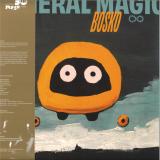
Now, we have General Magic’s second official full length comeback recording, Bosko. The new album is initially notable prior to the needle hitting the wax or the cursor identifying a track due to the artwork. Made by long term collaborator Tina Frank, this is Frank’s first analogue artwork, with a painting of a happy/nervous machine thing hovering in a landscape of no discernible identity. It’s quasi science fiction hovering amongst the potential for fun. Suited to the music? Natürlich.

Bosko sees Bauer and Pieper update and reframe their original investigations with a fresh supply of head scratching, heart racing tunes that hit the inexplicable with a wild mesh of drums, pianos, synthetic voices and all manner of immaterial sonic play. Startling sonics shock the ears on Club Duchamp which sounds like a conversation between synthetic adult ants in an environment still in development. Elfer features vocals supplied by a female-ish voice who, whilst grappling melody, has trouble executing a firm identity. Noorenhalt catapults along a mainframe of syncopation so unwieldy it feels like the voice, which is utterly alien, provides the only comfort. Seite 5 inhabits a fuzzy zone where a synthetic Horn of Jericho type ambience competes with rhythms never quite sure of who they are. Rise of the Ombré raises the spectral dread. Is this Science Fact? Absolutely nothing within Bosko is predictable.

The amount of change in the miasma of existence and the things we touch in order to make things has shifted so exponentially we are at the point where minds are starting to glaze over. All of this makes the return of the always original, always surprising, always fresh and exciting General Magic totally in tune with the artificial intelligent apocalyptic age we currently inhabit. The tools may have changed but the wonderfully warped gaze of Bosko offers a fresh new vision of perplexing funk and robotic punk.

pas en stock

Commandez maintenant et nous commanderons l'article pour vous chez notre fournisseur.

24,58

Last In: 9 months ago
World Brain - Open Source

Lucas Chantre, aka WORLD BRAIN, last graced us with a solo release half a decade ago, with 2019’s Peer 2 Peer. As its name suggests, that album explored the promise and perils of universal connectivity via quirked-up songwriting and instrumental psychedelia. His new release, Open Source, deepens this internal and external journey. Bursting beyond the four walls of ‘bedroom pop’ and reflecting a move from Berlin to Paris—where much of the album was recorded—and on to Brussels, the album has a jazzy, cinematic scope (as on the Brubeck-inspired march “Fromage collatéral,”) enveloping the listener in a cosmic-pastoral audiosphere.

There are still many tones that evoke the software sounds of decades past (the exemplar here is “cAPTCHA,” whose virtual marimba and vocalese suggest a breathless, Exotica-inspired introduction .mov for the information superhighway) but the palette has become richer and more organic, lead by the woodwinds which play a major role throughout, with flute provided by labelmate Martha Rose. (On the aforementioned “cAPTCHA” one also hears the world-class whistling talents of the incomparable Molly Lewis.)

Yet the single most noticeable new element may be the use of Chantre’s native French, sung by his sister on “Ville fleurie” and the gorgeous, fluttering “Minute papillion” (the title an idiomatic injunction to slow down!) Chantre initially wrote these lyrics in English, but felt something wasn’t quite right, only realizing what was off when he heard them sung in another language. That spirit of discovery – of finding a new spark in returning home – suffuses Open Source. It invites us to play, beckons us to relax, reminds us to find serenity amidst the churn of the present: minute papillon, dans le tourbillon.

pas en stock

Commandez maintenant et nous commanderons l'article pour vous chez notre fournisseur.

19,54

Last In: 9 months ago
Various - AW001 - Various Artists

Anothr World steps onto the bridge between Paris, the Ruhr Area, and Berlin.

Marking its debut with a vinyl-only release, the label presents a compelling Various Artists compilation that sets the tone for its unique sonic identity.
From France, Berlin-based Casual Treatment and Paris-native Hemka contribute powerful tracks. Representing the Ruhr Area, Rostom and Verschwender bring their own distinctive energy, grounding the release with gritty, hypnotic textures and raw groove.

This first offering is a bold statement of intent - a fusion of cities and sounds.

En stock du16.06.2026

13,40

Last In: 4 months ago
Various - Habibi Funk: A Selection From Libyan Tapes (LP 3x12")

Habibi Funk is more than happy to announce our 31st release which happens to be our 3rd various artists compilation. The album is dedicated to the cassette tape scene in Libya from the late 80s to early 2000s, from disco to reggae to pop. All songs previously unreleased outside of Libya and not available on any DSP platforms.

This compilation isn’t a sweeping history of Libyan music — it’s a personal journey into the sounds we fell in love with while digging through tapes, conversations, and stories across Libya and beyond. Rather than spotlighting the country’s most famous musical exports, the compilation brings forward a mix of overlooked gems and local classics of the cassette era: artists whose work thrived despite political limitations, and scarce international exposure. The music featured here blends reggae rhythms, synthy disco grooves, gritty pop, house, and funk, a vibrant collision of genres that reflects Libya’s unique sonic landscape from the 1980s to the early 2000s. Many of these recordings were recovered from the TK7 cassette factory in Sousse, Tunisia, a now-demolished site that once played a quiet but vital role in distributing and manufacturing Libyan music. Other tracks were digitised in a Cairo hotel room in 2021, where we transferred nearly 100 tapes over the course of three days, on-site using a high-grade cassette deck brought into Egypt with us. From that trove emerged artists like Ahmed Ben Ali, Cheb Bakr, and Najib Alhoush & The Free Music, who have already featured on our earlier releases. Their sounds sit alongside contributions from this release from the likes of Khaled Al Melody, Fathi Aldiyqz & Sons of Africa Band, City Lights Band, Libya Music Band, and Group Hewaya. During this era, Independent artists relied on makeshift home studios or travelled abroad to record in Tunisia and Egypt, gradually building their own infrastructures for creativity. By the 90s and early 2000s, as access to digital equipment increased, a few of the artists began setting up their own studios — a shift that gave rise to a more self-sufficient recording culture across the country. The resulting sounds are anything but homogeneous. They reflect Libya’s geographic and cultural crossroads: North African rhythms meet Arab melodies and deep African roots. Reggae, in particular, took on a local Libyan flavour — not just musically, through the slowed-down cadence of traditional shaabi beats, but socially, as a vehicle for expressing identity and pride. What ties all the artists on this comp together is a boundary- pushing approach to genre and style: recorded in small studios, exchanged by hand, and shaped by a cross-pollination of influences, from Benghazi to Tripoli and beyond. All tracks are licensed from their creators and in the case of the artists being deceased from their estates. All profits are being split 50:50 between us in the licensors and ownership remains with the creators, we only licensed the music.

pas en stock

Commandez maintenant et nous commanderons l'article pour vous chez notre fournisseur.

46,64

Last In: 5 months ago
Cranes - FUSE LP

Cranes

FUSE LP

12inchDADA006LPX
Dadaphonic
22.08.2025

The Fuse album was remastered at Abbey Road in 2023.  The album includes an extra unheard track from the period called New Liberty. Artwork is by Chris Bigg of V23.
The second in a series of archive releases by Cranes, Fuse was recorded in Portsmouth, their home town by siblings Alison and Jim Shaw. It originally appeared as a cassette album in 1986 on the Bite Back! label. With an initial run of only 200 copies, over the years this album, with its distinctive purple cover has been highly sought after amongst fans, often exchanging hands for more than £100. 

FUSE showcases a sparser, darker and more industrial, post punk sound. From the hypnotic allure and rhythmic intensity of the title track to the ferocious and challenging beats of Wrench, the songs are just as mesmerising as Cranes' later, critically acclaimed releases.  

Recorded in a garage on a 4 track porta-studio, the band spent many months experimenting and became obsessed with the recording process. Jim Shaw used a very early sampling pedal to create the drum sounds, which were all individually triggered. The only and first ‘industry’ person to hear anything by Cranes at this time was Martin Hannett (legendary producer of Joy Division and New Order).  He was looking for unsigned bands to appear on a new music TV show in Manchester and so Ian Binnington from Biteback! sent him a compilation tape of many Portsmouth bands. Hannett picked out ‘Fuse - original version” by Cranes and told Ian that the track was ‘fucking great’.   

Following their sold out gigs in October 2023 in London and Portsmouth, Cranes will be playing the following shows in May, supported by deary*: Tue 30th April BRUSSELS, Botanique, L’orangerie (Sold-Out) Thu 9th May LEEDS, Brudenell Social Club* Sat 11th May LONDON, Islington Assembly Hall* Mon 27th May BARCELONA, Primavera @Apolo.

pré-commande22.08.2025

il devrait être publié sur 22.08.2025

21,43
PRINZ EZO - KURIER

PRINZ EZO

KURIER

12inchTNLP02
Tech-Nology
22.08.2025

Tech-Nology was launched in 2003 specifically to make records with the artist Bjorn Svin. Bjorn was the first Danish artist who made underground crossover into commercial hit territory via "Mer Strom" - but still keeping respect in the "real" music world for his enthusiasm, non-compromising style, persona, and sweaty live performance skills - his musical understanding and need to explore new directions took the crowd on a personal musical journey from jazz and classical musicians to early electronic pioneers - but always in a tone of his own. Bjorn always felt a need to escape norms, to grow and not to repeat, but investigate and create. The first record on Tech-Nology was born under the alias - El Far: Couples of lonely dancers. "Bjorn is maybe the most talented electronic producer ever in Denmark" and he was celebrated as a wonder kid by the media back in the 90's. An insider with new knowledge of Bjorn told us: "Yeah I think its good music.. It's not for everyone I must add, but it's definitely quality music for those who dig this sound.. sometimes a bit too deep.. which kind of works against it, cause you really need to listen to it.. you cannot just skip through it, cause then you don't really grasp the soul of it.. so this is what makes it more difficult to sell - but if a guy like this was a bigger name he would sell much better.."

We love Bjorn and we agree - We have tried to sell Bjorn and his music for over 2 decades now - But you can't capture Bjorn, you can't own him - he is only making music for himself - and you can get on the ride if you want to, but don't expect all the rides to be fun - sometimes it hurts! Bjorn is difficult to sell, but we don't think Bjorn really would like to sell much better if he had the option to do a more commercial approach to his music - because Bjorn is about not selling out, he's a purist at heart, making music documents for the few. Bjorn is bigger than superficial success and streaming numbers. He made jingles for Nokia, toured and played Roskilde's main stage, the biggest Festival in Denmark, but he still doesn't care... and that is important if you want to make interesting music that last for the future. When Bjorn met Mester Jakobsen, label boss of Tech-Nology, he has been releasing on numerous underground labels, made the jump to a major label, and everything more or less turned out as a big disappointment, so Bjorn presented a completely experimental album to the Tech-Nology label under the moniker Prinz Ezo - The Body Offset. We loved it then - we still love it now - and a truly collectors item and a secret DJ tool.

Today, Bjorn is still breaking all habits and rules, still doing the same thing - just in new ways, but he has gained insight on another level, adding even more nuances and textures to his post-genre compositions.

Welcome to the second album by Prinz Ezo on Tech-Nology: KURIER Why Kurier? Because Bjorn left to explore the Berlin Underground, shortly after the first two releases on Tech-Nology - he left his roots to search for a bigger meaning, a bigger understanding, to compose real mature sounds and understanding his skills, at the point where you understand why you have to cross borders, still incognito, doing smuggler-sounds, always in transit - between cities, between cultures, between worlds, time and space. Not Restless nor rootless, just forever on the move, always discovering new landscapes! But now Bjorn is settling down - accordingly with the music - to find - not inner peace, but to be completely in balance with the music inside of him. Prinz Ezo is raw, narrative, minimalistic electronic storytelling that refuses to freeze. Tension builds and releases - feel the energy and the drama for the last 2 decades if you dare to take the journey?

Almost twenty years after the first Prinz Ezo album, it has now been possible to make the music for those who never arrived.

pas en stock

Commandez maintenant et nous commanderons l'article pour vous chez notre fournisseur.

14,71

Last In: 9 months ago
GREY OCTOBER SOUND - Late Night Lo-Fi
  • A1: Fascination / Grey October Sound & Zaqlo
  • A2: Moonlit Fish / Grey October Sound & Tsubaki Sounds
  • A3: Ronin Vibes / Grey October Sound & Don C
  • A4: Tokyo Dream - Cloudy Memories / Grey October Sound & Sand Land Studio
  • A5: Yoru No Ame / Grey October Sound & Matcha One
  • B1: Late Night / Grey October Sound &Adon
  • B2: Room 503 / Grey October Sound & Orilo
  • B3: Night In The Rain / Grey October Sound & Rensui
  • B4: Black Butterfly / Grey October Sound & Léa Fontenay
  • B5: Night Walker / Grey October Sound & Route

Grey October Sound has gained widespread popularity not only in Japan but also around the world through their series of cover albums, including Lo-fi Ghibli,
a collection of Ghibli film music covers; Lo-fi City Pop, featuring covers of classic and beloved City Pop songs; and Lo-fi Anime, which reimagines popular anime
theme songs in their signature style.

Amid the success of their original compilation series Timeless Lo-fi, they are now launching a brand-new series titled Late Night Lo-fi.
This new album, composed entirely of newly recorded tracks, continues to reflect Grey October Sound’s distinctive style while offering mellow and chill tunes that
evoke the atmosphere of late-night hours, just as the title suggests.

pré-commande22.08.2025

il devrait être publié sur 22.08.2025

40,80
Debris' - Debris'

Debris'

Debris'

12inchSV137LP
SUPERIOR VIADUCT
22.08.2025

Chickasha, Oklahoma is not a place known for producing a lot of original proto-punk bands. In fact, there is, to our knowledge, only one: Debris'. Formed in 1975 by bassist Chuck Ivey, guitarist Oliver "Rectomo" Powers and drummer Johnny Gregg, the trio created some of the most art-damaged outsider rock 'n' roll this side of MX-80 Sound.

When a local studio offered the package deal of ten hours for recording and mixing as well as pressing 1,000 LPs and two-color jackets, Debris' came in well-rehearsed – nailing all eleven of their songs in just one take. In April 1976, the same month as Ramones' debut album, Debris' would release their lone record onto the world.

Opener "One Way Spit" could easily be mistaken for a lost KBD single – from Chuck's bizarre count-in to the band's trashy start-stop rhythms, unfurling a Dadaist flag around Johnny's visceral vocals. On "Tricia," a reference to the then-current Patty Hearst trial, Oliver's gruesome groans are sardonically juxtaposed with an electric saw. These LSD-tinged tunes are a potent mix of Beefheart-ian controlled chaos and the genuinely weird avant-rock associated with the mid-'70s Cleveland scene.

Enhanced by analog synthesizers and electronic effects, the album sounds like Eno-era Roxy Music or Stooges' Fun House buried deep in the red Oklahoma dirt. While punk would spark a handful of bands who boldly straddled the line between the primal and the experimental, the relatively unsung Debris' were one of the first to do so.

Debris' had a standing invitation to play New York at Max's Kansas City and CBGB in 1976, although they never made it out of Oklahoma. The private-press edition of their self-titled album (also known as Static Disposal, which was actually the label name printed on the original front cover) has since become a collector's item and is even namechecked on the infamous NWW list.

pré-commande22.08.2025

il devrait être publié sur 22.08.2025

26,47
Feed LA - More Feed LP
  • 1: Bun Bo (Higher)
  • 2: Der Erste Dritte Tag (We Were Young)
  • 3: Striezl Stuck
  • 4: Feed Lala
  • 5: Die Risikobegegnung
  • 6: Snare Fingers
  • 7: Last Orders
  • 8: Fast Cash (Up In Stratosphere)
  • 9: Da Anda Koana
  • 10: Verschwende Den Tag
  • 11: Even Higher

Are you ready for seconds? Feed LA are back once again with their sophomore full-length album, "More Feed’.

With each release, Feed LA lifts away from familiar forms, offering listeners both inventive improvisations and unexpected harmonic textures. Based in Berlin, the band weaves freely across experimental jazz, punchy funk, and low rock treadings. Sidestepping neat categories and market gridlines, the group leans into the joy of jazz music—rich in wandering detours and pivoting surprises. Feed LA's tracks unfurl before our ears, inviting listeners to the intricate conversations between players, where every murmur, pause, and sudden spark waits to be discovered.

They describe their style as "Free Pop”, a blend of jazz, funk, and pop instrumentation, with a touch of vocal accompaniment.

Get a second helping of Feed LA's unique musical sounds with their newest album, "More Feed,” now available on black vinyl LP and compact disc. Only on Mighty Eye Records!

pré-commande22.08.2025

il devrait être publié sur 22.08.2025

33,57
FaltyDL - Neurotica LP

FaltyDL

Neurotica LP

12inchZIQ475X
Planet Mu Records
19.08.2025

It’s been ten years since Drew Lustman aka FaltyDL last released on Planet Mu. In the meantime he's been running his own label Blueberry Records, been in-house producer for Mykki Blanco and has become a dad. The best things come out of play and it was Drew’s relationship with his young daughter that switched on this playful side of his music. The album in question, ‘Neurotica,’ expresses Drew’s fun in creating such energetic pieces people will want to move to. It's a dizzying sugar-rush at a high-speed bounce; the music is fresh and inviting and most important of all, joyful."Summer of ’24, we were in Catalonia. My girl, our young daughter, the old folks. Days by the village pool, afternoons on the dirtbike. At night, I made salads. Simple things. Good things. One afternoon, lying back, phone in hand, I saw a friend post a GRWM. The music behind it stopped me. A song grabbed hold. The track was ‘Secret’ by Mietze Conte, which is fast-paced euro-pop dance music, like soft fluffy gabber with childlike vocals. I hunted down the full version. Played it again. And again. Twenty times over the next few days. It unlocked something. The best music does that. Like the first time I heard Burial. Had to know what was happening under the surface. That time, it led to ‘Love Is A Liability’ in 2009. This time, it led to ‘Neurotica.’“ “I started to record, getting down fast, bright, sugar-rush sounds. 185 to 200 BPM. I wrote them quick—half a day per track. In between, I slowed things down. Gave space for breath. Mike Paradinas helped shape the album, his ear guiding the flow. I tested the tracks. Played them for kids barely out of diapers and grown folks who still move like they are. It worked, on all ages. I kept it simple. Only two rules: keep it moving and don’t look at my phone. Cut the vocals like I used to.” ‘Neurotica’ is FaltyDL with his mojo refreshed, a new life squared, do yourself a favour, crack a smile and feel the joy.

pas en stock

Commandez maintenant et nous commanderons l'article pour vous chez notre fournisseur.

25,17

Last In: 9 months ago
JOSEPH	DECOSIMO - FIERY GIZZARD
  • Ida Red
  • Glory In The Meetinghouse
  • Flowery Girls
  • I Had A Good Father And Mother
  • Shady Grove
  • Pretty Fair Maid
  • Billy Button
  • Puncheon Camps
  • The Queen Of Rocky Ripple
  • Boatsman
également disponible

SEAWEED GREEN VINYL[22,27 €]


Old-time and traditional music stay exciting for their contrasts. Exacting instrumentation honed through mentorships and late-night jams at fiddler's conventions tangles with a community-sourced inventiveness that influences variants and new sounds. Joseph Decosimo is a master of this genre for this very reason, blending deep technique with an openness and curiosity that keep his music crackling with life. A "marvelous fiddler" (No Depression) and banjo player who braids "exultation and veneration" (INDY Week) into his music, on his third solo album Fiery Gizzard Decosimo gathers a close-knit ensemble of friends from his musical career to infuse his interpretations of fiddle and banjo pieces with a contagious communal joy. As an artist working with traditional music from the South and Appalachia, Decosimo chooses songs based not only on historical significance and lineage but also his own sensory approach. For Fiery Gizzard, his ear was tuned to otherworldly tones and mystery, sourcing from field recordings such as Virginia fiddler Luther Davis' hypnotic version of "Shady Grove" while amping up the music's psychedelic potential. On the middle Tennessee banjo composition "Flowery Girls," a VHS of bluesman Abner Jay inspired Decosimo to rig up a pickup inside a fretless banjo and play it thr ough a tube amp to capture some of Jay's edge and funkiness. But to round out the sound and keep it kinetic meant galvanizing a genre-eschewing crew to jam out - and not in a "spaced-out drooly" kind of way, he laughs, but as a sort of "responsive conversation." Decosimo has always been a community-minded artist. He began playing as a seventh graderin Tennessee, fostering relationships with older players at jams and in homes, a learning mode natural to his inquisitive nature and desire for musical connection. A folklorist by intuition, he later became one by profession, studying with old-time legend Clyde Davenport, teaching in East Tennessee State University's renowned bluegrass program, and receiving his PhD at the University of North Carolina with a dissertation titled "Catching the `Wild Note': Listening, Learning, and Connoisseurship in Old-Time Music." In North Carolina, Decosimo kicked about in the verdant environment of Durham and Chapel Hill's folk and indie scenes, collaborating with artists including Alice Gerrard, Hiss Golden Messenger, and Jake Xerxes Fussell. This community has influenced his own music, including his "sublime and strangely heartening" (Bandcamp Daily) 2022 release While You Were Slumbering and Beehive Cathedral, Decosimo's 2024 "Appalachian mountain music treasury" (New Commute) trio album with Luke Richardson and Cleek Schrey for Dear Life Records. Continuing on this path, Fiery Gizzard is home base for a loose outfit of mostly Tarheel-based musicians from within and beyond traditional music. Inspired by a tour with fiddler Stephanie Coleman (Nora Brown), guitarist Jay Hammond, and synth builder and multi-instrumentalist Matthew O'Connell, Decosimo assembled studiomates based on close friendships and comfort. Coleman, O'Connell, and Hammond contribute to Fiery Gizzard, along with bassist and producer Andy Stack (Helado Negro, Wye Oak), horn player Kelly Pratt (Beirut, David Byrne), Mipso and Fust's Libby Rodenbough, Joseph O'Connell (Elephant Micah), andtrad/experimental artist Cleek Schrey. Decosimo's fiddle and banjo work is virtuosic, intricate and simple simultaneously, a testament to his many years of study. On some tracks, his playing or lovely, plain-hearted singing is the centerpiece, such as on his interpretations of Texan street preacher Washington Phillips' 1929 recording "I Had a Good Father and Mother" or the Eastern Kentucky fiddle barn-burner "Glory in the Meetinghouse," famously played by Luther Strong for Alan Lomax. But there's also a trusting open-door policy, like where Southern Appalachian tune "Ida Red" relaxes into Coleman's sweet, confident fiddling and Hammond's loping guitar. As a bandleader, Decosimo's confidence and enthusiasm for the music reveal the heart of traditional music and how it can come to life through community. Fiery Gizzard is Joseph Decosimo as a powerful champion of traditional music - a sponge who soaks up as much as he squeezes out, a responsive artist who makes his genre accessible, and a magnet who can bring musicians of all sorts into his orbit with his same passion.

pré-commande15.08.2025

il devrait être publié sur 15.08.2025

22,65
MELAINE DALIBERT & DAVID SYLVIAN - VERMILLION HOURS
  • Musique Pour Le Lever Du Jour
  • Arabesque

With Vermilion Hours, Melaine Dalibert offers a condensed rereading of his Musique pour le lever du jour, still exploring minimal variations and subtle piano resonances. This new version, enriched by David Sylvian's discreet electronic textures, retains the atmospheric magic of the original while offering a new density. Sylvian, best known as the singer of Japan, is also an important figure in ambient music, collaborating with Czukay, Hassell and Sakamoto. Their collaboration, born of a sincere artistic affinity, acts here as a transmission between generations. The two tracks on the album - Musique pour le lever du jour and Arabesque - evoke a soundscape where each note is reflected and diffracted infinitely. The electronic work acts like a halo, a vibrant aura. Dalibert speaks of a desire to humanize his theoretical processes, to touch through the organic. Like a Klee painting, each stratum of sound builds depth. This is, indeed, "landscape music," where, if you listen closely, you might hear birds singing in the background. And that is the true essence of these suspended harmonies, these vermilion hours-which transport us, as only the contemplation of nature can, into another space-time, a sonic bath that is also a renewal of the senses. Since his career with Japan began in 1974, David Sylvian has explored a wide range of musical territories, collaborating with the likes of Robert Fripp, Jon Hassell, Readymade FC and Ryuichi Sakamoto - venturing as far as ambient music, which he further develops here in tandem with Melaine Dalibert. While continuing to teach at the Rennes Conservatoire, Melaine Dalibert regularly releases albums on various labels and performs both his own works and those of other composers - most recently, a reworking of Keith Jarrett's Köln Concert. He also co-curates the Autres Mesures festival. The two pieces forming Vermilion Hours feel like transcending the generations. Between Melaine Dalibert (born in 1979) and David Sylvian (1958) lies the same generational gap as between Sylvian and Czukay (1938-2017) or Hassell (1937-2021). The CD versions adds two edit versions of both long tracks.

pré-commande15.08.2025

il devrait être publié sur 15.08.2025

19,29
Susumu Yokota - Magic Thread (Skintone Edition) LP 2x12"

Magic Thread is Susumu Yokota’s deeply soothing and delicate debut release on the Skintone label. With a spartan palette of sounds and textures, Yokota taps into a fundamentally human need to fuse and connect disparate fibres, magically forming work which glistens and pulsates with life.

Magic Thread originally came out in 1998 as a limited-edition CD release of 500 copies. Initially intended for the Japanese market, it came without any artwork in a standard transparent CD case adorned only by a sticker containing essential album information and a quote:

‘Somewhere in the process of evolution, the spinning and weaving of thread became possible for humankind. How did this come to pass? It can only be that the thread is possessed of magical properties.’ – Yokota, 1998.

pas en stock

Commandez maintenant et nous commanderons l'article pour vous chez notre fournisseur.

35,08

Last In: 7 months ago
Articles par page:
N/ABPM
Vinyl