One of the great enigmatic figures of jazz, Sun Ra's persona as philosopher, showman and space enthusiast often overshadowed his purely musical accomplishments as one of the most prolific and creative composers and big band leaders in the business. The current release contains one of Sun Ra's most exceptional and highly regarded albums of the 1950s: Jazz in Silhouette. Although the exact recording dates are unknown (no details were given on the original LP back cover, which included no liner notes at all) it was recorded in Chicago in late 1958. The Penguin Guide to Jazz would give Jazz in Silhouette the prestigious four stars accompanied by a crown, which is its highest rating.
Cerca:origin unknown
- A1: Cho-Zets☆Dynamic! (Hero Version) 1:08
- A2: Soul Of A Warrior 2:34
- A3: Project Zero Humans 2:05
- A4: Trunks And Mai 1:32
- A5: A Mother's Love 1:39
- A6: Desperate Battle With Goku Black 1:40
- A7: A Mystery's Mysterious Solution 1:41
- A8: Hand-To-Hand Battle 1:44
- A9: Zamasu's Overwhelming Power 1:13
- A10: Humiliating Defeat 1:11
- A11: Birth Of Fusion Zamasu 1:25
- A12: Painful Battle 1:37
- A13: Trunks The Savior 1:23
- A14: The Humans’ Song Of Praise 1:56
- B1: Vow Of Peace 1:57
- B2: Zen-Oh's Anger 1:17
- B3: Triumphant Return 2:03
- B4: Cho-Zets☆Dynamic! (Defeat Version) 1:37
- B5: Cho-Zets☆Dynamic! (Sad Version) 1:17
- B6: An Eerie Enemy 1:36
- B7: Limit Break×Survivor (Instrumental・A Type) 1:28
- B8: Jiren's Theme 1:37
- B9: Prelude To Battle 2:19
- B10: Peril Of Universe 7 1:44
- B13: Hitting A Wall 1:42
- C1: Limit Break×Survivor (Instrumental・B Type) 3:08
- C2: The Price To Pay 2:18
- C3: Boys' Adventure 1:51
- C4: Distant Journey 1:57
- C5: Camouflage Battle 1:37
- C6: Sinister Plot 2:03
- C7: Desperate Attempt 1:42
- C8: Magnificent Warriors 1:29
- C9: Finishing Strike 1:56
- C10: Dear Friend 1:38
- C11: Tactics 1:48
- C12: Zen-Oh's Theme 1:31
- C13: Forceful Battle 1:34
- D1: Split-Second Battle 2:10
- D2: Clash With A Powerful Enemy 4:01
- D3: Tag Team Match Of Dreams 2:24
- D4: A Terrifying Enemy 2:26
- D5: Closely Matched Powers 2:21
- D6: Do-Or-Die Secret Plan 2:30
- D7: A Futile Battle 2:08
- D8: The Last Desperate Battle 2:47
- D9: Our Hero, Son Goku 2:24
- B11: Unknown Domain 1:55
- B12: Breaking Limits 2:09
Son Goku is back to face a new threat that is descending upon Earth. Synopsis: Goku goes to train with Master Kaio, who informs him that a powerful enemy has awakened from a 39-year slumber: Beerus, God of Destruction. Beerus is searching for a warrior who appeared to him in a dream, the Super Saiyan God, whom he wishes to challenge. The vinyl includes numerous BGM from the Future Trunks and Universe Survival arcs. They range from dark to epic in a very orchestral style with the legendary Norihito Sumitomo composing (DBZ: Battle of Gods, the film, as well as video games like Gran Turismo). Some BGMs were created by Kazuya Yoshii and Takafumi Iwasaki, the latter having worked on musical projects for spin-offs of Digimon and Konosuba.
Dark Entries and Honey Soundsystem Records have teamed up once more to release the final volume of gay porn soundtracks by San Francisco-based musician and producer, Patrick Cowley. One of the most revolutionary and influential figures in the canon of disco, Cowley created his own brand of Hi-NRG dance music, The San Francisco Sound.' Born in Buffalo, NY on October 19, 1950, Patrick moved to San Francisco in 1971 to study at the City College of San Francisco. He founded the Electronic Music Lab at the school, where he would make experimental soundtracks by blending various types of music and adapting them to the synthesizer.
By the mid-70's, Patrick's synthesis techniques landed him a job composing and producing songs for disco superstar Sylvester, including hits like You Make Me Feel (Mighty Real)', Dance Disco Heat' and Stars.' This helped Patrick obtain more work as a remixer and producer. His 18-minute long remix of Donna Summer's I Feel Love' and his production work with edgy New Wave band Indoor Life were both of particular note. By 1981, Patrick had released a string of dance 12 singles, like Menergy' and Megatron Man'. He also had founded Megatone Records, the label upon which he released his debut album, Menergy'. Around this time Patrick was hospitalized and diagnosed with an unknown illness: that which would later be called AIDS. Throughout 1982, he recorded two more Hi-NRG hits, Do You Wanna Funk' for Sylvester, and Right On Target' for Paul Parker, as well as a second solo album Mind Warp'. On November 12, 1982, he passed away.
In 1979 Patrick was contacted by John Coletti, owner of famed gay porn company Fox Studio in Los Angeles. Patrick jumped on this offer and sent reels of his college compositions from the 70s to John in LA. Coletti then used a variable speed oscillator to adjust the pitch and speed of Patrick's songs in-sync with the film scenes. The result was the VHS collections Muscle Up' and School Daze' released in 1979 and 1980. Afternooners' is the third collection of Cowley's instrumental songs, recorded in May 1982. These recordings were culled from two 23-minute reels in the Fox Studio vaults. All songs were originally untitled, so we've used the titles from Fox Studio's 8mm film loops. This compilation also includes three bonus tracks found in the archives of fellow Megatone Records recording artist Paul Parker and the attic of teenage friend Lily Bartels. Influenced by Tomita, Wendy Carlos, and Giorgio Moroder, Patrick crafted a singular sound from his collection of synthesizers, percussion, modified guitars, and hand-built equipment. The listener enters a world of forbidden vices, evocative of Patrick's time spent in the bathhouses of San Francisco. The songs on Afternooners' reflect the advances of the equipment available at the onset of the 1980s. Cowley's unadulterated electronic forms are stripped down and dubbed up. Lush electronic percussion, soaring synthesizer riffs and low slung funk grooves comingle on these magnificent soundscapes.
Featuring 70 minutes of music never before released on vinyl. All songs have been remastered by George Horn at Fantasy Studios in Berkeley, CA. The vinyl is housed in a gatefold jacket designed by Berlin-based artist Gwenael Rattke, featuring black and white photos of Patrick in his studio that opens to a full color array of x-rated scenes from the Fox Studio vaults. Included is a fold-out poster featuring a handmade collage using photography and xeroxed graphics of classic gay porn imagery and an essay from Drew Daniel of Matmos. For Patrick's 67th birthday, Dark Entries and Honey Soundsystem Records present a glimpse into the futuristic world of a young genius. These recordings shed a new light on the experimental side of a disco legend who was taken too soon.
Gregory T.S. Walker’s Minstrels & Minimoogs was self-published by a young, nomadic composer and virtuoso in 1988 to accompany an immersive multimedia performance at the University of Colorado Boulder’s Fiske Planetarium. Created with this outer, and other, world setting in mind, the four tracks find Walker stretching toward an ancient-to-future vision where Egyptian myths and Hieronymus Bosch-ian tableaus are rendered in a screaming three dimensional circuitry of electronic drums, synth guitars, and, of course, Minimoog. Given the musical terrains and outmoded topics traversed, and that this entirely DIY effort was originally released as a micro one-sided 12” edition, Minstrels & Minimoogs is as perplexing and euphoric a document lost-to-time as it is now found.
Born in 1961 into an intensely musical family spanning four generations, Gregory’s mother Helen Walker-Hill was a noted musicologist specializing in the rediscovery and work of historical Black female composers, while his father, George Walker, was the first African American composer to win the Pulitzer Prize for music. Both parents studied with the famed (and famously strict) Nadia Boulanger in Paris in the 1950s, and held to lofty aesthetic standards in their home life. Walker began studying the violin as a child, but when a burgeoning interest in the electric guitar and rock music as a teen manifested, it was largely verboten in the household. The rule was that the music played in the home was to be acoustic and classical. Although the elder Walkers eventually relented and allowed Gregory’s guitar to be plugged in for a brief interval on the weekends, the remaining days he settled for strumming it sans amplification.
Gregory, conditioned and eager for a life in music but looking to get out from under the influence and yoke of his famous composer father, ultimately chose to study computer music at the University of California at San Diego, where he earned a Master of Arts. This was followed by another MA in electronic music composition at that hotbed of West Coast experimental music, Mills College. Intermedia and multimedia in the arts was the rage in the 1980s, and Mills was one of the centers for it; audacious spectacle meeting visionary performance, such as one of the realizations for Anthony Braxton’s music for multiple orchestras a young Gregory performed in with his violin.
After a series of solo synthesizer concerts around California, Gregory followed a girlfriend on a mid-country move to Boulder, Colorado. After picking up yet another composition degree at University of Colorado Boulder, his life as a composer really started, writing a piece for extended technique for guitar, a passacaglia for vocoder and orchestra, as well as Minstrels & Minimoogs.
Envisioned as a multimedia performance such as the kind he’d experienced at Mills (which was all but unknown in Boulder at the time), Gregory roped in a number of college going or aged friends of varying skill levels and musical sympathies to accompany him with distorted sax or oblique spoken interludes. Confronted with a lack of finances, but driven to get his ideas captured in a complete musical package, the album was recorded in his brother’s apartment. If not every player assembled was on Gregory’s virtuosic level, so be it; it was more about capturing the spirit of his intentions and embracing the serendipity of mistakes.
An inspired attempt at world building, Minstrels & Minimoogs draws on the deep well of musical knowledge Gregory gathered from his parents and teachers, but all the while subverting that historical basis by incorporating mutant strains of prog and pop music. The work accumulated is not unlike the playful 1980s work of Gregorio Paniagua, where medieval estampies and rondeaus are wrenched into an anachronistic present where Hildegard Von Bingen and Kate Bush are contemporaries. Ars nova, new art, a 20th century minimalist jester and troubadour.
A one sided LP was the cheapest option Gregory found to have Minstrels & Minimoogs memorialized on vinyl, so somewhere between 50 to 100 copies were pressed. There was no distribution, outside of copies that were handed out to friends or sold at the performances at the planetarium. Gregory T.S. Walker’s cosmic-futuristic forays into oblique pop and baroque subversion could forever reside perfectly in both the domed simulacrum of our universe for which it was composed, in the formats it is being reintoduced now, and our own biblical firmament. For in the words of Gregory, straight from the original liner notes: “God Is A Minimoog”
Gregory T.S. Walker’s Minstrels & Minimoogs arrives again August 23, 2024 on vinyl and digitally as part of uncommon¢ (“uncommon sense”), an open-ended, serialized endeavor from Freedom to Spend that provides new meaning for rarefied recordings from music's outermost fringe.
Handling the Undead, the Original Motion Picture Soundtrack, is the latest in composer Peter Raeburn’s long and multi award-winning body of work. The music scores director Thea Hvistendahl’s extraordinary film. We are taken on an emotional journey experiencing grief, devastation, hope, the unknown and acceptance .Recorded at Soundtree Studios in London and Los Angeles and featuring members of Europe’s renowned 12 Ensemble, Peter Raeburn’s score offers unique textures and virtuosic performances amongst the ever-growing and transcendent sense of life and death that the score, as a whole, brings to the film. Raeburn’s score for Handling the Undead was awarded the World Cinema Dramatic Special Jury Award for Original Music at the 2024 Sundance Film Festival, and has been nominated for Best Score at Norway's Amanda Awards.
Vinyl Packaging: Full color jacket featuring original artwork by Callum Rooney. Can I Communicate With the Unknown? is the new album from Go By Ocean, moniker of Northern California based singer / songwriter / producer Ryan McCaffrey. Co-produced alongside Tim Bluhm (The Mother Hips) and David Glasebrook, the album features contributions from a wide cast of characters, ranging from the tight knit community of Phil Lesh’s much loved Terrapin Crossroads to the wider West Coast indie-rock scene, including members of The Mother Hips, Sugar Candy Mountain, ALO, Tea Leaf Green, and more. Building upon McCaffrey’s catalog of songs, the new album finds inspiration in the down-to-earth music of 1970’s Marin County, when songwriters like Michael Hurley and Jesse Colin Young lived out in Olema and Point Reyes, the kind of places where songs blow in on the breeze from the Pacific Ocean. Lyrically, the album traces a hero’s journey as the narrator struggles with addiction, eventually finding peace and freedom in a tumultuous world, wrestling with metaphysical and spiritual ideas along the way. Highly anticipated new album from Go By Ocean, co-produced by Tim Bluhm of The Mother Hips. Press coverage includes reviews and features in Austin Town Hall, Glide Magazine, Psychedelic Baby Magazine, and more. UK/EU Publicity handled by Chris Carr & Mal Smith. “...washed with breezy beachy vibes…” - Glide Magazine // “...marries the bright guitar arrangement of The Byrds with an updated indie appeal.” - The Wild Is Calling // “...you can almost feel the hope over the hills waiting for you with open arms.” - Austin Town Hall // “‘...satisfyingly artful and I would venture to guess you’ve never heard anything quite like it.” - Ear To the Ground Music // “We will be spinning the hell out of this record for the rest of the summer.” - Up To Hear Music // “...it’s not hard to imagine some of these songs floating in on the coastal fog, ascending ghosts indeed.” - Psychedelic Baby Magazine
Black Truffle is thrilled to announce a reissue of Chico Mello and Helinho Brandão’s self-titled release from 1984, the first return to vinyl of this classic of Brazilian experimental music with its original cover art and complete track listing. An under-recognised figure whose work inhabits a singular terrain where radical new music techniques and music theatre meet musica popular brasileira, Mello has lived and worked in Berlin since the late 1980s. A student of Dieter Schnebel, Mello played in the 90s iteration of Arnold Dreyblatt’s Orchestra of Excited Strings alongside compatriot Silvia Ocougne, with whom he produced a radical and hilarious deconstruction of MPB classics on Musica Brasileira De(s)composta (an early and rather atypical release on Edition Wandelweiser).
On this release, his only recording predating his move to Europe, Mello works with the alto saxophonist Helinho Brandão, who appears to be otherwise unknown outside Brazil. The record’s six tracks range from solo saxophone improvisation to densely layered ensemble works bridging minimalism, acoustic sound art and a plaintive melodic sensibility that calls up Edu Lobo or Milton Nascimento. Beginning with a dramatic, dissonant wind and string surge from which emerge ominously pounding piano chords, opener ‘Água’ slowly builds in intensity, a halo of clustered vocal harmonies gradually closing in on Brandão’s squealing sax until the piece opens up to reveal a gorgeous passage of melodic singing. The piano accompaniment reduces to tolling bass notes as the voice begins a repeated incantation, suggesting a ritualistic atmosphere reminiscent of parts of Xenakis’ setting of Oresteia. Dissonant, sawing tremolos on the strings climb to a crescendo before disappearing into the sounds of water being poured and splashed into metal vessels, presented not as a field recording but as a percussive element performed by the ensemble. A child’s voice then appears, singing to piano accompaniment the same melody heard earlier in the piece. After a brief solo alto improvisation from Brandão, working with the guttural pops and fleeting melodic gestures of Braxton or Roscoe Mitchell, the remainder of the first side is dedicated to the leisurely unfolding of ‘Baiando’ over the course of twelve minutes. A trio for Brandão on soprano saxophone, Mello on a very period-appropriate phased nylon string guitar and Edu Dequech on bongos, the performance eases its way hypnotically through subtle variations on a set of rhythmic and melodic patterns, almost derailed at points by Brandão’s wild forays into extended technique but held together by Mello’s droning guitar notes.
The second side opens with another multi-part epic for a larger ensemble, ‘Matraca’, which makes use of strings, electric guitars and a wide range of South American percussion instruments. Rasping violin harmonics hover as drum hits, repeated guitar notes and triangle accompany a slowly descending bass glissando. A sudden change in direction introduces a thrumming, incessantly repeated bowed bass tone, beginning a series of episodes of minimalist phasing and pattern variation, the combinations of electric guitars and orchestral instruments giving the ensemble an ad hoc charm like the early Penguin Café Orchestra but with more percussive drive. Eventually the piece is overrun by a cacophony of the titular matracas (a kind of ratchet/cog rattle). Following a lyrical trio improvisation by Mello, Brandão and Gerson Kornin on bass, the final ‘Danca’ focuses entirely on Mello’s layered acoustic guitars and vocals, using this restricted palette to build up a haunting piece of almost orchestral density, reminiscent of the 70s work of Egberto Gismonti in how it thickens a folkish ambience with harmonic sophistication.
Arriving in a starkly beautiful gatefold sleeve and sounding better than ever in its new remaster, one might call the stunning music contained on Chico Mello/Helinho Brandão ahead of its time. But what (other than some of Mello’s own work) produced in the years since its initial release has really touched the organic fusion of minimalism, free improvisation, radical instrumental technique and popular song achieved here? Forty years after its first release, Chico Mello/Helinho Brandão remains music of the future.
Prepare to be engulfed in the sonic maelstrom that is The Jonny Halifax Invocation as they unleash their blistering new single "Thank You”. Renowned for their mesmerising forays into extended sun-scorched psychedelic soundscapes on the critically acclaimed albums Açid Blüüs Räägs Vols.1 & 2, The Jonny Halifax Invocation now emerge with a thunderous new proposition in the form of their latest 7" single. A dynamic shift of gears in The Invocation’s sonic landscape, “Thank You” is a two minutes and thirty-seven second explosion of raw, primal energy, a revolutionary last call, an arrow shot of burning malcontent for this time. “Thank You” goes for the kill from the first beat of filthy amphetamine buzzsaw swagger cutting some heavy sonic rug with spiritual forefathers The Stooges and MC5. Cosmic free jazz saxophonic squawks soar, while the preacherman of the apocalypse invites the congregation to question the root of their original gratitude with life or death urgency. Meanwhile over on the flip side, "Gratitude Dub” slows the rumbling groove to a lurching, swaggering rollercoaster ride of hallucinogenic dub exotica just before the wheels fall off.
Big thanks to a certain Mr. Gilles Peterson who first alerted Paul Murphy, Head of Jazz Room Records to this Spiritual Jazz meets Bebop gem when he played the track "I've Known Rivers" on his show on BBC6 MUSIC. Paul immediately took steps to contact Mr. Noviello with a view to release this previously unknown (to him anyway) hidden delight. It's Frank Noviello's debut album and a mixed bag of Jazz Standards and highly original covers and originals. Randy Westons's "High Fly" has a really grooving arrangement, Vocal Bebop in the original "Tribal Dance" and the highlight in the Gary Bartz/Langston Hughes Spiritual Jazz outing "I've Known Rivers". If you're known to glide in and around to that Mark Murphy bag then this is hip to the trip for you!...
This is the highly demanded second edition of System Olympia's first release "Dusk & Dreamland" EP.
Originally pressed by a small italian label in an unknown number of copies, this EP was the first appearance of System Olympia' very own blend of funk, melancholy and female sensuality that defined a whole new department in the italo/nu disco scene.
Features two new original tracks never pressed on vinyl before, Girl On Girl and Signal Your Love, and a new edition of the cover art illustrated by Pip Carter. Essential record for your home collection, club nights, late night car rides and bedroom entertainment.
Unknown spiritual jazz gem recorded in Argentina in the 80s, under the influence of Pharoah Sanders, Don Cherry, Archie Shepp_, and originally released on Litto Nebbia's label Melopea. Already supported by Gilles Peterson on his radio show, this mind-blowing album combines ethno-free jazz passages and deep progressive compositions led by saxophonist Marcelo Peralta resulting a very impressive ode to the legacy of Coltrane. First time reissue. Includes extensive notes and many previously unpublished photos. 180g vinyl. DESCRIPTION Unknown spiritual jazz gem recorded in Argentina in the late 80s, under the influence of Pharoah Sanders, Don Cherry, Archie Shepp_, and originally released on Litto Nebbia's label Melopea. This is the first and only album ever released by this band, Grupo de Improvisación Tercer Mundo (Third World Improvisation Group), formed by a quartet of young musicians based in Buenos Aires accompanied by drummer Norberto Minchillo (López Fürst, Fernando Gelbard, Jorge Navarro_) and Litto Nebbia himself during the recording sessions. They would also organize weekly jam sessions in public spaces in Buenos Aires, getting visual artists, poets and even passersby involved in these communal actions that aimed to promote self-expression in an environment of total freedom. After the gigs they'd gather again for intense listening sessions of deep jazz for hours_ Already supported by Gilles Peterson on his radio show, this mind-blowing album combines ethno-free jazz passages and deep progressive compositions led by saxophonist Marcelo Peralta resulting a very impressive ode to the legacy of Coltrane and a very accomplished work of jazz improvisation. 'Almas Liberadas' and 'Un Hilo de Luz' sound as a clear tribute to Pharoah Sanders, as the subtitle of the latter openly states. First time reissue. Includes extensive notes and many previously unpublished photos.
HIGHLIGHTS Originally released in 1980, this was Stiv Bators' first solo album. Now reissued with 2 bonus tracks, not available on the original version, a slightly different picture on the cover (the actual unfiltered photo as used on the 1980 issue) and a booklet with extensive liner notes and photos. Bators was the man who destroyed Rocket from the Tombs, from which he hijacked half the members to found one of the most influential American punk bands to have existed, The Dead Boys. Stiv had turned in his broken teeth for a more power pop oriented solo career. This is not an album recorded by a has-been former punk idealist; instead it's a true step forward into another unknown arena packing all the glare and attitude that remained from the last. The music is more similar to 60's power pop than the vicious punk rock that Bators became known for originally, while a member of The Dead Boys. New generations continue to discover it. It still holds up very well and sounds as fresh and vibrant as ever. DESCRIPTION On August 11th of 1980, Stiv Bators, David Quinton Steinberg, George Cabaniss and Frank Secich flew to Vancouver, in British Columbia, Canada. They were there to do the West Coast leg of the "URGH! A Music War" tour. On the bill of the tour were Pere Ubu, Magazine, the Members, and they were billed as Stiv Bators and the Dead Boys or just the Dead Boys. After the tour they were supposed to embark on a 6-week tour of Australia, New Zealand, and the Far East. During the beginning of the Urgh Tour the Australian Tour was abruptly canceled. Greg Shaw who owned Bomp Records decided that since the band were already going to be in California that they should do Stiv's solo album which they had planned to do after returning from Down Under. So, Bators and the rest of the group set up camp at the infamous Tropicana Motel in West Hollywood and Greg booked them into Perspective Studios in Sun Valley, CA. Before going into Perspective, they went into Andy Chappel's Stone Fox rehearsal studio in North Hollywood, CA for a few days to rehearse the songs and arrange them for the album. "We had 'Evil Boy' (Zero-Secich), David Quinton's 'Make Up Your Mind' and my song 'A Million Miles Away'. We also rearranged mine and Stiv's 'The Last Year' changing the key from D to F# and making it much easier to sing in a power pop vein. In addition, we had 'Swinging A Go-Go' another great contribution by George Cabaniss. Stiv and I had written two more for the album 'Ready Anytime' and the album closer 'I Wanna Forget You (Just the Way You Are)'. We also had a moody dark instrumental (written by Cabaniss-Quinton-Secich) that we were playing around with for some time. Stiv was supposed to write lyrics for it, but he never got around to it, so we left it as an instrumental. It had a great vibe and reminded me of the John Cassavetes 1956 film "Crime in The Streets" and was thus christened that. The last song we picked for the LP was 'I Had Too Much To Dream (Last Night)' which was the one cover we did that suited Stiv's voice perfectly. After a few days of rehearsing at Stone Fox, we went into Perspective Studio in Sun Valley, California. Greg hired Thom Wilson (who would later become a famous punk rock producer of Offspring, Iggy Pop, Dead Kennedys, T.S.O.L., Bad Religion and many others). Stiv co-produced with Thom and Andy Chappel and Thom did the engineering." Frank Secich recalls. In September, after the "Disconnected" mixing sessions, Stiv went to Baltimore to film "Polyester" with Movie Director John Waters and actors Tab Hunter and Divine. Stiv then went to the UK to record with the Wanderers doing their LP "Only Lovers Left Alive". He wanted to have both bands going simultaneously but logistically and practically they all knew that could never work. The "Disconnected" Band would do one last tour to support the album release of "Disconnected". The LP was released by Bomp Records on Monday December 08th, 1980. Later that night, John Lennon was murdered in New York City. So many of the principal characters involved in the creation of "Disconnected" have passed on. Stiv Bators (June 3rd, 1990), Greg Shaw (October 2nd, 2004), Thom Wilson (February 8th, 2015), and George Cabaniss (July 17th, 2020). But "Disconnected" lives on and on and has left quite a legacy for itself. There have been over 100 cover versions internationally of the songs from "Disconnected" and it has been in print and reissued in various forms in many countries around the world. New generations continue to discover it. It still holds up very well and sounds as fresh and vibrant as ever.
- A1: Mr Righteous (Intro)0 35
- A2: You Need Knowledge 3 45
- A3: 88 Soul 3 12
- A4: Black Shakespeare 3 02
- B1: For My People ..It's Spiritual 2 55
- B2: Lonely At The Top 3 56
- B3: Just Listen 4 05
- B4: California Dreamin' 4 33
- C1: Purity 3 59
- C2: Kunta Kente 4 20
- C3: 1993 Shit 3 49
- D1: We Got Plots 3 38
- D2: Do Win-Dis 4 11
- D3: Hope She Remembers Me 3 15
A Gilles Peterson-approved deep jazz-rap classic.
2024 first time vinyl release, 140g double vinyl, remastered audio with restored artwork.
Limited and Non-Returnable.
Holy grail hip-hop alert! Superstar Quamallah's Invisible Man was never released on wax so, to celebrate the 15th anniversary of this astounding record, we present the first ever vinyl edition. A stunning record which gained accolades upon its initial release, such as a prominent feature on Gilles Peterson's renowned Best Of 2009 show, it's one of the most essential jazz rap albums of all time.
Deep jazz rap on that mellow-melodic tip, Invisible Man is an unforgettable album with nothing but dope beats and dope bars. There's a strong chance this album has passed you by but we truly believe it to be a lost hip-hop masterpiece. It supremely captures the essence of a golden age classic without being slavish to the past. No, this ain't some facile throwback rap. It's a fresh and deeply soulful, original album shot through straight from the heart. Perfect to chill to, Invisible Man is profoundly jazz-oriented and captures with simplicity and sincerity the essence of hip-hop circa 1983-1994. It sounds like vibing with your nearest, dearest and oldest friends on a long hot summer night as the tantalising thought that anything is possible fills the air. You know what, we can just call this "magic hour rap" and we think you'll know what we mean. It's just beautiful. Just Listen.
Brooklyn-born, California-based emcee, DJ, and producer Superstar Quamallah was active in the West Coast underground scene throughout the 90s and recorded extensively with such revered names as Defari and Tajai. His parents were some serious artistic heavyweights, too; his father was soul organist Big John Patton, a giant in the jazz world known for his releases on Blue Note whilst his mother was an active designer. However, he remains relatively unknown. Invisible Man, named ostensibly after the classic Ralph Ellison novel, could also refer to how he is viewed by the public at large. With close affiliations to the Hieroglyphics, Dilated Peoples and Likwit crew, his debut EP "Don't Call Me John" arrived in 1999 on ABB Records, after which he took a sabbatical from recording which included graduate school, travelling, teaching at Inglewood High and eventually a professorship of African Studies at Berkeley.
With a laidback flow and deep, relaxing presence on the mic, Superstar Quamallah is equal parts Big Daddy Kane, Rakim and Guru. Invisible Man is refined, soulful, feel-good hip-hop of the old school. Its wise, spiritual and literate sound, combined with the summertime vibes projected by the smooth beats and the nostalgia-inducing samples and vocal scratches, created jazzy boom-bap rap reminiscent of prime De La Soul, A Tribe Called Quest and Gang Starr.
Irresistibly bouncing opener "You Need Knowledge" loops sparkling pianos, horns and a nagging whistle refrain with scratched vocal refrains from Slick Rick, Mobb Deep and Guru. The super-smooth head-nod classic "88 Soul" also utilises a beautifully swelling piano line and dusty breaks whilst Quamé reminisces about his childhood in NYC. Deeply moving, the silky, sultry "Black Shakespeare" is built around an elegant piano loop and goes hard on the superman lover tip whilst "For My People...It's Spiritual" is transcendental rap in conversation with Rakim and older gods. The "Moment Of Truth"-sampling "Lonely At The Top" is striking for its undiluted boom-bap stylings and the staccato flute-hop of "Just Listen" is riddled with soulful refinement. The deeply-affecting, wistful-yet-triumphant bells and horn-drenched single "California Dreamin'" is top-tier rap of unimpeachable quality. What a flow!
Another highlight is the rich melodic piano-rap of "Purity", a beautiful ode to the foundations of rap and those keeping the culture authentically alive. Beautifully played instruments and spiritual jazz samples elevate the deep thinking present on "Kunta Kente" whilst the darker jazz-tinged battle-rap of "93 Shit" goes super hard both in a lyrical sense and with its no-holds drum punches. The breezy Rhodes and string loops that serve as the sonic backdrop to the slinky jazz rap of "We Got Plots" are just gorgeous as our hero evokes Common's "I Used To Love H.E.R." with a head-spinning tale of crime, deception and double crossing. And some twist! "Do Win-Dis" has a tense crime-funk backing and rolling beats which complement Quamé's flow perfectly before the record is rounded out by the tough yet jazzy brilliance of rap confessional "Hope She Remembers Me". Just sensational.
Upon its original release, Quamallah himself declared: "My favorite time period for Hip Hop music was definitely between 1983 and 1994 with 1988 and 1993 being two years that standout as extremely impressive years musically and culturally. The fashion, slang, movies, TV shows and vibe during those years was incredible. While totally submerged in the feelings and music of that entire time period, I went to work on Invisible Man and I am excited for people to hear the result! It is an album that I would want to hear from some of my favorite artists of the past and present today. This is not a RETRO trip for me; this is me at my best lyrically and spiritually using the accessories of the 80s and 90s to fuel me. I am a 88 soul as the song states!"
This album goes deep. It goes all in. When Invisible Man first came out it had a real hold on us here at Be With HQ. We couldn't stop listening to it. We'd venture to say it's one of the top 25 rap records of the 2000s. In the years since its release, it has remained a criminally underrated record, an increasingly hidden gem. We sincerely hope this first time double LP release will go some way to correct this.
It's been mastered for vinyl by Simon Francis, cut by Cicely Balston and pressed at Record Industry. Finally available on the format it should always have been on, it must never be rendered invisible again.
For the third label’s release, Clouzer returns to Distant Gaze with “Call of the Abyss,” a six-track EP featuring three originals alongside three remixes from acclaimed artists Damon Jee, Zakmina, and Berlin’s emerging talent, Zee Mon.
At the helm of the EP is Clouzer’s captivating journey, “Voices from the Abyss,” extraterrestrial echoes and pulsating broken beats, embarking on an exploration into the depths of the unknown. The EP’s second track emerges as a powerful stage presence, guided by the haunting vocals of Valentin Henning. Blurred and delayed textures immersing the listener in a mind-altering experience. Pulsating rave energy of “Perpetual” fuses cosmic elements, broken beats, and dark disco bassline, embodying Clouzer’s distinctive sonic identity.
Adding to the EP’s allure are three remixes, each offering a unique interpretation. Zee Mon’s rendition of “Perpetual” channels darkwave energy, infusing the track with an irresistible pulse, a primetime banger on vibing dance-floor. Damon Jee’s remix of “Stalactites” delivers his trademark full-throttle dance-floor oriented dark disco, elevating the EP to the next level of intensity. Finally, Zakmina’s broken beat journey serves as a beautiful sublime culmination of the EP, evoking the feeling of a perfect closing track for an enchanting morning DJ set.
Amsterdam-based flutist Han Litz returns with another genre-bending release where he teamed up with long-time collaborator Kid Sublime. Together they know how to add sincere soulfulness to the dance floor, ranging from house to broken beat-inspired rhythms with Han's captivating flute playing telling the stories. Including stellar remixes by original Bugz In The Attic broken beat icon Daz-I-Kue and rising Dutch talent, Kofi The Unknown.
"Espontaneamente se Tenta: Aventuras Sonoras de Djalma Corrêa is an album of deeply exploratory pieces by legendary percussionist and composer Djalma Corrêa. This double-LP set features previously unreleased recordings that cover a wide range of sonic experiments, revealing an unknown side of the prolific and groundbreaking Brazilian artist. Most of the tracks on this album were digitized for the first time – directly from the original tapes – and were compiled in collaboration with Corrêa just before he passed.
The result is a wild and unsettling collage that shows us just how original and intense Corrêa could be: from the unorthodox electroacoustic piece Evolução (Para Fita e Filme), which channels ancestral African inspirations to create a sonic cosmogonical narrative, to the proto-mixtape Exemplo de Sintetizadores, in which he transitions from transcendental drones to astral cha-cha-chas.
While the compilation might seem disjointed at first listen, it is in fact the most accurate translation or representation of his central concept: spontaneous music. Djalma's relationship with sound was always guided by his fearless approach to listening, and by his audacious and dynamic interaction with both musicians and equipment, which enabled him to work across a wide array of genres: from jazz to completely abstract music, always through a personal DIY ethic.
Corrêa developed a strong bond with experimentalist and inventor Walter Smetak, with whom he shared a studio during his formative years at Universidade Federal da Bahia. Suite Contagotas, featured in this collection, is no less than a sonic materialization of that bond: an experiment revolving around dripping water and its randomness – a tentative exploration of the ideas and possibilities envisioned by Smetak for his audacious, albeit unrealized, Estúdio OVO.
Djalma, however, is best known for his studio work in historical albums, including many by Caetano Veloso, Gilberto Gil and Jorge Ben, and for his own polyrhythmic opus Baiafro. The last track is an early recording called Bossa 2000 dC, first performed by Djalma at the 1964 Nós, Por Exemplo concert, an event which is often cited as marking the beginning of the Tropicalia movement. At the time, he was the only artist in the lineup using electronic devices to create sounds, e.g. medical oscillators and contact mics to augment his percussive palette.
The artwork is an amalgamation of material found in the Djalma Corrêa Archive (currently managed by his son Caetano Corrêa) and other material created during the period in which the record was being put together. The intention is to guide the listeners through this possibly tempestuous soundscape, giving them additional resources so that they may draw their own meanings and make their own sense of this extremely immersive and original experience – which is like nothing we've ever heard before."
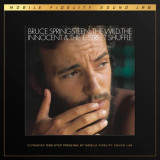
Released only eight months after his exhilarating debut, Bruce Springsteen's The Wild, the Innocent & the E Street Shuffle contains rousing dispatches from the boardwalk, the street, the beach, and the bedroom. It explodes with energy, dares to dream, teases with humour, crackles with tragedy, clings to hope, and overflows with discovery, youthfulness, and personality. It features an unforgettable cast of characters — corner boys, teenage hustlers, doomed lovers, jazz men, junk men, factory girls, fortune tellers, alley cats, pimps, escorts, and more — illuminated by vivid colour, breathtaking detail, and poetic action.
Musically, the heartfelt 1973 record is inhabited by sympathetic vignettes and cinematic arrangements steeped in rock 'n' roll, soul, jazz, and R&B. It finds the New Jersey native looking beyond the parameters of his preceding record and seeking to move on from environments he knows well (and chronicles here) by rushing headlong toward unknown territories, adventures, and people. Underpinned by the singer-guitarist's ambitious poetic enterprise and will to succeed, The Wild, the Innocent & the E Street Shuffle is the album on which Springsteen becomes the Boss.
Mastered on Mobile Fidelity's renowned mastering system, pressed at RTI on MoFi SuperVinyl, and strictly limited to 7,500 numbered copies, Mobile Fidelity's UltraDisc One-Step 180g 33RPM LP set is the definitive-sounding version of Springsteen's sophomore record. Benefitting from SuperVinyl’s nearly non-existent noise floor, superb groove definition, and dead-quiet surfaces, The Wild, the Innocent & the E Street Shuffle plays with a clarity, energy, presence, and openness that complement the expressiveness, dynamics, and scope of the seven restless songs that comprise a work Rolling Stone ranked the 345th Greatest Album of All Time.
Beyond the audiophile sonics that practically place you behind the console at 914 Sound Studios — listen to the separation between the instruments, natural decay of the notes, interplay within the widescreen soundstaging, and nothing-to-lose youthfulness of Springsteen’s voice — this reissue takes seriously this record’s influential merit by presenting it in packaging that underlines its status. Tucked in a beautiful slipcase, the LP is housed in a special foil-stamped jacket with faithful-to-the-original graphics. This reissue is made for listeners who prize sound quality and who want to engage themselves in everything involved with the invigorating set that busted Springsteen loose from the club circuit and landed him on the radio
Determined to liberate anyone within earshot and unafraid to come on strong, The Wild, the Innocent & the E Street Shuffle serves as the debut of the E Street Band — not only heard but seen for the first time by most of the public courtesy of the back-cover photograph. This is where saxophonist Clarence Clemons, organist-accordionist Danny Federici, and pianist David Sancious step out of the shadows — and drummer Vini Lopez and bassist Garry Tallent again stoke a fiery rhythmic engine that helps drive the untamed, reimagined big-band swing of “Kitty’s Back,” breathless R&B thrust of “Rosalita (Come Out Tonight),” and carefree dance steps of the funky “The E Street Shuffle.”
Of course, the main attraction remains a then-24-year-old visionary on the precipice of becoming a sensation and turning a then-bloated rock scene on its head. Recorded over three months while Springsteen and company were busy touring his debut LP, The Wild, the Innocent & the E Street Shuffle reflects the high-octane approach the vocalist embraced onstage and drifts away from the label-dictated acoustic-based frameworks of his debut. The set also witnesses Springsteen deepening his observational skills, with narratives such as the romantically tinged “4th of July, Asbury Park (Sandy)” and redemptive epic “Incident on 57th Street” mirroring changes taking place in the singer’s own life, small towns, and America at large.
A thrilling collision of memories, reflections, and composites — Sandy, Rosalita, and the latter’s parents are all based on actual people Springsteen knew, as is the community depicted in the opening track — the aptly titled The Wild, the Innocent & the E Street Shuffle resonates decades on due to its truths, authenticity, and spirit. Those characteristics — as well as the fact that many of its lengthy songs come on as the equivalent of sweaty, feverish soul revue that won’t stop until you’ve been exhausted — also explain how this now-iconic album triumphed over the reservations of industry “experts” that both demanded Springsteen re-record it and instructed deejays not to play it.
Yet there’d be no stopping a record that saw the past, present, and future, a band whose will would not be denied, and a phenomenon who was born to run. A never-ending invitation to act real cool and stay up all night, The Wild, the Innocent & the E Street Shuffle always feels alright.
Kurt Wagner is back, mit neuer Platte, neuen Sounds und neuen Überraschungen, alles wie immer eigentlich, nur anders. Die Songstrukturen entstanden nicht wie üblich an der Gitarre, sondern wurden als Midi-Piano Miniaturen geboren." Die Befreiung von diesen Einschränkungen führte zu einem überraschenden neuen Sound, mit abgeschliffenen Kanten und durch Kurts eigene, spezifische Linse betrachtet. Etwa zur gleichen Zeit bereitete er sich auf eine Live-Show beim Eaux Claires Sommerfestival in Wisconsin vor, das ursprünglich von Justin Vernon von Bon Iver und Aaron Dessner von The National gegründet wurde. Inspiriert von der Originalität der Performances, die er während des PEOPLE Festivals 2018 in Berlin gesehen hatte, und einigen der Leute, die er dort getroffen hatte, machte er sich wieder einmal auf die Suche nach etwas Neuem und wandte sich an Ryan Olson und Andrew Broder, um seine groben Piano-Ideen zu konkretisieren. Wir müssen an dieser Stelle nicht erwähnen, dass die Show nie stattfand, aber die Ideen wuchsen weiter und führten zu etwas Größerem, zu einer ganz neuen Ära für Lambchop. Außerdem mit dabei Trompeter CJ Camerieri und Grammy-Preisträger Jeremy Ferguson kehrt als Co-Produzent zurück. Da schien es auch ein günstiger Zeitpunkt zu sein, einen weiteren Musiker an Bord zu holen, der ganz hervorragend zu Lambshop passt, eine Zusammenarbeit fühlte sich für viele längst überfällig an. Zum ersten Mal spielt James McNew, ein langjähriger Freund sowie Mitglied von Yo La Tengo, am Kontrabass.
After the great response to the launch with Deer Jade and David Hasert/Niconé, our lively split EP format is going into the next round. Always true to the motto: Only killers, no fillers!
Brazilian born come Berlin resident Joyce Muniz teams up with Algerian born come Rome resident DJ producer Sara Bluma for their phenomenal Kompakt debut “Beats & Lines”, an uplifting electro disco affair with plenty of pop appeal. “I met Sara Bluma a year ago, when she booked me to play at one of her parties in Rome. We connected straight away. It was a matter of time that we decided to make some music together. I had this idea for a while, so I sent it to Sara and asked her if she would like to do some vocals. She came up with this great fun text. This tune interprets the energy from both of us. Which is supposed to be fun!“. Mission accomplished… The good vibes between Sara and Joyce are definitely contagious!
London’s Hardt Antoine is back to the mothership with a bang! “I Will” is a sensual, percussion-driven house anthem for those morning hours, when spirits are high and the sense of unity is palpable. “La Mosca” is taking a more hypnotic approach, putting a joyous chant of unknown origin to good use. Something tells us that 2024 will become a banner year for Antoine!
First Step Beyond by proto-metal quintet Medusa might have forever shifted the perception of Chicago rock history had it managed to make the leap from tape to its never-realized vinyl pressing. Instead, the conflagation of Sabbath, Hawkwind, and Amon Duul II remained petrified in the Corycian Caverns... otherwise known as the drummer's basement. Self-produced on four track in 1975, this lone transmission from Medusa's repertoire appeared on the extremely mysterious Pepperhead label, whose proprietor allegedly disappeared after a bad trip and was never been seen again. Forged in ceremonial mock-velvet, custom embossed in Gorgon-gold and blood-red, and art directed in accordance with the band's elaborate original stage props and artwork, Numero Group positioned this unreleased opus to finally reach its destination: the stereos of pot-smoking and leather-clad teenagers, young and old.
Green Vinyl[22,06 €]
In many ways, the music of Writhing Squares could have only originated in Philadelphia; the city itself a microcosm of creatives, go-getters, freaks & weirdos that have coalesced into a supportive & boundary-pushing crew. Former Purling Hiss bassist Daniel Provenzano & Ecstatic Vision sax-player & vocalist Kevin Nickles' first musical missive was shot forth in 2013 (the self-released CDR "Live In Space") & various singles, split releases, albums (and a double-album) later we arrive at the duo's fourth full-length "Mythology", their third for Chicago-based Trouble In Mind Records. "Mythology" picks up the pieces left shattered by their previous double-album "Chart For The Solution" and reconnects the broken shards together like Kintsugi, the ancient Japanese technique for mending broken ceramics, infusing the breaks with powdered gold. The Squares themselves are like mad-scientists, taking the ruined detritus populating junk shops & surplus outlets & constructing their own sonic laboratories in their New Jersey basements to record, mix & tweak "Mythology"s eight tracks. Their new location allowed the band to regroup, reassess & reconstruct their sound from the ground up, shearing away the cosmic excess of 2021's "Chart For The Solution" to a sharper point. Tracks like `Barbarians' & `LEM' are classic Squares; brutal, aggressive, unwavering assault of Motorhead/Stooges-inflected sci-fi punk scree, while others like `Chromatophage's mutant funk & `Cerberus's techno-slink owe a serious debt to electric-era Miles Davis or Herbie Hancock & show that the group has more to offer than bludgeoning you with sonic force. Provenzano's bass & electronics are like a tank rolling across the terrain - a gnarly construct of Hawkwind-ian headiness & `Vincebus Eruptum's snarl - uncaring of what gets in the way. Nickles' brass vacillates between Stooges-influenced sleaze, jazzy no-wave stabs, & cacophonous sonic storms, strafing the listener into oblivion. The duo are joined on "Mythology" by drummer John Schoemaker - who contributed drums to "Chart For The Solution"s epic closing track `Epilogue' - whose percussive pulse adds an organic swing to The Square's sonics, particularly on album closer "The Damned Thing"s cosmic strut. "Mythology" tackles a multitude of themes, from fantastical tales of hellhound `Cerberus' or the comic-inspired "Eternity " to `Chromatophage's colorful/evil yarn about animals that eat colors (or a Magic: The Gathering card) to the true-life influenced `Acid Rain' that deals with the uncertainty of consuming drinking water after a chemical spill in the Delaware River. Elsewhere, `Ferrell' is an homage to the late, great Ferrell "Pharaoh" Sanders & `The Damned Thing' by a short horror story penned by Ambrose Bierce about an animal whose coloring is invisible to the naked eye. Writhing Squares are in a transitional phase, mapping out a new sonic mythology for themselves after crossing the event horizon into unknown space. "Mythology" is streaming on most DSPs & released on black vinyl & limited fluorescent green vinyl (while supplies last) on April 26th, 2024.
Black Vinyl[21,22 €]
In many ways, the music of Writhing Squares could have only originated in Philadelphia; the city itself a microcosm of creatives, go-getters, freaks & weirdos that have coalesced into a supportive & boundary-pushing crew. Former Purling Hiss bassist Daniel Provenzano & Ecstatic Vision sax-player & vocalist Kevin Nickles' first musical missive was shot forth in 2013 (the self-released CDR "Live In Space") & various singles, split releases, albums (and a double-album) later we arrive at the duo's fourth full-length "Mythology", their third for Chicago-based Trouble In Mind Records. "Mythology" picks up the pieces left shattered by their previous double-album "Chart For The Solution" and reconnects the broken shards together like Kintsugi, the ancient Japanese technique for mending broken ceramics, infusing the breaks with powdered gold. The Squares themselves are like mad-scientists, taking the ruined detritus populating junk shops & surplus outlets & constructing their own sonic laboratories in their New Jersey basements to record, mix & tweak "Mythology"s eight tracks. Their new location allowed the band to regroup, reassess & reconstruct their sound from the ground up, shearing away the cosmic excess of 2021's "Chart For The Solution" to a sharper point. Tracks like `Barbarians' & `LEM' are classic Squares; brutal, aggressive, unwavering assault of Motorhead/Stooges-inflected sci-fi punk scree, while others like `Chromatophage's mutant funk & `Cerberus's techno-slink owe a serious debt to electric-era Miles Davis or Herbie Hancock & show that the group has more to offer than bludgeoning you with sonic force. Provenzano's bass & electronics are like a tank rolling across the terrain - a gnarly construct of Hawkwind-ian headiness & `Vincebus Eruptum's snarl - uncaring of what gets in the way. Nickles' brass vacillates between Stooges-influenced sleaze, jazzy no-wave stabs, & cacophonous sonic storms, strafing the listener into oblivion. The duo are joined on "Mythology" by drummer John Schoemaker - who contributed drums to "Chart For The Solution"s epic closing track `Epilogue' - whose percussive pulse adds an organic swing to The Square's sonics, particularly on album closer "The Damned Thing"s cosmic strut. "Mythology" tackles a multitude of themes, from fantastical tales of hellhound `Cerberus' or the comic-inspired "Eternity " to `Chromatophage's colorful/evil yarn about animals that eat colors (or a Magic: The Gathering card) to the true-life influenced `Acid Rain' that deals with the uncertainty of consuming drinking water after a chemical spill in the Delaware River. Elsewhere, `Ferrell' is an homage to the late, great Ferrell "Pharaoh" Sanders & `The Damned Thing' by a short horror story penned by Ambrose Bierce about an animal whose coloring is invisible to the naked eye. Writhing Squares are in a transitional phase, mapping out a new sonic mythology for themselves after crossing the event horizon into unknown space. "Mythology" is streaming on most DSPs & released on black vinyl & limited fluorescent green vinyl (while supplies last) on April 26th, 2024.
Keplar presents the first-ever vinyl edition of the 2003 album »From Tokyo to Naiagara« by Tujiko Noriko. This reissue with new artwork by Joji Koyama is an abridged version of the album as Tomlab label owner Tom Steinle and producer Aki Onda had originally intended to publish it alongside the original CD version. Written by the France-based Tujiko while she still lived in Japan, »From Tokyo to Naiagara« followed up on her two seminal Mego albums and marked a turning point in both the artist’s career and personal life: While she was preparing to leave Japan behind, she succinctly connected the dots between her experiments in pop music and her interest for more abstract sounds. Tujiko worked primarily with a Yamaha synthesizer and an MPC sampler while also incorporating contributions by other musicians such as Onda, Riow Arai and Sakana Hosomi into the pieces. Sometimes approaching an IDM and clicks’n’cuts-style production or working with trip-hop and hip-hop beats while using conventional song structures in the most unconventional of ways, the album showcases her multifaceted influences and skills as a singer and musician to full effect.
Tujiko fondly remembers the time when she made the album. »I had a lot of time for myself back then and I didn’t even feel like I was very busy,« she says today. She describes producing it in close collaboration with Onda, who would relocate to New York City shortly after, as »quite Tokyo and very local.« They explored parts of the city that they hadn’t yet been to for a photography project (finding, among other things, a coin laundry called Naiagara—a transliteration of Niagara). This left its mark on a record that mixes melancholia with joy. The driving opener »Narita Made,« named after one of Tokyo’s airports, already makes this clear: Tujiko’s wistful vocals and lyrics like »I miss you terribly« emphasises the sense of bittersweetness that forms the common thread for a sonically diverse and stylistically open-ended album—this music is looking back while moving forward. It is probably no surprise that its reissue too evokes tender memories of Onda and Steinle in Tujiko, while also reminding her of what lies ahead. »I have so much more to do and not enough time for that,« she muses, before quickly adding: »But I also feel less alone having that album again.«
Influenced in equal parts by the experience of strolling through previously unknown Tokyoite back alleys and thinking about the paths not (yet) taken, »From Tokyo to Naiagara« is precisely that: the perfect travel companion for a journey that leads its listeners from past to future.
Label mainstays Fouk just dropped the perfect dancefloor Bomb with ‘Mirage’ paired with a high-octane Elisa Bee remix
We all know Dutch duo Fouk from their soulful, bouncy take on house music. They’re also responsible for some of Heist’s biggest tracks like Kill Frenzy or their Lil Louis inspired 2021 release ‘Blue Steel’. On their new EP, the talented duo shows us a fresh side of their sound: the main-room hands-in-the-air-going-wild side. To top things off, Italian producer Elisa Bee made time in her busy schedule of DJ’ing and releasing for artists like Ben Sims on his Hardgroove imprint and Unknown to the Unknown to deliver a killer remix of the title track.
Fouk’s return to Heist after 3 years is a welcome one and with ‘Mirage’, they might just have given us their biggest house track in their decade spanning career. The track is built around a stuttering synth loop and a seductive female vocal chanting ‘What made you wanna…” The real star here is the bassline, which propels the track into a seriously infectious groove. Add some lush strings and moody changeovers and you’ve got yourself a full-blown dancefloor weapon. Mirage has been a staple in Dam Swindle’s sets for the past months and has been one of their set highlights ever since.
“Coffee” is one for the classic Fouk fans. It’s got lovely Rhodes, a joyous combination of whoo’s, snare-rolls and synth hits grooving on top of an infectious orchestral background loop. “Tapioca” is a hybrid latin-electronic groove that builds on punchy synths, live percussion and drunk keys to balance the energy of the track.
Elisa Bee’s remix of ‘Mirage’ is an intense percussive workout that builds on a breakbeat loop and a rave-bassline. The tempo is turned up a notch or 2 and that stutter synth and vocal of the original make this remix a wild warehouse affair.
Closing track of the EP is ‘Abalone’; A lovely bleep-house affair that still has a bit of that warehouse vibe. It’s got the perfect amount of distortion the drums while keeping things dreamy with some face-melting pads throughout the track.
As always, enjoy the music and play it loud!
Lars & Maarten
There is no in-between, neither is it only black or white - it is always, also, a question about contrast.
This is the third edit release on the newly reborn Tech-nology label.
The first was played by Luca Bacchetti at Burning Man 2023 and by Michael Meyer in his Soundcloud, radioshow - a big thanks.
The second is yet to be discovered, but mostly jazz and afro with a Minimal and Chicago touch.
The edit series is a mix between techno, which was initially the start of the label, so!
The edit series is not disco in the sense that is most popular or most accepted, this is a new way!
Making a techno approach to attack the original disco track.
Tech-nology!
This output is the third and not a secret track.
Here it is black, like the techno sound behind.
There is the basic well-known one-to-one production with extra techno breaks for your dancing
pleasure.
But the flipside, with 2 versions, is the big room killer.
There is always white noice
There is no in-between, neither is it only black or white - it is always, also, a question about contrast.
This is the third edit release on the newly reborn Tech-nology label.
The first was played by Luca Bacchetti at Burning Man 2023 and by Michael Meyer in his Soundcloud, radioshow - a big thanks.
The second is yet to be discovered, but mostly jazz and afro with a Minimal and Chicago touch.
The edit series is a mix between techno, which was initially the start of the label, so!
The edit series is not disco in the sense that is most popular or most accepted, this is a new way!
Making a techno approach to attack the original disco track.
Tech-nology!
This output is the third and not a secret track.
Here it is black, like the techno sound behind.
There is the basic well-known one-to-one production with extra techno breaks for your dancing
pleasure.
But the flipside, with 2 versions, is the big room killer.
There is always white noice
Shelly y Nueva Generación was a cult Spanish soul and garage band that left an indelible mark on the late 1960s music scene. Their rare 45s, now classic DJ spins in the mod/psych 60s scene, boast a funky Le Beat Bespoke style freakbeat sound. Three singles were released on Philips between 1968-69, including their stunning take on Nonato Buzar's 'Vesti Azul' and the outstanding original 'I'm Just a Fool', as featured on Ivan Zulueta's cult film "Un, Dos, Tres, Al Escondite Inglés". This long-awaited release unveils their complete discography plus many unreleased recordings unearthed from lost tapes now seeing the light of day for the first time! It comes with a 8-page booklet with extensive notes and rare photos of the artists. This compilation stands as both a celebration of the band's legacy and a rediscovery of the timeless allure that made Shelly y Nueva Generación an enduring force in the annals of Spanish music history.
There weren't a lot of rockabilly bands from Norway in 1993, and Hot Rod Torgeir & His Rock-A-Hulas were rather exotic when they appeared as unknown freshmen on the Oslo stage with washboards on fire, two drummers, skeleton masks and fireworks from the edge of stage. After some line up changes they went on to record the album "Cruisin'". The songs were mostly originals, with classic rockabilly themes such as cars, girls, card games, sex and goats. Two bonus tracks have been added to this vinyl reissue including a cover version of "I feel fine" by The Beatles.
Limited To 140 Copies Worldwide*
One of the most imaginative, creative EP’s we have ever put out on Vinyl Fanatiks. Originally released on Three Scar Records in 1993, Silver Fox’s own label, hailing from Wolverhampton. Back in 2019 it was repressed on Vinyl Fanatiks on orange vinyl but sold out before it got to distribution, so grab a copy while you can.
This EP has incredible sample usage and amazing depth and texture for a hardcore release, I do not think there is another release like it from that era. Silver Fox use to rent a flat with Goldie when they lived in the city as they were both on a printing course. Silver Fox stayed in the Wolverhampton and put his printing course to good use, making rave t-shirts which he would sell at Club Kinetic and Quest in Wolverhampton – two rave clubs that were renowned across the UK at that time. He now runs Ricochet Print and does all the merch for Vinyl Fanatiks.
This is an EP you can listen from start to finish and be taken on a trip to a time when Akai samplers were being brutalised and Cubase was the king of the rollers.
Only 140 have been pressed on 180g pink marbled vinyl.
'Clannad in Concert' was the first live album by, now globally recognized, Irish folk band Clannad, released in 1978 by Ogham Records It was recorded at an unknown location during their 1978 tour of Switzerland, during which the group decided to continue with the band full time. This 2023 remastered CD re- issue replicates the original artwork as it was first released. The cover features an elaborate mythological Celtic design by artist Roy McCullough. The interior artwork also features lyrics in the original Irish language. The line-up consists of Ciaran O Braonain, Maire Ni Bhraonain, Pol O Braonain, Noel O Dugain and Padraig O Dugain. The band line up features O Braonain and O Dugain siblings without sister and niece Eithne Ni Bhraonain (better known as Enya) who joined the group for two years between 1980 and 1982. Nicky Ryan, who would later become Enya's long-time production partner, was on producer duties for this live recording
Organ of Corti, the trio of Joachim Nordwall (IDEAL Records, The Gagmen), Mattias Gustafsson (Altar of Flies) and Dan Johansson (Sewer Election, Enhet för Fri Musik) returns with another exercise in the slow-motion decay of analog sound. Usher, a minimal hypnotic track on side A reveals its subtle details after multiple listens while the claustrophobic Trauma on the flipside will grab your immediate attention. Machines that hum, sputter, and crackle while slowly moving forward. Vaguely familiar tape loops, spacious synths and crumbling electronics. A journey into the unknown.
The Swedish underground scene continues to deliver some of the best experimental acts and Organ of Corti firmly establish themselves as part of the foundation with a recent self-released cassette, another cd on New Forces and this new single. While their sound has clearly evolved, these alchemists are staying true to their original intention of forging fragments of surreal nightmares.
Whitney Houston’s self-titled debut album has few parallels. Viewed solely through the lens of sales numbers, Whitney Houston is a watershed statement on par with the most commercially successful and culturally dominant LPs ever released. Having sold more than 14 million copies in the U.S. and upwards of 25 million units worldwide, the 1985 LP became the equivalent of the television show or blockbuster film that everyone collectively experiences and discusses. Nearly four decades later, it’s lost none of its appeal or magnetism — and its artistic significance and historical import have only grown.
Sourced from the original master tapes, pressed at RTI on MoFi SuperVinyl, and strictly limited to 4,000 numbered copies, Mobile Fidelity's 180g SuperVinyl LP of Whitney Houston presents the breakthrough in audiophile sound for the first time. The signature traits Houston exhibits on every song — her three-octave range, radiant warmth, personal conviction, impossibly controlled register — come across with exceptional clarity, focus, and presence. Free of artificial ceilings and constricted dynamics, this reissue plays with an openness, airiness, and balance that put the singer’s once-in-a-lifetime instrument and immortal artistry into proper perspective.
It does the same for the songs’ cascading melodies and captivating arrangements. Individually produced by one of four renowned industry veterans — Kashif, Micheal Masser, Jermaine Jackson, and Narada Michael Walden — each composition feels grander, closer, more genuine. A vocal spectacular, Whitney Houston benefits from the high-end characteristics of SuperVinyl, which include a nearly inaudible noise floor, superb groove definition, and dead-quiet surfaces. This is how an album that changed the direction of popular music — opening previously inaccessible doors for Black artists; bringing smooth-singing vocalists back into the mainstream; kickstarting a movement that soon included several “divas” who would command the charts through the early 21st century — should look and sound.
Though Houston’s seemingly effortless performances suggest otherwise, creating the record Rolling Stone ranks as the 257th Greatest Album of All Time wasn’t easy. Nearly 18 months were required to identify songs suitable for a still-unknown singer who did not fit into the conventional frameworks of the mid ‘80s. Confident, powerful, and prodigiously talented, Houston would forge her own parameters with Whitney Houston. In the process, she obliterated the stubborn lines between R&B and pop, Black and white radio. She dared to reimagine who could be a superstar and then went out and defined the role. Recorded for nearly $400,000 and released on Valentine’s Day, the LP exceeded the wildest expectations of those most closely associated with it — save for Houston and her family.
Having made her first public appearance at the age of 11 singing at a Baptist church, Houston understood pressure and knew her way around, inside, and through a song. The invaluable guidance and support she received from her mother, Cissy, an accomplished gospel vocalist who backed Aretha Franklin and Elvis Presley, are on display throughout Whitney Houston. They arrive in the types of authoritativeness, discipline, and diction rare for even most seasoned veterans — and unheard-of for a 21-year-old newcomer. Houston brings a soulful elegance, understated glamour, and in-the-moment rapture to every note. Moving up, down, or staying in the middle of the vocal ladder; channelling softness or sweetness; showing restraint or increasing the volume, she is a marvel of emotionalism, a dynamo who can seamlessly transition from one mood to another within a verse.
Though the 10-track LP largely concerns itself with the ballad tradition, Houston covers the bases, getting into an R&B groove on the fleet “Thinking About You,” turning up the heat on the duet “Take Good Care of My Heart,” and investing the contagious dance-pop confection “How Will I Know” with all the anxiety, hope, energy, and enthusiasm its lyrics demand. Featuring her mom on background vocals and Houston’s pitch-perfect tone, uncanny precision, and skyscraper highs (no AutoTune here, friends), the synth-based anthem propelled Whitney Houston into the stratosphere, the vocalist into regular MTV rotation, and the term “crossover” into popular parlance. The double-platinum single reached No. 1 on the Hot 100, Hot R&B, and Adult Contemporary charts — a trifecta that foreshadowed accomplishments that would ultimately crown Houston as the most-awarded female artist of all time.
Whitney Houston became the first album by a Black female performer to top the Billboard charts. It remained there for 14 non-consecutive weeks en route to claiming the title of the best-selling LP of 1986. It stands as the first debut and first album by a solo female artist to spawn three No. Hits, as well as the first album by a Black female artist to top the year-end charts in Australia and Canada. These are just a handful of the accolades — along with four Grammy nominations — that surround a set that also contains the unforgettable ballad “Saving All My Love,” string-accompanied “Greatest Love of All,” and sensual “You Give Good Love.”
As TIME observed in an article written two years after the album took the world by storm: “This is infectious, can't-sit-down music, and her performance dares the listener not to smile right back.” We’re still smiling.
'Pussy Plays Again' the follow up album to the original 1969 classic is finally here. The original 'Pussy Plays' album was released in 1969. That album had a psychedelic and freaky, fuzz n' wah-wah guitar with swirling keyboards and a classic '60s production loaded with all the studio effects of the era. Pussy Plays is undoubtedly also one of the most obscure and beautiful psychedelic albums of the 1960s.
So here at last, after 55 years, the follow-up album to that first hugely iconic British Psych album, 'Pussy Plays'. The original Pussy drummer Steve Townsend and ex-Iron Maiden guitarist Bob Sawyer, along with friends Paul Jackson and Rick Cullen, came together for the follow up album 'Pussy Plays Again'. The recording techniques were basic, the sound is lo-fi, and where this is less than puurrrfect, we believe the quality of the music itself and the imagination and creativity shine through.
One of the most successful and enjoyable debuts in history, The Cars' self-titled album doubles as a greatest-hits collection. That's because not one song here is unrecognized or unknown. A huge reason why the Boston quintet became America's most popular new-wave band, The Cars launched eight tracks still regularly heard on radio stations everywhere. Consider the hit list: "You're All I've Got Tonight." "Good Times Roll." "Just What I Needed." "Moving in Stereo." "My Best Friend's Girl." "Don't Cha Stop." If you're a fan of pop music, this album is mandatory. Just call it the best new-wave rock album ever made.
And now, The Cars sounds better than it has in any previous incarnation. Mastered from the original analogue tapes, Mobile Fidelity's numbered-edition LP allows the music's oscillating rhythms, futuristic keyboard passages, panned stereo images, and rippling textures to be experienced like never before. The songs take on a surreal quality, the Cars manipulating the vibrant music at will to mesmerize the listeners' senses and hold them at bay. Mobile Fidelity's pressing epitomizes the sensation of "moving in stereo."
Led by Ric Ocasek and Benjamin Orr, the Cars managed to unite then-disparate styles: bubblegum pop melodies, angular art rock, progressive arrangements, and terse minimalism. Orr's low, understated singing and Ocasek's cool, detached vocals lend shades of doubt and double meaning to the lyrics, which are further counterbalanced by orchestral keyboard flourishes and electronic beats. The brilliant arrangements also benefit from a laidback cool and understated irony that remain uncommon in the over-the-top world of mainstream music. Obsessed with incorporating the latest technologies and sounds into its palette, the band spiced its tunes with delightfully quirky accents — country-tinged guitar fills, echoing Syndrums, reggae splashes, hard-rock tones, robotic pulses.
The results are the sounds of a creative landmark. At once accessible and eccentric, edgy and catchy, The Cars explodes with emotion, energy, and hooks. It's impossible not to get caught up humming and singing along to every song, an appeal that comes courtesy of Roy Thomas Baker's stellar production. The legendary producer, best known for his work with Queen, ensured that the record seamlessly packed a smooth midrange, spacious imaging, and call-and-answer choruses in one tight package. Baker's trademark touches with harmony vocals abound.
"The MoFi disc is much better than the original in every way. It's more dynamic, much more natural on top, and all three dimensions have a lot bigger space. This disc is great from start to finish, but "Moving in Stereo" will blow you away on a great system in a big room."
—Jeff Dorgay, TONEAudio
- Star Trek: The Next Generation-Main Title
- Stardate
- Troi Senses
- Picard‘s Plan
- First Chase
- First Chase (Part 2)
- Detaching
- Separation
- Shaken
- Court Time
- There Goes Da Judge
- U.s.s. Hood
- On Manual
- The Next Generation-End Credit
- Personal Log
- Admiral
- Old Lovers
- Caverns
- Splashing
- The Woods
- Memories
- Scanned
- Big Guns
- Unknown
- Departure
- Main Title-Version #2 (Alternate M.t.)
- Revealed
- Reaching Out
„Star Trek: The Next Generation“, the soundtrack composed by Dennis McCarthy, now available on vinyl. This exclusive vinyl edition brings the iconic music of the acclaimed sci-fi series directly to your home, delivering an authentic and aweinspiring sonic experience. This exclusive vinyl edition is a must-have for all Star Trek fans and vinyl enthusiasts.
Featuring stunning cover artwork and a limited number of copies, this LP is sure to be a highly coveted collector‘s item. Get your copy of Star Trek: The Next Generation - Original Soundtrack on vinyl now, and let the power of music take you into the vastness of space!
More Than Ten Years Since He First Emerged On Skull Disco, Appleblim Presents His Debut Album. The Label He Co-founded With Shackleton Was The First The World Heard Of His Productions, But Laurie Osborne's Innate Relationship With Electronic Music Culture Reaches Back Much Further Than Those Groundbreaking Early Days Of Dubstep. Early Days Spent Soaking Up Hardcore, Jungle, Techno And Plenty More Besides Were Fundamental Foundations From Which To Spring Into The Then-unknown Realms Of Sub-low Half-step Club Music. At That Time Fwd>> And Dmz Were The Church For This Ritualistic Sound, And Appleblim Was A Regular Fixture At Both.
As Dubstep Matured, Magnified, Mutated And Meandered, So Appleblim Moved Beyond Skull Disco To Explore Different Avenues Of Expression In The New Many- Layered Club Music Landscape. His Own Apple Pips Imprint Was A Natural Vessel On Which To Explore The Emergent Fusions Of Hardcore-derived Sounds And The Us-born House, Techno And Electro, While Labels Such As Aus Music Equally Provided A Home For His Work (often Alongside Komonazmuk). Meanwhile Long-standing Collaborations With Alec Storey (al Tourettes / Second Storey) Finally Manifested In The Hyper-modern Mind-twist Of Also, Captured As An Album On Legendary Rave Label R&s.
More Recently It's Been Possible To Hear Appleblim Delve Into Electro-acoustic And Ambient Production Alongside Bassweight Sounds On Tempa, One Of The Original Bastions Of Dubstep Culture. As The Existing Boundaries Between Genres, Cultures, Eras And Scenes Continue To Dissolve, On His Debut Album Appleblim Offers Up A Fresh Approach That Brings Some Of The Foundational Sound Ethics Of Rave Culture Into A Modern Framework.
Hardcore Breaks Are Still A Regular Sound Source In Contemporary Club Tracks, But On Life In A Laser It's Instantly Apparent That Appleblim Has Moved Beyond Choosing Popular Drum Samples To Truly Tap Into The Elusive Feeling Engendered By The Music Of The Era. It's A Tricky Feat To Manage, But In The Pie-eyed Chords Of ignite', The Subby 808 Tom Basslines On nci' Or The Mr. Fingers Synth Flex On manta Key' The Sonic Finish Sports The Same Understated Grit And Grime That Made Those Early Records So Timeless. There's Still Space For Modernism, Not Least On Snaking 2-step Killer i Think We'll Let The Gas Sort This One Out', But It's Offset By A Layer Of Dust, Not To Mention An Inherent Moodiness That Can't Be Faked.
This Fine Balance Of Rave Romanticism And Future-minded Approaches Binds Together In A Cohesive Conceptual Statement. First And Foremost It's Appleblim's Personal Reflection On The Music That Has Moved Him On Countless Dancefloors Since His First Flirtations With Soundsystem Culture. At The Same Time The Canny Influx Of Modern Ideas Into The Soundworld Of The 90s Genuinely Results In A New Proposition, Making For A Perfect Fit On The Modern-day 'ardcore Fetishists Label Of Choice, Sneaker Social Club. Many May Claim To Draw On Old-skool Influences In Their Modern Trax, But Take One Listen To flows From Within' And You'll Feel The Same Time-slipping Surge Of Future-shock As The Ravers At Lost, Dreamscape, The Dungeons, Clink Street, Blue Note And All Those Other Iconic Spots.
- Chance Is Her Opera
- Heatwave Pavement
- Green Ray
- Orange Zero
- Late July
- Darkness-Blue Glow
- Mono Valley
- Coastal Lagoon
- Alkaline Eye
- 3: Am Walking Smoking Talking
- Three Fires
- Disc 2
- She Smiled Mandarine Like
- Under The 3000 Foot Red Ceiling
- Orange Zero (Single)
- Chance Is Her Opera (Demo)
- Late July (Demo)
- Alkaline Eyed (Demo)
- She Smiled Mandarine Like (Demo)
World Of Echo are proud to announce the long-awaited reissue, on 17th February, of the self-titled debut album by Bristol’s Movietone. Originally released in 1995 by Planet Records and reissued on CD in 2003 by The Pastels’ Geographic Music imprint, this is the first time Movietone has been reissued on vinyl. An expanded double-LP edition, it includes the extra tracks from the 2003 CD (their first two singles, and an unreleased demo of “Chance Is Her Opera”), and adds three more unearthed gems: demos of “Alkaline Eye” and “She Smiled Mandarine Like”, and an early take of “Late July”, recorded in a garden by Dave Pearce (Flying Saucer Attack) in 1993. Taken together, this is the definitive collection of music from the first phase of one of Bristol’s most remarkable groups.
Movietone was the cumulation of a series of events, explorations, and discoveries, starting at secondary school – the group’s core membership of Kate Wright, Rachel Brook, Matt Elliott and Matt Jones met at Cotham School in Bristol. As for many other groups, their early years were all about experimenting, and finding ways to ‘make do’, a DIY sensibility that would inform Movietone through their decade-long lifespan. From formative rehearsals in a shed in the garden of Brook’s family home, to recording early material to four-track in Redland Library, and on into the Whitehouse and Mr Grin’s studio sessions for their debut album, Movietone’s music fell together in a creatively unpredictable, yet conceptually rigorous manner.
By the time they released Movietone, they’d found a home with Bristol’s Planet, run by author Richard King and James Webster, who had both released their first two singles, “She Smiled Mandarine Like” and “Mono Valley”. There was other music happening around them in Bristol, too, from the Jones brothers’ avant-rock outfit Crescent (who were Movietone’s closest conspirators), through Elliott’s jungle/electronica project Third Eye Foundation, and Brook and Elliott’s membership of Flying Saucer Attack. A closely knit community, Movietone are the centre of this nestling architecture of groups.
The vision in the music, mostly, belongs to Wright, but Movietone ran in democratic creative consort. Listening back to Movietone, you can hear this democracy in action through the wildness of the music, which is balanced by the poetics of Wright’s lyrics and melodies. Full of half-captured memories and entangled abstractions, there’s an elliptical, ruminative quality to much of the writing here that shows the deep influence of the Beat Generation writers, along with a twilight environment captured in the songs that’s pure third-album Velvets, Galaxie 500, early Tindersticks, Codeine. Unpredictable interventions – the crashing glass in “Mono Valley”, the sudden explosions of “Orange Zero” – point towards the noise blowouts of My Bloody Valentine, the unpredictability of Sonic Youth; Wright’s understated vocal cadence suggest a deep, embodied understanding of John Cage’s Indeterminacy.
Movietone would go on to make three fantastic albums for Domino – Night & Day (1997), The Blossom Filled Streets (2000) and The Sand & The Stars (2003) – and their Peel Sessions were released early in 2022 by Textile. Still held in high regard by artists like Steven R. Smith, and The Pastels, whose Stephen McRobbie once described them as “one of the great unknown English groups,” it’s an absolute thrill to listen to Movietone anew – still inspired, still seductive, still magic, still mysterious.