Aestum’s self-titled debut album is an in-depth journey into supreme and tranceformative soundscapes. Oscillating around the apex of spacious power ambient and drone, the compositions recorded during 2020 combine monolithic electronica with decaying fantasies and slow-motion euphoria.
The imagination for the album was inspired by the idea of panortosia (universal reform) as described in old scholar books devoted to inter-communication and sacrosanct harmonies in order to find a way into divine temple and shining lux (eternal light). From sonic perspective Aestum created a juxtaposition between warped atmospheres and distant remnants for a state of trance, a multiverse vision of feeling that was evoked by timeless parties and almost religious peak-time club anthems during end of 90’s and 00’s when Aestum as a duo of young friends were entering dancefloors across Europe. With this attitude every composition - often accompanied with dreamy messages and heavenly choirs of Dutch vocalist Bobbie 0rkid - marks its own emotional landscape and reaches new enigmatic spheres.
Influenced by this concept a New York based multidisciplinary artist Emma Pryde created visuals for the album - not just the cover where the story of panartosia is being told across the front and back cover, but also transformative videos for tracks Panortosia and Himmel. Using pure elements like heaven or meadows on the base, she added layers of imagery from sci-fi effects to more ancient and religious images, warping and blending into each other, leading into a fantasy that represents the past and future, and gives a meaningful hope.
Cerca:osci
Kulør is proud to present My Space – Kasper Marott’s 2nd record for the label following 2019’s luscious, longform Forever Mix EP.
The EP represents the latest addition to a diverse but uniquely crafted discography for the Danish producer, DJ and label owner. After scoring something of a mega-hit in 2018 with ‘Keflavik,’ released on Modeselektor’s Seilscheibenpfeiler label and named by Resident Advisor as “one of the biggest club records of the year,” Marott would use that momentum to launch the community-focused label Axces alongside close friend Alfredo92 and release a string of records representing some of Denmark’s finest producers. At the beginning of 2021 Marott released his debut album Full Circle, allowing a more complete picture of his distinctively melodic sound, one described by Pitchfork as “stimulating the imagination as much as the limbs… This is music for dancing but also music for dreaming.”
The four pieces that make up the My Space EP seem to take that last quote as a jumping- off point, oscillating between the beatless serenity of ‘Mosens Tone’, the unashamed force of ‘NV Laser’ and the shades in between on the opening title track and closer ‘Microfest’. Marott’s influences snake over one another, folding crisp percussion underneath his signature glassy textures and intimate field recordings alongside supersaw riffs. This fluid shape-shifting results in an EP that hints at different genres while confining itself to none.
In the fight against Alzheimer’s, epilepsy, schizophrenia and other diseases characterized by an imbalance in neuronal activity, there are chemical weapons, such as those that try to prevent the protein fragments known as beta-amyloid plaques from developing in the
cerebral cortex , and physical, such as electrical stimulation that allow to restore the functionality of brain cells. This last resort, which has already been shown to be effective in modifying the activity of the cerebral cortex, is today a weapon of general intervention.
Converting it to precision requires the development of individualized and predictive brain models that allow identifying where and how much to stimulate each patient. To achieve this, an international European team is working on the creation of virtual replicas of the
most unknown organ in the body: the Neurotwin project.
According to recent research, the decrease in power in the neuronal oscillations of the gamma band of the cerebral cortex (a pattern whose frequency ranges between 20 and 50 Hertz) favors the development of protein fragments related to Alzheimer’s.
Transcranial application of weak electrical currents has proven to be an effective and painless way to modulate brain activity without side effects.
The objective is to create complete computational models of the brain with real data of living beings (human patients) and that allow to anticipate and specify the effects of noninvasive stimulation techniques on neurological mechanisms.
“Never turn your back on a friend.”
Alfred Hitchcock
Mastering – Eternal Midnight Mastering Studio
Cover Art – Nitasha Singh Brett
Visuals - Dietriamgle, Espii Studios, Irene Avellanal
Barren wastelands, a distant moon.
Far screeches: gloomy rituals.
Piercing cries.
The deepest indigo, a desolate and rude imagery.
Yoga-darśana : this is a den of iniquity.
Hyperlacrimae’s savage sound shows the Italian duo’s roots in industrial music with the addition of a strong dark-infused oniric attitude.
Straddling post-industrial sounds and a personal style with tribal and catacombic features.
A sort of mystical and distorted ritual, a wild dance with an ancient and primordial flavour.
The LP oscillates between a raw intense dynamism - fully demonstrated by “Kobra”, the album’s climax, “Kogawa No Gotsu” and “Blood Ties” - and a sense of perdition, evinced in reflective acts like “Incubus” and the outro “Korekore-Matakawa”. There’s also room for the distressing atmosphere of “In My Poison”, a contemporary example of obscure Industrial’s heaviest face.
The remixers Shrouds, Impure Secretion, Scarpa participate with three reinterpretations of great impact.
Recorded and Produced by Erminio Granata & Carmine Laurenza
Vocals by Carmine Laurenza
Mastered by Hyperlacrimae at Red Dungeon (Naples)
Artworks and Photos by Nullam Rem Natam (Athens)
Design and Layout by Erminio Granata
Drumcode continues its commitment to releasing the scene's most cutting-edge techno. With releases this year already from Adam Beyer, Pig&Dan, Alan Fitzpatrick, Dense & Pika and Julian Jeweil, this July see's the return of Enrico Sangiuliano with 'Astral Projection'.
After his remix of Moby's of 'Why Does My Heart Feel So Bad' back in November last year, Enrico sought creative inspiration from his travels, transcending that into his productions and long studio sessions during the winter months. The result brings a mind and body melting release from the Italian producer.
The title track 'Astral Projection' is a captivating, big room techno masterpiece. Deep reverberations punch alongside a sinisterly crisp percussive drive. Launching into a groove laden synth modulation of low end textures, it breaks down into an ethereal amalgamation of pads and synths before the vocal launches, taking this track to another level.
'Blooming Era' has destructive dancefloor intent. There is no holding back with the low end synth modulation which Enrico has mastered to perfection. A tightly woven percussive flare moulds flawlessly with the rolling oscillations of the beast of this track.
If you have seen label head honcho Adam Beyer playing anywhere on the globe in the last 5 months, this has been a peak time favourite. Road-tested to the max, and with much success.
Meeting vulnerability with persistence, Lucerne-based musician Remo Helfenstein presents Spite, his first solo album on Präsens Editionen. Whereas his 2022 debut EP, Comforting Katharina, traced raw, devotional impulses, Spite expands the terrain—balancing psychedelic drift with sudden moments of clarity, wounded grandeur with flashes of pop transcendence.
The record thrives on contradiction: oscillating between the no wave austerity of Suicide and the meditative (and dadaist) expanses of Bitchin Bajas and Bonnie “Prince” Billy’s collaborative work, while opening into passages of gospel-infused spaciousness. At times intimate and porous, at times expansive and ecstatic, Helfenstein shapes a sound world that fuses analog and digital processes—both deeply personal and insistently collective. This duality comes to life most strikingly in recordings with fellow musicians Klara Germanier (background vocals and guitar), Raphael Loher (k
- 01: Devotional Fade
- 02: Clown Car
- 03: Morocco
- 04: Cool Whip
- 05: Soft Hold
- 06: Seven On The Floor
- 07: Arpeggio
- 08: End Of The Horn
Matt Gold and Dustin Laurenzi present Devotional Fade, a collaborative record of electroacoustic rhythmic improvisations – equal parts meditation and dance, released on We Jazz Records, 24th April. Laurenzi and Gold, key collaborators in the Chicago creative scene and with genre spanning artists such as Bill Callahan and Makaya McCraven, step forward here with a major artistic statement, a product of extended improv sessions capturing the duo's hypnotic interplay. This is the sound of two of Chicago's most vibrant instrumental voices listening deeply, communing in sound.
Recorded in Laurenzi's attic studio, Devotional Fade emerged from a series of weekly sessions over the course of a single month. The duo kept the tape rolling continuously each day and selected a number of immersive sonic worlds to present, oscillating between patient, sacred minimalism and wild, dancefloor-worthy combustion.
The pair set two parameters to heighten the sessions' stakes: editing would be kept to a minimum, and a rule of "no pitched overdubs" was put in place – ensuring that all melodic and harmonic gestures would have to be committed in real time. Laurenzi and Gold held true, only sparingly adding a stray shaker or brush to these already largely complete improvisations. Devotional Fade is imbued with quiet propulsion and ecstatic repetition.
Matt Gold is a guitarist, multi-instrumentalist, songwriter, and producer based in Chicago, IL. His work pulls from diverse traditions of electric and acoustic music. Matt has performed across six continents and contributed to over fifty recordings as a collaborator and instrumentalist, garnering critical praise from Pitchfork for playing "one of the most exhilarating guitar solos of recent memory, in any genre." Gold has several long-running collaborative bands spanning jazz, folk, experimental, and chamber music including Sun Speak, Storm Jameson, and Tin. He performs and records with an array of creative artists including Makaya McCraven, Marquis Hill, Jamila Woods, Natalie Merchant, and Greg Ward. Gold co-curates the record label and concert series Flood Music.
Chicago saxophonist/multi-instrumentalist Dustin Laurenzi has developed a personal approach to improvisation and composition that has garnered the attention of the city's creative music community. Laurenzi's music is inspired and informed by jazz, folk, and improvised music. His inventive improvisational sensibilities have made him a sought-after musician in many circles of Chicago's vibrant music scene and beyond. Laurenzi has toured extensively with songwriter Bill Callahan and is featured on Callahan's 2024 release Resuscitate! He has toured with Grammy award-winning artist Bon Iver and appears on the band's critically lauded 2016 release 22, A Million. Laurenzi has also performed with Jeff Parker & The New Breed, Marquis Hill, Makaya McCraven, Matt Ulery, Japanese Breakfast, and This Is The Kit.
Epsie steps up on Secretsundaze’s 9FINITY imprint with ‘Any Colour You Like’, a four-track EP weaving trippy, techy, and subtly progressive elements juxtaposed with darker, electro-orientated moments for a heady dancefloor statement.
Built with a live-first mentality, his productions mirror the fluidity of his sets—intricate rhythms and elastic basslines ground the EP in pace and movement. The release oscillates from the sleek to the abrasive with punchy drums and otherworldly synths existing in tandem with deep tech house grooves. A distinctly European sensibility runs throughout: restrained yet exploratory, minimal yet richly detailed, all landing with understated psychedelia and deep functionality tailored for the heads.
Saxophonist, producer and composer Brian Allen Simon explores darker hues, transposing waking and altered states under his studio veil Anenon. On the deeply evocative new album 'Dream Temperature', he shifts electronic processing to the foreground, introducing digitized wind instruments and unworldly atmospherics, not heard since his innovating mid-late 2010s output.
A longtime Los Angeles resident, born and raised, Brian Allen Simon has expressively operated under the moniker Anenon, releasing the highly revered 'Petrol' (2016), 'Tongue' (2018) and the viscerally beautiful 'Moons Melt Milk Light' (2023), in a line of unwavering musical dialogues. While the penultimate album was a deliberate, reductive, entirely acoustic detour that was born out of a want to unplug, 'Dream Temperature' sees Brian primed with a newly discovered wind synthesizer as his central compositional tool, alongside acoustic piano and tenor saxophone. The entirety of the album's electronics are triggered by Brian's lungs, generating otherworldly synths modulated by expressive breath control, channelled through the laptop as the core processing chamber for added textural components and field recordings.
A free floating and heavy emotional resonance marks 'Dream Temperature' from beginning to end, invoking the feeling of waking up, still heavy from a night of half-remembered dreams, and continuing one's day in this state. Simon maps out the album's spatial voice early on the statement title track, a deep, yet compact cut, generated from digital saxophone rasps that whistle by in close proximity, along with haze filled textures and sub bass. There is a sonic oscillation of urban grit and pastoral drift throughout as tracks pass by like introspective thoughts, fueling both a tense and ethereal quality that underpins the album. Interluding solo and part-solo piano improvisations 'Last Sun 1' and '2' are positioned adjacent to the buffering digital soundscapes. Their softer, still processed timbres pierce the melancholic exterior, offering a contrasting tenderness that could echo the grace of Ry?ichi Sakamoto, the spiritualist rigor of ECM's Keith Jarrett and a touch akin to Aphex Twin's piano miniatures. 'Nulle Part 1+2' signals the first appearance of an acoustic wind instrument, as tenor saxophone flourishes are juxtaposed against noisy drones, all shouting at the void, with notes resurfacing like lost digital data.
The album was recorded at home during either sunset or nocturnal hours between September of 2024 and October of 2025, a period in which Brian found himself craving more lengthy and intimate studio time as he searched for more pronounced textural qualities amidst his new sonic ambitions. 'When The Light Appears, Boy' shows further evidence of this deeper universe, revealing a grittier edge as the album's essential blueprint is sonically inked. A sprawling expanse of wind synths rhythmically encircle the listener before a dreamy, ghostly ambience blankets 'Toyama'. The sound is evocative of the productions of post dubstep era luminaries such as Burial or the productions of HTRK's Nigel Yang. More isolating and enveloping than the previous all acoustic record, this is music both disorienting and yet warmly inviting all at once. A sonic diarist at heart, personal field recordings were also taken from Sardinia, Japan, Big Sur and LA which intersect at unexpected moments throughout the album's 31-minute play time.
'Dream Temperature' is a vital coalescence of both Simon's electronic and acoustic practices with repositioned electronics akin to earlier works, both haunting and elegant, yet still profoundly personal. Simon continuously resonates as an experimental outlier treading an enthralling, non-linear musical path. This music resolutely glows with an unknowing aura, like an untapped energy source waiting to be discharged.
Dry Socket is a politically charged hardcore band from Portland, Oregon, known for blistering performances and emotionally uncompromising songwriting. Rooted in the raw aggression of classic hardcore, their sound channels the urgency of early Ceremony, G.L.O.S.S., and Negative Approach while carving out a distinctly modern, inclusive space within the genre, one where anger, grief, and survival are not just themes, but lived realities.
Their music confronts systems of violence, coercion, and control with unflinching honesty, creating room to be unapologetically furious, vulnerable, and alive at the same time. Every riff lands like a strike; every lyric feels torn from experience rather than abstraction.
Since forming, Dry Socket has toured extensively across the U.S., Europe, and Mexico, sharing stages with Gorilla Biscuits, The Hope Conspiracy, Torso, and more.
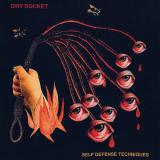
Their latest record, Self Defense Techniques, centers on survival under constant pressure. Inspired by the practice of dehorning rhinos to protect them from poachers, removing a vital part of the animal in order to keep it alive, the album examines the compromises people are forced to make to endure a hostile world. Horns are tools for protection, communication, care, and identity. To survive, so many of us are taught to remove our own.
Across the record, Dry Socket interrogates life inside systems that demand silence, obedience, and self-erasure. Songs wrestle with exhaustion, spiritual betrayal, and economic violence, oscillating between fury and grief. Self Defense Techniques isn’t about triumph, it’s about endurance, documenting the cost of staying alive while refusing the lie that softness is weakness or that silence is peace
- A1: Tout Est Bizarre (Feat Agnès Hélène)
- A2: Abanije (Feat Nayel Hóxò)
- A3: Soy Dos (Feat Agnès Hélène)
- A4: Viv Li (Feat Olivya)
- A5: Laissez Passer (Feat Agnès Hélène)
- B1: Ta Logbe Jongo (Feat Nayel Hóxò)
- B2: Soulshine (Feat Nayel Hóxò)
- B3: En Synchro (Feat Agnès Hélène)
- B4: Aïshododo (Feat Nayel Hóxò)
- B5: L’or & Le Sang (Feat Agnès Hélène)
Ayô Dele — which means "joy comes to me" in Yoruba — is neither a slogan nor a promised miracle. It is a breath of fresh air. That of an album born in the interstices, where the word find their way between shadow and light, between the disorder of the worldand the impulse to be .
At the heart of the project, Julien Gervaix and Damien Tesson, multi-instrumentalist beatmakers, share a groove language that is both dense and airy, where every detail breathes and finds its place.
With background in Afrobeat, Dub, Funk, Soul, Roots Reggae, and Electronic Music, they treat the studio to be their playground. Their music is a hybrid groove that speaks to the body: round or bouncing basslines, brass oscillating between melodic warmth and funk energy, textured guitars, arpeggios, enveloping Rhodes, clavinet that slides, presses, and embraces. Everything comes together with precision and flexibility, in an inventive and warm composition. The meeting of their experiences and sensibilities gives rise to open, generous music, made for dancing and vibration.
With Ayô Dele , Ireke is embarking on a new chapter: the duo is refining its style,allowing the voices to breathe. The groove remains the driving force but opens up to intimacy. This intimacy is carried by two unique female voices: Nayel Hoxo, a Beninese-Nigerian singer/rapper, and Agnès Hélène, who has already made a name for herself on Tropikadelic with "Petit a Petit". They don't sing side-by-side; they coexist, respond to each other, and sometimes intersect. But each follows her own path: Nayel, with the power of her words in Yoruba, offers songs of elevation, healing, and resistance — a light born in the cracks Agnès explores these cracks themselves: what wavers within us, what reinvents itself in bonds, glances, and gestures.
For one track, Olivya (Dowdelin) joins this dialogue in Martinican Creole. Her sunny soul sketches the contours of gentle resistance and celebrates rediscovered light.
Ayô Dele embodies a quiet yet radical determination: to smooth nothing over, to let plurality, contradictory emotions, and mixed heritage live. An album that moves forward through vibrations, that speaks of emancipation without slogans, love without clichés, anger without uproar.
Two women, two inner worlds: a sensitive complicity, a shared breath. Music that seeks not effect, but echo, weaving a living soundscape between reinvented traditions and contemporary textures. An alchemy faithful to the spirit of Underdog Records, where music unites and brings people together. Ayô Dele : "joy comes to me." A lucid joy, crossed by shadows, patiently regained. Music that welcomes, releases, gives, and in doing so, makes us feel good.
In a saturated world, Ayô Dele chooses nuance: transmission without emphasis, joy without naivety. An album that vibrates more than it demonstrates, that connects more than it imposes, and which, in its quiet clarity, resonates with a deep desire to be fully alive.
A new duo and record label based in Madrid lands on the underground techno scene, led by Mike Gómez and José Castillo, the latter known for his aliases Milford and UHF, and also the owner of the electro label Gladio Operations.
Diorama is born with the intention of recovering the soul and essence lost in electronic music, which for some time has become practically homogeneous and predictable. With a timeless, fresh, and warm sound, Diorama produce rhythms close to dub and Detroit techno, mainly influenced by Juan Atkins, UR, and Basic Channel, among others.
This EP, titled Pacific Trak, begins with a nod to the old Scottish school, where they revive a forgotten track by British producer Anthony Scott, adding its imposing main chord to a true sea of melodic textures, bathed in exquisite acid. Spanish techno master Tadeo gives us his vision of Pacific Trak, exploring dub territories that remind us of past pieces released under the incomparable Maurizio label.
The B-side opens with Soul Memories, a manifesto of resistance that vibrates with detuned harmonies and raw bass lines, recalling the origins of Detroit’s primitive sound. The package closes with Polymorphic, a progression of relentless aquatic chords, set among careful and precise minimalist rhythms that oscillate between high-dynamics tech and dub.
Refined, trippy, and beautifully hypnotic. PIRAT005 marks a deep and elegant statement from Pirat Records and delivers exactly the kind of timeless, hypnotic minimalism that turns heads on first listen and stays in the bag for years. A record built on restraint, texture, and atmosphere: rolling, seductive, and deeply functional for long sets and late hours. With a clear nod to that unmistakable Perlon-inspired aesthetic, Venedig moves with precision, subtle tension, and groove-driven detail, stripped back, but full of character. The collaboration spirit on this release gives it a special depth, while the overall sound remains focused, classy, and unmistakably underground.
Carlos Giffoni reconnects with Thurston Moore for two sides of loose-limbed axe noise, oscillator worship and hard-phased, Spacemen 3-style feedback.
Giffoni’s been on a roll recently. Since the No Fun founder returned to the scene with »Vain¡, a genius set of synth mutations that appeared in iDEAL back in 2018, he’s been slowly ramping up the activity, dropping the celestial »Dream Walker« on Stephen O’Malley’s Ideologic Organ in 2024 and following it with »Pendulum«, a bumper compendium of collaborations, just a few weeks back. For those who remember Giffoni’s first trip round the block, he was always able to hold his own chopping it up in person, not just by mail.
Just scrub through his early catalog and you’ll see collabs with Nels Cline and Chris Corsano, Merzbow, Jim O’Rourke and Lasse Marhaug, and of course, Thurston Moore. The two rekindle their thing on »IGUANA’« picking up where 2001’s fabled »4 Guitars Live« performance left off. Here, Giffoni straddles a tabletop synth and FX while Moore attacks his signature Jazzmaster with a drumstick and a screwdriver – vibes fully intact.
Moore is on blistering form, sounding as if he’s taken a step back to refresh his approach since the early ‘00s when he could be spotted moonlighting on any number of basement-adjacent noise sides. Sawing at his strings and turning the guitar into a shrieking resonator, he leaves only faint vapours of the classic Sonic Youth sound as opiating accents on his animalistic wails and rumbles. On the opening half, his whammy – assisted shreds are balanced out by Giffoni’s off-world whirrs and airlocked vibrations, building a dense wall of noise towards an unexpectedly elegiac conclusion. At some point, Giffoni’s rasping churr transforms into a simmering shudder and Moore’s into hymnal drones – squint a bit and you could almost call it pretty.
Of course, they ramp things up on the flip, dissolving the melancholia with smokey white noise and twangy, post-Derek Bailey chimes that Giffoni accompanies with aggy oscillations. Like every great taped noise set, the recording quality is crucial - »IGUANA« was captured from the pit by Guillermo Hernandez Avendano, the dad of Lia Miranda who provides the cover photo. It’s that kinda show.
Some years ago, Kjell Bjørgeengen and Keith Rowe attempted to convert video signals into sound by setting up Rowe’s pickups next to an old CRT monitor, turning its magnetic field into a sound generator. Rowe further developed the system with David Jones at Alfred University, slimming down the setup using a copper coil, a circuit board, a video input, and a telephone pickup. Jones named it the »Flood Coil«, and it’s that instrument you can see on the album’s front cover and that lies at the core of these recordings, made without any physical live input from the artists themselves. In essence, it’s generative music in its purest form.
Bjørgeengen’s video feed is generated by oscillators, then routed into Marhaug’s pedals and then back into the Flood Coil, so any visual shifts alter the sound, and any modification to the sound changes the video. The duo have played this setup live many times, but for this studio version they left the system to do its thing without any intervention for two minutes at a time before moving onto the next idea. They recorded hours and hours using this process and then selected 18 highlights for this album, extracting harsh noise, power electronics, lulling feedback drone, and peculiar rhythmic snippets to show the scope of their technique.
A wall of growling, hi-octane Pulse Demon-style noise opens the set, gradually exposing us to more asymmetric textures, shifting through unstable repetitions that transform Merzbow’s metal-inspired screams into »Aaltopiiri«-era rhythmic noise. It’s remarkable, actually, how much Marhaug and Bjørgeengen can squeeze from the system, chancing on shivering, lower-case chugs and pops, galloping drums, soundsystem subs, and grinding blast beats that sound like Napalm Death’s »Scum« piped through a broken amp stack. It ain’t pretty, but noise/industrial freaks will revel in the fierce delights inside.
Glasgow, Scotland duo Thomas + James deliver their silky-smooth dub laced sounds for Federsen’s Alt Dub with the four-track ‘Realtime’ EP.
Thomas + James are a Glasgow-based DJ and production duo whose sound reflects a deep immersion in electronic music. Raised in the city’s west end and shaped by early exposure to techno pioneers like Luke Slater, Slam and Jeff Mills alongside the atmospheric legacy of ’90s drum & bass, their productions lean into a dub infused, forward-looking aesthetic.
Drawing equally from house traditions via influences such as St Germainand Laurent Garnier, the pair blur the lines between dub techno, deep house, acid and minimal.
Their new EP onFedersen’s Alt Dub captures that hybrid vision with a maturity that belies their years, being born in 2006,marking them out as a quietly compelling new voice from Glasgow’s next generation.
Leading the release is the original title-track ‘Realtime’, setting the tone with a sturdy yet pared-back rhythm section, oscillating synth flutters, bouncy sub-bass and hazy textures that subtly shift across the arrangement.
Label boss Federsen steps in next with his interpretation, reducing the track to its deepest foundations and recasting it as a delicately drifting soundscape of evolving spatial echoes, weighty low-end pressure and restrained, muted drums.
On the flip, Thomas + James return with ‘Armonia’, an ethereal, dub-leaning deep house cut propelled by billowing pads, delayed vocal chants, fluid dub chords and a heavily swung, minimalist groove.
The EP closes with ‘X-Intense’, further highlighting the duo’s groove-driven signature sound as reverberant, airy stabs weave through breathy vocals and shuffled percussion to bring the release to a hypnotic conclusion.
WRWTFWW Records is very happy to announce the release of Interwoven, the deeply moving collaborative album from Ken-ichiro Isoda and aus (Yasuhiko Fukuzono) — now available on limited edition transparent sea green colored vinyl LP housed in a heavyweight sleeve with selective-varnish 3D print, as well as in digipack CD and digital formats.
Recorded between Hachijo Island and Tokyo, Interwoven distills two visionary voices of Japanese ambient and electronic music into a single breath of feather-light and quietly luminous meditative sound.
Isoda is a revered figure of New-age and environmental music whose work on Oscilation Circuit – Série Réflexion 1 (originally released on famed label Sound Process) has long attained mythic status. He composes, notably with harp and wind instruments, produces contemporary music and video game scores, and crafts his very own brand of ambient music from the volcanic island of Hachijo-jima. Tokyo-based electronic composer and synth master aus is known for tender, melody-driven soundscapes. From the two artists comes a dialogue suspended between land and sea, bridging the generation gap and the physical distance between them.
What began as a series of sketches — impressions of water, islands, and shifting light — gradually evolved into an exchange without explanation, a correspondence of sound that dissolved boundaries. In that anonymity, both artists discovered an uncommon freedom: a place where each could move lightly and intuitively, without expectation. The music drifts with a gentle, intuitive grace: lingering piano, soft cinematic synths, and field recordings that unfold like whispered recollections, while flute and saxophone lines pass through like occasional breezes — a human presence felt as warmth more than form.
Interwoven is music for those who cherish stillness and the delicate beauty of the everyday. It’s music for admirers of Satoshi Ashikawa, Midori Takada, Satsuki Shibano, Hiroshi Yoshimura, Takashi Kokubo, Brian Eno, and all who seek a quiet refuge in sound.
Boutique-pressed 7" vinyls A-side: "Wonderin'" / B-side: "Dream"
Drawing influence from the likes of CAN, Faust, Mahavishnu Orchestra, and David Vorkhaus, Shakti Soundsystem traverses the borderlands of psychedelic rock, Krautrock, jazz fusion, and ritual improvisation. But this isn't a retro trip—this is future folklore.
Each track is a trance in motion, built on hypnotic basslines, spiraling melodies, and moments of ecstatic dissonance. The instrumentation is as unconventional as the process: Bulbul Tarang, modular synths, guitars, drums, and vocals that oscillate between invocation and surrender.
Their first singles have already made waves across tastemaker blogs and listener-curated Spotify playlists, includingNeo-Psychedelia, Psych Rock Melting Pot, Rock for when 26 King Gizzard albums aren't enoug and Psychedelic & Space Rock.
"Wonderin',"described by Analogue Trash (UK) as "an absorbing, psychedelic jam that thrives on hypnotic repetition and a raw, live energy,"introduced their trance-infused sound to a wider audience.
"Silver," hailed by RMAS (Mexico) as"a hypnotic journey between Krautrock and spoken word... a sonic delirium that recalls CAN and the free spirit of the European underground," cements their place in the modern psych scene.
- A1: A Bureaucratic Desire For Revenge Part 1 (Black Noi$E Inversion)
- A2: A Bureaucratic Desire For Revenge Part 2 (Black Noi$E Inversion)
- B1: Ouroboros Is Broken (Black Noi$E Inversion)
- C1: Geometry Of Murder (Black Noi$E Inversion)
- C2: German Dental Work (Black Noi$E Inversion)
- D1: Divine And Bright (Black Noi$E Inversion)
- D2: Dissolution I (Black Noi$E Inversion)
New “Inversions” of drone rock pioneers Earth’s debut release. A collaboration between Dylan Carlson and Black Noi$e (Armand Hammer, Danny Brown, Earl Sweatshirt) formed in mutual respect and appreciation for one another. Both artists were intrigued by the creation of vast musical landscapes and the connection of music, with its ability to transport the listener. The music of Earth was recognised and celebrated for moving at a glacial pace and yet this new collaboration surprisingly saw Black Noi$e slowing things down even further.
The debut, which originally came out in 1991, notably featured Kelly Canary and Kurt Cobain on vocals on the tracks “A Bureaucratic Desire for Revenge Part 2” and “Divine and Bright”. Black Noi$e reimagines the original recordings with his experimental sensibility and innovative multi-instrumental, cross genre exploration. Applying contemporary electronics to the heavy droning bass and guitars and languid rhythms, this inversion oscillates and reverberates with a different kind of energy whilst simultaneously highlighting the much loved low slow and distorted properties of the original.
‘Extra Capsular Extraction’ was the first music Dylan made with Earth and his first time in a recording studio, which he recalls at the time as being “terribly exciting”. It also marked the first time collaborating with others and seeing it reified into a tangible object or product, a spirit that Dylan has carried through to the present. The original album is a document of a specific period and Dylan’s creative development. These inversions of Extra Capsular Extraction are, to quote Dylan, “an exciting way to reintegrate them into the present time and with my more expanded conceptions of musical endeavours”.
"Doom-metal innovators" Pitchfork.
"With guitars ramped up to the nth degree, but tuned to gut-wrenchingly low frequencies, Earth carved out a veritable canyon of pure molten drone, one which would have a profound influence on modern metal music." The Quietus