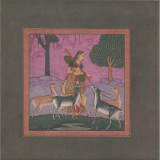
Matir Gaan is a collaboration between young Bengali migrant, Mohammed After Hussain and Italian electronic artist, Andrea Rusconi (aka Paq). The resulting album delightfully combines the ancient folk songs of Md After's homeland with Paq's cosmic synth exotica.
Mohammed After Hussain escaped Bangladesh in 2015 and arrived in Italy in 2017 after a long and dangerous journey across the Mediterranean from the violence he found in Libya. In Italy he found safety and hospitality as an asylum seeker in Rimini's Associazione Ardea, where Andrea is involved with 'Ardea Recordings' - a project aiming to create an archive of songs, stories and sounds by some of the people who spent some time with Ardea's refugee programme.
Md After was invited to sing and play the folk and village songs he knew on the harmonium and pakhawaj (two headed drum) while Andrea immersed himself in the songs providing a bed of warm Crumar synth and Veena drones to create a finished album of totally uniquela renditions of the mystic Baul folk songs known so well by people across the Bangla speaking regions of India.
The Bauls are a famous group of wandering minstrels from the region of Bengal whose culture is derived from the teachings of the early Sufi mystics and Hindu Fakhirs. The Baul devotees are considered to be mad, or possessed, with the love of God. While transcending religion the Baul compositions celebrate celestial and earthly love and expound the key philosophy of “Deha tatta” or truth in the body, epitomised by the aphorism “whatever is in the universe is in the body”. They reach for divinity here in this world and they seek to access it through music and dance. They seek spirituality in the music, they live fo r the music, wandering from village to village offering ecstatic sound waves in exchange for sustenance. Their presence remains an important part of village life in Bangladesh, and this is why Md After knows the songs despite the fact he would not consider himself part of the Baul ascetic tradition.
We hope you'll enjoy this wonderfully psychedelic album, with its unique interpretations of these ancient mystic songs from the earth.
Comes with a printed inner sleeve featuring sleeve notes and lyric translations by Brian P. Heilman
quête:p drum
With the two-part EP Mediterranean Dreams, Perugia producer and composer Feel Fly revisits his musical roots and pays tribute to the sounds and ‘sun-kissed nostalgia’ that informed his style.
Mediterranean Dreams Part 1 collected four tracks, and added that Feel Fly touch of emotive chord progressions and layered production onto cosmic disco grooves to powerful dancefloor effect. Now with Mediterranean Dream Part 2, Feel Fly switches the tempo both up and down, to fully demonstrate his affinity for club moments of all shapes and sizes.
Nebula flies out the gate with full intent, recalling classic Detroit techno while pushing the vibe even more wide-screen - it’s driving, melodic dance music that delivers on the fine details as much as it does on the life-affirming, big picture sentiment.
Optical Bells opens in meditative style, not unlike a new dawn in a Tibetan monastery, before each element of the track slowly reveals itself and assumes its place. It’s an arrangement technique that Feel Fly employs masterfully, and gives the impression of a camera lens moving into focus, or a storyteller setting the scene. The revolving chord changes pull you in and while whisking you away, you’re compelled to engage with the moment - like being asked to dance by a mysterious stranger.
The B side kicks off with Luce Eterna Ai Sognatori, still keeping the tempo high while cherry-picking disco house drum patterns and piano synths with a slight Italo flavor to create an irresistible slice of dancefloor dessert. This is a soundtrack for Sognatori, in whose dreams anything is possible.
The EP finishes up with a superb cut of echoey balearic dub in the form of Templum Dub. Putting the drums through its mixing desk paces, Feel Fly reanimates the drum kit with delays, phasers and flangers, and wraps it up in hazy drifting pads that could accompany any moment of contemplation - from that morning espresso to a midnight phone call.
Mediterranean Dreams Part 2 acts as the perfect compliment to its prequel Part 1, and shows a producer at the height of his powers, reimagining his musical roots and composing a love letter to the sounds and stories of his youth.
X Files returns for the series’ second instalment, dropping vinyl debut armed with two fresh edits.
Launched in 2021, X Files unveiled a new Unknown Artist series exploring the realms of house and beyond via slick takes on unconventional records, transporting them to main room dance floors and hazy early morning after parties. Following support from Marco Carola, Jamie Jones, Skream, Michael Bibi, Enzo Siragusa, Dennis Cruz and Archie Hamilton, March sees the first vinyl release on the label with another two-track package for the series’ second anonymous release.
Harnessing one of music’s most iconic melodies and vocals alongside murky bass and tough drums on the A-Side, before keeping things funky and punchy on the flip, XFL002 serves up a hot slab of wax set to be a must-have for many.
Support:
Jamie Jones
Michael Bibi
Marco Carola
Skream
East End Dubs
Luuk van Dijk
Ben Sterling
Archie Hamilton
Kölsch returns to his first home and Kompakt’s eternal Speicher series following a remarkably productive past 18 months that included his 4th full length opus “Now Here No Where”, a double single on his own IPSO imprint and remixes for the likes of Joe Goddard, Douglas Greed and Agoria.
Expect the unexpected this round from our man with the hat with the squelching “Woohman”. He rolls back the clock and brings back a spirit of RAVE, delivered in the way we adore his signature style most. The flip side “Speicherband” feels for us here at Kompakt like an homage of sorts to one of our founding father’s Wolfgang Voigt. The minimal churn of a technofied bass drum pounds forth, as a troop of horns call forth the return of unadulterated gatherings to the once empty dance floors across the globe.
Kölsch kehrt wieder zurück in die alte Heimat KOMPAKT und zu unserer ewig jungen Speicher-Serie, nachdem er in den letzten 18 Monaten außerordentlich produktiv war und sein viertes Album "Now Here No Where", die digitale Single “Hold/Clear” auf seinem eigenen IPSO Label und Remixe für Leute wie Joe Goddard, Douglas Greed und Agoria veröffentlicht hatte.
Mit dem druckvollen "Woohman" geht es los und hier klingt unser Mann mit dem Hut getreu dem Motto: “Erwarte das Unerwartete”. Er dreht die Zeit zurück und bringt den Spirit des RAVE zurück, und zwar auf seine ganz eigene und unverwechselbare Art und Weise, die wir so an ihm lieben. Die Flipside "Speicherband" fühlt sich für uns hier bei Kompakt wie eine Art Hommage an einen unserer Gründungsväter Wolfgang Voigt an. Dieses minimalistische Dröhnen einer Techno-Bassdrum, dazu ein Satz Bläser, der die Menschen zur Rückkehr auf die einst verwaisten Tanzflächen der Welt herbei ruft.
Lined up next on Cosmocities is a special delivery and direct nod to our formative years’ loves - in this very case, trance music. Fruit of 90s cross-channel outfit Prism, the collaborative endeavour of French producer Pascal Eloy and UK-based Grant Wilkinson, the three-track EP “CMSR006” mixes unreleased music (Refraction), a 1996-issued goodie (Rain) and an exclusive remix from SYO, better known for his ambitiously retro-futuristic output under the S.O.N.S moniker.
Originally released as part of Planet Dog’s 1996 compilation “Feed Your Head”, “Rain” retains all of its original mystique and soulful use of modern production tools - letting a cascading flow of arpeggiated synths, stealth bass onslaughts and 303-borne trippiness pour down as a fully immersive digital shower for the senses.
An unheard gem from the vault, initially written and recorded in 1995, “Refraction” pulls further dynamic traction from a bubbling drum programming and damp, urban jungle-y atmosphere - beaming us straight back in the rave’s most compelling heyday with its feverish maelstrom of fluttering bleeps, spiralling tribal motifs and faux-organic, Neo-Easternmost harmonics.
Adding his ever innovative spin to the table, SYO cuts into the flesh of the original to deliver a further syncopated and spacious version, flush with complex rhythmic sleights of hand and subtle melodic trickery throughout, bound to keep you on the edge with every bar. 25 years on since it was first designed, Prism’s lasting relevancy shines bright on this all-road, bold-to-the-full trance epic that’s lost nothing of its flair.
Another disastrous POPPERS attempt at making people feel like dancing, this time featuring a promo release for DJ Tranquilos - a completely unknown "artist", never booked before DJ, virgin territory for bookers. Guaranteed to offer anything but tranquility to the listener. French vocal epic HiNRG pop cover and Soca dancefloor bulldozer on the A side. Heavy percussive acoustic drums with extraterrestrial synths and a sound effects DJ tool on the B side. Mastered for maximum dancefloor impact - only for true Peak Time DJs.
Brazilian artist Bruno Furlan is the next to make his mark on the famed Hot Creations imprint. The two-track release, The Speakers Pump Like This, is set to bring the heat and make serious waves on dancefloors this year.
Title track The Speakers Pump Like This transports you straight to the club, with its peak-time pace, sonic synth stabs and prominent vocal cuts. On the flip, Moving gets to work with a sharp kick-drum and infectious vocals, as subtle builds and drops move throughout the track, whilst retaining the solid, rolling groove.
Hailing from the diverse and electric city of Sao Paulo in Brazil, Bruno Furlan started his DJ career while still a teenager and quickly became a highlight in the Brazilian electronic music scene, capturing the attention of artists such as Claude VonStroke, Chris Lake, Solardo, Green Velvet and Amine Edge & Dance. Always driven by a great love for his art, Bruno has created his own unique way of approaching music production, resulting in a standout discography and performances throughout the world. In addition to his own record label Whistle Records, Bruno has released on labels such as Dirytbird, Relief, , Sony Music, SOLA, Nervous, and more.
Kerri Chandler’s Kaoz Theory kicks off 2022 with Mr. ID’s Language Of Jazz EP, featuring two remixes from the label boss himself alongside two original cuts.
2021 saw Kerri Chandler’s Kaoz Theory continue to move from strength to strength, unveiling material from the likes of Dutch rising star Chris Stussy and of course Kerri himself, here we see the imprint wrap things up with a new addition to the roster, Casablanca, Morocco-based artist Mr. ID.
Up first on the release is ‘Track ID1’, a collaboration between Mr. ID and Youssef Grirane featuring Rita Mdn. It’s a unique six-minute journey through jazzy pianos and organ licks, intricate organic percussion and mesmeric, textural atmospheres. Kerri gives it the remix treatment in style extracting all of the jazziness of the original and retwisting things with the classic Chandler authentic house feel. Next, Chandler employs his revered 623 alias for the ‘623 Again Mix’ version which strips things back to low-slung drums, bumpy stabs and emotive piano lines.
The flip side houses ‘Track ID1’ in all its original glory before ‘Track ID2’ closes out proceedings seeing Mr. ID join forces with Younes Akhraz, rhythmically shifting to a jazzy 4/4 drum groove while wandering keys and warm subs fuel the mystical vibe.
DJ Feedback:
Sasha – Tasty
Laurent Garnier – Love the whole EP
Jimpster – Jazzed up piano house heaven! Love It!
Lea Lisa – Lovely remix by Kerri
Mr. V – Kerri delivers the goods once again!!!
Anja Schneider – Great. Love It.
Archie Hamilton – Nice
Andrew Treagust - Man that's some crazy production – really like it!
Mike W - absolutely classic release. how on earth could you go wrong? the world needs more piano!
Fish Go Deep - All tracks sounding great here. ID1 is a lovely warm groove and Kerri's remixes inject a little dancefloor bump to proceedings.
Daniel Troberg – incredible music
Kiki Navarro – excellent single, loving all the mixes special ID1 and the Kerri Chandler Main Remix
Ben Lovett – Remix mastery from Chandler – wonderful meeting of piano and drum – fire.
Sergio – Excellent example of classic house with personality
Hector Samper – Amazing EP!!!
Baby Buddha is David Javelosa and musical partner Charles Hornaday playing instruments and providing their own whacked-out vocals. Baby Buddha really was less of a band than a project; a side project in fact, for some members of another group, Los Microwaves. Baby Buddha would eventually record and release an album, 1981's provocatively-titled Music for Teenage Sex on Robbie Fields' L.A.-based Posh Boy label.
Happily, the project's guiding creative light, David Javelosa has recently seen to a vinyl reissue of the now-40-year-old record, mystifyingly retitled Music for Teenage Sects. Definitely among the stranger releases of the new wave era, Music for Teenage Sex/Sects could perhaps only have been created when and where it was made. But on the occasion of its 40th anniversary, the music sounds as weirdly wonderful as ever. "We Are Not" sounds like Human League stuck in a car with The Residents. And their cover of "All Shook Up" sounds like a musical kin to those inscrutable eyeball guys too; it wouldn't be out of place on Meet the Residents. "Little Things" is a house-of-mirrors, scary track, with spoken-word vocals by Los Microwaves' Meg Brazill and label head Fields.
The album cover is slightly different as well: it displays a bedroom scene like the original LP, but with the young female model absent. The new release (on Javelosa's own Hyperspace Communications label) is pressed on beautiful translucent blue vinyl and comes in a gatefold sleeve with a lively collage of photos, buttons, gig posters. Limited to 500 copies.This playfully titled release features David Javelosa (on synth and vocals) along with Meg Brazill (on bass and vocals) plus drummer Todd "Rosa" Rosencrans. Side One features five studio tracks, none of which were included on the band's 1981 Posh Boy LP, Life After Breakfast. Three of these tracks were recorded in '82; there's no information regarding the provenance of the other two songs. The records' second side collects five live recordings, capturing Los Microwaves onstage in New York City (The Peppermint Lounge) and Boston as well as at San Francisco's own I-Beam, a venue that often played host to the band. Those tracks date form roughly the same ear, 1980-83. Sonically the songs variously recall Blondie, Flying Lizards, Gang of Four and a far less dour Human League. Importantly, the band rocks, even when it's employing a spare drum kit, solid but elemental bass, and monophonic analog synthesizers. The stripped down aesthetics of the group – necessitated by its minimalist instrumental approach – are nonetheless thrilling. Even if you weren't there in 1980, this'll take you back.
30 years as a full-time touring nightclub DJ sounds like one hell of a career, and for Kenny Summit it's as much of a milestone as it is a turning point. Having shared the stage with greats such as David Byrne, Stevie Wonder, Chaka Khan, George Michael, Kylie Minogue and Prince over the years, Kenny took that influence and inspiration and decided it was time for him to get behind the mic too.
‘Burnin’ is a song written, produced and performed by Kenny Summit that speaks on a desire that's been burning inside of him for three decades. Across those 30 years he’s made many an influential friend too, three of which come on board to remix ‘Burnin’ - the late great Paul Johnson, D&B icon DJ Aphrodite and Brooklyn legend DJ Spinna.
"I caught the fever for house in 1990 and by 1992 I was booked for my first DJ gig at New Jersey's famed Zanzibar nightclub where house legend Tony Humphries held court on a weekly basis. Something changed that night, a fire started and its been building, growing inside of me and now it's time to put paper to pen and write my own songs."
Clearly influenced by the artists Kenny's worked with over the years, ‘Burnin’ is a culmination of one man's journey through dance music; from the Nile Rogers-ish 70s guitar riff to the whining Steely Dan-like keys, to the lush strings and synth pop stabs that would make Moroder blush, the track itself is masterfully produced and punctuated with Kenny's unique uplifting vocals, sang in a manner as if David Byrne and Boz Scaggs were put together and yet still very uniquely Kenny Summit.
Up on remix duties the late great Paul Johnson, Chicago's shining star, serves up a dark, very much after house vibe, that still keeps that trademark Paul Johnson sound. Drum & Bass icon DJ Aphrodite applies his unique sound to ‘Burnin’ with a stellar remix the D&B community has been patiently waiting over three years for. And finally, long-time friend, Brooklyn's DJ Spinna steps up, who after hearing the track commented 'this needs a dope DUB! Leave it to me, imma hook you up bruh!'. The Discoelectric Dub does not disappoint.
black.round.twelve presents the second release on its imprint, signed by the Romanian talent Pîrvu.
Dance Refuge EP’ is a 4-track EP spanning from minimal house to broken beat, showcasing a collection of music drenched in vibrant and sincerely playful energy – a sonic naivety of sorts, very akin to Pîrvu’s own personality.
Both ‘Twelve’ and the title track ‘Dance Refuge’ fill the A-side of this record with a positively warm tone where the groove is king. Razor-sharp drum programming shines through compositions with hints of acid, profoundly accurate sub-basses, and just the right amount of atmosphere, creating a musical spectrum very prone to those floating, early-morning dancefloors. The flipside’s ‘Space’ follows the same groove-led narrative introduced previously and infuses it with an extra dose of playfulness and feel-good sound design before toning it down to the introspective ‘Lver,’ finishing this EP with just the right amount of breaks and warmth.
As usual, the cover of the EP was (undoubtedly) drawn and painted by the talented Berlin-based Juli Jah, beautifully portraying Pîrvu.
The third release of , which will be released on vinyl with the theme of ancient and modern east and west ~ Nihon no Uta ~, is blindness caused by an illness that he had when he was a child, he met Tsugaru shamisen in a poor and difficult life.
Chikuzan Takahashi, a master of the Tsugaru shamisen, has raised Japanese folk songs to the level of art that has been praised around the world. The recorded song is "Iwaki Impromptu".
Several versions are also recorded in the album work, and there are different arrangements only for improvisational songs, but this time Held from 1973 to 2011 at "Maruyama Park Concert Hall" in Kyoto City to coincide with the Gion Festival in Kyoto
It is a sound source when he appeared in "Yoiyoyama Concert". A thick string that tells the beginning, like slamming Overwhelming power that tightens the chest even though it is not a drumstick, like an orchestra that does not seem to be a single performance
Spread of sound, free development of sound. A shamisen player named Chikuzan Takahashi who completely deviated from the frame of so-called standard folk songs It seems that the expression of is involved in the audience at the scene without even seeing it.
Mr. Takeyama describes this song as "a song where you don't know where it started, where it started, and where it ended." It's just an impromptu song, something that you listen to with subtle changes in sound and complex rhythms while making various changes. It is a masterpiece full of dynamism that you can grab until the end.
Bill Laswell, who is active as a world-class bassist, reconstructed the original sound source this time. He has a deep knowledge of ethnic sound sources, and his arrangement is "Mix-translation" instead of "Remix". Is used. While making the best use of Mr. Takeyama's sound source, as the difference in the words shows, it is unique Arrangement with swelling deep bass bass makes you feel as if you are standing on the same live stage and having a session. It is a finish that you can understand his idea of chewing the original and then translating it.
The jacket picture is by Mr. Akira Kasai, a photographer who has taken Mr. Takeyama's picture for a long time. We asked Mr. Takuji Matsubayashi, the author of "Takeyama Takahashi, the sound of the soul," to introduce the work.
Pure product of the Neapolitan scene, Fabrizio Fattore turns up on Cosmocities Records with his third solo effort. Comprised of two originals on the A-side, and two bespoke revamps from Vince Watson on the flip, this new EP from Fattore draws a direct bridge betwixt the idyllic coastal flow of Italian boogie and straight out pulsating alien disco, sure to keep galaxies bouncing in good order.
Clocking in first is the vibey, otherworldly 'Lyle' - a cross-pollinated ode to the healing power of laid-back, 80s-informed house, bristling with shimmering Casio synthlines and Cuban jazz-friendly pianos and drums. Heliotropic by nature, Fattore's sound sits half-way loungey summer atmospherics and trailblazing post-kosmische jaunts. Then comes 'Island Goddess', casting more of a Sino-Caribbean flavoured spin on the dance floor with its obsessive miss-mash of processed chimes and prismatic webwork of steel pans.
On the B-side dwell two versions of 'Lyle' by true house legend Vince Watson, each of which deliver in their own right. If you’re after a proper classy, straightforward roller, bound to take dancers into a ravishingly deep but rousing trip, then the 'Watson Reshape' fits the bill like a glove, whereas the 'Balearic mix' does exactly what's written on the tin - ushering you into a sense-soothing haven, where keyboard-laden escapism and Afro-style rhythms meet the elegance of muted chamber music.
'Cryptic Speech' opens this release with the thump of UMEK’s trademark kick drum and a pulsating synth line. Dramatic stabs lead to the haunting breakdown which provides an epic hands-in-the-air moment before the percussions slams back in.
'Bounce That Ass' has a jacking sound that takes influence from Chicago's ghetto and booty styles. Chunky percussion and UMEK’s own personal twist add a modern take on the tried and tested style loved by dance floors all over the world. The growling bass stabs, muffles vocals and snare rolls combine to create the fist pumping groove.
'Killer' tips its hat to the old school rave scene by utilising retro style synth stabs and a broken beat percussion loop in its timeless breakdown.
'Navigating' sees a welcome return to the UMEK's classic hoover synth arpeggios that gave his early tracks such a stand out sound, and the raw energy is nothing less than superb!
Few groups arrive as fully formed as EPMD did. This dropped as the third single from the album of the same name, and further cemented their distinctive aesthetic: Slow rhyming, trading lines rather than the rappers being confined to their own verses, and backings that were ruthlessly funky and simple at the same time.
They’d go on to be labelmates with Public Enemy when Def Jam picked up their contract in 1990, and to compare and contrast the two is illuminating. While PE at that time were making waves with the Bomb Squad’s breathless, kitchen sink approach to production, EPMD were equally adored for taking the opposite approach.
Here, there’s a sprinkle of drums from Kool & The Gang’s oft-sampled ‘Jungle Boogie’, paired with a very recognisable portion of Eric Clapton’s ‘I Shot the Sheriff’. And that’s pretty much it – the two samples are linked, looped and left to their own devices. Such was Erick and Parrish’s confidence in their own rhyming ability and strong voices, no further embellishment was needed.
That confidence extends to the subject matter. While their debut album and later projects were heavy with concepts – the ‘Jane’ series – and notable guest verses, this was the third straight single of pure brag rap. Two MC’s, one beat, a whole heap of lyrics about how good they were. It’s something you can’t do unless you truly are special, and this duo most certainly were.
Paired with the classic instrumental version, which didn’t make it to the US 7” releases – it’s only on a hard-to-track-down French 7” pressing from 1989 – this this is a timely reminder of how breathtakingly perfect hip-hop can be.
The Tel-Aviv centered Yotam Avni officially joined forces with Stroboscopic Artefacts last year, turning in a sensual an invigorating entry for the Monad series. Thanks to his personalized fusion of esoteric and worldly sound elements, Avni immediately made a case to deliver more work to the label, and now he has done so with 'Perlude to Dybbuk,' the second in a new series of S.A. releases to feature the Oblique Artefacts visual team's distinct, elegant portrayals of scanned foliage. As with Avni's previous Monad contribution, the new Perlude to Dybbuk makes references - both in title and in sonic content - to the ancient Hebrew folklore of his homeland (a 'dybbuk' being a kind of limbonic spirit attaching itself to the body of a living human until it has successfully reached its final destination). However, the atmospheric, rather than overt, use of these references gives this record a level of dignity and quality as well as a premonitory feeling that hovers over the proceedings.The opening 'Avka (New Life)' opens with the twin stimuli of chthonic, rolling percussion and ambience that has become a modern Stroboscopic tradition, but ever so gradually deviates from the realm of the easily anticipated. Some of the surprises to be found here are sharp, organic drum fills and sighing strings that have an uncanny vocal quality to them. By the time a surgically clipped acid synth sample comes into the mix, the track has reached a simmering level of excitement and the listener's imagination will have license to reside in a virtual world seamlessly combining elements both ancient and futuristic.Dybbuk' temporarily situates listeners back in brutal modernity, with the first sounds heard being something like insistently slicing helicopter blades. Avni merely uses this as the foundation, though, for a genuinely unique construction whose shamanic beats, throttled horn and undertow of frenzied electronics combine to give the feeling of being menaced and eventually overtaken by a spirit entity. This piece shows just what Avni is capable when operating in a more aggressive, 'post-industrial' mode, and the result stands up with some of the best exponents of that genre.The finale 'Modern Matters' is the most readily club-friendly selection from the disc. This potent, floor-shaking and perspiration-inducing number superimposes resonant vocals from traditional Middle Eastern folk song onto this alchemical mixture of machine oil and sweat, and provides a romantic flair without resorting to naïve, touristic 'ethno-techno.' Avni's skillful dedication to counterpoint, and determination to make a finished form is more than the sum of its parts, shines through here and throughout the duration of this record.
Incoming, a massive EP from Anderson.
After his recent easter eggs EP, this four tracker is a blend of trance, breaks, drum & bass and experimental electronica.
Starting off the A side with the ‘Jelly Bean (Virus Outbreak Mix)’, this monster of tune will rattle your subs (and brain) with his crunchy kicks and trancey sequencing. This track will blast you off into oblivion eventually bringing you right into A2, ‘Level Quest’, a trancey chugging progressive tune building energy from the moment the first kick ignites.
After a much needed break, the B1 puts you in an immediate trancestate lasting just a few minutes and before you know it you will be blasted into drum and bass land with ‘Tasteful Nudes’ closing out the EP.
See you on the other side..
Pink Marbled
Limited 50 copy press
Reissue of Elizio De Buzios's "Tamanquiro". Remastered and pressed on 45 RPM!
Sitting a good 90-minute drive away from Rio de Janeiro’s crowded beaches and packed tourist hot-spots, Campo Grande is not a neighbourhood that attracts travellers from around the World. Traditionally it is home to the city’s lower middle-class, whose aspirations of moving up the social ladder were played out in a suburb that has always been solidly working-class.
Campo Grande is home to Elizio De Buzios, a Brazilian musician who started playing music in the late 1970s and early 1980s. De Buzios began as a drummer, before learning to play guitar and starting to compose and sing his own music. When he turned 18, De Buzios joined a local band formed by some of his friends and other like-minded local musicians: Sol da Terra. The band mostly played samba in neighbourhood bars and small venues around Camp Grande, but De Buzios was interested in more than just samba. While he naturally admired great samba composers such as Cartola and Beth Carvalho, his musical pass went far beyond Brazil’s national music. He also loved MPB and bossa-nova and at home he listed to Joäo Bosco, Milton Nascimento, Luis Melodia, Tom Jobim, and many bossa-nova singers.
In 1980 De Buzios was noticed by a local representative of international major label Polygram, who gave him the opportunity to record two songs. He was excited, so started searching for inspiration for the songs he would eventually lay down. He found that inspiration close to home while passing a neighbourhood shop which made and sold clogs. After noticing a display of then fashionable Portuguese clogs outside the store, De Buzios popped inside to talk to the owner. It turned out that he was a tamanqueiro – as clog-makers are traditionally called in his native Portugal – and was as passionate about music as he was about the footwear he made. Thus inspired, De Buzios returned home to work more on the lyrics and music.
The next day, he headed into the studio to record the song, with Vale Ribeiro, who later went on to produce tracks for Marcos Valle, behind the desk. With Ribeiro’s assistance, De Buzios managed to record two songs in one day: ‘Tamanqueiro’ and ‘Sou Um Louco’, a ballad with English lyrics blended into the mostly Portuguese text. From the start, it was clear that ‘Tamanqueiro’ would be the single’s A-side. Incredibly catchy and funky, with some subtle disco elements, the song remained distinctively Brazilian thanks to the use of the cuíca. Listening back all these years on, De Buzios’ lyrics seem almost spontaneous, carry the track forward, and make it almost impossible not to sing along. Its infectiousness and funkiness made it an instant hit with the first few people to hear it.
When it was released, responses to the song were enthusiastic, even if it never became the Brazil-wide smash it should have been. It resonated well in the local clubs and on the radio, but unfortunately the marketing was handled by an inexperienced Polygram employee who failed to adequately promote the track. As a result, the record sank without trace and De Buzios’ dreams of stardom evaporated. Having just started a family, he realized he could not live off the uncertainty of being a musician. Instead, he got a job at city hall as a civil servant, a role he continued until his retirement a few years ago. ‘Tamanqueiro’ and ‘Sou Um Louco’ remain the only two songs he ever recorded.
In the early 2000s, with the rise of diggers’ culture, ‘Tamanqueiro’ slowly surfaced again. It became a sought after, hard to find seven-inch single, finding its way onto the airwaves once more and into the ears of a new generation of listeners. Some started appreciating the song so much that it was referred to as the “best-Jorge-Ben-song-Jorge-Ben-never-recorded”. And they are right: ‘Tamanqueiro’ does have that Jorge Ben-straight-forwardness. It’s a completely honest song that’s almost impossible not to fall in love with. Thanks to this remastered reissue on Rush Hour, De Buzios may now get the props his sole record so richly deserves.
Now for the good news: De Buzios is still singing in local bars and clubs in and around Campo Grande. He is surprised, but also incredibly proud, that the record he had almost forgotten about is appreciated so much by a group of music lovers he didn’t even know existed. But above all, he is happy that more than 40 years after the recording session, the record lives on – not only on this re-release, but also in his weekend sets in the bars of Campo Grande.
For their second release Breidenbach Label once more gathers six artists from their regional circuit. Connected by their floating and sometimes even hypnotic soundscape, pulsating pads and strong grooves, each of the four tracks has its own intimate style.
With Love Entropy Crécy delivers a powerful and emotional ambient introduction to the A-Side. His fellow artist and close friend Ami adds a poetic layer: spoken word which shimmers through the sound, adding to the sentimental vibe. An atmospheric first serve. KliX picks up the love theme and transforms it into a mesmerizing ear catcher called Give Me Love. The somewhat trancy elements accompanied by evolving patterns, vocoder-vocals and classy 909 drums give this track its enticing and unique character.
Spaceloop on the records B-Side marks a debute release for the Mannheim based duo Seeder. They teamed up with Benny Delara to deliver a hip shaking dancefloor weapon that captivates through its strong and pulsating baseline combined with atmospheric elements that carry the records narrative. The EP is accomplished by Tech Report from the promising live-due CVSO. While blending breaky grooves with atmospheric elements the listener may find himself surprised by a jazzy piano melody that is proof of their creative and forward-thinking musical mindset.