From its earliest utterances, experimental music has been particularly disposed to transnational and cross-cultural collaboration. Seeking the answer for a fundamental problem - how to transcend the boundaries of difference, distance, and time - it presents a means to find common ground and communicate through the elemental form of sound. Over the last 5 years, this precisely what the duo of Félicia Atkinson & Jefre Cantu-Ledesma has achieved, intertwining sublime sonorities across the geographic expanses between their respective homes in France and the United States. Their third album for Shelter Press, ‘Un hiver en plein été’ (‘A winter in the middle of summer’) - the first to have been largely recorded by Atkinson and Cantu-Ledesma together in the same space - distills a mesmerizing pallet of acoustic and electronic sources into an open discourse of radically poetic forms, offering glimpses of warmth and intimacy waiting in the post-covid world to come.
Both veteran experimentalists with celebrated bodies of solo work behind them - each traversing the challenges of electroacoustic practice in their own singular ways - prior to their first recorded outing in 2016, Félicia Atkinson and Jefre Cantu-Ledesma had only crossed paths in person once, initially meeting in San Fransisco during 2009. The mutual bond formed during that brief encounter flowered into their first LP, ‘Comme Un Seul Narcisse’, followed two years later by 2018’s ‘Limpid As The Solitudes’. Both recorded remotely - sending files back and forth, fortified by conversations on a vast range of subjects - these two albums were guided by impassioned conceptual nods to Guy Debord, Baudelaire, Brion Gysin and Sylvia Plath, while seeking resolutions for the challenges and unique possibilities that working at a distance provoked.
Where the triumphs of its predecessors rose from the bridging of disparate moments and divergent spaces, ‘Un hiver en plein été’ culminates as a celebration of closeness, a result of Atkinson and Cantu-Ledesma working together in the studio, responsively in real time, for the first time. Recorded in Brooklyn during August of 2019 - a handful of months before the pandemic would impose chasmic distances across the globe - its six discrete works, carefully crafted and finalized over the ensuing year, evolve seamlessly across the album’s two sides, weaving a sprawling tapestry of sonority, within which both artists retaining their own voices and visions, while drawing each other towards uncharted ground.
Atkinson likens the recording of ‘Un hiver en plein été’ to have been akin to “a playground”, each artist “hungry for each sound, a bit like the rush in the Louvre in Godard’s Bande à part”, to which Cantu-Ledesma adds that the process seemed to have had “a mind of its own”, with both “along for the ride”. This organic sense of entropy and enthusiasm - a joyous exploration of the unknown - guides the momentum of the album’s evolving arc, as unfolding chasms of ambient space ripple with humanity, life, and fleeting glimpses of the actions that led to its material core.
Crafted from deconstructed melodic elements and drifting long-tones - laden with subtle nods to Indian classical ragas and free jazz - searching patterns of speech, textural elements captured within the studio and the outside world, and searching tonal and percussive interventions, ‘Un hiver en plein été’ coheres as a multi-faceted series of electroacoustic dialogues; nesting conversations between two artists working at the juncture of abstraction and narration, field recording and harmony, and the philosophical and phenomenological, in search for the meaning of friendship, and its manifestation in pure sound.
Cerca:pan tone
‘Expressions of Interest’ is the debut album from Melbourne/Naarm post-punk group screensaver.
Sonically, the 10 track album is rich and detailed, and pays homage to its era of inspiration (late 70s-mid 80s post-punk and new wave) with gripping vocals, dissonant guitar, melodic basslines, washes of synths and motorik drumming. Engineered by Julian Cue alongside band member Chris Stephenson and recorded over multiple studio sessions between 2020-2021
The album opens with the ominously titled ‘Body Parts’, an immediately arresting song that showcases the bands penchant for blending classic post-punk elements, leaning into a sound somewhere between the Banshees and Protomartyr.
Maynard doubles down on these themes in the frenetic second track, ‘No Movement’. Guttural organ tones swim under overdriven guitar, jagged and intense. Additional textures and sound effects are used percussively to embellish the dynamics, creating a feverish atmosphere with some Martin Hannett like flourishes.
The album takes a surprising turn into electronic driven krautrock on track three with 'Buy, Sell, Trade' - a rollicking piece of danceable ephemera, dominated by swirling synth sounds and punctuated with electronics reminiscent of Sparks/Moroder collaborations. Chris Stephenson's masterful guitar work begins with Greg Sage-esque determination before a crescendo into a lush Frippertronics outro.
'MEDS' transports us back to the foundation established on 'Body Parts', a gothy piece, full of tribal toms and dirge-y synths. Industrial punk rock nearly swallowed whole by the keys in the middle and slowly building back to complimentary guitar and vocal hooks.
It's from this point in the album that the band let's their other influences rise to the surface, as they explore touches of EDM on 'Static State' - a brutal, death-disco style track, Krystal Maynard's lead synth and gloomy vocal complimenting the pounding drums and dub-esque bass line culminating in a track worthy of the dancefloor.
Opening side two we have 'Skin', beginning with a solid and simple backbeat, James Beck’s post-punk percussion provides a steady and minimal framework for the rest of the band to colour in with great depth and detail. Giles Fielke’s bass guitar wobbles brilliantly leading the verse melody, whilst Chris Stephenson’s guitar drives the chorus that folds neatly in on itself.
In ‘Attention Economy’, Krystal Maynard is flexible with her lyrical style, and knows how and when to lend her voice to the greater backdrop of the composition. ‘Attention Economy’ has an almost Kraftwerkian structure - repetitious, but engaging with its constant tom driven beat, lush synth lines and minimal bass tones.
Just when you thought things had slowed down, screensaver ramp things right back up again with ‘Overnight Low’ - a no holds barred thumper. Giles Fielke underpins the hard-edged sound with his bassline, keeping things smooth and tight. It brings to mind a hybrid of PiL’s ‘Annalisa’ and Wire’s ‘Two People In a Room.’
Before you can catch your breath, we have ‘Regular Hours’ - another industrial track, and perhaps the sister song to ‘Static State’ heard earlier on side one. Seething electronic drum samples cut through an abyss of growling synths, Giles Fielke hanging up the bass temporarily to accompany Krystal Maynard on synth duties.
The album closes with the fittingly titled ‘Soft Landing’, literally bringing the listener back down...softly. The song is heavy on atmos, and resembles the aesthetics previously encountered on ‘Attention Economy’ a few tracks earlier.
‘Expressions of Interest” was recorded at various locations across Melbourne, with a handful of songs being captured before the start of the Covid pandemic in January 2020. With the recording timeline being drastically altered, the band shifted focus to work on what would become their first single ‘Strange Anxiety’, throughout the first months of the Melbourne 2020 lockdown.
GENRE: Modern Classical, Experimental, Ambient Metal. RIYL: György Ligeti, Sarah Davachi, Stars Of The Lid. 180g LP pressed at Optimal, 350gsm jacket, inner & DL card. Jessica Moss Also Known For Her Tenure In Thee Silver Mt. Zion (2002-2015), Black Ox Orkestar (2002-2007), Recordings By Vic Chesnutt, Carla Bozulich, Arcade Fire, Basia Bulat, Roy Montgomery, Sarah Davachi, Big Brave & More. A phosphene is “the phenomenon of seeing light without light entering the eye.” The title of the heart-rending and resolute new album by composer/violinist Jessica Moss could not be better chosen. Moss is by now a seasoned practitioner of immersive isolation music; across three previously acclaimed solo records of minimal and maximal post-classicism, her acoustic, amplified, and electronically-shifted violin is the raw material for deeply expressive, palpably haunted, wholly committed compositions. But Phosphenes inscribes fleeting halos of refracted ghostly light out of a prevailing darkness with especially plangent determination and intensity. This is the most overtly searching, mournful and inexorable music Moss has made to date. The pieces on Phosphenes exquisitely navigate consonance and dissonance, building patiently from single notes to multiple voicings, harmonic stacks and clusters. These compositions channel themselves like slow-moving water in a dark cave, finding small eddies and catching glints of luminescence from within. Signal processing is kept to a minimum in the three-movement “Contemplation” suite on Side One, where Moss deploys amplification chiefly in the service of activating overtones and pitch-shifts, thickening and widening the sonics, carving out her unique timbral space. Based on a four-note sequence that sets whole tones against one another, “Contemplation” is a bona fide requiem that finds Moss at her most instrumentally naturalistic, measured, and modern. Side Two unfolds in a more foreboding vein: “Let Down” is marked by cavernous octave-dropped arco and pizzicato, providing a gothically-inflected substratum upon which hauntingly wordless vocal invocations and cumulative gyres of violin melody unfurl. “Distortion Harbour” grinds with noisier grit and a more harrowing complexion, highlighting Moss’s ambient-metal sensibility and her distinctive palette of industrial-inflected power electronics a reminder of why she’s also been a go-to player on albums by the likes of Big Brave, Oiseaux-Tempête and Zu in recent years. These two songs also feature upright bass from old friend and former bandmate Thierry Amar (Godspeed You! Black Emperor, Thee Silver Mt. Zion, Black Ox Orkestar). Album closer “Memorizing & Forgetting” is inarguably the most tender and beautiful song in Jessica’s oeuvre: a keening lullabye of sorts, on which she plays piano, violin and guitar, joined by her partner Julius Levy in a lustrous ambient vocal duet. Everyone has been trying to find a way through and out of pandemic, lockdown, social isolation and often darkened hope and for many musicians, the absence of touring, of live performance, live sound, live audiences, and a living. For Moss, it’s also been “like when you press your fists hard against your eyes and eventually there is fireworks.” The light gets in where it can, even or maybe especially as imaginative sensory simulacra (if/when we shut down our screens and are left to our own devices). Phosphenes is a stoic, acutely sensitive, superlative musical statement from Moss
Both regulars of the club, arts and queer scenes of New York, Berlin and London of the last three decades, it's surprising Wolfgang Tillmans and Honey Dijon only met five years ago. A walk between clubs in Brooklyn resulted in the two having a mutual interest to collaborate. Busy as both are, the wait was long, but well worth it. This week's release of Honey Dijon's Euphoria Mix of 'Can't Escape into Space' sets the tone for what is left of this summer: Our desire to be together, with friends and strangers, close up on dancefloors, festivals and open airs. Honey's and Wolfgang's shared unapologetic spirit comes alive as Dijon transforms Tillmans's original song into an electrifying dance floor banger. As we can already sense a reawakening of our freedom blowing in the air, even if many clubs remain closed, the two musicians' call to come together again is euphoric and inescapable.
The original version of the song was released last winter in the midst of lockdown, accompanied by a video showing an empty nightclub and its mirror balls performing for the camera, filmed in 2017 by Tillmans, in pre-pandemic Fire Island. A new video accompanies Honey Dijon's Euphoria mix with three vignettes of longing and passion.
- 1: Too Many Creeps
- 2: Snakes Crawl
- 3: You Taste Like The Tropics
- 4: Punch Drunk
- 5: Cold Turkey
- 6: Things That Go Boom In The Night
- 7: Das Ah Riot
- 8: Cowboys In Africa
- 9: Rituals
- 10: You Can’t Be Funky
- 11: Moonlite
- 12: Dum Dum
- 13: Stand Up And Fight
- 14: Page 18
- 15: Color Green
- 16: Mr. Lovesong
- 17: World
- 18: Motörhead
- 19: Pretty Thing
- 20: You Don’t Know Me
- 21: Heart Attack
- 22: Ocean
- 23: Nails
- 24: True Blue
- 25: Red Heavy
- 26: Out Again
- 27: There Is A Hum
- 28: Seven Years
- 29: Sucker Is Born
- 30: Run Run Run
- 31: Cutting Floo
Flashes of light rarely burn for long. Bush Tetras exploded into
New York in 1979 and flamed out just a few years later. Yet
somehow this lightning-quick band have risen from their own
ashes again and again for four decades. The spark that ignited
Bush Tetras tapped into a deep grid of power, fuelled by
guitarist Pat Place, singer Cynthia Sley and drummer Dee Pop.
That chemistry is palpable on ‘Rhythm and Paranoia: The Best
of Bush Tetras’, which features 30 tracks across 2CDs in a 4-
panel digipack / 29 songs across 3LPs pressed onto 180gram
vinyl in a rigid lift-off box with lift ribbon, remastered by Carl
Saff, plus a 40-page (2CD) / 46-page (3LP) book with neverbefore-seen photos, an original essay on the band by Marc
Masters and micro essays by Sonic Youth’s Thurston Moore,
R&B legend Nona Hendryx, The Clash’s Topper Headon and
more.
From the band’s earliest recordings to their current, vital-asever incarnation, ‘Rhythm and Paranoia’ - for the first time ever
- showcases their unique, influential and body-shaking meld of
rock, punk, funk, reggae and more in one cohesive, immersive
and meticulously constructed box set.
“Coupled with ‘Too Many Creeps’’ dancey arrangement, Sley’s
monotonous tone signaled that within the Tetras’ newly staked
safe space, misogyny wasn’t a threat: it was just a boring,
predictable damper on the party. Like the rest of their peers, this
band was over it.” - Pitchfork (The History of Feminist Punk in
33 Songs)
“The Bush Tetras are a national treasure” - VICE
“Renowned at the dawn of the eighties for pairing the disjoined
guitar skronk of the inaccessible No Wave scene with
irrepressible, funk-infused rhythms, the Bush Tetras were
remarkably influential without ever really receiving their due” -
The New Yorker
“Bush Tetras bridge the gap between the Ramones and Sonic
Youth.” - NY Post
[e] 5 Cold Turkey [Live in London]
[p] 16 Mr. Lovesong [Alternate Version]
[xd] 30 Run Run Run [Live in San Francisco]
- A1: The Mebusas Good Bye Friends
- A2: Georges Happi Hello Friends
- A3: Black Reggae Darling I'm So Proud Of You
- A4: Christy Essien I'll Be Your Man
- A5: The Lijadu Sisters Bobby
- B1: Tala Andre Marie Hop Sy Trong
- B2: Essama Bikoula I'll Cry
- B3: Carlos And Miki All This Nonsense
- B4: Pasteur Lappe Babette D'o (Rastawoman)
On 18th April, 1980, after decades of anti colonial struggle, the Zimbabweian flag was finally raised at midnight at the Rufaro Stadium in Harare. Not long after, the words "Ladies and Gentlemen, Bob Marley and The Wailers!" rang out, and Zimbabwe's independent future began.
In the years that followed, Africa was to produce it's own reggae superstars, as the likes of Alpha Blondy, Majek Fashek and Lucky Dube swept across the continent and beyond, and there's no doubting Bob Marley's explosive impact on this particular narrative.
Marley's unswerving commitment to liberation and unity ranged from the sweeping spiritual sentiments of iconic hits such One Love and Redemption Song to the galvanising, focused tone of 1979's 'Zimbabwe', and his status as global superstar ensured that his (self funded) part in the countries' epochal celebrations meant that the history of reggae in Africa would always be viewed through the prism of his influence ( Wiki/African Reggae : "In 1980, world-famous Jamaican reggae musician Bob Marley performed in Harare, Zimbabwe, and that concert is often credited as marking the beginning of reggae in Africa")
But in fact, the recorded history of reggae produced in Africa stretches back over a decade before Marley's arrival on the continent, and showcases broad pan - diasporic interflows between the Carribean and Africa, with the UK and the US communities playing influential supporting roles, all helping shape the evolution and development of the genre in Africa from late 60's inception to Marley's arrival in 1980, and then well beyond.
Reggae Africa : Roots and Culture, 1972 - 1981 tries to capture a sense of that evolution, starting in 1972 as Mebussa's ultra rare 'Good Bye Friends' effortlessly captures triangular, transatlantic cultural interflows, with the short lived Nigerian group's bitter sweet chords echoing classic US soul, but laid over a gritty, skanking Jimmy Cliff - esque proto reggae rhythm.
Trying to work out the precise provenance of Black Reggae's 'Darling I'm So Proud of You' (1975) isn't easy, but involves Paris based / African focused label Fiesta, some proper OG co-branding exercise with Bols Brandy ( "Bols Brandy presents Black Reggae") - and deeply infectious, lilting Rocksteady.
By 1976, glorious Nigerian sister duo Lijadu Sisters are echoing the chunky roots of a Dennis Brown or U Roy on 'Bobby', and in 1977, bespoke Nigerian drummer Georges Happi is introing 'Hello Friends' with the soon to be universal signature reggae tom roll intro, before veering leftfield with snatches of spoken Afro - English vocal in between the hooky choruses.
Nigerian giant Chrissy Essien's 'I'll Be You Man' (1979) combines floaty Lovers vibes with catchy ska shuffle, and in the same year, Cameroonian afro-funk/disco heavyweight Pasteur Lappe' drifts seamlessly into skanking, Lovers infected reggae on 'Babbette D.O. ( Rastawoman )' (before a sprawling electric guitar solo reminds us how unselfconsiously eclectic so much African music of the era was.)
And finally bookending the compilation, in chronological terms, fellow Cameroonian Tala AM also swaps his funk and soul for the rootsy and infectious 'Hop Sy Trong' (1981), again highlighting the diverse and eclectic approach to this timeless Carribean musical genre taken by African musicians in the years before that Bob Marley year zero event in Zimbabwe.
Diving into the archives of Alter Ego - the Italian experimental ensemble of Manuel Zurria, Paolo Ravaglia, Aldo Campagnari, Francesco Dillon, Oscar Pizzo, and Eugenio Vatta - Die Schachtel is thrilled to present Microwaves, a never before released body of recordings of works composed by Atli Ingólfsson, Giovanni Verrando, Yan Maresz, and Riccardo Nova, made with Pan Sonic (Mika Vainio and Ilpo Vaisanen) in 2005. Resting at the outer reaches of avant-garde chamber and electronic music, the LP’s blistering structures, tones, and textures - plowing forward with frenetic energy - remain radical and ahead of their time, more than 15 years after they were first laid to tape.
A modular chamber ensemble with a pointedly anti-academic approach to music, over the course of its activities - running roughly between 1990 and 2010 - Alter Ego developed a devoted following among some of the most forward thinking voices in experimental music, all the while collaborating widely with artists spanning a vast range of practices and disciplines, including Robin Rimbaud, Philip Jeck, Matmos, Gavin Bryars, Andrew Hooker, William Basinski, David Moss, Alvin Curran, Terry Riley, and near countless number of others.
Alter Ego’s diverse activities can be understood as interventions with the disposition toward formality within contemporary chamber music, often pairing themselves with artists working well beyond their own context as a means to develop highly original interpretations of a specific composer’s work. In 2004, this process led them to instigate a collaboration Pan Sonic, the Finnish duo of Mika Vainio and Ilpo Vaisanen, pioneers of a remarkably distinct form of rhythmic, experimental electronic music, and regarded by many as one of the most visionary and irreverent projects working in the field during the '90s and 2000s.
Initially conceived with Fausto Romitelli in 2004 before being sidelined by the composer’s untimely passing the following year, Microwaves acts, in part, a remembrance in sound, featuring four works by some of his closest friends, the composers Atli Ingólfsson, Giovanni Verrando, Yan Maresz, and Riccardo Nova. Each composition, Ingólfsson’s Snap, Verrando’s Harmonic Domains #3, Maresz’s Link, and Nova’s Thirteen13x8@Terror Generating Deity, have roots in a pallet of samples and fragments drawn by each composer from existing works by Pan Sonic. Upon completion, these compositions then entered into a collaborative process between Mika Vainio and Ilpo Vaisanen (Pan Sonic) and Alter Ego (Manuel Zurria, Paolo Ravaglia, Aldo Campagnari, Francesco Dillon, Oscar Pizzo, and Eugenio Vatta), and were performed collectively by both groups during an extensive tour that year.
Distinct and free-standing, while operating as a seamless whole, the four works encountered across the album’s two sides - built from the sounds of flute, clarinet, violin, cello, piano, electronics, and further treatments - present an engrossing intersection between electronic and acoustic sound that diverges from most standing conceptions of electroacoustic music. Each composer’s carefully rendered structures rise and fall within the startling, conversant interplay between the two groups, finding perfect balance - between the frenetic and restrained - in what can only be regarded as one of the most striking and singularly unique expressions of contemporary chamber music realized during the 2000s.
Vast in scope, visionary in concept and artistry, and sonically engrossing, Die Schachtel is thrilled to present these never before heard recordings from the archives of Alter Ego. Microwaves is available on black vinyl, in a limited edition of 350 copies.
Diving into the archives of Alter Ego - the experimental ensemble of Manuel Zurria, Paolo Ravaglia, Aldo Campagnari, Francesco Dillon, Oscar Pizzo, Fulvia Ricevuto, and Eugenio Vatta - Die Schachtel is thrilled to present Pranam - A(Round) Giacinto Scelsi, a never before released body of recordings interpreting the works of the legendary Italian composer Giacinto Scelsi, made with Matmos (Martin Schmidt and Drew Daniel) in 2005. Resting at the outer reaches of avant-garde chamber and electronic music - moving at a glacial pace of tightly wound energy - Pranam’s two sides radically rethink the terms electroacoustic music in ways that still feel radically ahead of their time, more than 15 years after they were first laid to tape.
A modular chamber ensemble with a pointedly anti-academic approach to music, over the course of its activities - running roughly between 1990 and 2010 - Alter Ego developed a devoted following among some of the most forward thinking voices in experimental music, all the while collaborating widely with artists spanning a vast range of practices and disciplines, including Robin Rimbaud, Philip Jeck, Pan Sonic, Matmos, Gavin Bryars, Andrew Hooker, William Basinski, David Moss, Alvin Curran, Terry Riley, and near countless number of others.
Alter Ego’s diverse activities can be understood as interventions with the disposition toward formality within contemporary chamber music, often pairing themselves with artists working well beyond their own context as a means to develop highly original interpretations of a specific composer’s work. In 2005, this process led them to invite Matmos, the American duo of Drew Daniel, Martin Schmidt - acclaimed for a body of visionary albums at the vanguard of electronic process and sampling - to collaborate on a series of interpretations of works by the legendary Italian composer Giacinto Scelsi.
Realized in collaboration with The Fondazione Isabella Scelsi, which holds Giacinto Scelsi’s archives, and performed at the Festival Roma Europa and the Festival Aeterforum during May of 2005, the album’s four works - Estratti dal Quartetto per archi n.3 (1963), Ko-Lho (1966), Riti: I Funerali di Carlo Magno A.D. 814 (1976), Aitsi (1974) - shift the boundaries of 20th Century chamber music toward markedly new and contemporary terms, incorporating everything from the sounds of the Revox tape machine that Scelsi used to record his own improvisations and processed electronics, to the plastic trumpets used by fans during football matches.
From intertwining, shifting lone-tones that render startling resonances and dissonances, to passages guided by a vast pallet of electronics and flurries of acoustic sounds, joined as a single ensemble, across the two sides of Pranam, Alter Ego and Matmos infuse these four works by Scelsi with humor and playfulness, while retaining all the urgency and rigour with which they were initially composed.
Delicate and meditative, while tightly wound and brooding, Pranam brings the works of Giacinto Scelsi to life in ways that almost no group ever has. Riveting and immersive from start to finish, Die Schachtel is thrilled to present these never before heard recordings from the archives of Alter Ego. Pranam is available on black vinyl, in a limited edition of 350 copies.
What happens when you put four of the most creative musicians from the Norwegian jazz scene in lockdown? They create. In march 2020, when the corona pandemic forced Norway into lockdown, Flukten found their oasis. Flukten springs out of one thing - the will to create music. Flukten consists of musicians from some of the most critically acclaimed jazz groups in Norway: Hanna Paulsberg Concept, Atomic, Moskus, GURLS, Wako, Espen Berg Trio, Hullyboo, Skadedyr and Trondheim Jazz Orchestra.After Flukten's debut concert last year one music critic wrote: "if there is one band debut that really has left their mark in soul and heart, it is this".With a musical reference library filled with the likes of John Scofield, Joe Lovano, Per "Texas" Johansson, Salif Keita and Paul Motian, they take detours through hip hop, soul and folk music from all over the world. Here, all spontaneous whims can be cultivated and explored. Flukten gives you dirty jazz that makes you move, and soft, fine tuned jazz that makes you think. This is music that celebrates life and embraces the unbelievable. In February 2021, the four musicians entered the recording studio with the same open attitude as when they first jammed together. On Flukten`s debut album you hear saxophonist Hanna Paulsberg's eternal vocabulary and multifaceted tone unfold completely without compromises. You hear guitarist Marius Klovning somewhere in the middle of John Scofield, sharp soul, western and Norwegian folk music. Hans Hulbækmo's drumming is tempting to compare with the playing of a solo pianist in his melodic repertoire. Bassist Bárdur Reinert Poulsen drives everything with his punchy, hard swinging hand, but also provides us with emotional solos.Together, Flukten are an explosion of joyful playing from some of Norways most talented musicians. The songs of Flukten's debut album span from playful melodies to dissonant harmonies. Sometimes it's a composition based on a voice memo of someone humming. Other times we hear snapshots from improvisations in the vivid studio atmosphere. The music dances, other times it is like a soft caress. Suddenly they fly into ecstasy. This album is the sonic equivalent to jumping from a hot sauna and into cold water. The music wakes you up. This is music that could only appear this exact moment from these exact musicians. Maybe you spend hours lying on the floor, lost in a book. Maybe you get drunk, or you run into the woods? We all need to escape now and then.
- A1: The Fate Of The World On Our Shoulders
- A2: Existential Terror
- A3: Necromantic Fantasies
- A4: Crawling King Chaos
- B1: Here Comes A Candle.. (Infernal Lullaby)
- B2: Black Smoke Curling From The Lips Of War
- B3: Discourse Between A Man And His Soul
- B4: The Dying Of The Embers
- C1: Ashen Mortality
- C2: How Many Tears To Nurture A Rose?
- C3: Suffer Our Dominion
- C4: Us,Dark.invincible
- D1: Sisters Of The Mist
- D2: Unleash The Hellion
Black vinyl[30,71 €]
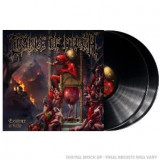
Belched from Hell’s depths into the rustic charms of the Witch County, Suffolk thirty long and disturbing years ago, CRADLE OF FILTH are undisputed giants of the heavy metal realm. Imperious purveyors of a perennially unique strain of dark, dastardly and wilfully extreme metal, with deep roots in the worlds of gothic horror and occult curiosity, the band led by Dani Filth has weathered three decades of tumult and trial, earning a formidable reputation as both a singular creative force and one of the most riotously entertaining live bands the metal world has ever produced.
From primitive early works like 1992 debut »The Principle Of Evil Made Flesh« to more expansive and theatrical classics like ‘Cruelty And The Beast’ and ‘Midian’, CRADLE OF FILTH defied trends and constructed their own idiosyncratic world of foul grandeur, becoming one of the UK’s most notable metal bands in the process. Since then, they have traversed the world countless times, hoovering up plaudits and praise from an ever-expanding international fan base. Resolutely prolific, the band’s catalogue has grown in depth and stature all the while, irrespective of line-up changes or the whims of the faithful.
In more recent times, CRADLE OF FILTH have hit an unmistakable hot streak of creativity and urgency. As a new line-up coalesced around the creation of 2015’s »Hammer Of The Witches«, fresh impetus propelled the band to new heights, as the revitalised crew became more in demand around the world than ever before. 2017’s ‘Cryptoriana - The Seductiveness Of Decay’ repeated the trick with even more explosive flamboyance. Until a global pandemic brought the music industry to a jarring halt, CRADLE OF FILTH were almost permanently on the road and absolutely fucking flying. As a result, it should surprise no one that the band’s brand new album, ‘Existence Is Futile’, is yet another monumental and electrifying journey through the dark.
Buoyed by these recent triumphs, CRADLE OF FILTH recorded »Existence Is Futile« during 2020, piecing the record together in isolation, at Grindstone Studios in Suffolk with studio guru Scott Atkins (Devilment/Benediction/Vader). Although instantly recognisable as the work of these veteran blackhearts, the thirteenth CRADLE OF FILTH album is a wholly different beast from its immediate predecessors. Pitch-black, perverse and at times absurdly brutal and extreme, it hangs together with mesmerising fluidity. It is also absolutely rammed with giant, rousing melodies and moments of jaw-dropping invention. No one could mistake the venomously catchy likes of ‘How Many Tears To Nurture A Rose?’ or monstrous ballad ‘Discourse Between A Man And His Soul’ for anything other than CRADLE OF FILTH, of course, but ‘Existence Is Futile’ confirms that the band’s exploratory instincts remain as sharp as ever.
Underpinned by its huge and disarmingly organic production, »Existence Is Futile« is plainly the darkest and most unsettling album CRADLE OF FILTH have made in a while. Eschewing the band’s trademark twisted storytelling in favour of horrified glimpses into the mortal void and ruminations on the inevitable destruction of life on Earth, its poignancy and relevance to the cluster of nightmares facing humanity in 2021 is impossible to ignore, even if Dani Filth insists, not unreasonably, that he didn’t anticipate a global pandemic when the news songs were being written.
With the best possible timing, CRADLE OF FILTH were already due to make a new album during those long, lonely months of lockdown in 2020. Having grabbed the opportunity with both hands, Dani avows that unavoidable isolation from the rest of the world was the best possible incentive to get the job done, while also adding plenty of eerie atmosphere to the whole experience.
Sonically speaking, ‘Existence Is Futile’ is easily the most powerful and dramatic record CRADLE OF FILTH have ever made: it’s the sound of band’s enviable onstage chemistry spilling over into the studio, propelling each member of the band to new levels of intensity. Combined with the expected labyrinthine arrangements and moments of spellbinding bombast, ‘Existence Is Futile’ may be the most vivid representation of the CRADLE OF FILTH experience yet.
Also, diehard fans will be thrilled to learn that horror icon Doug 'Pinhead' Bradley makes a welcome return to the CRADLE fold, lending his dulcet tones to the epic ‘Suffer Our Dominion’, and to one of the forthcoming new record’s bonus tracks, as Dani explains.
“There are also two bonus tracks in addition to the album, one of which is the culmination to the ‘Her Ghost In The Fog’ trilogy, which began on »Midian«.
For this we had little hesitation in enlisting our friend and actor Doug Bradley to reprise his narrative role. Doug lives in Pittsburgh, which he refers to ‘The Pit’, thus we directed his narrative over Skype from his local studio. He adopts this almost David Attenborough-ish role on ‘Suffer Our Dominion’, which is possibly the most politically astute song we’ve written of late. As a band we usually shy from branching into politics, but it’s something that needed spouting. The fact we’re fucking our ecology up and desperately need to address the situation pronto…”
So, if we’re all going to perish in the fire of our own stupidity, we might as well have a suitably deranged and destructive soundtrack to do it by.
A bewitching, fearless nosedive into the abyss, the band's thirteenth studio album confirms the ferocious efficacy of CRADLE OF FILTH in 2021. Bold, brave, wildly imaginative and heavy as hell, the band’s latest runaway train-ride through the flames is the perfect album for these most imperfect of times. As Dani concludes, “Be like the virus! Mutate and survive!”
- A1: The Fate Of The World On Our Shoulders
- A2: Existential Terror
- A3: Necromantic Fantasies
- A4: Crawling King Chaos
- B1: Here Comes A Candle.. (Infernal Lullaby)
- B2: Black Smoke Curling From The Lips Of War
- B3: Discourse Between A Man And His Soul
- B4: The Dying Of The Embers
- C1: Ashen Mortality
- C2: How Many Tears To Nurture A Rose?
- C3: Suffer Our Dominion
- C4: Us,Dark.invincible
- D1: Sisters Of The Mist
- D2: Unleash The Hellion
Purple/Black Marbled Vinyl[39,62 €]
Belched from Hell’s depths into the rustic charms of the Witch County, Suffolk thirty long and disturbing years ago, CRADLE OF FILTH are undisputed giants of the heavy metal realm. Imperious purveyors of a perennially unique strain of dark, dastardly and wilfully extreme metal, with deep roots in the worlds of gothic horror and occult curiosity, the band led by Dani Filth has weathered three decades of tumult and trial, earning a formidable reputation as both a singular creative force and one of the most riotously entertaining live bands the metal world has ever produced.
From primitive early works like 1992 debut »The Principle Of Evil Made Flesh« to more expansive and theatrical classics like ‘Cruelty And The Beast’ and ‘Midian’, CRADLE OF FILTH defied trends and constructed their own idiosyncratic world of foul grandeur, becoming one of the UK’s most notable metal bands in the process. Since then, they have traversed the world countless times, hoovering up plaudits and praise from an ever-expanding international fan base. Resolutely prolific, the band’s catalogue has grown in depth and stature all the while, irrespective of line-up changes or the whims of the faithful.
In more recent times, CRADLE OF FILTH have hit an unmistakable hot streak of creativity and urgency. As a new line-up coalesced around the creation of 2015’s »Hammer Of The Witches«, fresh impetus propelled the band to new heights, as the revitalised crew became more in demand around the world than ever before. 2017’s ‘Cryptoriana - The Seductiveness Of Decay’ repeated the trick with even more explosive flamboyance. Until a global pandemic brought the music industry to a jarring halt, CRADLE OF FILTH were almost permanently on the road and absolutely fucking flying. As a result, it should surprise no one that the band’s brand new album, ‘Existence Is Futile’, is yet another monumental and electrifying journey through the dark.
Buoyed by these recent triumphs, CRADLE OF FILTH recorded »Existence Is Futile« during 2020, piecing the record together in isolation, at Grindstone Studios in Suffolk with studio guru Scott Atkins (Devilment/Benediction/Vader). Although instantly recognisable as the work of these veteran blackhearts, the thirteenth CRADLE OF FILTH album is a wholly different beast from its immediate predecessors. Pitch-black, perverse and at times absurdly brutal and extreme, it hangs together with mesmerising fluidity. It is also absolutely rammed with giant, rousing melodies and moments of jaw-dropping invention. No one could mistake the venomously catchy likes of ‘How Many Tears To Nurture A Rose?’ or monstrous ballad ‘Discourse Between A Man And His Soul’ for anything other than CRADLE OF FILTH, of course, but ‘Existence Is Futile’ confirms that the band’s exploratory instincts remain as sharp as ever.
Underpinned by its huge and disarmingly organic production, »Existence Is Futile« is plainly the darkest and most unsettling album CRADLE OF FILTH have made in a while. Eschewing the band’s trademark twisted storytelling in favour of horrified glimpses into the mortal void and ruminations on the inevitable destruction of life on Earth, its poignancy and relevance to the cluster of nightmares facing humanity in 2021 is impossible to ignore, even if Dani Filth insists, not unreasonably, that he didn’t anticipate a global pandemic when the news songs were being written.
With the best possible timing, CRADLE OF FILTH were already due to make a new album during those long, lonely months of lockdown in 2020. Having grabbed the opportunity with both hands, Dani avows that unavoidable isolation from the rest of the world was the best possible incentive to get the job done, while also adding plenty of eerie atmosphere to the whole experience.
Sonically speaking, ‘Existence Is Futile’ is easily the most powerful and dramatic record CRADLE OF FILTH have ever made: it’s the sound of band’s enviable onstage chemistry spilling over into the studio, propelling each member of the band to new levels of intensity. Combined with the expected labyrinthine arrangements and moments of spellbinding bombast, ‘Existence Is Futile’ may be the most vivid representation of the CRADLE OF FILTH experience yet.
Also, diehard fans will be thrilled to learn that horror icon Doug 'Pinhead' Bradley makes a welcome return to the CRADLE fold, lending his dulcet tones to the epic ‘Suffer Our Dominion’, and to one of the forthcoming new record’s bonus tracks, as Dani explains.
“There are also two bonus tracks in addition to the album, one of which is the culmination to the ‘Her Ghost In The Fog’ trilogy, which began on »Midian«.
For this we had little hesitation in enlisting our friend and actor Doug Bradley to reprise his narrative role. Doug lives in Pittsburgh, which he refers to ‘The Pit’, thus we directed his narrative over Skype from his local studio. He adopts this almost David Attenborough-ish role on ‘Suffer Our Dominion’, which is possibly the most politically astute song we’ve written of late. As a band we usually shy from branching into politics, but it’s something that needed spouting. The fact we’re fucking our ecology up and desperately need to address the situation pronto…”
So, if we’re all going to perish in the fire of our own stupidity, we might as well have a suitably deranged and destructive soundtrack to do it by.
A bewitching, fearless nosedive into the abyss, the band's thirteenth studio album confirms the ferocious efficacy of CRADLE OF FILTH in 2021. Bold, brave, wildly imaginative and heavy as hell, the band’s latest runaway train-ride through the flames is the perfect album for these most imperfect of times. As Dani concludes, “Be like the virus! Mutate and survive!”
- A1: Takin A Ride (Alternate Version)
- A2: Careless (Alternate Version)
- A3: Customer (Alternate Version)
- A4: Hangin Downtown (Alternate Version)
- A5: Kick Your Door Down (Alternate Mix)
- A6: Otto (Alternate Mix)
- A7: I Bought A Headache (Alternate Mix)
- A8: Rattlesnake (Alternate Mix)
- A9: I Hate Music (Studio Demo)
- B1: Johnny’s Gonna Die (Alternate Mix)
- B2: Shiftless When Idle (Studio Demo)
- B3: More Cigarettes (Alternate Mix)
- B4: Don’t Ask Why (Alternate Mix)
- B5: Somethin To Dü (Alternate Version 2)
- B6: I’m In Trouble (Alternate Version)
- B7: Love You Till Friday (Alternate Mix)
- B8: Shutup (Alternate Version)
- B9: Raised In The City (Alternate Version)
The Replacements’ 1981 Twin/Tone Records debut, Sorry Ma, Forgot To Take Out The Trash, heralded the Minneapolis-based band’s competing tendencies toward indelible genius and reckless abandon. With now classic songs including 'Takin' A Ride,' 'Shiftless When Idle,' 'Customer' and 'Johnny's Gonna Die,' the 'Mats' legendary founding line-up of lead singer/songwriter and guitarist Paul Westerberg, Chris Mars (drums) and brothers Bob and Tommy Stinson (lead guitar and bass, respectively) unleashed a shambling, dynamic sound. Loose, live, and brimming with energy, Sorry Ma… is a lesson in chaos.
The 40th anniversary of Sorry Ma, Forgot To Take Out The Trash is celebrated this fall with a 4CD/1LP set that offers a remarkable document of The Replacements’ formative years. Of the set’s 100 tracks, 67 have never been released before, including the first demos the band recorded in early 1980, as well as a professionally captured concert from January 1981. Along with a newly remastered version of the original album, it also uncovers many unreleased rough mixes, alternate takes, and demos from the band’s first 18 months together. The LP included in the set, titled Deliberate Noise, presents an alternate version of the original album using these previously unreleased tracks.
CD Tracklist:
1. TAKIN A RIDE
2. CARELESS
3. CUSTOMER
4. HANGIN DOWNTOWN
5. KICK YOUR DOOR DOWN
6. OTTO
7. I BOUGHT A HEADACHE
8. RATTLESNAKE
9. I HATE MUSIC
10. JOHNNY’S GONNA DIE
11. SHIFTLESS WHEN IDLE
12. MORE CIGARETTES
13. DON’T ASK WHY
14. SOMETHIN TO DÜ
15. I’M IN TROUBLE
16. LOVE YOU TILL FRIDAY
17. SHUTUP
18. RAISED IN THE CITY
19. IF ONLY YOU WERE LONELY
1. TRY ME (Demo)
2. SHE’S FIRM (Demo)
3. LOOKIN FOR YA (Demo)
4. RAISED IN THE CITY (Demo)
5. SHUTUP (Demo)
6. DON’T TURN ME DOWN (Demo)
7. SHAPE UP (Demo)
8. I HATE MUSIC (Studio Demo)
9. CARELESS (Studio Demo)
10. SHUTUP (Studio Demo)
11. OTTO (Studio Demo)
12. GET ON THE STICK (Studio Demo)
13. OH BABY (Studio Demo)
14. RAISED IN THE CITY (Studio Demo)
15. SHIFTLESS WHEN IDLE (Studio Demo)
16. MORE CIGARETTES (Studio Demo)
17. YOU AIN’T GOTTA DANCE (Studio Demo)
18. DON’T TURN ME DOWN (Studio Demo)
19. RATTLESNAKE (Basement Version)
20. TAKIN’ A RIDE (Basement Version)
21. LIE ABOUT YOUR AGE (Basement Version)
22. WE’LL GET DRUNK/CUSTOMER (Basement Version)
23. JOHNNY FAST (Basement Version)
24. MISTAKE (Basement Version)
25. BASEMENT JAM (Rehearsal)
1. CARELESS (Alternate Version)
2. TAKIN A RIDE (Alternate Version)
3. SHUTUP (Alternate Version)
4. OTTO (Alternate Mix)
5. RAISED IN THE CITY (Alternate Version)
6. RATTLESNAKE (Alternate Mix)
7. LOVE YOU TILL FRIDAY (Alternate Version)
8. CUSTOMER (Alternate Version)
9. SOMETHIN TO DÜ (Alternate Version)
10. JOHNNY’S GONNA DIE (Alternate Version)
11. I’M IN TROUBLE (Alternate Version)
12. I HATE MUSIC (Alternate Version)
13. WE’LL GET DRUNK
14. MORE CIGARETTES (Alternate Mix)
15. GET LOST (Instrumental)
16. HANGIN DOWNTOWN (Alternate Version)
17. SHUTUP (Alternate Version 2)
18. SOMETHIN TO DÜ (Alternate Version 2)
19. DON’T ASK WHY (Alternate Mix)
20. KICK YOUR DOOR DOWN (Alternate Mix)
21. LOVE YOU TILL FRIDAY (Alternate Mix)
22. JOHNNY’S GONNA DIE (Alternate Mix)
23. LIKE YOU (Outtake)
24. GET LOST (Outtake)
25. A TOE NEEDS A SHOE (Outtake)
26. YOU’RE PRETTY WHEN YOU’RE RUDE (Solo Home Demo)
27. IF ONLY YOU WERE LONELY (Working Version/Solo Home Demo)
28. BAD WORKER (Solo Home Demo)
29. YOU’RE GETTING MARRIED (Solo Home Demo)
1. CARELESS
2. TAKIN A RIDE
3. TROUBLE BOYS
4. HANGIN DOWNTOWN
5. LIKE YOU
6. OFF YOUR PANTS
7. GET LOST
8. EXCUSE ME
9. CUSTOMER
10. I WANNA BE LOVED
11. MISTAKE
12. MY TOWN
13. SHIFTLESS WHEN IDLE
14. OH BABY
15. I’M IN TROUBLE
16. JOHNNY’S GONNA DIE/ALL BY MYSELF
17. MORE CIGARETTES
18. OTTO
19. DON’T ASK WHY
20. SLOW DOWN
21. SOMETHIN TO DÜ
22. LOVE YOU TILL FRIDAY
23. RAISED IN THE CITY
24. RATTLESNAKE
25. ALL DAY AND ALL OF THE NIGHT
26. I HATE MUSIC
27. SHUTUP
Nanocluster Vol 1. is an album with some serious pedigree. It sees Immersion (aka Malka Spigel and Colin Newman of influential groups Minimal Compact and Wire respectively) collaborating with some of the finest left field artists of our era: Tarwater, Laetitia Sadier, Ulrich Schnauss and Scanner. The project was born out of a Brighton based club night, also called Nanocluster, run by Spigel and Newman alongside writer, broadcaster and DJ Graham Duff, and promoter Andy Rossiter. The club features a range of influential and cutting edge music acts. But the unique aspect of the evenings is that each show climaxes with a one off collaboration between Immersion and the headliners. The songs having been written and recorded in the studio in just three days prior to the performance - or one day in the case of Schnauss. "It could have just been a series of performances." Says Newman.? "But the fact that we had built the tracks in the studio for the performances means we had these recordings." Says Spigel. The recordings have since been developed with Immersion heading up pro- duction duties. The result is a beautiful and unique album.? "I think the really interesting thing is how different everybody is," says Spigel. "Both as people and creatively." - Immersion and Tarwater: The German duo of Ronald Lippok and Bernd Jestram have created an impressive body of work. Yet their involvement with Immersion has opened out their sound, creating a more panoramic soundscape. The opening instrumental 'Ripples' is a gentle breathe of optimism, all purring tones and sun dazzled synths. Meanwhile, 'Mrs. Wood' is a dubby psychedelic shuffle, Lippok's vocal cool and assured over a fat bass line and skybound eastern melodics. It feels like a more spacious take on the Tarwater of albums such as 'Suns, Animals and Atoms'. The four musicians' 3rd collaboration is Nanocluster's most pop moment: with a heartfelt yet unsentimental lyric unfurling over feline rhythms, 'All You Cat Lovers' is a feel-good anthem for cat lovers everywhere. - Immersion and Laetitia Sadier: An original and distinctive presence in contemporary music, Sadier made her name with the inimitable Stereolab, but she's also created several impressive solo works. The instrumental 'Unclustered' sees Sadier's spidery guitar weaving through Immersion's lush web of synths drones. The following 'Uncensored' has a subtle melodic tug with a classic Spigel guitar line underpinning Sadier's sweet yet worldly wise vocal. 'Riding the Wave' is another feel good song, swapping between Newman's plaintive vocal, and Spigel's vocal and Sadier's backing vocals. With its uplifting chorus: 'Things have a way of working out' 'Riding The Wave' feels like it might be the sound of the summer we've all been waiting for. - Immersion & Ulrich Schnauss: A highly respected solo artist, as well as being a member of Tangerine Dream, Schnauss' skill with electronics is legendary. The opening 'Remember Those Days On The Road' skips along on a rimshot rhythm with Spigel's honeyed vocal telling a tale of life on tour. Yet it is far removed from such usual fare. This feels vulnerable and flecked with melancholy. 'Skylarks' opens with a lattice of arpeggios before a gently nag- ging guitar enters and everything takes a turn for the sublime. 'So Much Green' is everything you'd hope a collaboration between Newman, Spigel and Schnauss could be. A constantly spiralling urban-kosmisch, with Spigel's plangent bass anchoring the celestial sounds. The addition of her wordless backing vocals and recordings of real birdsong only serve to elevate the mood further. - Immersion & Scanner: Scanner - aka Robin Rimbaud - is one of the most prolific and diverse artists currently working in contemporary music. Spigel and Newman have of course collaborated extensively with Rimbaud before: alongside Max Franken in the art-pop group Githead. But this is something very different. Their opening piece together: 'Cataliz' is the album's moodiest moment. With its serpentine synth drones it sounds like the soundtrack to a mysterious thriller. The rich pulsing 'Metrosphere' recalls Immersion's early work whilst adding another layer of grainy uncertainty. The closing 'The Mundane and the Profound' opens with a "Rimbaud scanned" recording of an irritated flight attendant but this is eventually subsumed by a simple yet emotive piano figure: a gentle and touching end to a unique collection of songs. Nanocluster Vol.1 is a testament to a remarkable synergy between a diverse assembly of strongly individual talents. The fact that it not only succeeds, but excels should be cause for celebration.
Sound Wonders: A Series of Epics is the second compilation from Touchtheplants, the imprint and multidisciplinary creative environment founded by Kaitlyn Aurelia Smith and Sean Hellfritsch (aka Cool Maritime). Following 2020's Breathing Instruments, the new collection features sonic responses to a new prompt. Like its predecessor (which explored music as an extension of the human body and the natural world), the medium of focus here dates back to ancient civilizations. Smith invited artists to compose music based on the idea of epics: the long poems and narrative verse works that have detailed deeds and adventures since the dawn of storytelling. The musicians — some of today's most exciting practitioners of experimental sound design, instrumentation, and synthesis — took this directive loosely, realizing a series of vibrant and transportive songs evoking wondrous visions, subjects, and locales.
From Elori Saxl’s chamber piece to Olive Ardizoni’s ode to the strange and beautiful phenomenon of starling murmurations with synth and xylophone tones the album splays out like chapters in a panoramic account of all that surrounds us.
- Tänk Att Få Vakna / Morning
- Has Broken (Traditional)
- Nature Boy (Eden Ahbez)
- A Minor (Nils Landgren)
- In A Sentimental Mood
- (Duke Ellington)
- Solitude (Duke Ellington)
- Värmlandsvisan
- (Traditional)
- Allt Under Himmelens Fäste
- (Traditional)
- Der Mond Ist Aufgegangen
- (Traditional)
- Nu Sjunker Bullret
- (Traditional)
- Din Klara Sol Går Åter Opp
- (Traditional)
- Som Stjärnor Små (Evert
- Taube)
- Den Blomstertid Nu
- Kommer (Traditional)
- Jag Lyfter Ögat Mot
- Himmelen (Traditional)
- Sov På Min Arm (Evert Taube)
“40 years ago my international career started for real when I got
a call from the musical mastermind Thad Jones, asking me to
join his new big band project Ball of Fire in Milan, Italy.
“Guess if I said yes!
“Since then I have walked winding musical paths and I still do.
“As the pandemic started to spread, I got stranded at home in
Skillinge Sweden from 13 March 2020.
“Many many months later, I can present something I’ve never
done before, a solo performance. Only me, myself and my
trombone in a beautiful-sounding church not far away from
where I live with my wife Beatrice, Ingelstorp Kyrka.
“I do not really know exactly when the idea got stuck in my head
but I guess around Christmas 2020. Having spent a strange but
personally wonderful year being at home, I suggested a solo
recording to my wife, and she thought it was a great idea.
“I called the priest in the church, named Maria, and she
immediately said ‘Yes, go for it. I will see to it that the church is
heated and ready for you.’
“The first time was almost a shock. Such a beautiful sound,
making the tone of my trombone just fly through time and
space. Beatrice and I looked at each other in silence, knowing
that this can become something special.
“I picked a wide range of songs and hymns for these occasions
and it felt very special to be able to record it in a wonderful room
with only one person in the audience, the one I love the most.
“All the songs have a special meaning to me, whether they are
songs I sang in church as a child or just picked them up on the
way. One is even written by one of my ancestors, Israel
Kolmodin.
“They present a side of me that is always there, but not always
to be seen. I hope you like it.
“Love, Nils.” - Nils Landgren
For its first standalone release of 2021, Climate of Fear is proud to announce the debut album by NYC avant punk duo Clebs, aka Jason Nazary & Emilie Weibel. “Feed Me Gently” is one of those works that hits out of nowhere: a collection of songs so finely honed and unflinchingly unique it’s hard to believe this is the group’s first outing. Opening with “Negative Space,” the duo pull a deadly fakeout, with gurgling, saliva drenched musique concrète suddenly dive bombing into a ricocheting, noise-encrusted panic attack. Seasoned with trace amounts of 90’s electronica, Weibel’s atomized vocal work and Nazary’s careening drumwork set the tone for the rest of the album. “Feed Me Gently” draws its power from the tension between its snarling aggression and its eerily calm sensuality, with Weibel’s poetic incantations and choked birdsong weaving around melted synth lines, jazzy interludes and brutally deconstructed percussion. A deeply strange, fully formed soundworld, “Feed Me Gently” invites you to bask in its eerily sensual violence.
Black Truffle is pleased to announce Parampara Festival 13.3.1992, a stunning performance by Amelia Cuni captured live in Berlin almost thirty years ago. Milanese by birth and resident in Berlin for many years, Cuni lived in India for over a decade, studying the classical vocal style of dhrupad under masters of the form. Though perhaps known to many listeners primarily through her performances of the vocal music of John Cage and collaborations with Werner Durand and Terry Riley, she is recognised internationally as one of the great contemporary proponents of traditional dhrupad singing. These recordings document her performance at the 1992 Parampara Festival at the Haus der Kulturen der Welt, a landmark event celebrating the global spread of Indian classical music, bringing together Indian teachers with their international students.
Accompanied by Gianni Ricchizzi on vichitra vina (a plucked zither played with a glass ball slide) and her own tanpura, Cuni stretches out for a languorous side-long performance of the late night Raag Bageshri, the limpid tones of her vocal improvisations illuminating the droning strings like flashes of the moon revealed by rushing clouds. Initially working patiently through a series of subtle dialogues between Cuni’s melodic extemporisations and phrases in response from Richizzi’s vichitra vina, the performance builds to a series of strikingly beautiful, virtuosic held notes from Cuni at the beginning of its second half, before picking up some brisker rhythmic articulation on the way to its conclusion.
On Devino Amor, Cuni presents her own composition, a setting of mystical texts by the 13th century Franciscan friar Jacopone da Todi, elaborated through various traditional raags. Like the words used for most dhrupad compositions, the text Cuni has selected from da Todi praises divine love, thus linking her otherwise unorthodox use of Italian text to the dhrupad tradition. The result is a performance of a yearning intensity that communicates across any language barrier. On the final performance, Cuni and Ricchizzi are joined by Helmut Waibl on the two-headed pakhawaj drum for a piece using a 14 beat rhythmic pattern that sets in motion a cycle of tension and release, metrical dissolution and resolution, possessing a subtle grandeur.
Illustrated with archival images of the performance and accompanied by new liner notes from Peter Pannke and Lars-Christian Koch, Parampara Festival 13.3.1992 invites listeners to lose themselves in Amelia Cuni’s unique approach to ancient tradition.
New York City 4-piece deliver a modern blues rock masterclass on their feisty debut album.
“A timeless classic rock sound that revels in lean riffs and raw emotion.” – Afropunk
In an age where artistic merit is awarded to those who shout the loudest, Dakota Jones pride themselves on an unwavering ability to leave a lasting impression. Spearheaded by Tristan Carter-Jones fierce and unashamedly uncensored songwriting, the band’s fast-growing reputation as formidable live act has stamped Dakota Jones with the hell-hath-no-fury power of Chaka Khan, the wild spontaneity of Janis Joplin, and the honey-dripping sensuality of Marvin Gaye. Their debut album’s message of proud black heritage and triumphant queerness manifests itself in Carter-Jones’ ability to challenge norms of adulthood and femininity as she takes a deep dive into some of life’s most visceral emotions.
Tristan Carter-Jones: “I’m a black, queer woman expressing myself through love and music. Some folks still find that to be a transgressive act in and of itself. I work to fight that idea. I write a lot about my
Continued over…
sexuality and the ways in which I express it. Songs about sex and love bounce back and forth between songs about heartache, hangovers and self-medication, and the pleasure and pain of truly finding yourself. I don’t think we get to hear these things from a woman’s mouth as often as we should.”
Serving as an instant tone setter, the album opens with the line "Stretch marks from growing pains" with Carter-Jones lamenting the woes of adjusting to adulthood on lead single ‘Did It To Myself’ - her husky and commanding vocal instantly asserting its place in the spotlight. The atmosphere soon turns steamy on the flirtatious title track ‘Blacklight,’ whilst fantasising over a modern-day Bonnie & Clyde love affair the funk-laden ‘We Playin Bad Games’ packs a punch with its tale of free spirits entwined in a haze of late-night revelry.
Elsewhere, stories of caustic heartache twist the knife into wounded blues guitar riffs on ‘Like That’ and ‘Black Magic (That Power)’, in which Carter-Jones’s stoical voice never once faulters as she mourns the memories of a previous flame. Personal prayer ‘Lord Please’ recites empowered words of reassurance, and solidarity in the face of injustice erupts into a rallying cry for change on the classic sounding ‘Noise’ – written as a reaction to the 2016 US election. “I woke up after the election feeling pure panic and fear in my body,” remembers Tristan. “I wanted people in a place of privilege to stand up for what I was feeling, stand up for injustice, stand up for all of the things we need to change as a country. I wanted their rage, and I wanted their noise.”
Finally, the band’s tender tropes of togetherness eventually boil into gritty, guitar-slung balladry on hidden bonus track, ‘California,’ where, knees buckling under the weight of past trials and tribulations, Carter-Jones sets out on one final journey of self-discovery, hastily pulling out from reality and leaving only a dust cloud in her wake.
Production comes courtesy of the Grammy-winning John Wooler, ex Virgin Records A+R and founder of the Blues label Pointblank who has worked with everyone from John Lee Hooker and John Hammond to Isaac Hayes and Van Morrison. The album also features a wealth of hugely talented and accomplished musicians, including backing vocalist Kudisan Kai, former backing vocalist for the likes of Elton John, Chaka Khan, Anita Baker, Natalie Cole, Beck, Sting, Mary J. Blige and Jill Scott. Also present; Grammy winning keyboardist Jon Gilutin, who has spent years working with some of the industry’s most respected and iconic artists including Linda Ronstadt, James Taylor, Lady Gaga, Willie Nelson, Aretha Franklin, Diana Ross, Jackson Browne, Celine Dion, Bonnie Rait and Carole King. You’ll also hear the talents of acclaimed guitarist Michael Toles. Most well-known for being a part of the Stax Records group The Bar Kays, and for his contributions on famous records by Issac Hayes, Al Green, BB King, Johnny Taylor, Rufus Thomas, Albert King to name just a few.
Dakota Jones are a rising funk, soul and blues rock band from Brooklyn, New York City. Comprising of Tristan Carter-Jones (vocals), Scott Kramp (bass) Steve Ross (drums), and acclaimed musician Randy Jacobs (guitar) - former member of Was(Not Was) who has recorded for Seal, Bonnie Raitt, Tears for Fears, Elton John and many others. Though Carter-Jones and Ross first met in 1999 whilst at primary school, the band formed years later following a series of home jam sessions in 2016. The band’s collective alias originates from Carter-Jones’s middle name, ‘Dakota’. Dakota Jones have since released a string of acclaimed singles and EPs as well as received international attention for their track, ‘Have Mercy’ after it featured on Netflix’s 2019 film, Always Be My Maybe starring Ali Wong and Randall Park – and now after years of hard work and determination, the band are finally set to reveal their long awaited debut album. “We’d been regularly releasing EPs, waiting for our chance to come, and wondering what that would look like,” says Carter-Jones. “We didn’t realise until we started making this record that we needed to stop waiting for some break to come along, and just do it ourselves, independently.”
“Black Light really dives into a place of funk soul and everything that comes with it. There’s joy and dancing, sleek guitar licks and funky bass slaps. There’s pain and longing, and there’s the feeling of relief when you come out of that place and find your joy and purpose again. Black Light is my story.”
Concentric Records presents Radiant, the third compilation of its introductory release trilogy. Featuring music by ASWA, HOLOVR, Max Loderbauer, Petre Inspirescu, Supply, The Waves, William Selman, the album evokes luminous, iridescent and ethereal sonic spaces - a journey that overcomes struggles, spinning upward towards the light.
The album opens with calm, bright and assertive tonalities, evoking mental spaces prone to exploration and wondering. Molecular textures and real-world sounds bring us closer to an intimate and physical sphere, a voice. Ultimately everything dissolves into a synthetic domain of acid-like washes, in a cinematic sense of departure.
MAX LODERBAUER has been an active engineer, producer, and musician across four decades. He first came to notice in the late ‘80s as a member of Fischerman’s Friend. Known then as Daimler Max, Loderbauer’s associates included Stephan Fischer and Tom Thiel, as well as producer Thomas Fehlmann. Once the group went dormant, Loderbauer and Thiel established Sun Electric; one of the leading sources of entrancing downtempo and ambient techno through the ‘90s. During the 2000s and 2010s, Loderbauer collaborated in numerous settings, including NSI with Tobias Freund, Chica & the Folder with Paula Schopf, and Moritz von Oswald Trio with Vladislav Delay and Moritz von Oswald. Loderbauer was partly responsible for some of the most progressive and experimental electronic music released during these years. In 2011, he and contemporary Ricardo Villalobos assembled Re: ECM, a project that involved radical transformations of ECM label recordings by the likes of Bennie Maupin, Christian Wallumrød, John Abercrombie, and Arvo Pärt. More recently he consolidated the collaboration with Ricardo Villalobos via the Vilod project, and with Samuel Rohrer and Claudio Puntin as Ambiq - both described as ‘a fertile patch of inspiration, shaking up the principles of minimal techno with the loose, expressive qualities of jazz’. The album opening track - ‘Harmonic’ - feels like a glowing dream. Composed of stunning electronics in a polychromatic, blinding and shimmering light; harmonious interwoven melodies calmly wind down invoking a serene mental state and grounding peace.
WILLIAM SELMAN was the very first artist ever approached by Concentric Records prior to the label’s birth, back in 2018, following his defining release ‘Musica Enterrada’. A musician and multimedia artist currently based in Portland, Oregon, his work employs analogue and digital synthesis techniques, live percussion and instrumentation, and his own rich field recordings to create compositions and sound art focused on the ideas of place and environment. Selman's recent works have been released on Mysteries of the Deep and Hausu Mountain.
PETRE INSPIRESCU is an extremely versatile composer. As co-founder of the legendary RPR Soundsystem together with Rhadoo and Raresh, he mostly produced club-ready, heavily textured takes on tech-house and minimal techno. In 2015 he released his first album on Mule Musiq, considered a significant departure from his previous work, scoring piano, strings and woodwind instruments for the first time, resulting in a set that sat somewhere between ambient and neo-classical. Since then, he continued to explore further sonic territories, adding in vintage synthesizers and occasional nods to dub techno, resulting in melodious sequences of musical movements that relate to the work of classical composers, American minimalists and ambient legends. ‘The Garden’ is a dreamy, intimate and nature inspired composition, recorded in his home studio in Ibiza sometime in the Summer.
DJ and producer SUPPLY (youngest so far on the label) was born and raised in Gießen, within sight of the skyscrapers of Frankfurt am Main, and has been living in Berlin since 2017. Musically socialised through hip hop, he found his connection to electronic music produced in Chicago and Detroit in the 90s by moving to FFM in 2013. For almost 6 years he has hosted his own events in his hometown. His productions connect the dots between hip hop, retro futuristic movie soundtracks and techno, he recently released on YAY Recordings. ‘Inhale / Exhale’ was created during a time of stress and mental tension, partly self-inflicted, partly result of my surroundings, as it turned out in retrospect. The track tries to capture a moment of taking a deep breath by releasing that tension for a moment. I came up with the first sketch one night around 4am, the final arrangement found its way onto a C60 Chromoxid Cassette - inhale - exhale.’ - Supply
THE WAVES is a post-punk and synthwave-inspired project led by Maayan Nidam, that places her vocals at its front and centre. As a musician obsessed with sound and the technology behind its creation, her workflow places a strong focus on the studio environment. Triggering chain reactions between guitar pedals, drum machines, modular synths and acoustic instruments, generating sounds in unpredictable ways. Drum machines keep a steady groove as to give support to an array of guitars and synthesisers, all topped with The Waves own, mostly unmasked, lyrics and voice. ‘Hold On’ was written by Maayan during the 2020 pandemic as she dived deeply in studio work in Berlin. Her lyrics are featured as part of the art print insert, and have became a central statement to the LP and its narrative - the power to hold on and break through.
Jimmy Billingham's HOLOVR project has racked up various releases on some of the most forward-thinking electronic music labels over the past few years, including Firecracker Recordings, Likemind, Further Records, Opal Tapes and his own Indole Records. Though best known for melodic, drifting acid techno and electronica, he's equally at home crafting textured ambient soundscapes. HOLOVR's deeply emotional synth passages and pads will take you on a journey into the outer. 'Melancholy of Time came out of a period exploring ways of producing and recording outside of the grid-based structures that I was previously working with. I wanted to strip it back to what I often find to be the emotional core of a piece of electronic music - ebbing and flowing synth pads - but to push and pull it a bit to create a slight disjointedness, unpredictability and shop-worn texture, as if it's coming apart and fraying, yet retaining a sonic clarity. I recorded it live using looped and layered synth phrases, underpinned by a layer of hiss and pin-prick textures. I find reflections on time and its passing to be a recurrent feature of my work, both in a more straightforward way of harking back to music of a certain period or pieces of equipment but also in a more abstract sense of creating a feeling where time doesn't matter - a deep feeling of now; that escape that you find in music and other ecstatic experiences. Though of course we’re always in - and running out of - time, and hence the melancholy.’ - Jimmy Billingham
Hailing from the German underground scene, ASWA aka Attila Fidan has an intricate, hypnotic style of electro, techno and ambient. Coming from visual arts and not primarily a trained musician, Attila produces under various and multiple monikers: ‘I never really start out knowing which moniker the track will be made under’. Since 2017 he runs a boutique Berlin label named ‘Tape Archive’. ‘Dust Palace’ is a synthetic piece that resonates with a cinematic vastness, closing the LP in an uplifting tone that evokes new departures and new beginnings.
Fake Laugh & Tarquin first became acquainted a very long time ago, before they were either Fake Laugh or Tarquin. Two humans in their late teens with a keen interest in sound, they would indulge each other in whatever conversation they could muster while loitering in the corridors of their sixth-form college. Their place of learning existed in a sleepy Sussex town where once a year, the skies are filled with explosions, while burning effigies are carried through the cobbled streets by inebriated locals. The two did not suspect that much would become of their light friendship - but in good time that would all change…
In the years that followed, the two young artists moved to London and embarked upon their own totally distinct musical journeys - Fake Laugh was playing in venues with ‘rock bands’, while Tarquin was carving out a niche for himself in the bubbling, lava-like instrumental grime scene, which brought a new kind of heat to the clubs of the city. His vibrant, unapologetically obtuse (and at times absurd) brand of club-music delighted the ears of listeners, the feet of dance-floor dwellers and the brains of music theorists - all in one fell swoop. Having released with Mr. Mitch’s crucial Gobstopper imprint as well as big-guns Rinse, Tarquin has become a household name in the homes of those that know. All the while, Fake Laugh was in his bedroom writing scores of songs and occasionally releasing collections of the strongest cuts on a variety of indie labels who believed in his talent for timeless melody, focussed through his own rose-misted, yet modern lens.
It wasn’t until the fabled summer of 2019 that Fake Laugh & Tarquin would make music together in the same room. The first session resulted in album opener Slow, a song which for the previous two years, lay dormant in an acoustic form on a dusty Fake Laugh hard-drive. Fake Laugh had the idea that perhaps the song could be transformed into something far bigger and better in the hands of Tarquin - a theory which was proven correct.
Throughout Fake Laugh & Tarquin the pair continuously confound the listener, fusing sharp and glacial synthetic elements with warm organic tones and heartfelt vocal performances. Money was written at the start of the global pandemic, a time in which people had more financial concerns than usual. Rejecting total doom and gloom, Fake Laugh & Tarquin turn this dystopian angst on its head and create a one-of-a-kind club mover that pulls inspiration from the super-slick grooves of early noughties stalwarts Moloko and Groove Armada. The album twists, turns, morphs and mutates until it’s peaceful conclusion in the form of existential piano-ballad Meaningless Thin
Joshua is the follow-up album to Olympic. While the second album, typically, often shows what critics call “maturity”, here Simon has released instead an album of adolescence. The musician opened up his own memory box to contemplate his childhood souvenirs, and dust them off of all nostalgia. At that time, he would VHS-record movies from TV and tape record soundtracks directly from the TV speaker, so he could listen to them in his bedroom. This is when he “discovered the power of music, the way it makes you enter another world, far from reality. I wanted to pay tribute to the era I shaped myself in – the ’80s and ’90s”. Tangerine Dream, Kraftwerk and Soft Machine. Logically, these are the sonic signatures that seem to haunt the album. The timeless pioneers of synthetic music constitute the sound references, without any established chronological timeline, that blend with the atmosphere of typically “French Touch” movie soundtracks – long before the term was even coined. “I use a musical palette that acts as a flashback to my favourite teenage movies: the synth sounds of Close Encounters of the Third Kind; the synth pads in Jean-Jacques Cousteau’s fascinating documentaries about the sea world; the melodies in the manner of François De Roubaix; the themes that evoke the soundtracks of late-night TV sessions (those by Verneuil, those with Belmondo, Depardieu, etc.); and the sci-fi ambiences like in Blade Runner.” In short, an aesthetic was decided on by Simon very early on: French analog synths instead of North American symphonic orchestras.
The name Joshua has two meanings for French 79: one is linked to the idea of nostalgia, the other to adventure. On the one hand, the computer in the 1983 movie Wargames, and on the other, the boat of French sailor Bernard Moitessier.
The track titled Joshua synthesizes the spirit of the album – an odyssey, a neverending crossing of the world in search of oneself, a spontaneous escape into the future, under the benevolent eye of the past. This epic invites everyone of us to a specific place in our imagination, which is also the source of an indescribable pleasure for French 79: a gust of wind, a sailboat ride, a skateboarding trick, the smell of freshly fallen snow, or the dull roar of an impatient audience.
The same aesthetic preferences are found in the videos that illustrate Joshua’s first tracks: for Hold On, the skateboarder chose to recall the cult ’90s skate videos that he would watch on repeat as a teenager, while Hometown hints at Close Encounters of the Third Kind. Although he now calls Marseille home, Simon continuously draws with passion from the anachronic contemporaneity of his childhood in the Eastern French region.
“I need escape to be able to create. A two or three-day sailing trip gives me enough inspiration to lock myself in the studio for a week when I’m back on dry land.” His boat takes him far away from everything, far from the Old Port where she moors, the rest of the time Simon would escape by walking the streets of his city or climbing the Alpine mountains.
Not only does the new version French 79 reveal a few biographical pieces of Simon henner's history, but it also inaugurates the first vocal track for the musician. One feels a guilty pleasure when hearing him take the lead on the first track, The Remedy. The electronic fugue that opens the album sets the tone: Simon has found the cure for his inner turmoil and wants us to discover our own treatment too. Hold On is a sonic explosion that celebrates the feeling of freedom - what's more of a teenage dream than this feeling - and it eventually command one to feel the same way too. Echoing Olympic, the electronic argonaut invites his muse again, singer Sarah Rebecca. On By Your Side and Touch The Stars, the native of Ocean Springs, Mississippi, now based in Paris, hoisted the mainsail of dream pop. First, though a dialogue that surfaced their unfailing attachment to the bonds of friendship, then through the light hearted atmosphere that leaves us with no choice but to believe in our own dreams and do anything possible to fulfill them. The quest for peace in the midst of the daily din is heard in both Code Zero and the title track Joshua, two majestic journeys in search of hedonism, combined with introspection.
After enduring a year like 2020, no one could have possibly expected Al Jourgensen to stay silent on the maelstrom of the past 12 months. As the mastermind behind pioneering industrial outfit Ministry, Jourgensen has spent the last four decades using music as a megaphone to rally listeners to the fight for equal rights, restoring American liberties, exposing exploitation and putting crooked politicians in their rightful place—set to a background of aggressive riffs, searing vocals and manipulated sounds to drive it home.
As Jourgensen watched the chaos that befell the world during the height of a global pandemic and the tensions rising from one of the most important elections in American history, he seized on the opportunity to write, spending quarantine holed up in his self-built home studio—Scheisse Dog Studio— along with engineer Michael Rozon and girlfriend Liz Walton to create Ministry’s latest masterpiece, Moral Hygiene (out October 1 on Nuclear Blast Records). Anchored by last year’s leadoff track “Alert Level”—which asks listeners to internalize the question “How concerned are you?”—the 10 songs on this upcoming 15th studio album cover the breadth of the current dilemmas facing humanity, while ruminating on the sizable impact of COVID-19, the inevitable effects of climate change, consequences of misinformed conspiracies and the stakes in the fight for racial equality. And most importantly doing so with the lens of what we as a society are going to do about it all.
Moral Hygiene comes on the heels of Ministry’s acclaimed 2018 album AmeriKKKant (hailed by Loudwire as Jourgensen’s own “state of the union” address) that was written as a reaction to Donald J. Trump being elected president—though Jourgensen says this new album is more informational and reflective in tone. “With AmeriKKKant I was in shock that Trump won. I didn’t know what to do, but I knew I had to do something. Because I believe if you are a musician or an artist you should be expressing what’s going on around you through your art. It’s going to happen whether you do it consciously or unconsciously. Moral Hygiene however has progressed even further into a cautionary tale of what will happen if we don’t act. There’s less rage, but there’s more reflection and I bring in some guests to help cement that narrative.”
In addition to recruiting long-time cohort Jello Biafra (Jourgensen’s partner in the side project Lard) for the quirky earworm “Sabotage Is Sex,” other guest appearances include guitarist Billy Morrison (Billy Idol/Royal Machines) on a rendition of The Stooges hit “Search & Destroy.”
Another standout track is “Believe Me,” featuring a throwback vocal style from Jourgensen that harkens back to his singing on Twitch and cult classic “(Every Day Is) Halloween.” The song came out of a jam session with Morrison, Cesar Soto and sampling from Liz Walton, and reminded Jourgensen of his formative days at Chicago Trax Studios where communal ideas were constantly informing early Ministry records. “’Believe Me’ had such an old school vibe I wanted to bring back old school vocals. …It’s funny how things come back to you,” says Jourgensen, also reflecting on Ministry turning 40 in 2021.
With the release of Moral Hygiene, Jourgensen is more positive than before. “This may sound crazy but I’m more hopeful about 2021 than I have been in two decades at least,” he says. “Because I do see things changing; people are starting to see through all the bullshit and want to get back to actual decorum in society. We could just treat each other nicely and be treated nicely in return. I never thought Ministry would be in the position of preaching traditional values, but this is the rebellion now.”
Etruria Beat founder Luca Agnelli unveils his long-awaited debut album, ‘Source Drops’ – presenting a ten-track journey through techno and beyond.
A name at the centre of Italy’s rich house and techno scene for over a decade, Etruria Beat head-honcho Luca Agnelli continues to showcase his talent as a leading DJ, producer and label boss on the international stage. With releases via a host of globally renowned labels, plus standout remixes including Moby’s iconic ‘Porcelain’, the Tuscany native’s reputation has seen him become of the genre’s leading artists when combining energetic, entrancing productions throughout his powerful DJ sets. Yet, the core of his work has always found a perfect home on his own Etruria Beat imprint, with July now welcoming the arrival of his highly-anticipated debut album ‘Source Drops’ – an in-depth musical story presenting growth, development, self-reflection and raw emotions via a collection of ten tracks ranging from powerful peak-time anthems through to EBM influenced cuts and slower, hypnotic productions.
“This is the journey that traces my musical evolution of the last 20 years, discovering more conceptual, deeper musical territories; taking inspiration from what influenced me in my career as a DJ and from my continuous research without musical barriers. A journey always in equilibrium, at times dark and sharp, solar and fluid, that develops a different creative vision in each track trying to convey my most intimate and strongest emotions". – Luca Agnelli
Opening via the slow-blooming builds and atmospheric and waves of ‘Black Mirror’, before diving into the heady and menacing tones of ‘Mutant Circle’, the ten-track project quickly showcases a wide-reaching range of influences and nuances central to Agnelli’s development as an artist over his career. Productions such as ‘Balance’ and ‘Oxigen’ contrast with one another whilst bringing space to proceedings, guided by breaks-influenced percussion, minimal arrangements and warping leads, whilst the driving ‘Resistance’ harnesses classic techno tendencies to provide an energetic and lively, snaking journey through rich soundscapes.
Title cut ‘Source Drops’ brings that trademark Luca Agnelli energy to the heart of the project, merging scintillating melodies, acid-tinged stabs and icy hats to unveil a high-octane ride into the peak-time, whilst ‘Raw Surface’ keeps the tempo high with sweeping leads, oscillating basslines and resonant lasers. Next, ‘Omega’ spirals into an off- kilter ride through glitchy echoed vocals, crunchy percussion and rumbling low-ends, with the epic ‘Losing Control’ welcoming an infectious lead melody at its core guided by punchy kicks and slick drum licks. To close, the package veers to an eerie yet ethereal close as hazy, celestial vocal chants meet panning sirens and swooping electronics – punctuating an expansive and diverse offering from the Italian favourite and shaping up an impressive debut LP in the process.
Blue Vinyl
Lynch protégé and Twin Peaks sound designer Dean Hurley coaxes an incredible puzzlebox of atmospheres and mood pieces on this killer contribution to our Documenting Sound series, now remastered and pressed on vinyl for what is, perhaps unsurprisingly, the most cinematic and neon-lit instalment in the series. Like a
smudged and overdubbed copy of the BoC Maxima tape, with added iridescence.
Across almost 40 minutes we transition from aerosolised synths to romantic chromatics, thru to Nurse WIth Wound-style severed rhythms and fading glimmers of hope, ‘Concrete Feather’ epitomises Dean Hurley’s prized knack for nuanced instrumental story-telling in the finest and most engrossing style we could imagine. Against the backdrop of the Hollywood film industry that has primed us for as long as we can all remember, the music spans a panorama of lush, mirage-like choral pads and starry flickers thru to gloaming
nightmare sequences and screwed drums, while touching on some of the dankest synth tones this side of his ‘Anthology Resource’ volumes or indeed his soundtrack work for Twin Peaks: The Return. It’s full of dread and a slowly unfolding sense of tragedy.
“Having a regular practice of recording is probably the single most important element to my craft. It’s a way of dropping indiscriminate mile markers while constantly moving forward in time without ability to pause.
Over the years, working for David Lynch taught me a great deal about this and the concept and importance of experimentation. I’ve found myself clinging to those lessons during this time and using them as tools for both productivity and balance. His notion of experimentation is a simple one, yet incredibly profound. It was one of the very first words I heard him say during our initial meeting, and I never stopped hearing the term daily over the subsequent 13 years working together. An ‘experiment’ can provide a legitimate mental back-entrance into the act of creation. It can position an approach toward discovery as opposed to effort, and eliminate the thought that one needs to ‘will’ something into existence. It also aids in calming the judgmental
side of a brain from stepping on/interfering with expression…after all, experiments are not about success or failure, they’re simply about learning. In the Lynch school of thought, multiple experiments then become firewood…and with firewood, one can not only build but actually sustain a fire…even turn it into a multipleacre blaze or more.
Dean Hurley
Where have you gone, Charles Tolliver? There was such promise in the concept of Music Inc., and in Strata East, but evidently the music world's attention was elsewhere and this tremendous live set was probably heard by only a few hundred sets of ears. On the back of the record sleeve, Tolliver undersigned his mission statement: "Music Inc. was created out of the desire to assemble men able to see the necessity for survival of a heritage and an Art in the hopes that the sacrifices and high level of communication between them will eventually reach every soul." And he isn't kidding. You won't find a much higher level of communication than he, Cecil McBee, Stanley Cowell, and Jimmy Hopps engaged in on May 1, 1970 at Slugs' in New York City. This was much more than an attempt to merely 'preserve acoustic jazz' as in the stilted Marsalis vein. This was an attempt to preserve a measure of authenticity while maintaining the notion of forward-thinking, present-tense improvised music. They deserved a greater response than the lukewarm, sparse applause they received that night, and continue to deserve a far more cognizant audience for their efforts.
Tolliver ('Drought"), McBee ("Felicite"), and Cowell ("Orientale") each contribute a track to the set; though very much distinct, each is equally strong. "Drought" is the kind of dark-hued, well-honed burner which Tolliver routinely produced in his fertile years. "Felicite" is a more contemplative affair, a deeply felt and empathically performed piece; the unit here is in particularly sublime form, merging considerable skill with a staggering depth of emotion. "Orientale" falls somewhere in between the pace of the two, with Cowell's Eastern scales establishing an austere, industrious tone throughout its seventeen-and-a-half-minute length.
Through its duration, the music on Live at Slugs' is often riveting and incessantly compelling. Hopps is a lesser-known entity to me, but the other three players featured here are some of the all-time underrated presences in the jazz pantheon, and they play nothing short of masterfully. Always a presence on his recordings, Tolliver demonstrates tremendous range, flair, and command as a trumpeter and leader. Had he not come along at a time when pure jazz was falling out of favour, I have to believe his name (along with Woody Shaw's) would be every bit as prolific as Freddie Hubbard's or Lee Morgan's; the same holds for the always brilliant and expressive McBee on bass.
I feel saddened that Music Inc. fell so far short of "eventually reaching every soul" - yet fortunate that it eventually reached mine.
Rico started his career in the late 1950’s playing with the likes of Prince Buster, Laurel Aitken and Max Romeo as a session musician in addition to creating his own recordings. He moved to the UK in the early 60’s and continued performing live and playing as a session musician. He signed to Island Records in the 70’s, releasing his first solo albums.
In 1979 Rico met Jerry Dammers and began playing with The Specials. He became an honorary member of the band and featured prominently on some of their most famous tracks, along with Dick Cuthell, which produced a distinctive sound. In 1980 he released his first album for the 2 Tone label, That Man is Forward.
Jama Rico was the second album released on 2 Tone Records in 1982. This album felt like a celebration of Jamaican musicians - Jama Rico was an altogether different beast. This was a more resolute statement, more African in its rhythms and a hidden treasure within the 2 Tone label.
This time the recording sessions were split between Joe Gibbs studio in Jamaica and sessions at London’s Town House Studios. The Jamaican sessions again were produced by Dick Cuthell and comprised of musician friends Sly Dunbar, Robbie Shakespeare, Headley Bennett, and Ansel Collins. The London sessions, produced by Dick and Jerry Dammers, featured Specials John Bradbury and Horace Panter, along with Tony Utah and Satch Dixon.
This new remaster, originally released in May 1982, is a part of the ongoing 2 Tone ‘40th Anniversary’ releases.
The package is a 3mm Spined Sleeve, 180gm Heavyweight Black Vinyl, printed inner and bellyband.
Good things come to those who wait! A commonplace that is also true in the case of Perel’s Running Back debut. Ever since „Die Dimension“ appeared on DFA, our own CEO couldn’t wait for a call from the lady herself. Star is the consequence of said call and not only that.
Picturing Perel’s development as a recording artist on the one hand and the hardships everyone had to experience since the world has been changed by a pandemic on the other, making it - in her word words - „an EP about crossing the „physical distance between the people I miss and love“. Opening with the riveting vocals of Star („This song is literally a love song for my people“), the three pieces also show Perel's growing versatility as a producer. The tried and tested neon disco lights interchange with darker tones, uplifting and affirmative moments (Tour De Perel) rotate with contemplative and pondering intervals (Internal Monologue). Yet, by no means Perel is whistling a sad tune. Her melodies are as always deep, distinguishable and delightful to dance to. Wherever that may be.
Kolonel Djafaar’s ‘Cold Heat’ packs a mighty punch, combining the irresistible charm of Ethio jazz and psych rock with the power of a big band brass section, that has made them a formidable live force across Belgium. As they come into their own cinematic sound, now is the time for them to be enjoyed more widely, thanks to masters of exotic groove, Batov Records.
Kolonel Djafaar’s debut release for Batov is an all-killer-no-filler EP. On "Bactrian Camel’’ the four-man brass section picks up a thundering groove, only for the organ-led rhythm section to answer with their own snaking retort. Joris Wendelen’s electric guitar riffing adds a further Middle Eastern flavour to the stew. Written by trombonist Willem De Mol, who delivered the song after two months alone in Russia, "Lamentation" continues the Ethio vibe with a little
Latin panache. The brass-led tone here is mysterious, the melody lingers. An almost surf-esque guitar solo transports the listener before the main groove on organ and brass recalibrates us to the solid rhythm.
Comparable to, but distinct from, The Budos Band and The Comet is Coming, the low-slung sounds of "Recording 68" in particular reveal Kolonel Djafaar coming into their own. The tempo drops, emphasizing the depth of the groove. The EP is appropriately closed in cinematic style on "The Heist". The pace picks up. Drums of death, in the mode of DJ Shadow or Unkle, hold up the distorted synths and that sharpest of horn sections. A song ready for the dirtiest of chase scenes. "Cold Heat" is suitably titled. Fast or slow, killer grooves that will take no prisoners. A taste of Kolonel Djafaar’s power on stage and the clearest picture yet of their direction in sound.
Leo Ceccanti should be a familiar name to all followers of the Claremont 56 label. Alongside sometime studio partner Gianluca Salvadori, he was responsible for two delightfully distinctive Almunia albums released on the label, 2011’s New Moon and 2013’s Pulsar. Both sets were filled with golden, sun-kissed sounds, psychedelic grooves and immersive, life-affirming soundscapes.
Now he’s decided to go it alone as Leo Almunia, delivering a debut album for Claremont 56 that’s every bit as alluring, wide-eyed and evocative as those he made with Salvadori. In keeping with his previous work, the album blends layered acoustic and electric guitars with toasty bass, dreamy synthesizers and grooves that variously touch on hypnotic house, chugging mid-tempo disco, sunset-ready Balearic beats and, on the glistening, life-affirming album highlight ‘Wishing Star’, loose-limbed jazz breaks.
What’s most significant about Ceccanti’s personal musical style is not the blend of stylistic influences he draws on – think psychedelic rock, progressive rock, jazz-rock, new age ambient and slow-motion disco – but rather the way he uses it to paint vivid aural images that genuinely linger long in the memory.
After opening with the duelling guitars and chunky dub disco grooves of ‘Sinking Fields’, Ceccanti sashays between magical moments of rush-inducing positivity, heart-tugging poignance and heady nostalgia.
Along the way, you’ll find numerous sonic highlights. On the intoxicating 21st century psychedelia of ‘Panerea’, jangling chords and eyes-closed psych-rock guitar solos ride a chugging, thickset electronic bassline, while ‘Il Cormorano’ is a metronomic, flash-fried workout rich in fuzz-tone guitar motifs, bluesy riffs and echoing instrumental touches.
He cannily joins the dots between Mid-West Americana and throbbing, psychedelic disco-chug on ‘Loveblind’, while ‘Minor Circle’ sits somewhere between Santana, the Pat Metheny Band and sunrise-ready Balearic blues. Arguably even better is the saucer-eyed brilliance of ‘Brillo De Luna’, where a dubbed-out electronic beat becomes enveloped in life-affirming acoustic guitar chords, exotic slide guitar motifs and string-bending solos. If John Lennon had ingested MDMA rather than LSD before writing ‘Across The Universe’, it would probably sound like this.
Then there’s the album’s crowning moment, closer ‘Can’t Hold a Lover’. A heart-aching, largely ambient instrumental that channels the loneliness and anguish felt by many of those separated from their nearest and dearest during the pandemic, it sees Ceccanti brilliantly wrap a variety of sun-bright guitar textures and solos around some of the loveliest synthesizer chords you’re every likely to hear. On an album packed with effervescent, mood-enhancing musical highs, it’s a rare moment of bittersweet bliss.
Moving into 2021 Pure Space is excited to deliver another year of Australian electronic music. Lately we’ve found therapy through regular body movement to help us see that better days are ahead. We hope you feel this too with this new release…
For our first release of the year, Melbourne’s Third Space captures his most club-focussed exploration to date. It offers a broad path which melts genres, instead showing us an alternate domain.
Having started his own label ‘Nice Setting’ in 2020 and self-releasing an album and an EP, Third Space has established his sound of complex undulating rhythms. For his release on Pure Space, ‘Pattern of Spring’ continues this exploration of dramatic structures with continually shifting timbres - morphing them as they progress through energies, rumbles, and struck surfaces.
The two A-side tracks are powerful displays of organic instrumentation with fluttering pads and subtle resonations. An upbeat tempo and abright atmosphere underpins the opening side, anchored by dnb leaning programming and off-kilter polymetric rhythms.
‘170 Shitshow’ showcases complex percussion underwritten by a formidable resonating karplus-strong section throughout the track. Whilst ‘Pulsing Delay Mod’ builds upon this notion of polymetric rhythms continually at play with one another, it offers a crisp and menacing drum pattern pulsating amongst metallic timbres.
Flipping to the B-sides; ‘Cyclical Pan Workout’ reflects an unruly and evolving atmosphere, anchored by a wonderfully cerebral drum pattern and delicate pad toward the close.
The final track ‘Nonlinear (For Pillows)’ offers re-contextualised melodies and percussion, providing a sense of closure and sonic bookending by linking tones and timbres referenced throughout the EP into a pillow like state.
After he became one of the most respected name in the global Balearic scene skipping rocks across water and moving through an amazing and different philosophy. A Vision of Panorama's latest release is an extremely well-designed album which is morphing his synth-o-logy on even more subtly and glistering shapes. With previous 12'' releases on Mellophonia, Cala Tarida Musica and Omena gave us the first sings ''Tiger'' was a matter of time. Boogie-crafted sound with squelching percussions and a touch of 'jazz in the house' which representing the charismatic sound of Larry Heard is managing not only to satisfy his already fans but to be discovered by tones of new ones who their musical references are not only the European 'state of Balearic music' but the breezy US sound too
Pure Donzin is the debut solo offering by Amsterdam - based Donald “Donny” Madjid - also known for his involvement in The Mauskovic Dance Band. On a pandemic - induced break from his usually busy tour ing schedule, Donny, armed with a 60’s drum machine and a few synths, made the most of his time off by experimenting with, and home - recording new sounds - resulting in a fully - fledged 9 - track album under the artist monicker Don Melody Club.
Whilst many of his local peers tend to turn to sounds further from home for inspiration, Madjid felt drawn to honour the literary and musical tradition of The Netherlands, following in the footsteps of classic and lesser known Dutch troubadours such as Ramses Shaffy (a cover of ‘Laat Me’ features on the album) and Ronald Langestraat. Don drew inspiration from bard - like storytelling and for the first time started writing in his native tongue, craftily forging lyrics that his rich tenor voice delivers with a sincerity that translates regardless of whether or not you understand Dutch. This intimacy is balanced evenly with synth and drum machine grooves, recalling Dutch New Wave legends Doe Maar - merging ear worm pop hooks and infectious danceable beats to these otherwise pe nsive ballads.
An ode to being immersed in the magic of the night in good company, an experience so lacking during the year in which the album was recorded, is the danceable Psychonauten. The track is a fine example of the glittering synthesis of infectio us musical atmosphere and lyrically rich straightforwardness Donny has mastered on the album.
The influence of The Mauskovic Dance Band, especially the bass driven, hypnotic groove - a signature sound Don guides in new directions - can be detected on Ver anderd. Somewhat of an anthem, it is laced with tones of 70’s West - African sounds, like fast percussive key arrangements and energetic backing vocals. An example of a more laid back tune on the record is Isabel, a cool nostalgic love song, a soother for a sentimental occasion.
Opening number Geen Nood (No Panic), lyrically nothing short of a ‘sign of the times’ track, paints a mindful setting of cycling past the Amsterdam canals, seeing the leaves in the water, and feeling your blood flow peacefully throu gh your veins - letting go of the need to be anywhere other than where you are. Be it through meditative observances, or hypnotic dance grooves, Pure Donzin is a record that tempts the listener to become just that: immersed in the moment.
Conceived at the heel of Italy's boot-shaped peninsula in Apulia, Patrick Belaga's Blutt makes music for the unruly imagination. The title is an old German word for 'naked', 'bare', but it can also mean 'blood' when spelt blut. Take away another letter and it makes 'butt'. None of these definitions and adaptations were what prompted the classically-trained composer and cellist to name his second album with a word simulating the sound of a punctured artery. That came later. Blutt's nine woozy compositions are inspired by a contemplative road trip with a friend, and the mysterious muffled music heard from an unidentified source. It was a combination of jazz and classical music that haunted Belaga's wanderings through the Byzantine town Gallipoli, and soon infected his dreams of long-gone civilizations. This record is its outcome, where organic instrumentals and electronic production merge into a sound that's both contemporary and ancient. Samples of mewing incantations and tape hiss sway atop the waltzing thud of piano chords on "Sigh". Composite layers of Belaga's cello play in downcast harmony on "Rust". There's a wistful sense for the romantic, in the eerie rhythm of a piece like "Momentum". The quarter tones of an Eastern European and Middle Eastern folk scale probe a profound melancholy via Kai Knight's violin. Its notes are haunted by a field recording of running water on "Unsoft", echoes of panpipes and a Jew's harp on opener "Lilt". As a consummate composer and performer known for his work with artists Wu Tsang, boychild, Josh Johnson and Asma Maroof, Belaga's Blutt is itself marked by flawless collaborations. Vocalist and instrumentalist Jazmin Romero sings and composes the surreal melodies of "Grey Eye". Multidisciplinary dance artist and producer Riley Watts contributes to the muted, motorik movement of "The Tunnel is a Tower". Together, the record plays as a stunning soundtrack to the strangeness of sleeping, and the heartbreaking transience of time. Like an intense dream half-remembered, the emotions persist after waking but for the sharp machinations just outside of the mind's reach. The album is mastered by Rashad Becker, featuring artwork by Giovanni Furlino & design by N MRE 08.
- A1: Pilot: The Fire
- A2: Will I Remember To Remember?
- A3: My New Foster Parents
- A4: No Friends, Just Visions
- A5: Her Love Interest
- A6: His Love Interest
- A7: The Future Is Bright, The Future Is Orange
- B1: I, Robot?
- B2: The Ballad Of Loss And Self-Doubt
- B3: The Domestic Accomplices
- B4: Mastering My Powers
- B5: Infinite Versions Of Myself, Same Old House Fire
- B6: Let’s Run Into The Flames Together
- B7: Epic Plot Twist: Extinguished
For Fans Of: The Burning Hell; Belle & Sebastian; Iron & Wine.
Following swiftly on from last year’s Tiny Men Parts EP, Quiet Marauder re-enter the sonic fray with their latest Bubblewrap Collective long-player, The Gift, on 9th April 2021. Taking a strong divergence from the bombastic pop-punk of its predecessor, The Gift sees backing vocalist Kadesha Drija step to the foreground for the majority of the album, standing afront a richly crafted, multi-instrumental acoustic-folk backdrop.
Recorded pre-pandemic, January 2020, in The Burning Hell’s (Canada) pop-up Snowbird Studios, aka an art deco villa in Riofreddo, near Rome (Italy), this release marks another chapter in the ongoing international collaboration between the bands. For this album, Quiet Marauder’s (Wales) contributions of acoustic guitar, bass, trumpet and layered lead and backing vocals are granted further textural depth from their Canadian counterparts. These include minimalist harmonic splashes of flute, piano, organ (Jake Nicoll), electric guitar, bouzouki (Darren Browne) and bass clarinet (Ariel Sharratt).
Returning to the conceptual songwriting approach of previous releases MEN and The Crack And What It Meant, The Gift charts the narrative of a troubled teenage girl (Willow) haunted by visions of a mysterious house fire. Willow’s path is traced through well-meaning foster parents, teenage love interests, time-bending superpowers, distrust of domestic appliances and, ultimately, her own memories; covering themes of self-identity and the fallibility of human recall. Though the album marks a more overtly serious tone for the band, the sensitive subject matter is delicately handled through their trademark low-key, observational and, sometimes, darkly humorous lyrics.
Ed Cosens is stepping out of the shadows to take centre stage. The bewitching ‘If', his debut single, marks both the start of an overdue solo career and the latest chapter in the life of a longtime lynchpin of the Sheffield music scene. Best known as the guitarist/bassist and co-songwriter in Reverend & The Makers, Ed has spent 15 years conquering the charts and touring the world, yet leaving the limelight to others. With ‘If', the first song written for his forthcoming solo album, Fortunes Favour (due early 2021), he’s finally ready to reveal his true self. “It’s only taken 10 years or so for me to find the confidence!” says the self-depreciating singer, who shared stages with Arctic Monkeys members Matt Helders and Alex Turner before the Makers took off. “I subscribe to the fine wine way of thinking - allow things to mature fully before enjoying. Nobody wants to be Lambrusco!” ‘If' distils a lifetime of longing and loss, of dreams Vs. desires, into three mesmerising minutes of tremolo-rich, strings-soaked melody. Plangent chord progressions and mournful tones pair with poetic reflections on life’s twists and turns. Shades of The Beatles, Echo & The Bunnymen and Richard Hawley snake in and out. Emotions take over as Ed opens up fully for the first time. Drawing on Ed’s personal experience, he says of ‘If' "Its a love-lorn tale of the struggle between true love’s path and the path which you think you're destined to follow. It’s about the conflict between what you think you want, where you unwittingly lead yourself and ultimately where you should really be." “After several attempts, it became the song that sent me in the right direction. With a lot of albums, it takes one song to kick things off and this was that moment for me. It set out the stall for who I wanted to be as an artist with its strong sense of emotion and the journey that runs through it.” ‘If' was produced by Dave Sanderson, recorded at Giant Wafer studios in Wales at the tail end of 2018 and finally the man from Sheffield’s musical shadows can relish the start his solo career. “People ask why I waited so long, but there was no masterplan,” says Ed. “The time had to feel right. I found my voice along with an inner confidence and suddenly the itch was too much not to scratch. Once I'd started, I scratched like there was no tomorrow.”
Bad Colours is the moniker of London-born, Maryland-raised, Brooklyn-based DJ and producer Ibe Soliman. With influences of garage from both sides of the Atlantic as well as funk, post-disco, proto-house and rap samples; his debut album 'PINK' is set for release by Bastard Jazz on 26th February 2021.
The drive to record an album came about while isolating at home in Flatbush during the COVID-19 pandemic. Inspired by some rough ideas and samples that friends sent him, Ibe focussed his attention on making music. From time well spent soaking up and storing sounds from clubs around the world, Ibe found, now with the time to dedicate towards it, the tracks flooding out. Taking cues from early Trax records and Larry Heard, the UKG musicality of MJ Cole, Todd Edwards' vocal sampling techniques, the brashness of Bmore, and an encyclopedia of disco, funk and soul knowledge; Ibe got to work and quickly compiled more than enough tracks for a full-length release.
Flowing from the album intro 'PINK!', first single 'Cookin' vibes over a Chris Faust sample and saxophone from south California virtuoso Carras Paton. 'Feelin' Like' was originally built around a short vocal sample by Jarv Dee, but grew to include additional lyrics on black power from the Seattle rapper after he heard it: "Dancey stuff with a message" says Ibe.
Slow jam 'Heyyy', with its preemptive lyrical synths, bridges to the album's next single 'Get You Off'. Ibe had been listening to a lot of Marvin Gaye - particularly 'I Want You' - during lockdown, getting into the production and vocals. After writing the "I just wanna get you off" hooks, he handed the track over to talented singer, actor and playwright Marcus Harmon who wrote the verses and provided the stunning vocal performance.
Keeping the sensual vibe, 'Skin To Skin' samples vocals from 'Private Play' by Wash 'N' Set, also produced by Ibe, with the Chris Isaak-esque guitar lines by Lex from Foreign Tapes. Made late at night, CMYK reminded Ibe of driving at night in the rain in NYC, where the colors bleed together on the wet road while 'Boss', the first track made for the album, is based around a Sunny Jones sample. The closing track 'Feel' was made at the peak of Black Lives Matter protests. "I just wanted something hard sounding," says Ibe.
Known for his residencies at some of New York's top venues, Ibe has been rocking crowds as a DJ for over a decade, and has shared the decks with the likes of James Murphy, Mark Ronson, and Q-Tip. He's performed alongside Wiz Khalifa, Snoop Dogg, Pusha T, and Young Thug, to name a few. In high demand as a private party curator, he's helped set the tone for Jeff Koons, FKA Twigs, Justin Timberlake, Travis Scott, and Usher. When Ibe's not behind the decks, he's in the lab, where he's produced for Kendrick Lamar, Faith Evans, Keyshia Cole, and Rick Ross, among others.
Tape
After tapes on Steep Gloss and Cruel Nature, we are happy that Stuttgart-based collective Zebularin join the OM family with their new release “Hermetic Topography“.
The album, a product of weekly recording sessions between March and July 2020, just when the pandemic slowed a bit down, might be the closest approach to what communal experiences sounded throughout 2020. It‘s a bold design of how collective improvisation can work in the post-covid era.
The first minute of „Budenzauber“ sets the tone for the whole record. Synth waveforms get joined by a drumset, both settling into a vivid conversation between digital noise and analog free jazz, finding a shared rhythm for this journey.
Daniel Vujanic, known to some from his recordings with Höhlenmusk Ensemble, Ixtar or E Jugend and the driving force behind Zebularin, had this urge to layer electro-acoustic solo material, synths, prerecorded audio meditations, without bending the sounds into detailed harmonic structures, but to build up dense, morphing atmospheres. In came Daniel Kartmann, a combatant in many of Vujanic‘s musical endeavours, his percussions, wind instruments and some deep musical talk - from obscure black metal to brazilian psychedelica, from Scott Walker to Gustav Mahler. The duo laid down basic tracks, kept arrangements vague, creating a perfect environment for a range of other players and instruments to walk in: piano, woodwinds, electronics, ebowed guitars and a vibraphone. The resulting record is a tender, affectionate take on jazz and electroacoustic composition. One can hear the routine of the involved cast as well as the fun, deep listening and correspondence that took place; even though this album was not recorded live in big-band-style, musical ideas interlock on an intuitive level and complement each other.
Take „Peljuga“ as a perfect example, a loosened jazz improv reminding of The Notwist‘s more psychic enhanced moments, which blends into a conversation between a contact mic and heavily manipulated synths and turns into a minimalist piano composition, which melds into a climactic peak and is interrupted only to rise again. And as complex as this description sounds, as uplifting is the actual song. Or the album‘s last track, „Holmen“, which starts out as an underwater ambient piece and evolves pretty organically into cosmic power electronics.
Despite its name and the Heideggerian flair of some song titles, „Hermetic Topography“ is all but hermetic. It‘s rich in musical colours without melting into a quagmire of maximalist noise. It‘s sophisticated but never top-heavy. It might be one of your favourite tapes of 2021.
One of the most enjoyable parts of Dirtybird is to watch a talented artist grow. Nala started out in Miami cutting her teeth on the local DJ circuit and then moved to LA where she eventually signed with VonStroke and Aundy's Motherbird Management.
Her weekly Dirtybird "TV Party" on Twitch is one of the most popular shows on the network. Each week she features her unmistakeable punk & new wave-influenced DJ style while also hosting a special underground guest, as well as her long time friend and local LA rave legend, Richie Panic.
Nala’s debut on Dirtybird, “Psychic Attack”, is a gritty A-side with her own vocals shouting about the nervous the angst of 2020. The B-side, “Sun Is Hot” showcases her gentler side with a deep groove, a smooth vocal tone, and melodic vintage synth riffs throughout.
The Pet Parade,” the title track to Fruit Bats’ newest album, might be a surprising opening track for longtime fans of Eric D. Johnson’s beloved indie folk-rock project. The six-and-a-half-minute tone poem smolders and drones over just two chords, inspired by the strange and silly community events that he saw growing up outside of Chicago, in La Grange, Illinois, in which people dressed up and showed off their pets. Decades later, The Pet Parade emerges in troubled times, living within what Johnson refers to as the beauty and absurdity of existence. While many of the songs on The Pet Parade were actually written before the pandemic, it’s impossible to disassociate the record from the times. As an example, producer Josh Kaufman (Bob Weir, The National, and Bonny Light Horseman, in which he plays with Johnson and Anaïs Mitchell) was brought in for his deep emotional touch and bandleading abilities. However, Johnson, Kaufman, and the other musicians on The Pet Parade drummers Joe Russo and Matt Barrick (The Walkmen, Fleet Foxes), singer-songwriter Johanna Samuels, pianist Thomas Bartlett (Nico Muhly, Sufjan Stevens), and fiddler Jim Becker (Califone, Iron & Wine) were forced to self-record their parts in bedrooms and home studios across America. Still, says Johnson, “The songs have enough intimacy that it doesn’t sound like it was made a million miles away.” Such tension and turmoil also impacted the lyrics of The Pet Parade. While “Cub Pilot” and “Here For Now, For You” began as more traditional love songs from a personal “I” to a specific “you” Johnson quickly realized that these songs needed to comfort broader audiences, changing the words to a more inclusive “we” and “us.” So too in “The Balcony,” a song ostensibly about a particular space in his grandmother’s apartment, but one that evolved into a metaphor on patience. At times upbeat and reassuring (“Eagles Below Us”) and at times quietly contemplative (“On the Avalon Stairs”), The Pet Parade marks a milestone for Johnson, who celebrates 20 years of Fruit Bats in 2021. In some ways still a cult band, in other ways a time-tested act, Fruit Bats has consistently earned enough small victories to carve out a career in a notoriously fickle scene. And Johnson himself who has played in The Shins, composed film scores, gone solo and returned back to the moniker that started it all, and most recently, earned two GRAMMY® nominations with Bonny Light Horseman doesn’t take this long route of life’s pet parade for granted. “I’m still really excited to make records,” he says. “Lucky and happy and maybe happier that things went slower for me. I’m savoring it a lot more.


![Rico - Jama Rico [40th Anniversary]](https://www.deejay.de/images/l/4/0/977140.jpg)