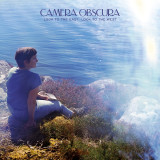
Fresques sur les parois secrètes du crâne is the second album by french duo Cheval de frise, one of the most paradoxical bands rock has ever produced. This striking, enigmatic, baroque masterpiece, was recorded at Black Box studio in 2002, and released in CD format on RuminanCe (Paris), in 2003. The album is now being reissued by New York label Computer Students™, and pressed to vinyl and cassette tape for the first time, with the original track list remastered by Carl Saff. Evoking the cubist digressions of expert jazz, as well as the paroxysms of flamenco with a nylon guitar flexing its muscles on the anvils of the darkest metal, Cheval de Frise creates a frightened rock'n'roll, highly aesthetic yet half ugly, with a transfigured ugliness. Transfigured by what? The question remains unanswered. As does almost every other question that repeated listening to Fresques sur les parois secrètes du crâne raises
Buscar:paradox
His new EP, "Nostalgic For The Future", was inspired by an experience he had during a lucid dream that evoked a paradoxical and enigmatic feeling. Also influenced by the artists of his childhood such as Daft Punk, Alan Braxe or Jestofunk, this new project is imbued with house sounds.
By using artificial intelligence in the conception of "Nostalgic for The Future", Fhin proposes an innovative vision to tackle eternal and inexhaustible themes of music: love, the meaning of our existence or the intensity of our emotions.
Synthesizer king J.B. Banfi, a.k.a. Giuseppe 'Baffo' Banfi, hit the record market with the great italian prog rock outfit Biglietto per l'Inferno who released a legendary LP in 1974 on Trident and have been reivindicated in several occasions since with the release of lost recordings from the era as well as unearthing an unreleased 1974 live album. The band existed between 1972 and 1975, and had both Pilly Cossa on Hammond doing the virtuoso work and Baffo's keyboard explorations adding sound texture and atmosphere. Their second LP was recorded and mixes were to be produced by Klaus Schulze, but it remained unissued due to the Trident label flop. The band split shortly after this, but Baffo continued his experiments with electronic keyboards.
In 1978 Baffo released his first solo LP 'Galaxy My Dear', credited to J.B.Banfi and echoing huge influences from his friend and master Klaus Schulze, who would also produce his two next releases. A total DIY domestic home recording, with all the limitations implied but also with all its warmness within, 'Galaxy My Dear' is entirely played by Banfi and shows an accurate taste in his use of the synths, plus of course a strong kraut / cosmiche appeal that links the album's sound to that of the early Tangerine Dream or Ash Ra Tempel, but also brings a hint of Jean-Michel Jarre or even a certain reminiscence of the early electronic experiments by Franco Battiato and is a good contender to be filed along other Wah Wah reissues like those of Roberto Cacciapaglia or Franco Leprino.
Comes in original artwork with notes written by Baffo Banfi himself in a limited edition of 500 copies only.
His new EP, "Nostalgic For The Future", was inspired by an experience he had during a lucid dream that evoked a paradoxical and enigmatic feeling. Also influenced by the artists of his childhood such as Daft Punk, Alan Braxe or Jestofunk, this new project is imbued with house sounds.
By using artificial intelligence in the conception of "Nostalgic for The Future", Fhin proposes an innovative vision to tackle eternal and inexhaustible themes of music: love, the meaning of our existence or the intensity of our emotions.
Sea Blue in Coke Bottle Clear Vinyl.
Because Hold, Jack Tatum's fifth album under the moniker Wild Nothing, was written in the aftermath of new parenthood during the pandemic, it was probably inevitable that it would be searching and existential music. But during the recording process, the artist known for synth-pop tastefulness used it as an opportunity to reach for a new sonic maximalism and wider set of influences. With contributions from longtime collaborator Jorge Elbrecht, Tommy Davidson of Beach Fossils and Hatchie's Harriette Pilbeam, first single "Headlights On" features an acid house-worthy bass groove and breakbeat that prove Tatum is playing for the rafters. Tatum produced the rest of the record on his own, partially out of necessity, due to the challenges of the pandemic. The songs were eventually brought to Adrian Olsen at Montrose Recording in Richmond to begin recording drums and filling in the gaps. While largely a product of isolation, Hold also reflects the things Tatum has learned from collaborators, both on previous records and during his acclaimed work with Japanese Breakfast and Molly Burch. The rest of the record was mixed by Geoff Swan, who listeners might know for his work with Caroline Polachek and Charli XCX. Swan put Tatum's vocals high in the mix, and throughout the album, he embraces playful vocal processing like never before. Tatum moved from Los Angeles back to his home state of Virginia about five years ago in search of a scaled-back lifestyle. The relatively suburban environment - and the occasional regret it inspired - proved to be great artistic fodder. It's the paradox of modern America - the suburbs are supposed to be stultifying to art, but they are so full of human desperation perfect for dramatizing. On "Suburban Solutions", he presents an anti-jingle with an acidly bright synthesizer melody, imploring you to sign on the dotted line, put your feet up, and embrace sweet oblivion. Adding to the song's menacing cheeriness is a chorus-sung bridge, made with assistance from Molly Burch and Tatum's wife, Dana, It was loosely inspired by the classic Martika song "Toy Soldiers" and the long-ago pop craze for children's choirs, and he embraces the trend's less-than-stellar reputation. By design, Hold dwells in uncertainty and fear, but in a package that encourages meditation and a bit of fun. "In the face of the pandemic, I think being a parent really forced my hand," Tatum said. "I felt that I had no other choice but to have a positive outlook on the world. Because if I were to give in at any moment and say, "Oh, everything is horrible," then I'll feel as if I've lost and I've given up on my son being able to thrive in this world."
Sea Blue in Coke Bottle Clear Vinyl LP + artist signed art print. Only 200 available.
Because Hold, Jack Tatum's fifth album under the moniker Wild Nothing, was written in the aftermath of new parenthood during the pandemic, it was probably inevitable that it would be searching and existential music. But during the recording process, the artist known for synth-pop tastefulness used it as an opportunity to reach for a new sonic maximalism and wider set of influences. With contributions from longtime collaborator Jorge Elbrecht, Tommy Davidson of Beach Fossils and Hatchie's Harriette Pilbeam, first single "Headlights On" features an acid house-worthy bass groove and breakbeat that prove Tatum is playing for the rafters. Tatum produced the rest of the record on his own, partially out of necessity, due to the challenges of the pandemic. The songs were eventually brought to Adrian Olsen at Montrose Recording in Richmond to begin recording drums and filling in the gaps. While largely a product of isolation, Hold also reflects the things Tatum has learned from collaborators, both on previous records and during his acclaimed work with Japanese Breakfast and Molly Burch. The rest of the record was mixed by Geoff Swan, who listeners might know for his work with Caroline Polachek and Charli XCX. Swan put Tatum's vocals high in the mix, and throughout the album, he embraces playful vocal processing like never before. Tatum moved from Los Angeles back to his home state of Virginia about five years ago in search of a scaled-back lifestyle. The relatively suburban environment - and the occasional regret it inspired - proved to be great artistic fodder. It's the paradox of modern America - the suburbs are supposed to be stultifying to art, but they are so full of human desperation perfect for dramatizing. On "Suburban Solutions", he presents an anti-jingle with an acidly bright synthesizer melody, imploring you to sign on the dotted line, put your feet up, and embrace sweet oblivion. Adding to the song's menacing cheeriness is a chorus-sung bridge, made with assistance from Molly Burch and Tatum's wife, Dana, It was loosely inspired by the classic Martika song "Toy Soldiers" and the long-ago pop craze for children's choirs, and he embraces the trend's less-than-stellar reputation. By design, Hold dwells in uncertainty and fear, but in a package that encourages meditation and a bit of fun. "In the face of the pandemic, I think being a parent really forced my hand," Tatum said. "I felt that I had no other choice but to have a positive outlook on the world. Because if I were to give in at any moment and say, "Oh, everything is horrible," then I'll feel as if I've lost and I've given up on my son being able to thrive in this world."
Sechs Jahre nach Ihrem Debüt und direkt nach ihrer Tournee als Special Guest für Depeche Mode erscheint mit „Navel" das langerwartete zweite HOPE Album auf Haldern Pop Recordings.
NAVEL, das zweite Album der Berliner Band Hope ist eine Übung in Verletzlichkeit. Die vier Musiker*innen wagen sich hinter den Soundwänden hervor, die sie in der Vergangenheit um sich herum errichtet hatten, und zeigen, wie sie hinter den Barrikaden sind: sanft, nah- und fehlbar.
Das hat zum einen mit einer inneren Entwicklung der Sängerin Christine Börsch-Supan zu tun und mit der sich daraus ergebenden neuen musikalischen Richtung der Band. Wo früher Wut und Wucht war, ist heute so etwas wie Ruhe. An die Stelle von Monumentalität ist Meditation getreten. Erzählte das 2017 erschienene HOPE in seinem vollkommen eigenständigen dunklen, dystopischen Noise-Sound von Zwängen, unterdrückten Gefühlen und Gewalt, stellt sich auf NAVEL nun Heilung ein. „Solace“ singt Christine Börsch-Supan mit ihrer genauso klaren wie warmen Stimme im gleichnamigen Song immer wieder: Trost, Trost, Trost.Die Sängerin, auf deren eigener Gefühlswelt die Texte der Band basieren – und damit auch ihr emotionaler Klangraum –, hat sich in den vergangenen Jahren von einer Essstörung befreit und damit von der großen Wut, der anklagenden Haltung und dem Aufbegehren, die die Musik von Hope lange bestimmten. Mit NAVEL hat die Band nun eine Art Zen-Garten errichtet. Einen offenen, auf das Maximale reduzierten, luftigen Raum, der dazu einlädt, ihn zu durchschreiten, der sich aber nicht aufdrängt – und der niemandem eine Deutung aufzwingt. Die Moog-Sounds, die zarten Gitarrenakkorde, das Schlagzeug, oft nur so auf den Fellen der Trommel gespielt, dass ein Sound entsteht, der wirkt wie elektronisch erzeugt – alles auf NAVEL ist durch die Weite bestimmt, die sich zwischen den Elementen auftut. Für NAVEL hat sich die Band von der Idee von Perfektion und Kontrolle verabschiedet und damit – schönstes Paradox – ein nahezu perfektes Stück Musik geschaffen.
Last summer the idea came up that the material of the Chillum Trio live act, which had been matured for years by then, would deserve a release on its own. The concept was to try to reproduce the experience of the live performances as close as possible, so a semi-mixed album was created, on which the seven tracks work separately, but the effect is best when listening to the record in its entirety. The musical world of Random Rituals is crazy dense and colorful, similar to Chillum Trio's previous releases, an exotic mix of contemporary electronics, world music and club sounds;s still, it has a unified character, which is due to the fact that it has grown from a live set that has been constantly developing over the years. Genre-wise, it is characterized by low-tempo, organic desert house, tropical acid drops, deep dub, hypnotic tribal beats and psychedelic episodes. Just like genres, eras and cultures are mixed as well: from the jazz-funk of the 70s, via tribal trance of the 90s to modern deep house, from Peru to Pakistan, from Sudan to Senegal: a real musical journey through space and time.
Géza Szekeres, the heart and soul of Chillum Trio, summed up the essence of the record as follows:
"Random Rituals shows me the paradox that recharges can be planned and ad-hoc at the same time. Rituals are characterized by a predictable scenario, but the effect can also be unexpected, so that events spin without a score. You don't walk into the ritual, but it comes to you, creating the same state that then fills you up."
DJ Bone is a Detroit titan. He plays on the decks with high energy and next-level skill that few can match - which is why they call him the Terminator. He pulls no punches in the studio either, crafting all killer no-filler club weaponry as exemplified here by his new album Further. This is top-level techno on his own Subject Detroit label with lashings of machine soul, futuristic ideals and evocative atmospheres. Some cuts sink into deep inner grooves and take you on a mindful trip and some are more wildly expressive, but all of them bang in the club.
Works for the Ever Present Orchestra Vol. II continues Black Truffle’s documentation of the late work of legendary American experimental composer Alvin Lucier, who sadly passed away in 2021 at the age of 90. Like the first volume of the series, the two works recorded here were written for The Ever Present Orchestra, an ensemble founded in Zürich in 2016 to perform Lucier’s work exclusively. At the core of the music Lucier wrote for the ensemble is the electric guitar, an instrument he began to explore in 2013. Played with e-bows, in these works electric lap steel guitars take on roles akin to the slow sweep pure wave oscillators heard in many of Lucier’s works since the early 1980s. This strikingly elegant pair of compositions would serve as an ideal introduction to Lucier’s late music for a listener as yet unfamiliar with its graceful exploration of beating patterns and other acoustic phenomenon.
The two pieces have quite different characters, exemplifying Lucier’s ability to harvest a remarkable range of musical results from closely related compositional procedures and concerns. In Arrigoni Bridge (2019), Lucier uses a technique familiar from earlier works such as Still Lives (1995), where sine waves traced the shapes of household objects. Here, three lap steel electric guitars (played by Oren Ambarchi, Bernhard Rietbrock, and Jan Thoben) follow the form of the Arrigoni Bridge that connects Middletown and Portland, Connecticut. The bridge’s two enormous steel arcs become slowly sweeping pitches, alongside which alto saxophone (Joan Jordi Oliver Arcos), violin (Rebecca Thies) and cello (Lucy Railton) sustain long tones, creating a variety of audible beating patterns depending on their distance from or proximity to the guitars. With its stately pacing, warm middle register tones, and rich timbral variety in the sustaining instruments, Arrigoni Bridge is a beautiful example of compositional reduction producing immersive results. Flips (2020), on the other hand, is more austere. Scored for two lap steel electric guitars (Rietbock and Thoben), double bass (Ross Wightman) and glockenspiel (Trevor Saint), the two acoustic instruments played with bows, the piece zooms in on the range of a major second (two semitones). The two guitars sweep in opposite directions within the range, crossing every four minutes; the double bass and glockenspiel sustain long tones, producing beats of different speeds determined by their distance from the guitar tones. This limitation of the tonal range means the music is often dissonant and forces the phenomenon of audible beating to the surface, resulting in a paradoxical music composed entirely of long tones yet alive with pulsating rhythm. Exemplifying Lucier’s ability to uncover near-infinite complexity within seemingly simple materials, Works for the Ever Present Orchestra Vol. II is a fitting tribute to one of the major figures of the experimental music tradition and a testament to the continuing power of his work.
- A1: Tower Of Meaning I
- A2: Tower Of Meaning Ii
- A3: Tower Of Meaning Iii
- A4: Tower Of Meaning Iv
- A5: Corky I / White Jet Set Smoke Trail I
- A6: Consideration
- B1: Tower Of Meaning V
- B2: Tower Of Meaning Vi
- B3: Tower Of Meaning Vii
- B4: Tower Of Meaning Viii
- B5: Tower Of Meaning Ix / Corky Ii
- C1: Tower Of Meaning X
- C2: Give It To The Sky
- D1: Tower Of Meaning Xi
- D2: Tower Of Meaning Xii
- D3: Corky Iii / Tower Of Meaning Xiii
- D4: White Jet Set Smoke Trail Ii
Black vinyl[26,01 €]
Im Herbst 2023 erscheint bei Erased Tapes das Album Give It to
the Sky: Arthur Russell"s Tower of Meaning Expanded. Bei der
vom Komponisten und Producer Peter Broderick und dem 12-
köpfigen Ensemble 0 aus Frankreich aufgenommenen Version,
handelt es sich um eine erweiterte Neuinterpretation von Arthur
Russells minimalistischer Orchesterkomposition "Tower of
Meaning", die erstmals im Jahr 1983 veröffentlicht wurde. "Give
It to the Sky.." vereint zudem auch unveröffentlichte Stücke von
Russell, die überarbeitet und neu aufgenommen wurden. Mit
ihrer umwerfenden, insgesamt 80 Minuten langen Hommage
hauchen Broderick und Ensemble 0 dem "Tower of Meaning"
neues Leben ein und verknüpfen diesen minimalistischen
Meilenstein mit etlichen verlorenen Songideen aus Russells
Nachlass. Das komplette Album, das so gut wie ohne Overdubs
auskommt, wurde live in einem kleinen Theater im Südwesten
Frankreichs eingespielt. Gewiss war Russell nie ein Freund
endgültiger Versionen. Er dachte kontinuierlich über die
Möglichkeiten eines Stücks nach und fragte sich, was es sonst
noch alles sein oder werden könnte. "Give it to the Sky" knüpft
ganz klar an diese Herangehensweise an, indem es "Tower of
Meaning" als grobes Framework nutzt, um darauf aufzubauen,
diesen atmenden Kern nach oben und nach außen zu erweitern
- und insgesamt etwas entstehen zu lassen, das man ganz klar
in Russells wundersam-paradoxer Welt verorten kann. Auch
"Give it to the Sky" kann somit keineswegs als letztes Wort oder
ultimative Interpretation gedacht sein. Broderick und Ensemble
0 sind längst darüber im Austausch, welche Formen es auf der
Bühne annehmen oder wohin es sonst führen könnte.
- 1: Tower Of Meaning I
- 1: 2Tower Of Meaning Ii
- 1: 3Tower Of Meaning Iii
- 1: 4Tower Of Meaning Iv
- 1: 5Corky I / White Jet Set Smoke Trail I
- 1: 6Consideration
- 1: 7Tower Of Meaning V
- 1: 8Tower Of Meaning Vi
- 1: 9Tower Of Meaning Vii
- 1: 0Tower Of Meaning Viii
- 1: Tower Of Meaning Ix / Corky Ii
- 2: 1Tower Of Meaning X
- 2: Give It To The Sky
- 2: 3Tower Of Meaning Xi
Clear vinyl[25,17 €]
Im Herbst 2023 erscheint bei Erased Tapes das Album Give It to
the Sky: Arthur Russell"s Tower of Meaning Expanded. Bei der
vom Komponisten und Producer Peter Broderick und dem 12-
köpfigen Ensemble 0 aus Frankreich aufgenommenen Version,
handelt es sich um eine erweiterte Neuinterpretation von Arthur
Russells minimalistischer Orchesterkomposition "Tower of
Meaning", die erstmals im Jahr 1983 veröffentlicht wurde. "Give
It to the Sky.." vereint zudem auch unveröffentlichte Stücke von
Russell, die überarbeitet und neu aufgenommen wurden. Mit
ihrer umwerfenden, insgesamt 80 Minuten langen Hommage
hauchen Broderick und Ensemble 0 dem "Tower of Meaning"
neues Leben ein und verknüpfen diesen minimalistischen
Meilenstein mit etlichen verlorenen Songideen aus Russells
Nachlass. Das komplette Album, das so gut wie ohne Overdubs
auskommt, wurde live in einem kleinen Theater im Südwesten
Frankreichs eingespielt. Gewiss war Russell nie ein Freund
endgültiger Versionen. Er dachte kontinuierlich über die
Möglichkeiten eines Stücks nach und fragte sich, was es sonst
noch alles sein oder werden könnte. "Give it to the Sky" knüpft
ganz klar an diese Herangehensweise an, indem es "Tower of
Meaning" als grobes Framework nutzt, um darauf aufzubauen,
diesen atmenden Kern nach oben und nach außen zu erweitern
- und insgesamt etwas entstehen zu lassen, das man ganz klar
in Russells wundersam-paradoxer Welt verorten kann. Auch
"Give it to the Sky" kann somit keineswegs als letztes Wort oder
ultimative Interpretation gedacht sein. Broderick und Ensemble
0 sind längst darüber im Austausch, welche Formen es auf der
Bühne annehmen oder wohin es sonst führen könnte.
French label and promoter Much More recordings is proud to present the second vinyl of its collection. This vinyl features 6 tracks ranging from breaks to techno and passing electronica, designed for soundsystem and anchored in their proper original and analogic techno sound.
- In the cosmos of techno, a pear takes height,
As Hawking once mused, our past's pear-shaped light.
Evoking the essence of techno's design.
From acid's lemon embrace to bitter-sweet's delight,
Techno's past and future, in pear-shaped swirl.
Upon the tree stump, a glimpse of starlight,
A timeless journey, through cosmic embrace.
Techno's essence, expanding through space,
Techno's soulful evolution, a work of art. -
AudioKast joins, promoting sheer delight. Intelligent, smooth, with a touch of piano, A break-infused track, atmospheric glow. Falling Echoes, from France's southern land, Techno that lingers, both fresh and grand. Straight, mental, efficient, it ensnares, A captivating sound, with eternal affairs. Ricardo Garduno, Mexico's pride, Illegal Alien's head, his track provides heavy, straightforward, 4-to-the-floor, A dancefloor bomb, demanding much more. Johannes Astrup,
from Copenhagen's embrace, Smart-stepping techno, a timeless grace. Killing beats that reverberate and flow, Infinite rhythms, an everlasting show. Joton and Aicrag, a powerful duo, Break smart-stepping techno, boomy and true. Their collaboration, a vibrating spell, Moving bodies, a dancefloor's sweet swell. The Blackmailer, a friend tried and true, Driving, big room, a relentless beat, Techno's love, a symphony complete. Dear friends, in this cosmic dance we partake, Love and techno, our souls awake.We are back to the essence, and yet, much more.
- Ain’t Gotta Do It
- Spinning Round (Feat. Viktoria Tolstoy)
- Who’s Right, Who’s Wrong
- I Had To Learn Not To Care
- Moonlight (Feat. Seven)
- Turn The Lights Down Low (Feat. Kim Sanders)
- Carnaval De La Gente (Feat. Bireli Lagrène)
- Soul Searching (Feat. Nils Landgren)
- Walk Away (Feat. Randy Brecker)
- Naked Funk
- Keep On Running (Feat. Pete York)
- Wade Groove
- I’ll Do It Anyway (Feat. Ida Sand)
- Paradox Jam (Feat. Magnus Lindgren)
- Another Star
- A1: Zena - A Dame
- A2: Navraty - Returns
- A3: Listicko - Foliage
- A4: Shwakespearuv Paradox - Good Soldier Shwakespeare's Paradox
- A5: Ulice - The Street
- A6: Pes - A Dog
- A7: Nevime - We Don't Know
- A8: At' - Even If
- B1: Krysy - The Rats
- B2: Navoneny - Perfumed
- B3: Snad - Hopefully
- B4: Noha - A Leg
- B5: Silak - Muscleman
- B6: Egoista - Egoist
- B7: Vul Z Zuly - The Stone Ox
- B8: Kdo Z Koho Ten Toho - Victor Tall Over All
- B9: Neni Na To Cas - Ther Is No Time For That
Darkwave artist Harsh Symmetry returns with sophomore album "Imitation" via Fabrika Records. Los Angeles-based musician Julian Sharwarko has swiftly carved out a commanding presence with his darkwave project. Sharwarko's adeptness at bridging the gap between the past and present is palpable, as he seamlessly blends influences from genre titans such as Depeche Mode, The Cure, New Order, Echo and the Bunnymen, The Teardrop Explodes, and Human League, while also incorporating elements from contemporary acts like Twin Tribes and Boy Harsher. Harsh Symmetry's second album, "Imitation," spans the chasm of darkwave and synthpop, a world-weary modern album, warmed by the solid embrace of nostalgia. Astonishingly, the entire album was entirely recorded and performed by Shawarko, in a remarkably quick turnaround from his last year's critically acclaimed debut album, 2022's "Display Model." Releasing a new album every year during the 1980s was par for the course with bands like The Cure and Siouxsie and the Banshees, as well as other highly prolific bands such as his labelmates Lebanon Hanover, but this level of artistic output is rarely matched today. "A lot of the material was informed by isolation and struggling with the paradox of wanting to be original yet feeling like your entire identity is built on mimicry," he admits. "The album was recorded as I was preparing to move out of the city I grew up in, I guess that kind of nudged me to think about what I'm doing more, and the place my work might have in the world." That mindset led to a pleasant surprise during his recent tour, which he describes as a 'really interesting and exciting experience.' This year, Harsh Symmetry graced the stages of Wave Gotik Treffen and the Grey Scale Festival in Munich, to much audience acclaim, cementing the project's status as an essential artist in the international darkwave scene. Genre: Alternative / Post-punk / Darkwave
'AVANT TRASH' ist der programmatische Titel des Debütalbums der Cousines like Shit.
Mit ihren kritischen Punchlines verlautbaren die Cousinen ihre Beobachtungen zu Gesellschaft und dem Paradoxon Mensch. In Tracks wie 'Barbie', 'Vivid Sassy' oder 'Bachelorette' kann man sich wiederfinden, ertappt fühlen, oder man muss schlicht schmunzeln, wenn einem die Komik gewisser menschlicher Verhaltensmuster bewusst wird. Mit der Wahl des Titels 'AVANT TRASH' kreieren die Cousinen nicht weniger als ein eigenes Genre für sich, für ihren unverkennbaren Stil, textfokussiert und untermalt von simplen, aber eingängigen Melodien.
The early days of "Baltimore Club Music" saw it played at popular venues like Club Fantasy, The Ozone, Hammerjack's, and Paradox. DJs Sean Marshall, Marc Henry, Shawn Caesar (at DJs Outlet in Old Towne Mall), Scottie B and Danny Class (at Inner City Records), Technics (at Music Liberated), DJ Patrick (at Sound of Baltimore), and Diamond K and Kenny B (at Electronics & More) all contributed to the mix of hip-hop, house music and homemade beats that made up this new sound. "Booty Mission" (1992) is a creation of Shawn Caesar and Ty "Flex" James and is considered one of the most influential releases, an essential for any Baltimore Club Music fan. It is sure to remain timeless.
A long-in-the-works project of ours, here comes A Tribe Called Kotori's first foray into full-length territories, as the immensely talented Rampue takes us on a melancholy-riddled ride across his phantasmatic mindscapes. A true sound explorer, deftly steering his ship down the junction of electronica, abstract and balearic-infused prog house, the Berlin-based vibist has us transfixed and elevated throughout the twelve cuts that form the backbone to this lushly textured promenade in sound - at times understatedly euphoric, at others rivetingly exotic.
Of the creative process that lead to 'Bubblebath Trance', Rampue explains "It all started and ended in the same moment: my cherished feline companion, my laptop awash with an unintended bath, and alas, a dearth of backups. The resultant calamity, an echo of chaotic tranquility." Under the generous layer of irony lies some unaltered truth about Rampue's debut long-player for A Tribe Called Kotori: this sense of serenity that goes with stepping into this warm and bubbling primitive chaos of sorts infuses the listening experience far and wide. Distantly emulating the "euphonious strains" of iconic PS1 video games soundtracks from his youth days, the album has us surfing a constant paradox of emotions, wistful but not abandoning itself to sorrow, dynamic yet suspended in some sort of mind-expanding stasis. As if you were looking at the world beneath you in exploded view, conscious of all thing, slowly moving up the many layers of our atmosphere towards uncharted skies.
A paragon of Rampue's most poignant take on classic electronica tropes, 'Harmonie' blazes with a poetic fire that engulfs about everything in its wake. Just figure yourself riding a chocobo across the sand-covered expanse of North Corel (toasting to the FFVII nerds here) as this blasts out in the distance. From this trancey bubblebath emerge lots of musical shades and nuances, from the nicely dubbed-out, brass-heavy coastal jazz of 'Schattenschranz' to the choppy, trip-hop-adjacent future electronics of 'Inside', via the exuberantly joyous mess of faux-organic number 'Tripomatic' and cinematic charisma of 'Ich hasse Sonne' high-flying orchestrations.
Connecting the dots between that trance-indebted ebullience and further downtempo-friendly attraction, 'Verfahren' perhaps encompasses best what 'Bubblebath Trance' is about: gracefully walking the tightrope in-limbo nostalgia-soaked inner movements and a powerful outward thrust, burning to let the feelings ooze out from the shell that holds them.Clad in purely 90s-compatible breaksy motion, 'Salz' is another attempt to reconcile emotional and physical dissonance, like kneading all states - solid, liquid and vaporous - into an impossible mega-vibe of its own; malleable, strong and enveloping in equal measure. Borrowing from two-step and UK garage, 'Take Away' is a definite high in Rampue's master unfolding of musical twists and turns, summoning a Boarder Community-esque atmosphere and clashing it alongside floor-ready footwork motifs to fascinating effect.
An ode to his studio companion, 'Buchla Trip' finds Rampue's exploring his machinic friend's quirky yet soulful array of electronic potentialities - making it sound like a conversation you'd have with R2-D2 in the heart of a Sandcrawler, whereas 'Kajal' beams us up to a fragmented headspace, halfway altered PC-Pop and arps-loaded electronica on amphetamines. Effusive and transporting, the title-track 'Bubblebath Trance' could well figure as the album's no.1 medley in essence: a bountiful lucid dream of dancing forms, colours and sentiments to wrap your head around, confidently drifting from a liminal state of consciousness down the rapids of one's troubled inner workings.
Rounding off the package, the languid ambient finale of 'Die Leiden des hungrigen Fruehstuecks' rubber-stamps the feeling that 'Bubblebath Trance' belongs to that rare category of albums. The ones that mint their own alphabet aside from typical norms and expectations, teaching you the ropes of their new language as it unreels between your ears - real and unreal, elusive to any other meaning than the one your guts and brains will be inclined to give it to, in real time. A crystal-pure object if you will, that shall not reveal its secrets, even after a thousand listens and just as many wowing moments.
- A1: Hello, Beautiful
- A2: Leaving Spacedock
- A3: No Win Scenario
- A4: Blood In The Water
- A5: Flying Blind
- B1: Legacies
- B2: Evolution
- B3: Laforges
- B4: Invisible Rescue
- B5: Dominion
- C1: Get Off My Bridge
- C2: Frontier Day
- C3: Hail The Fleet
- C4: Make It So
- C5: Where It All Began
- D1: The Last Generation
- D2: The Missing Part Of Me
- D3: Must Come To An End
- D4: A New Day
- D5: Names Mean Everything
- D6: The Stars - End Credits
Der Soundtrack zu Star Trek: Picard Staffel 3 in limtierter Auflage als Doppel-LP auf Sky Blue w. White Burst Vinyl mit Gatefold-Hülle und Inserts
Die Vertonung des Spiels durch den preisgekrönten britischen Komponisten Stephen Barton (Star Wars Jedi: Fallen Order, Call of Duty 4: Modern Warfare, Titanfall, 12 Monkeys, Apex: Legends) und dem deutschen Emmy-Gewinner Frederik Wiedmann (All Hail King Julien, Green Lantern: The Animated Series, Justice League: The Flashpoint Paradox, Son of Batman, Justice League: Thron von Atlantis und Justice League: Gods and Monsters) Barton verfügt über einen umfangreichen Erfahrungsschatz als Produzent, Dirigent, Musikarrangeur und Programmierer bei der Komposition von Musik für verschiedene Videospiele. Er gilt auch als Experte für das aufstrebende Gebiet der räumlichen und immersiven Audiotechnik. Wiedmann war ein wichtiger Bestandteil des DC-Filmuniversums, beginnend mit seiner Arbeit an Green Lantern - The Animated Series, der seine Arbeit an Green Lantern folgte (für die er zwei aufeinanderfolgende Annie-Nominierungen erhielt). Dies führte zu großartigen DC-Projekten wie Justice League - The Flashpoint Paradox, Son of Batman, Justice League - Throne of Atlantis, Justice League - Gods and Monsters.
Die gefeierte dänische Singer-Songwriterin eee gee veröffentlicht ihr zweites Albums ”SHE-REX”.
Das elegante Universum von eee gee ist eines der Paradoxe und Kontraste. Ein Ort, an dem sich die komplexe Welt einer jungen Frau, die versucht, ihren Weg im Leben zu finden, in Form von magischen
musikalischen Momenten und fesselnden Geschichten entfaltet. Oder wie eee gee einfach sagt: ”Ich mache Musik für Introvertierte, die ständig in die unbequeme extrovertierte Art, wie die Welt funktioniert, gedrängt werden.”
Nachdem eee gee sich 2022 in ihrem Heimatland als eine der besten jungen dänischen Songwriterinnen etabliert hatte, legte die Künstlerin 2023 mit einem atemberaubenden Auftritt beim Eurosonic richtig los -
gefolgt von einem Auftritt bei The Great Escape (UK), wo sie als Support von Arlo Parks spielte. Diesen Sommer stehen noch eine Reihe von Festivals in ganz Europa an, darunter das Lollapalooza in Berlin, das Roskilde Festival in Dänemark und das BBK Festival in Bilbao sowie das Pitchfork Festival in Paris und London.
- A1: Terence Fixmer - Threetwoone
- A2: Kujo - Cardioid Resonance
- A3: Nocturnal Emissions - Settimio
- A4: Vatican Shadow - Predawn Coup D'etat
- B1: Alessandro Adriani - Lyra01
- B2: Phase Fatale – Fabricated Fog
- B3: Ancient Methods - Thus Spoke The Leviathan
- C1: Key Clef - Dreaming Sun
- C2: 3 14 - Taltos Remembers
- C3: Ezuri & Rsot - Blasphemous Bath
- D1: Junk Dna - Capacitance
- D2: Cpr - Fire Gathering
- D3: Zoviet*France - Floresiense
Summer’s here with Limbic Resonance ‘s first vinyl release giving a strong impression of our exploration into the darker sides of electronic music & ambient soundfields.
Spread over 13 tracks by pioneering artists, established current acts, upcoming new faces and under the radar mavericks, LDRR is a sound canvas representing LR ongoing interest in unpredictable & undertow sounds & atmospheres.
Compiled by Alexandra Ismalone
Limbic Resonance is a platform set up by Jeroen Lauwers (Red Stars Over Tokyo, Hot Hair Records, Testtoon), Alexandra Ismalone (Alekzandra/CPR) & Tobias Lisius (Liziuz, CPR) bringing together their solo and cooperative output.
LR conjures a sound that paradoxically traverses dark & light, a wave of dark ambient music punctured by rays of light sculpted w/ lush loops, heartbeat pulses & psychedelic electronics. Their vision is abstract primitivism and modern romanticism bypassing the artificial modern day present, a soothing meditative space w/ indefinable mysterious undertones.
Creating a “beyond logic” world & vision that melts smothered spectral ghostlike dreampop soundfields with unbound dark occult ceremony exercises. A cross pollination of two universes where space and time confront themselves and will be burned down within the ritualistic circle, the remaining void filled with warmth and sparkles, detached from their original source, a rebirth of natural primitivism.
RITUAL MUSIC AND URBAN SURVIVAL STRATEGIES
Die Autofenster sind heruntergelassen, die Luft ist warm, und die Möglichkeiten sind grenzenlos. Auf Cut Worms, dem neuen, selbstbetitelten Album des aus Brooklyn stammenden Max Clarke, setzt der Singer-Songwriter und Musiker seine Erkundung dessen fort, was er "Pop-Essentialismus" nennt. Indem er die goldenen Hits vergangener Tage für einen zeitlosen Doppel-A-Seiten-Sound ausgräbt, betrachtet er uralte Fragen durch eine moderne Linse. Hier lässt er das legendäre Studio und die gefragten Produzenten hinter sich und arbeitet mit einer Reihe von begabten Freunden und Kollaborateuren zusammen, um seinen eigenen Ansatz zu finden. Das Ergebnis ist eine kompakte Sammlung von Tagtraum-Hymnen, die zwischen den hoffnungsvollen Anfängen des Sommers und dem flüchtigen Ende der Saison angesiedelt sind. Anstatt das gesamte Album in einem Stück in einem Studio aufzunehmen, variierte Clarke seine Methoden. Drei der Songs wurden von Anfang bis Ende in seinem gemeinsamen Proberaum aufgenommen. "Don't Fade Out" und Living Inside" wurden in Brooklyn von Brian und Michael D'Addario von den Lemon Twigs aufgenommen, die bei diesen beiden Stücken auch Klavier bzw. Bass spielten. Weitere grundlegende Aufnahmen wurden von Rick Spataro (von der Indie-Folk-Band Florist) in seinem Studio Onlyness Analog im Hudson Valley gemacht, mit Beiträgen der langjährigen Live-Band Cut Worms - Keyboarder John Andrews, Bassist Keven Louis Lareau und Schlagzeuger Noah Bond (der bei allen drei Sessions mitwirkte). Die neun Songs sind von einem jugendlichen Geist durchdrungen. Die mit Nelken geschmückte Schulball-Serenade "I'll Never Make It", die sternenklare Verliebtheit von "Is it Magic?", das erste Herbstlaub auf der Busfahrt zur Schule in "Living Inside" - sie alle beschwören einen Ort der Wärme und Sicherheit. Erklärungen wie "Don't Fade Out", "Let's Go Out On The Town" und "Use Your Love" stellen hohe Anforderungen an das Leben, um es zu verändern, bitten aber gleichzeitig darum, das zu bewahren, was uns als Menschen ausmacht. Clarke ringt mit einem Paradoxon: Die Freuden der Erfahrung können nicht ohne den Verlust der Unschuld gewonnen werden.
The Nature of Things is King Khan's follow up to his jazz debut The Infinite Ones, and is titled after a nature television show he grew up watching hosted by David Suzuki. The album by King Khan also features John Convertino (Calexico) on drums, percussion and marimba, Alex White (Fat White Family) on sax and flute, Torben Wesche (King Khan and The Shrines) on saxophone, Davide Zolli (Mojomatics) on percussion and Brontez Purnell (Younger Lovers) on drums and percussion and Maureen Buscareno on Harp.
Three timeless tracks from the esteemed D.C. LaRue back catalogue get brand new remixes from three equally exciting producers to give a modern spin to these ‘70s classics.
LaRue joined the music industry by recording two top 40 pop records influenced by the teen-idol era. In his early adulthood, he began writing songs about the fast-growing club and bar subculture he frequented where the most outcast of society’s young and marginalized could safely congregate after being ostracized in work, church, school, and often family. In this relatively brief selection of LaRue classics, contemporary remixes paradoxically bring out the timelessness of his songs, in tone, message and musicality.
First up, ‘Do You Want the Real Thing’ gets a fresh update from re-edit royalty Opolopo in the style of the lush yet sharp Motown and Philadelphia production pieces that inspired the arrangement originally, still resonates as a nightly inner dialogue or negotiation, another of LaRue’s literary signatures.
‘Let Them Dance’ greeted in its time as a one of the breakthrough moments of new music technology, is reinterpreted by Dr Packer mainly with its live acoustic tracks, also retaining bright, rhythmic synthesizer hooks with results that are still true to his intentionally oblique lyric, a novelistic portrayal of the drug dealers, the LGBTQ+ underground community, and the powerful upper class elite that made up the multi-racial, socially integrated crowds on the dance floors at the height of disco.
Last up, ‘Indiscreet’ from LaRue’s 1976 concept album, ‘The Tea Dance,’ tells much of the story about how disco had already birthed its own far more popular and influential successor form, Hip-Hop, by the time it was declared dead by the superannuated establishments of the radio, media, and record businesses. Released in a highly limited, personally inscribed 12-inch 45 rpm edition for a select list of top disco DJs, its complex, elastic polyrhythm made it as irresistible to younger black DJs and breakdancing teens as any of the year’s other big street breakouts. Only Good Vibes Music head honchos and Scotland’s finest The Knutsens give it the magic touch for the modern dancefloor.
Glitching through pop music, cruising around the borders of the avant garde, passing by the edge of coldwave and tumbling into dance and club vibes: after her debut Bad Woman Céline Gillain is back with her second album: 'Mind is Mud'.
On Mind is Mud' Gillain let herself sink in the swamp of emotional confusion, the perpetual brain fog caused by a post Covid-world asking herself: do we have to get used to paradox as a way of life from now on?*
A musical dissection in nine songs of the mudflow, a flow which reveals its rich complexity the more Gillain dived into it: from the demanding intro 'Together' Céline opens up her highly personal and unique vision, shifting between high definition lost dimensions and emotionsthe mud slowly transfers in a crackling and sparkling stream of consciousness.
The mud is well alive in all its weirdness and unclarity. At times, it even glows in the dark.
The answer to that question is yes. The story of Mind is Mud by Céline Gillain: "Music is a place where intuiting is a work in itself. For me, it's the one place where I'm in charge, free to think and do what I want. Mind is Mud is the fruit of a collaborative practice with a DAW, a research around the palliative power of rhythm and the dancefloor, music as a space where emotions and ideas merge, storytelling, the comic potential and imaginative nature of sound. I don't really write, I copy paste and then I arrange and rearrange. Every sound I use comes from software, field recording, Instagram, movies and midi scores I collect here and there. In the hierarchy of sounds, you might call them cheap sounds. The lyrics are collages as well, made of pieces of texts from various contradictory sources. In addition to using the voice as a vehicle for ideas, I investigate its percussive and polyphonic potentialities, the possibility to have more than one voice/mouth."
repress !
Striking back the way we like it.
With a primitive approach the duo Fractions initiates this ritualistic 12" with a hyper-disco trance induced big room smasher.
As it follows Lars Huismann burns it with a tune that could be directly extracted from a 2000's mighty label like Primate, danger funk alert.
Heavily influenced by the present music the hit of this record has a name, She Won't Make Me Sad. Jheal Bashta pushes once again the limits of the urban music transforming this trap track into a unique piece of dance floor techno music not easy to forget. Sang by his brother Metal Fence.
Closing the issue Kontain's Paradox, will melt the heart and the shoes of those who can still on the dance floor (one of the tracks that I've been playing in the last parts of my sets lately the most).
Discoteca Neanderthal for disc-jockeys and collectors.
Did you know that if we go back 10 generations, we could count for each of us some 2,046 ancestors, going back 20 generations there would be 2.097.150 ancestors and going back 40 generations each of us would have more than a trillion ancestors, which is more than all the people who have ever lived on earth?
This complicated paradox, known as the Pedigree Collapse, however, leads to the simple conclusion that we all share at least one ancestor with each other.
Inspired by this reflection, "How many ancestors do we have?" is the latest EP by Woxow, sound mixologist and mastermind of Little Beat More, translating the concept into a profound journey in search of the roots of music, to find that ancestral vibration that has resonated in every human being since the dawn of time.
Jazz atmospheres, refined hip hop beats, world music overtones, dub rhythms and reggae reminiscences, all enriched by the dense and meaningful voices of London's Reggae RoastMC Natty Campbell, the eclectic and electric Raashan Ahmad and the legendary rapper and
performance poet Azeem, bringing to light the infinite connections that unite all humanity.
The album is further enriched by the precious remixes of underground legend Koralle, electronic shaman Deela, dub master Paolo Baldini Dubfiles, and gifted hip-hop head Luke Beats, who hybridise Woxow's ancestral vision with their skillful artistry, giving a new dimension to the tracks.
The artwork by visual artist and filmmaker Simone Brillarelli captures the essence of the album in a vibrant bloom of colourful flowers sharing the same soil, and ultimately the same planet, reiterating the message of shared family and unity that is celebrated in the music.
The EP is available both as a gatefold with two 7-inch vinyls and as a single 12-inch vinyl, as well as digital. Join the family now.
Did you know that if we go back 10 generations, we could count for each of us some 2,046 ancestors, going back 20 generations there would be 2.097.150 ancestors and going back 40 generations each of us would have more than a trillion ancestors, which is more than all the people who have ever lived on earth?
This complicated paradox, known as the Pedigree Collapse, however, leads to the simple conclusion that we all share at least one ancestor with each other.
Inspired by this reflection, "How many ancestors do we have?" is the latest EP by Woxow, sound mixologist and mastermind of Little Beat More, translating the concept into a profound journey in search of the roots of music, to find that ancestral vibration that has resonated in every human being since the dawn of time.
Jazz atmospheres, refined hip hop beats, world music overtones, dub rhythms and reggae reminiscences, all enriched by the dense and meaningful voices of London's Reggae RoastMC Natty Campbell, the eclectic and electric Raashan Ahmad and the legendary rapper and
performance poet Azeem, bringing to light the infinite connections that unite all humanity.
The album is further enriched by the precious remixes of underground legend Koralle, electronic shaman Deela, dub master Paolo Baldini Dubfiles, and gifted hip-hop head Luke Beats, who hybridise Woxow's ancestral vision with their skillful artistry, giving a new dimension to the tracks.
The artwork by visual artist and filmmaker Simone Brillarelli captures the essence of the album in a vibrant bloom of colourful flowers sharing the same soil, and ultimately the same planet, reiterating the message of shared family and unity that is celebrated in the music.
The EP is available both as a gatefold with two 7-inch vinyls and as a single 12-inch vinyl, as well as digital. Join the family now.
- A1: Solid As A Rock Feat Natty Campbell
- A2: Blueprint Feat Raashan Ahmad
- A3: Enough Is Enough Feat Azeem
- B1: Blueprint Feat Raashan Ahmad (Koralle Remix)
- B2: Enough Is Enough Feat Azeem (Deela Remix)
- B3: Solid As A Rock Feat Natty Campbell (Paolo Baldini Dubfiles Remix)
- B4: Enough Is Enough Feat Azeem (Luke Beats Remix)
Did you know that if we go back 10 generations, we could count for each of us some 2,046 ancestors, going back 20 generations there would be 2.097.150 ancestors and going back 40 generations each of us would have more than a trillion ancestors, which is more than all the people who have ever lived on earth?
This complicated paradox, known as the Pedigree Collapse, however, leads to the simple conclusion that we all share at least one ancestor with each other.
Inspired by this reflection, "How many ancestors do we have?" is the latest EP by Woxow, sound mixologist and mastermind of Little Beat More, translating the concept into a profound journey in search of the roots of music, to find that ancestral vibration that has resonated in every human being since the dawn of time.
Jazz atmospheres, refined hip hop beats, world music overtones, dub rhythms and reggae reminiscences, all enriched by the dense and meaningful voices of London's Reggae RoastMC Natty Campbell, the eclectic and electric Raashan Ahmad and the legendary rapper and
performance poet Azeem, bringing to light the infinite connections that unite all humanity.
The album is further enriched by the precious remixes of underground legend Koralle, electronic shaman Deela, dub master Paolo Baldini Dubfiles, and gifted hip-hop head Luke Beats, who hybridise Woxow's ancestral vision with their skillful artistry, giving a new dimension to the tracks.
The artwork by visual artist and filmmaker Simone Brillarelli captures the essence of the album in a vibrant bloom of colourful flowers sharing the same soil, and ultimately the same planet, reiterating the message of shared family and unity that is celebrated in the music.
The EP is available both as a gatefold with two 7-inch vinyls and as a single 12-inch vinyl, as well as digital. Join the family now.
Birds Of Rhythm deliver Bird Island, marking the 20th release from their imprint Lips & Rhythm Records.
The album is a smooth glide between Balearic house, contemporary funk and indie disco, powered by FM synthesizers.
Bird Island is the debut album from Birds Of Rhythm and features waves of varying tempos & grooves. It's a timeless adventure album laced with saxophone, fit to be played in natural settings and clubs alike.
Seven warm tracks, forged between San Francisco and London, tell the melodic story of Birds Of Rhythm and their journey to Bird Island...
Brussels-based producer Sagat’s highly anticipated debut album ‘Silver Lining’ lands on Vlek Records. Sagat takes us on a deep dive into a dense sonic universe: It’s bass music viewed from multiple vantage points, an explorative zoom onto contemporary dance music’s broad ranging cadences, paradoxically viewed from a distance. Silver lining bathes in cluttering rhythms that hover over corroded thumping grooves. Poly chrome synths emerge dramatically, interlocking with oddly timed techno syncopations. Yet all tracks are held together by firm, dubbed out beat repetitions and slabs of sub bass, not without a melodic sense of drama. Sagat’s disintegrated sound-design stands in between musical dichotomies, at once spaced-out, disorienting and emotive, but also explorative, colourful and full of tension. Moving, yet statuesquely standing idle. Silver Lining is an album longing for the dancefloor, but also about disconnection from it: A highly personal presentation of this producers’ singular take on bass oriented club music. From our standing point we love to see how Sagat’s music keeps evolving, toying with contemporary club music’s specific tropes, unbound by its normativeness. Silver lining is an album rich in contrast that works for personal listening experience as well as for the adventurous DJ with one foot firmly on the dancefloor, the other somewhere way out there.
Repeat Offender Records - was active between 2006 and 2010, recreating the '92 UK Breakbeat Rave Sound with tracks from label owners Wax & Inferno and a roster of like minded artists pushing the "Nu-Rave" sound at the time. These are label archive copies from the original press run from 2009 supplied in original printed sleeves and available in very limited quantities its Old, New, Old Skool...
Markus Popp is endlessly curious and his music as Oval is delightfully inventive. Since pioneering albums in the 90s systemisch and 94diskont., Oval has continually excavated new spaces in electronic music, leaving an indelible mark on the landscape. New album Romantiq finds Popp delivering his most light and delicate tones to date. Like the plucking of harp strings, Popp"s organic and playful approach to sound is warm and bright. Oval continually, confounds with his ability to conjure such lithe, evocative sonics from software. Romantiq evolved from an audio-visual collaboration with digital artist Robert Seidel for the grand opening of the German Romantic Museum, where a huge outdoor projection covered the museum building. Popp sought a more expansive definition of the romantic, conjuring flickering images that glitch, evolve and collapse in on one another - opulent neo-chamber music lit by the paradoxically heartwarming screen glow of social media flirtations. Popp crafted dozens of short vignettes that each sought to evoke a specific mood or emotion. Processed period instruments trace luxuriant spaces that shift from low-lit chambers to glistening palatial grandeur, glitching through past, present and future. Swelling atmospheres emerge like perfume, rich scents flooding the senses before evaporating on the breeze. Romantiq"s musical oxytocin is made from ancient instruments processed and edited by a modern electronic master with the utmost deftness and delicacy.
The trio Amiira of Klaus Gesing, Björn Meyer and Samuel Rohrer has returned after a layoff of six years since their debut LP. It would be unwise to expect for them to pick up exactly where they left off, given all the turbulent change that the world has encountered since this time, and indeed the new Album Curious Objects reflects a clear expansion of the players’ abilities. The fundamentals that guided the
debut album – spatiality, refined coolness, the non-verbal “narrative” quality - are still very much present, but are this time reinforced with an even more pronounced feeling of communicating across wide
physical and conceptual spaces. Altogether, Curious Objects is a potent antidote for spiritual and musical fatigue; especially
recommended for those who have already left behind the limitations posed by genres. It is more than the sum of its parts, and its crossing of numerous different boundaries never feels like the goal in and of
itself: instead, all this activity feels like a tool for unlocking and decoding even more supposedly irreconcilable qualities and ideas.
BAG X COLLAPSING DRUMS is a collaboration between experimental producer Collapsing Drums (Charlie Behrens) and spoken word/electronic duo BAG (Jody DeSchutter and Dan Allison). Modular synth, spoken word, field recording, experimental play and abstract guitar are a few of the practices visited by the project.
Momentary Lapses was born of an improvisational outburst sewn into a back and forth process, the three diverse perspectives nurturing creation and dissection along the way. This album maps multiple landscapes and conditions as drawn by the trio in an exploratory document, providing a journey through textures and atmospheres, beats and spaces, construction and reassembly. During the 18 months of the album’s creation, a series of bereavements disrupted and informed BXCD’s journey.
DeSchutter’s dada-esque verse moves purposely forward, fragmented through synaesthetic habitats. Her words, woven into the electronic compositions of Behrens and Allison, touch on themes of re-interpretation, incongruity, and longing. Momentary Lapses celebrates all that is unknown, pluralistic, and paradoxical as proposed antidotes to a binary mode of knowing. Sonically bridging the gaps between postpunk, IDM and experimental, BAG X COLLAPSING DRUMS promises a fresh take on the possibilities of sonic abstraction.