Released on the heels of her breakthrough album Tapestry, Carole King's Music is every bit the equal of its more famous predecessor: a No. 1 smash that features impeccable songwriting, beautiful melodies, and extraordinary piano playing. In short, everything that's made King an institution. After of years of being overshadowed, this 1971 singer-songwriter classic has been given the audiophile treatment it's long deserved.
Sourced from the original master tapes and pressed on dead-quiet vinyl at RTI, Mobile Fidelity's numbered-edition 180g LP of King's second solo masterpiece is rife with intimacy, transparency, soulfulness, and you-are-there sound. Never before remastered, Music seems like a brand-new album as King's familiar voice, intelligent arrangements, and ace support band presented on a deep, three-dimensional soundstage. Your appreciation for and understanding of the depth of King's inspirational lyrics and performances will doubtlessly increase — this reissue brings you that much closer.
Accompanied by percussionist Bobbye Hall, drummer Russ Kinkel, guitarist/vocalist James Taylor, and a multitude of other professional wind musicians, King delves further into R&B and jazz-derived pop. Warm and cohesive, songs echo with simplicity and honesty. And as is typical of much of King's work, several of tunes here were later covered by other artists, including "It's Going To Take Some Time" (the Carpenters). Yet the originals trump the later renditions, and King's rendition of the standard "Some Kind of Wonderful" stands among the best ever recorded.
With Taylor lending more of a hand on Music than he does on Tapestry, King expands her reach on the piano and peppers the songs with graceful touches of saxophone, flute, pedal-steel guitar, and woodwinds. Ballads sway ("Surely"), gospel raises spirits ("Brighter"), and backup vocals float amid pop arrangements like clouds ("Song of Long Ago"). The most irresistible aspect? King's voice, infused with fondness, concern, joy, and a quiet power that parallels the delicacy and deliberate nature that define Music.
Mobile Fidelity's 180g LP is free of the limiting artifacts that have helped keep this record in the dark for the better part of the 80s, 90s, and early 2000s. Acoustic guitars, subtle brass elements, and soft percussion contribute to the enjoyment of the songs, and King's voice —pleasant, assuring, emotional — comes through with incredible clarity and inflection. The brilliance of Lou Adler's original production is restored to its full glory.
Aptly named, this companion to Tapestry is an aural and sonic delight.
Cerca:parallel
Blue Vinyl[25,17 €]
Svart Records unleashes a heady brew of nocturnal Post-Punk atmosphere and avant-garde Metal from Swedish Goth-tinged Doom Rock band Shaam Larein. The new album, “Sticka en kniv i världen” literally meaning: “stick a knife into the world”, is a ravishing, cut-throat statement of Shaam Larein’s heavy intent, that casts a new shadow of stunning darkness. Formed in 2018, Shaam Larein released their debut album “Sculpture” in 2020 to raptured underground praise, earning them an instant booking to the prestigious Roskilde Festival and planting them on the radar of cult artists such as Chelsea Wolfe. Now signed to Finland’s Svart Records, whose reputation has been forged on bringing new heavy rock artists such as Messa, Green Lung and Beastmilk from the underground into the limelight, Shaam Larein is soon to be hot on the tongues of the cult grapevine. Named after their auteur-like visionary singer Shaam Lerein, who was brought up on Russian classical art and the cinema of Tarkovsky, composes and visualizes their dark materials, cementing Sticka En Kniv I Världen” as an utterly unique take on bat-winged heavy rock. With a devout appreciation of the mystic powers inherent in heavy music, Shaam Larein will ignite memories of Swedish Metal artists such as In Solitude, who swayed towards the eclectic and gothic atmospheres Shaam’s music touches on in their later days. With artist friends from back home in Uppsala, Pelle Åhman making the Album cover and his brother Gottfrid Åhman, both of In Solitude fame, making four videos for Shaam Larein, the links weave closer, but it is to artists like Chelsea Wolfe, Ruth Rundle & Marissa Nadler that you can imagine fans drawing parallels and opening their heart to the enigmatic sound of “Sticka En Kniv I Världen”. Shaam describes her music as “a touch of aggression mixed with passion” and “Sticka En Kniv I Världen” for her is about finding the light through a sea of darkness “accepting the melancholy and seeing the beauty of what lies underneath our mysterious sound”. For a world of heavy rock hungry for a new wave of something dark and mysterious, Shaam Larein has it all in unparalleled dosage, just waiting to be discovered. “Sticka En Kniv I Världen” is released on December 9th by Svart Records.
Black Vinyl[25,17 €]
Svart Records unleashes a heady brew of nocturnal Post-Punk atmosphere and avant-garde Metal from Swedish Goth-tinged Doom Rock band Shaam Larein. The new album, “Sticka en kniv i världen” literally meaning: “stick a knife into the world”, is a ravishing, cut-throat statement of Shaam Larein’s heavy intent, that casts a new shadow of stunning darkness. Formed in 2018, Shaam Larein released their debut album “Sculpture” in 2020 to raptured underground praise, earning them an instant booking to the prestigious Roskilde Festival and planting them on the radar of cult artists such as Chelsea Wolfe. Now signed to Finland’s Svart Records, whose reputation has been forged on bringing new heavy rock artists such as Messa, Green Lung and Beastmilk from the underground into the limelight, Shaam Larein is soon to be hot on the tongues of the cult grapevine. Named after their auteur-like visionary singer Shaam Lerein, who was brought up on Russian classical art and the cinema of Tarkovsky, composes and visualizes their dark materials, cementing Sticka En Kniv I Världen” as an utterly unique take on bat-winged heavy rock. With a devout appreciation of the mystic powers inherent in heavy music, Shaam Larein will ignite memories of Swedish Metal artists such as In Solitude, who swayed towards the eclectic and gothic atmospheres Shaam’s music touches on in their later days. With artist friends from back home in Uppsala, Pelle Åhman making the Album cover and his brother Gottfrid Åhman, both of In Solitude fame, making four videos for Shaam Larein, the links weave closer, but it is to artists like Chelsea Wolfe, Ruth Rundle & Marissa Nadler that you can imagine fans drawing parallels and opening their heart to the enigmatic sound of “Sticka En Kniv I Världen”. Shaam describes her music as “a touch of aggression mixed with passion” and “Sticka En Kniv I Världen” for her is about finding the light through a sea of darkness “accepting the melancholy and seeing the beauty of what lies underneath our mysterious sound”. For a world of heavy rock hungry for a new wave of something dark and mysterious, Shaam Larein has it all in unparalleled dosage, just waiting to be discovered. “Sticka En Kniv I Världen” is released on December 9th by Svart Records.
- A1: Saint Etienne - Like A Motorway (Chemical Brothers Chekhov Warp Vocal Mix)
- A2: David Holmes - It's Over, If We Run Out Of Love (Feat Raven Violet - Darren Emerson Huffa Remix)
- B1: The Parrots - It's Too Late To Go To Bed (Confidence Man Remix)
- B2: Working Men's Club - Ploys (Erol Alkan Rework)
- B3: Monkey Mafia - Blow The Whole Joint Up (Let's Slash The Beats Mix)
- B1: Mattiel - Cultural Criminal (Raf Rundell's Salty Man Dub)
- C2: Espiritu - Baby I Wanna Live (Monkey Mafia's Terminal Mix)
- C3: Audiobooks - Lalala It's The Good Life (Herbert's Vaccine Dub)
- D1: Confidence Man - Luvin U Is Easy (Totally Enormous Extinct Dinosaurs Remix)
- D2: Flowered Up - Weatherall's Weekender (Audrey Is A Little Bit Partial Mix)
Heavenly Recording’s final long player release of 2022 is set to close the year on the dancefloor at home or in the clubs. More classic Heavenly remixes on wax and CD formats for your collection. Artwork by Luke Insect.
Released on Friday November 25th, these compilations follow Heavenly Remixes Volume 1 & 2 and Heavenly Remixes Volumes 3 & 4 (Andrew Weatherall Remixes).
Since the first Heavenly recording, there have been striking remixes that reframe the original track. These remakes offer a parallel reading of the last four decades of releases; they take the music to places where genres can be pulled inside out before being reassembled for different dancefloors, or for a different state of mind.
It’s a selection of those secret sounds that make up the latest in this series of flawless compilations. Each presents a parallel reading of the Heavenly Recordings story, a version that’s best heard as the light fades and the furniture gets shoved to one side of the room in decent work places the world over.
Ernest Hood’s Neighborhoods was released some two decades after the Portland, Oregon born and raised musician’s first forays into field recordings. These very recordings, and those captured over intervening years, define the universal sound and aural images of childhood, a theme memorialized by Hood’s privatelypressed opus of 1975.
Sprawling through a haze of zither, synthesizer melodies, and foraged pedestrian sound, Neighborhoods is both a score and documentary composed and directed by Hood to offer, in his words, joy in reminiscence. Hood’s nostalgic impulse ran parallel to the developments of other artists, writers, and filmmakers of the 1970s who were looking back to the 1950s to convey a collective memory of childhood. Unlike some of the widely embraced work of this nature, the music of Neighborhoods eschews irony or detachment for lucidity, striving above all for a dream-like return to the details of sensory memory.
Born into a musical lineage, Hood’s early, promising career as a guitarist in a globetrotting jazz outfit was cut short when he contracted polio in his late twenties. Moving from guitar to less physically-demanding stringed instruments in the late 1940s, Hood first began implementing field recordings in his jazz ensemble collaborations as early as 1956. In 1961, Hood and trumpeter Jim Smith collaborated on a local Portland television program, with their large, tight ensemble providing breakneck contemporary jazz for an action painting by famed West Coast modernist painter Louis Bunce. Hood incorporated his own field-recorded sounds of birds in the performance – an element that would resurface in Neighborhoods with great abundance among other found sounds.
- 1: Turpe Est Sine Crine Caput
- 2: Não Fale Com Parede
- 3: Espêlho
- 4: Lem - Ed - Êcalg
- 5: Ôlho Por Ôlho, Dente Por Dente
- 6: Metrô Mental
- 7: Teclados
- 8: Salve-Se Quem Puder
- 9: Animália
Módulo 1000 were not messing around when they made 'Não Fale Com Paredes’. It holds its own, not just as a raw, heavy, experimental “Brazilian” psychedelic rock album, but as a raw, heavy, experimental psychedelic rock album, full-stop!
Formed in Rio de Janeiro in 1969, Módulo 1000 honed their craft as the house band in clubs and resorts in São Paulo where they predominantly covered American artists such as Jimmy Hendrix as well as British giants, Led Zeppelin. After acquiring a taste for fame following the performance of one of their tracks at the Rio International Song Festival, the band focussed their attention on composing original material. Their manager, Marinaldo Guimarães, encouraged the band to explore their experimental and creative sides. This, in parallel with the explosion of experimental music in Brazil, resulted in the band performing alongside heavyweights such as O Têrço; there was a happening in the air.
Módulo 1000 recorded just one album. Released on Top Tape records in 1972, it featured Eduardo Leal on bass, Candido Faria on drums, Daniel Cardone on guitar, violin and vocals, and Luiz Paulo Simas on organ, piano, and vocals. 'Não Fale Com Paredes' was produced by the popular DJ, Ademir Lemos, and came housed in a fold-out cover featuring tripped-out artwork and design by Wander Borges. However, due the uncompromising nature of its wild, heavy psychedelic rock sound, the album was destined not to be played on the radio in Brazil. Rumours suggest that the label didn't understand the album, and as a result, it wasn't promoted or marketed. Thus, like many other underground cult classics, it was lost in the ether, only later to be rediscovered by a new audience at a different time.
One thing is certain, you definitely know when you've heard Módulo 1000. The sound is raw, heavy and at points quite aggressive, more Black Sabbath than Os Mutantes. It floats between psychedelic rock, prog rock, early metal, and dare we say, displays elements of proto-math-rock.
The band’s discography includes a 7" single, as well as their music being featured on several compilations for Odeon Records, additionally they released a 7" single under their alias 'Love Machine' for Top Tape Records. These compositions are included as bonus tracks on the CD version of our reissue.
Summer at Land's End is not an interlude or tangent for The Reds, Pinks & Purples but rather a perfect fourth movement following the albums Anxiety Art, You Might Be Happy Someday, and Uncommon Weather. As with these self-recorded records (the primary work of songwriter Glenn Donaldson), the songs on Summer at Land's End were crafted slowly and then drawn together to make a unified statement. But here, and more than before, Summer at Land's End combines Donaldson's rueful pop sensibility with a parallel musical universe, one composed of pictures, dreams, and feelings without words. Even if the underlying theme of this collection is one of conflict or unhappiness, the vision of the music presents an escape to a new world, always fading in and out of sight. For listeners who may not be familiar with Donaldson's corner of San Francisco--the Richmond district--or the current wave of hazy, melodic DIY pop groups performing in the city, Summer at Land's End pulls in images and scenes that feel like a collision of the mundane and the sublime of this present landscape. With this record, The Reds, Pinks & Purples give less focus to the vanities of a subculture and more to the challenge of connecting with someone, to the ordinary goals of being human and finding harmony with others. This deliberate saturation in drama and ambiance, along with some of Donaldson's best songwriting to date, is what gives Summer at Land's End its special class in the project's discography. Of the album's cinematic mood, Donaldson refers to films like Summer of '42 and the influence of the classic 4AD catalogue of the 1990s. This style informs much of Donaldson's prior and current ventures of course (The Ivytree, Vacant Gardens, and a dozen projects in between) but now The Reds, Pinks & Purples have taken the mantle, embracing this instinct for instrumental or dreamier modes of pop songwriting. It's a pleasure to experience Summer at Land's End, as this record finds a thrilling balance between songs and sounds, instruments and voices, and the ironic twin poles of art and life.
PALE GREEN STARS VINYL
Summer at Land's End is not an interlude or tangent for The Reds, Pinks & Purples but rather a perfect fourth movement following the albums Anxiety Art, You Might Be Happy Someday, and Uncommon Weather. As with these self-recorded records (the primary work of songwriter Glenn Donaldson), the songs on Summer at Land's End were crafted slowly and then drawn together to make a unified statement. But here, and more than before, Summer at Land's End combines Donaldson's rueful pop sensibility with a parallel musical universe, one composed of pictures, dreams, and feelings without words. Even if the underlying theme of this collection is one of conflict or unhappiness, the vision of the music presents an escape to a new world, always fading in and out of sight. For listeners who may not be familiar with Donaldson's corner of San Francisco--the Richmond district--or the current wave of hazy, melodic DIY pop groups performing in the city, Summer at Land's End pulls in images and scenes that feel like a collision of the mundane and the sublime of this present landscape. With this record, The Reds, Pinks & Purples give less focus to the vanities of a subculture and more to the challenge of connecting with someone, to the ordinary goals of being human and finding harmony with others. This deliberate saturation in drama and ambiance, along with some of Donaldson's best songwriting to date, is what gives Summer at Land's End its special class in the project's discography. Of the album's cinematic mood, Donaldson refers to films like Summer of '42 and the influence of the classic 4AD catalogue of the 1990s. This style informs much of Donaldson's prior and current ventures of course (The Ivytree, Vacant Gardens, and a dozen projects in between) but now The Reds, Pinks & Purples have taken the mantle, embracing this instinct for instrumental or dreamier modes of pop songwriting. It's a pleasure to experience Summer at Land's End, as this record finds a thrilling balance between songs and sounds, instruments and voices, and the ironic twin poles of art and life.
2022 Repress
After a few nice but largely unnoticed 12"s for lower-profile labels, Dürerstuben is ready to make a serious maneuver, and Pampa is pleased to provide them with the proper platform. The Sheets of Rane EP is the Berliner duo's most sophisticated statement yet, imbuing cold programmed sounds with a glowing human touch and a penchant for melody. A1 'Gscheids Planet' unfolds with a deceptive intro, click-clackety downtempo stomps and crunchy snares beneath a tender vocoder coo, just when some muted guitar plucks crescendo into a burst of robo-synths. Although three minutes have passed, only now does the song reveal its true nature, a summery tune with rich synths that billow in the wind. Then, as its title indicates, 'Haeckles Kosmos' further explores Dürerstuben's fascination with the unlimits of outer space. This star system in particular has a very tropical flair, punctuated with bouncy parallel fifths straight out of the Italo Orient. In between movements, the duo makes some brief non sequiturs into piano balladry, the kind that force a smile (and a record deal) out of DJ Koze. Finally, venturing even further into jacking territory, 'Freiherr in der Wall' hinges upon syncopated, sometimes faltering beatbox rhythms, a swaggering bassline and fluttering arpeggiation. Coupled with hand-played chords, this is a prime example of how Dürerstuben can tame the beast machine and let irregularities be strengths. If you can get down with Metro Area, Zapp, Tensnake, and yes, even Survivor, then pick this one up.
"Have you ever had this endless feeling of unconditional love for someone or music, between virtuality and reality, which seems to be eternal for your own heart... " — Nicolas Masseyeff French DJ and producer Nicolas Masseyeff shares his first album in almost a decade on Marc Romboy’s label Systematic. The release brims with lush tones, electronica-flecked rhythms and rich soundscapes, suitable for a club-based audience and home listening. Celebrated visual artist Yann Masseyeff—Nicolas’s brother—is responsible for the artwork of the release.
Raised on the French Riviera, Nicolas Masseyeff started out as a local record dealer before purchasing his own shop, Limelight, establishing it as the most respected vinyl haunt in the South of France. Pursuing music production full-time since the late noughties allowed Nicolas to follow his true path, shaping him into the multi-genre artist he is today. Having released on Herzblut Recordings, Systematic, KD Music, Mobilee and several other esteemed imprints, Nicolas has worked relentlessly to craft a sound that transcends house, electronica, downtempo and afro house. Collaborations with Kittin, Oxia and Parallelle wind throughout his back catalogue, as well as remixes for Frankyeffe, Pig&Dan, Nikola Gala, Hot Since 82 and many more besides.
Endless offers an insight into Nicolas’ spiralling world, detailing the artist’s lithe production skills and consideration when collaborating with other talents, like the interdisciplinary singer Kittin. The collection sums up where Nicolas is at now in his career—a storied producer who continues to evolve, sharing an aesthetic rich in melody while retaining a dance-driven flavour. It’s the kind of sound that comes with years of practice, patience and perseverance.
A double shot of Y2K digi thrillers from Sydney via Bromley electro-dub producer Jeff Dread. Part of the city’s burgeoning network of blunted bass and sound system culture, Dread worked in parallel with the likes of Sheriff Lindo, Andy Rantzen and Ali Omar, issuing two dynamite albums on Creative Vibes in 1999 and 2001.
Utilising the Atari 1020 Ste, Dread would frantically live mix up to 9 tracks direct to CD-R, echoing the same rough and ready low tech intuition as Jamaican trailblazers King Tubby, Scientist and Jack Ruby and their UK-based disciples Jah Shaka, Adrian Sherwood and Mad Professor. While unmarked discs of his indulgently durational sessions litter the archives, this plate showcases versions immortalised by two crucial compilation CDs. Wicked stepper ‘Dub The Farmer’s Daughter’ burrows the ear canal with its addictive melodica and tightly coiled acid synth lines, edited for high impact by Sheriff Lindo for his volume of Dub For the Masses (Dread would curate its successor), while ‘Out On A Limb’ hails from Just Is, a double album sequenced by legendary Sydney queer party crew Club Kooky. A bass bin creeper that was extended with horns for his second longplayer Return From Alpha One, it’s this unembellished work in progress that really stings.
With Dread’s allegiance to local sound system heavyweights Firehouse, these totally brained studio jams are tried and tested weapons, finally blasting on the sacred 7” format.
Dickie Landry & Lawrence Weiner's Having Been Built on Sand was conceived as a vinyl edition and released by the Rüdiger Schöttle gallery in Munich with sleeve design by Weiner. The piece consists of eight untitled tracks. Lawrence Weiner, Tina Girouard, and Britta Le Va recite text with Dickie Landry’s woodwinds, all recorded in the natural reverb of Robert Rauschenberg’s studio, a former mission and chapel in Lower Manhattan. Layering Girouard in English, Le Va in German, and Weiner in English and German blocks of related or physically proximal texts repeat, invert, and intersect with Landry’s music as a constant. The layers of text and sound have meanings that fluctuate in complexity and scope, and like much of Weiner’s work, beyond mere facts.
The first piece is a trio for Landry’s keening tenor, repeating winnowed but breathy lines that contrast with and buoy Le Va’s clear, husky phrases, building in intensity as Weiner, in English, offers statements that are caught just off mic. The third cut adds Girouard, and one can hear woven parallels in the two women’s voices, cadences, and pitches, with Weiner’s cutting inflection dancing amid them. Landry’s bass clarinet is rich in its warble, full and gentle with woody footfalls that demarcate shapes through the chorus. Vocal rhythmic cycles, wordless in nature, are the energy that courses through the fourth song, urgent and sweaty as Weiner recites statements of political position in the Middle Ages, Le Va declaiming alongside in German. On soprano saxophone for the fifth tune, Landry pierces and darts in a bright manner in a private dialogue with himself, echoing Steve Lacy as female voices nearly bury one
Walter Astral is a celestial explorer, roaming through parallel universes, and diving down wormholes hidden in gigantic sequoias. Stars living in the trees, candle-shaped men, witches and druids, these and other creatures accompany Walter Astral on his transcendental journey.
Hyperdruide is Walter Astral's first EP to be released. It combines French pop, psychedelic rock with the world of techno, acid and house. Tristan's drum machines and acid bass mix with the retro sound of Tino's guitar and a banjo so old it provides quarter tones, like a saz.
Twisted and irreverent, The Rabbits combined ear-splitting guitar shrapnel with one of punk’s greatest-ever snot-nosed vocalists. With hints of PIL or Chrome, but beamed in from a parallel dimension and filtered through the warped lens of visionary loner Syoichi Miyazawa. First-ever vinyl release, fully remastered from the band’s original early ’80s cassette releases, and housed in a sturdy tip-on sleeve. Includes a double-sided, printed insert. Edition of 500
Singer-songwriter Syoichi Miyazawa’s tale is a confounding one.
He grew up in a small town in Yamagata Prefecture (in northern Japan), loved Dylan and The Beatles, and had very little exposure to, or interest in, underground music. And yet, shortly after 24-year-old Miyazawa arrived in Tokyo in 1978, he began performing solo shows at tiny clubs in the city, singing and playing guitar. His performances quicky devolved from brisk acoustic jaunts to lengthy, heavy dirges sung in a snot-nosed wail over a blown-out electric guitar detuned to produce a kind of sonic sludge.
At one of his earliest gigs, a mutual friend introduced him to Endo Michiro, who would soon become the legendary front man of Japanese punk icons The Stalin. It turned out Miyazawa and Endo had attended Yamagata University at the same time just a few years earlier, but hadn’t known each other at school. In Tokyo, they became fast friends, moved into the same apartment building, and for years were inseparable. Endo played guitar and drums on Miyazawa’s debut release, the “Christ Was Born in a Stable” flexi disc. But while Endo was social and outgoing, Miyazawa preferred to be alone, avoiding concerts unless he was performing.
Despite these antisocial tendencies, Miyazawa came to despise playing solo. In 1982, an eccentric high school student named Chika introduced herself at one of Miyazawa’s gigs, and Miyazawa asked if she’d play bass. She agreed and drafted two of her friends to play second guitar and drums. The Rabbits were born.
Miyazawa wrote the tunes, and had a clear vision for the group, but struggled to get the sound he wanted from the other members. His second guitarist was more of a fusion player, and Miyazawa took great pains to get him to tone down the shredding. The group quickly went through multiple line-up changes. Frustrated with the sound of their first proper recording (self-released as the “X1(x)” cassette), Miyazawa spent a full year mixing their second cassette, “Winter Songs,” on his own.
The hard work paid off — the sound of “Winter Songs” is striking, and unlike anything the band’s peers produced. There’s liberal use of delay on the vocals, giving the music a psychedelic feel, but the guitars are caustic, cutting through the mix like metal shrapnel. The rhythm section seems on the verge of teetering out of control throughout, an overdriven and pummeling current below abrasive slabs of guitar and vocals. Even at their most aggressive, though, The Rabbits had strong pop sensibilities, complete with cooing backing vocals and the occasional harmonica solo. Miyazawa delivers his borderline nonsensical lyrics with equal amounts of menace and gaiety, consistently riding that fine line as only a natural oddball can. At times, the band sounds like a distant cousin of PiL, Chrome or The Homosexuals, but beamed in from a parallel dimension and filtered through Miyazawa’s warped lens.
Although The Rabbits briskly sold all 500 copies of the "Winter Songs" tape, live audiences at the time seemed dumbfounded by the group, and would stare at them in silence. After two years together, The Rabbits called it quits in 1984.
When asked if any of the many legendary groups (Les Rallizes Desnudes, G.I.S.M., etc.) he shared stages with left an impression, Miyazawa recently revealed that he always left the venue as soon as he finished performing, so he never caught any of the other bands…
All of which is to say —
The Rabbits are one of the great punk bands of the early ’80s, but their leader had no interest in the punk scene and always thought he was making “normal” music. They rubbed shoulders with a slew of notable groups of the era, and their singer was best friends with arguably the most famous Japanese punk of all time, but Miyazawa shunned fraternization and purposefully distanced himself from his peers.
Could this be why so few underground music fans are familiar with the group, even in Japan? Why they seem to have been written out of the official history of Japanese punk? One can never know for sure, but Mesh-Key hopes to remedy this travesty by offering this compilation, the first-ever official LP by The Rabbits, to a new generation of punk and psychedelic music connoisseurs.
credits
- 1: Hello From The Spirit World (Instrumental)
- 2: The Gates (Instrumental)
- 3: Button Masher (Instrumental)
- 4: Dog At The Door (Instrumental)
- 5: Gauze (Instrumental)
- 6: Pizza Alley (Instrumental)
- 7: Crystal Sword (Instrumental)
- 8: Boot Soup (Instrumental)
- 9: Coveralls (Instrumental)
- 10: Jumping Coffin (Instrumental)
- 11: Holy Waterfall (Instrumental)
- 12: Flies (Instrumental)
- 13: Salt (Instrumental)
- 14: Sleeper Car (Instrumental)
- 15 1: To 10 (Instrumental)
- 16: Attaboy (Instrumental)
- 17: Kodokushi (Instrumental)
- 18: Fixed And Dilated (Instrumental)
- 19: Side Quest (Instrumental)
- 20: Marble Cake (Instrumental)
- 21: The Four Winds (Instrumental)
Following the success of Aesop Rock's most recent solo album, Spirit World Field Guide, he returns to deliver the instrumental version of those interdimensional adventures. Aesop has long been celebrated for his talents as a lyricist, but he has continually grown and evolved as a producer as well. While the original Spirit World Field Guide was packed with insightful chapters of firsthand know-how into the terrain, wildlife, and social customs of our parallel universe, the Spirit World Field Guide Instrumentals not only set the tone but also provide the roadmap for you to take your own journey. Welcome to the Spirit World. Explore with intention. "He's never before been such a commanding presence behind the boards. The beats here are the best of his career, full of torque and life." - Pitchfork "The strongest collection of beats he's ever produced." - Passion of the Weiss Official instrumentals from Aesop Rock's critically acclaimed album, Spirit World Field Guide, available for the first time. Album produced entirely by Aesop Rock, except for "Sleeper Car" produced by Hanni El Khatib. Additional album instrumentation provided by Grimace Federation and Hanni El Khatib Vinyl packaging includes 12" matte gatefold jacket, printed record sleeves, and one each of transparent cloudy effect green/blue double-vinyl, plus free digital download card. Album artwork illustrated by renowned artist Justin "Coro" Kaufman
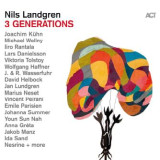
Nils Landgren war und ist das Rückgrat der ACT-Familie. 40
Alben als Leader und weitere 20 als Produzent und Solist
sind bisher auf dem Label erschienen. All diese Rollen und
damit verbundenen Qualitäten kommen auf ‘3 Generations‘
parallel zum Tragen: Zusammen mit ACT-Gründer und
Produzent Siƽi Loch bringt Landgren, anlässlich des
30-jährigen Label-Jubiläums, drei Generationen von ACTKünstler*innen in verschiedenen Besetzungen zusammen.
Im Jahre 1994, nur zwei Jahre nach Label-Gründung, begegneten sich Siƽi Loch und Nils Landgren erstmals. Kurz
darauf wurde Landgren exklusiver ACT-Künstler. Über sein
Netzwerk kamen in der Folge Künstler*innen wie Esbjörn
Svensson, Viktoria Tolstoy, Rigmor Gustafsson, Ida Sand
oder Wolfgang Haffner zum Label. Auf '3 Generations' sind
Joachim Kühn, Michael Wollny, Iiro Rantala, Lars Danielsson, Viktoria Tolstoy, Wolfgang Haffner, Julian & Roman
Wasserfuhr, David Helbock, Jan Lundgren, Marius Neset,
Vincent Peirani, Emile Parisien u.v.m. zu hören.
Jozef Van Wissem- Lute, Electronics, Beats, Electric Guitar, Found Bird Sounds. In 2013 van Wissem won the Cannes Soundtrack Award at the Cannes Film Festival for Jim Jarmusch’s “Only Lovers Left Alive “. In December 2017 Jozef van Wissem was invited to perform the madrigal depicted in Caravaggio’s painting The Lute Player (1596) at the Hermitage museum of Saint Petersburg. In 2022 three of his works were used for in the soundtrack and trailer of Irma Vep (HBO). His completely unique musical world can be easily verified by his collaborations, especially that these relationships are also strengthening his own musical character. He worked together with Zola Jesus, Tilda Swinton, Jarboe as well as with his long-time collaborative partner, also his friend, Jim Jarmusch. “La Cinémathèque Française in Paris commissioned me to write and perform the score at the presentation of the restored version of Nosferatu. I was a bit overwhelmed by its success. It was sold out. I wasn’t going to repeat it. But people kept asking. In the beginning the soundtrack was more improvised and reactive to the images but after a few times the audience kind of showed me the way. To start with a few notes and building the score slowly to a dense slow metal ending. I found an old 7-inch single with recordings of extinct birds on a market, I electronically processed and added them to the score . “ Manipulating the sounds of electric guitar in alternate tuning he manages to create the feeling of fear, equal to the experience of the victims of Count Orlok. “To me Nosferatu personifies this Death Bird of the Plague. The Black Death depicted in the film offers a timeless parallel with contemporary society. The vampire Count Orlok infests the city with rats and people are infected with the plague. They must quarantaine. This provokes hysteria. Much like nowadays”. With a melodic almost medieval magic and mystery Jozef van Wissem has reignited the light through the filters of dark energy post punk and even black metal into a wondrous new melodramatic cinematic space…- John Robb (Louder Than War) Beginning with a solo played on the lute, his performance will incorporate electric guitar and distorted recordings of extinct birds, graduating from subtlety to gothic horror. – New York Times Delightfully macabre, intense and electrifying – MXDWN
Hate Propaganda's far too overlooked 2019 debut EP "World War 666" sees a much needed reissue on vinyl, remastered and enhanced by brand new artwork commissioned for the purpose by Xerox master P. Van Trigt. When it was first released on cassette tape back in 2019 by War Arts Productions, this war-torn debut offering of primeval warnoise by the mysterious Portuguese war criminals stood out immediately as a crown jewel debut for the genre and as one of the year's most definitive and underrated manifestations of extreme metal's most hateful and berserk fringe. Packing in nineteen minutes of absolute hatred, the annihilating MLP manifests as a nightmare hallucination of complete violence and negativity, evoking eons of perennial apocalyptic global planetary war and terror on the wings of its nefarious design of achieving maximum annihilation in the shortest amount of time possible. To harness this bleak pantheon of ruin, the Portuguese conquerors have assembled a weaponized and uncontrolled sonic chain reaction where grindcore, black metal, death metal and hardcore punk are all accelerated and instigated into an inescapable payload of death aimed straight at the vital sinews of humanity. A sonic maelstrom churned into shape by an onslaught of obscure violent riffs, psychotic leads and ominous laughter which, parallel to a pulverizing drum performance, emanates from oblivion with an antediluvian, negative aura. Comparisons to bands like Diocletian, Heresiarch, Tetragrammacide and Nuclearhammer will run abound, yet these would be only easy superficial conjectures as this is a manifestation of sonic extremism which dwells on a plain of excellence entirely its own. Its uniqueness transpires particularly in the maniacal drumming which underlines the band's hardcore and punk influences, and is exalted further by an unusually crystalline production and by a masterful onslaught of uber-audible riffs hiding behind nothing and seemingly going in the opposite direction of the homogenous and indiscernible sensorial smothering the genre usually opts to go in. Tracklisting: 1. World War 666 2. Neverending Mass Graves 3. Violent Nature of Human Annihilation 4. Welcoming the Nuclear War With Open Arms 5. Let the Sirens Signal the End of Times
Laila Sakini's new album 'Paloma' arrives via Modern Love and is her most striking and ambiguous to date - a pointed and timely meditation on hope and hierarchies that riffs on Zbigniew Preisner's magical "The Double Life of Veronique" score and enduring outsider music tome "The Langley Schools Music Project". Subtly transcendent, fathoms-deep music.
When Laila Sakini's debut album ‘Vivienne’ arrived in 2020, it felt like the record we were waiting for to map out our tangled reactions to an uninvited reality. Never self-consciously strange, it revealed itself slowly and cautiously, like a shadow in the corner of the eye, or an alchemical symbol in a bowl of alphabet spaghetti. This time around Sakini has worked her unique world-building to an even finer point, forming six tracks around a theme that's so close to our heart it's almost beating in time. Initially inspired by Krzysztof Kieślowski's 1991 arthouse classic "The Double Life of Veronique", the cult Polish director's enduring modern fairytale that serves as a cosmic rumination on identity and choice. Detailing two identical women - both singers, both in love - the film lets one live as the other dies, forcing us to consider the implications of art and endurance in the face of life's myriad challenges.
Sakini takes Polish composer Zbigniew Preisner's influential score for the film and uses it as a jumping-off point for ‘Paloma’, bending the more grandiose moments into baroque awkwardness on opening track 'Fluer D'Oranger' and evoking the mood of scene-setting cues 'Weronika' and 'Véronique' on the recorder-led 'The Light That Flickers In The Mirror'. And while Preisner's score zeroed in on the musical virtuosity of the film's lead characters, Sakini reinterprets that as a metaphor for self-discovery. Playing piano, violin, glockenspiel, timbale, recorder, and occasionally singing, Sakini captures a mood of innocence that immediately transports the listener back to simpler times. Her music isn't self-consciously simplistic, but forcing herself to interface with instruments impulsively rather than studiously, her sounds are all heart, no filigree.
In spirit, it reminds us of cult Canadian album "The Langley Schools Music Project", a collection of 1970s recordings of school kids singing rudimentary renditions of pop songs in a school gymnasium. That album's genius was in the bottling of hope and innocence: the feeling of joy from hearing and wholesomely interacting with music that's known and loved without a sense of hierarchy or desire for cultural clout. Sakini subtly subverts this by evoking the amateur spirit in the most bewitching way; instead of sourcing her ideas from Bowie, Fleetwood Mac and the Beach Boys, her stock is the established art canon, and by reforming those sounds she makes an insightful comment on intellectualism and access. European classical music is all too often trapped behind the frosted glass of respectability and assumed skill - craft replaces spirit, and technique replaces soul. By approaching these gestures from a different angle, Sakini softens the edges sonically and intellectually, finding music that bubbles with emotion, and most strikingly - hope.
Her choice of instruments and the way she interacts with them allows us to feel as if we're not only listening but contributing. It's a bottom-up way of absorbing art that's traditionally been top-down, and a reminder that we're all part of the experience, whether we're humming along to the remnants of a theme as it dribbles out of an ear in the shower, or dreaming of spotlights in a parallel life that may or may not be real. Sakini's music is nostalgic in a sense, but nowhere near the buttered popcorn and high-fructose candy migraine of the Netflix/Spotify algorithm generation of regurgitated churn. She makes sounds that remind us of what time and experience may have stolen from us, and how we might recover it.
Einstürzende Neubauten producer Boris Wilsdorf, Karl O’Connor aka Regis and MY DISCO's Liam Andrews assemble as EROS, bottling no-wave/industrial lightning with a tight set of pulverized, widescreen torched-songs that rasp, grate and throb somewhere between This Heat, The Cure, Cabaret Voltaire, Alva Noto x Pan Sonic.
An industrial fantasy of flesh and steel, ‘A Southern Code’ is the stunning continuation of the trio’s work at Wilsdorf’s pivotal Anderesbaustelle studio on Regis’ watershed album, ‘Hidden In This Is The Light That You Miss’. Rejoined by another key muse, Anni Hogan, and Einstürzende Neubauten’s Jochen Arbeit, they effectively galvanised a new band, EROS, during long days and nights in the studio across 2020 and into 2021. The sound they make is fiercely lean, shaped by Wilsdorf’s manacled mixing and anchored in the frankly sexy as f#ck swerve of Regis vocals and his snake-hipped rhythm section.
The first songs issued from those sessions form a lustrous new high point of contemporary industrial and dance music, one porous to Kurdish dabke as much as archetypal goth, pulsing with a metallic bloodlust and spatialized by Wilsdorf’s genre-forming tekkerz in a way that seriously rewards with proper amplification. Judged on its immediate merits, it’s the sort of record that could have feasibly come out at any point between the ‘80s and now, but closer inspection reveals a discreet framework of sculpted subbass and sleekly rolling traction that betrays the modernity of minimalist D&B physics and up-to-the-second sound design that places ‘A Southern Code’ in a timeless echelon.
Registering the venomous drums and over-the-shoulder whispers of its title track, plus the incendiary middle eastern horns of ‘The Crawling Man’ - a real parallel dimension take on The Cure’s ‘The Top’ - to the post-apocalyptic lounge lizard styles of ‘In This Place’, and the unheimlich creep to ‘Nature Unborn (From Sun to Sun)’, the band’s first album plants a vital stake in the ground for industrial musick at the crest of a new decade.