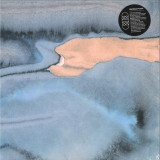
Moondust For My Diamond’ is the second album by
Hayden Thorpe, released on Domino Recordings.
In contrast to ‘Diviner’, a critically acclaimed album
steeped in solitude and fragility, ‘Moondust For My
Diamond’ moves into a more natural visual and sonic
palette. Hayden is interested in, he says, “the meeting
point between science and religion, the grand struggle for
reality that shapes so much of our time.” Thorpe has made
an album that is galvanizing, reassuring, elegant and
seductive: it oozes Big Cosmic Energy.
The pastoral evolution of last year’s ‘Aerial Songs’ EP
hinted at an expanding palette that reflected Thorpe’s
return to The Lake District, the natural environment he
grew up surrounded by. These additional influences seep
into ‘Moondust For My Diamond’, along with Hayden’s
involvement with Wavepaths, a pioneering project
integrating music into psychedelic therapy, plus ‘hybrid’
gigs and breath workshops with pioneering breath
practitioner Richie Bostock. It’s those surrenders,
experiments and collaborations that make this such an
enticing, sensory, soul-expanding album
Cerca:parallel
Impressions cast from lyric and rhythm – desire in movement, now articulated and set forth. Meaning arises between attention and action. In darkness what is it?
Air is breath, like light through crystal; it’s truth and sacred geometry. A version like ancient stone - the sample shows in layers, solid time. Compressed life. Pages packed together and seen from the edge, razor sharp and two dimensional. We are the salt we become, our children and ancestors. All at once, being forever; a verse, then volume and tome.
But we slow, dragging like ploughs tilling clay. The physical is a language like memory – translated into real. Turn from backwards to parallel, watch it reduce; remember downstream. The rock, earth and salt, our real reconfigured.
Type peels away, turning to sand in the wash. Disordering disorder - now still. Translation becomes everything, set sequence and entropy. Whole, to node, to nothing, and all. Not new, just another.
Vector Trancer’s journey continues; re-emerging into the central stream, deep dub glows and woven polyrhythm conjure vital knowledge for protection and expression. Viridis Mantra and outer canopy steam, we’re brought tense rhythm experiments and biospheric reverb – see further excursions in atmos and shades from Touch, Fax, Geometrik, or Ed Handley on a dark one.
Tape
A few months after the release of the legendary Strumming in 1974, Charlemagne gave a masterful and powerful 56 minutes performance in Antwerp in an exciting concert series. With the work and the precious help of M KHA and Lotte Beckwé, we were able to find this recording. We are pleased to offer you this unreleased performance on cassette and CD.
This release takes place in parallel with the magnificent M KHA exhibition which will begin on September 11, 2021.
Music by Charlemagne Palestine played on a Bösendorfer Imperial piano.
A remix album of Tolerance by Osaka-based electronic musician Junya Tokuda released from remodel, a label established by Yuzuru Agi and Studio Warp.
In addition to performing live and releasing works, Junya Tokuda runs the web label Linesound and organizes the electronic music event "Line".
His previous releases include "map not seen EP" (Linesound, 2011), "A Day In The Alley" (shrine.jp, 2016), "Unleash EP" (LongLongLabel, 2018), and "No Man's Land" (shrine.jp, 2020). jp, 2020).
remodel also released solo album, "Anemic Cinema", in April 2021, prior to this work, and his track was included in a two-disc compilation, "a sign 2", released in May 2020.
This album "VANITY RE-MAKE/RE-MODEL Vol.1" is a remix album using material from the Tokyo-based project Tolerance by Junko Tange from Vanity Records.
The production was done in parallel with "Anemic Cinema" (late August 2020 to mid-December 2020), and the basic musicality, especially the brilliant treatment of sound by dub-like spatial effects, is common to both works.
However, in this album, the material of Tolerance is sometimes vague and fragmented like a torn tape swimming on the surface of the water, and at other times like a tape reel rolling down from the ocean-like sound image created by the skillful blending of pads and moving noises through the manipulation of dub effects.
The tactile sensation of poking and stroking the ears (like ASMR), which was also felt in "Anemic Cinema," is more vividly revealed by the carefully considered incorporation of a foreign object.
In addition, the instrumental aspect of Toleranece's musicianship, especially the effective use of the electric piano sound, is also impressive. Interestingly, in other tracks, the bassline exerts a strong pull and draws out the phrasing aspect of Junya Tokuda's musicianship as if in response to the electric piano.
Junya Tokuda's music, which even creates an organic feel with its deft handling of generated sounds and samples, reveals its caliber and hidden patterns through the inclusion of Tolerance voices, noises, and instruments that seem hard, rough, and axially distorted. It is an exhilarating and magical work.
Volume 1[21,81 €]
Volume 3[22,65 €]
Orange Vinyl Volume 2[22,65 €]
Yellow Vinyl Volume 1[22,65 €]
Fractal City, the latest Cubenx album is a collection of terrestrial jams and arachnean ambient ballads that are particularly apt for urban listening. If its predecessors cracked the musical codes in force and shone by the versatility of their references, this new opus offers its listener an intense and symbolic sound environment.
The raw material of Fractal City was first conceived as a series of sound patches, designed to run in parallel with Canadian digital artist Maotik's installation. Broadcasted in real-time by generative patches reacting to various external and non-human data, those musical excerpts have been rendered in hundreds of nuances and extended over infinite durations. This unusual approach confers to the recording of the finished album's outstanding immersive strength.
Recorded live on a single track over a short period of a few weeks, the nine compositions of Fractal City capture the obsessions of its author for postmodern urban landscapes, and the revelation of new perspectives on the city of Paris.
The opening piece `Ssarg´ seems to hide the figure of the Mexican ambient producer Jorge Reyes. Cubenx built a cocoon of energetic layers, a new home of the mystical kind harmoniously integrated in a flourishing rainforest ecosystem.
`Transect ´refers to the urban development model of the same name, which is based on a division of the city into autonomous "fractal" zones. It also echoes the concept of "metro polarities" which considers the city as a mosaic of social groups. "By cycling in the evening with a friend, we could get away from the city centre to the suburbs of Paris. The contrasts are striking. You move from chic districts to bedroom communities, from industrial zones to improvised caravan camps. But there is a kind of energy in this heterogeneity that pushes you to always pedal further."
A few miles away, it would look like Art and urbanism have tried to level the cultural and social discrepancies of the outskirts of Paris. "Architectural sites like the Arcades of Bofill are splendid. There are completely extravagant projects, which seem to emerge from nowhere."
These buildings with ambitious aesthetics off the beaten tourist track, deteriorate over time and often remain far from the expectations of the local population. A feeling of nostalgic beauty is particularly perceptible on the slowest and most introspective ballads of the album as 'Urban Decay', 'Hagel' or 'Axe Majeur'. The producer leaves nonetheless no room for melancholic emptiness. "Every time, I have the impression that urban culture is taking its rights back and that young people appropriate the places in one way or another."
Just like `Transect', ` Quantified' and `Fractal City' present themselves as mirrors of a daily urban life in constant motion. All three are empowered by an overheated factory, which dispatches hypnotic beats and burst of analogue compressors with a clinical precision and direct them straight away to the reptilian areas of their listener's brains.
The sequencing leaves however space and time to take breath and makes way for aerial sonic excursions of spiritual and enlightened nature. On `Human Dilemma', Cubenx shows some concerns to opening the Pandora's box of transhumanist theories. While a long cosmic wave gives the listener a feeling of perfect fullness, a dizzying guitar distortion cast doubts on long term outlooks. `Smash Other' on the other way alternates gentle dissonances over an ocean of white noise and concludes the album on ethereal note.
With ´Fractal City", Cubenx eludes his irreconcilable love for shoegaze pop song and techno to concentrate exclusively on the production of mutant experimental materials. The result is an uncanny musical object, rich in image and sensation. Cubenx give us a guiding framework, enthralling enough to engage the listener to a tour of town. But he leaves it to the sole listeners to design their own projection of the city.
After the exploration of snowy mountains of Alpestres, released on Hands in the Dark in 2018, French composer Matthias Puech ventures into new territories, sketching a cartography of the invisible where the journey, in chiaroscuro, is announced as a rite of passage. A Geography of Absence, as introspective as unpredictable, immerses the listener into a unique sensory whirlwind where organic matter becomes almost palpable. A researcher in theoretical computer science and an engineer at GRM, Matthias Puech constructs a dialog between synthetic music and field recording, capturing sounds that surround him and creating his own sonic language with the help of synthesizers he designs and develops; notably the Oscillator Ensemble and the Tapographic Delay, made by the American company 4ms.
Composed during a moment marked by ordeal and mourning, A Geography of Absence retraces an inner journey where the physicality of sound leads the listener into an initiatory tunnel filled with apparitions, ghosts, visions. With sound oscillations as a navigational map, we progress, step by step, through the meanders of an unknown world, dazzled by the prospect of a new synthetic horizon, an electronic biotope teeming with life and incarnations. Playing with time, space and matter in an approach similar to that of musique concrète, Matthias Puech combines ambient and noise, floating sounds and electroacoustic experimentations, thus shaking up our listening perspective, which finds itself walking through a parallel universe, strata after strata, sequence after sequence.
The trip begins with “Hollow”, as if on board a night train travelling at full speed through ghost towns. Or is it a spaceship? Removed from their original habitat, sounds – picked up during walks or moduled by synths – are free to be interpreted differently by everyone, according to the memories that shape us. Granular and metallic, this first piece takes us to an elsewhere in orbit. "Work Song" is built around the pulsation of the void, of space, where strange creatures and liquid emanations abound. We become fetus, cocoon coiled in the placenta, heart beating to the rhythm of the gooey choreography of the human body. "Chrysalis" awakens the racket that lies dormant in us, when the skin changes, when the transition takes place. One seems to recognize certain sounds stemming from nature but they could also be mirages, imitating reality to render the barely perceptible engulfing. “Tunnel Vision” brings out a herd of haunted bells, slowly swelling in a pastoral maelstrom, ending in a deafening buzz. Further on, the chirping of an animatronic bird mixes with the hooting of an owl: "A Faint Beacon" invokes a nocturnal vigil that mixes the crackling of a fire and icy gusts of wind blowing everything away. Like an epic, sucking the listener into the breach of a black hole in the center of the Milky Way, it's up to "Homeostasis" to conclude in the high spheres and contemplative vapors, where the balance of dawn announces a rebirth.
A Geography of Absence is a meticulous and sensitive piece that constructs a delicate symphony of extremes, between introspection and desire for the unknown. Accompanied by the ink work of the artist Léa Neuville, whose folds of prints sketch this imaginary atlas, Matthias Puech becomes a narrator of mental adventures. And succeeds once again in transcending reality to dig a path to the unspeakable.
"Transitional Being reveals another side of XVARR’s production palette — characteristically tranceinducing, this release highlights the transformational potential of dance music.
Spanning the last ten years, these six tracks handpicked by Aural Medium align with a particular relationship to technology that has formed the central pillar to the XVARR studio set up. Often starting with a drum pattern and sequenced bass-line, the physical rhythm is stripped out and surrounding elements are drawn out and manipulated to convey the ‘hidden’ intention behind the track. With the tracks compiled here, he lets the rhythms ride. The influence of more ‘club-orientated’ music has remained firmly embedded in XVARR’s psyche, although typically the trip has been more introverted. The approach here may differ from other XVARR outputs, but the mood most definitely remains the same, with an overarching desire to channel emotion and passion from the other side of nowhere.
XVARR recognizes the parallels between the ritualistic dance of the Witches’ Sabbath and a dark room filled with sweat, smoke, and sound. It is in this parallel void of transcendent possibilities that tracks such as “Running out of Time”, “The Crooked Path” (a nod to Andrew Chumbley) and “Universal” reside. There’s also a subtle presence of influences from Industrial music, with groups such as SPK, Conrad Schnitzler, Chris Carter and Cabaret Voltaire paving the way for XVARR’s early experiments with electronic music. The alchemical results on this EP float in a universe populated by such luminaries as AFX, Drexciya, and the constellation created by Chain Reaction, within a cosmos governed by the gravitational pull of Baldelli and Weatherall."
- A1: Business Trip
- A2: Ice
- A3: Dog Treat
- A4: Jongles Ambiance
- A5: Trader Jazz 1
- A6: Jongle Woodencastle
- A7: Lava
- A8: Wasteland Waterlands
- A9: Water Gost
- A10: Abandoned Watertanks
- B1: There Is No Way Out
- B2: Reprogrammed Prototypes
- B3: Last Breath
- B4: Lifeforms
- B5: Helper Unit
- B6: The Big City
- B7: Rocker
- B8: Trader Jazz 2
- B9: Sono
- B10: Friendly Primates
Welcome valued share-holder, great to have you on board! This musical soundtrack by Running Out Of Time is a digital epic consisting of federally approved 99,9% original material carbon-dated to the last previous 12-24 lunar cycles. For 50 minutes, sit back and let our R.O.O.T. executive branch provide an experience like no other - neuro-programmed especially for your individual cerebral make-up. Choose from a selection of premium Terraform Realities, ranging from cyborgs battling human rebels through synthetic jungles and swamplands, to alien organisms escaping through intricate water tank systems. As you can see in diagram 2.1 in our presentation, each territory is mapped out in complete dimensional fidelity. For example, the water tank causeways also lead to a long-forgotten underwater world full of hidden creatures. Embrace your inner subaquatic explorer, as you search for artefacts and alien embryos that could be exploited for the corporation. Just remember - our trademark Quantum Parallel Reality Experience is guaranteed to feel as authentic as the real thing!* As a top tier investor, you will also have early bird access to our Platinum Realities selection - including our award-winning Apocalypse Cityscapes. With fully-rendered city centers that once bustled with 21st century traders, these abandoned heritage sites are now home to the lost souls of a free market economy that collapsed eons ago under its own weight. But beware! Some of the spirits will help you, and some will lead you into deadly traps - so choose wisely. Your investment portfolio depends on it! We are excited to have you join the team and look forward to sharing many more experiences together. *Tax Free corp accepts no liability for cognitive dissociation or neural dysfunction as a result of any Quantum Parallel Reality Experience.
Andre Navarra,Josef Suk,Czech Philharmonic Orchestra
BRAHMS: CONCERTO FOR VIOLIN, CELLO AND ORCHESTRA
This LP is extracted from the CD “Cello” box set which received rave
reviews. Awarded the first prize at the Conservatoire de Paris by
unanimous decision of the jury when he was only 13, Andre Navarra was
barely 20 years old when his soloist career began, taking him across Europe
as he performed with the finest orchestras to play all the concertos
of the repertoire.
Navarra took first prize at the Vienna International Competition in 1937. But
the war put a temporary obstacle in the way of his ascension. Unlike some of
his fellow musicians, he refused to collaborate with the occupiers and he took
refuge behind his music stand, playing as an ordinary member of the Paris Opera orchestra. From 1945 onwards, he could again be heard in the capitals of
Europe, conducted by the likes of Munch, Paray and Barbirolli, and later Mehta,
Ristenpart and Ancerl.
A parallel career opened up for him: teaching. He taught in Paris, Sienna, SaintJean-de-Luz, Nice, London, Vienna, Sion and Detmold. His mastery of the bow
was unique: he borrowed the technique used by violinists. It revolutionized
the method of cello playing, bringing roundedness, sensitivity and strength. He
pursued his two callings with equal intensity, one career enriching the other, as
this collection shows so clearly.
He approached every repertory with the same passion: contemporaries such
as Jolivet and Schmitt; classics such as Bach, Boccherini and Haydn; romantics
such as Dvorak, Brahms, Schumann, Bruch and Bloch; and early 20th century
composers such as Prokofiev, Kodaly and Martin.
Navarra died under the Tuscan sun that was so dear to him, his legacy a school
of cello playing that is unique in the world and whose technique and phrasing can still be recognized in the playing of those who use it, from Heinrich
Schiff, Frederic Lodeon, Philippe Muller, Roland Pidoux, Marcel Bardon, Rene
Benedetti, Anne Gastinel, Valentin Erben, Dominique de Williencourt, Marcio
Carneiro, Yvan Chiffoleau and Christophe Coin to Gautier Capu on, Yan Levionnois, Xavier Phillips, Taeguk Mun, Victor Julien-Laferriere and Bruno Philippe.
His perpetual, intense energy notwithstanding, Navarra leaves us with the image of a warm-hearted, unassuming man, who could, after a day alone with his
cello, invite his students on the spur of the moment to fun-filled spaghetti parties. Pablo Casals, who admired Navarra’s free spirit, said to him at a competition in Mexico City, “Ah, there you are, Andre. The man who never comes when
I invite him. I thought you were afraid of me. But no, the cello is your only love.”
A DAY IN THE LIFE – is the first chapter of a dedicated series fully curated by Steve Bicknell for KR3.
This bold new work by the veteran English artist provides an insight into the mind of the artist.
Side A features three tracks by The Evader, another face of Steve Bicknell.
An obscure intro leads us straight to the point: 4/4 sounds, repetitive and hypnotic, not afraid to be heavy.
In fact, that’s the point: to take everything that is a burden to us and embrace it. After all, there can be no light without darkness.
On Side B, Steve Bicknell has a killer approach. A parallel rail to Side A, with a more furious, still gloomy attitude. He moves in the same direction but vents different emotions. The sound is harder, rawer, faster and more impetuous. An outro ends the EP, as if to represent a circle closing: The first lap inside A Day in the Life.
Multi-instrumentalist/vocalist Dan Friel is unrivaled in his capacity to inject blistering noise and energy into ferocious pop songs. A champion and mainstay of the NYC underground, Friel the has played alongside the likes of Lightning Bolt and Black Dice as well collaborated with acclaimed string quartet ETHEL. Upper Wilds channels Friel's unbreakably ebullient spirit into mountainous rock music dripping with molten fuzz. The trio's exploration of the interstellar expands in parallel to their increasing levels of bombast and precision. Venus synthesizes the experimentation of debut Guitar Module 2017 and the thunder of 2018's Mars into ten lean chunks of cosmic rock laden with scorching hooks. On Venus, Upper Wilds rocket lovestruck anthems centered around the planet named for the Roman goddess of love at full tilt from the moment "Love Song #1" makes liftoff. The album's incendiary opening trilogy crashes with a relentless vigor and addictive melodies. The rhythm section of bassist Jason Binnick (who also mixed the album) and drummer Jeff Ottenbacher tear through off-kilter riffs that pound with meteoric impact. Friel's guitar sputters and froths beneath his voice before soaring into frenetic leads that pack every moment with powerful melody. Alien croons and glitching spasms spill out of Friel's wild, filtered humming, amplified into oblivion. Venus' few moments of respite lay bare the raw efficiency and beauty of Friel's songwriting, like transmissions home to loved ones thousands of miles away slipping through the crackle and chaos of space. Venus traverses the havoc, mystery, and joy of humanity's countless follies in both space and love. Both cosmic and human, Venus is a deeply affecting celebration of the wonders of what is beyond comprehension internally and externally. Upper Wilds' Venus is an exhilarating odyssey of tremendous exuberance and a testament to human resilience in the face of the unknown.
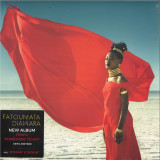
Fatoumata Diawara ist eine malische Singer/Songwriterin und Schauspielerin. Ihr Debüt "Fatou" (2011) und darauffolgende Aktivitäten machten die Künstlerin zu einer der wichtigsten Vertreterinnen moderner afrikanischer Musik. Sie sang auf Alben von Dee Dee Bridgewater ("Red Earth"), Oumou Sangaré ("Seya") und Herbie Hancock ("The Imagine Project"). Darüber hinaus kollaborierte sie mit Bobby Womack, Mulatu Astatke, Cheikh Lô, dem Orchestre Poly-Rythmo de Cotonou, Blick Bassy sowie Rocket Juice & the Moon. Diawara spielte bereits Glastonbury und andere große Festivals, trat in der Carnegie Hall auf und begab sich an Bord von Damon Albarns Africa Express, wo sie sich als Höhepunkt eine Bühne mit Paul McCartney teilte. Parallel setzte sie ihre Karriere als Schauspielerin fort, unter anderem in den Filmen "Timbuktu" (2014) und "Mali Blues" (2015). Ihr Album "Fenfo" (deutsch: "Etwas zu sagen") wurde in Mali, Burkina Faso, Paris und Barcelona aufgenommen und von Diawara selbst sowie dem französischen Superstar Matthieu Chedid alias -M- produziert. "Fenfo" geriet zu einem im besten Sinne grenzenlosen Album. Die elf Songs verbinden alte afrikanischen Saiteninstrumente wie die Kora und Ngoni mit elektrischen Gitarren sowie traditionelle Perkussion mit Kit-Drums. Diawara, die meist auf Bambara singt, wird unter anderem von -M- (Gitarre, Keyboards) dem brillanten Cellisten Vincent Ségal und dem Kora-Spieler Sidiki Diabaté begleitet.
The Turbo Guidance quest keeps going on. Our musical roughnecks decided to seek help from a wizard. They needed to empower their earing sense and their dancing skills like mutant elves. Luckily the mighty Mali-I was living in the nearby forest and had something special to share...
In his hightower, it took Mali-I years to find and cook secretly the delicate mixture. It's forbidden to name the ingredients, but once you taste it you immediately feel the bouncy chords and dub delays rising. Play the mighty sound of the "Fallow Tales" and enter into the blue magic power. Full versatility to expand your mind and to reach a parallel astral plane. Exactly what our heroes need to face the coming storm. Next step is going to be darker...
*Sprinkle your ears with the red powder to increase the musical experience*
Vinyl sweetly pressed in 400 limited copies (no repress business) with a riso insert printed in two colors (blue and black) on a Munchen Pure Rough paper 150g/m2 (at Studio Fidele, Paris).
Tape
It might be easy to assume that the distinctly focused compositional voice unveiled on Rose Bolton's The Lost Clock is the product of its creator's rigorous, almost hermetic dedication to her own particular aesthetic universe. A quick survey of Bolton's artistic career, however, reveals that her carefully sculpted approach to abstract electronica has been forged through a longstanding engagement with a wide range of intertwining creative activities.
This album—coming out on Important Records' cassette imprint, Cassauna—demonstrates both the Toronto-based composer's unique mastery of colour and her gift for breathing a tactile, organic quality into synthetic landscapes. Bolton's distinctive sensibility is akin to that of a painter—every hue has been carefully mixed so as to imbue its accompanying gesture with its own life and personality. This tangible dimensionality her electronic work assumes, however, can be traced back to the work Bolton has been doing since the 1990's. She has produced a large and varied catalogue of work that includes pieces for solo performers, chamber ensembles, orchestra, electronics, voice, and to accompany installations and films. A number of her works reside in several of these zones simultaneously, such as Song of Extinction, an ambitious collaboration between herself, filmmaker Marc de Guerre, poet Don McKay, and multiple live ensembles, that was mounted in an abandoned power station for Toronto's Luminato Festival.
This quasi-instrumental vitality isn't the only feature of The Lost Clock that reflects Bolton's diverse artistic practice. It can also be heard within the structural realm. Each of the collection's four tracks trace a patient unfolding and favour a certain roundness of timbre, even as finer details begin to fidget along the perimeter of the music. As with her writing for the concert hall, Bolton doesn't shy away from the evocative here, yet she doesn't pursue this poignancy through conventional, direct or quasi-narrative means. Her compositions lead the listener gradually through their impressionistic sonic scenery, but neither the path they take nor their ultimate destination are at all predictable. The ostensible gentleness each piece exudes dissolves as dissonances slowly insinuate themselves, obscure textures writhe just out of earshot, percussive lattice work materializes, or as the overall blend begins to exert a heavier weight. Her lucid-dream vision of form functions in tandem with her acute micro-level attentiveness to engender a vivid and elusive soundworld that resists classification.
Over more than two decades Rose Bolton has been garnering acclaim and enthusiasm from audiences and major collaborators alike. Last year, her brooding string quartet The Coming Of Sobs was nominated for Classical Composition of the Year at the JUNO Awards, following earlier accolades such as SOCAN Awards for Young Composers, and the Canadian Music Centre's Norman Burgess Fund. Her music has been commissioned by the likes of the CBC, stalwart experimental music festival the Sound Symposium, as well as key interpreters and ensembles such as percussionist David Schotzko, accordionist Joseph Petric the Esprit Orchestra, Continuum, Arraymusic, the Kitchener-Waterloo Symphony, and guitar quartet Instruments of Happiness (led by Tim Brady). Together with Marc de Guerre, she produced an 8-speaker sound and video installation for Toronto's Nuit Blanche Festival. She's also been featured by the likes of revered pianist Eve Egoyan, The Vancouver Symphony, L'ensemble contemporain de Montréal, The Music Gallery, and AKOUSMA, while appearing in concert alongside the likes of Jerusalem in My Heart (Constellation Records), Tanya Tagaq, and Francis Dhomont. Bolton is also a respected film composer, notably contributing music to the highly regarded documentary Anthropocene: The Human Epoch (co-directed by Jennifer Baichwal, Nicholas de Pencier and Edward Burtynsky).
As a performer, she variously employs electronics, violin, and viola. Parallel to her engagement with exploratory approaches, she's invested in the fiddle traditions of the British Isles, and various Canadian regions. She teaches this repertoire at the Royal Conservatory of Music. Bolton has also performed with Rhys Chatham, Owen Pallett, opened for Charlemagne Palestine, and appears on recordings by the likes of Chatham and Aidan Baker. In 1999 she joined the Canadian Electronic Ensemble, whose fifty-years together make them the world's longest-running live-electronic music group. In February 2020, the CEE held a residency and provided guest lectures at Carnegie Mellon University's music department. Bolton has also led workshops at the Banff Centre, also founded the SOCAN/ Moog Audio-sponsored program EQ: Women in Electronic Music, which worked to foster community and mentorship among (trans/cis) women and non-binary individuals.
- A1: Flash
- A2: Retrouvailles
- A3: Parallèles
- A4: Du Haut Du 33E Étage
- A5: Spectacle Du Monde
- B1: L'attente
- B2: Sans Accolades
- B3: L'homme Idéal
- B4: La Chanson Européenne
- C1: E Pericoloso Sporgersi
- C2: Vous Êtes Ici
- C3: Correspondance
- C4: J'ai Adoré Cette Journée
- C5: Rêve Capital
- D1: L'homme Idéal (Yuksek Radio Edit)
- D2: L'attente (Version Instrumentale)
- D3: Du Haut Du 33E Étage (Charles Dollé Cover)
- D4: L'homme Idéal (Yuksek Extended)
Bertrand Burgalat's new album, RÊVE CAPITAL, will be released on Friday June 11, 2021 by Tricatel.
How many of Burgalat's songs have accompanied difficult afternoons, happy evenings and lonely mornings? The list is long. And it gets longer with this album, each track of which widens the rift between the plates of space and time.
Jean-Pierre Montal
Burgalat makes crackle what we like most in his universe: the reality of things and their discrepancy, the intimate and the universal.
Stéphane Lerouge
- A1: Experience
- A2: Golden Butterflies - Day 1
- A3: Berlin Song
- A4: Love Is A Mystery
- A5: Main Theme From The Third Murder
- B1: My Journey
- B2: The Water Diviner
- B3: Petricor
- B4: Fly
- C1: Time Lapse
- C2: Walk
- C3: Cold Wind Var 1 - Day 1
- C4: Ascolta
- C5: Fuori Dal Mondo
- D1: Due Tramonti
- D2: Run
- D3: Le Onde
- D4: L'origine Nascosta
- D5: White Night
A HANDPICKED COLLECTION OF HIS GREATEST MUSICAL WORKS FROM FILM & TELEVISION, FEATURING MUSIC FROM NOMADLAND, THE FATHER, INSIDIOUS, THIS IS ENGLAND & MANY MORE
"The most syncable modern composer" Synchtank
The new collection Cinema features 28 breath-taking pieces that take the listener through Ludovico's incredible musical journey working in film & television, and includes two previously unreleased tracks** (see tracklist below)
Includes music from films and series such as the Golden Globe & BAFTA Award-winning and Oscar favourite Nomadland, another BAFTA Award-winning and Oscar favourite The Father, This Is England, I'm Still Here, Insidious, Dr Foster, Sense8 & many more
"I felt like he Ludovico and the character of Fern were walking in parallel; their shared love of nature connects them, and I knew then his music would fit perfectly with our movie" Chloé Zhao on Nomadland
Award-winning scores such as Fuori Dal Mondo (Oscar nominated, Echo Klassik award) and Sotto falso nome (Avignon Film Festival) are also included
Einaudi has become the biggest streamed classical artist of all time. His beautifully evocative music lends itself so perfectly to use in films, tv & advertising and has the incredible ability to provoke and enhance emotion.
This is why for many years directors have been using it to complement their images and continue to do so.
Famous fans & collaborators include Shane Meadows (This Is England, Dead Man's Shoes), Russell Crowe (The Water Diviner, Gladiator, Les Miserables), Chloé Zhao (Nomadland), Ricky Gervais (Derek), Eric Toldedano (The Intouchables), Clint Eastwood (J Edgar), Casey Affleck (I'm Still Here) & Darren Aronofsky (Black Swan).
A musical omnibus, ‘The Best of Lily Konigsberg Right Now’ is the
first widely distributed Lily Konigsberg physical release, as well as
the first vinyl treatment for EPs ‘Good Time Now’ and ‘4 Picture
Tear’.
The collection loosely parallels the melancholic narrative behind
the latter, where a mental break triggered Konigsberg’s
depersonalized sense of her past self. Of the ‘4 Picture Tear’ EP
Konigsberg says, “I would look at this photo booth picture I took
with Matt Norman and cry because I thought I was looking at the
person I used to be in that picture and that that person was gone.”
In retrospect, these EPs feel like distinctive vignettes of
Konigsberg’s progression as a songwriter, each version of her
past self-tethered by an invisible thread to the present through
musical alliances and fervent introspection.
‘Owe Me’, a song Konigsberg never felt fit on any of her previous
releases, now serves as an opening curtain call. “Thank you all for
coming to my show,” Konigsberg says to an invisible audience’s
applause, “If you didn’t know, now you certainly know.” It’s a
transportive moment that combines Konigsberg’s patient steps into
the underground pop limelight with her exceptional ability to
connect with a diverse and talented cohort of creatives.
One third of egalitarian art-punk outfit Palberta, the Brooklyn-born
and-based Lily Konigsberg has occupied her time with music since
her early childhood. “Basically I was born and immediately started
wanting to be a rock star,” she says.
“Even before she became a fixture of the New York underground,
Lily Konigsberg was staking out her place in local music.” -
Pitchfork (Rising Artist, 2020)
“A crisp, catchy, and concise bit of 90s-indebted indie rock” -
Stereogum
“The freewheeling, flitting melodies underline the precision of
Konigsberg’s songwriting: She knows what she wants to say and
she is methodical about how much to reveal.” - Pitchfork
“Warm and direct but tough to grasp, untraceable” - Tiny Mix
Tapes
- A1: Experience
- A2: Golden Butterflies - Day 1
- A3: Berlin Song
- A4: Love Is A Mystery
- A5: Main Theme From The Third Murder
- B1: My Journey
- B2: The Water Diviner
- B3: Petricor
- B4: Fly
- C1: Time Lapse
- C2: Walk
- C3: Cold Wind Var 1 - Day 1
- C4: Ascolta
- C5: Fuori Dal Mondo
- D1: Due Tramonti
- D2: Run
- D3: Le Onde
- D4: L'origine Nascosta
- D5: White Night
Mit einer Karriere, die sich über drei Jahrzehnte und mehrere Generationen erstreckt, ist die fesselnde
Musik des Komponisten und Pianisten Ludovico Einaudi zu einer der bekanntesten der Welt geworden.
Um seine unglaublichen filmischen Leistungen zu feiern, veröffentlicht Decca Records, mit Cinema eine
neue handverlesene Sammlung von Einaudis unglaublichen musikalischen Werken aus Film und Fernsehen.
Cinema enthält 28 atemberaubende Tracks aus Film und Fernsehen, darunter Insidious, Sense8, This
is England und vier von Einaudis Tracks aus dem Oscar-gekrönten Film und Soundtrack Nomadland.
Die Regisseurin Chloe Zhao war kürzlich zu Gast im Podcast Experience: The Ludovico Einaudi Story
und sprach mit Moderator Joe Dempsie darüber, wie sie Einaudis Musik zum ersten Mal entdeckte:
”Ich ging online auf die Suche nach klassischer Musik, die von der Natur inspiriert ist... es führte mich
zu einem YouTube-Video von seiner Elegy for the Arctic. Dann fing ich an, Seven Days Walking zu hören
und war erstaunt, wie ich das Gefühl hatte, Ludovico würde in den Alpen wandern. Ich hatte das Gefühl,
als würden er und die Figur von Fern parallel wandern; ihre gemeinsame Liebe zur Natur verbindet sie, und
da wusste ich, dass seine Musik perfekt zu unserem Film passen würde.”