quête:partial records

Genres
Tout
Joni Mitchell - Blue LP 2x12"

Of the countless accolades and analyses that surround Blue, no point is more significant than the fact that the 1971 Joni Mitchell album continues to become more popular, revered, referenced, and relevant with each passing day. Such vitality is not only extremely singular; it is the ultimate measure of great art and, in the context of Blue, indisputable proof of the record's accessibility, integrity, and timelessness. If the most brilliant and everlasting music seeks to find truths shared by all of humanity, Blue can be said to be universal doctrine.

Sourced from the original analogue master tapes, pressed on MoFi SuperVinyl, and strictly limited to 12,000 numbered copies, Mobile Fidelity's UltraDisc One-Step 180g 45RPM 2LP box set presents the landmark album with reference-grade detail, tonality, and directness. Marking the first time the beloved LP has received audiophile-quality treatment, it's one of six iconic 1970s Mitchell records Mobile Fidelity is reissuing on definitive-sounding vinyl and SACD sets.

Everything about Blue sounds more intimate, involving, and inescapable on this transparent pressing, which benefits from a virtually non-existent noise floor and superior groove definition. Mitchell's voice, positioned front and center, and primarily accompanied by minimalist acoustic guitar, piano, and dulcimer playing, comes across clearly and prominently. Suspended notes and radiant chords double as question marks, commas, and phrases. The in-the-room presence and spatial dimensionality make absolute the full-range spectrum of introspective emotions — hurt and distress, self-awareness and joy, difficulty and uncertainty, warmth and desire — Mitchell navigates, queries, and contemplates throughout the record. The defencelessness the singer once spoke about is laid bare here like never before.

The packaging of the Blue UD1S set complements its distinguished status. Housed in a deluxe box, both LPs come in special foil-stamped jackets with faithful-to-the-original graphics that illuminate the splendor of the recording. This UD1S reissue exists as a curatorial artifact for listeners who prize sound quality and production, and who desire to engage themselves in everything involved with the album, including the unforgettable cover photograph of a ruminative Mitchell shot by Tim Considine.

Deemed the third Greatest Album of All Time by Rolling Stone; universally celebrated by critics, fans, artists, and educators; and defined by a spell of disarmingly vulnerable songs that are at once confessional, intense, spare, honest, painful, hopeful, and exquisite, Blue charts love, spiritualism, independence, and loss like no record before or since. Widely considered the album that established the singer-songwriter template, the largely autobiographical LP changed everything shortly after its original release in June 1971. Amazingly, it continues to do so more than five decades later.

An incalculable influence on generations of artists, it stands as the through-line from Carole King, Elton John, James Taylor, Joan Armatrading, and Leonard Cohen to Patti Smith, Carly Simon, Emmylou Harris, and Rosanne Cash to 21st century contemporaries like Brandi Carlile, Taylor Swift, Sharon Van Etten, and Courtney Barnett. Teetering between agony and optimism, it is — to borrow a phrase from Mitchell's eternal "A Case of You" — a bottomless "box of paints."

The beauty of the stripped-down arrangements, intoxicating melodies, and Mitchell's wisdom on Blue didn't go unnoticed. Critical acclaim, coupled with the depth of the material and Mitchell's reputation, propelled the album into the Top 20 in the U.S. and Top 10 in the U.K. Yet while so much pop music diminishes with age, Blue has defied norms and headed in the opposite direction. Its 50th anniversary year witnessed an outpouring of tributes, reflections, and testimonials that helped frame the record's escalating importance and symbolism — apt in an age in which women have become the prominent trailblazers in rock, R&B, and hip-hop.

Perhaps most succinctly, in a 2021 article celebrating the LP, the Los Angeles Times declared: "In 1971, nothing sounded like Joni Mitchell's Blue. 50 years later, it's still a miracle." Nothing, indeed. Yet "miracle" suggests Blue partially owes to a divine agent or inexplicable circumstance. And though Mitchell's bracing conviction and forthright sincerity can appear otherworldly, her musical approach and lyrical storytelling is nothing if not personal and human. What we hear is pure truth — no matter how aching, complicated, or stark.

Much has been written about the circumstances that inspired the songs on Blue: Mitchell's romances; her time overseas; her disdain for celebrity; her lingering sense of loss at having given up her daughter for adoption; her treatment by the very same industry that her music made uncomfortable; her prolonged search for resolution. These situations and experiences pushed Mitchell to question everything — especially big-picture concepts that have always obsessed mankind: fulfilment, autonomy, love, honesty, being.

"I wanna make you feel free," Mitchell sings on the record-opening "All I Want." Mission accomplished. Blue is liberation — and the start of a freedom that continues to impact music, culture, and identity today.

More About Mobile Fidelity UltraDisc One-Step and Why It Is Superior
Mobile Fidelity Sound Lab's UltraDisc One-Step (UD1S) technique bypasses generational losses inherent to the traditional three-step plating process by removing two steps: the production of father and mother plates, which are created to yield numerous stampers from each lacquer that is cut. For UD1S plating, stampers (also called "converts") are made directly from the lacquers. Since each lacquer yields only one stamper, multiple lacquers need to be cut. Mobile Fidelity's UD1S process produces a final LP with the lowest-possible noise floor. The removal of two steps of the plating process also reveals musical details and dynamics that would otherwise be lost due to the standard multi-step process. With UD1S, every aspect of vinyl production is optimized to produce the best-sounding vinyl album available today.

pré-commande15.03.2024

il devrait être publié sur 15.03.2024

201,64
CCR HEADCLEANER - CLEANER LP

***After birthing Street Riffs, their hi-definition, hi-energy, statement from 2020, CCR Headcleaner turned inward. The retreat from the pro-studio to the home studio was partially by design and partially decided by global events. Cleaner is very much a pandemic album, more of a homespun head trip than its predecessors. At the same time guitarist, songwriter and spiritual center of the group, Lacey Emmanuel, left the Bay for the shores of Lake Michigan. By most accounts an apocalyptic live-band became by and large a home recording animal. This is most apparent when Headcleaner turns up the balladry. “Don’t Feel the End” is a proto-metal campfire anthem, and “Everyday” hovers somewhere between keyboard misfit John Bender and the White Album. Make no mistake, the record will still be filed under “Punk” at your local record shop. It kicks off with “the brining pt. 2” the hottest slice of Funhouse free-rock that the band has committed to record. “Too Much” gives us its jail abolition rap over a two chord hardcore stomp. In a town (San Francisco) that is experiencing something of a DIY pop renaissance, Headcleaner has always fought to establish the fact that they have actual songs. This is no 70s throwback, but instead an attempt to up the ante. Without all the rock histrionics, technical arrogance and misogyny can the rock riff deliver on its ultimate promise: heavy music for total liberation. All tracks were mixed and lovingly fucked with by none other than Eric Bauer at his Bauer Mansion (RIP) Chinatown SF.

pré-commande03.02.2024

il devrait être publié sur 03.02.2024

32,98
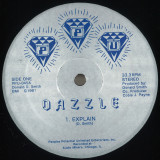
Dazzle - Explain

Dazzle rolled deep. Very deep. In the 1980s, it wasn't unusual for the Milwaukee-based group to show up at various Midwest night clubs in a caravan of 30-40 cars and vans. Their live following was hard won over a career that spanned 20+ years, many line up changes, and a handful of project names. Friends, family, and fans made the journey with them weekend after weekend, a testimony to both the musical prowess of the group and the tight-knit community that they emerged from.

Donald Smith, band leader, was there the whole time - joined by many of his siblings and friends - first as founder of the Ghetto Players, a early 70's nine-piece which also included siblings Michael, Ronald, and Charles. They played hard funk in the style of early Kool and the Gang, and although they sadly left no recordings, the strength of their live act managed to catch the eye of local Milwaukee R&B music entrepreneur Cobie Joe Payne. Cobie had made a couple of records locally in the early/mid 70s as a singer, including the impossibly weird and amazing rare afro-blues-funk 45 "Sweet Thing", but had never enjoyed national success. When the Ghetto Players disbanded in the early-mid 70s, Donald soon put together a new group, C on the Funk (the 'C' referring to lead vocalist and sibling Charles), under Payne's tutelage. Sister Lorrie Smith came in as the drummer, the line-up being fleshed out by brothers David and Melvin Johnson, and friend Robert Mitchell. After a few years as a strictly live attraction, they drove to Chicago and produced a single, "In the Disco" / "A Place" for Payne's small record label Sweet Thang Records in 1980. Lacking the financial backing needed to supply the local R&B disk jockey's "promotional fees" , this single sadly languished in obscurity, gathering dust inside the local tavern jukeboxes and manilla promo envelopes that comprised Payne's DIY distribution network.

C on the Funk were traveling the Mid West extensively at this point, and making some important friends on the road. Ike Wiley Jr. of the Dazz Band/Kinsman Dazz took particular interest and the band was re-christened Dazzle, partially as a tie-in with Dazz, partially to embrace the new sounds that would distinguish the 70s disco scene from what record collectors and DJs would now refer to as the "Boogie" era. There no doubt was a stigma attached to the word "Disco" as the eighties began, and as we see in this collection C On the Funk's "In the Disco" is remixed and transformed into the psychedelic synth instrumental of Dazzle's "Disco's Out", a title which embodies both the next-step approach Smith and company were pushing for, and humorously comments on the state of black dance music in the early 1980s. The Dazzle recording, done in Chicago in 1982, updated the sound and featured an expanded line up, most notably a second synth player (Charles Washington), and a percussionist/second lead vocalist (Greg McDonald). The added synth textures and deep percussive grooves give the Dazzle recordings an elegant late night vibe that resonate just as well in a good pair of headphones as they do on the dance floor. The trance inducing cough syrup-warble of "Explain" may best exemplify this here. Sadly, a pressing flaw in the 12" halted production and promotion, and the EP and the songs within were lost to the ages. The group, having done a much better line in the live music business, followed that path instead all the way to the early 90s. --bio provided by andy noble

pas en stock

Commandez maintenant et nous commanderons l'article pour vous chez notre fournisseur.

15,34

Last In: 2 years ago
Jason Isbell - Sirens of the Ditch
  • Brand New Kind Of Actress 5:31
  • Down In A Hole 4:18
  • Try 4:48
  • Chicago Promenade 3:19
  • Dress Blues 4:07
  • Grown 3:42
  • Hurricanes And Hand Grenades 5:07
  • In A Razor Town 3:15
  • Shotgun Wedding 3:45
  • The Magician 4:16
  • The Devil Is My Running Mate 3:45
  • Whisper 4:39
  • Crystal Clear 5:03
  • The Assassin 3:38
  • Racetrack Romeo 5:11

The debut album from accomplished guitarist and songwriter Jason Isbell, formerly of Drive By Truckers (DBT), is reissued with 4 unreleased tracks from the original recording sessions. The addition of those 4 extra songs finds Sirens Of The Ditch clocking in at 15 total tracks. Sirens Of The Ditch's mystical quality can be partially attributed to the FAME recording studio (Aretha Franklin, Duane Allman, Otis Redding) in Isbell’s hometown of Muscle Shoals, AL where the album was recorded. Co-produced by Isbell and Patterson Hood (DBT), Sirens Of The Ditch features Isbell singing lead vocals and playing guitar throughout, joined by Shonna Tucker (Formerly of DBT) on Bass and Brad Morgan (DBT) on drums. Several musicians pop in for cameos including Spooner Oldham and David Hood (Patterson's father) on "Down In A Hole", John Neff (Formerly of DBT) on "Dress Blues" and Patterson himself guests on "Shotgun Wedding". "a strong debut, full of the kind of confident, charismatic songwriting that just can't be taught." - Pitckfork “Isbell could be roots rock’s Flannery O’Connor.” - Spin

pré-commande17.11.2023

il devrait être publié sur 17.11.2023

31,89
Serenity - Nemesis A.D

Serenity

Nemesis A.D

12inch3571357
Napalm Records
28.10.2023

Symphonic metal powerhouse SERENITY unleash their new studio album, Nemesis AD! The successor to their previous full length, The Last Knight (2020), which landed #25 on the German album charts, is out on October 27, 2023 via Napalm Records and is the first record with Marco Pastorino (Temperance) as additional guitarist and backing vocalist. Known for their thematic albums inspired by historic characters and stories of the past, on Nemesis AD, SERENITY draw inspiration from the life and highly influential art of painter Albrecht Dürer of the German renaissance. Grandiose intro track “Memoriae Alberti Dureri” sets the scene for the album, before legendary singer Roy Khan (Conception, ex-Kamelot) lends his impressive vocals on the mighty “The Fall of Man”. ""Ritter, Tod und Teufel (Knightfall)” (named after Dürer’s famous artwork) features lyrics sung partially in German, for the first time in the band’s history spanning over more than two decades. The powerful track showcases SERENITY’s signature blend of orchestral arrangements, heavy guitar riffs, and soaring vocals. Heart-wrenchingly emotional yet empowering “Reflections (of AD)” mesmerizes the listener with its awe-inspiring instrumentation, multifaceted vocals and brilliant changes throughout the gripping eight-minute track. Theatrical “Sun of Justice” leads the listener to a faraway fantasy world while the vocal performance of skilled singer Georg Neuhauser ultimately unlocks the track's hit potential. “The End of Babylon” represents one of the darker, heavier tracks on Nemesis AD - climactic arrangements carry the dramatic storyline. Monumental orchestral version of “The Fall of Man” closes the album on a thrilling note that is sure to send a chill up your spine. With Nemesis AD, SERENITY add yet another bombastic symphonic metal masterpiece to their notable discography - there is no doubt that the talented unit’s standing in the scene is well deserved. BLURB "The Fall of Man" - Single No 2 Symphonic metal unit SERENITY unleash “The Fall of Man”, a mighty single off of the band’s new album Nemesis AD! With vocal support from legendary singer Roy Khan (Conception, ex-Kamelot), the song is a sure future hit with fans old and new. SERENITY’s previous studio album, The Last Knight (2020), hit #25 on the German album charts, and the band has gained millions of Spotify streams and YouTube views with their earlier efforts.

pré-commande28.10.2023

il devrait être publié sur 28.10.2023

25,17
WILD NOTHING - HOLD

Wild Nothing

HOLD

12inchCTLPC1362
Captured Tracks
27.10.2023

Sea Blue in Coke Bottle Clear Vinyl.

Because Hold, Jack Tatum's fifth album under the moniker Wild Nothing, was written in the aftermath of new parenthood during the pandemic, it was probably inevitable that it would be searching and existential music. But during the recording process, the artist known for synth-pop tastefulness used it as an opportunity to reach for a new sonic maximalism and wider set of influences. With contributions from longtime collaborator Jorge Elbrecht, Tommy Davidson of Beach Fossils and Hatchie's Harriette Pilbeam, first single "Headlights On" features an acid house-worthy bass groove and breakbeat that prove Tatum is playing for the rafters. Tatum produced the rest of the record on his own, partially out of necessity, due to the challenges of the pandemic. The songs were eventually brought to Adrian Olsen at Montrose Recording in Richmond to begin recording drums and filling in the gaps. While largely a product of isolation, Hold also reflects the things Tatum has learned from collaborators, both on previous records and during his acclaimed work with Japanese Breakfast and Molly Burch. The rest of the record was mixed by Geoff Swan, who listeners might know for his work with Caroline Polachek and Charli XCX. Swan put Tatum's vocals high in the mix, and throughout the album, he embraces playful vocal processing like never before. Tatum moved from Los Angeles back to his home state of Virginia about five years ago in search of a scaled-back lifestyle. The relatively suburban environment - and the occasional regret it inspired - proved to be great artistic fodder. It's the paradox of modern America - the suburbs are supposed to be stultifying to art, but they are so full of human desperation perfect for dramatizing. On "Suburban Solutions", he presents an anti-jingle with an acidly bright synthesizer melody, imploring you to sign on the dotted line, put your feet up, and embrace sweet oblivion. Adding to the song's menacing cheeriness is a chorus-sung bridge, made with assistance from Molly Burch and Tatum's wife, Dana, It was loosely inspired by the classic Martika song "Toy Soldiers" and the long-ago pop craze for children's choirs, and he embraces the trend's less-than-stellar reputation. By design, Hold dwells in uncertainty and fear, but in a package that encourages meditation and a bit of fun. "In the face of the pandemic, I think being a parent really forced my hand," Tatum said. "I felt that I had no other choice but to have a positive outlook on the world. Because if I were to give in at any moment and say, "Oh, everything is horrible," then I'll feel as if I've lost and I've given up on my son being able to thrive in this world."

pré-commande27.10.2023

il devrait être publié sur 27.10.2023

26,26
WILD NOTHING - HOLD LP (German Edition)

Sea Blue in Coke Bottle Clear Vinyl LP + artist signed art print. Only 200 available.

Because Hold, Jack Tatum's fifth album under the moniker Wild Nothing, was written in the aftermath of new parenthood during the pandemic, it was probably inevitable that it would be searching and existential music. But during the recording process, the artist known for synth-pop tastefulness used it as an opportunity to reach for a new sonic maximalism and wider set of influences. With contributions from longtime collaborator Jorge Elbrecht, Tommy Davidson of Beach Fossils and Hatchie's Harriette Pilbeam, first single "Headlights On" features an acid house-worthy bass groove and breakbeat that prove Tatum is playing for the rafters. Tatum produced the rest of the record on his own, partially out of necessity, due to the challenges of the pandemic. The songs were eventually brought to Adrian Olsen at Montrose Recording in Richmond to begin recording drums and filling in the gaps. While largely a product of isolation, Hold also reflects the things Tatum has learned from collaborators, both on previous records and during his acclaimed work with Japanese Breakfast and Molly Burch. The rest of the record was mixed by Geoff Swan, who listeners might know for his work with Caroline Polachek and Charli XCX. Swan put Tatum's vocals high in the mix, and throughout the album, he embraces playful vocal processing like never before. Tatum moved from Los Angeles back to his home state of Virginia about five years ago in search of a scaled-back lifestyle. The relatively suburban environment - and the occasional regret it inspired - proved to be great artistic fodder. It's the paradox of modern America - the suburbs are supposed to be stultifying to art, but they are so full of human desperation perfect for dramatizing. On "Suburban Solutions", he presents an anti-jingle with an acidly bright synthesizer melody, imploring you to sign on the dotted line, put your feet up, and embrace sweet oblivion. Adding to the song's menacing cheeriness is a chorus-sung bridge, made with assistance from Molly Burch and Tatum's wife, Dana, It was loosely inspired by the classic Martika song "Toy Soldiers" and the long-ago pop craze for children's choirs, and he embraces the trend's less-than-stellar reputation. By design, Hold dwells in uncertainty and fear, but in a package that encourages meditation and a bit of fun. "In the face of the pandemic, I think being a parent really forced my hand," Tatum said. "I felt that I had no other choice but to have a positive outlook on the world. Because if I were to give in at any moment and say, "Oh, everything is horrible," then I'll feel as if I've lost and I've given up on my son being able to thrive in this world."

pas en stock

Commandez maintenant et nous commanderons l'article pour vous chez notre fournisseur.

23,49

Last In: 2 years ago
RAT COLUMNS - BABYDOLL (LTD BLACK LP + BONUS 7")

Classic black vinyl plus bonus 7"-single with two exclusive tracks! Babydoll is the fifth Rat Columns album and, following 2021's Pacific Kiss, the second to be released on Tough Love. The recordings took place in Perth, Western Australia, partially by engineer Jason Hayles in a 1960's office building that formerly housed the secretarial pool of a successful mattress company, and partially by DW in an industrial unit, and feature the ensemble cast of Taylah McLean, Chris Grunwaldt, Scott Payne, Richard Ingham, Cohen Bourgault and, of course, DW himself. It was then mixed and mastered in Melbourne by Mikey Young and Joseph Carra, respectively. Babydoll seems to mark a return to a murkier, dirgier Rat Columns format. Distortion is fetishized again and many small amplifiers were tortured in the album's production. Tempos have drifted down and the lyrical concerns move ever inward, in an inverse bloom. The mood is dour, introspective, circular, the songs long, and short attention spans are neglected. 'Cerulean Blue' churns through a crystalline memoryscape, homaging low-brow grunge auto-fiction and a partial history of mid-period rave. 'Life In The Jungle' is a fever dream of imperialist wartime fantasy projection. 'Heavenly Assault' attempts a crushing density amid visions of transcendent devotion. 'Virtual Sweden' takes us ever northwards into the frosted tip of Scandinavian détente. 'Babydoll', like 'Cerulean Blue', homages a primarily imagined low-cosmopolitan world of alt-lit digi-poets, bedroom fantasists, underwater prisons for gorgeous, gorgeous girls. 'Bees Make Honey' lets more sophisticated music machines into the conversation, and marks the first use of vocal tuning software on a Rat Columns album, albeit in an avant-amateurist fashion. 'Jane, I Live For You' enters the space-ballad race, dreaming of synthetic folk-rockers, leaning on sampler keybeds in the half-light. 'December' is yet another tribute to fallen Stars, mansions on the hill, winter skin in cashmere sweaters, truth in education, love, faith, (im)purity. In all these respects, it is a classic Rat Columns record. Because all Rat Columns records are classic records.

pré-commande20.10.2023

il devrait être publié sur 20.10.2023

36,93
Remotif - Substation Fever

Bristol’s Remotif makes his highly-awaited debut on space•lab with his wormhole of a new EP, ‘Substation Fever’. Kicking things off on the A side, the title track enters the scene with spacious, organic drums, building in energy as we tunnel through its course; travelling from the cool, oxygenated air of a forest-scape into dazzling, far-reaching intergalactic realms.

Next up, ‘Substation Fever’ gets a dreamy reimagining courtesy of Leeds legend and space•lab regular, Adam Pits. Channelling the energy of Remotif’s original into a hazy, blissed-out cloudscape, this track was made for accompanying early morning sunrises where orange-hued dashes of light reflect off the surface of gently rippling water.

On the flip side, ‘Hi Tek Lo Life’, crackles with the fluctuating electrical impulses of a TV without signal or a radio between channels. Flecked with corroded vocal samples and billowing synthlines, this is a track that explores the inbetween - the moment when connection is almost lost, but not quite. There is a beauty in the roughened-edges of these partially obscured details.

The final track of the EP, ‘The Signal Prevails’ is perhaps an answer to its precursor. Opening out onto trip-hop-esque terrain, this track follows the path set out by a blurred-out, echoing vocal as it deftly works its way through narrow, winding pathways of powerful 90s-style breaks.

A much-loved DJ regularly making an appearance on space•lab’s lineups, we are delighted to now showcase Remotif’s skill in the studio with this mind-opening new EP.

pas en stock

Commandez maintenant et nous commanderons l'article pour vous chez notre fournisseur.

13,32

Derniere entrée: 31 jours
Vorna - Sateet Palata Saavat LP 2x12"

Band: VORNA Album: Sateet palata saavat Release Date: September 27th Clichés almost always have a true core. That artists from the (European) Far North tend to melancholy is one thing that has already been confirmed many times. VORNA is no different. The band from Tampere has been in existence since 2008, and still is today in its original line-up. The six-piece group is well-rehearsed and has continuously developed its sound over the years. With pride and self-confidence the musicians grasp their playing as "Finnish melancholic metal". This means songs with a dark mood and an emotional state-of-mind, which cause reactions from the developing atmosphere. The melancholy comes to bear on different levels, but without ever slipping into pessimistic gloom. VORNA's access to the heavy spectrum is broad and open-minded. The six musicians are guided by their emotions and transform them into dark tuned music. Starting from a base between Folk and Black Metal, the Finns have enriched their playing since 2008. The symphonic extension of the third album underlines the atmospheric and melodic composition of the songs. "Sateet palata saavat" means something like "Return to Rains". In other words: something is brewing before the sky opens its floodgates and the power of nature discharges. This picture fits very well to what VORNA musically have to offer. "Sateet palata saavat" develops to be tense and intense. VORNA's vocals, left in Finnish, don't compromise the access to VORNA's "Finnish melancholic metal". The underlying emotions can be empathized and create an interaction with the listener right from the beginning. The organic songwriting of VORNA underlines the down-to-earth approach, the Finns are following. Partially, however, "Sateet palata saavat" sounds uncanny and creepy.

pré-commande09.06.2023

il devrait être publié sur 09.06.2023

27,31
Nucleus - Elastic Rock

Nucleus

Elastic Rock

12inchBEWITH125LP
Be With Records
26.05.2023

Nucleus's Elastic Rock is undisputedly a milestone in Jazz-Rock. A beautiful and vital debut album, it was first released on Vertigo in 1970. Original copies are now very tricky to score and, like all the Nucleus records, it’s aged ridiculously well. This Be With re-issue, re-mastered from the original analogue tapes, shows off just why this deserves to be back in press.

Genius trumpeter and visionary composer Ian Carr was one of the most respected British musicians of his era. He was a true pioneer and saw the potential in fusing the worlds of jazz with rock, just as Miles Davis and The Tony Williams Lifetime did in the US. In late 1969, following the demise of the Rendell-Carr quintet, and tiring of British jazz, Carr assembled the legendary Nucleus. Regarding music as a continuous process, Nucleus refused to “recognise rigid boundaries” and worked on delivering what they saw as a “total musical experience”. We can get behind that.

Under bandleader Carr, Nucleus existed as a fluid line-up of inventive, skilled musicians. This constant evolution and revolution was all part of the continuous musical exploration and discovery that took jazz to new levels. And the music has kept relevant. To steal a line from a review of our re-issue of Roots, when it comes to anything Nucleus “it’s basically already hip-hop”.

The very title Elastic Rock could be regarded as the group's MO, describing a melting point between their rock and jazz impulses. Indeed, housed in a memorable gatefold jacket designed by Roger Dean, the die cut molten teardrop shape on the front sleeve opens to reveal a fiery volcanic crater. On the back, Dean's drawing has Carr with saxophonist Brian Smith, guitarist Chris Spedding, drummer John Marshall, bassist Jeff Clyne and sax, oboe and pianist Karl Jenkins in a circle, the central core of a movement and the basis for its activity.

Recorded over four days in January 1970, Elastic Rock didn't sound like any other British jazz album. Exploding out the gate, "1916" opens with Marshall's frantic pounding before melancholic horns enter. The smooth title track, "Elastic Rock" is just a gorgeous electric blues track. Light drums, gentle melodic horns, piano and a solid bassline serve as the perfect bed for Spedding's graceful bluesy guitar melodies. The serene "Striation", a Clyne and Spedding collaboration, is led by bowed bass and is the epitome of calm before the late night laid back vibe of "Taranaki" breezes along sweetly and smoothly with great trumpet and tenor.

The truly emotional "Twisted Track" is elegant with horns, while guitar is gently played with drums and bass. Initially deeply soothing, it gradually builds with various solos and duets. "Crude Blues (Part 1)" features an excellent oboe part by Jenkins with laconic guitar helping out. "Part 2" is livelier, with a heavy backbeat and great wind parts. "1916 (Battle Of Boogaloo)" features a steady bassline and great call and response parts from the horn section.

The highly-charged centrepiece of the record, the mesmeric epic "Torrid Zone" features an hypnotic bassline and hi-hat with some of the ensemble's best soloing. Brilliantly encapsulating the jazz fusion aesthetic so desired by the group, the rhythm section is rock-influenced but magically retains a laid-back jazz vibe. Just perfection. Spacey jazz in the style of In a Silent Way, the semi-ambient "Stonescape" features smooth, muted brass, warm, smokey keys and a barely-there rhythm section. Heavenly.

The bubbling, fragile restraint of "Earth Mother" partially utilises the "Torrid Zone" bassline but takes the energy in a different direction with Marshall's frenetic drumming and Spedding's unpredictable riffing. Next comes the very idiosyncratic drum solo track by Marshall in the appropriately-titled "Speaking for Myself, Personally, in My Own Opinion, I Think." The album closes with the raucous "Persephones Jive", a track that ends the album frantically, riotously, just as it began.

This Be With edition of Elastic Rock has been re-mastered from the original Vertigo master tapes, Simon Francis’ mastering working together with Cicely Balston's cut at AIR Studios to weave their usual magic with these wonderful recordings. The stunning die-cut gatefold sleeve has been restored in all its molten glory.

pas en stock

Commandez maintenant et nous commanderons l'article pour vous chez notre fournisseur.

26,01

Last In: 2 years ago
King Gizzard And The Lizard Wizard - Polygondwanaland (Mono)

Pressing Info: 180g 'muddy water' (transparent green) vinyl, mono audio, printed inner sleeve, hand numbered, limited to 500. As part of their ongoing King Gizzard bootleg series, Fuzz Club are releasing a mono version of 'Polygondwanaland' - the Aussie psych legend's twelfth studio album and the bootleg that started it all. Polygondwanaland first appeared as a partial leak on the band's demos for the album. The leak was uploaded to SoundCloud but was soon taken down. As a result, news of the album was scarce and mostly involved rumours, one of which stated that it would be the last of the five albums released in 2017. The track "Crumbling Castle," which appeared on the demo, was performed live by the band as early as September 2016, albeit in a much shorter form. However, it lay dormant for many months during an especially prolific period for the band, leading to speculation that the track might have been scrapped. Both the track and the music video were finally released on 18 October 2017, exactly one year after the first performance of the song was uploaded to YouTube. The legitimacy of the demos was all but confirmed at this point, as not only did the track feature the album's name in the lyrics, but it also contained lengthy musical passages equal in duration to the demo. Polygondwanaland was officially announced on the band's Facebook page on 14 November 2017. The release date and cover art were publicized by the band, who stated, "This album is FREE. Free as in, free," encouraging fans to make their own copies and bootlegs of the album.

pré-commande20.01.2023

il devrait être publié sur 20.01.2023

24,33
Ryuichi Sakamoto - A Tribute to Ryuichi Sakamoto - To the Moon and Back 2x12"

From contemporary admirers of Sakamoto's work like Thundercat, Devonté Hynes, and Hildur Gudnadóttir to longtime collaborators and friends like David Sylvian, Alva Noto, Cornelius, and Fennesz, plus some of Sakamoto's personal favourites like Lim Giong, Gabrial Wek, and 404. zero, the included artists reflect the breadth of Sakamoto's influence on contemporary music. Given full access to the musician's extensive catalogue of solo releases and film scores, each artist personally selected their contribution and put their unique spin on Sakamoto's originals.

pré-commande02.12.2022

il devrait être publié sur 02.12.2022

35,25
Lee Tracy & Isaac Manning - Is it What You Want

As the sun sets on a quaint East Nashville house, a young man bares a piece of his soul. Facing the camera, sporting a silky suit jacket/shirt/slacks/fingerless gloves ensemble that announces "singer" before he's even opened his mouth, Lee Tracy Johnson settles onto his stage, the front yard. He sways to the dirge-like drum machine pulse of a synth-soaked slow jam, extends his arms as if gaining his balance, and croons in affecting, fragile earnest, "I need your love… oh baby…"

Dogs in the yard next door begin barking. A mysterious cardboard robot figure, beamed in from galaxies unknown and affixed to a tree, is less vocal. Lee doesn't acknowledge either's presence. He's busy feeling it, arms and hands gesticulating. His voice rises in falsetto over the now-quiet dogs, over the ambient noise from the street that seeps into the handheld camcorder's microphone, over the recording of his own voice played back from a boombox off-camera. After six minutes the single, continuous shot ends. In this intimate creative universe there are no re-takes. There are many more music videos to shoot, and as Lee later puts it, "The first time you do it is actually the best. Because you can never get that again. You expressing yourself from within."

"I Need Your Love" dates from a lost heyday. From some time in the '80s or early '90s, when Lee Tracy (as he was known in performance) and his music partner/producer/manager Isaac Manning committed hours upon hours of their sonic and visual ideas to tape. Embracing drum machines and synthesizers – electronics that made their personal futurism palpable – they recorded exclusively at home, live in a room into a simple cassette deck. Soul, funk, electro and new wave informed their songs, yet Lee and Isaac eschewed the confinement of conventional categories and genres, preferring to let experimentation guide them.

"Anytime somebody put out a new record they had the same instruments or the same sound," explains Isaac. "So I basically wanted to find something that's really gonna stand out away from all of the rest of 'em." Their ethos meant that every idea they came up with was at least worth trying: echoed out half-rapped exhortations over frantic techno-style beats, gospel synth soul, modal electro-funk, oddball pop reinterpretations, emo AOR balladry, nods to Prince and the Fat Boys, or arrangements that might collapse mid-song into a mess of arcade game-ish blips before rallying to reach the finish line. All of it conjoined by consistent tape hiss, and most vitally, Lee's chameleonic voice, which managed to wildly shape shift and still evoke something sincere – whether toggling between falsetto and tenor exalting Jesus's return, or punctuating a melismatic romantic adlib with a succinct, "We all know how it feels to be alone."

"People think we went to a studio," says Isaac derisively. "We never went to no studio. We didn't have the money to go to no studio! We did this stuff at home. I shot videos in my front yard with whatever we could to get things together." Sometimes Isaac would just put on an instrumental record, be it "Planet Rock" or "Don't Cry For Me Argentina" (from Evita), press "record," and let Lee improvise over it, yielding peculiar love songs, would-be patriotic anthems, or Elvis Presley or Marilyn Monroe tributes. Technical limitations and a lack of professional polish never dissuaded them. They believed they were onto something.

"That struggle," Isaac says, "made that sound sound good to me."

In the parlance of modern music criticism Lee and Isaac's dizzying DIY efforts would inevitably be described as "outsider." But "outsider" carries the burden of untold additional layers of meaning if you're Black and from the South, creating on a budget, and trying to get someone, anyone within the country music capital of the world to take your vision seriously. "What category should we put it in?" Isaac asks rhetorically. "I don't know. All I know is feeling. I ain't gonna name it nothing. It's music. If it grabs your soul and touch your heart that's what it basically is supposed to do."

=

Born in 1963, the baby boy of nine siblings, Lee Tracy spent his earliest years living amidst the shotgun houses on Nashville's south side. "We was poor, man!" he says, recalling the outhouse his family used for a bathroom and the blocks of ice they kept in the kitchen to chill perishables. "But I actually don't think I really realized I was in poverty until I got grown and started thinking about it." Lee's mom worked at the Holiday Inn; his dad did whatever he had to do, from selling fruit from a horse drawn cart to bootlegging. "We didn't have much," Lee continues, "but my mother and my father got us the things we needed, the clothes on our back." By the end of the decade with the city's urban renewal programs razing entire neighborhoods to accommodate construction of the Interstate, the family moved to Edgehill Projects. Lee remembers music and art as a constant source of inspiration for he and his brothers and sisters – especially after seeing the Jackson 5 perform on Ed Sullivan. "As a small child I just knew that was what I wanted to do."

His older brother Don began musically mentoring him, introducing Lee to a variety of instruments and sounds. "He would never play one particular type of music, like R&B," says Lee. "I was surrounded by jazz, hard rock and roll, easy listening, gospel, reggae, country music; I mean I was a sponge absorbing all of that." Lee taught himself to play drums by beating on cardboard boxes, gaining a rep around the way for his timekeeping, and his singing voice. Emulating his favorites, Earth Wind & Fire and Cameo, he formed groups with other kids with era-evocative band names like Concept and TNT Connection, and emerged as the leader of disciplined rehearsals. "I made them practice," says Lee. "We practiced and practiced and practiced. Because I wanted that perfection." By high school the most accomplished of these bands would take top prize in a prominent local talent show. It was a big moment for Lee, and he felt ready to take things to the next level. But his band-mates had other ideas.

"I don't know what happened," he says, still miffed at the memory. "It must have blew they mind after we won and people started showing notice, because it's like everybody quit! I was like, where the hell did everybody go?" Lee had always made a point of interrogating prospective musicians about their intentions before joining his groups: were they really serious or just looking for a way to pick up girls? Now he understood even more the importance of finding a collaborator just as committed to the music as he was.

=

Isaac Manning had spent much of his life immersed in music and the arts – singing in the church choir with his family on Nashville's north side, writing, painting, dancing, and working various gigs within the entertainment industry. After serving in the armed forces, in the early '70s he ran The Teenage Place, a music and performance venue that catered to the local youth. But he was forced out of town when word of one of his recreational routines created a stir beyond the safe haven of his bohemian circles.

"I was growing marijuana," Isaac explains. "It wasn't no business, I was smoking it myself… I would put marijuana in scrambled eggs, cornbread and stuff." His weed use originated as a form of self-medication to combat severe tooth pain. But when he began sharing it with some of the other young people he hung out with, some of who just so happened to be the kids of Nashville politicians, the cops came calling. "When I got busted," he remembers, "they were talking about how they were gonna get rid of me because they didn't want me saying nothing about they children because of the politics and stuff. So I got my family, took two raggedy cars, and left Nashville and went to Vegas."

Out in the desert, Isaac happened to meet Chubby Checker of "The Twist" fame while the singer was gigging at The Flamingo. Impressed by Isaac's zeal, Checker invited him to go on the road with him as his tour manager/roadie/valet. The experience gave Isaac a window into a part of the entertainment world he'd never encountered – a glimpse of what a true pop act's audience looked like. "Chubby Checker, none of his shows were played for Black folks," he remembers. "All his gigs were done at high-class white people areas." Returning home after a few years with Chubby, Isaac was properly motivated to make it in Music City. He began writing songs and scouting around Nashville for local talent anywhere he could find it with an expressed goal: "Find someone who can deliver your songs the way you want 'em delivered and make people feel what you want them to feel."

One day while walking through Edgehill Projects Isaac heard someone playing the drums in a way that made him stop and take notice. "The music was so tight, just the drums made me feel like, oh I'm-a find this person," he recalls. "So I circled through the projects until I found who it was.

"That's how I met him – Lee Tracy. When I found him and he started singing and stuff, I said, ohhh, this is somebody different."

=

Theirs was a true complementary partnership: young Lee possessed the raw talent, the older Isaac the belief. "He's really the only one besides my brother and my family that really seen the potential in me," says Lee. "He made me see that I could do it."

Isaac long being a night owl, his house also made for a fertile collaborative environment – a space where there always seemed to be a new piece of his visual art on display: paintings, illustrations, and dolls and figures (including an enigmatic cardboard robot). Lee and Issac would hang out together and talk, listen to music, conjure ideas, and smoke the herb Isaac had resumed growing in his yard. "It got to where I could trust him, he could trust me," Isaac says of their bond. They also worked together for hours on drawings, spreading larges rolls of paper on the walls and sketching faces with abstract patterns and imagery: alien-like beings, tri-horned horse heads, inverted Janus-like characters where one visage blurred into the other.

Soon it became apparent that they didn't need other collaborators; self-sufficiency was the natural way forward. At Isaac's behest Lee, already fed up with dealing with band musicians, began playing around with a poly-sonic Yamaha keyboard at the local music store. "It had everything on it – trumpet, bass, drums, organ," remembers Lee. "And that's when I started recording my own stuff."

The technology afforded Lee the flexibility and independence he craved, setting him on a path other bedroom musicians and producers around the world were simultaneously following through the '80s into the early '90s. Saving up money from day jobs, he eventually supplemented the Yamaha Isaac had gotten him with Roland and Casio drum machines and a Moog. Lee was living in an apartment in Hillside at that point caring for his dad, who'd been partially paralyzed since early in life. In the evenings up in his second floor room, the music put him in a zone where he could tune out everything and lose himself in his ideas.

"Oh I loved it," he recalls. "I would really experiment with the instruments and use a lot of different sound effects. I was looking for something nobody else had. I wanted something totally different. And once I found the sound I was looking for, I would just smoke me a good joint and just let it go, hit the record button." More potent a creative stimulant than even Isaac's weed was the holistic flow and spontaneity of recording. Between sessions at Isaac's place and Lee's apartment, their volume of output quickly ballooned.

"We was always recording," says Lee. "That's why we have so much music. Even when I went to Isaac's and we start creating, I get home, my mind is racing, I gotta start creating, creating, creating. I remember there were times when I took a 90-minute tape from front to back and just filled it up."

"We never practiced," says Isaac. "See, that was just so odd about the whole thing. I could relate to him, and tell him about the songs I had ideas for and everything and stuff. And then he would bring it back or whatever, and we'd get together and put it down." Once the taskmaster hell bent on rehearsing, Lee had flipped a full 180. Perfection was no longer an aspiration, but the enemy of inspiration.

"I seen where practicing and practicing got me," says Lee. "A lot of musicians you get to playing and they gotta stop, they have to analyze the music. But while you analyzing you losing a lot of the greatness of what you creating. Stop analyzing what you play, just play! And it'll all take shape."

=

"I hope you understood the beginning of the record because this was invented from a dream I had today… (You tell me, I'll tell you, we'll figure it out together)" – Lee Tracy and Isaac Manning, "Hope You Understand"

Lee lets loose a maniacal cackle when he acknowledges that the material that he and Isaac recorded was by anyone's estimation pretty out there. It's the same laugh that commences "Hope You Understand" – a chaotic transmission that encapsulates the duality at the heart of their music: a stated desire to reach people and a compulsion to go as leftfield as they saw fit.

"We just did it," says Lee. "We cut the music on and cut loose. I don't sit around and write. I do it by listening, get a feeling, play the music, and the lyrics and stuff just come out of me."

The approach proved adaptable to interpreting other artists' material. While recording a cover of Whitney Houston's pop ballad "Saving All My Love For You," Lee played Whitney's version in his headphones as he laid down his own vocals – partially following the lyrics, partially using them as a departure point. The end result is barely recognizable compared with the original, Lee and Isaac having switched up the time signature and reinvented the melody along the way towards morphing a slick mainstream radio standard into something that sounds solely their own.

"I really used that song to get me started," says Lee. "Then I said, well I need something else, something is missing. Something just came over me. That's when I came up with 'Is It What You Want.'"

The song would become the centerpiece of Lee and Isaac's repertoire. Pushed along by a percolating metronomic Rhythm King style beat somewhere between a military march and a samba, "Is It What You Want" finds Lee pleading the sincerity of his commitment to a potential love interest embellished by vocal tics and hiccups subtlely reminiscent of his childhood hero MJ. Absent chord changes, only synth riffs gliding in and out like apparitions, the song achieves a lingering lo-fi power that leaves you feeling like it's still playing, somewhere, even after the fade out.

"I don't know, it's like a real spiritual song," Lee reflects. "But it's not just spiritual. To me the more I listen to it it's like about everything that you do in your everyday life, period. Is it what you want? Do you want a car or you don't want a car? Do you want Jesus or do you want the Devil? It's basically asking you the question. Can't nobody answer the question but you yourself."

In 1989 Lee won a lawsuit stemming from injuries sustained from a fight he'd gotten into. He took part of the settlement money and with Isaac pressed up "Saving All My Love For You" b/w "Is It What You Want" as a 45 single. Isaac christened the label One Chance Records. "Because that's all we wanted," he says with a laugh, "one chance."

Isaac sent the record out to radio stations and major labels, hoping for it to make enough noise to get picked up nationally. But the response he and Lee were hoping for never materialized. According to Isaac the closest the single got to getting played on the radio is when a disk jock from a local station made a highly unusual announcement on air: "The dude said on the radio, 107.5 – 'We are not gonna play 'Is It What You Want.' We cracked up! Wow, that's deep.

"It was a whole racist thing that was going on," he reflects. "So we just looked over and kept on going. That was it. That was about the way it goes… If you were Black and you were living in Nashville and stuff, that's the way you got treated." Isaac already knew as much from all the times he'd brought he and Lee's tapes (even their cache of country music tunes) over to Music Row to try to drum up interest to no avail.

"Isaac, he really worked his ass off," says Lee. "He probably been to every record place down on Music Row." Nashville's famed recording and music business corridor wasn't but a few blocks from where Lee grew up. Close enough, he remembers, for him to ride his bike along its back alleys and stumble upon the occasional random treasure, like a discarded box of harmonicas. Getting in through the front door, however, still felt a world away.

"I just don't think at the time our music fell into a category for them," he concedes. "It was before its time."

=

Lee stopped making music some time in the latter part of the '90s, around the time his mom passed away and life became increasingly tough to manage. "When my mother died I had a nervous breakdown," he says, "So I shut down for a long time. I was in such a sadness frame of mind. That's why nobody seen me. I had just disappeared off the map." He fell out of touch with Isaac, and in an indication of just how bad things had gotten for him, lost track of all the recordings they'd made together. Music became a distant memory.

Fortunately, Isaac kept the faith. In a self-published collection of his poetry – paeans to some of his favorite entertainment and public figures entitled Friends and Dick Clark – he'd written that he believed "music has a life of its own." But his prescience and presence of mind were truly manifested in the fact that he kept an archive of he and Lee's work. As perfectly imperfect as "Is It What You Want" now sounds in a post-Personal Space world, Lee and Isaac's lone official release was in fact just a taste. The bulk of the Is It What You Want album is culled from the pair's essentially unheard home recordings – complete songs, half-realized experiments, Isaac's blue monologues and pronouncements et al – compiled, mixed and programmed in the loose and impulsive creative spirit of their regular get-togethers from decades ago. The rest of us, it seems, may have finally caught up to them.

On the prospect of at long last reaching a wider audience, Isaac says simply, "I been trying for a long time, it feels good." Ever the survivor, he adds, "The only way I know how to make it to the top is to keep climbing. If one leg break on the ladder, hey, you gotta fix it and keep on going… That's where I be at. I'll kill death to make it out there."

For Lee it all feels akin to a personal resurrection: "It's like I was in a tomb and the tomb was opened and I'm back… Man, it feels so great. I feel like I'm gonna jump out of my skin." Success at this stage of his life, he realizes, probably means something different than what it did back when he was singing and dancing in Isaac's front yard. "What I really mean by 'making it,'" he explains isn't just the music being heard but, "the story being told."

Occasionally Lee will pull up "Is It What You Want" on YouTube on his phone, put on his headphones, and listen. He remembers the first time he heard his recorded voice. How surreal it was, how he thought to himself, "Is that really me?" What would he say to that younger version of himself now?

"I would probably tell myself, hang in there, don't give up. Keep striving for the goal. And everything will work out."

Despite what's printed on the record label, sometimes you do get more than one chance.

pas en stock

Commandez maintenant et nous commanderons l'article pour vous chez notre fournisseur.

11,72

Last In: 3 years ago
Noah And The Whale - Last Night On Earth

Noah & The Whale were one of the leading protagonists of the small but
perfectly formed indie-folk scene of the early days of the 21st Century
Formed in Twickenham, the five-piece, led by vocalist and guitarist Charlie Fink,
originally boasted Laura Marling in their line- up, before she left to begin her
successful solo career.
Containing the Top 10 single L.I.F.E.G.O.E.S.O.N., Last Night On Earth was partially
recorded in LA with producer Jason Lader. On its release in 2011, Fink spoke of
capturing "that excitement of being young and being in the night," and being
influenced by Bruce Springsteen. That can be heard on Wild Thing, which blends
Springsteen and Lou Reed into something that is unmistakeably the group's own.
The Telegraph called it "Heartfelt, spirited, lyrical, moody and mostly magnificent
pop rock."
This re- issue faithfully recreates the original 2011 Mercury Records UK release
and is pressed onto high quality 180g vinyl. Also includes the original's bonus 7"
single featuring demo versions of Tonight's The Kind Of Night and Wild Thing.
...

pré-commande30.09.2022

il devrait être publié sur 30.09.2022

27,31
Lee Tracy & Isaac Manning - Is it What You Want LP

As the sun sets on a quaint East Nashville house, a young man bares a piece of his soul. Facing the camera, sporting a silky suit jacket/shirt/slacks/fingerless gloves ensemble that announces "singer" before he's even opened his mouth, Lee Tracy Johnson settles onto his stage, the front yard. He sways to the dirge-like drum machine pulse of a synth-soaked slow jam, extends his arms as if gaining his balance, and croons in affecting, fragile earnest, "I need your love… oh baby…"

Dogs in the yard next door begin barking. A mysterious cardboard robot figure, beamed in from galaxies unknown and affixed to a tree, is less vocal. Lee doesn't acknowledge either's presence. He's busy feeling it, arms and hands gesticulating. His voice rises in falsetto over the now-quiet dogs, over the ambient noise from the street that seeps into the handheld camcorder's microphone, over the recording of his own voice played back from a boombox off-camera. After six minutes the single, continuous shot ends. In this intimate creative universe there are no re-takes. There are many more music videos to shoot, and as Lee later puts it, "The first time you do it is actually the best. Because you can never get that again. You expressing yourself from within."

"I Need Your Love" dates from a lost heyday. From some time in the '80s or early '90s, when Lee Tracy (as he was known in performance) and his music partner/producer/manager Isaac Manning committed hours upon hours of their sonic and visual ideas to tape. Embracing drum machines and synthesizers – electronics that made their personal futurism palpable – they recorded exclusively at home, live in a room into a simple cassette deck. Soul, funk, electro and new wave informed their songs, yet Lee and Isaac eschewed the confinement of conventional categories and genres, preferring to let experimentation guide them.

"Anytime somebody put out a new record they had the same instruments or the same sound," explains Isaac. "So I basically wanted to find something that's really gonna stand out away from all of the rest of 'em." Their ethos meant that every idea they came up with was at least worth trying: echoed out half-rapped exhortations over frantic techno-style beats, gospel synth soul, modal electro-funk, oddball pop reinterpretations, emo AOR balladry, nods to Prince and the Fat Boys, or arrangements that might collapse mid-song into a mess of arcade game-ish blips before rallying to reach the finish line. All of it conjoined by consistent tape hiss, and most vitally, Lee's chameleonic voice, which managed to wildly shape shift and still evoke something sincere – whether toggling between falsetto and tenor exalting Jesus's return, or punctuating a melismatic romantic adlib with a succinct, "We all know how it feels to be alone."

"People think we went to a studio," says Isaac derisively. "We never went to no studio. We didn't have the money to go to no studio! We did this stuff at home. I shot videos in my front yard with whatever we could to get things together." Sometimes Isaac would just put on an instrumental record, be it "Planet Rock" or "Don't Cry For Me Argentina" (from Evita), press "record," and let Lee improvise over it, yielding peculiar love songs, would-be patriotic anthems, or Elvis Presley or Marilyn Monroe tributes. Technical limitations and a lack of professional polish never dissuaded them. They believed they were onto something.

"That struggle," Isaac says, "made that sound sound good to me."

In the parlance of modern music criticism Lee and Isaac's dizzying DIY efforts would inevitably be described as "outsider." But "outsider" carries the burden of untold additional layers of meaning if you're Black and from the South, creating on a budget, and trying to get someone, anyone within the country music capital of the world to take your vision seriously. "What category should we put it in?" Isaac asks rhetorically. "I don't know. All I know is feeling. I ain't gonna name it nothing. It's music. If it grabs your soul and touch your heart that's what it basically is supposed to do."

=

Born in 1963, the baby boy of nine siblings, Lee Tracy spent his earliest years living amidst the shotgun houses on Nashville's south side. "We was poor, man!" he says, recalling the outhouse his family used for a bathroom and the blocks of ice they kept in the kitchen to chill perishables. "But I actually don't think I really realized I was in poverty until I got grown and started thinking about it." Lee's mom worked at the Holiday Inn; his dad did whatever he had to do, from selling fruit from a horse drawn cart to bootlegging. "We didn't have much," Lee continues, "but my mother and my father got us the things we needed, the clothes on our back." By the end of the decade with the city's urban renewal programs razing entire neighborhoods to accommodate construction of the Interstate, the family moved to Edgehill Projects. Lee remembers music and art as a constant source of inspiration for he and his brothers and sisters – especially after seeing the Jackson 5 perform on Ed Sullivan. "As a small child I just knew that was what I wanted to do."

His older brother Don began musically mentoring him, introducing Lee to a variety of instruments and sounds. "He would never play one particular type of music, like R&B," says Lee. "I was surrounded by jazz, hard rock and roll, easy listening, gospel, reggae, country music; I mean I was a sponge absorbing all of that." Lee taught himself to play drums by beating on cardboard boxes, gaining a rep around the way for his timekeeping, and his singing voice. Emulating his favorites, Earth Wind & Fire and Cameo, he formed groups with other kids with era-evocative band names like Concept and TNT Connection, and emerged as the leader of disciplined rehearsals. "I made them practice," says Lee. "We practiced and practiced and practiced. Because I wanted that perfection." By high school the most accomplished of these bands would take top prize in a prominent local talent show. It was a big moment for Lee, and he felt ready to take things to the next level. But his band-mates had other ideas.

"I don't know what happened," he says, still miffed at the memory. "It must have blew they mind after we won and people started showing notice, because it's like everybody quit! I was like, where the hell did everybody go?" Lee had always made a point of interrogating prospective musicians about their intentions before joining his groups: were they really serious or just looking for a way to pick up girls? Now he understood even more the importance of finding a collaborator just as committed to the music as he was.

=

Isaac Manning had spent much of his life immersed in music and the arts – singing in the church choir with his family on Nashville's north side, writing, painting, dancing, and working various gigs within the entertainment industry. After serving in the armed forces, in the early '70s he ran The Teenage Place, a music and performance venue that catered to the local youth. But he was forced out of town when word of one of his recreational routines created a stir beyond the safe haven of his bohemian circles.

"I was growing marijuana," Isaac explains. "It wasn't no business, I was smoking it myself… I would put marijuana in scrambled eggs, cornbread and stuff." His weed use originated as a form of self-medication to combat severe tooth pain. But when he began sharing it with some of the other young people he hung out with, some of who just so happened to be the kids of Nashville politicians, the cops came calling. "When I got busted," he remembers, "they were talking about how they were gonna get rid of me because they didn't want me saying nothing about they children because of the politics and stuff. So I got my family, took two raggedy cars, and left Nashville and went to Vegas."

Out in the desert, Isaac happened to meet Chubby Checker of "The Twist" fame while the singer was gigging at The Flamingo. Impressed by Isaac's zeal, Checker invited him to go on the road with him as his tour manager/roadie/valet. The experience gave Isaac a window into a part of the entertainment world he'd never encountered – a glimpse of what a true pop act's audience looked like. "Chubby Checker, none of his shows were played for Black folks," he remembers. "All his gigs were done at high-class white people areas." Returning home after a few years with Chubby, Isaac was properly motivated to make it in Music City. He began writing songs and scouting around Nashville for local talent anywhere he could find it with an expressed goal: "Find someone who can deliver your songs the way you want 'em delivered and make people feel what you want them to feel."

One day while walking through Edgehill Projects Isaac heard someone playing the drums in a way that made him stop and take notice. "The music was so tight, just the drums made me feel like, oh I'm-a find this person," he recalls. "So I circled through the projects until I found who it was.

"That's how I met him – Lee Tracy. When I found him and he started singing and stuff, I said, ohhh, this is somebody different."

=

Theirs was a true complementary partnership: young Lee possessed the raw talent, the older Isaac the belief. "He's really the only one besides my brother and my family that really seen the potential in me," says Lee. "He made me see that I could do it."

Isaac long being a night owl, his house also made for a fertile collaborative environment – a space where there always seemed to be a new piece of his visual art on display: paintings, illustrations, and dolls and figures (including an enigmatic cardboard robot). Lee and Issac would hang out together and talk, listen to music, conjure ideas, and smoke the herb Isaac had resumed growing in his yard. "It got to where I could trust him, he could trust me," Isaac says of their bond. They also worked together for hours on drawings, spreading larges rolls of paper on the walls and sketching faces with abstract patterns and imagery: alien-like beings, tri-horned horse heads, inverted Janus-like characters where one visage blurred into the other.

Soon it became apparent that they didn't need other collaborators; self-sufficiency was the natural way forward. At Isaac's behest Lee, already fed up with dealing with band musicians, began playing around with a poly-sonic Yamaha keyboard at the local music store. "It had everything on it – trumpet, bass, drums, organ," remembers Lee. "And that's when I started recording my own stuff."

The technology afforded Lee the flexibility and independence he craved, setting him on a path other bedroom musicians and producers around the world were simultaneously following through the '80s into the early '90s. Saving up money from day jobs, he eventually supplemented the Yamaha Isaac had gotten him with Roland and Casio drum machines and a Moog. Lee was living in an apartment in Hillside at that point caring for his dad, who'd been partially paralyzed since early in life. In the evenings up in his second floor room, the music put him in a zone where he could tune out everything and lose himself in his ideas.

"Oh I loved it," he recalls. "I would really experiment with the instruments and use a lot of different sound effects. I was looking for something nobody else had. I wanted something totally different. And once I found the sound I was looking for, I would just smoke me a good joint and just let it go, hit the record button." More potent a creative stimulant than even Isaac's weed was the holistic flow and spontaneity of recording. Between sessions at Isaac's place and Lee's apartment, their volume of output quickly ballooned.

"We was always recording," says Lee. "That's why we have so much music. Even when I went to Isaac's and we start creating, I get home, my mind is racing, I gotta start creating, creating, creating. I remember there were times when I took a 90-minute tape from front to back and just filled it up."

"We never practiced," says Isaac. "See, that was just so odd about the whole thing. I could relate to him, and tell him about the songs I had ideas for and everything and stuff. And then he would bring it back or whatever, and we'd get together and put it down." Once the taskmaster hell bent on rehearsing, Lee had flipped a full 180. Perfection was no longer an aspiration, but the enemy of inspiration.

"I seen where practicing and practicing got me," says Lee. "A lot of musicians you get to playing and they gotta stop, they have to analyze the music. But while you analyzing you losing a lot of the greatness of what you creating. Stop analyzing what you play, just play! And it'll all take shape."

=

"I hope you understood the beginning of the record because this was invented from a dream I had today… (You tell me, I'll tell you, we'll figure it out together)" – Lee Tracy and Isaac Manning, "Hope You Understand"

Lee lets loose a maniacal cackle when he acknowledges that the material that he and Isaac recorded was by anyone's estimation pretty out there. It's the same laugh that commences "Hope You Understand" – a chaotic transmission that encapsulates the duality at the heart of their music: a stated desire to reach people and a compulsion to go as leftfield as they saw fit.

"We just did it," says Lee. "We cut the music on and cut loose. I don't sit around and write. I do it by listening, get a feeling, play the music, and the lyrics and stuff just come out of me."

The approach proved adaptable to interpreting other artists' material. While recording a cover of Whitney Houston's pop ballad "Saving All My Love For You," Lee played Whitney's version in his headphones as he laid down his own vocals – partially following the lyrics, partially using them as a departure point. The end result is barely recognizable compared with the original, Lee and Isaac having switched up the time signature and reinvented the melody along the way towards morphing a slick mainstream radio standard into something that sounds solely their own.

"I really used that song to get me started," says Lee. "Then I said, well I need something else, something is missing. Something just came over me. That's when I came up with 'Is It What You Want.'"

The song would become the centerpiece of Lee and Isaac's repertoire. Pushed along by a percolating metronomic Rhythm King style beat somewhere between a military march and a samba, "Is It What You Want" finds Lee pleading the sincerity of his commitment to a potential love interest embellished by vocal tics and hiccups subtlely reminiscent of his childhood hero MJ. Absent chord changes, only synth riffs gliding in and out like apparitions, the song achieves a lingering lo-fi power that leaves you feeling like it's still playing, somewhere, even after the fade out.

"I don't know, it's like a real spiritual song," Lee reflects. "But it's not just spiritual. To me the more I listen to it it's like about everything that you do in your everyday life, period. Is it what you want? Do you want a car or you don't want a car? Do you want Jesus or do you want the Devil? It's basically asking you the question. Can't nobody answer the question but you yourself."

In 1989 Lee won a lawsuit stemming from injuries sustained from a fight he'd gotten into. He took part of the settlement money and with Isaac pressed up "Saving All My Love For You" b/w "Is It What You Want" as a 45 single. Isaac christened the label One Chance Records. "Because that's all we wanted," he says with a laugh, "one chance."

Isaac sent the record out to radio stations and major labels, hoping for it to make enough noise to get picked up nationally. But the response he and Lee were hoping for never materialized. According to Isaac the closest the single got to getting played on the radio is when a disk jock from a local station made a highly unusual announcement on air: "The dude said on the radio, 107.5 – 'We are not gonna play 'Is It What You Want.' We cracked up! Wow, that's deep.

"It was a whole racist thing that was going on," he reflects. "So we just looked over and kept on going. That was it. That was about the way it goes… If you were Black and you were living in Nashville and stuff, that's the way you got treated." Isaac already knew as much from all the times he'd brought he and Lee's tapes (even their cache of country music tunes) over to Music Row to try to drum up interest to no avail.

"Isaac, he really worked his ass off," says Lee. "He probably been to every record place down on Music Row." Nashville's famed recording and music business corridor wasn't but a few blocks from where Lee grew up. Close enough, he remembers, for him to ride his bike along its back alleys and stumble upon the occasional random treasure, like a discarded box of harmonicas. Getting in through the front door, however, still felt a world away.

"I just don't think at the time our music fell into a category for them," he concedes. "It was before its time."

=

Lee stopped making music some time in the latter part of the '90s, around the time his mom passed away and life became increasingly tough to manage. "When my mother died I had a nervous breakdown," he says, "So I shut down for a long time. I was in such a sadness frame of mind. That's why nobody seen me. I had just disappeared off the map." He fell out of touch with Isaac, and in an indication of just how bad things had gotten for him, lost track of all the recordings they'd made together. Music became a distant memory.

Fortunately, Isaac kept the faith. In a self-published collection of his poetry – paeans to some of his favorite entertainment and public figures entitled Friends and Dick Clark – he'd written that he believed "music has a life of its own." But his prescience and presence of mind were truly manifested in the fact that he kept an archive of he and Lee's work. As perfectly imperfect as "Is It What You Want" now sounds in a post-Personal Space world, Lee and Isaac's lone official release was in fact just a taste. The bulk of the Is It What You Want album is culled from the pair's essentially unheard home recordings – complete songs, half-realized experiments, Isaac's blue monologues and pronouncements et al – compiled, mixed and programmed in the loose and impulsive creative spirit of their regular get-togethers from decades ago. The rest of us, it seems, may have finally caught up to them.

On the prospect of at long last reaching a wider audience, Isaac says simply, "I been trying for a long time, it feels good." Ever the survivor, he adds, "The only way I know how to make it to the top is to keep climbing. If one leg break on the ladder, hey, you gotta fix it and keep on going… That's where I be at. I'll kill death to make it out there."

For Lee it all feels akin to a personal resurrection: "It's like I was in a tomb and the tomb was opened and I'm back… Man, it feels so great. I feel like I'm gonna jump out of my skin." Success at this stage of his life, he realizes, probably means something different than what it did back when he was singing and dancing in Isaac's front yard. "What I really mean by 'making it,'" he explains isn't just the music being heard but, "the story being told."

Occasionally Lee will pull up "Is It What You Want" on YouTube on his phone, put on his headphones, and listen. He remembers the first time he heard his recorded voice. How surreal it was, how he thought to himself, "Is that really me?" What would he say to that younger version of himself now?

"I would probably tell myself, hang in there, don't give up. Keep striving for the goal. And everything will work out."

Despite what's printed on the record label, sometimes you do get more than one chance.

pas en stock

Commandez maintenant et nous commanderons l'article pour vous chez notre fournisseur.

23,49

Last In: 3 years ago
LOU REED - WORDS & MUSIC, MAY 1965 LP (2x12")

DELUXE EDITION

Das Herzstück der ersten Lou Reed Archive Series Veröffentlichung von Light In The Attic ist die Deluxe 45-RPM Doppel-LP Edition von "Words & Music, May 1965". Diese auf 7.500 Exemplare weltweit limitierte Sammlung wurde von dem mehrfach mit dem GRAMMY ausgezeichneten Künstler Masaki Koike entworfen und verfügt über einen stilisierten, gestanzten Klappumschlag, der von Stoughton Printing Co. hergestellt wurde, mit fortlaufender Foliennummerierung. Darin enthalten sind zwei 45-RPM 12"-LPs, gepresst auf 180-Gramm-Vinyl in HQ-Audiophil-Qualität bei Record Technology Inc. (RTI), mit der einzigen Vinyl-Veröffentlichung von "I'm Waiting for the Man - May 1965 Alternate Version". Eine Bonus 7" Single, die in einer eigenen, gestanzten Bilderhülle untergebracht ist und bei Third Man Record Pressing hergestellt wurde, enthält die einzige Vinyl-Veröffentlichung von sechs bisher unveröffentlichten Bonustracks, die einen nie zuvor gesehenen Einblick in Reeds prägende Jahre bieten, darunter frühe Demos, eine Coverversion von Bob Dylans "Don't Think Twice, It's All Right" und ein Doo-Wop-Ständchen, das 1958 aufgenommen wurde, als der legendäre Singer-Songwriter gerade 16 Jahre alt war. Ein begleitendes, gestanztes, 28-seitiges Buch mit Texten, Archivfotos und Linernotes enthält eine Archivreproduktion eines selten Briefes, den Reed um 1964 an seinen College-Professor und Dichter Delmore Schwartz schrieb. Das Set enthält eine CD mit dem kompletten Audiomaterial des Pakets in einer gestanzten Hülle. "Ein Tonband mit ihren frühesten Demos, aufgenommen am 11. Mai 1965 und bis heute unter Verschluss gehalten, zeigt Spuren von Dingen, die selten mit The Velvet Underground in Verbindung gebracht werden: Blues und Folk, erdig und traditionell, unsicher und zögerlich - und doch von diesem rostigen, ätzenden Lou Reed-Geist durchdrungen. Es ist eine Offenbarung." - Will Hodgkinson, MOJO. Light in the Attic Records ist stolz darauf, in Zusammenarbeit mit Laurie Anderson den ersten Titel ihrer fortlaufenden Lou Reed Archive Series vorzustellen: "Words & Music, Mai 1965". Das Album, das anlässlich des 80. Geburtstages des verstorbenen Künstlers erscheint, bietet einen außergewöhnlichen, ungeschminkten und ergreifenden Einblick in einen der wahrlich größten amerikanischen Poeten und Songwriter. Diese bisher unveröffentlichte Sammlung von Songs, die der junge Lou Reed mit Hilfe seines späteren Bandkollegen John Cale aufnahm und sich selbst als "Urheberrecht des armen Mannes" mit der Post zuschickte, wurde fast 50 Jahre lang ungeöffnet in einem Originalumschlag aufbewahrt. Der Inhalt verkörpert einige der wichtigsten und bahnbrechendsten Beiträge zur amerikanischen Popmusik im 20. Jahrhundert. Die fest in der Folk-Tradition verwurzelten Songs belegen Lous nachhaltigen Einfluss auf die Entwicklung der modernen amerikanischen Musik deutlich - vom Punk bis zum Art-Rock und allem, was dazwischen liegt. Diese Aufnahmen sind eine wahre Zeitkapsel und halten nicht nur die ersten Funken dessen fest, was die Keimzelle der unglaublich einflussreichen Velvet Underground werden sollte; sie machen Reed auch zu einem echten Beobachter mit einem angeborenen Talent, die Welt um ihn herum zu synthetisieren und in reine Klangpoesie zu verwandeln. Mit Beiträgen von Reeds zukünftigem Bandkollegen John Cale präsentiert "Words & Music, May 1965" die frühesten bekannten Aufnahmen so historischer Songs wie "Heroin", "I'm Waiting for the Man" und "Pale Blue Eyes", die Reed später mit Velvet Underground aufnehmen und unauslöschlich prägen sollte, in ihrer Gesamtheit. Außerdem sind mehrere bisher unveröffentlichte Kompositionen enthalten, die zusätzliche Einblicke in Reeds kreativen Prozess und seine frühen Einflüsse geben. Das Album wurde von Laurie Anderson, Don Fleming, Jason Stern, Hal Willner und Matt Sullivan produziert und enthält neu gemasterte Tonaufnahmen vom Originalband durch den GRAMMY-nominierten Toningenieur John Baldwin. Abgerundet wird das Paket durch neue Linernotes des renommierten Journalisten und Autors Greil Marcus sowie ausführliche Archivnotizen von Don Fleming und Jason Stern, die das Lou Reed Archiv betreuen, während die Veröffentlichung von dem mehrfach GRAMMY-prämierten Künstler Masaki Koike gestaltet wurde.

pré-commande26.08.2022

il devrait être publié sur 26.08.2022

132,31
LOU REED - WORDS & MUSIC, MAY 1965 LP

"Ein Tonband mit ihren frühesten Demos, aufgenommen am 11. Mai 1965 und bis heute unter Verschluss gehalten, zeigt Spuren von Dingen, die selten mit The Velvet Underground in Verbindung gebracht werden: Blues und Folk, erdig und traditionell, unsicher und zögerlich - und doch von diesem rostigen, ätzenden Lou Reed-Geist durchdrungen. Es ist eine Offenbarung." - Will Hodgkinson, MOJO. Light in the Attic Records ist stolz darauf, in Zusammenarbeit mit Laurie Anderson den ersten Titel ihrer fortlaufenden Lou Reed Archive Series vorzustellen: "Words & Music, Mai 1965". Das Album, das anlässlich des 80. Geburtstages des verstorbenen Künstlers erscheint, bietet einen außergewöhnlichen, ungeschminkten und ergreifenden Einblick in einen der wahrlich größten amerikanischen Poeten und Songwriter. Diese bisher unveröffentlichte Sammlung von Songs, die der junge Lou Reed mit Hilfe seines späteren Bandkollegen John Cale aufnahm und sich selbst als "Urheberrecht des armen Mannes" mit der Post zuschickte, wurde fast 50 Jahre lang ungeöffnet in einem Originalumschlag aufbewahrt. Der Inhalt verkörpert einige der wichtigsten und bahnbrechendsten Beiträge zur amerikanischen Popmusik im 20. Jahrhundert. Die fest in der Folk-Tradition verwurzelten Songs belegen Lous nachhaltigen Einfluss auf die Entwicklung der modernen amerikanischen Musik deutlich - vom Punk bis zum Art-Rock und allem, was dazwischen liegt. Diese Aufnahmen sind eine wahre Zeitkapsel und halten nicht nur die ersten Funken dessen fest, was die Keimzelle der unglaublich einflussreichen Velvet Underground werden sollte; sie machen Reed auch zu einem echten Beobachter mit einem angeborenen Talent, die Welt um ihn herum zu synthetisieren und in reine Klangpoesie zu verwandeln. Mit Beiträgen von Reeds zukünftigem Bandkollegen John Cale präsentiert "Words & Music, May 1965" die frühesten bekannten Aufnahmen so historischer Songs wie "Heroin", "I'm Waiting for the Man" und "Pale Blue Eyes", die Reed später mit Velvet Underground aufnehmen und unauslöschlich prägen sollte, in ihrer Gesamtheit. Außerdem sind mehrere bisher unveröffentlichte Kompositionen enthalten, die zusätzliche Einblicke in Reeds kreativen Prozess und seine frühen Einflüsse geben. Das Album wurde von Laurie Anderson, Don Fleming, Jason Stern, Hal Willner und Matt Sullivan produziert und enthält neu gemasterte Tonaufnahmen vom Originalband durch den GRAMMY-nominierten Toningenieur John Baldwin. Abgerundet wird das Paket durch neue Linernotes des renommierten Journalisten und Autors Greil Marcus sowie ausführliche Archivnotizen von Don Fleming und Jason Stern, die das Lou Reed Archiv betreuen, während die Veröffentlichung von dem mehrfach GRAMMY-prämierten Künstler Masaki Koike gestaltet wurde.

pré-commande26.08.2022

il devrait être publié sur 26.08.2022

21,22
Articles par page:
N/ABPM
Vinyl